By Skills Gap Trainer / June 25, 2026
Technology, Legitimacy, and the Fight for the Next Fifty Years
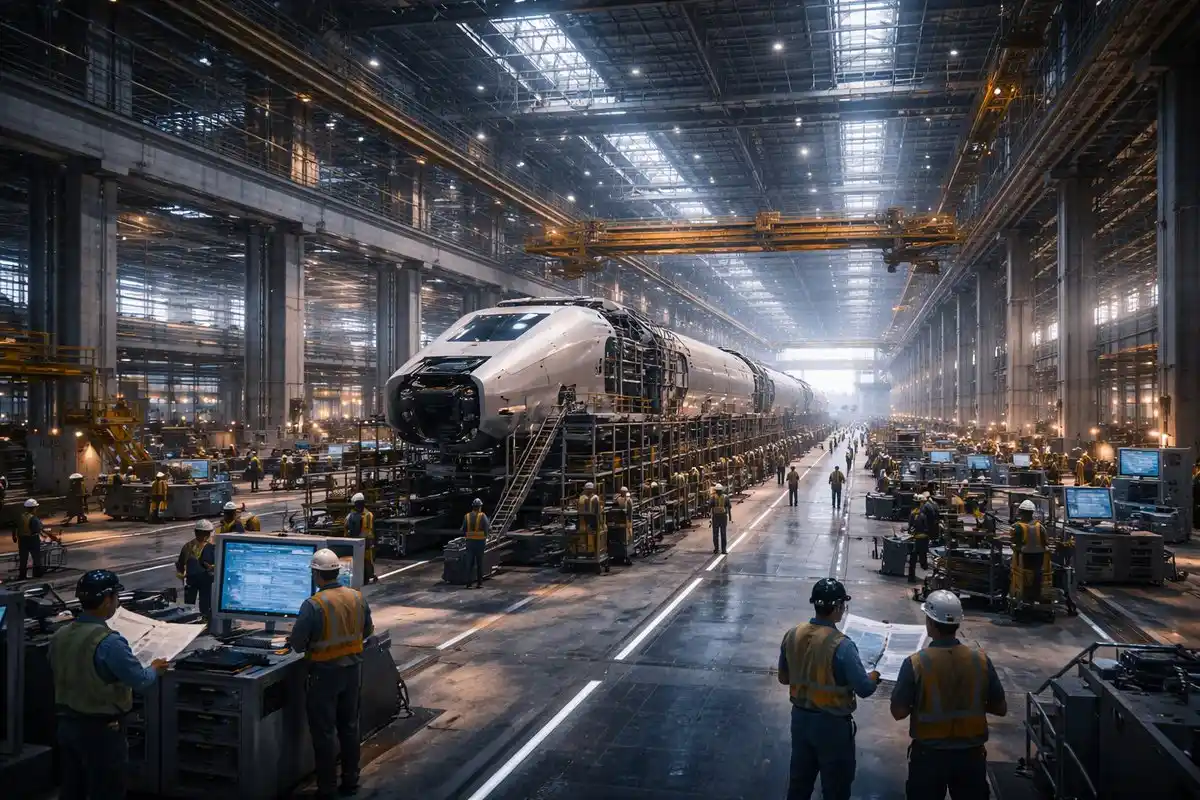
Chapter 12 — Resilience or Control
The most important question of this book is not whether the future will be technologically powerful. That has already become difficult to doubt. The real question is what kind of civilization that power will produce. A society can become more capable and less free at the same time. It can become richer in systems and poorer in citizens. It can widen computation, surveillance, automation, and strategic control faster than it widens competence, trust, belonging, and legitimate participation. That is why the final fork of 2020–2070 is not simply growth versus decline, or progress versus collapse. It is resilience or control.
This chapter is the place where the argument has to become morally and politically clear. The earlier chapters showed how the future became imaginable, visible, delayed, accelerated, and then harder-edged under geopolitical pressure. They showed the converging-risk field, the return of strategic rivalry, the importance of infrastructure and system function, and the centrality of human capability. But none of that remains merely descriptive by the end. Once accelerating power arrives inside fragile institutions, legitimacy stress, synthetic media, and uneven human preparedness, the question becomes unavoidable: does civilization respond by becoming thicker, freer, and more resilient — or by becoming more brittle, more centralized, and more managerial in the name of stability?
The chapter brief is right to make this the final fork. It is not because every future must fit cleanly into one word or another. It is because resilience versus control is the clearest civilizational distinction through which the rest of the book can be synthesized. The age does not end in one cinematic resolution. It branches. Some societies may remain free but strained. Some may become more resilient through competence, energy, and institutional repair. Others may drift toward concentrated systems of verification, dependency, and managed compliance. The point is not to flatten the century into slogan. It is to clarify the direction of travel.
Why this is the final fork
The reason this fork comes last is that it is produced by everything before it. A civilization that can still build, still train people, still widen energy, still maintain system function, still preserve legitimate yes-making, and still withstand geopolitical stress has a real chance of becoming more resilient as capability rises. A civilization that loses those properties does not remain neutral. It does not hover peacefully in dysfunction. Under pressure, it looks for substitutes. The substitute for competence is management. The substitute for trust is surveillance. The substitute for broad capability is concentration. The substitute for real resilience is often control.
This is what makes the coming decades different from a normal reform cycle. The pressure is too broad and the systems are too intertwined. AI, robotics, synthetic media, energy strain, industrial rivalry, debt fragility, climate adaptation, public distrust, and weak onboarding are not isolated trends. They interact. That interaction creates a world in which political systems will increasingly be judged by whether they can preserve freedom while still delivering order, adaptation, and continuity. A state that cannot do that may begin to believe it must choose between drift and command.
The final fork is therefore not a theory of political temperament. It is a theory of what kinds of social order emerge when power rises faster than legitimacy, capability formation, and system repair. Some futures widen participation. Some narrow it. Some teach citizens to become more competent. Some increasingly treat citizens as variables to be managed. That difference is large enough to organize the back half of the century.
Resilience, uneven adaptation, and brittle control
The future does not divide neatly into one good path and one bad path. The chapter brief is more disciplined than that, and it should remain so. The real landscape has at least three visible forms.
The first is resilient adaptation. In this pathway, societies remain under real pressure, but they preserve enough institutional coherence, energy depth, system function, and human capability to adapt without hollowing themselves out. They are not utopias. They are simply substantial enough to absorb shocks without defaulting to permanent emergency politics. They still possess citizens, not just users or dependents.
The second is uneven adaptation. In this pathway, the future remains mixed. Some sectors modernize. Some institutions recover. Some regions stay functional. But the society as a whole does not achieve thick resilience. It staggers forward in turbulence, preserving some freedoms, losing others, and relying heavily on uneven islands of competence. This is likely to be the most common condition of the next few decades, because many societies will neither collapse nor fully renew.
The third is brittle control. This is the path where systems become more concentrated, more securitized, and more dependent on top-down management as complexity rises. Capability may remain high at the top. In some cases it may rise spectacularly. But the surrounding civilization becomes thinner: fewer believable pathways into adulthood, weaker broad competence, more information management, more dependency on opaque systems, and less room for correction by ordinary citizens. This is not resilience with stronger branding. It is a different social form.
That is why the chapter must keep the middle lane visible. Uneven adaptation matters because not every control-heavy future looks openly tyrannical, and not every resilient future looks triumphant. The century is more likely to contain mixtures, gradients, and partial recoveries than clean ideological endings. But the distinction still holds. The question remains whether power is being metabolized through thicker freedom or through thinner citizenship.
Decentralization versus concentration
At the center of this fork lies a structural question: where does capability live? Does it become more distributed, more local, more modular, more auditable, and more widely inhabitable? Or does it collect upward into narrower technical, political, and financial systems whose complexity exceeds the ordinary citizen’s ability to understand, contest, or enter them?
This is why the decentralization strand belongs here as a cross-cutting countermodel rather than a detached ideology. Decentralization, in the serious sense used by the project, is not a mood or a branding exercise. It is the proposition that resilient civilizations reduce brittle single points of failure. They widen the base of meaningful participation. They preserve local repairability. They create architectures in which failure can be seen, responsibility can be located, and sovereignty is not entirely outsourced to distant technical centers. Distributed resilience is therefore not merely an aesthetic preference. It is one of the ways freedom becomes materially defensible.
Concentration, by contrast, is not always evil in intention. It often appears first as efficiency. Centralized systems can look cleaner, faster, more secure, and more manageable. Under genuine stress they may even be necessary in bounded form. But concentration becomes dangerous when it ceases to be a tool and becomes a habitat. A society can drift into systems where a narrowing group of institutions control verification, infrastructure, finance, identity, labor access, and public reasoning at once. Once that happens, freedom remains on paper more easily than in lived reality.
The real issue is therefore not decentralization versus coordination. Serious civilizations need coordination. The issue is whether coordination remains compatible with broad competence, traceability, and plural centers of function — or whether it gradually settles into architectures that ordinary people can only obey, consume, or depend on.
Synthetic Reality, Trust Collapse, and the Drift Toward Verification Monopolies
This is where the information layer enters the fork directly. Media disorder and synthetic environments push societies toward centralized truth systems because epistemic disorder is expensive. A public sphere saturated by generated text, manipulated imagery, deepfaked speech, clipped context, and strategic persuasion does not merely become noisy. It becomes harder to govern without some form of authentication, filtering, or narrowed authority. Under those conditions, demands for verification become politically powerful.
That demand can begin in reasonable form. Citizens want to know what is real. Institutions want ways to prove authenticity. Platforms want to prevent cascading deception. Governments want to maintain order in conditions of narrative instability. All of this is understandable. But the pressure does not stop at authentication. Under prolonged stress, censorship, narrative management, and truth-gatekeeping begin to grow alongside verification. The line between trustworthy verification and coercive information control becomes one of the most important lines in the whole century.
This is one of the strongest approved additions to the chapter, and it belongs here because the control path is no longer imaginable without it. The society that cannot tolerate epistemic instability may increasingly prefer narrower systems of approved reality. At first those systems may be justified by anti-fraud logic, anti-disinformation logic, or emergency order. Later they may become habits of governance. That is the drift toward verification monopolies.
The serious response is not to romanticize disorder. A resilient civilization needs trustworthy information systems. But it must build them in ways that preserve contestability, openness, and freedom to reason. The control-heavy alternative treats public ambiguity as an excuse to centralize truth itself.
What strengthens resilient futures
Resilient futures are strengthened by thickness. That word matters more than optimism. A resilient civilization has thick energy systems, thick institutions, thick technical competence, thick local repair capacity, thick civic trust, and thick pathways into adulthood and responsibility. It does not rely on one miracle technology or one charismatic reform. It builds enough layers of real capacity that shocks do not automatically translate into panic, paralysis, or securitized overreaction.
Energy abundance belongs here. So does infrastructure that still works under load. So do legal systems that can close decisions rather than infinitely reopen them. So do schools and firms that still know how to form people for real systems. So do public institutions whose authority remains traceable enough to be trusted under stress. So does the widening of capability rather than its hoarding.
Resilient futures also require that adaptation remain citizen-bearing. This is where the human answer from Chapter 11 must carry through. A society becomes more resilient when trained, competent, adaptable populations can still enter the systems that shape their lives. It becomes less resilient when power rises but entry narrows. The chapter brief was correct: resilient futures depend on trained, competent, adaptable human populations. Without that, resilience becomes a slogan for a structure run by others.
War and strategic pressure matter here too. A geopolitically stressed world can still produce resilient outcomes — but only if states use pressure to widen competence, harden systems, and rebuild throughput rather than to normalize permanent secrecy and administrative command. The resilient future does not deny rivalry. It metabolizes it without surrendering the civic center.
Family, Meaning, and Thick Social Reproduction
Resilient civilization requires more than grids and software. That is the second major approved insertion, and it deepens the chapter exactly where it needed deepening. A society may preserve infrastructure and still become thin in the more human sense. It may continue to function while weakening the structures that make continuation meaningful. That is not full resilience. It is survival without depth.
Family formation, fertility confidence, civic adulthood, belonging, and intergenerational continuity belong here because thick survival is more than technical survival. A civilization worth preserving has to reproduce more than power and logistics. It has to reproduce responsibility, attachment, and the belief that the future is inhabitable enough to justify sacrifice. A society that increasingly lives in delayed adulthood, weak household formation, civic detachment, and social thinning may still keep the lights on. But it loses part of the human substance that makes resilience worth the effort.
This point must remain structural rather than moralizing. The claim is not that one family model saves civilization or that social change can be reduced to one variable. The claim is that belonging, continuity, and stable pathways into adulthood materially affect long-range resilience. People carry harder burdens for worlds they believe are theirs. They train more seriously for futures that feel continuous with their lives. They endure adaptation more willingly when they believe they are preserving more than a machine.
That is why thick social reproduction belongs inside the resilient lane. The resilient civilization is not only one that survives. It is one that remains worth inhabiting.
What strengthens control-heavy futures
Control-heavy futures are strengthened by weakness disguised as sophistication. They emerge when systems become too opaque to trust, too complex to contest, too fragile to decentralize, and too politically strained to widen capability. They are strengthened by permission architectures that make yes-making rare, by human pipelines too thin to distribute competence, by concentrated technical power, by weak civic trust, by fear of disorder, and by institutions that increasingly prefer manageability to participation.
Scarcity sharpens all of this. So does insecurity. A society that feels continuously strained — by housing pressure, energy bottlenecks, labor displacement, migration stress, climate shocks, fiscal burden, and information disorder — becomes more tempted by narrow managerial answers. The case for control rarely begins as naked domination. It begins as the claim that only tighter systems can preserve continuity. Some of that claim may be partly true. But once narrow command becomes the main substitute for competence and legitimacy, the control path deepens.
This is where strategic rivalry enters again. War pressure and sovereignty anxiety can push adaptation toward control rather than competence if systems are weak. A confident civilization may answer threat by broadening skill, throughput, redundancy, and civic seriousness. A weaker one may answer mainly by centralizing command, securitizing discourse, and shrinking the citizen’s role. The same pressure produces different outcomes depending on the health of the underlying society.
The control-heavy future is therefore not simply chosen. It is often drifted into. It is what happens when enough systems become brittle enough that concentration begins to feel like the only remaining language of order.
Debt Scarcity, Managed Dependence, and Civic Thinning
The third approved insertion belongs exactly here. Chronic fiscal fragility and scarcity politics increase dependence because they narrow the horizon of action. A debt-stressed society has less room to build buffers, less tolerance for experimentation, less ability to widen capability through generous transition systems, and greater temptation to manage decline administratively rather than reverse it structurally.
This matters because monetary fragility is not only an economics problem. It is a civic problem. Debt scarcity encourages systems that ration rather than build. It makes dependence easier to administer than renewal. It strengthens the politics of allocation, triage, and managed access. Under such conditions, the state and large institutions may drift toward narrower managerial systems not because they are ideologically committed to domination, but because scarcity makes broad-based resilience look too expensive and too slow.
That drift produces civic thinning. People cease to feel like participants in a shared build effort and increasingly experience themselves as claimants, dependents, clients, or managed populations. The public sphere becomes thinner because citizens are offered less agency and more procedural containment. The society still functions, sometimes impressively on the surface, but in a way that narrows the role of ordinary adulthood inside it.
This is one of the hidden bridges between macro fragility and control. A civilization that cannot afford resilience may slowly teach itself to accept dependence instead.
The three main pathways
By this point, the main pathways of the century are visible.
The first pathway is resilient abundance. This is not a fantasy of painless progress. It is the pathway in which societies succeed in widening energy, system function, human capability, and trustworthy institutional capacity fast enough that accelerating power becomes more broadly inhabitable. Freedom survives because resilience becomes substantial rather than rhetorical.
The second pathway is uneven turbulence. This is the most likely condition for many regions: partial adaptation, partial stagnation, uneven competence, uneven freedoms, and recurring stress. The society does not fully break, but it does not fully renew. Islands of excellence coexist with broad fatigue. The future remains open, but not evenly.
The third pathway is brittle control. In this pathway, societies respond to complexity through concentration, verification monopolies, civic thinning, dependency management, and strategic securitization. Capability remains high in some centers, but the wider civilization becomes more passive, more surveilled, and less able to contest or share in the systems that govern it.
These pathways are not proof. The archetypal language should remain controlled, as the chapter brief required. But used carefully, it helps compress the fork. One future feels like resilient abundance. One feels like uneven turbulence. One feels like brittle control — cyberpunk without romance, techno-feudal without grandeur. The value of those images is not that they predict. It is that they help name the direction of travel.
What survival means if freedom is lost
The final question is the hardest one. A civilization may survive formally and still fail in the deeper sense. It may preserve order, continuity of supply, managed stability, even technical sophistication, while losing the conditions that once made its survival meaningful. That is why this chapter cannot end with mere continuity as its standard. Survival is not enough if the citizen disappears inside the system.
A control-heavy future may still maintain infrastructure, information channels, health systems, and strategic competence. It may even outperform weaker democracies on certain visible metrics. But if its order depends on narrowed truth systems, civic dependence, weak entry into real responsibility, and the steady replacement of free adaptation with managerial containment, then something central has been lost. The society has survived, but not as the kind of civilization this book has been trying to defend.
That is why the human answer and the final fork belong together. Resilient futures are not defined only by stronger grids or better AI policy. They are defined by whether trained, competent, adaptable populations still matter as citizens rather than merely as managed units inside high-capability systems. If that human center holds, accelerating power may widen freedom. If it fails, accelerating power may still produce order, but of a thinner and more coercive kind.
This is the final synthesis of the 12-core-chapter arc. The future is not decided by technology alone. It is decided by whether civilizations can still build, govern, repair, and train human beings fast enough to absorb accelerating power without collapsing into brittleness, concentration, and control. The fork is real because the age is real. And the task now is not only to name the pathways, but to make the handoff into scenarios, regions, and build priorities explicit.
The next chapters must therefore ask four applied questions. What are the main lanes from here to 2070? How do regions differ in their pressures and capacities? What must actually be built if resilience is to beat control? And how should the whole system be tracked over time so that the book remains a living framework rather than a closed prophecy? Those are the downstream questions. This chapter has done its work if the reader now understands why they matter.

Chapter 13 — Scenarios for 2020–2070
The future cannot be carried honestly by a single line.
A civilization does not move through fifty years the way a train moves through a tunnel, on one track, at one speed, toward one predetermined station. Too many forces are interacting at once. Energy systems tighten or expand. AI diffuses or concentrates. Institutions reform or harden. Public trust stabilizes or weakens. Skills broaden or stall. Geopolitical rivalry sharpens or recedes. Climate pressure intensifies under some conditions faster than adaptation capacity. Under such circumstances, the question is not What will happen with certainty? The question is: which kinds of futures are strengthening, under what conditions, and by what signs?
That is why the book does not end with diagnosis. Diagnosis is necessary, but not enough. Once the structural baseline, the builder inheritance, the permission age, converging risk, accelerating power, geopolitics, system function, and human capability have all been laid out, the reader deserves something more disciplined than anxiety and more honest than prophecy. Scenarios are the answer. They allow a civilization to think in plural without becoming vague, and to think in probabilities without pretending that uncertainty has vanished.
The project’s scenario logic is already stable on this point. The report does not offer one deterministic forecast. It uses structured lanes organized around major drivers, key uncertainties, and observable indicators, with three primary pathways: Lane A — Managed Turbulence / Uneven Adaptation, Lane B — Distributed High-Capacity Adaptation, and Lane C — Brittle Control plus Cascading Instability. These are not prophecies. They are structured futures.
Why the report uses scenarios
Scenarios are often misunderstood as either polite guesses or elaborate fiction. In serious foresight, they are neither. A scenario is a structured pathway built from interacting drivers and uncertainties. It says: if these pressures strengthen, if these institutions adapt in this way, if these capabilities diffuse under these constraints, then the world begins to resemble this kind of future more than that one.
This matters especially for 2020–2070 because the book has already shown that the age is compressed and multi-directional. The converging-risk chapter established that multiple bottlenecks may mature together. The acceleration chapter showed that capability is rising faster than many institutions can absorb. The geopolitics chapter showed that this acceleration is unfolding inside strategic rivalry and industrial hardening. The NSIR and human-capability chapters showed that not all societies will respond with equal throughput, repairability, or learning capacity. Under those conditions, one official forecast would not be rigor. It would be evasion disguised as certainty.
The scenario framework therefore performs a practical function. It turns the book’s civilizational fork into operational lanes. It asks not what will happen with certainty, but which kinds of futures are strengthening, and under what conditions? That is the real work of Chapter 13.
What these scenarios are — and what they are not
These lanes are not destiny. They are not excuses to smuggle archetypes past evidence discipline. They are not invitations to choose a favorite future and call it analysis. The frozen architecture forbids that. The lanes are built from the interaction of hard constraints, capability acceleration, institutional adaptation, human-capability formation, and freedom-versus-control dynamics. Some elements of the system are more stable than others. The lane logic is already mature enough to use. Exact probabilities, thresholds, and region-specific calibration remain more provisional.
That distinction matters because it keeps the chapter honest. The scenario system is strong enough to guide judgment, weak enough to require revision, and useful enough to organize the back half of the book. It is a living framework, not a closed oracle.
The three main lanes
The three primary lanes are not arbitrary. They emerge directly from the rest of the architecture.
Lane A — Managed Turbulence / Uneven Adaptation describes a future in which societies avoid outright collapse but fail to achieve thick renewal. Some systems modernize. Some sectors adapt. Some regions remain functional. But the overall picture is uneven: recurring strain, partial repair, intermittent legitimacy crises, and persistent mismatch between rising capability and social absorption. This lane is not success, but it is not failure in the full sense either. It is the most recognizably late-modern continuation: a world of patchy competence and recurring instability.
Lane B — Distributed High-Capacity Adaptation describes a future in which societies succeed in widening energy, system function, human capability, and trustworthy institutional capacity fast enough that accelerating power becomes more broadly inhabitable. Capability diffuses more widely. Permission systems are reformed enough to permit build-out. Throughput improves. Human formation improves. Trust does not become universal, but it becomes thick enough that adaptation remains citizen-bearing rather than merely managerial. This is the resilient lane.
Lane C — Brittle Control plus Cascading Instability describes a future in which pressure, fragmentation, and weakness interact badly. Capability may remain high in narrow centers, but the broader civilization becomes thinner, more dependent, more securitized, and less able to distribute competence widely. Information disorder sharpens control pressure. Debt and scarcity narrow civic room. Public systems grow more brittle. In some regions this becomes hard control; in others it becomes rolling system stress and cascading disorder. This is not simply “authoritarianism” in the abstract. It is brittleness under high power.
These three lanes are sufficient for the chapter’s main work. They compress the century without pretending to settle it. Reserve lanes may still exist conceptually, but they remain secondary. They help stress-test the model. They do not replace the three main pathways.
Lane A — Managed Turbulence / Uneven Adaptation
Lane A strengthens when societies preserve enough capacity to avoid systemic break but not enough to achieve deep renewal. Institutions remain intact but fatigued. Build systems improve in some places and stall in others. AI and automation generate gains, but those gains diffuse unevenly. Trust remains partial. Politics remains reactive. Energy expands, but not always fast enough. Skills improve in pockets, but onboarding and adaptation remain inconsistent.
This lane is attractive to many systems precisely because it does not require full reform. It is the path of partial adjustment. It allows elites to claim progress where progress exists and to defer harder structural choices where those choices remain politically costly. It is therefore highly plausible.
But Lane A has weaknesses. It can normalize mediocrity. It can hide deeper fragility beneath acceptable short-run performance. It can preserve enough order to avoid crisis politics while failing to build the buffers required for the harder decades ahead. It is a lane of survivable strain, not decisive resilience.
Lane B — Distributed High-Capacity Adaptation
Lane B strengthens when societies widen real capacity faster than they widen control. Energy becomes more abundant and better routed. Infrastructure remains buildable. Human capability formation improves across youth, work transitions, and adult reskilling. Institutions retain enough legitimacy to close decisions rather than endlessly relitigate them. Capability diffuses through schools, firms, local systems, and public institutions rather than remaining trapped in a narrow frontier zone.
This lane does not require utopia. It requires thickness. Thick energy systems. Thick competence. Thick feedback loops. Thick repairability. Thick public trust. It is the lane in which decentralization works not as fantasy but as distributed resilience design. A society in Lane B does not abolish central coordination. It simply keeps capability broad enough that adaptation remains widely inhabitable.
The main danger to Lane B is that it is demanding. It requires real build-out, not rhetoric. It requires real training, not slogans about lifelong learning. It requires institutions willing to simplify permission where necessary without erasing legitimacy. It requires enough political confidence to widen citizens rather than narrowing them into managed populations.
Lane C — Brittle Control plus Cascading Instability
Lane C strengthens when pressure rises faster than adaptation and societies increasingly substitute concentration for competence. Grid strain, system weakness, debt pressure, information disorder, labor disruption, geopolitical rivalry, and weak onboarding all accumulate into a world where order feels too fragile to decentralize. Verification centralizes. Capability concentrates. Institutions grow more opaque. Public life becomes more securitized. In some cases this produces hard managerial systems. In others it produces rolling fragmentation and reactive command.
Lane C is not one uniform outcome. In stronger states it may look like high-capability control with narrowed public agency. In weaker ones it may look like recurring system stress, brittle infrastructure, legitimacy collapse, and emergency governance. The common thread is that freedom narrows because resilience was never widened enough to carry the age.
The danger of Lane C is that it can appear rational in the short term. Under sustained stress, concentration often looks cleaner than broad formation. Managed dependence often looks easier than capability diffusion. Narrative management often looks more practical than rebuilding public trust from below. That is why the lane is plausible. It is also why it is dangerous.
Cross-Lane Modifiers
The chapter revision memo was right to add the underweighted layers here as modifiers rather than rival lanes. They increase completeness without multiplying primary pathways. They alter probabilities, speed, and pressure across Lane A, Lane B, and Lane C. They do not create hidden fourth and fifth futures.
Modifier A — Monetary / Debt Fragility
Debt stress strengthens Lane A and Lane C because it narrows the room for adaptation. A debt-stressed society can still see what must be built and still fail to finance it at the required tempo. That pushes it either toward uneven partial adjustment or toward scarcity politics, managed dependence, and control-heavy triage.
Fiscal resilience strengthens Lane B because adaptation is expensive. Energy expansion, water systems, workforce transition, infrastructure redundancy, biosecurity readiness, and institutional reform all require financing room. A society with stronger fiscal resilience is better able to build buffers before crisis density becomes overwhelming.
The financial breakdowns that most change lane probabilities are the ones that shorten time horizons sharply: sovereign stress, chronic interest burden, unstable money, or repeated crisis-financing failure. These do not mechanically decide the future, but they change which pathways remain politically and materially reachable.
Modifier B — Food / Water / Biosecurity
Food, water, and public-health stress amplify instability because they move quickly from technical strain into legitimacy strain. A society that cannot maintain food continuity, water reliability, or biological continuity under stress becomes more vulnerable to unrest, migration pressure, fiscal shock, and political hardening.
Resilience in these domains improves adaptive capacity because it widens the civilizational buffer. Societies with stronger agricultural resilience, more secure water systems, better public-health continuity, and better biosecurity readiness are less likely to convert every external shock into a regime-level crisis. This modifier especially matters when the age becomes compressed and recovery time narrows.
Modifier C — Media / Trust / Synthetic Reality
Epistemic fragmentation raises control pressure. That is the core effect of this modifier. A public sphere saturated by manipulation, imitation, synthetic media, and high-speed distrust makes democratic adaptation harder. It weakens the legitimacy of institutions precisely when those institutions must move faster.
Trust systems therefore matter for lane drift. Stronger verification without coercive truth monopoly helps Lane B. Weak trust, narrative warfare, and rising verification stress strengthen Lane C. Lane A often persists where the system is noisy but not yet fully collapsed into either resilient verification or hard narrative management.
Modifier D — Culture / Family / Fertility / Meaning
Civilizational continuity affects resilience because adaptation depends on more than hardware. It depends on whether people still believe the future is inhabitable enough to justify training, sacrifice, family formation, institution-bearing adulthood, and intergenerational transmission. Thin continuity weakens those motives.
Thin meaning systems therefore weaken adaptation even when technical capacity remains high. A society may still own advanced tools while becoming less capable of forming citizens, workers, parents, maintainers, and institutional stewards at scale. This does not create a separate lane. It alters the strength and durability of the three existing ones.
Reserve lanes
Reserve lanes remain useful, but they stay subordinate. High-tech authoritarian stabilization, fragmented polycentric recovery, or techno-feudal concentration may still emerge as sharpened variants or regional subcases. They are analytically helpful because they keep the framework open to surprise. But they are not the primary architecture of the chapter. They function as edge cases and stress tests, not as rival master futures.
Which lane is strongest now
The most honest answer is that Lane A remains the base-case pathway for much of the world at present. It requires the least heroic renewal and the least catastrophic collapse. It fits a world of recurring strain, patchy adaptation, technological acceleration, and uneven legitimacy.
Lane B remains the most desirable pathway and the one most consistent with resilience, freedom, and broad capability. But it requires more deliberate build capacity, stronger energy and infrastructure expansion, better onboarding and capability formation, and more trustworthy institutions than many societies currently possess.
Lane C is not the base case everywhere, but it is the most important danger lane because multiple pressures can push societies toward it faster than they expect. Information disorder, debt stress, weak system function, concentrated technical power, and geopolitical hardening all raise its plausibility.
That is why this chapter should not end in fake neutrality. The lanes are not morally interchangeable. They are structured futures, and the difference between them matters.
What signs matter most
Some signals matter more than others across all three lanes.
The first is energy and throughput. Can societies expand the substrate of the future fast enough?
The second is human capability formation. Can they train, onboard, and reskill people fast enough for the systems they are building?
The third is institutional closure. Can they still make decisions, authorize projects, and correct failure within bounded time?
The fourth is trust under synthetic pressure. Can they preserve verification and public reasoning without collapsing into either chaos or monopoly control?
The fifth is fiscal room. Can they still finance adaptation before every crisis becomes a scarcity regime?
Those are the decisive fork variables because they link the whole book together. They also prepare the handoff to the regional chapter, where the same lanes must be interpreted through different structural realities.
Why the next chapter must regionalize
No single region represents the whole century. That is why the scenario chapter cannot be the end of the applied architecture. The same three lanes will manifest differently in the United States, Canada, Europe, China, India, the wider Global South, and resource states. Debt means something different in a reserve-currency system than in a fragile importer. Food stress means something different in a water-rich exporter than in a densely populated, climate-exposed state. Trust fragmentation means something different in a plural democracy than in a tightly managed information regime.
That is why Chapter 14 exists. Chapter 13 clarifies the lanes. Chapter 14 shows where those lanes are more or less plausible, and why.
Chapter 14 — Regional Trajectories
The future will not arrive everywhere in the same form.
This seems obvious, but many global forecasts forget it at the moment it matters most. They build a world model, identify a handful of decisive drivers, describe several civilizational pathways, and then speak as though the planet were one jurisdiction moving on one time scale. That is not how the next fifty years will unfold. The same age of accelerating power will pass through different regions with different builder inheritances, different bottlenecks, different political forms, different energy endowments, different demographic pressures, and different capacities for training, building, and adapting. A serious foresight system therefore has to regionalize the global model without breaking it.
That is why this chapter exists. Chapter 13 clarified the main lanes. Chapter 14 asks how those lanes instantiate differently across the United States, Canada, Europe, China, India, the wider Global South, and commodity or resource states. The purpose is not to crown winners too early. It is to make visible the different structural positions through which the same century will move. Some regions begin with stronger energy resilience. Others begin with stronger human-capability potential. Some retain greater freedom reserves. Others retain stronger state coordination. Some have rich builder inheritances but weak current momentum. Others are still building their first great systems under the same pressure that older powers enter with fatigue.
The regional comparison problem
The first discipline of this chapter is methodological. Regions are comparable, but not infinitely so. The no-false-ranking rule remains essential. Regions should not be turned into a simplistic leaderboard if indicators are not truly comparable, evidence quality is weak, or major internal heterogeneity is being hidden. That caution is not a weakness in the model. It is one of its strengths. A civilization-scale forecast becomes less serious, not more serious, when it pretends that all regional differences can be flattened into a single score.
What matters most is not who looks strongest in the abstract, but which combination of regional traits strengthens which lane. That is why fork variables matter so much in this chapter. They allow the forecast to stay comparative without becoming falsely precise. A region may be rich but brittle. It may be institutionally sophisticated but underbuilt. It may have immense human potential but weak system absorption. It may be geopolitically exposed but still capable of widening resilience faster than its rivals. These are the distinctions that matter.
The United States
The United States remains the single most consequential regional test of the century because it sits near the frontier of so many decisive systems at once: AI, compute, finance, military power, higher education, venture capital, energy innovation, media influence, and platform-scale control. That gives it a unique advantage. It also gives it a unique burden. The American question is not whether frontier capability exists. It is whether frontier capability can be turned into broad resilience rather than remaining trapped in a narrow band of elite institutions, firms, and regions.
Under Managed Turbulence / Uneven Adaptation, the United States remains globally central but internally fractured. It continues to innovate, attract capital, and produce high-end technical breakthroughs, yet struggles to translate these strengths into evenly distributed social resilience. Some states and metros become high-capacity adaptation zones. Others remain caught in infrastructure weakness, housing strain, fiscal stress, political mistrust, and cultural fragmentation.
Under Distributed High-Capacity Adaptation, the United States succeeds in doing something harder: it converts frontier advantage into civilizational breadth. Energy, grid expansion, advanced manufacturing, human-capability formation, and institutional reform begin to close the gap between frontier power and lived public resilience. In that lane, the country does not become harmonious, but it does become substantial enough to absorb its own speed.
Under Brittle Control plus Cascading Instability, the United States becomes one of the century’s most important cautionary cases: extraordinarily powerful at the top, increasingly fragmented below, vulnerable to information disorder, legitimacy erosion, and civic thinning, with growing temptation toward securitized management in response to instability.
Additional Structural Fork Variables
- debt and monetary leverage versus fiscal strain
- information fragmentation
- family formation and social trust
- synthetic-reality pressure
Canada
Canada is smaller than the United States, but this book has already made clear why it matters disproportionately as a lens. Canada tests whether a society with deep builder inheritance, vast geography, abundant resources, relatively high institutional trust, and acute underbuilding pressure can reactivate seriousness before drift hardens into permanent restraint. It is one of the clearest cases where inheritance and hesitation coexist in the same national frame.
Under Managed Turbulence / Uneven Adaptation, Canada continues to function above the level of breakdown but below the level of renewed builder confidence. It remains rich, orderly, and institutionally legible by global standards, yet struggles to align housing, energy, sovereignty, infrastructure, and training into a faster civilizational tempo. The result is competent drift: enough capacity to avoid crisis, not enough decisiveness to become a leading resilience state.
Under Distributed High-Capacity Adaptation, Canada reforms permission, widens energy and throughput, rebuilds confidence in project execution, and treats human capability, engineering, and institutional closure as national priorities rather than sectoral disputes. In that lane, its geography and resource endowment become advantages again rather than excuses for delay.
Under Brittle Control plus Cascading Instability, Canada does not become dramatic in the cinematic sense. It becomes slower, more constrained, more expensive, more dependent, and more administratively dense while still sounding morally advanced. That is one of the ways a high-trust society can become brittle without looking openly broken.
Additional Structural Fork Variables
- housing, debt, and family-formation stress
- food and water resilience as advantage
- trust and institutional legitimacy
- demographic continuity
Europe
Europe remains one of the most complex regional cases in the book because it is both a civilization and a coordination problem. It retains enormous wealth, legal sophistication, high human capital, major industrial zones, and a still-formidable cultural and institutional inheritance. But it also carries aging, fiscal divergence, energy dependence, migration pressure, strategic exposure, and plural political structures that make coordinated adaptation harder than its aggregate strength might suggest.
Under Managed Turbulence / Uneven Adaptation, Europe continues as a zone of partial resilience: strong in some states, weak in others, capable of sophisticated regulation and social stabilization, but often slower at large-scale throughput, defense hardening, and decisive strategic adaptation than the century may demand. This is perhaps the most intuitive baseline for Europe.
Under Distributed High-Capacity Adaptation, Europe proves that legality and pluralism need not imply paralysis. It widens energy security, industrial resilience, technical capability, and political coordination enough to remain a high-capacity democratic pole in a harsher world. That would be one of the most important positive outcomes of the century.
Under Brittle Control plus Cascading Instability, Europe drifts into a more anxious order: still regulated, still articulate, still legally dense, but increasingly pressured by weak growth, demographic fatigue, migration conflict, external dependence, and more securitized public life. In that lane, the continent does not fail uniformly. It fragments into different velocities of resilience and stress.
Additional Structural Fork Variables
- aging and fertility
- debt and fiscal divergence
- migration, food, and energy interaction
- information legitimacy
China
China is the century’s most consequential concentration test. It enters the period with extraordinary state coordination, industrial depth, infrastructure scale, manufacturing strength, and long-range strategic seriousness. But it also carries profound internal questions: debt and property fragility, fertility collapse, narrative concentration, opacity, and the long-run challenge of keeping adaptive intelligence alive inside a highly centralized order.
Under Managed Turbulence / Uneven Adaptation, China remains formidable, but with more internal strain than surface confidence suggests. It continues to build, coordinate, and compete, yet faces mounting pressure from demographic contraction, debt overhang, external rivalry, and the difficulty of sustaining innovation intensity inside a tightly managed information and legitimacy architecture.
Under Distributed High-Capacity Adaptation, China would have to accomplish something historically difficult: preserve coordination and scale while remaining adaptive enough to avoid hardening into brittle concentration. This lane is not impossible, but it asks whether a highly managed system can renew flexibility without losing control.
Under Brittle Control plus Cascading Instability, China becomes one of the central examples of high-capability brittleness: impressive in infrastructure, security, and industrial direction, but increasingly vulnerable to demographic narrowing, debt stress, social opacity, and the possibility that concentrated narrative control weakens rather than strengthens long-run adaptability.
Additional Structural Fork Variables
- debt and property fragility
- fertility collapse
- narrative-control concentration
- public-trust opacity versus system performance
India
India may be the century’s largest scale-and-formation test. It carries enormous demographic energy, a still-developing builder trajectory, a rising technical class, and the possibility of becoming one of the century’s major resilience laboratories. But its promise is inseparable from its burdens: food and water pressure, infrastructure scale demands, institutional unevenness, and the difficulty of turning demographic mass into high-quality human capability fast enough.
Under Managed Turbulence / Uneven Adaptation, India advances but unevenly. It grows, builds, digitizes, and expands strategic weight, yet continues to struggle with the scale gap between national ambition and broad delivery. Some sectors leap. Others lag. The result is upward motion without full civilizational thickening.
Under Distributed High-Capacity Adaptation, India becomes one of the most important positive cases in the whole model: a society that successfully combines demographic scale, human formation, industrial build-out, and digital coordination into broad resilience rather than narrow elite islands. That would make it one of the century’s most significant civilizational pivots.
Under Brittle Control plus Cascading Instability, India’s scale becomes a stress multiplier. Water pressure, infrastructure lag, capability bottlenecks, and social fragmentation interact badly, turning youth potential into institutional overload rather than resilience.
Additional Structural Fork Variables
- food and water pressure
- demographic youth opportunity
- family and social continuity
- human-capability scaling
The Global South
The phrase “Global South” hides enormous diversity, and this chapter must state that openly. It is a comparative convenience, not a unitary civilization. But it remains useful because many states across Africa, Latin America, South Asia outside India, and parts of Southeast Asia face a shared structural question: does late development in the age of accelerating power become leapfrogging, dependence, or fragmentation?
Under Managed Turbulence / Uneven Adaptation, many parts of the Global South continue to experience mixed outcomes: uneven infrastructure build-out, uneven governance quality, recurrent exposure to food, water, debt, and climate stress, yet also major zones of urban growth, digital adoption, and entrepreneurial adaptation. This is the lane in which partial progress coexists with chronic fragility.
Under Distributed High-Capacity Adaptation, parts of the Global South become some of the most important resilience laboratories in the world. Better financing terms, practical infrastructure build-out, digital public goods, energy access, and broad human-capability formation allow some states to leapfrog older institutional bottlenecks. This is one of the century’s most important underestimated possibilities.
Under Brittle Control plus Cascading Instability, the most fragile states become pressure concentrators for the wider world: migration, food insecurity, climate displacement, public-health weakness, extractive digital governance, and foreign strategic dependence reinforce one another. In this lane, fragility does not remain local. It radiates.
Additional Structural Fork Variables
- food and water vulnerability
- biosecurity and public-health fragility
- debt dependency
- youth bulge versus institutional capacity
Commodity, energy, and resource states
Resource states form a distinct and indispensable category because the century’s physical economy will remain foundationally material. Energy, minerals, food, and extractive commodities still sit underneath AI, electrification, strategic rivalry, and industrial rebuild. These states may be rich or poor, democratic or authoritarian, stable or volatile, but they share one central condition: much of their civilizational position depends on whether resource leverage is turned into durable systems or trapped inside brittle extraction.
Under Managed Turbulence / Uneven Adaptation, resource states continue to matter greatly, but many remain trapped between windfall and weakness. They gain from scarcity or strategic competition, yet often fail to convert that advantage into long-term capability, institutional trust, or diversification. This is the familiar baseline.
Under Distributed High-Capacity Adaptation, some resource states become resilience anchors. They use energy, minerals, or agricultural leverage to build infrastructure, deepen governance quality, expand education and training, and become indispensable nodes in a more stable global order. This is one of the less discussed but highly consequential positive pathways.
Under Brittle Control plus Cascading Instability, resource states become rentier-security systems: strategically important, politically brittle, and deeply vulnerable to elite capture, corruption, external pressure, or violent contest over extraction. In this lane, the very importance of their resources can make them less resilient, not more.
Additional Structural Fork Variables
- commodity-cycle debt traps
- food import dependence
- family, legitimacy, and rentier stability
- elite capture versus resilience investment
Regional trajectories and the civilizational fork
The deepest purpose of this chapter is to show that the civilizational fork is not an abstraction floating above geography. It is embodied in regions. The United States tests whether frontier capability can become broad resilience. Canada tests whether builder inheritance can be reactivated before underbuilding hardens into permanent drift. Europe tests whether legality and pluralism can remain high-capacity under strategic pressure. China tests whether concentration can remain adaptive without becoming brittle. India tests whether scale and human formation can align in time. The Global South tests whether late development becomes leapfrogging or fragmentation. Resource states test whether physical leverage becomes resilience or rentier fragility.
In that sense, regional trajectories are not the “applied” part of the book in some lesser sense. They are where the whole model becomes humanly recognizable. Civilizations do not act in the abstract. Regions, states, federations, blocs, and cities do.
And that is why the next chapter must become more practical still. Once the global lanes and regional pathways are visible, the book has to ask a harder question: given this world, what actually needs to be built? Not in the abstract, and not only in policy language, but in systems, energy, institutions, skills, and public architecture. That is why the next step is What Must Be Built.
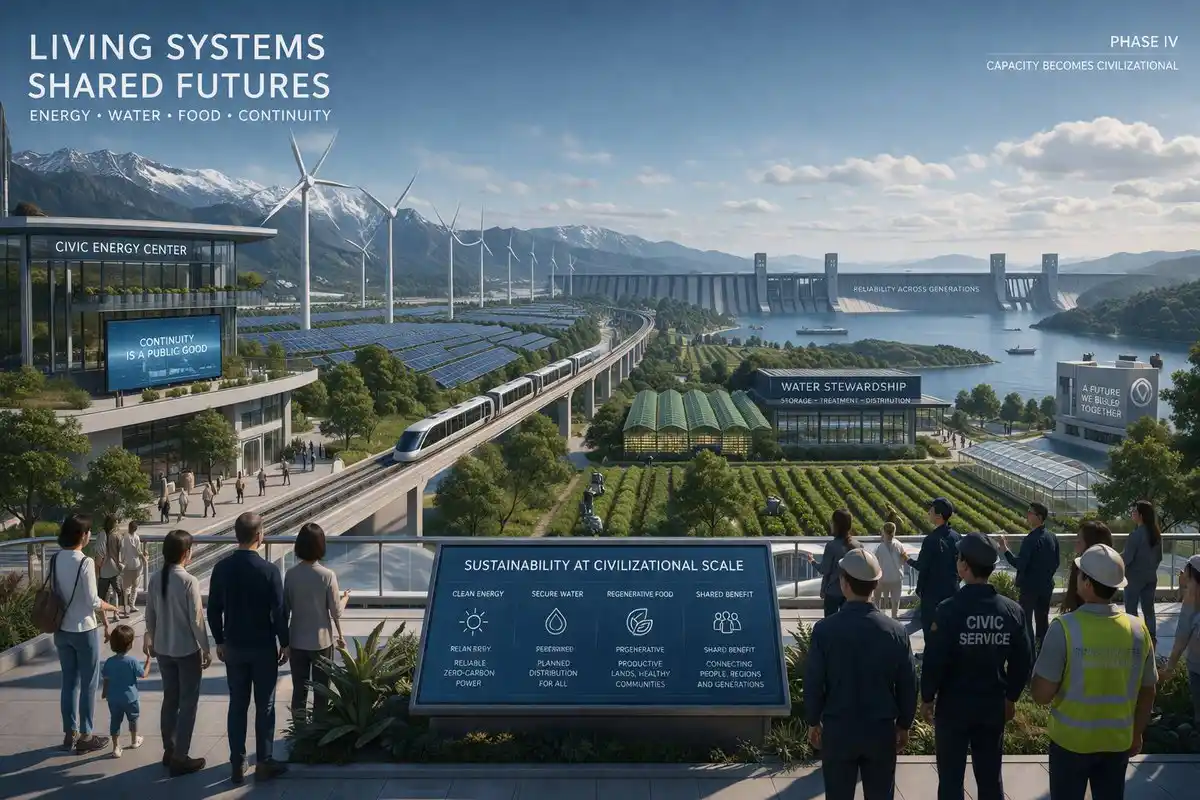
Chapter 15 — What Must Be Built
Diagnosis is not enough.
A civilization can describe its bottlenecks brilliantly and still fail the century. It can write reports about risk, sovereignty, capability, legitimacy, geopolitical pressure, and human fragility, and still drift. It can understand the permission age, the return of geopolitics, the strain on infrastructure, the acceleration of AI, the thinning of public trust, the weakness of onboarding, the collapse of visible future-building — and still leave the reader with nothing but sharpened anxiety. That is not where this book can end. Once the architecture is clear, the question becomes practical: what must actually be built if a resilient future is to remain more plausible than a control-heavy one?
That is the purpose of this chapter. It is the normative build agenda of the book, but it must remain structural rather than moralizing. It cannot collapse into generic policy optimism. It has to stay at civilizational scale. The task is not to produce a list of wishes. It is to identify the systems, capacities, and human conditions without which the next fifty years will drift toward fragility, dependence, and brittle control. What must be built is not only infrastructure in the narrow sense. It is the wider architecture by which a society remains capable of carrying freedom under pressure.
The book has already made the stakes plain. Energy must widen. Institutions must close decisions. Human capability must thicken. System function must remain real. Trust must not collapse into either nihilism or monopoly control. Sovereignty must become more than rhetorical posture. The point of Chapter 15 is to gather those implications into a disciplined build program.
Why the answer cannot be abstract
The century ahead will punish abstraction. It will punish societies that speak fluently about resilience while failing to widen the substrate on which resilience depends. It will punish states that announce transition without building transmission, computing without building power, sovereignty without industrial depth, public trust without institutional credibility, and skills without real pathways into competence.
That is why “what must be built” is the right title. It keeps the chapter anchored in obligation rather than commentary. Build is the operative word. Not merely regulate. Not merely narrate. Not merely optimize within inherited decline. Build. The question is what forms of seriousness are still required if the age of accelerating power is not to be carried by thinner and more coercive social orders.
Build energy abundance and physical throughput
The first requirement is still material. A society that cannot widen power, transmission, logistics, and physical throughput will not remain resilient no matter how advanced its software becomes. Energy abundance is not a luxury good for the next era. It is one of its operating conditions. AI, electrification, industrial policy, climate adaptation, strategic rivalry, housing, mobility, and system repair all intensify the need for real, routable force.
This means building grids that can carry higher load, generation systems that can widen without paralysis, transmission that can actually be completed, transport and logistics systems that remain resilient under stress, and industrial infrastructure adequate to a harder century. The point is not that every society must build the same way. The point is that none will remain free for long if they cannot sustain the material base of adaptation.
Build institutions that can still say yes
The second requirement is institutional. The permission age showed that societies can become rich in declared necessity and poor in authorized execution. What must therefore be built is not only hardware, but decision architecture. Institutions need closure again. They need review systems that remain real without becoming non-terminating. They need traceable authority, bounded overrides, finite timelines, and enough legitimacy that action is no longer the least governable part of public life.
This is not a call to abolish oversight. It is a call to rebuild a civilization that can still authorize itself. A century of converging risk and accelerating capability cannot be carried by systems that re-litigate every act of future-making until the window closes.
Build human capability, not just machines
The third requirement is human. Chapter 11 made the point plainly: machine acceleration without broad human formation produces passive displacement, dependence, and social thinning. A resilient future therefore requires that societies rebuild the pathways by which people enter competence: stronger youth formation, better transitions from school into work, real onboarding, adult reskilling, and institutions willing to absorb the cost of guided entry into difficult systems.
This belongs in the build agenda because it is not ancillary. A civilization that cannot form enough capable adults to operate, adapt, repair, and govern its systems will eventually centralize by necessity. Narrow technical elites will grow more powerful. Broader populations will become more managed. That is one of the quiet roads into the control-heavy future.
Build sovereignty without closure
Sovereignty is one of the most abused words in modern politics because it is often invoked rhetorically and left materially empty. The project’s better logic is more balanced: open enough to learn, trade, and innovate; sovereign enough to secure critical systems, industrial depth, and strategic autonomy under pressure. That is the frame this chapter should keep.
Practically, that means building energy security, industrial depth in critical sectors, resilient logistics, regional strategic leverage, more secure data and identity layers, and enough defense-industrial seriousness that a society can remain politically free under geopolitical strain. But it also means resisting the temptation to answer every strategic vulnerability with secrecy, centralization, and permanent emergency governance. Sovereignty built through brittle control is not the book’s positive pathway. Sovereignty built through resilient capability, auditable systems, and competent populations is closer to it.
Build Monetary and Fiscal Resilience
But sovereignty and resilience cannot rest on infrastructure alone. They also depend on whether a society can still finance seriousness. Debt sustainability is therefore a form of build capacity. A civilization drowning in chronic fiscal fragility may still know what needs to be done — grid expansion, housing, public-health continuity, training pipelines, water systems, strategic stockpiles, industrial renewal — and still find itself unable to carry those tasks at the required scale or speed.
Crisis financing capacity matters because hard centuries do not arrive on schedule. A society that can borrow, refinance, absorb shocks, and direct capital toward resilience under stress retains room to adapt without immediate recourse to panic or austerity. A society that cannot do so becomes more dependent on triage, scarcity politics, and short-term managerial improvisation.
Monetary stability is part of this picture as well. A civilization that cannot preserve enough confidence in its currency, credit structure, or financing channels will find long-horizon adaptation harder to price and harder to sustain. Under those conditions, even technically sound responses become politically and institutionally harder to carry. That is why underfunded adaptation collapses into rhetoric. Societies still announce plans. They still publish strategies. They still promise transition, resilience, and renewal. But when the fiscal base is too weak, those promises remain thin. A serious build program therefore requires not only good priorities, but the monetary and fiscal capacity to make priorities real.
Build Food, Water, Biosecurity, and Public-Health Resilience
A resilient civilization must also secure the systems that keep ordinary life physically continuous. Agricultural resilience, food-chain robustness, water systems, biosecurity preparedness, and public-health continuity are not soft humanitarian concerns sitting outside the “real” architecture of the future. They are part of that architecture.
Food-chain robustness matters because a society can remain wealthy and still become fragile if transport, storage, fertilizer access, labor continuity, or distribution networks begin to fail under stress. Agricultural resilience matters because food security is not just a rural issue. It is a legitimacy issue, a labor issue, and, under harder conditions, a geopolitical issue. A civilization that cannot reliably feed itself or secure access to food systems will find many other freedoms harder to preserve.
Water systems are equally foundational. Water is infrastructure in the deepest sense: treatment, routing, maintenance, storage, and restoration under pressure. A society that neglects water is not postponing a secondary concern. It is weakening one of the operating conditions of civilization itself. Biosecurity preparedness and public-health continuity belong in the same build agenda. Public health is not only about clinics and hospitals. It is a continuity system for labor, trust, education, logistics, and civic stability. Biosecurity failures can become legitimacy failures, and legitimacy failures under pressure can rapidly become political and strategic crises. What must be built, then, includes not only power, data, and industry, but the physical resilience of food, water, health, and biological security systems. A civilization that cannot preserve these under stress may still appear advanced for a time. But it will be less durable than it believes.
Build Trustworthy Media and Information Systems
The century ahead will also be decided in part by whether societies can preserve public reasoning under synthetic and fragmented information conditions. What must be built here is not a state monopoly on truth, nor a naïve faith that information chaos will somehow self-correct. It is a more demanding middle architecture: trustworthy verification systems, free-but-trustworthy information ecosystems, anti-synthetic-reality resilience, and institutions capable of preserving public reasoning without default censorship.
Verification systems matter because the rise of generated text, image, audio, and video increases the cost of trust. If everything can be plausibly simulated, societies need stronger ways to authenticate records, evidence, public speech, journalism, and institutional communication. That does not mean converting every ambiguity into a centralized permission system. It means building enough trusted verification that civic life does not drown in epistemic exhaustion.
Free-but-trustworthy information ecosystems matter because a resilient civilization cannot survive either total information anarchy or total narrative command. It needs media institutions, public norms, technical safeguards, and civic habits that preserve contest without collapsing into nihilism. It needs enough openness for criticism and pluralism, and enough trust architecture that citizens can still distinguish signal from manipulation. Anti-synthetic-reality resilience therefore becomes part of the build agenda. This includes institutional literacy about synthetic persuasion, better authentication practices, stronger source integrity, and cultural expectations that slow the automatic spread of fabricated certainty. Most importantly, it includes institutions capable of preserving public reasoning without default censorship. A control-heavy civilization solves epistemic disorder by narrowing permitted truth. A resilient civilization solves it by strengthening verification, credibility, and civic competence.
Build Conditions for Family Formation, Meaning, and Intergenerational Continuity
Finally, what must be built are the conditions under which human beings still experience civilization as worth entering, sustaining, and handing on. Adulthood pathways matter here: believable routes into work, home formation, responsibility, and public participation. Family-supportive conditions matter because resilient societies do not reproduce themselves through abstractions alone. They reproduce themselves through environments where continuity, care, and durable obligation remain possible.
Civic belonging also matters. A population that no longer feels meaningfully attached to the society around it will struggle to support long-horizon adaptation, even if many technical systems remain available. Meaningful participation matters because resilience cannot rest forever on spectatorship. The future has to become inhabitable, not merely observable. This is why resilience requires lives worth reproducing, not just systems worth operating. A civilization may preserve grids, logistics, data centers, and institutional shells and still become thin if it cannot sustain the social depth by which people attach effort to continuity. The build agenda therefore has to include the moral and social preconditions of durable seriousness: stable initiation into adulthood, family-supportive conditions, civic belonging, and enough shared purpose that effort still feels worth the cost. The point is not nostalgia. It is civilizational realism. A society that cannot reproduce meaning, continuity, and belonging will eventually struggle to reproduce competence, trust, and resilience as well.
Build differently by lane
What must be built also depends on which scenario lane is strengthening. The project’s scenario system is explicit that the three pathways are not prophecies but structured futures, and that different actions matter differently under each one.
Under Managed Turbulence / Uneven Adaptation, the task is to thicken buffers: improve energy and grid adequacy, reduce the most damaging approval bottlenecks, widen human capability, and keep institutions functionally legible enough that turbulence does not harden into control. Under this lane, the build program is partly defensive and partly preparatory. It aims to stop drift from becoming destiny.
Under Distributed High-Capacity Adaptation, the task is more ambitious. Build not only buffers, but abundance: more power, more transmission, more industrial depth, more competence, more local repairability, more trustworthy media architecture, more family-supportive and adulthood-bearing social conditions, and more institutional confidence in visible future-making. This is the lane in which build capacity becomes civilizational renewal rather than emergency patching.
Under Brittle Control plus Cascading Instability, the task becomes twofold and harsher: preserve critical function while resisting the temptation to answer every weakness with concentration. Even in a worsening environment, the build agenda should still favor auditability over opacity, competence over dependency, verification over narrative monopoly, and resilience over permanent emergency governance. If that discipline is lost, the chapter’s build program turns into its own negation.
The build program as civilizational answer
The book’s core claim is that the next fifty years will be decided by whether societies keep or lose the ability to build the future under accelerating power. Chapter 15 is therefore where the whole argument becomes answerable. What must be built is not merely hardware. It is a civilization thick enough to remain free under pressure: energy, throughput, institutional closure, fiscal room, food and water resilience, biological continuity, trustworthy information systems, human capability, meaningful adulthood, and sovereign seriousness without closure or command addiction.
That answer is demanding, but it is not vague. It is also not utopian. Nothing in this chapter promises painless renewal. It only states the harder truth: if these things are not built, then much of what the earlier chapters warned about becomes more likely by default. The control-heavy future does not need to be chosen outright. It only needs resilient capacity to remain underbuilt.
That is why this chapter matters. It is the moment where diagnosis becomes obligation.
And that is why the next chapter must become operational. Once the build agenda is clear, the question becomes how to track it — what indicators, thresholds, bundles, and update rules can keep the framework alive rather than frozen. That is the work of Appendix B — Dashboard and Update System.

Appendix A — Relative Position of The Builder Civilization Within the SGT Archive
The SGT archive contains multiple kinds of future-oriented work, and they should not be judged by the same standard. Some pieces function as forecasting scaffolds, some as scenario or dystopian-warning branches, some as governance or systems-design proposals, and some as broader flagship syntheses.
The Ghost in the Machine and the Spectre of Dystopia
This work belongs in the archive’s comparative-philosophical and dystopian-forecast lineage. It is not the strongest narrow forecasting scaffold, but it is an important precursor because it deepens the archive’s treatment of transhumanism, colliding dystopias, and the contrast between Eastern and Western civilizational responses to technological transformation. Its value lies in showing that the archive’s later concern with converging risk, control, and future branching did not emerge only from policy or engineering analysis, but also from a more philosophical and cultural reading of science fiction, ethics, and human futures.
Within that larger archive, The Great Filter Ahead remains the strongest pure forecasting spine. It is the clearest macro-risk scaffold in the corpus, especially in its framing of converging pressures and its emphasis on the 2030–2050 window as a likely period of heightened civilizational compression.
The Nexus dystopian prediction article belongs to a different class of work. It is best understood as part of the archive’s scenario / archetype / branching-futures layer rather than its core forecast base. Its value lies in imaginative range, vividness, and stress-testing. It is useful not because it provides the strongest methodological forecast, but because it dramatizes one possible direction of civilizational failure or bifurcation.
The same is true, in related form, of Colliding Dystopias / Dystopian Singularity. These are important warning architectures and scenario engines, but they are less transparent and less methodical than the strongest forecasting documents. Their proper use is as stress-test material, not as the sole predictive backbone.
The Builder Civilization occupies a different position from all of these. It is not the archive’s strongest narrow forecast report, and it is not its most vivid dystopian branch. Its strength is broader. It is the archive’s strongest flagship synthesis: the work that most successfully integrates builder civilization, unfinishedness, permission failure, converging risk, accelerating capability, and geopolitics into one coherent civilizational architecture.
For that reason, the archive can be understood in three layers:
- Best pure forecast spine: The Great Filter Ahead
- Best dystopian / branching-futures scenario branch: the Nexus dystopian prediction line, closely related to Dystopian Singularity and Great Convergence
- Best overall flagship manuscript: The Builder Civilization
The distinction matters. A document can be “better” in one domain and not in another. The Great Filter Ahead may remain superior as a narrow forecasting scaffold. The dystopian Nexus branch may remain superior in imaginative future branching and warning vividness. But The Builder Civilization is superior as the archive’s most complete civilizational framework and as the work most capable of organizing the rest of the archive into one readable intellectual system.
In that sense, The Builder Civilization should not be judged only as one more report among many. It should be judged as the archive’s leading candidate for a flagship work: the manuscript most capable of transforming the SGT corpus from a cluster of reports, warnings, and scenario branches into a unified account of the civilizational transition now unfolding.
Appendix B — Inference Note on Synthetic Claims
This appendix does not replace citation. It clarifies how major claims in this manuscript are supported when they are not single-source empirical statements but structured conclusions derived from recurring SGT concepts, systems logic, and STEM-style inference. Its purpose is to distinguish direct evidence, mechanism-based inference, interpretation, and claims that still require external corroboration.
Claim classes
This manuscript uses four main claim types: empirical claims, mechanistic claims, interpretive claims, and forecast claims. Empirical claims should be read against direct evidence. Mechanistic claims are supported by system logic such as throughput, control loops, feedback, onboarding, and capability reproduction. Interpretive claims are disciplined readings of civilizational patterns. Forecast claims require the greatest external support.
Support key
[SS] strongly supported by recurring SGT concepts and close internal logic.
[MS] moderately supported; good internal basis but more synthetic.
[KI] keep as interpretation; valuable, but not presented as narrow proof.
[NEE] needs external evidence.
Core rule
The manuscript is strongest when it explains how systems weaken: broken onboarding, weakened capability transmission, rising friction, unstable closure conditions, degraded throughput, and poor legal or institutional design. It is less self-sufficient when it makes large historical, geopolitical, or macroeconomic magnitude claims. In practical terms, the SGT corpus supports mechanism more strongly than scale.
High-load-bearing claims
- “Builder civilization is an operating system” — [SS]
- “The skills gap is a throughput problem” — [SS]
- “Capability transmission is part of infrastructure” — [SS]
- “Unfinished civilization means inherited machinery plus weakened reproduction of competence” — [MS]
- “The permission age makes authorization the bottleneck” — [MS]
- “Law can be analyzed as a control system” — [SS]
- “AI acceleration increases the need for formation” — [SS]
- “Mechanism support is stronger than magnitude support” — [SS]
Boundary condition
This appendix does not claim that internal corpus support is equivalent to independent proof. It shows where the manuscript’s inferences are structurally strong, where they remain interpretive, and where outside evidence is still needed.
Appendix C — Selected References
- Intergovernmental Panel on Climate Change, Climate Change 2023: Synthesis Report (Geneva: IPCC, 2023), doi:10.59327/IPCC/AR6-9789291691647.
- International Energy Agency, Electricity 2025 (Paris: IEA, 2025).
- International Energy Agency, Energy and AI (Paris: IEA, 2025).
- International Monetary Fund, Fiscal Affairs Department, 2025 Global Debt Monitor (Washington, DC: International Monetary Fund, September 2025).
- Organisation for Economic Co-operation and Development, OECD Skills Outlook 2025: Building the Skills of the 21st Century for All (Paris: OECD Publishing, 2025), doi:10.1787/26163cd3-en.
- Organisation for Economic Co-operation and Development, OECD Survey on Drivers of Trust in Public Institutions – 2024 Results: Building Trust in a Complex Policy Environment (Paris: OECD Publishing, 2024), doi:10.1787/9a20554b-en.
- World Health Organization, Preparedness and Resilience for Emerging Threats Module 1: Planning for Respiratory Pathogen Pandemics (Geneva: WHO, March 21, 2024).
- Food and Agriculture Organization of the United Nations, FAO Food Price Index, accessed April 4, 2026.
- World Bank, Fertility Rate, Total (Births per Woman), indicator SP.DYN.TFRT.IN, accessed April 4, 2026.
- National Institute of Standards and Technology, Artificial Intelligence Risk Management Framework: Generative Artificial Intelligence Profile, NIST AI 600-1 (Gaithersburg, MD: U.S. Department of Commerce, July 2024), doi:10.6028/NIST.AI.600-1.
- World Bank, Connecting to Compete 2023: Trade Logistics in an Uncertain Global Economy; The Logistics Performance Index and Its Indicators (Washington, DC: World Bank, 2023).
- Commodity Markets Outlook (Washington, DC: World Bank, October 2025).

“The Builder Civilization (Part 1)” https://skillsgaptrainer.com/the-builder-civilization-part-1/
“The Builder Civilization (Part 2)” https://skillsgaptrainer.com/the-builder-civilization-part-2/