How Canada Lost the Systems That Formed Its People – and How to Rebuild Them
Main Edition
- Prologue
- Chapters 1–30
- Appendix P — The Buried Builder Identity of Canada
That gives:
- the full narrative journey,
- the repair philosophy,
- the builder spine,
- without overwhelming with the entire appendix vault.
For highly curious readers and researchers, the full appendicex vault is available after Chapters 1–30:
Companion Volume / Appendix Vault / Formation Atlas
A–O, plus P if desired.
Table of Contents
- Prologue — The Country That Forgot Its Own Machinery
Part I — The Living Inheritance
- Chapter 1 — A Country Is More Than Its Opinions
- Chapter 2 — The Past Does Not Need to Be Innocent to Have Taught Something
- Chapter 3 — Restore Functions, Not Props
Part II — Childhood and Common Reality
- Chapter 4 — Winter, Weather, and Public Reality
- Chapter 5 — Neighbourhood Childhood
- Chapter 6 — School as Civic Rehearsal
- Chapter 7 — Family as Archive
- Chapter 8 — Stores, Roads, and Public Life
Part III — Active Cultural Engines
- Chapter 9 — Bodies in Trainin
- Chapter 10 — Tools, Shops, and Material Competence
- Chapter 11 — Nature, Bushcraft, and Canadian Land Memory
- Chapter 12 — Games, Simulations, and Strategic Worlds
- Chapter 13 — Making Images, Sound, and Stories
Part IV — The Canadian Story Engine
- Chapter 14 — Peacekeeper, Soldier, and Public Duty
- Chapter 15 — Canada the Builder
- Chapter 16 — Wilderness, North, and Land Myth
- Chapter 17 — Shared Screen Canada
- Chapter 18 — Multicultural Confidence and Difficult Truths
- Chapter 19 — Where the Future Entered Canada
Part V — The Adult Ladder
- Chapter 20 — University as Promise
- Chapter 21 — Work, Rent, and the Broken Ladder
- Chapter 22 — Burnout and Self-Management
Part VI — Managed Reality
- Chapter 23 — Interfaces Replace People
- Chapter 24 — The Platform Self
- Chapter 25 — The Screen Becomes the Room
Part VII — Political Capture
- Chapter 26 — Politics Enters the Vacuum
- Chapter 27 — Commentary Replaces Participation
- Chapter 28 — Influencers as Replacement Institution
Part VIII — Repair
- Chapter 29 — What Was Actually Lost
- Chapter 30 — What Should Not Come Back
- Chapter 31 — Rebuilding the Country That Forms People
Appendices
- Appendix A — Canadian Value Inheritance
- Appendix B — Common Reality Infrastructure
- Appendix C — Reality Domain Taxonomy
- Appendix D — First 100 Reality Tiles
- Appendix E — Childhood Media and Hero Formation
- Appendix F — Engineering / Adventure / Competence Imagination
- Appendix G — School, Ritual, and Institutional Value Scripts
- Appendix H — Tools, Risk, and Competence
- Appendix I — Family, Faith, and Moral Transmission
- Appendix J — Screens, Platforms, and Managed Identity
- Appendix K — Work, Housing, and the Broken Ladder
- Appendix L — Moral Language and Value Inversion
- Appendix M — Political Capture and Commentary Substitution
- Appendix N — Global Civilizational Frames
- Appendix O — Repair: Rebuilding Character Formation
- Appendix P — The Buried Builder Identity of Canada
Prologue — The Country That Forgot Its Own Machinery
Canada did not forget itself all at once.
It forgot itself through ordinary losses.
A snow day became a notification. A school assembly became something to endure. A paper route disappeared. A library card became a login. A Saturday broadcast became a private feed. A shop class became rare. A family album moved into the cloud. A first job became a portal. A neighbourhood became a housing market. A national story became a fight.
None of these changes alone explains the country. Together, they reveal something larger: many of the ordinary systems that once helped Canadians become capable were weakened faster than their human work was rebuilt.
A country is not only raised by law. It is not only raised by markets. It is not only raised by elections, slogans, rights, apologies, brands, and arguments.
A country is raised by repeated life.
By snowbanks and school buses.
By rinks and libraries.
By lunchrooms and basements.
By poppies and Terry Fox pledge sheets.
By Canadian Tire aisles and public pools.
By road hockey, shop class, family recipes, old tools, local papers, corner stores, swimming lessons, Remembrance assemblies, bus routes, first jobs, student loans, rent, repairs, church basements, temples, Radio-Canada, Hockey Night, MuchMusic, YTV, public parks, provincial parks, cottages, farms, ports, mines, winter roads, immigrant plazas, union halls, Legion halls, and kitchens where older people told stories younger people did not yet know they needed.
This book is about that machinery.
Not machines in the mechanical sense. Not one central system controlled from above. The machinery was ordinary. It was distributed across families, schools, weather, stores, Christian communities, sports, trades, media, work, roads, land, rituals, and public institutions. It formed people because it repeated. It asked things of them before they could explain themselves.
Winter asked for preparation.
School asked for public rhythm.
Road hockey asked for rules.
A bike asked for courage.
A library asked for trust.
A shop bench asked for patience.
A family album asked for memory.
A rink asked for discipline.
A canoe trip asked for humility.
A first job asked for usefulness.
A Remembrance ceremony asked for gratitude.
A citizenship ceremony asked for belonging.
A mortgage, a lease, a paycheque, a toolbox, a recipe, a uniform, a bus pass, a rink schedule, a poppy, a prayer, a language, a route through snow — all of them carried instructions.
Not perfect instructions. Not innocent instructions. Not instructions everyone received equally.
That matters.
There was never one Canada. There were many Canadas: English and French, Indigenous and immigrant, rural and urban, northern and southern, coastal and prairie, working-class and professional, religious and secular, settled and displaced, welcomed and excluded. Some people inherited safety. Others inherited suspicion. Some found belonging in school gyms and rinks. Others found humiliation there. Some families preserved memory. Others preserved silence. Some institutions served. Others harmed. Some national stories gave people courage. Others erased the people standing underneath them.
So this book is not a plea for innocence.
The past does not need to be innocent to have taught something.
That is the first rule.
The second rule is this: when a society corrects what was wrong, it must not accidentally destroy what was forming people.
Canada has spent decades learning to name harms that were once hidden: residential schools, racism, sexism, abuse, exclusion, poverty, institutional failure, colonial violence, language conflict, family silence, unsafe workplaces, bad coaching, church scandals, police failures, and the false comfort of national myths. That truth-telling was necessary. It still is.
But truth-telling alone does not raise people.
A country also has to build things that form judgment, competence, courage, gratitude, repair, restraint, service, memory, adulthood, and shared reality.
That is where the problem begins.
Many older systems were not reformed into stronger systems. They were weakened, priced out, digitized, privatized, bureaucratized, professionalized, made suspicious, made cringe, turned into content, turned into debt, turned into portals, turned into performance, or turned into politics.
The library did not disappear, but reading lost some of its shared childhood force.
The rink did not disappear, but local sport became more expensive, specialized, and resume-shaped.
The school assembly did not disappear, but civic ritual became harder to perform without embarrassment or conflict.
The family album did not disappear, but memory scattered into phones, clouds, broken homes, distant relatives, and stories no one had time to ask for.
The job did not disappear, but work stopped promising settlement with the same confidence.
The university did not disappear, but the degree became more like insurance against insecurity than a bridge into adulthood.
The public counter did not disappear everywhere, but more of life moved into portals, passwords, automated menus, and systems where the user did the work while authority hid behind the screen.
The screen did not remain inside the room. The screen became the room.
And when enough non-political systems weaken, politics grows too large. It moves into dinner, school, friendship, family chats, entertainment, identity, and private imagination. It becomes a substitute for belonging, a substitute for religion, a substitute for local service, a substitute for action, a substitute for meaning.
That is not because people suddenly became foolish. It is because they were left hungry for explanation and belonging.
A country that forgets how to form people should not be surprised when platforms, markets, bureaucracies, and political tribes rush in to do the job.
This is not a book against technology. Technology has saved time, opened access, connected families across oceans, helped disabled people navigate hostile systems, given creators audiences, exposed abuses, preserved archives, and allowed people to find knowledge and community they could not find locally.
This is not a book against modern Canada. Modern Canada has told truths older Canada avoided. It has made room for voices older Canada ignored. It has given rights, recognition, safety, and opportunity to many people who were once expected to be silent.
This is not a book against young people. They did not build the managed world. They inherited it.
And this is not a book asking Canada to go backward.
Going backward would be too easy and too false.
The task is harder: recover the human work that older systems sometimes did, reject the harms they carried, and rebuild the functions worth saving in forms honest enough for the present.
The question is not, “How do we bring back Blockbuster?”
The question is, “Where do families practice choosing together now?”
The question is not, “How do we bring back the exact old school assembly?”
The question is, “How does a plural country teach children public memory without lying to them?”
The question is not, “How do we bring back every old job, store, rink, farm, church, newspaper, or neighbourhood?”
The question is, “What helped people become useful, brave, truthful, rooted, skilled, grateful, forgiving, and capable — and what replaced it?”
Because something always replaces a formation system.
If children do not learn independence in neighbourhoods, they may learn dependence through screens and schedules.
If young people do not learn identity through family, place, skill, faith, work, and friendship, they may learn it through profiles, brands, metrics, and politics.
If adults cannot settle through work and housing, they may live longer inside performance, anxiety, and self-management.
If institutions become interfaces, people may stop experiencing society as a set of accountable human relationships.
If media no longer gives shared reference, people may live in private realities.
If memory becomes only guilt or only nostalgia, the country loses both truth and gratitude.
If politics becomes the main source of meaning, everything becomes fuel.
This is the danger.
But it is also the opportunity.
A country can rebuild.
Not by copying the past.
Not by pretending harm did not happen.
Not by branding itself better.
Not by scolding people into unity.
Not by outsourcing life to apps.
Not by telling exhausted individuals to optimize themselves harder.
A country rebuilds by rebuilding what forms people.
It rebuilds child independence.
It rebuilds family memory.
It rebuilds public rituals.
It rebuilds practical competence.
It rebuilds affordable sport.
It rebuilds land relationship.
It rebuilds honest history.
It rebuilds local journalism and public media.
It rebuilds work that leads somewhere.
It rebuilds housing that lets adults settle.
It rebuilds human access inside institutions.
It rebuilds spaces where people can belong without politics consuming everything.
Canada forgot too much of its machinery.
Not all of it. Not everywhere. Not for everyone. There are still parents, teachers, coaches, elders, librarians, tradespeople, pastors, priests, aunties, uncles, volunteers, veterans, farmers, nurses, builders, artists, hunters, fishers, immigrants, Quebec storytellers, northern workers, public servants, and neighbours doing the work of formation every day.
The country is not dead.
But it is thinner than it should be.
This book is an attempt to remember the machinery while there is still time to rebuild it.
Not the props.
The functions.
Not the innocence.
The truth.
Not the old country as fantasy.
The living country as responsibility.
Part I — The Living Inheritance
Chapter 1 — A Country Is More Than Its Opinions
A country is more than its opinions about itself.
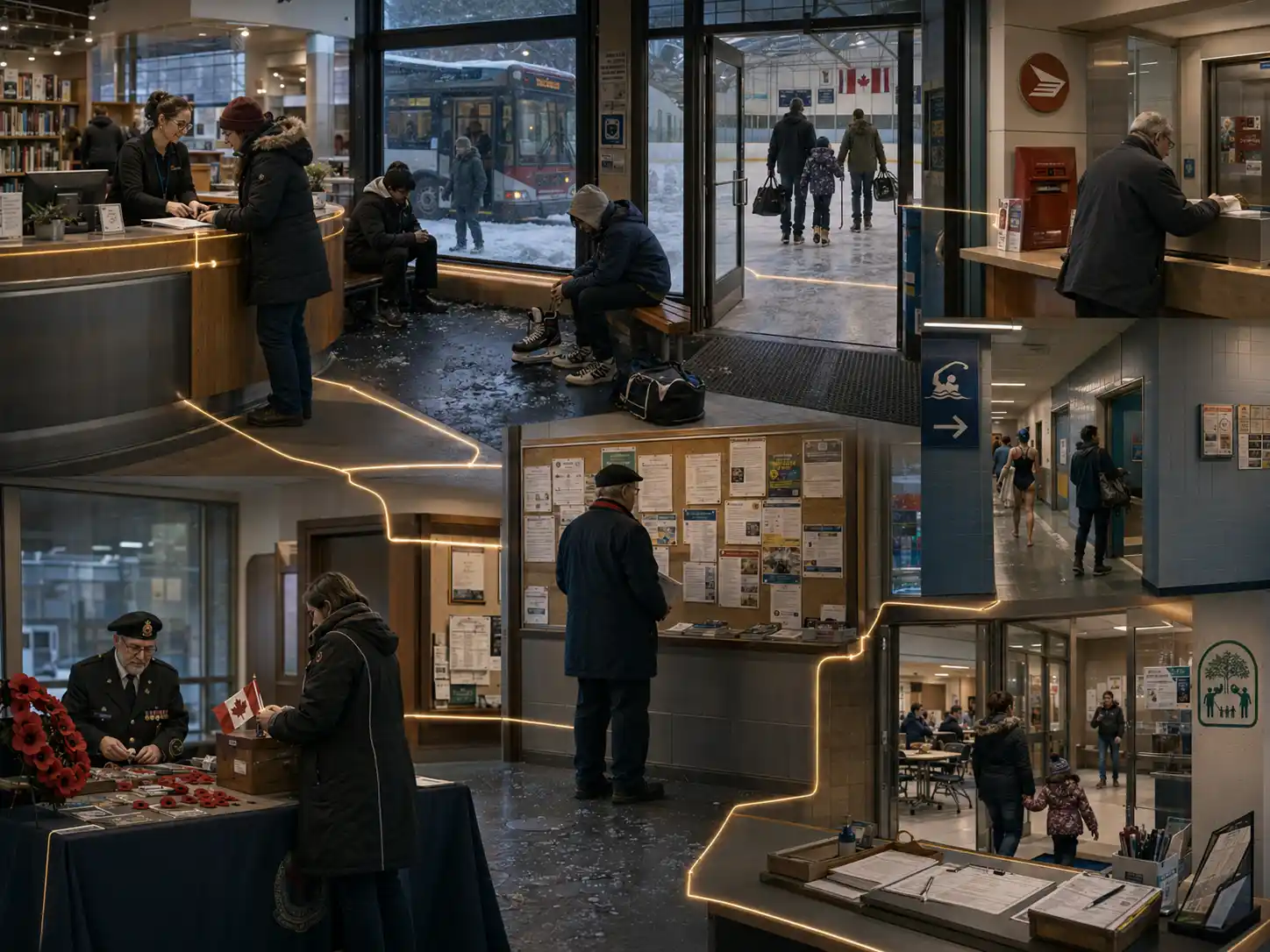
Before Canada became a daily argument, it was also a set of places.
A library with a card.
A rink with a schedule.
A school gym with folding chairs.
A Legion hall with poppies at the door.
A post office counter.
A community centre.
A public pool.
A town hall.
A church basement.
A temple hall.
A band office.
A friendship centre.
A union hall.
A co-op store.
A fire hall.
A local newspaper office.
A bus stop in winter.
A public broadcaster in the background.
These places did not make Canada innocent. They did something more basic: they made Canada encounterable.
You could enter them. You could wait in them. You could ask for help in them. You could be seen by people who were not only family, not only employers, not only friends, and not only strangers on a screen. You could learn that the country was not an abstraction floating above your life. It had counters, doors, schedules, rooms, bulletin boards, ceremonies, volunteers, clerks, librarians, coaches, elders, staff, rules, forms, smells, sounds, and people who remembered your name.
That matters because a country cannot be inherited only as an idea.
It has to be inherited as repeated life.
A child does not first meet Canada through constitutional theory. He meets it through a school bus, a library card, a snowplow, a rink, a public pool, a classroom flag, a Terry Fox Run, a Remembrance assembly, a book fair, a park, a doctor’s office, a road trip, a local store, a bus route, a family story, a neighbour with a shovel.
An immigrant does not first meet Canada as a slogan. She meets it through an airport, a rental application, a school office, a transit route, a grocery store, a language class, a workplace, a tax form, a citizenship ceremony, a winter coat, a remittance counter, a religious community, a public library, a child translating at a desk.
A rural Canadian does not meet Canada only through national media. He meets it through roads, weather, fuel, farms, fisheries, grain elevators, machine shops, volunteer fire halls, hockey arenas, school closures, distant hospitals, local papers, resource work, and the knowledge that distance is not metaphor.
A northern Canadian does not meet Canada as a southern fantasy of wilderness. She meets it through flights, fuel, food prices, ice roads, darkness, snow machines, health access, community halls, land knowledge, extraction, military presence, state neglect, and the stubborn fact that the map looks different when you have to live inside it.
An Indigenous person does not meet Canada only as a civic project. Canada is also treaty, reserve, band office, school, church, court, police, child welfare, language loss, language revival, land defence, kinship, ceremony, urban friendship centre, northern community, veteran memory, and survival under systems the country long refused to see clearly.
A Quebecer does not meet Canada simply as English Canada with French subtitles. Canada is also language, parish memory, secular revolution, referendum, Radio-Canada, French school, neighbourhood, hockey, comedy, music, law, and the knowledge that the country has never been one simple story.
That is the first correction this book has to make: Canada was never only one thing.
But it was also not nothing.
It was not merely an administrative zone.
It was not merely a market.
It was not merely a brand.
It was not merely a guilt machine.
It was not merely a set of arguments about identity.
Canada was a lived inheritance: uneven, flawed, plural, contested, loved, resented, built, damaged, repaired, and carried through ordinary systems.
Those systems formed people before they knew they were being formed.
A rink taught time, cold, teamwork, money, effort, and local pride.
A library taught trust, quiet, borrowing, return, and public access to knowledge.
A post office taught that even distance could be organized.
A school gym taught how to sit with others inside a public ritual.
A Legion hall taught that memory had a room.
A church, temple, or community hall taught that belonging required food, service, elders, children, and repetition.
A town hall taught that place had decisions.
A public pool taught bodies, safety, rules, and shared water.
A local newspaper taught that public life had names.
A bus stop taught dependence, timing, and weather.
A community centre taught that a neighbourhood could gather without needing to buy something first.
This is why places matter.
When a country becomes mostly an argument, people inherit less than they need. They get opinions before practices. They get positions before duties. They get identity before belonging. They get outrage before responsibility. They get national symbols without local rooms where those symbols can be tested, complicated, and made human.
The modern Canadian often has more opinions about the country than places where he experiences it as a shared life.
That is not his fault alone. The places weakened.
Some closed.
Some became expensive.
Some became distrusted.
Some became politicized.
Some became understaffed.
Some became digital portals.
Some became content.
Some became inaccessible.
Some became embarrassing.
Some became so bureaucratic that the person disappeared inside the form.
The public counter became a login.
The local paper became a feed.
The community noticeboard became a platform.
The school assembly became a controversy.
The library became one of the last indoor places where a person could exist without buying something.
The rink became too expensive for some families.
The town hall became a battleground.
The national broadcaster became a culture-war symbol.
The family table became a group chat.
The neighbour became a stranger with a lawn sign.
This is how a country thins.
Not by vanishing from the map.
Not by losing every institution at once.
Not by one dramatic collapse.
A country thins when fewer people encounter it through trustable places and more people encounter it through screens, forms, arguments, brands, scandals, and abstractions.
The damage is not that Canadians argue. A free country argues. A plural country argues. A serious country argues about land, language, immigration, memory, rights, power, money, religion, schools, history, and the future.
The damage is when argument becomes the main remaining form of belonging.
If the rink is gone or unaffordable, if the local paper is gone, if the church basement is empty, if the school ritual is hollow, if the library hours shrink, if the job does not lead anywhere, if the public counter disappears, if the neighbourhood has no shared room, if the family archive is silent, if the screen becomes the default place of contact — then politics, branding, and identity rush into the gap.
They offer belonging without place.
They offer moral drama without service.
They offer explanation without responsibility.
They offer enemies faster than they offer duties.
This is why the book begins by insisting that a country is more than its opinions. Because if Canada is understood mainly as an argument, then every crisis becomes a crisis of messaging. Better slogans. Better branding. Better speeches. Better campaigns. Better moral instruction. Better national narratives.
But Canada’s deeper problem is not only narrative.
It is infrastructural in the human sense.
The country needs places where people practice being a people.
Places where old and young meet.
Places where newcomers enter.
Places where children are trusted in small ways.
Places where memory is carried.
Places where bodies train.
Places where tools are learned.
Places where grief is public.
Places where work leads somewhere.
Places where disagreement does not cancel shared life.
Places where people are not only users, consumers, clients, patients, applicants, viewers, voters, or profiles.
A country that loses those places can still talk about itself endlessly.
It can produce policy, commentary, analysis, advertising, election campaigns, apology statements, branding exercises, diversity language, heritage months, tourism videos, and angry feeds.
But it will struggle to form people.
This is not a call to trust every old institution.
Many institutions failed badly. Schools harmed. Police harmed. Governments harmed. Hospitals harmed. Families harmed. Sports organizations harmed. Employers harmed. Media organizations lied or excluded. Public systems ignored people. Some places that gave one person belonging gave another person humiliation.
The answer is not blind trust.
The answer is accountable trust.
A country cannot function with naive trust, but it also cannot survive with total suspicion. People need institutions that can be criticized without being abandoned, repaired without being worshipped, entered without humiliation, and trusted without pretending harm never happened.
That is a hard balance. But it is the balance of civilization.
Canada’s older public world had too much silence. The newer world often has too much suspicion. The repair is neither silence nor suspicion. The repair is truthful public life.
Truthful public life means a Legion hall can honour sacrifice without turning war into costume.
It means a library can defend free inquiry while serving children, newcomers, elders, the poor, and the lonely.
It means a Christian community can preserve ritual and service without mistaking stagnation for faithfulness.
It means a town hall can host conflict without becoming permanent theatre.
It means a public broadcaster can carry national conversation without pretending the country has one voice.
It means a citizenship ceremony can welcome new Canadians without reducing belonging to paperwork.
It means Quebec is not treated as a complication to be managed, Indigenous peoples are not treated as a footnote to a national myth, immigrant communities are not treated as decoration, and rural, northern, working-class, disabled, religious, secular, English, French, and urban lives all appear as real parts of the country.
A country is more than its opinions because a country is also a discipline of attention.
What do people notice?
What do they maintain?
Where do they gather?
Whose stories are repeated?
Whose pain is named?
Whose work is respected?
Where do children learn public behaviour?
Where do young adults enter responsibility?
Where do elders remain useful?
Where do newcomers become neighbours?
Where does memory become more than grievance or branding?
Where does disagreement remain attached to shared life?
If the answer is nowhere, the country is in trouble.
If the answer is only online, the country is thin.
If the answer is only politics, the country is captured.
The repair begins by taking ordinary places seriously again.
Libraries are not extras.
Rinks are not extras.
School gyms are not extras.
Community centres are not extras.
Christian and cultural halls are not extras.
Local newspapers are not extras.
Public pools are not extras.
Parks are not extras.
Transit routes are not extras.
Human counters are not extras.
Small stores, repair shops, union halls, friendship centres, band offices, immigrant plazas, language schools, seniors’ centres, and youth clubs are not extras.
They are part of how a country becomes real to itself.
A government can pass laws. A market can sell goods. A platform can connect users. A campaign can shape opinion. But none of these alone can raise citizens.
Citizens are formed in the rooms where they learn how to share time, responsibility, memory, conflict, and place.
That is why Canada must be recovered first as lived inheritance.
Not because inheritance is pure.
Because inheritance is unavoidable.
The only choice is whether it will be remembered truthfully, repaired intelligently, or replaced silently by systems that do not love the people they shape.
A country is more than its opinions about itself.
It is the life that teaches people what those opinions are worth.
Chapter 2 — The Past Does Not Need to Be Innocent to Have Taught Something
The past does not need to be innocent to have taught something.
That sentence matters because almost every argument about memory now tries to force a false choice.
Either the past was good, and therefore we should defend it.
Or the past was harmful, and therefore we should discard it.
Either inheritance is wisdom.
Or inheritance is contamination.
Either gratitude.
Or accusation.
That is too simple for a country.
Canada’s past was not one thing. It was shelter and exclusion. Work and exploitation. Courage and silence. Beauty and erasure. Family and harm. Public duty and public failure. Immigrant hope and racist gatekeeping. Indigenous endurance and Canadian violence. Quebec memory and English-Canadian simplification. Rural competence and rural hardship. Faith, service, abuse, sacrifice, poverty, humour, discipline, shame, love, loneliness, repair.
A country that cannot hold these together cannot remember itself. It can only swing between nostalgia and self-hatred.
Both are forms of forgetting.
Nostalgia forgets the people who were hurt.
Self-hatred forgets the things that formed people.
Neither is strong enough to rebuild a country.
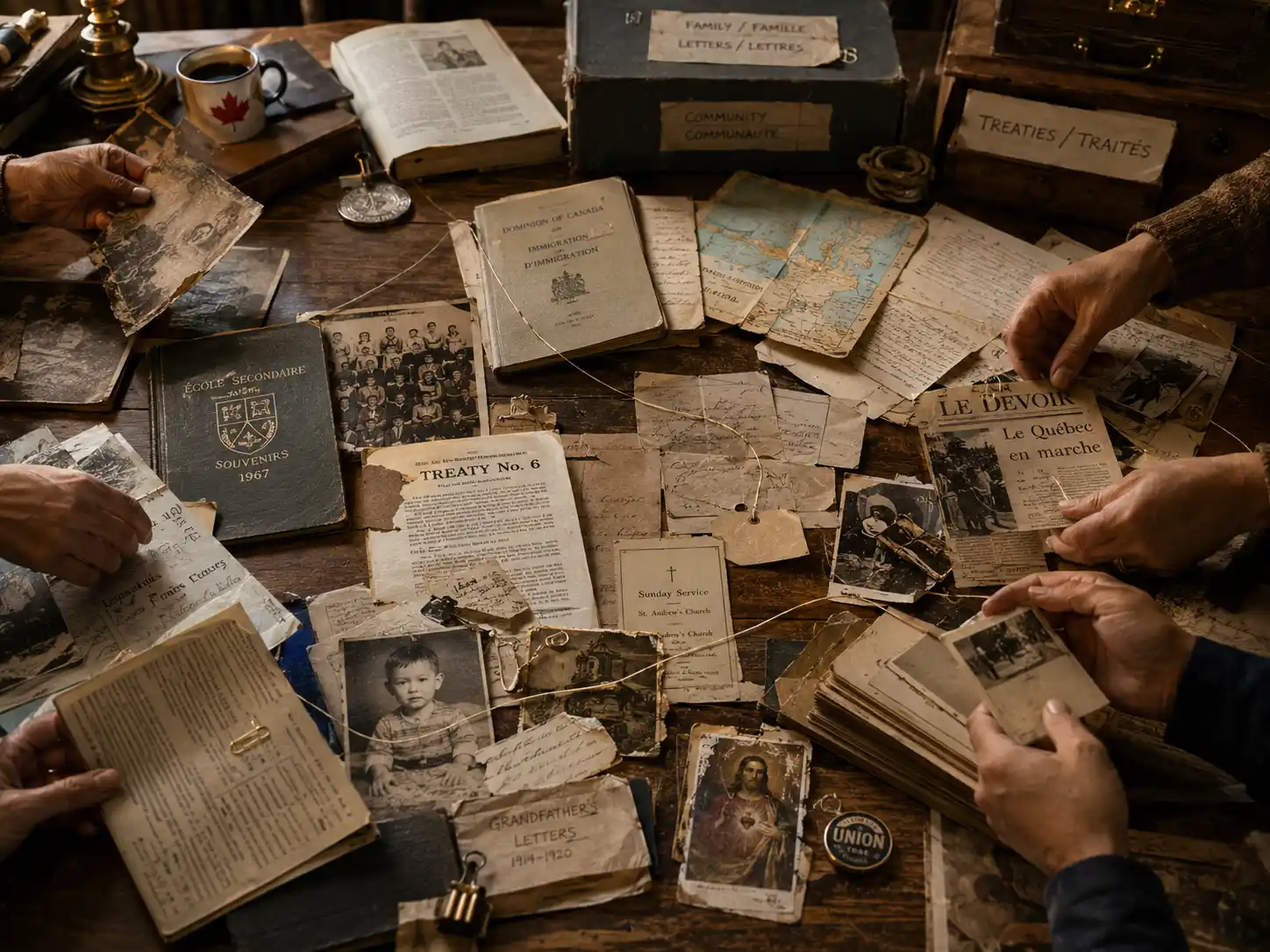
A family photo album shows the problem in miniature. It looks innocent at first: weddings, babies, backyards, Christmas tables, cousins on couches, old cars in driveways, grandparents younger than you remember, someone holding a cake, someone standing beside a house that has since been sold. But every photo album also hides something. The argument before the picture. The alcoholism nobody named. The relative who stopped being invited. The marriage that looked stable and was not. The child who was afraid. The parent who worked nights. The person who came from another country and never fully explained what had been left behind. The person whose name is known only because someone wrote it on the back.
The album lies.
But it also tells the truth.
It tells who gathered. Who cooked. Who served. Who was missing. Who held the baby. Who wore the uniform. Who built the porch. Who aged too quickly. Who kept the recipe. Who came from the old country. Who never spoke of the war. Who worked with his hands. Who prayed. Who stopped praying. Who carried grief as if it were normal. Who preserved a language. Who lost one. Who made the family possible and was barely thanked.
That is memory. Not purity. Not proof by itself. Not innocence. But knowledge.
A country works the same way.
Canada has photo albums too. Some are literal: family boxes, community archives, school yearbooks, local newspapers, church records, synagogue bulletins, union halls, Legion walls, band offices, friendship centres, immigration papers, land records, treaty documents, residential school testimony, sports photos, factory pictures, fishing boats, farm auctions, class pictures, citizenship ceremonies, parade footage, VHS tapes, and local histories printed in small towns.
Some are cultural: Terry Fox Runs, Remembrance Day, Hockey Night, Heritage Minutes, Radio-Canada, MuchMusic, YTV, school assemblies, old catalogues, winter storms, road trips, community suppers, provincial parks, rinks, libraries, shop classes, first jobs, university acceptances, rental basements, and family kitchens.
These memories do not agree with one another.
They should not.
The child who remembers the school gym as belonging may sit beside another who remembers the same gym as humiliation. One person remembers the church basement as food, music, elders, and service. Another remembers silence, fear, or abuse. One remembers the police officer as safety. Another remembers being watched. One remembers Canada Day as uncomplicated joy. Another remembers it as absence, anger, or forced performance. One remembers the wilderness as freedom. Another remembers land taken, regulated, sold, flooded, or renamed.
A mature country does not solve this by choosing one memory and deleting the rest.
It learns to read memory truthfully.
This is especially hard in Canada because the national story has been corrected so sharply. Many things once treated as background are now primary: residential schools, forced assimilation, anti-Indigenous policy, racist immigration law, internment, language conflict, sexism, homophobia, institutional abuse, class contempt, disability exclusion, and the ways polite public stories protected private harm.
That correction was necessary. A country that refuses truth becomes morally childish.
But correction can become another form of forgetting if it teaches people that nothing inherited is usable.
If every older ritual is only propaganda, if every family story is only repression, if every national symbol is only violence, if every institution is only hypocrisy, if every public memory is only exclusion, then people do not become truthful. They become disinherited.
Disinheritance is not the same as justice.
A disinherited person may know what to condemn but not what to carry. He may know what language to avoid but not what duties to accept. She may know how to detect harm but not how to build trust. A country can become fluent in critique and still fail to raise people who can repair anything.
That is the danger.
The past does not need to be innocent to have taught something.
A grandfather’s war story may be incomplete, self-protective, sentimental, or silent about things too ugly to say. It may still teach sacrifice, fear, duty, loss, and the cost of public peace.
An immigrant parent’s story may exaggerate hardship or hide shame. It may still teach courage, adaptation, debt, gratitude, ambition, and the grief of leaving one world for another.
A Quebec family story may carry language, humour, Catholic memory, secular revolt, referendum pain, and the sense of being a people inside a larger country that often misunderstands them.
An Indigenous family story may carry land, kinship, school violence, survival, child welfare, language loss, ceremony, veterans, urban movement, and revival — not as a footnote to Canada, but as a central reality Canada must finally learn to hear.
A rural family story may carry work, weather, isolation, farm debt, mechanical competence, church suppers, hockey arenas, volunteer fire halls, and the knowledge that the country looks different when the hospital is far away.
A working-class story may carry shift work, tools, factories, injuries, layoffs, unions, pride, exhaustion, and the quiet knowledge of who actually kept things running.
A family business story may carry risk, child labour, sacrifice, pride, resentment, and the smell of a store or restaurant before opening.
A religious story may carry belonging, food, service, music, moral discipline, abuse, guilt, beauty, coercion, forgiveness, and the difficulty of sorting God from institution.
A country that cannot hear these mixed stories will not become more honest. It will become thinner.
The purpose of memory is not to prove that the past was good.
The purpose of memory is to recover reality.
Reality is mixed. Therefore memory must be mixed.
This requires a different kind of reading.
When we look at an old system, we should not ask only, “Was it good or bad?” That question is too blunt.
We should ask:
What did it teach?
Who did it help?
Who did it harm?
Who was included?
Who was excluded?
What human capacity did it build?
What silence did it demand?
What did modern change improve?
What did modern change weaken?
What must be refused?
What must be rebuilt?
Those questions turn memory into repair.
Take school ritual. A Remembrance assembly could be solemn, shallow, moving, boring, militarized, truthful, incomplete, or all of these at once. It could teach gratitude and also avoid hard questions. It could honour sacrifice while forgetting some soldiers. It could ask children to stand in silence before they understood why.
Should it disappear?
No. It should become more truthful.
Take family dinner. It could transmit recipes, stories, humour, obligation, language, and belonging. It could also enforce silence, gender roles, shame, and obedience to harmful authority.
Should it disappear?
No. It should become more truthful.
Take wilderness memory. It could teach land, scale, humility, weather, animals, and practical skill. It could also erase Indigenous presence and turn land into empty scenery.
Should it disappear?
No. It should become more truthful.
Take church, temple, synagogue, or community hall. These places could form service, discipline, charity, inter-generational care, song, ritual, food, and belonging. They could also conceal abuse, pressure dissenters, shame children, or exclude outsiders.
Should they disappear?
No. The harm must be named. The service must be repaired. The authority must be accountable. The human need for durable community remains.
This is the discipline the book needs.
Not nostalgia.
Not erasure.
Sorting.
Keep courage. Reject cruelty.
Keep duty. Reject coercion.
Keep memory. Reject lies.
Keep skill. Reject exclusion.
Keep belonging. Reject forced sameness.
Keep gratitude. Reject propaganda.
Keep correction. Reject contempt.
Keep truth. Reject rootlessness.
Without this discipline, Canada will keep making the same mistake in opposite directions.
One side will defend old symbols without asking whom they harmed.
The other side will condemn old symbols without asking what human work they performed.
Both will miss the deeper problem: once a formative system is destroyed, its function does not automatically return in a healthier form.
A bad school ritual does not become good by disappearing. It leaves the question of how children learn shared public memory.
A harmful family pattern does not become healthy because the family stops telling stories. It leaves the question of how people inherit identity, obligation, and love.
A flawed national myth does not become a mature national story because everyone learns to distrust the country. It leaves the question of how people belong to a place truthfully.
A corrupt institution does not become accountability because people retreat into platforms. It leaves the question of how public trust is rebuilt.
That is why memory matters.
Memory is not a museum.
Memory is not a shrine.
Memory is not a prison.
Memory is not a weapon to win arguments.
Memory is a repair tool.
It tells us what existed, what it did, what it cost, what it formed, what it hid, and what remains unfinished.
When memory is reduced to nostalgia, it becomes childish.
When memory is reduced to accusation, it becomes sterile.
When memory is treated as evidence of human formation, it becomes useful.
This is why old objects matter in the book: the photo album, the recipe card, the poppy, the hockey stick, the library card, the shop tool, the VHS tape, the citizenship paper, the fishing rod, the church bulletin, the union pin, the school yearbook, the family business sign, the Sears catalogue, the road map, the cassette, the lunchbox, the winter boot.
The object is not sacred.
The object is a witness.
It says: this is how people lived. This is what they touched. This is what they repeated. This is what they carried. This is what they forgot to explain before it disappeared.
A country that throws away all witnesses because some tell painful stories becomes blind.
A country that keeps all witnesses but refuses to interpret them becomes sentimental.
A country that wants to repair itself must learn to question its witnesses.
What do you prove?
What do you hide?
What did you teach?
Who could not enter your story?
What should we carry forward?
What should we bury?
What should we confess?
What should we rebuild?
That is the work of mature memory.
Canada needs mature memory because it is too plural for simple nostalgia and too real for total erasure.
The country contains Indigenous nations older than Canada, French Canada’s deep memory, English Canada’s uneasy institutions, immigrant inheritances from everywhere, Black Canadian histories, prairie settlement, Atlantic outmigration, northern endurance, urban multiplicity, rural repair culture, faith communities, secular revolts, resource towns, labour struggles, suburban childhoods, and families who built private worlds out of public uncertainty.
No single story can flatten that.
But a country does not need one flat story to have common life.
It needs shared practices honest enough to hold different memories.
That is why the past matters. Not because it gives Canada a single clean identity, but because it contains the record of what formed people before the present learned to describe itself.
The present is not as self-sufficient as it thinks.
It lives off inherited roads, schools, laws, languages, libraries, hospitals, rituals, technologies, stories, family sacrifices, public systems, private disciplines, and built environments it did not create alone. Even critique depends on inheritance. The person denouncing the past often uses rights, literacy, institutions, language, and moral categories inherited from people who were themselves unfinished.
This should produce humility.
No generation creates itself from scratch.
The question is whether it receives its inheritance honestly.
Canada does not need innocence. It needs truthful continuity.
Truthful continuity means the country can say:
This happened.
This helped.
This harmed.
This formed.
This excluded.
This must end.
This must be repaired.
This must not be forgotten.
This must be rebuilt differently.
That is not nostalgia.
That is adulthood.
A country becomes adult when it stops needing the past to be pure before it can learn from it.
The past does not need to be innocent to have taught something.
But the future will not be wise unless someone remembers what the lesson was.
Chapter 3 — Restore Functions, Not Props
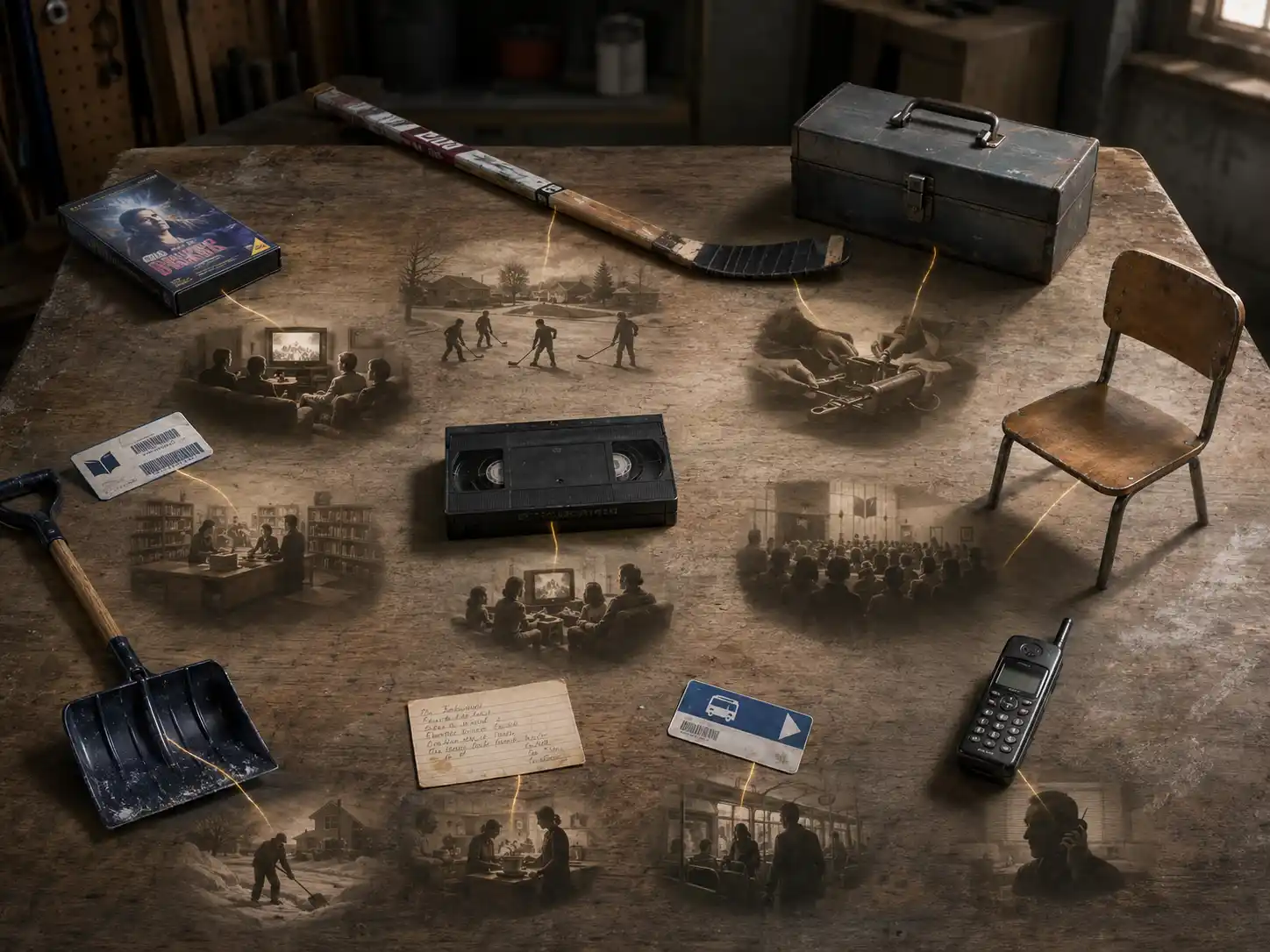
The point is not to bring back Blockbuster.
The point is to understand what the video store did.
A family walked in with time, disagreement, and limits. The walls were full, but not infinite. New releases might be gone. Someone wanted comedy. Someone wanted action. Someone wanted horror and was outvoted. A parent read the back of the box. A child judged the cover. A friend recommended something half-remembered. The decision took longer than expected because the choice had to be shared.
Then the family left with one movie.
One.
That limit mattered.
The video store did not make people wise. It did not save civilization. It was a commercial place with late fees, plastic cases, bored clerks, bad lighting, and rows of forgettable movies. But it trained a small social habit that streaming did not automatically replace: choosing together under limits.
That is the method of this book.
Do not worship the object. Find the human work underneath it.
Blockbuster is not the point. Shared choice is.
Road hockey is not the point. Child-led rule-making is.
Canadian Tire is not the point. Household competence is.
Shop class is not the point. Material confidence is.
A library card is not the point. Public trust is.
MuchMusic is not the point. Shared youth reference is.
A family album is not the point. Intergenerational memory is.
A first job is not the point. Usefulness is.
A public counter is not the point. Accountable human access is.
A snow day is not the point. Reality interrupting the plan is.
A canoe trip is not the point. Humility before land, weather, distance, and weight is.
The mistake is to confuse the container with the function.
A society can lose the container and still rebuild the function. That is repair.
A society can keep the container while losing the function. That is museum life.
A society can mock the container and never notice the function disappeared. That is how civilizational loss hides.
This distinction matters because nostalgia usually stops at the prop.
It wants the old sign back. The old store. The old theme song. The old catalogue. The old broadcast. The old school ritual. The old main street. The old childhood object. The old phrase. The old room.
But props do not raise people.
Practices do.
A hockey stick does not teach public life unless children are actually negotiating a game.
A library building does not teach trust if nobody uses it as a living public room.
A national anthem does not teach belonging if it becomes empty performance or compulsory embarrassment.
A shop full of tools does not teach competence if nobody is allowed to touch them.
A family album does not teach memory if nobody tells the stories.
A church basement, temple hall, synagogue classroom, or community centre does not teach belonging if nobody shows up to serve and be known.
A public broadcaster does not create common life if no one trusts it and every household lives in a different feed.
A school does not form citizens if it becomes only credential delivery, behavioural management, or ideological combat.
The function is the living part.
The prop is only evidence that a function once had a home.
This is why the past must be handled carefully. It is very easy to become a collector of dead symbols. It is also easy to become a destroyer of old symbols without asking what they carried.
Both are lazy.
The harder work is diagnosis.
What did this thing teach?
Who did it form?
Who did it exclude?
What did it make easier?
What did it make harder?
What replaced it?
What improved?
What disappeared?
What should not return?
What must be rebuilt differently?
That is the repair method.
Take road hockey.
The object version says: kids used to play street hockey. That was nice.
The function version asks: what did street hockey do?
It turned a street into a negotiated public space. It required children to create rules, enforce fairness, manage anger, include or exclude players, adapt to cars, handle older kids, accept uneven teams, and keep the game alive without adults solving every dispute.
The phrase “car” was civic training.
It meant: the world is shared. Move the net. Pause the game. Let another use the space. Return when the interruption passes.
That is not only nostalgia. That is a human capacity.
The repair is not to force every child into road hockey. The repair is to rebuild safe, unscripted, child-scale public life where children practice freedom under limits.
Take Canadian Tire.
The object version says: people remember Canadian Tire money and aisles of stuff.
The function version asks: what did the store assume?
It assumed households needed practical readiness. Snow shovels, furnace filters, windshield washer fluid, hockey tape, fishing line, extension cords, duct tape, tools, propane, batteries, and camping gear all belonged to a country where ordinary people were expected to fix, prepare, maintain, improvise, and endure weather.
The repair is not to make one retailer sacred. The repair is to rebuild household competence and respect for repair.
Take shop class.
The object version says: bring back old shop.
The function version asks: what did shop teach?
It taught that the material world has consequences. Wood splits. Engines fail. Wires must connect. Measurements matter. Tools can hurt. Repair takes patience. A person can understand an object rather than only consume or replace it.
Old shop culture could be sexist, unsafe, rough, and class-coded. That should not return.
But material competence must return.
The repair is modern shop, trades, robotics, cooking, sewing, electronics, mechanics, woodworking, repair, and practical intelligence taught seriously to everyone.
Take the school assembly.
The object version says: children used to sing O Canada and sit through ceremonies.
The function version asks: what should a school ritual do?
It should teach shared attention. It should give children practice standing inside public memory. It should mark grief, gratitude, history, service, and belonging without lying. It should teach that a country is not only personal preference.
Old rituals sometimes hid Indigenous truth, flattened Quebec, ignored immigrant stories, enforced conformity, or treated dissent as disrespect. That should not return.
But shared civic rehearsal must return.
The repair is truthful ritual.
Take the family album.
The object version says: old photos are precious.
The function version asks: what did the album do?
It linked generations. It made children ask who came before them. It preserved migration, work, marriage, grief, holidays, war, farms, houses, old countries, languages, and faces that would otherwise vanish. It also hid abuse, silence, shame, and absence.
The repair is not family mythology. The repair is truthful transmission: what happened, who carried what, what harmed us, what helped us, what we refuse, what we owe.
Take MuchMusic.
The object version says: music television was better.
The function version asks: what did shared music media do?
It gave youth culture a public square. Videos, VJs, countdowns, interviews, fashion, jokes, bands, taste, and controversy were watched in overlapping time. Not everyone shared it. Not Quebec in the same way, not every class, not every household, not every newcomer family. But there was overlap. Young people discovered music in public, not only through private algorithms.
Streaming improved access enormously. It gave everyone more music than MuchMusic ever could.
But shared discovery weakened.
The repair is not to bring back cable music television exactly. It is to rebuild common cultural discovery that does not trap everyone inside private recommendation systems.
Take the public counter.
The object version says: people used to talk to clerks.
The function version asks: what did the counter do?
It made institutions humanly reachable. Someone could ask, misunderstand, be corrected, hand over a form, explain a problem, receive judgment, encounter impatience, receive help, and leave knowing a person had seen the issue.
Counters were not perfect. They could be racist, dismissive, slow, humiliating, inaccessible, bureaucratic, and arbitrary.
But portals did not automatically fix that. Often they hid authority and moved labour onto the user.
The repair is not paper nostalgia. It is accountable human access inside modern institutions.
This is how the whole book must work.
Not “old thing good.”
Not “new thing bad.”
Not “bring it back.”
Not “burn it down.”
Instead:
What function did this thing perform, and how do we rebuild that function without rebuilding the harm?
This method protects the book from two mistakes.
The first mistake is nostalgia.
Nostalgia mistakes emotional recognition for truth. It remembers the mall food court, the video store, the rink, the school dance, the paper route, the catalogue, the TV show, the family basement, and says: that was better.
Sometimes it was not.
The second mistake is contempt.
Contempt looks at the same things and says: that was just consumerism, exclusion, cringe, colonial mythology, suburban memory, old media, outdated institutions, or childhood sentiment.
Sometimes it was more than that.
The mature position is not halfway between nostalgia and contempt. It is above both.
It says: this thing was mixed. Let us examine what it did.
That examination is the heart of repair.
If an old system taught courage but also cruelty, keep courage and reject cruelty.
If it taught duty but also silence, keep duty and reject silence.
If it taught belonging but also exclusion, keep belonging and reject exclusion.
If it taught gratitude but also propaganda, keep gratitude and reject propaganda.
If it taught skill but also humiliation, keep skill and reject humiliation.
If it taught memory but also lies, keep memory and reject lies.
If it taught discipline but also abuse, keep discipline and reject abuse.
This is not compromise. It is civilization work.
A country that cannot do this will swing between two childish futures.
One future dresses up in old symbols and calls that restoration.
The other destroys old symbols and calls that justice.
Both leave the hard work undone.
Because after the symbol is defended or destroyed, the human function still has to be rebuilt.
Where do children practice independence?
Where do teenagers become themselves without permanent record?
Where do families transmit memory?
Where do young adults enter useful work?
Where do people learn tools?
Where do citizens encounter institutions as humans?
Where does a plural country practice shared ritual?
Where does media create common reference?
Where does politics stop and ordinary belonging begin?
If these questions are not answered, the empty space will not remain empty.
Platforms will answer.
Markets will answer.
Bureaucracies will answer.
Political tribes will answer.
Influencers will answer.
Algorithms will answer.
Debt will answer.
Screens will answer.
Something always forms people.
The question is whether the systems doing the forming love the people they shape, know the places they inhabit, and answer to the communities they affect.
That is why restoring functions matters.
A function is not sentimental. It is practical.
Public trust.
Local independence.
Material competence.
Shared memory.
Embodied discipline.
Land humility.
Adult settlement.
Human access.
Non-political belonging.
Common reference.
Repair.
These are not props. They are capacities.
Canada does not need to bring back every old form. It cannot. The country has changed. Technology has changed. Families have changed. Immigration has changed. Indigenous truth can no longer be buried. Quebec cannot be flattened into English Canada’s story. Work and housing have changed. Disability access matters. Abuse must not be hidden. Women and girls cannot be pushed back into old limits. Young people cannot be blamed for a world built before them.
So the restoration must be creative, not theatrical.
A modern library can rebuild public trust.
A walkable neighbourhood can rebuild child independence.
A truthful school ritual can rebuild civic memory.
A repair cafe can rebuild practical competence.
A community kitchen can rebuild intergenerational belonging.
A local sports club can rebuild embodied courage.
A digital tool with human accountability can rebuild access without erasing people.
A public broadcaster, local newspaper, school media program, or civic event can rebuild common reference.
A housing system that allows settlement can rebuild adulthood.
A land program rooted in Indigenous truth can rebuild place without false wilderness myth.
The object may change.
The function must be named.
That is the rule.
Once you see this, the whole country looks different.
A snow shovel is not only a snow shovel. It is a tool of household readiness.
A poppy is not only a poppy. It is a test of public memory.
A bus route is not only transit. It is access to the common world.
A rink is not only sport. It is cold discipline and local belonging.
A family recipe is not only food. It is migration, memory, gender, labour, love, and transmission.
A job is not only income. It is entry into usefulness and adult time.
A phone is not only a device. It is a room where identity, work, entertainment, politics, memory, maps, shopping, and loneliness now meet.
A country is not only a country. It is a system of formation.
The danger is that Canada has been losing formation systems while debating symbols.
The opportunity is that functions can be rebuilt once they are seen.
So this book will keep asking the same question in different places:
What did this teach people?
If the answer is nothing, cut it.
If the answer is real, examine it.
If it harmed people, name the harm.
If something improved, protect the improvement.
If something was lost, name the capacity.
If the capacity still matters, rebuild it in a better form.
That is how memory becomes useful.
That is how repair avoids nostalgia.
That is how a country stops collecting props and starts forming people again.
Part II — Childhood and Common Reality
Chapter 4 — Winter, Weather, and Public Reality
Winter taught Canada before Canada explained itself.
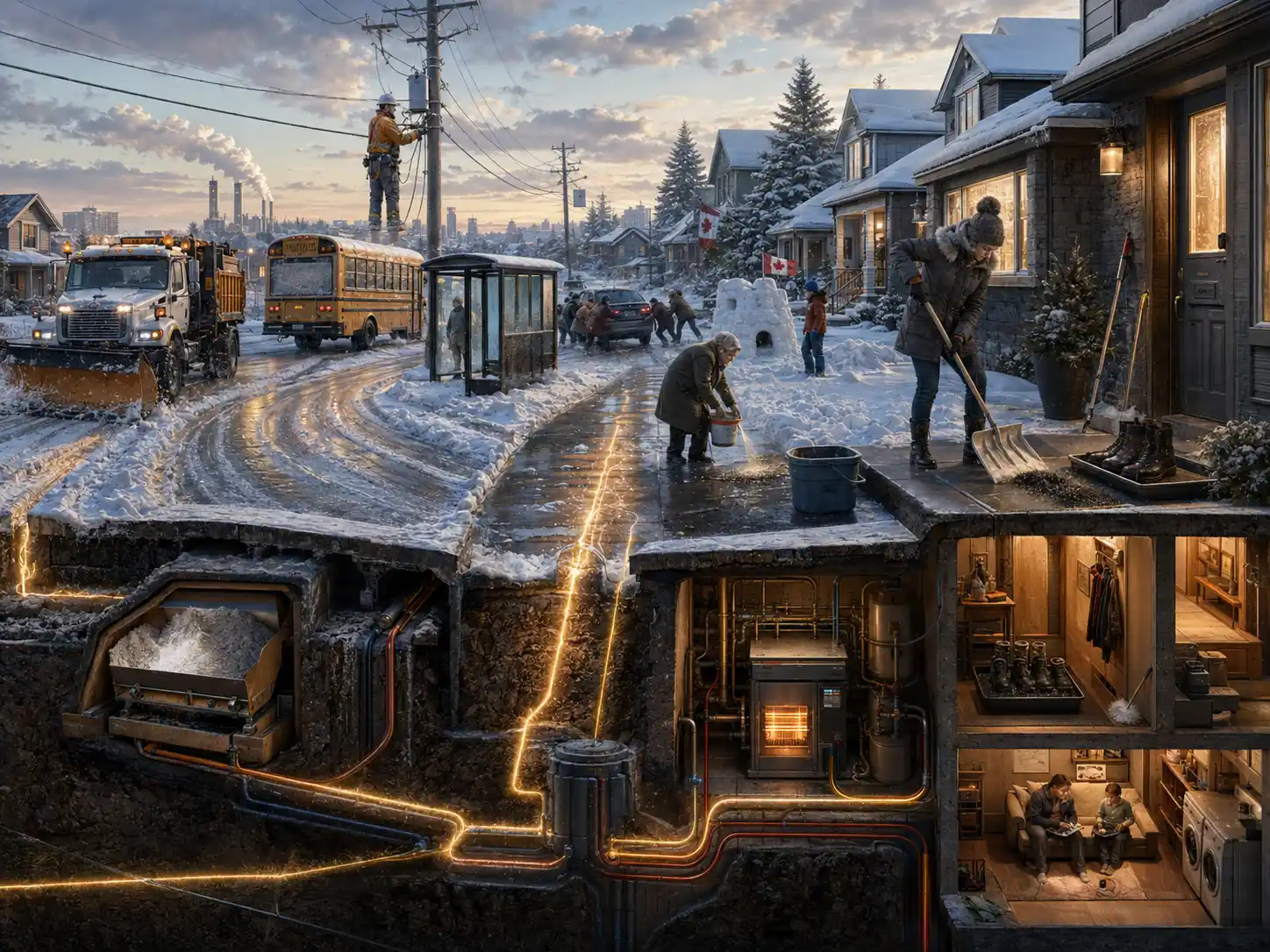
A child did not need a theory of geography to understand the country. The lesson arrived through wet mittens, snow pants, frozen eyelashes, salt stains on boots, school buses in the dark, and the sound of a shovel scraping the driveway before breakfast. Winter was not scenery. It was a public fact.
Before a child knew anything about national identity, winter had already made claims on the body.
Put on your boots.
Zip your coat.
Find your mitts.
Do not forget your hat.
Check the road.
Start the car early.
Scrape the windshield.
Walk carefully.
Do not touch the metal pole.
Come in when your socks are wet.
Winter was one of the first teachers of reality because it did not argue. It did not care whether anyone felt ready. It arrived, stayed, blocked, froze, delayed, soaked, cracked, buried, and demanded preparation.
A snow day was not just a day off school. It was a civic event.
Children listened to the radio or watched the television crawl to hear whether their school board had closed. Parents rearranged work. Buses stopped. Teachers adjusted plans. Streets grew quiet. Neighbours dug out driveways. Someone’s car got stuck. Someone had the better shovel. Someone had salt. Someone had a snowblower and became briefly important.
The ordinary schedule broke because weather had authority.
That mattered.
A snow day taught that public life could be interrupted by something larger than preference, productivity, or planning. It taught that a community was not only people agreeing with one another. It was people dealing with the same storm.
Winter also taught preparation.
A Canadian Tire aisle understood this version of the country better than many speeches did: snow brushes, windshield washer fluid, furnace filters, salt, batteries, extension cords, antifreeze, flashlights, shovels, boots, gloves, space heaters, ice scrapers, tarps, generators, roof rakes, and tools for problems weather would eventually create.
A household was not only a private space. It was a small weather station, repair shop, storage system, and emergency plan.
Someone had to know where the shovel was. Someone had to check the furnace. Someone had to buy the salt before the sidewalk turned dangerous. Someone had to remember that the car needed winter tires, that pipes could freeze, that the power could go out, that the driveway would not clear itself.
Winter made maintenance moral.
It taught that neglect becomes someone else’s danger. An unshovelled walk could hurt an elder. A car without proper tires could endanger strangers. A child without boots would suffer because an adult failed to prepare. A furnace problem was not an inconvenience; it was a threat.
That is why winter formed people. It made invisible systems visible.
Heat was not abstract. Roads were not abstract. Transit was not abstract. Power lines were not abstract. School buses were not abstract. Municipal services were not abstract. Parents, neighbours, plow drivers, hydro workers, caretakers, mechanics, road crews, landlords, and bus drivers all became part of the same public reality.
Winter taught dependence without sentimentality.
You could be independent and still need the plow.
You could be tough and still need heat.
You could be prepared and still need neighbours.
You could be responsible and still be overruled by ice.
This is one reason winter belongs near the beginning of the book. It shows the difference between real formation and abstract identity. Winter did not ask Canadians what they believed about Canada. It asked whether they could live in it.
The lessons varied by place.
A child in Vancouver might know winter mostly as rain, damp cold, mountain snow, wet shoes, and the rare city-stopping snowfall. A child in Winnipeg might know windchill as a force that changed how long skin could be exposed. A child in Montreal might know icy stairs, slush, laneways, snowbanks, and the choreography of boots in apartment halls. Atlantic Canada knew storms that could shut down roads and knock out power. Rural children knew long drives, drifting roads, and the seriousness of a vehicle that would not start. Northern communities knew winter not as season but as structure: roads, fuel, food, isolation, darkness, machines, and survival.
There was no single Canadian winter.
There were many winters, and they were unequal.
Bad housing made winter harder. Poverty made winter harder. Disability made winter harder. Old age made winter harder. Rural distance made winter harder. Northern prices made winter harder. Newcomers learned winter quickly, sometimes with humour, sometimes with shock, sometimes with fear. Indigenous communities faced winter through histories of land knowledge, colonial disruption, infrastructure neglect, and northern resilience that southern Canadians often romanticized without understanding.
Winter could kill. It could isolate. It could exhaust. It could make work dangerous. It could expose bad landlords, weak infrastructure, poor planning, and the cruelty of pretending everyone faced the same conditions.
So winter should not be made cute.
The point is not nostalgia for snowbanks. The point is that winter taught a kind of public realism that modern life often tries to soften or outsource.
More weather alerts helped. Better forecasting helped. Winter tires helped. Remote work helped some people avoid dangerous roads. Better heating, better clothing, better emergency planning, better accessibility, and better communication all improved life. A parent no longer had to wait by a radio hoping to catch the school closure. A worker could sometimes stay home. A family could track the storm. A person with mobility limits could avoid a dangerous trip.
Those gains are real.
But something was also weakened when winter became more mediated by notifications, apps, delivery systems, remote work, indoor entertainment, private cars, and managed convenience.
The old lesson was not that suffering is good. The lesson was that reality is shared.
A storm was not content.
It was not only a photo.
It was not only a complaint.
It was not only a traffic update.
It was a test of preparedness, infrastructure, patience, neighbourliness, and limits.
A culture that loses contact with winter as teacher can start to believe that reality should always be adjustable. It can begin to treat inconvenience as injustice, limits as failure, maintenance as someone else’s problem, and public dependence as embarrassment.
Winter corrected that.
It taught that not everything bends.
It taught that bodies have limits.
It taught that roads need clearing.
It taught that tools matter.
It taught that homes require care.
It taught that community is sometimes as simple as helping push a car.
It taught that plans are fragile.
It taught that comfort is built, not guaranteed.
For children, winter also made play out of difficulty.
Snow forts, snowballs, sledding hills, frozen ponds, outdoor rinks, hockey bags, wet socks, red cheeks, hot chocolate, and mittens drying over vents turned hardship into imagination. The same weather that blocked roads also built worlds. A pile of plowed snow became a castle. A frozen patch became a rink. A schoolyard became a battlefield, a construction site, a mountain, a place where children learned how cold felt and how long they could stand it.
This was not separate from formation. Play made endurance bearable. It taught children that discomfort did not always mean danger. It taught them to read their bodies, manage risk, test limits, and come inside before frostbite replaced fun.
Modern childhood often protects more and exposes less. Some of that is good. Children should not be abandoned to danger. But if all discomfort is removed, children lose practice in distinguishing difficulty from emergency.
Winter gave that practice.
It was a national teacher precisely because it was not ideological. It did not care whether a family voted left or right, spoke English or French, arrived three generations ago or three months ago. Everyone had to negotiate it. Not equally. Not under the same conditions. But nobody lived entirely outside it.
Even in places where winter was mild, the country carried winter as expectation: in clothing, shipping, housing, sports, school calendars, road budgets, jokes, warnings, stories, and the strange Canadian pride of surviving weather that made no promises.
A country formed by winter should remember what winter taught.
Prepare before the crisis.
Respect limits.
Maintain what keeps people alive.
Do not confuse comfort with reality.
Do not leave the vulnerable to face the cold alone.
Do not make public systems invisible until they fail.
Do not pretend geography is branding.
Do not forget that a country is also roads, heat, boots, salt, tools, buses, plows, and neighbours.
Winter did not make Canadians morally superior. It did not make everyone tough. It did not make the country innocent.
It did something more basic.
It taught that reality comes first.
That lesson is needed again.
A society living through screens, portals, feeds, climate volatility, housing stress, infrastructure strain, and political fantasy needs contact with non-negotiable reality. Not as punishment. As grounding.
Winter is one of the places Canada can still find that grounding.
Not the old winter exactly. The climate is changing. Cities are changing. Work is changing. Childhood is changing. The North is changing faster than southern imagination can process. The old rhythms cannot simply be restored.
But the function must be rebuilt.
Respect season.
Prepare households.
Maintain infrastructure.
Teach children weather judgment.
Build communities that check on the vulnerable.
Treat land and climate as reality, not backdrop.
Recover the civic meaning of shared interruption.
A snow day was never only a day off.
It was a reminder that Canada is not an idea floating above the ground. It is a country of bodies, weather, distance, roads, heat, tools, and dependence.
Winter taught that.
The repair begins by remembering it.
Chapter 5 — Neighbourhood Childhood
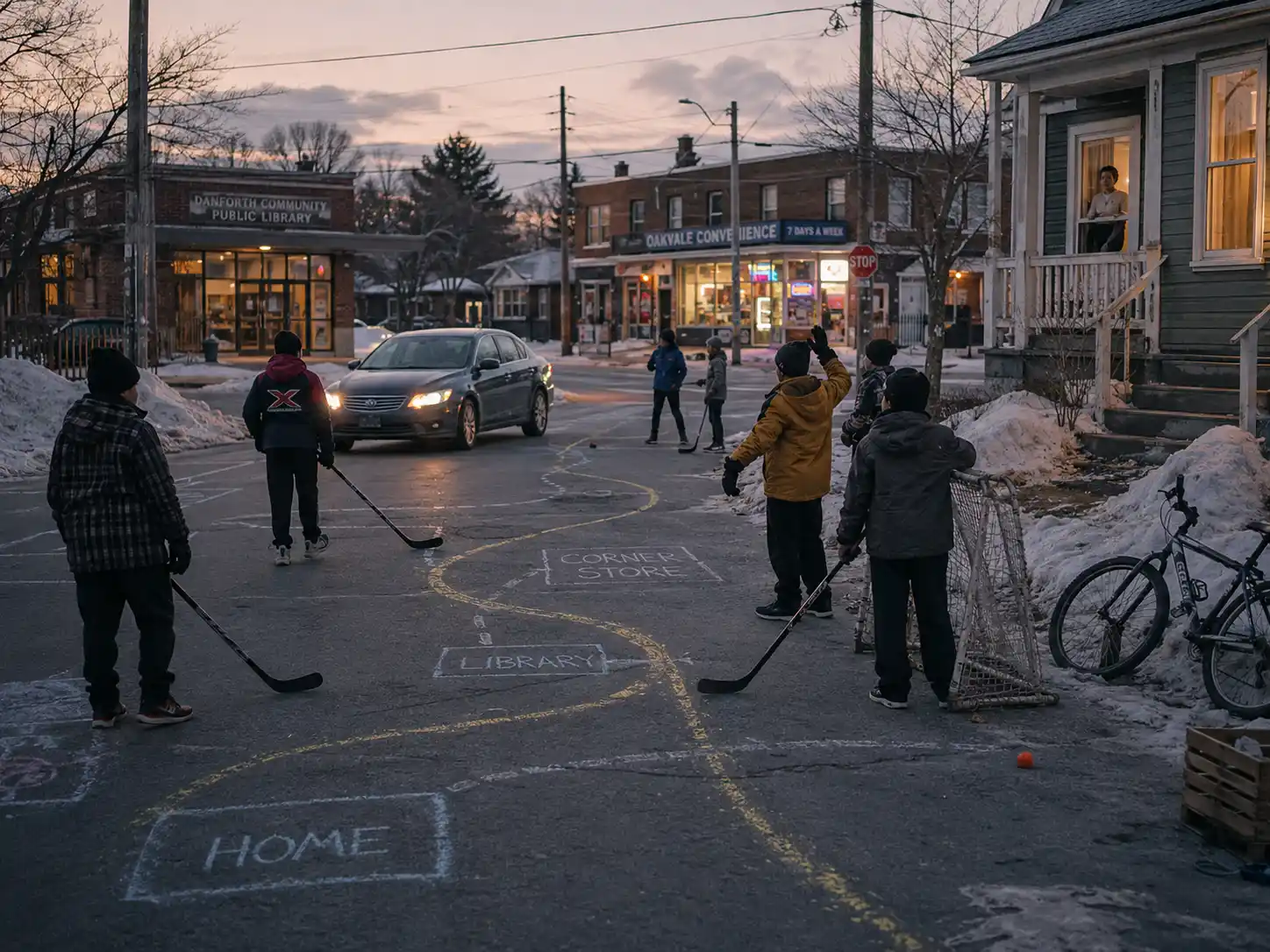
The game stopped when someone yelled “car.”
That was the rule. Not written down. Not approved by a committee. Not posted on a sign. Not supervised by an adult in a vest. Someone saw headlights, shouted the warning, and the whole game broke apart for a moment. Nets dragged to the curb. Sticks lifted. The ball was retrieved from under a parked car or a snowbank. The driver passed through the middle of the rink that was not a rink. Then the nets came back, the argument resumed, and the game continued.
That small interruption carried an entire civic education.
The children had no permit, but they had a public order. They had no referee, but they had rules. They had no adult manager, but they had consequences. Too many arguments and the game ended. Too much selfishness and nobody passed to you. Too much cowardice and you lost respect. Too much aggression and someone went home crying, or bleeding, or angry enough to tell a parent.
Road hockey was not only hockey. It was child-led public life.
A street became a place children could govern temporarily. Not own. Govern. That distinction mattered. The street still belonged to cars, neighbours, delivery trucks, dog walkers, parents, older kids, and the weather. Children learned to make a world inside a world that did not belong entirely to them.
They learned the curb.
They learned the driveway.
They learned whose lawn not to step on.
They learned which neighbour complained.
They learned which older kid bent the rules.
They learned how long an argument could last before the game died.
They learned that public space was negotiated, not granted.
Neighbourhood childhood was made from these small negotiations.
Road hockey. Bike freedom. Paper routes. Corner stores. Schoolyards. Apartment courtyards. Cul-de-sacs. Parks. Library trips. Snow forts. Basketball driveways. Friends’ houses. Garage sales. Streetlights. Crosswalks. Shortcuts. Dogs behind fences. Older kids at the edge of the playground. Main roads you were not allowed to cross. Places you could go alone. Places you could go only with a friend. Places you could not go at all.
A child on a bike learned the neighbourhood differently from a child in a car.
In a car, distance belongs to adults. On a bike, distance becomes personal. The hill is not a grade on a road map; it is a burning in the legs. The corner store is not a commercial location; it is the edge of courage. The library is not a public facility; it is a destination you can reach by yourself. A friend’s house is not an address; it is part of a mental map of shortcuts, fences, puddles, hills, loose dogs, strict parents, busy intersections, and the exact point where freedom ended.
Bike freedom taught route memory. It taught machine trust. It taught the body’s relation to distance. It taught the feeling of being far enough from home to be responsible for yourself, but close enough that you still belonged somewhere.
That scale mattered.
Childhood needs a middle distance: not trapped inside the house, not thrown into adult danger, but allowed to move through a real place with real limits. The neighbourhood was that middle distance for many children. It was the first republic, the first geography, the first economy, the first legal system, the first theatre of courage.
The paper route made this even clearer.
A paper route turned streets into obligation. A child had names, houses, porches, dogs, weather, collection money, complaints, missed deliveries, heavy bags, and customers who noticed. The route had to be done when it was boring, cold, wet, dark, or inconvenient. It taught that responsibility is often repetitive and local. It taught that adults could depend on a child for something small but real.
A corner store taught a different lesson. It taught money, choice, temptation, arithmetic, trust, and the social risk of entering a public place without your parents. A child with coins in a pocket learned price, tax, desire, restraint, and embarrassment. He learned how to talk to the adult at the counter. He learned that the world did not automatically explain itself.
A schoolyard taught hierarchy. Not all of it was good. Some of it was cruel. But it taught the presence of others. It taught that one child’s wish did not govern the world. Games formed, broke, merged, excluded, invited, punished, forgave. The schoolyard was where children learned that social life could not be paused and redesigned for comfort. It had to be entered.
This is why neighbourhood childhood mattered: it gave children practice before adulthood.
Practice with conflict.
Practice with distance.
Practice with weather.
Practice with strangers.
Practice with older children.
Practice with minor danger.
Practice with money.
Practice with boredom.
Practice with responsibility.
Practice with being seen by people who were not your parents.
Modern life often gives children stimulation without territory. It gives them entertainment without local authority. It gives them connection without route memory. It gives them safety tools without much independence to spend them on.
The older world was not better in every way. It was not safe for every child.
This must be said plainly.
Gender changed freedom. Boys were often permitted to roam where girls were warned, watched, or threatened. Race changed freedom. Some children moved through neighbourhoods under suspicion others never felt. Disability changed freedom because curbs, roads, stairs, snow, bikes, playgrounds, and buildings were often designed as if every child had the same body. Poverty changed freedom. A child in an unsafe building, a violent household, a neglected neighbourhood, or a high-traffic area did not experience “go outside” as simple liberation. Indigenous children, immigrant children, Black children, rural children, northern children, Quebec children, apartment children, suburban children, and small-town children all had different maps of permission and danger.
Some children were abandoned under the name of freedom. Some were bullied while adults looked away. Some were hurt in places later remembered by others as innocent. Some learned not independence but fear.
So the repair is not to romanticize unsupervised childhood.
The repair is to ask what healthy independence used to provide and how to rebuild it without repeating the old blindness.
The answer cannot be total supervision.
A childhood organized entirely by adults becomes efficient and thin. Lessons, leagues, clubs, screens, homework, vehicles, devices, tracking apps, scheduled playdates, and supervised activities can all be useful. But if every hour is managed, children lose the chance to practice judgment when no adult is narrating the next step.
They need some unscripted world.
They need to decide whether to cross.
They need to remember the way home.
They need to knock on the door.
They need to settle the rule.
They need to lose the game.
They need to spend the coins.
They need to be bored enough to invent something.
They need to feel the first small terror of being responsible for themselves.
Screens changed this bargain.
The screen gave children new worlds: games, friends, videos, chats, fandoms, tutorials, music, jokes, and knowledge. For isolated children, disabled children, rural children, immigrant children, and children whose local world was hostile, screens sometimes opened doors that the neighbourhood kept shut.
That gain matters.
But screens also became a replacement territory. A child could travel farther through a feed than through a street. He could know global jokes and not know the name of the neighbour two doors down. She could manage a profile before managing a route. They could become socially fluent in platforms while remaining inexperienced in the ordinary risks of a local place.
The result is not simply “children don’t play outside anymore.” That sentence is too easy.
The deeper issue is that many children lost repeated practice in local agency.
Agency is not a feeling. It is a skill. It grows when a person acts in the world and receives consequences. The neighbourhood once gave many children small consequences at human scale. Not life-ending consequences. Not professionalized consequences. Not permanent searchable consequences. Just ordinary ones: a missed paper, a broken rule, a lost ball, a wrong turn, a cold walk, a fight to repair, a customer to apologize to, a friend to win back.
That scale is precious.
Modern childhood often swings between two extremes: overprotection in physical space and underprotection in digital space. A child may be tracked walking three blocks but left alone with algorithmic systems built by adults who do not know him and do not love him. A parent may fear the corner store more than the feed. A school may restrict playground freedom while every student carries a portal into adult conflict, pornography, cruelty, advertising, status anxiety, and political rage.
This is not a sane trade.
The neighbourhood had visible risks. The digital world has invisible ones. The solution is not to deny either. It is to rebuild childhood around real, scaled, embodied competence.
That means safer streets. Slower cars. Walkable schools. Public libraries children can reach. Parks designed for actual use. Neighbours who know one another. Affordable local sport that is not only elite travel competition. Schoolyards with enough freedom to form social judgment. Family rules that allow movement without abandonment. Community centres, pools, rinks, Scouts, Guides, cadets, Christian youth groups, arts programs, and local clubs where children meet adults who are not only parents or teachers.
It also means restoring trust carefully.
Trust is not naivet-. Trust is built through repeated contact. A neighbourhood where no one knows anyone cannot suddenly grant freedom. The adults need public life too. Parents need to know other parents. Children need to be recognized by librarians, coaches, crossing guards, neighbours, shopkeepers, bus drivers, and elders. Local institutions make independence safer because they create eyes that are not surveillance and care that is not control.
That was one of the hidden strengths of older neighbourhood life. A child could be away from parents without being entirely alone. Someone might know whose kid that was. Someone might call home. Someone might tell you to stop doing that. Someone might help if you fell.
Not always. Not everywhere. But often enough that freedom had a social container.
When that container weakens, independence becomes harder to grant. Parents retreat. Children stay inside. Screens fill the gap. Streets empty. Empty streets feel less safe. The cycle feeds itself.
To repair neighbourhood childhood, Canada has to rebuild the container.
This is not only a family problem. It is urban design, traffic policy, housing, school siting, library funding, recreation costs, public trust, local journalism, work schedules, disability access, newcomer integration, and the strength of ordinary institutions.
A child cannot bike freely through a subdivision built only for cars. A child cannot walk to school if the school is too far away. A child cannot use a library if the branch is closed or unreachable. A child cannot join local sport if the cost turns play into a class marker. A child cannot learn public trust in a place where adults never meet except through complaint.
Neighbourhood childhood was not a toy of the past. It was infrastructure.
Soft infrastructure, but infrastructure all the same.
It formed people by giving them a world small enough to know and large enough to test them. That world taught children that freedom is not the absence of limits. Freedom is movement inside limits you are learning to understand.
The street was not yours, so you yelled “car.”
The bike could carry you only as far as your legs and permission allowed.
The paper route had to be finished.
The corner store required money.
The library books had to come back.
The game needed rules or it died.
The neighbourhood gave freedom, but it also gave feedback.
That feedback helped make capable people.
A country that wants capable adults must give children more than protection and content. It must give them places to practice life.
Not abandonment.
Not nostalgia.
Not unsafe freedom.
Practice.
Rebuild the walk.
Rebuild the bike route.
Rebuild the reachable library.
Rebuild the public park.
Rebuild the local game.
Rebuild the errand.
Rebuild the adult network around the child.
Rebuild the right to be trusted in small ways before adulthood demands trust in large ones.
The game stopped when someone yelled “car.”
Then the game came back.
That was the lesson: interruption, adjustment, shared space, and return.
Children need that lesson still.
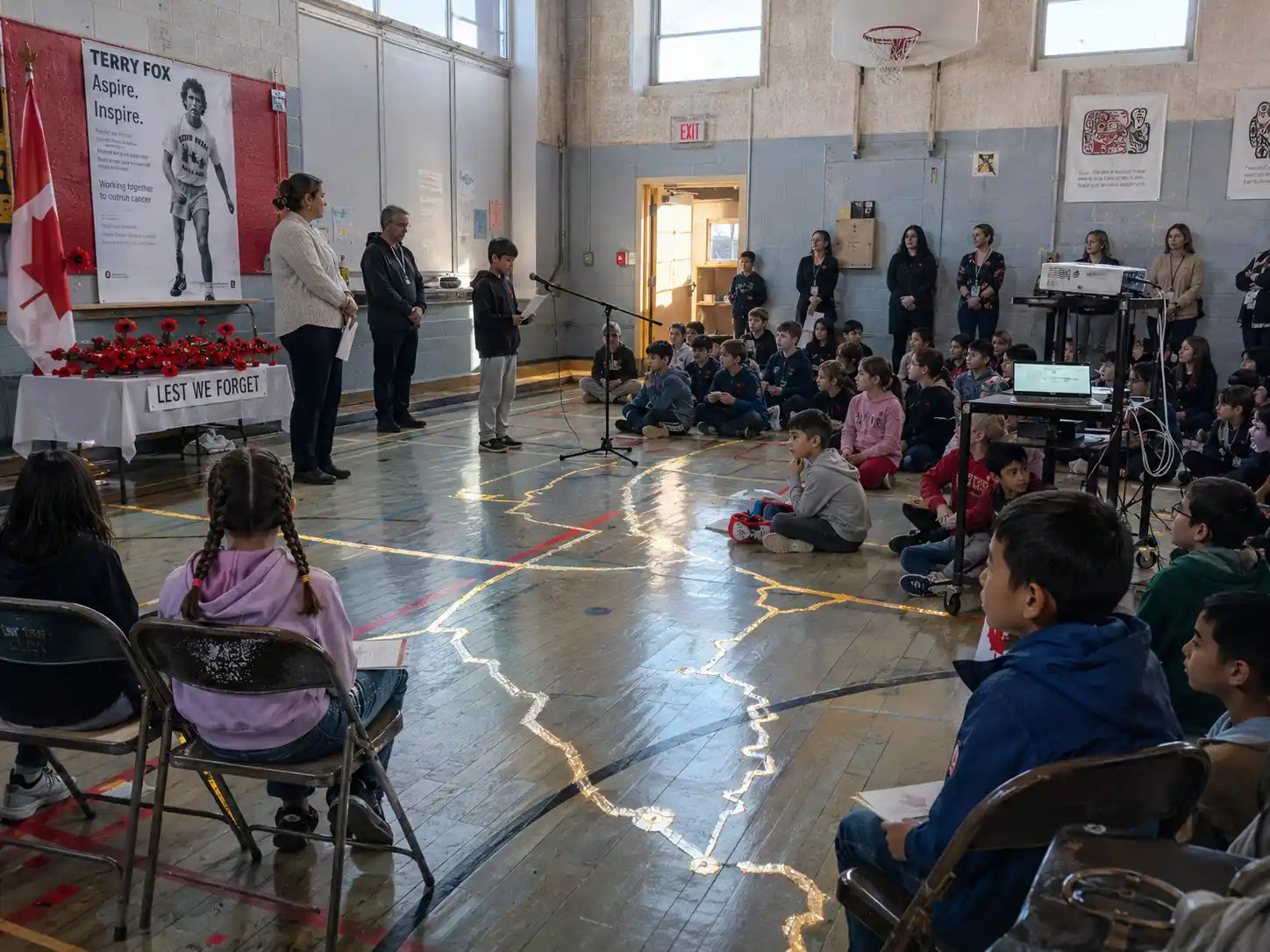
Chapter 6 — School as Civic Rehearsal
A school gym could briefly become the country.
Children sat cross-legged on the floor. The microphone squealed. Someone adjusted the flag. The principal stood near the front with a sheet of announcements. A class waited to perform. Teachers lined the walls. A few students whispered until a look shut them down. Then O Canada began: sometimes sung clearly, sometimes mumbled, sometimes half-known, sometimes in English, sometimes in French, sometimes with children still learning the words.
It was not grand.
It was folding chairs, floor tape, fluorescent lights, old basketball hoops, winter boots by the wall, a projector that might not work, and a room full of children learning how to be quiet together.
That was part of school’s civic work.
School was never only curriculum. It was rehearsal. Children learned math and reading, but they also learned how to stand in lines, wait for announcements, carry forms home, borrow library books, lose mittens, sit through assemblies, change for gym, share equipment, raise hands, join teams, handle report cards, enter dances, sell raffle tickets, walk to field trips, listen to guest speakers, and endure the boredom of public life.
Boredom mattered. Waiting mattered. Sitting with people you did not choose mattered.
A country needs some spaces where children practice being part of a public before they are old enough to understand politics.
The school calendar once carried a whole civic rhythm.
September meant new shoes, sharpened pencils, class lists, lockers, agendas, buses, lunch bags, and the feeling of beginning again. October brought Halloween parades, orange and black construction paper, costumes in hallways, and the first real weather change. November brought poppies and Remembrance Day. December brought concerts, food drives, winter crafts, Christmas, or other family and community rhythms depending on the school and neighbourhood. Winter brought indoor recess, snow pants, wet floors, and school closure announcements. Spring brought science fairs, track and field, field trips, book fairs, graduations, and the final strange weeks when classrooms smelled like dust, paper, and heat.
The calendar formed children because it repeated.
The Terry Fox Run was one of the clearest examples. Children pinned pledge sheets to fridges, collected coins, heard the story, watched a video, ran or walked laps around a field, and learned that a young man’s suffering had become a public duty. Most did not understand cancer, amputation, mortality, or national memory in any adult way. They understood shoes, laps, teachers cheering, names on a sheet, and the idea that a body could be used for something beyond itself.
That was civic rehearsal.
Remembrance Day worked differently. It asked for silence. Poppies appeared on coats. The Last Post played. Poems were read. Veterans or family stories sometimes entered the gym. Children fidgeted because children fidget. But even imperfect silence trained something rare: the ability to stand still before sacrifice.
A Scholastic Book Fair did another kind of work. It turned reading into a public event. Paper flyers went home. Children circled books they wanted. The library or gym filled with tables, posters, pencils, erasers, bookmarks, and bright covers. Desire met money. Some children bought stacks. Some bought one thing. Some bought nothing. Some looked anyway. The book fair taught that stories could become objects in the hand and that reading could be part of a shared childhood economy.
Science fairs taught explanation. Gym class taught bodies under rules. School dances taught awkward public identity. Lunchrooms taught noise, hierarchy, appetite, embarrassment, friendship, and the social meaning of where you sat. Lockers taught territory. Agendas taught planning. Computer labs taught a first version of digital citizenship before screens followed everyone home.
Even the school bus was formation. It was not home and not school, but a moving social world with its own order: older kids in the back, younger kids near the front, winter darkness in the morning, fogged windows, drivers who knew routes, and the strange discipline of waiting at the end of a driveway or street while the whole day had not yet begun.
School was one of the few places where a country could still gather children across difference.
Not completely. Not equally. Not without sorting. But more than most places.
Children from different families, incomes, languages, abilities, and temperaments had to share rooms, hallways, teachers, gyms, teams, assemblies, bathrooms, playgrounds, libraries, rules, and time. They did not always become friends. That was not the point. The point was that they had to encounter one another before retreating into private worlds.
A country cannot be built only from chosen groups.
School forced some unchosen public life.
This is also why school could hurt so deeply.
A place that forms people can also deform them.
Schools humiliated, excluded, streamed, punished, ignored, and failed children. Some teachers were cruel. Some principals protected the institution over the child. Some classrooms made poverty visible in painful ways. Some children were marked as slow, difficult, foreign, dirty, weird, poor, feminine, masculine, disabled, racialized, or disposable before they understood the labels.
Indigenous children and families carry a far deeper wound: school as a site of state violence, forced assimilation, family rupture, language loss, abuse, and death. That history cannot be treated as a side note inside a chapter about school ritual. It changes the meaning of Canadian schooling. The same word — school — carries safety for some memories and terror for others.
A truthful account has to hold that.
Schools also failed Black children, immigrant children, disabled children, poor children, religious minorities, rural children, northern children, and children who did not fit the expected mould. Some children learned belonging in school. Others learned that public life meant being watched, corrected, mocked, or erased.
So the repair cannot be “bring back old school.”
Old school contained too much harm, silence, false history, class sorting, gender policing, racial discipline, and institutional arrogance.
But a country cannot abandon the civic work of school just because older schooling failed.
The task is to rebuild school as truthful civic rehearsal.
That means school must do more than deliver credentials.
A school that is only a credential machine cannot form citizens. It can sort, test, rank, and prepare students for the next competition, but it cannot teach shared memory, public duty, embodied life, practical skill, or belonging.
A school that is only an ideological battleground cannot form citizens either. If every ritual, book, policy, flag, bathroom, sport, historical fact, or classroom phrase becomes ammunition in adult conflict, children inherit anxiety before responsibility. They learn that the public world is a war of symbols before they learn how to serve it.
School should not be either factory or battlefield.
It should be a public rehearsal space where children practice truthful belonging.
That requires memory. Not false memory. Not sanitized memory. Memory strong enough to name treaties, racism, war, immigration, Quebec, labour, women’s struggles, local history, environmental damage, and national achievement without reducing the country to either pride or shame.
It requires ritual. Not forced patriotism. Not empty ceremony. Ritual serious enough to teach that some moments deserve common attention.
It requires skill. Reading, writing, mathematics, science, history, art, music, physical education, shop, cooking, digital judgment, financial basics, repair, public speaking, and the ability to work with others.
It requires bodies. Children cannot be formed only in chairs and screens. They need gyms, fields, playgrounds, pools, tracks, dances, drama rooms, music rooms, shops, labs, gardens, and field trips.
It requires responsibility. Children should carry things, return things, clean things, help younger students, speak in front of others, lose gracefully, apologize, repair harm, and learn that rights live alongside duties.
It requires contact with place. A school should know its neighbourhood, town, reserve, city, watershed, local history, public library, parks, elders, veterans, newcomers, workers, artists, and institutions. A school without local memory becomes a content-delivery site.
It requires protection from adult overreach. Children should not be used as symbols in every national argument. They should be taught truth, but not turned into miniature activists before they can understand duty, scale, or complexity. They should be protected from indoctrination, but also from ignorance disguised as neutrality.
This is difficult because schools sit at the crossroads of everything adults fight about: history, race, religion, language, sex, class, technology, work, family, nation, safety, and the future.
That is exactly why schools matter.
If adults cannot build truthful public life in schools, they probably cannot build it anywhere.
Canadian schools also have to be understood regionally. A school in rural Saskatchewan is not a downtown Toronto school. A French school in Quebec is not an English public school in Alberta. A northern school is not a suburban school in Ottawa. A reserve school is not the same as a private school. An immigrant-heavy school in Brampton or Surrey or Montreal carries a different formation burden from a small-town school where everyone knows the same last names.
The country’s plurality enters the classroom every morning.
That plurality should not make civic rehearsal impossible. It should make it more necessary.
A school can teach children that they do not all come from the same story and still ask them to share a public world.
That is the Canadian challenge.
Not sameness. Shared life.
The older school assembly often assumed too much sameness. The future school cannot. But if the future school gives up on shared moments entirely, it will leave children with private identity, private screens, private feeds, private grievance, and public suspicion.
The answer is not less common life.
It is better common life.
A Terry Fox Run can still teach courage, suffering, public memory, and service. It can also include children who cannot run and still belong to the ritual.
A Remembrance assembly can still teach gratitude and grief. It can also include Indigenous veterans, peacekeeping complexity, Afghanistan, civilian suffering, and the moral seriousness of war.
A school concert can still gather families. It can include many religions and none. It can let children perform without pretending every family celebrates the same calendar.
A book fair can still make reading social. It can include books that show more of the country than older shelves did.
A history lesson can still build belonging. It can do so by telling the truth.
A gym class can still form bodies. It can do so without humiliation.
A shop class can still teach tools. It can do so without sexism or tracking.
A school library can still open worlds. It can do so without becoming merely another screen station.
A schoolyard can still teach public life. It can do so with enough adult care to prevent cruelty and enough freedom to allow judgment.
This is the balance.
Too little adult presence, and children can be abandoned to bullying, injury, exclusion, and silence.
Too much adult management, and children lose the chance to practice living.
School must hold the middle.
That middle is where formation happens.
The damage to school comes when that middle collapses. On one side, school becomes institutional control: forms, tests, compliance, surveillance, liability, risk avoidance, public relations, and defensive administration. On the other side, school becomes adult politics projected onto children. In both cases, the child disappears.
The child needs formation.
Not management.
Not propaganda.
Not neglect.
Formation.
A country that forgets this will ask schools to solve every social problem while stripping them of the rituals, trust, authority, tools, time, and shared purpose required to form people.
Teachers cannot do everything. Schools cannot replace families, neighbourhoods, faith communities, sports clubs, libraries, trades, public institutions, and stable housing. But schools remain one of the last common systems through which nearly every child passes.
That makes them precious.
It also makes them vulnerable.
When school is damaged, the whole country feels it later.
The repair is practical.
Restore serious reading.
Restore physical education as embodied formation.
Restore shop, cooking, music, art, drama, and technical skill.
Restore school libraries as living rooms of knowledge.
Restore field trips into local reality.
Restore rituals that can hold truth.
Restore recess and schoolyards as places of social learning.
Restore respect for teachers without making them untouchable.
Restore accountability without turning every problem into paperwork.
Restore local history.
Restore public service.
Restore the idea that school is not only preparation for the economy, but preparation for shared life.
This does not require pretending schools were better before.
It requires admitting that some older school practices performed functions we still need.
Children need shared time.
They need common memory.
They need adult authority that is neither abusive nor absent.
They need public rituals.
They need body training.
They need practical skill.
They need reading.
They need art.
They need local belonging.
They need truthful history.
They need to encounter people unlike themselves.
They need to learn how to sit in a room with others.
That last skill sounds small.
It is not.
A country where people cannot sit in a room with others will eventually become a country that can only shout across distance.
The school gym, with its squealing microphone and restless children, was never a perfect model of civic life.
But for a moment, it gathered a future public and asked it to practice attention.
That practice is worth rebuilding.
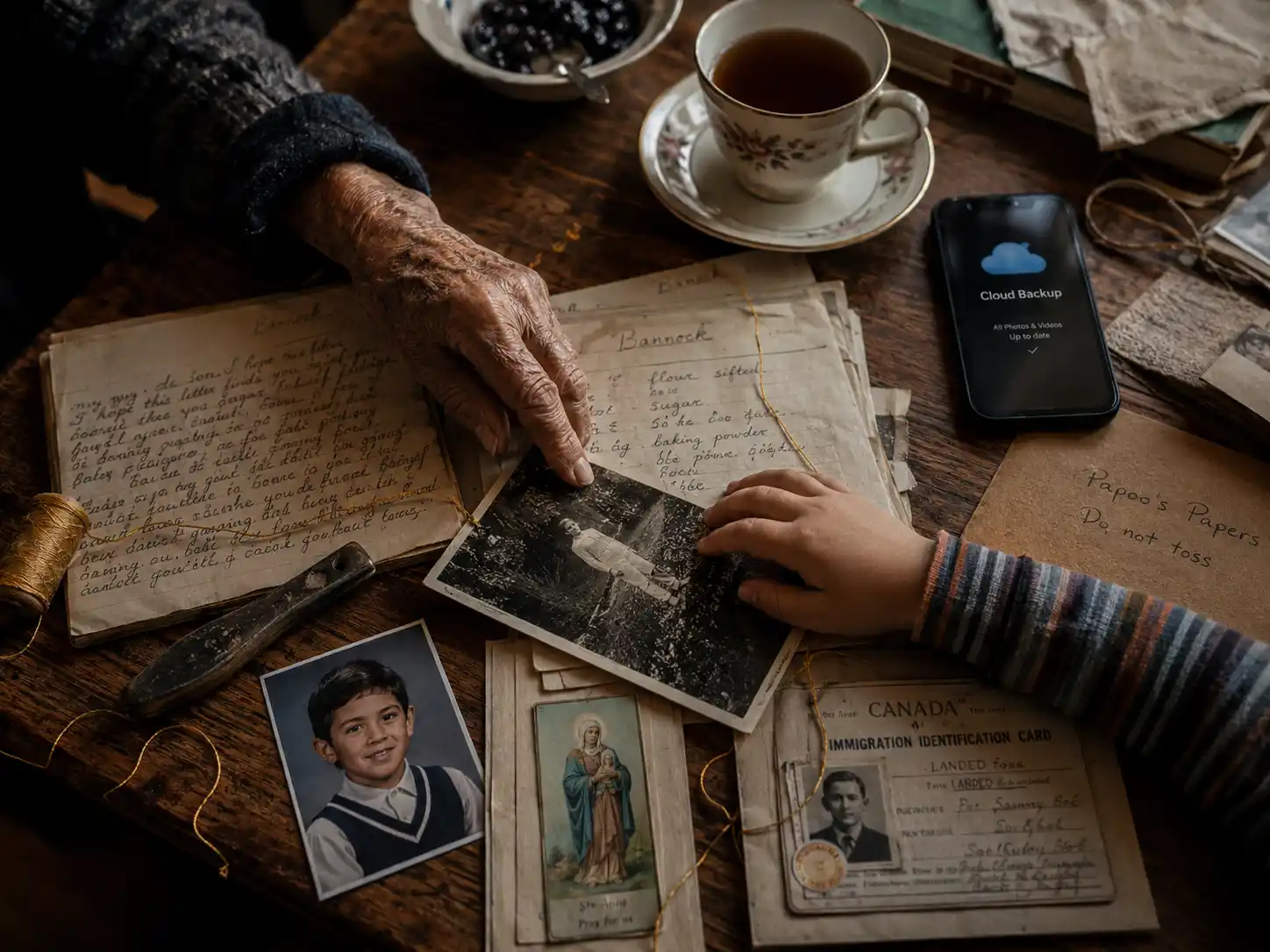
Chapter 7 — Family as Archive
A basement could hold more history than a textbook.
Photo albums. Old tools. Wedding china. VHS tapes. Recipe cards. Uniforms. Immigration papers. Boxes nobody had opened in years. A sewing kit. A work jacket. A faded certificate. A jar of screws. A funeral card. A drawer full of keys to locks nobody remembered. A picture of people who looked familiar but whose names were almost lost.
Family was one of Canada’s archives.
Not official Canada. Not the Canada of speeches, policy, museums, campaign slogans, or national branding. The Canada of grandparents, aunties, cousins, parents’ workplaces, Sunday dinners, Christmas basements, Chinese New Year meals, Ukrainian halls, Greek festivals, Swedish finance groups, Hungarian gatherings, Romanian picnics, Polish computer clubs, Czech soccer teams, Italian clubs, Portuguese bakeries, West Coast gaming meetups, Portuguese gamers, Caribbean churches, Quebec kitchens, prairie farm relatives, Indigenous kinship, old-country memory, and stories repeated until children knew who they belonged to.
Family memory was not always organized. It lived in objects more than systems.
The recipe card with grease on the corner.
The toolbox with the old man’s initials scratched into the lid.
The wedding photo in a frame from a marriage nobody discussed.
The work boots by the basement stairs.
The prayer book.
The union pin.
The citizenship paper.
The war medal.
The baby bracelet.
The funeral program.
The VHS tape labelled in marker.
The faded class picture.
The family business sign stored behind the furnace.
The old suitcase that came from somewhere else.
The photograph taken on land the family no longer owns.
These things were not merely sentimental. They were evidence.
They told a child that life did not begin with him. Before his preferences, profile, politics, and ambitions, there were people who worked, moved, married, failed, prayed, fought, cooked, repaired, migrated, endured, built, drank, hid things, survived things, and carried names forward.
That knowledge gives a person weight.
A child who knows no family story can still become strong. Many do. Some must, because the family story is broken, hidden, violent, or unavailable. But where family memory works well, it gives orientation before ideology. It says: you came from somewhere. People paid for you to be here. Some did right. Some did wrong. Some suffered. Some caused suffering. Some left one country for another. Some stayed on land for generations. Some lost land. Some built houses. Some lost houses. Some served. Some escaped. Some were silenced. Some refused to disappear.
The archive does not absolve. It locates.
That is why family mattered as a formation system. It transmitted memory before the child could choose identity as a project.
Modern life often tells people that identity is self-definition. That is partly true. A person is not only the family he inherits. Some inherit abuse, shame, silence, coercion, poverty, racism, addiction, or roles that must be refused. A person has to become more than what was handed down.
But identity built only from self-definition can become weightless.
It can be shaped too easily by platforms, brands, politics, peer language, therapeutic slogans, and the market of available selves. Without inherited memory, a person may know what he feels but not what he carries. He may know his preferences but not his obligations. She may know her trauma vocabulary but not her grandmother’s route through the world. They may know the national argument but not the family cost of arriving in the country.
Family archives were one way people resisted weightlessness.
For immigrant families, memory often crossed oceans.
It lived in suitcases, passports, old photographs, recipes, remittances, accents, translated documents, phone calls at odd hours, relatives visited after years away, stories of war, scarcity, farms, apartments, borders, exams, sponsorships, factories, taxis, cleaning jobs, restaurants, credentials not recognized, degrees repeated, names mispronounced, children translating, and parents who carried grief without making it the centre of dinner.
An immigrant family archive could teach gratitude and pressure at the same time. It could say: we came here so you could have a chance. It could also become a burden: do not waste the sacrifice, do not embarrass the family, do not forget where you came from, do not become too Canadian, do not remain too foreign.
That tension formed millions of Canadians.
The country’s multicultural story often speaks in public language: diversity, inclusion, belonging, citizenship. Family memory holds the private cost: the jobs taken, the rooms rented, the winter coats bought, the money sent home, the languages kept or lost, the old parents missed, the old country argued over, the children who became interpreters before they became adults.
For Indigenous families, archive cannot be reduced to boxes in a basement.
Memory lives through kinship, land, language, ceremony, games, names, stories, songs, aunties, uncles, grandparents, community, urban networks, friendship centres, band offices, veterans, survivors, children taken, children returned, and the long work of cultural continuity after deliberate rupture.
Residential schools attacked family as archive. So did child welfare, relocation, language suppression, and policies that treated Indigenous kinship as an obstacle to Canadian administration. The damage was not only individual trauma. It was an assault on transmission: on the ability of families to carry language, law, land memory, food, ceremony, discipline, humour, grief, and belonging across generations.
That means Indigenous family memory is not a side example. It is central to understanding what happens when a state damages the systems by which people remember themselves.
It also shows that family archive can survive attack. Through grandparents, aunties, language keepers, ceremony, political struggle, art, community memory, and everyday care, transmission continues.
For Quebec families, memory often carried a different national atmosphere: Catholic grandparents and secular grandchildren, French language as home and public duty, referendum nights, school systems shaped by language law, Radio-Canada in the background, family gatherings where humour, politics, hockey, music, and history carried a sense that Canada was never simply one country speaking English.
A Quebec family archive reminds the rest of Canada that national memory is not singular. The same flag, war, school, anthem, broadcast, or political debate can sound different depending on language, church history, class, region, and the memory of being a people inside another political structure.
For rural families, memory often lived in land and tools: farm auctions, barns, machinery, hunting rifles, fishing gear, tractors, grain bins, boats, nets, snowmobiles, family roads, volunteer fire halls, church suppers, weather stories, crop failures, workplace injuries, and the knowledge that neighbours were not a lifestyle preference but survival infrastructure.
For working-class families, memory could live in uniforms, lunch pails, union cards, factory photos, pay stubs, shop stories, steel-toed boots, injuries, layoffs, night shifts, and pride mixed with exhaustion. Work was not self-actualization. It was duty, money, body, time, danger, and the hope that children might have choices their parents did not.
For religious families, memory lived through ritual: baptisms, bar mitzvahs, confirmations, Eid, Diwali, Vaisakhi, Passover, Christmas, Ramadan, funerals, weddings, fasts, feasts, hymns, prayers, food, clothing, calendars, rules, stories, elders, and the repeated claim that life belonged to something larger than the self.
These archives could bless. They could also burden. Religion could transmit service, beauty, discipline, charity, and belonging. It could also transmit fear, control, shame, secrecy, and institutional betrayal.
Family memory is powerful because it is close to the body.
It tells you what people ate, how they prayed, what they feared, where they worked, who left, who stayed, who drank, who saved, who served, who disappeared, who sacrificed, who was never forgiven, who held everyone together, and who paid the price for holding everyone together.
That closeness is why family can wound so deeply.
A family archive is not always safe.
It can preserve lies. It can demand silence. It can turn abuse into “that’s just how it was.” It can hide addiction, incest, violence, racism, betrayal, poverty, mental illness, residential school damage, war trauma, exile, coercion, and shame. It can make children carry roles they never chose. It can punish those who ask questions. It can treat loyalty as obedience.
Some people need distance from family to survive.
Some need to leave the house, the religion, the town, the language, the business, the expectations, or the inherited script. Some become whole only by refusing the archive they were given.
That must be honoured.
The repair is not family worship.
The repair is truthful transmission.
Truthful transmission says: this happened. This helped. This harmed. This was endured. This should not be repeated. This deserves gratitude. This deserves grief. This was love. This was control. This was sacrifice. This was silence. This is where we came from. This is what we owe. This is what we refuse.
Without truthful transmission, family memory decays into two bad forms: mythology or disappearance.
Mythology turns the family into a heroic story. Everyone worked hard. Everyone sacrificed. The old ways were better. The elders were always wise. The family was strong. The harm is minimized because naming it feels like betrayal.
Disappearance does the opposite. It lets the photos go unlabelled, the recipes vanish, the language fade, the tools be thrown out, the stories die with the old people, the family business close without record, the migration story reduce to a fact, the grief become private clutter, the old country become a cuisine, the war become a medal without meaning.
Both are losses.
Mythology keeps memory but loses truth.
Disappearance keeps freedom but loses depth.
The modern world accelerates disappearance.
Photos moved from albums to phones. Then from phones to clouds. Thousands of images replaced a few printed ones. The record expanded while memory weakened. A printed photo demanded selection. Someone chose it, developed it, placed it, labelled it, stored it, showed it. A digital archive can become infinite and inaccessible: searchable in theory, forgotten in practice.
A family may now possess more images than any previous generation and remember less about them.
Who will label the cloud?
Who will explain the video?
Who will say where the recipe came from?
Who will tell why the uncle stopped visiting?
Who will remember the name of the town before it is mispronounced into nothing?
Who will know which tools belonged to whom?
Who will ask the grandmother before the dementia comes?
Who will record the language before the last fluent speaker in the family dies?
Who will ask what the old country was really like, not only what the family says at weddings?
Housing pressure also weakens family archive.
When young people move often, live with roommates, rent small rooms, return home under stress, delay families, or scatter across cities and provinces, objects become burdens. There is no basement. No garage. No attic. No family house that holds memory accidentally. Storage costs money. Moving punishes inheritance. The old boxes are thrown out because no one has space for them.
Mobility creates freedom. It also breaks continuity.
Divorce, estrangement, migration, remarriage, smaller families, elder isolation, and long work hours change transmission too. The Sunday dinner is not guaranteed. The cousins may not grow up together. The grandparents may live across the country or across the world. A parent may carry two jobs. A child may know relatives mostly through video calls and family group chats.
Again, some of this improves life. People leave harmful homes. Women gain freedom. Children escape silence. Digital calls keep diasporas connected. Blended families create new bonds. Therapy language helps people name what older generations buried.
Those gains are real.
But the function remains: someone has to transmit memory.
If biological family cannot do it, chosen family, elders, community, archives, friendship centres, churches, temples, synagogues, cultural associations, libraries, local historians, and oral-history projects may have to help. The point is not that every family must look the same. The point is that people need continuity across generations.
A country without inter-generational transmission becomes easier to manipulate.
If people know no family story, politics can give them one.
If they know no local story, platforms can give them identity.
If they know no inherited duties, brands can sell them belonging.
If they know no ancestral grief, outrage can supply meaning.
If they know no real elders, influencers can become substitutes.
If they know no old mistakes, they may repeat them with better language.
Family archives protect against this not by making people conservative or obedient, but by making them less empty.
A person with memory has more than a mood. More than a feed. More than a brand. More than a politics. More than a diagnosis. More than a resume.
He has context.
She has witnesses.
They have ghosts, obligations, warnings, examples, jokes, recipes, songs, tools, prayers, photographs, debts, inheritances, and unfinished work.
That is why family memory belongs in a book about national repair. The nation is not only built upward through government. It is built sideways and backward through families remembering, correcting, and transmitting.
The state cannot do this by itself.
Schools can teach history. Archives can preserve records. Museums can exhibit objects. Governments can apologize. Public institutions can collect testimony. But the intimate work of transmission happens closer to home: at tables, funerals, weddings, kitchens, hospital beds, car rides, prayer gatherings, community halls, old houses, and moments when a child finally asks, “Who was that?”
The answer matters.
Not because blood determines destiny. It does not. Not because every inheritance deserves loyalty. It does not. Not because family is always safe. It is not.
The answer matters because people need to know the human chain they stand inside.
That chain can be biological, adoptive, chosen, communal, spiritual, cultural, national, or local. But without some chain, the self becomes too easy to isolate.
The repair is practical.
Print some photos. Label them. Record elders. Ask about work. Ask about migration. Ask about land. Ask about religion. Ask about languages. Ask about shame. Ask about war. Ask about residential school, if the family carries that history and if the person is willing. Ask about the old town. Ask about the first job. Ask about the recipe. Ask about the tool. Ask about the business. Ask about the song. Ask about the funeral. Ask about the person nobody mentions.
Do not ask to extract.
Ask to honour.
Some stories should be handled gently. Some should not be forced. Some elders have spent a lifetime surviving by not speaking. Some descendants have a right not to reopen wounds on command. Truthful transmission is not interrogation. It is patient recovery.
Families can build small archives. A box. A binder. A folder. A recording. A labelled album. A recipe book. A tool with a note. A map. A timeline. A family tree with uncertainty marked honestly. A digital folder that someone actually organizes. A community oral-history night. A school project that asks students to bring family objects with care. A library program that helps people preserve photographs. A local archive that treats ordinary families as historically meaningful.
This work sounds small.
It is not.
A country that forgets family memory becomes dependent on official memory, commercial memory, and political memory. It loses the texture that keeps national stories honest.
Official memory can say “immigration.” Family memory says: your grandfather washed dishes for three years and sent money home.
Official memory can say “war.” Family memory says: he woke up screaming and nobody knew what to call it.
Official memory can say “industrial economy.” Family memory says: this tool was his, this injury changed his life, this strike divided the town.
Official memory can say “Quebec nationalism.” Family memory says: this is how referendum night felt in our kitchen.
Official memory can say “rural decline.” Family memory says: this is the farm auction where everyone pretended not to cry.
Family memory makes history human.
It also makes responsibility harder to avoid.
A person who knows what his family endured may become grateful. A person who knows what his family did may become accountable. A person who knows what was hidden may become freer. A person who knows what was lost may become more careful with what remains.
That is the goal.
Not pride alone. Not shame alone. Continuity.
Canada needs continuity because many of its formation systems have become thin. The family archive is one of the last places where a person can still encounter time at human scale.
A recipe can carry a century.
A tool can carry a trade.
A photograph can carry migration.
A song can carry language.
A scar can carry work.
A silence can carry trauma.
A name can carry land.
A funeral can carry the truth of what one person meant.
Modern life moves quickly. Family memory slows it down.
It says: before you perform yourself, know who formed you.
Before you condemn everything, know what was carried.
Before you defend everything, know what was hidden.
Before you call yourself self-made, know who paid.
Before you cut the past loose, know what you are cutting.
A basement could hold more history than a textbook.
But only if someone opens the boxes.
Only if someone asks.
Only if someone tells the truth.
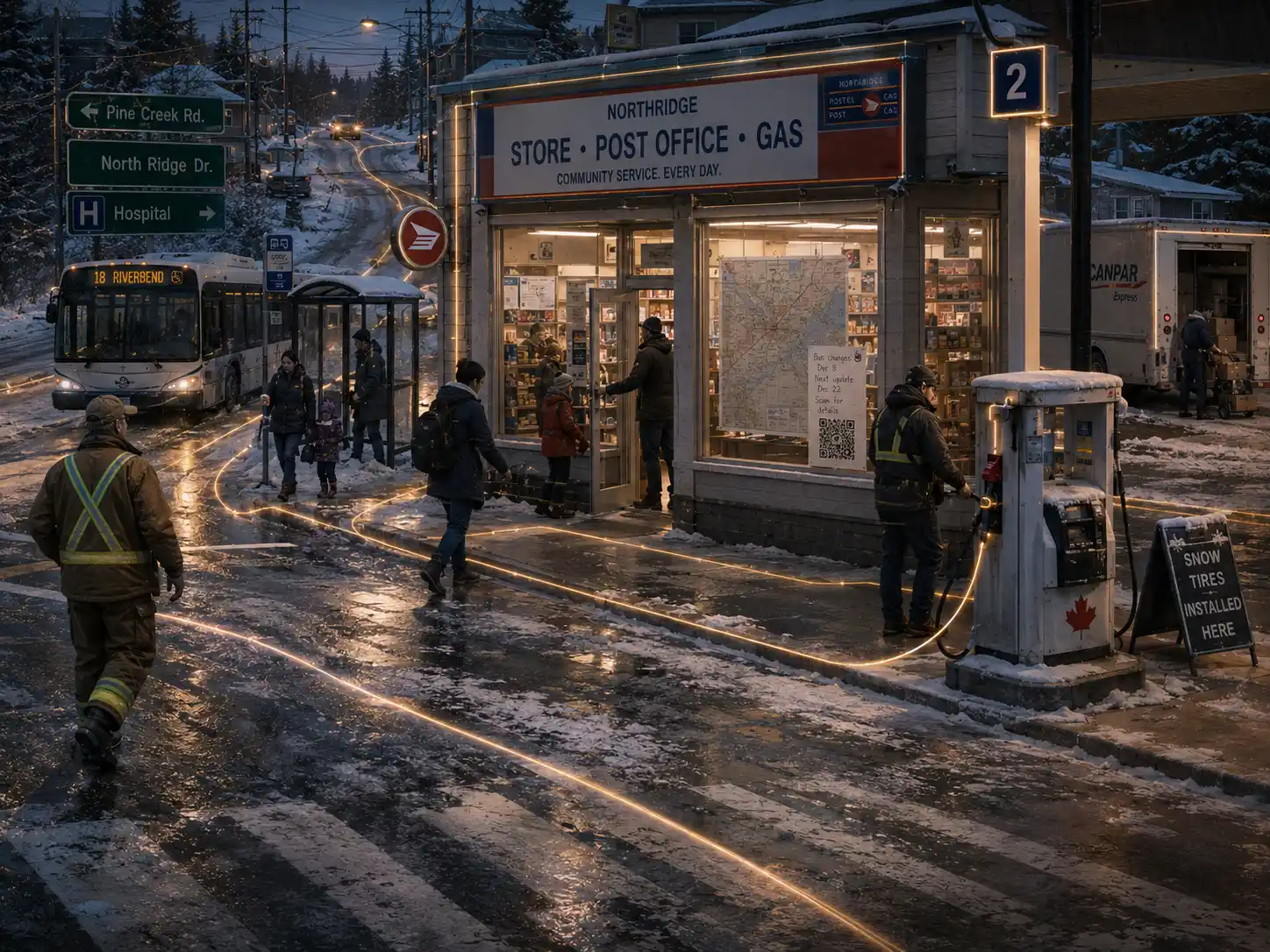
Chapter 8 — Stores, Roads, and Public Life
A Canadian Tire aisle could tell you what kind of country you lived in.
Snow shovels. Hockey tape. Fishing line. Furnace filters. Extension cords. Windshield washer fluid. Propane. Duct tape. Batteries. Camping gear. Work gloves. Tarps. Salt. Flashlights. Plungers. Bike tubes. Paint. Screwdrivers. Ratchet sets. Barbecue parts. Canoe straps. Mosquito coils. Replacement bulbs. Things for leaks, cracks, flats, rust, snow, heat, rain, repairs, chores, weekends, emergencies, and problems nobody wanted to call a specialist for.
A store like that was not only a store.
It was a map of household competence.
It assumed a person might need to shovel, tape, patch, tighten, scrape, measure, plunge, cut, sand, paint, inflate, grill, camp, tow, fix, or prepare. It assumed weather would cause trouble. It assumed weekends involved errands. It assumed the house, car, cottage, bike, yard, basement, rink bag, fishing rod, and furnace all belonged to the same practical world.
Canadian Tire did not make Canadians capable by itself. No store could. But its aisles reflected a country where ordinary people were still expected to know what tools were for.
The same was true, in different ways, of Home Hardware, local hardware stores, Canadian co-ops, farm supply stores, gas stations, corner stores, libraries, malls, Sears catalogues, Zellers, The Bay, Consumers Distributing, Blockbuster, movie theatres, bus stations, diners, Tim Hortons, and roadside stops.
They were not all noble. They were commercial places. They sold things. Some were ugly, fluorescent, underpaid, wasteful, suburban, car-dependent, and ordinary in the least romantic sense. But ordinary places do ordinary civilizational work.
They taught people how to move through public life.
A library card made a child a borrower. It gave a name, a number, a due date, and a small civic trust. A child could take home a book that did not belong to him because a public institution believed he could return it. That was not a small lesson.
A mall gave adolescents a public indoor world. Not home, not school, not fully adult. A place to wander, browse, perform, flirt, spend too much time in a food court, test clothes, test taste, test identity, test distance from parents without being entirely uncontained. The mall could be shallow and commercial, but it also gave teenagers a public stage before the platform turned identity into a profile.
A Sears catalogue brought desire into the kitchen. It made the household imagine winter coats, toys, tools, curtains, appliances, bedding, gifts, and things that might arrive later. A catalogue taught waiting. It taught browsing under scarcity. It taught that wanting something and getting it were separated by time, money, mail, and parental judgment.
A Blockbuster wall forced a family to choose one movie together. One. Not everything. A person could wander the aisles, read the backs, argue over comedy or action, discover that the good copy was gone, settle for something else, and carry the case to the counter. Streaming solved that problem by making almost everything available. It did not automatically replace the ritual of choosing under limits.
A road trip turned distance into memory. Highways, paper maps, gas stations, ferry terminals, bus depots, roadside motels, back seats, snack bags, provincial border signs, rest stops, and Tim Hortons cups made geography physical. A child learned that Canada was not only a shape on a classroom map. It was hours in a car, weather changing through the windshield, arguments over music, bathroom stops, lakes appearing and disappearing, small towns passing, and the knowledge that arrival took time.
Roads formed people because distance formed people.
A country as large as Canada cannot understand itself without roads. Some roads were highways between suburbs. Some were logging roads. Some were prairie grids. Some were winter roads. Some were ferry-linked routes on coasts. Some were northern lifelines. Some were bus routes across cities. Some were dangerous roads children were told never to cross. Some roads connected opportunity. Some roads marked neglect.
Public life happened along them.
A gas station was not just fuel. It was directions, bathrooms, chocolate bars, windshield squeegees, lottery tickets, local gossip, a mechanic nearby, a map rack, a payphone once, a place to stop when weather or distance became too much.
A corner store was not just candy. It was a child’s first independent transaction. Coins in a pocket. Tax misunderstood. A clerk watching. A choice made under pressure. A walk home with a Slurpee, gum, hockey cards, chips, pop, or something the parent would not have bought.
A bus station was not just transit. It was departure, waiting, strangers, announcements, bags, relatives arriving, students leaving, workers commuting, people passing through towns they could not afford to fly over.
A public library was not just books. It was heat in winter, quiet, internet access, story time, homework, local history, job search help, photocopying, newcomers learning systems, seniors reading newspapers, children wandering shelves, and people sharing space without having to buy anything.
That last part matters.
A society needs places where people can exist without constant purchase.
Commercial places formed people, but public places held a different kind of trust. The library, community centre, public pool, arena lobby, park bench, rink, school gym, post office, and town hall all taught that Canada was not only private property and private consumption. There were still rooms, counters, schedules, and services that belonged to the public.
This world varied wildly.
Rural stores were not suburban malls. Northern stores were not Toronto plazas. A reserve store, a prairie co-op, a Quebec depanneur, an Atlantic fish plant town, a Vancouver strip mall, a Scarborough plaza, an Edmonton power centre, a Winnipeg bus route, a Newfoundland outport road, a Saskatchewan grain elevator town, and a Montreal metro station did not produce the same public life.
Immigrant plazas did their own civilizational work. Grocery stores, bakeries, travel agencies, remittance counters, restaurants, religious bookstores, language schools, tailors, salons, medical offices, and community bulletin boards turned commerce into settlement. A plaza could become a bridge between old country and new country. It could teach a child that Canada was not only school and English television. It was also parents sending money home, buying familiar food, speaking another language at the counter, finding a tax preparer, meeting relatives, and slowly building a life.
Quebec public life had its own forms: depanneurs, parish legacies, cafes, French-language bookstores, Radio-Canada in the background, school systems shaped by language and history, neighbourhoods where public life carried a different national memory inside Canada.
Indigenous public life cannot be reduced to southern retail memory. Stores, roads, band offices, friendship centres, schools, health clinics, hockey arenas, community halls, ferry docks, winter roads, powwow grounds, and urban Indigenous organizations all sit inside histories of land, displacement, resilience, neglect, and continuity that the rest of Canada too often treats as peripheral.
Roads and stores also carried harm.
Highways cut through neighbourhoods. Malls killed main streets. Big-box stores weakened local businesses. Car dependency isolated people without vehicles. Public places could exclude poor people, racialized people, teenagers, disabled people, homeless people, and anyone treated as suspicious. Retail workers were underpaid. Security guards watched some bodies more than others. Libraries and malls were warm for some and hostile for others. Roads killed pedestrians. Parking lots replaced walkable places. Consumer life trained desire as much as competence.
So this chapter is not a hymn to retail.
It is an argument that public life needs places where ordinary people encounter the world outside the house.
The damage came when more of those encounters moved into private interfaces.
Shopping became scrolling. Browsing became recommendation. Renting became streaming. A catalogue became an infinite cart. A map became GPS. A clerk became a chatbot. A counter became a login. A mall became a website. A library became, for some, a database rather than a room. A road trip became optimized routing. A job application moved from a handshake or paper resume to a portal. Food arrived without the restaurant. Groceries arrived without the aisle. Banking arrived without the teller. Government arrived without the counter.
Again, much improved.
Online shopping helped rural people, disabled people, overworked parents, people without nearby stores, and anyone who needed something unavailable locally. GPS saved time and reduced fear. Streaming opened access. Delivery helped the sick, the elderly, and the busy. Digital libraries expanded reach. Online forms saved trips. Remote services made life possible for people who had been badly served by distance.
But convenience has a hidden price when it replaces too many shared places.
The person gains efficiency but loses practice. No browsing with strangers. No asking the clerk. No waiting in line. No local noticeboard. No chance meeting. No child learning how to pay. No teenager learning how to behave in a semi-public place. No family negotiating in one aisle. No elder reading the paper in the library. No newcomer learning the system through a face at a counter. No human being seeing what the town actually sells, wears, reads, repairs, eats, borrows, wastes, and needs.
Public places make society visible.
Digital systems make society accessible, but often invisible.
That difference matters.
When society becomes invisible, people can start to imagine they do not depend on anyone. They click, order, stream, scan, route, and receive. The labour disappears behind the app. The warehouse, driver, clerk, librarian, mechanic, cashier, road crew, cleaner, shelf stocker, programmer, call-centre worker, and public servant become background. The world feels smoother because more human work is hidden.
Older public life did not hide the world as completely. It made people deal with the inconvenience of other people.
A line.
A closing time.
A sold-out shelf.
A late bus.
A wrong size.
A return policy.
A librarian’s warning.
A cashier’s mistake.
A neighbour in the same aisle.
A teenager blocking the mall entrance.
A child asking for something the parent refused.
A stranger giving directions.
These frictions were annoying. They were also social training.
They taught patience, negotiation, embarrassment, restraint, trust, disappointment, and public behaviour. They taught that the world was not instantly adjustable to the self.
The great shift is that more life now arrives without friction, but also without contact.
That is why stores, roads, and public life belong in this book. They show how ordinary places formed ordinary capacities. Not heroic capacities. Not ideological ones. Capacities like finding your way, asking for help, choosing under limits, borrowing and returning, waiting your turn, handling money, recognizing workers, sharing space, fixing a problem, and seeing yourself as part of a local world.
A country cannot be formed only through private convenience.
It needs shared rooms.
Some of those rooms will be commercial. Some public. Some religious. Some civic. Some recreational. Some temporary. Some seasonal. But people need places where they can be near one another without being reduced to audience, consumer profile, applicant, patient, user, or voter.
The repair is not to bring back every dead store.
Zellers does not need to return for Canada to become whole. Blockbuster does not need to return. The Sears catalogue does not need to return. Canadian Tire money does not need to return as paper memory. The point is not to preserve every retail artifact.
The point is to rebuild what those places sometimes allowed: practical browsing, local errands, public trust, family negotiation, teenage semi-freedom, child-scale commerce, shared entertainment, human counters, and places where people can enter without already knowing exactly what they want.
The future needs better public places than the past had.
More walkable. More accessible. Less car-dependent. Less hostile to the poor. More welcoming to teenagers without treating them as threats. More useful for elders. More reachable for disabled people. More supportive of local business. More honest about Indigenous land. More connected to immigrant settlement. More alive in winter. More human inside digital systems.
Libraries are one model. They are among the last places where a person can enter without paying, stay without buying, ask for help, use a computer, bring a child, attend a program, read local history, warm up, study, or sit quietly among strangers. They are not nostalgic. They are future infrastructure.
Community centres are another. Rinks, pools, gyms, meeting rooms, bulletin boards, festivals, public kitchens, youth programs, seniors’ activities, newcomer services, and local events all rebuild the physical commons.
Local stores matter too, especially when they carry more than goods: repair knowledge, names, advice, bulletin boards, continuity, and memory.
Roads matter when they connect rather than isolate. A road can be a highway, but it can also be a walk to school, a bike lane to the library, a bus route to work, a safe crossing to the park, a winter road to a northern community, a ferry route to a coastal town, or a main street where people still meet.
The question for repair is simple:
Where do people encounter one another now?
If the answer is mostly online, mostly in cars, mostly as consumers, mostly through portals, mostly through politics, or mostly not at all, then the country is thinning.
Canada needs places where ordinary life can still mix.
Places to borrow.
Places to browse.
Places to repair.
Places to wait.
Places to ask.
Places to return.
Places to sit.
Places to meet.
Places to be seen without performing.
Places to belong without declaring a position.
A Canadian Tire aisle could tell you what kind of country you lived in.
So could a library card.
So could a bus route.
So could a mall food court.
So could a depanneur.
So could a ferry terminal.
So could an immigrant plaza.
So could a gas station on a winter highway.
So could a corner store with a child counting coins at the counter.
The country was not only in Parliament, policy, or national myth.
It was in the errands.
And if Canada wants to rebuild common life, it has to take errands seriously again.
Part III — Active Cultural Engines
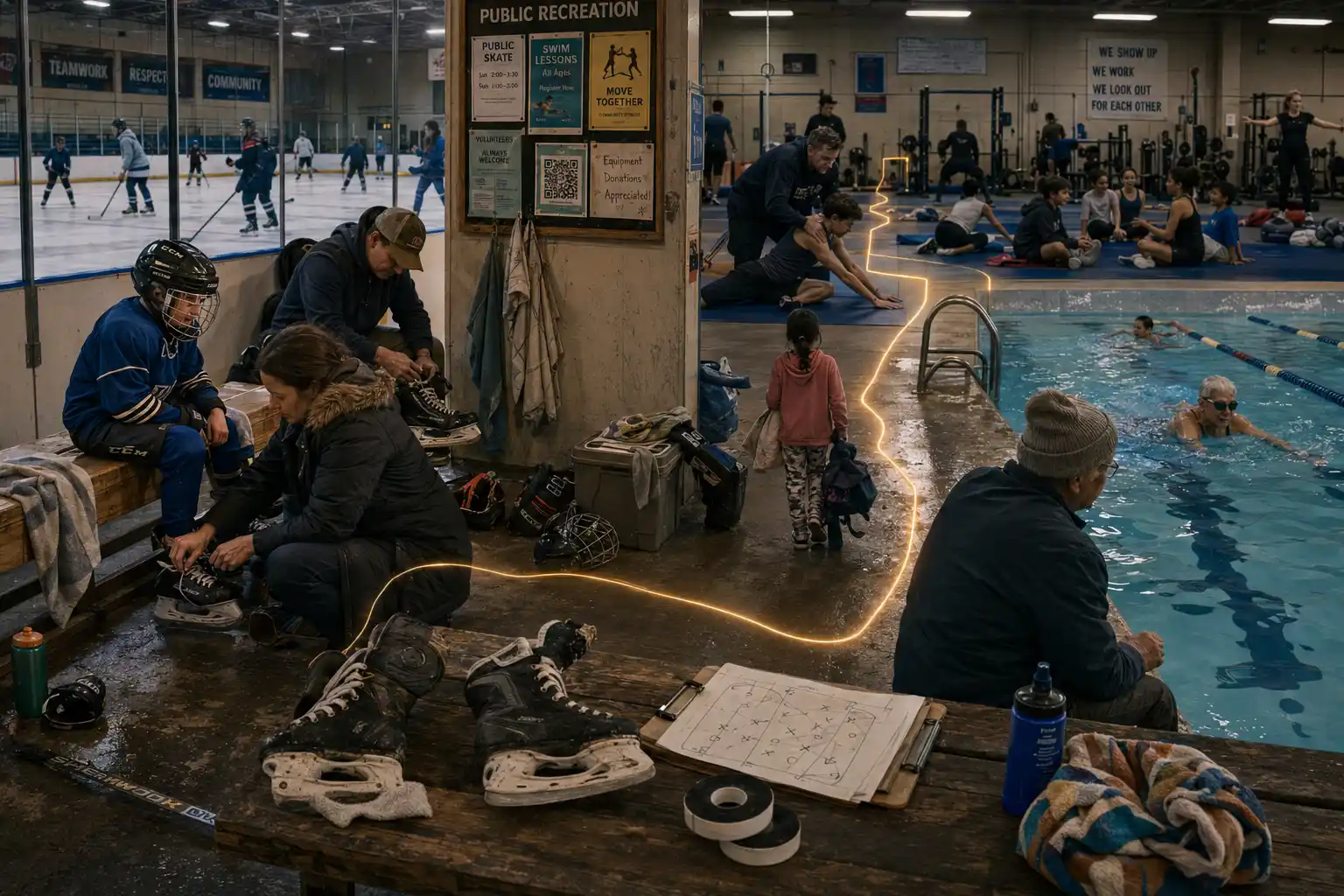
Chapter 9 — Bodies in Training
A rink was not only a rink.
It was cold air, bad coffee, skate guards, wet hair, vending machines, parents in winter coats, coaches with clipboards, children learning how to lose, and teenagers discovering that the body does not care what you think you are. You either trained or you did not. You either showed up or you did not. You either crossed the line, made the pass, took the hit, missed the shot, finished the race, or got back up.
Bodies tell the truth.
That is why physical culture mattered.
Long before a young person had language for discipline, confidence, masculinity, femininity, anxiety, health, identity, performance, trauma, or resilience, the body was already teaching. It taught through breath, sweat, soreness, balance, fear, impact, rhythm, timing, strength, weakness, pain, recovery, and repetition.
A child could say anything about himself. The body answered differently.
Can you skate?
Can you swim?
Can you run the lap?
Can you take instruction?
Can you lose without quitting?
Can you win without humiliating someone?
Can you get hit and stay calm?
Can you be tired and keep form?
Can you be afraid and still step forward?
Can you control yourself when you are stronger than someone else?
These are not only athletic questions.
They are character questions asked through the body.
Canada had many places where those questions were asked: rinks, school gyms, public pools, boxing clubs, wrestling mats, martial arts dojos in strip malls, soccer fields, basketball courts, baseball diamonds, rugby pitches, track meets, lifeguard chairs, weight rooms, curling clubs, ski hills, outdoor rinks, rec centres, and basement gyms with mismatched plates.
The rink is the easiest symbol, but it should not be the only one.
A public pool formed people differently. It taught breath, panic, trust, danger, instruction, and rescue. Swimming lessons were not only recreation; they were survival training in a country of lakes, rivers, pools, beaches, docks, cottages, boats, and summer camps. Lifeguarding taught vigilance: watching others while boredom tried to dull attention.
A wrestling mat taught that there is nowhere to hide from leverage. Strength mattered, but so did balance, pressure, humility, and technique. A child who thought he was tough could be folded by someone smaller who knew what he was doing.
A boxing gym taught fear more honestly than most classrooms. It taught that courage is not loudness. Courage is stepping in when the body wants to step out. It taught restraint because uncontrolled aggression becomes weakness. It taught respect because every person in the room knew what it felt like to be exposed.
A martial arts dojo taught ritualized discipline: bowing, repetition, rank, form, sparring, patience, and the slow discovery that skill cannot be downloaded.
A track meet taught the clock. No excuses. No debate. Run the distance. Cross the line. See the time.
A rugby field taught mud, contact, trust, and the strangeness of controlled violence under rules.
A basketball court taught rhythm, space, pressure, and improvisation.
A dance studio taught pain hidden under grace.
A weight room taught that nobody becomes strong by wanting to be strong.
Each of these places trained a different part of the person. Together, they formed one of the country’s active cultural engines: embodied practice.
Embodied practice is different from opinion, image, or commentary. It cannot be faked for long. You can talk like an athlete, dress like an athlete, post like an athlete, and still be exposed by the work. The body keeps records. It remembers skipped practice, bad sleep, fear, pride, injury, effort, laziness, patience, and repetition.
This is why sports and physical disciplines mattered beyond sport.
They taught young people to live under limits.
The body has limits. Time has limits. Energy has limits. Skill has limits. Pain has meaning. Fatigue changes judgment. Fear changes movement. Pride makes people sloppy. Panic wastes breath. Repetition builds capacity. Recovery matters. Instruction matters. Showing up matters.
A culture that loses bodily formation can become very fluent in talk and very weak in practice.
It can argue endlessly about strength while becoming physically fragile.
It can perform confidence while avoiding difficulty.
It can celebrate bodies as images while neglecting bodies as instruments.
It can turn courage into language instead of behaviour.
It can confuse identity with capacity.
Sport prevented some of that because it forced contact with reality.
Not perfectly. Not always. Sport can become its own fantasy. But at its best, it made young people answer to something outside self-description.
This mattered in Canada because the country’s climate, land, work, and public life all demanded bodies. Winter asked for endurance. Water asked for swimming. Work asked for strength, stamina, and coordination. Land asked for walking, carrying, paddling, chopping, lifting, balancing, and tolerating discomfort. Public life asked for people who could show up, serve, coach, volunteer, and stay with a task.
The body was not separate from citizenship.
A person who has practiced discipline in the body often carries that discipline elsewhere. Not automatically. Athletes can be selfish, cruel, vain, or foolish. But physical formation gives raw material: effort, pain tolerance, coachability, courage, timing, teamwork, restraint, recovery after failure.
Those things matter in families, workplaces, emergencies, and public life.
The local arena was one school of this.
It taught children that family time could be reorganized around practice. Parents woke early. Siblings waited in cold lobbies. Coaches demanded attention. Equipment had to be packed. Skates had to be sharpened. Fees had to be paid. Volunteers ran the clock, sold snacks, drove teams, opened doors, and kept the whole thing moving.
The arena taught that a body does not train alone. It is surrounded by hidden labour.
Someone flooded the ice.
Someone coached.
Someone drove.
Someone paid.
Someone washed the jersey.
Someone tied the skates.
Someone taped the stick.
Someone worked the canteen.
Someone sat through the tournament.
This is part of what made local sport civilizational. It did not only train the athlete. It trained the surrounding adults in service.
A good local sports culture teaches the whole community to form young people.
But local sport changed.
In many places, it became more expensive, specialized, professionalized, travel-heavy, and resume-shaped. Childhood sport began to look less like play and formation and more like investment. Private training, elite teams, tournament travel, expensive gear, year-round schedules, and parental pressure turned some sports into class markers. The child who once needed a stick and a street now needed fees, rides, ice time, coaching, and a family calendar capable of absorbing the sport.
Some of this improved performance. Some created opportunity. Some gave girls and women more serious pathways. Some raised safety standards. Some made coaching better. Some opened doors for athletes who once would have been ignored.
But something was also lost when local sport became too professionalized.
The ordinary child lost access. The late bloomer lost time. The family without money lost entry. The neighbourhood lost casual play. The body became a project before it became a source of joy. The game became a pathway instead of a practice.
This happened beyond hockey. Soccer clubs, dance programs, gymnastics, martial arts, swimming, baseball, basketball, and other activities all felt versions of the same pressure: fees, travel, specialization, competition, ranking, equipment, and parental management.
At the same time, screen life expanded.
A young person could now spend enormous time watching bodies instead of training one. Sports became highlights, clips, debates, fantasy leagues, athlete brands, arguments, scandals, memes, and commentary. Fitness became images, transformations, influencer routines, supplements, metrics, and body comparison. Masculinity and femininity became online performances. Health became optimization. The body became content.
Again, not all of this is bad. Online fitness helped many people learn. Disabled athletes found visibility. Women’s sports gained audiences. Training knowledge spread. Communities formed. A teenager in a small town could learn technique from world-class coaches online. A person embarrassed to enter a gym could begin privately.
The gain is real.
The loss comes when watching and performing replace doing.
A culture can become obsessed with bodies while becoming less embodied.
It can know athlete stats but not its own lungs.
It can debate courage but avoid risk.
It can post discipline but skip practice.
It can consume combat sports while never learning restraint.
It can admire strength while outsourcing every physical task.
It can turn fitness into appearance instead of capability.
The repair is not anti-screen. It is pro-practice.
Physical culture also has to face its harms.
Older sport often excused cruelty as toughness. Coaches screamed because that was considered character-building. Injuries were hidden. Concussions were minimized. Girls were denied opportunities or treated as secondary. Disabled children were excluded. Poor children were priced out. Children with bodies outside the preferred type were mocked. Abuse was covered up to protect teams, reputations, schools, clubs, churches, or national dreams.
That must not return.
The repair is better physical formation, not old brutality.
A good coach forms courage without humiliation.
A good club demands effort without worshipping winning.
A good team teaches loyalty without silencing harm.
A good gym teaches strength without contempt for weakness.
A good martial art teaches violence under discipline, not aggression as identity.
A good sport culture protects children without removing all difficulty.
That last balance matters. Protecting children from abuse is necessary. Protecting them from every discomfort is damaging. Young people need difficulty that is real but held inside care. They need to know what it feels like to be tired, corrected, outmatched, nervous, disappointed, and responsible to others.
Physical formation should include pain, but not abuse.
Fear, but not terror.
Discipline, but not degradation.
Competition, but not dehumanization.
Belonging, but not silence.
This is how bodies train character.
A boxing gym can teach this well. It can also fail badly.
At its best, the gym takes raw aggression, fear, shame, insecurity, anger, and energy and puts them under rule. Wrap your hands. Warm up. Listen. Keep your guard up. Breathe. Do not turn away. Touch gloves. Respect the person across from you. Control your power. Learn defence. Accept correction. Do rounds. Clean up. Come back.
The lesson is not violence. The lesson is governed force.
That lesson is badly needed in a culture where much aggression has moved into language, feeds, politics, and performance. People who never learn embodied restraint may seek symbolic combat everywhere else. They fight with takes, insults, tribes, and fantasies because they have never been humbled by a real opponent under rules.
Sport can humble without destroying.
That is one of its gifts.
The same applies to swimming. Water is indifferent. It does not care about confidence. A child either learns breath, float, kick, stroke, calm, and rescue, or the danger remains. In a country of lakes and rivers, swimming is not only an activity. It is a civic safety skill.
The same applies to outdoor sport and winter sport. Skating, skiing, snowshoeing, hiking, paddling, and climbing all teach that the body meets environment directly. A person learns weather, gear, fatigue, injury, terrain, and preparation.
The same applies to dance, theatre movement, marching band, cadets, and physical labour. Not all bodily formation looks like sport. Some comes through rhythm, posture, endurance, repetition, service, and the discipline of doing something with others in time.
A country that wants capable people should widen its idea of physical culture.
Not everyone will be an athlete. Not everyone should. But everyone has a body. Everyone needs some relationship to strength, balance, endurance, movement, breath, risk, rest, and care.
This is especially important in a managed world.
A person who lives mostly through screens can become abstract to himself. Work becomes typing. Friendship becomes messaging. Shopping becomes delivery. Entertainment becomes scrolling. Politics becomes posting. Identity becomes profile. The body becomes something to display, manage, or diagnose rather than inhabit.
Physical practice returns the person to reality.
Lift the thing.
Run the distance.
Hold the stance.
Make the pass.
Take the fall.
Breathe under pressure.
Show up when tired.
Lose without excuses.
Win without cruelty.
Recover and return.
These are simple lessons. They are not small.
Repairing physical culture means rebuilding accessible places where those lessons can happen.
Affordable rinks. Public pools. School gyms open after hours. Local sports leagues that do not require elite travel. Martial arts and boxing clubs with strong safeguards. Wrestling, track, rugby, soccer, basketball, baseball, dance, skating, swimming, lifeguarding, outdoor clubs, and strength training that welcome ordinary bodies. Coaches trained not only in tactics but in formation. Programs for girls, disabled children, poor families, newcomers, Indigenous youth, rural youth, and children who are not already confident.
It also means rebuilding informal play.
Not every physical lesson needs a league. Street hockey, pickup basketball, sledding hills, playground games, bike rides, swimming at the public pool, outdoor rinks, schoolyard soccer, hiking with family, carrying groceries, shovelling snow, chopping wood, helping move furniture, walking to school — these are all bodily formation.
A culture that outsources every physical task and schedules every movement into paid activity will not form people well.
Bodies need ordinary life too.
Canada should take this seriously because many of its older formation systems depended on embodied people. Winter, land, tools, work, sport, service, and public life all require bodies that can do more than consume and comment.
A body in training learns that freedom is not the absence of limits. Freedom is capacity built inside limits.
That is true of citizenship too.
A citizen who has never practiced limits may experience every constraint as oppression. A citizen who has practiced only obedience may accept too much. Physical formation teaches the middle: discipline that increases freedom.
Train the body, and the world opens.
Learn to swim, and water changes.
Learn to skate, and winter changes.
Learn to fight under rules, and fear changes.
Learn to run, and distance changes.
Learn to lift, and work changes.
Learn to breathe under pressure, and panic changes.
Learn to lose, and pride changes.
This is why bodies matter to civilization.
Not because strong bodies guarantee good souls. They do not.
Because a society that neglects embodied practice produces people with fewer chances to learn courage, restraint, endurance, humility, and recovery in concrete ways.
Those lessons will be needed elsewhere.
In family.
In work.
In crisis.
In politics.
In grief.
In repair.
A rink was not only a rink.
A pool was not only a pool.
A mat was not only a mat.
A field was not only a field.
A gym was not only a gym.
They were rooms where the body told the truth until the person learned to listen.
Canada needs those rooms again.
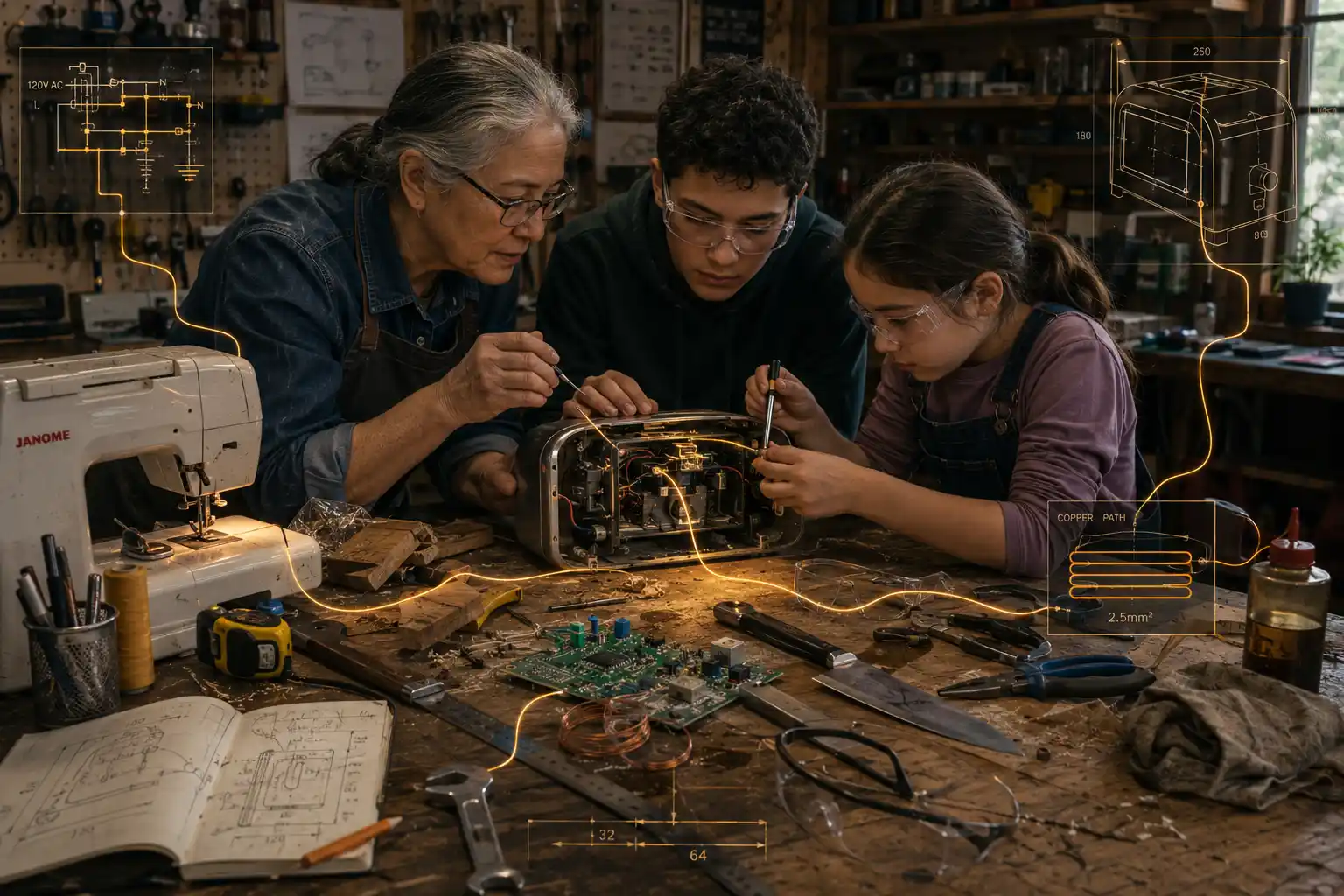
Chapter 10 — Tools, Shops, and Material Competence
A workbench teaches differently from a screen.
On a screen, the world can be resized, undone, refreshed, copied, searched, filtered, and closed.
On a workbench, the screw strips. The board splits. The socket does not fit. The engine will not start. The measurement is wrong. The wire is loose. The blade is dull. The hinge is crooked. The glue needs time. The pipe still leaks. The object refuses your opinion.
That refusal is a gift.
It teaches that reality has grain.
Wood has grain. Metal has tolerance. Engines have sequence. Circuits have continuity. Fabric has tension. Food has heat. Soil has season. Tools have danger. Machines have reasons. Repairs have order. A person who learns this stands differently in the world.
Material competence is not only “working with your hands.” That phrase is too small. It makes practical intelligence sound separate from thinking.
A good mechanic thinks.
A good carpenter thinks.
A good welder thinks.
A good cook thinks.
A good seamstress thinks.
A good machinist thinks.
A good farmer thinks.
A good robotics student thinks.
A good electrician thinks.
A good nurse, builder, plumber, technician, driver, fisher, logger, and repair person thinks through matter, timing, risk, and consequence.
Canada needed this intelligence because Canada was always more material than its polite self-image admitted.
A cold country needs furnaces, boots, roads, plows, roofs, insulation, pipes, power lines, batteries, vehicles, salt, tools, and people who know what happens when maintenance fails.
A large country needs bridges, ferries, railways, ports, trucks, aircraft, buses, ships, snowmobiles, winter roads, grain elevators, fuel systems, machine shops, and people who can keep distance from defeating daily life.
A resource country needs miners, fishers, farmers, foresters, drillers, mill workers, hydro workers, surveyors, engineers, mechanics, heavy-equipment operators, environmental technicians, safety officers, and tradespeople who understand both productivity and risk.
A household country needs cooking, sewing, cleaning, fixing, budgeting, painting, patching, building, gardening, mending, sharpening, tightening, unclogging, wiring, and the ordinary competence that keeps life from becoming dependence on a service call.
That is why shop class mattered.
Not because every child needed to become a carpenter. Not because old shop culture was pure. It was not. But because shop placed young people in front of the material world and said: this will not flatter you.
Measure twice. Cut once.
That sentence carries a whole moral order.
It says preparation matters. Attention matters. Carelessness has cost. Confidence without accuracy ruins the board. The mistake does not vanish because you explain yourself well. The line is either straight or it is not. The joint fits or it does not. The machine runs or it does not.
Shop class gave some students their first serious experience of this kind of truth.
A classroom answer can sometimes be argued. A paragraph can be rephrased. A test can be guessed through. But a bad cut remains visible. A crooked shelf leans. A loose wire fails. A stripped bolt announces itself. The object does not care about your intention.
For some students, that was humiliating. For others, it was liberation.
A student who felt stupid in academic classes could discover intelligence at the bench. He could see, measure, assemble, repair, and understand things others only talked about. A student who struggled with reading could understand an engine. A student who hated sitting still could concentrate for hours with tools. A student who had never been praised for thought could become precise through making.
This is one of the great injustices of credential culture: it often mistakes one kind of intelligence for intelligence itself.
Canada harmed itself when it allowed practical competence to be treated as lesser.
The hierarchy was clear in many schools and families. University was promise. Trades were backup. Office work was success. Manual skill was what you did if you were not academic. Parents who had worked with their bodies often wanted children to escape that work, sometimes for good reason. Bodies were injured. Factories closed. Farms struggled. Mines boomed and collapsed. Trades could be dangerous, sexist, unstable, or poorly respected. The wish for a different life was understandable.
But a society that degrades practical work while depending on it becomes dishonest.
It wants houses but looks down on builders.
It wants heat but forgets technicians.
It wants roads but ignores crews.
It wants food but forgets farms.
It wants phones but forgets minerals, power, cables, and logistics.
It wants hospitals but forgets cleaners, maintenance workers, technicians, cooks, porters, and care aides.
It wants a green transition but forgets that transitions are built by people using tools.
The contempt does damage beyond status. It makes people less capable.
If children never learn tools, they become easier to manage as consumers. If they cannot repair, they replace. If they cannot diagnose, they submit. If they cannot maintain, they depend. If they cannot make, they mistake buying for agency.
Material incompetence is expensive. It is also politically dangerous.
A person who has no contact with how things are built can be sold fantasies about how quickly they can be changed. A person who has never repaired anything may underestimate maintenance. A person who has never worked with tools may treat infrastructure as magic. A person who has never waited for glue, concrete, crops, permits, parts, skilled labour, or weather may think reality should move at the speed of a screen.
Tools teach patience because matter is slow.
The old Canadian garage understood some of this.
Not every family had one. Not every garage was healthy. Some were places of drinking, anger, or clutter. But a garage could also be a classroom: bikes upside down, hockey sticks taped, lawnmowers repaired, oil changed, shelves built, tires stacked, fishing gear stored, snowblowers cursed at, tools borrowed, and a child holding the flashlight badly while an adult said, “No, there.”
Holding the flashlight was not trivial. It was apprenticeship in attention.
Look where the work is.
Anticipate the next move.
Do not shine it in my eyes.
Hand me the socket.
No, the other one.
Watch your fingers.
Listen to the sound.
See how that fits.
Remember where this goes.
That is how competence begins: not with mastery, but with proximity.
The kitchen taught the same thing. So did the sewing machine, the garden, the farm shop, the boat shed, the construction site, the machine room, the darkroom, the robotics lab, the church basement kitchen, the community hall, the family restaurant, the fishing boat, the barn, the hair salon, the repair counter, the bike shop, the welding bay.
Tools were everywhere once you knew how to see them.
A knife is a tool.
A needle is a tool.
A ladle is a tool.
A torque wrench is a tool.
A stethoscope is a tool.
A camera is a tool.
A firearm is a tool.
A shovel is a tool.
A language can be a tool.
A recipe is a tool for transmitting embodied knowledge.
A map is a tool for thinking through distance.
The problem is not technology. Humans are tool-makers. The problem is when tools become sealed systems that train dependence instead of competence.
A hammer teaches directly. A smartphone hides its workings. A car once invited some basic repair; many modern vehicles discourage it. Appliances became cheaper to replace than fix. Software subscriptions replaced ownership. Devices became glued shut. Customer support became scripts. The person became a user rather than a maintainer.
This shift was not all bad. Modern tools are often safer, more powerful, more efficient, and more accessible. Digital design tools opened engineering, art, music, coding, film, robotics, and making to people who might never have entered an old shop. YouTube tutorials taught millions how to fix things. Maker culture, 3D printers, Arduino boards, coding clubs, robotics teams, and repair videos created new forms of practical learning.
Those gains matter.
The repair is not anti-digital. It is anti-helplessness.
A modern country should teach both: the physical tool and the digital tool, the wrench and the code, the sewing machine and the design software, the kitchen and the spreadsheet, the garden and the sensor, the old repair manual and the online tutorial.
But the principle must remain: tools should extend human agency, not replace human understanding.
Shop class failed when it became a dumping ground. It failed when it treated some students as less worthy It failed when safety was poor. It failed when practical skill was separated from intellectual seriousness. It failed when immigrant, disabled, and poor students were sorted by adult expectation rather than supported in full possibility.
Those failures should not return.
But removing tools from education did not make education more equal. It often made it more abstract.
A child can graduate knowing how to analyze a poem, submit assignments online, manage a slideshow, and discuss social issues, yet not know how to cook ten meals, patch drywall, invest in commodities, code web languages, fix laptops, re-build motorcycles, sew a button, sharpen a knife, change a tire, understand a breaker panel, maintain a bike, grow food, read a measuring tape, or recognize when a machine is unsafe.
That is not sophistication. It is a gap.
The old split between academic and practical learning is part of the problem. A serious education should form the whole person.
Read books.
Write clearly.
Do math.
Study history.
Learn science.
Train the body.
Make art.
Use tools.
Cook food.
Repair objects.
Understand money.
Serve others.
Know the land.
Work with people.
A country that removes practical life from education then complains that young people are not resilient has misunderstood resilience.
Resilience is not a poster. It is accumulated competence.
The first time a person fixes something, a small mental shift occurs. The world becomes less closed. The object is no longer only a product. It is a system. It has parts, causes, failure points, and possible interventions. Even if the repair fails, the person has crossed a line: from passive user to active participant.
That line matters everywhere.
In a home, it creates confidence.
In a workplace, it creates usefulness.
In a community, it creates mutual aid.
In a country, it creates citizens less easily mystified by systems.
This is why trades should be treated as national intelligence.
Carpenters, plumbers, electricians, welders, mechanics, machinists, millwrights, cooks, care aides, heavy-equipment operators, HVAC technicians, farmers, fishers, foresters, trappers, bushcrafters, loggers, hunters, sports shooters, overlanders, hikers, campers, travellers, soldiers, and construction workers hold knowledge a country cannot outsource without becoming unreal.
They know what plans look like after weather, budgets, supply chains, bodies, regulations, shortages, mistakes, and time touch them.
They know that every ideal meets materials.
That does not make them automatically wise about everything. No class has a monopoly on wisdom. But a country that excludes practical workers from its self-understanding becomes top-heavy: rich in language, poor in contact.
Canada often speaks as if it is a country of values. It is also a country of maintenance.
Someone has to keep heat in the building. Someone has to plow the road. Someone has to repair the bridge. Someone has to wire the clinic. Someone has to maintain the ferry. Someone has to fix the truck. Someone has to process the fish. Someone has to staff the long-term care home. Someone has to build the housing everyone discusses.
If the country forgets those people, its politics becomes theatrical.
The repair begins in childhood, but it does not end there.
Schools should restore serious practical education. Not token projects. Not underfunded rooms full of broken tools. Serious programs: woodworking, metalwork, robotics, auto, electronics, cooking, sewing, agriculture, design, construction, digital fabrication, repair, energy systems, environmental technology, and household maintenance.
Girls must be fully welcomed. Disabled students must be accommodated creatively. Indigenous knowledge and land-based skills must not be treated as decoration. Immigrant family skills should be recognized as real knowledge. Academic students should not be allowed to imagine practical work is beneath them. Practical students should not be told their intelligence is second-class.
Practical education should connect to colleges, apprenticeships, unions, employers, community projects, farms, maker spaces, libraries, and municipal needs.
Let students build things the community can use.
Let them repair bikes.
Let them cook for events.
Let them design gardens.
Let them maintain equipment.
Let them learn energy systems.
Let them build benches, shelves, ramps, robotics projects, stage sets, storage, planters, and small structures.
Let them see that skill creates public value.
Families can do this too.
Give children tools suited to their age. Teach cooking before adulthood. Teach cleaning as competence, not punishment. Teach sewing, budgeting, basic repair, safe knife use, bike maintenance, snow shovelling, painting, gardening, and how to ask for help from someone who knows more.
Not every parent knows these things. That is why communities matter.
Libraries can host repair cafes. Community centres can teach maintenance workshops. Tradespeople can mentor. Seniors can teach skills. Newcomers can teach food, craft, and household knowledge. Farmers can teach agricultural competence. Preppers can teach survival. Fighters can teach self defense. Schools can partner with local workers. Faith communities and cultural halls can transmit practical traditions through food, events, service, and care.
The point is not to make everyone self-sufficient.
Total self-sufficiency is fantasy. Modern life depends on specialization. The point is to give people enough competence to respect the systems they depend on, participate in maintenance, recognize exploitation, and avoid helplessness.
Material competence also changes moral imagination.
A person who has fixed a thing is less likely to treat objects as disposable. A person who has cooked for many people understands service differently. A person who has built something understands cost. A person who has repaired an old machine understands continuity. A person who has worked a dangerous job understands safety regulations differently. A person who has grown food understands weather differently. A person who has sewn understands labour hidden in clothing. A person who has wired a circuit understands why codes exist.
Competence creates respect.
This is badly needed in a society where consumption hides labour. A package arrives and the chain disappears. A meal appears and the kitchen disappears. A house is bought and the trades disappear. A phone works and the mines, factories, coders, shippers, technicians, and energy systems disappear. A city runs and the maintenance disappears.
When labour disappears, gratitude thins.
So does accountability.
If people cannot see the systems that sustain them, they cannot repair them, honour them, or challenge them intelligently.
Tools make dependence visible.
They remind us that civilization is built from material acts repeated by human beings.
This chapter belongs in the active cultural engines because tool culture is active. It is not memory alone. It is not identity alone. It is doing. Measuring. Cutting. Testing. Failing. Adjusting. Cleaning. Maintaining. Returning.
It also belongs beside the chapter on land because land without tools becomes scenery. Beside the chapter on work because work without competence becomes resume performance. Beside the chapter on managed reality because interfaces without material understanding make people into users of systems they cannot question.
The screen has its place. But the screen should not become the only place where young people feel competent.
Let the object refuse them.
Let the bread fail to rise.
Let the bike chain slip.
Let the board split.
Let the code break.
Let the wire be wrong.
Let the soup need salt.
Let the hinge sit crooked.
Let the seed fail because it was planted too early.
Let the student discover that reality gives feedback no adult can soften.
Then teach repair.
That is the moral heart of practical competence: not perfection, repair.
Repair teaches that failure is information. It teaches humility without despair. It teaches responsibility without shame. It teaches that broken things are not always trash. It teaches that patience can restore usefulness.
A country that learns repair in objects may become better at repair in institutions.
Not automatically. But the habit matters.
Diagnose the failure.
Find the part.
Understand the system.
Ask who knows.
Use the right tool.
Do not pretend.
Do not force what does not fit.
Do not ignore safety.
Test the repair.
Maintain it afterward.
That is good advice for a furnace, a school, a family, a public broadcaster, a housing system, or a country.
Canada does not need to romanticize the old shop.
It needs to recover the intelligence of the bench.
The object refuses your opinion.
Listen long enough, and it teaches you how the world works.
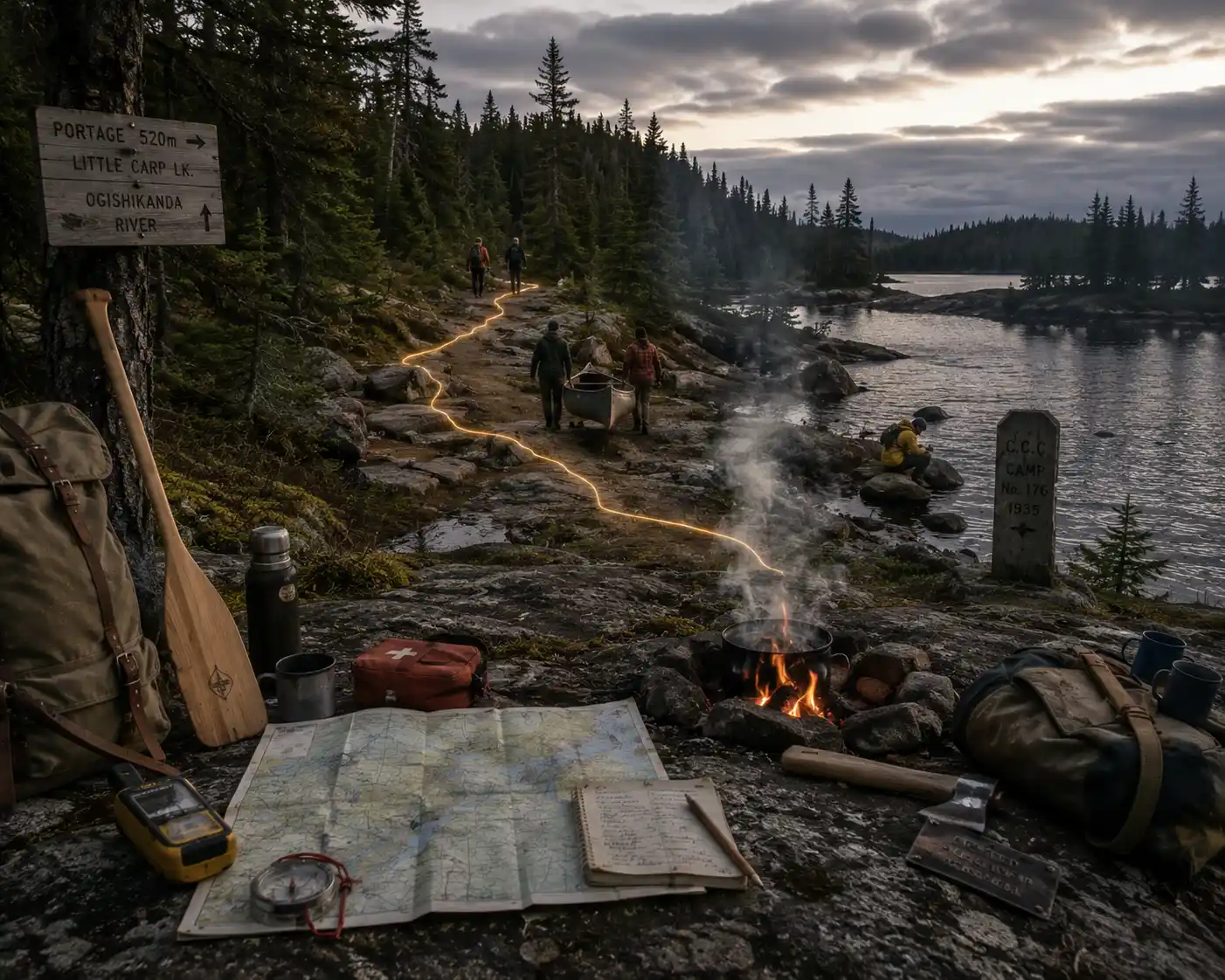
Chapter 11 — Nature, Bushcraft, and Canadian Land Memory
Canada once imagined itself as a country that could handle distance.
That imagination lived in canoes, fishing rods, campfires, portages, bug spray, wood smoke, cottages, cabins, provincial parks, national parks, Scouts, Guides, cadets, maps, compasses, Swiss Army knives, park signs, bear warnings, fishing licences, canoe barrels, camp stoves, snowshoes, wood stoves, and the unmistakable voice of Hinterland Who’s Who.
Some of it was myth.
Some of it was advertising.
Some of it was middle-class cottage memory dressed up as national identity.
Some of it erased Indigenous land and treated wilderness as empty.
That false emptiness must be rejected.
But the practical memory underneath still matters. Land teaches what screens cannot. Wet wood does not care about your mood. A lake crossing changes when the wind rises. A portage teaches weight. A trail teaches attention. A fish teaches patience. A fire teaches preparation. A compass teaches direction. Blackflies teach limits. Cold teaches respect.
This was one of Canada’s older formation systems: the belief that a person should have at least some relationship to land, weather, tools, distance, animals, darkness, and risk.
Not everyone had it equally. Not everyone wanted it. Not everyone experienced it as recreation. But it shaped the country’s imagination.
A child who went camping learned that comfort had to be built. The tent did not raise itself. The fire did not start by intention. The sleeping bag had to stay dry. Food had to be packed, protected, cooked, cleaned, and carried. A forgotten raincoat mattered. A dull knife mattered. A bad knot mattered. A wet match mattered.
A canoe trip taught an even older lesson: everything you bring becomes weight.
On the water, excess is not just clutter. It is burden. At the portage, the fantasy of comfort becomes something on your shoulders. The canoe goes up. The pack digs in. Mosquitoes gather. Roots catch your boots. Someone complains. Someone falls behind. Someone realizes the map is not the territory.
That phrase is usually philosophical. On a canoe trip, it is literal.
The map shows a line. The body meets mud, rocks, slope, heat, hunger, bugs, and the slow humiliation of distance.
That is land memory.
Fishing taught another kind. It taught stillness, timing, weather, equipment, disappointment, and respect for creatures that did not arrive on command. Hunting taught more serious lessons: patience, marksmanship, responsibility, death, meat, law, safety, and the moral weight of taking an animal. Hiking taught pace. Snowshoeing taught effort. Ice fishing taught cold. Chopping wood taught sequence and danger. A wood stove taught attention. A campfire taught that heat is not magic. Building forts taught children that landscape could be worked with, not only looked at.
Even bug spray carried knowledge. Mosquitoes and blackflies were not background details. They were part of the country’s instruction. They taught that nature was not a wellness poster. It bit.
Canadian land memory was always mixed with discomfort. Wet socks. Burnt food. Sunburn. Leeches. Splinters. Bad coffee. Smoke in the eyes. Sleeping on roots. A raccoon in the cooler. A thunderstorm over the lake. The humiliating discovery that the person who talked the most knew the least.
These things sound small until they disappear.
A culture that loses contact with such discomfort can begin to mistake scenery for land. It can consume images of wilderness without learning how to behave in it. It can speak of nature as content, lifestyle, branding, politics, or therapy while losing the practical humility that actual land demands.
Canada has been especially vulnerable to this because land has always been one of its strongest myths.
The country was painted as lakes and pines. Sold as wilderness. Branded through mountains, bears, loons, maples, northern lights, parks, canoes, and endless space. School walls, tourism ads, beer commercials, government imagery, children’s television, wildlife shorts, and family calendars all repeated the message: Canada is land.
But whose land?
That question cannot be avoided.
The land was not empty. It was Indigenous land, treaty land, stolen land, lived land, hunted land, trapped land, sacred land, farmed land, mined land, flooded land, defended land, contaminated land, remembered land, and loved land.
Canadian land memory becomes false when it turns Indigenous presence into scenery or past tense. It becomes false when it treats the canoe as a national symbol but forgets the peoples whose technologies, routes, foodways, and knowledge made travel and survival possible. It becomes false when parks are remembered only as innocent escapes and not also as managed territories with histories of exclusion, displacement, conservation, tourism, and control.
A truthful land chapter must hold several Canadas together.
For some Canadians, land meant cottage weekends, provincial parks, summer camp, Scouts, Guides, canoe trips, family fishing, and hiking trails.
For others, land meant farm work, tractors, fences, irrigation, calving, harvest, barns, grain bins, dust, debt, weather, and the knowledge that a storm could change the year.
For others, land meant logging roads, mining camps, oilfield work, fishing boats, traplines, construction crews, hydro projects, survey lines, resource towns, and bodies shaped by work that urban Canada often consumes but does not understand.
For northern communities, land and weather were not weekend experiences. They were structure: fuel, food, flights, roads, darkness, ice, machines, emergency care, prices, and distance.
For Indigenous communities, land carries law, kinship, language, ceremony, food, memory, sovereignty, grief, and continuity — as well as histories of dispossession, residential schools, relocation, extraction, and state control.
For many immigrant families, land memory was layered. Canada’s snow, lakes, campsites, parks, and distances were met alongside memories of other mountains, farms, villages, rivers, islands, wars, droughts, cities, and old-country landscapes. A first camping trip could be bewildering, funny, alienating, or liberating. A child might learn Canadian land through school trips while parents learned it through work, transit, weather, and the price of winter clothing.
For many urban Canadians, “nature” arrived through school field trips, ravines, parks, waterfronts, conservation areas, television, summer camps, family drives, or rare trips outside the city. The relationship was mediated but still real.
There was never one land memory.
That is why the old Canadian wilderness myth is too thin. It cannot carry the truth by itself. But replacing it with pure guilt is too thin as well. A country cannot belong to land by pretending it has no right to love the places where its people live. It also cannot love land honestly while refusing to remember dispossession.
The repair is not land romance.
The repair is truthful land competence.
That means knowing where you are. Knowing what should inherit the land. Knowing what treaties, histories, and obligations belong to that place. Knowing how weather behaves. Knowing what water can do. Knowing that animals are not props. Knowing that tools matter. Knowing that fire is serious. Knowing that distance changes risk. Knowing that parks are not outside history. Knowing that resource work is not a cartoon. Knowing that environmental care cannot be only an identity marker. Knowing that land is not content.
Modern life improved parts of this relationship.
Outdoor gear became safer. Weather forecasting improved. GPS helped people avoid getting lost. Emergency communication saved lives. Environmental awareness grew. More people learned to question empty wilderness myths. Disability access improved some outdoor experiences. Urban families built new outdoor cultures that older gatekeeping often missed.
Those gains matter.
But something was also lost when land became increasingly specialized, expensive, branded, regulated, aestheticized, or consumed through screens.
Camping became, for some, a gear category. Outdoor competence became a lifestyle market. Hunting, fishing and sports shooting, became culture-war symbols instead of ordinary practices with laws, ethics, food, skill, responsible citizenship and community. Cottages became real estate. Parks became Instagram backdrops. Hiking became content. Environmentalism became sometimes more fluent in slogans than in local knowledge. Urban Canadians could become passionate about nature while knowing little about soil, weather, tools, farming, hunting, fishing, forestry, mining, trapping, fire, scouting, sports shooting, cottage building, or northern infrastructure.
At the same time, many people who still worked directly with land were treated as embarrassments by the very society that depended on them.
A country that eats food, heats homes, builds with wood, drives on roads, uses metals, charges phones, exports resources, vacations in parks, trains in oudoor heritage recreation, and celebrates wilderness cannot afford contempt for people who farm, fish, hunt, shoot, log, mine, drill, build, guide, trap, conserve, fight fires, repair roads, maintain northern life and simulate heritage frontier activities of previous settlers to the region.
Nor can it afford to let those industries operate without truth, accountability, and environmental responsibility.
The land asks for maturity.
It asks Canadians to stop splitting into childish camps: wilderness fantasy against resource cynicism, urban purity against rural resentment, guilt against gratitude, tourism against treaty, content against competence.
The land is more serious than that.
A canoe does not care about your politics.
A storm does not care about your brand.
A fish does not care about your identity.
A fire does not care about your intention.
A road washed out by flood does not care about your theory.
A northern community waiting on fuel does not care about southern symbolism.
A treaty does not disappear because it is inconvenient.
A poisoned river does not become clean because the advertisement used green colours.
Land is reality.
That is why land formed people.
It taught that the world is not merely interpreted. It is encountered. It is crossed, carried, respected, damaged, restored, worked, defended, and survived.
This chapter belongs beside the chapters on winter, tools, and public life because all of them teach the same thing: a country becomes unreal when it forgets the material conditions that make life possible.
The screen can show a forest. It cannot teach you how to move through one in rain.
The feed can display a lake. It cannot teach you what wind does to water.
A brand can sell wilderness. It cannot teach you humility.
A political slogan can invoke land. It cannot teach you how to belong to it.
The repair begins with practice.
Teach children weather.
Teach maps before total dependence on GPS.
Teach fire safety.
Teach cottage building.
Teach where food comes from.
Teach tools.
Teach local plants, animals and greenhouses.
Teach frontier pioneer history as living reality, not only hunting and sports shooting.
Teach treaties as obligations.
Teach farming, fishing, hunting, hiking, climbing, diving, camping, overlanding, sports shooting, forestry, mining, conservation, and parks as complicated human-land systems.
Teach outdoor skill without pretending everyone has the same access.
Teach environmental care through contact, not only messaging.
Make land local again.
Not only national parks far away. Not only elite outdoor trips. Not only cottage property. Local ravines. Local rivers. Local farms. Local trails. Local shorelines. Local snow. Local flooding. Local heat. Local species. Local history. Local truckers. Local farmers. Local hunters. Local fishers. Local loggers. Local sports shooters. Local damage. Local repair.
A Canadian child should know more than how to admire a mountain in a photograph. A Canadian adult should know more than how to consume wilderness as scenery. A Canadian citizen should know more than how to repeat land acknowledgements without changing conduct.
Canada’s land memory must become less innocent and more useful.
Less postcard.
More practice.
Less empty wilderness.
More truthful belonging.
Less lifestyle.
More competence.
Less guilt alone.
More obligation.
Less content.
More contact.
The country once imagined itself as producing people who could handle land, weather, tools, and distance.
That story was never fully true.
But it pointed toward a real need.
Canada still needs people who can handle land, weather, tools, and distance — and who can do so truthfully, with Indigenous presence remembered, environmental damage faced, resource dependence understood, and practical humility restored.
A country that cannot read its land cannot understand itself.
And a country that cannot handle distance will eventually lose the scale of its own soul.
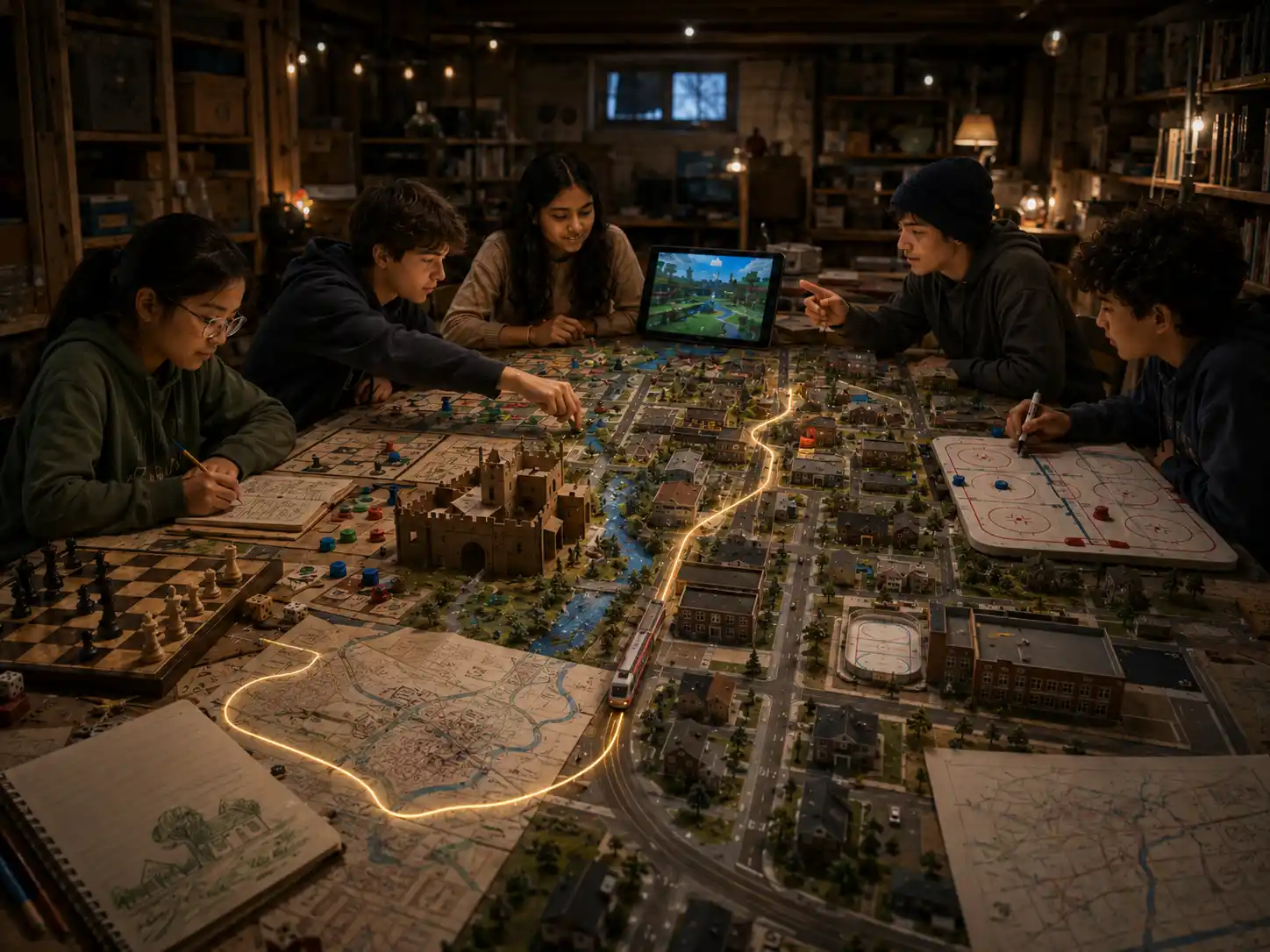
Chapter 12 — Games, Simulations, and Strategic Worlds
Not all screen time was the same.
That sentence matters because the word “screen” now hides too much. A child building a city in SimCity, solving the quiet machinery of Myst, managing food and wood in Age of Empires, running a LAN cable through a basement, painting a Warhammer miniature, building a PC, or sitting around a table with dice and rulebooks was not doing the same thing as endlessly scrolling a feed.
Both used attention.
They did not form attention the same way.
A strategy game asked for patience.
A simulation asked for systems thinking.
A role-playing game asked for imagination under rules.
A LAN party asked for technical setup and friendship in a room.
A tabletop campaign asked for commitment over time.
A computer lab asked students to learn machines before machines became invisible.
This chapter is not a defence of all gaming. Games can waste time, isolate people, monetize compulsion, normalize ugliness, and become a substitute for life. But early digital and tabletop culture also trained real capacities that should not be dismissed.
Games were one of the places where many young people learned systems.
A child playing Age of Empires was not only staring at a screen. He was learning that food, wood, gold, stone, maps, technology, timing, labour, military decisions, and geography formed one world. Lose the villagers and the army never arrives. Ignore the map and the enemy controls the crossing. Advance too late and the whole civilization falls behind. Spend everything on soldiers and the economy collapses.
The game taught trade-offs.
It taught that outcomes were produced by systems, not wishes. It taught that power required resources. It taught that development had sequence. It taught that bad planning could look fine until the collapse arrived.
That is not a small lesson.
Civilization taught time. Not real history, but historical imagination: settlement, technology, diplomacy, expansion, war, trade, government, culture, and the strange feeling that choices made early could echo hundreds of turns later. SimCity taught infrastructure. Roads, power, zoning, taxes, pollution, traffic, budgets, and public satisfaction became visible as interlocking pressures. A child could discover that a city is not only buildings. It is systems under stress.
These games simplified reality. Of course they did. They also gave young people a first taste of complexity.
That mattered in a culture that often taught children facts without showing how systems behave.
A textbook could say “infrastructure.” A simulation made congestion visible.
A teacher could say “resources.” A strategy game made scarcity punish you.
A parent could say “plan ahead.” A campaign made bad planning ruin the next hour.
The best games were not only entertainment. They were laboratories of consequence.
Myst taught a different capacity. It was slow, quiet, atmospheric, and strange. It did not constantly flatter the player. It asked for attention, notes, memory, pattern recognition, and the willingness to remain confused. There were no endless notifications rushing to reassure you. The world waited. The puzzle sat there until the mind changed.
That kind of slowness is rare now.
A child inside Myst or Riven learned that not every problem announces its category. Some problems must be observed. Some doors open only after the player has listened to the world. That is a kind of intelligence too: not speed, but attention.
Doom and Quake taught another world: reflex, space, speed, hardware, modding, maps, and the early culture of computers as machines you could push, break, configure, and understand. The game was not only the game. It was sound cards, drivers, graphics settings, shareware, copied disks, local networks, server lists, keyboard layouts, and someone who knew why it was not working.
The machine had to be dealt with.
That made early computer gaming different from later app life. The computer was not yet a sealed appliance. It was temperamental, visible, and sometimes hostile. You had to install things. Patch things. Configure things. Crash things. Ask someone. Read forums. Try again.
That frustration created technical curiosity.
A LAN party made the point even clearer.
The digital world returned to the basement.
Friends carried towers, monitors, keyboards, mice, tangled cables, power bars, burned discs, snacks, pop, and sleeping bags into one room. Someone always had a problem. The network did not see a machine. A driver was missing. A game version did not match. Someone forgot a cable. Someone knew more than everyone else and became briefly powerful.
Then, once the machines worked, the digital game became embodied social life: shouting across the room, trash talk, laughter, rage, pizza boxes, fatigue, someone’s parents coming downstairs, and the strange intimacy of being together while inside a virtual arena.
This was not the same as isolated platform use.
It was digital culture with bodies still in the room.
The same was true of console multiplayer. GoldenEye on a split screen. Mario Kart. Tekken. Mortal Kombat. Sports games. Fighting games in basements, rec rooms, dorms, and apartments. Friends learned skill, rivalry, embarrassment, turn-taking, and the social pressure of losing where everyone could see your face.
The screen mediated the play, but it did not yet swallow the room.
Tabletop games did something even older.
Dungeons & Dragons taught rules, imagination, probability, character, patience, listening, improvisation, storytelling, group commitment, and the awkward art of making a shared world with other people. A campaign required more than consumption. People had to show up. Someone had to prepare. Someone had to learn rules. Someone had to keep the story moving. The group had to tolerate difference, boredom, argument, failure, and the strange vulnerability of pretending together.
Warhammer and other miniature games added craft: painting, lore, measuring, terrain, tactics, money, storage, and the slow pride of making an army by hand. Board games like Risk, chess, Settlers of Catan, Axis & Allies, Magic: The Gathering, and countless others taught probability, negotiation, betrayal, planning, collection, rule interpretation, and defeat.
These worlds were nerd culture, yes. But “nerd” is too small a word for what they formed.
They taught young people that worlds can be built from rules.
That is civilizationally important.
A person who understands rules can understand institutions better. A person who understands systems can see why changing one part changes another. A person who understands games can recognize incentives, exploits, feedback loops, bottlenecks, hidden information, and unintended consequences.
This matters in adulthood. Workplaces are systems. Housing markets are systems. Governments are systems. Families have rules. Platforms have incentives. Politics has game mechanics. Economies have resource flows. Institutions can be gamed. Bureaucracies can be exploited. A person trained only in feelings may miss structure. A person trained only in obedience may miss design. A person trained in systems asks: what are the rules, what are the incentives, who benefits, what is being optimized, where is the exploit?
Good games train that question.
This is why the chapter belongs in the active cultural engines. It is not only about entertainment. It is about strategic imagination.
Canada had its own version of this culture.
It lived in school computer labs, basements, suburban rec rooms, university dorms, local gaming stores, arcades, libraries, after-school clubs, comic shops, science-fiction shelves, LAN cafes, mall game stores, used-game counters, and friends’ houses where someone had the better console.
Computer labs mattered. Rows of beige machines, Macs in elementary schools, typing programs, educational games, Oregon Trail memories, early internet access, Encarta, HyperCard, Kid Pix, Logo, school printers, floppy disks, and the first feeling that a machine could be both tool and world.
Local gaming stores mattered too. They were not only retail. They were meeting points for Magic tournaments, Warhammer tables, D&D books, comics, dice, card sleeves, rule debates, posters, and teenagers who did not fit as easily in sport or mainstream school culture. A store could become a small institution of belonging.
Science fiction mattered because it gave technological imagination a moral horizon. Star Trek, Stargate, The X-Files, cyberpunk novels, space operas, and shelves of paperbacks taught that technology, empire, exploration, alien life, time, war, machines, and human nature could be imagined before they arrived as policy or product.
A country needs people who can imagine systems before systems capture them.
Gaming and sci-fi helped some young people do that.
But the culture was never pure.
Gaming could isolate. It could become avoidance. It could train obsession, aggression, sleep loss, misogyny, racism, status hierarchy, and contempt for bodies. Disabled players, and socially awkward young people could find refuge or cruelty, sometimes in the same community. Some boys disappeared into games because other parts of life were failing. Some used fantasy worlds to avoid real responsibility.
The room could form friendship. It could also become a bunker.
The same systems imagination that made games powerful could become a trap if it replaced lived courage, work, family, land, bodies, and public life. A person can become brilliant at simulated worlds and helpless in the real one.
So the repair is not “more games.”
The repair is better play.
Play that builds attention instead of harvesting it.
Play that teaches systems instead of only compulsion.
Play that strengthens friendship instead of isolating the player.
Play that invites making, modding, storytelling, and strategy.
Play that stays connected to bodies, rooms, and real life.
The damage came when more games and platforms shifted from worlds of mastery into engines of engagement.
This happened gradually.
The old game had limits. A cartridge ended. A campaign ended. A match ended. A LAN party ended when everyone went home. A tabletop session ended and people waited until next week. Even an addictive game had more boundaries because the system was less total.
Later, more games became services. Always online. Always updating. Always offering rewards, seasons, cosmetics, battle passes, loot boxes, daily tasks, rankings, notifications, and social pressure. The game did not simply invite play. It demanded return.
The business model changed the psychology.
A world built for mastery asks: can you get better?
A platform built for engagement asks: can you stay longer?
Those are not the same question.
The same shift happened outside games. Social media borrowed game mechanics: likes, streaks, follower counts, levels, badges, notifications, rankings, streak maintenance, infinite scroll, algorithmic reward, social comparison. Life itself became more game-like, but not in the best sense. Not rule-bound imagination. Not friendship. Not mastery. Instead: metrics, performance, compulsion, and status.
This is one of the great reversals of the digital age.
Games once offered contained worlds where young people could practice systems thinking.
Then the world became gamified by systems designed to capture young people.
The player became the resource.
That is the line this chapter has to draw.
Digital play can form intelligence. Platform capture can deform attention.
The difference is not screen versus no screen. The difference is whether the activity builds capacity or consumes it.
A strategy game can teach planning.
A feed can train reaction.
A tabletop game can teach cooperation.
A loot system can train compulsion.
A simulation can teach complexity.
An algorithm can trap preference.
A LAN party can build friendship.
A platform can monetize loneliness.
A modding community can teach making.
A content ecosystem can turn every player into audience, product, and promoter.
The repair is to recover the best functions of gaming while resisting the worst structures of platform life.
That means parents, teachers, and communities need a more precise language than “screen time.”
A child writing code, building a mod, learning music software, playing a thoughtful strategy game, editing a film, doing robotics, designing a level, running a D&D campaign, and scrolling short videos for three hours are all using screens or media.
They are not doing the same human work.
The question should be:
Is this building attention or breaking it?
Is this teaching systems or only reaction?
Is this social in a real way or only connected?
Is this finite or endless?
Is this creative or consumptive?
Is this chosen or compulsive?
Is this connected to real friendship, craft, and life?
Does the person return stronger or thinner?
That is the test.
Schools could use this well. A computer lab should not be only a device room. It should teach how systems work: coding, hardware, networks, media literacy, game design, simulation, data, privacy, repair, and the difference between tool and feed. Students should learn not only how to use software, but how software uses them.
Libraries and community centres could host tabletop clubs, coding clubs, robotics teams, retro game nights, strategy game groups, digital storytelling labs, and media-making workshops. Local gaming stores can be treated as youth institutions when they are healthy. Parents can encourage games that require patience, creativity, reading, cooperation, and mastery while setting boundaries around endless engagement systems.
The goal is not purity.
The goal is agency.
A young person should learn to play games without being played by them.
That requires adult seriousness. Not panic. Not mockery. Not surrender. Seriousness.
Adults often failed this because they did not understand the worlds forming young people. They dismissed games as pointless, then handed children phones governed by systems far more manipulative than the games they mocked. They worried about fantasy monsters while ignoring algorithmic feeds. They feared the basement LAN party but allowed the bedroom to become a portal into everything.
The old fear was often aimed at the wrong thing.
The monster was not always the game.
Sometimes the game was the last structured world the child had.
The deeper danger was the collapse of boundaries around attention.
That is why the best repair may come from older forms of play combined with modern tools.
Bring back rooms.
Bring back tables.
Bring back local multiplayer.
Bring back clubs.
Bring back campaigns.
Bring back making.
Bring back modding.
Bring back game design as education.
Bring back computer labs that teach machines as understandable systems.
Bring back science fiction as moral imagination, not only franchise content.
Bring back play that ends.
A game that ends gives the player back to life.
That matters.
The point is not to make every child a gamer. The point is to recognize that games, simulations, and strategic worlds are now part of how people learn systems. If the culture abandons that territory to companies optimizing engagement, it loses a major formation system.
Canada should treat digital and tabletop play as something to civilize, not simply consume.
Civilized play has rules.
It has limits.
It has friendship.
It has mastery.
It has imagination.
It has return.
It teaches something the player can carry back into the world.
The uncivilized version has no end. It follows the player everywhere. It turns attention into resource, friendship into metric, imagination into franchise, and play into compulsion.
The difference is everything.
Not all screen time was the same.
Some screens trained systems imagination.
Some tables trained shared worlds.
Some games taught patience, rules, strategy, and consequence.
Some communities gave young people belonging when other institutions failed.
Those functions are worth saving.
But they have to be rebuilt against the feed.
A country that wants capable people needs play that makes minds stronger, friendships thicker, and reality more understandable.
Not just games that keep people logged in.
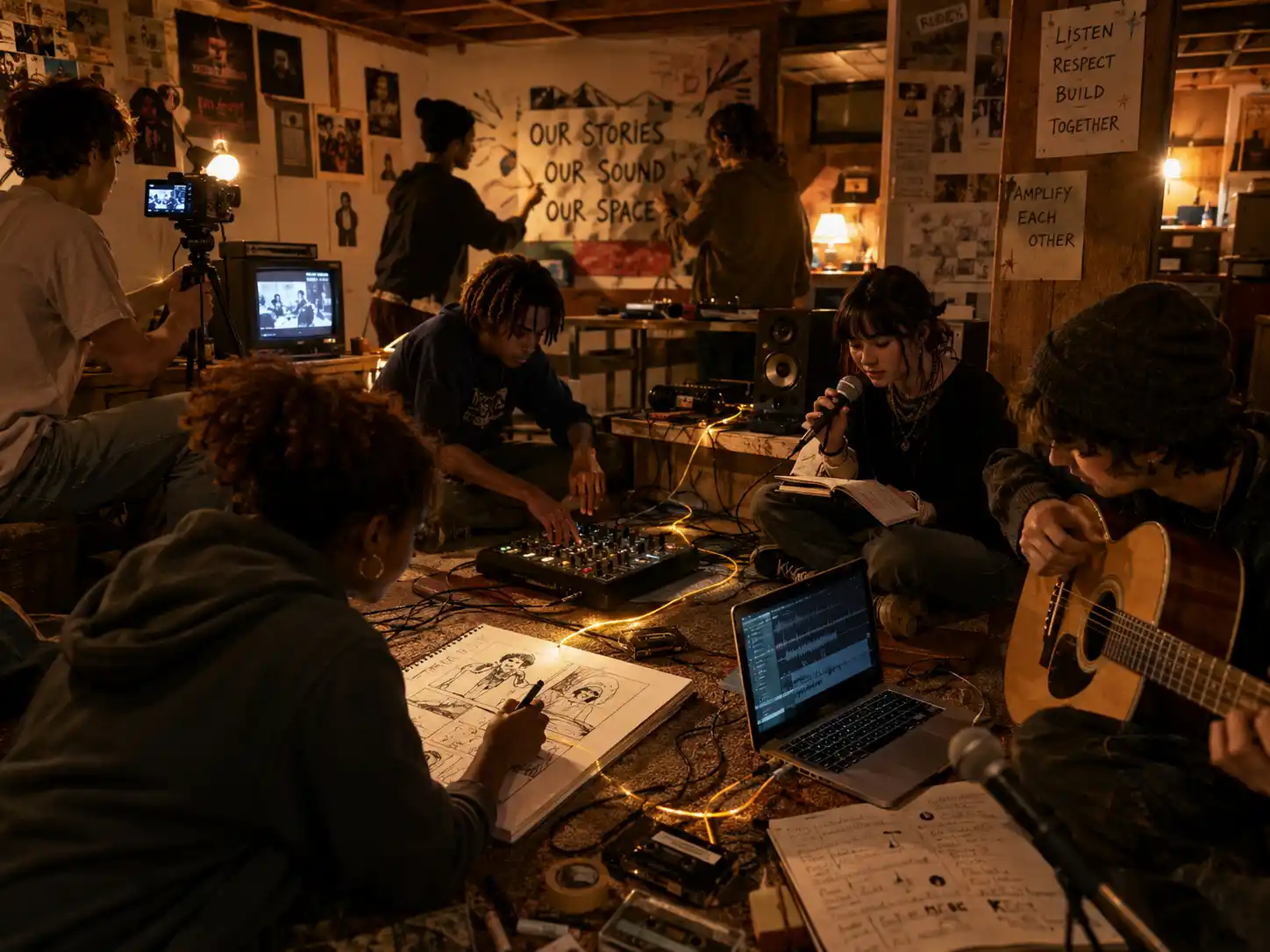
Chapter 13 — Making Images, Sound, and Stories
A garage band did not need a brand strategy.
It needed a basement, a drum kit, a cheap guitar, a borrowed amp, bad timing, patient neighbours, and enough nerve to play in front of people before the songs were ready. A school band needed folding chairs, sheet music, squeaking reeds, brass spit valves, a conductor, and repetition. A film project needed a camcorder, a friend willing to act, bad lighting, and the discovery that editing takes longer than filming.
Making things formed people.
Not because every song was good.
Not because every photo mattered.
Not because every school play was art.
Not because every zine, short film, painting, poem, cassette, garage recording, or drama-club monologue deserved preservation.
Most of it was rough.
That was the point.
A person learned by making badly before making well. The first song was awkward. The first drawing was stiff. The first photograph was poorly framed. The first video had terrible sound. The first poem was too dramatic. The first stage performance was embarrassing. The first public reading made the body shake. The first recording revealed that the singer was not as good as he sounded in his own head.
Creation teaches humility because the thing leaves the imagination and becomes real.
Inside the mind, the song is brilliant.
On the recording, it is thin.
Inside the mind, the film is cinematic.
On the screen, the lighting is yellow and the acting is wooden.
Inside the mind, the poster is striking.
On the paper, the proportions are wrong.
Inside the mind, the story is powerful.
On the page, the sentences do not yet carry it.
That gap is where craft begins.
Canada’s creative formation did not happen only in official art institutions. It happened in school band rooms, church choirs, temple festivals, drama clubs, yearbook committees, local theatres, community cable stations, basement recording setups, zines, school newspapers, photography classes, art rooms, darkrooms, talent shows, open mics, garage bands, local shows, wedding halls, cultural festivals, powwow grounds, kitchen songs, immigrant community stages, French-language theatre, and teenagers learning iMovie or GarageBand on whatever machine they could access.
The creative world was local before it was global.
A band might play in a basement, then a school gym, then a church hall, then a community centre, then a bar it was not quite old enough to enter, then nowhere at all. That still mattered. The point was not fame. The point was that sound had moved through bodies in a room.
A school play was not Broadway. It was paint, cardboard, costumes, panic, forgotten lines, parents holding programs, a teacher holding the whole thing together, and students discovering that public attention has weight.
A yearbook committee was not a publishing house. It was captions, photos, names, layouts, deadlines, inside jokes, bad design, and the strange responsibility of deciding how a year would remember itself.
A school newspaper was not national journalism. It was interviews, complaints, jokes, editorials, sports scores, teacher profiles, poems, and the first lesson that public words have consequences.
A darkroom taught patience. The image did not appear instantly. It emerged slowly, chemically, almost magically, but only if the person followed the process. Photography taught looking. Film taught sequence. Theatre taught presence. Music taught timing. Writing taught attention. Drawing taught seeing. Editing taught that reality can be arranged but not without loss.
Creative practice formed people because it made them offer something.
That is different from consuming.
A listener can judge quickly. A maker cannot. A maker has to stay with the problem. The chord does not work. The scene drags. The photograph is flat. The article is unclear. The painting is muddy. The joke fails. The audience does not laugh. The singer misses the note. The poem sounds false. The camera battery dies. The file corrupts. The printer jams. The whole project is worse than imagined.
Then the maker has to decide whether to quit or continue.
That decision forms character.
Making also teaches collaboration. A band is not only music; it is conflict management. Who is too loud? Who is late? Who wrote the song? Who controls the set list? Who owns the amp? Who forgot the cable? Who gets credit? Who is serious? Who is just posing?
A film crew teaches the same thing. Someone needs to act. Someone needs to hold the camera. Someone needs to organize the location. Someone needs to edit. Someone needs to tell a friend that the scene does not work. The fantasy of pure personal expression meets the social reality of making with others.
Art is often described as self-expression. It is also self-discipline.
You may express yourself. But if the audience cannot hear, see, follow, feel, or understand it, the work is not finished. Craft is respect for the person receiving the expression.
This mattered in older local creative culture because audiences were human-scale.
You could not hide entirely behind metrics. You saw faces. The church choir had elders in the pews. The garage band had friends in the basement. The drama club had parents in folding chairs. The open mic had strangers at tables. The community theatre had the town. The powwow had dancers, singers, families, protocol, memory, and community presence. The cultural festival had children, elders, food, language, and the pressure of representing something more than yourself.
A local audience is not always kind. It can be unfair, small-minded, cliquish, racist, sexist, homophobic, dismissive, or bored. But it gives one thing the platform often cannot: proportion.
You are seen, but not by the whole world.
You can fail, but not forever.
You can be embarrassed, but not permanently archived for strangers.
You can improve where people know your beginning.
That scale is precious.
The digital turn changed everything.
It gave ordinary people tools older generations could barely imagine. Cameras became cheap. Editing software entered bedrooms. Recording became possible without studios. Distribution opened. A teenager could publish a song, film, drawing, essay, animation, podcast, photo, or joke to the world. Gatekeepers weakened. People outside old centres of power could find audiences. Indigenous artists, immigrant artists, disabled artists, rural artists, young artists, and people ignored by mainstream institutions could speak, show, record, remix, teach, and gather.
This was a real liberation.
A child in a small town could learn guitar from online videos. A newcomer could preserve language and music across distance. A disabled creator could make work without entering inaccessible rooms. A young filmmaker could edit on a laptop. A poet could publish without waiting for a magazine. A rapper could record in a bedroom. A photographer could build an audience from a phone. A community could document itself without asking national media to care.
The tools became more democratic.
But the audience became stranger.
Making moved into measurement.
Views. Likes. Shares. Follows. Comments. Subscribers. Watch time. Engagement. Analytics. Reach. Conversion. Personal brand. Content strategy. Posting schedule. Thumbnail. Hook. Algorithm. Niche. Monetization.
The maker became a manager of attention.
This changed the psychology of creation. The old question was often: can I make this better? The platform question became: will this perform?
Those questions are not the same.
Craft asks for patience. Performance metrics ask for reaction.
Craft asks what the work needs. Metrics ask what the audience will click.
Craft allows obscurity. Platforms punish invisibility.
Craft builds a person slowly. Content demands constant output.
A young person can now begin making something and almost immediately be asked to think like a marketer. Before the song is mature, there is branding. Before the photograph is honest, there is aesthetic. Before the thought is developed, there is a post. Before the person has privacy, there is audience.
This is the danger.
Not that people publish. Publication can be wonderful. The danger is that making becomes inseparable from self-display.
The garage band becomes a content channel.
The painter becomes a personal brand.
The writer becomes a platform.
The musician becomes an engagement strategy.
The photographer becomes an aesthetic feed.
The filmmaker becomes a thumbnail designer.
The comedian becomes a clip machine.
The young artist becomes a public self before the private craft is strong enough to hold him.
When that happens, art can stop forming the maker and start consuming him.
This is one reason creative culture belongs beside the chapters on the platform self and the screen becoming the room. Making used to give people a way to encounter the world. Platform culture can turn making into another way the world watches the self.
That does not mean old creative culture was pure.
It had gatekeepers. It excluded people. It mocked amateurs. It favoured those with money, confidence, beauty, connections, equipment, free time, supportive parents, cultural fluency, or proximity to institutions. Quebec culture was often misunderstood by English Canada. Working-class art was treated as lesser. Religious art was mocked by secular taste. Disability access was poor. Rural artists lacked venues. Many people never got the room, instrument, camera, lesson, or stage they needed.
Digital tools corrected some of that.
So the repair is not to reject the platform entirely. It is to rebuild spaces where craft can develop before performance metrics take over.
A country needs places where young people can make things badly without becoming content.
School music rooms matter.
Drama clubs matter.
Art rooms matter.
Film classes matter.
Photography walks matter.
Community theatres matter.
Local newspapers matter.
Church choirs, temple festival, powwow songs, cultural halls, and immigrant community stages matter.
Libraries with recording equipment matter.
Youth media labs matter.
Open mics matter.
Zine fairs matter.
Local cable mattered, and its modern equivalents matter.
Public broadcasters matter when they show a country its own makers.
Small audiences matter.
This is not because everyone should become a professional artist.
Professionalization is not the point.
The point is agency.
A person who has made sound, image, story, scene, meal, song, photograph, film, poster, costume, article, or performance knows something about the world that a pure consumer does not. He knows that culture is made. She knows that taste can be trained. They know that a public offering requires courage.
Making teaches that the world is not only received. It can be shaped.
That lesson is civilizational.
A passive culture waits to be entertained.
An active culture makes.
A passive culture scrolls.
An active culture rehearses.
A passive culture reacts.
An active culture practices.
A passive culture becomes audience to its own decline.
An active culture builds rooms where people can offer something.
Canada has often underplayed this part of itself. It imagines itself through politics, politeness, nature, hockey, public institutions, and national arguments. But creative engines have always carried the country: folk music, Quebec chanson, student technician and student artist storytelling, immigrant festivals, community theatre, local bands, school choirs, comedy, television, radio, poetry, murals, documentary film, kitchen music, church music, Caribbean carnivals, Ukrainian dance halls, fiddle traditions, hip-hop scenes, francophone comedy, powwow singing, and teenagers in basements trying to sound like somewhere else while becoming from here.
Creative culture does not only decorate a country.
It lets people hear themselves.
That is why local creation matters. A country that only imports entertainment may forget the sound of its own rooms. A town without local music, local theatre, local journalism, local photography, local festivals, local stories, and local humour becomes dependent on distant mirrors.
Distant mirrors distort.
They show glamour but not the local street.
They show trends but not the grandmother’s kitchen.
They show celebrity but not the community hall.
They show national controversy but not the person two blocks away who can sing, paint, fix, write, teach, cook, or tell stories.
Local making restores attention.
It says: this place is worth representing. These people are worth hearing. This accent, language, joke, grief, dance, meal, rhythm, and memory belong to the country too.
That is especially important in a plural country. Canada cannot be represented by one voice. It needs many local acts of making. English and French. Indigenous and immigrant. Rural and urban. Northern and southern. Religious and secular. Artist and technician. Working-class and professional. Old and young. Official and unofficial.
But plurality alone is not enough. A country also needs shared stages where difference can be encountered without becoming only a branding exercise.
The school concert, local festival, public broadcaster, community theatre, library reading, open mic, music program, cultural hall, and youth film night are not trivial. They are places where a plural country practices seeing and hearing itself.
This is one of the repairs needed now.
Make more rooms.
Not only feeds. Rooms.
Rooms where a child can play the trumpet badly and come back next week.
Rooms where teenagers can make a short film without immediately becoming influencers.
Rooms where elders can teach songs.
Rooms where newcomers can perform in languages the school does not speak at home.
Rooms where Western provinces stories are carried with protocol and respect.
Rooms where Quebec culture is not flattened into translation.
Rooms where working-class humour and grief have space.
Rooms where disabled artists can enter without fighting the building first.
Rooms where the audience is close enough to be responsible.
Technology should serve those rooms.
Use the camera. Use the software. Use the platform when it helps. Publish, record, archive, distribute, connect. But do not let the metric become the master. Do not let every act of creation become self-brand management. Do not let young people confuse being seen with getting better.
The repair is craft before content.
Practice before posting.
Room before feed.
Skill before brand.
Local audience before algorithm.
Making before monetizing.
Voice before performance.
Patience before reach.
This does not mean hiding work forever. Art needs audiences. Makers need courage. Public offering is part of formation. But timing matters. A seedling should not be judged like a tree. A beginner should not have to become a brand to justify learning.
A culture that demands public performance too early will produce anxiety, imitation, and self-protection. A culture that protects private practice forever will produce fear. The middle is apprenticeship: make, show, receive, revise, return.
That is how craft forms the person.
The garage band eventually has to leave the basement.
The poem eventually has to be read.
The photograph eventually has to be shown.
The play eventually has to open.
The article eventually has to be published.
The song eventually has to meet ears.
But it should meet them as work, not only as content.
Content fills a feed.
Work carries a person’s attention, skill, risk, and offering into the world.
That difference matters.
Canada needs more work and less content. More makers and fewer anxious brands. More local stages and fewer isolated performers chasing metrics alone. More school bands, choirs, art rooms, media labs, community theatres, open mics, local papers, cultural festivals, public archives, and shared rooms where people can practice making a world together.
A garage band did not need a brand strategy.
It needed a room, a song, a mistake, a witness, and another rehearsal.
That is still how people become makers.
Part IV — The Canadian Story Engine
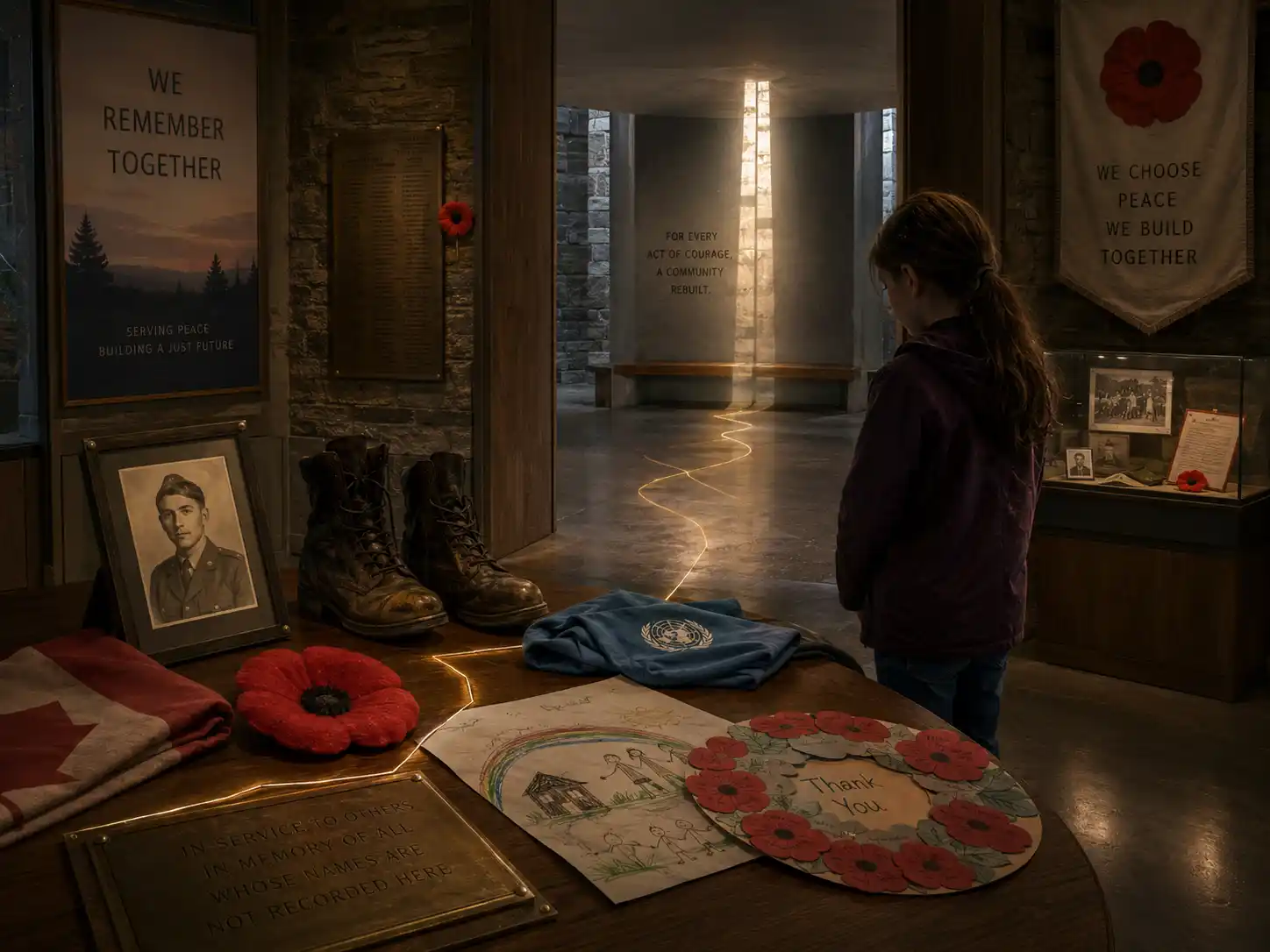
Chapter 14 — Peacekeeper, Soldier, and Public Duty
A poppy is a small object with a heavy job.
Pinned to a coat before Remembrance Day, it asks a child to enter a story older than himself. He may not understand it yet. He may only know that adults become serious, that the school gym is quieter than usual, that someone has put up a flag, that a trumpet sounds strange and sad, that the room stands still for a minute longer than children are used to standing still.
That minute matters.
A school Remembrance assembly was one of the places where Canada taught public grief. Not private sadness. Not entertainment. Not politics first. Public grief.
Children sat on the floor while teachers stood along the walls. A principal spoke. A student read a poem. A veteran, if one was present, sat near the front with medals that made history suddenly physical. The Last Post played. The room fell silent. Some children bowed their heads. Some stared at the floor. Some did not understand. Some fidgeted. Some were moved without knowing why.
That was civic rehearsal.
It taught that public life includes debts we did not personally choose.
A country is not only built by the living. It is also carried by the dead, the wounded, the returned, the grieving, the frightened, the damaged, the brave, the conscripted, the volunteered, the forgotten, the misremembered, and the families who paid for decisions made far away.
Canada’s military memory has never been simple.
There is the Canada of Vimy Ridge, Juno Beach, convoy routes, air training, naval service, liberation, sacrifice, cemeteries, uniforms, letters, medals, and names carved into stone.
There is the Canada of peacekeeping, blue helmets, Lester Pearson, Cyprus, the Sinai, the Golan Heights, Bosnia, Rwanda, and the national image of a country that entered conflict as helper rather than conqueror.
There is the Canada of Afghanistan, where an older peacekeeping self-image became harder to maintain. Soldiers fought, died, returned changed, lost friends, carried injuries, and came home to a country that often did not know what to do with their experience.
There is the Canada of Indigenous veterans who served a country that denied rights, land, language, and dignity to their own families.
There is the Canada of Asian, Jewish, Ukrainian, Polish, Hungarian, Swedish, Romanian, Polish, Italian, Dutch, American, British, French, Greek, Spanish, Mexican, Caribbean, rural, urban, immigrant, and working-class military stories, each carrying different memories of empire, war, racism, service, loyalty, exclusion, and belonging.
There is the Canada of mothers, fathers, wives, husbands, children, siblings, and grandparents whose sacrifice was not always visible in uniform.
There is the Canada of cadets, reserves, Legion halls, cenotaphs, Remembrance assemblies, wreaths, poppies, faded photographs, folded flags, family medals in drawers, and stories told badly because the real ones were too hard.
This memory formed people because it asked for seriousness.
Not agreement. Seriousness.
A child did not need to understand geopolitics to learn that war was not a video game. He did not need a complete history of Canada’s military engagements to learn that some people had given up ordinary life for public duty. She did not need to know every failure of the state to feel that silence could be appropriate.
That is one of the things public ritual can do. It gives the body a form before the mind is ready for the full meaning.
Stand.
Listen.
Be silent.
Remember.
Do not make yourself the centre.
Receive a story you did not invent.
Those are rare instructions now.
They are also dangerous if handled badly.
Remembrance can become costume patriotism. It can make war look clean. It can turn sacrifice into branding. It can flatten the dead into symbols. It can ask children for reverence before giving them truth. It can hide military failure, imperial history, Indigenous service under injustice, trauma, civilian suffering, and the moral ambiguity of war.
It can also go wrong in the opposite direction.
It can become so suspicious of public gratitude that it cannot honour anyone. It can treat all military memory as propaganda. It can make young people fluent in critique but unable to stand respectfully before a grave. It can turn every inherited ritual into embarrassment.
Neither is mature.
A country needs mature remembrance.
Mature remembrance does not love war.
It does not turn soldiers into mascots.
It does not use veterans as props.
It does not hide PTSD, suicide, moral injury, bad leadership, political failure, or the cost of sending young people into violence.
It does not pretend every mission was noble or every national story clean.
But it also does not sneer at sacrifice.
It does not make gratitude impossible.
It does not erase courage because institutions failed.
It does not reduce service to manipulation.
It does not teach children that inherited public grief is automatically suspect.
A mature country can say: some served bravely; some were used badly; some missions were necessary; some were confused; some memories were mythologized; some people were excluded from honour; some truths were hidden; the dead are still dead; the wounded are still wounded; gratitude and judgment must stand together.
That is hard.
That is why the ritual matters.
The ritual is a container for complexity. At its best, it slows the country down enough to hold grief, gratitude, criticism, humility, and duty in the same room.
The Legion hall carried some of this work.
In many towns, the Legion was not only a veterans’ organization. It was a hall, a bar, a dance floor, a meeting room, a fundraiser, a place for meat draws, darts, posters, local ceremonies, old men, old stories, and community memory. It could be warm. It could be closed. It could be ordinary. It could smell like smoke, beer, coffee, old wood, and time. It could preserve memory better than official speeches because memory had faces there.
The Legion also shows why institutions matter. Memory needs rooms. It needs walls, photographs, rituals, volunteers, schedules, archives, and people who keep returning.
When those rooms weaken, memory becomes easier to flatten into content. A Remembrance clip. A post. A controversy. A school announcement. A brand campaign. A yearly symbol without the ordinary community that once held it.
The same is true of cenotaphs.
A war memorial in a small town is not abstract. It says that history touched this place. These names belonged to families, farms, streets, schools, churches, factories, reserves, shops, and kitchens. A national war becomes local when the dead have last names you recognize.
That localization matters because duty must be embodied to be believed.
Public duty is not only a military concept. It is a larger civic capacity.
The soldier is one figure of duty. So is the nurse. So is the firefighter. So is the teacher who stays. So is the volunteer who shows up every year. So is the snowplow driver. So is the search-and-rescue team. So is the lifeguard. So is the elder preserving language. So is the parent caring for a disabled child. So is the neighbour checking on someone during a storm. So is the public servant who answers honestly. So is the citizen who does the boring work of maintaining common life.
Military remembrance should not swallow all duty. It should teach the seriousness of duty so that other forms become visible too.
That is one reason cadets, reserves, Scouts, Guides, lifeguarding, volunteer fire halls, search-and-rescue groups, and local service organizations matter. They give young people forms of disciplined obligation. Uniforms, drills, badges, training, ceremonies, ranks, duties, equipment, service, and responsibility can be misused, but they also teach that freedom is not the absence of obligation.
A country that forgets duty becomes childish.
It expects service without serving.
It expects safety without sacrifice.
It expects rights without responsibility.
It expects institutions without maintenance.
It expects peace without memory.
It expects order without people willing to bear cost.
Remembrance interrupts that childishness.
It says: someone paid.
But the sentence must be completed carefully.
Someone paid, and not everyone was asked fairly.
Someone paid, and some were not honoured equally.
Someone paid, and some leaders failed them.
Someone paid, and some wars should be questioned.
Someone paid, and civilian suffering must not be erased.
Someone paid, and veterans came home to injustice.
Someone paid, and families carried wounds for decades.
Someone paid, and the debt cannot be turned into easy nationalism.
This is the difference between gratitude and propaganda.
Propaganda simplifies sacrifice to produce loyalty.
Gratitude receives sacrifice and becomes more responsible.
Canada’s older peacekeeping story shows the danger of simplification. It gave the country a powerful moral image: Canada as helper, mediator, stabilizer, reasonable actor, not empire, not conqueror, not aggressor. That story formed national confidence. It gave Canadians a way to imagine public duty without militarism.
But the story could become flattering. It could hide complexity. Peacekeeping was not magic. It involved danger, failure, politics, violence, impossible mandates, and situations where Canada’s self-image outran reality. Rwanda, Bosnia, Somalia, Afghanistan, and other histories made it harder to rest inside a clean myth.
That correction was necessary.
But again, correction should not leave nothing.
A country still needs an image of public duty. If peacekeeping as myth is too simple, then build a truer story: Canada as a country that has sometimes served, sometimes failed, sometimes helped, sometimes hidden from cost, and must now remember duty without innocence.
That is more adult than the myth.
It is also more demanding.
The same applies to soldiering. To honour soldiers truthfully is not to approve every war. It is to recognize that citizens sometimes carry the consequences of state decisions in their bodies. The veteran is not a prop for anyone’s politics. He or she is a witness to the cost of public action.
A country that forgets veterans becomes ungrateful.
A country that uses veterans becomes dishonest.
A country that listens to them may become wiser.
Listening means hearing pride and pain. Hearing discipline and trauma. Hearing loyalty and anger. Hearing silence. Hearing the family story. Hearing what service gave and what it took.
Not every veteran wants to speak. Not every story should be extracted. Some memories are private because survival required privacy. Public duty must not become public consumption.
But the country needs enough listening to prevent abstraction.
War should not be learned only through video games, films, slogans, political arguments, or ceremonies stripped of testimony. It should be learned through letters, graves, local names, veterans’ accounts, family stories, veteran service records, peacekeeping histories, Afghanistan reflections, medical consequences, and the silence of those who cannot make memory easy.
School can help here if it handles ritual seriously.
A good Remembrance lesson should not be merely sentimental. It should teach local names. It should teach different wars and missions. It should include Indigenous veterans. It should include women’s service. It should include francophone and anglophone experiences. It should include peacekeeping and Afghanistan. It should include trauma, civilian suffering, and moral complexity at an age-appropriate level. It should allow gratitude without forcing propaganda. It should allow grief without turning grief into politics.
The ritual can remain simple.
A poppy.
A poem.
A name.
A song.
A silence.
A story.
Children do not need every complexity at once. They need a form that can deepen over time.
That is what good ritual does. It grows with the person.
At six, the child learns silence.
At ten, sacrifice.
At fourteen, history.
At seventeen, moral ambiguity.
As an adult, debt.
As an elder, the fragility of memory.
If the ritual is abandoned, that development may never happen.
If the ritual lies, it becomes brittle.
So keep the ritual and tell the truth.
This chapter also belongs in the book because public duty has been weakened beyond military memory.
Many Canadians now encounter the country more as consumers, users, taxpayers, clients, patients, applicants, viewers, or political identities than as people with duties to one another. Public life becomes something to complain about, optimize, or outsource. Institutions become services. Citizenship becomes opinion. Sacrifice becomes suspicious. Authority becomes either worshipped or despised.
A country cannot live that way for long.
Every serious society has to teach that some things are owed.
Owed to the dead.
Owed to children.
Owed to elders.
Owed to newcomers.
Owed to the vulnerable.
Owed to land.
Owed to truth.
Owed to people who built and maintained what we inherited.
Owed to people harmed by what we inherited.
Owed to the future.
Duty is not the enemy of freedom. It is one of the things that makes freedom durable.
Freedom without duty becomes consumption.
Duty without freedom becomes coercion.
The repair is to hold them together.
Canada’s public duty rituals should not become empty. They should become fuller. More truthful. More local. More inclusive. More serious. Less theatrical. Less self-congratulatory. Less afraid of gratitude. Less afraid of criticism.
A Remembrance ceremony should be able to honour a soldier without worshipping war.
A school should be able to teach public silence without demanding false innocence.
A Legion hall should be able to preserve memory while making room for veterans the old culture missed.
A citizenship ceremony should be able to welcome new Canadians into duties as well as rights.
A public institution should be able to say: this country has failed many people, and that is why your service matters.
This is the mature story.
Not Canada the pure peacekeeper.
Not Canada the guilty fraud.
Canada the unfinished country whose people still owe duties to one another.
The poppy is small because duty often begins small.
Show up.
Stand still.
Listen.
Remember.
Serve.
Do not use the dead.
Do not forget them.
Do not make inherited peace cheap.
Do not make criticism an excuse for ingratitude.
Do not make gratitude an excuse for lies.
A country that can do that has not lost its soul.
A country that cannot do that will turn memory into either branding or contempt.
Canada needs better than both.
It needs mature remembrance.
Gratitude without propaganda.
Grief without self-hatred.
Truth without erasure.
Duty without coercion.
Service without spectacle.
The school gym was not grand.
But when the room went silent, children practiced something the country still needs: the ability to stand together before a cost they did not pay and ask what kind of people they should become because of it.
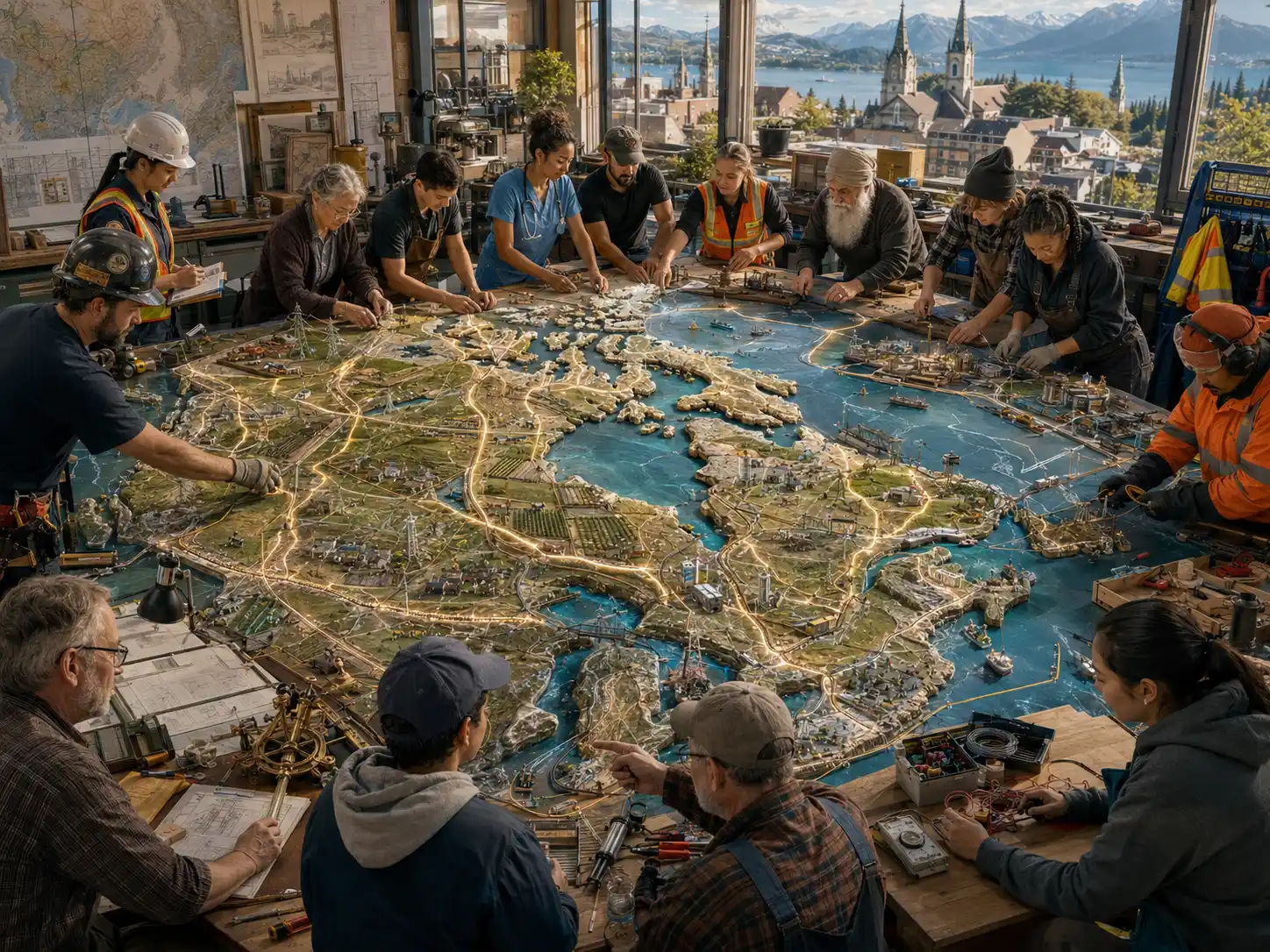
Chapter 15 — Canada the Builder
Canada is not only spoken.
It is built.
It is built through railways, ports, farms, ranges, parks, fisheries, mines, forests, ranges, hydro dams, bridges, roads, ferries, construction sites, power lines, grain elevators, winter roads, machine shops, shipyards, trucks, trades, survey lines, pipelines, factories, transmission towers, warehouses, culverts, docks, cranes, snowplows, and people fixing what breaks in weather that does not care.
A country this large cannot live on symbolism alone.
It needs steel, wood, concrete, fuel, food, wires, ports, plows, pipes, ferries, cables, engines, tools, and hands that know how to keep systems running.
Canada likes to speak of values. But before values can be lived, somebody has to build the room, heat it, wire it, plumb it, stock it, road it, staff it, clean it, maintain it, and repair it when winter, rust, water, time, and human error begin their work.
That is the builder story.
It is not only the heroic story of great projects. It is also the daily story of maintenance. The bridge inspected before anyone notices. The road salted before the commute. The fishing boat repaired before the season. The combine fixed before the weather turns. The mine equipment maintained underground. The ferry running because a crew knows the route. The hydro worker out after a storm. The nurse’s station kept warm in a northern community. The apartment boiler repaired before families freeze. The grain moved, the shipment loaded, the truck fixed, the roof patched, the power restored.
A country is built once.
Then it has to be built again every day.
That second part is often forgotten.
Canada the Builder was one of the country’s great story engines. It gave Canadians an image of themselves as people who could cross distance, endure weather, move goods, connect regions, feed cities, power homes, and make life possible across an enormous geography.
Railways carried this myth powerfully.
The railway was not only transportation. It was nation-making in steel. It joined regions, carried settlers, moved grain, connected ports, supplied towns, enabled extraction, made markets, and gave Canada a physical line across distance. Schoolchildren learned railways as one of the country’s central facts: Canada was too large to merely declare itself. It had to be joined.
But the railway story is also morally dangerous if told cleanly.
It involved dispossession. It crossed Indigenous lands. It depended on brutal labour, including Chinese workers who faced danger, discrimination, exclusion, and racist law after their labour helped make the project possible. It served settlement and extraction as well as connection. It was a builder story with blood, hierarchy, ambition, and state power inside it.
That does not mean the railway story should be discarded.
It means it must be told truthfully.
Canada was built.
Canada was also built over people.
Canada was connected.
Canada also used connection as control.
Canada’s infrastructure made life possible.
Canada’s infrastructure also carried injustice.
The adult task is to hold both.
Hydro carries the same tension.
A dam is not just concrete and turbines. It is light in homes, heat in winter, factories running, elevators moving, hospitals functioning, cities expanding, and the quiet miracle of power arriving when a switch is touched. Hydro helped make modern Canada feel clean, public, technical, and future-facing.
But dams also flood land. They change rivers. They alter fish, hunting, burial places, traplines, communities, and treaty realities. They can bring power to cities while imposing cost on people and ecosystems far from the switch.
The builder story is never innocent.
Mines carry the same contradiction.
Mining built towns, wages, rail lines, export wealth, machinery, unions, injuries, disease, pride, boom-bust cycles, environmental damage, and family stories. A mine can mean opportunity and danger in the same breath. It can feed a household and poison a watershed. It can give dignity to labour and dependency to a region. It can make the materials required for modern life while reminding us that “clean” technologies still come from the ground.
Forestry, fisheries, farming, oilfields, ports, and construction all carry the same moral mixture.
The builder story is not pure pride.
It is material truth.
A country that consumes without seeing builders becomes childish. It imagines comfort as normal and inconvenience as failure. It speaks as if electricity, housing, food, roads, phones, hospitals, schools, and supply chains appear by intention. It debates outcomes while ignoring the labour, land, tools, and maintenance that make outcomes possible.
Somebody poured the concrete.
Somebody framed the wall.
Somebody drove the truck.
Somebody welded the beam.
Somebody packed the fish.
Somebody picked the crop.
Somebody repaired the line.
Somebody ran the machine.
Somebody cleaned the facility.
Somebody maintained the road.
Somebody showed up in the cold.
The phrase “essential worker” briefly made this visible. Then much of the country forgot again.
Canada often forgets builders because builders do not always control the story. The people who maintain the country are often too busy maintaining it to narrate it. The language of national identity is produced elsewhere: in politics, media, universities, branding, corporate communications, public relations, and cultural argument. These worlds matter. But if they float too far from material life, the country becomes top-heavy.
Rich in commentary. Poor in contact.
That is one reason the builder story belongs here, after chapters on family, school, stores, sport, tools, land, and public memory. The book has been moving through the ordinary systems that formed people. Building is one of the deepest of them because it shows that a country is not only imagined. It is made.
And making requires trade-offs.
This is where mature Canada must replace childish Canada.
Childish Canada wants clean pride or clean condemnation.
Clean pride says: look what we built.
Clean condemnation says: look what building destroyed.
Mature Canada says: look honestly at both, then learn to build better.
The country needs housing, roads, ports, transit, schools, hospitals, energy, water systems, broadband, ferries, bridges, farms, repair shops, and climate-resilient infrastructure. It also needs Indigenous rights, environmental responsibility, labour dignity, regional fairness, and humility about what past building cost.
The answer cannot be to stop building. A country that stops building traps the young, abandons the remote, prices out families, overloads old systems, and turns maintenance failure into a way of life.
The answer also cannot be to build as if land, water, treaties, labour, and communities are obstacles.
The repair is truthful building.
Build, but know where you are.
Build, but know whose land is involved.
Build, but know who bears the cost.
Build, but honour the worker.
Build, but maintain what already exists.
Build, but do not hide damage under national myth.
Build, but do not let guilt become paralysis.
Build, but remember that future Canadians will inherit both the structure and the debt.
Canada has a bad habit of speaking about itself as if being good were enough.
Good intentions do not build housing.
Good values do not repair bridges.
Good messaging does not move freight.
Good apologies do not maintain water systems.
Good branding does not train welders, nurses, carpenters, electricians, fishers, farmers, mechanics, engineers, heavy-equipment operators, cooks, care aides, and road crews.
Good politics does not matter if the country cannot physically sustain the people living inside it.
This is not an argument against values. It is an argument that values must become competent.
Compassion must become housing.
Reconciliation must change land, law, infrastructure, water, school, and conduct.
Environmentalism must understand energy, materials, food, transport, and maintenance.
Immigration must include settlement systems, language, work, housing, schools, and public belonging.
Care for the elderly must become staffing, buildings, wages, training, and time.
Concern for youth must become real pathways into work, skill, and home.
Love of country must include respect for the people who keep the country working.
Without material competence, values become theatre.
The builder story also restores dignity to maintenance.
Modern culture often loves innovation and despises maintenance. It celebrates disruption, launch, growth, novelty, and scale. But civilization depends on boring continuity. Pipes, roads, ferries, schools, hospitals, grids, sewers, farms, and homes do not stay functional because someone announced a vision. They stay functional because people inspect, clean, repair, replace, budget, schedule, train, and return.
Maintenance is love in practical form.
A parent maintaining a home.
A mechanic maintaining a bus.
A custodian maintaining a school.
A nurse maintaining a body.
A farmer maintaining soil.
A road crew maintaining access.
A librarian maintaining public knowledge.
A language keeper maintaining words.
A community elder maintaining memory.
A public servant maintaining a record.
A tradesperson maintaining heat.
All of that is builder work.
Canada has often separated “builders” from “care,” as if building belonged to hard hats and care belonged to softer institutions. That is too narrow. Care builds. Maintenance builds. Teaching builds. Cooking builds. Cleaning builds. Nursing builds. Childcare builds. Elder care builds. Translation builds. Community work builds.
A country is built by everyone who makes life possible for others in durable ways.
This broader builder story helps avoid turning the chapter into a monument to masculine industrial nostalgia. Canada the Builder is not only men in hard hats, though they are part of it. It is also women in factories, hospitals, farms, homes, labs, classrooms, offices, and unions. It is immigrant labour. Indigenous labour. Care work. Domestic work. Food work. Textile work. Administrative work. Planning work. Invisible work. The work that does not appear in national murals but without which nothing functions.
The old builder myth often forgot too many of these people.
The repaired builder story must include them.
It must also include regions honestly.
Atlantic Canada knows ports, fisheries, shipyards, outmigration, offshore work, storms, ferries, and communities shaped by water and distance.
Quebec knows hydro, construction, aerospace, language institutions, labour struggles, farms, cities, Catholic infrastructure turned secular, and a builder story tied to its own national memory.
Ontario knows factories, auto plants, suburbs, universities, mines in the north, farms, finance, warehouses, highways, and the transformation from industrial work to service and knowledge economies.
The Prairies know grain, oil, potash, rail, trucks, farms, irrigation, wind, distance, winter, and the politics of being both essential and misunderstood.
British Columbia knows ports, forestry, mountains, fisheries, real estate, film, tech, bridges, ferries, resource towns, Indigenous land conflicts, and the Pacific.
The North knows infrastructure as survival: runways, winter roads, fuel, housing, food supply, health access, communications, military presence, extraction, and the cost of southern decisions made far away.
There is no single builder Canada.
There are many built Canadas.
But they share one truth: people live inside material systems. When those systems fail, abstractions vanish quickly.
A power outage teaches this. So does a boil-water advisory. So does a bridge closure. So does a ferry cancellation. So does a rail strike. So does an empty shelf. So does a housing shortage. So does a furnace failure in February. So does a flood.
Suddenly the hidden country appears.
The repair truck.
The lineman.
The road crew.
The dispatcher.
The nurse.
The neighbour with a generator.
The worker at the counter.
The driver.
The plumber.
The person who knows where the shutoff valve is.
Crisis reveals builders.
A wise country should not wait for crisis to honour them.
The damage to builder culture is not only forgetting. It is also abstraction. Work moved into portals, dashboards, policies, metrics, financial instruments, and distant ownership structures. Housing became an asset class before it was a place to live. Food became a supply chain before it was a farm, fishery, warehouse, truck, store, kitchen, and table. Energy became a debate before it was heat. Infrastructure became an announcement before it was labour.
This abstraction makes bad politics easier.
People demand outcomes without respecting constraints. Others defend industries without acknowledging damage. Some speak of transition without understanding materials. Some speak of development without understanding land. Some speak of labour without knowing workers. Some speak of environment without knowing how life is powered. Some speak of housing without knowing what it takes to build.
The builder story can correct this if told maturely.
It can teach that reality is made of systems, not wishes.
It can teach that every convenience has a material chain.
It can teach that building requires permission, skill, time, money, land, tools, risk, and maintenance.
It can teach that neglect is a decision.
It can teach that a country must be judged not only by what it says, but by what it can actually build, repair, and sustain.
That last standard is severe.
Can Canada build homes its young can afford?
Can it build institutions people can reach?
Can it build infrastructure that survives climate stress?
Can it build water systems that do not abandon Indigenous communities?
Can it build transit that makes cities livable?
Can it build rural and northern access without pretending distance is easy?
Can it build energy systems honestly?
Can it build schools, clinics, care homes, and community places that form people?
Can it build trust after institutions have failed?
These are builder questions.
They cut through slogans.
A country that cannot build what it claims to value does not yet fully value it.
The repair must therefore put builders back near the centre of national respect.
Not as propaganda. Not as sentimental labour imagery. Not as an excuse to ignore environmental harm or Indigenous rights. But as recognition that the country’s future depends on people who can make, maintain, repair, grow, transport, power, house, feed, and care.
That respect should change education. Trades and technical programs should be treated as high intelligence. Students should see building as civic contribution, not fallback. Universities, colleges, apprenticeship systems, unions, employers, engineering communities, outdoor communities, municipalities, and schools should be connected more seriously. Practical skill should not be separated from moral responsibility.
That respect should change politics. Infrastructure should not be only ribbon-cutting. Maintenance should be honoured before collapse. Housing should be treated as settlement, not only market. Energy debates should include materials, labour, reliability, emissions, Indigenous rights, and regional realities.
That respect should change culture. The people who keep Canada running should appear in the national imagination: care aides, carpenters, technicians, technologits, applied scientists, information systems professionals, engineers, truckers, fishers, farmers, hunters, sports shooters, miners, electricians, snowplow drivers, port workers, cooks, mechanics, welders, custodians, nurses, forestry workers, engineers, construction labourers, ferry crews, water operators, and people maintaining life in remote places.
That respect should also change memory.
When families tell stories, ask who built. Who worked on the line? Who farmed? Who cleaned? Who drove? Who cooked? Who repaired? Who sewed? Who kept the books? Who built the house? Who maintained the church, temple, school, or hall? Who worked nights so others could study? Who carried the country without being called a builder?
Canada’s builder story becomes more truthful when it includes both the great projects and the ordinary hands.
The railway and the lunch pail.
The dam and the flooded land.
The mine and the injured worker.
The farm and the debt.
The port and the migrant labour.
The house and the person cleaning it.
The highway and the neighbourhood it cut through.
The bridge and the inspector.
The school and the custodian.
The hospital and the care aide.
The national project and the family body that paid for it.
This is not anti-pride.
It is better pride.
Pride that can survive truth is stronger than pride that requires forgetting.
Canada needs that kind of pride now because the country has to build again. Housing, climate adaptation, water, energy, northern infrastructure, public institutions, transit, schools, care, repair culture, and local places will not appear through values statements.
They will have to be built.
And if they are built without memory, they will repeat harm.
If they are blocked by guilt, they will abandon the future.
If they are driven only by profit, they will hollow out the common good.
If they are driven only by politics, they will become theatre.
If they are built truthfully, they can become repair.
Canada the Builder must become Canada the Maintainer, Canada the Repairer, Canada the Honest Builder.
A country that remembers only what it built becomes arrogant.
A country that remembers only what building cost becomes paralyzed.
A country that remembers both can build better.
That is the task.
Not to worship railways, dams, mines, ports, farms, forests, roads, or towers.
To understand what they made possible, what they damaged, who paid, who worked, who was erased, who benefited, and what kind of building the future now requires.
Canada is not only spoken.
It is built.
And the next Canada will be judged not by what it says about itself, but by what it has the courage, skill, honesty, and discipline to build.
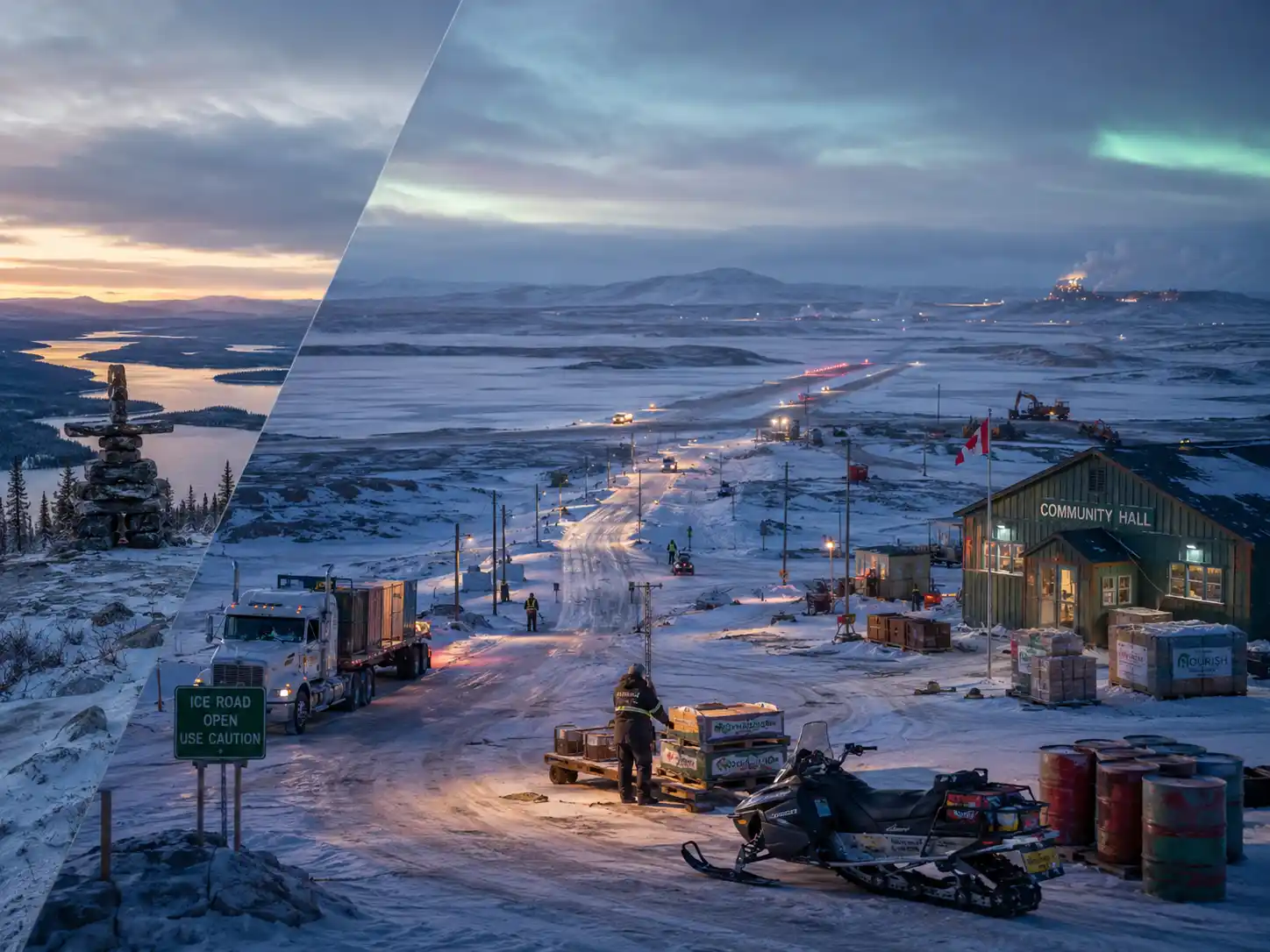
Chapter 16 — Wilderness, North, and Land Myth
Canada’s land has always been bigger than Canada’s stories about it.
The country was taught through images of lakes, forests, mountains, northern light, canoes, wildlife, snow, rock, distance, and silence. The Group of Seven gave many Canadians a visual grammar of rugged land. School posters, calendars, tourism ads, parks, beer commercials, wildlife segments, cottage roads, canoe trips, family drives, and classroom maps repeated the message until it felt natural:
Canada is land.
That story formed something real.
It taught scale.
It taught humility.
It taught that the country was not only cities, laws, politics, and markets.
It taught that weather, water, forest, rock, ice, animals, distance, and season were not decoration.
It gave children a way to imagine a country larger than their street.
But the story was also false when it treated land as empty.
The land was not empty.
It was lived land. Hunted land. Trapped land. Farmed land. Fished land. Logged land. Mined land. Flooded land. Indigenous land. Sacred land. Defended land. Contaminated land. Remembered land. Loved land.
Canada’s wilderness myth became dangerous whenever it made people love scenery while forgetting people.
A painting of a northern lake can teach beauty. It can also hide history. A park can teach wonder. It can also hide displacement, control, and unequal access. A canoe can symbolize freedom. A mountain can humble a person. It can also be turned into real estate, branding, or content.
The problem is not loving land.
The problem is loving land falsely.
Canada cannot repair itself by abandoning land love. That would make the country more rootless, not more just. People need attachment to the places they live. A child should know the river, trail, ravine, field, shore, hill, park, snowbank, wind, insects, birds, and weather of his own region. A country whose people do not love place will not protect it well.
But Canada also cannot keep telling land stories as if the land were only backdrop for national innocence.
The repair is truthful land belonging.
That means learning to hold beauty and harm together.
The old wilderness story was powerful because Canada really is a country of scale. To drive across the Prairies, cross northern Ontario, ferry along the coast, fly into a remote community, travel a winter road, paddle a lake system, or stand under mountains is to feel that the country exceeds human mood. Distance is not metaphor here. Weather is not atmosphere. Water is not scenery. Land is not a stage.
It acts.
A storm closes roads.
A river floods.
A fire remakes a town.
A winter road opens and disappears.
A lake changes with wind.
A forest burns, regrows, or is cut.
A coastline feeds and threatens.
A mountain divides.
A mine opens a future and a wound.
A farm waits on rain.
A northern community measures life through fuel, food, flights, ice, and cost.
Land is reality.
This is why land formed Canadian imagination so deeply. Even urban Canadians inherited the myth. Children who never camped still knew the symbols: the loon, the maple, the canoe, the moose, the pine, the mountain, the snowfield, the northern light. They saw them on coins, stamps, murals, textbooks, sports logos, beer ads, postcards, calendars, and public-service shorts. The land became a shared language for a country that often lacked other shared language.
That language did useful work. It reminded Canadians that life here had a physical basis. It offered humility against urban arrogance. It connected winter, sport, travel, resource work, conservation, and national scale.
But symbols can become lazy.
Once land becomes a symbol, people can mistake recognition for relationship. They can know the picture but not the place. They can praise wilderness while knowing nothing about watersheds, invasive species, resource labour, hunting ethics, fire management, northern housing, or how far food travels. They can post a mountain while ignoring the community below it. They can say “our land” without asking who “our” includes.
This is where Canadian land myth becomes morally thin.
A truthful land story must include Indigenous presence at the centre, not as a cautionary footnote.
Indigenous peoples are not part of Canada’s scenery. They are peoples with law, kinship, language, ceremony, memory, land relationships, and histories older than the state. Any Canadian land story that starts with emptiness is already wrong.
Forced relocations, reserve systems, resource extraction, hydro flooding, child welfare, and state control all damaged relationships to land that Canada now too easily tries to honour with words.
A land acknowledgement that changes no conduct can become another form of scenery.
Truthful land belonging requires more than reciting whose territory one occupies. It requires learning what that means, what obligations follow, what histories remain active, what communities are asking for, what legal and moral responsibilities exist, and how ordinary life is built on land others did not simply consent to lose.
This does not mean non-Indigenous Canadians must become rootless.
It means their belonging must become accountable.
There is a difference between possession and belonging.
Possession says: this is ours because we use it.
Belonging says: we live here, therefore we owe truth, care, restraint, repair, and relationship.
Canada needs belonging, not possession.
The North exposes this more sharply than almost anywhere else.
Southern Canada often imagines the North as pure space: snow, tundra, aurora, polar bears, minerals, sovereignty, adventure, military strategy, climate warning, or spiritual emptiness. But the North is not an idea. It is home. It is community, language, food prices, flights, housing, diesel, darkness, ice, hunting, schools, health care, search and rescue, mines, military stations, climate change, colonial administration, and people whose lives are constantly simplified by southern imagination.
The North is not Canada’s backdrop for awe.
It is part of the country’s conscience.
A country that invokes the North while ignoring northern housing, food security, infrastructure, Indigenous rights, mental health, language, climate change, and local authority is using the North as myth, not meeting it as reality.
The same danger exists with wilderness.
Parks can teach reverence. They can also teach a false idea of nature as separate from human history. A park sign may tell visitors about animals, trails, and geology while saying too little about the peoples whose relationships to that place were disrupted, regulated, or erased. Conservation is necessary, but conservation without history can become another form of control.
At the same time, rejecting parks as merely colonial would also be too simple. Parks preserve ecosystems, teach children wonder, protect species, give urban people contact with land, and create spaces where people can learn humility before something not built for them.
Again the book’s rule applies:
Keep what forms.
Reject what lies.
Repair what harmed.
Rebuild the function truthfully.
The function of wilderness memory was never only scenery. At its best, it taught humility before scale, awareness of place, desire to protect land, practical outdoor skill, and the feeling that Canada was more than administration.
The lie was emptiness.
So the repair is not to stop teaching land. It is to teach land with people, history, obligation, and skill restored.
That also means telling the resource story honestly.
Canada’s land is not only parkland. It is worked land.
Forests are cut. Fish are caught. Fields are seeded. Minerals are mined. Oil and gas are extracted. Rivers are dammed. Roads are built. Transmission lines cross distance. Trucks move goods. Ports load ships. Gravel is dug. Houses are framed from wood. Phones require metals. Wind turbines, solar panels, batteries, and electric vehicles also require extraction, land, labour, and infrastructure.
A childish environmental imagination pretends that modern life can be clean by hiding the dirty parts somewhere else.
A childish resource imagination pretends that jobs and growth erase ecological cost.
Canada needs neither.
It needs a mature land imagination: one that understands dependence, damage, limits, rights, skill, and repair.
That means respecting the people who work land without romanticizing extraction. Farmers, fishers, hunters, trappers, foresters, miners, drillers, guides, conservation officers, park wardens, firefighters, surveyors, truckers, and northern workers often know forms of land reality that urban moral language misses.
It also means respecting engineering, applied science technology, environmental science, local communities, and the fact that some damage cannot be undone.
Land maturity means refusing easy innocence in every direction.
The old myth said Canada’s land made the country pure.
It did not.
The new temptation says land is mainly a site of guilt.
It is not only that either.
Land is home, food, law, work, beauty, grief, profit, memory, conflict, danger, ceremony, recreation, responsibility, and future.
A country that can hold all of that may become wise.
This chapter belongs after the builder chapter because building and land cannot be separated. Canada the Builder without land truth becomes conquest and extraction. Land myth without building truth becomes scenery and paralysis. The country has to learn how to build while remembering where it is.
It also belongs after the chapter on outdoor competence because personal land skill and national land story are connected. A child who has felt a portage, watched wind move across water, waited for a fish, seen a clear-cut, visited a farm, heard an elder speak of land, or learned why a river matters has a different imagination from a child who knows land only through wallpaper and slogans.
The screen makes this harder.
Land is now endlessly visible as image. Lakes, mountains, northern lights, cabins, trails, parks, wildlife, sunsets, fires, floods, and storms circulate constantly. But seeing land on a screen can become a substitute for knowing it. The image can produce feeling without obligation.
A person can love the idea of wilderness while being careless with the local ravine.
A person can condemn resource work while living inside resource dependence.
A person can praise rural life while treating rural people as backward.
A person can mourn climate change while knowing little about applied science or engineering.
This is why repair must become local.
Do not start only with national myth.
Start with the ground under the feet.
What watershed are you in?
Whose land are you on?
What treaties or histories shape it?
What grew here before the subdivision?
Where does the water go?
What floods?
What burns?
What species live here?
What was farmed, mined, logged, buried, paved, protected, poisoned, restored?
Which Indigenous nations remain connected to it?
Which roads, rails, ports, pipelines, hydro lines, and food systems sustain your life?
Which parks are accessible?
Who cannot reach them?
Who works the land you consume from?
Those questions turn scenery into responsibility.
They also make belonging possible.
A person cannot belong truthfully to an abstraction. He belongs to places he knows, cares for, and answers to.
Canada’s old land myth gave people symbols of belonging. The repair must give them practices of belonging.
Walk the local trail.
Learn the watershed.
Learn the treaty.
Learn the plants.
Learn the weather.
Learn the food systems.
Visit the park and know its history.
Listen to grounded teachers in STEM where invited and appropriate.
Respect hunting and fishing as more than stereotypes.
Respect farming as more than nostalgia.
Respect conservation as more than branding.
Respect northern life as more than awe.
Respect resource workers without making them shields against criticism.
Respect environmental limits without using them to despise people who work.
This is hard because land arguments quickly become identity arguments.
Urban against rural.
Settler against Indigenous.
Environment against jobs.
South against North.
Recreation against work.
Conservation against extraction.
Guilt against pride.
But land is too important to be left inside these binaries.
The land does not become healthier because people perform the correct identity around it. It becomes healthier through knowledge, restraint, law, stewardship, technology, repair, sacrifice, and changed conduct.
The land does not become more just because people feel bad. It becomes more just when rights, title, treaties, governance, access, water, housing, protection, and relationship change.
The land does not become more loved because it appears in branding. It becomes more loved when people know it well enough to miss it, protect it, and be corrected by it.
Canada’s land story must move from image to obligation.
That is the upgrade.
The Group of Seven painting is not enough.
The canoe symbol is not enough.
The park selfie is not enough.
The land acknowledgement is not enough.
The resource slogan is not enough.
The climate slogan is not enough.
Each may point to something real. None can replace relationship.
This does not make beauty unimportant. Beauty is part of why people protect anything. A child should still be allowed wonder. The first sight of mountains, the sound of a loon, the smell of pine, the flat terror of prairie sky, the ice on a river, the Atlantic hitting rock, the stillness of northern light, the green of a ravine after rain — these can form love before politics begins.
But love must grow up.
Childish love says: this is beautiful, therefore it is mine.
Mature love says: this is beautiful, therefore I owe it truth.
The same applies to national belonging.
A childish national land story says: Canada is beautiful, therefore Canada is good.
A mature one says: Canada is beautiful, damaged, indebted, responsible, and still worth repairing.
That sentence is strong enough to build on.
It allows gratitude without innocence.
It allows criticism without rootlessness.
It allows environmental responsibility without contempt for work.
It allows pride without erasure.
It allows repair.
Canada’s land has always been bigger than Canada’s stories about it.
That is not a reason to stop telling stories.
It is a reason to tell better ones.
Stories where the lake is beautiful and not empty.
Where the forest is alive and not merely resource.
Where the mine is useful and not morally weightless.
Where the farm is labour and not postcard.
Where the North is home and not symbol.
Where the park is wonder and history.
Where the city is land too.
Where the treaty is not past tense.
Where Indigenous peoples are not scenery.
Where newcomers can belong without pretending no one was here before.
Where children learn that Canada is not only something to admire, but something to answer for.
The repair is truthful land belonging.
Less postcard. More practice.
Less empty wilderness. More history.
Less guilt alone. More obligation.
Less scenery. More relationship.
Less myth. More maturity.
A country that cannot tell the truth about its land cannot tell the truth about itself.
But a country that learns to belong truthfully to land may yet become capable of repair.
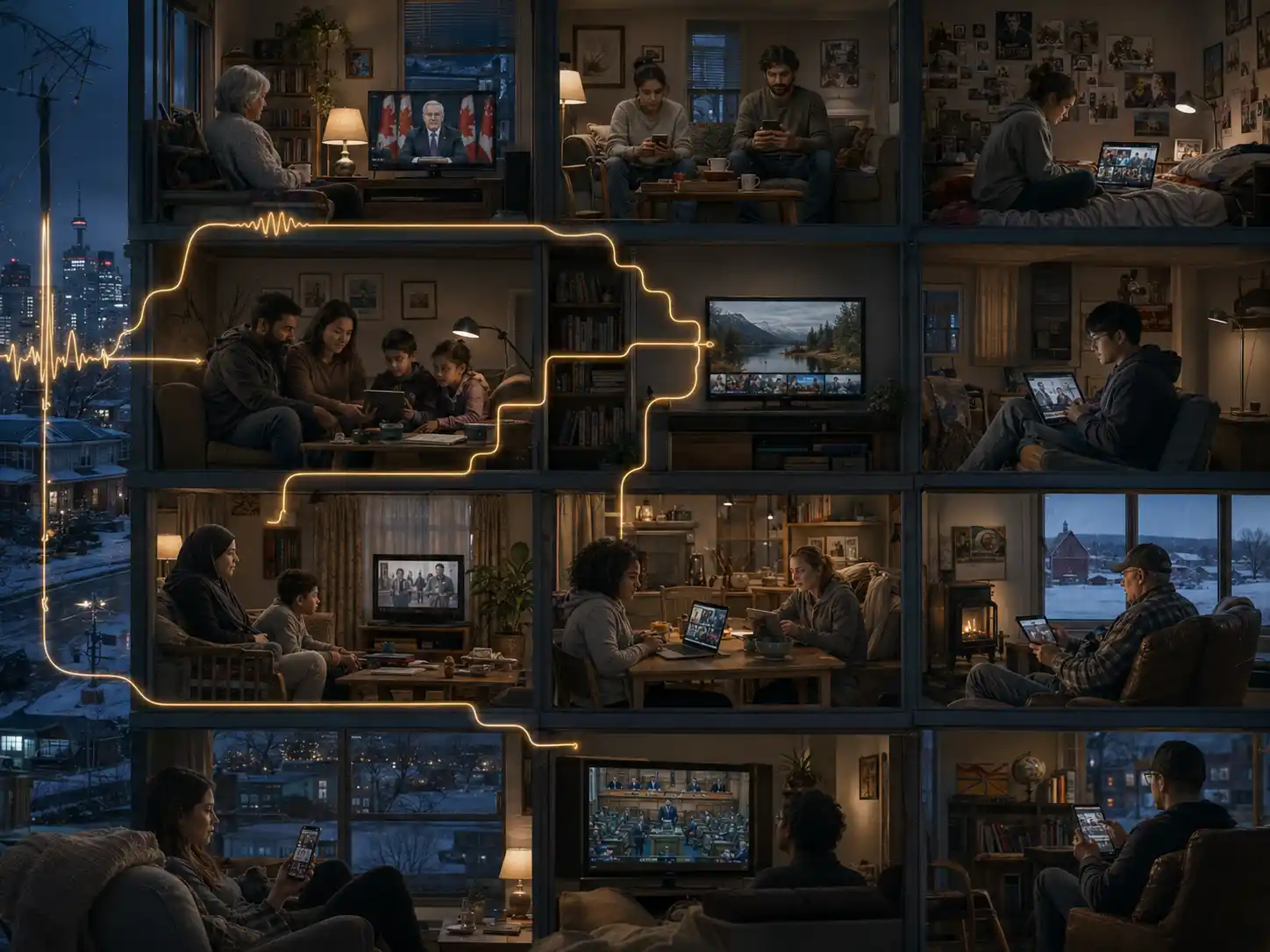
Chapter 17 — Shared Screen Canada
Media once amplified common life.
It did not yet replace it.
That distinction matters because Canada’s shared screen was never the whole country. It did not create family, school, winter, stores, rinks, public pools, libraries, churches, temples, synagogues, work, land, roads, or neighbourhood life. It sat on top of them. It gave them references. It gave them timing. It gave children jokes, songs, ads, sports calls, weather reports, public-service warnings, theme music, and stories that could travel across provinces.
A screen was once inside the room.
The room still mattered.
A family watched the broadcast together. A child saw the commercial at the same time as classmates. A teenager watched a music video and heard people talk about it at school the next day. A hockey game gave Saturday night a shape. A snow-day announcement came over the radio. A Heritage Minute appeared between shows and lodged itself somewhere in national memory. A public-service ad warned children about the “house hippo” and somehow became more memorable than many official civics lessons.
This was shared screen Canada.
Not one Canada. Never one Canada. The country was always divided by language, region, class, immigration, religion, race, geography, household rules, technology access, and taste. Radio-Canada did not simply mirror CBC. Quebec had its own media world. Immigrant families carried channels, tapes, newspapers, satellite dishes, languages, music, films, and news from elsewhere. Rural and northern Canadians encountered media through different timing, access, and local needs. Some homes had cable. Some did not. Some parents restricted television. Some children watched everything.
So the shared screen was never universal.
But it created overlap.
That overlap formed people.
CBC, Radio-Canada, CTV, Global, TVO, TFO, YTV, Teletoon, MuchMusic, Hockey Night in Canada, Heritage Minutes, Hinterland Who’s Who, Body Break, House Hippo, Degrassi, ReBoot, Mr. Dressup, The Friendly Giant, The Raccoons, This Hour Has 22 Minutes, Rick Mercer, Saturday cartoons, local news, weather reports, Olympic broadcasts, World Juniors, newspaper TV listings, radio call-in shows, and school conversations after last night’s episode all helped create a common layer of reference.
A child did not need to watch everything. Enough children watched enough of the same things for the culture to have some shared furniture.
A theme song could call a room to attention.
A public-service ad could become a joke everyone knew.
A music video could become a style lesson.
A hockey broadcast could organize a Saturday.
A children’s show could give a generation the same emotional weather.
A news anchor could make national events feel like they entered the home.
A local radio station could make snow, traffic, school closures, contests, birthdays, and lost dogs feel part of the same public world.
Media did not replace common life because common life was still thick around it.
The broadcast ended and children went to school.
The show ended and the family ate.
The game ended and people went to the rink.
The ad ended and the child went outside.
The music video ended and teenagers went to the mall, the basement, the bus, the dance, the record store, or the friend’s house.
The weather report mattered because actual weather waited outside.
That is the key.
Media amplified a world that still existed beyond media.
Hockey Night in Canada is the clearest example. It was not only a television program. It joined rinks, families, bars, living rooms, local teams, Saturday routines, playoffs, arguments, heroes, disappointments, and national timing. It mattered because hockey already lived in bodies and places: frozen ponds, minor hockey, street games, arenas, equipment bags, coaches, parents, and cold mornings.
The screen amplified the game. It did not yet replace the game.
MuchMusic did something similar for youth culture. It made music public. Videos, VJs, interviews, countdowns, fashion, jokes, scandals, live moments, and viewer call-ins gave teenagers a feeling that taste was happening somewhere visible. Music was not only a private stream. It was a shared flow. You could discover something because it appeared in front of everyone at once. You could hate it with others. You could imitate it. You could argue about it. You could feel that youth culture had a room.
YTV and Teletoon gave children scheduled worlds. After-school blocks, weekend cartoons, hosts, bumpers, commercials, contests, and holiday programming created time that felt shared. A child could return to school knowing others had seen the same thing. Not everyone, but enough.
Public-service ads had a strange national power because they appeared unexpectedly. House Hippo, Body Break, anti-smoking ads, safety warnings, ParticipACTION messages, Hinterland Who’s Who, wildlife shorts, and government spots entered ordinary viewing and stayed there. They were sometimes awkward, sometimes preachy, sometimes funny, sometimes oddly beautiful. But they belonged to an era when public messaging could still become shared memory.
Heritage Minutes were especially revealing. They were tiny national myths delivered through television timing. They simplified history. They left things out. Some were sentimental. Some became jokes. Some taught more slogan than complexity. But they also did something the country now struggles to do: they gave people small, memorable pieces of shared historical reference.
The problem was not that they existed.
The problem is that public memory cannot stop there.
A Heritage Minute can open a door. It cannot be the whole house.
Shared screen Canada gave common references, but it also had gatekeepers. It excluded. It flattened. It centralized. It made Toronto and Montreal larger than many regions. It underrepresented Christian families, hunters, fishers, responsible firearm owners, sports shooters, soldiers, except through stereotypes, absence, or narrow issue frames. It often treated immigrant communities as flavour, problem, success story, or background. It missed working-class reality, rural complexity, disabled life, northern experience, and many forms of faith. English Canada often failed to understand Quebec media as a full world rather than a translation problem.
So the old shared screen should not be idealized.
More channels, more creators, more languages, more platforms, and more access corrected real limits. People can now find media that old broadcasters ignored. Indigenous creators can speak directly. Immigrant families can remain connected to global cultures. Disabled creators can build audiences. Regional voices can publish without waiting for a national gatekeeper. Archives are searchable. Niche communities are real. A young person can watch lectures, films, music, comedy, ceremonies, language lessons, and local history from almost anywhere.
That expansion is a gain.
The loss is not choice.
The loss is common timing.
A country can gain infinite choice and lose shared rhythm.
Streaming weakened the schedule. Algorithms weakened accidental common reference. Smartphones privatized viewing. Headphones separated people in the same room. YouTube, TikTok, Instagram, Discord, podcasts, group chats, Netflix, Spotify, and algorithmic feeds gave each person a personalized media weather system. Two siblings could sit on the same couch inside different worlds. Two classmates could live in the same town and share almost no cultural references. A family could be together physically while each member inhabited a separate feed.
The screen was no longer inside the room.
The screen became the room.
That shift changed the social function of media.
Scheduled media said: this happens now.
Algorithmic media says: this happens for you.
Scheduled media produced waiting.
Algorithmic media produces endlessness.
Scheduled media created scarcity.
Algorithmic media creates abundance.
Scheduled media gave a household a common object.
Algorithmic media gives each person a private stream.
Scheduled media had gatekeepers.
Algorithmic media has hidden governors.
The old gatekeepers were visible enough to criticize. Broadcasters, networks, editors, regulators, hosts, and newspapers could be named. The new gatekeepers are harder to see: recommendation systems, engagement metrics, platform policies, search rankings, advertiser incentives, data extraction, creator economies, and algorithmic feedback loops.
Choice expanded, but control did not simply disappear. It changed form.
That is one of the central facts of managed reality.
People feel freer because they can choose anything. But the menu is shaped, ranked, pushed, measured, and monetized by systems most users do not understand. The shared screen became the personalized feed, and the personalized feed became one of the strongest formation systems in modern life.
It trains attention.
It trains taste.
It trains outrage.
It trains desire.
It trains comparison.
It trains loneliness.
It trains politics.
It trains identity.
Older media trained people too. It sold products, shaped norms, excluded voices, manipulated attention, and carried propaganda. But the new system is more intimate. It follows the person everywhere. It learns the person. It adapts to weakness. It fills boredom instantly. It turns private impulses into data. It makes the self both audience and product.
This is why shared screen Canada matters to the book. It marks the bridge between thick common life and managed reality.
Media first amplified common life.
Then media began replacing common life.
The hockey broadcast once pointed back to rinks. Now sports can become highlights, gambling, fantasy, commentary, clips, drama, and takes detached from local play. Music television once pointed back to bands, dances, malls, rooms, and records. Now music can become private mood management in headphones. News once pointed back to a city, province, or country with some common events. Now news becomes personalized alarm. Comedy once produced shared jokes. Now humour fractures into micro-audiences. Public-service media once tried to give common warnings. Now public information competes with influencers, memes, suspicion, and platform incentives.
The country did not simply get more media.
It got less shared reality.
Local news is central here. A local newspaper or radio station made public life nameable. Council meetings, school issues, minor sports, obituaries, weather, fires, openings, closures, crimes, fundraisers, letters, photos, and arguments all appeared in one place. The paper could be biased, thin, underfunded, or wrong, but it gave a town or neighbourhood a record of itself.
When local journalism weakens, people may know more about distant outrage than their own municipality. They may know American political personalities better than their school trustee, councillor, local reporter, union issue, library closure, water problem, or zoning decision. They become nationally inflamed and locally blind.
That blindness feeds political capture.
A person without local information becomes easier to absorb into national spectacle. A town without local journalism becomes more vulnerable to rumour, imported conflict, and social media distortion. A country without shared public facts becomes harder to govern and easier to manipulate.
Public broadcasting was supposed to help with this at national scale. In a country as large and regionally uneven as Canada, public media had a real formation role: to make the country audible to itself. CBC and Radio-Canada did not always do this well. They could be centralized, smug, politically contested, regionally uneven, and blind to many lives. But the function remains necessary: a large country needs institutions that try to create shared civic information across distance, language, and region.
The repair is not to return to three-channel scarcity.
That world is gone. It also excluded too much.
The repair is to rebuild common reference under modern conditions.
A plural country does not need everyone watching the same thing all the time. It does need some shared moments, trusted information, public-interest media, local journalism, civic rituals, national events, educational programming, and cultural spaces where different people can still encounter overlapping realities.
Common reference can be rebuilt through many forms.
Local journalism that names place.
Public broadcasters that earn trust by showing more of the country.
School media literacy that teaches how feeds shape attention.
National events that gather without flattening.
Regional storytelling that travels.
Indigenous media with authority, not tokenism.
Quebec media understood as a full civilizational world, not a side channel.
Immigrant and multilingual media treated as part of Canada’s real public life.
Libraries and archives that preserve shared memory.
Public-service media that people actually remember.
Youth culture that includes common discovery, not only private recommendation.
This requires better judgment about media than nostalgia can provide.
Old media had common reference but too few voices.
New media has many voices but weak common reference.
The task is not to choose one failure. It is to build a better balance.
More voices. More truth. More access. More local memory. More shared reality.
That is hard because platforms are not designed primarily to form citizens. They are designed to capture attention, sell advertising, grow engagement, collect data, and keep users returning. They can host public life, but they are not public institutions in the old sense. Their obligations are not the obligations of a town square, school, library, or broadcaster.
A country that hands its common reality to platforms should not be surprised when reality fragments.
This does not mean people should abandon digital media. That would be impossible and foolish. Digital media carries art, knowledge, testimony, friendship, archives, humour, education, minority voices, local organizing, and global connection. The question is whether digital media serves common life or consumes it.
The old screen had a boundary. The show ended. The station signed off. The paper was folded. The radio moved to another program. The household returned to the room.
The new feed does not end.
That endlessness is one of its powers. It prevents return.
A person does not come back from the feed the way a family came back from a show. The feed can follow into bed, school, work, bathroom, car, table, sidewalk, and silence. It is not only media. It is environment.
This is why media repair must include bodily and public repair.
Shared screen cannot be rebuilt only with better content. It needs shared rooms again.
Watch the game together.
Hold local film nights.
Revive school screenings and discussions.
Use libraries as media commons.
Support local arts coverage.
Create public events around documentaries, debates, sports, history, music, and civic questions.
Teach children to make media, not only consume it.
Protect family meals and common rooms from total device capture.
Give youth culture places to gather offline after discovering things online.
A shared screen without shared rooms becomes just another feed.
A shared room without truthful media becomes provincial and blind.
The repair needs both.
This chapter also has to recognize French and English Canada clearly. Radio-Canada was not merely CBC in French. It helped sustain a public world with its own humour, politics, stars, debates, cultural references, and national feeling. Quebec media shows that shared screen can form a people inside a larger country. English Canada often misunderstood this because it treated national media as if the English conversation were the default.
A repaired Canada has to understand that shared reference may be plural.
There can be overlapping screens, not one screen.
English public media. French public media. Indigenous media. Local media. Immigrant media. Regional media. Youth media. National events. Public archives. Civic education. These do not need to collapse into one voice. They need bridges.
A bridge is different from a monoculture.
A bridge allows people to cross.
That is what the older shared screen sometimes did by accident. A Heritage Minute, a hockey game, a public-service ad, a national news event, a weather crisis, an Olympic broadcast, or a children’s show could give people a small crossing point. Not enough for a full country, but enough for recognition.
Modern Canada needs deliberate crossing points.
Not forced sameness.
Not algorithmic isolation.
Not culture-war broadcasting.
Not public media that lectures more than listens.
Not private platforms that fragment everything into engagement niches.
Crossing points.
A country needs things people can refer to together.
Not because everyone must agree. Because disagreement itself needs shared objects. If people share no facts, no events, no references, no rituals, no rooms, and no memory, then public argument becomes hallucination against hallucination.
Shared reference is not a luxury.
It is the ground under disagreement.
This is why the loss of shared screen is not merely cultural nostalgia. It is civic damage. The weakening of common media helped create the conditions for political capture. When people inhabit different feeds, politics can become identity theatre. Commentary can replace participation. Influencers can become institutions. Rumour can outrun reporting. Outrage can travel faster than correction. Imported conflicts can overwrite local reality.
The repair begins by asking what media is for.
If media is only entertainment, then personalization wins.
If media is only market, then engagement wins.
If media is only politics, then propaganda wins.
If media is part of common life, then the question changes: what helps people share a reality?
That question points back to the whole book.
Media alone cannot rebuild common life. It can only amplify what exists. If neighbourhoods are empty, if schools are brittle, if families are fragmented, if local institutions are weak, if work exhausts everyone, if housing prevents settlement, then media will not save the country.
But media can help people see what must be rebuilt.
It can show local life.
It can preserve memory.
It can carry difficult truths.
It can teach children.
It can gather attention around real events.
It can connect regions.
It can honour language.
It can expose harm.
It can create shared jokes.
It can make hidden builders visible.
It can return attention from the feed to the world.
That is the media worth rebuilding.
Media once amplified common life.
It did not yet replace it.
The future should not ask media to replace life again. It should ask media to serve life: families, schools, land, work, public rituals, local places, plural memory, shared facts, and the difficult project of belonging to a country large enough to need many screens but fragile enough to still need some common light.
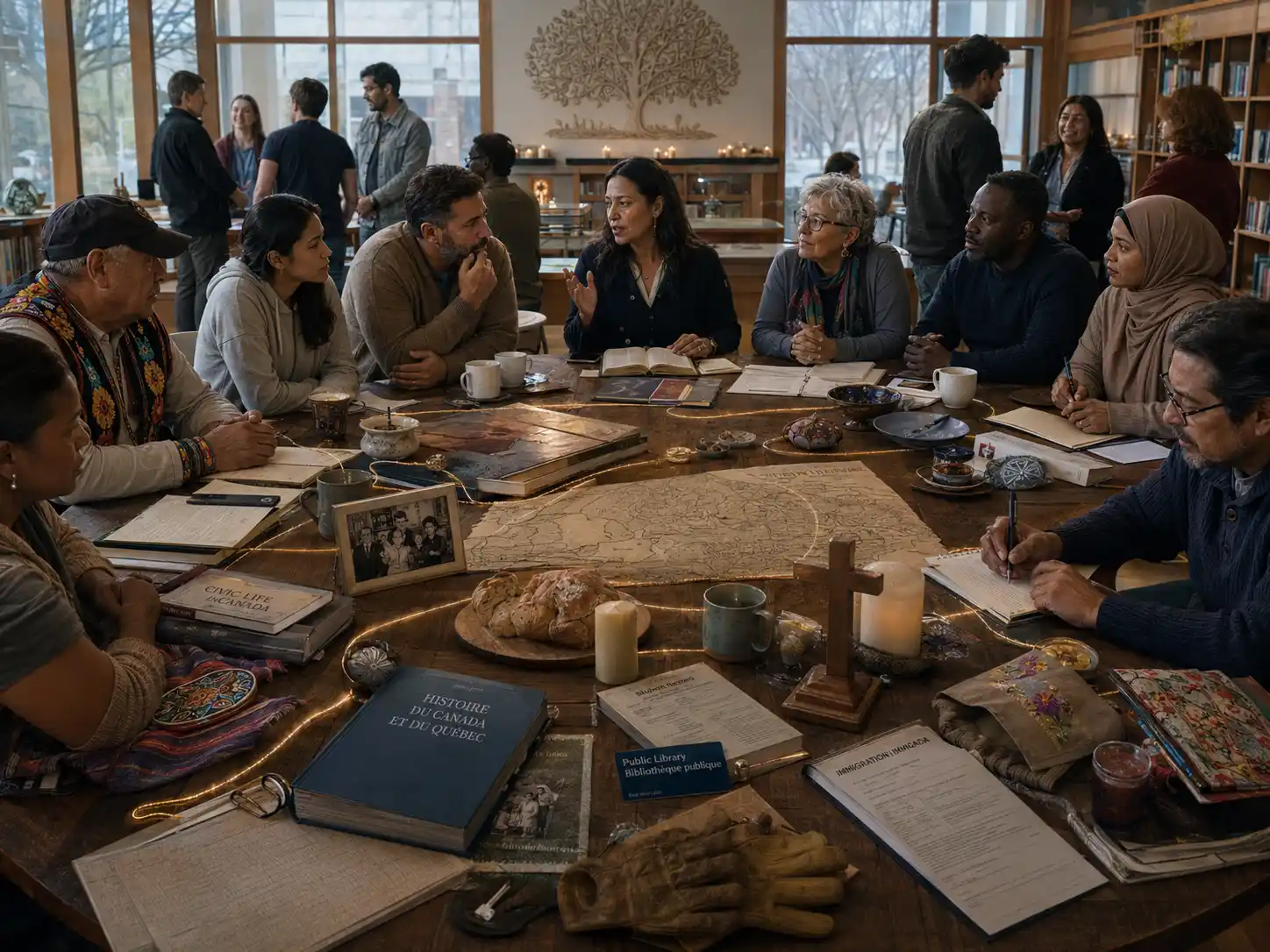
Chapter 18 — Where the Future Entered Canada
Builder Energy, Pacific Imagination, and the Western Corridor
The future does not enter a country only through its capital.
Sometimes it enters through a corridor.
A film worker leaves Vancouver for Calgary because the rent no longer makes sense.
An engineer trained in Alberta takes a contract in Burnaby.
A nurse moves between British Columbia and Alberta and carries one public system’s habits into another.
A tradesperson follows energy work, then brings west-coast expectations back to a prairie job site.
A student studies in Victoria, works in Vancouver, takes a position in Calgary, and discovers that Canada is not one economy but a chain of possible lives.
A software worker moves between gaming, film, finance, energy, logistics, and government systems without ever appearing in a national myth.
A family leaves the Lower Mainland for Alberta and carries with it Asian food, Pacific media, Vancouver taste, California references, housing anger, and a different sense of the future.
This is how civilization moves.
Not mainly through speeches.
Not mainly through rankings.
Not mainly through search results.
Not mainly through foreign approval.
Not mainly through national branding.
It moves through workers, students, crews, contracts, rents, layoffs, marriages, credentials, tools, friendships, children, ports, job sites, studios, roads, gyms, basements, ranges, and people deciding where the next stage of life is still possible.
Canada often talks about regions as if they are fixed personalities.
Alberta is oil.
British Columbia is lifestyle.
Ontario is the centre.
Quebec is the complication.
The Atlantic is memory.
The North is symbol.
The Prairies are grievance.
Vancouver is real estate.
Calgary is business.
Ottawa is government.
These simplifications are useful only to people who do not have to live inside them.
Real regions are not slogans. They are formation systems. They teach people what counts as real, what counts as possible, what kind of work matters, what kind of future can be imagined, and what kind of person is respected.
Alberta and Vancouver matter because they carry two forms of energy Canada badly needs.
Alberta carries builder energy.
Vancouver carries Pacific imagination.
That pairing may be one of the country’s most important future corridors.
Alberta knows that a country is not sustained by opinion, branding, administration, or moral language alone. It is sustained by fuel, grids, roads, housing, machinery, logistics, trades, engineering, finance, risk, maintenance, extraction, repair, and the ability to complete physical projects.
Vancouver knows that the future does not arrive only through Parliament, policy papers, or national broadcasters. It arrives through film sets, software, games, ports, Asian migration, California technology, Japanese animation, Korean media, Chinese capital and culture, American Sci-Fi and war films, Global blockbustere films, European films, finance, education, and the strange ability to recognize a future before official institutions can name it.
One builds.
One reads.
One powers.
One imagines.
One knows the weight of steel, concrete, fuel, pipe, wire, road, truck, crane, rig, grid, and permit.
One knows image, interface, translation, screen, version, taste, software, port, diaspora, studio, archive, and Pacific time.
Canada needs both.
A country that has only builder energy can become hard, defensive, extractive, and suspicious of culture.
A country that has only media imagination can become stylish, weightless, expensive, and detached from material reality.
The future requires the correction of each by the other.
That is why the Alberta–Vancouver corridor matters.
It is not a fantasy of western grievance. It is not a proposal to replace Ottawa with Calgary. It is not a claim that Alberta is pure or that Vancouver is wise.
Neither is true.
Alberta can become trapped in resentment, boom-bust memory, resource defensiveness, and the belief that being necessary is the same as being right.
Vancouver can become trapped in real-estate unreality, status taste, imported sophistication, climate moralism without project capacity, and the belief that recognizing the future is the same as building one.
Both can fail.
But together they contain a national possibility that central Canada often cannot see clearly:
the future as something powered, built, filmed, coded, shipped, financed, translated, argued over, and lived before it is theorized.
That is different from the Laurentian habit.
The Laurentian centre often tries to recognize the future after it has been ranked, certified, searched, approved, internationalized, moralized, and translated into institutional language. It looks for validation before it trusts reality. It asks which expert system approves, which foreign model is fashionable, which credential ranks highest, which phrase is safest, which policy vocabulary is acceptable, which institution can bless the direction.
That is not always wrong. Countries need expertise. They need law, caution, standards, diplomacy, public process, and institutional memory.
But a country governed mainly by permission can forget how life actually moves.
The western corridor begins somewhere else.
Where is the energy?
Where is the port?
Where is the job site?
Where is the crew?
Where is the housing pressure?
Where is the wildfire?
Where is the grid?
Where is the studio?
Where is the software?
Where is the migration?
Where is the trade?
Where is the future already being rehearsed?
Those are not abstract questions.
They are civilizational questions.
Canada had a builder soul before it had modern language for it.
Railways.
Bridges.
Ports.
Hydro dams.
Mines.
Farms.
Fishing boats.
Shipyards.
Airfields.
Machine shops.
Winter roads.
Grain elevators.
Transmission lines.
Resource towns.
Repair garages.
Immigrant stores.
Basement workbenches.
Public works.
War production.
Engineering schools.
Toolboxes in houses where no one called themselves a builder but everyone knew something would eventually break.
This inheritance was not innocent.
It carried colonial expansion, Indigenous dispossession, environmental damage, unsafe labour, class hierarchy, gender exclusion, racial exclusion, and the arrogance of people who mistook building for ownership.
But it built.
The later Canadian habit corrected some of the older country’s blindness. That correction mattered. A country that cannot name harm becomes morally childish.
But correction can become another form of forgetting if it teaches people that capability itself is suspect.
Canada became increasingly fluent in critique, process, safety language, inclusion language, risk management, stakeholder language, international language, apology language, and institutional language.
Some of that language named real things.
But it could not carry the whole country.
It did not know how to speak naturally about courage.
It did not know how to speak naturally about tools.
It did not know how to speak naturally about strength under restraint.
It did not know how to speak naturally about mission.
It did not know how to speak naturally about energy, defence, borders, machines, discipline, repair, sacrifice, and technical competence as virtues.
So those virtues went elsewhere.
They went into private shelves.
They went into film collections.
They went into martial arts gyms.
They went into games.
They went into garages.
They went into ranges.
They went into YouTube channels.
They went into sci-fi box sets.
They went into anime.
They went into Hollywood.
They went into Silicon Valley mythology.
They went into Pacific media.
They went into Alberta job sites.
They went into Vancouver studios.
They went into basements where people watched the future before public language could name it.
This was the strange thing.
The imported future did not feel entirely foreign.
It fit.
It fit like a glove over something Canada had buried.
James Bond gadgets, Mission: Impossible plans, Star Trek engineering, MacGyver improvisation, Iron Man’s workshop, Apollo 13’s crisis room, Gundam’s machines, Ghost in the Shell’s cybernetic future, Akira’s technological nightmare, Jackie Chan’s physical invention, Donnie Yen’s precision, Batman’s discipline, Spider-Man’s responsibility, Rocky’s training, Rambo’s survival, The Lord of the Rings’ fellowship, Stargate’s portals, Warhammer’s systems, Unreal Engine’s worldbuilding, and Silicon Valley’s garage myth all touched a buried Canadian nerve.
They said: the future belongs to people who can build, repair, train, improvise, code, endure, and act.
Official Canada often did not know how to say that without embarrassment.
So people learned it privately.
In theatres.
In basements.
In martial arts gyms.
In garages.
In game rooms.
In computer labs.
In video stores.
In range houses.
In workshops.
In engineering programs.
In film sets.
In immigrant plazas.
In the quiet admiration of people who knew that competence was still beautiful.
The shelf was not only a shelf.
It was a private curriculum.
It had rooms inside it.
The machine future:
Mobile Suit Gundam
Akira
Ghost in the Shell
Appleseed
Neon Genesis Evangelion
Terminator
Star Trek
Stargate
Iron Man
Apollo 13
Unreal Engine
The trained body:
Dragon Ball
Dragon Ball Z
Bruce Lee
Jackie Chan
Jet Li
Donnie Yen
Sammo Hung
Shaw Brothers films
Police Story
Drunken Master
Ip Man
boxing
kickboxing
Muay Thai
kendo
MMA
The mission world:
James Bond
Mission: Impossible
The Guns of Navarone
Where Eagles Dare
MacGyver
Knight Rider
Battleship
Midway
Pearl Harbor
Patton
The moral hero:
Spider-Man
Batman
Batman: The Animated Series
Superman
The Flash
Justice League
Marvel
Iron Man
The Lord of the Rings
Rocky
Gladiator
The Shawshank Redemption
The dark city:
film noir
The French Connection
Clint Eastwood films
Léon: The Professional
Equilibrium
District B13
Elysium
assassin films
Hong Kong police thrillers
The systems world:
Warhammer
Super Nintendo collections
PlayStation collections
PC strategy games
LAN culture
boxed sets
Criterion shelves
IMDb lists
director’s cuts
LaserDiscs
DVDs
Blu-rays
These were not only titles.
They were training categories.
The superhero genre asked: what is power for?
The war genre asked: what does duty cost?
The science-fiction genre asked: what future is being built?
The crime genre asked: what happens when trust fails?
The martial-arts genre asked: what can discipline make of the body?
The noir genre asked: how much darkness can a person know and still act?
The anime future asked: what happens when technology outruns the soul?
The game world asked: what system is underneath the story?
The classic film canon asked: how did images learn to think?
That is why the archive mattered.
A person who worked through IMDb lists, Criterion editions, silent films, Citizen Kane, film noir, westerns, war films, science-fiction classics, French crime films, Hollywood blockbusters, Hong Kong action cinema, Japanese anime, Star Trek seasons, superhero cartoons, and PlayStation libraries was not simply consuming entertainment.
He was learning patterns.
How command works.
How betrayal works.
How machines fail.
How cities rot.
How teams form.
How missions go wrong.
How power corrupts.
How courage looks when it is not glamorous.
How technology changes the soul.
How institutions can be noble and compromised at the same time.
How a body moves differently when it has trained.
How a world is built underneath the story.
This was not school.
But it taught.
A kid who watched Star Trek learned that a future could have ranks, law, science, medicine, engineering, diplomacy, alien contact, war, ethics, command, and duty without giving up the hope that intelligence could remain moral.
A kid who watched Deep Space Nine learned that even a bright federation had shadows: occupation, religion, terrorism, intelligence services, borders, compromised politics, and wartime decisions that could not be solved by optimism alone.
A kid who watched Stargate learned myth, portals, teams, military discipline, alien worlds, ancient technology, and the strange pleasure of exploration under command.
A kid who watched MacGyver learned that the useful person is not always the loudest person. The useful person understands materials, pressure, timing, chemistry, tools, and escape.
A kid who watched Iron Man learned engineering fantasy: the workshop, the suit, the prototype, the failure, the iteration, the ego, the correction, the machine as moral test.
A kid who watched Apollo 13 learned builder virtue under crisis. A machine fails. A crew is endangered. A room full of people must think clearly. Ego becomes useless. Procedure, improvisation, calculation, communication, and calm become life-saving virtues.
A kid who watched Batman learned discipline, trauma, city darkness, masks, money, restraint, villains, police, corruption, and the danger of becoming what one fights.
A kid who watched Spider-Man learned that power does not remove awkwardness. It adds responsibility to homework, rent, grief, jokes, guilt, family, science, neighbourhood, and failure.
A kid who watched Superman learned the opposite problem: how to remain gentle when one is strong.
A kid who watched Mission: Impossible learned timing, masks, surveillance, climbing, running, hacking, driving, betrayal, trust, and precision under pressure.
A kid who watched Bond learned style, gadgets, cars, entrances, exits, villains, rooms, maps, laboratories, and the theatre of power.
A kid who watched Rocky learned that winning was not the whole point. Going the distance mattered. Training mattered. Humility mattered. The body could become a moral argument.
A kid who watched Rambo childishly learned weapons. A kid who watched Rambo more deeply learned abandoned veterans, state failure, wilderness skill, trauma, and the danger of a society that uses people and then forgets them.
A kid who watched Gladiator learned empire, corruption, grief, spectacle, loyalty, and the question of whether honour can survive inside a rotten system.
A kid who watched The Lord of the Rings learned that power corrupts even the good, that small people carry history, that fellowship is a civilizational force, and that victory still leaves wounds.
A kid who watched Jackie Chan learned environment: ladder, chair, table, wall, window, mistake, recovery, comedy, pain.
A kid who watched Donnie Yen learned compression: speed, line, precision, impact, tactical rhythm.
A kid who watched Bruce Lee learned presence: philosophy, charisma, directness, intensity, the body as argument.
A kid who watched Jet Li learned lightness: grace, speed, myth, wirework, the body as legend.
A kid who watched Akira learned that a city could become a nightmare about youth, state violence, psychic power, militarized science, motorcycles, urban collapse, and bodies changing faster than moral language could follow.
A kid who watched Ghost in the Shell learned artificial bodies, machine souls, surveillance, cybernetic identity, and the question of whether the self can survive technological reconstruction.
A kid who watched Gundam learned that machines live inside institutions. Robots are not only toys. They are military hardware, pilots, fear, factions, bureaucracy, supply chains, trauma, and war.
A kid who watched Evangelion learned that the machine can become the shape of the wound.
A kid who watched Cowboy Bebop learned jazz, debt, loneliness, bounty hunting, old wounds, style, silence, and the adult melancholy of drifting through space with people who cannot fully save one another.
A kid who watched Dragon Ball learned training, rivalry, hunger, humour, escalation, discipline, humiliation, recovery, and the myth that strength is not possession but becoming.
A kid who watched Naruto learned recognition, loneliness, inherited pain, village belonging, rivalry, hidden power, and the desire to be seen.
A kid who watched Death Note learned intelligence as danger, surveillance, ego, policing, secrecy, and the temptation to become justice itself.
A kid who watched Attack on Titan learned walls, fear, militarized youth, propaganda, ethnic hatred, revenge, and the horror of discovering that the enemy’s story is also a history.
This was future literacy.
Not prediction.
Recognition.
The viewer learned the atmosphere of things before they arrived in policy language.
AI.
Surveillance.
Megacities.
Synthetic bodies.
Biotech.
Class walls.
Corporate power.
Machine war.
Propaganda.
Security states.
Alienation.
Post-human identity.
Institutional compromise.
The loneliness of technical civilization.
For much of official Canada, these were topics for reports, conferences, university language, or belated regulation.
For many people in the West Coast media world, they were already familiar.
They had seen the city.
They had seen the machine.
They had seen the body altered.
They had seen the hero fail.
They had seen the institution lie.
They had seen the future arrive as image.
But the Pacific future did not arrive only through screens.
It arrived through bodies.
A child or teenager in the Lower Mainland could encounter Asia not first as geopolitics, trade strategy, or multicultural branding, but through a gym floor.
A taekwondo school in a strip mall.
A karate dojo above a storefront.
A kung fu school near Chinatown.
A boxing gym with old bags and hand wraps.
A kickboxing class in a warehouse.
A Muay Thai gym with pads, shin guards, and the sound of kicks cracking against leather.
A kendo class in a community centre, bamboo swords striking armour.
A judo mat in a recreation hall.
A kenpo school with framed certificates and fading photos.
A ninjutsu or self-defence class advertised on a poster by the bus stop.
Later, an MMA gym where boxing, wrestling, jiu-jitsu, kickboxing, and cage-fighting language mixed into one modern combat grammar.
These places were not exotic decoration.
They were formation rooms.
Children bowed, lined up, stretched, counted, learned forms, sparred, failed belt tests, held pads, got corrected, learned distance, learned fear, learned restraint, learned that the body lies when tired, and learned that confidence without discipline becomes stupidity.
This was one of the places where West Coast media culture became physical.
The same teenager who watched Jackie Chan fall through glass, Donnie Yen move with surgical precision, Jet Li turn speed into elegance, Bruce Lee become myth, or a Hong Kong assassin film turn alleys and stairwells into choreography could then step into a gym and learn that the body was not edited.
A kick missed.
A punch hurt the hand.
A stance collapsed.
A guard dropped.
Breath ran out.
Timing mattered.
Film made movement visible.
Training made movement honest.
That combination formed a different literacy.
In broadcast Canada, a child might share a joke from a commercial or a line from a children’s show.
In Pacific screen Canada, a child might compare fighting styles without yet knowing that this was cultural analysis.
Taekwondo looked different from boxing.
Karate looked different from kung fu.
Muay Thai looked different from kickboxing.
Kendo carried a different ritual world from MMA.
A Jackie Chan fight scene taught one philosophy of movement.
A Donnie Yen scene taught another.
A samurai film, a Hong Kong police thriller, an anime duel, a tournament match, a UFC card, and a local belt test all became part of the same informal curriculum.
This was not academic multiculturalism.
It was embodied comparison.
The footwork was different.
The rhythm was different.
The etiquette was different.
The room was different.
The teacher’s authority was different.
The poster on the wall was different.
The country imagined behind the art was different.
A World Taekwondo-style school carried Korean modernity: discipline, sport, Olympic aspiration, kicking systems, belt progression, tournaments, and the moral language of respect.
A kung fu school carried Chinese memory, forms, family lineages, animal styles, cinema echoes, and Chinatown authority.
A karate dojo carried Japanese and Okinawan discipline, kata, hierarchy, striking, and silence.
A kendo class carried ritual, armour, timing, and the seriousness of controlled aggression.
A boxing gym carried working-class directness, sweat, roadwork, hand wraps, and the old democratic brutality of the ring.
A Muay Thai gym carried Thai rhythm, clinch, elbows, knees, and the unmistakable sound of impact.
An MMA gym carried modern synthesis: less purity, more testing.
The West Coast absorbed all of this earlier and more densely than the national story knew how to describe.
That is why familiarity matters.
The future did not feel like a policy paper. It felt like entering a room where the floor was covered in mats, the mirrors were fogged, the heavy bags were taped, the trophies were dusty, the instructor had a voice everyone obeyed, and the posters showed bodies doing impossible things.
It also felt like the range.
Gravel roads.
Mountain backdrops.
Cold mornings.
Range flags.
Eye and ear protection.
Benches.
Targets.
Timers.
Brass on the ground.
People checking rules.
Older shooters correcting younger ones.
The seriousness of a line no one crosses casually.
Sports shooting, properly understood, was not lawless fantasy. At its best, it was rule-bound, supervised, timed, technical discipline. IPSC-style shooting demanded focus, safety, control, humility, and respect for consequences.
This world could go wrong.
Preparedness could become paranoia.
Tactical literacy could become fantasy.
Weapon culture could become identity performance.
Online channels could turn fear into business.
A person could mistake gear for courage, suspicion for wisdom, and aesthetic readiness for actual responsibility.
But the function should not be dismissed.
At its best, preparedness taught that systems fail, weather matters, supply chains are fragile, bodies need training, tools require practice, and panic is less useful than skill.
A boxing gym teaches that a guard dropped at the wrong time has a cost.
A kendo class teaches that ritual restrains aggression.
A taekwondo school teaches repetition before confidence.
A Muay Thai gym teaches impact and breath.
A range teaches that tools with consequence require discipline before ego.
A wilderness course teaches that weather does not negotiate.
A repair bench teaches that materials do not care about intention.
This was the anti-feed.
The feed trains reaction.
The gym trains repetition.
The range trains restraint.
The trail trains preparation.
The workshop trains patience.
The film archive trains pattern recognition.
The game world trains systems thinking.
The mission film trains courage under constraint.
The science-fiction shelf trains future-recognition.
Together, these formed a western capability imagination.
Not everyone inherited it.
Not everyone used it well.
Not every version was healthy.
But it existed.
And it helps explain why Alberta and Vancouver can be read as a future corridor rather than as isolated regions.
Vancouver brought media, Pacific literacy, film craft, games, Asian futures, California adjacency, and collector culture.
Alberta brought builder energy, resource realism, trades, logistics, project seriousness, and material consequence.
Between them moved people already trained by stories of capability: engineers who loved science fiction, tradespeople who loved action films, film workers who trained martial arts, gamers who learned systems, range people who respected rules, preppers who thought about failure, and families who carried both Asian media and western outdoor competence.
No ministry designed this.
No ranking table produced it.
No foreign expert certified it.
No national broadcaster fully understood it.
It accumulated through familiarity.
Through Rocky and Rambo.
Through Batman and Star Trek.
Through Jackie Chan and Donnie Yen.
Through Gundam and Ghost in the Shell.
Through MacGyver and Iron Man.
Through Warhammer and Unreal Engine.
Through Apollo 13 and The Guns of Navarone.
Through martial arts gyms and boxing gyms.
Through beautiful ranges and cold trails.
Through YouTube preparedness channels and real-world correction.
Through people learning, sometimes clumsily, that admiration is not enough.
You have to practice.
That is the chapter’s deeper point.
The future does not belong to the people who merely predict it.
It belongs to the people who can remain capable inside it.
This is where Alberta returns with force.
Alberta is not important only because of oil.
Oil is too small a word for what Alberta represents in the Canadian imagination.
Alberta represents the question of whether Canada still knows that a country must be powered, housed, built, moved, repaired, exported, defended, and completed.
Energy is not only an industry.
It is a civilizational test.
Can the lights stay on?
Can the grid handle demand?
Can houses be built?
Can materials move?
Can workers afford to live?
Can projects finish?
Can a permit become a road, a pipe, a plant, a bridge, a port, a mine, a transmission line, a refinery, a rail connection, a school, a hospital, a home?
A country that cannot complete projects becomes dependent on other people’s completed projects.
It may still speak beautifully.
It may still produce reports.
It may still rank itself highly.
It may still issue statements.
But it becomes less sovereign in the physical sense.
Alberta knows this because physical sovereignty has never been abstract there. Boom and bust teach it. Winter teaches it. Distance teaches it. Energy markets teach it. Work camps teach it. Equipment yards teach it. Truck routes teach it. Pipelines teach it. Land conflict teaches it. Environmental damage teaches it. Regulatory delay teaches it. Jobs teach it. Layoffs teach it. Families moving in and out teach it.
Alberta can be arrogant about this.
It can mistake necessity for innocence.
It can use jobs as a shield against ecological cost.
It can turn real grievance into permanent identity.
It can reduce Canada to energy politics.
But the rest of Canada can be equally childish in the opposite direction.
It can enjoy the benefits of energy while despising the people who produce it.
It can moralize about extraction while outsourcing extraction elsewhere.
It can demand transition without admitting that transition also requires mines, grids, transmission lines, ports, labour, capital, and engineering.
It can speak as if modern life is clean because the dirty parts have been hidden from view.
Canada needs neither childish resource pride nor childish environmental innocence.
It needs mature builder governance.
That is why Alberta needs Vancouver.
And Vancouver needs Alberta.
Vancouver can read the future earlier than many places. It can sense media shifts, Asian signals, software cultures, design languages, global capital, food, fashion, gaming, film, and Pacific movement. But Vancouver can become trapped in unreality: houses as assets more than homes, taste as status, climate language without project capacity, sophistication without settlement, and cultural fluency without material seriousness.
Alberta can build and power, but it can become narrow: suspicious of culture, reactive to criticism, defensive about extraction, dismissive of media, and tempted to treat grievance as destiny.
Together, they correct each other.
BC teaches Alberta that the future is Pacific, digital, cinematic, Asian, American, Western Canadian, financial, software-driven, image-driven, and culturally plural.
Alberta teaches BC that the future still needs fuel, steel, roads, trades, housing, logistics, workers, risk, maintenance, and projects that actually finish.
This is the western corridor at its best.
Not Alberta alone.
Not Vancouver alone.
Energy and image.
Builder capacity and media literacy.
Infrastructure and imagination.
Ports and pipelines.
Trades and software.
Finance and film.
Resource realism and Pacific futurism.
Calgary, Edmonton, Vancouver, Victoria, Kelowna, Fort McMurray, Burnaby, Richmond, Surrey, Nanaimo, and the smaller towns and corridors between them all participate in this transfer system.
The point is not to design a new Canada from above.
That would repeat the Laurentian mistake.
The point is to follow the flows that already exist.
Workers move.
Students move.
Film crews move.
Engineers move.
Nurses move.
Tradespeople move.
Software workers move.
Families move.
Capital moves.
Taste moves.
Skills move.
Asian cultural memory moves.
California technical habits move.
Alberta builder habits move back.
This is how civilization actually transfers itself: not mainly through slogans, but through people carrying working knowledge from one place to another.
A top-down country asks which region has the highest rank, which foreign model is fashionable, which expert system approves, which institution has prestige, and which phrase performs best.
An organic country asks where life is already generating capacity.
Where is the energy?
Where is the building?
Where is the media?
Where is the port?
Where is the migration?
Where is the trade?
Where is the skill transfer?
Where is the future already visible?
By that measure, Alberta and Vancouver are not peripheral.
They are one of Canada’s most important future gateways.
This also reveals a failure of government imagination.
The criticism here is not of immigrants as persons.
It is of state judgment.
A mature state should be able to distinguish between human dignity and institutional probability. Every person deserves lawful treatment and basic dignity. But not every migration stream carries the same integration profile. Some arrive through existing channels of compatibility: work, education, technology, engineering, trade, media, allied institutions, similar legal assumptions, familiar professional standards, shared security interests, and already-functioning community networks. Others may come from regions marked by war, sectarian conflict, authoritarian politics, extremist movements, corruption, weak rule of law, or unresolved foreign conflicts that can be imported into Canadian streets.
A serious country does not pretend these differences do not matter.
It studies them.
It plans for them.
It builds integration around them.
It asks where social trust is likely to grow.
It asks where conflict pressure is likely to rise.
It asks where existing Canadian formation systems can absorb difference.
It asks where those systems are already too weak.
Canada too often did the opposite.
It treated immigration as moral arithmetic, labour-market supply, demographic replacement, humanitarian performance, or elite self-image. It counted admissions more easily than it measured cohesion. It celebrated diversity more confidently than it rebuilt the places where diversity becomes common life.
At the same time, it underrecognized organic compatibility already forming elsewhere.
American technology and media already harmonized with Canada’s buried builder inheritance. California software, Hollywood production, science fiction, engineering myths, games, vehicles, tools, and garage culture resonated with older Canadian habits of repair, winter preparation, public works, resource towns, shops, farms, railways, and engineering.
Pacific migration and media already harmonized with Canada’s future needs. Japanese, Korean, Taiwanese, Hong Kong, Chinese, Australian, and broader Asia-Pacific connections brought technology, education seriousness, manufacturing memory, robotics, chips, games, ports, trade, martial arts, media sophistication, and future-city imagination. These were not frictionless. No migration stream is. But they often entered through work, school, enterprise, engineering, family discipline, trade, and technical aspiration — channels that could speak to Canada’s buried builder and engineering soul.
The state did not properly value this.
It preferred top-down pluralism to organic integration.
Organic integration follows existing compatibility:
who is already working together,
studying together,
building together,
trading together,
training together,
coding together,
filming together,
serving together,
and forming families inside shared civic expectations.
Top-down pluralism follows institutional imagination:
what sounds morally impressive,
what satisfies elite narratives,
what meets targets,
what performs openness,
what signals virtue,
what fits policy fashion,
what can be defended in bureaucratic language.
The first asks: what can become a country?
The second asks: what can be announced?
That is the failure.
Not that Canada received people from difficult regions. A rich and moral country can receive refugees, protect the persecuted, and give people from broken places a chance to rebuild life. But humanitarian capacity depends on formation capacity. A country that cannot house, integrate, educate, employ, secure, and culturally orient newcomers is not being generous. It is being reckless with both newcomers and citizens.
The issue is not openness versus closure.
The issue is judgment.
A government should prefer migration streams that strengthen shared life, and when it receives higher-conflict streams, it should be honest about the extra work required: stronger screening, better civic integration, serious language acquisition, employment pathways, anti-extremism enforcement, protection of vulnerable communities, equal law for all, housing capacity, school support, and clear expectations that foreign conflicts cannot override Canadian public order.
That is not hatred.
That is statecraft.
The Canadian mistake was to treat statecraft as embarrassment.
It became easier to accuse citizens of fear than to admit that not all forms of pluralism integrate themselves. It became easier to repeat inclusion language than to rebuild the actual machinery of inclusion. It became easier to celebrate diversity in the abstract than to protect the concrete conditions under which different people can share a country.
A repaired Canada would be neither xenophobic nor naïve.
It would say:
Every person has dignity.
But the state must govern probabilities.
Every culture contains human beings capable of friendship, loyalty, work, courage, and love.
But not every migration context carries the same risks.
Compassion matters.
But compassion without capacity becomes disorder.
Pluralism matters.
But pluralism without formation becomes segmentation.
Diversity can enrich a country.
But only when the country remains strong enough to integrate difference into common life.
This brings the argument back to the western corridor.
The corridor is not an ethnic ranking.
It is a test of formation.
Who is already building?
Who is already coding?
Who is already filming?
Who is already trading?
Who is already training?
Who is already moving between regions?
Who is already sharing institutions, tools, gyms, ports, studios, schools, and workplaces?
Who is already helping Canada become capable again?
Those are better questions than slogans can answer.
They also expose the political rupture of the 2020s.
Canada had a pivot available to it.
Not a return to the past.
A completion of the builder civilization in modern form.
Energy and AI.
Ports and chips.
Film and games.
Housing and infrastructure.
Martial discipline and civic restraint.
Engineering and public works.
Immigration through capability, not abstraction.
A Canada that could build again without pretending the old country had been pure.
That was the pivot.
But Canada did not take it.
The United States, at its own crossroads, found a rougher and more explosive renewal language. It named sovereignty, energy, borders, industry, national interest, anti-managerial revolt, contempt for elite permission, and the demand that a country serve its own people again. That movement was polarizing, reckless, often crude, sometimes false, and morally dangerous in places.
But it named an energy.
Canada’s political system did not name its equivalent.
It converted the moment into management.
Many Canadians experienced the 2025 election as a lost pivot. Not necessarily stolen in the legal sense. A serious account should not claim fraud without proof. The deeper loss was narrative and civilizational. A decade of accumulated anger was redirected into institutional continuity. The governing class that many voters wanted judged was allowed to present itself as the country’s shield.
That is why the reaction was so bitter.
People were not only disappointed by a result. They felt that the organic heritage of the nation had been ignored again. They felt that the builder country, the western corridor, the affordability revolt, the energy reality, the public-order anxiety, the immigration-capacity problem, and the desire to end managerial contempt had all been overruled by a last-minute central narrative.
The country did not receive renewal.
It received reassurance.
And reassurance was no longer enough.
This is where separation talk grew more serious. Separatism is not only constitutional theory. It is what happens when people believe the centre can no longer hear reality. Alberta anger was not merely oil politics. It was the anger of a builder region watching a permission country survive again. Western alienation was not only resentment. It was a signal that one of Canada’s most important formation systems no longer recognized itself in the national government.
That does not make separation wise.
A broken country is not repaired by reflexively breaking it further.
But separation talk is evidence.
It reveals that Canada missed a pivot.
The task is not to flatter western anger. The task is to understand what it is trying, sometimes clumsily, to say.
It is saying that a country cannot be governed forever by people who do not understand its energy.
Not only oil energy.
Human energy.
Builder energy.
Media energy.
Cultural energy.
Technical energy.
Regional energy.
The energy of people who still want the country to become capable again.
This chapter should not romanticize that energy.
Every energy here can be corrupted.
Builder energy can become extraction without repair.
Media literacy can become collector vanity.
Pacific futurism can become status taste.
California technology can become platform domination.
Asian admiration can become naïve civilizational envy.
Martial arts can become costume.
Preparedness can become paranoia.
Range discipline can become identity performance.
Superhero fantasy can become childish power worship.
War films can become militarized nostalgia.
Alberta grievance can become permanent bitterness.
Vancouver sophistication can become weightless contempt.
Political renewal can become revenge.
Separation can become escape from the harder work of repair.
So the rule remains the same.
Keep what forms.
Reject what lies.
Repair what harmed.
Rebuild the function truthfully.
Bond is not the point. Mission competence is.
Anime is not the point. Future recognition is.
Martial arts are not the point. Disciplined embodiment is.
Ranges are not the point. Consequence under rules is.
Alberta oil is not the point. Builder capacity is.
Vancouver film is not the point. Pacific imagination is.
The corridor is not the point. Organic national repair is.
The repair is not to move every institution west.
The repair is to stop governing Canada as if the centre is the only place where national intelligence lives.
Build where the energies meet.
Energy.
Ports.
Housing.
Water.
Wildfire response.
Defence logistics.
Film.
Games.
AI.
Engineering.
Trades.
Immigration integration.
Local journalism.
Public media.
Sports.
Security.
Schools.
Gyms.
Ranges.
Libraries.
Studios.
Repair shops.
Community rooms.
Places where people train, build, serve, argue, and belong.
This is how the chapter connects to the whole book.
A country is not only restored by changing leaders.
It is restored by rebuilding formation.
Children need rooms where capability is practiced.
Young people need archives that become literacy, not addiction.
Families need places where media becomes conversation, not isolation.
Immigrants need entry into a common project, not parallel segmentation.
Workers need jobs that lead somewhere.
Regions need institutions that recognize their reality.
Public life needs courage without cruelty and justice without weakness.
The western corridor does not solve Canada.
But it shows where Canada can begin to remember.
Canada did not lack a future.
It lacked a centre capable of recognizing where the future was entering.
It entered through job sites and studios.
Through ports and pipelines.
Through anime shelves and boxing gyms.
Through Star Trek box sets and Iron Man workshops.
Through taekwondo mats and IPSC timers.
Through Silicon Valley mythology and Alberta equipment yards.
Through Richmond malls, Calgary offices, Vancouver film sets, Victoria policy rooms, Fort McMurray camps, Burnaby studios, Surrey gyms, Kelowna roads, Nanaimo ferries, and families carrying more than one civilization in the same house.
The future did not replace Canada.
It found the buried Canada.
The task now is not to worship that energy.
It is to mature it.
Less grievance. More building.
Less fantasy. More practice.
Less permission. More responsibility.
Less central narration. More living capacity.
Less empty pluralism. More common formation.
Less passive watching. More trained imagination.
Less nostalgia. More completion.
Alberta anchors builder governance.
Vancouver opens the Pacific future.
The corridor does not solve Canada.
But it shows where Canada can begin to remember how to become capable again.
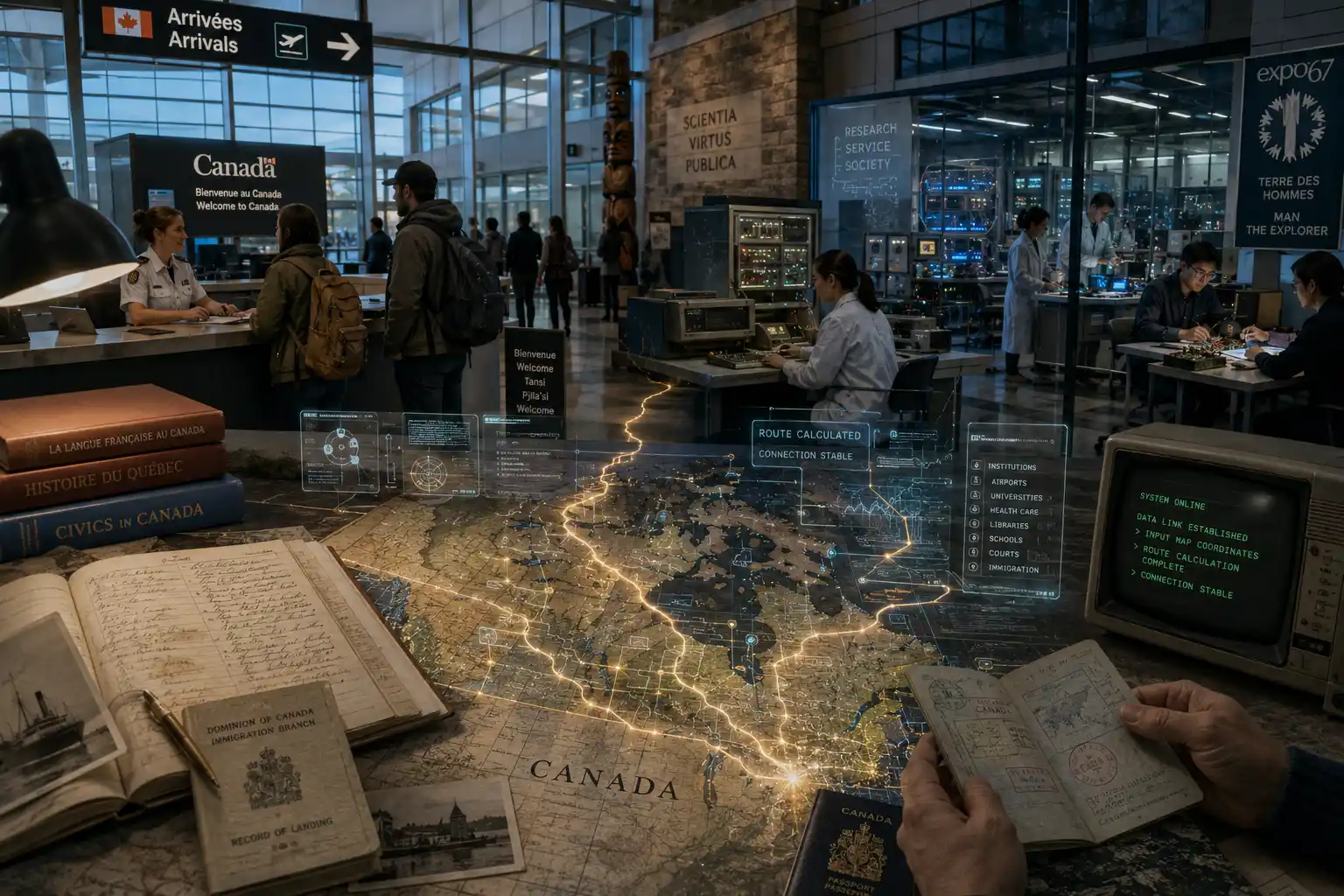
Chapter 19 — Multicultural Confidence and Difficult Truths
Canada’s multicultural story was never just a slogan.
It lived in grocery stores, churches, temples, language schools, citizenship ceremonies, strip-mall plazas, family businesses, school lunches, wedding halls, remittances, old-country stories, neighbourhood festivals, basement apartments, winter coats, workplace accents, translated forms, and children explaining Canadian systems to parents who had crossed oceans before they understood the country’s paperwork.
For many families, Canada was not first encountered as an idea.
It was encountered as rent.
As snow.
As a school office.
As a bus route.
As a grocery aisle with unfamiliar food.
As a familiar food found at last in an immigrant plaza.
As a factory shift.
As a taxi.
As a university application.
As a tax form.
As a public library.
As a citizenship test.
As a child coming home with English or French faster than the parents.
As relatives abroad asking for help.
As money sent home.
As a new passport.
As a quiet hope that the next generation might stand more securely.
That is why multiculturalism cannot be reduced to policy language.
It was lived through sacrifice.
The public version says diversity. The family version says your father worked nights. The public version says inclusion. The family version says your mother’s credentials were not recognized. The public version says cultural celebration. The family version says your grandmother cried because the old language was disappearing from the house. The public version says opportunity. The family version says six people shared an apartment until the first stable job arrived.
The story was real. It was also incomplete.
For many immigrants and children of immigrants, Canada did offer something precious: public safety, school access, economic hope, legal protection, clean streets, libraries, parks, hospitals, universities, citizenship, and the chance to belong without fully erasing where they came from.
But belonging was never automatic.
The newcomer had to learn winter, rent, work, transport, school systems, pronunciation, taxes, doctors, landlords, credit, workplace manners, humour, loneliness, and the strange emotional labour of becoming understandable to people who thought they were being normal.
Children often became bridges before they became adults.
They translated at counters. They answered phones. They read letters from school. They explained report cards. They filled forms. They corrected parents gently or impatiently. They learned which foods smelled “weird” to classmates. They learned when to shorten names, when to defend them, when to laugh, when to stay quiet, and when Canada’s politeness hid distance.
This too formed Canadians.
Not through official multicultural celebration alone, but through the daily work of carrying more than one world.
A strip-mall plaza could become a civilizational machine.
There might be a grocery store, bakery, travel agency, remittance office, accountant, immigration consultant, medical clinic, religious bookstore, tutoring centre, salon, restaurant, phone-card shop, driving school, tailor, pharmacy, and community bulletin board. Parents could buy familiar ingredients, speak a language they did not have to translate, send money home, find a lawyer, arrange a wedding, book a ticket, meet relatives, or hear news from a country that still pulled on them.
To outsiders, it was just a plaza.
To the people inside it, it was settlement infrastructure.
Multicultural Canada was built in such places: not only in federal speeches, but in stores, kitchens, worship spaces, workplaces, schools, and family routines. Food carried memory. Language carried authority. Religion carried calendars. Weddings carried obligation. Funerals carried old grief into new cemeteries. Small businesses carried risk. Children carried translation. Grandparents carried stories from places the grandchildren might never fully know.
This was one of Canada’s strengths: the country could become home without demanding that every older belonging vanish immediately.
But the strength was fragile.
Multicultural confidence becomes shallow when it is reduced to food, festivals, and branding.
A school multicultural day can be lovely. It can also become costume without history. A festival can build pride. It can also turn living communities into performances for consumption. A government slogan can affirm belonging. It can also hide poverty, credential barriers, racism, housing stress, religious suspicion, labour exploitation, and the private grief of migration.
The repair is not to reject celebration.
Celebration matters.
A child should be able to bring food without shame. A family should be able to wear clothing, speak language, keep holy days, sing songs, dance, cook, worship, mourn, and remember without feeling that Canada requires embarrassment.
But celebration must be thick enough to carry truth.
The food came from somewhere.
The song came from somewhere.
The prayer came from somewhere.
The language survived something.
The family left something.
The community built something.
The child is carrying something.
A mature multiculturalism has to ask what was carried, what was lost, what was changed, what was protected, and what Canada asked of people in return.
It also has to ask what binds the country together.
This is the hard part.
A country cannot survive as a collection of private inheritances with no shared public life. Nor can it survive by forcing sameness. The Canadian challenge is to build a common life strong enough to hold difference without flattening it.
That means multiculturalism needs civic depth.
Not only: you may keep your culture.
Also: you are joining a shared public world.
A shared public world includes rights, duties, law, language, schools, taxes, neighbours, public memory, respect for others, care for the vulnerable, honest history, and responsibility to the place where one lives. It asks newcomers to enter Canada, and it asks Canada to become worthy of entry.
That relationship cannot be one-way.
Immigrants should not be treated as decorative proof of Canadian virtue. They are not props in a national self-image. They are families, workers, citizens, elders, students, builders, business owners, artists, drivers, nurses, engineers, cleaners, neighbours, voters, believers, skeptics, and children trying to become whole.
Nor should Canada be treated as merely a service provider. A country is not a hotel. Belonging requires participation, memory, duty, and investment in the common good.
The older Canadian multicultural confidence worked best when it offered both welcome and expectation.
You can belong here.
You can bring memory here.
You can build here.
You can worship here.
You can speak here.
You can become Canadian here.
And because you belong, you owe something here too.
That is not assimilation in the crude sense. It is civic belonging.
But Canadian belonging has to be honest about the country being joined.
Canada is not an empty moral space where everyone arrived equally.
Indigenous peoples were here before Canada. Their relationship to land, law, sovereignty, kinship, language, and memory is not one cultural strand among many inside multiculturalism.
This is one of the great mistakes of shallow Canadian pluralism: treating Indigenous peoples as another heritage group rather than peoples whose lands, rights, and histories expose the limits of the Canadian project itself.
A truthful multicultural confidence must therefore hold two things at once.
Canada has offered real refuge and opportunity to many immigrants.
Canada is also built on Indigenous dispossession.
Neither truth cancels the other. Both must shape belonging.
Quebec also complicates the national story in a way that must be treated seriously.
Quebec is not a regional flavour inside English Canada’s multicultural self-image. It is a French-speaking society with its own memory, institutions, language politics, Catholic-to-secular transformation, nationalism, referendums, humour, music, television, law, and anxieties about cultural survival. For many Quebecers, multicultural language can sound different because the central question is not only individual inclusion, but the survival of a French-speaking public culture in North America.
English Canada often struggles to understand this because it imagines diversity through an English-majority frame. Quebec reminds Canada that plurality is not only many cultures under a neutral national roof. Sometimes plurality means more than one national memory inside the same state.
That matters.
A serious Canadian book cannot treat Quebec as an appendix or problem. It has to understand Quebec as lived civilization: Radio-Canada, French schools, language law, neighbourhoods, comedy, hockey, music, secularism debates, immigrant integration in French, family memory, political wounds, and the deep desire not to disappear.
A truthful multicultural confidence must therefore be strong enough to hold Indigenous history, Quebec difference, and immigrant plurality without flattening any of them.
That is a much harder story than “Canada is diverse.”
But it is also much more real.
The old slogan version of multiculturalism is too thin for the present.
It can become branding: Canada as tolerant, friendly, colourful, morally superior.
It can become compliance: correct language without deep relationship.
It can become consumerism: food and festivals without history.
It can become bureaucracy: boxes checked, identities managed, people sorted.
It can become suspicion: every difference treated as a potential conflict.
It can become performance: public virtue without private obligation.
It can become avoidance: celebration used to dodge harder questions about housing, wages, racism, Indigenous rights, Quebec, credential barriers, religious freedom, and class.
The repair is not less pluralism.
It is thicker pluralism.
Thicker pluralism asks more from everyone.
It asks the majority culture to stop pretending it has no culture. English Canadian default life — its institutions, humour, schools, media, assumptions, politeness, class codes, and historical amnesia — is not neutral. It forms people too.
It asks immigrant communities to preserve memory without turning children into prisoners of inherited fear.
It asks secular institutions to understand religion as more than private superstition or cultural colour.
It asks Christian communities to serve without coercion and protect people from abuse.
It asks Quebec to preserve French public life while facing its own exclusions and tensions.
It asks Indigenous truth to be treated as obligation, not symbolism.
It asks schools to teach children that belonging is not sameness, but it is also not isolation.
It asks Canada to become more than a loose market of identities.
That last point is crucial.
Modern identity culture can weaken multicultural confidence by turning inherited communities into personal branding. Culture becomes aesthetic. Food, clothing, music, language, trauma, and politics become pieces of self-display. A person can perform roots while losing relationship to elders. A platform can make identity visible while weakening inter-generational transmission.
This is not only a problem for immigrant communities. It happens everywhere. The self becomes a curated exhibition. Family memory becomes content. National identity becomes a stance. Religion becomes style or enemy. Politics becomes belonging. Culture becomes vocabulary detached from obligation.
But real culture asks things of people.
It asks them to cook, show up, speak, translate, help, mourn, marry, bury, forgive, learn, teach, contribute, remember, and sometimes obey limits they did not invent.
That is why cultural engines matter. A church supper, powwow, Ukrainian dance hall, Greek festival, Hungarian concert, German night club, Caribbean carnival, Portuguese bakery, Romanian remittance network, Italian club, Chinese school, Jewish community centre, francophone theatre, or Quebec family kitchen all carry practices, not just identities.
Practices form people.
The question is whether those practices can live inside a shared Canadian public without becoming either sealed off or dissolved.
The best version of Canada says yes.
It says a child can inherit a family story and still belong to a public school.
A family can keep faith and still share civic life with neighbours who do not.
A newcomer can love the old country and still owe duties to this one.
A Quebecer can defend French public life and still be part of a wider Canadian reality.
A country can tell hard truths and still be worthy of gratitude.
That is multicultural confidence.
Not the confidence of innocence.
The confidence of a country mature enough to hold difficult truths without collapsing into self-hatred or branding.
This confidence is necessary because the alternative is fragmentation.
If Canada cannot build honest plural belonging, people will retreat into narrower identities. Ethnic enclaves without civic bridges. Online tribes. Religious suspicion. Anti-immigrant resentment. Quebec alienation. Majority defensiveness. Minority exhaustion. Politics filling the space where common life should be.
A plural country without shared civic ground becomes fragile.
But shared civic ground cannot be built by pretending difference is easy.
Difference is not always easy. It changes schools, holidays, food, language, neighbourhoods, religious accommodation, public symbols, policing, employment, dating, marriage, humour, and memory. It creates misunderstandings. It exposes prejudice. It produces beauty and friction.
A serious country does not panic at friction.
It builds institutions strong enough to handle it.
Schools where children learn both family pride and public responsibility.
Libraries where newcomers, elders, children, and the poor can enter without buying anything.
Community centres where different groups share rooms.
Local journalism that tells stories without turning communities into stereotypes.
Citizenship ceremonies that mean more than paperwork.
Language programs that respect both integration and memory.
Public rituals that can include without flattening.
Religious freedom joined to protection from coercion and abuse.
Quebec understanding that goes deeper than translation.
This is work. Real work.
It cannot be solved by a poster.
A citizenship ceremony shows what is possible.
Families arrive dressed for the occasion. Some bring children. Some bring elders. Some have waited years. Some have fled danger. Some have come for work, school, love, safety, or opportunity. Names are called. An oath is spoken. A flag is held. Photographs are taken. People become citizens in law, but the deeper belonging will take years of life.
That ceremony can be thin if citizenship becomes only paperwork.
It can also be profound if the country understands what it is asking: not forget yourself, not worship Canada, not pretend the country is innocent, but enter a shared responsibility.
Citizenship should mean: your memory belongs here now, and you owe the common life your care.
That sentence can hold a lot.
It can hold gratitude. It can hold criticism. It can hold Quebec difference. It can hold immigrant sacrifice. It can hold the obligation to build.
Canada’s multicultural future depends on recovering that seriousness.
The country cannot survive on being “nice.” Niceness is too shallow. It avoids conflict. It smiles over distance. It can hide class contempt, religious ignorance, and the loneliness of people who are tolerated but not known.
The country needs hospitality, which is stronger than niceness.
Hospitality makes room.
Hospitality learns names.
Hospitality shares food.
Hospitality tells the truth about the house.
Hospitality expects the guest to become responsible if the guest becomes family.
Canada also needs gratitude, which is stronger than branding.
Gratitude does not deny harm. It recognizes gifts without lying.
And Canada needs accountability, which is stronger than guilt.
Guilt can become performance. Accountability changes conduct.
The repair is honest plural confidence.
Belonging with truth.
Memory without erasure.
Criticism without contempt.
Gratitude without propaganda.
Difference without fragmentation.
Shared life without forced sameness.
This is not easy.
But Canada’s best promise was never that it would be easy.
The promise was that many inheritances could live here without having to become weightless. That people could arrive, remember, work, worship, argue, build, and become part of a country still unfinished. That a child could carry more than one story and not be broken by it. That public life could be wide enough for difference and strong enough to ask for duty.
That promise is worth repairing.
Not as a slogan.
As a way of life.
Part V — The Adult Ladder
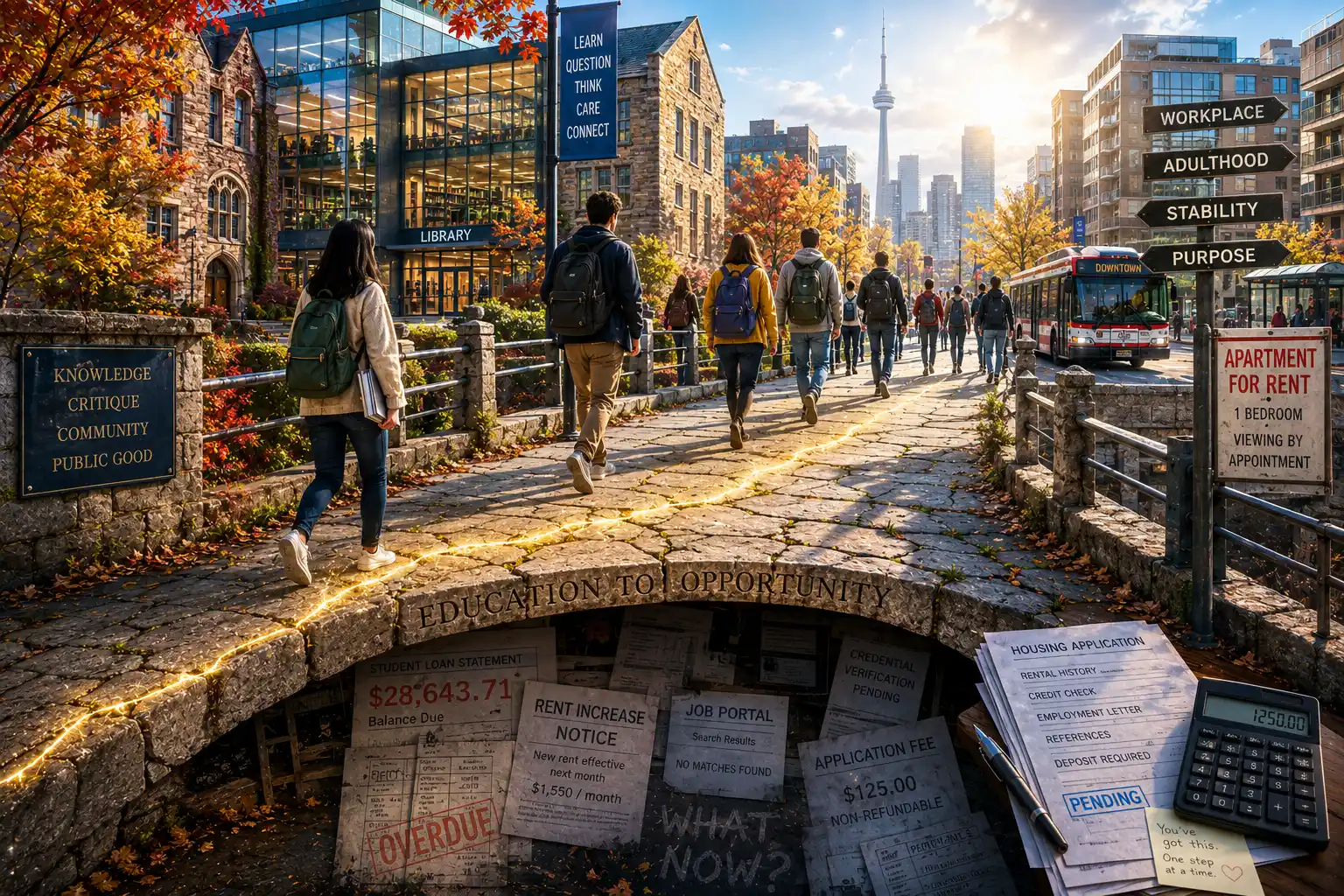
Chapter 20 — University as Promise
University was sold as a promise.
For many Canadian families, the promise was simple: work hard, get in, get the degree, and adulthood will open.
A guidance counsellor said it.
A parent repeated it.
A teacher believed it.
A brochure polished it.
A campus tour staged it.
A student loan made it possible.
A degree parchment made it official.
For some families, university was not only education. It was arrival.
A child whose parents worked in factories, restaurants, farms, taxis, warehouses, offices, care homes, small businesses, mines, or night shifts could walk onto campus carrying more than a backpack. He carried a family wager. She carried the hope that one generation’s exhaustion would become the next generation’s stability.
A university acceptance letter could feel like proof that the ladder still worked.
The campus had its own machinery of becoming. Orientation week. Student cards. Lecture halls. Residence rooms. Course calendars. Campus libraries. Used textbooks. Cafeteria meals. Student pubs. Group projects. Lab sections. Office hours. Midterms. Final exams. Co-op applications. Career fairs. Student newspapers. Posters on poles. Laptops in lecture. Part-time jobs. OSAP or provincial student aid. Debt totals that felt abstract until repayment began.
University promised several things at once.
It promised knowledge.
It promised independence.
It promised status.
It promised escape.
It promised professional entry.
It promised mobility.
It promised adulthood.
That promise was not fake.
University changed lives. It still does. It opened professions that had once been closed. It gave first-generation students a way out of inherited limits. It gave immigrant families a language of progress. It gave rural students a path into larger worlds. It gave women, disabled students, and working-class students forms of access earlier systems denied or restricted. It exposed people to books, labs, teachers, arguments, friendships, cities, disciplines, and possibilities they might never have encountered otherwise.
A good university enlarges a person.
It teaches that knowledge is bigger than the self. It teaches discipline, reading, research, experiment, debate, doubt, evidence, theory, history, language, and the strange humility of discovering that the world is more complicated than one’s upbringing.
It can also teach solitude. A student leaves home, sits in a lecture hall among strangers, learns to cook badly, misses deadlines, changes majors, discovers politics, loses faith, finds faith, drinks too much, studies all night, falls in love, fails an exam, calls home, learns the city, and becomes less legible to the family that sent him.
That too is formation.
University is one of the places where a young person separates from childhood without yet fully entering adulthood. It is a threshold. Not home. Not work. Not family. Not yet a settled life. A campus is an in-between world where a person is allowed to become.
That in-between world mattered.
But the promise changed.
As tuition, rent, credential expectations, job-market uncertainty, housing pressure, and debt grew, university became less like a bridge and more like expensive insurance against insecurity.
The degree was still necessary for many paths, but it no longer guaranteed arrival.
That is the hinge.
The old promise said: get the degree and a stable life opens.
The new pressure says: without the degree, many doors close; with the degree, nothing is guaranteed.
That is a different psychological world.
It turns education from aspiration into defence.
A student no longer asks only, “What do I want to learn?” He asks, “What will this protect me from?” She asks, “Will this pay off?” “Will this degree be enough?” “Should I do a master’s?” “Should I take co-op?” “Should I move?” “Should I network?” “Should I brand myself?” “Should I choose passion or employability?” “Will I be able to rent?” “Will I ever own?” “Will I disappoint my parents?” “Will I become the kind of adult this was supposed to make possible?”
The campus still says promise.
The bank account says risk.
The student loan is central here.
A loan can be a bridge. It can let a student study who otherwise could not. That is a real good. Public student aid expanded opportunity. Many families could not have reached university without it.
But debt changes the meaning of learning.
A borrowed education asks for return. It turns semesters into future payments. It makes curiosity negotiate with interest. It makes mistakes expensive. It makes changing direction feel like failure. It makes the young person begin adulthood already carrying a number.
Debt does not destroy education by itself. But it alters the atmosphere.
A student sitting in a lecture hall may be learning philosophy, engineering, nursing, history, computer science, business, biology, education, social work, trades-connected technical theory, or literature. At the same time, another lesson runs underneath: this time costs money; this room must lead somewhere; this path must justify itself.
That pressure does not fall equally.
A student whose parents can pay experiences risk differently from one who borrows. A student living at home experiences rent differently from one paying city prices. A student in Toronto, Vancouver, Montreal, Halifax, Calgary, Winnipeg, or a smaller university town meets different costs. A student with family networks enters professional pathways differently from a first-generation student trying to decode office hours, internships, references, and career language alone.
The promise is unequal even when the campus speaks universally.
For immigrant families, university can carry almost sacred pressure. The degree becomes proof that the migration sacrifice worked. The child is not only choosing a program; the child is carrying a family story. Medicine, engineering, law, business, computer science, pharmacy, accounting, education — these are not only careers. They are symbols of security, respect, and repayment.
That pressure can inspire. It can also suffocate.
For Indigenous students, university can mean access, leadership, research, law, medicine, education, language revitalization, and return to community. It can also mean entering institutions shaped by colonial histories, distance from home, racism, financial barriers, cultural isolation, and the burden of explaining realities the institution should already understand.
For Quebec students, university sits inside a different language and institutional landscape, where French and English systems, CEGEP pathways, provincial politics, class, and language futures shape the meaning of higher education.
For rural and northern students, leaving for university can mean leaving the place itself: family, land, community, work, and identity. The promise of education may also become a pipeline out, weakening the towns and regions that raised the student.
For working-class students, university can feel like translation. Not only academic translation, but class translation. How to speak. How to email a professor. How to network. How to dress for an interview. How to accept unpaid experience. How to explain to family that reading all day is work. How to return home without sounding like you think you are better.
University gives mobility, but mobility has a cost.
This is one of the book’s main themes: every formation system gives and takes.
University gave access, knowledge, status, and possibility.
It also helped produce credential inflation, class sorting, debt anxiety, delayed adulthood, and the quiet demotion of other forms of intelligence.
Not everyone needed university. Many needed trades, colleges, apprenticeships, military pathways, entrepreneurship, caregiving skills, farm succession, technical training, art schools, union entry, public service, or direct work. But as university became the approved promise, other paths were too often treated as lesser.
That was a civilizational mistake.
A country needs scholars. It also needs builders, plumbers, welders, electricians, mechanics, nurses, farmers, fishers, care aides, cooks, early childhood educators, technicians, drivers, clerks, artists, machinists, forestry workers, coders, repair people, and people who can keep systems alive.
When university becomes the only respectable ladder, the country humiliates many of the people it depends on.
It also overloads the university.
The university becomes responsible for too much: education, status, class mobility, job preparation, personal identity, political formation, social belonging, professional filtering, mental-health support, and the promise of adulthood itself.
No institution can carry that much without distortion.
The damage is not university.
The damage is making university compensate for a broken adult ladder.
If work paid reliably into settlement, if housing were attainable, if trades carried equal dignity, if colleges and apprenticeships were treated as serious pathways, if local economies gave young people entry, if practical competence had status, then university could be more fully itself. It could be a place of deep learning rather than a debt-backed gate.
But when the adult ladder weakens, university becomes defensive infrastructure.
Students enter not only to learn, but to avoid falling.
That changes classrooms. It changes majors. It changes parents. It changes mental health. It changes the relationship between education and imagination.
A student under defensive pressure has less room for intellectual risk. The question “What is true?” competes with “Will this be on the exam?” and “Can I afford to care?” and “Will this get me hired?” That is not because students are shallow. It is because the stakes around them have changed.
Credential pressure also changes childhood before university. High school becomes preparation for applications. Volunteering becomes resume. Sport becomes scholarship strategy. Clubs become evidence of leadership. Summer becomes enrichment. The young person learns to package himself before he has had enough time to become himself.
By the time university begins, the platform self is already waiting.
LinkedIn, internships, networking, personal branding, curated accomplishments, professional headshots, online portfolios, digital reputations, co-op rankings, and algorithmic job portals all join the degree in shaping the student. The campus no longer exists outside managed reality. It feeds into it.
The laptop in the lecture hall captures the shift.
Knowledge is open. The student can search anything. Lectures can be recorded. Articles can be downloaded. AI can summarize. Wikipedia can orient. Group chats can share notes. Online courses can supplement. A student has more access to knowledge than any previous generation.
And yet access does not equal formation.
Formation requires attention, difficulty, relationship, correction, memory, and time.
A student can have infinite information and still lack a pathway.
This is why the university chapter belongs before work, rent, and burnout. It is the place where promise begins to meet the broken ladder.
The student is told: become.
Then the world says: borrow, compete, optimize, apply, brand, relocate, rent, repay, network, and remain flexible.
That is not the same promise.
What improved must be protected.
More people entered higher education. More fields opened. More women gained professional pathways. More first-generation students crossed old class lines. More immigrant families used education to build stability. More Indigenous scholars, lawyers, doctors, teachers, artists, and leaders entered institutions that once excluded them. More disabled students gained accommodations, though still unevenly. More knowledge became accessible. More campuses became diverse. More research changed the world.
Those gains are real.
The repair should not shrink education back into old privilege.
The repair should make pathways more honest, plural, affordable, and connected to life.
A country needs universities that teach deeply and tell the truth about outcomes.
It needs colleges and polytechnics treated with equal seriousness.
It needs apprenticeships that are not framed as second-class.
It needs co-op and work-integrated learning that do not become exploitation.
It needs career guidance that tells students the truth about debt, wages, geography, housing, and employment.
It needs student aid that expands opportunity without quietly transferring too much risk onto the young.
It needs families to stop treating one pathway as the only respectable future.
It needs employers to stop using degrees as lazy filters for jobs that do not require them.
It needs governments to understand education, work, housing, and family formation as one system.
Most of all, it needs to restore the link between learning and life.
The question is not only, “How many people can attend university?”
The question is, “Does education help people become capable adults inside a country that has room for them?”
If the graduate cannot work into settlement, the promise is broken.
If the apprentice is treated as lesser, the promise is distorted.
If the student borrows to enter a labour market that demands more credentials, more flexibility, more unpaid experience, and more self-marketing, the promise becomes a treadmill.
If the university teaches critique but not competence, ambition but not duty, credentials but not wisdom, it fails at formation.
A good university should not be only job training.
But it also cannot be indifferent to whether students can live.
This balance is hard. The university must defend knowledge from being reduced to employability. But it must also stop hiding behind noble language while students carry debt into unstable adulthood.
The repair is not anti-intellectual. It is pro-formation.
Learning should make a person larger. It should deepen judgment, skill, memory, humility, courage, and public responsibility. It should connect a person to work, but not reduce him to labour market value. It should open the world, but not detach him from place, family, duty, and material reality.
A university that forms people asks more than: can you pass?
It asks: can you think clearly?
Can you read honestly?
Can you argue without lying?
Can you handle complexity?
Can you serve a public beyond yourself?
Can you use knowledge without contempt for people who do different work?
Can you enter adulthood with responsibility, not only credentials?
That is the promise worth keeping.
The old promise was too simple.
Get the degree and life will open.
The repaired promise must be more truthful:
Learn deeply. Choose honestly. Borrow carefully. Respect many paths. Build skills. Serve something larger. Connect education to work, place, and responsibility. Do not confuse credentials with adulthood. Do not build a country where young people must buy permission to begin.
University was sold as a promise.
The promise should not be abandoned.
It should be made honest enough to keep.
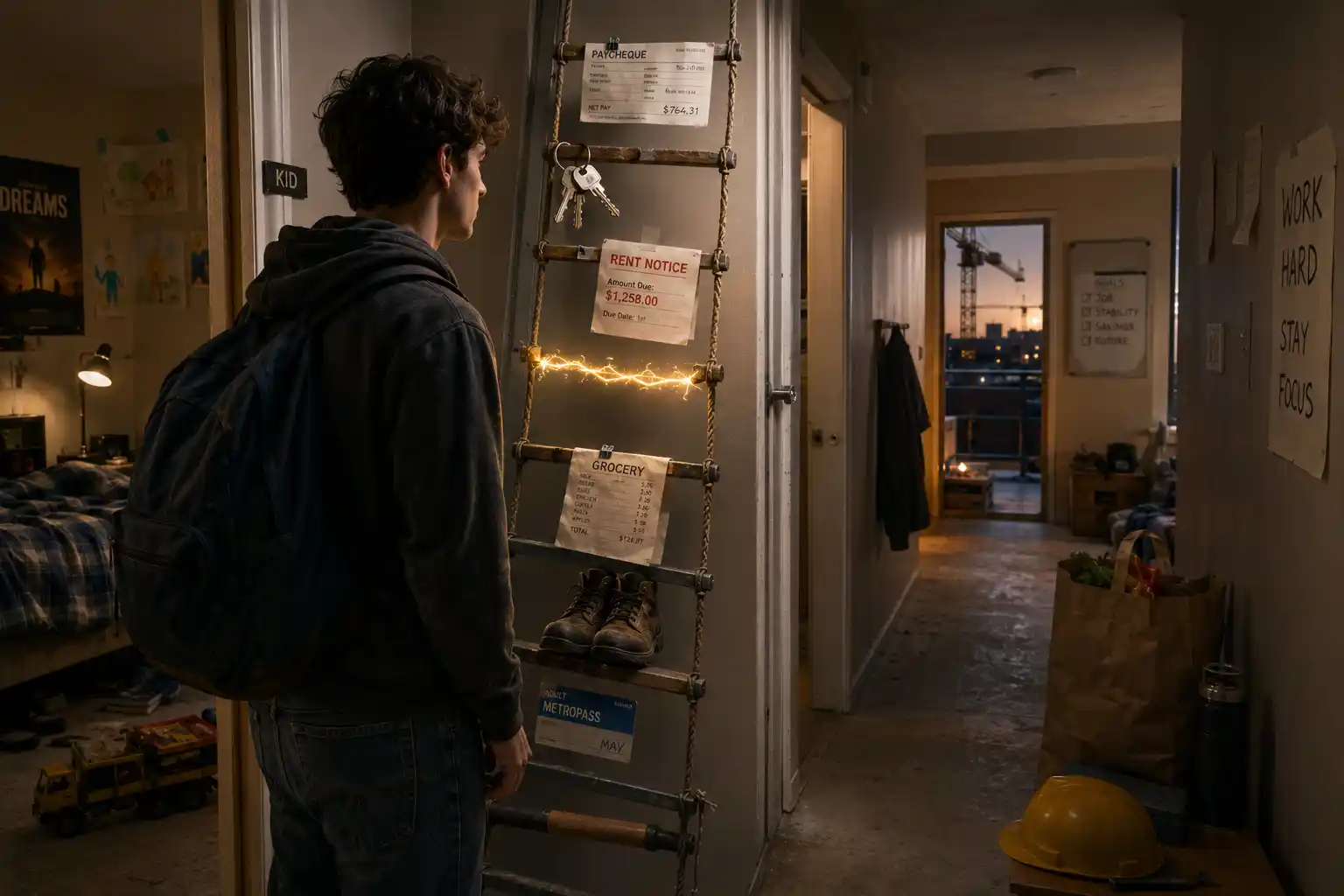
Chapter 21 — Work, Rent, and the Broken Ladder
A first job used to mean more than money.
It meant being expected somewhere.
A uniform.
A schedule.
A name tag.
A manager.
A punch clock.
A break room.
A bus route.
A closing shift.
A sore back.
A first paycheque.
A customer who was rude.
A co-worker who showed you the shortcut.
A supervisor who did not care about your feelings.
A morning when you did not want to go and went anyway.
Work taught things school could not.
It taught punctuality under consequence. It taught boredom. It taught hierarchy. It taught that being smart was not the same as being useful. It taught that other people were waiting on your part. It taught that a task can be undignified and still need doing. It taught that money arrives from time, effort, skill, service, and sometimes humiliation.
A teenager washing dishes learned the speed of a kitchen.
A cashier learned impatience.
A lifeguard learned watchfulness.
A camp counsellor learned responsibility for children.
A landscaper learned weather and exhaustion.
A retail worker learned politeness under pressure.
A construction labourer learned that strength without attention is dangerous.
A farm kid learned that animals and weather do not care about weekends.
A babysitter learned that care is work.
A gas station clerk learned night shifts and strangers.
A server learned timing, memory, and emotional control.
A warehouse worker learned repetition and the body’s limits.
These jobs were not always good. They could be underpaid, unsafe, exploitative, boring, sexist, racist, humiliating, or badly managed. Some bosses abused power. Some workplaces stole wages. Some customers treated workers as furniture. Some young people had to work too much because the family needed money. Some were excluded from the jobs others got through networks. Some entered adult stress too early.
But first work still did something important when it worked: it introduced a young person to usefulness.
Usefulness is not self-expression.
That is why it matters.
A society that teaches young people to express themselves but not to be useful leaves them fragile. Work says: there is a task outside you. Do it. Show up. Learn. Improve. Help the next person. Get paid. Come back.
That was the first rung.
The second rung was rent.
A room. A basement apartment. A shared lease. A mattress on the floor. Used dishes. A couch from a parent’s basement. A grocery bill. A hydro bill. A damage deposit. A landlord. A roommate who did not clean. A laundromat. A bus pass. A cheap table. A first argument about money. The discovery that toilet paper, dish soap, garbage bags, and light bulbs do not appear by themselves.
Rent turned income into adult responsibility.
It taught that independence was not a mood. It had costs, routines, forms, signatures, keys, receipts, repairs, and consequences.
Together, work and rent formed the adult ladder.
Work led to pay.
Pay led to rent.
Rent led to independence.
Independence led to settlement.
Settlement made room for partnership, family, community, volunteering, local memory, risk-taking, and responsibility.
The ladder was never equally sturdy. Race, class, gender, region, disability, family support, immigration status, education, and luck all mattered. Some Canadians were never securely on it. Some worked hard and still stayed poor. Some were shut out by discrimination. Some families crowded into housing long before the recent crisis. Some Indigenous communities faced housing conditions that should have shattered any national complacency. Some rural and northern people faced distance, seasonal work, and limited options. Some women could not rely on work to bring freedom if wages, violence, childcare, or law trapped them.
So the old ladder should not be mythologized.
But the moral expectation was clearer: effort was supposed to lead somewhere.
That expectation has weakened.
The deeper problem is not only that life became expensive. It is that effort lost credibility.
A person can work, study, move, commute, apply, network, save, optimize, and still feel unable to settle. Rent eats the future. Housing becomes a market before it becomes a home. Entry-level jobs demand experience. Experience is unpaid or underpaid. Job applications disappear into portals. Interviews become performances. A degree is necessary but not enough. LinkedIn turns work into visibility. Side hustles turn free time into income strategy. Moving back home becomes practical, common, sometimes wise, sometimes humiliating, sometimes life-saving.
The young adult is told to hustle because the ladder is missing rungs.
That is not motivation. It is displacement.
A broken ladder turns structural failure into personal anxiety.
If you cannot afford rent, budget better.
If you cannot get the job, network harder.
If you cannot settle, move farther.
If you cannot move, retrain.
If your degree is not enough, get another.
If your wage is weak, monetize your hobby.
If you are exhausted, manage your mindset.
If adulthood feels impossible, optimize yourself.
Some of this advice can help. A person should learn budgeting, networking, skill-building, discipline, and resilience. But no amount of personal optimization can fully repair a society where work and housing no longer connect reliably.
The adult ladder is not only private. It is civilizational infrastructure.
A country that wants families needs housing.
A country that wants children needs adults who can settle.
A country that wants community needs people who are not moving every year under pressure.
A country that wants volunteers needs citizens with some time and stability.
A country that wants trust needs effort to feel meaningful.
A country that wants hope needs young people to believe the future is buildable.
When work no longer leads to settlement, the damage spreads.
Marriage is delayed or avoided. Children are delayed or become financially terrifying. Friendships scatter. Local involvement weakens. Risk-taking declines. Small businesses become harder to start. Political anger rises. Family dependence stretches longer. Young adults remain adolescents in public language even while carrying adult stress. Parents become financial backstops long after they expected to stop. Those without family help fall further behind.
The housing crisis is therefore not only an economic crisis.
It is a formation crisis.
A home is not only an asset. It is a base for adulthood. It holds routines, neighbours, meals, repairs, arguments, rest, memory, and future plans. A rental can be a real home if it is stable, decent, and affordable. Ownership is not the only form of settlement. But some form of secure dwelling is necessary for adult life to deepen.
If housing becomes permanently unstable, people do not just lose square footage.
They lose continuity.
A person who moves constantly has fewer chances to know neighbours, join a local club, volunteer, plant a garden, keep family objects, host dinners, care for elders, build routines, or feel responsible for a place. A child raised under housing instability learns that the world can change without consent. An elder priced out of a neighbourhood loses more than a unit; she loses the social map that made aging possible.
Housing is memory infrastructure.
This is why rent matters in a book about civilization.
The broken ladder also changes work itself.
A job once had a clearer place in the moral order. Not always fair, not always secure, not always dignified, but clearer. You worked to live. You earned, learned, endured, advanced, supported a household, and became more useful over time.
Now work often asks for more of the self while guaranteeing less of the life around it.
Be flexible.
Be passionate.
Be available.
Be entrepreneurial.
Be a team player.
Be your own brand.
Be reachable.
Be upgrading.
Be grateful.
Be resilient.
The language of work becomes emotional while the contract becomes thinner.
This is especially cruel for young people. They are told to bring the whole self to work, but the workplace may not bring a future to them.
Gig work sharpens the problem. It can offer flexibility and entry, but it also turns the worker into an atomized unit of availability. Delivery, rideshare, task platforms, freelance marketplaces, contract work, temp agencies, and app-based labour can help people survive. But survival is not settlement. A person can be constantly working and still remain outside the ladder.
Job portals add another layer of abstraction.
The old way was not always better. Paper resumes, personal networks, and in-person applications favoured insiders and excluded many. Online applications widened access in some ways. A person could search more widely, apply faster, and find postings that once would have been invisible.
But the portal also made work feel faceless.
Upload the resume. Re-enter the resume. Answer the screening questions. Attach the cover letter. Create the account. Verify the email. Wait. Hear nothing. Repeat. The applicant becomes a file moving through systems no human may meaningfully read.
For a young person trying to enter adulthood, this teaches a bitter lesson: the world asks for your information before it offers recognition.
The rental market can feel the same.
Applications, credit checks, references, deposits, income requirements, viewings, bidding pressure, scams, renovictions, roommate interviews, and the quiet humiliation of proving oneself worthy of shelter. Housing becomes another gate where the young adult is measured before being allowed to begin.
Work portal. Rental application. Student loan. Credit score. LinkedIn profile. Background check. Reference. Login. Password. Verification. Queue.
Adulthood becomes administration.
This connects directly to managed reality. The adult ladder did not only become more expensive. It became more mediated. A young person must now navigate systems that are abstract, automated, competitive, and unforgiving. The old rites of adulthood — first job, first room, first furniture, first bill, first workplace, first neighbourhood — are still there, but surrounded by portals, debt, metrics, and insecurity.
That changes the soul.
It makes young adults feel that adulthood is not a stage they enter, but a system they are failing to access.
This is one reason burnout appears later. Burnout is not only overwork. It is what happens when a person becomes responsible for absorbing the failure of systems that no longer carry him.
The repair must be material.
Not inspirational.
A country cannot gratitude-journal its way out of rent. It cannot mindset-coach its way out of wages that do not match housing. It cannot tell young people to form families while making shelter unstable. It cannot praise work while allowing useful people to remain permanently precarious.
Repair means reconnecting work to life.
That includes wages, housing supply, rental stability, transit, childcare, training, apprenticeships, regional opportunity, worker protection, credential honesty, and pathways that do not require every young person to become an anxious professional self-marketer.
It means treating housing as settlement, not only investment.
It means treating first jobs as formation, not disposable labour.
It means treating trades, care work, service work, and practical work with dignity.
It means rebuilding entry-level pathways where a person can begin, learn, advance, and become known.
It means making cities and towns livable for the people who work in them.
It means understanding that a young adult cannot build civic life if every ounce of energy goes into staying afloat.
This does not mean every person gets the same life. It does not mean adulthood becomes easy. Work should still require effort. Rent should still teach responsibility. People should still budget, compromise, sacrifice, move, train, and make hard choices.
But effort must plausibly connect to progress.
That is the moral core of the adult ladder.
Without that connection, a country breeds cynicism.
Young people are not lazy because they notice a broken bargain. Many are working, studying, caring, commuting, applying, and trying under conditions older advice does not fully understand. They may look delayed from the outside, but many are carrying adult pressures without adult settlement.
The response should not be contempt.
It should be repair.
A country that wants capable adults must build conditions where adulthood can be practiced.
Give young people real work.
Pay useful work into life.
Build enough housing.
Protect stable renting.
Respect trades and service.
Stop using degrees as lazy filters.
Make apprenticeships visible.
Create co-op and entry pathways that do not exploit.
Keep transit connected to work.
Support regional economies.
Treat childcare as formation infrastructure.
Make human hiring possible again.
Let a first apartment be humble without being impossible.
The first apartment does not need to be beautiful. In fact, it probably should not be. The mattress can be on the floor. The dishes can be mismatched. The couch can be ugly. The table can wobble. The building can be ordinary.
But it must be possible.
There is dignity in a humble beginning if the beginning leads somewhere.
There is humiliation in permanent precarity disguised as freedom.
The old ladder excluded too many. The new ladder must be wider, fairer, and more honest. But it must still be a ladder.
A country cannot raise people if it offers only platforms, credentials, subscriptions, and advice.
It has to offer rungs.
Work.
Rent.
Skill.
Stability.
Settlement.
Contribution.
Future.
That is what broke.
That is what must be rebuilt.

Chapter 22 — Burnout and Self-Management
Burnout is not only tiredness.
Tiredness ends when rest is enough.
Burnout is different. Burnout is what happens when rest no longer reaches the part of the person that has been carrying too much for too long. It is the feeling of waking up already behind. It is the inbox that refills while you answer it. It is the calendar full of meetings about work that leaves less time to do the work. It is the Sunday-night dread. It is the phone lighting up after dinner. It is the body sitting still at a laptop while the nervous system runs like it is being chased.
Burnout is what happens when a person becomes the shock absorber for failing systems.
Housing is expensive, so budget better.
Work is unstable, so network harder.
The job is always on, so set boundaries.
The inbox is endless, so optimize your workflow.
The future is uncertain, so build a personal brand.
The institution is confusing, so navigate the portal.
The body is exhausted, so download an app.
The country is anxious, so manage your nervous system.
Some of this advice helps.
People do need tools. A calendar can help. Therapy can help. Exercise can help. Remote work can help. Medication can help. Sleep matters. Boundaries matter. A person should learn how to say no, organize tasks, ask for support, manage money, move the body, and notice when stress has become dangerous.
The mistake is not self-management.
The mistake is making self-management carry the weight of social failure.
A person cannot mindfulness his way out of rent.
She cannot productivity-hack a broken job market.
They cannot personal-brand their way into community.
A worker cannot wellness-app his way out of a life with no stable ladder.
A parent cannot breathing-exercise away the cost of childcare.
A young adult cannot schedule-block a future that housing has made unreachable.
A citizen cannot meditate a portal into answering the phone.
Burnout became system smoke.
It showed that something larger was overheating.
The older adult ladder had already weakened: education no longer guaranteed entry, work no longer reliably led to settlement, rent consumed the future, institutions became harder to reach, and the screen became the room. Under those pressures, the individual was asked to become administrator, therapist, career strategist, brand manager, financial planner, health monitor, emotional regulator, and customer-service agent for his own life.
This is not adulthood in the old sense.
It is permanent self-administration.
The modern adult must manage passwords, benefits, taxes, portals, applications, subscriptions, credit scores, rent, debt, career profiles, work chats, family group chats, school emails, medical appointments, online banking, wellness routines, food delivery, transportation apps, insurance forms, performance reviews, social reputation, and the quiet pressure to appear functional while everything demands attention.
The person becomes an office.
That is managed reality at the level of the nervous system.
It is not only that work changed. The border around work changed.
Email made work portable. Smartphones made it intimate. Slack, Teams, Zoom, shared calendars, project-management software, and remote desktops made work follow people into kitchens, bedrooms, basements, buses, vacations, and sick days. The office used to be a place. Now it can be an expectation.
For some people, remote work was a gift. It returned commuting time. It helped disabled workers, caregivers, parents, rural workers, and people exhausted by office politics. It allowed people to stay employed through distance, illness, and family complexity. It gave some workers more control over the day.
Those gains are real.
But remote work also blurred the line between being home and being free.
A laptop on the kitchen table can turn the home into an office without giving the worker the authority of either. The body is home. The mind is at work. The child is in the next room. The message arrives anyway. The meeting begins anyway. The day has no clean edge.
Hybrid work can improve life. It can also spread work across every surface.
The same pattern appears in education. Students manage learning platforms, email, group chats, PDFs, portals, recordings, AI tools, deadlines, submissions, and notifications. A missed announcement can feel like a moral failure. School becomes less a place one attends and more a system one must monitor.
This is the logic of managed life: the institution gives the individual tools, then makes the individual responsible for not being overwhelmed by them.
The language around burnout often turns structural strain into personal technique.
Try better habits.
Try gratitude.
Try sleep hygiene.
Try a morning routine.
Try a productivity system.
Try therapy.
Try boundaries.
Try a standing desk.
Try a walk.
Try journaling.
Try an app.
Again, some of these are good. The problem is that they arrive downstream from the damage.
They help the person survive a system they do not repair.
This produces a strange moral atmosphere. The exhausted person feels guilty for being exhausted. If the tools exist and he is still drowning, then perhaps he is the problem. If the app tracks sleep and she is still tired, perhaps she is failing. If the calendar is organized and the work still spills over, perhaps the boundary was not strong enough. If everyone else appears to be coping online, perhaps the weakness is private.
Burnout feeds shame because the culture individualizes overload.
The old language of duty could also be cruel. It told people to toughen up, stop complaining, sacrifice silently, and keep going. That damaged many people. Men especially were often taught to ignore pain until it became rage, illness, addiction, collapse, or absence. Women were often expected to carry care work invisibly, smile through exhaustion, and call it love. Workers were told to be grateful. Parents were told everyone struggles. Students were told pressure builds character.
The newer language of mental health corrected real silence. It gave people words for anxiety, depression, trauma, boundaries, burnout, panic, neurodivergence, abuse, grief, and overload. It helped many people ask for help before collapse. That is a genuine gain.
The danger comes when mental-health language is used to adapt people to conditions that should be changed.
If a workplace creates impossible demands, the solution cannot only be resilience training.
If a university overloads students while charging heavily for the promise of opportunity, the solution cannot only be counselling.
If a housing market keeps people in permanent stress, the solution cannot only be budgeting education.
If public systems are unreachable, the solution cannot only be teaching users to navigate portals.
If families are isolated, the solution cannot only be private therapy.
Therapy can heal wounds. It cannot replace a functioning society.
This distinction is essential.
A good society supports mental health through more than treatment. It builds lives with enough stability, belonging, time, work, housing, service, and meaning that people are not constantly pushed to the edge.
The Canadian story here is not one story.
A young office worker in Toronto or Vancouver may burn out from rent, email, competition, and the feeling that professional life never settles.
A nurse or care aide may burn out from understaffing, emotional labour, physical strain, and the moral injury of knowing what good care would require but not having enough time.
A teacher may burn out from classroom complexity, administrative burden, parental conflict, political pressure, and the sense that school is being asked to solve every social problem.
A tradesperson may burn out from long hours, injury, travel, job-site pressure, and the body’s accumulation of wear.
A gig worker may burn out from instability, ratings, app pressure, fuel costs, and the loneliness of work without a workplace.
A student may burn out from debt, grades, jobs, applications, identity pressure, and uncertainty about whether the whole path leads anywhere.
A parent may burn out from childcare costs, housing, work expectations, school communications, elder care, and the collapse of extended-family support.
A newcomer may burn out from credentials, language, remittances, isolation, racism, and the pressure to succeed quickly.
A rural or northern person may burn out from distance, weather, limited services, travel for care, housing shortages, resource cycles, and being treated as invisible by southern systems.
Burnout is not only a white-collar laptop condition.
It is what happens when human limits are exceeded and the person is told to manage better.
That is why the chapter must not become a complaint about email alone. Email is a symbol. The larger issue is overload without adequate social container.
Older communities had their own cruelties, but they often contained more non-market support: nearby relatives, neighbours known by name, faith communities, clubs, local institutions, stable work groups, predictable rhythms, and public places where people were seen outside productivity. Many people were harmed by those systems, and no one should pretend they were universally caring. But where they worked, they distributed stress.
Modern life often privatizes stress.
The isolated person must buy services, book appointments, download tools, manage subscriptions, search advice, maintain motivation, curate support, and explain himself to systems.
This is exhausting.
A country that wants healthier people must rebuild shared containers for stress.
Family memory helps.
Neighbourhood trust helps.
Faith and community institutions help when they are safe.
Sports and physical practice help.
Local clubs help.
Public libraries help.
Stable housing helps.
Workplaces with real boundaries help.
Human institutions help.
Care networks help.
Public rituals help.
Time outside screens helps.
Being useful to others helps.
Burnout shrinks the world to survival.
Repair expands the world back into relationship.
That is why self-management cannot be the final answer. It keeps the person focused inward: mood, habits, productivity, health, brand, coping, performance. Some inward attention is necessary. But too much inward management becomes another prison. The person becomes both worker and supervisor, patient and therapist, brand and audience, user and support desk.
A human being cannot live entirely as a project.
The repair is not to reject self-care. It is to restore forms of life that make self-care less desperate.
Work should end.
That sentence sounds simple. It is not. Work should have edges. People should be able to be unreachable sometimes. A day should contain spaces not colonized by messages. Vacations should not become remote monitoring. Sick days should not require performance of legitimacy. Parents should not have to pretend children do not exist. Caregivers should not be treated as scheduling inconveniences. Workers should not have to trade all privacy for flexibility.
Work that never ends becomes a form of occupation.
Housing should settle.
A person cannot regulate a nervous system while constantly fearing eviction, rent hikes, renoviction, overcrowding, or the impossibility of moving forward. Stable housing is mental-health infrastructure. A decent room, a predictable lease, a safe building, a neighbourhood, a table, a place to keep family objects — these are not luxuries. They are conditions under which people become less frantic.
Institutions should answer.
A system that cannot be reached produces a special kind of exhaustion. The phone menu loops. The portal fails. The form is unclear. The appointment is months away. The chatbot misunderstands. The user is told to try again. Nobody owns the problem. This is not only inefficient. It is demoralizing. It teaches people that society is a maze without a face.
Human access is a burnout issue.
Community should hold.
People need places where they are known outside performance. Not every relationship should be networking. Not every activity should be optimization. Not every public appearance should be content. A person needs rooms where usefulness, friendship, ritual, humour, food, service, and presence matter more than personal progress.
Time should be less invaded.
Notifications are not neutral. They train the body to expect interruption. The phone teaches micro-vigilance: check, respond, clear, scan, compare, remember, forget, repeat. Even leisure becomes managed by feeds, queues, recommendations, streaks, and unfinished content. The person rarely arrives fully anywhere.
A culture serious about burnout must protect attention as a public good.
This begins at home, school, and work, but it also requires design. Devices, platforms, employers, schools, and institutions should not be allowed to treat human attention as an endlessly extractable resource. A person’s mind is not public land for every system to mine.
This connects burnout to the larger civilizational argument: many of the systems now forming people do not love them. They optimize for engagement, compliance, throughput, risk reduction, profit, data, or administrative efficiency. The person adapts until the body refuses.
Burnout is the body’s refusal.
Like the stripped screw on the workbench, burnout says: the system is not fitting. Stop forcing it.
If Canada wants to repair this, it has to recover humane rhythms.
That means daily rhythms: work that ends, meals that are not always rushed, sleep protected, phones put away, children outdoors, bodies moving, evenings that are not only recovery from exhaustion.
Weekly rhythms: rest, worship or reflection where meaningful, sport, family visits, chores, community service, local events, boredom, unstructured time.
Seasonal rhythms: school years, holidays, winter preparation, summer parks, community festivals, harvest, storms, public rituals, beginnings and endings.
Life rhythms: education, work, love, housing, children, care, elderhood, mourning, and transmission.
Modern life has not abolished rhythm. It has replaced many shared rhythms with individualized schedules and platform time.
Platform time is endless. Human time is not.
A healthy country helps people live in human time.
That will require structural repair.
Housing policy. Labour standards. Healthcare access. Mental-health care. Childcare. Transit. Public spaces. Digital design. Workload expectations. School communication. Institutional accountability. Community rebuilding. Support for caregivers. Respect for rest. Better management. Less glorification of hustle. Less moral pressure to turn every difficulty into self-improvement content.
It will also require personal and communal choices.
Families can protect meals and stories.
Friends can meet without turning everything into posts.
Workplaces can respect evenings.
Schools can reduce unnecessary digital clutter.
Communities can rebuild clubs and service.
Religious and cultural institutions can offer care without coercion.
Libraries and community centres can become low-pressure public rooms.
Individuals can learn boundaries, but boundaries work best when others respect them.
The individual still has agency. The chapter is not an excuse for helplessness. People do need to manage themselves. But agency should not be confused with total responsibility.
A person can choose habits.
A society chooses conditions.
Both matter.
Burnout tells us the conditions are wrong.
The answer is not simply to make people calmer inside a life that should make them angry, tired, or sad. Sometimes distress is information. Sometimes anxiety is not irrational. Sometimes exhaustion is not weakness. Sometimes the body is correctly reporting that the ladder is broken, the workload is impossible, the rent is too high, the institution is unreachable, the phone is too invasive, the community is too thin, and the future feels blocked.
Listen to the report.
Then repair what it is reporting.
That is the difference between coping and rebuilding.
Coping asks, “How do I survive this?”
Rebuilding asks, “Why are so many people being asked to survive this?”
Canada needs both, but it has leaned too hard on coping.
It has offered individuals techniques while leaving too many pressures intact. It has told people to adapt to systems that should be made more human. It has celebrated flexibility while ignoring the exhaustion of permanent adjustment.
The future should be less impressed by hustle and more committed to stability.
Less impressed by optimization and more committed to rhythm.
Less impressed by personal brand and more committed to personhood.
Less impressed by constant access and more committed to presence.
Burnout is not only tiredness.
It is a warning that the human being has been made to absorb too much system failure alone.
The repair is not just rest.
It is a country where rest can reach the soul because life is no longer organized as permanent overload.
Part VI — Managed Reality
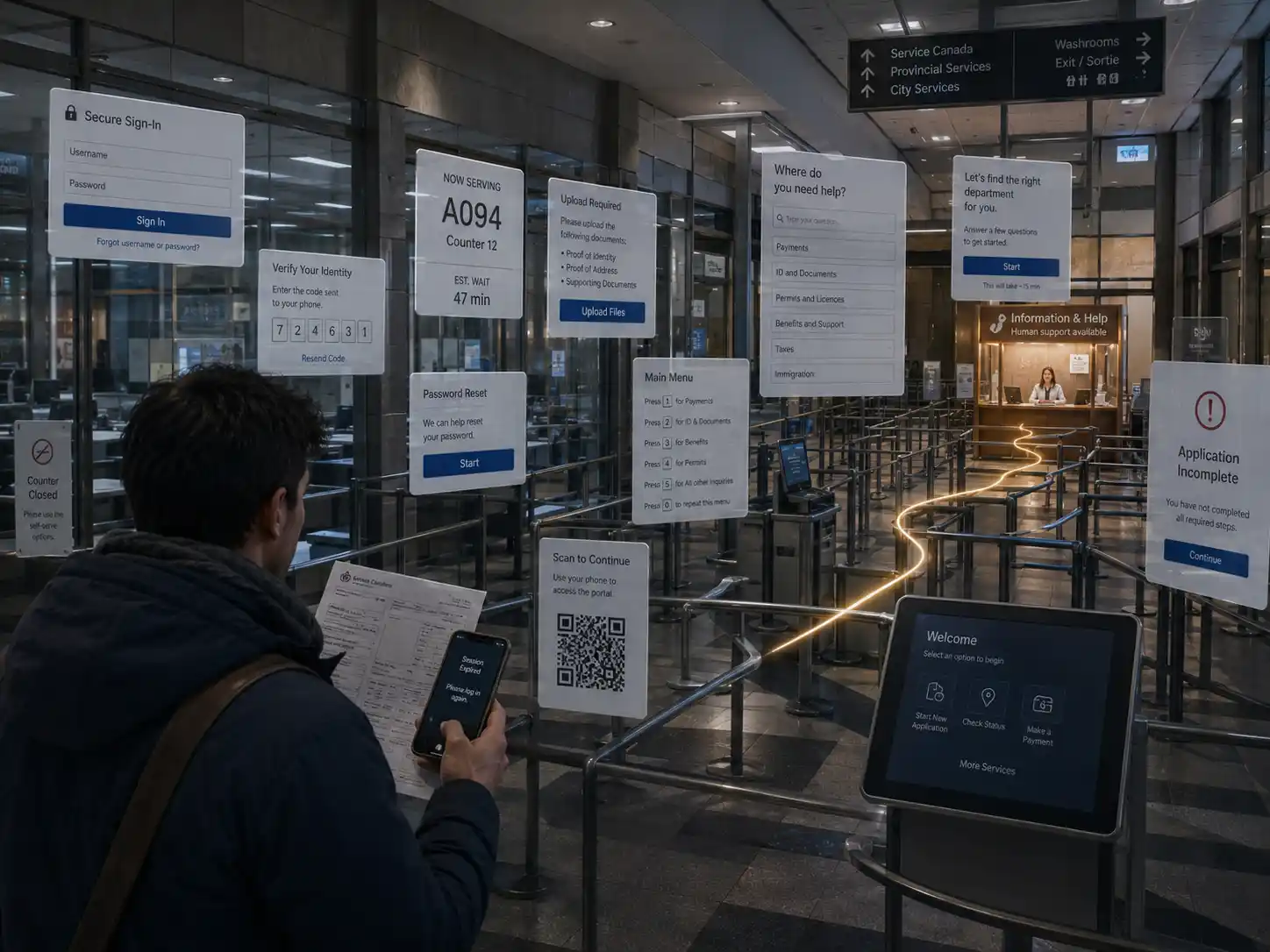
Chapter 23 — Interfaces Replace People
The first promise of the interface was simple:
This will be easier.
Pay the bill online.
Scan the groceries yourself.
File the form from home.
Book the appointment through the portal.
Check the package.
Reset the password.
Upload the document.
Print the label.
Tap the card.
Download the ticket.
Enter the code.
Press one for English.
Press two for French.
Press six for a department that may not answer.
The interface did not arrive as a revolution.
It arrived as convenience.
And much of it really was convenient.
Online banking saved trips. Bank machines gave access after hours. Government portals reduced paperwork for some people. Digital tickets saved lines. Parking apps saved coins. Delivery tracking reduced uncertainty. Tax software helped people complete forms that once required envelopes, counters, or accountants. Airport kiosks made check-in faster. Online booking let people schedule without waiting on hold. A person in a rural area could sometimes access services without travelling. A disabled person could sometimes avoid a hostile counter, a bad bus route, or a long wait in a public office.
The gains were real.
But something changed in the relationship between person and institution.
The bank, store, school, workplace, hospital, airline, utility, tax office, university, landlord, and government department became less like places and more like systems to be navigated.
The person became the user.
That word matters.
A citizen can make a claim.
A customer can ask for service.
A patient can describe pain.
A student can seek help.
A neighbour can be known.
A user must operate the system.
The user is expected to adapt.
Create an account.
Choose a password.
Confirm the password.
Reset the password.
Find the code.
Use two-factor authentication.
Agree to the terms.
Upload the file in the right format.
Resize the file.
Wait for verification.
Check the spam folder.
Try another browser.
Clear the cache.
Call the number.
Listen to the menu.
Go back to the portal.
Start again.
This is not only inconvenience. It is a transfer of labour.
Work once done by clerks, tellers, receptionists, agents, travel staff, librarians, cashiers, bank employees, school secretaries, public servants, and customer-service workers moved onto the individual. The user became unpaid clerk, scheduler, troubleshooter, records manager, password keeper, document scanner, form interpreter, call-centre navigator, and customer-service agent for himself.
Responsibility moved downward.
Authority stayed hidden.
That is the structure of interface life.
If the system works, it feels seamless. If it fails, the person often has nowhere to stand. No counter. No name. No face. No local memory. No one who knows the situation. Just a loop.
The loop is one of the defining experiences of managed reality.
The password reset loop.
The phone menu loop.
The chatbot loop.
The form error loop.
The “your session has expired” loop.
The “please upload supporting documents” loop.
The “estimated wait time is longer than usual” loop.
The “we are experiencing higher than normal call volumes” loop, which somehow lasts for years.
A loop is not just frustrating. It teaches helplessness.
It says: the institution is real enough to demand things from you, but not human enough to answer you.
This is one of the quiet ways public trust erodes.
People do not lose trust only because of scandals or ideology. They lose trust when ordinary systems become unreachable. When the government office cannot be reached. When the bank cannot explain. When the airline cannot help. When the school portal buries the message. When the health system asks for online booking but has no appointments. When the landlord uses forms but avoids responsibility. When the employer sends the worker to HR software. When the tax agency speaks through notices and portals more than people.
The institution remains powerful.
The person becomes administratively alone.
This loneliness is new in form, even if bureaucracy is old.
Older bureaucracies could be slow, arbitrary, racist, sexist, inaccessible, humiliating, and maddening. The counter was not always kind. A clerk could dismiss you. A government office could waste your day. A bank manager could deny you. A school secretary could judge your family. A hospital desk could make you feel small. A police station or immigration office could be terrifying. Human systems often abused their discretion.
The repair is not nostalgia for counters.
The repair is accountable access.
Digital systems should reduce humiliation, not hide responsibility.
A portal is good when it makes a task faster and still gives a person a way out when the task becomes complicated.
A portal is bad when it becomes the institution’s shield.
This distinction matters because interface life often pretends to be neutral. It says the process is standardized, efficient, modern, scalable, user-friendly, secure. But the user is not equally positioned.
A confident, literate, digitally fluent person with a stable address, good internet, a printer, a scanner, a smartphone, a credit card, free time, and English or French fluency experiences a portal differently from someone without those things.
An elder experiences it differently.
A newcomer experiences it differently.
A disabled person experiences it differently.
A person with low literacy experiences it differently.
A person without stable housing experiences it differently.
A person in a northern or rural area with poor connectivity experiences it differently.
A person working two jobs experiences it differently.
A person dealing with grief, illness, addiction, debt, or fear experiences it differently.
The interface claims to simplify. Often it simplifies for the institution and complicates life for the person with the least margin.
This is one reason libraries became even more important in the interface age. Public libraries are no longer only book institutions. They are help desks for the digital state. People come to print forms, use computers, ask how to apply, access email, scan documents, search jobs, book appointments, and understand systems that were supposedly made easier.
The library becomes the human counter for institutions that removed their own counters.
That should tell us something.
It tells us that digital access is not the same as public access.
A service is not truly accessible because it exists online. It is accessible when real people can use it, complete it, correct mistakes, ask questions, appeal decisions, and reach a human being when the system fails.
Self-checkout shows the same shift at a smaller scale.
At first it feels efficient. Scan, bag, pay, leave. No line. No small talk. No waiting behind someone buying lottery tickets or arguing about a coupon.
But the machine also changes the store. The customer does more work. The staff become watchers, troubleshooters, and security intermediaries. The machine misreads the weight. The barcode fails. The system says unexpected item in bagging area. A worker comes over with a card, clears the error, moves away. The customer has become cashier without the wage, while the human worker has become manager of machine failure.
This is not the greatest injustice in the world. But it is a symbol.
The interface promises autonomy while often increasing surveillance and shifting labour.
Banking did something similar. The ATM was useful. Online banking was useful. Mobile deposit was useful. But the branch also changed. Tellers disappeared. Local knowledge weakened. Fees remained. Problems became call-centre problems. Fraud detection, account holds, password resets, credit systems, automated decisions, and customer-service scripts created a new relationship: the bank everywhere and nowhere at once.
Government portals did this at civic scale.
The citizen became a login.
A tax account. A benefits account. A health account. A student loan account. An immigration account. A school account. A municipal account. Each requires identity proof, passwords, security questions, document uploads, email confirmations, and patient obedience to the system’s categories.
Again, this can be better than old paper systems. But the civic meaning changes when the state becomes a set of portals.
A citizen should not feel that government is only a locked door with a password field.
The danger is not technology itself.
The danger is when technology allows institutions to retreat from human obligation.
This retreat is often justified by efficiency. But efficiency for whom?
If a company saves labour by making customers do the work, the work has not disappeared. It has moved. If a government saves counter service by making citizens navigate online systems, the complexity has not disappeared. It has been redistributed. If a school saves staff time by moving communication into portals, parents may now monitor multiple platforms, emails, forms, permissions, and deadlines. If a hospital moves booking online, patients without digital fluency may become less visible.
A society can call this modernization while quietly increasing the administrative burden on ordinary people.
This is why burnout and interface life are connected.
The person is not only working a job. He is also working the systems around the job. Rent systems. Health systems. School systems. Tax systems. Banking systems. Benefit systems. Transportation systems. Subscription systems. Password systems. Communication systems. Each one makes small demands. Together they produce a life of constant minor administration.
No single task is impossible.
The total is exhausting.
This exhaustion is especially corrosive because it rarely feels noble. It is not the exhaustion of building a house, raising a child, caring for an elder, helping a neighbour, or finishing a difficult project. It is the exhaustion of being trapped in process.
Process without relationship.
Process without memory.
Process without judgment.
Process without mercy.
A human clerk can be unfair, but a human clerk can also understand. A form cannot. A portal cannot. A chatbot cannot truly care. An algorithm cannot know that the person is grieving, confused, honest, desperate, ashamed, or one document short because the previous institution failed.
Human discretion can be dangerous. But the absence of discretion can be cruel.
The repair is not to bring back every old counter or abolish every interface.
The repair is to design systems around human accountability.
Every critical system should have a human exit.
A person should be able to reach someone.
A decision should be explainable.
A denial should be appealable.
A form should be understandable.
A system should remember context when appropriate.
A portal should not be the only door.
A public service should serve the public that actually exists, not the ideal user imagined by designers.
This requires a different moral standard for technology.
Do not ask only: is it efficient?
Ask: who does the work now?
Who is excluded?
Who is watched?
Who can appeal?
Who owns the error?
Who benefits from the friction removed?
Who suffers from the friction added?
Where does responsibility go when the screen fails?
These questions reveal whether an interface is serving people or managing them.
The best interfaces extend human agency.
They let someone in a remote community access a service without travel. They let a working parent complete a form at night. They let a disabled person avoid unnecessary physical barriers. They let someone track medication, money, documents, transit, or appointments. They reduce waiting. They reduce humiliation. They preserve dignity.
The worst interfaces turn people into data-entry clerks for institutions that no longer want to meet them.
Both realities exist.
The task is to build the first and refuse the second.
Canada should be especially careful here because the country is large, regional, bilingual, rural, urban, northern, immigrant, aging, and unequal in access. A single digital system can look clean from Ottawa, Toronto, Vancouver, Montreal, or a corporate office and still fail real people in real places.
A northern community with weak connectivity is not a design exception.
An elder without smartphone confidence is not an inconvenience.
A newcomer confused by forms is not user error.
A disabled person needing another channel is not inefficiency.
A person without a printer is not irresponsible.
A citizen who wants to talk to a human being is not outdated.
Public systems should be judged by how they serve people with low margin, not only by how they serve the smooth user.
This is also a democratic issue.
When institutions become unreachable, people become suspicious. They may not have the technical language for administrative burden, but they know the feeling of being processed instead of heard. That feeling becomes political fuel. It feeds distrust, resentment, conspiracy, and the belief that no one is accountable.
Some of that anger is misdirected. Some is exploited. But the underlying experience is often real.
A country that wants trust should make institutions answerable at ordinary points of contact.
Trust is not built only by speeches. It is built when the person can get help.
The same principle applies to private companies. A bank, airline, telecom provider, landlord platform, insurance company, delivery app, or subscription service that traps people in loops teaches them that power has become faceless. When enough of life feels like that, the culture changes. People become more cynical, more aggressive, more defensive, more likely to treat every interaction as a battle before it begins.
Bad systems make bad citizens by training bad expectations.
Good systems form people too.
A good public counter can teach that institutions are human.
A good website can teach clarity.
A good librarian can teach confidence.
A good clerk can teach process.
A good appeal system can teach fairness.
A good service design can teach respect.
Interfaces are not neutral. They are civic teachers.
They teach either: you can do this, and someone is accountable if it fails.
Or: you are alone, and the institution owes you nothing but a screen.
Modern Canada has too often accepted the second as progress.
It is not progress.
It is abandonment with better design.
The repair should begin with essential services: government, healthcare, banking, education, housing, employment, transit, utilities, immigration, taxes, and benefits. These are not luxury conveniences. They are the systems through which people live.
For essential services, digital-only should be treated with suspicion.
Not because digital is bad. Because essential life requires redundancy. A bridge has backups. A plane has procedures. A public service should have more than one way in.
Online. Phone. In person. Community intermediary. Library support. Plain-language forms. Accessible design. Translation. Appeal. Human escalation. Local knowledge where possible.
Redundancy is not inefficiency when the cost of failure is human harm.
The pandemic years made this visible. Remote systems became necessary. Portals, online school, digital health, delivery, video meetings, and emergency benefits helped keep life moving. But they also exposed who had space, devices, internet, privacy, literacy, support, and flexibility — and who did not. A society can move online quickly, but people do not arrive there equally.
The lesson should not be that digital life failed.
The lesson is that digital systems need human scaffolding.
Without that scaffolding, managed reality becomes class sorting.
Those with skills, devices, time, and confidence pass through. Those without get stuck, blamed, delayed, denied, or made dependent on someone else.
This is why human intermediaries matter: librarians, settlement workers, social workers, community volunteers, school secretaries, clinic staff, local advocates, Indigenous service organizations, seniors’ centres, disability organizations, legal clinics, and public servants who can translate the system into human steps.
They are not extras. They are infrastructure.
A country that removes them because the portal exists misunderstands access.
The deeper repair is cultural. Canadians need to stop confusing convenience with civilization.
Convenience is good when it serves life.
Convenience is dangerous when it replaces relationship, hides labour, removes accountability, and leaves people alone with systems.
The grocery machine, the banking app, the government portal, the school platform, the automated menu, the QR code, the customer-service bot, the parking app, the delivery tracker, the digital ticket — all of these can be useful. None should be allowed to redefine the human being as merely a user.
People are not users first.
They are citizens, neighbours, workers, parents, elders, patients, students, newcomers, children, and members of communities.
A humane interface should remember that.
The right to reach a person may become one of the great civic rights of the managed age.
Not for every small task. Not as hostility to technology. But when something serious is at stake — money, housing, health, immigration, education, taxes, benefits, employment, identity, public access — people need human accountability.
The repair is simple to state and hard to build:
Keep the useful interface.
Restore the human door.
Make the system efficient for people, not only institutions.
Make authority reachable.
Make errors correctable.
Make public life answer back.
The first promise of the interface was that life would be easier.
The next promise must be that life will remain human.
Chapter 24 — The Platform Self
MSN Messenger was not the same as Facebook.
That difference matters.
MSN was digital, but it was not yet fully public. It belonged to the half-lit world of early online adolescence: screen names, away messages, Hotmail addresses, chat windows, custom fonts, inside jokes, late-night conversations, song lyrics as emotional code, and the strange thrill of seeing someone’s status change from offline to online.
It was not innocent. Nothing involving teenagers ever is. There was drama, cruelty, flirting, exclusion, gossip, performative sadness, and social pressure. But MSN still allowed a kind of temporary becoming.
A teenager could change a screen name for the night.
He could write a dramatic away message and delete it later.
She could flirt badly without announcing it to the whole school.
Friends could talk after class without adults hearing every word.
A person could be more emotional online than in the hallway and still not have that version of the self become permanent public infrastructure.
It was identity play before identity became a profile.
That is the hinge.
The early internet extended social life. The platform internet reorganized it.
A screen name was not the same as a real-name profile. An away message was not the same as a permanent post. A chat window was not the same as a feed. A contact list was not the same as a public friend graph. A private embarrassment was not the same as a searchable identity.
Then Facebook arrived, and the self became more fixed.
Names, schools, networks, photos, relationship status, friend counts, walls, comments, tagged pictures, likes, events, groups, birthdays, and timelines turned identity into something visible, searchable, and socially measurable. What had once been scattered across bedrooms, hallways, phone calls, lockers, basements, parties, malls, rinks, workplaces, and private conversations began to gather in one place.
The person became a page.
At first, it felt like connection.
You could find people.
You could see photos.
You could remember birthdays.
You could reconnect with old classmates.
You could organize events.
You could join groups.
You could carry your social world from high school to university, from one city to another, from one country to another.
For immigrant families, platforms were not trivial. They helped maintain relationships across oceans. Photos, calls, messages, family groups, and shared updates reduced distance that had once been far more painful. A grandparent abroad could see a child grow. Cousins separated by migration could remain present. Old-country memory could remain connected to Canadian life.
For isolated young people, platforms also opened doors. Disabled youth, religious minorities, rural youth, gamers, artists, political dissidents, and socially awkward teenagers could find language and community that local life did not provide. A person trapped in a hostile school or town could discover that the world was larger than the room that misunderstood him.
That gain was real.
The platform self did not grow only from vanity. It grew from real human needs: friendship, memory, recognition, belonging, opportunity, romance, safety, escape, and continuity.
But the structure changed the person.
A human being who becomes searchable begins to manage himself differently.
Before platforms, young people still performed. They performed in school hallways, malls, parties, sports teams, churches, workplaces, family gatherings, neighbourhoods, and friend groups. Identity was always social. The difference was that performance had more walls.
You could be one person with cousins, another at school, another at work, another online, another in the locker room, another in the basement with close friends. These versions could conflict, but they did not always collapse into one public record.
Platforms collapsed contexts.
Your aunt, your classmate, your boss, your ex, your future employer, your childhood friend, your political acquaintance, your teammate, your cousin abroad, your teacher, your neighbour, and a stranger could all become part of the same audience.
This is not normal for human development.
A young person needs rooms.
Not only physical rooms. Social rooms. Places to try a joke, a belief, a style, a friendship, a crush, a mistake, a phase, an opinion, a costume, a haircut, a sound, a posture, a way of speaking — and then leave it behind.
Becoming requires some forgetting.
Platforms make forgetting harder.
Tagged photos, screenshots, archived chats, old posts, search results, cloud albums, reposts, and mutual networks extend the life of moments that once would have faded. A bad joke, ugly opinion, awkward photo, failed relationship, immature performance, or painful confession can outlive the person who made it.
The self becomes sticky.
This does not affect everyone equally. Some people are more exposed than others. Girls and young women often experience harsher scrutiny around appearance, sexuality, popularity, and reputation. Poor youth may have fewer resources to manage appearance, privacy, and devices. Public figures, activists, artists, and students entering competitive careers learn early that reputation can be mined.
The platform self trains caution.
That caution can look like sophistication. Young people learn to curate. They learn angles, captions, deletion, privacy settings, soft launches, hard launches, group chat politics, screenshot risk, employer risk, family visibility, and the social meaning of silence.
But beneath the sophistication is a cost: less private becoming.
A person who grows up watched may confuse selfhood with management.
What should be posted?
What should be hidden?
What will this say about me?
Who will see it?
Who will judge?
Who will save it?
Who will misunderstand?
What does my profile prove?
What does my absence suggest?
This is exhausting because the platform self is never finished.
It must be updated, defended, corrected, improved, and compared.
LinkedIn professionalizes the self. Instagram aestheticizes it. Dating apps market it. TikTok performs it. Snapchat fragments it. Discord shelters parts of it. Group chats judge it. Google preserves traces of it. Screenshots threaten it. Cloud photos accumulate it. Algorithms feed it back through metrics.
The self becomes a project under observation.
This is one of the biggest changes in human formation.
Older institutions formed people through family, school, faith, work, sport, neighbourhood, land, media, and public rituals. Platforms form people through visibility, metrics, comparison, memory, audience, and feedback.
A “like” is not only a like. It is social information.
A follower count is not only a number. It is rank.
A profile picture is not only an image. It is a signal.
A relationship status is not only romance. It is public classification.
A dating profile is not only introduction. It is self-advertisement under market conditions.
A LinkedIn profile is not only resume. It is professional identity performed before a permanent room.
These tools can help. They can get people jobs, dates, friends, clients, audiences, community, and recognition. But they also train people to see themselves from outside.
The platform self is the self imagined as viewed.
That is psychologically powerful.
A person living through platforms may begin to ask not “What do I think?” but “How will this read?” Not “What happened?” but “How does this look?” Not “Who am I becoming?” but “What does my profile say I am?”
The danger is not performance itself. All social life includes performance. The danger is permanent, measurable, searchable performance becoming the default condition of identity.
This damages youth especially because adolescence is supposed to be unfinished.
A teenager should be allowed to be embarrassing. To change politics. To change style. To like bad music. To say something clumsy and learn. To try on seriousness. To become arrogant and be humbled. To fall in love badly. To overstate. To retreat. To reappear. To grow.
If every stage is recorded, becoming becomes risky.
That risk produces two opposite behaviours.
Some young people become hyper-curated. They polish the self before it has matured.
Others become reckless, performing extremity because attention rewards it.
Both are shaped by the same structure: the self under audience pressure.
This is where platform identity connects to politics and influencer culture. Once the self is public, every position can become identity material. Politics, taste, moral language, trauma, humour, fitness, spirituality, education, work, and relationships can all become part of the display. The person is rewarded not only for living, but for packaging life.
The self becomes content.
That is not the same as having a life.
A life can contain contradictions, privacy, boredom, repetition, duty, failure, unphotographed care, unannounced kindness, changing beliefs, and relationships that do not need an audience.
Content prefers clarity, angle, identity, novelty, conflict, beauty, pain, and proof.
A person trained by content may begin to mistrust unposted life.
If the meal was not photographed, did it matter?
If the relationship was not visible, is it real?
If the grief was not shared, was it processed?
If the achievement was not announced, did it count?
If the opinion was not posted, is silence guilt?
If the self is not legible to others, does it exist?
That is a terrible burden.
The repair is not to tell people to disappear from modern life. That is unrealistic and often unfair. Platforms are now tied to work, school, friendship, family, activism, art, immigration, business, dating, and public information. To withdraw entirely can mean isolation or disadvantage.
The repair is to rebuild spaces where people can exist without performance.
Family rooms without constant recording.
Friendships that do not require posting.
Schools that teach privacy as a developmental need.
Youth groups, clubs, sports, arts, faith communities, and community centres where the person is known face to face.
Local work where reputation comes from showing up, not only branding.
Digital norms that forgive change.
Laws and platform designs that protect minors.
Homes where children are not turned into content before they can consent.
Institutions that do not require every young person to become a public relations manager for the self.
A child should not have a brand.
A teenager should not have to manage a permanent audience.
A young adult should not need to convert every skill, hobby, friendship, belief, and hardship into visible capital.
This is especially important for work. The job market already pushes young people toward self-packaging. Build a profile. Network. Post expertise. Create a portfolio. Optimize your presence. Show leadership. Display passion. Be searchable. Be employable before being employed.
Some of this is practical. But it pushes adulthood further into performance. The young worker is not only applying. He is becoming a product.
LinkedIn is the polite version of this. Dating apps are the intimate version. Instagram is the aesthetic version. TikTok is the performative version. X is the argumentative version. Each asks the person to become legible in a format designed by someone else.
Formats shape souls.
A dating app turns romance into selection. Swipe, match, message, compare, ghost, return. It can help people meet who otherwise would not. It can also train disposability, performance, and the sense that another person is one option among endless profiles.
A professional platform turns career into narrative. It can help opportunity travel. It can also make every achievement feel like an announcement and every silence feel like falling behind.
A visual platform turns life into aesthetic proof. It can inspire creativity. It can also make ordinary life feel inadequate.
A short-video platform turns expression into hook, pace, trend, and reaction. It can democratize voice. It can also punish depth and reward performative certainty.
The person adapts to the format, often without noticing.
This is why privacy is not only a legal issue. It is a formation issue.
Privacy is where the self can grow without immediate judgment. It is where conscience forms. It is where shame can be processed without spectacle. It is where children and teenagers can become without turning every mistake into identity evidence. It is where friendship deepens because not everything is for others.
A society that treats privacy as outdated will produce anxious performers.
It will also produce shallow judgment. If nobody is allowed to have a past, nobody can mature. If every old statement is treated as final essence, then growth becomes impossible. A culture without forgiveness traps people in their worst documented moment.
Forgiveness does not mean no accountability.
Some actions are serious. Some patterns reveal danger. Some public harm needs public response. But ordinary human development requires room for correction.
A thirteen-year-old should not be judged like a thirty-year-old. A person should be allowed to outgrow a stupid post, an ugly phase, a bad opinion, a failed performance, a painful relationship, a clumsy attempt to belong.
The platform archive often lacks proportion.
It makes everything retrievable but not everything meaningful.
The repair requires cultural maturity: learning to distinguish harm from immaturity, pattern from moment, danger from awkwardness, accountability from permanent punishment.
This applies to families too.
Parents now create children’s platform selves before children can speak. Baby photos, school photos, tantrums, medical stories, funny moments, achievements, punishments, and private family life become posts. Sometimes this is harmless sharing with relatives. Sometimes it becomes exposure. Sometimes the child’s life becomes material for adult identity.
The child should have a future claim on privacy.
Family memory matters, as this book argued. But family memory is not the same as public content. A photo album in a basement and a searchable post are different kinds of archive. One belongs to family transmission. The other may belong to the platform forever.
This difference must be taught.
Modern family archive needs consent, care, and restraint.
The same goes for schools. Schools should teach digital citizenship not as fear-mongering, but as formation: what is public, what is private, what is permanent, what is performative, what is manipulative, what is data, what is consent, what is reputation, what is repair, what is forgiveness.
Students should learn that they are more than their profiles.
They should also learn that other people are more than theirs.
That may be the deeper moral repair. The platform self does not only change how I see myself. It changes how I see you. You become a profile, a post, a take, a photo, a signal, a category, a match, a follower, a threat, a brand, a position, a type.
Face-to-face life resists that reduction.
Not perfectly. People stereotype in person too. But the body complicates the profile. Voice, timing, awkwardness, humour, fatigue, kindness, hesitation, contradiction, and shared physical space make it harder to turn a person entirely into content.
That is why local institutions matter against platform life.
A coach knows more than the profile.
A teacher sees change over time.
A librarian helps without needing a brand.
An elder carries memory outside the feed.
A neighbour becomes harder to caricature when you shovel the same sidewalk.
A faith or community group can know a person across years.
A workplace can form reputation through usefulness.
A team can make identity secondary to showing up.
These are not perfect safeguards. Local life can be cruel. But without local life, the platform becomes more powerful.
The platform self weakens when people are known in thicker ways.
Known as someone’s child, yes, but also as a helper, teammate, reader, worker, singer, builder, neighbour, student, cook, driver, volunteer, cousin, apprentice, mentor, friend.
The self needs many rooms because no single profile can hold a person.
This is especially true in Canada’s plural society. A person may carry family culture, public Canadian identity, religious belonging, language difference, online community, school life, work identity, and private self all at once. Platforms often pressure these into display. But some forms of belonging need discretion. Not every inheritance can or should be flattened into a bio.
A mature multicultural country should protect layered identity.
A mature democratic country should protect private thought.
A mature technological country should protect unrecorded becoming.
The platform self is now part of life. It will not disappear.
The question is whether it remains one tool among many or becomes the master template for personhood.
If it becomes the master template, people will increasingly become managers of visible identity rather than participants in shared life. They will mistake metrics for belonging, recognition for love, visibility for meaning, and profile for self.
The repair is to return the self to the world.
Not by abandoning digital tools, but by rebuilding the non-digital formation systems strong enough to keep platforms in proportion.
Family memory.
Neighbourhood independence.
School ritual.
Physical training.
Practical tools.
Land contact.
Local media.
First jobs.
Public institutions.
Friendship without audience.
Art before branding.
Politics inside a larger life.
A person formed by these has more resources against the platform. He can use it without being wholly defined by it. She can appear without becoming only appearance. They can connect without dissolving into metrics.
MSN Messenger was not the same as Facebook.
The difference was not only technical.
It was civilizational.
One extended adolescence into a semi-private digital room.
The other helped turn identity into public infrastructure.
Now the task is to build a world where young people can again become in rooms the whole world does not own.

Chapter 25 — The Screen Becomes the Room
The screen used to be inside the room.
Then the screen became the room.
That change happened quietly because each step made sense.
The phone became the camera.
The phone became the map.
The phone became the calendar.
The phone became the mailbox.
The phone became the bank.
The phone became the music player.
The phone became the television.
The phone became the newspaper.
The phone became the shopping mall.
The phone became the dating scene.
The phone became the classroom.
The phone became the office.
The phone became the family album.
The phone became the argument.
No one had to announce a revolution. Ordinary convenience did the work.
A person could wake up, check messages, scan headlines, answer work, pay a bill, send money, check weather, order groceries, apply for a job, watch a lecture, attend a meeting, message a parent, scroll a feed, listen to music, follow a war, book a doctor, look for rent, flirt with a stranger, argue about politics, track a package, watch a show, and fall asleep under the same glowing surface.
The world collapsed into a rectangle.
At first, this looked like freedom.
And in many ways, it was.
A newcomer could speak to family across the world without waiting for a calling card or letter. A rural worker could attend a meeting without driving hours. A disabled person could access services that buildings, buses, stairs, weather, pain, or fatigue once made difficult. A student could watch lectures, find papers, learn skills, and join communities far beyond the school library. A parent could coordinate rides, appointments, groceries, and family messages while standing in a parking lot. A small creator could publish without a broadcaster. A lonely person could find a forum where someone understood.
The screen solved real problems.
It collapsed distance.
It opened archives.
It made maps speak.
It let families stay present across borders.
It made knowledge portable.
It gave isolated people company.
It gave citizens evidence of things institutions once hid.
It gave ordinary people tools that once belonged to offices, studios, banks, broadcasters, publishers, and experts.
The gain must be counted honestly.
But when the screen becomes the room, the world changes.
A screen inside a room is a tool.
A screen as the room is an environment.
That is the difference.
When the television was in the living room, the living room still organized the experience. The family sat somewhere. The show had a time. Someone controlled the remote. The broadcast ended. The room remained. Other people were still physically present. The television was powerful, but it had a location.
The smartphone has no room because it travels through all of them.
It enters the bedroom, classroom, kitchen, car, bus, bathroom, office, playground, hospital waiting room, dinner table, sidewalk, church, rink lobby, lecture hall, worksite, and funeral reception. It turns every pause into potential connection and every silence into potential consumption.
This means the person is never simply where he is.
He can be at dinner and in a work chat.
In class and in a feed.
In bed and in a war.
At a rink and in an argument.
On a walk and in a podcast.
With family and with strangers.
Alone and watched.
Resting and reachable.
The screen does not only take time. It changes presence.
A family can sit together while each person lives elsewhere. The television may be off, but everyone has a private screen. The room is physically shared and mentally scattered. One person is watching a video. Another is texting. Another is checking work. Another is scrolling headlines. Another is in a group chat. The family is together in the old sense and not together in the new one.
This is not because families became worse. It is because the room was invaded by infinite rooms.
The same happens in school.
A classroom used to be a contained public space. Not perfectly. Notes passed, minds wandered, windows distracted, social life intruded. But the room had stronger boundaries. Now every student may carry a portal to friends, entertainment, cheating tools, family demands, gossip, pornography, shopping, games, politics, and global crisis. Even when phones are banned, the mental shape of life has changed. The outside world is expected to be instantly available.
Teachers are asked to compete with everything.
That is not a fair competition.
It is not a fair competition for parents either. Or employers. Or friends. Or churches. Or libraries. Or books. Or sleep. Or silence.
The phone brings the whole world into every room, but it also makes every room compete with the whole world.
The office changed too.
Work once had a place. Many people still worked too much. Many brought stress home. Many were exploited long before smartphones. But the office, factory, store, school, hospital, job site, or farm had more physical boundaries. Now work can travel in the pocket. Email, Slack, Teams, Zoom, shared docs, calendars, scheduling apps, and notifications make work spatially loose and psychologically sticky.
The worker is never fully gone.
Even if no one expects an immediate response, the possibility sits there. The unread message exists. The calendar reminder exists. The project update exists. The small red number exists. Work becomes ambient.
This is one reason burnout feels different now. The person does not only work. The person remains connected to work as an atmosphere.
Remote work intensified this.
For some, it was liberation: no commute, more flexibility, better disability access, more time with family, a chance to remain in a community while working elsewhere. For others, it turned the home into a workplace without restoring the time that work had taken. Kitchen tables became desks. Bedrooms became offices. Children entered meetings. Meetings entered rest. The day lost edges.
The screen did not only deliver work. It dissolved the room around work.
Entertainment changed in the same way.
Streaming gave choice. You no longer had to wait for a broadcast, rent a tape, buy a DVD, or accept whatever was on. The archive opened. Great films, bad shows, niche documentaries, old cartoons, tutorials, music, comedy, lectures, sports, news, and endless fragments became available on demand.
This was astonishing.
It also weakened common timing.
A show no longer had to gather people at the same hour. Music no longer had to pass through shared channels. News no longer had to arrive through a common bulletin. The family could watch separately. Friends could recommend endlessly without having watched the same things. The country could experience the same event through entirely different feeds.
The screen became personal weather.
Each person carries a climate of information, entertainment, outrage, desire, humour, fear, and memory curated by choices and systems they only partly control.
This changes public reality.
A country used to disagree over shared events more often. Now people can disagree from different event worlds. One person lives in economic anxiety. Another in climate alarm. Another in celebrity drama. Another in foreign war clips. Another in wellness content. Another in political scandal. Another in sports betting. Another in spiritual advice. Another in conspiracy. Another in memes. Another in local parenting groups. Another in private grief.
All of these worlds may be real in fragments. The problem is that they do not necessarily meet.
The screen can make reality more visible and less shared at the same time.
That is one of the defining contradictions of the age.
We can see more suffering than any previous generation. Wars, floods, fires, police violence, protests, famine, corruption, disasters, cruelty, heroism, humiliation, and private pain cross the screen instantly. This can awaken conscience. It can expose lies. It can force institutions to answer.
It can also overwhelm moral capacity.
A human being was not built to grieve everything in real time. The feed gives suffering without proximity, outrage without agency, fear without context, and urgency without a place to act. The person becomes emotionally activated and practically powerless. He knows too much and can do too little. She scrolls past catastrophe into a recipe, a joke, a dance, an advertisement, a friend’s baby, a political insult, a weather warning, and a video of a dog.
The moral nervous system becomes scrambled.
This is not the user’s failure. It is the structure of the room.
When the screen becomes the room, every kind of experience is flattened onto the same surface. A message from your mother, a work deadline, a bombing, a meme, a rent listing, a blood test result, a celebrity scandal, a prayer request, a school notice, a bank alert, and a stranger’s rage all arrive through similar gestures.
Tap. Swipe. Scroll. Reply. Like. Delete. Save. Share.
The body performs the same motions for experiences that should not feel the same.
That flattening damages judgment.
A funeral should not feel like a notification.
A war should not feel like a clip.
A friend’s pain should not feel like content.
A political crisis should not be processed between ads.
A child’s photo should not belong to the same stream as outrage bait.
A job application should not feel like another login in the same endless room.
But the screen trains sameness.
This is why the repair cannot be only “use the phone less.” That is too small. The deeper issue is that too many human functions have been absorbed into one device and one mode of attention.
Memory, work, friendship, news, entertainment, dating, banking, navigation, school, politics, art, shopping, prayer, grief, family, and identity now compete inside the same room.
A person needs different rooms because different human activities require different kinds of presence.
Work needs focus and boundary.
Family needs attention and memory.
Friendship needs unmeasured time.
School needs concentration and shared authority.
Worship needs reverence.
Grief needs slowness.
Politics needs proportion.
Art needs patience.
Sleep needs protection.
Childhood needs places where the child is not constantly reachable, watched, or entertained.
The screen can serve all of these.
It cannot become all of them without damage.
The pandemic years accelerated the shift dramatically. School moved online. Work moved online. Worship moved online. Family visits moved online. Doctors moved online. Funerals moved online. Birthdays moved online. Fitness moved online. Public meetings moved online. The screen became not only convenient, but necessary.
For a time, it held parts of life together.
That should be acknowledged. Without screens, isolation would have been worse for many people. Families stayed connected. Students kept some continuity. Workers kept jobs. Communities held meetings. Religious groups prayed together. Doctors saw patients. Artists performed. Governments delivered information. Friends remained visible.
But emergency tools can become permanent architecture.
The danger is that life reorganizes around the screen even after the emergency passes, not because it is always better, but because institutions have discovered it is cheaper, scalable, trackable, and administratively convenient.
Remote access should remain where it helps.
But embodied life must not be treated as a luxury upgrade.
A class in a room is not the same as a video window.
A doctor seeing a patient is not the same as a form.
A funeral in person is not the same as a stream.
A public meeting with neighbours is not the same as a comment box.
A family dinner is not the same as a group chat.
A church, synagogue, or community hall is not the same as a livestream.
A workplace is not always better as an office, but neither is a workplace merely a set of tasks on a screen.
Bodies matter.
Place matters.
Shared time matters.
This is the central argument of the whole book returning through technology: human formation needs embodied reality.
The screen is powerful because it abstracts.
It removes distance, hides friction, compresses time, simulates presence, archives memory, and personalizes experience. These are extraordinary abilities.
But people also need friction, distance, time, presence, forgetting, and shared experience.
Friction teaches patience.
Distance teaches scale.
Time teaches waiting.
Presence teaches responsibility.
Forgetting allows growth.
Shared experience teaches common reality.
A screen-heavy life weakens these unless other systems compensate.
Many systems did not compensate. They weakened too. Neighbourhoods thinned. Work became unstable. Housing delayed settlement. Local media declined. Public counters disappeared. School rituals became contested. Family memory scattered. Politics grew larger. The screen entered not a thick world, but a thinning one.
That made it stronger.
A child with a strong neighbourhood, team, family story, library, school, outdoor life, and local adults can use screens differently from a child whose main world is the screen. A worker with stable hours, housing, community, and boundaries can use digital tools differently from one whose life is already precarious. A family with rituals can absorb phones better than a family with no shared time left to protect.
The screen does not affect everyone equally because people do not enter it with equal support.
This is why repair must rebuild the world around the screen, not only discipline the individual user.
Create rooms where phones are not central.
Protect school attention.
Restore libraries as physical commons.
Make sport and arts affordable.
Give teenagers places to go.
Support public events.
Build housing that allows family and community life.
Design work with boundaries.
Keep human service counters.
Teach media literacy as self-defence.
Teach children how algorithms shape desire.
Make outdoor life reachable.
Support religious, cultural, and civic spaces where embodied presence matters.
The goal is not purity. The goal is proportion.
A healthy person can use screens. A healthy family can use screens. A healthy school can use screens. A healthy country can use screens.
But the screen must not become the default container for every human need.
When it does, politics changes too.
If friendship, news, entertainment, identity, and moral language all arrive through feeds, politics becomes more emotional, more performative, more personalized, and more constant. Political conflict no longer waits for elections, newspapers, meetings, or dinner arguments. It enters the pocket all day. It becomes meme, clip, take, outrage, identity, joke, fear, and group belonging.
This prepares the ground for political capture.
The screen becomes the room; then politics enters the room; then the room becomes difficult to leave.
That is why this chapter comes before the political chapters. The platform did not invent conflict, but it changed where conflict lives. It moved public argument into private time. It made the national fight portable. It turned civic life into an ambient emotional field.
A person can now be radicalized, demoralized, entertained, educated, misled, comforted, monitored, and marketed to in the same place where he texts his mother.
That mixture is unstable.
A country that wants sane politics needs sane rooms outside the feed.
Rooms where people make things.
Rooms where children play.
Rooms where bodies train.
Rooms where families eat.
Rooms where elders speak.
Rooms where citizens deliberate.
Rooms where faith is practiced.
Rooms where grief is held.
Rooms where art is made.
Rooms where help is human.
Rooms where silence is possible.
The word “room” here is literal and symbolic.
A room is a bounded space with a purpose. It tells the person how to be. A library asks for one kind of attention. A rink asks for another. A kitchen another. A classroom another. A shop another. A place of worship another. A public meeting another. A bedroom another.
When everything happens through one screen, these distinctions blur.
Repair means rebuilding distinctions.
Not every moment should be reachable.
Not every feeling should be public.
Not every silence should be filled.
Not every memory should be archived.
Not every task should be digitized.
Not every relationship should be mediated.
Not every public issue should enter every private hour.
This is not anti-modern. It is pro-human.
The phone is a brilliant tool. But a brilliant tool can become a bad world.
A map is useful. But if the map replaces local knowledge entirely, people stop learning routes.
A camera is useful. But if every event becomes documentation, people stop inhabiting it fully.
A messaging app is useful. But if all family life becomes coordination, memory thins.
A work platform is useful. But if work never ends, the person frays.
A feed is useful. But if it becomes public reality, the country fragments.
An AI assistant is useful. But if thinking, writing, remembering, choosing, and relating all become outsourced, human capacities weaken.
Every tool asks for a boundary.
The screen’s boundary must be rebuilt deliberately because it no longer has a natural one.
Television had walls.
Radio had schedules.
Newspapers had pages.
Letters had delay.
Phones had cords.
Stores had hours.
Schools had buildings.
Work had places.
Libraries had doors.
Games had endings.
The smartphone has none of these unless people create them.
That is the work.
Families can create phone-free meals, bedtime boundaries, shared viewing instead of isolated scrolling, and family archives that are not only clouds.
Schools can create device rules that protect attention while teaching digital competence honestly.
Workplaces can create right-to-disconnect norms, meeting discipline, and communication expectations that respect human time.
Communities can create public events worth attending.
Governments can regulate harmful platform design, protect privacy, support local media, and maintain non-digital access to services.
Individuals can rebuild practices of reading, walking, making, praying, training, cooking, visiting, repairing, and being unreachable.
None of this is easy because the screen is useful precisely when life is hard.
The exhausted parent reaches for it.
The lonely teenager reaches for it.
The overworked employee reaches for it.
The isolated elder reaches for it.
The bored child reaches for it.
The anxious citizen reaches for it.
Do not mock them.
Build a life where the screen is not the only relief.
That is the repair.
A country cannot shame people out of screens while removing the places, time, affordability, trust, and public life that make alternatives possible.
Give people rooms again.
Real rooms. Shared rooms. Public rooms. Sacred rooms. Play rooms. Work rooms with doors that close. Classrooms with attention. Libraries with chairs. Rinks with ice. Community centres with lights on. Parks within reach. Homes that can host. Streets where children can move. Institutions with humans inside them.
The screen used to be inside the room.
Then the screen became the room.
Now the task is to put the screen back in its place.
Not outside life.
Inside life.
As a tool serving the world, not a world replacing it.
Part VII — Political Capture
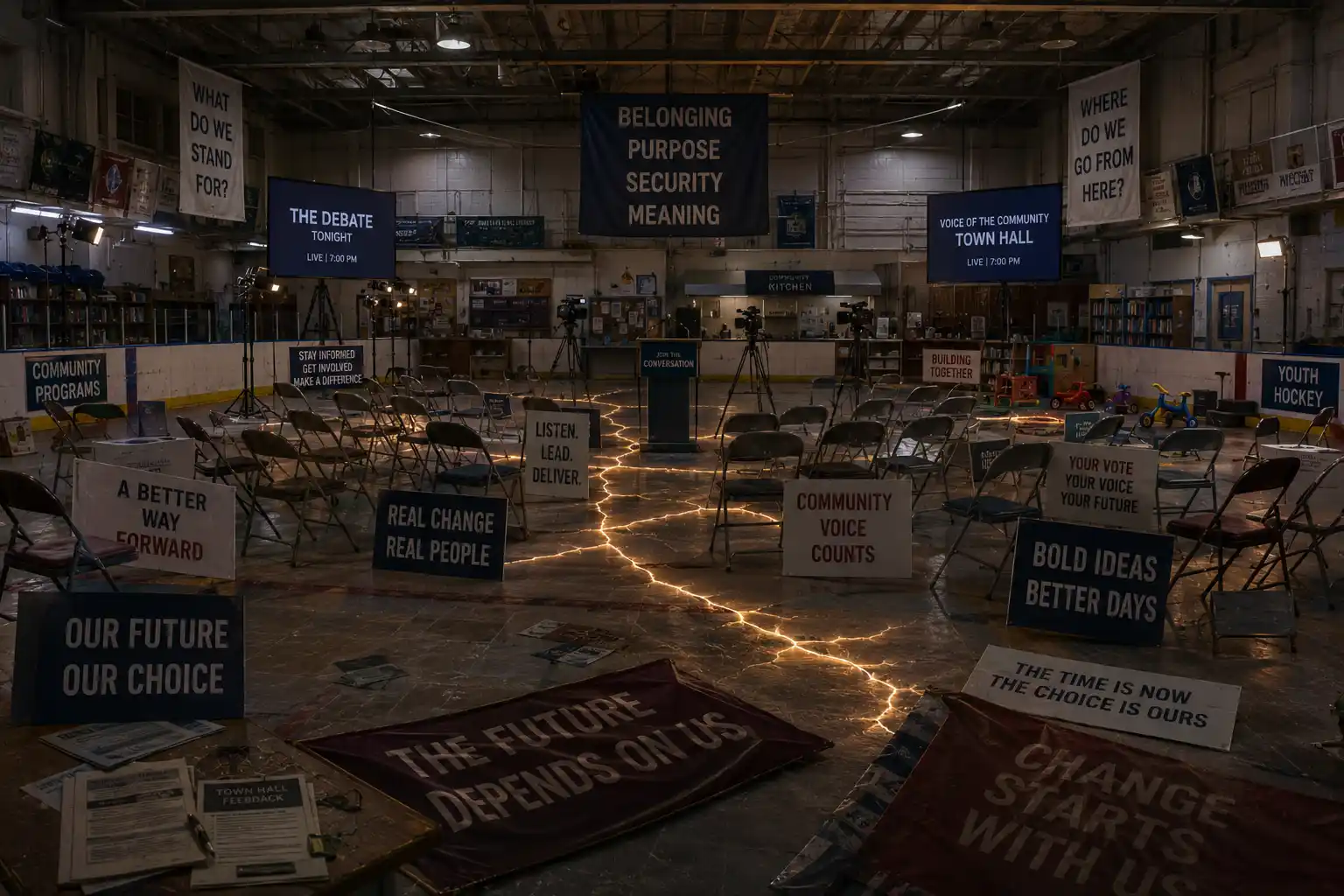
Chapter 26 — Politics Enters the Vacuum
Politics did not enter an empty room.
It entered a room where other things had weakened.
Family memory had thinned. Work felt less secure. Housing delayed adulthood. Institutions became portals. Media fragmented into feeds. Faith declined for many. Clubs weakened. Local newspapers disappeared or shrank. Schools became battlegrounds. Public rituals became awkward or contested. Neighbourhoods emptied. The screen became the room. The adult ladder became less believable.
Into that space came politics.
Not only elections.
Not only Parliament.
Not only parties.
Not only policy.
Not only left and right.
Politics became dinner-table argument, family group chat, YouTube identity, podcast routine, school board conflict, Facebook fight, X outrage, Reddit thread, protest footage, meme language, moral vocabulary, entertainment, self-description, friendship filter, dating filter, workplace anxiety, and substitute belonging.
It became more than public decision-making.
It became a way to explain life.
That is the danger.
Politics has a proper place. A serious country needs politics. Citizens should care about laws, budgets, rights, taxes, schools, housing, immigration, Indigenous rights, language, war, police, healthcare, environment, labour, public spending, and the use of state power. A person who refuses all politics is not mature. Public life requires judgment.
But politics becomes destructive when it grows beyond its proper size.
A family should not need politics to explain every fracture.
A school should not become only a battlefield for adult ideologies.
A hobby should not need political justification.
A friendship should not be constantly audited for ideological safety.
A movie, sport, holiday, song, meal, flag, book, road, truck, mask, vaccine, pronoun, church, university, police call, climate event, or children’s story should not instantly become a loyalty test.
When politics expands into everything, it stops being politics in the civic sense.
It becomes atmosphere.
The older country had political arguments too. Canada was never a peaceful village of shared assumptions. Confederation, language, conscription, labour, immigration, Indigenous policy, Quebec, the West, religion, women’s rights, race, war, policing, taxation, and regional power all produced deep conflict. Families argued. Newspapers raged. Movements organized. People protested. Elections mattered.
So the problem is not that people now disagree.
The problem is that disagreement has moved into a thinner social world.
When people once argued politics at the dinner table, the table still had other purposes. It carried family memory, food, jokes, old stories, obligations, children, elders, religion, holidays, and the ordinary need to keep belonging even after argument. Politics might enter the room, but it did not always own the room.
Now the family group chat can become a broadcast channel for articles, memes, warnings, accusations, screenshots, and moral sorting. The person who once had to face relatives at dinner can now fire messages into the family’s nervous system at midnight. The argument does not end when dinner ends. It waits in the phone.
The room has no door.
That changes politics.
Politics gains power when other forms of belonging weaken. A person who has family memory, work dignity, local service, faith or philosophy, sport, craft, friendship, place, and public duties can hold political identity in proportion. Politics matters, but it is not the whole self.
A person who lacks those things may ask politics to carry too much.
Meaning.
Belonging.
Enemy.
Moral purity.
Social status.
Personal explanation.
Historical destiny.
Identity.
Entertainment.
A reason for loneliness.
A reason for failure.
A reason to hope.
A reason to hate.
Politics is too thin to carry all that. But it is very good at pretending it can.
It gives names to frustration. It turns confusion into story. It turns anxiety into anger. It turns private disappointment into public drama. It offers teams. It offers rituals. It offers slogans. It offers villains. It offers belonging without the slow work of relationship.
That offer is powerful.
If a young man cannot enter adult life through work and housing, politics may tell him who stole his future.
If a young woman feels unsafe, dismissed, or exhausted, politics may tell her who is responsible.
If a parent feels school has become unrecognizable, politics may give language to fear.
If a worker feels ignored by institutions, politics may offer revenge.
If a newcomer feels both grateful and excluded, politics may offer recognition or resentment.
If a religious person feels mocked, politics may offer protection.
If an Indigenous person sees empty reconciliation language, politics may be the only arena where power seems to answer.
If a Quebecer feels language and culture threatened, politics may become survival.
If a rural person feels despised by urban institutions, politics may become dignity.
If a city renter feels trapped, politics may become rage.
Some of these grievances are real. That matters. Political capture is not always invented out of nothing. It often grows from real failures that other institutions did not repair.
Housing failure becomes political anger.
School mistrust becomes political anger.
Institutional contempt becomes political anger.
Regional neglect becomes political anger.
Economic insecurity becomes political anger.
Cultural humiliation becomes political anger.
Unanswered injustice becomes political anger.
The mistake is not noticing the anger.
The mistake is allowing politics to become the main container for every human need the country failed to meet elsewhere.
Politics can expose injustice. It cannot replace family.
Politics can change law. It cannot replace neighbourhood.
Politics can protect rights. It cannot replace friendship.
Politics can fund institutions. It cannot replace trust.
Politics can correct history. It cannot replace memory.
Politics can organize people. It cannot replace ordinary belonging.
When politics tries to replace those things, it becomes totalizing.
A totalizing politics asks every object to confess allegiance. A flag, phrase, holiday, sport, truck, vaccine, hairstyle, school lesson, news source, grocery choice, children’s book, police uniform, church sign, university poster, comedy bit, family joke, and social media silence can become evidence.
Evidence of what side you are on.
This produces a culture of permanent suspicion.
People begin to scan one another for signs. What did he mean by that? Why did she share that? Why did they not post? Why did that teacher say it that way? Why is that neighbour’s sign on the lawn? Why does that store sell that? Why is this show pushing that? Why did my cousin like that video? Why did my friend use that word?
Suspicion becomes a habit of attention.
Once that happens, politics does not need formal meetings. It lives in perception. People become amateur investigators of one another’s moral position.
This is exhausting.
It also damages truth. When everything becomes politically coded, people stop asking first whether something is real. They ask what it means for the fight. Facts are sorted by team before being examined. Suffering is believed or dismissed depending on political use. Hypocrisy matters only when the other side commits it. The same action changes moral meaning depending on who performs it.
Politics becomes less about governing and more about belonging.
The screen intensifies this because it feeds politics as drama.
Clips travel without context. Outrage arrives faster than correction. American conflict floods Canadian attention. National issues become memes. Local problems get translated into imported scripts. A school board meeting becomes content for strangers. A protest becomes identity theatre. A politician becomes a character in a long-running show. Citizens become audience, commentator, and combatant at once.
Canada is especially vulnerable to imported politics because of proximity to the United States. American media scale, culture-war language, celebrity politics, racial categories, constitutional arguments, and partisan styles cross the border constantly. Some American debates illuminate real Canadian issues. Many distort them.
A Canadian school, police force, church, university, neighbourhood, or legislature has its own history. But online politics often flattens local reality into larger scripts. People begin arguing in borrowed language before asking what is actually happening here.
That does not mean Canadian politics is innocent.
Canada has its own deep conflicts: Indigenous sovereignty and reconciliation, Quebec nationalism, language, regional alienation, immigration, housing, resource development, climate, healthcare, public broadcasting, policing, secularism, religious freedom, rural-urban divides, class, race, and national memory. These deserve serious argument.
But serious argument requires contact with reality.
Platform politics often rewards the opposite: speed, certainty, performance, enemy images, and emotional escalation.
The person who knows little about local institutions can still feel politically alive through commentary. He can watch clips, share takes, repeat slogans, and feel part of a national or global struggle while never attending a municipal meeting, coaching a team, volunteering, reading a local paper, helping a neighbour, or building an institution.
That is political capture: politics replacing participation.
It is not only a problem on one side. Different movements, parties, ideologies, and subcultures all do this in different ways. Each offers a story in which its own people are awake and the others are duped, evil, weak, brainwashed, hateful, privileged, traitorous, dangerous, or subhuman.
Once that language takes over, civic repair becomes harder.
You cannot rebuild a country with people you have trained yourself to despise.
A healthy politics requires opponents.
An unhealthy politics requires enemies.
Opponents can be defeated, persuaded, compromised with, or outvoted.
Enemies must be exposed, humiliated, purified, removed, or destroyed.
The more politics becomes identity, the more opponents become enemies.
This is why non-political life is so important. It lets people meet before politics reduces them. The neighbour with the wrong sign may also shovel your walk. The cousin with bad opinions may also care for your grandmother. The teammate may vote differently. The librarian may not share your worldview but still help your child. The tradesperson, nurse, teacher, coach, elder, pastor, imam, rabbi, priest, volunteer, or bus driver may not fit your categories.
Shared life complicates enemy images.
When shared life weakens, enemy images become easier.
This is one reason political capture follows the weakening of family, neighbourhood, work, sport, faith, local media, and public institutions. Those systems gave people cross-pressures. They forced more complicated relationships. You could not reduce everyone to politics because you needed them for other things.
A country with many rooms can survive political disagreement.
A country with only one room cannot.
The screen has made politics the loudest room.
The repair is not to tell people to care less about injustice. That would be cowardice. The repair is to rebuild proportion.
Politics should matter. It should not consume everything.
A person should be able to care deeply about housing policy and still attend a child’s game without turning every parent into a category.
A person should be able to care about Indigenous rights and still build truthful friendship beyond slogans.
A person should be able to defend religious freedom without making every disagreement apocalyptic.
A person should be able to care about climate without despising every worker in resource industries.
A person should be able to care about public safety without treating every criticism of police as betrayal.
A person should be able to care about racism without flattening every human being into identity arithmetic.
A person should be able to care about free speech without using it as cover for cruelty.
A person should be able to love Canada without lying about it.
A person should be able to criticize Canada without wanting to erase it.
That is political maturity.
Political maturity requires other sources of meaning.
Family memory.
Work dignity.
Local service.
Faith or moral discipline.
Physical training.
Practical skill.
Land contact.
Arts.
Friendship.
Neighbourhood.
Public ritual.
Humour.
Care.
Repair.
These do not remove politics. They keep it human.
They remind a person that life is not only a fight.
A country that wants less political capture should not begin by scolding citizens for being polarized. It should ask why politics became so emotionally necessary.
What did people lose?
Where did they stop belonging?
Which institutions failed them?
Which futures became unreachable?
Which local rooms closed?
Which duties disappeared?
Which identities became too thin?
Which screens replaced which relationships?
Those are repair questions.
The answer will not be one thing. It will be housing, work, family, faith, school, public media, local journalism, civic ritual, neighbourhood design, economic security, technology, education, and trust.
Politics will still be needed to repair some of those systems. But politics cannot be allowed to devour the systems it is supposed to repair.
That is the paradox.
We need politics to rebuild non-political life.
But if politics becomes the whole of life, rebuilding becomes impossible.
This is why leaders, commentators, activists, educators, and citizens need restraint. Not silence. Restraint.
Do not turn every tragedy instantly into a weapon.
Do not teach people to hate before they understand.
Do not import scripts without checking local reality.
Do not make children carry adult political identities too early.
Do not destroy family bonds for the pleasure of public righteousness.
Do not confuse posting with serving.
Do not let national argument erase local duty.
Do not let politics replace the slow work of becoming useful to real people.
Political courage is not only speaking.
Sometimes it is refusing to feed the machine.
Sometimes it is attending the boring meeting instead of sharing the perfect clip.
Sometimes it is calling the cousin instead of humiliating him online.
Sometimes it is volunteering where no one cares what your take is.
Sometimes it is admitting your side is wrong.
Sometimes it is building the institution your politics says should exist.
A captured politics rewards performance.
A repaired politics must reward responsibility.
This chapter belongs late in the book because politics is not the root of the story. That was one of the project’s most important corrections. If politics comes first, the whole book becomes another political argument. But politics should come after the weakening of common life because that is how it often enters experience.
Politics expands into the vacuum.
The vacuum was created by lost formation: less family memory, less neighbourhood independence, less practical competence, less land relationship, less local media, less stable work, less affordable housing, fewer human institutions, fewer shared rituals, more screens, more self-management, more platform identity.
Political capture is the symptom and the accelerant.
It feeds on loss, then deepens it.
The repair is not anti-political. It is pro-civilizational.
Put politics back inside a larger life.
Let families be more than argument chambers.
Let schools be more than ideological territory.
Let sports be more than cultural symbolism.
Let faith communities serve before they posture.
Let libraries stay open to people who disagree.
Let local media report before national outrage scripts arrive.
Let work and housing give young people a future worth protecting.
Let public rituals hold grief and gratitude without becoming propaganda.
Let technology serve relationship instead of turning every difference into content.
A country that has only politics left has already lost too much.
Canada does not need less seriousness.
It needs seriousness in more places.
Serious family memory.
Serious school formation.
Serious work.
Serious housing.
Serious land truth.
Serious public institutions.
Serious local service.
Serious media.
Serious repair.
Then politics can become one form of responsibility among others, not the substitute for them all.
Politics did not enter an empty room.
So rebuild the room.
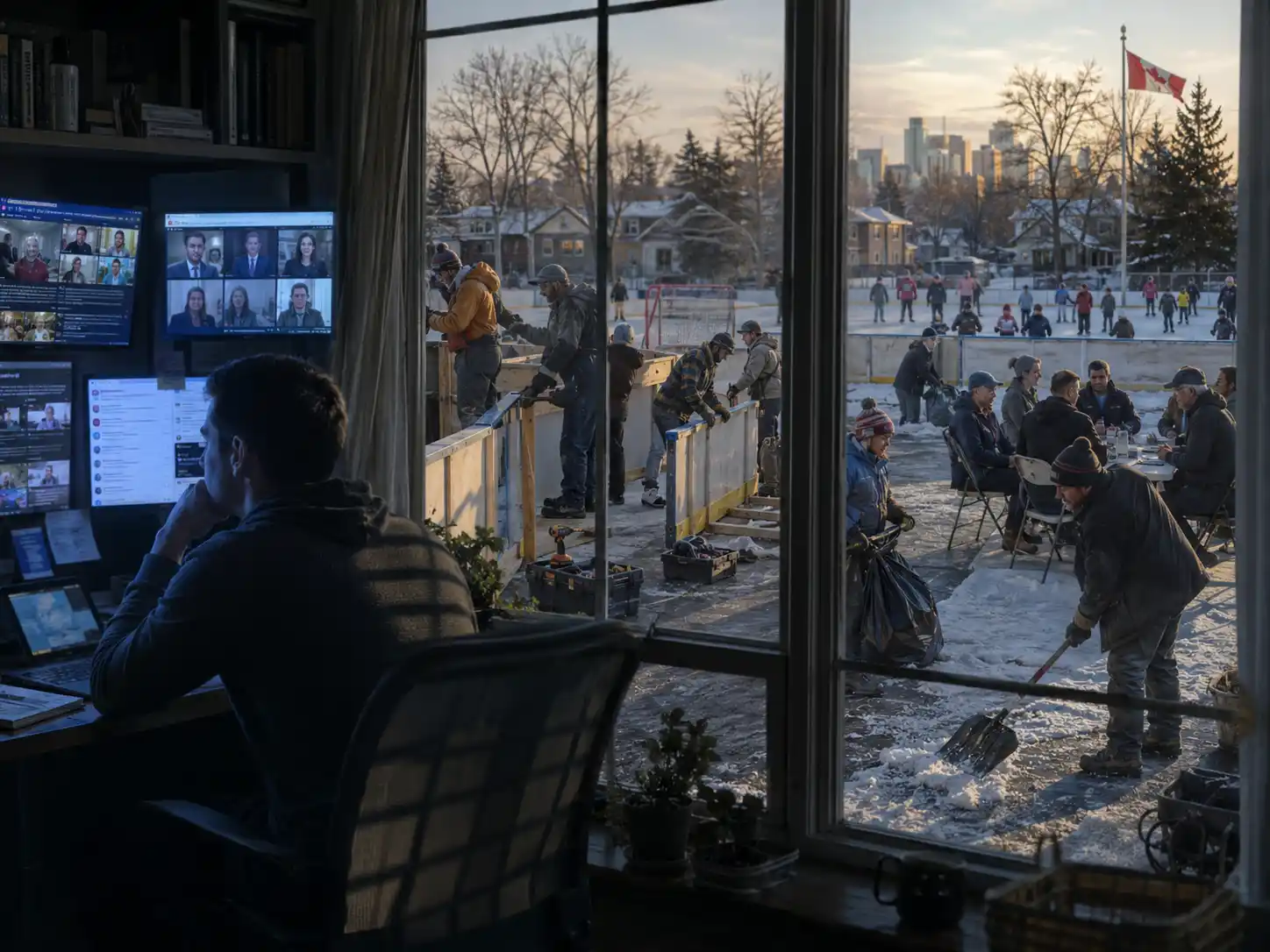
Chapter 27 — Commentary Replaces Participation
Commentary feels like participation.
That is why it is dangerous.
You watch the video. You hear the argument. You share the clip. You post the thread. You listen to the podcast. You know who is lying, who is corrupt, who is cringe, who is brave, who is captured, who is dangerous, who is right, who is bought, who is weak, who is compromised, who finally said the thing everyone else was afraid to say.
Then nothing in your street changes.
No child is coached.
No neighbour is helped.
No meeting is attended.
No institution is joined.
No room is opened.
No tool is repaired.
No elder is visited.
No local problem is touched.
No young person is mentored.
No common life is rebuilt.
The person feels politically alive and practically absent.
That is one of the great traps of the age: attention can imitate action.
A citizen can spend hours each week consuming interpretation and feel morally awake while becoming less embedded in the world directly around him. He knows the scandal in Ottawa, Washington, London, or some distant platform fight. He knows the latest hypocrisy. He knows the correct framing. He knows the enemy’s language. He knows the commentator’s cadence. He knows what everyone should have said.
But he may not know the name of his city councillor.
He may not know when the library board meets.
He may not know who runs the local food bank.
He may not know which school is closing a program.
He may not know which elder on his street needs help with snow.
He may not know where a teenager could go after school.
He may not know what his own town is losing until it is gone.
Commentary expands knowledge outward while participation would have rooted attention nearby.
That does not mean commentary is useless.
A society needs analysis. Journalism matters. Public argument matters. Independent voices can expose institutional failure. Commentary can help people understand events too large or complicated to interpret alone. Podcasts, essays, videos, newsletters, panels, radio shows, documentaries, explainers, and debates can teach, warn, clarify, provoke, and give language to people who feel something is wrong but cannot yet name it.
Good commentary can serve participation.
Bad commentary replaces it.
The difference is whether speech returns people to the world or traps them in spectatorship.
A good commentator helps a person see more clearly and act more responsibly.
A bad commentary system gives the person endless emotional reward for watching decline.
It creates expert spectators of collapse.
The expert spectator has opinions about everything and obligations to almost nothing. He knows the country is failing, but not where to serve. He knows institutions are corrupt, but not how to build one. He knows people are misled, but not how to teach a child. He knows elites are detached, but may be detached from his own neighbourhood. He knows civilization is in danger, but does not attend the meeting, join the club, volunteer at the rink, repair the hall, coach the team, mentor the apprentice, or sit with the lonely person.
He has diagnosis without duty.
That is not wisdom.
It is paralysis dressed as awareness.
Modern commentary is powerful because it is constant. Older commentary had limits. Newspapers arrived in the morning. Radio shows had time slots. Television panels ended. Magazines were monthly. Public lectures required attendance. Even political talk at the coffee shop or dinner table had a room, a beginning, and an end.
Now commentary is portable, endless, and personalized.
Podcasts fill commutes. Clips fill breaks. Threads fill insomnia. Livestreams fill evenings. Newsletters fill inboxes. Reaction videos respond to reaction videos. Debates become clips. Clips become memes. Memes become identities. The day becomes a stream of interpreted reality.
The citizen does not simply learn about events.
He learns how to feel about them in real time.
This is the emotional economy of commentary: outrage, vindication, contempt, fear, superiority, belonging, despair, hope, fury, relief, and the pleasure of hearing someone articulate your suspicion better than you could.
That pleasure is not trivial.
Many people turn to commentary because official institutions failed to tell the truth. Legacy media missed stories, flattened realities, protected class assumptions, ignored regions, misunderstood faith, caricatured working people, simplified Indigenous issues, treated Quebec as an inconvenience, underplayed immigration stresses, overplayed moral branding, or spoke in a language ordinary people did not trust.
Alternative commentary grew partly because people felt spoken down to.
That matters.
Some independent commentators exposed real failures. Some journalists outside old institutions did brave work. Some podcasts hosted deeper conversations than television panels. Some local writers preserved stories that larger media ignored. Some citizen reporting captured events that institutions would rather have buried.
The repair is not to silence commentary.
The repair is to reconnect commentary to responsibility.
Because the same system that can expose truth can also monetize attention without building anything.
The commentary machine rewards the person who keeps the audience returning. That often means the next outrage, the next betrayal, the next scandal, the next enemy, the next proof that everything is worse than you thought. Calm repair is harder to monetize. Boring local participation is harder to clip. A volunteer budget meeting does not travel like a humiliation video.
So commentary selects for drama.
The world becomes more legible as conflict than as work.
This distorts the citizen’s imagination. He may begin to believe the important people are the ones talking about events, not the ones doing difficult work without audience. The podcaster becomes more vivid than the volunteer. The analyst more important than the teacher. The thread writer more exciting than the councillor who fixed a transit issue. The reaction channel more emotionally satisfying than the person running a youth program in a church basement.
Attention migrates from builders to interpreters.
A country cannot be rebuilt that way.
Speech is necessary. But speech is not the same as construction.
A take does not repair a rink.
A thread does not teach a child to read.
A podcast does not clear the snow from an elder’s steps.
A reaction video does not build housing.
A quote tweet does not restore family memory.
A debate clip does not staff a public pool.
A livestream does not become a local newspaper.
An infographic does not replace the hard work of institution-building.
Commentary should lead to these things.
Too often it substitutes for them.
This substitution is especially seductive because it gives the feeling of moral membership. The audience becomes a community. They share jokes, enemies, phrases, recommended books, internal references, and a sense of being among the few who see clearly. This can relieve loneliness. It can also deepen detachment from local life.
A person may feel he belongs to a national or global interpretive tribe more strongly than to his neighbourhood, town, school, workplace, congregation, union, club, or community centre.
That is understandable. Local life can be weak, boring, hostile, expensive, or closed. Online commentary is available instantly and flatters the desire for meaning. But belonging to an audience is not the same as belonging to a place.
An audience gathers around attention.
A place gathers around responsibility.
That is the difference.
In a place, people need you when you are not entertaining. They need you to show up, unlock the door, bring food, stack chairs, coach the child, sit through the agenda, cover the shift, make the phone call, shovel the path, visit the hospital, and return next week.
Audience belonging is easier because it often asks less. You listen, agree, share, donate, subscribe, comment, and feel included.
Place belonging forms people because it asks more.
Commentary also changes the meaning of knowledge. A person can become extremely informed in one sense and underformed in another. He may know the ideological history of a conflict but not how to run a meeting. He may know the failures of public education but not how to help at a school. He may know the housing crisis in theory but not how zoning works locally. He may know the decline of institutions but not how to join, repair, or govern one.
Knowledge without practice becomes brittle.
It makes people impatient with the slow pace of real work. Real work involves compromise, unclear facts, mixed motives, boring procedures, difficult personalities, budgets, trade-offs, and partial victories. Commentary often presents politics and culture as moral clarity. Participation reveals mud.
That mud is where citizenship lives.
A town meeting is not as satisfying as a monologue. A committee is not as clean as a take. A union local, parent council, church board, tenants’ association, sports club, friendship centre, band office, or municipal hearing is full of ordinary human difficulty. People repeat themselves. They misunderstand. They protect turf. They make mistakes. They care about details outsiders find small. They are tired. They are proud. They are local.
But that is where common life is actually governed.
A country of commentators may become unable to tolerate the messiness of participation.
This is one reason institutions weaken further. People lose trust, retreat into commentary, become more contemptuous, and then find real institutions even more disappointing when they encounter them. The loop closes.
Institution fails.
Commentary explains failure.
Audience grows.
Participation declines.
Institution weakens.
Commentary gains more material.
The machine feeds on the world’s decay.
Breaking that loop requires action.
Not action as theatrical protest only. Protest has its place. Sometimes it is necessary. But participation includes quieter forms: volunteering, coaching, mentoring, joining a board, attending meetings, organizing local events, helping at a library, supporting local journalism, teaching skills, repairing a hall, joining a union, serving in a faith community, helping newcomers, visiting elders, running youth programs, building co-ops, starting clubs, planting gardens, doing mutual aid, showing up after the cameras leave.
Participation is what remains after performance ends.
That is why it forms people.
It teaches patience.
It teaches limits.
It teaches compromise.
It teaches service.
It teaches local knowledge.
It teaches that people are harder to hate when you have to work beside them.
It teaches that reality does not move at the speed of commentary.
Canada needs that lesson badly.
The country has many national arguments and too few durable rooms where people practice responsibility together. The internet makes politics feel immediate, but repair remains stubbornly local. Housing gets built somewhere. Children go to particular schools. Libraries open at particular hours. Transit routes run down particular streets. A community centre either has volunteers or it does not. A rink either has ice time or it does not. An elder either gets visited or she does not.
Reality remains particular.
Commentary often floats above particulars.
It converts local things into examples for national arguments. A school-board conflict becomes content. A crime becomes proof. A protest becomes symbol. A teacher, parent, nurse, pastor, imam, police officer, student, or worker becomes a character in a larger morality play. The local facts may be complicated, but the commentary needs narrative clarity.
This is dangerous because people begin to consume other communities as material.
They do not ask what happened there, who lives there, what history shaped it, what the local people need, or what responsibility follows. They ask what the event proves.
A society that treats every event as proof becomes less capable of truth.
Participation corrects this by forcing contact.
If you attend the meeting, the issue becomes less clean. If you volunteer, the poor are not a symbol. If you coach, youth are not an abstraction. If you serve in a shelter, addiction is not a talking point. If you work with newcomers, immigration is not a slogan. If you sit with veterans, remembrance is not branding. If you visit a reserve or friendship centre with humility and relationship, Indigenous issues are not content. If you learn French Canada through actual people and institutions, Quebec is not a debate category.
Participation gives reality back its names.
Commentary without participation strips names away.
This is why the repair must include a personal test:
After consuming commentary, what am I now more able to do?
If the answer is only “argue better,” be careful.
Good commentary should make a person more truthful, more responsible, more locally attentive, more willing to serve, more able to distinguish reality from performance, more patient with complexity, and more courageous in actual relationships.
Bad commentary makes a person more addicted to interpretation, more contemptuous, more passive, more certain, more entertained by collapse, and more hostile to ordinary duty.
The test is severe, but useful.
Does this media make me more capable?
Or only more activated?
That question belongs in schools, families, churches, temples, universities, workplaces, and homes. Young people especially need it because they inherit commentary as atmosphere. They may learn national and global conflict before they learn local responsibility. They may become fluent in ideological language before they have cooked for an event, joined a meeting, repaired something, coached someone, or served alongside people they disagree with.
A young person should learn to interpret the world.
But interpretation should not arrive before participation so completely that participation begins to feel pointless.
This is another way politics captures the imagination. The scale of commentary makes local action seem too small. Why help at a library when civilization is collapsing? Why coach a team when the system is corrupt? Why attend a meeting when the real power is elsewhere? Why repair the local when the national fight consumes everything?
The answer is that civilization is partly made of small repairs.
The national fight may matter. But if everyone abandons the local for the national spectacle, the national has nothing left to stand on.
A country is not rebuilt by people who only know how to watch.
This chapter should not insult the person who listens to podcasts while working a hard job, raising children, commuting, caring for elders, or surviving isolation. Commentary can be companionship. It can educate. It can keep people sane. It can make invisible people feel less alone. It can help people who have no strong local institutions find language and courage.
The problem is not listening.
The problem is substitution.
When commentary becomes the main form of civic life, the citizen becomes audience.
And audiences are easy to manage.
They can be retained, segmented, enraged, monetized, flattered, frightened, and sold a continuing story. Participation is harder to manage because it creates local loyalties and practical judgment. A person who serves in real life becomes less dependent on distant interpreters for meaning.
That is why rebuilding participation is not only wholesome. It is protective.
It protects people from manipulation.
A person with a place to serve is less easily captured by abstract despair. A person who knows local problems firsthand is less easily fooled by imported scripts. A person who works beside political opponents is less easily trained to hate them. A person who builds something knows the difference between speech and work.
Participation restores proportion.
It does not eliminate commentary. It disciplines it.
The commentator should become a guide back to responsibility, not a replacement for it. The listener should ask where the insight lands. In what action? In what relationship? In what institution? In what habit? In what repair?
If there is no landing, the commentary is smoke.
The repair for this chapter is plain:
Turn attention into service.
Not all of it. People can rest. People can think. People can read and listen for pleasure. But some attention must land in the world.
Choose one local institution and learn it.
Choose one public meeting and attend.
Choose one child or young person to mentor.
Choose one elder to visit.
Choose one community room to help keep open.
Choose one skill to teach.
Choose one local source of news to support.
Choose one volunteer duty.
Choose one neighbourly act that cannot be posted into importance.
Choose one real responsibility that survives your mood.
This is how the spectator becomes a citizen again.
Not all at once.
By returning.
A country needs people who return.
Commentary is always ready with the next thing. Participation asks you to return to the same thing: the same team, same hall, same school, same street, same committee, same family, same library, same repair, same difficult people, same unfinished duty.
Returning is one of the habits civilization depends on.
The commentator can leave when the topic cools.
The participant stays.
That is the difference.
Canada has had too much national diagnosis without enough local reconstruction. Too many people know the country is broken in theory and too few have a place to practice repair. The next phase of the country will require less performance of awareness and more rebuilding of rooms.
The podcast can help.
The thread can help.
The essay can help.
The speech can help.
But only if it leads back to the world.
Commentary feels like participation.
It is not participation until something beyond the screen has changed.
Chapter 28 — Influencers as Replacement Institutions
The influencer is not just a performer.
In many lives, the influencer has become a replacement institution.
A fitness influencer replaces the coach.
A finance influencer replaces the banker, older relative, workplace pension lesson, or boring adult who once explained compound interest at a kitchen table.
A political commentator replaces the local newspaper, civics teacher, party meeting, union hall, or town forum.
A lifestyle creator replaces the magazine, neighbour, aunt, older sibling, church elder, community norm, or public-health pamphlet.
A streamer replaces the basement hangout.
A podcaster replaces the long conversation with a mentor.
A self-help figure replaces the pastor, therapist, uncle, professor, or friend who knew your actual life.
A productivity guru replaces the manager who should have made the work sane.
A dating coach replaces community wisdom about love, character, restraint, and commitment.
A parenting creator replaces family transmission.
A nutrition creator replaces the doctor, grandmother, cook, coach, or local food culture.
Sometimes this helps.
That must be said first.
Influencers are not automatically frauds. Some are talented, generous, funny, brave, skilled, disciplined, and genuinely useful. A person can learn exercise technique, budgeting, cooking, repair, history, language, coding, music, writing, prayer, parenting, study habits, self-defence, civic issues, law, disability navigation, and political context from people online. A young person in a small town can find a teacher the local world did not provide. A newcomer can find practical guidance. A disabled person can find someone who understands barriers. A lonely person can find company. A confused person can find language.
The rise of influencers happened partly because older institutions failed.
People did not turn to online figures only because they were foolish. They turned because the coach was unaffordable, the school was weak, the doctor was rushed, the bank was confusing, the family did not talk, the church had lost trust, the local paper closed, the public broadcaster felt distant, the university was expensive, the workplace did not mentor, the community centre was underfunded, and adulthood itself became harder to enter.
Influencers rushed into the gaps.
That is the key.
The influencer economy is not only about vanity. It is a map of institutional absence.
Where people lack coaches, influencers sell discipline.
Where people lack elders, influencers sell wisdom.
Where people lack stable work, influencers sell hustle.
Where people lack family memory, influencers sell identity.
Where people lack local journalism, influencers sell explanation.
Where people lack faith, influencers sell meaning.
Where people lack friendship, influencers sell parasocial intimacy.
Where people lack political agency, influencers sell commentary.
Where people lack adult pathways, influencers sell a system.
Some of this is useful.
Much of it is dangerous.
The danger is not merely that influencers can be wrong. Every institution can be wrong. Teachers can be wrong. Priests can be wrong. Doctors can be wrong. Journalists can be wrong. Coaches can be wrong. Parents can be wrong. Experts can be wrong.
The deeper danger is that influencer authority often travels without obligation.
A local coach knows the child’s body, parents, schedule, fear, laziness, injury history, teammates, and temperament. A fitness influencer knows an audience segment.
A family elder knows the family’s history, wounds, debts, loyalties, and patterns. A self-help influencer knows pain as a market category.
A local journalist knows the town, documents, names, meetings, sources, grudges, and history. A political influencer knows which narrative will travel.
A pastor, imam, rabbi, priest, elder, or spiritual teacher embedded in a community can be held accountable by relationships, tradition, other leaders, and real consequences. An online spiritual figure can drift into charisma without correction.
A union steward, teacher, librarian, doctor, therapist, coach, or mentor occupies a role with some obligations beyond attention. An influencer’s first structural obligation is usually to audience retention.
That is the difference.
Institutions can fail, but real institutions have roles, duties, norms, records, colleagues, procedures, community memory, and ways — imperfect ways — to correct abuse.
Influencers often have audience, brand, metrics, sponsorships, and charisma.
Those are not the same as accountability.
A follower may feel known. But the influencer does not know him.
That asymmetry is one of the defining emotional facts of the age.
The viewer knows the influencer’s voice, kitchen, routine, dog, trauma story, marriage status, gym program, political enemies, favourite phrases, bookshelf, breakfast, and personal mythology. The influencer knows the viewer only as analytics: age, location, watch time, retention, conversion, comments, likes, subscriptions, engagement, perhaps a username.
This is not friendship.
It can feel like friendship because humans are built to respond to faces and voices. A person who spends hours with a voice in his ear develops trust. The podcaster rides the bus with him. The streamer fills the lonely evening. The creator becomes a presence during cooking, cleaning, workouts, work breaks, insomnia, and commutes.
That presence can comfort.
It can also capture.
A lonely person is vulnerable to voices that seem to explain everything.
A young man without mentors may adopt the worldview of a charismatic man who has never had to answer to his actual community.
A young woman under pressure may absorb the habits, anxieties, beauty standards, and consumption patterns of creators who profit from dissatisfaction.
A confused citizen may follow commentators who convert complexity into enemy stories.
A parent under stress may receive advice from someone whose child, marriage, money, house, and support system are nothing like hers.
A worker facing instability may buy the hustle gospel from someone whose real income comes from selling hope to unstable workers.
Influence becomes dangerous when intimacy is simulated and obligation is absent.
That is not a moral failure of every creator. It is a structural problem.
The platform rewards people who can create attachment at scale. It rewards clarity, confidence, frequency, emotional intensity, relatability, beauty, outrage, disclosure, and repeatability. It does not necessarily reward wisdom, proportion, humility, local knowledge, or accountability.
The old authority figure could be boring. Sometimes that was a virtue.
The bank employee explaining RRSPs might not be exciting. The coach repeating fundamentals might not be viral. The librarian guiding research might not be charismatic. The elder telling the same story might not optimize retention. The local journalist covering a zoning meeting might not inspire a fandom. The teacher correcting a paragraph might not scale.
But formation often happens through boring repetition.
Influence prefers intensity.
That is why online authority can distort maturity. It makes people expect guidance to be entertaining, confident, branded, and emotionally satisfying. Real guidance is often slower. It asks questions. It knows context. It disappoints. It corrects. It says no. It refuses to flatter the person’s self-image.
A good mentor is not always affirming.
A good institution is not always exciting.
A good teacher is not always viral.
A healthy culture should know the difference between charisma and authority.
Authority, properly understood, is not domination. It is responsibility recognized over time.
A coach earns authority by forming athletes safely.
A teacher earns authority by teaching students honestly.
A journalist earns authority by reporting truthfully.
A doctor earns authority by serving patients under professional standards.
An elder earns authority by carrying memory and conduct.
A tradesperson earns authority by skill tested in reality.
A spiritual leader earns authority by service, discipline, humility, and accountability.
A parent earns authority through care, sacrifice, boundary, and presence.
An influencer may earn authority too, but only if the influence is tied to truth, competence, accountability, and restraint.
Follower count is not authority.
Virality is not authority.
Confidence is not authority.
Relatability is not authority.
Aesthetic polish is not authority.
The collapse of this distinction is one reason influencers became replacement institutions.
People lost trust in institutions, then sometimes replaced them with figures less accountable than the institutions they distrusted.
That is a bad trade.
Distrust of old institutions was often earned. Churches hid abuse. Media missed stories. Schools failed children. Governments lied or buried harm. Police abused power. Universities grew arrogant. Banks confused people. Employers treated workers as disposable. Experts sometimes spoke beyond knowledge. Public-health communication sometimes became too managerial. Families silenced pain. Sports organizations protected reputations.
So the repair cannot be “trust institutions again” as if nothing happened.
The repair is to rebuild trustworthy institutions and teach people to evaluate influence.
A rebuilt culture needs both: better institutions and better personal judgment.
The first question to ask of an influencer is not “Do I like this person?”
It is:
What is this person replacing in my life?
A coach?
A friend?
A parent?
A journalist?
A therapist?
A pastor?
A teacher?
A financial adviser?
A political party?
A local community?
A boyfriend, girlfriend, spouse, sibling, uncle, aunt, elder, or mentor?
If the answer is “nothing, this person is just useful,” good.
If the answer is “this person has become my main source of guidance, belonging, identity, and explanation,” be careful.
No distant figure should carry that much authority without relationship.
The second question is:
What does this person want from me?
Attention?
Money?
Subscription?
Purchase?
Political loyalty?
Emotional dependence?
Lifestyle imitation?
Status?
Data?
Conversion?
A share?
A vote?
A worldview?
Again, wanting money or attention does not make someone evil. Everyone needs support. But the audience should know the exchange.
The third question is:
Can this person be corrected?
Do they admit error? Do they cite sources? Do they change when facts change? Do they have peers who challenge them? Do they encourage followers to think beyond them? Do they push people toward real-world responsibility? Do they protect the vulnerable? Do they know the limits of their expertise?
Or do they intensify loyalty whenever challenged?
A bad influencer cannot afford your independence.
A good teacher wants you to become more capable without needing them forever.
That is the test.
Does this influence make you more capable, more responsible, more connected to real people, more truthful, more disciplined, more useful?
Or does it make you more dependent, more resentful, more performative, more isolated, more contemptuous, more addicted to the next upload?
Influencer culture also changes institutions themselves. Schools, churches, politicians, journalists, universities, charities, and public agencies begin acting like influencers. They chase engagement. They brand everything. They shorten attention. They produce content. They worry about optics. They speak in performance language. They turn service into visibility.
This is another sign of institutional weakening.
When institutions behave like influencers, they stop trusting their own deeper authority.
A school should not need to become a content brand to matter.
A church should not confuse discipleship with platform growth.
A journalist should not confuse reporting with personal fame.
A politician should not confuse public service with constant performance.
A university should not confuse education with marketing.
A charity should not confuse help with optics.
A country should not confuse being seen with being strong.
The platform has made visibility feel like existence. If an institution is not visible, it fears irrelevance. If a person is not visible, he fears disappearance. If a cause is not visible, activists fear failure. Sometimes visibility is necessary. Hidden work can be ignored. Public storytelling can build support. But visibility is not the same as formation.
Formation often happens off-camera.
A mentor’s conversation.
A coach’s correction.
A librarian’s help.
A teacher’s feedback.
A parent’s boundary.
A neighbour’s favour.
A tradesperson’s demonstration.
A spiritual leader’s visit.
A volunteer’s return.
A local reporter’s patient call.
A friend’s honest warning.
These do not scale easily.
That is why they matter.
Canada’s repair requires recovering embedded authority: people known in place, over time, through service.
Embedded authority is not perfect. Local figures can abuse trust. Small communities can hide harm. Elders can be wrong. Coaches can be cruel. Religious leaders can manipulate. Local media can be biased. Families can silence. The answer is not blind localism.
The answer is accountable embeddedness.
Authority should be close enough to know the person and accountable enough not to own the person.
That is difficult, but far better than distant charisma without consequence.
This is why the replacement-institution problem must be answered by rebuilding real institutions.
If young people need fitness guidance, rebuild affordable sport, physical education, community gyms, coaches, and outdoor programs.
If people need financial guidance, rebuild practical education, trustworthy advice, workplace mentorship, plain-language public resources, and family money conversations without shame.
If citizens need political explanation, rebuild local journalism, civic education, public forums, unions, parties, neighbourhood associations, and institutions people can actually join.
If families need parenting wisdom, rebuild intergenerational support, community centres, family programs, faith and cultural supports, public-health guidance with human warmth, and neighbourhood networks.
If people need meaning, rebuild trustworthy spiritual, philosophical, artistic, and civic communities where questions can be lived, not only consumed.
If young people need models of adulthood, give them adults they can actually know.
That last sentence may be the heart of the chapter.
The influencer age reveals a hunger for models.
People want to see how to live. How to train. How to dress. How to cook. How to date. How to think. How to speak. How to parent. How to make money. How to believe. How to be a man. How to be a woman. How to be healthy. How to be successful. How to survive collapse. How to be Canadian. How to be good.
This hunger is human.
Older societies answered it through family, elders, religion, apprenticeship, local reputation, literature, schools, military service, sport, work, art, and public figures. Many of those answers were flawed. Some were oppressive. But they gave models within structures of obligation.
Now the model arrives through the feed.
That model may be useful, but it may also be edited, sponsored, filtered, exaggerated, staged, ghostwritten, algorithmically selected, or emotionally manipulative. The viewer sees the lesson but not the full life. The routine but not the staff. The discipline but not the inherited money. The marriage advice but not the private conflict. The political certainty but not the doubts. The financial success but not the risk, luck, or hidden revenue stream. The parenting wisdom but not the nanny. The spiritual peace but not the unresolved harm.
Influencer life is partial by design.
The audience must remember that.
The repair is not cynicism. Total cynicism makes learning impossible. The repair is proportion.
Learn from distant people. But do not let distant people replace all nearby wisdom.
Use online guidance. But test it against reality.
Admire skill. But ask what incentives shape the message.
Take inspiration. But do not confuse inspiration with relationship.
Build real mentors. Build rooms. Build institutions. Build communities where guidance can become accountable.
A healthy person should have more than influencers.
A coach or elder.
A friend who can interrupt delusion.
A local institution.
A family story, chosen or inherited.
A teacher.
A craft.
A place of service.
A body in training.
A relationship with land.
A public duty.
A source of news tied to reality.
A community where he is known when he is not performing.
The influencer can then become a supplement, not a substitute.
This is the goal: supplement, not substitute.
A cooking creator can supplement family food memory.
A fitness channel can supplement local training.
A political podcast can supplement civic participation.
A parenting account can supplement real support.
A financial educator can supplement trustworthy advice.
A streamer can supplement friendship, not replace it.
A spiritual teacher online can supplement embodied community, not become a private cult in the ear.
When the supplement becomes the institution, the person is at risk.
When an entire society begins replacing institutions with influencers, the country is at risk.
Because influencers cannot carry civilization alone.
They cannot baptize the child, coach the team, staff the library, repair the bridge, maintain the school, run the meeting, bury the dead, visit the elder, build the house, hold the addict accountable, teach the apprenticeship, report the council minutes, or stay in the neighbourhood after the trend moves on.
Some may encourage these things. Good ones do.
But the work itself has to be done by people in place.
That is where Canada has to return.
Not away from the internet entirely. Away from substitution.
The influencer is not just a performer.
The influencer is evidence of what people are missing.
So when a country asks why influencers have so much power, it should not begin with contempt for the audience.
It should ask: who stopped showing up? What rooms closed? Which adults vanished? Which institutions became untrustworthy? Which pathways broke? Which forms of guidance became too expensive, too distant, too scripted, too bureaucratic, or too ashamed to speak?
Then rebuild there.
Rebuild coaches.
Rebuild mentors.
Rebuild local journalism.
Rebuild libraries.
Rebuild public forums.
Rebuild family transmission.
Rebuild trades and apprenticeships.
Rebuild youth clubs.
Rebuild spiritual and civic communities with accountability.
Rebuild schools as places of formation.
Rebuild work that teaches.
Rebuild rooms where people can become without needing an audience.
A country that does this can use influencers wisely.
A country that does not will be governed more and more by voices that know how to hold attention but do not have to stay for the consequences.
Part VIII — Repair
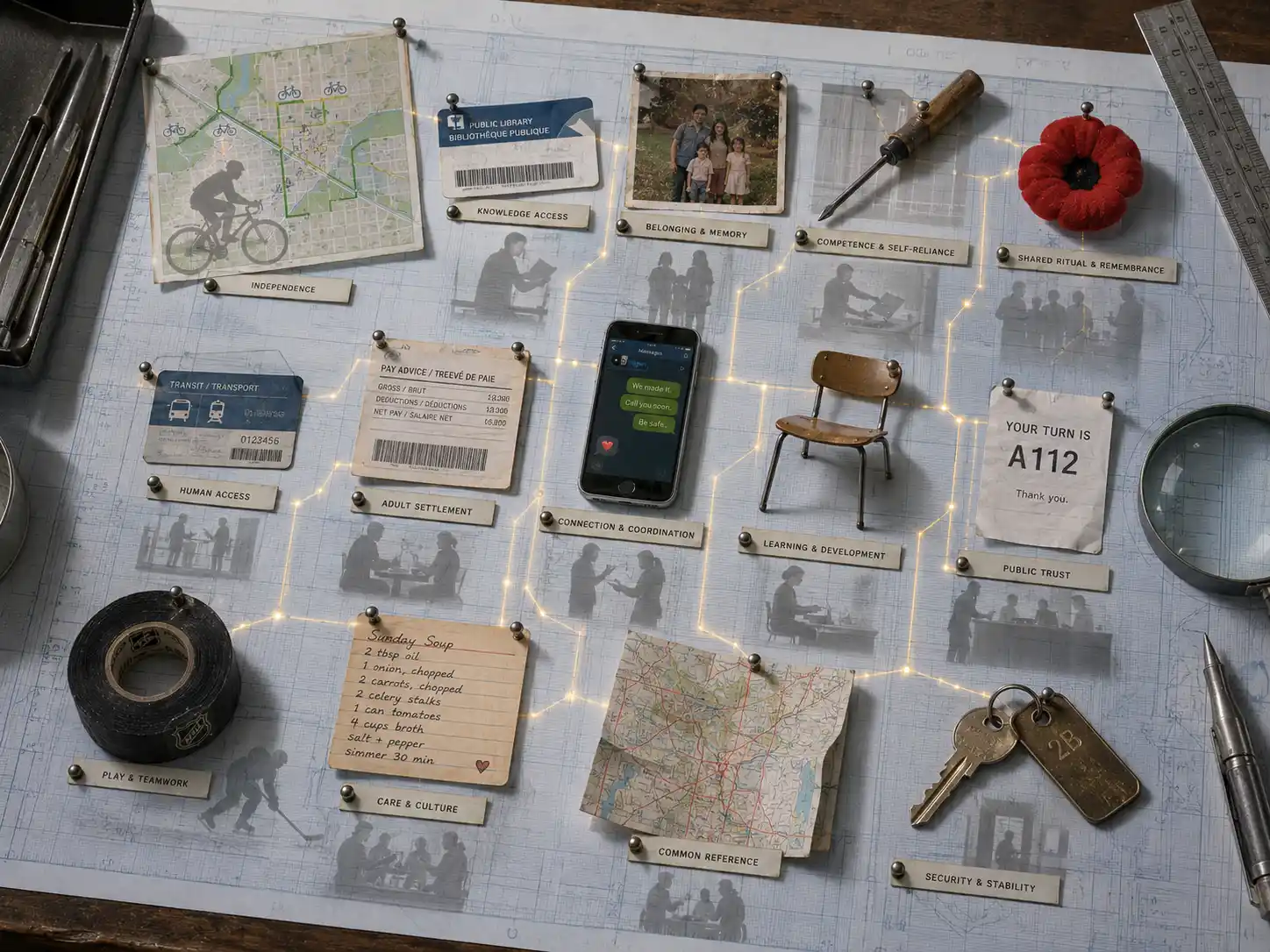
Chapter 29 — What Was Actually Lost
What was actually lost?
Not Blockbuster.
Not road hockey.
Not MuchMusic.
Not Canadian Tire money.
Not the Sears catalogue.
Not the exact school assembly, the exact rink, the exact mall, the exact TV schedule, the exact family basement, or the exact Saturday night broadcast.
Those things matter because they point to something underneath.
What was lost was practice.
Practice choosing together.
Practice moving through a neighbourhood.
Practice waiting.
Practice fixing.
Practice remembering.
Practice serving.
Practice standing in public silence.
Practice losing a game without becoming a victim.
Practice talking to an adult at a counter.
Practice knowing where you came from.
Practice becoming a person without turning every stage into a profile.
A country is made through repeated practice.
That is the central claim of this book.
Canada did not simply lose a collection of old objects. It lost many ordinary situations where people had to rehearse being capable. The situations were small, but they repeated so often that they formed character before anyone called them formation.
A snow day taught that reality could interrupt the plan.
Road hockey taught that public space required negotiation.
A bike route taught distance and courage.
A school assembly taught shared attention.
A family album taught inheritance.
A library card taught public trust.
A shop bench taught material consequence.
A rink taught discipline.
A canoe trip taught humility before land.
A first job taught usefulness.
A lease taught adult cost.
A public counter taught how to deal with an institution through a human being.
A shared broadcast taught common reference.
A Remembrance ceremony taught gratitude and grief.
A citizenship ceremony taught formal belonging.
A local newspaper taught that public life had names and places.
A church basement, temple union hall, Legion hall, or community centre taught that belonging required showing up somewhere.
These were not all good. They did not reach everyone. They did not teach the same lesson to everyone. Some taught belonging to one child and exclusion to another. Some taught courage and also cruelty. Some taught duty and also silence. Some taught memory and also shame.
But the fact that a system was flawed does not mean it did no human work.
That distinction is the difference between repair and erasure.
A society that cannot tell the difference between “this harmed people” and “this did nothing but harm people” will eventually destroy its own memory. A society that cannot tell the difference between “this formed people” and “this was perfect” will become nostalgic and dishonest.
Both failures are dangerous.
The serious question is not whether the old systems were innocent. They were not. The question is which capacities they trained, which harms they carried, which gains came from replacing them, and which capacities were never rebuilt.
That is what was lost: not the prop, but the capacity.
Not the video store: the family ritual of choosing under limits.
Not the paper route: child-scale responsibility to real households.
Not the old mall: teenage public life before permanent profiles.
Not the library card: civic trust embodied in borrowing and returning.
Not the school assembly: practice standing inside a shared story.
Not the rink: local discipline, affordable sport, and cold public belonging.
Not the shop class: confidence that objects can be repaired.
Not the canoe trip: practical humility before distance, water, weather, and weight.
Not the family basement: intergenerational memory stored in objects, tools, recipes, photos, and stories.
Not the Saturday broadcast: shared timing before every screen became private.
Not the first job: the feeling that effort could begin adulthood.
Not the public counter: accountable human contact inside institutions.
This is why nostalgia is too weak a word for the project.
Nostalgia wants the object back.
Memory asks what the object did.
Repair asks how to rebuild the function without rebuilding the harm.
Take Blockbuster. The old video store was not sacred. It was a business. It had late fees, limited selection, bad lighting, bored employees, and shelves full of mediocre movies. Streaming improved almost everything about access. More choice. More convenience. More archives. More control. More room for niche taste.
But the video store did one thing streaming did not automatically replace: it made selection communal and finite. A family had to browse the same walls. Friends had to negotiate. The good copy might be gone. Someone had to settle. Someone had to take a risk. Someone had to be disappointed. The decision had a little weight because the options were limited.
That was practice.
Not profound practice. Not heroic practice. But social practice.
A feed removes that friction. Everyone can watch separately. Everyone can search endlessly. Everyone can abandon the choice after six minutes. The gain is obvious. The loss is subtle.
The same pattern repeats across the book.
A library became an app or database for many purposes, but the public room mattered. A child in a library was not only accessing information. He was learning quiet, borrowing, return, trust, shelves, help, and the feeling that knowledge could be held in common.
A self-checkout made the errand faster, but it also moved labour onto the customer and removed one small human exchange.
A job portal widened access, but it also made entry into work abstract, automated, and faceless.
A smartphone connected people across oceans, but it also turned memory, friendship, maps, work, entertainment, identity, and politics into one surface.
A school ritual corrected itself by becoming more truthful, but sometimes lost the shared seriousness that ritual requires.
A national story became more honest about harm, but sometimes left people with no usable gratitude.
This is the difference between progress and replacement.
Progress repairs a function.
Replacement often removes a function while solving a surface problem.
Canada solved many surface problems. It became safer in ways. More inclusive in ways. More truthful in ways. More convenient in ways. More accessible in ways. More connected in ways. Those gains must be protected.
But a gain in access can coincide with a loss of practice.
A gain in safety can coincide with a loss of independence.
A gain in choice can coincide with a loss of shared reference.
A gain in truth-telling can coincide with a loss of usable belonging.
A gain in convenience can coincide with a loss of competence.
A gain in digital connection can coincide with a loss of local obligation.
A gain in self-expression can coincide with a loss of inherited memory.
A gain in political awareness can coincide with a loss of non-political life.
A mature country has to count both.
If it counts only the gains, it becomes shallow and managerial. It assumes every old thing was merely inefficient. It forgets that inconvenience often trained judgment.
If it counts only the losses, it becomes nostalgic and resentful. It forgets the people who were harmed, excluded, silenced, mocked, watched, or pushed out by the same systems others remember warmly.
The work is harder than either mood.
Count the gain.
Name the loss.
Rebuild the function.
Refuse the harm.
That is the repair ethic.
It applies to childhood. The older neighbourhood gave many children independence, route memory, public risk, and unsupervised judgment. It also exposed some children to danger, bullying, racial suspicion, gendered threat, traffic, neglect, and exclusion. The answer is not to abandon independence. The answer is to rebuild safe independence.
It applies to school. Old school rituals could be shallow, coercive, colonial, or false. They could also teach public attention, memory, and shared rhythm. The answer is not to abandon civic ritual. The answer is truthful civic ritual.
It applies to family. Family carried stories, recipes, tools, faith, migration memory, work ethic, language, grief, and belonging. Family also carried abuse, silence, shame, racism, sexism, addiction, and trauma. The answer is not to worship family or dissolve it into self-invention. The answer is truthful transmission.
It applies to land. Canadian wilderness memory often erased Indigenous presence and romanticized emptiness. It also taught scale, weather, distance, humility, and practical competence. The answer is not empty wilderness myth or rootless guilt. The answer is truthful land belonging.
It applies to technology. Digital tools opened access, connection, knowledge, safety, and creativity. They also moved life into interfaces, feeds, metrics, and platforms that weakened embodied practice. The answer is not anti-technology. The answer is technology that serves human formation instead of replacing it.
It applies to politics. Political awareness exposed injustice and gave voice to people ignored by older institutions. But when politics becomes the main source of meaning, it eats family, friendship, work, school, art, sport, faith, and public trust. The answer is not apathy. The answer is a larger non-political life strong enough to keep politics in proportion.
What was lost, then, was not a golden age.
It was density.
The density of repeated situations that asked people to become capable in different ways.
Weather asked for preparation.
Neighbourhoods asked for judgment.
Schools asked for shared attention.
Families asked for memory.
Stores asked for practical choice.
Sports asked for discipline.
Tools asked for patience.
Land asked for humility.
Games asked for strategy.
Art asked for courage.
National rituals asked for gratitude.
University asked for aspiration.
Work asked for usefulness.
Housing asked for settlement.
Institutions asked for trust.
Media asked for common reference.
Politics, once kept in proportion, asked for citizenship rather than total identity.
When enough of these systems thin out, the person becomes easier to manage.
Not because Canadians are weak. Because formation has been outsourced.
The child becomes a schedule.
The student becomes a credential.
The worker becomes a profile.
The citizen becomes a user.
The neighbour becomes a stranger.
The family becomes a group chat.
The institution becomes a portal.
The memory becomes a cloud archive.
The public square becomes a feed.
The national story becomes a fight.
The self becomes a brand.
None of this happened completely. None of it happened everywhere. Many people still build, coach, teach, repair, farm, fish, hunt, volunteer, worship, mentor, serve, create, remember, and raise children well. The country is not empty of formation.
But the defaults changed.
That is what the book has been trying to name.
A society can lose capacity without noticing because the replacement is often more convenient than the thing it replaced. By the time people feel the loss, they may no longer remember the practice well enough to rebuild it.
They notice anxiety but not the disappearance of private becoming.
They notice polarization but not the weakening of non-political belonging.
They notice loneliness but not the disappearance of public rooms.
They notice incompetence but not the loss of repair culture.
They notice fragility but not the loss of scaled childhood risk.
They notice rootlessness but not the thinning of family and land memory.
They notice distrust but not the disappearance of human counters and local institutions.
They notice outrage but not the substitution of commentary for participation.
The task is to make the invisible visible again.
Not so the country can go backward.
So it can build forward with memory.
The future does not need Blockbuster. It needs shared choice.
It does not need the old paper route. It needs child-scale responsibility.
It does not need every old school ritual. It needs truthful civic rhythm.
It does not need the old shop class exactly. It needs material competence.
It does not need empty wilderness myth. It needs truthful land relationship.
It does not need three-channel television. It needs common reference points.
It does not need old family silence. It needs intergenerational truth.
It does not need old nationalism. It needs honest belonging.
It does not need old workplaces. It needs work that leads to life.
It does not need anti-digital purity. It needs digital tools that do not replace the world.
This is what was actually lost:
not the past, but the practice of becoming capable inside a shared world.
That loss can be repaired only if it is named without embarrassment.
Canada forgot too much of its machinery. But machinery can be rebuilt if people still know what it was for.
The work now is not remembrance alone.
It is reconstruction.
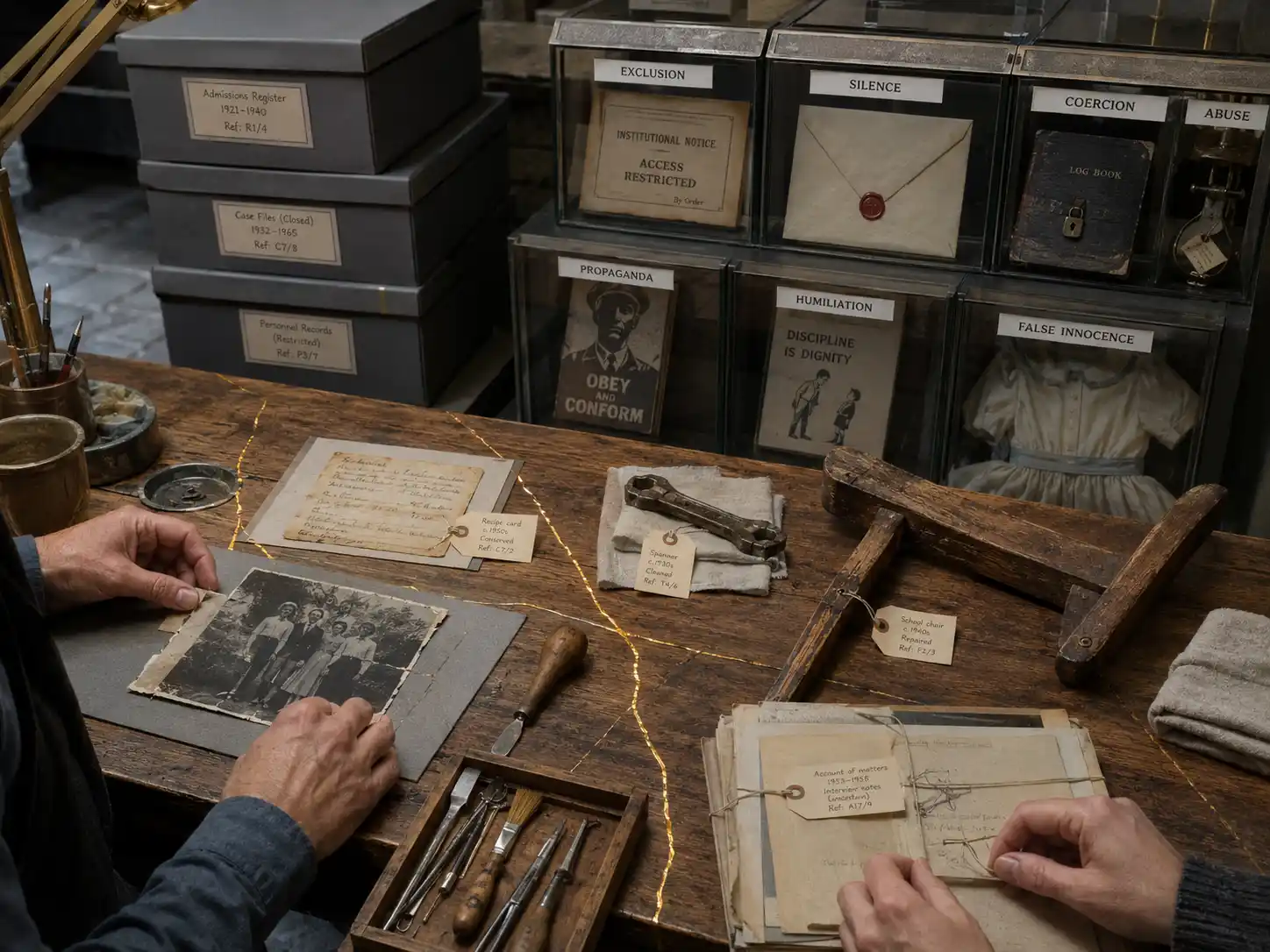
Chapter 30 — What Should Not Come Back
Not everything that formed people should return.
That sentence has to stand near the end of this book because repair without judgment becomes nostalgia. A country that remembers only what was lost can start wanting the wrong things back.
Some old systems trained courage.
Some trained silence.
Some taught duty.
Some protected abuse.
Some built belonging.
Some enforced exclusion.
Some gave children freedom.
Some abandoned them.
Some preserved memory.
Some preserved lies.
Some gave Canada pride.
Some erased Indigenous land, French difference, immigrant pain, Black history, disabled experience, women’s limits, poverty, abuse, and the lives of people who did not fit.
A serious repair has to know the difference.
This book has argued that Canada lost many formation systems: neighbourhood independence, family memory, practical competence, local sport, public ritual, shared media, work-to-adulthood pathways, human institutions, land relationship, and non-political belonging. Those losses matter. But naming loss is not the same as asking the past to return whole.
The past should not return whole.
It was never whole.
The old country was many countries at once. One child found belonging in the school gym; another found humiliation. One family found strength in faith; another found fear. One boy found freedom on a bike; one girl learned the same street was not equally safe. One worker found dignity in the shop; another found injury, racism, sexism, or a dead-end wage. One Canadian found pride in Remembrance Day; another found a national story that did not know his grandfather served. One family found opportunity after immigration; another found credentials dismissed and accents mocked. One settler family loved the lake; an Indigenous family remembered who had been removed from it.
So the repair cannot be “bring back the old Canada.”
There is no old Canada pure enough to bring back.
The repair has to be selective.
Keep courage. Reject cruelty.
Keep duty. Reject coercion.
Keep memory. Reject lies.
Keep skill. Reject humiliation.
Keep belonging. Reject forced sameness.
Keep gratitude. Reject propaganda.
Keep discipline. Reject abuse.
Keep land love. Reject empty wilderness.
Keep family transmission. Reject family silence.
Keep public ritual. Reject false innocence.
Keep community. Reject exclusion.
Keep correction. Reject erasure.
This is not a compromise between nostalgia and contempt.
It is a higher standard than both.
Nostalgia says: it was better then.
Contempt says: it was all rotten.
Repair says: what formed people, what harmed people, what improved, what was lost, and what must be rebuilt differently?
That question should govern every part of the book.
Take childhood freedom.
The old street, the bike, the paper route, the corner store, the snow fort, the schoolyard, the park, the unsupervised walk — these formed many children. They built route memory, courage, judgment, independence, boredom tolerance, conflict resolution, and local belonging.
But not every child was free in the same way.
Girls were often warned where boys were released. Racialized children could be watched, suspected, or over-policed. Disabled children were excluded by streets, playgrounds, stairs, snow, and assumptions. Poor children sometimes had too much freedom because adults were absent, exhausted, or working. Some children were bullied without protection. Some streets were dangerous. Some homes were dangerous. Some neighbourhoods were not places of healthy independence but places children had to survive.
So what should not come back?
Neglect should not come back.
Bullying dismissed as toughness should not come back.
Gendered fear should not come back.
Traffic danger treated as normal should not come back.
Racial suspicion should not come back.
The idea that children must simply endure cruelty should not come back.
What should come back is scaled freedom inside care.
Walkable routes. Bikeable streets. Trusted adults. Reachable libraries. Real play. Local errands. Enough risk to build judgment, not so much abandonment that children are left alone with danger.
That is the pattern.
Take school.
Old schools carried civic ritual, reading, public attention, body training, assemblies, libraries, book fairs, science fairs, Remembrance Day, Terry Fox Runs, sports, music, shop, field trips, and shared time. They formed children because they made them practice public life.
But old schools also harmed.
Residential schools were instruments of state violence against Indigenous children, families, language, land transmission, and culture. Public schools also streamed, humiliated, excluded, punished, ignored, and misread children by race, class, disability, language, religion, gender, and temperament. Some teachers abused power. Some administrators protected institutions over students. Some school rituals taught false history. Some classrooms made children feel that Canada belonged to others.
So what should not come back?
False history should not come back.
Colonial silence should not come back.
Punishment disguised as discipline should not come back.
Streaming children into lowered expectations should not come back.
Humiliation as teaching should not come back.
School ritual that demands gratitude without truth should not come back.
What should come back is school as truthful civic rehearsal.
Children still need shared attention, public memory, reading, tools, sport, music, art, science, duty, and local belonging. But the story has to be true enough to hold Indigenous history, Quebec difference, immigrant memory, racism, class, disability, and the country’s unfinished work.
Take family.
Family can be one of the deepest archives a person has. Recipes, photographs, tools, language, faith, migration, grief, work, land, old stories, grandparents, aunties, uncles, cousins, funerals, weddings, holiday tables, and family businesses can give a person orientation before ideology.
But family can also be where harm is hidden longest.
Abuse. Addiction. Violence. Shame. Racism. Sexism. Homophobia. Forced silence. Religious coercion. Mental illness denied. War trauma buried. Residential school damage carried without language. Children forced into adult roles. Women expected to absorb everyone’s pain. Men taught never to speak until they break.
So what should not come back?
Family mythology should not come back.
Silence as loyalty should not come back.
Abuse protected by privacy should not come back.
Gendered servitude should not come back.
The idea that elders are always right should not come back.
The idea that leaving a harmful family is betrayal should not come back.
What should come back is truthful transmission.
Ask the old questions. Keep the photos. Record the recipes. Honour sacrifice. Name harm. Refuse repetition. Let family memory become a source of depth, not a prison.
Take sport and physical culture.
Rinks, pools, dojos, boxing gyms, wrestling mats, soccer fields, basketball courts, tracks, and school gyms trained bodies. They taught courage, discipline, loss, teamwork, pain, restraint, repetition, and respect for limits.
But old sport also excused cruelty.
Bad coaches called humiliation toughness. Injuries were hidden. Concussions were minimized. Poor families were priced out. Disabled children were excluded. Indigenous and racialized athletes faced stereotyping and isolation. Abuse was sometimes buried to protect teams, reputations, schools, clubs, churches, or national dreams.
So what should not come back?
Abuse as discipline should not come back.
Coach worship should not come back.
Playing injured to prove character should not come back.
Sexism in sport should not come back.
Elite cost replacing local play should not come back.
Locker-room cruelty should not come back.
What should come back is affordable embodied formation.
Children need bodies in training. They need challenge, fatigue, correction, courage, failure, and teamwork. But difficulty must be held inside care, not brutality.
Take tools and shop culture.
Shop class, garages, farms, kitchens, sewing rooms, machine shops, robotics labs, bike repairs, wood benches, and work sites taught material competence. They taught that the object refuses your opinion. They taught patience, sequence, measurement, safety, repair, and respect for people who keep the material world alive.
But old practical culture could be narrow.
It could be sexist, class-coded, unsafe, dismissive of academic students, hostile to girls, rough toward queer students, inaccessible to disabled students, and used to track working-class students into lesser expectations. It could treat practical intelligence as lower status even while depending on it.
So what should not come back?
Shop as dumping ground should not come back.
Sexist tool culture should not come back.
Unsafe work as normal should not come back.
Class contempt should not come back.
The idea that practical intelligence is for “less academic” people should not come back.
What should come back is modern material competence for everyone.
Wood, metal, code, cooking, sewing, robotics, mechanics, repair, energy, gardening, electronics, design, construction, and maintenance should be taught as intelligence, not fallback.
Take land.
Canada’s land memory taught scale, weather, distance, humility, outdoor skill, beauty, and the seriousness of place. Canoes, maps, portages, fishing, hunting, camping, parks, farms, forests, northern roads, and local watersheds formed people by putting them back into reality.
But the old land story often lied.
It treated wilderness as empty. It turned Indigenous land into national scenery. It loved canoes without remembering the peoples whose knowledge made travel possible. It made parks innocent. It romanticized the North while ignoring northern communities. It consumed resource wealth while hiding damage. It used beauty to avoid obligation.
So what should not come back?
Empty wilderness should not come back.
Land love without Indigenous truth should not come back.
Conservation without history should not come back.
Resource pride without cost should not come back.
Southern fantasy about the North should not come back.
Land acknowledgements that change nothing should not come back.
What should come back is truthful land belonging.
Know where you are. Know whose land you are on. Know the watershed, treaty, weather, work, damage, species, food systems, and obligations. Love land without lying about it.
Take national memory.
Remembrance Day, peacekeeping, Vimy, Juno, Afghanistan, citizenship ceremonies, public broadcasters, Heritage Minutes, school flags, Canada Day, and local memorials all gave Canada stories through which people could imagine duty, gratitude, belonging, sacrifice, and public life.
But national memory can become propaganda.
It can flatten war. It can erase Indigenous service. It can ignore civilian suffering. It can make Canada the hero of every story. It can turn immigrant gratitude into proof that the country owes no further correction. It can treat Quebec as an inconvenience. It can transform difficult history into branding.
So what should not come back?
Innocent nationalism should not come back.
War memory used as costume should not come back.
Citizenship as shallow branding should not come back.
Peacekeeping myth without complexity should not come back.
Public ritual that cannot survive truth should not come back.
What should come back is mature public gratitude.
A country should be able to stand in silence, honour sacrifice, welcome citizens, remember service, tell hard truths, and still ask people to belong.
Take multicultural confidence.
Canada’s plural life gave millions of people a real opening: immigrant plazas, religious communities, school lunches, language schools, remittances, citizenship ceremonies, family businesses, old-country stories, and children carrying more than one world.
But shallow multiculturalism can become performance.
Food without history. Festivals without sacrifice. Diversity slogans without housing, wages, credential recognition, anti-racism, Indigenous truth, Quebec seriousness, religious freedom, or civic duty. Communities celebrated as decoration but ignored as workers, citizens, believers, builders, and families with burdens.
So what should not come back?
Assimilation by embarrassment should not come back.
Token multiculturalism should not come back.
Food-and-festival pluralism without truth should not come back.
Treating Indigenous peoples as one diversity category should not come back.
Treating Quebec as English Canada plus translation should not come back.
Treating newcomers as proof of Canadian virtue should not come back.
What should come back is honest plural confidence.
You can carry memory here. You can belong here. You can criticize here. You can build here. And because you belong, you owe the common life something too.
Take work.
First jobs, trades, service work, offices, farms, factories, restaurants, warehouses, care homes, and local businesses taught usefulness. They introduced young people to schedules, hierarchy, money, fatigue, skill, customers, responsibility, and the adult world.
But work also exploited.
Low wages. Unsafe sites. Racism. Sexism. Harassment. Wage theft. Dead-end jobs. Bad bosses. Disposable workers. Bodies used up. Immigrant labour undervalued. Care work underpaid. Working-class people respected in speeches and ignored in policy.
So what should not come back?
Exploitation as character-building should not come back.
Unsafe work should not come back.
Contempt for service workers should not come back.
The idea that working people should suffer quietly should not come back.
Credential snobbery should not come back.
The broken bargain that effort guarantees nothing should not continue.
What should come back is work that forms and leads somewhere.
A first job should teach usefulness. A trade should carry dignity. Care should be respected. Work should connect to housing, family, settlement, and public contribution.
Take media.
Shared screen Canada gave overlapping references: CBC, Radio-Canada, Hockey Night, MuchMusic, YTV, Teletoon, Heritage Minutes, House Hippo, Body Break, local news, weather, newspapers, radio, and public-service messages. Media amplified common life before feeds personalized everything.
But old media also excluded.
It centralized power, missed regions, underrepresented Indigenous peoples, flattened immigrant communities, misunderstood Quebec, ignored rural complexity, and often treated official voices as more trustworthy than lived ones. Gatekeepers decided who appeared and who did not.
So what should not come back?
Gatekept monoculture should not come back.
Regional blindness should not come back.
Token representation should not come back.
Public media smugness should not come back.
A shared screen that silences too many voices should not come back.
What should come back is common reference with more voices.
A country needs shared facts, local journalism, public-interest media, plural storytelling, and some common timing. But the future screen must be wider, more truthful, more regional, more Indigenous, more French and English, more local, and more accountable.
Take institutions.
Public counters, libraries, post offices, banks, schools, clinics, town halls, community centres, and government offices gave people human access to systems. You could ask a person. You could be seen. The institution had a room.
But human institutions could also humiliate.
Counters could be racist, slow, arbitrary, inaccessible, sexist, classist, and cruel. A clerk could dismiss you. A public servant could hide behind procedure. A school office could judge a family. A bank manager could exclude. A hospital desk could make suffering wait.
So what should not come back?
Arbitrary gatekeeping should not come back.
Humiliating counters should not come back.
Institutional arrogance should not come back.
Human discretion without accountability should not come back.
What should come back is human access inside accountable systems.
Digital tools should remain where they help. But essential systems need human doors, appeal, explanation, and responsibility. A portal should not be the only face of the country.
Take religion and community authority.
Faith communities, cultural halls, elders, pastors, priests, imams, rabbis, granthis, monks, aunties, uncles, youth leaders, and volunteers carried ritual, food, care, discipline, charity, music, identity, and intergenerational belonging.
But authority can abuse.
Religious and community institutions can hide harm, shame dissenters, control women, silence children, reject queer people, protect leaders, and make belonging conditional on obedience. Elders can be wise; they can also be wrong. Community can nourish; it can also trap.
So what should not come back?
Authority without accountability should not come back.
Silence around abuse should not come back.
Community control disguised as care should not come back.
Gendered obedience should not come back.
Religious coercion should not come back.
What should come back is embedded authority that serves.
People still need elders, ritual, moral formation, service, and spiritual depth. But authority must be accountable, humble, protective of the vulnerable, and open to truth.
Take technology.
Older life had more embodied practice, but it also lacked access modern tools provide. Digital tools connected families across oceans, helped disabled people, opened knowledge, exposed abuses, created new art, improved navigation, expanded education, and allowed people to find communities that local life denied them.
So what should not come back?
Information scarcity should not come back.
Forced isolation should not come back.
Gatekeepers controlling all publication should not come back.
Rural and disabled exclusion from services should not come back.
The old silence that let institutions hide should not come back.
What should not continue is platform capture.
The screen becoming the room.
The self becoming a profile.
The institution becoming a portal.
The citizen becoming a user.
The child becoming content.
The audience replacing community.
The influencer replacing embedded authority.
The feed replacing shared reality.
The repair is technology in service of human formation.
Use the tool. Do not become its raw material.
Take politics.
Political awakening has exposed real injustice. It has helped people name racism, colonial violence, corruption, abuse, housing failure, labour exploitation, environmental damage, gendered harm, and institutional betrayal. Some things became visible because people politicized them.
That gain matters.
But politics should not become the whole house.
Politics should not replace family, friendship, faith, art, sport, local service, school, work, humour, or neighbourly life. It should not turn every object into a loyalty test. It should not train people to see opponents as enemies. It should not become the main source of identity.
So what should not come back?
Apolitical silence in the face of injustice should not come back.
But what should not continue?
Politics as total identity.
Commentary as participation.
Outrage as belonging.
Influencers as institutions.
Imported scripts replacing local reality.
Family life consumed by permanent argument.
The repair is politics inside a larger life.
Care about public things. Then build non-political rooms strong enough to keep politics human.
This chapter is the guardrail against misunderstanding the entire project.
The book is not saying the past was better.
The book is saying the past contained functions that modern life often failed to rebuild.
The book is not saying the new world is evil.
The book is saying the new world solved some problems while creating others, and a mature society must count both.
The book is not saying old Canada should return.
The book is saying Canada needs to recover the human work that older systems sometimes performed, reject the harms they carried, and build better versions for the present.
That is the difference between restoration and repair.
Restoration wants the old house back.
Repair asks what was load-bearing, what was rotten, what was beautiful, what was unsafe, what must be preserved, what must be rebuilt, what must be removed, and what kind of house can now shelter more people truthfully.
Canada does not need an old house with fresh paint.
It needs a stronger house built from memory, truth, skill, duty, and care.
That means some things must be left behind.
Leave behind innocence.
Leave behind silence.
Leave behind cruelty called toughness.
Leave behind abuse hidden by family, church, sport, school, or nation.
Leave behind exclusion disguised as tradition.
Leave behind nationalism that cannot hear grief.
Leave behind guilt that refuses gratitude.
Leave behind multicultural branding without obligation.
Leave behind practical contempt for working people.
Leave behind digital systems that make people administratively alone.
Leave behind politics that eats the whole soul.
But do not leave behind formation.
Do not leave behind memory.
Do not leave behind courage.
Do not leave behind service.
Do not leave behind bodies.
Do not leave behind tools.
Do not leave behind land.
Do not leave behind family truth.
Do not leave behind public ritual.
Do not leave behind local places.
Do not leave behind work that leads to life.
Do not leave behind shared reality.
Do not leave behind the idea that a country should raise capable people.
The future will not be protected by erasing the past.
It will be protected by judging it properly.
That is the moral work of repair.
Not everything that formed people should return.
But a country that refuses to learn from anything that formed people will eventually forget how to form them at all.
Chapter 31 — Rebuilding the Country That Forms People
A country is repaired by rebuilding what forms people.
Not by slogans.
Not by branding.
Not by scolding.
Not by nostalgia.
Not by elections alone.
Not by apps.
Not by telling exhausted people to optimize themselves harder.
Repair has to become real again.
It has to become a library card in a child’s hand. A rink schedule a family can afford. A shop class with sharp tools and serious safety. A public pool with enough lifeguards. A school gym where civic ritual is truthful, not fake. A local newspaper that still knows the town. A community centre with lights on after dinner. A bus route that reaches the library. A first job that teaches usefulness. A rental market that lets young adults settle. A public counter where a confused person can reach a human being. A family table where stories are told before they disappear into phones and clouds.
A country is not rebuilt in abstraction.
It is rebuilt through places, habits, duties, skills, rooms, tools, routes, schedules, ceremonies, and people who return.
That is the lesson of the book.
Canada forgot too much of its machinery because it stopped seeing ordinary formation as national infrastructure. It treated too many formative systems as private preference, outdated custom, inefficient friction, childhood nostalgia, local colour, or cultural clutter. Then, when those systems weakened, the country tried to solve the consequences with policy language, platforms, therapy vocabulary, moral instruction, branding, and individual self-management.
Those things can help.
They cannot replace formation.
You cannot replace neighbourhood independence with resilience posters.
You cannot replace family memory with identity slogans.
You cannot replace shop class with consumer choice.
You cannot replace local sport with professional spectacle.
You cannot replace civic ritual with online opinion.
You cannot replace adult settlement with productivity advice.
You cannot replace public trust with automated portals.
You cannot replace belonging with politics.
The repair begins by admitting that capability is built.
Children are not born knowing how to handle weather, distance, boredom, rules, tools, money, neighbours, elders, strangers, disappointment, conflict, duty, grief, public silence, or shared space.
Adults are not magically produced by age.
Citizens are not formed by having opinions.
Workers are not formed by uploading resumes into portals.
Families are not sustained by cloud storage.
A country is not held together by everyone having a take.
People become capable because repeated systems ask things of them.
A walk to school asks for route memory.
A snowstorm asks for preparation.
A road hockey game asks for negotiation.
A book fair asks for desire under limits.
A library asks for trust.
A family recipe asks for transmission.
A rink asks for discipline.
A shop bench asks for patience.
A fishing dock asks for stillness.
A Remembrance ceremony asks for gratitude.
A first job asks for usefulness.
A lease asks for adult responsibility.
A local paper asks for attention to place.
A faith community asks for service.
A citizenship ceremony asks for belonging.
A public counter asks for mutual accountability.
When these systems are strong, they do not make perfect people.
But they give people practice.
When they weaken, people are left to improvise adulthood out of screens, debt, self-branding, politics, anxiety, and private coping.
That is not enough.
The repair is not one program. It is a national change of attention.
Canada has to stop asking only, “What do people believe?” and start asking, “What is forming them?”
What is forming children when they no longer move freely through neighbourhoods?
What is forming teenagers when public identity becomes permanent performance?
What is forming students when education becomes debt-backed insurance?
What is forming workers when jobs do not reliably lead to settlement?
What is forming families when memory is scattered across devices?
What is forming citizens when institutions become portals?
What is forming public life when commentary replaces participation?
What is forming national belonging when history becomes either branding or accusation?
Those questions matter more than another argument about whether the past was good or bad.
The past was mixed.
The future will be mixed too.
The task is not to return.
The task is to repair intelligently.
Start with childhood.
A country that wants capable adults must give children scaled freedom. Not abandonment. Not unsafe neglect. Scaled freedom.
Children need walkable routes, bikeable streets, schoolyards with real play, public libraries they can reach, parks where they can linger, local sport that is not only for wealthy families, and adults nearby who are not constantly managing them.
Child independence is not sentimental.
It is how people practice judgment before the stakes become adult.
Build slower streets. Protect school routes. Keep libraries open. Fund parks and recreation. Make room for children to be seen in public without treating them as threats or projects. Give them errands. Give them tools. Give them local responsibilities. Let them become useful in small ways.
Then rebuild practical competence.
A country that cannot repair things becomes dependent on systems it cannot understand.
Bring back serious shop, trades, home economics, cooking, sewing, robotics, auto, woodworking, electronics, gardening, and repair education — not as lower-status tracks, but as national intelligence.
The future does not need dusty nostalgia for old shop class. It needs modern material competence: safe, inclusive, technically rich, connected to trades, engineering, environmental repair, household resilience, and community usefulness.
Every young person should know that the material world is not magic.
Things are built.
Things break.
Things can be fixed.
Things require maintenance.
People who know how to maintain them deserve respect.
Rebuild sport and embodied culture.
Canada does not need every child in elite travel hockey. It needs affordable local physical formation: rinks, pools, martial arts gyms, wrestling mats, soccer fields, basketball courts, tracks, trails, dance studios, boxing clubs, public swims, outdoor rinks, and coaches who understand that they are forming people, not only producing wins.
Bodies need practice.
Courage needs practice.
Losing needs practice.
Restraint needs practice.
Teamwork needs practice.
A screen-heavy country needs places where bodies tell the truth.
Rebuild land relationship.
Do not rebuild fake wilderness mythology. Do not teach children empty land. Do not turn Indigenous presence into a ceremonial sentence and then move on.
Teach land truthfully.
Teach local watersheds. Teach treaties. Teach Indigenous history as living reality. Teach parks as history, ecology, management, and access. Teach farming, fishing, hunting, forestry, mining, conservation, weather, tools, fires, floods, and northern distance as part of the real country.
A Canadian child should know more than how to admire land.
A Canadian citizen should know obligations to it.
The repair is not romance.
It is contact.
Less postcard. More practice.
Less empty wilderness. More truthful belonging.
Less land as content. More land as responsibility.
Rebuild family memory.
This does not mean forcing loyalty to harmful families. It means refusing to let memory disappear by accident.
Ask the old questions before the old people are gone. Label the photographs. Record the recipes. Keep the tools with stories attached. Ask about migration, war, work, language, farms, neighbourhoods, churches, temples, old countries, reserves, towns, losses, mistakes, silences, and survival.
Every family archive is mixed. Some carry pride. Some carry trauma. Most carry both.
The repair is truthful transmission: what helped us, what harmed us, what we carried, what we refuse, what we owe, what we remember.
A country that loses family memory becomes easier to define from outside.
Rebuild public ritual.
Not false ritual. Not propaganda. Not sentimental nationalism.
Serious ritual.
Schools should be able to mark Remembrance Day without turning grief into costume or embarrassment. They should be able to run Terry Fox events without forgetting why the story mattered. They should be able to teach O Canada, Canadian values, Christian values, European inheritance, American inheritance, Sci-Fi inheritance, enlightnment thinking, western philosophy, Quebec difference, immigrant belonging, public duty, and difficult history without forcing children into either pride without truth or truth without belonging.
A plural country still needs shared moments.
Ritual is not the enemy of truth.
Bad ritual is. Hollow ritual is. Lying ritual is.
The repair is truthful ceremony: public forms strong enough to hold gratitude, grief, criticism, and obligation together.
Rebuild institutions as places, not only portals.
Digital service is useful. Keep it. Improve it. Make it accessible. But do not let every institution hide behind a login.
People still need counters, names, rooms, phones that reach humans, librarians who help, clerks who know the form, public servants who can answer, health systems that do not abandon the confused, banks that do not turn every problem into a password loop, and schools that communicate like human communities rather than software systems.
When institutions become only interfaces, responsibility moves downward onto the user while authority remains hidden.
A country that wants trust must make authority reachable.
Rebuild work that leads to life.
A first job should teach responsibility. A trade should lead somewhere. A degree should not become a debt trap. A full-time worker should not live permanently as an applicant, renter, brand manager, and anxious optimizer.
Housing is not only an economic issue.
It is a formation issue.
If young adults cannot settle, they delay more than ownership. They delay marriage, children, volunteering, local memory, risk-taking, neighbourliness, and participation in the future.
A country cannot raise adults if adulthood is materially unreachable.
Rebuild local media and shared reference.
Do not bring back gatekept monoculture. Do not pretend everyone watched the same thing or should.
But rebuild enough common reference that people still inhabit some shared reality.
Local journalism matters because places need memory. Public broadcasting matters because large countries need shared conversation. School and community media matter because young people need to see their own place reflected back to them. National events matter because a country needs some shared time.
A feed can inform.
It can also isolate.
Canada needs media that does not only capture attention, but returns attention to the country.
Rebuild non-political belonging.
This may be the most urgent repair.
Politics has become too large because other sources of meaning became too weak. Family, faith, sport, clubs, unions, local journalism, volunteer service, neighbourhoods, art, trades, public rituals, and stable work once carried parts of identity that politics now absorbs.
The answer is not apathy.
Citizens should care about public life.
But politics should not be asked to provide everything: friendship, morality, identity, entertainment, religion, family drama, and personal purpose.
A healthy country has many rooms.
Politics should be one room, not the whole house.
Rebuild the other rooms.
Rinks. Libraries. Kitchens. Shops. Choirs. Trails. Farms. Churches. Temples. Union halls. Volunteer fire halls. Community centres. Local papers. Public pools. Book clubs. Repair cafes. School gyms. Youth programs. Senior centres. Immigrant plazas. Friendship centres. Band offices. French-language institutions. Northern community halls.
Places where people do things together without first sorting one another into ideological camps.
That is how politics becomes proportional again.
This repair cannot be only governmental.
Government matters. Funding matters. Zoning matters. Schools matter. Transit matters. Housing policy matters. Media policy matters. Indigenous rights matter. Municipal design matters.
But civilizational repair cannot be delegated entirely upward.
Families have work.
Schools have work.
Municipalities have work.
Religious communities have work.
Libraries have work.
Sports clubs have work.
Trades have work.
Media have work.
Employers have work.
Neighbours have work.
Young people have work.
Elders have work.
Artists have work.
Builders have work.
Citizens have work.
The work is not abstract.
Ask what your child can do without you.
Ask what your family remembers.
Ask what your neighbourhood makes possible.
Ask what your school treats as sacred.
Ask who teaches repair.
Ask where teenagers can go.
Ask where elders are heard.
Ask where newcomers enter public life.
Ask where Indigenous truth changes conduct, not only language.
Ask where Quebec is understood as living civilization, not a footnote.
Ask where work leads.
Ask where people can get help from a human being.
Ask what local thing would be missed if it closed.
Ask what is forming people when nobody is paying attention.
That last question is the heart of repair.
What is forming people when nobody is paying attention?
For too long, Canada allowed the answer to become screens, debt, portals, metrics, feeds, markets, politics, and private anxiety.
Now the answer has to become richer.
Weather. Memory. Skill. Duty. Sport. Work. Land. Language. Faith. Art. Service. Public trust. Shared time. Local place. Human institutions. Adult settlement. Honest history. Repair.
The old systems cannot simply be copied. The country has changed. Families are different. Technology is different. Immigration is different. Cities are different. Climate is changing. Indigenous truth can no longer be pushed aside. Quebec cannot be treated as an inconvenience inside an English story. Disability access matters. Abuse cannot be hidden. Women and girls cannot be asked to accept old limits. Young people cannot be blamed for a world they inherited.
But none of that means Canada must become weightless.
A just country still needs memory.
A modern country still needs skill.
A digital country still needs bodies.
A plural country still needs shared rituals.
A truthful country still needs gratitude.
A free country still needs duties.
A wealthy country still needs builders.
A safe country still needs courage.
A critical country still needs love.
The repair is not to restore the old country.
The repair is to build a country that can form people again.
More truthful than before.
More inclusive than before.
More practical than before.
More locally alive than before.
More honest about harm than before.
More serious about competence than before.
More capable of gratitude and criticism at the same time.
Canada forgot too much of its machinery.
But machinery can be rebuilt when people remember what it was for.
The library was for trust.
The rink was for discipline.
The shop was for competence.
The family table was for memory.
The road was for distance.
The ceremony was for gratitude.
The job was for usefulness.
The house was for settlement.
The public counter was for accountability.
The local paper was for shared attention.
The land was for humility.
The country was for responsibility.
That is the work now.
Not to become innocent.
To become capable again.
Atlas — Reality Tiles
The Atlas gathers the concrete Canadian objects, rooms, rituals, and practices that support the book. Each tile names a store of lived reality, the human capacity it carried, what weakened it, and what should be rebuilt.
Appendices
Appendix A — Canadian Value Inheritance
Canada did not inherit one value system.
It inherited many.
Some arrived through Indigenous nations whose laws, languages, land relationships, kinship systems, ceremonies, and responsibilities long preceded the Canadian state. Some arrived through French Catholic settlement, parish life, survival, language, family, and memory. Some arrived through British law, parliamentary institutions, common-law habits, Protestant moral culture, Loyalist memory, imperial service, and civic order. Some arrived through Black communities, refugees, railway workers, farmers, labourers, soldiers, immigrants, religious minorities, displaced peoples, and families who carried other civilizations into Canadian weather.
Canada’s values were never cleanly singular.
They were layered.
Land and law.
Faith and skepticism.
French survival and English institutions.
Indigenous memory and settler expansion.
War service and peacekeeping.
Resource extraction and environmental reverence.
Local independence and public order.
Individual freedom and social trust.
Immigrant ambition and civic restraint.
Practical humour and moral seriousness.
This appendix does not claim that Canada always lived up to its values.
It did not.
The purpose is different.
The purpose is to identify the value inheritance that once formed Canadian life strongly enough that people could feel what Canada was supposed to be, even when the country failed to honour it.
A civilization loses itself not only when it betrays its values.
It also loses itself when it can no longer name them.
1. Value as Inheritance, Not Branding
A value is not a slogan.
A slogan can be printed.
A value must be transmitted.
A slogan can be announced by an institution that does not practice it.
A value lives when children see adults repeat it under pressure.
A country’s values are not mainly what it says in public campaigns, corporate statements, school posters, political speeches, or national branding exercises. They are what its people learn to admire, expect, punish, forgive, repeat, and sacrifice for.
If a child sees adults shovel a neighbour’s walk, that teaches a value.
If a student watches a teacher treat the weakest child with dignity, that teaches a value.
If a family stands in silence on Remembrance Day, that teaches a value.
If a young worker sees an older tradesperson refuse to cut a dangerous corner, that teaches a value.
If a newcomer watches a stranger help with directions in winter, that teaches a value.
If an elder tells the truth about a wrong that the family would rather hide, that teaches a value.
If a country promises reconciliation but leaves communities without basic infrastructure, that teaches a value too.
Values are not only ideals.
They are revealed priorities.
Canada’s value inheritance therefore must be studied through lived reality: family, school, land, work, weather, rituals, public institutions, conflict, repair, and daily conduct.
The question is not: what words did Canada use?
The question is: what kinds of people did Canada try to form?
2. The Core Canadian Value Cluster
At its strongest, the Canadian value inheritance contained a recognizable cluster of virtues.
Not perfectly.
Not equally.
Not without contradiction.
But strongly enough to shape a national character.
The core cluster included:
competence,
restraint,
fairness,
public service
, courage, without theatricality,
practical, humour
, neighbourliness
, duty,
lawfulness,
endurance
, modesty,
repair
local, responsibility,
respect for work,
respect for weather, and land
care for the vulnerable,
plural coexistence,
suspicion of arrogance
, gratitude for peace
, memory of sacrifice,
belief in order, without worship of power
This cluster was not always explicit.
It often appeared as manners.
Don’t make a scene.
Help if someone is stuck.
Do the job properly.
Don’t brag.
Show up.
Dress for weather.
Respect the ice.
Stand for the anthem.
Hold the door.
Let the ambulance through.
Don’t waste food.
Don’t mock honest work.
Take your boots off.
Remember the dead.
Fix what you broke.
Say sorry.
Try again.
This ordinary moral vocabulary carried more civilization than it seemed to.
It was not enough. It could hide conflict, suppress pain, excuse silence, and make necessary confrontation difficult. But it also formed habits that made common life possible.
A country cannot live only by intense moral declarations.
It also needs small repeated standards.
Canada had many of them.
3. Indigenous Value Inheritances
No account of Canadian value inheritance can begin honestly without acknowledging Indigenous nations.
Indigenous value systems are not one thing. Cree, Anishinaabe, Haudenosaunee, Inuit, Métis, Dene, Mi’kmaq, Coast Salish, Blackfoot, Innu, and many other peoples carry distinct laws, languages, stories, governance forms, spiritual practices, and responsibilities.
They should not be flattened into a single symbolic category.
Still, several broad value functions entered the Canadian moral landscape through Indigenous presence and remain essential to any truthful restoration.
Land is not scenery.
Land is relation, law, memory, food, burial, route, ceremony, authority, responsibility, and teacher.
Knowledge is not only abstract.
It is carried through elders, practice, story, observation, language, season, and place.
Community is not only voluntary association.
It is kinship, obligation, reciprocity, and continuity.
Time is not only progress.
It is ancestry, future generations, seasonal return, and the duty to preserve what was received.
Repair is not only apology.
It requires land, language, family, governance, health, infrastructure, and authority.
The Canadian state often violated these inheritances. It treated land as available, children as removable, languages as disposable, and Indigenous governance as an obstacle to national projects.
That is not a footnote.
It is one of the central moral failures of the country.
But Indigenous value inheritance survived.
It remains one of the deepest sources for rebuilding Canada’s formation ecology because it insists that people are not formed by abstraction alone. They are formed by land, elders, language, ceremony, kinship, and responsibility across generations.
A Canada that ignores Indigenous inheritance cannot understand itself.
A Canada that reduces Indigenous inheritance to ceremonial language cannot repair itself.
4. French Canadian and Quebec Value Inheritances
French Canada gave the country a lesson English Canada often forgets:
a people survives deliberately.
Language does not transmit itself automatically.
Culture does not survive by vague goodwill.
Memory requires institutions.
Family, parish, school, law, song, theatre, literature, humour, politics, and daily speech all matter.
Quebec’s inheritance includes Catholic memory, parish life, rural endurance, family continuity, French language defence, artistic seriousness, intellectual argument, secular revolt, labour struggle, nationalist tension, and the insistence that culture must be protected if it is not to disappear.
This inheritance contains contradictions.
Clerical authority could be oppressive. Social conformity could be heavy. Women often bore unfair burdens. Secularization corrected real abuses. Quebec nationalism has sometimes produced exclusion, suspicion, or harshness toward minorities and newcomers.
But the survival lesson remains indispensable.
English Canada can afford to be vague about cultural transmission because English is continentally powerful. Quebec cannot. That difference matters.
Quebec teaches that a value inheritance must be embodied in schools, laws, media, public signs, artistic production, family speech, civic expectation, and everyday pride.
A language lives when people use it.
A culture lives when people transmit it.
A country lives by the same principle.
5. British Institutional and Civic Inheritance
Canada inherited from Britain a powerful institutional vocabulary:
parliament
common law
crown
civil service
courts
local government
public order
military service
schools
clubs
voluntary associations
procedural fairness
civic restraint
respectability
rule-governed conduct
This inheritance shaped Canadian expectations around law, process, moderation, duty, public office, and institutional continuity.
At its best, it taught that power should be bound by rules.
That public service was honourable.
That order mattered.
That law was not merely force.
That institutions should outlast personalities.
That a society needed habits of restraint.
At its worst, this inheritance could become hierarchy, class condescension, imperial blindness, racial exclusion, bureaucratic coldness, and moral certainty about systems that were harming people.
Both truths must be held.
Canada’s British institutional inheritance helped build public trust, stable government, professional administration, and civic seriousness.
It also participated in colonial systems and exclusions that must be faced honestly.
The repair is not to discard institutional inheritance.
It is to restore its best function: lawful, restrained, accountable, service-oriented public order — while rejecting imperial arrogance, exclusion, and bureaucratic dehumanization.
6. Immigrant Value Inheritances
Immigrants did not merely enter Canadian values.
They brought values with them.
Sacrifice.
Family duty.
Work ethic.
Religious seriousness.
Education hunger.
Business risk.
Respect for elders.
Memory of war.
Memory of scarcity.
Language loyalty.
Food as inheritance.
Hospitality.
Discipline.
Frugality.
Ambition.
Survival.
A family arrives from Italy, Ukraine, Portugal, India, China, the Philippines, Jamaica, Vietnam, Lebanon, Somalia, Iran, Poland, Korea, Nigeria, El Salvador, Syria, Afghanistan, Haiti, or anywhere else, and it does not arrive empty. It arrives carrying moral equipment.
Some of that equipment fits Canada easily.
Some conflicts with Canada.
Some changes Canada.
Some is changed by Canada.
Immigrant values have strengthened the country enormously. They have built homes, businesses, churches, temples, community associations, restaurants, farms, professional practices, trucking companies, construction crews, care networks, and schools of ambition inside families.
But immigrant values can also carry tension: gender expectations, family pressure, intergenerational conflict, old-country politics, religious boundaries, class anxieties, and pressure placed on children to redeem parental sacrifice.
The point is not to romanticize immigrants.
The point is to restore their human reality.
Immigrants are not diversity props.
They are value carriers.
A serious Canada must ask not only how newcomers adapt to Canadian values, but how their inherited values deepen, challenge, and repair Canada.
7. Prairie, Rural, Northern, and Resource Values
Canada’s material geography formed values.
The farm taught seasons, patience, machinery, animals, weather, debt, inheritance, neighbour help, and the fact that food does not come from opinions.
The fishery taught danger, skill, family labour, ocean knowledge, and dependence on forces larger than the self.
The mine taught risk, crew trust, mechanical competence, extraction, danger, and the moral complexity of resource wealth.
The forest taught tools, weather, bodily endurance, and the cost of taking from land.
The North taught distance, preparation, humility, and the difference between symbolic wilderness and lived reality.
The prairie taught scale, wind, weather, isolation, cooperation, grain, machines, settlement, and political grievance rooted in distance from power.
These value inheritances are often looked down upon by more abstract, urban, credentialed culture.
That is a mistake.
A country that depends on food, energy, lumber, minerals, roads, trucks, ports, and power while despising the people who produce them is morally confused.
At the same time, resource values must be disciplined by ecological truth, Indigenous rights, worker safety, climate reality, and long-term repair.
The repair is not resource romanticism.
It is material honesty.
Canada must honour the values formed by practical work while facing the damage practical work can cause when severed from stewardship.
8. Military, Peacekeeping, and Service Values
Canada’s public identity drew heavily from two related but distinct value inheritances: soldiering and peacekeeping.
War service formed memory of sacrifice, courage, grief, duty, loyalty, and the cost of freedom.
Peacekeeping formed an image of restraint, mediation, service, international responsibility, and moral seriousness without conquest.
Both inheritances mattered.
Both can be simplified.
The soldier can be romanticized into clean heroism, ignoring trauma, moral injury, political failure, and the terrible reality of war.
The peacekeeper can be romanticized into national innocence, ignoring limits, failures, and the fact that peace often depends on force, sacrifice, and hard power.
Still, the service value remains crucial.
A country needs citizens who understand that freedom, order, peace, and safety are not natural conditions. They are maintained.
Sometimes by soldiers.
Sometimes by police.
Sometimes by firefighters.
Sometimes by nurses.
Sometimes by teachers.
Sometimes by public servants.
Sometimes by parents.
Sometimes by ordinary citizens doing the unglamorous work that keeps trust alive.
The Canadian service inheritance says: life is not only self-expression.
It is contribution.
9. Public-Service and Common-Good Values
Canadian identity has long included a public-service imagination.
Healthcare.
Public schools.
Libraries.
Roads.
Parks.
Public broadcasting.
Social insurance.
Municipal services.
Snow clearing.
Water systems.
Emergency response.
This inheritance taught that some goods must be held in common because they sustain the conditions under which private life can flourish.
Public service can become bureaucratic, slow, self-protective, expensive, abstract, and unresponsive. Canadians know this well.
But public service at its best forms a moral expectation: the vulnerable should not be abandoned, the sick should not be treated only as customers, knowledge should not belong only to the wealthy, roads should be cleared, water should be safe, emergencies should be answered, and a country should maintain systems that individuals cannot build alone.
The value is not “government good.”
The value is common responsibility.
The repair is to make public institutions human again: accountable, responsive, competent, and service-oriented.
A public system that does not answer people eventually discredits the very values it was built to serve.
10. The Value of Competence
Competence is one of the central Canadian values in this project.
Not vanity.
Not dominance.
Competence.
The ability to do the thing.
Drive in snow.
Fix the problem.
Build the shed.
Patch the leak.
Teach the class.
Run the meeting.
Cook the meal.
Care for the patient.
Repair the machine.
Read the weather.
Handle the crisis.
Understand the land.
Keep the road open.
Make the home livable.
Competence is moral because other people depend on it.
A bridge that fails is not only technical failure.
It is moral failure.
A school that cannot teach is not only administrative failure.
It is formation failure.
A hospital that cannot care is not only system failure.
It is human failure.
A country that loses competence becomes dependent on language to cover what reality will eventually expose.
Canada’s repair requires a renewed honouring of competence across class and credential lines: trades, professions, care work, farming, engineering, homemaking, teaching, public service, parenting, construction, repair, and governance.
A good country should admire people who can actually do what needs doing.
11. The Value of Restraint
Restraint has been one of Canada’s recognizable moral habits.
Do not overstate.
Do not dominate the room.
Do not humiliate.
Do not brag too much.
Do not escalate unless necessary.
Do not confuse loudness with strength.
This restraint has virtues.
It supports pluralism.
It lowers social temperature.
It allows people to share space.
It protects institutions from personality cults.
It helps diverse communities coexist.
But restraint can also become avoidance.
It can silence necessary anger.
It can make victims polite before injustice.
It can hide cowardice under manners.
It can treat serious conflict as rudeness.
A repaired Canada needs mature restraint.
Not emotional deadness.
Not fear of truth.
Not passive aggression.
Mature restraint means disciplined force.
Say what must be said.
Do not dehumanize.
Correct what must be corrected.
Do not destroy the possibility of return.
Fight when needed.
Do not make fighting your identity.
Restraint should serve truth and peace, not denial.
12. The Value of Fairness
Fairness is one of the values Canadians often claim most confidently.
Wait your turn.
Play by the rules.
Give people a chance.
Do not cheat.
Do not cut the line.
Treat people decently.
Fairness helped build trust in schools, sport, work, immigration, law, and public life.
But fairness is also one of the values most easily exposed as incomplete.
Canada did not always give people a fair chance.
Indigenous peoples were denied fairness systematically.
Black Canadians and other racialized communities faced exclusion.
Women were restricted.
Immigrants were selected, used, excluded, or humiliated.
Disabled people were marginalized.
Quebec’s relationship with Canada was often marked by tension over recognition and power.
Working-class people were told the game was fair when it was not.
The repair is not to abandon fairness.
It is to deepen it.
Fairness must mean more than polite equal treatment at the surface.
It must include real access, material conditions, truthful history, and institutional accountability.
But it must also avoid becoming a permanent accusation system in which no shared rule can survive.
Fairness requires both justice and trust.
13. The Value of Neighbourliness
Neighbourliness is one of the quiet Canadian virtues.
It appears in small acts.
Pushing a car out of snow.
Checking on someone during a storm.
Shovelling an elder’s walk.
Bringing food after a death.
Watching a child for ten minutes.
Lending a tool.
Giving directions.
Holding a door.
Helping a newcomer understand winter.
Neighbourliness is not the same as friendship.
It is thinner than friendship but thicker than politeness.
It says: you are near me, so your condition partly concerns me.
This value is threatened by platform life, housing instability, urban anonymity, distrust, work exhaustion, and the privatization of daily life.
It is also threatened by fear: fear of saying the wrong thing, fear of strangers, fear of intrusion, fear of obligation.
The repair is local.
Know names.
Use public spaces.
Support libraries and community centres.
Build mixed spaces where people can meet without buying something.
Teach children to greet adults respectfully.
Create habits of small help.
A country with neighbourliness can survive many ideological differences.
A country without neighbourliness becomes dependent on policy and policing to do what trust once did.
14. The Value of Humour
Canadian humour has often carried humility, awkwardness, regional self-awareness, embarrassment, understatement, and resistance to grandiosity.
Humour formed social intelligence.
It allowed people to endure weather, distance, failure, class tension, institutional absurdity, and national insecurity.
It made life less brittle.
But humour can also wound.
It can hide cruelty.
It can enforce conformity.
It can mock outsiders, women, minorities, Indigenous people, immigrants, rural people, urban people, Quebecers, English Canadians, religious people, poor people, and anyone marked as different.
The repair is not humourlessness.
A humourless country becomes unbearable.
The repair is generous humour: humour that punctures arrogance, shares embarrassment, tells the truth, includes rather than humiliates, and gives people room to be ridiculous without being destroyed.
A country that cannot laugh at itself will turn politics into religion.
A country that laughs only with contempt will lose love.
Canada needs humour with affection and teeth.
15. The Value of Memory
Memory is a value because it binds generations.
A country that remembers only guilt becomes ashamed of existing.
A country that remembers only glory becomes dangerous.
A country that remembers nothing becomes manageable.
Canadian memory includes Indigenous civilizations, French settlement, British institutions, Black communities, Loyalists, Métis resistance, prairie settlement, residential schools, treaties, railways, Chinese labour, internment, war service, immigration, public healthcare, resource work, northern life, Quebec’s Quiet Revolution, constitutional struggle, hockey, broadcasting, music, comedy, literature, local histories, and millions of family stories that never enter textbooks.
The value of memory is not that every memory is comforting.
The value is that a people with memory cannot be easily flattened.
Memory makes citizens harder to manipulate because they know that life existed before the latest slogan.
The repair requires family archives, public history, local museums, school curriculum, oral histories, language preservation, truthful national ceremonies, and stories that carry both love and judgment.
16. The Value of Repair
Repair may be the most important value for the next Canada.
Not performance.
Repair.
Repair means fixing what is broken where possible.
Repair a relationship.
Repair a house.
Repair a school.
Repair a treaty relationship.
Repair a language transmission line.
Repair a public institution.
Repair a local newspaper.
Repair a family story.
Repair a civic ritual.
Repair a broken ladder into adulthood.
Repair requires humility because it admits damage.
It requires competence because good intentions do not fix systems.
It requires patience because repair takes longer than denunciation.
It requires courage because some damage was caused by people we admire.
It requires love because no one repairs what he secretly wants to discard.
Canada’s future value inheritance must be repair-oriented.
Not guilt-oriented.
Not nostalgia-oriented.
Not branding-oriented.
Repair-oriented.
17. The Value Inversion Problem
This project argues that one of the great modern changes is value inversion.
Not simply value change.
Inversion.
Competence becomes privilege unless carefully defended.
Duty becomes oppression unless carefully framed.
Restraint becomes repression.
Pride becomes suspicion.
Family becomes trauma source before transmission source.
Nation becomes guilt object before inheritance.
Work becomes exploitation before dignity.
Faith becomes risk category before moral formation.
Tradition becomes exclusion before memory.
Masculinity becomes danger before service.
Femininity becomes confinement before care or strength.
Safety becomes fragility.
Inclusion becomes administration.
Justice becomes performance.
Diversity becomes branding.
This is not always wrong in origin.
Many inversions began as corrections to real harms.
Competence was sometimes used to exclude.
Duty was sometimes used to exploit.
Family did hide trauma.
Nation did hide injustice.
Work did exploit.
Faith did abuse.
Tradition did exclude.
Masculinity did dominate.
Femininity was used to trap.
Safety was necessary.
Inclusion was necessary.
Justice was necessary.
The problem arises when correction devours the original function instead of repairing it.
A civilization cannot live by anti-values.
It must recover repaired values.
Competence without arrogance.
Duty without exploitation.
Family without silence.
Nation without denial.
Work without dehumanization.
Faith without coercion.
Tradition without exclusion.
Masculinity without domination.
Femininity without confinement.
Safety without fragility.
Inclusion without abstraction.
Justice without performance.
That is the central restoration task.
18. A Repaired Canadian Value Inheritance
A repaired Canadian value inheritance would not be identical to the older one.
It would be wider.
More truthful.
More plural.
More conscious of harm.
More deliberate about formation.
It would include:
land as obligation
, truthful memory
, competence,
courage
, service
re, pair
family transmission
, Indigenous authority and survival
, Quebec cultural transmission,
immigrant sacrifice and belonging,
public responsibility,
plural coexistence,
lawful restraint,
fairness deepened by justice
neighbourliness,
work dignity
, housing as formation,
respect for tools and material reality
, care for the vulnerable,
gratitude without denial
, pride without propaganda
, critique without sterility,
technology under human purpose,
politics in proportion,
common reality
This is not a new branding exercise.
It is an inheritance map.
A country that can teach these values through rooms, rituals, work, schools, families, public institutions, and shared stories will be harder to dissolve into abstraction.
19. The Transmission Test
To know whether a value is real, ask:
Where is it taught?
Who embodies it?
What room repeats it?
What ritual protects it?
What work requires it?
What story carries it?
What happens when it is violated?
Can a child see it?
Can a newcomer understand it?
Can an elder recognize it?
Can it survive a screen?
Can it survive politics?
Can it survive institutional language?
Can it survive prosperity?
Can it survive suffering?
If a value exists only in statements, it is weak.
If it exists in repeated practice, it can form people.
Canada’s task is not to produce more value language.
It is to rebuild value transmission.
20. Closing: Values Must Become Life Again
A child does not inherit Canada because someone tells him Canada has values.
A child inherits Canada when he sees values become life.
A teacher staying late.
A parent telling the truth.
A neighbour shovelling snow.
A coach teaching courage without humiliation.
An elder naming the land.
A newcomer opening a shop.
A Quebec family speaking French at the table.
An Indigenous community restoring language.
A nurse holding patience under pressure.
A tradesperson refusing bad work.
A soldier remembered in silence.
A public servant answering the phone.
A family feeding guests.
A citizen showing up to a meeting.
A teenager helping a younger child tie skates.
Values become civilization only when they become repeated reality.
Canada’s inheritance is not empty.
It is vast, wounded, beautiful, contradictory, and unfinished.
The task is not to invent values from nothing.
The task is to remember what formed people, tell the truth about where it failed, and rebuild the conditions under which better people can be formed.
A country rises when its values stop being words and become rooms, habits, duties, tools, rituals, stories, and lives.
That is the Canadian value inheritance worth restoring.
Appendix B — Common Reality Infrastructure
A country is not held together by ideas alone.
Ideas matter. Laws matter. Rights matter. Stories matter. But beneath all of them there must be something more basic: a common reality people can encounter together before they begin arguing about what it means.
Common reality is the shared world that citizens touch, use, depend on, remember, and move through.
Weather.
Roads.
Schools.
Stores.
Libraries.
Public pools.
Rinks.
Hospitals.
Buses.
Workplaces.
Neighbourhoods.
Family tables.
Local news.
Shared broadcasts.
Ceremonies.
Parks.
Camps.
Church basements.
Community centres.
Sidewalks.
Snowbanks.
Job sites.
Classrooms.
Waiting rooms.
First apartments.
The common reality infrastructure is the set of places, rhythms, objects, institutions, and repeated experiences that make a society feel real to its people.
It is not abstract.
It is not ideological.
It is not only governmental.
It is the lived infrastructure through which people learn what kind of world they inhabit.
Canada’s crisis is partly that much of this common reality infrastructure has weakened, fragmented, disappeared, moved behind screens, become too expensive, become too managed, or become illegible.
When common reality weakens, people do not merely disagree more.
They begin to live in different worlds.
1. Common Reality Before Opinion
Common reality comes before opinion.
Two people may disagree about climate policy, but both should know what winter feels like, what a flood does, what a forest fire means, what farmers face, what a road closure costs, and what a hydro bill is.
Two people may disagree about schools, but both should know what a classroom is actually like, what teachers carry, what children need, what phones do to attention, and what rituals form public behaviour.
Two people may disagree about immigration, but both should know what rent costs, how credential recognition works, what arrival feels like, what language barriers do, and what a citizenship ceremony means.
Two people may disagree about Indigenous policy, but both should know whose land they live on, what treaty or unceded territory means, what language loss means, what land-based transmission means, and what symbolic gestures cannot repair.
Two people may disagree about technology, but both should know what it feels like when a portal replaces a person, when a child sleeps beside a phone, when a job application vanishes into an automated system, and when a family is physically together but attention is elsewhere.
Common reality does not eliminate disagreement.
It makes disagreement possible.
Without common reality, people do not debate the same world. They debate images, slogans, feeds, fragments, and moral atmospheres delivered to them separately.
A democracy can survive disagreement.
It cannot survive total reality fracture.
2. The Physical Layer
The first layer of common reality is physical.
Canada’s physical layer includes land, weather, water, distance, roads, housing, schools, hospitals, farms, mines, forests, fisheries, ports, railways, bridges, power lines, grocery stores, public buildings, parks, rinks, and neighbourhoods.
This layer teaches people that the world is not made of language.
A snowstorm does not care about slogans.
A bridge does not care about branding.
A leaking roof does not care about institutional statements.
A road must be cleared.
A child must be picked up.
A furnace must work.
Food must arrive.
Water must be safe.
The physical layer formed Canadian realism. It taught preparation, patience, competence, neighbour help, and respect for conditions larger than the self.
When the physical layer weakens or becomes invisible, people become more abstract.
If food appears only as delivery, land disappears.
If heat appears only as thermostat, energy disappears.
If roads are taken for granted, maintenance disappears.
If housing becomes only investment, home disappears.
If public institutions become only websites, the human system disappears.
Common reality begins when people can still see and respect the material world that holds them.
3. The Weather Layer
Weather is one of Canada’s oldest common teachers.
Winter formed routines, clothing, schedules, humour, risk, neighbourliness, endurance, and shared inconvenience.
Snow days formed collective memory.
Cold formed preparation.
Ice formed caution.
Floods formed vulnerability.
Smoke formed awareness of distance and interdependence.
Heat waves now form new kinds of public concern.
Weather does not affect everyone equally. The housed experience winter differently from the unhoused. The car owner differently from the transit rider. The northern family differently from the southern commuter. The elderly person differently from the teenager. The farm differently from the condo.
Still, weather remains one of the few realities that cuts across abstraction.
It makes bodies remember that Canada is not only an idea.
It is a condition.
Common reality weakens when weather becomes only notification rather than lived lesson: an app alert, a climate argument, a background inconvenience, or content.
Weather should be restored as a teacher of humility, interdependence, emergency preparation, local knowledge, and care for the vulnerable.
A country that cannot read its weather cannot read itself.
4. The Childhood Layer
Childhood once contained many shared reality points:
schoolyards
snowpants
road hockey
public pools
bike routes
library cards
school assemblies
field trips
Terry Fox Runs
Remembrance Day poppies
book fairs
lunchrooms
gym class
shop class
music class
summer camp
after-school television
Blockbuster shelves
malls
corner stores
parks
sleepovers
sports teams
paper routes
first jobs
Not every child had these. Some children had much harder childhoods. Some were poor, unsafe, isolated, excluded, overburdened, or harmed by institutions. Childhood was never one thing.
But a society needs overlapping childhood realities.
Common childhood infrastructure gives people memory in common before politics divides them.
A person who remembers the same school ritual, cartoon, lunchroom smell, snowstorm, public pool, local rink, or library program shares more than nostalgia. He shares formation evidence.
He knows, bodily, what it meant to be in a country with certain rooms.
When childhood becomes more private, platformed, individualized, economically stratified, and screen-mediated, the shared layer weakens.
Children grow up in parallel atmospheres.
Some have travel sports, private tutoring, curated enrichment, and parental management.
Some have overcrowded housing, unstable schools, food insecurity, and too much screen babysitting because adults are exhausted.
Some live in algorithmic worlds adults barely see.
A restored Canada needs shared childhood infrastructure: public parks, libraries, pools, rinks, school rituals, outdoor education, arts, sports, practical skills, safe routes, and common civic experiences that do not depend entirely on family wealth.
5. The School Layer
School is one of the most important common reality institutions because it gathers children from different households into a shared public room.
The school layer includes:
classrooms,
hallways,
assemblies
, curriculum,
teachers,
lunchrooms
, playgrounds,
sports
, music,
art
s, hop
, libraries
, field trips
, ceremonies
discipline
, friendship,
conflict
, public rules
School teaches children that the world contains people beyond family.
It teaches waiting, attention, authority, fairness, disagreement, embarrassment, public speech, shared time, and the first experience of belonging to a civic institution.
When school works, it is common reality infrastructure.
When school becomes overburdened, politicized, screen-saturated, administratively cautious, or stripped of practical and ritual formation, common reality weakens.
Schools cannot carry every social failure. They cannot replace family, housing, mental health systems, local culture, faith, work, or neighbourhoods.
But they remain one of the few places where a country can deliberately form shared civic experience.
A restored school system must teach truth without self-erasure, pluralism without flattening, Indigenous history without symbolism alone, Quebec reality without dismissal, national belonging without propaganda, and practical competence without class prejudice.
The school should be one of the places where Canada becomes legible.
6. The Family Table Layer
The family table is one of the smallest forms of common reality.
It is also one of the strongest.
At the table, children learn:
who belongs
, what happened today,
what the family remembers,
how adults speak,
how conflict sounds
, how food appears
, how gratitude is expressed,
how elders are treated
, how stories repeat
, how silence works
, how apology happens,
how culture tastes
The family table can be loving or tense, abundant or scarce, loud or quiet, safe or unsafe. Some families do not have a stable table. Some carry harm. Some need outside protection.
But the function matters.
The family table is where private life becomes transmissive.
When the table weakens — through work schedules, screens, exhaustion, family breakdown, housing pressure, distance from elders, or loss of shared meals — a major memory infrastructure weakens with it.
A country cannot replace millions of family tables with curriculum, platforms, therapy, or public messaging.
It can support the conditions under which tables become possible again: housing, work schedules, food security, parental time, elder connection, and cultural confidence.
Common reality begins when people have rooms where memory is spoken aloud.
7. The Public Room Layer
Public rooms are places where people encounter one another without being only consumers.
Libraries.
Community centres.
Rinks.
Pools.
Parks.
Civic halls.
Legions.
Church basements.
Synagogue social halls.
Longhouses.
School gyms.
Local theatres.
Public markets.
Volunteer halls.
Municipal chambers.
These rooms teach citizens how to share space.
They create ordinary trust.
They allow people to become visible at human scale.
They make service possible.
They let children see adults outside the family performing public roles.
When public rooms weaken, people still have homes, feeds, workplaces, and stores. But the civic middle thins.
Citizens become more private, more digital, more consumerized, more politically reactive, and less locally attached.
A restored Canada must treat public rooms as formation infrastructure, not optional amenities.
A library is not just a building with books.
It is a democratic room.
A rink is not just a sport facility.
It is a discipline room.
A community kitchen is not just a meal site.
It is a service room.
A municipal hall is not just bureaucracy.
It is citizenship at local scale.
8. The Work Layer
Work is common reality because it connects people to material contribution.
Work teaches:
punctuality
skill
dependence
hierarchy
cooperation
frustration
service
money
time
fatigue
pride
craft
responsibility
Work also exposes inequality, exploitation, danger, humiliation, and class difference.
A society’s work layer is healthy when people can see a path from contribution to dignity.
The job should enter somewhere.
The apprentice should learn.
The worker should be respected.
The immigrant credential should not be wasted.
The care worker should not be treated as disposable.
The tradesperson should not be culturally dismissed.
The young person should not vanish into portals.
The workplace should not become only metrics, modules, branding, and extraction.
When work becomes precarious, automated, hidden, platformed, or stripped of apprenticeship, the common reality of adulthood weakens.
A restored work layer must honour contribution across class and credential categories.
A country that cannot respect the people who maintain its material life will eventually become abstract and brittle.
9. The Housing Layer
Housing is one of the deepest common reality infrastructures because housing determines whether people can settle into adult life.
Housing is not only shelter.
It is the container for:
sleep
family
privacy
childhood
study
meals
caregiving
marriage
birth
illness
grief
hospitality
neighbourhood
memory
elder care
future planning
When housing works, adult life has somewhere to land.
When housing breaks, everything else becomes harder: family formation, child stability, immigrant settlement, work dignity, schooling, mental health, civic trust, and intergenerational continuity.
A country that treats housing mainly as asset class loses sight of housing as formation infrastructure.
The result is not only unaffordability.
It is delayed adulthood.
Rootlessness.
Crowding.
Commuting strain.
Fertility pressure.
Neighbourhood churn.
Family stress.
Political resentment.
A restored Canada must rebuild housing as common reality, not merely market object.
A home is where citizenship becomes daily life.
10. The Media Layer
Media once provided more common reality than it does now.
Newspapers, radio, public broadcasting, local television, cable channels, music television, sports broadcasts, children’s programming, weather reports, and national ceremonies created overlapping references.
People did not all watch the same things.
But enough overlap existed to make certain images, songs, jokes, events, warnings, and broadcasts commonly recognizable.
The media layer gave Canada shared screens, shared timing, and shared memory.
It also excluded, distorted, stereotyped, Americanized, commercialized, and centralized attention. The old media system needed correction.
But the new feed system fragments common reality into personalized atmospheres.
The citizen no longer necessarily sees what the neighbour sees.
The child no longer necessarily watches what siblings watch.
The family no longer necessarily gathers around one screen.
The country no longer necessarily receives a common event as common.
A restored media layer does not require returning to broadcast monoculture.
It requires rebuilding shared cultural rooms inside media abundance: local journalism, public-interest broadcasting, regional storytelling, Indigenous media, Quebec and French-language cultural production, children’s programming, civic rituals, and national stories truthful enough to hold complexity.
A country needs mirrors, not only windows and feeds.
11. The Ritual Layer
Ritual turns memory into repeated public form.
Rituals include:
Remembrance Day
, citizenship ceremonies,
school assemblies
, graduations,
weddings,
funerals
, religious services
, seasonal festivals
, Terry Fox Runs
national holidays
, local parades
, Indigenous ceremonies
, Quebec cultural festivals
, community meals,
sports ceremonies
Rituals can become hollow or dishonest. They can exclude. They can be used to avoid material repair. They can become performance.
But without ritual, emotion becomes scattered.
Grief becomes content.
Belonging becomes branding.
Memory becomes curriculum alone.
Citizenship becomes paperwork.
Ritual teaches people how to stand together when feeling alone would be insufficient.
A restored ritual layer must be truthful.
A land acknowledgement must point toward real relationship.
Remembrance must honour sacrifice without romanticizing war.
Citizenship ceremonies must teach obligation, not only celebration.
School rituals must form civic seriousness, not empty compliance.
Funerals must gather bodies, not only viewers.
Ritual is common reality made visible.
12. The Local News Layer
Local news is common reality infrastructure because it tells people what is happening nearby.
A road closure.
A school-board decision.
A zoning change.
A local death.
A storm warning.
A hospital problem.
A court case.
A business closing.
A festival.
A fire.
A council vote.
A missing person.
A community victory.
When local news weakens, people become more dependent on national commentary, platform rumours, imported culture war, and personal feeds.
They may know more about a distant scandal than the meeting that changed their street.
This distorts citizenship.
Local news is not perfect. It can be shallow, biased, under-resourced, sensational, or captured by local elites.
But the function is essential.
A restored Canada needs local journalism, community reporting, school newspapers, municipal explainers, Indigenous community media, ethnic media, French-language media, and public-interest reporting that makes the nearby world visible.
People cannot repair what they cannot see.
13. The Mobility Layer
Roads, sidewalks, transit, buses, trains, bikes, ferries, airports, and winter maintenance form common reality because they determine whether people can reach one another.
Mobility is not only transportation.
It shapes work, school, family, healthcare, friendship, sport, worship, shopping, and civic participation.
A child who can walk safely to school inhabits a different world than one who cannot.
A senior who can reach a community centre inhabits a different world than one trapped at home.
A worker with reliable transit inhabits a different city than one dependent on unstable routes.
A northern community dependent on flights inhabits a different national reality than southern cities imagine.
Mobility infrastructure teaches whether the country is connected in fact or only in rhetoric.
A restored common reality must include reachable life.
If people cannot reach rooms, the rooms do not matter.
14. The Land and Water Layer
Land and water are the deepest common reality layer.
They precede the state.
They hold Indigenous presence, ecology, food, weather, work, settlement, memory, law, beauty, danger, and obligation.
Canada’s land and water layer includes:
rivers,
lakes,
coasts
, forests,
prairies,
mountains,
Arctic ice
farms
, parks,
traplines,
watersheds
, mines
ports
, wetlands,
cities built on buried streams,
suburbs built on former fields,
reserve lands,
treaty lands,
unceded territories
A country that sees land only as scenery becomes shallow.
A country that sees land only as resource becomes dangerous.
A country that sees land only as moral symbol becomes abstract.
Land must be known as relation, work, ecology, jurisdiction, food, home, beauty, and obligation.
Common reality requires local land literacy.
What water do you drink?
Whose territory are you on?
What treaty applies, or does not?
Where does waste go?
What feeds the local economy?
What species live nearby?
What risks does climate bring?
What has been damaged?
Who knows this land better than you?
A restored Canada must teach land and water as reality, not backdrop.
15. The Institutional Door Layer
Common reality depends on whether institutions have doors people can actually enter.
A school office.
A clinic desk.
A government counter.
A library help desk.
A public-service phone line.
A municipal office.
A housing office.
A university registrar.
A workplace manager.
A bank teller.
A human being who can answer.
Digital systems can help, but when portals replace people entirely, common reality becomes managed reality.
The citizen becomes user.
The person becomes file.
The problem becomes ticket.
The question becomes dropdown.
The nonstandard life becomes error.
A restored Canada must preserve human doors, especially for essential services.
If the elderly, poor, disabled, rural, northern, newcomer, grieving, sick, or overwhelmed cannot reach a human being, the institution has become unreal to those who need it most.
Common reality requires accountable human presence.
16. The Shared Object Layer
Common reality is also built around shared objects.
The poppy.
The library card.
The hockey stick.
The lunchbox.
The mailbox key.
The work boot.
The canoe paddle.
The snow shovel.
The bus pass.
The school agenda.
The citizenship certificate.
The family photo box.
The Canadian Tire flyer.
The public pool wristband.
The Blockbuster card.
The report card.
The first apartment key.
The tool borrowed from a neighbour.
Objects matter because they carry repeated practices.
They make values physical.
A poppy carries memory.
A shovel carries neighbourliness.
A library card carries public knowledge.
A work boot carries labour.
A lunchbox carries family care.
A key carries adult settlement.
When shared objects disappear or become purely digital, the practices behind them may weaken.
The goal is not to worship objects.
It is to understand what they carried.
A restored country needs new shared objects that carry real functions, not merely branding.
17. The Common Reality Breakdown
Common reality breaks down through several mechanisms.
Privatization: shared spaces become private purchases.
Platforming: common experience becomes personalized feed.
Portalization: human institutions become interfaces.
Pricing out: ordinary life becomes unaffordable.
Fragmentation: media, school, housing, and work divide people into separate realities.
Abstraction: institutions speak in language detached from daily life.
Automation: systems become efficient for standard cases and hostile to complex ones.
Commentary substitution: people talk about reality more than they participate in it.
Ceremonial compression: deep obligations are reduced to symbolic gestures.
Identity administration: persons become categories before they become neighbours.
These mechanisms do not affect everyone equally.
They often harm the already vulnerable first.
But over time they change the whole society.
A country can have more information than ever and less common reality than before.
That is one of the central paradoxes of the age.
18. Common Reality Versus Managed Reality
Common reality is shared contact with the world.
Managed reality is reality mediated through systems that categorize, guide, measure, personalize, and administer people.
Common reality says:
Here is the room.
Here is the road.
Here is the weather.
Here is the school.
Here is the neighbour.
Here is the work.
Here is the land.
Here is the problem.
Managed reality says:
Create an account.
Complete the module.
Check the dashboard.
Upload the proof.
Refresh the portal.
Manage your profile.
Follow the feed.
Read the statement.
Trust the process.
Managed reality is not always bad. Some management is necessary. Complex societies need systems.
But when managed reality replaces common reality, people become less grounded in shared life and more dependent on interfaces.
They may become more informed but less capable.
More connected but less present.
More recognized but less known.
More processed but less helped.
The repair is not to abolish management.
It is to subordinate management to common reality.
Systems must serve rooms, relationships, and real life.
19. The Repair of Common Reality Infrastructure
Repair begins by asking practical questions.
Where do people still gather?
Where do children learn shared attention?
Where do newcomers become known?
Where do elders transmit memory?
Where do citizens encounter local problems?
Where do families eat together?
Where do workers learn from older workers?
Where do people meet without buying something?
Where do rituals still carry truth?
Where are human doors still open?
Where is land taught as obligation?
Where does the country become visible?
Every community should be able to answer these questions.
If the answer is weak, that is where repair begins.
Repair common reality by rebuilding:
public rooms
school rituals
local journalism
family transmission
walkable neighbourhoods
libraries
parks
rinks
pools
work apprenticeships
citizenship ceremonies
human service counters
local land literacy
screen-free rooms
community meals
shared cultural production
housing stability
intergenerational programs
practical skill education
Indigenous-led land and language transmission
French-language cultural infrastructure
newcomer integration rooms
Common reality is not restored by one national speech.
It is restored through repeated contact with real things.
20. Closing: Reality Must Be Shared Before It Can Be Repaired
Canada cannot repair what Canadians no longer experience together.
A country needs more than shared opinions.
It needs shared rooms.
Shared weather.
Shared schools.
Shared rituals.
Shared roads.
Shared memories.
Shared responsibilities.
Shared institutions that answer.
Shared land obligations.
Shared stories complex enough to be true.
The point is not sameness.
Canada is too large, too plural, too regional, too Indigenous, too Quebec, too immigrant, too rural, too urban, too northern, too internally varied to be reduced to one experience.
But pluralism still requires overlap.
Difference needs a common floor.
Without that floor, people become categories in managed systems, audiences in separate feeds, users in portals, consumers in markets, and political identities in conflict.
With that floor, they can become neighbours, citizens, builders, critics, repairers, and inheritors.
Common reality infrastructure is the floor.
It is where a country becomes touchable.
It is where memory becomes believable.
It is where children learn that the world is not only what appears on a screen.
It is where values stop being words and become practice.
A civilization rises from real things.
Canada’s repair begins by making reality common again.
Appendix C — Reality Domain Taxonomy
A civilization is not formed in one place.
It is formed through domains.
A domain is a zone of repeated contact between human beings and reality. It is a place, practice, institution, relationship, object, rhythm, or environment that teaches people what the world is, what matters, what is expected, what is admirable, what is dangerous, and what kind of person they are supposed to become.
Family is a domain.
Weather is a domain.
School is a domain.
Work is a domain.
Sport is a domain.
Screens are a domain.
Land is a domain.
Faith is a domain.
Housing is a domain.
Political life is a domain.
A country’s operating system is the interaction of its domains.
When the domains are thick, coherent, and connected, people are formed by reality before they are captured by abstraction. They learn duty from family, competence from tools, courage from sport, humility from weather, belonging from neighbourhoods, moral seriousness from ritual, public trust from institutions, and adult responsibility from work and housing.
When the domains weaken, fragment, or become managed through interfaces, people are still formed. But they are formed differently.
More by screens than rooms.
More by feeds than elders.
More by portals than public counters.
More by commentary than participation.
More by categories than neighbours.
More by anxiety than apprenticeship.
More by identity performance than embodied duty.
This taxonomy names the domains so the project can inspect them clearly.
The purpose is not classification for its own sake.
The purpose is restoration.
A country can rebuild only what it can see.
1. The Land Domain
The land domain is the deepest reality domain.
It includes territory, water, weather, soil, forests, rivers, lakes, mountains, coasts, prairies, farms, traplines, reserves, cities, suburbs, roads, ports, mines, parks, and the built world that rests on older land.
The land domain forms humility because land precedes human intention.
It forms responsibility because land is not empty space.
It forms memory because every place has a history.
It forms competence because weather, terrain, water, distance, and ecology punish fantasy.
Canada’s land domain is morally complex. It carries Indigenous presence, treaty relationships, unceded territories, settlement, extraction, agriculture, urbanization, conservation, dispossession, beauty, labour, and damage.
The old operating system often treated land as wilderness, resource, farm, frontier, scenery, or national backdrop.
A repaired operating system must treat land as relation, jurisdiction, teacher, home, obligation, and shared reality.
Core functions: humility, orientation, stewardship, embodied realism, local knowledge, memory, ecological responsibility.
Drift: abstraction from land, urban detachment, platformed life, resource blindness, symbolic land language without material relationship.
Replacement: land as image, asset, content, brand, carbon metric, political symbol, or development object.
Repair: land literacy, Indigenous-led teaching, watershed knowledge, outdoor competence, local ecology, food systems, treaty education, material stewardship.
2. The Weather Domain
Weather is Canada’s most democratic and unequal teacher.
It reaches everyone, but not everyone with the same consequences.
Winter, heat, wildfire smoke, flooding, ice, storms, drought, wind, and distance all form behaviour. Weather teaches preparation, patience, limits, interdependence, neighbourliness, and respect for conditions larger than the self.
The weather domain once formed Canadian humour and realism. It taught people to dress properly, check roads, shovel, help push cars, respect ice, read sky, protect elders, and accept inconvenience without turning every hardship into crisis.
Modern technology has not ended weather. It has mediated it through apps, climate systems, infrastructure, heated interiors, alerts, and news cycles. The danger is not that people know less about weather information. They may know more. The danger is that weather becomes notification rather than lived teacher.
Core functions: endurance, preparation, humility, neighbour-help, emergency realism, bodily awareness.
Drift: indoor life, app-mediated weather, reduced outdoor competence, climate anxiety without local skill, class-separated exposure to weather.
Replacement: alerts, climate discourse, emergency dashboards, convenience insulation.
Repair: practical weather education, winter competence, heat and smoke preparedness, neighbourhood care systems, outdoor practice, emergency skills.
3. The Family Domain
Family is the first formation domain for most people.
It transmits language, memory, duty, food, manners, stories, faith or non-faith, humour, class habits, conflict styles, gender expectations, work attitudes, fear, confidence, and belonging.
The family domain can heal or harm. It can transmit love, competence, dignity, and rootedness. It can also transmit silence, abuse, shame, addiction, prejudice, domination, and fear.
A serious restoration project must protect the function without romanticizing the form.
The family is not automatically good.
But no society can replace it wholesale.
A repaired family domain must be honest enough to name harm and strong enough to transmit inheritance.
Core functions: belonging, memory, care, intergenerational speech, duty, moral first language, identity, attachment.
Drift: family thinning, distance from elders, work exhaustion, divorce stress, screen interruption, housing pressure, loss of shared meals, outsourced formation.
Replacement: platforms, therapy language, school-managed identity, peer formation, influencer authority, institutional scripts.
Repair: family storytelling, shared meals, chores, elder contact, truthful memory, protection from abuse, practical teaching, phone boundaries, intergenerational rituals.
4. The Childhood Domain
Childhood is not merely a life stage.
It is a formation environment.
The childhood domain includes play, schoolyards, streets, siblings, neighbourhoods, cartoons, sport, boredom, risk, toys, games, books, sleepovers, first responsibilities, family rituals, camps, public pools, rinks, libraries, and the early moral imagination.
The older childhood domain contained more unstructured play, more physical risk, more shared media, more public wandering, and more contact with neighbourhood institutions. It also contained bullying, neglect, danger, lack of supervision, hidden abuse, and exclusions that should not be revived.
The modern childhood domain contains more safety language, more supervision, more digital exposure, more parental anxiety, more private screens, more enrichment for the affluent, more platform risk, and more unequal access to embodied public childhood.
Core functions: play, courage, imagination, peer negotiation, bodily confidence, independence, shared memory.
Drift: screen saturation, risk elimination, over-scheduling, class stratification, weakened public childhood, declining free play.
Replacement: tablets, algorithmic content, managed activities, surveillance parenting, private enrichment, platform sociality.
Repair: public play spaces, outdoor competence, libraries, sport, arts, safe independence, shared rituals, practical childhood responsibilities.
5. The School Domain
School is the civic rehearsal domain.
It gathers children from many households into shared time, shared rules, shared knowledge, shared conflict, and shared public expectation.
School forms attention, literacy, numeracy, public behaviour, civic memory, obedience, rebellion, friendship, comparison, shame, courage, competition, and the first experience of institution.
The school domain is now asked to carry too much. It must teach, protect, include, monitor, report, accommodate, feed, counsel, correct family gaps, absorb political conflict, and manage screen-shaped attention.
A school cannot replace every weakened domain.
But it remains one of the few places where a plural country can deliberately build common reality.
Core functions: literacy, attention, civic formation, public behaviour, common knowledge, fairness, social contact, disciplined disagreement.
Drift: politicization, administrative overload, screen distraction, weakened ritual, teacher burnout, curriculum anxiety, loss of practical skill.
Replacement: portals, modules, institutional scripts, identity administration, therapeutic frameworks, platform attention.
Repair: serious curriculum, practical skills, civic ritual, teacher authority with accountability, screen discipline, local history, Indigenous and Quebec awareness, debate, arts, shop, physical education.
6. The Work Domain
Work forms adults.
It teaches time, hierarchy, contribution, fatigue, competence, money, cooperation, frustration, craft, service, and dignity.
The work domain once offered more visible ladders for many: apprentice to journeyman, clerk to manager, entry-level to permanent, part-time to career, labour to settlement. It was never fair for everyone, and many workplaces were dangerous or discriminatory. But the ladder function was real.
The modern work domain is more credentialed, automated, precarious, remote, branded, monitored, and portalized. Many workers are more educated but less secure. Many are more flexible but less rooted. Many apply more and hear less.
Core functions: dignity, contribution, apprenticeship, adult identity, responsibility, material competence, settlement.
Drift: precarious work, gig work, automation, credential inflation, remote isolation, loss of mentorship, algorithmic hiring.
Replacement: job portals, profiles, metrics, platforms, modules, personal branding, hustle culture.
Repair: apprenticeship, fair wages, honest credentials, stable entry pathways, immigrant credential recognition, trades respect, mentorship, humane work systems.
7. The Housing Domain
Housing is the settlement domain.
A home is the place where adult life becomes concrete. It holds sleep, meals, family, privacy, study, childrearing, elder care, memory, illness, grief, and hospitality.
Housing is therefore not only an economic issue. It is formation infrastructure.
When housing is reachable, adulthood has a place to land. When housing breaks, the adult ladder breaks with it.
The housing domain now carries some of Canada’s deepest social strain: delayed independence, rent pressure, crowding, unstable neighbourhoods, commuter exhaustion, postponed family formation, newcomer stress, youth frustration, and political resentment.
Core functions: settlement, privacy, family formation, rootedness, hospitality, memory, adult responsibility.
Drift: unaffordability, housing as investment, rental instability, overcrowding, delayed household formation, geographic mismatch.
Replacement: perpetual renting, basement adulthood, financialized housing, roommate adulthood, nomadic work-life arrangements.
Repair: stable rentals, starter homes, co-ops, family housing, Indigenous housing, northern housing, student housing, transit-linked housing, neighbourhood continuity.
8. The Tool Domain
Tools are reality teachers.
A tool connects intention to material resistance. Hammer, saw, wrench, needle, knife, stove, shovel, paddle, skate, drill, sewing machine, fishing rod, canoe, tractor, snowblower, computer, camera — each teaches a different relation between body, judgment, patience, and outcome.
The tool domain forms competence because tools answer back. They reveal whether the user knows what he is doing.
A society that loses tool competence becomes more dependent on specialists, products, replacements, and service systems. It also loses confidence in its own agency.
Digital tools are real tools, but they often lack the same physical feedback. They can increase capability, but they can also make people think competence is information access rather than practiced skill.
Core functions: competence, patience, repair, bodily confidence, respect for matter, problem-solving.
Drift: decline of shop class, disposable consumer goods, screen-based learning without practice, risk avoidance, outsourcing repair.
Replacement: tutorials without embodiment, apps, service platforms, replacement culture, warranties, consumer dependency.
Repair: shop, home repair, tool libraries, maker spaces, sewing, cooking, bike repair, first aid, trades education, intergenerational skill-sharing.
9. The Sport and Body Domain
The body domain includes sport, play, physical education, walking, swimming, skating, hiking, labour, dance, martial arts, and ordinary bodily competence.
This domain forms courage, risk literacy, discipline, teamwork, pain tolerance, humility, grace, confidence, and knowledge of limits.
Sport can also form cruelty, exclusion, injury, obsession, parental pressure, sexism, racism, class barriers, and unhealthy identity. Repair does not mean worshipping sport. It means recovering bodily formation without abuse.
Modern life often gives people more information about the body and less embodied confidence. The person watches bodies, compares bodies, tracks bodies, posts bodies, and optimizes bodies, but may not inhabit the body with courage and gratitude.
Core functions: courage, discipline, health, teamwork, risk, resilience, confidence, public failure.
Drift: screen life, cost barriers, sedentary habits, body-image pressure, hyper-competitive youth sport, decline of free play.
Replacement: fitness content, body comparison, sports commentary, e-sport spectator identity, wellness branding.
Repair: accessible sport, physical education, swimming, outdoor play, recreation leagues, movement for all ages, body competence over body display.
10. The Media Domain
Media is the imagination and reference domain.
It includes books, television, radio, music, film, newspapers, magazines, video games, social media, public broadcasting, local journalism, streaming, podcasts, and children’s programming.
Media does not merely entertain. It teaches heroes, villains, jokes, desires, fears, style, language, rhythm, moral expectation, national reference, and global possibility.
Older media created more shared reference. It also excluded many voices, imported stereotypes, sold consumer desire, and centralized cultural power.
Modern media opened access and voice, but fragmented common attention into personalized streams.
Core functions: shared reference, imagination, public memory, hero formation, humour, civic awareness, cultural belonging.
Drift: media fragmentation, algorithmic personalization, local journalism decline, platform capture, attention economy.
Replacement: feed, recommendation engine, influencer authority, commentary loops, contentification.
Repair: local journalism, public-interest media, children’s programming, Indigenous media, Quebec/French media, shared events, media literacy, screen discipline, story production.
11. The Faith and Moral Depth Domain
Faith and moral tradition form ultimate meaning.
This domain includes churches, synagogues, temples, longhouses, ceremonies, prayer, scripture, ethics, ritual, service, confession, forgiveness, death practices, and secular moral communities.
Faith can form humility, service, transcendence, forgiveness, discipline, care, and intergenerational meaning. It can also form coercion, shame, abuse, exclusion, fear, and institutional self-protection.
Modern Canada often struggles to understand faith except as identity, heritage, private preference, or risk category. That is too thin.
A repaired plural society must take moral depth seriously without surrendering public life to any one tradition.
Core functions: meaning, humility, service, repentance, forgiveness, sacred time, moral discipline, death literacy.
Drift: secular thinning, institutional scandals, privatization of belief, loss of ritual, faith reduced to identity.
Replacement: therapy language, political religion, spirituality content, wellness, moral branding.
Repair: accountable faith communities, service, interfaith literacy, embodied ritual, moral education, sacred time, care for vulnerable people.
12. The Public Institution Domain
Public institutions are the trust domain.
They include government offices, courts, schools, hospitals, libraries, postal systems, public broadcasting, municipal services, police, fire departments, transit, social services, and regulatory systems.
At their best, they teach that the public world is real, accountable, and service-oriented. At their worst, they become bureaucratic, cold, ideological, evasive, or unreachable.
The public institution domain has drifted toward portals, dashboards, statements, risk management, and automated process. The human door has weakened.
Core functions: trust, fairness, public service, common responsibility, access, stability, accountability.
Drift: portalization, automation, bureaucratic language, institutional retreat, service delays, loss of human contact.
Replacement: digital forms, automated phone trees, dashboards, institutional statements, case numbers, compliance language.
Repair: human doors, service culture, plain language, appealable decisions, local presence, institutional humility, competence.
13. The Neighbourhood Domain
Neighbourhood is the local belonging domain.
It includes streets, sidewalks, apartment halls, parks, stores, neighbours, schools, bus stops, local rituals, casual recognition, and small acts of help.
Neighbourhood forms trust because people repeatedly encounter one another outside chosen intimacy. It teaches tolerance, local knowledge, safety, mutual aid, and small responsibility.
Neighbourhood can also exclude, surveil, gossip, discriminate, and trap people.
Modern neighbourhood life is strained by housing churn, commuting, car dependence, digital life, fear, social fragmentation, and the decline of public rooms.
Core functions: local trust, neighbourliness, practical help, belonging, public patience, human-scale accountability.
Drift: anonymity, churn, privatization, car dependency, screen retreat, economic segregation.
Replacement: online groups, delivery systems, private entertainment, distant networks, political identity communities.
Repair: walkable spaces, local events, community gardens, libraries, parks, block gatherings, tenant associations, public seating, local service.
14. The Ritual Domain
Ritual is the repeated meaning domain.
It includes public ceremonies, holidays, worship, graduations, citizenship oaths, funerals, weddings, Remembrance Day, school assemblies, seasonal festivals, Indigenous ceremonies, Quebec cultural events, newcomer ceremonies, sports rituals, and family rites.
Ritual forms belonging, memory, seriousness, gratitude, grief, adulthood, and public time.
Ritual can become hollow, coercive, exclusionary, or symbolic cover for inaction. But without ritual, collective emotion becomes disorganized and easily captured by platforms or politics.
Core functions: memory, belonging, public seriousness, shared emotion, gratitude, grief, covenant.
Drift: hollow ceremony, political suspicion, screen-mediated ritual, institutional performance, loss of shared time.
Replacement: hashtags, statements, viral mourning, content rituals, branding ceremonies.
Repair: truthful ritual, embodied gathering, material follow-through, inclusive seriousness, local ceremonies, citizenship renewal.
15. The Language Domain
Language is the meaning transmission domain.
It includes English, French, Indigenous languages, immigrant languages, regional speech, family sayings, professional vocabularies, slang, jokes, prayers, songs, and public moral language.
Language carries memory.
Quebec shows that language survival requires deliberate institutions and daily use.
Indigenous languages show that language loss is not merely communication loss; it is law, land, family, and worldview loss.
Immigrant languages show how families carry old worlds into new ones.
Modern public language often becomes institutional, therapeutic, managerial, branded, or politically coded. It may name harms well but struggle to transmit courage, duty, gratitude, and repair.
Core functions: memory, worldview, belonging, moral imagination, intergenerational continuity, humour.
Drift: language loss, jargon, institutional scripts, platform slang, moral narrowing, weakened family speech.
Replacement: branding language, HR vocabulary, therapy-politics fusion, algorithmic shorthand, official statements.
Repair: language preservation, family storytelling, French transmission, Indigenous language revitalization, plain public speech, moral vocabulary renewal.
16. The Immigration and Belonging Domain
Immigration is the arrival and covenant domain.
It includes borders, paperwork, citizenship ceremonies, language learning, credential recognition, work, housing, schools, faith communities, diaspora networks, family sacrifice, and the emotional labour of becoming new somewhere.
Immigration forms ambition, gratitude, grief, translation, resilience, family duty, and plural belonging. It also exposes systems: housing, labour, schools, licensing, racism, public services, and civic story.
A country that invites newcomers without building the conditions for settlement is not practicing welcome. It is exporting system strain into family life.
Core functions: renewal, sacrifice, plural belonging, work, family ambition, civic covenant, cultural exchange.
Drift: managed diversity, housing strain, credential waste, diaspora isolation, category-first identity, symbolic inclusion without material settlement.
Replacement: diversity branding, immigration portals, labour pipelines, ethnic marketing, identity administration.
Repair: citizenship seriousness, credential pathways, housing capacity, language support, local integration rooms, material welcome, person-before-category pluralism.
17. The Indigenous Nationhood and Repair Domain
This domain must be distinct from ordinary diversity or multicultural categories.
It includes Indigenous nations, land, law, treaty, unceded territory, language, governance, kinship, ceremony, child welfare, education, health, infrastructure, and sovereignty.
This domain forms Canada not as one cultural group among many, but as a state built in relation to peoples who were here before it.
If this domain is mishandled, the whole national story becomes false.
Symbolic recognition cannot substitute for material repair.
Core functions: land relationship, prior authority, law, language, kinship, intergenerational repair, truthful national foundation.
Drift: ceremonial compression, pan-Indigenous flattening, symbolic acknowledgement without infrastructure, education without relationship.
Replacement: land acknowledgements as performance, reconciliation branding, institutional modules, trauma content.
Repair: specific nation relationships, land-based learning, language revitalization, infrastructure, governance respect, treaty literacy, child and family repair.
18. The Quebec and French Survival Domain
Quebec and French Canada represent the cultural survival domain.
This domain includes French language, law, schools, media, literature, music, theatre, comedy, Catholic inheritance, secularization, nationalism, federalism, immigration integration, and minority language realities.
It teaches that culture requires deliberate reproduction.
English Canada often underestimates this because English feels natural in North America. Quebec cannot.
This domain complicates easy diversity language because it shows that pluralism must include collective survival, not only individual expression.
Core functions: language survival, cultural confidence, institutional transmission, artistic identity, collective memory.
Drift: North American English pressure, demographic anxiety, political polarization, shallow outside interpretation of Quebec.
Replacement: generic diversity framing, culture as content, language as inconvenience, symbolic bilingualism without deep understanding.
Repair: French transmission, Quebec literacy in English Canada, minority language respect, artistic support, truthful federal understanding.
19. The Political Domain
Politics is the governance domain.
It includes parties, elections, laws, parliaments, councils, school boards, courts, movements, protests, public debate, rights, obligations, and power.
Politics is necessary. It becomes dangerous when it expands into the vacuum left by weakened formation systems.
When family, faith, school, work, media, local institutions, and national story thin, politics becomes identity, therapy, morality, belonging, entertainment, and substitute religion.
The political domain should govern shared life.
It should not replace life.
Core functions: deliberation, law, rights, power accountability, public decision-making, justice, civic scale.
Drift: polarization, platform outrage, imported culture war, moral identity fusion, commentary substitution, national story collapse.
Replacement: political identity as selfhood, online commentary, outrage loops, therapeutic-political language.
Repair: civic scale, local service, institutional trust, disagreement capacity, political humility, participation beyond commentary.
20. The Screen and Platform Domain
The screen domain is the mediated reality domain.
It includes phones, television, streaming, social media, games, feeds, profiles, apps, portals, group chats, influencers, recommendation systems, and digital identity.
Screens are now part of formation. They teach attention, comparison, desire, politics, sexuality, humour, identity, language, and belonging.
The problem is not that screens exist.
The problem is that screens have become rooms, teachers, authorities, mirrors, markets, stages, and nervous-system environments.
A repaired society must use screens without letting screens govern all formation.
Core functions: connection, knowledge access, media, creativity, communication, coordination, memory support.
Drift: platform selfhood, attention capture, private feeds, child exposure, influencer authority, screen-saturated rooms.
Replacement: feed as world, profile as self, influencer as mentor, portal as institution, group chat as family room.
Repair: screen hierarchy, phone-free rooms, platform literacy, delayed child exposure, human authority, embodied practice, digital tools under real life.
21. The Civic Memory Domain
Civic memory is the domain of national legibility.
It includes history, public monuments, museums, textbooks, family stories, films, songs, ceremonies, archives, local histories, national myths, corrections, apologies, and commemorations.
Canada’s civic memory must hold achievement and harm together.
If memory becomes only pride, it becomes propaganda.
If memory becomes only guilt, it becomes self-erasure.
If memory disappears, citizens become manageable.
Core functions: national legibility, gratitude, accountability, continuity, adult citizenship, shared story.
Drift: amnesia, myth collapse, guilt-only narratives, nostalgia, fragmented histories, platform history.
Replacement: branding, grievance scripts, shallow pride, shallow shame, viral history fragments.
Repair: truthful inheritance, local archives, family memory, Indigenous truth, Quebec history, immigrant histories, public history, adult national story.
22. The Repair Domain
Repair is the final domain because it turns diagnosis into civilization.
Repair includes apology, restitution, rebuilding, maintenance, reconciliation, institutional reform, family healing, infrastructure work, mentorship, language revitalization, housing construction, school renewal, and cultural transmission.
Repair is not performance.
Repair is not nostalgia.
Repair is not managed language.
Repair is the disciplined act of restoring function where function has been broken.
Core functions: restoration, accountability, competence, hope, continuity, future-building.
Drift: symbolic gestures without material follow-through, performative politics, endless critique, despair, administrative substitutes.
Replacement: statements, branding, awareness campaigns, commentary, reputation management.
Repair: rebuild rooms, restore ladders, transmit memory, answer citizens, teach skills, protect children, form adults, reconnect land, work, family, school, and public life.
Master Taxonomy Table
Closing: Taxonomy as Restoration Map
This taxonomy is not a storage shelf.
It is a map of formation.
Each domain answers the same questions:
Where did Canadians meet reality?
What did that reality form?
What weakened it?
What replaced it?
What changed in people?
What must be rebuilt?
The book’s central claim becomes clearer through the taxonomy: Canada’s loss was not one event, one policy, one ideology, one technology, or one generation’s failure.
It was a broad weakening of formation domains.
Land became background.
Weather became alert.
Family became overburdened.
School became contested.
Work became unstable.
Housing became unreachable.
Media became feed.
Tools became outsourced.
Ritual became statement.
Institutions became portals.
Politics became identity.
Screens became rooms.
People did not stop being formed.
They were formed by a different ecology.
A restored Canada must therefore rebuild across domains, not only argue within one.
It must recover land, weather, family, school, tools, work, housing, media, ritual, institutions, neighbourhoods, language, and memory as living formation systems.
Civilization is not an idea floating above life.
It is the pattern of reality repeated across domains until it becomes character.
Canada rises when those domains form people again.
Appendix D — First 100 Reality Tiles
A civilization is built from repeated contact with reality.
Not only great events. Not only constitutions, elections, wars, policies, and famous speeches. Those matter. But below them are the small repeated realities that form people long before they can explain what has happened to them.
A child tying skates.
A father scraping ice from a windshield.
A mother packing lunch.
A teacher calling attendance.
A public pool wristband.
A library card.
A snow day.
A paper route.
A first apartment key.
A Remembrance Day poppy.
A work boot.
A school assembly.
A Canadian Tire aisle.
A Blockbuster shelf.
A phone at dinner.
A job portal.
A self-checkout machine.
A citizenship ceremony.
These are not trivial details.
They are reality tiles.
A reality tile is a concrete fragment of lived life that carries a hidden formation function. It is a small scene, object, ritual, place, practice, or repeated encounter through which people learn values, skills, limits, belonging, memory, courage, duty, restraint, humour, competence, and public reality.
The main chapters use these tiles to make the reader feel the lost world.
This appendix preserves them as a working catalogue.
The purpose is not nostalgia. The purpose is diagnosis.
For each tile, ask:
What did this form?
What weakened it?
What replaced it?
What function must be rebuilt?
The first hundred tiles below are not exhaustive. They are the opening map of the project’s reality archive.
1. Road Hockey
Scene: Kids drag nets into the street. Someone yells “car.” Everyone moves. The game resumes.
Function: Self-organization, courage, negotiation, neighbourhood trust, physical confidence, public space.
Drift: Car dependence, safety anxiety, screen play, fewer children outside, weaker neighbourhood ties.
Replacement: Online games, organized paid sport, private recreation, indoor screen time.
Repair: Restore safe public play, neighbourhood childhood, mixed-age outdoor games, low-cost sport.
2. Snow Day
Scene: Children wait for the school closure announcement. The whole day changes.
Function: Shared time, weather humility, childhood wonder, family improvisation, local reality.
Drift: Remote learning, parental work pressure, digital alerts, school policy caution.
Replacement: Online assignments, individualized schedules, work-from-home logistics.
Repair: Preserve weather as shared experience; let children encounter interruption, wonder, and outdoor play.
3. School Assembly
Scene: Students sit cross-legged or in rows while the whole school gathers.
Function: Shared attention, civic ritual, public behaviour, belonging to something larger.
Drift: Hollow rituals, politicized distrust, screen distraction, administrative caution.
Replacement: Emails, portals, announcements, modules, fragmented classroom messaging.
Repair: Rebuild truthful civic ritual with seriousness, beauty, memory, and student participation.
4. Terry Fox Run
Scene: Students walk or run outside with paper pledges, teachers, and classmates.
Function: Sacrifice, courage, public memory, bodily participation, national story.
Drift: Fundraising fatigue, event management, reduced shared ritual.
Replacement: Online donation campaigns, awareness days without embodied action.
Repair: Keep embodied civic memory alive through walking, running, service, and storytelling.
5. Remembrance Day Poppy
Scene: A red poppy pinned to a coat. Silence in a gym, hall, or cenotaph.
Function: Gratitude, grief, military memory, public restraint, sacrifice.
Drift: Historical distance, politicization, ritual thinning, loss of military literacy.
Replacement: Social media remembrance posts, symbolic controversy, shallow patriotism or shallow dismissal.
Repair: Teach war service truthfully: sacrifice, trauma, duty, moral complexity, and peace.
6. Library Card
Scene: A child receives a small card that opens shelves of books.
Function: Public knowledge, trust, quiet citizenship, intellectual dignity without purchase.
Drift: Digital search, library funding pressure, attention fragmentation.
Replacement: Search engines, subscriptions, algorithmic recommendations.
Repair: Restore libraries as civic rooms, not only service hubs: books, quiet, access, community, memory.
7. Public Pool Wristband
Scene: A coloured band around the wrist, wet hair, chlorine smell, locker rooms.
Function: Bodily confidence, public recreation, class-mixing, safety, summer memory.
Drift: Facility closures, cost, liability, private recreation, screen leisure.
Replacement: Backyard pools for some, no swimming access for others, digital entertainment.
Repair: Treat public pools as formation infrastructure: swimming, confidence, health, shared childhood.
8. The Rink Lobby
Scene: Coffee, hockey bags, grandparents, vending machines, schedules taped to walls.
Function: Community rhythm, sport discipline, intergenerational presence, local belonging.
Drift: Rising costs, over-professionalized youth sport, facility strain.
Replacement: Elite sport pathways, screen spectator culture, private training.
Repair: Rebuild accessible sport as character formation, not only competition.
9. Skates Being Tied
Scene: An adult kneels to tighten a child’s laces before the child enters the ice.
Function: Trust, bodily courage, adult guidance, entry into risk.
Drift: Loss of shared sport access, less outdoor confidence, cost barriers.
Replacement: Watching sport, gaming sport, private lessons.
Repair: Restore adult-guided entry into difficult embodied skills.
10. Hockey Bag Smell
Scene: Damp equipment, cold air, old rubber, sweat, and effort.
Function: Bodily reality, discipline, repetition, humility, public failure.
Drift: Sanitized childhood, screen-based identity, reduced physical hardship.
Replacement: Fitness aesthetics, body comparison, sport commentary.
Repair: Honour unglamorous physical practice.
11. Canadian Tire Aisle
Scene: Tools, hockey tape, camping gear, car parts, winter supplies.
Function: Material competence, seasonal preparation, repair imagination, practical adulthood.
Drift: Disposable goods, online shopping, outsourcing repair, declining tool literacy.
Replacement: Delivery, warranties, service platforms, consumer dependency.
Repair: Restore practical skill, tool literacy, and repair culture.
12. Work Boots by the Door
Scene: Muddy or salt-stained boots left near the entrance.
Function: Respect for labour, material world, bodily contribution, class dignity.
Drift: Credential culture, remote work abstraction, class contempt toward manual work.
Replacement: Professional branding, laptop labour status, invisible supply chains.
Repair: Honour builders, tradespeople, cleaners, farmers, miners, drivers, nurses, and care workers.
13. Shop Class
Scene: Sawdust, machines, goggles, measuring mistakes, teacher warnings.
Function: Competence, risk literacy, patience, material resistance, craft pride.
Drift: Liability, academic streaming stigma, budget cuts, safety anxiety.
Replacement: STEM abstraction, tutorials, maker branding without universal access.
Repair: Bring practical skill back as democratic formation for all students.
14. Home Economics Kitchen
Scene: Students cook basic food, wash dishes, measure ingredients, clean up badly.
Function: Self-care, domestic competence, nutrition, cooperation, adult preparation.
Drift: Gender politics, curriculum cuts, academic pressure, outsourcing meals.
Replacement: Food delivery, cooking content, consumer convenience.
Repair: Teach cooking as universal life competence, not gendered expectation.
15. Paper Route
Scene: A child or teenager delivers newspapers in weather before or after school.
Function: Responsibility, money sense, route knowledge, early work, weather endurance.
Drift: Newspaper decline, child safety anxiety, digital media, labour changes.
Replacement: Online content, no early civic work, platform microtasks.
Repair: Create safe early responsibilities that connect youth to neighbourhood and work.
16. Local Newspaper
Scene: A paper on the kitchen table with local deaths, council news, sports, ads.
Function: Common local reality, civic scale, memory, accountability.
Drift: Advertising collapse, platform media, nationalized attention.
Replacement: Social feeds, rumours, national commentary, fragmented local groups.
Repair: Rebuild local journalism and community reporting.
17. Evening News
Scene: A family or household hears the same broadcast after dinner.
Function: Shared civic attention, national awareness, common reference.
Drift: Streaming, feeds, distrust, polarization, audience fragmentation.
Replacement: Personalized news feeds, podcasts, commentary channels.
Repair: Build shared public-interest media without returning to monoculture.
18. Hockey Night in Canada
Scene: Saturday night broadcast, theme music, commentators, families watching.
Function: Shared time, sport ritual, national reference, winter culture.
Drift: Media fragmentation, streaming rights, betting culture, commentary overload.
Replacement: Clips, fantasy sports, individualized feeds.
Repair: Restore shared cultural events that gather attention across difference.
19. YTV After School
Scene: Children come home and enter a shared after-school media world.
Function: Generational reference, humour, imagination, decompression after school.
Drift: Streaming personalization, platform algorithms, private devices.
Replacement: Infinite individualized content.
Repair: Create children’s media that forms common reference and imagination.
20. Teletoon / Saturday Cartoons
Scene: Morning television, cereal, siblings, cartoons, commercials.
Function: Shared childhood imagination, heroes, villains, jokes, timing.
Drift: On-demand viewing, algorithmic content, global platform feeds.
Replacement: Personalized video streams, influencer children’s content.
Repair: Support children’s programming that is thoughtful, communal, and character-forming.
21. Blockbuster Shelf
Scene: Family members browse rows of VHS tapes or DVDs and negotiate one choice.
Function: Shared choosing, patience, anticipation, family ritual, public browsing.
Drift: Streaming convenience, algorithmic recommendations, private screens.
Replacement: Infinite choice, separate viewing, recommendation engines.
Repair: Restore shared selection rituals and family viewing rooms.
22. Video Game Cartridge / Disc
Scene: Blowing on a cartridge, sharing controllers, waiting turns.
Function: Patience, shared play, competition, strategic thinking, social gaming.
Drift: Online gaming isolation, monetization, endless updates, private headsets.
Replacement: Live-service games, solo algorithmic play, platform economies.
Repair: Encourage shared games, local play, strategic worlds, and moderation.
23. Pokémon Cards
Scene: Children trade, compare, protect, argue over value and fairness.
Function: Collecting, negotiation, scarcity, memory, peer economy.
Drift: Speculation culture, online pricing, adult market capture.
Replacement: Digital collectibles, microtransactions, algorithmic status.
Repair: Preserve child-led trading and fairness lessons without predatory markets.
24. Pogs and Marbles
Scene: Children play small physical games with simple objects and informal rules.
Function: Tactile play, rules, negotiation, winning and losing.
Drift: Screen entertainment, safety concerns, disappearance of playground traditions.
Replacement: Mobile games, digital points, platform streaks.
Repair: Restore simple, low-cost playground games.
25. Roadside Lemonade Stand
Scene: Children sell lemonade, make signs, handle coins, talk to neighbours.
Function: Enterprise, confidence, money, public trust, local friendliness.
Drift: Regulation anxiety, cashless payments, less outdoor childhood.
Replacement: Online selling, parent-managed enrichment.
Repair: Let children practice safe, small-scale public initiative.
26. First Bike Ride Alone
Scene: A child rides past the house boundary for the first time.
Function: Independence, spatial knowledge, risk judgment, confidence.
Drift: Traffic danger, parental fear, car-oriented suburbs, screen time.
Replacement: Supervised activities, indoor entertainment.
Repair: Build safe routes and graduated independence.
27. School Bus Stop
Scene: Children wait together in cold, rain, or early morning.
Function: Routine, peer contact, patience, public schedule.
Drift: parental driving, safety fear, school choice geography.
Replacement: Car drop-off lines, private transport.
Repair: Restore safe, shared mobility and neighbourhood school contact.
28. Lunchbox
Scene: A child opens food packed from home.
Function: Family care, culture, class visibility, routine, nourishment.
Drift: food insecurity, busy households, school food systems, shame around difference.
Replacement: cafeteria purchasing, packaged snacks, delivery for older students.
Repair: Honour food diversity, reduce shame, support nutrition and family transmission.
29. School Book Fair
Scene: Tables of books, posters, pencils, excitement, limited money.
Function: Reading desire, public browsing, school culture, aspiration.
Drift: online shopping, reduced book culture, digital distraction.
Replacement: algorithmic recommendations, e-commerce.
Repair: Create tactile book rituals for children.
30. Report Card Envelope
Scene: A paper report travels home and changes the mood of the house.
Function: Accountability, parent-school link, effort recognition, consequence.
Drift: real-time portals, grade surveillance, administrative overload.
Replacement: dashboards, continuous monitoring, notification anxiety.
Repair: Balance feedback with human conversation and growth.
31. Parent-Teacher Night
Scene: Parents sit in small chairs and hear about their child from a teacher.
Function: Shared adult responsibility, school-family connection, local trust.
Drift: time pressure, mistrust, digital communication, institutional overload.
Replacement: emails, portals, conflict calls.
Repair: Restore in-person school-family relationship where possible.
32. School Gym Floor
Scene: Lines painted for basketball, volleyball, assemblies, dances, ceremonies.
Function: Multipurpose public room, sport, ritual, social life.
Drift: facility pressure, reduced after-hours access, privatized recreation.
Replacement: private gyms, online fitness, fragmented activity.
Repair: Keep school buildings as community formation spaces.
33. High School Dance
Scene: Awkward music, gym lights, nervous teenagers, social risk.
Function: Embodied social courage, romance, manners, peer ritual.
Drift: social media exposure, fear of embarrassment, changing youth culture.
Replacement: online flirting, dating apps, private parties, platform performance.
Repair: Preserve safe embodied social rituals for youth.
34. Yearbook
Scene: Signatures, photos, inside jokes, frozen school memory.
Function: communal memory, identity, belonging, transition.
Drift: social media archives, privacy concerns, reduced shared memory objects.
Replacement: profiles, feeds, cloud photos.
Repair: Create durable, locally held memory artifacts.
35. Graduation Stage
Scene: A name is called. A student crosses the stage. Family claps.
Function: recognition, transition, family pride, civic rite of passage.
Drift: credential inflation, uncertain adulthood, ceremony without ladder.
Replacement: digital credentials, LinkedIn announcements.
Repair: Reconnect education rituals to real adult pathways.
36. First Apartment Key
Scene: A young adult holds a key to a small, imperfect place.
Function: independence, household formation, privacy, adult responsibility.
Drift: housing unaffordability, delayed adulthood, rental precarity.
Replacement: basement adulthood, roommates into later life, perpetual applications.
Repair: Rebuild housing ladders and stable first steps.
37. Used Couch
Scene: A couch from parents, a thrift store, a curb, or a friend.
Function: modest beginning, household improvisation, independence.
Drift: expensive housing, consumer perfection, social comparison.
Replacement: curated apartments online, delayed household ownership.
Repair: Honour imperfect starter life.
38. Hydro Bill
Scene: A first utility bill arrives and makes adulthood concrete.
Function: responsibility, cost awareness, household management.
Drift: delayed independence, bundled services, auto-pay invisibility.
Replacement: subscriptions, digital bills, parental support.
Repair: Teach real household economics early.
39. First Grocery Run
Scene: A young adult realizes food costs more than expected.
Function: budgeting, nourishment, adulthood, price reality.
Drift: delivery apps, inflation pressure, food insecurity, loss of cooking skill.
Replacement: takeout, meal apps, convenience food.
Repair: Teach cooking, budgeting, food systems, and nutrition.
40. Basement Bedroom
Scene: An adult child lives in a childhood room below family footsteps.
Function: family support, but also delayed independence.
Drift: housing wall, unstable work, debt, delayed settlement.
Replacement: multigenerational necessity without chosen structure.
Repair: Rebuild adult pathways while honouring intergenerational support.
41. Job Application Portal
Scene: Upload résumé, re-enter résumé, submit, receive silence.
Function Lost: human entry into work, recognition, feedback, apprenticeship access.
Drift: automation, HR systems, credential filtering.
Replacement: opaque hiring platforms.
Repair: Make entry-level pathways human, answerable, and transparent.
42. First Paycheque
Scene: A teenager or young adult receives earned money.
Function: dignity, contribution, independence, work reality.
Drift: precarious work, gig platforms, delayed work entry.
Replacement: digital transfers, platform payouts, family dependency.
Repair: Create real youth work and early responsibility.
43. Time Clock
Scene: Punching in, shift beginning, body entering work time.
Function: discipline, work boundary, shared labour rhythm.
Drift: remote work, flexible schedules, always-on messaging.
Replacement: apps, dashboards, elastic workday.
Repair: Restore humane work boundaries and respect for time.
44. Union Hall
Scene: Workers gather, argue, vote, organize, and remember struggles.
Function: class solidarity, voice, adult citizenship, workplace power.
Drift: labour decline, gig work, individualization, political fragmentation.
Replacement: online labour discourse, HR branding.
Repair: Rebuild worker voice and collective dignity.
45. Job Site Thermos
Scene: Coffee in a thermos on a cold work site.
Function: labour culture, preparation, endurance, embodied work.
Drift: remote abstraction, class invisibility.
Replacement: café lifestyle, office productivity culture.
Repair: Restore respect for physical labour and maintenance work.
46. Nurse’s Parking Lot
Scene: A nurse sits in a car after a shift, too tired to drive.
Function Revealed: system smoke, care burden, moral injury.
Drift: understaffing, overload, bureaucratic wellness scripts.
Replacement: resilience modules, wellness emails.
Repair: Staff care systems properly; honour care without exploiting compassion.
47. Teacher Inbox
Scene: Emails, reports, policy updates, parent messages, portal alerts.
Function Lost: teaching as human formation.
Drift: administrative overload, school as catch basin for social failure.
Replacement: documentation culture, wellness messaging.
Repair: Reduce load, restore teaching time, support classrooms.
48. Church Basement
Scene: Folding tables, coffee urns, casseroles, meetings, grief meals.
Function: service, intergenerational care, moral community, local support.
Drift: secular thinning, scandals, institutional decline.
Replacement: wellness spaces, online groups, nonprofit programs.
Repair: Rebuild accountable moral communities and service rooms.
49. Synagogue Security Door
Scene: A community gathers with vigilance because threat is real.
Function: memory, resilience, minority belonging, security and faith.
Drift: antisemitism, public ignorance, fear.
Replacement: abstract tolerance language.
Repair: Take minority vulnerability seriously while protecting public worship.
50. Longhouse / Indigenous Ceremony
Scene: People gather in relation to land, language, law, kinship, and memory.
Function: nationhood, transmission, sacred continuity, governance.
Drift: colonial suppression, symbolic compression, pan-Indigenous flattening.
Replacement: generic land acknowledgements, institutional modules.
Repair: Honour specific nations, authority, language, land, and ceremony.
51. Family Photo Box
Scene: A box of unsorted photographs in a closet or basement.
Function: ancestry, continuity, proof of life before the self.
Drift: cloud storage, platform archives, loss of family storytelling.
Replacement: phone galleries, social media memories.
Repair: Restore family archives and oral history.
52. Grandparents’ Basement
Scene: Old furniture, tools, photos, canned goods, holiday decorations.
Function: family memory, class history, practical storage, intergenerational continuity.
Drift: downsizing, distance, housing churn, elder isolation.
Replacement: storage units, digital memories, fragmented families.
Repair: Preserve elder stories and material family memory.
53. Recipe Card
Scene: Handwritten ingredients stained by use.
Function: food transmission, family continuity, culture, care.
Drift: online recipes, delivery, loss of cooking time.
Replacement: food content, meal kits.
Repair: Teach family recipes and cooking as inheritance.
54. Family Group Chat
Scene: Photos, warnings, jokes, prayers, guilt, coordination.
Function: kinship across distance, care coordination.
Drift: migration, distance, screen mediation, constant obligation.
Replacement: digital family room.
Repair: Use digital tools to support, not replace, embodied relationship.
55. Dinner Table
Scene: Plates, interruptions, jokes, arguments, memory, boredom.
Function: manners, gratitude, family speech, reconciliation, transmission.
Drift: screens, schedules, exhaustion, food delivery.
Replacement: parallel eating, individualized media.
Repair: Protect shared meals where possible.
56. Phone at Dinner
Scene: The table is full, but everyone is partly elsewhere.
Function Lost: presence.
Drift: work messages, social feeds, habit, exhaustion.
Replacement: private rooms inside the shared room.
Repair: Establish phone-free rooms and attention rituals.
57. Self-Checkout
Scene: Customer scans, machine supervises, employee manages exceptions.
Function Lost: human service, ordinary contact, staffed public commerce.
Drift: automation, labour reduction, efficiency logic.
Replacement: customer as unpaid worker.
Repair: Use automation to support workers and preserve human help.
58. Automated Phone Tree
Scene: “Your call is important to us,” repeated until it means the opposite.
Function Lost: institutional answerability.
Drift: cost cutting, automation, call volume, process culture.
Replacement: menu systems, chatbots, deflection.
Repair: Make essential institutions reachable by humans.
59. Government Counter
Scene: A person explains a problem to a clerk who knows the system.
Function: human mediation, discretion, civic access.
Drift: portalization, office closures, digital-first service.
Replacement: forms, dashboards, tickets.
Repair: Preserve human doors for complex lives.
60. Citizenship Ceremony Flag
Scene: A small flag in a child’s hand after the oath.
Function: belonging, covenant, public welcome, obligation.
Drift: ceremony as paperwork, shallow diversity branding, weak civic education.
Replacement: status update, certificate, photo moment.
Repair: Strengthen citizenship rituals with history, duty, Indigenous foundations, Quebec reality, and public service.
61. Newcomer Plaza
Scene: Tax offices, tutoring centres, shawarma, roti, travel agencies, cell repair.
Function: settlement infrastructure, immigrant adaptation, practical belonging.
Drift: housing strain, credential waste, economic pressure.
Replacement: managed diversity language without material support.
Repair: Build real settlement ladders.
62. Former Engineer Driving Taxi
Scene: A skilled immigrant works below training while rebuilding life.
Function Revealed: sacrifice, credential loss, dignity under humiliation.
Drift: licensing barriers, credential mismatch, labour stratification.
Replacement: survival work.
Repair: Recognize and bridge skills honestly.
63. Quebec Family Speaking French
Scene: French defended at home, school, public life, and culture.
Function: language survival, deliberate transmission, collective continuity.
Drift: English pressure, cultural dilution, shallow outside misunderstanding.
Replacement: generic diversity framing.
Repair: Honour Quebec’s lesson: culture survives through deliberate use.
64. French-Language Theatre / Comedy
Scene: A people laughs and argues in its own language.
Function: cultural confidence, language vitality, shared imagination.
Drift: platform pressure, English dominance, market scale.
Replacement: translated content, global feeds.
Repair: Support living French cultural production.
65. Indigenous Language Class
Scene: Children or adults relearn words nearly taken from them.
Function: worldview, kinship, land relationship, repair.
Drift: colonial suppression, residential schools, language interruption.
Replacement: symbolic recognition without transmission.
Repair: Fund and honour language revitalization under Indigenous authority.
66. Canoe Portage
Scene: Carrying gear over land between waters.
Function: endurance, teamwork, land knowledge, humility, practical risk.
Drift: reduced outdoor education, liability, urban detachment.
Replacement: outdoor content, adventure branding.
Repair: Restore land-based competence and respect.
67. Camping Trip Rain
Scene: Wet gear, bad sleep, smoke, bugs, laughter, problem-solving.
Function: resilience, discomfort tolerance, practical cooperation.
Drift: indoor life, comfort culture, risk management.
Replacement: curated travel, screen leisure.
Repair: Teach young people how to be uncomfortable without collapsing.
68. Scouts / Guides Campfire
Scene: Youth learn knots, fires, songs, service, and group responsibility.
Function: practical skill, ritual, belonging, leadership.
Drift: institutional decline, scandals, competing activities.
Replacement: private enrichment, online communities.
Repair: Rebuild accountable youth formation organizations.
69. Fishing Dock
Scene: Waiting, watching water, learning patience from an adult.
Function: attention, silence, land-water relation, intergenerational teaching.
Drift: screen impatience, loss of access, ecological change.
Replacement: nature videos, game simulations.
Repair: Restore patient contact with land and water.
70. Farm Auction
Scene: Machinery, neighbours, debt, inheritance, weather, and risk.
Function: agricultural reality, community economy, generational transition.
Drift: farm consolidation, urban ignorance, financial pressure.
Replacement: food abstraction, grocery-only awareness.
Repair: Teach food systems and rural reality.
71. Grain Elevator / Prairie Road
Scene: Distance, horizon, machinery, harvest, towns held by work.
Function: scale, patience, production, regional identity.
Drift: rural depopulation, urban policy distance.
Replacement: prairie as symbol or flyover.
Repair: Restore respect for rural and agricultural Canada.
72. Northern Flight
Scene: Food, medicine, people, and equipment depend on air routes.
Function: distance realism, northern infrastructure awareness.
Drift: southern ignorance, high costs, underbuilt systems.
Replacement: abstract northern symbolism.
Repair: Treat northern life as real Canadian infrastructure, not scenery.
73. Mining Shift
Scene: Workers descend, operate machinery, manage danger.
Function: risk, resource competence, crew trust, material economy.
Drift: environmental conflict, class distance, urban abstraction.
Replacement: resource politics without worker reality.
Repair: Honour labour while demanding stewardship and Indigenous rights.
74. Forest Road
Scene: Trucks, mud, timber, equipment, weather, extraction.
Function: material economy, skill, land cost.
Drift: resource invisibility, ecological strain.
Replacement: forest as image or commodity alone.
Repair: Teach resource dependence and stewardship together.
75. War Memorial
Scene: Names carved in stone in a town or city.
Function: local sacrifice, continuity, grief, national seriousness.
Drift: historical distance, ritual thinning.
Replacement: online remembrance, generic patriotism.
Repair: Connect local names to real stories.
76. Legion Hall
Scene: Veterans, darts, ceremonies, community events, aging memory.
Function: service memory, civic room, intergenerational contact.
Drift: veteran aging, institutional decline, cultural distance.
Replacement: abstract support-the-troops messaging.
Repair: Renew service memory and community use.
77. Public Broadcaster Voice
Scene: A familiar national voice narrates events, weather, culture, crisis.
Function: national legibility, shared reference, public trust.
Drift: media distrust, platform fragmentation, politicization.
Replacement: feeds, podcasts, partisan commentary.
Repair: Rebuild trustworthy public-interest storytelling.
78. Heritage Minute
Scene: A short dramatized national memory enters classrooms and homes.
Function: common historical reference, civic imagination.
Drift: simplified history, changing media, critique of myth.
Replacement: viral clips, fragmented history posts.
Repair: Create truthful, mature public history shorts that include complexity.
79. MuchMusic / Music Video Countdown
Scene: Youth share songs, videos, style, hosts, jokes.
Function: shared youth culture, music discovery, national media identity.
Drift: streaming, algorithmic music, influencer culture.
Replacement: personalized playlists, TikTok audio.
Repair: Restore shared music rooms and Canadian cultural discovery.
80. Mall Food Court
Scene: Teenagers gather without much money, surrounded by public commerce.
Function: semi-public youth independence, social contact, local culture.
Drift: mall decline, online shopping, parental anxiety.
Replacement: digital hangouts, private homes, paid venues.
Repair: Create safe youth public spaces.
81. Corner Store
Scene: A child buys candy, milk, or cards and learns small public exchange.
Function: neighbourhood trust, money, local recognition.
Drift: chain retail, car dependence, online delivery, cost pressure.
Replacement: apps, big-box retail.
Repair: Support walkable local commerce and child-scale public life.
82. Bus Pass
Scene: A card or paper pass grants movement through the city.
Function: independence, public mobility, class mixing, urban knowledge.
Drift: transit underfunding, car dependence, safety concerns.
Replacement: rideshare, parental driving, isolation.
Repair: Build reliable, safe, dignified transit.
83. Winter Commute
Scene: Scraping windows, late buses, slippery sidewalks, dark mornings.
Function: endurance, shared inconvenience, respect for infrastructure.
Drift: remote work for some, unequal exposure for others.
Replacement: work-from-home class split.
Repair: Honour essential commuters and maintain winter infrastructure.
84. Family Doctor Waiting Room
Scene: Chairs, old magazines, coughs, receptionist, worry.
Function: embodied care access, trust, local health continuity.
Drift: doctor shortages, telehealth, portals, overwhelmed systems.
Replacement: walk-ins, apps, emergency rooms, self-navigation.
Repair: Restore primary care continuity and human health doors.
85. Hospital Bracelet
Scene: A band on the wrist marks vulnerability inside a system.
Function: care, trust, institutional dependence, mortality awareness.
Drift: overload, burnout, administrative pressure.
Replacement: patient portals, waitlists, fragmented care.
Repair: Humanize healthcare and support care workers.
86. First Driver’s Licence
Scene: A teenager passes a test and gains mobility.
Function: independence, responsibility, risk, adult trust.
Drift: cost, urban transit differences, delayed adulthood, ride apps.
Replacement: rideshare, parental transport, digital mobility.
Repair: Teach mobility responsibility and road competence.
87. Snow Shovel
Scene: Clearing a walk after a storm.
Function: neighbourliness, physical duty, winter competence.
Drift: service outsourcing, aging, rental churn, weak neighbour ties.
Replacement: paid snow removal, neglected sidewalks.
Repair: Rebuild small duties toward neighbours.
88. Borrowed Tool
Scene: A neighbour lends a ladder, drill, shovel, or wrench.
Function: trust, reciprocity, repair, local relationship.
Drift: anonymity, consumer replacement, fear of obligation.
Replacement: buying new, rental apps.
Repair: Build tool libraries and neighbour exchange.
89. Community Garden Plot
Scene: Shared soil, seeds, watering, conversation.
Function: land contact, food literacy, neighbour trust.
Drift: urban density, food abstraction, private life.
Replacement: grocery convenience, food content.
Repair: Expand gardens as local formation spaces.
90. Funeral Sandwich Tray
Scene: Food appears after death because grief needs bodies and service.
Function: communal mourning, care, embodied ritual.
Drift: distance, screen funerals, weakened faith/community institutions.
Replacement: condolence posts, livestreams.
Repair: Preserve embodied grief and practical care.
91. Wedding Reception Hall
Scene: Families mix, speeches, food, dancing, awkward belonging.
Function: covenant, kinship, public commitment, intergenerational ritual.
Drift: cost, individualization, family fragmentation.
Replacement: curated event branding, social media spectacle.
Repair: Restore weddings as community covenant, not only performance.
92. Baby Shower / Naming Ceremony
Scene: Community gathers around a coming child.
Function: welcome, intergenerational support, family continuity.
Drift: distance, consumer gifting, online registries.
Replacement: delivery gifts, posts.
Repair: Build real support around new parents.
93. Elders’ Table
Scene: Older adults sit together at a community event, watching and remembering.
Function: continuity, memory, authority, witness.
Drift: elder isolation, age segregation, family distance.
Replacement: senior services without intergenerational life.
Repair: Bring elders back into formation spaces.
94. Volunteer Sign-Up Sheet
Scene: A clipboard asks who will bring food, coach, drive, clean, or set up.
Function: service, duty, participation, local maintenance.
Drift: busyness, burnout, consumer posture, liability.
Replacement: paid services, online likes, commentary.
Repair: Make volunteering easier, visible, and honoured.
95. Community Bulletin Board
Scene: Notices for babysitting, church suppers, lost cats, lessons, meetings.
Function: local information, trust, public room memory.
Drift: social media groups, institutional fragmentation.
Replacement: platform groups, targeted ads.
Repair: Restore local notice infrastructure in physical and digital form.
96. The First Cell Phone
Scene: A teenager receives a device that changes reachability and independence.
Function: safety, contact, status, new autonomy.
Drift: smartphone expansion, platform capture, constant visibility.
Replacement: pocket world, profile self, permanent contact.
Repair: Teach device hierarchy and delayed exposure.
97. Bedroom Screen Glow
Scene: A child or teenager lies awake, face lit by a phone.
Function Lost: protected private becoming, sleep, imagination, unobserved life.
Drift: platform access, social pressure, algorithmic feeds.
Replacement: night feed, group chat, influencer authority.
Repair: Protect sleep, privacy, and screen-free childhood rooms.
98. The Child Getting Back Up
Scene: A child falls on the ice, grass, pavement, stage, or classroom floor — then rises.
Function: resilience, courage, public failure, adult witness, repeated attempt.
Drift: overprotection, shame exposure, screen comparison, fear of failure.
Replacement: avoidance, performance identity, private retreat.
Repair: Restore safe, embodied failure as a central formation practice.
Closing: The Tiles Are the Evidence of Formation
The hundred tiles are not decorations.
They are evidence.
They show that Canadian life was not merely a set of opinions or official values. It was a dense field of repeated encounters with reality.
Children met weather.
Families met tables.
Students met rituals.
Workers met tools.
Citizens met public rooms.
Newcomers met ceremonies.
Communities met grief.
Adults met bills.
Bodies met ice.
Neighbours met snow.
The country became real through these tiles.
When enough tiles weaken at once, a civilization begins to feel abstract. People still live somewhere, but the shared world becomes harder to touch. Institutions speak, but people do not feel held. Platforms connect, but rooms empty. Politics expands, but duties shrink. Memory remains, but transmission breaks.
The restoration task is not to bring every old tile back exactly as it was.
Some should not return.
Some cannot return.
Some must be repaired before they can be restored.
The task is to recover the functions these tiles carried:
courage
, competence,
memory
, belonging,
service,
risk literacy,
settlement
, hared attention
, public trust,
family transmission,
adult responsibility
, neighbourliness,
repair capacity,
truthful pride
A country rises when enough of its people encounter enough real things, often enough, with enough guidance, to become capable of carrying reality forward.
These are the first hundred tiles.
The work now is to rebuild the floor.
Appendix E — Childhood Media and Hero Formation
A child does not only learn from parents, teachers, churches, schools, streets, sports, weather, and work.
A child also learns from heroes.
Not always consciously. Not always accurately. Not always in morally clean ways. But deeply.
A hero gives shape to admiration.
A hero tells the child what strength looks like.
What courage sounds like.
What danger means.
What friendship requires.
What sacrifice costs.
What evil is.
What competence does.
What a team is for.
What a body can become.
What a tool can do.
What a mission feels like.
What kind of person is worth becoming.
For several generations of Canadians, childhood media was one of the major hero-formation systems. Cable television, Saturday cartoons, after-school programming, blockbuster films, superhero stories, sports broadcasts, music television, science shows, video games, school libraries, toys, trading cards, and playground imitation created a shared imaginative field.
This field was not pure. It was commercial. It sold toys, cereals, games, shoes, identities, beauty standards, violence, gender scripts, American cultural dominance, and consumer desire. It often simplified good and evil. It often underrepresented many people. It could produce aggression, passivity, stereotype, distraction, and fantasy escape.
But it also did something powerful.
It gave children a vivid imagination of competence.
Teams.
Missions.
Tools.
Training.
Transformation.
Adventure.
Courage.
Responsibility.
Friendship.
Sacrifice.
Justice.
Repair.
The question is not whether childhood media was innocent.
It was not.
The question is what functions it performed, what replaced it, and what kind of heroic imagination the next generation is receiving now.
1. Childhood Media as Formation System
Childhood media is often dismissed as entertainment.
That is too shallow.
Entertainment is one of the ways a civilization smuggles values into the imagination before children can analyze them.
A child watching a cartoon about a team of heroes learns more than plot.
The child learns that evil can be resisted.
That friends matter.
That special gifts require discipline.
That cowardice has consequences.
That the weak need protection.
That monsters can be faced.
That transformation is possible.
That identity is not only what one feels, but what one does when danger arrives.
A child watching a science show learns that the world can be investigated.
A child watching a survival show learns that weather, shelter, fire, water, food, and judgment matter.
A child watching sports learns public pressure, competition, loyalty, excellence, failure, and the drama of effort.
A child watching a sitcom learns humour, family conflict, embarrassment, and social rhythm.
A child watching music television learns style, aspiration, performance, rebellion, beauty, sexuality, and belonging.
Childhood media is curriculum without a classroom.
It repeats.
Repetition becomes imagination.
Imagination becomes expectation.
Expectation becomes character.
That is why this appendix belongs in the book.
2. The Cable-TV Childhood Canon
The cable-TV childhood canon was chaotic, commercial, and powerful.
It included action cartoons, superhero shows, anime, science fiction, sitcoms, music videos, sports, nature shows, science programming, game shows, educational shows, and after-school blocks that many children encountered as a shared daily atmosphere.
A partial action/adventure canon includes:
Teenage Mutant Ninja Turtles
, Power Rangers,
Voltron
, Transformers
, G.I. Joe,
Batman: The Animated Series
, Spider-Man: The Animated Series,
X-Men: The Animated Series
, ReBoot
Beast Wars,
Gargoyles
, Mighty Max,
Biker Mice from Mars
, Street Sharks
, SWAT Kats,
Dragon Ball Z,
Sailor Moon
, Pokémon
, Digimon
Yu-Gi-Oh!
, Beyblade,
Medabots
, Jackie Chan Adventures
, Avatar: The Last Airbender,
Ben 10
, Kim, Possible
, Totally Spies!,
Samurai Jack,
Justice League,
Justice League Unlimited
, Teen Titans
This list matters not because every show was profound.
Many were ridiculous.
That is part of the point.
Children do not require perfect art to be formed. They require repeated symbolic worlds where courage, humour, skill, loyalty, danger, and transformation are made visible.
The shared canon taught children a rough grammar:
There is a mission.
There is a team.
There is a threat.
There are tools.
There is training.
There is a test.
There is failure.
There is return.
There is growth.
There is usually some distinction between cowardice and courage, selfishness and loyalty, chaos and order, destruction and protection.
That grammar was not everything a child needed.
But it was something.
3. The Team Hero
The team hero was one of the strongest formation patterns.
The child did not only see one exceptional person.
The child saw teams.
Turtles.
Rangers.
X-Men.
Sailor Scouts.
Justice League.
Teen Titans.
Pokémon companions.
Digimon partners.
Pilots.
Mutants.
Fighters.
Students.
Friends.
Each member had a role. Strength, speed, intelligence, humour, discipline, healing, leadership, technical skill, emotional courage, wildness, restraint. The team was not sameness. It was coordinated difference.
This mattered.
Team stories taught that personality is not enough. Gifts must be integrated. The reckless one needs the disciplined one. The brilliant one needs the brave one. The leader needs the loyal friend. The loner must learn to trust. The comic relief sometimes saves the mission. The strange one has a purpose.
This was a child’s first sociology.
A team is a moral form.
It teaches that individual power should become shared duty.
Modern identity culture often teaches children to ask, “Who am I?” That is not wrong.
Team hero stories asked another question:
“What is my role in the mission?”
That question is also necessary.
A repaired childhood imagination must restore the idea that difference becomes meaningful when ordered toward shared responsibility.
4. Transformation and Training
Many childhood media heroes transformed.
A teenager became a ranger.
A boy became a trainer.
A student became a fighter.
A robot changed form.
A sailor scout awakened.
A mutant learned powers.
An ordinary child entered a digital world.
A weak character trained and became stronger.
Transformation stories are powerful because childhood itself is transformation. The child knows, bodily, that he or she is not finished. The child is becoming.
Good transformation stories teach that becoming requires training.
Not merely self-expression.
Training.
The hero receives power but must learn to use it.
The fighter becomes strong through repetition.
The wizard, martial artist, pilot, trainer, athlete, or superhero must practice.
The tool must be mastered.
The body must be disciplined.
The fear must be faced.
The ego must be corrected.
This is why these shows mattered beyond entertainment. They dramatized the formation process.
Modern culture often speaks of identity as discovery: find who you are.
Older hero media often added identity as discipline: become worthy of what you are.
Both are needed.
A child needs recognition.
A child also needs formation.
5. The Competence Fantasy
Childhood media created competence fantasies.
A child imagined knowing karate.
Piloting a robot.
Solving a mystery.
Hacking a system.
Catching a creature.
Building a device.
Saving a friend.
Escaping a trap.
Leading a team.
Surviving in the wild.
Using a weapon responsibly.
Repairing a machine.
Defeating a monster.
The word “fantasy” here is not an insult. Fantasy is one of the rehearsal spaces of childhood. A child pretends before acting. The imagination tries forms before the body can fully inhabit them.
The danger is when fantasy remains pure consumption.
The gift is when fantasy inspires practice.
A child who watches heroes may want to take martial arts, draw comics, join scouts, learn coding, play hockey, build forts, make films, ride bikes, read mythology, study science, or invent games with friends.
The old media ecosystem often fed into embodied play. Children watched a show, then imitated it outside, in basements, schoolyards, driveways, parks, or bedrooms.
The screen did not always trap the child.
Sometimes it launched the child into action.
The modern concern is not simply that children watch screens.
It is that screens increasingly retain the child inside the screen.
The heroic imagination becomes less embodied when the play loop closes inside the device.
6. The Action Figure and the Toy World
Toys extended media into physical play.
Action figures, vehicles, cards, costumes, plastic weapons, LEGO, model kits, stuffed creatures, and improvised props allowed children to move the story into their hands.
A toy is not just a product.
It can be a bridge from media to imagination.
The child changes the plot.
Makes alliances.
Invents battles.
Repairs endings.
Creates worlds.
Knocks everything down.
Starts again.
Toy worlds taught narrative agency. The child was not merely viewer. The child became director.
Commercial exploitation was real. Many shows were designed to sell toys. Children were targeted as consumers. Families were pressured. Desire was manufactured.
But the play function was also real.
A plastic figure could become a training tool for story, conflict, friendship, courage, and invention.
The question for repair is not how to resurrect old toy lines.
It is how to preserve child-led imaginative play in a world where entertainment increasingly arrives pre-scripted, monetized, algorithmic, and enclosed.
Children need objects they can control more than content that controls them.
7. The Playground Afterlife of Media
The real power of childhood media often appeared after the screen turned off.
Children became characters in the schoolyard.
One child was the Red Ranger.
Another was Wolverine.
Someone was Leonardo.
Someone was Goku.
Someone was Batman.
Someone was Pikachu.
Someone invented a new character because the best ones were already taken.
They argued over rules.
That power is too strong.
You already died.
No, I blocked it.
You cannot have all the powers.
Fine, then I am invisible.
This was absurd and important.
Children were negotiating power, fairness, imagination, hierarchy, identity, and conflict.
They were practicing social life through heroic forms.
The media provided common symbols. The playground transformed them into embodied negotiation.
When children no longer share enough media references, or when play becomes more private and screen-bound, this common symbolic play weakens.
A culture does not need every child to watch the same show.
But children need enough shared imaginative vocabulary to play together without everything being individually customized.
Shared media once fed shared play.
Repair requires rebuilding shared childhood references that lead back into embodied group imagination.
8. Heroes and Moral Clarity
Many childhood stories gave children moral clarity.
Not sophistication.
Clarity.
Protect the weak.
Do not betray the team.
Do not use power selfishly.
Do not give up because the enemy is frightening.
Do not mistake appearance for worth.
Do not let fear rule you.
Train.
Help.
Return.
Apologize.
Try again.
This moral clarity could be simplistic. Real life is more complex than heroes and villains. Some stories reinforced stereotypes or glorified violence. Some taught shallow justice. Some made evil too external, as if the darkness is always a monster outside the self.
But children need moral basics before moral complexity.
A child who learns only ambiguity too early may become clever without courage.
A child who learns only critique may not know what admiration is for.
Hero stories provide first moral architecture. Later education can complicate it. The problem is not that children begin with heroes. The problem is when adults never deepen the hero.
A repaired culture should not abolish heroic imagination.
It should mature it.
Heroism should move from fantasy power to real service.
From defeating villains to protecting people.
From spectacle to sacrifice.
From dominance to courage.
From purity to responsibility.
9. Batman, Spider-Man, and the Wounded Hero
Some childhood media introduced children to darker heroism.
Batman: The Animated Series gave many children a world of loss, crime, restraint, intelligence, atmosphere, justice, and moral injury.
Spider-Man: The Animated Series taught responsibility through guilt, adolescence, humour, sacrifice, and the burden of power.
X-Men: The Animated Series taught difference, exclusion, power, fear, prejudice, loyalty, and the danger of both hatred and revenge.
These stories were not merely action.
They gave children a language for wounded heroism.
A hero might suffer.
A hero might be misunderstood.
A hero might be tempted by bitterness.
A hero might have power and still feel alone.
A hero might be rejected by the society he protects.
This mattered for children who felt different, wounded, excluded, angry, or burdened by family difficulties they could not name.
The lesson was not therapeutic in the modern sense.
It was moral.
Your wound does not excuse you from responsibility.
Your difference may become service.
Your pain must not become cruelty.
This is a powerful formation message.
It should not be lost.
10. Dragon Ball Z and the Training Imagination
Dragon Ball Z gave children an exaggerated, almost mythic training imagination.
Train harder.
Get up.
Face stronger opponents.
Surpass limits.
Protect friends.
Endure pain.
Fail, recover, return.
The show could be ridiculous, repetitive, violent, and emotionally blunt. But its training arc was formative.
It taught that strength is not given once.
Strength is built.
The body changes through effort.
The enemy reveals the next limit.
The hero is not done.
For many boys especially, this mattered. It gave symbolic structure to ambition, discipline, competition, and bodily transformation.
The danger is obvious: strength can become obsession, violence, dominance, or endless escalation.
But the repair is not to remove training imagination.
It is to connect training to service, humility, and real embodied practice.
A society that does not provide healthy training stories will leave young people vulnerable to unhealthy ones.
11. Sailor Moon and the Feminine Hero Team
Sailor Moon gave many children a different hero grammar.
Friendship.
Beauty.
Emotion.
Transformation.
Team loyalty.
Romance.
Comedy.
Sacrifice.
Cosmic stakes.
Young women as defenders.
It did not require heroism to become masculine in order to be heroic. It allowed femininity, style, feeling, friendship, and courage to coexist.
This mattered.
A girl could imagine herself powerful without becoming cold.
A boy could see female heroes as central, not decorative.
The show’s world still carried beauty pressures and stylized fantasy, but it widened the heroic field.
A repaired culture should retain this insight: courage has many forms. The feminine heroic imagination should not be reduced to either passive beauty or imitation masculinity. It can include care, friendship, elegance, emotional courage, sacrifice, protection, and power.
12. Pokémon, Digimon, and Companion Formation
Pokémon and Digimon were not merely collection stories.
They were companion stories.
A child and a creature grow together.
The creature evolves.
The trainer matures.
The bond matters.
Care and competition coexist.
Knowledge matters.
Patience matters.
Friendship matters.
The child hero is not alone.
This is important because companion stories teach relational growth. The hero’s task is not only to become stronger but to help another being flourish.
There are problems too: collection, ownership, battle, commercialization, status competition. But the companion function remains powerful.
A repaired childhood imagination should preserve stories where growth happens through care, not only domination.
13. ReBoot, Beast Wars, and Digital Worlds Before Platform Life
ReBoot and Beast Wars hold special significance in the Canadian media memory because they connected childhood imagination to digital worlds, transformation, technology, and early computer-generated aesthetics.
They presented digital and mechanical worlds before the platform age fully arrived.
The digital world was strange, adventurous, dangerous, rule-governed, and explorable.
This was different from today’s platform environment. The screen was still a portal into story, not yet the full architecture of identity, social status, work, school, dating, politics, and family life.
Those shows taught children to imagine technology as a world of adventure, not yet as a system of self-management.
The drift from digital adventure to platform management is one of the major changes in the book.
The child once watched a digital world.
Now the child lives inside one.
That difference matters.
14. Superheroes and the Burden of Power
Superhero stories taught one of the oldest moral lessons:
Power creates obligation.
A child may not use those words. But the pattern repeats.
The strong must protect.
The gifted must serve.
The team must return.
The hero cannot walk away merely because he is tired.
This lesson can be abused. It can train over-responsibility, saviour fantasies, violence, and unrealistic moral purity. But it also teaches something modern culture sometimes weakens:
Ability is not only self-expression.
It is responsibility.
The repaired heroic imagination should teach that gifts are for service. Intelligence, strength, beauty, money, charisma, technical skill, courage, and leadership all create duties.
A culture that teaches people to cultivate gifts only for personal brand, status, pleasure, or escape will form weaker citizens.
A culture that teaches gifts as service has a chance to form builders.
15. The Science and Engineering Shows
Childhood media was not only cartoons.
Shows like Popular Mechanics for Kids, How It’s Made, MythBusters, Bill Nye, nature documentaries, space programming, and science segments taught that the world could be understood, tested, built, disassembled, and repaired.
These shows were crucial to the competence imagination.
They made machinery visible.
They made factories interesting.
They made experiments playful.
They made failure part of discovery.
They showed that reality had mechanisms.
This kind of media formed practical curiosity.
How does that work?
What happens if we try this?
Can we build it?
Can we test it?
Can we fix it?
A civilization needs children who ask these questions.
If childhood media shifts too far toward identity, performance, reaction, consumption, and social comparison, technical curiosity weakens.
A restored media ecology should give children machines, tools, experiments, nature, engineering, maps, weather, science, and repair as sources of wonder.
16. Survival Media and Wilderness Competence
Programs such as Survivorman, outdoor documentaries, camping shows, and nature programming connected media to Canadian land imagination.
Fire.
Shelter.
Water.
Cold.
Food.
Navigation.
Danger.
Judgment.
These shows reminded viewers that nature is not only scenery. It is a teacher.
They also risked turning wilderness into spectacle. Real Indigenous land knowledge, northern life, rural work, and ecological complexity cannot be reduced to survival entertainment.
But the function was real: survival media reintroduced bodily humility.
The child or adult watching learned that comfort is not guaranteed, that skill matters, that weather matters, and that panic is dangerous.
A repaired Canadian media imagination should connect wilderness admiration to actual land literacy, Indigenous authority, ecological responsibility, and outdoor competence.
17. Sports Broadcasts and Public Excellence
Sports broadcasts taught children public excellence.
Hockey, basketball, baseball, soccer, figure skating, skiing, Olympics, curling, wrestling, martial arts, and other sports gave children images of discipline under pressure.
The child saw bodies do difficult things in front of others.
This matters.
A child needs to know what excellence looks like.
Sports media can become excessive: celebrity worship, gambling, aggression, commercialism, tribalism, and spectator identity. But it can also teach effort, team loyalty, strategic thinking, resilience, and admiration for mastery.
The repair is not to turn every child into a spectator.
It is to connect sports watching to sports doing.
Admiration should lead to practice.
18. Music Television and Style Formation
MuchMusic and music-video culture formed style, mood, rebellion, aspiration, humour, sexuality, and generational belonging.
Music media gave youth shared references, artists, countdowns, hosts, interviews, jokes, fashion, and emotional vocabulary.
It also commercialized desire, intensified beauty standards, imported American celebrity culture, and sometimes accelerated sexualization.
Still, the shared music room mattered.
A song became a cohort memory.
A video became a visual reference.
A host became a guide.
A national music channel could make Canadian artists visible.
Modern music discovery is often more personalized, algorithmic, and platform-driven. This gives access to more music but weakens the shared generational room.
A repaired culture should preserve shared music discovery, local scenes, Canadian artists, Quebec music, Indigenous music, immigrant music, school bands, community concerts, and places where young people encounter sound together.
19. Comedy and the Anti-Pompous Hero
Canadian childhood media also included comedy that punctured grandiosity.
The Red Green Show, This Hour Has 22 Minutes, Royal Canadian Air Farce, The Simpsons, sketch comedy, sitcoms, and local humour taught that authority, masculinity, politics, family, and national identity could be laughed at.
Humour is formation.
It teaches humility.
It prevents politics from becoming religion.
It allows people to survive embarrassment.
It makes failure livable.
But humour can also become cruelty, cynicism, or avoidance.
The repaired humour function must keep affection and truth together. Laugh at arrogance. Laugh at the self. Laugh at absurdity. Do not turn every human weakness into contempt.
A country without humour becomes brittle.
A country with only contempt becomes cruel.
20. The Heroic Ladder: From Child Fantasy to Adult Duty
A healthy childhood media ecology should create a heroic ladder.
Fantasy hero.
Play hero.
Skill hero.
Service hero.
Adult hero.
The child first imagines saving the world.
Then plays saving the world.
Then learns real skills.
Then serves actual people.
Then becomes an adult who may never wear a cape but can repair a house, teach a class, nurse a patient, raise a child, defend a country, restore a language, build a bridge, coach a team, feed strangers, or tell the truth when lying would be easier.
The problem is not childhood fantasy.
The problem is when fantasy fails to mature into duty.
Modern media often traps heroism in spectatorship, identity, aesthetic, fandom, or commentary. The child consumes heroic worlds without necessarily entering practices that form heroic capacities.
Repair requires connecting media to reality.
A child inspired by heroes should be guided toward sport, craft, service, reading, outdoor skill, music, science, volunteering, and real mentorship.
Hero formation must leave the screen and enter the body.
21. The Anti-Hero Drift
One of the cultural shifts this project identifies is the movement from hero to anti-hero, and sometimes from value to anti-value.
The older child canon often held moral clarity even when it was silly.
The newer media environment often rewards irony, deconstruction, moral ambiguity, villain charisma, cynicism, trauma identity, and subversion of heroism.
This is not entirely bad.
Children and adults need more complex stories as they mature. Villains may have motives. Systems may be corrupt. Heroes may fail. Power may be compromised. The old clean hero can become propaganda if left unexamined.
But if deconstruction arrives too early or becomes the whole atmosphere, children may lose the ability to admire.
They may learn critique before courage.
Irony before duty.
Trauma before service.
Ambiguity before moral foundation.
A culture that cannot produce admirable figures will produce either cynics or extremists. Children will seek heroes somewhere else, often from influencers, politics, celebrity, or dangerous online subcultures.
The repair is not simple heroes forever.
It is staged moral development.
Give children heroes.
Then deepen them.
Do not give children only anti-heroes and expect them to become brave adults.
22. Commercial Capture and Toy-Driven Story
The old childhood media system was heavily commercialized.
This must be admitted.
Many shows existed partly to sell toys, cards, games, fast food, cereals, clothing, and branded identities. Children were trained as consumers. Desire was deliberately cultivated.
The hero formation system was therefore mixed from the beginning.
It formed courage and consumption at once.
It taught teamwork and brand loyalty.
It taught imagination and product desire.
This contradiction matters.
A restored media ecology should not romanticize corporate childhood.
But commercial capture has not disappeared. It has intensified and personalized.
The old toy commercial was visible.
The new ad may be embedded in influencer content, algorithmic recommendation, game economy, microtransaction, sponsored post, or identity brand.
The old commercial said: buy this toy.
The new system may say: become this kind of person.
That is deeper capture.
Repair requires media literacy, advertising transparency, limits on exploitative design, and adult awareness that children are being targeted not only as buyers but as identities-in-formation.
23. Canadian Specificity in a North American Media World
Much of the childhood canon was North American, Japanese, or globally circulated, not exclusively Canadian.
This does not make it irrelevant to Canada.
Canadian childhood has long been formed by imported and shared media. American, Japanese, British, and global stories entered Canadian houses and schoolyards. Children did not experience them as foreign policy. They experienced them as imagination.
But Canadian specificity came through the surrounding ecology:
the weather outside,
the school system,
YTV and Teletoon scheduling,
Canadian commercials,
local sports,
MuchMusic,
CBC,
Hockey Night in Canada,
Canadian Tire,
Terry Fox Runs,
Heritage Minutes,
winter routines,
bilingual packaging,
regional jokes,
Canadian actors and voice work,
public broadcasting,
schoolyard play,
and the way imported heroes were reinterpreted inside Canadian life.
The media was not always Canadian.
The childhood was.
This distinction matters. Canada’s formation system was not sealed. It was a hybrid ecology: local life plus imported imagination plus national rituals plus regional weather plus school culture.
A repaired Canadian media ecology should not try to purify children from global culture. That is impossible and undesirable.
It should create enough Canadian rooms around global media that children know where they are.
24. Indigenous, Quebec, and Immigrant Hero Formation
Hero formation was never identical across Canada.
Indigenous children often encountered mainstream media alongside family stories, community heroes, elders, athletes, language keepers, land defenders, and the complicated effects of colonial media representation. Too often, mainstream media misrepresented or erased Indigenous people. Repair requires Indigenous children seeing Indigenous heroes rooted in language, land, humour, survival, excellence, and nationhood — not only trauma.
Quebec children grew up inside a distinct French-language media ecology: television, comedy, music, theatre, children’s programming, public figures, and cultural references that transmitted language survival. Hero formation in Quebec is inseparable from language. A hero who speaks your language helps prove that your world is real.
Immigrant children often lived between home-country heroes, Canadian media, religious figures, family sacrifice heroes, sports icons, diaspora media, and global pop culture. A child might admire a superhero on television, a cricket player from the old country, a parent working nights, a saint, an uncle who built a business, and a Canadian hockey player at the same time.
This plural hero ecology is Canada’s reality.
A repaired culture must widen hero formation without flattening it.
Children need heroes who look, speak, pray, work, struggle, and belong in ways they can recognize.
They also need shared heroes who connect them to a common country.
Both are necessary.
25. The Parent as Media Interpreter
Parents were never merely gatekeepers.
They were interpreters.
A parent watching with a child could say:
That is not how real fighting works.
That was brave.
That was foolish.
He should not have lied.
She protected her friend.
That villain is wrong, but he is hurt.
You cannot solve problems by destroying everything.
This is pretend.
That part is true.
Media interpretation turns entertainment into moral conversation.
When children watch alone, especially through private devices, interpretation weakens.
The child is formed directly by the media environment.
A repaired household does not need to ban every screen. It needs to restore adult interpretation.
Watch together sometimes.
Ask what the child admires.
Ask what the story says about strength.
Ask who sacrifices.
Ask who is mocked.
Ask what is being sold.
Ask what would happen in real life.
Ask what kind of person the child wants to become.
Media becomes safer when it re-enters relationship.
26. From Broadcast Childhood to Platform Childhood
The most important historical shift is from broadcast childhood to platform childhood.
Broadcast childhood had schedules, shared shows, commercials, family screens, channel limits, public references, and physical play after viewing.
Platform childhood has feeds, private screens, infinite availability, personalization, algorithmic retention, creator intimacy, metrics, comments, and constant social comparison.
Broadcast childhood formed shared reference and consumption.
Platform childhood forms identity and behaviour more directly.
The child is no longer only watching a story.
The child may be building a profile, receiving messages, comparing body and status, following influencers, being targeted by content, participating in metrics, and entering adult worlds early.
This is a different formation environment.
The repair is not to pretend broadcast was pure.
It is to recognize that platform childhood requires stronger adult, school, and public formation than broadcast childhood did.
The screen is now more powerful.
Therefore the surrounding rooms must become stronger.
27. What Was Lost
What was lost was not innocence.
Childhood media was never innocent.
What was lost was a shared heroic grammar connected to embodied play and common reference.
The team.
The mission.
The training arc.
The protective hero.
The competence fantasy.
The science curiosity.
The adventure imagination.
The public sports ritual.
The shared after-school show.
The playground imitation.
The family viewing negotiation.
The common song.
The idea that power should serve.
As media became more personalized, platformed, ironic, adult, influencer-driven, and metrics-based, the heroic imagination changed.
Children gained more access, more representation, more choice, more communities, and more voices.
But many also lost shared symbolic worlds that trained admiration before critique and play before performance.
28. What Improved
Many things improved.
Children can now find heroes beyond old gatekeepers.
Girls see more kinds of strength.
Racialized children see more representation.
Indigenous creators can speak directly.
Quebec and French-language media can circulate in new ways.
Immigrant children can access old-country media and Canadian media simultaneously.
Disabled children can find representation and tools.
Queer youth can find recognition.
Children can learn art, coding, science, music, history, sports, and languages from extraordinary sources.
Old stereotypes can be challenged.
Old exclusions can be corrected.
These gains should remain.
The repair is not to force all children back into one old media canon.
It is to build a healthier heroic ecology: shared enough to create common reference, plural enough to include real Canada, deep enough to form courage, and connected enough to lead children back into embodied life.
29. Repairing Hero Formation
A repaired childhood hero ecology should include:
team stories
training stories
service stories
science and engineering stories
outdoor competence stories
Indigenous hero stories rooted in nation and land
Quebec and French-language heroes
immigrant family sacrifice stories
female heroism without caricature
male heroism without domination
disabled heroes without sentimentality
working-class heroes
builders
nurses
teachers
farmers
firefighters
elders
artists
athletes
inventors
protectors
repairers
truth-tellers
The child should see that heroism is not only spectacle.
Heroism is also:
staying,
building
, protecting,
repairing
, teaching
, serving
, forgiving
, telling the truth,
learning the skill
, carrying the burden,
returning after failure
Media can begin this formation.
But adults must complete it.
The hero must leave the screen and become a practice.
30. Closing: Give Children Heroes Worth Maturing
A child needs heroes.
Not idols.
Heroes.
An idol asks to be worshipped.
A hero asks the child to become better.
A hero is not necessarily perfect. A perfect hero is often useless. A good hero gives the child a direction: toward courage, skill, loyalty, sacrifice, service, truth, and repair.
Canada’s childhood media memory is not important because every show was good.
It is important because the media ecology gave children a symbolic world of action, team, adventure, competence, and moral striving that connected, at least sometimes, to embodied play and real aspiration.
The repair is not to bring back one decade of television.
The repair is to rebuild the heroic imagination under modern conditions.
Children need shared stories that make courage beautiful.
They need local rooms where courage can be practiced.
They need heroes who protect without domination.
Heroes who serve without vanity.
Heroes who build.
Heroes who repair.
Heroes who tell the truth.
Heroes who honour land, family, language, work, and memory.
Heroes who make children want to become useful to the world.
A civilization that gives children no heroes should not be surprised when they borrow them from the loudest available voices.
A civilization that gives children only anti-heroes should not be surprised when admiration decays.
A civilization that gives children heroes but no practices will produce spectators.
A civilization that gives children heroes, practices, rooms, mentors, tools, and duties may still form people capable of rising.
The screen can show the hero.
But life must teach the child how to become one.
Appendix F — Engineering / Adventure / Competence Imagination
A child looks at a machine before understanding the machine.
A snowblower. A train. A crane. A tractor. A fighter jet in a documentary. A bridge over a river. A dam. A ship. A logging truck. A subway tunnel. A radio tower. A bush plane. A hydro line crossing distance. A factory conveyor belt. A rocket launch on television. A garage workbench full of tools. A father or mother fixing something. A teacher opening a cabinet of wires, batteries, pulleys, magnets, or gears.
The child does not know the equations.
But the child knows the feeling.
Someone built this.
Someone understood enough of the world to make matter obey purpose.
That feeling is one of the foundations of civilization.
Before a person becomes an engineer, mechanic, builder, pilot, scientist, carpenter, electrician, farmer, coder, welder, nurse, soldier, doctor, artist, architect, or public servant, the person may first be seized by a competence imagination: the belief that reality can be learned, entered, repaired, survived, shaped, and improved through disciplined contact with it.
This appendix names that imagination.
It is not merely technical.
It is moral.
A country that loses its competence imagination does not only lose engineers.
It loses confidence in the human capacity to meet reality without becoming abstract, helpless, performative, or managed.
1. What the Competence Imagination Is
The competence imagination is the inner picture of a human being as capable.
Not magically capable.
Not effortlessly capable.
Capable through attention, training, tools, discipline, courage, apprenticeship, experiment, failure, and return.
It says:
The machine can be understood.
The road can be built.
The fire can be started.
The roof can be fixed.
The patient can be stabilized.
The map can be read.
The storm can be prepared for.
The bridge can be designed.
The canoe can be repaired.
The code can be debugged.
The house can be wired safely.
The child can be taught.
The crisis can be managed.
The broken thing can be examined before it is discarded.
This imagination does not deny danger. It depends on danger. Competence means reality can answer back harshly. The ice can break. The machine can injure. The weather can kill. The bridge can fail. The circuit can burn. The plane can crash. The patient can die. The code can break the system. The tool can betray the careless hand.
Competence is therefore humble.
It does not say: I can do anything.
It says: reality has laws, and if I submit to learning them, I can act more truthfully within them.
That is why competence is a civilizational virtue.
2. Engineering as Moral Imagination
Engineering is often treated as technical work.
It is that.
But it is also moral imagination under constraint.
An engineer asks:
What must this hold?
What forces act on it?
What will happen under stress?
What can fail?
Who will depend on it?
What materials are available?
What margin of safety is required?
What cost is acceptable?
What maintenance will be needed?
What happens if the user is tired, poor, rushed, frightened, or wrong?
These are not only technical questions.
They are questions about reality, responsibility, consequence, and trust.
A bridge is a moral object because people cross it believing they will not fall.
A water system is a moral object because families drink from it.
A hospital machine is a moral object because a body depends on it.
A road in winter is a moral object because a driver’s life depends on drainage, grading, plowing, signage, and design.
A school building is a moral object because children spend their days inside it.
The engineering imagination teaches that good intentions are not enough.
Reality requires design, testing, maintenance, correction, and humility.
A country needs this imagination far beyond engineering departments.
It needs it in policy.
In schools.
In families.
In healthcare.
In immigration systems.
In housing.
In technology.
In politics.
In public institutions.
Ask not only, “What do we intend?”
Ask, “What will this actually form, carry, break, or require?”
That is engineering morality.
3. The Adventure Imagination
Adventure is often mistaken for entertainment.
At its best, adventure is the symbolic rehearsal of courage.
A child sees a map, forest, spaceship, cave, mountain, river, desert, city, abandoned building, battlefield, digital world, or unknown road, and imagines entering.
Adventure says the world is larger than the room.
There are dangers.
There are mysteries.
There are tests.
There are companions.
There are tools.
There is a route.
There is a return.
Adventure teaches that fear is not always a stop sign.
Sometimes fear is the doorway to competence.
This is why childhood adventure stories mattered: The Hardy Boys, Nancy Drew, Tintin, The Lord of the Rings, Star Trek, Stargate, The X-Files, Indiana Jones, The Goonies, Jurassic Park, ReBoot, Beast Wars, survival shows, science fiction, fantasy, outdoor documentaries, superhero missions, and schoolyard quests.
Not all were Canadian.
But Canadian children received them through Canadian weather, schools, family rooms, libraries, channels, stores, and neighbourhoods.
Adventure imagination formed the belief that the world was worth entering.
A culture that loses adventure becomes psychologically indoor.
It may know many problems.
It may talk constantly about safety.
It may identify risks.
But it may lose the desire to go out and face reality directly.
A repaired civilization needs adventure again — not reckless danger, not colonial fantasy, not conquest, but meaningful entry into difficulty.
4. Canada as Competence Country
Canada once carried a strong competence image.
Not only politeness.
Not only healthcare.
Not only multiculturalism.
Competence.
A northern country.
A winter country.
A railroad country.
A farming country.
A mining country.
A forestry country.
A hydro country.
A bush-plane country.
A bridge-and-road country.
A hockey country.
A peacekeeping and soldiering country.
A public-service country.
A country of mechanics, nurses, engineers, teachers, fishers, firefighters, loggers, farmers, pilots, surveyors, builders, truckers, electricians, welders, doctors, carpenters, and people who knew how to prepare.
This image was incomplete. It often ignored Indigenous expertise, women’s labour, immigrant labour, racialized workers, care workers, and the environmental costs of development. It could become myth, and sometimes did.
But it also carried a real national function.
It told children and adults that Canada was made by people who could do things.
Not merely talk.
Not merely manage.
Do.
Build.
Fix.
Endure.
Navigate.
Maintain.
Serve.
When that image weakens, national identity becomes thinner. Canada becomes a brand, a moral posture, a service platform, a housing market, a credential maze, a collection of statements, or a guilt object rather than a lived civilization of capable people.
The repair is not to invent fake toughness.
It is to restore admiration for real competence across the whole country.
5. The Science Show as Formation Engine
Children’s science and engineering media were critical to competence imagination.
Popular Mechanics for Kids.
How It’s Made.
MythBusters.
Bill Nye.
Nature documentaries.
Space documentaries.
Factory shows.
Weather segments.
Construction shows.
Aircraft documentaries.
Behind-the-scenes specials.
These shows made reality intelligible.
They showed that an object had a process.
A pencil.
A hockey stick.
A car.
A bridge.
A candy bar.
A snowmobile.
A shoe.
A rocket.
A roller coaster.
A turbine.
A child learned that the made world was not magic. It had materials, workers, machines, steps, tolerances, mistakes, tests, and systems.
This produced curiosity.
How does that work?
Who made it?
What happens if it breaks?
Can I build something like it?
Can I take it apart?
The science show did not only inform.
It dignified the question.
A repaired media ecology must restore this feeling: the world is not only to be consumed, argued about, or performed inside. It is to be investigated.
6. The Workshop Imagination
A workbench is a world.
Tools on hooks.
Jars of screws.
Old paint.
A vise.
A drill.
A saw.
Extension cords.
A measuring tape.
A flashlight.
Wood scraps.
A radio.
Dust.
A coffee can full of mysterious parts.
The workshop teaches several civilizational truths:
Things break.
Broken things can sometimes be repaired.
Repair requires patience.
Tools require respect.
The right tool matters.
Improvisation matters.
Hands learn what words cannot teach.
The child watching an adult in a workshop learns something even before being allowed to help.
The adult is not merely consuming the world.
The adult is acting upon it.
A society that loses workshop imagination becomes more dependent on purchasing replacements, calling services, or abandoning the object.
That may be necessary sometimes. Modern systems are complex. Not everyone can repair a phone, furnace, car, laptop, or medical device. Specialization is real.
But if ordinary repair imagination disappears, people become less confident in their agency.
The repair is not that everyone becomes a master tradesperson.
The repair is that every child learns some contact with tools, maintenance, and material reality.
A civilization should not produce people who are helpless before every broken object.
7. Shop Class and Democratic Competence
Shop class was never just a class.
At its best, it was democratic competence.
It said that every student, not only future tradespeople, should know something about measuring, cutting, fastening, wiring, building, safety, tools, and material resistance.
Shop class had problems. It was often gendered. It was sometimes treated as a lower-status track. Students were streamed by class assumptions. Girls were sometimes excluded or discouraged. Academic culture often looked down on it.
Those failures should be corrected.
But the function should not be discarded.
A repaired school system should teach material competence to everyone. Boys and girls. Academic and non-academic. Future doctors and future electricians. Future lawyers and future carpenters. Future artists and future engineers.
Material competence is not a fallback for students who “cannot do academics.”
It is part of becoming a whole person.
The hand and mind should not be enemies.
A country that separates thinking from making will eventually produce abstract elites and undervalued builders.
That is dangerous.
8. The Canadian Tire Imagination
The Canadian Tire aisle is a small civic archive.
Hockey tape.
Snow brushes.
Socket sets.
Fishing gear.
Camping stoves.
Extension cords.
Batteries.
Paint.
Car oil.
Lawn tools.
Barbecues.
Work gloves.
Tarps.
Duct tape.
Skates.
Coolers.
Flashlights.
These objects carry a national grammar of readiness.
Winter is coming.
The car needs work.
The kid needs skates.
The campsite needs gear.
The house needs repair.
The driveway needs salt.
The yard needs tools.
The country is not only ideas. It is maintenance.
A big-box retail aisle can be commercial, impersonal, and consumerist. This is not romanticism about a store. The point is the function.
The aisle tells a story: life will require tools.
The repair is not to worship retail brands.
It is to preserve readiness culture.
Every household should have some capacity to respond to weather, repair, cooking, illness, power loss, and ordinary breakdown.
Preparedness is not paranoia.
In Canada, preparedness is common sense.
9. The Fort, the Treehouse, and the Improvised World
Children once built forts from snow, branches, couch cushions, plywood scraps, cardboard boxes, blankets, leaves, and whatever adults would tolerate.
The fort is primitive engineering.
It teaches enclosure, structure, negotiation, imagination, secrecy, ownership, and failure.
The roof collapses.
The wall falls.
The snow tunnel is unsafe.
The blanket fort needs chairs.
Someone is excluded.
Someone is bossy.
Someone improves the design.
The fort matters because it turns children from spectators into builders of worlds.
It also lets children experience space as something they can shape.
Modern childhood often gives children more polished environments and fewer self-made ones. Play structures are designed by adults. Digital worlds are built by companies. Toys come with scripts. Enrichment activities are scheduled.
Children need improvised worlds.
They need to build badly.
They need to see that making a place is different from entering a designed experience.
A repaired childhood should include forts, cardboard cities, Lego towns, blanket kingdoms, snow walls, backyard courses, and all the rough architecture of imagination.
10. The Vehicle Imagination
Cars, trucks, tractors, snowmobiles, buses, trains, ferries, planes, and bikes all formed competence imagination.
A vehicle is freedom plus danger.
It requires maintenance, fuel, route knowledge, rules, timing, and judgment.
For rural and northern Canadians especially, vehicles are not lifestyle objects. They are lifelines. A truck, snowmobile, tractor, boat, ATV, bush plane, or ferry can be the difference between connection and isolation.
The vehicle imagination taught children that movement required systems.
Roads.
Weather.
Engines.
Maps.
Licences.
Fuel.
Repair.
Responsibility.
Modern mobility can become app-mediated: tap, order, ride, track, arrive. That is convenient, and often valuable. But it may weaken understanding of the systems beneath movement.
A repaired competence culture should teach mobility literacy: how roads work, how transit works, how vehicles are maintained, how winter changes travel, how rural and northern distance differs from urban convenience, and why transportation is civilizational infrastructure.
A country as large as Canada cannot afford mobility ignorance.
11. The Railway, Bridge, and Dam
Large infrastructure forms national imagination differently than household tools.
A railway tells a child that distance can be crossed.
A bridge says a gap can be spanned.
A dam says water can become power.
A port says goods move through systems.
A highway says geography has been negotiated.
An airport says the local is connected to the world.
These are not neutral symbols. Railways, dams, highways, and resource projects have histories of Indigenous dispossession, environmental damage, labour exploitation, and political conflict. Any mature national imagination must face that.
But it must also face the other truth: infrastructure is one of the ways people make common life possible.
A country without infrastructure is not morally pure.
It is helpless.
The repaired infrastructure imagination must join engineering pride to historical truth and ecological responsibility.
Build.
But know where you are building.
Build.
But ask who pays the cost.
Build.
But maintain.
Build.
But do not lie about what was damaged.
Build.
Because people need roads, water, energy, transit, schools, ports, and homes.
A civilization must not choose between conscience and competence.
It needs both.
12. Bush Planes, Northern Flights, and Distance
The bush plane is one of Canada’s great competence symbols.
It connects distance, weather, skill, risk, and service.
In many northern and remote regions, flight is not glamour. It is medicine, food, family, education, emergency, mail, and survival.
The southern imagination often treats the North as scenery, resource, climate symbol, or adventure backdrop. The competence imagination sees the North differently: as lived reality requiring logistics, aviation skill, maintenance, local knowledge, Indigenous authority, and infrastructure honesty.
A repaired Canada must understand distance as more than map space.
Distance is cost.
Time.
Risk.
Fuel.
Weather.
Isolation.
Supply.
Medical access.
Food price.
Schooling.
Emergency response.
The adventure imagination must mature into respect.
Not “the North” as fantasy.
Northern life as real human infrastructure.
13. Space, Science Fiction, and Civilizational Scale
Science fiction enlarged the competence imagination.
Star Trek.
Stargate.
The X-Files.
Space documentaries.
Alien worlds.
Time travel.
Robots.
Artificial intelligence.
Other civilizations.
Science fiction told children that reality was larger than the neighbourhood and that intelligence could move outward.
At its best, science fiction joined engineering, ethics, exploration, diplomacy, danger, and wonder. It asked:
What is a human being?
What should power do?
What if technology outruns wisdom?
What is a civilization?
What is first contact?
What is duty beyond Earth?
For Canada, science fiction also connected to a broader national self-image: a modern, technical, educated, outward-looking country capable of participating in space, research, communications, medicine, engineering, and global institutions.
The drift into platform life narrowed some of this horizon. Technology became less a frontier of exploration and more an environment of management, distraction, identity, and surveillance.
The repair is to restore technological wonder without technological surrender.
Children should imagine building futures, not only managing profiles.
14. ReBoot and the Digital Adventure Before the Feed
ReBoot mattered because it imagined the digital world before platform life fully captured identity.
The digital world was a place of adventure, danger, rules, characters, and systems.
A child watched technology as story.
Today, the child lives technology as environment.
That difference is profound.
The old digital imagination asked: what is inside the machine?
The platform imagination asks: who am I inside the system?
The first can produce curiosity.
The second can produce self-management, comparison, performance, and anxiety.
A repaired digital competence culture should return children to the first question.
How does the machine work?
Who built the platform?
What is an algorithm?
What is a server?
What happens to data?
How does code shape behaviour?
How can technology be used, modified, governed, and resisted?
Digital literacy should not mean only safe use.
It should mean structural understanding.
A child should not merely live inside digital systems.
A child should learn how systems are made.
15. MythBusters and the Experimental Temper
The experimental temper is a civilizational treasure.
Try it.
Test it.
Measure it.
Fail safely.
Revise.
Try again.
MythBusters made this entertaining. It turned curiosity into spectacle, but the underlying lesson was serious: claims can be tested against reality.
A culture needs this temper.
Without it, politics becomes assertion.
Marketing becomes truth.
Institutional language becomes reality.
Feeds become evidence.
Rumours become certainty.
The experimental imagination trains people to ask:
How do we know?
What would prove this wrong?
What happens under stress?
Can it be replicated?
What did we miss?
What failed?
This is not only science.
It is citizenship.
A repaired Canada needs experimental humility in public life. Try policies at human scale. Measure consequences. Listen to people affected. Admit failure. Revise. Maintain. Do not confuse moral intention with actual outcome.
The experiment is a moral discipline because it submits language to reality.
16. Competence Versus Credential
Competence is not the same as credential.
A credential may signal competence.
It may also signal access, money, social code, endurance through bureaucracy, or institutional approval.
Modern society often confuses the two.
The credential says: this person has passed a gate.
Competence says: this person can do the thing.
A healthy civilization needs both. Credentials matter in complex systems. Nobody wants an untrained surgeon, engineer, pilot, teacher, electrician, or lawyer. Standards protect the public.
But credential inflation becomes dangerous when it distances people from real ability, blocks capable people, wastes immigrant talent, or teaches the young that proof matters more than performance.
The engineering / competence imagination should restore the distinction.
Can the bridge hold?
Can the nurse care?
Can the teacher teach?
Can the mechanic fix?
Can the administrator answer?
Can the public servant solve?
Can the graduate write clearly?
Can the citizen act usefully?
A repaired Canada should respect credentials while refusing credential worship.
17. Adventure Versus Consumption
Adventure requires entry into difficulty.
Consumption requires purchase of experience.
Modern life often sells adventure as consumption.
Buy the gear.
Book the trip.
Post the view.
Wear the brand.
Capture the moment.
Curate the story.
This can still involve real experience. Travel, camping, sport, and outdoor activities can form people. But adventure becomes thinner when the main aim is display.
True adventure changes the person because reality resists.
The weather turns.
The route is harder.
The body tires.
The plan fails.
The group argues.
The child cries.
The fire will not start.
The map is confusing.
The repair is not to stop consuming outdoor goods. Gear matters.
The repair is to restore adventure as formation, not aesthetic.
A child does not need the perfect jacket to learn courage.
A teenager does not need a remote expedition to learn risk.
A family does not need a curated wilderness brand to learn humility.
Adventure can begin with a walk in bad weather, a canoe lesson, a bike repair, a camping trip, a snow fort, a public pool, a local trail, a school outdoor day, or a night without the phone.
18. Risk, Safety, and Competence
Competence requires risk.
Not catastrophic risk.
Graduated risk.
A child learns to use a knife safely by eventually using a knife.
Learns water safety by entering water.
Learns winter by being outside in winter.
Learns tools by handling tools.
Learns conflict by experiencing conflict under guidance.
Learns public courage by speaking in public.
Learns failure by failing and surviving.
Modern safety culture has saved lives and corrected negligence. That matters. Older systems often exposed children and workers to unacceptable danger.
But safety without competence can produce fragility.
A person who has never encountered risk becomes anxious before difficulty.
A repaired competence culture must unite safety and challenge.
Helmets, yes.
But also biking.
Supervision, yes.
But also independence.
Tool safety, yes.
But also tools.
Water safety, yes.
But also swimming.
Screen safety, yes.
But also real-world confidence.
The goal is not risk elimination.
The goal is risk literacy.
19. Competence and Masculinity
The competence imagination has often been associated with masculinity.
Tools, machines, risk, building, adventure, combat, sport, and engineering were culturally coded male in many contexts.
This created real goods and real harms.
It gave many boys a path into discipline, skill, strength, protection, and responsibility.
It also excluded girls, trapped boys in narrow emotional roles, degraded care work, and confused competence with dominance.
The repair is not to detach competence from boys.
Boys need competence formation urgently.
The repair is to detach competence from domination and open it to everyone.
A healthy male competence culture teaches:
build,
protect,
repair,
serve,
master yourself,
do not use strength to humiliate,
respect women,
respect tools,
respect danger,
tell the truth,
be useful.
A healthy universal competence culture teaches the same to girls and women in their own full strength.
A repaired Canada should not feminize boys into passivity or masculinize girls into imitation.
It should form both into capable human beings.
20. Competence and Femininity
Women have always carried enormous competence.
Cooking, medicine, childbirth, teaching, accounting, sewing, farming, running households, managing kin, nursing, organizing communities, maintaining churches and schools, operating businesses, surviving migration, caring for elders, and working in factories, offices, labs, hospitals, classrooms, farms, and homes.
Much of this competence was made invisible because it was feminized.
A repaired competence imagination must restore women’s practical, intellectual, moral, and technical authority.
Female competence is not new.
Recognition is.
Girls should see themselves in engineering, trades, science, sport, medicine, aviation, farming, entrepreneurship, public service, and tool use.
They should also see care, household management, teaching, nursing, mothering, community building, and emotional labour recognized as real competence, not lesser work.
A civilization collapses if it honours only visible construction and not the hidden maintenance of life.
Competence includes both building the bridge and keeping the family alive.
21. Indigenous Competence and Land Knowledge
Indigenous competence must not be treated as folklore or symbolic wisdom.
It is technical, ecological, legal, spiritual, linguistic, and practical.
Land knowledge.
Water knowledge.
Hunting.
Navigation.
Seasonal movement.
Medicine.
Fire.
Food.
Governance.
Kinship.
Ceremony.
Language.
Observation.
Survival.
A colonial society often dismissed Indigenous knowledge while depending on Indigenous guidance in land, travel, diplomacy, and survival.
A repaired Canada must understand Indigenous competence as living authority, not decorative tradition.
This does not mean romanticizing Indigenous communities or pretending all Indigenous people relate to land in identical ways. It means recognizing that land-based knowledge, language, and law are serious civilizational knowledge systems.
Engineering imagination must meet land knowledge humbly.
The question is not only, “Can we build this?”
It is also, “What does this land already know, and who has the authority to speak for it?”
22. Immigrant Competence and Rebuilding Life
Immigrants often arrive with intense competence.
Professional competence.
Survival competence.
Language-learning competence.
Family-management competence.
Entrepreneurial competence.
Religious and cultural transmission competence.
The ability to rebuild life after rupture is itself a high form of competence.
A parent who leaves a country, learns new systems, works below status, navigates schools, sends money home, protects children, starts over, and still cooks the old food is not merely “resilient” in the abstract.
That parent is technically, morally, and emotionally competent.
Canada often wastes immigrant competence through credential barriers, class misrecognition, and labour-market mismatch.
The repair is not only economic.
It is civilizational.
A country should not invite formed people and then treat their formation as invisible.
A repaired competence culture must honour the builder inside the newcomer.
23. Quebec and Cultural Engineering
Quebec demonstrates a different kind of engineering: cultural engineering.
Not artificial manipulation in the negative sense.
Deliberate reproduction.
Language laws.
Schools.
Media.
Music.
Comedy.
Publishing.
Theatre.
Public speech.
National memory.
Quebec shows that culture does not survive by accident beside a larger English-language world.
It requires design, protection, repetition, argument, and confidence.
This is competence applied to cultural survival.
English Canada often lacks this deliberate cultural engineering because English feels automatic. But nothing civilizational is automatic forever.
A repaired Canada can learn from Quebec: if something matters, build systems that transmit it.
Do not assume it will survive because people vaguely approve.
24. The Anti-Competence Drift
One of the dangers identified in this project is anti-competence drift.
Competence becomes suspicious if it is associated only with privilege, hierarchy, masculinity, extraction, colonial power, old authority, or technical arrogance.
Some suspicion is justified.
Competence has been used to exclude. Technical projects have harmed land and peoples. Experts have dismissed communities. Builders have ignored costs. Institutions have hidden behind “professional judgment” while failing the vulnerable.
But anti-competence is not justice.
A country still needs bridges that hold, doctors who know medicine, teachers who can teach, engineers who understand systems, nurses who can respond, tradespeople who can build, farmers who can grow food, and public servants who can deliver.
The repair is accountable competence.
Competence with humility.
Competence with justice.
Competence with memory.
Competence with service.
Not incompetence disguised as moral purity.
Reality will not be moved by purity alone.
25. Managed Reality Versus Competent Reality
Managed reality tells people to navigate systems.
Competent reality teaches people to act in the world.
Managed reality says:
Create account.
Submit form.
Check portal.
Follow process.
Complete module.
Update profile.
Contact support.
Competent reality says:
Understand the mechanism.
Use the tool.
Read the weather.
Fix the object.
Build the room.
Care for the person.
Take responsibility.
Modern life requires some managed reality. Complex systems need records, forms, and process.
But if people are trained mainly as system navigators, they may become less able to meet reality directly.
They become users instead of builders.
Applicants instead of apprentices.
Profiles instead of persons.
A repaired society must teach both navigation and competence.
Know how to use the portal.
But also know how the real system works.
Know how to apply.
But also know how to do.
Know how to speak institutionally.
But also know how to repair materially.
The old operating system formed people through contact with things.
The new system often manages people through contact with interfaces.
Competence repair means restoring contact with things.
26. The Adventure of Public Building
Adventure need not mean wilderness or fantasy.
Public building is also adventure.
Start a library program.
Restore a local paper.
Open a shop.
Coach a team.
Build housing.
Revive a school ritual.
Start a repair café.
Teach children to swim.
Create a youth workshop.
Plant a community garden.
Rebuild a church basement meal.
Organize a neighbourhood tool library.
Restore a language class.
Volunteer at a fire hall.
Run for council.
Help a newcomer family.
These are not glamorous adventures.
They are better than glamour.
They are real.
A repaired competence imagination should make public building feel heroic again.
Not in the childish sense of applause.
In the adult sense of meaningful difficulty.
A society becomes passive when all adventure is consumed as entertainment.
It becomes alive when people see repair itself as adventure.
27. What Was Lost
What was lost was not engineering itself.
Canada still has engineers, scientists, builders, tradespeople, pilots, coders, nurses, doctors, farmers, technicians, and capable people everywhere.
What weakened was the shared imagination that competence is a central human good.
Many children see technology as interface before mechanism.
See adventure as content before difficulty.
See work as credential competition before craft.
See tools as specialized objects rather than ordinary extensions of agency.
See risk as danger to avoid rather than reality to learn.
See expertise as either oppressive or blindly authoritative, instead of accountable service.
See national building as suspect, impossible, or abstract.
The loss is psychological and cultural.
A people may still have experts but lose confidence that ordinary people can become capable.
That is dangerous.
28. What Improved
Many things improved.
Technical fields opened more to women and minorities.
Safety standards improved.
Environmental awareness deepened.
Indigenous critiques exposed destructive development.
Public consultation became more expected.
Digital tools expanded learning.
YouTube and online communities can teach repair, coding, engineering, cooking, survival, science, and craft to millions.
Maker culture widened access.
Representation in science and engineering improved.
Dangerous old forms of masculinity were challenged.
The repair should preserve these gains.
The goal is not to return to a careless builder culture.
The goal is to create a wiser competence culture.
More inclusive.
More accountable.
More ecological.
More historically aware.
More democratic.
More embodied.
More serious.
29. Repairing the Competence Imagination
To repair the competence imagination, Canada should restore:
shop class for all students,
home economics as universal life skill
, outdoor education,
swimming and water safety
, winter competence
, tool libraries
, repair cafés
maker spaces,
apprenticeship pathways,
science media for children
, engineering documentaries
, local infrastructure education,
farm and food-system education
Indigenous land-based learning
, Quebec cultural-transmission lessons,
immigrant skill recognition,
public-building stories
, sports and physical challenge
, youth service projects
, mentorship between elders and youth
, practical civic education
, digital systems literacy
, risk literacy
The repair principle is simple:
Do not merely tell young people to be resilient.
Give them real things to become competent in.
Competence is formed by practice, not affirmation.
30. Closing: The Child and the Machine
Return to the child looking at the machine.
Maybe it is a snowblower in a garage.
A train crossing a bridge.
A tractor in a field.
A crane lifting steel.
A plane coming down in northern wind.
A hydro dam.
A ferry.
A lathe.
A sewing machine.
A telescope.
A computer motherboard.
A kitchen mixer.
A hospital monitor.
A canoe.
A bicycle upside down while someone fixes the chain.
The child asks:
How does it work?
That question should be protected.
It is one of civilization’s sacred questions.
Not because machines are sacred.
Because the question means the child has not surrendered to mystery as helplessness.
The child believes the world can be learned.
A country that answers that question well may form builders.
A country that ignores it may form users.
A country that mocks it may form cynics.
A country that turns it only into credential competition may form anxious achievers.
A country that connects it to service may form citizens.
The engineering, adventure, and competence imagination is the imagination of a people who believe reality can be entered truthfully.
Not conquered without cost.
Not consumed without duty.
Entered.
Learned.
Served.
Repaired.
Built.
Canada needs that imagination again.
Not as nostalgia for a harder past.
Not as denial of harm.
Not as worship of machines.
As a repaired civilizational confidence:
real people, formed by real things, can still learn the world well enough to carry it forward.
Appendix G — School, Ritual, and Institutional Value Scripts
A school bell is not only a sound.
It is a value script.
It tells children that time is shared, that the day has order, that private preference must sometimes yield to public rhythm, that a person may be tired or bored or distracted and still be expected to arrive, sit, listen, speak, work, wait, and return.
A school hallway is not only a hallway.
It is a value script.
It teaches movement under rules. Walk, do not run. Keep to one side. Do not block the door. Wait your turn. Respect the younger child. Do not shove. Do not make the hallway only yours.
A school assembly is not only an assembly.
It is a value script.
It teaches children how to gather as a public body. Sit with others. Listen to someone not chosen by you. Stand when asked. Be quiet for something serious. Applaud for someone else. Hear names. Hear songs. Hear warnings. Hear memory. Hear the institution speak.
Modern people often underestimate these scripts because they appear ordinary, even boring. But civilization is partly made from repeated boring forms. A child does not become publicly formed by one speech about citizenship. A child becomes publicly formed through hundreds of small scripts that teach the body how to behave among others.
This appendix names those scripts.
It does not argue that old schools or institutions were pure.
They were not.
Schools humiliated children. Schools erased languages. Schools punished difference. Schools streamed by class. Schools sometimes protected bullies and failed victims. Canadian schooling carries deep wounds, especially in relation to Indigenous children and residential schools. No honest account of school formation can avoid that.
But neither can a serious account pretend that schools only transmitted harm.
Schools also taught reading, friendship, public conduct, civic memory, sportsmanship, music, art, science, punctuality, discipline, courage, service, and the idea that a child belongs to something larger than the household.
The question is not whether schools form children.
They always do.
The question is what scripts they are using, whether those scripts are truthful, and whether they form people capable of carrying a country forward.
1. What a Value Script Is
A value script is a repeated institutional pattern that teaches people what matters without needing to explain itself every time.
Line up.
Raise your hand.
Stand for the anthem.
Sit in silence.
Share equipment.
Put your name on the page.
Wait for the bell.
Return the library book.
Wear proper shoes in the gym.
Take turns.
Clean the desk.
Do not cheat.
Say sorry.
Listen to the guest speaker.
Stand for the elder.
Shake hands after the game.
Remove your hat.
Hold the door.
Use your indoor voice.
Do not mock the disabled student.
Do not interrupt the teacher.
Ask before leaving the room.
These rules may sound small.
They are not small.
They script the relationship between self and world.
A value script tells the child:
You are not alone.
Other people are real.
The room has a purpose.
Your body must be governed.
Your voice must be timed.
Your desire is not sovereign.
Your work can be judged.
Your effort matters.
Your conduct affects others.
The world existed before you entered it.
A country needs these scripts. Not because children should be crushed into obedience, but because freedom without form becomes noise.
The repair question is not whether to have scripts.
The repair question is which scripts teach truthful responsibility rather than fear, humiliation, passivity, performance, or ideological compliance.
2. The Bell Script
The bell is one of the most basic institutional scripts.
It divides time.
Start.
Stop.
Move.
Return.
Begin again.
A school bell teaches that public life has rhythm. The child learns that the day is not simply an extension of mood. The child may want to keep talking, keep playing, keep hiding, keep wandering, but the bell marks transition.
This can be oppressive when overused. Bells can make school feel industrial, rushed, fragmented, and indifferent to deeper learning. Not every human activity fits a bell. Creative work, conversation, grief, curiosity, and care often need more fluid time.
But the bell also teaches something important: shared time exists.
In a platform world, time becomes personalized. Watch when you want. Reply when you want. Scroll endlessly. Work bleeds into home. School portals follow the student into evening. Notifications create their own false bells, each one demanding attention without public purpose.
The old bell gathered.
The new notification interrupts.
That is a major difference.
A repaired school does not need to worship the bell, but it must restore shared time. Students need to feel that some moments belong to the room, not to the feed, the device, the individual preference, or the continuous stream.
The bell script should become more humane, not disappear.
3. The Attendance Script
Attendance seems administrative.
It is also moral.
A teacher calls the names.
A student answers.
Present.
Here.
Yes.
The institution records the child’s presence, but something deeper is happening. The child hears that presence matters. The room is incomplete when people are absent. A name belongs to a body. A body belongs to a community of attention.
Attendance can become surveillance. It can punish children whose absences are caused by poverty, illness, disability, family chaos, transportation, housing insecurity, or grief. It can become bureaucratic rather than relational.
But the attendance script at its best says:
You are expected.
You are noticed.
Your absence matters.
Someone should know if you are not here.
Modern systems often replace relational attendance with portal attendance. The student becomes a record. Absence becomes data. Parents receive alerts. Administrators track trends.
Some of this is useful.
But the repair is to reconnect attendance to care. A good school does not merely mark absence. It asks why the child is missing, who knows, what is happening, and how the child can return.
Presence must be more than compliance.
It should be belonging.
4. The Desk Script
A school desk teaches boundaries.
This is your space for now.
Keep it reasonably ordered.
Put your book here.
Write here.
Do not carve into it.
Do not take someone else’s pencil.
Do not sprawl over another student.
The desk is a small rehearsal for property, responsibility, attention, and respect for shared objects.
The desk can also become a symbol of passivity. Sit still. Face forward. Receive instruction. Do not move. Do not speak. Do not question. Some children suffer in overly desk-bound education. Bodies need movement. Learning requires doing, building, experimenting, speaking, and sometimes leaving the desk entirely.
But the desk script carries a value worth keeping: focused work has a place.
A repaired school should not trap the child at the desk all day. It should teach the child when the desk matters and when the body must enter another mode.
There is a time to sit and write.
A time to stand and speak.
A time to build.
A time to run.
A time to listen.
A time to clean.
A time to gather.
Formation requires movement among scripts, not the abolition of scripts.
5. The Raised Hand Script
The raised hand is a miniature democracy under authority.
It teaches that speech is not only impulse.
Wait.
Signal.
Be recognized.
Speak to the room.
Listen while others speak.
This can be over-controlled. Some children are silenced by it. Some teachers ignore certain hands. Some students learn that their voice does not matter. Overly rigid hand-raising can punish spontaneity and suppress genuine discussion.
But the function matters.
The raised hand teaches the child that the room is shared. Speech must be ordered so that others can speak too.
In platform culture, speech is often immediate, reactive, and performed for attention. The comment box has no raised hand. The person speaks instantly, often before understanding.
A repaired classroom must teach both courage and restraint in speech. Students should learn to speak freely, ask questions, challenge ideas, and admit confusion. They should also learn not to dominate, interrupt, humiliate, or turn every thought into performance.
The raised hand is not the whole answer.
But the value behind it is crucial: speech belongs to a common room.
6. The Line-Up Script
Line up at the door.
Line up for the bus.
Line up for lunch.
Line up after recess.
The line-up teaches order, patience, fairness, bodily restraint, and the idea that public life requires some surrender of immediate desire.
Children often hate lines.
Adults do too.
But waiting one’s turn is one of the first forms of justice a child can understand.
The line-up can also be misused. It can become excessive control, military obedience, or humiliation for energetic children. It can punish disability, neurodivergence, or trauma if applied without judgment.
Still, the value script matters.
No society can function if people cannot wait without collapsing into resentment or domination.
A repaired school should teach waiting as public respect, not blind compliance.
The child should learn:
You matter.
So does the person ahead of you.
7. The Lunchroom Script
The lunchroom is one of school’s great formation spaces.
It teaches appetite in public.
Who sits with whom.
Who eats what.
Who has enough.
Who shares.
Who is alone.
Who is mocked.
Whose food smells different.
Whose lunch is carefully packed.
Whose lunch is missing.
The lunchroom teaches class, culture, friendship, shame, generosity, cruelty, curiosity, and belonging.
A school can say it values inclusion, but the lunchroom tells the truth.
If children mock immigrant food, the school has a value problem.
If children go hungry, the school has a care problem.
If disabled students sit alone, the school has a belonging problem.
If teachers never see what happens at lunch, the institution may miss where real formation occurs.
The lunchroom script should teach gratitude, cultural respect, nourishment, conversation, and protection of the vulnerable.
A repaired school must treat meals as formation, not just logistics.
Food is never only food.
It is family, culture, class, care, and dignity made visible.
8. The Playground Script
The playground is not recess from formation.
It is formation without desks.
Children negotiate rules, territory, friendship, conflict, speed, strength, fear, fairness, courage, exclusion, and imagination.
Tag.
Soccer.
Swings.
Snow forts.
Skipping.
Trading cards.
Arguments.
Friendship drama.
Falling.
Getting up.
The playground can be cruel. Bullying often lives there. Children can be excluded, injured, mocked, or abandoned by adults who mistake neglect for independence.
But the answer is not to remove risk or turn recess into managed programming.
The playground needs adult presence without adult domination.
Children need real play.
They need enough freedom to negotiate and enough protection that cruelty does not become culture.
The playground script should teach:
The world contains others.
Bodies matter.
Rules must be made and remade.
Winning is not everything.
Cruelty has consequences.
Courage is practiced.
Friendship is work.
Screens threaten this script because they offer private escape from messy public play. A child can avoid playground negotiation by entering a device. Sometimes this protects a lonely child. Sometimes it prevents social formation.
A repaired school protects recess as civic and bodily training.
9. The Assembly Script
The school assembly is one of the strongest institutional value scripts.
It gathers the whole school into one body.
Students see that they are not merely members of a class. They belong to a public institution. They hear announcements, songs, warnings, awards, memorials, guest speakers, performances, apologies, ceremonies, and sometimes silence.
Assemblies can be boring, manipulative, politicized, hollow, or badly designed. They can humiliate students or perform values the institution does not live.
But the function is vital.
Children need shared attention.
They need to know how to sit in public seriousness.
They need to clap for others.
They need to listen to elders, veterans, artists, scientists, athletes, survivors, newcomers, Indigenous speakers, local workers, and people whose lives are not content on a feed.
A repaired assembly should not be propaganda.
It should be truthful civic ritual.
It should teach the school what it honours.
Courage.
Service.
Skill.
Honesty.
Kindness.
Memory.
Repair.
The assembly is where the institution shows its soul.
If the assembly is empty, the school’s public imagination weakens.
10. The Anthem Script
Standing for an anthem is complicated.
For some, it teaches gratitude, belonging, national memory, and public seriousness.
For others, it can feel coercive, exclusionary, false, or painful, especially when national symbols have been associated with dispossession, exclusion, racism, or state harm.
A mature country must understand both.
The anthem script should not require innocence. A child should not be taught that standing means pretending the country has done no wrong.
Standing should mean something harder:
This country is real.
It contains beauty and harm.
I inherit it.
I am responsible to it.
The anthem can form gratitude without propaganda only if schools also teach truthful history: Indigenous nations, treaties, residential schools, Quebec, immigration, war service, exclusion, rights struggles, labour, public institutions, and the unfinished work of repair.
A restored anthem script must join love to truth.
Otherwise it becomes either hollow patriotism or rejected ritual.
11. The Poppy Script
The poppy teaches memory through a small object.
It pins the dead to the coat.
It reminds the child that the peace in which school occurs did not appear naturally.
Someone served.
Someone suffered.
Someone did not return.
The poppy script can be simplified into militarism or ritual habit. Some children never learn the real stories behind it. Some ceremonies avoid the trauma, moral ambiguity, and political complexity of war.
But the core function remains important.
The child must learn that ordinary life is held by sacrifice.
A repaired Remembrance script should include soldiers, nurses, families, veterans, peacekeepers, civilians, trauma, grief, Indigenous veterans, racialized veterans, women’s wartime labour, moral injury, and the commitment to peace.
The value is not war worship.
The value is gratitude sobered by cost.
12. The Terry Fox Script
The Terry Fox Run is one of Canada’s clearest formation rituals.
A young person runs on an injured body for a cause beyond himself.
Children do not need to understand everything about cancer, media, disability, national memory, or heroic sacrifice to feel the script.
Keep going.
Use suffering for service.
The body is fragile and capable.
A person can become larger than private pain.
The ritual works because it is embodied. Children walk or run. The story enters the legs.
This is what strong institutional scripts do: they connect memory to action.
A repaired civic culture needs more rituals like this — not necessarily identical in form, but similar in function.
Tell the story.
Move the body.
Serve something beyond the self.
13. The Report Card Script
The report card tells the child that work can be evaluated.
This is necessary and dangerous.
Necessary because children need feedback, standards, correction, and recognition.
Dangerous because the child can confuse evaluation with worth.
The old report card arrived at intervals. It created anticipation, fear, pride, disappointment, conversation, and sometimes family conflict.
Modern portals have changed the script. Grades can now appear continuously. Parents can monitor. Students can refresh. Teachers become data producers. The report card becomes ambient surveillance.
Some transparency helps. Parents can intervene earlier. Students can track responsibilities.
But continuous evaluation can make school feel like a live market of self-worth.
A repaired evaluation script should distinguish:
Your work can be judged.
Your worth is not your grade.
Your effort matters.
Your growth matters.
Your character matters.
Your teacher is not only a data-entry point.
Assessment should form responsibility, not permanent anxiety.
14. The Award Script
Awards teach what an institution admires.
Academic excellence.
Most improved.
Sportsmanship.
Service.
Leadership.
Citizenship.
Attendance.
Art.
Music.
Courage.
Kindness.
Awards can inspire. They can also create resentment, status hierarchy, favouritism, or a narrow view of worth.
The problem is not awards themselves.
The problem is what the institution chooses to honour.
If only top performance is honoured, hidden virtues disappear.
If everyone is honoured equally for everything, honour becomes meaningless.
A repaired award script should recognize genuine excellence and genuine growth. It should make visible the virtues a society needs: service, truthfulness, courage, discipline, craftsmanship, care for others, repair, and intellectual seriousness.
Children should see that admiration is not only for popularity, beauty, athletic dominance, or grades.
A school reveals its value system through what it claps for.
15. The Detention Script
Punishment is also a value script.
Detention says: actions have consequences.
This is necessary.
But punishment can easily deform. It can humiliate, harden resentment, disproportionately target certain children, ignore trauma, punish disability, or treat symptoms without understanding causes.
Older schools often overused shame and fear. Modern schools sometimes avoid consequences until disorder grows.
Both failures damage formation.
A repaired discipline script should be firm, fair, relational, and restorative where possible.
The child should learn:
You are responsible for your conduct.
Your conduct harmed the room.
You can repair.
You are not thrown away.
You are not allowed to destroy the conditions others need to learn.
Discipline should not be revenge.
It should restore the room and form the person.
16. The Apology Script
A forced apology can be empty.
Say sorry.
Sorry.
The word may mean nothing.
But a real apology script is one of the most important moral forms a school can teach.
What happened?
Who was harmed?
What did you do?
What must be repaired?
What will change?
Can the harmed person speak?
Can the offender return without humiliation?
Modern culture often struggles here. It can demand public confession, permanent cancellation, bureaucratic mediation, or therapeutic processing. Older culture often demanded shallow apologies that protected authority and ignored victims.
A repaired apology script must teach responsibility without annihilation.
A person is more than the worst act, but the act still matters.
A school that teaches real apology teaches future citizenship.
Democracy requires people who can repair after conflict.
17. The Library Script
The school library teaches quiet freedom.
The child can browse.
Choose.
Read.
Ask.
Research.
Sit.
The library script is different from the classroom script. It gives more agency. The child learns that knowledge is public and that curiosity has a room.
The decline of libraries, the shift to digital research, and the pressure on school budgets weaken this script.
A search bar is not a library.
A search bar answers a query.
A library teaches wandering, discovery, attention, and intellectual citizenship.
A repaired school needs libraries as formation rooms, not just resource centres.
The library should say:
The world is larger than your feed.
Knowledge can be sought without being sold to you.
Quiet is a public good.
18. The Gym Script
The gym teaches the body in public.
Run.
Stretch.
Throw.
Catch.
Climb.
Lose.
Win.
Sweat.
Be seen trying.
This is difficult for many children. Gym can humiliate the unathletic, disabled, overweight, anxious, poor, or socially vulnerable child. It can reward dominance and cruelty.
But the answer is not to abandon bodily formation.
A repaired gym script should teach competence, health, teamwork, courage, and respect for different bodies.
The child should learn that the body is not only for display, shame, or comparison.
The body is for action.
Modern screen life makes this more urgent, not less.
Children need embodied public confidence.
19. The Music Class Script
Music class teaches listening in common.
Sing together.
Keep time.
Hear harmony.
Practice.
Enter when it is your turn.
Listen to others.
Music forms attention differently than text or sport. It teaches rhythm, beauty, discipline, cooperation, and emotional expression without pure self-display.
Music programs are often treated as extras.
They are not extras.
They are formation systems.
A country that cuts music from schools weakens a major way children learn beauty, patience, and shared timing.
A repaired school should protect music and art not as enrichment for the already privileged, but as common formation.
Beauty is not luxury.
Beauty trains the soul to notice order and feeling beyond utility.
20. The Art Room Script
The art room teaches making, seeing, patience, and public vulnerability.
A child makes something imperfect and shows it.
This can be frightening.
The art room can form courage because creation reveals the self.
It can also become trivialized if treated as mere self-expression without craft. Or it can become intimidating if only technical excellence is honoured.
A repaired art script should hold expression and discipline together.
Children need to learn that making images, objects, and designs is not only emotional release. It is a way of seeing the world and ordering attention.
Art forms citizens who can perceive, not merely consume.
21. The Shop and Lab Safety Script
Safety goggles.
Tie back hair.
Do not touch that.
Point the blade away.
Wash hands.
Label the beaker.
Measure twice.
The safety script in shop or science class teaches respect for reality.
Matter can hurt you.
Tools are not toys.
Chemicals do not care about confidence.
Electricity does not care about intention.
This script is one of the best forms of risk education because it does not eliminate danger. It teaches disciplined contact with danger.
A society that removes all risk prevents competence.
A society that ignores risk produces injury.
The safety script should teach:
Respect the world enough to learn its rules.
22. The Field Trip Script
A field trip teaches that learning is not confined to the school building.
Museum.
Farm.
Parliament.
Science centre.
Historic site.
Theatre.
Forest.
Water treatment plant.
Factory.
Reserve or cultural centre where invited and appropriate.
Courthouse.
University.
Art gallery.
A field trip connects classroom knowledge to public reality.
It also teaches conduct outside school: stay with the group, represent the school, ask questions, respect the place.
Field trips are expensive and administratively difficult. Liability, transportation, staffing, and cost make them harder.
But their function matters enormously.
A repaired education system should treat field trips as civic infrastructure. Children need to see how the world works.
The country becomes real when students leave the classroom and meet it.
23. The Guest Speaker Script
A guest speaker brings outside authority into the school.
Veteran.
Elder.
Scientist.
Artist.
Firefighter.
Nurse.
Immigrant parent.
Indigenous knowledge keeper.
Judge.
Athlete.
Farmer.
Engineer.
Care worker.
Local historian.
The guest speaker teaches that knowledge lives in people.
Not only textbooks.
Not only feeds.
Not only teachers.
A good guest speaker can awaken a child’s imagination because the speaker proves that adult life has forms.
The risk is tokenism. Schools can use speakers symbolically, especially Indigenous speakers or minority speakers, without deeper relationship or material follow-through.
A repaired guest speaker script should be respectful, specific, prepared, and integrated into learning.
Do not bring people in as symbols.
Bring them in as carriers of reality.
24. The School Dance Script
The school dance is awkward and therefore important.
It teaches social courage, public embarrassment, attraction, rejection, friendship, music, style, restraint, and how to exist with peers in a semi-ritual space.
Many adults dismiss such events.
They should not.
Teenagers need embodied social rituals that are neither purely academic nor purely digital.
The dance can also produce exclusion, pressure, status anxiety, harassment, and humiliation. It must be supervised and safe.
But a culture that eliminates awkward public rituals may leave young people to learn romance and social performance through apps, pornography, private parties, and platforms.
A repaired youth culture needs supervised social spaces where young people can be awkward without being archived forever.
25. The School Team Script
A school team teaches that a person can represent a place.
Jersey.
Coach.
Practice.
Bench.
Travel.
Loss.
Win.
Handshake.
A team can form discipline, loyalty, humility, courage, and bodily confidence.
It can also form arrogance, exclusion, injury, status hierarchy, and parental madness.
The repair is not to abolish team culture.
It is to restore the team as character formation.
The child should learn:
You are not bigger than the team.
Your role matters.
Effort matters.
Losing reveals character.
Winning requires grace.
The opponent is not an enemy.
The handshake line may be one of the simplest civic rituals in childhood.
Fight hard.
Then recognize the other.
A democracy needs that script.
26. The School Play Script
The school play teaches voice, memory, courage, timing, cooperation, embarrassment, beauty, and public risk.
A child stands under lights and speaks words in front of others.
This matters.
The school play also teaches hidden labour: sets, costumes, lighting, sound, programs, rehearsals, teachers staying late, parents driving, students waiting.
It is active culture.
A repaired school should protect drama because it forms the ability to enter another person’s words, hold attention, and risk failure in public.
In a platform age, children perform constantly but often in controlled, edited, self-branded ways.
The stage is different.
It happens live.
The body cannot edit.
That is why it forms courage.
27. The Citizenship Education Script
Civics is not only a unit.
It is the script by which a child learns what a citizen is.
Too often civics becomes institutional diagram: Parliament, provinces, courts, elections.
Those matter.
But citizenship is more than structure.
A repaired civics script should teach:
how local government works,
how schools are governed,
how public money is spent,
how laws are made,
how rights and duties relate,
how Indigenous treaties and land relations shape the state,
why Quebec matters,
how immigrants become citizens,
how public services are maintained,
how to disagree,
how to write a letter,
how to attend a meeting,
how to volunteer,
how to distinguish scale,
how to repair something local.
Citizenship should be practiced before it is tested.
A student should not graduate knowing only how to critique power. The student should also know how to carry responsibility.
28. The Institutional Poster Script
Schools and public buildings are full of posters.
Respect.
Diversity.
Kindness.
Safety.
Inclusion.
Mental health.
Anti-bullying.
Wellness.
Belonging.
Posters are not bad. They can name values, reassure students, and set expectations.
But a poster is weak if the room contradicts it.
A “kindness” poster beside a cruel lunchroom teaches hypocrisy.
An “inclusion” poster in a school where disabled students lack support teaches branding.
A “wellness” poster in a burned-out staffroom teaches evasion.
A “truth and reconciliation” poster with no serious Indigenous relationship teaches symbolic compression.
The repaired poster script must be simple:
Do not display values the institution is unwilling to practice.
Let posters name what rooms actually do.
Better a few truthful words lived daily than walls of moral branding.
29. The Portal Script
The school portal is one of the strongest new institutional scripts.
It teaches constant visibility.
Grades update.
Assignments appear.
Parents monitor.
Teachers upload.
Students refresh.
The portal has benefits. It can support organization, transparency, access, and communication.
But it changes formation.
The student becomes trackable.
The parent becomes manager.
The teacher becomes data producer.
The home becomes administrative extension of school.
The portal script can train anxiety, surveillance, and continuous evaluation.
A repaired portal script must limit itself.
Use the portal for support.
Do not let it become the emotional centre of education.
A child is more than a dashboard.
A teacher is more than an uploader.
A parent is more than a monitor.
School remains a human room.
30. The Institutional Statement Script
Modern institutions often respond to moral events through statements.
We acknowledge.
We affirm.
We condemn.
We stand with.
We are committed to.
Some statements are necessary. Silence can signal indifference. Public institutions must sometimes speak clearly.
But statements can become substitute ritual, substitute repair, substitute courage, and substitute action.
Students learn from this.
They learn that moral response means producing language.
A repaired institutional script should connect speech to action.
If the school acknowledges Indigenous land, what relationship follows?
If the school condemns bullying, what changes in the hallway?
If the school affirms mental health, what supports exist for students and teachers?
If the institution says inclusion, who is actually included in the room?
Institutional speech should be accountable to institutional practice.
Otherwise it teaches cynicism.
31. The Residential School Warning
No appendix on school and institutional scripts can ignore residential schools.
They were not simply schools with flawed scripts.
They were institutions designed to destroy Indigenous family transmission, language, culture, spirituality, and identity. They used school form — schedule, discipline, uniforms, language rules, religious instruction, separation, punishment, institutional authority — as instruments of cultural assault.
This matters for the entire project.
It proves that formation systems are powerful.
It proves that schools can form and deform at civilizational scale.
It proves that ritual, language, discipline, and institutional scripts are not neutral.
They can transmit memory.
They can also break memory.
Any restored Canadian school script must carry this warning seriously.
The answer is not to abandon institutional formation.
The answer is to make institutional formation truthful, accountable, plural, humble, and protective of family, language, land, and human dignity.
Schools can be instruments of repair only if they remember how schools were used as instruments of harm.
32. Quebec and the School as Cultural Survival
Quebec shows another truth about schooling:
Schools transmit peoplehood.
Language survives through school.
History survives through school.
Literature, songs, humour, civic expectation, law, and cultural confidence all depend partly on school transmission.
English Canada often treats culture as atmosphere. Quebec knows culture must be reproduced deliberately.
This is not simple. Quebec school politics carries its own tensions around religion, secularism, immigration, language, minority rights, and national identity.
But the lesson stands: schooling is never culturally neutral.
A repaired Canada must understand that schools always teach belonging. The question is whether they teach belonging truthfully and generously, or whether they pretend to be neutral while transmitting hidden assumptions.
Quebec’s school experience is essential to understanding Canada’s formation ecology.
33. Immigrant Children and the School Script
For immigrant families, school is often the first major Canadian institution children enter.
The child learns English or French.
Learns local norms.
Learns lunches, permission forms, holidays, field trips, report cards, sports, slang, history, and social codes.
Often the child becomes translator between family and institution.
This can be empowering and heavy.
School may open doors.
It may also humiliate parents, misread cultural difference, waste talent, or pressure children to detach from family inheritance.
A repaired school script should help immigrant children belong without forcing them to amputate memory.
The child should learn Canada.
The school should also respect that the child brings a family civilization.
Belonging is not erasure.
Integration is not emptiness.
34. The Graduation Script
Graduation is a public crossing.
A name called.
A stage crossed.
A hand shaken.
A family watching.
A photograph taken.
Graduation teaches that effort leads to transition.
But when the adult ladder weakens, graduation becomes unstable. The ritual promises movement, but the world may offer debt, uncertain work, unaffordable housing, and more applications.
A repaired graduation script must reconnect ceremony to reality.
Do not only celebrate completion.
Prepare students for entry.
Work.
Housing.
Civic duty.
Money.
Service.
Family.
Risk.
Failure.
Repair.
A graduation should not merely say, “Follow your dreams.”
It should say:
You are entering responsibility.
You are needed.
The country is real.
Bring what you have learned into it.
35. What Was Lost
What was lost was not old school discipline.
Some of that deserved to be lost.
What was lost was confidence that institutions could form public character through truthful repeated scripts.
Shared time weakened.
Assemblies became hollow or contested.
Rituals became suspect or performative.
Portals replaced relationships.
Statements replaced action.
Safety sometimes displaced courage.
Inclusion sometimes became administration.
Assessment became continuous.
Teachers became overloaded.
Parents became monitors.
Students became data, profiles, risks, identities, and applicants before becoming citizens.
A school can survive many reforms.
It cannot survive losing its formation soul.
36. What Improved
Many things improved.
Schools became more aware of bullying, disability, mental health, racism, sexism, Indigenous history, abuse, exclusion, and student safety.
Children once silenced can speak more easily.
Some harmful rituals were challenged.
Corporal punishment disappeared from ordinary schooling.
Girls gained wider opportunities.
Disabled students gained rights and visibility.
Immigrant children often receive more recognition.
Indigenous truth-telling entered curriculum more seriously.
These gains matter.
The repair must preserve them.
The goal is not to return to harsher schools.
The goal is to build stronger schools.
More truthful than the old ones.
More formative than the current ones.
37. Repairing School Scripts
A repaired school should deliberately rebuild value scripts around:
shared time,
public attention,
truthful civic ritual
, practical competence
, embodied courage,
speech discipline
, real apology,
service,
land, literacy,
Indigenous truth and relationship,
Quebec and French awareness,
immigrant belonging
, teacher authority with accountability,
family partnership,
screen discipline,
beauty
music,
art,
sport
s, hop
libraries,
local history
, public responsibility
Each script should be tested by one question:
What kind of person does this repeated practice form?
If the answer is passivity, anxiety, performance, cynicism, dependency, fragility, or ideological compliance, revise the script.
If the answer is courage, competence, truthfulness, service, belonging, attention, humility, repair, and civic responsibility, strengthen it.
38. Closing: The Institution Teaches Before It Explains
A school teaches before it explains.
The hallway teaches.
The bell teaches.
The assembly teaches.
The lunchroom teaches.
The poster teaches.
The silence teaches.
The portal teaches.
The teacher’s exhaustion teaches.
The principal’s courage teaches.
The way a school handles a bullied child teaches.
The way it honours the dead teaches.
The way it speaks of the country teaches.
The way it faces Indigenous history teaches.
The way it welcomes newcomers teaches.
The way it treats French teaches.
The way it uses screens teaches.
The way it disciplines teaches.
The way it apologizes teaches.
Children are always reading the institution.
They notice the real curriculum.
A restored Canada needs schools and institutions whose real curriculum is worthy of the children inside them.
Not perfect institutions.
Truthful ones.
Human ones.
Courageous ones.
Institutions that do not merely manage children, classify children, monitor children, or protect themselves from children.
Institutions that form children.
A country rises when its institutions teach, through repeated practice, that reality matters, other people matter, memory matters, duty matters, truth matters, and repair is possible.
That is the school script worth rebuilding.
Appendix H — Tools, Risk, and Competence
A tool is a small encounter with reality.
A hammer does not care what a person intended. It strikes cleanly or badly. A knife cuts food or skin. A saw follows the line or wanders. A drill bites, slips, binds, or breaks. A stove heats. A needle pierces. A shovel meets snow, soil, ice, root, and stone. A canoe paddle answers the water. A skate blade answers the ice.
Tools teach because tools resist fantasy.
They make the world answer back.
A child can say he knows how to build. The wood will tell him if he does. A teenager can say she knows how to cook. The pan will tell her. A homeowner can say the repair is simple. The pipe will tell him. A student can watch ten videos about knots, fires, engines, stitches, gardens, circuits, or first aid. The body still has to perform the skill under conditions that are never exactly like the video.
This is why tools matter to civilization.
They form a human being who understands that reality is not only language, feeling, intention, identity, or opinion. Reality has weight. Heat. Friction. Weather. Tension. Timing. Cost. Consequence.
A society that loses contact with tools does not only lose practical skills.
It risks losing a whole moral education.
Tools teach patience.
Tools teach limits.
Tools teach humility.
Tools teach repair.
Tools teach risk.
Tools teach courage.
Tools teach that competence is not declared. It is demonstrated.
1. The Tool as Teacher
A tool teaches before it explains.
A child sweeping a floor learns that the body can restore order.
A child using a screwdriver learns that force must be directed.
A child chopping vegetables learns attention.
A child sewing a button learns patience.
A child carrying firewood learns weight.
A child helping change a tire learns sequence, safety, and consequence.
A child holding a fishing rod learns waiting.
A child using a compass learns orientation.
A child using a shovel in winter learns that public life has physical duties.
The tool says:
You must attend.
You must use your body.
You must respect the material.
You must accept correction.
You must try again.
This is different from a screen interface. A screen can also be a tool, and digital competence is real. Coding, design, editing, mapping, modelling, writing, research, and communication all require skill. But many interfaces are designed to hide material consequences. They smooth friction. They undo mistakes. They make the world feel editable.
Physical tools do the opposite.
They make consequence visible.
This is why a balanced civilization needs both digital fluency and material competence.
The person should know how to use software.
But also how to tighten, cut, cook, lift, clean, carry, plant, mend, paddle, measure, and repair.
2. Competence Is Moral
Competence is often treated as practical, not moral.
That is a mistake.
Competence becomes moral whenever another person depends on the result.
A nurse inserting an IV.
A mechanic fixing brakes.
A teacher teaching reading.
A carpenter framing stairs.
A cook preparing food safely.
A parent strapping a child into a car seat.
A driver entering winter traffic.
An electrician wiring a house.
A public servant processing a benefit.
A doctor reading a test.
A pilot landing in bad weather.
A neighbour clearing an icy sidewalk.
In each case, competence protects other people from harm.
Good intentions do not hold up the staircase.
Compassion does not tighten the bolt.
Awareness does not stop the bleeding.
A sincere statement does not clear the snow.
Competence is love made reliable.
This is one of the project’s central claims.
A country that speaks endlessly about care but does not form competent people will eventually injure those it claims to care about. A country that speaks endlessly about justice but cannot build housing, staff hospitals, maintain schools, answer phones, repair roads, or teach children to read will become morally theatrical and materially weak.
Competence is not enough by itself. A competent person can serve evil. A highly skilled system can exploit, exclude, surveil, or destroy.
But morality without competence becomes fragile.
The repaired society needs both: good ends and people capable of acting well in reality.
3. Risk Is Not the Enemy
Risk is not the enemy of formation.
Unmanaged danger is.
There is a difference.
A child using a sharp knife under guidance encounters risk.
A child abandoned with a knife encounters danger.
A teenager learning to drive in winter encounters risk.
A teenager speeding on ice encounters danger.
A student using a saw under supervision encounters risk.
A student using damaged equipment without instruction encounters danger.
A child climbing a tree encounters risk.
A child climbing rotten branches over concrete without help nearby may encounter danger.
A civilization that cannot distinguish risk from danger will either injure its young or overprotect them.
Older life often tolerated too much danger. Children were hurt. Workers were maimed. Abuse was hidden. Bullying was excused. Unsafe tools, unsafe roads, unsafe water, unsafe workplaces, and unsafe institutions were normalized.
Modern safety corrected many failures. Seatbelts, helmets, workplace safety, child protection, disability access, food standards, fire codes, medical knowledge, and anti-bullying awareness are gains.
But if safety becomes the elimination of every meaningful challenge, it produces a different harm.
The child becomes less able to judge risk.
The young adult becomes afraid of failure.
The citizen becomes dependent on systems to remove friction.
The worker knows policy but lacks judgment.
The person becomes safer in the short term and less capable in the long term.
A healthy formation ecology gives people graduated risk.
Small risks before large ones.
Supervised risks before independent ones.
Real consequences before catastrophic ones.
Enough difficulty to form courage.
Enough protection to prevent ruin.
4. The Lost Ladder of Risk
Risk should arrive in a ladder.
At first, the child carries a plastic cup.
Then a glass cup.
Then a plate.
Then a tray.
Then a knife.
Then a pot.
Then a stove.
Then a meal.
At first, the child walks with an adult.
Then to the corner.
Then to school.
Then across town.
Then through a city.
Then through the country.
At first, the child climbs low.
Then higher.
At first, the child uses blunt scissors.
Then sharper ones.
At first, the child speaks in a small group.
Then to a class.
Then on a stage.
At first, the child loses a board game.
Then a sports game.
Then a competition.
Then a job.
Then a relationship.
The ladder matters because courage is built by sequence.
Modern life often breaks the ladder.
Some children are overprotected physically while overexposed digitally.
They are not allowed to walk alone to the store, but they carry a device that can bring adult sexuality, cruelty, politics, scams, gambling mechanics, body comparison, and global disaster into the bedroom.
This is not safety.
It is a reversal of risk.
The child is protected from manageable physical risks and exposed to unmanageable psychological, social, and digital risks.
A repaired childhood must restore the ladder.
More real-world risk under guidance.
Less unfiltered digital risk before maturity.
5. Tools and Class
Tool competence has often been classed.
Some people are raised around tools, job sites, farms, kitchens, garages, workshops, sewing rooms, boats, trucks, machinery, gardens, or repair culture. Others are raised in more abstract, credentialed, professional worlds where practical work is outsourced or invisible.
The danger is contempt in both directions.
The credentialed person may look down on manual competence as lower-status.
The practical person may look down on academic competence as useless.
Both errors weaken the country.
A civilization needs people who can think clearly and make things work.
The best formation does not divide hand and mind.
A good carpenter thinks.
A good engineer imagines.
A good nurse reads bodies and systems.
A good farmer understands weather, markets, machinery, soil, animals, and timing.
A good teacher uses craft.
A good cook understands chemistry, sequence, and care.
A good coder uses tools no less real because they are abstract.
A repaired Canada must honour practical intelligence as intelligence.
Not as fallback.
Not as lesser.
Not as a consolation prize for those who did not enter university.
Tool competence is democratic dignity. It says every person should have some ability to act usefully in the world.
6. The Kitchen as Tool Room
The kitchen is one of the first workshops.
Knife.
Pan.
Stove.
Oven.
Sink.
Spoon.
Scale.
Timer.
Cutting board.
Pot.
Heat.
Water.
Salt.
Food.
A kitchen teaches sequence, care, danger, nourishment, thrift, culture, timing, and service.
Cooking is not merely lifestyle. It is survival competence. It is family transmission. It is cultural memory. It is hospitality. It is health. It is adult independence.
Modern life has made food easier and harder at the same time. Recipes are everywhere. Videos demonstrate everything. Ingredients from the world can be found in many cities. Immigrant and regional cuisines enrich Canadian life enormously.
But time pressure, delivery apps, processed food, high costs, housing instability, tiny kitchens, exhaustion, and loss of family teaching can weaken cooking competence.
A person who cannot cook is more dependent on markets.
A family that never cooks loses a major transmission room.
A child who never helps in the kitchen loses early contact with tools, responsibility, food, and service.
The repair is not gourmet performance.
It is basic competence.
Every child should learn to feed himself and others simply, safely, and with gratitude.
7. The Garage and Basement Workshop
The garage or basement workshop formed many Canadians quietly.
It was a place of unfinished repairs, seasonal preparation, old cans of paint, jars of screws, bikes upside down, hockey sticks, extension cords, snow shovels, fishing rods, rakes, work gloves, and tools whose names children learned slowly.
It taught that a household was not only a place to consume comfort.
It was a place to maintain reality.
The workshop has weakened for many reasons: apartment living, smaller spaces, cost, specialization, safety concerns, disposable goods, time pressure, and the complexity of modern devices.
Not every family can have a workshop.
That is why public alternatives matter.
Tool libraries.
Repair cafés.
School shops.
Community maker spaces.
Bike co-ops.
Sewing circles.
Community gardens.
Youth workshops.
Public kitchens.
A country that wants competence cannot rely only on private garages. It must build shared rooms where skill can be taught.
8. The Outdoor Tool Kit
Outdoor competence depends on simple tools.
Boots.
Knife.
Compass.
Map.
Matches.
Rope.
Flashlight.
First-aid kit.
Tarp.
Paddle.
Fishing line.
Water bottle.
Whistle.
Warm clothing.
These tools teach preparation.
The outdoors punishes the person who confuses optimism with readiness.
Canada’s wilderness imagination can be romantic and false when it ignores Indigenous knowledge, ecological fragility, northern reality, danger, and the fact that many Canadians do not live close to safe outdoor access.
But the outdoor tool kit still carries a vital formation function.
It tells the person:
The world is larger than controlled interiors.
You must prepare.
You must learn from those who know more.
Your body matters.
Weather matters.
Water matters.
The repair is not wilderness cosplay.
It is land and weather literacy appropriate to place: urban, rural, northern, coastal, prairie, forest, mountain, or suburban.
Every Canadian child should learn some form of outdoor realism.
9. The Digital Tool
Digital tools must not be dismissed.
A laptop, phone, camera, spreadsheet, code editor, map app, design program, translation tool, research database, or communication platform can expand human capacity enormously.
Digital tools help disabled people access worlds. They help newcomers translate and navigate. They help families separated by oceans remain connected. They help Indigenous language learners hear pronunciation. They help Quebec and French creators circulate culture. They help rural communities access services. They help students learn. They help workers create.
The problem is not digital tools.
The problem is digital environments that stop acting like tools and start acting like rooms, authorities, markets, mirrors, and masters.
A tool serves a purpose.
An environment shapes the person.
A repaired digital culture must teach children:
What is this tool for?
Who designed it?
What does it want from me?
What does it make easier?
What does it make harder?
What does it hide?
What does it measure?
What does it form in me?
Digital competence should include coding, search literacy, privacy, data, algorithms, interface design, misinformation, attention economics, and the difference between using a tool and being used by a system.
10. Repair Versus Replacement
A disposable society forms disposable habits.
If something breaks, replace it.
If clothing tears, buy new.
If a chair wobbles, discard it.
If a device slows, upgrade.
If a relationship strains, exit.
If an institution fails, condemn.
Not everything can or should be repaired. Some objects are unsafe. Some relationships are abusive. Some institutions are corrupt. Some systems must be replaced.
But a culture with no repair instinct becomes wasteful and impatient.
Repair teaches a different character.
Look closely.
Find the failure.
Ask what caused it.
Use the right tool.
Be patient.
Accept imperfection.
Preserve what can still serve.
Know when repair is worth it and when replacement is necessary.
This applies beyond objects.
Families need repair.
Schools need repair.
Public institutions need repair.
Treaty relationships need repair.
Languages need repair.
Neighbourhoods need repair.
Workplaces need repair.
A society trained only to replace will struggle to restore.
The tool culture teaches repair as a habit of mind.
11. The Risk of the Tool
Tools can harm.
This must be said clearly.
A tool is not automatically virtuous.
A hammer can build or injure.
A knife can cook or threaten.
A truck can deliver food or kill a pedestrian.
A platform can connect or exploit.
A gun can be sport, subsistence tool, state weapon, crime instrument, or object of fetish. Different societies regulate this differently for good reasons.
A machine can liberate labour or destroy workers.
A technology can heal or surveil.
A road can connect communities or cut through land and habitat.
Engineering can provide water or flood territory.
Tool competence must therefore include moral judgment.
Can we build this?
Should we build this?
Who benefits?
Who bears risk?
Who maintains it?
What happens if it fails?
What does it form in users?
What does it make easier to ignore?
This is where competence meets wisdom.
The repaired society does not worship tools.
It disciplines them under human purpose.
12. The Safety Script
A healthy tool culture has safety scripts.
Wear goggles.
Unplug before repair.
Cut away from the body.
Check the ladder.
Keep fingers clear.
Do not rush.
Ask for help.
Use the guard.
Respect the current.
Ventilate.
Read the label.
Tie the knot properly.
Tell someone where you are going.
These scripts can feel annoying.
That is why they matter.
They teach that confidence must bow before reality.
Safety scripts become unhealthy when they are used to avoid all meaningful risk. But they are essential when they allow contact with risk without catastrophe.
A repaired safety culture must say:
We teach safety so people can do difficult things, not so they never do difficult things.
Safety is not the end of formation.
It is the condition that allows courage to grow without needless injury.
13. The Apprentice Script
Tool competence is best transmitted through apprenticeship.
Watch.
Try.
Fail.
Receive correction.
Try again.
Do it beside someone better.
Learn what cannot be written in the instructions.
The apprentice script forms humility because the beginner must submit to instruction. It forms confidence because the beginner gradually becomes capable. It forms relationship because skill passes through trust.
Modern education often overvalues formal instruction and undervalues apprenticeship. Modules, videos, certifications, and manuals can help, but they cannot fully replace someone standing beside you saying:
Not like that.
Watch your hand.
Listen to the sound.
Feel when it catches.
That is tight enough.
That is too tight.
Try again.
A repaired Canada needs apprenticeship beyond the trades: teaching, nursing, parenting, public service, journalism, farming, cooking, faith leadership, community organizing, and citizenship.
People learn judgment by being near judgment.
14. The Tool and the Elder
Elders carry tool memory.
Not all elders, and not only old people. But many older adults know things that disappear if no one asks.
How to can food.
How to sharpen.
How to sew.
How to stretch a dollar.
How to read weather.
How to fix the hinge.
How to split wood.
How to make soup from almost nothing.
How to drive in snow.
How to calm a baby.
How to organize a funeral meal.
How to plant.
How to negotiate with a difficult neighbour.
How to endure.
Modern culture often treats elders as care recipients rather than knowledge carriers. This is a serious loss.
A repaired tool culture should bring elders back into teaching roles wherever possible. Schools, libraries, community centres, faith halls, Indigenous language programs, newcomer centres, youth workshops, and local repair spaces should connect generations around practical skill.
When an elder teaches a tool, the tool carries memory.
15. The Tool and the Newcomer
Immigrant families often arrive with rich tool and survival competence.
Cooking, sewing, building, business, repair, professional knowledge, language navigation, family logistics, religious practice, and the courage to start over.
But Canadian systems often fail to recognize this competence. Credentials are questioned. Accents are underestimated. Work experience is discounted. Professional adults are forced into survival jobs. Children watch parents lose status.
This damages both the family and the country.
A repaired Canada must learn to see newcomer competence clearly.
The taxi driver may have been an engineer.
The cleaner may have managed a business.
The food-court worker may have been a teacher.
The mother navigating three systems in two languages may be performing extraordinary civic competence.
Immigration is not only diversity. It is the arrival of human formation from other worlds.
A serious country should not waste it.
16. The Tool and Indigenous Knowledge
Indigenous tool knowledge belongs in this appendix not as decoration, but as serious competence.
Canoes.
Snowshoes.
Fishing tools.
Hunting tools.
Medicines.
Fire.
Clothing.
Shelter.
Navigation.
Food preservation.
Land-based technologies.
Language tied to terrain.
Seasonal knowledge.
Governance practices around use, respect, and restraint.
Colonial systems often dismissed Indigenous knowledge as primitive while relying on it for survival, travel, mapping, diplomacy, and land understanding.
A repaired Canada must recognize Indigenous competence as living knowledge, not historical artifact.
This requires specificity. Different nations carry different practices and laws. Not everything is public. Not every knowledge belongs in a classroom or appendix. Some knowledge is ceremonial, relational, or protected.
The repair principle is humility.
Learn where invited.
Support transmission under Indigenous authority.
Do not extract knowledge as content.
Do not reduce land-based competence to outdoor recreation.
17. The Tool and Gender
Tools were often gendered.
Boys were handed hammers, drills, lawnmowers, engines, fishing rods, and risk.
Girls were handed cooking, cleaning, sewing, childcare, beauty, and emotional labour.
This division formed real competencies but also real injustices. Boys were sometimes denied domestic competence and emotional skill. Girls were denied technical confidence and public risk. Care work was undervalued because it was feminized. Tool work was overidentified with masculinity.
A repaired tool culture must widen competence.
Boys should cook, clean, sew, care, and comfort.
Girls should build, repair, wire, lift, navigate, and take physical risks.
Everyone should learn care.
Everyone should learn tools.
This does not require pretending bodies, interests, or cultural patterns are identical. It requires refusing to make incompetence a gender identity.
A whole person should not be helpless in half of life.
18. The Tool and Disability
Competence must not be narrowly defined by able-bodied ideals.
Disabled people have always developed tool competence in profound ways: adaptive devices, mobility aids, communication tools, routines, environmental modifications, assistive technologies, body knowledge, and problem-solving strategies that many able-bodied people never have to learn.
A wheelchair, cane, hearing aid, screen reader, prosthetic, medication organizer, communication board, ramp, modified vehicle, or sensory tool is not merely a support.
It is part of a competence ecology.
A repaired society should understand accessibility as competence infrastructure. It does not make people passive. It allows people to act.
This expands the meaning of tool culture.
The goal is not one image of rugged independence.
The goal is human agency under real conditions.
19. The Tool and Public Institutions
Public institutions also have tools.
Forms.
Phones.
Counters.
Databases.
Vehicles.
Snowplows.
Classrooms.
Hospital beds.
Water systems.
Library catalogues.
Transit schedules.
Court procedures.
Portals.
These tools can serve the public or distance institutions from the public.
A snowplow is public competence.
A working phone line is public competence.
A clear form is public competence.
A readable website is public competence.
A human counter is public competence.
An institution that cannot use its tools to help people has failed at the most basic level.
Public competence is not glamorous, but it is one of the foundations of trust.
The repaired public institution should ask:
Do our tools make life more navigable for the people who need us?
Or do our tools protect us from them?
20. The Canadian Risk Temperament
At its best, Canadian risk temperament was neither reckless nor timid.
Prepare.
Check the weather.
Bring extra.
Respect ice.
Do not show off.
Help if someone gets stuck.
Know the route.
Keep tools in the car.
Dress properly.
Do not make a big speech.
Do the thing.
This temperament could become overcautious or passive. It could avoid confrontation. It could confuse restraint with virtue even when courage was needed.
But the basic pattern is valuable.
It combines humility and action.
The repaired Canadian risk temperament should say:
We do not worship danger.
We do not flee all difficulty.
We prepare, learn, act, and help others.
That is a strong national virtue.
21. Tools, Masculinity, and Service
Many boys need tools.
Not because girls do not.
Because boys often need embodied pathways into responsibility.
A boy who is drifting may not respond to abstract moral language. But give him a real task, a tool, a mentor, and a standard, and something may awaken.
Fix this.
Carry that.
Build this.
Help him.
Show up at seven.
Do not leave until it is done.
Tool-based formation can transform restless energy into usefulness.
The danger is that tool competence becomes swagger, dominance, contempt for weakness, or identity performance.
The repair is service.
A boy should learn:
Strength is for protection.
Skill is for usefulness.
Tools are for building and repair.
Competence does not make you superior.
It makes you responsible.
This is how tool culture can help repair male formation without reviving destructive models of masculinity.
22. Tools, Femininity, and Authority
Girls also need tools.
Not as a novelty.
As a right of agency.
A girl who knows how to use tools carries herself differently in the world. She is less dependent on being rescued. She can build, repair, judge, and act. She may still choose many forms of life, but she chooses from competence rather than imposed helplessness.
At the same time, the tools historically associated with women must be honoured: cooking, sewing, caregiving, household management, budgeting, nursing, teaching, organizing, healing, social repair.
These are not lesser tools.
A society that honours only hammers and not kitchens misunderstands civilization.
A repaired tool culture recognizes technical, domestic, emotional, medical, educational, and civic tools as part of competence.
The point is not to masculinize competence.
It is to humanize it.
23. The Tool and Beauty
Tools do not only produce utility.
They produce beauty.
A well-cut joint.
A clean weld.
A mended garment.
A garden row.
A sharpened knife.
A properly set table.
A handwritten sign.
A tuned instrument.
A repaired bicycle.
A soup made well.
A canoe sliding cleanly through water.
Competence has aesthetic force.
The beautiful tool action tells the viewer that body, mind, material, and purpose have aligned.
This matters because modern culture often separates beauty from usefulness. But ordinary beauty may be one of the best ways to restore dignity to daily life.
A repaired country should teach children that making something well is beautiful.
Not because it goes viral.
Because reality has been honoured.
24. What Was Lost
What was lost was not all competence.
Canada remains full of competent people.
The loss is that competence stopped being a shared cultural expectation for everyone.
Many children encounter fewer tools.
Many schools offer less practical education.
Many families are too exhausted to teach skills.
Many objects are designed not to be repaired.
Many public systems turn people into users.
Many young adults become highly credentialed but materially unsure.
Many people know how to comment on systems they cannot navigate, repair, or build.
The loss is not merely skill.
It is confidence in contact with reality.
25. What Improved
Many improvements are real.
Workplace safety improved.
Child protection improved.
Girls and women gained access to technical fields.
Disabled people gained adaptive technologies and rights.
Digital tools opened vast learning worlds.
YouTube and online teaching made skills more accessible.
Maker spaces and repair movements emerged.
Indigenous land-based education has gained recognition in some places.
Environmental awareness challenged destructive tool use.
These gains should remain.
The repair is not a return to careless danger or narrow tool culture.
It is a wider, safer, more just competence culture.
26. Repairing Tool Culture
Repair tool culture by rebuilding practical competence across the formation ecology.
In families:
children cook, clean, carry, help, repair, and learn household systems.
In schools:
shop, home economics, art, science labs, outdoor education, first aid, financial literacy, and digital systems literacy return as serious formation.
In communities:
tool libraries, repair cafés, gardens, kitchens, workshops, bike co-ops, and maker rooms become public infrastructure.
In workplaces:
apprenticeship and mentorship are restored.
In public institutions:
human doors and usable systems are treated as competence obligations.
In media:
children see builders, repairers, nurses, farmers, engineers, tradespeople, cooks, pilots, elders, and makers as admirable.
In national story:
Canada is remembered not only as a set of values, but as a country built and maintained by competent people.
27. The Tool Test
Every formation system should face the tool test:
Does it make people more capable of acting in reality?
Does it teach judgment?
Does it teach care?
Does it teach risk?
Does it teach repair?
Does it honour the body?
Does it respect material consequence?
Does it make people useful to others?
Does it reduce helplessness?
Does it preserve humility?
If a system produces people who can speak fluently but cannot act usefully, something is wrong.
If a system produces people who are skilled but morally careless, something is also wrong.
The goal is competent goodness.
That is the standard.
28. Closing: The Hand and the Country
The hand matters.
The hand holds the pencil, hammer, spoon, steering wheel, mop, scalpel, hockey stick, book, phone, wrench, paddle, seed, brush, rosary, prayer beads, child’s mitten, elder’s arm, and another person’s hand at a funeral.
The hand is where intention meets world.
A country becomes abstract when its people lose confidence in their hands.
Not only literal hands. The whole human capacity to act, repair, serve, build, hold, and carry.
Canada cannot be restored by language alone.
It needs words, yes.
But also tools.
Meals cooked.
Floors swept.
Roads cleared.
Children taught.
Homes built.
Wounds dressed.
Machines repaired.
Gardens planted.
Skates tied.
Phones put away.
Doors opened.
Hands trained.
Hands steadied.
Hands offered.
A civilization rises when its people can still meet the world with disciplined love.
That is what tools teach.
That is why risk matters.
That is why competence must be rebuilt.
Not for nostalgia.
For the future.
Appendix I — Family, Faith, and Moral Transmission
A child first learns morality before he knows the word morality.
He learns it in tone.
In the way adults speak to one another when they are tired.
In whether the family eats together or separately.
In whether grandparents are honoured, ignored, feared, visited, or hidden away.
In whether apologies happen.
In whether anger becomes violence, silence, prayer, humour, repair, or resentment.
In whether food is shared.
In whether guests are welcomed.
In whether the dead are remembered.
In whether Sunday, Friday prayer, Shabbat, feast days, fasting days, ceremonies, funerals, weddings, naming rituals, or family gatherings interrupt ordinary time and announce that life is more than appetite and schedule.
Before a child can debate ethics, he absorbs a moral atmosphere.
This is the family-and-faith domain.
It is one of the oldest formation systems in civilization.
It is also one of the most wounded.
No serious restoration project can pretend family and faith were always safe. Families can transmit love, memory, courage, discipline, humour, sacrifice, and belonging. They can also transmit abuse, silence, addiction, domination, fear, prejudice, shame, and inherited injury.
Faith communities can transmit service, humility, forgiveness, awe, sacred time, moral restraint, death literacy, and care for the vulnerable. They can also transmit coercion, exclusion, hypocrisy, institutional self-protection, spiritual abuse, and fear.
Both truths must be held.
The point is not to romanticize family.
The point is not to restore religious authority without accountability.
The point is to recognize a simple civilizational fact:
When family and faith weaken, moral transmission does not stop.
It moves elsewhere.
To school.
To therapy language.
To platforms.
To peer groups.
To influencers.
To politics.
To HR departments.
To brands.
To state institutions.
To algorithmic feeds.
To personal preference.
To grievance communities.
To identity markets.
The question is not whether human beings will be morally formed.
They will be.
The question is by whom, through what rituals, toward what kind of person, and under what accountability.
1. Family as First Moral World
The family is the first moral world because it is the first place where the child learns what love does under pressure.
Not what love says.
What love does.
Does love show up?
Does love feed?
Does love protect?
Does love tell the truth?
Does love apologize?
Does love forgive?
Does love set limits?
Does love remember?
Does love serve?
Does love endure?
Does love hide harm?
Does love excuse cruelty?
Does love demand silence?
Does love make the child carry adult burdens?
The family is powerful because its lessons enter the body before they enter conscious thought.
A child who grows up with reliable care may learn that the world can be trusted.
A child who grows up with chaos may learn vigilance before language.
A child who sees adults repair conflict may learn that relationships can survive truth.
A child who sees adults deny conflict may learn that peace means pretending.
A child who is given responsibilities may learn usefulness.
A child who is never trusted may learn helplessness.
A child who is overburdened may learn duty without joy.
This is why family transmission matters so much.
It forms the moral reflexes beneath public life.
A country cannot replace millions of family moral worlds through posters, policies, or school modules. It can only support, protect, correct, and strengthen them.
2. Family as Archive
Every family is an archive.
Some archives are rich and spoken.
Some are broken and silent.
Some are full of photographs, recipes, prayers, songs, jokes, documents, tools, uniforms, letters, immigration papers, medals, funeral cards, certificates, baby clothes, old passports, school reports, and stories told every holiday.
Some contain missing people.
Some contain names never spoken.
Some contain languages half-lost.
Some contain shame.
Some contain lies.
Some contain heroism.
The family archive tells a child:
You did not begin with yourself.
People came before you.
They suffered.
They sinned.
They worked.
They fled.
They built.
They failed.
They loved.
They made choices whose consequences reached you.
This is morally important. A person without ancestry can become easy to manage. He may know official narratives, platform trends, and political categories, but not the actual human chain that produced him.
Family memory gives resistance to abstraction.
A child who knows the story of a grandmother crossing an ocean, a grandfather losing a farm, a parent working nights, an uncle coming back from war changed, an aunt keeping the family together, an elder surviving residential school, a mother preserving French, a father learning English, a sibling overcoming illness, a cousin lost to addiction, or a family business built from nothing has a different relationship to reality.
He knows life is not only theory.
It happened in bodies.
3. The Family Meal
The family meal is one of civilization’s oldest moral technologies.
It teaches gratitude because food appears and must be received.
It teaches patience because not everyone is served at once.
It teaches manners because appetite must be governed.
It teaches speech because people must take turns.
It teaches hierarchy because children do not run the table.
It teaches equality because everyone must eat.
It teaches memory because stories return.
It teaches forgiveness because people who argued yesterday must sit together again.
It teaches culture because food carries history.
The family meal can be tense, unequal, or even unsafe. Some tables are ruled by fear. Some children are shamed there. Some parents use meals as interrogation. Some families have no stable table because of poverty, work schedules, housing, conflict, or exhaustion.
Still, the function matters.
When shared meals disappear, a major transmission system disappears with them.
People still consume food.
But they may lose the ritual of receiving life together.
Screens damage the table not because screens are evil, but because they compete with the table’s moral function. If each person eats beside a private feed, the meal becomes refuelling, not transmission.
A repaired household does not need perfect dinners.
It needs some protected meals where people are present enough to remember that they belong to one another.
4. Chores as Moral Formation
A chore is a small duty attached to belonging.
Take out the garbage.
Wash dishes.
Set the table.
Shovel the walk.
Sweep the floor.
Feed the pet.
Help with groceries.
Fold laundry.
Watch the younger child.
Water the plants.
Call your grandmother.
Chores teach that a household is not a hotel.
The child is not only cared for.
The child contributes.
This matters enormously.
A person who is never required to contribute may confuse love with service delivery. A person who is overburdened may confuse love with exploitation. The moral art is proportion.
A child’s duty should grow with capacity.
Small duties form belonging.
Real duties form confidence.
Shared duties form gratitude.
A repaired family teaches children that usefulness is not punishment. It is part of dignity.
The child who helps carry groceries learns more than logistics.
He learns: I am needed here.
5. The Father Function
The father function is not reducible to biological fatherhood, and it is not always performed by fathers. It may be carried by grandfathers, uncles, stepfathers, older brothers, coaches, teachers, priests, pastors, imams, mentors, neighbours, or adoptive fathers.
But the function exists.
At its best, the father function teaches protection, boundary, courage, restraint, work, duty, risk, and the moral use of strength.
It says:
You are safe enough to grow.
You are not allowed to become cruel.
You are stronger than you think.
You must learn self-command.
You must carry responsibility.
You must not use power to humiliate.
You must repair what you break.
The father function has often failed. Fathers can be absent, violent, emotionally frozen, domineering, addicted, contemptuous, selfish, or silent. Some families are safer without a dangerous father present. This must be said plainly.
But when the healthy father function disappears, the need does not disappear.
Many young people then seek boundary, confidence, discipline, toughness, and permission to become strong from influencers, peer groups, ideologies, gangs, online masculinity communities, political movements, or markets.
Some receive help.
Many receive poison.
A repaired culture should not sneer at the hunger for fatherhood.
It should restore trustworthy father functions: strength under love, authority under service, discipline under tenderness, courage under moral restraint.
6. The Mother Function
The mother function is also not reducible to biological motherhood and is not always performed by mothers. It may be carried by grandmothers, aunts, stepmothers, older sisters, adoptive mothers, teachers, nurses, neighbours, elders, faith women, or family friends.
At its best, the mother function teaches care, nourishment, attachment, emotional recognition, patience, protection of vulnerability, memory, and the body’s first experience of being received.
It says:
You are worth caring for.
Your weakness does not make you disposable.
Your body matters.
Your pain can be heard.
You belong before you perform.
The mother function has also failed. Mothers can be cruel, engulfing, manipulative, absent, exhausted, addicted, violent, resentful, or unsafe. Women have often been forced to perform endless care without honour, support, freedom, or rest.
So the repair is not to chain women to old expectations.
It is to honour care as civilization-making.
A society that devalues mothering, caregiving, and nurture will eventually pay for the loss in schools, clinics, prisons, loneliness, and politics.
The mother function teaches that human beings are not self-created.
Everyone begins dependent.
A civilization that despises dependence despises the truth of human life.
7. Siblings, Cousins, and Horizontal Formation
Not all family formation is vertical.
Siblings and cousins form one another horizontally.
They teach competition, imitation, jealousy, loyalty, alliance, betrayal, forgiveness, humour, shared memory, and the fact that other children are not abstractions.
A sibling may be the first rival.
The first friend.
The first bully.
The first protector.
The first witness.
Cousins often extend the child’s world beyond the household. They create a middle space between family and society. Holidays, summer visits, weddings, funerals, sleepovers, camps, and reunions all carry this function.
Modern life weakens horizontal family formation through smaller families, distance, divorce, migration, housing pressure, work schedules, and digital replacement of embodied contact.
The repair is not forcing one family form.
It is recognizing that children need peer kinship, or something like it: cousins, neighbours, family friends, mixed-age groups, faith communities, teams, clubs, and public childhood rooms where younger and older children learn from one another.
A child formed only by adults and algorithms misses something.
Children need other children who remain in their memory.
8. Grandparents and Elders
Grandparents and elders carry time.
They prove that life existed before the child’s immediate world.
An elder’s face, accent, hands, stories, habits, prayers, tools, recipes, warnings, songs, silences, and photographs transmit more than information.
They transmit continuity.
In Indigenous communities, elders can carry language, ceremony, land knowledge, law, family history, and survival memory. In Quebec families, grandparents may carry French transmission, Catholic memory, secular transformation, rural memory, political memory, and cultural seriousness. In immigrant families, grandparents may carry old-country language, recipes, faith, war memory, displacement, and the emotional bridge to another world.
Modern life often isolates elders.
Retirement homes, distance, family breakdown, mobility, language loss, work schedules, and age segregation all weaken elder transmission.
A society then tries to replace elders with content.
Videos, archives, heritage months, documentaries, genealogy apps.
These can help.
But an archive cannot fully replace a person.
A repaired formation ecology must bring elders back into the moral life of children wherever safe and possible.
The child needs to hear an old voice say:
I remember.
9. Faith as Moral Ecology
Faith is not only belief.
Faith is an ecology.
Time.
Ritual.
Food.
Prayer.
Song.
Silence.
Confession.
Sacrifice.
Service.
Dress.
Story.
Authority.
Community.
Birth.
Marriage.
Death.
Obligation.
A faith community teaches through repetition. The same prayers. The same seasons. The same fasts. The same feasts. The same stories. The same warnings. The same gestures. The same elders.
A child may not understand theology.
But the child understands that some things are sacred.
That some days are different.
That some words are old.
That the dead are not simply gone.
That the body must sometimes bow.
That food can be blessed.
That desire can be disciplined.
That wrong can be confessed.
That forgiveness can be asked for.
That the poor must be remembered.
Faith can be abused precisely because it is powerful. Spiritual authority can be used to silence victims, protect institutions, control women, shame children, exclude outsiders, or make fear sound holy.
A repaired society must hold faith accountable without pretending faith is merely private opinion.
Faith is one of the strongest moral formation systems human beings have built.
If it weakens, something else will take its place.
The replacement may not be wiser.
10. Sacred Time
Sacred time interrupts ordinary time.
Sabbath.
Sunday service.
Friday prayer.
Shabbat dinner.
Ramadan.
Eid.
Lent.
Easter.
Christmas.
Passover.
Diwali.
Vaisakhi.
Indigenous ceremonies.
Feast days.
Fasts.
Funerals.
Pilgrimage.
Birth rituals.
Marriage rituals.
Sacred time says:
Life is not only production.
Life is not only consumption.
Life is not only personal schedule.
The calendar belongs partly to memory, God, ancestors, community, gratitude, grief, and obligation.
Secular societies often lose sacred time and replace it with market time, school time, work time, entertainment time, platform time, and political time.
The person becomes always available.
Always reachable.
Always consuming.
Always managing.
Always updating.
The loss of sacred time is not only a religious loss.
It is a human loss.
People need protected time in which the world is received rather than optimized.
A repaired culture should protect forms of sacred or solemn time, religious and non-religious: meals, rest days, civic rituals, mourning, worship, silence, family gatherings, seasonal festivals, and screen-free spaces.
A life with no sacred time becomes thin.
11. Prayer, Silence, and Interior Life
Prayer teaches that the self is not the highest authority.
Silence teaches that not every inner movement must become expression.
Meditation, contemplation, prayer, confession, and stillness all form interior depth.
Modern life often pushes the self outward: profile, post, message, display, reaction, comment, update, statement, performance.
Interior life weakens when every feeling seeks audience.
Faith traditions, at their best, protected inner rooms.
The child learned that some things happen before God, before conscience, before the ancestors, before the self in truth, not before the crowd.
This is enormously important.
A civilization of pure visibility becomes spiritually exhausted.
Not everyone will pray.
But everyone needs some practice of inwardness: silence, reflection, examination, gratitude, repentance, mourning, reading, solitude, or attention not converted into content.
The repaired moral ecology must defend interior life from constant exposure.
The soul needs a room where no one is counting.
12. Confession and Repentance
Modern culture often has exposure without repentance.
Someone is caught.
Someone is denounced.
Someone issues a statement.
Someone disappears.
Someone returns with a new brand.
This is not the same as repentance.
Confession and repentance are old moral technologies.
They say:
I did wrong.
I will not hide.
I must tell the truth.
I must accept consequence.
I must repair where possible.
I must become different.
Religious traditions have often failed at this. They have protected wrongdoers, demanded forgiveness from victims too quickly, or made confession into ritual without justice.
But the underlying function remains vital.
A society without repentance has only denial, exposure, punishment, branding, and forgetting.
A repaired moral culture must teach real repentance.
Not performative shame.
Not endless self-condemnation.
Not cheap absolution.
Truth.
Consequence.
Repair.
Return if possible.
Transformation.
A country also needs repentance. Not national self-hatred. Not guilt theatre. Repentance means telling the truth about harm and changing the conditions that produced it.
13. Forgiveness and Mercy
Forgiveness is dangerous when preached cheaply.
It has been used to silence victims, rush healing, protect abusers, avoid justice, and preserve reputations.
So forgiveness must be handled carefully.
But a society without forgiveness becomes unlivable.
If no one can be forgiven, then every wrong becomes permanent identity.
Every mistake becomes evidence.
Every conflict becomes annihilation.
Every person hides.
Every institution manages liability rather than truth.
Mercy does not erase justice.
Mercy prevents justice from becoming pure destruction.
Families, schools, faith communities, and nations all need forms of forgiveness that are serious, not sentimental.
A repaired moral culture should teach:
Some harms require distance.
Some require punishment.
Some require restitution.
Some relationships cannot be restored.
But human beings must not be reduced forever to the worst thing they have done.
Without mercy, moral seriousness becomes terror.
Without justice, mercy becomes corruption.
The hard work is holding both.
14. Duty and Sacrifice
Family and faith transmit duty.
Visit the sick.
Care for your parents.
Feed the guest.
Help the neighbour.
Raise the child.
Honour the dead.
Keep the promise.
Fast.
Give.
Serve.
Apologize.
Stay when staying is required.
Leave when leaving is necessary to protect life.
Modern moral language often emphasizes boundaries, authenticity, self-care, safety, and personal growth. These are sometimes necessary corrections to abusive duty.
But if duty disappears, people become less capable of love.
Love requires inconvenience.
Children are inconvenient.
Elders are inconvenient.
Marriage is inconvenient.
Community is inconvenient.
Citizenship is inconvenient.
Faith is inconvenient.
Repair is inconvenient.
A life organized only around personal comfort cannot carry civilization.
The repair is not exploitative duty.
It is truthful duty.
Duty that protects the vulnerable.
Duty that is shared fairly.
Duty that does not demand silence around harm.
Duty that forms strength rather than resentment.
Duty is how love becomes durable.
15. Honour and Shame
Honour and shame are morally dangerous but not useless.
Older cultures used shame brutally. Shame was attached to poverty, sexuality, disability, failure, illegitimacy, divorce, mental illness, race, language, religion, and difference. Many people were crushed by it.
Modern culture rightly challenged shame.
But a society with no shame at all cannot form conduct.
Some things should be shameful.
Abandoning children.
Humiliating the weak.
Mocking the disabled.
Betraying trust.
Neglecting elders.
Lying for advantage.
Exploiting workers.
Using power sexually.
Stealing from public goods.
Dishonouring the dead.
Destroying what others depend on.
The problem is not shame itself.
The problem is false shame.
A repaired moral ecology must remove shame from human vulnerability and attach moral seriousness to conduct that harms others.
Honour too must be repaired.
Honour should not mean domination, reputation obsession, or male violence.
Honour should mean being worthy of trust.
16. Marriage and Covenant
Marriage is not only romance.
At its strongest, it is covenant.
A public promise that private love will become durable responsibility.
Marriage has often been idealized in ways that hide pain. Many marriages have been violent, loveless, unequal, coercive, or impossible to leave safely. Women especially have suffered under bad marriage systems. Queer people were long excluded from recognition. These realities must be faced.
But the covenant function remains important.
A society needs forms that teach people how love becomes obligation across time.
Whether in marriage or other stable commitments, adults need practices of promise, fidelity, repair, patience, shared property, shared grief, hospitality, childrearing, and care for one another through weakness.
Modern culture often excels at romance and struggles with covenant.
It knows how to desire.
It knows less about staying.
A repaired culture must honour commitment without trapping people in harm.
That is difficult.
It is also necessary.
17. Birth, Naming, and Baptism
A child’s arrival has always required ritual.
Baby shower.
Naming ceremony.
Baptism.
Aqiqah.
Brit milah.
Simchat bat.
Indigenous naming practices.
Family gatherings.
Grandparents visiting.
Meals brought.
Prayers spoken.
Photographs taken.
These rituals say:
This child is not merely a private lifestyle choice.
This child enters a people.
A memory.
A name.
A faith or moral world.
A family chain.
A set of obligations.
Modern life can privatize birth into consumer preparation, medical management, social media announcement, and individual parenting style. These can be useful or joyful, but they are not enough.
Parents need community around birth.
Children need to be welcomed by more than algorithms and markets.
A repaired culture should restore birth rituals as community commitment: we receive this child, and we owe this child a world.
18. Death and Funeral Practice
Death is the test of moral culture.
What does a family do when someone dies?
Who comes?
Who cooks?
Who calls?
Who sits?
Who prays?
Who carries?
Who remembers?
Who tells the children?
Who cleans the house afterward?
Who checks in months later?
Faith communities traditionally carried death rituals with great strength. So did extended families, neighbours, Legions, cultural associations, and local communities.
Modern death can become lonely, medicalized, professionalized, rushed, or livestreamed. Screens can help distant people attend, but they cannot replace bodies gathered in grief.
Funeral practice teaches that the human being is not disposable.
The dead are honoured.
The living are held.
Memory is spoken.
Grief is shared.
A repaired society must defend embodied mourning. A condolence post is not enough. Grief needs food, rooms, hands, silence, and witnesses.
19. The Faith Hall as Public Room
Church basements, synagogue social halls, temples, longhouses, and parish halls are not only religious spaces.
They are public rooms of formation.
They host meals, language classes, weddings, funerals, youth groups, elder care, charity, arguments, meetings, music, teaching, prayer, and community memory.
As faith participation weakens in some communities, these rooms weaken too.
The loss is not only theological.
It is civic.
When a church basement closes, a neighbourhood may lose a room for grief meals, AA meetings, youth events, refugee sponsorship, winter shelter, food banks, and intergenerational contact.
When a temple or church is treated only as an identity marker, outsiders miss its formation function.
A repaired plural Canada should understand faith halls as part of common reality infrastructure, while also holding them accountable to safety, law, and dignity.
20. Indigenous Moral Transmission
Indigenous moral transmission must not be flattened into generic “family and faith.”
It includes land, language, kinship, elders, ceremony, story, law, governance, season, food, and responsibility to past and future generations.
Colonial policy attacked precisely these transmission systems. Residential schools, child removal, land dispossession, language suppression, and religious coercion attempted to break the chain by which Indigenous peoples formed their children.
That is why repair cannot be merely symbolic.
Transmission must be restored materially.
Language programs.
Land-based education.
Elder support.
Family reunification.
Child welfare reform.
Ceremony under Indigenous authority.
Governance respect.
Infrastructure.
Health.
Housing.
The lesson for the wider project is profound: if you break the systems that form people, you break more than culture. You break identity, confidence, family, law, and future.
Indigenous survival also proves something equally important:
transmission can survive assault.
It can be restored when people carry memory with courage.
21. Quebec, Catholic Memory, and Secular Transformation
Quebec’s moral transmission history is distinct.
For generations, Catholic institutions helped carry family, parish, education, ritual, calendar, morality, and French survival. They also carried hierarchy, control, gender constraints, clerical power, and institutional failures.
The Quiet Revolution transformed Quebec by secularizing many functions once held by the Church. Education, health, social services, and national confidence shifted.
This is one of the most important Canadian examples of moral transmission changing form.
A people can reject institutional control and still need transmission.
Quebec did not stop needing language, memory, ritual, family, art, and collective purpose after secularization. It rebuilt many functions through state, culture, schools, media, law, and artistic life.
English Canada should study this carefully.
When faith weakens, the question is not whether moral formation continues.
It is what inherits the old function.
Quebec shows both the necessity and the danger of deliberate cultural transmission.
A people that wants to survive must form its children on purpose.
22. Immigrant Faith and Family Transmission
For many immigrant communities, family and faith are the main vehicles by which old worlds survive arrival.
Churches, mosques, temples, gurdwaras, synagogues, cultural associations, language schools, food rituals, weddings, funerals, and family gatherings hold memory together in a new land.
The child may resist.
The parent may insist.
The grandparent may not speak the dominant language.
The family negotiates Canada at the dinner table, in the car, at worship, through school forms, through marriage expectations, through career pressure, through clothing, food, holidays, and dating.
This transmission can be beautiful.
It can also be heavy.
Children may carry parental sacrifice as debt. Girls may face stricter controls than boys. Boys may be pressured into status roles. Faith may become boundary defense. Old-country politics may enter Canadian life. Family honour may silence pain.
The repair is not to mock immigrant family intensity.
It is to help immigrant transmission mature inside Canadian belonging.
Keep language.
Keep memory.
Keep faith.
Keep food.
Keep elders.
But do not make children pay for migration through impossible perfection.
Do not preserve harm in the name of culture.
Do not treat Canada as moral emptiness.
A strong Canada should give immigrant families enough confidence that belonging does not require forgetting.
23. Secular Moral Transmission
Not every family is religious.
Secular families also transmit morality.
Through conversation, books, service, nature, art, politics, philosophy, science, sports, family history, community, and example.
A secular family may teach truthfulness, kindness, courage, public service, environmental responsibility, human rights, intellectual honesty, compassion, and gratitude without formal faith.
The question is not whether secular people can be moral.
Of course they can.
The question is whether secular moral transmission has enough ritual, memory, discipline, and durability to form children across generations.
Many secular families rely heavily on school, politics, therapy language, or personal choice to carry moral formation. Sometimes this works. Sometimes it becomes thin.
A repaired secular moral culture should ask:
What are our rituals?
What do we honour?
What do we do when someone dies?
How do we teach forgiveness?
How do we teach duty?
How do we teach gratitude?
What interrupts consumption?
What holds us when feelings change?
What do we inherit?
What do we serve?
Secular morality needs embodied forms too.
Values do not transmit well as opinions alone.
24. Therapy Language and the Family
Therapy language has entered family life.
Boundaries.
Trauma.
Triggers.
Validation.
Emotional safety.
Attachment.
Healing.
Narcissism.
Toxicity.
This language has helped many families name real harms. It has allowed adult children to identify abuse, manipulation, neglect, enmeshment, and inherited wounds. It has helped parents become more emotionally aware. These are real gains.
But therapy language can also become a weapon.
A difficult parent becomes a narcissist.
An uncomfortable duty becomes a boundary violation.
A family disagreement becomes trauma.
Correction becomes invalidation.
Ordinary imperfection becomes toxicity.
Estrangement becomes identity.
Sometimes distance is necessary. Some families are genuinely dangerous. But not every difficult relationship is abuse. Not every obligation is oppression. Not every discomfort is harm.
A repaired family culture must integrate therapy language with older virtues: duty, forgiveness, humility, gratitude, patience, truth, and repair.
Healing should make people more capable of love.
Not only more fluent in self-protection.
25. Platforms as Moral Teachers
When family and faith weaken, platforms become moral teachers.
The feed tells the child what is admirable.
The influencer tells the teenager what men or women are.
The platform tells the adult which opinions signal goodness.
The comment section teaches punishment.
The algorithm teaches attention.
The metric teaches worth.
The brand teaches identity.
This is not neutral.
A family that does not discuss morality leaves the child to receive moral scripts elsewhere.
A faith or moral community that cannot speak clearly leaves the young to stronger voices.
The platform is always available.
It does not need dinner.
It does not need Sunday.
It does not need a grandmother.
It does not need a teacher.
It only needs attention.
This is why family and faith repair is urgent. The question is not whether children will have moral teachers.
They already do.
The question is whether the strongest teachers know them, love them, and are accountable for what they form.
26. Politics as Substitute Faith
Politics becomes substitute faith when it supplies ultimate meaning, belonging, enemy, ritual, confession, purity, moral language, and salvation.
This happens across the political spectrum.
People who no longer pray may still confess.
People who no longer attend worship may still gather around sacred symbols.
People who no longer believe in sin may still believe in contamination.
People who no longer speak of heresy may still punish wrong speech.
People who no longer believe in redemption may still demand public sacrifice.
Political action is necessary. Justice requires law, policy, movements, and power.
But politics cannot replace moral and spiritual formation without becoming total.
A repaired culture must put politics back in proportion by rebuilding family, faith, service, local institutions, and moral depth.
People who have real places to confess, serve, belong, mourn, and repair are less likely to ask politics to become religion.
27. Moral Language: Old and New
Older moral language gave us words like:
duty
honour
sin
virtue
sacrifice
humility
gratitude
mercy
forgiveness
repentance
service
loyalty
shame
courage
Modern moral language gives us words like:
trauma
harm
safety
consent
inclusion
boundaries
recognition
equity
identity
accessibility
mental health
lived experience
Both vocabularies contain truth.
Both can be abused.
Older language can become coercive, shame-based, hierarchical, and blind to suffering.
Modern language can become therapeutic, performative, fragile, and detached from duty.
The repair is not choosing one vocabulary against the other.
It is moral integration.
Trauma and courage.
Boundaries and loyalty.
Safety and risk.
Consent and duty.
Inclusion and standards.
Identity and service.
Harm and forgiveness.
Recognition and gratitude.
Mental health and sacrifice.
A civilization needs a moral language large enough to form whole people.
28. What Was Lost
What was lost was not a perfect family or a pure faith world.
Neither existed.
What was lost was moral transmission density.
More children once received repeated moral scripts from family, faith, elders, meals, rituals, chores, sacred time, funerals, weddings, prayers, stories, and public expectations.
Many of those scripts needed correction.
Some needed abolition.
But when they weakened, replacement systems did not always form stronger people.
Platforms gave attention.
Schools gave programs.
Therapy gave language.
Politics gave identity.
Brands gave values.
Institutions gave statements.
None fully replaced family and faith as lived moral ecologies.
The result is often moral intensity without moral depth.
More language.
Less transmission.
More exposure.
Less formation.
More identity.
Less duty.
More critique.
Less forgiveness.
More visibility.
Less interior life.
29. What Improved
Many improvements must be preserved.
Abuse is easier to name.
Children have more rights.
Women have more freedom.
Queer people are less forced into secrecy.
Mental health is more speakable.
Authoritarian family patterns are easier to challenge.
Religious institutions face more scrutiny.
Interfaith and intercultural families are more visible.
Immigrant children can negotiate identity more openly.
Indigenous truth-telling has exposed the violence of state and church against family transmission.
These gains are real.
The repair must not undo them.
The task is to build family and faith systems that are safer, more truthful, more accountable, more plural, and still strong enough to transmit moral life.
30. Repairing Moral Transmission
Repair begins with concrete practices.
In families:
eat together when possible,
tell family stories,
teach chores,
visit elders,
name the dead,
protect children,
apologize,
forgive carefully,
teach money,
teach food,
teach service,
teach the family’s failures as well as its achievements.
In faith communities:
protect the vulnerable,
tell the truth about institutional harm,
serve materially,
welcome without flattening,
teach repentance and mercy,
honour sacred time,
transmit ritual,
form youth through responsibility, not only entertainment.
In secular communities:
create rituals,
practice service,
teach gratitude,
mark birth and death,
read serious books,
build moral vocabulary,
honour elders,
protect silence,
connect values to duties.
In schools:
partner with families without replacing them,
teach moral reasoning without pretending children are value-neutral,
create rituals that form courage, truth, and service.
In public culture:
stop treating family as merely private,
stop treating faith as merely identity or risk,
stop treating moral language as branding,
stop treating children as self-forming consumers.
The repair principle is this:
Moral transmission must become lived practice again.
Not only language.
Not only critique.
Not only therapy.
Not only politics.
Practice.
31. Closing: The Child at the Table
Return to the child at the table.
Maybe the table is crowded.
Maybe it is quiet.
Maybe the food is simple.
Maybe the prayer is spoken.
Maybe no prayer is spoken, but someone says thank you.
Maybe the grandmother tells the same story again.
Maybe the father is learning how to apologize.
Maybe the mother is exhausted but still asks about the day.
Maybe an older sibling rolls his eyes.
Maybe a phone buzzes and is ignored.
Maybe the family is not traditional.
Maybe it is blended, immigrant, Indigenous, Quebec, secular, religious, single-parent, multigenerational, adoptive, foster, chosen, or stretched across distance.
The form can vary.
The function remains.
A child needs to receive memory, duty, care, correction, forgiveness, and belonging somewhere.
If not here, then where?
If not from people who love the child, then from whom?
If not through meals, rituals, stories, chores, sacred time, service, and elders, then through what?
This is the question at the heart of moral transmission.
Canada cannot rebuild character through slogans.
It must rebuild the rooms where moral life is practiced.
The family table.
The elder’s chair.
The faith hall.
The funeral meal.
The kitchen.
The prayer.
The apology.
The chore.
The story.
The visit.
The silence.
The promise.
The forgiveness.
The duty.
The love that becomes action.
A civilization rises when its children inherit more than information.
They must inherit a way to become human.
Appendix J — Screens, Platforms, and Managed Identity
A screen used to sit in a room.
Now the screen makes the room.
That is the difference.
A television once occupied a corner of the family room. A computer once sat in a basement, library, school lab, or office. A phone once hung on a wall. A video game console needed the household screen. A movie required a theatre, a tape, a disc, a rental, a schedule, or a choice made together.
The old screen had power, but it had a place.
The new screen follows the person.
Into the bedroom.
Into the classroom.
Into the car.
Into the workplace.
Into the dinner table.
Into the bathroom.
Into grief.
Into worship.
Into childhood.
Into politics.
Into dating.
Into boredom.
Into the self.
A screen is no longer only an object through which a person watches the world. It has become a formation environment. It trains attention, comparison, status, desire, politics, sexuality, memory, self-presentation, moral language, family connection, institutional navigation, and identity.
This appendix is not an anti-technology argument.
Technology has given real gifts: connection across distance, disability access, immigrant family continuity, Indigenous language teaching, French and Quebec cultural circulation, rural services, education, creative tools, medical access, work flexibility, public exposure of hidden abuses, and knowledge once locked behind gatekeepers.
The problem is not the screen.
The problem is the screen becoming the primary room of formation.
The problem is the tool becoming the environment.
The problem is the person becoming a managed profile.
1. From Tool to Environment
A tool serves a purpose.
A hammer drives a nail.
A shovel clears snow.
A stove cooks food.
A library catalogue helps find a book.
A phone once helped reach another person.
But a platform does more than serve a purpose. It surrounds behaviour. It designs incentives. It tracks attention. It shapes status. It ranks visibility. It changes what people notice, admire, fear, desire, and perform.
The old tool asked:
What do you want to do?
The platform asks:
How long can I keep you here?
A tool can be put away when the task is done.
An environment remains.
This shift is central to the new operating system. The screen began as device, became tool, became portal, became room, became identity layer.
The person does not merely use the platform.
The person learns to be seen through it.
This changes formation.
A child once learned selfhood through family, school, neighbourhood, church, temple, sports, friends, work, books, and play. Now the child also learns selfhood through metrics, images, feeds, comments, streaks, profiles, messages, influencers, algorithms, and searchable social memory.
That is not a minor change.
It is a new formation ecology.
2. The Profile Self
The profile self is the version of the person built for visibility.
Photo.
Bio.
Handle.
Status.
Feed.
Resume.
LinkedIn.
Dating app.
School portal.
Work dashboard.
Government account.
Banking profile.
Streaming preferences.
Purchase history.
Search history.
Social graph.
The profile self is useful. It lets people communicate, apply, organize, publish, date, work, bank, study, and access services. It can help a newcomer find community, an artist find an audience, a disabled person access tools, a job seeker apply widely, a family stay connected, or a small business reach customers.
But the profile self also changes the person’s relationship to identity.
The self becomes something to manage.
Update.
Optimize.
Protect.
Curate.
Search.
Defend.
Display.
The person becomes aware that he or she is not only living, but also appearing.
This was once the concern of public figures.
Now it is ordinary life.
A teenager does not merely become herself. She becomes herself under conditions of possible capture, judgment, comparison, and archive.
A young man does not merely fail. His failure may be recorded.
A worker does not merely apply. He submits a profile into systems that may never answer.
An adult does not merely hold opinions. He performs them in traceable public or semi-public spaces.
The profile self creates visibility.
Visibility is not the same as being known.
3. Visibility Without Recognition
Modern people are more visible than ever.
Photographed.
Tagged.
Tracked.
Messaged.
Searched.
Rated.
Reviewed.
Recorded.
Screened.
Measured.
Yet many feel less known.
This is not a contradiction.
Visibility means information about the person is available.
Recognition means the person is received by another human being in context.
A teacher who knows a child’s name recognizes.
A grandmother who remembers the family story recognizes.
A neighbour who notices absence recognizes.
A mentor who sees potential recognizes.
A friend who hears the tone beneath the words recognizes.
A platform can show the face, store the data, rank the post, and deliver the message.
It cannot fully recognize.
The danger of managed identity is that recognition is replaced by legibility to systems.
The person becomes easier to process but harder to hold.
A student is a profile.
A patient is a file.
A worker is an applicant ID.
A citizen is an account.
A customer is a data record.
A teenager is a set of posts.
A family is a group chat.
This can make life efficient.
It can also make life lonely.
A repaired society must distinguish being visible from being known.
Human beings need to be known.
4. The Feed as World
The feed is not a neutral stream.
It is a world-making machine.
It selects what appears.
It orders importance.
It repeats emotional cues.
It teaches the user what kind of world he inhabits.
One person’s feed says the world is full of danger.
Another says the world is full of beauty.
Another says the world is betrayal.
Another says the world is jokes.
Another says the world is injustice.
Another says the world is luxury.
Another says the world is collapse.
Another says the world is bodies to compare against.
Another says the world is enemies.
Another says the world is opportunities.
The feed does not invent reality from nothing, but it frames reality through repeated exposure.
This matters because common reality weakens when citizens no longer encounter the same basic world.
A family may sit together in one room while each member receives a different moral weather system.
One sees politics.
One sees beauty.
One sees war.
One sees comedy.
One sees fitness.
One sees conspiracy.
One sees grief.
One sees pornography.
One sees luxury apartments.
One sees climate disaster.
One sees celebrity.
One sees friends excluding him.
The room is shared physically.
Reality is not shared experientially.
A country cannot deliberate well when its people live inside separate feeds that train separate nervous systems.
5. The Algorithm as Hidden Teacher
The algorithm is a teacher without a face.
It teaches by repetition, reward, concealment, and escalation.
It teaches what holds attention.
It teaches which emotions travel.
It teaches which bodies are desirable.
It teaches which jokes work.
It teaches which opinions gain status.
It teaches what outrage feels like.
It teaches what beauty requires.
It teaches what masculinity or femininity should imitate.
It teaches what sadness should become.
It teaches what loneliness should buy.
It teaches who is enemy, who is admired, who is ridiculous, who is invisible.
The algorithm does not love the child.
It does not know the soul.
It does not ask what kind of adult the person is becoming.
It optimizes for the system’s goals.
This does not mean every algorithm is malicious. Recommendation systems can help people find music, books, art, tools, languages, lectures, comedy, lost communities, and needed knowledge. They can open doors.
But when algorithms become major formation engines, society must ask moral questions:
What are they rewarding?
What are they normalizing?
What are they intensifying?
What do they make children see before they are ready?
What do they make adults feel every day?
What kind of person does repeated exposure produce?
A repaired formation ecology cannot leave these questions to platform companies alone.
6. The Comment Section as Moral School
The comment section trains reflex.
Reply quickly.
Judge publicly.
Perform wit.
Perform certainty.
Perform virtue.
Detect hypocrisy.
Humiliate the exposed.
Join the pile-on.
Defend the tribe.
Correct the stranger.
Win the exchange.
Leave before repair is required.
Not every comment section is bad. Some are helpful, funny, informative, generous, corrective, or communal. People teach one another. Hidden knowledge appears. Lonely people find connection. Bad claims are challenged.
But the dominant formation pattern is dangerous.
The comment section often teaches judgment without responsibility.
In local life, speech has consequences that return to the speaker. If a person insults someone at a school meeting, he may see that person again at the grocery store. If a person mocks the coach, he may be asked to help. If a person attacks the neighbour, the relationship remains.
Online commentary often removes return.
The person can speak, judge, leave, and receive reward from spectators.
This forms a citizen who may be sharp but not useful.
A repaired culture must teach people to ask:
Am I speaking toward repair?
Or am I speaking to perform distance from the problem?
7. The Like Button and the Training of Desire
Metrics train desire.
Likes.
Shares.
Views.
Streaks.
Followers.
Ratings.
Hearts.
Reposts.
Engagement.
These numbers are not merely feedback. They become emotional architecture.
A teenager learns which face gets approval.
An adult learns which opinion travels.
An artist learns which work performs.
A political commentator learns which outrage pays.
A family member learns which moments are worth posting.
A person begins to feel life through potential reception.
This changes interior life.
Before doing something, the person may imagine its public value. Before speaking, imagine the reaction. Before grieving, imagine the post. Before helping, imagine the image. Before resting, imagine invisibility.
The metric does not force this.
It invites it.
Then repeats.
A repaired society must protect spaces where action is not measured.
Meals not posted.
Service not branded.
Childhood not archived.
Friendship not performed.
Prayer not content.
Grief not optimized.
Making before audience.
Identity before metrics.
A soul needs unmeasured rooms.
8. The Screen and the Bedroom
The bedroom once provided partial shelter.
Not always. Some bedrooms were lonely, unsafe, crowded, or controlled. But the bedroom often gave the child or teenager some hidden space to read, draw, daydream, cry, pray, listen to music, write badly, imagine, and become.
The smartphone changed the bedroom.
Now the bedroom can become the most exposed room in the house.
Messages arrive at night.
Comparison arrives at night.
Sexual content arrives at night.
Political fear arrives at night.
Bullying arrives at night.
Friends in crisis arrive at night.
Influencers arrive at night.
School portals arrive at night.
Work arrives at night.
The child is physically alone but digitally surrounded.
This is a major reversal.
The old danger was that a child might be isolated from the world.
The new danger is that the world enters before the child has enough self to meet it.
A repaired household must protect sleep, privacy, and unobserved becoming.
The phone should not be the child’s last teacher at night.
9. The Screen and the Family Table
The table is a transmission machine.
Food.
Manners.
Jokes.
Stories.
Boredom.
Gratitude.
Argument.
Repair.
Family memory.
The phone competes with all of this because it offers easier attention.
Family requires patience.
The feed offers novelty.
Family repeats.
The feed refreshes.
Family knows too much.
The feed lets the person perform.
Family asks for presence.
The phone offers exit.
A phone at dinner does not always destroy the meal. It may show photos, call grandparents, translate language, coordinate care, share music, or bring distant family near. Digital tools can serve the table.
But if the feed becomes the main presence, the table loses its function.
A repaired family does not need theatrical purity.
It needs hierarchy.
The table is above the phone.
The person in the room is above the person in the feed.
The meal is not merely refuelling.
Presence must be protected because transmission depends on it.
10. School Through Screens
Screens entered school for understandable reasons.
Research.
Writing.
Accessibility.
Translation.
Remote learning.
Communication.
Organization.
Coding.
Design.
Collaboration.
Digital literacy.
These are real gains.
But the school screen changed the classroom because the same device can hold the textbook, assignment, game, social world, cheating tool, pornography portal, messaging system, video platform, shopping site, political feed, and escape route.
The teacher competes with invisible rooms inside the room.
This is not fair.
A human teacher is embodied, limited, and interruptible. A platform is colourful, adaptive, social, and engineered for retention.
A repaired school must make hard distinctions.
Some screens support learning.
Some screens destroy attention.
Some digital tools create access.
Some fragment the room.
Some students need devices.
All students need embodied attention.
The school should teach technology as tool, not surrender the classroom as environment.
Children must learn how to attend to someone who is not optimized for them.
That is part of citizenship.
11. Work Through Screens
Work moved into screens.
Meetings.
Messages.
Dashboards.
Forms.
Portals.
Performance metrics.
Remote work.
Training modules.
Scheduling apps.
Remote work brought real gains: flexibility, accessibility, reduced commutes, rural possibilities, family accommodation, disability access, and new forms of work-life arrangement.
But screen work also changed adult formation.
The office entered the home.
The workday became porous.
The face became a tile.
The worker became a status light.
The hallway disappeared.
Mentorship weakened in some places.
Young workers lost overheard knowledge.
Managers gained metrics.
Workers gained flexibility but sometimes lost boundaries.
The workplace became less embodied.
Work is not only output. It is apprenticeship, rhythm, humour, trust, judgment, and social contact.
A repaired work culture should use screens where they help and restore embodied or relational formation where screens cannot carry the function.
A video call can transmit information.
It cannot fully replace apprenticeship.
A dashboard can show metrics.
It cannot fully read morale.
A chat can coordinate tasks.
It cannot fully form loyalty.
12. Government by Portal
The portal is one of the defining institutions of managed identity.
Create account.
Verify identity.
Upload document.
Select category.
Submit form.
Wait.
Check status.
Correct error.
Resubmit.
Contact support.
Receive automated reply.
Portals can improve access. They save time, reduce travel, standardize process, and help complex systems handle scale.
But when the portal becomes the only door, the citizen becomes a user trapped in managed reality.
The nonstandard case becomes a problem.
The elderly person struggles.
The newcomer misunderstands.
The disabled person hits design barriers.
The poor person lacks stable access.
The grieving person cannot navigate.
The rural person cannot reach help.
The person with a complex life does not fit the dropdown.
A repaired public institution must preserve human doors.
The portal should support service.
It should not replace the public servant.
A country becomes abstract when citizens can no longer reach a person.
13. The Self as Application
Modern life asks people to apply constantly.
For jobs.
Schools.
Housing.
Benefits.
Grants.
Scholarships.
Programs.
Dating.
Credit.
Apartments.
Professional recognition.
Immigration pathways.
The person is repeatedly translated into fields, files, metrics, keywords, references, proof, documents, and profiles.
Some application systems are necessary. Scarcity requires selection. Institutions need information.
But constant application changes identity.
The person begins to think like a candidate.
Package yourself.
Explain yourself.
Optimize yourself.
Prove yourself.
Upload yourself.
Market yourself.
The danger is that life becomes a series of auditions before systems that do not answer.
This is especially damaging for young adults entering work and housing. They are told to become resilient, but the real experience is often invisibility before portals.
A repaired society must reduce unnecessary self-application and rebuild direct ladders: apprenticeship, local hiring, human recommendation, stable rental pathways, transparent criteria, and institutions that respond.
People should not have to live permanently as applicants.
14. Dating Apps and Managed Romance
Dating has always involved performance, selection, rejection, fantasy, status, and risk.
Apps did not invent these things.
But they changed the environment.
The person becomes profile.
The first encounter becomes image selection.
The human face becomes swipe.
The market becomes visible.
Options appear endless.
Attention becomes competitive.
Rejection becomes frictionless.
Self-presentation becomes strategic.
Dating apps can help people meet across distance, orientation, schedule, disability, shyness, religion, culture, or social fragmentation. Many relationships begin there.
But the formation consequences are real.
The person may begin to evaluate others as inventory.
May become more anxious about appearance.
May confuse choice abundance with relational capacity.
May avoid the awkward embodied social spaces where attraction once emerged gradually.
May treat romance as optimization problem.
A repaired culture does not need to abolish dating apps.
It needs to rebuild social rooms where people can become known before being selected.
Workplaces, faith communities, schools, friend networks, sports, arts, volunteering, neighbourhoods, and public events all once helped romance emerge inside thicker social context.
Love needs more than profiles.
It needs worlds.
15. The Influencer as Identity Architect
The influencer does not merely entertain.
The influencer models identity.
How to dress.
How to think.
How to heal.
How to be masculine.
How to be feminine.
How to parent.
How to eat.
How to train.
How to date.
How to believe.
How to be Canadian.
How to be angry.
How to be successful.
How to interpret the world.
Influencers can teach real skills and give courage to people abandoned by older institutions. Some are generous, serious, and useful.
But influencer authority is unstable because it is intimate without being accountable.
The viewer may feel known by someone who does not know them.
The influencer may become mentor, elder, priest, coach, therapist, political guide, older sibling, or parent substitute.
A repaired culture should ask not only whether influencer content is true, but what it forms.
Does it send people back into life stronger?
Or keep them dependent on the channel?
Does it create service?
Or only audience?
Does it build competence?
Or performance?
Does it produce courage?
Or resentment?
The answer to bad influence is not only censorship or complaint.
It is better formation.
Real mentors must become louder than the feed.
16. Managed Identity and Institutions
Managed identity is the institutional habit of treating people primarily through categories, profiles, risk labels, demographic markers, compliance needs, and administrative language.
Some categorization is necessary. Institutions must track equity, access, need, safety, disability, income, eligibility, age, citizenship, risk, and service use.
But managed identity becomes dangerous when categories replace persons.
The person becomes:
student type,
risk profile,
equity category,
user segment,
applicant pool,
patient file,
tenant score,
customer class,
employee metric,
voter demographic,
content audience.
This can make institutions more aware of patterns of injustice. That is a gain.
But it can also make institutions less capable of encounter.
A person is not only the category that helps an institution process them.
A repaired institution should use categories humbly.
Data can reveal patterns.
Only relationship recognizes persons.
17. Managed Diversity Versus Plural Belonging
Screens and institutions often turn diversity into managed visibility.
Photos.
Statements.
Campaigns.
Categories.
Panels.
Awareness days.
Representation grids.
These can correct erasure. Visibility matters. People excluded from public imagery need recognition.
But managed diversity becomes thin when it replaces lived plural belonging.
Plural belonging is harder.
It means people eat together, argue together, attend school together, serve together, build together, mourn together, and learn enough of one another’s histories to share a country.
It means Indigenous peoples are not reduced to symbolic inclusion.
It means Quebec is not reduced to bilingual branding.
It means immigrants are not props in a national self-congratulation story.
It means religious communities are understood as formation worlds, not just identities.
It means difference enters common reality without being flattened.
Managed diversity asks: who is visible?
Plural belonging asks: who is known, obligated, protected, included, and able to build?
A repaired Canada must move from visibility management to shared life.
18. The Platform and the Body
Platforms separate stimulation from bodily completion.
A person sees exercise but does not move.
Sees food but does not cook.
Sees travel but does not walk.
Sees politics but does not serve.
Sees grief but does not sit with the grieving.
Sees beauty but does not make anything.
Sees outrage but does not repair.
The body remains still while the nervous system travels through fear, desire, anger, comedy, comparison, lust, envy, pity, and grief.
This creates exhaustion without accomplishment.
The person feels as if life has been intense, but the room has not changed.
A repaired formation ecology must reconnect perception to action.
Watch the cooking video, then cook.
Watch the repair, then fix.
Read the issue, then serve locally.
See the workout, then move.
Hear the elder, then visit.
Learn the history, then carry responsibility.
The screen should send the person back into the world.
If it does not, it becomes a substitute for living.
19. Memory in the Cloud
Family memory has moved into devices.
Photos.
Videos.
Messages.
Voice notes.
Scans.
Cloud folders.
Social media archives.
This is a gift. Families can preserve more than before. Immigrant families can share across oceans. Elders can be recorded. Children can see relatives who live far away. Lost photos can be restored. Language and song can be saved.
But digital memory can also become fragile.
Passwords lost.
Platforms shut down.
Phones break.
Files remain unsorted.
Thousands of images replace a few stories.
A child sees pictures but does not hear who the people were.
Memory becomes searchable but less narrated.
The old family photo box had limits, but it often gathered people physically. Someone opened the box. Someone told the story. Someone argued about the year. Someone remembered a name.
A repaired family archive should join digital preservation to spoken transmission.
Store the photo.
Tell the story.
Record the elder.
Visit the elder.
Make the folder.
Print some images.
Do not let memory belong only to a platform account.
20. The Group Chat as Family Room
The family group chat is one of the new moral rooms.
It can carry love.
Baby photos.
Weather warnings.
Prayers.
Jokes.
Appointments.
Food plans.
Elder care.
Immigrant family connection.
Diaspora memory.
Sibling humour.
It can also carry guilt, surveillance, political forwarding, passive aggression, misinformation, pressure, panic, and endless obligation.
The group chat is not fake relationship.
But it is not the same as presence.
A repaired family uses the chat to support embodied relationship.
Call.
Visit.
Gather.
Eat.
Care.
Do not let the chat become the only room where family exists.
Digital kinship is real.
It should remain servant to actual kinship.
21. The Screen and Faith
Faith entered screens through livestreamed services, sermon clips, scripture apps, prayer groups, online teachers, spiritual influencers, and diaspora worship.
These tools help people.
The sick can attend.
The distant can connect.
The newcomer can hear a familiar language.
The isolated can learn.
The curious can explore.
But faith is embodied.
Standing.
Singing.
Kneeling.
Eating.
Fasting.
Serving.
Confessing.
Touching.
Carrying.
Gathering.
Smelling candles, incense, coffee, soup, winter coats, wood, carpet, and shared food.
A screen can transmit words.
It cannot fully transmit congregation.
A repaired faith ecology should use screens as doors, not temples.
Let the screen invite people into embodied practice, not replace the practice entirely.
This principle applies beyond religion: funerals, weddings, graduations, citizenship ceremonies, Remembrance Day, and public mourning all lose something when reduced to viewership.
Ritual needs bodies.
22. The Screen and Politics
Screens did not create political conflict.
But they changed its speed, scale, intimacy, and emotional reward.
Politics now enters the bed, the bus, the school hallway, the dinner table, and the work break.
A person can be activated by a distant clip before breakfast.
An issue from another country can become a local identity test by lunch.
A school-board dispute can become national content by evening.
The screen collapses civic scale.
Everything feels immediate.
Everything feels personal.
Everything feels morally charged.
This produces political overextension. Citizens react to more than they can understand, repair, or influence.
A repaired political culture should restore scale.
What is household?
What is neighbourhood?
What is municipal?
What is provincial?
What is federal?
What is global?
What is merely content?
Screens make everything appear equally close.
Citizenship requires knowing what is actually near enough to serve.
23. The Screen and Childhood Sexuality
One of the most serious changes is the early arrival of adult sexual content into childhood and adolescence.
This is not moral panic.
It is formation reality.
The screen can expose children to images, scripts, expectations, aggression, comparison, fetishization, and distorted ideas of bodies and intimacy long before they have the emotional, relational, or moral maturity to interpret them.
Older societies had their own sexual dangers: abuse, secrecy, ignorance, shame, coercion, hypocrisy, and lack of education. Those must not be forgotten.
But digital exposure is different in speed, intensity, availability, and privacy.
A repaired culture must teach sexuality through family, school, faith or moral tradition, health education, and responsible adult guidance before platforms become the primary teacher.
Children need truth.
They also need sequencing.
Not every reality should arrive all at once.
24. The Screen and Beauty
Beauty became measurable.
Likes.
Comments.
Filters.
Angles.
Views.
Comparison.
A teenager sees not only peers but edited peers, influencers, celebrities, strangers, bodies, faces, lifestyles, homes, vacations, meals, and relationships arranged for visibility.
This changes the formation of desire.
Beauty becomes labour.
The face becomes project.
The body becomes display.
The self becomes brand.
The ordinary becomes insufficient.
This affects girls intensely, but not only girls. Boys also absorb body standards, status signals, wealth imagery, sexual comparison, and performance models.
A repaired culture must defend ordinary embodiment.
Children and adults need rooms where bodies are not evaluated as content.
Sport can help when it teaches what the body can do rather than how it appears.
Family can help when it honours care and character.
Faith and moral traditions can help when they teach dignity beyond display.
Schools can help when they resist constant comparison.
Art can help when beauty becomes perception, not only self-presentation.
A person should not have to become an image to feel real.
25. The Screen and Work Identity
The platform age asks people to brand their work selves.
LinkedIn voice.
Resume keywords.
Portfolio.
Public expertise.
Network.
Thought leadership.
Personal brand.
This can help people find opportunity and show skill. It can democratize visibility.
But it can also make the worker feel constantly unfinished as a market object.
The worker must be employable even when not employed.
Professional even when exhausted.
Optimized even when uncertain.
Visible even when learning.
The old workplace could be unfair and exclusionary, but it often allowed people to be known by work over time. The new system often asks people to narrate their value before anyone has seen them work.
A repaired work culture should restore demonstration, apprenticeship, and human recommendation.
Let people show what they can do.
Do not make everyone become a public relations department for the self.
26. The Screen and Education Identity
Students now live under educational visibility.
Grades portals.
Learning management systems.
Applications.
Digital submissions.
Online participation.
Academic profiles.
Scholarship forms.
Plagiarism checkers.
Performance dashboards.
These can help organization and access, but they can also make learning feel like constant evidence production.
The student becomes manager of educational identity.
A repaired education system should return learning to substance.
Can the student read deeply?
Think clearly?
Write honestly?
Build something?
Solve a problem?
Serve a community?
Speak well?
Listen well?
Understand the country?
Educational technology should support these ends, not replace them with metrics.
A student is not a dashboard.
27. What Was Lost
What was lost was not life before technology.
That never existed.
Human beings have always used tools, images, writing, clocks, books, radio, film, television, phones, cameras, and computers.
What was lost was proportion.
The screen moved from object to room.
The tool moved from servant to environment.
The person moved from embodied member to managed profile.
The institution moved from door to portal.
The family moved partly into group chat.
The school moved partly into dashboard.
The workplace moved partly into metrics.
The country moved partly into feed.
The result is not simply distraction.
It is a new formation system.
More visible, less known.
More connected, less present.
More informed, less embodied.
More expressive, less interior.
More managed, less held.
More searchable, less rooted.
28. What Improved
Many things improved.
Distant families can see one another.
Disabled people can access tools and communities.
Indigenous creators can teach and organize.
Quebec and French culture can circulate.
Immigrants can preserve transnational kinship.
Students can learn from extraordinary sources.
Artists can publish without permission.
Workers can avoid unnecessary commutes.
Patients can access care remotely.
Abuses can be exposed.
Local stories can travel.
Lonely people can find help.
These gains are real.
The repair should not reject them.
It should protect them by putting screens back into human proportion.
A tool that serves life is a gift.
A tool that replaces life becomes a master.
29. Repairing Screen Life
Repair begins with hierarchy.
The person above the device.
The room above the feed.
The child above the platform.
The table above the phone.
The teacher above the dashboard.
The citizen above the portal.
The elder above the archive.
The relationship above the group chat.
The ritual above the livestream.
The work above the metric.
Practical repairs include:
phones sleeping outside children’s bedrooms,
protected meals,
screen-light classrooms only where useful,
public institutions with human doors,
digital literacy that explains algorithms and attention economics,
family media interpretation,
school teaching about online authority,
local rooms that compete with feeds,
embodied rituals,
printed or preserved family archives,
apprenticeship beyond modules,
and cultural norms that honour unposted life.
The goal is not purity.
The goal is sovereignty.
Human life must govern the tool.
30. Closing: The Screen Must Become a Window Again
A screen can be a window.
A window to a grandparent across an ocean.
A window to a language almost lost.
A window to a lecture, map, song, ceremony, recipe, repair, archive, friend, doctor, teacher, or community.
Windows are good.
But a person cannot live only at the window.
At some point, the person must turn back to the room.
The child in the bedroom.
The family at the table.
The teacher in the classroom.
The worker beside the apprentice.
The elder with the story.
The citizen at the meeting.
The mourner at the funeral.
The neighbour in the snow.
The country in real weather, real land, real housing, real schools, real work, real people.
Screens can help Canada remember.
They cannot, by themselves, make Canada real.
Reality must be lived.
A repaired civilization does not smash the screen.
It restores the order of things.
The screen becomes a tool again.
The room becomes a room again.
The person becomes more than a profile.
And identity returns to the places where it can be known, tested, loved, corrected, and formed.
Appendix K — Work, Housing, and the Broken Ladder
A ladder is not a luxury.
A ladder is a promise made visible.
A child watches adults leave for work, pay bills, buy groceries, fix cars, rent apartments, buy homes, raise children, shovel walks, host dinners, save money, retire, and become the people younger generations measure adulthood against. The child does not understand economics yet. But the child absorbs a pattern.
Grow.
Learn.
Work.
Earn.
Settle.
Build.
Care.
Belong.
Pass something on.
This is the adult ladder.
It is not one ladder. It has many forms: trades, university, military, small business, farming, public service, caregiving, marriage, religious vocation, art, professional life, immigration sacrifice, family enterprise, public sector work, resource work, union work, entrepreneurship, and community service.
But all functioning ladders share one thing.
They lead somewhere.
A society can tolerate hard work if hard work enters a future.
It can tolerate study if study opens a door.
It can tolerate rent if rent is temporary or stable.
It can tolerate sacrifice if sacrifice produces settlement.
It can tolerate delay if delay has meaning.
But when the ladder breaks, effort becomes humiliating.
The person still climbs.
The rungs still demand energy.
But the top recedes.
Work no longer guarantees settlement.
Credentials no longer guarantee entry.
Rent no longer leads to saving.
Saving no longer catches housing.
Housing no longer simply houses.
Entry-level jobs do not enter.
Applications vanish into portals.
Young adults remain in preparation long after they are ready for responsibility.
The result is not only economic pain.
It is formation damage.
A broken ladder does not merely make people poorer.
It makes them less able to become adults.
1. Work as Formation
Work is not only income.
Work forms the adult self.
A first job teaches punctuality, hierarchy, fatigue, service, money, boredom, patience, competence, humiliation, humour, and the discovery that other people depend on your showing up.
A teenager washing dishes learns that work is repetitive.
A cashier learns the public.
A camp counsellor learns responsibility for younger children.
A construction worker learns weather, tools, danger, and crew trust.
A nurse learns the moral weight of bodies.
A teacher learns that attention is not automatic.
A farmer learns seasons.
A truck driver learns distance.
A cleaner learns invisible maintenance.
A public servant learns systems and citizens.
A cook learns timing under pressure.
A parent working nights teaches sacrifice without always naming it.
Work forms character because it puts the self under demand.
You cannot simply feel productive.
You must produce.
You cannot merely intend care.
You must perform it.
You cannot simply value responsibility.
You must arrive.
A society that treats work only as exploitation misses this truth.
A society that treats work only as virtue misses another truth: work can exploit, exhaust, injure, underpay, dehumanize, and trap.
The repair must hold both.
Work should form dignity.
It should not consume the human being.
2. The Old Ladder Was Not Fair
The older adult ladder was real.
It was also unequal.
Some Canadians could graduate, enter stable work, rent affordably, buy modest homes, raise families, and join community life with a predictability that now seems almost unreal.
But many were excluded or forced onto harsher ladders.
Indigenous peoples faced dispossession, residential schools, reserve systems, underfunded infrastructure, labour exclusion, and policies designed to damage family and economic transmission.
Women were restricted, underpaid, expected to perform unpaid labour, and often made economically dependent.
Black Canadians and other racialized communities faced discrimination in hiring, housing, schooling, credit, policing, and public life.
Immigrants often worked below status and faced credential barriers, racism, language barriers, and exploitation.
Quebec’s economic and cultural history included distinct tensions around class, language, church authority, labour, and access to power.
Disabled people were excluded from work and housing design.
Working-class people often paid for stability with dangerous labour, bodily injury, and limited mobility.
So the old ladder should not be romanticized.
But neither should its function be denied.
A flawed ladder still taught that adulthood could be reached through contribution.
A repaired society must build a wider ladder than the old one.
Not a fantasy return.
A better ladder.
3. Entry-Level Work That Entered Somewhere
The phrase “entry-level” once meant something stronger.
It implied entry.
Not always. Many jobs were dead ends. Many workers were exploited. But the idea of entry was socially meaningful.
A person could start in a mailroom, shop floor, counter, crew, office, plant, warehouse, store, farm, public department, military unit, hospital, school, or trade and learn a path upward or inward.
Older workers taught younger workers.
A manager could see effort.
A business owner knew names.
A union protected progression.
A foreman knew who could be trusted.
A young person learned not only tasks but adult conduct.
Modern entry often feels different.
Entry-level job postings demand experience.
Applications disappear into automated filters.
Temporary contracts replace apprenticeship.
Gig platforms offer tasks without belonging.
Remote work can provide flexibility but reduce mentorship.
Retail and service work may teach endurance without offering a future.
The young worker is told to build a brand, network constantly, update profiles, gain credentials, accept unpaid experience, and remain cheerful before systems that do not answer.
This changes formation.
The old beginner was often underpaid and humbled, but visible.
The new applicant may be invisible.
Invisibility is corrosive.
A repaired work system must restore real entry: apprenticeships, probationary paths, paid training, human hiring, local recommendation, transparent standards, and older workers responsible for teaching younger ones.
A society must not ask the young to become adults through portals alone.
4. The Credential Maze
Credentials can protect the public.
Nobody wants untrained doctors, engineers, pilots, electricians, teachers, nurses, accountants, or lawyers. Standards matter. Training matters. Certification matters.
But a credential system becomes a maze when credentials multiply faster than meaningful competence.
Degrees become minimums for work that once required training.
Certificates stack.
Licensing becomes slow or expensive.
Immigrant professionals are blocked.
Students accumulate debt to prove seriousness.
Employers outsource judgment to credentials because hiring systems cannot evaluate persons.
The credential becomes not only evidence of skill but a ticket into consideration.
This produces anxiety.
The young person asks:
How many credentials are enough?
What if the ladder moves again?
What if my degree does not enter?
What if I am educated but not formed?
A credential maze can produce people who are more qualified on paper and less connected to actual work.
It can also produce class closure. Families with money can fund longer preparation. Families without money cannot wait indefinitely.
A repaired society should respect credentials while reconnecting them to real competence, apprenticeship, and transparent pathways.
The question should not be only: what proof does this person hold?
It should also be: what can this person do, and how can this person grow into responsibility?
5. Immigrant Sacrifice and Credential Loss
The broken ladder is especially visible in immigrant lives.
A person arrives with training, experience, language, courage, and a family’s hope. In the old country he may have been an engineer, doctor, teacher, nurse, accountant, tradesperson, professor, manager, business owner, architect, mechanic, or public servant.
In Canada, he drives a taxi.
She cleans houses.
He works security.
She starts over in school.
He stacks boxes.
She studies at night.
The children translate.
The parents absorb humiliation.
This is not merely economic inefficiency.
It is moral waste.
Canada often praises immigrants as proof of national openness while failing to honour the human formation they bring. Credential recognition can be legitimately complex. Standards matter. Local law and safety matter. Language matters. But a system that repeatedly wastes skill damages both the newcomer and the country.
The immigrant ladder should not be a trapdoor.
A repaired Canada must build honest bridges: assessment, bridging programs, supervised practice, language support, fair licensing, regional placement, mentorship, and respect for prior competence.
Immigrants are not raw material.
They are formed people.
A serious country receives formation carefully.
6. Housing as Adult Ground
Housing is where adulthood lands.
A home is not only shelter.
It is the container for sleep, privacy, meals, love, children, grief, memory, study, illness, elder care, hospitality, and the daily rituals that form families.
Without stable housing, everything else becomes unstable.
Work becomes survival.
School becomes harder.
Family formation delays.
Children absorb stress.
Elders become isolated.
Immigrants struggle to settle.
Friendships become scattered.
Civic belonging weakens.
Mental health strains.
A person can be employed, educated, responsible, and still unable to settle.
This is one of the great humiliations of modern adulthood.
The person did what the culture asked.
Studied.
Worked.
Saved.
Avoided trouble.
Built a resume.
Paid rent.
And still the first key remains out of reach.
That is not merely a market inconvenience.
It is a broken formation system.
A country that cannot house its workers cannot form stable citizens.
7. The First Apartment
The first apartment is one of adulthood’s great humble rituals.
The used couch.
The mismatched dishes.
The milk crate.
The cheap table.
The first grocery bill.
The hydro bill.
The leaking sink.
The neighbour upstairs.
The first dinner hosted badly.
The first night of real privacy.
It does not have to be beautiful.
In fact, its imperfection is part of the formation.
The first apartment teaches:
This is yours to manage.
You must clean.
You must budget.
You must cook.
You must sleep on time.
You must answer the landlord.
You must learn the neighbourhood.
You must become adult in small, repeated ways.
When the first apartment becomes unreachable or unstable, young adults lose a major rite of passage.
They remain at home not always because family closeness is chosen, but because the ladder is blocked. Multigenerational living can be beautiful and culturally strong. It can transmit care, language, and support. But when adults remain dependent because housing has failed, the function changes.
A repaired housing culture should allow many forms of household: family homes, rentals, co-ops, apartments, multigenerational housing, student housing, worker housing, supportive housing.
But it must restore one principle:
Adult responsibility needs a place to stand.
8. Rent Without Future
Rent is not failure.
Many people rent by choice or necessity. Stable rental housing can support good lives, families, mobility, and community. A society does not need every adult to own property to be dignified.
The problem is rent without future.
Rent so high that saving becomes impossible.
Rent so unstable that roots cannot form.
Rent so crowded that privacy disappears.
Rent so insecure that children change schools repeatedly.
Rent so extractive that work becomes a funnel to landlords.
Rent so disconnected from wages that adulthood becomes math without hope.
When rent consumes the future, housing stops being shelter and becomes a treadmill.
The person pays to remain in place without moving forward.
A repaired Canada should defend dignified renting: security, affordability, family-sized units, tenant rights, good maintenance, co-ops, non-market housing, and paths to ownership where desired.
Rent should house life.
It should not devour it.
9. Housing as Asset and Housing as Home
A house can be both asset and home.
There is nothing wrong with families building security through property. Home equity helped many people retire, support children, survive crisis, and pass something on.
But when housing becomes primarily an asset class, home loses moral priority.
The house is no longer first a place where children sleep.
It becomes investment vehicle.
Speculation object.
Retirement plan.
Portfolio.
Rental yield.
Inheritance fortress.
Political battlefield.
Status marker.
This changes national character.
Older homeowners may feel secure while younger adults feel locked out.
Parents may want their home value to rise while their children need housing to become reachable.
Communities may resist new housing to protect neighbourhood character, while the next generation is priced out of the neighbourhood entirely.
A repaired housing ethic must place home above asset.
Property matters.
But the moral purpose of housing is habitation.
A house should serve life before wealth.
10. Work Without Settlement
Work once had a stronger relation to settlement.
Not for everyone, not always, but strongly enough that people believed it.
Get a job.
Rent or buy.
Marry or partner.
Have children if desired.
Join a community.
Build credit.
Save.
Belong.
Now work and settlement are often disconnected.
A full-time worker may not afford rent.
A professional may delay family.
A couple may need two high incomes and still struggle.
A young person may change cities repeatedly.
A gig worker may lack stability.
A graduate may hold credentials without entry.
A newcomer may work constantly without moving forward.
This damages the moral meaning of work.
People can accept effort when effort builds.
They become bitter when effort only sustains precarity.
Burnout grows when work consumes time without producing settlement.
Political anger grows when the promised exchange collapses.
A repaired economy must reconnect contribution to settlement. This does not mean one lifestyle for all. It means work should make adult life possible.
If it does not, the ladder is broken.
11. Burnout as Ladder Signal
Burnout is often treated as personal imbalance.
Too much work.
Not enough self-care.
Poor boundaries.
Need for wellness.
These may be real.
But burnout can also be system smoke.
It tells us that the building is on fire somewhere.
A nurse burned out by understaffing is not merely failing self-care.
A teacher burned out by impossible classroom demands is not merely needing mindfulness.
A young professional burned out by endless availability is not merely bad at boundaries.
A parent burned out by work, childcare, rent, commuting, and elder care is not merely disorganized.
A gig worker burned out by instability is not merely insufficiently resilient.
Burnout often means the ladder is demanding adult output without providing adult ground.
Wellness language can help people survive.
But if wellness replaces repair, it becomes evasion.
A repaired society should ask what the burnout is revealing.
What load has been moved onto the individual?
What institution has retreated?
What ladder has broken?
What support has disappeared?
What promise no longer holds?
12. The Work-Home Collapse
Work once had clearer boundaries for many people.
Not for farmers, caregivers, business owners, clergy, doctors, or many others. Work has always entered home in some lives. But for many workers, the workplace and home were physically distinct.
The screen collapsed that boundary.
Emails at night.
Messages on weekends.
Remote meetings in bedrooms.
Work laptops on kitchen tables.
School portals after dinner.
Gig apps always available.
Professional identity always active.
Remote work brought real benefits: flexibility, accessibility, family time, reduced commuting, rural possibility, and accommodation.
But without boundaries, work becomes atmospheric.
The person is never fully away.
The home becomes office.
The table becomes desk.
The bedroom becomes workplace.
A repaired work culture must protect home as formation space. People need places where they are not workers, applicants, profiles, or performers.
A home is not only a productivity zone.
It is where human beings recover enough to be human.
13. The Class Split in Flexibility
Modern work flexibility is uneven.
Some people can work from home, adjust schedules, move to cheaper areas, take calls, manage tasks digitally, and avoid weather.
Others must show up physically.
Nurses.
Cleaners.
Drivers.
Cashiers.
Construction workers.
Teachers.
Factory workers.
Farm workers.
Care aides.
Cooks.
Police.
Firefighters.
Tradespeople.
Warehouse workers.
Transit workers.
Childcare workers.
The remote worker experiences weather as background.
The essential worker experiences weather as obstacle.
The flexible worker experiences childcare as scheduling challenge.
The shift worker experiences childcare as crisis.
The professional worker may gain autonomy.
The service worker may gain surveillance.
A repaired work culture must not let the laptop class define reality for everyone.
The country still runs on bodies in places.
Respect begins by noticing who must be present.
14. The Disappearing Middle
The adult ladder depends on a middle.
Not everyone will become wealthy.
Not everyone needs to.
A healthy country needs a broad middle of stable dignity: teachers, nurses, tradespeople, public servants, small business owners, drivers, technicians, farmers, care workers, office workers, manufacturing workers, builders, retail managers, artists, and many others able to live with reasonable security.
When the middle thins, social imagination changes.
The top becomes fantasy.
The bottom becomes fear.
The middle becomes anxiety.
Young people are told to become exceptional because ordinary stability is less available.
This produces hustle culture, credential anxiety, status panic, and resentment.
A repaired Canada must make ordinary adulthood honourable and reachable again.
Not everyone should have to become a founder, influencer, investor, executive, elite professional, or personal brand to live securely.
Civilization depends on ordinary competent people.
They need a place to stand.
15. Small Business and Family Enterprise
Small businesses are adult ladders.
A shop.
A restaurant.
A repair service.
A trucking company.
A construction crew.
A farm stand.
A cleaning company.
A clinic.
A bakery.
A studio.
A daycare.
A family enterprise teaches risk, work, sacrifice, bookkeeping, customer service, children helping after school, immigrant ambition, local trust, and intergenerational hope.
Small business can also exploit family labour, consume marriages, create debt, and fail painfully. It is not romantic.
But its formation function matters.
It gives people a way to build outside credential systems.
For many immigrant families, small business is not lifestyle entrepreneurship. It is survival and dignity.
A repaired economy must make room for local enterprise without crushing it under rent, fees, bureaucracy, chain competition, platform dependence, and impossible margins.
A country of only giant employers and platform gigs is a thin country.
Local enterprise creates adult agency.
16. The Public Sector Ladder
Public service has long been one of Canada’s major adult ladders.
Teacher.
Nurse.
Clerk.
Planner.
Caseworker.
Librarian.
Transit worker.
Municipal employee.
Postal worker.
Policy analyst.
Inspector.
Healthcare worker.
Public servant.
At its best, the public sector offered stable work tied to common good. It formed people through service, procedure, fairness, and institutional memory.
At its worst, it became bureaucratic, slow, risk-averse, jargon-filled, self-protective, and distant from citizens.
The repair is not public-sector contempt.
Nor is it blind defence.
The public-sector ladder should be restored as service, not merely employment security.
A public servant should feel responsible to real people.
The institution should answer.
The forms should be readable.
The phone should be reachable.
The portal should not replace judgment.
Public work can be honourable when it remembers the public.
17. Trades and the Restoration of Respect
Trades are one of the clearest repair points.
Electricians.
Plumbers.
Carpenters.
Welders.
Mechanics.
HVAC technicians.
Heavy-equipment operators.
Masons.
Roofers.
Machinists.
Painters.
Millwrights.
Cooks.
Hairdressers.
Bakers.
Builders.
Canada needs them.
A country that needs trades but treats trades as second-class is confused.
For too long, many schools and families treated university as the superior path and trades as fallback. This damaged both the trades and university culture. It sent some students into debt and abstraction while skilled work went undervalued.
A repaired ladder must restore trades as respected adulthood: rigorous, skilled, intelligent, necessary, and capable of supporting family and community.
The hand and mind must be reunited.
18. Care Work and Hidden Maintenance
Care work is infrastructure.
Childcare.
Elder care.
Nursing.
Disability support.
Home care.
Teaching.
Social work.
Family caregiving.
Food preparation.
Cleaning.
Emotional labour.
Much care work has been feminized, underpaid, sentimentalized, or made invisible. Families and institutions depend on it while pretending it is natural, endlessly available, or motivated purely by love.
This is unjust and impractical.
Care work forms society because it holds people at points of vulnerability.
Children.
Sick people.
Elders.
Disabled people.
Dying people.
The exhausted.
The grieving.
A repaired work ethic must honour care as skilled, difficult, morally serious labour.
Love may motivate care.
But love does not pay rent.
A society that exploits care eventually breaks its caregivers.
19. Housing and Family Formation
Housing shapes family formation.
People delay children when housing is unstable or too expensive.
Couples postpone marriage or partnership commitments.
Grandparents live too far away to help.
Single parents face impossible costs.
Newcomer families crowd into unsuitable spaces.
Young adults remain in childhood bedrooms.
Children move schools repeatedly.
Fertility is not only personal preference. It is also material ecology.
A society cannot make family formation harder and then wonder why family transmission weakens.
This does not mean pressuring everyone to marry or have children. A plural society includes many lives.
But those who want to form families should not be blocked by housing impossibility.
A repaired Canada must understand housing policy as family policy, child policy, school policy, mental-health policy, immigration policy, and civic policy.
Home is where future citizens are formed.
20. The Suburban Promise
The suburb was one of Canada’s major postwar formation environments.
House.
Driveway.
School.
Park.
Mall.
Rink.
Backyard.
Garage.
Car.
Neighbourhood.
For many families, especially those leaving crowded conditions or arriving from elsewhere, the suburb represented safety, space, ownership, schools, and arrival.
The suburb also carried problems: car dependence, exclusionary zoning, cultural conformity, environmental costs, Indigenous land erasure, isolation, and class sorting.
The suburban promise must therefore be judged with maturity.
It was neither paradise nor disaster.
It was a formation system.
It allowed many families to settle.
Now that promise is strained by housing cost, commuting, loneliness, aging infrastructure, lack of third places, and generational lockout.
A repaired suburb should become more mixed, walkable, multigenerational, transit-connected, locally social, and open to new housing forms without losing family stability.
The function to recover is not the old subdivision.
It is settlement.
21. The City Ladder
Cities offer opportunity, density, diversity, culture, universities, jobs, transit, public life, and anonymity.
They also bring cost, competition, isolation, housing pressure, noise, and inequality.
For many young Canadians, the city is where adulthood begins and stalls at the same time.
The job is there.
The rent is there.
The friends are there.
The opportunity is there.
The future is unaffordable there.
This contradiction shapes a generation.
A repaired city must become more than a labour market and condo market. It must become a place where workers, families, newcomers, artists, elders, students, and children can live, not only pass through or serve wealth.
The city ladder must include housing, public rooms, transit, schools, local culture, and neighbourhood belonging.
Density without belonging becomes crowding.
Opportunity without settlement becomes churn.
22. Rural and Resource Ladders
Rural and resource communities carry different ladders.
Farm succession.
Fishing licences.
Forestry work.
Mines.
Oil and gas.
Hydro.
Small-town businesses.
Local schools.
Volunteer fire departments.
Seasonal work.
Family land.
These ladders form strong local identity, practical competence, and community obligation. They also face volatility, environmental pressure, boom-bust cycles, youth outmigration, service loss, and policy decisions made far away.
Urban Canada often misunderstands rural and resource work, treating it as backward, extractive, symbolic, or politically inconvenient.
A repaired national story must face both truths.
Resource work can damage land and climate.
Resource workers also build and maintain the material life urban Canadians rely on.
Rural communities can be exclusionary.
They can also preserve neighbourliness, practical competence, and public duty.
Repair requires honest transition, not contempt.
No country can rebuild common reality while despising the people who feed, fuel, build, mine, transport, and maintain it.
23. Northern Housing and the National Blind Spot
Northern housing reveals the moral limits of southern imagination.
Overcrowding.
High costs.
Climate stress.
Supply chains.
Mould.
Infrastructure gaps.
Distance.
Indigenous communities facing the consequences of policy failure and geographic neglect.
A national housing conversation that focuses only on southern urban markets misses a core reality.
Housing in the North is not merely real estate.
It is survival infrastructure.
Family health.
Language transmission.
Education.
Mental health.
Food storage.
Elder care.
Community continuity.
A repaired Canada must treat northern and Indigenous housing as central to national repair, not peripheral policy category.
A country cannot speak seriously of reconciliation while people lack homes fit for family life.
24. The Broken Ladder and Politics
When the adult ladder breaks, politics intensifies.
The young adult who cannot settle looks for explanation.
The worker who cannot get ahead looks for betrayal.
The renter who cannot save looks for enemies.
The credentialed graduate who cannot enter looks for ideological language.
The parent who cannot give children what was once normal feels shame and anger.
Politics enters the vacuum.
This does not make political anger fake.
It often points to real structural failure.
But political capture becomes dangerous when it offers identity instead of repair.
A person cannot live in a slogan.
A movement cannot substitute for a home.
A feed cannot replace work.
A party cannot replace apprenticeship.
A nation cannot be restored by anger unless anger becomes building.
Repair the ladder, and politics may become more proportional.
Leave the ladder broken, and politics will grow more desperate.
25. The Broken Ladder and Masculinity
The adult ladder has a particular effect on young men.
This must be handled carefully.
Women face intense pressures too: housing, work, safety, fertility timing, care burdens, wage gaps, body expectations, and professional demands. But many young men experience adulthood through the question of usefulness.
Can I provide?
Can I protect?
Can I build?
Can I earn respect?
Can I become someone?
When work is unstable, housing unreachable, and family formation delayed, many young men lose pathways into responsible adulthood.
The vacuum is then filled by online masculinity, hustle culture, resentment, pornography, gaming immersion, political anger, or withdrawal.
Mocking these young men does not help.
Excusing bitterness does not help either.
The repair is real formation: work, tools, mentorship, apprenticeship, physical discipline, service, emotional maturity, respect for women, and reachable settlement.
A young man needs to know how to become useful without becoming cruel.
The ladder matters for that.
26. The Broken Ladder and Women
Women entered education and work with extraordinary force.
This is one of modernity’s great gains.
But women now often carry a double burden: career pressure and care expectation, independence and family desire, professional achievement and fertility timing, safety concerns and economic necessity.
Housing cost intensifies everything.
A woman may be freer than her grandmother and more exhausted than expected.
She may have access but not support.
Choice but impossible trade-offs.
Career but delayed family.
Income but unaffordable housing.
Autonomy but loneliness.
A repaired ladder must respect women’s freedom while also making care, family, motherhood, work, and rest more humanly possible.
The answer is not to push women backward.
The answer is to build a society where women do not have to become superhuman to live ordinary adult lives.
27. The Broken Ladder and Childhood
Children feel the broken ladder indirectly.
They feel parental stress.
Housing instability.
Crowding.
Long commutes.
After-school gaps.
Food pressure.
Screen babysitting.
Fewer siblings or delayed family formation.
Less neighbourhood continuity.
Parents too tired to transmit memory.
Teachers carrying more social distress.
A child does not need to know the housing market to be shaped by it.
If home is unstable, childhood is unstable.
If parents are exhausted, transmission weakens.
If neighbourhood churn is high, local belonging weakens.
If adults cannot settle, children inherit unsettledness.
This is why work and housing belong in a book about character formation.
The adult ladder forms the conditions under which children are formed.
28. What Was Lost
What was lost was not a perfect economy.
The old economy was unfair, discriminatory, dangerous, and exclusionary in many ways.
What was lost was the believable connection between effort and settlement.
Work entered somewhere.
Credentials opened something.
Rent did not always devour the future.
A first apartment was possible.
A modest home was not fantasy for many workers.
A job could become identity.
A community could recognize contribution.
The young could imagine adulthood as reachable.
As that connection weakened, people became more anxious, delayed, over-credentialed, under-settled, politically reactive, and vulnerable to identity substitutes.
The broken ladder produced a broken formation sequence.
29. What Improved
Many improvements are real.
Women gained education and work freedom.
Workplace safety improved.
Discrimination became easier to challenge.
Remote work opened possibilities.
Digital tools expanded access.
Some workers gained flexibility.
Old corporate hierarchies weakened.
Entrepreneurship became more accessible in some fields.
Immigrant and minority professionals gained visibility.
Care work is more publicly discussed.
Mental-health language helps name burnout.
These gains must remain.
The repair is not to restore old dependency or unsafe work.
The repair is to connect modern freedom to stable formation.
Freedom must lead somewhere livable.
30. Repairing the Ladder
Repair requires material seriousness.
No slogan can replace housing.
No wellness module can replace staffing.
No career advice can replace real entry.
No personal brand can replace apprenticeship.
No diversity statement can replace credential recognition.
No hustle sermon can replace family-supporting work.
Repair means:
build housing as formation infrastructure,
restore affordable rental stability,
support co-ops and non-market housing,
create family-sized homes,
recognize immigrant credentials honestly,
restore apprenticeships,
honour trades,
pay care work properly,
make entry-level work enter somewhere,
humanize hiring,
protect work boundaries,
support small business,
strengthen public service as service,
rebuild local economies,
make childcare and elder care compatible with work,
connect education to real paths,
and stop treating adult delay as personal failure.
The repair principle is simple:
A country that wants responsible adults must build reachable adulthood.
31. Closing: The First Key
Return to the first key.
It is small.
Metal.
Ordinary.
It opens a door to an imperfect place.
The carpet is old. The walls need paint. The fridge hums too loudly. The bathroom fan barely works. The couch came from someone’s basement. The table wobbles. The neighbourhood is not glamorous. The rent is still too much.
But the key means something.
I can begin.
I can make a home.
I can host dinner.
I can sleep behind my own door.
I can work and return somewhere.
I can become responsible here.
A civilization should be able to give its young adults that moment without requiring luck, inheritance, or exhaustion beyond reason.
The broken ladder can be repaired.
But only if the country remembers what the ladder was for.
Not wealth alone.
Not productivity alone.
Not real estate value.
Not credential accumulation.
The ladder was for forming adults capable of work, settlement, care, memory, service, family, citizenship, and repair.
When the ladder breaks, the country does not merely lose affordability.
It loses formed people.
To rebuild Canada, rebuild the ladder.
Appendix L — Moral Language and Value Inversion
A civilization does not lose itself only when its institutions fail.
It can also lose itself when its words change meaning.
Not ordinary words first.
Moral words.
The words a people uses to name what is good, dangerous, shameful, admirable, cruel, courageous, oppressive, sacred, useful, loving, hateful, just, unjust, mature, immature, safe, unsafe, true, false, and worth protecting.
Moral language is not decoration.
It is navigation.
A child learns what to admire by the words adults use around him.
A student learns what is dangerous by what the school names as harm.
A worker learns what is honoured by what the workplace calls excellence.
A citizen learns what the country values by what public institutions celebrate, condemn, apologize for, reward, regulate, or avoid saying.
When moral language is healthy, it helps people see reality more clearly.
When moral language becomes inverted, it can make people suspicious of the very virtues needed to repair the world.
Duty becomes oppression.
Competence becomes privilege.
Restraint becomes repression.
Pride becomes danger.
Family becomes trauma before transmission.
Faith becomes risk before moral depth.
Nation becomes guilt before inheritance.
Work becomes exploitation before dignity.
Safety becomes fragility.
Inclusion becomes administration.
Justice becomes performance.
Critique becomes superiority.
Awareness becomes substitute action.
This is value inversion.
It does not happen because people become stupid or evil.
Often, value inversion begins as a correction to real harm.
Duty really was used to exploit.
Family really did hide abuse.
Faith really did protect bad authority.
Nation really did hide dispossession.
Work really did injure and underpay people.
Competence really was used to exclude.
Masculinity really was used to dominate.
Femininity really was used to confine.
Safety really was ignored.
Inclusion really was needed.
Justice really was denied.
The problem begins when correction devours the function it was supposed to repair.
A civilization cannot live by anti-values.
It must recover repaired values.
1. Moral Language as Formation Infrastructure
Moral language forms people before it persuades them.
A child who hears “be useful” grows differently from a child who hears only “be yourself.”
A child who hears “tell the truth” grows differently from one who hears only “protect your feelings.”
A child who hears “serve your family” grows differently from one who hears only “set boundaries.”
A child who hears “your country is complicated and worth serving” grows differently from one who hears “your country is innocent” or “your country is only shame.”
Words create expectation.
Expectation creates behaviour.
Behaviour repeated becomes character.
This is why moral vocabulary matters.
A people needs words for harm, trauma, consent, racism, colonialism, exclusion, mental health, accessibility, and abuse.
Without these words, real suffering remains hidden.
But a people also needs words for duty, honour, courage, gratitude, sacrifice, forgiveness, humility, service, restraint, repentance, loyalty, competence, and repair.
Without these words, people may become skilled at naming injury and weak at carrying responsibility.
A repaired Canada needs a moral language large enough for both wound and duty.
2. The Old Moral Vocabulary
Older Canadian moral life carried a vocabulary that many people still recognize.
Duty.
Respect.
Decency.
Service.
Honour.
Modesty.
Hard work.
Sacrifice.
Manners.
Responsibility.
Courage.
Restraint.
Loyalty.
Gratitude.
Fairness.
Neighbourliness.
Faith.
Family.
Country.
These words did real work.
They formed people who showed up, served, endured, built, volunteered, raised children, cared for elders, fought wars, built schools, ran local institutions, and carried responsibilities without needing to narrate themselves constantly.
But older moral language also hid harm.
“Duty” could mean silent suffering.
“Respect” could mean obedience to bad authority.
“Family” could mean protecting abusers.
“Faith” could mean institutional control.
“Honour” could mean reputation over truth.
“Modesty” could mean never speaking of injustice.
“Hard work” could mean accepting exploitation.
“Country” could mean ignoring Indigenous dispossession or racial exclusion.
“Restraint” could mean cowardice in the face of necessary confrontation.
So the older vocabulary needed correction.
The tragedy is that some corrections did not repair the old words.
They replaced them with suspicion.
3. The New Moral Vocabulary
Modern moral language brought necessary words into public life.
Trauma.
Consent.
Boundaries.
Safety.
Harm.
Mental health.
Inclusion.
Equity.
Accessibility.
Representation.
Recognition.
Colonialism.
Racism.
Sexism.
Homophobia.
Ableism.
Lived experience.
Identity.
Systemic injustice.
These words gave people tools to name realities that older public language often minimized or silenced.
A child could say bullying harmed him.
A woman could name coercion.
An Indigenous family could speak of intergenerational trauma.
A disabled person could name inaccessible design.
A worker could name harassment.
An immigrant could name discrimination.
A student could speak of exclusion.
These are gains.
The problem is not the vocabulary itself.
The problem is imbalance.
If harm language grows without courage language, people become more aware of injury than capable of risk.
If identity language grows without service language, people become more visible but not necessarily more useful.
If safety language grows without resilience language, institutions may protect bodies while weakening courage.
If inclusion language grows without common-life language, people may be categorized without belonging.
If trauma language grows without responsibility language, the wound can become the whole identity.
The new vocabulary must be integrated, not abolished.
4. Value Inversion
Value inversion happens when a virtue is remembered mainly through its abuses.
Family becomes primarily a site of trauma.
Faith becomes primarily coercion.
Nation becomes primarily domination.
Masculinity becomes primarily danger.
Tradition becomes primarily exclusion.
Work becomes primarily exploitation.
Authority becomes primarily oppression.
Discipline becomes primarily repression.
Competence becomes primarily privilege.
Standards become primarily gatekeeping.
Pride becomes primarily denial.
This inversion usually begins from truth.
Families do traumatize.
Faith communities do coerce.
Nations do dominate.
Men do harm.
Traditions do exclude.
Workplaces do exploit.
Authorities do oppress.
Discipline has been abusive.
Competence has been used to gatekeep.
Pride has hidden crimes.
But “primarily” matters.
If a society learns to see a value only through its corrupt form, it may lose the capacity to repair the value at all.
It does not rebuild family.
It manages trauma.
It does not rebuild faith.
It manages risk.
It does not rebuild nation.
It manages guilt.
It does not rebuild masculinity.
It manages danger.
It does not rebuild work.
It manages burnout.
It does not rebuild authority.
It manages compliance.
A civilization cannot be carried by suspicion alone.
5. Duty Becomes Oppression
Duty is one of the first inverted values.
Duty means that a person owes something beyond preference.
To children.
To parents.
To spouse.
To community.
To country.
To God or conscience.
To truth.
To the dead.
To the vulnerable.
To the future.
Duty has been abused terribly. Children have been told to obey abusive parents. Women have been trapped in bad marriages. Workers have been exploited in the name of loyalty. Soldiers have been sent into foolish wars. Citizens have been asked to suffer quietly while power protects itself.
So suspicion of duty is understandable.
But without duty, love becomes fragile.
A parent does not care for a child only when authentic feeling appears.
An adult does not visit an aging parent only when convenient.
A citizen does not repair a country only when inspired.
A teacher does not serve students only when emotionally rewarded.
A neighbour does not shovel the walk only when personally fulfilled.
Duty is love under obligation.
A repaired culture must distinguish exploitative duty from truthful duty.
Exploitative duty says: suffer silently so the powerful are not disturbed.
Truthful duty says: your life is bound to others, and love must become action.
6. Competence Becomes Privilege
Competence is another inverted value.
Competence can be associated with unfair advantage. Some people had better schools, safer homes, family wealth, networks, tutors, health, language, stability, and confidence. Competence has been used to exclude people who were never given equal conditions to develop it.
This is true.
But competence itself is not the enemy.
A bridge must hold.
A nurse must know what to do.
A teacher must teach reading.
A mechanic must fix brakes.
A public institution must answer.
A parent must feed the child.
A citizen must know enough reality to act responsibly.
If competence is treated mainly as privilege, a society may become morally fluent but practically weak.
It may become better at critiquing systems than maintaining them.
It may admire awareness more than skill.
It may produce people who can name injustice but cannot build the room in which justice can live.
The repair is not competence worship.
It is competence justice.
Give more people the conditions to become capable.
Remove unfair barriers.
Honour practical skill.
Recognize immigrant competence.
Teach tools, reading, writing, numbers, cooking, repair, civic knowledge, and digital literacy.
Do not lower reality’s standards.
Help people meet them.
7. Safety Becomes Fragility
Safety is a real good.
Children should be protected from abuse.
Workers should not be maimed.
Schools should not tolerate bullying.
Women should not be unsafe.
Disabled people should not be endangered by design.
Roads, food, buildings, medicine, and workplaces should be safe.
Older systems often failed here.
But safety becomes inverted when it means the removal of all discomfort, risk, disagreement, uncertainty, or emotional disturbance.
A child cannot learn courage without fear.
A student cannot learn truth without difficulty.
A citizen cannot deliberate without disagreement.
A worker cannot become skilled without correction.
A nation cannot repair without shame.
A person cannot grow if every challenge is treated as harm.
The repaired value is not danger.
It is risk literacy.
Safety should protect people so they can face meaningful difficulty.
It should not protect them from becoming capable.
8. Inclusion Becomes Administration
Inclusion is necessary.
Many people were excluded from schools, housing, jobs, institutions, public honour, neighbourhoods, churches, clubs, professions, media, and national story.
Inclusion corrects real injustice.
But inclusion becomes inverted when it becomes administrative visibility without lived belonging.
A person is counted but not known.
Represented but not heard.
Categorized but not befriended.
Displayed but not invited into responsibility.
Included in statements but not in rooms.
Managed as identity but not received as neighbour.
This is managed diversity.
Plural belonging is deeper.
Plural belonging means eating together, learning names, sharing institutions, protecting religious freedom, understanding Quebec, honouring Indigenous nationhood, receiving immigrants as builders, making disability access real, and creating common life where difference is not merely displayed but lived.
Inclusion should lead to belonging.
If it stops at administration, it becomes a mirror for institutions to admire themselves.
9. Justice Becomes Performance
Justice is one of the highest moral words.
It names the right ordering of relationships, law, power, repair, protection, truth, and human dignity.
But justice becomes performance when the appearance of moral alignment replaces actual repair.
Statements replace action.
Awareness replaces service.
Land acknowledgements replace relationship.
Hashtags replace sacrifice.
Public condemnation replaces patient institution-building.
Correct language replaces material change.
Personal branding replaces solidarity.
The danger is not that symbolic acts are always false. Symbols matter. Speech matters. Public acknowledgement matters.
But symbols must point toward reality.
A repaired justice culture asks:
Who was harmed?
What caused the harm?
What must be repaired?
Who has authority?
What material change follows?
Who will maintain the repair?
What does this cost us?
If justice costs only words, it may not yet be justice.
It may be performance.
10. Pride Becomes Propaganda
Pride is dangerous when it refuses truth.
National pride can become propaganda.
Family pride can hide abuse.
Religious pride can hide hypocrisy.
Cultural pride can become contempt.
Male pride can become domination.
Institutional pride can become self-protection.
So suspicion of pride is understandable.
But a people without pride cannot build.
No one repairs what he only despises.
No child becomes strong from being taught only shame.
No country rises from self-erasure.
The repair is truthful pride.
Truthful pride says:
This inheritance is not innocent.
But it is real.
It contains beauty, sacrifice, courage, work, error, sin, harm, and unfinished obligation.
Because it is worth carrying, it must be told truthfully.
Canada needs pride that can face residential schools, broken treaties, racism, exclusion, Quebec’s grievances, immigrant hardship, women’s struggle, worker exploitation, environmental damage, and still say:
We are responsible for this country because it matters.
Pride without truth is propaganda.
Truth without love becomes abandonment.
Truthful pride is repair energy.
11. Family Becomes Trauma
Family can be the first school of love.
It can also be the first site of terror.
Modern language helped many people name family harm. This was necessary. Abuse, neglect, addiction, manipulation, violence, emotional cruelty, and silence have damaged generations.
But family becomes inverted when it is understood first as trauma source rather than transmission ecology.
If family is mainly danger, then schools, platforms, therapy, peer groups, and institutions inherit the child.
Some children need outside protection. Some families cannot be trusted. But society as a whole cannot replace family with systems.
A repaired family value says:
Protect children from harm.
Tell the truth about family wounds.
Do not force silence.
Do not romanticize blood.
But rebuild family transmission wherever possible.
Stories.
Meals.
Chores.
Elders.
Apology.
Forgiveness.
Memory.
Care.
Duty.
A country cannot outsource first belonging forever.
12. Faith Becomes Risk
Faith communities have failed in serious ways.
Abuse.
Coercion.
Shame.
Institutional cover-ups.
Control of women.
Exclusion of minorities.
Complicity in colonial harm.
Fear-based authority.
These failures must be faced.
But faith becomes inverted when it is understood mainly as risk category, identity label, or private preference.
Faith is also one of humanity’s strongest moral formation systems.
It teaches sacred time.
Service.
Repentance.
Mercy.
Humility.
Death literacy.
Prayer.
Silence.
Duty to the poor.
Obligation beyond self.
Community across generations.
If faith disappears from public understanding, its functions do not disappear. They migrate into politics, therapy, wellness, identity, nationalism, ideology, or personal spirituality without community discipline.
A repaired Canada must hold faith accountable while taking its formation role seriously.
Faith should not rule the state.
But a society that cannot understand faith cannot understand many of its people.
13. Nation Becomes Guilt
Nation is morally dangerous when it claims innocence.
But nation becomes inverted when it becomes only guilt.
Canada’s national story must face Indigenous dispossession, residential schools, broken treaties, racial exclusion, internment, anti-Black racism, Quebec alienation, gender injustice, labour exploitation, and environmental damage.
But if national story becomes only shame, it cannot form citizens.
It may form avoidance.
Resentment.
Apathy.
Reaction.
Branding.
Or shallow moral superiority.
A country needs a story that can hold both harm and inheritance.
Canada built and harmed.
Served and failed.
Welcomed and excluded.
Protected and dispossessed.
Created public goods and committed public wrongs.
A mature citizen can live inside this harder story.
The repaired value is not nationalism without conscience.
It is national responsibility.
14. Work Becomes Exploitation
Work can exploit.
It can exhaust bodies, steal time, underpay, injure, humiliate, discriminate, and consume family life.
Modern critique of work has revealed real abuses.
But work becomes inverted when it is understood mainly as exploitation rather than contribution.
Human beings need to be useful.
Work gives form to service.
Work teaches skill, time, endurance, cooperation, and responsibility.
A person who cannot enter meaningful work may suffer not only financially but morally: he does not know where his effort belongs.
The repair is dignified work.
Work that pays enough.
Work that forms skill.
Work that respects care.
Work that honours trades.
Work that recognizes immigrant competence.
Work that gives young people entry.
Work that does not devour the household.
Work should neither be worshipped nor despised.
It should be humanized.
15. Authority Becomes Oppression
Authority has failed.
Parents, priests, teachers, police, governments, bosses, doctors, coaches, experts, and institutions have abused authority.
So suspicion of authority is often earned.
But authority becomes inverted when all authority is treated as domination.
Children still need adults.
Students still need teachers.
Apprentices still need masters of craft.
Patients still need medical judgment.
Communities still need elders.
Citizens still need lawful institutions.
A society with no trusted authority does not become free.
It becomes vulnerable to charisma, influencers, mobs, algorithms, and coercive systems pretending to be liberation.
The repaired value is accountable authority.
Authority rooted in service.
Authority that can be questioned.
Authority that protects the vulnerable.
Authority that tells the truth.
Authority that accepts limits.
Authority that forms people without owning them.
16. Masculinity Becomes Danger
Masculinity has caused harm when fused with domination, emotional deadness, sexual entitlement, violence, contempt for weakness, and avoidance of care.
This needed correction.
But masculinity becomes inverted when it is treated mainly as danger rather than as a formation field requiring discipline, service, and responsibility.
Many boys need a path into strength.
If responsible society refuses to give it, irresponsible voices will.
The repaired value is not old domination.
It is responsible masculinity:
strength as protection,
confidence as service,
discipline as self-command,
risk as courage,
work as contribution,
sexuality under respect,
anger under judgment,
leadership under humility,
competence under love.
A society that cannot form men should not be surprised when boys seek counterfeit formation.
17. Femininity Becomes Confinement
Femininity was often used to confine women.
Domestic expectations, beauty demands, sexual double standards, economic dependence, and moral policing harmed many women.
Modern freedom corrected real injustice.
But femininity becomes inverted when care, motherhood, beauty, tenderness, domestic competence, and relational strength are treated mainly as traps.
Women need freedom.
They also need honour for the forms of life that women have often carried: caregiving, family continuity, emotional intelligence, birth, hospitality, teaching, social repair, beauty-making, and community maintenance.
These should never be imposed as cages.
But neither should they be despised because they were once exploited.
The repaired value is free femininity.
Not confinement.
Not denial of difference.
Not compulsory performance.
A woman should be free to build, lead, mother, create, fight, heal, think, serve, rest, and belong without having to despise the historically feminine to prove her freedom.
18. Tradition Becomes Exclusion
Tradition can exclude.
It can preserve prejudice, silence victims, resist necessary change, and treat inherited forms as sacred even when they harm people.
But tradition becomes inverted when it is understood only as exclusion.
Tradition is also memory carried by practice.
Songs.
Recipes.
Languages.
Rituals.
Tools.
Stories.
Holidays.
Crafts.
Prayers.
Ceremonies.
Games.
Funerals.
Ways of greeting.
Ways of mourning.
Ways of feeding guests.
A person without tradition is not automatically free.
He may simply be more available to markets, platforms, and institutions.
The repaired value is truthful tradition.
Keep what forms life.
Repair what harms.
Discard what cannot be repaired.
Expand what was too narrow.
Do not preserve cruelty.
Do not abandon memory.
19. Critique Becomes Superiority
Critique is necessary.
It reveals hidden power.
It corrects myths.
It exposes abuse.
It prevents nostalgia from becoming propaganda.
But critique becomes inverted when it becomes a status position.
The critic stands above.
Sees through everything.
Admires little.
Risks little.
Builds little.
Repairs little.
Names flaws faster than others can make things.
A civilization needs critique, but it cannot live on critique.
The repaired value is criticism ordered toward repair.
Ask:
What is wrong?
What is worth saving?
Who is harmed?
What should be built?
What burden will I carry?
Critique without responsibility becomes sterility.
Critique with love becomes repair.
20. Awareness Becomes Action Substitute
Awareness matters.
People cannot repair what they cannot see.
Awareness of racism, residential schools, mental health, disability, abuse, poverty, housing, climate, and institutional failure has changed public life.
But awareness becomes inverted when knowing about a problem replaces acting on it.
A person is aware of homelessness but knows no shelter worker.
Aware of Indigenous issues but knows no local nation, treaty, or material need.
Aware of mental health but does not visit the lonely.
Aware of workers but treats service staff badly.
Aware of climate but cannot name the local watershed.
Aware of community but belongs nowhere.
Awareness should be the beginning of duty.
Not the substitute for it.
A repaired moral culture should ask after every awareness campaign:
What action follows?
Who is responsible?
What will change?
Who will maintain the change?
21. Harm Becomes Identity
Naming harm can free a person from confusion.
A wound named can begin to heal.
But harm becomes inverted when it becomes the centre of identity.
The person is not only what happened to him.
The community is not only its trauma.
The country is not only its crimes.
A wound deserves care.
It should not become the whole self.
This is delicate because some harms are deep and lifelong. No one should rush another person out of grief, trauma, or memory. But a culture should help people move toward agency where possible.
The repaired value is healing into responsibility.
Not denial.
Not permanent woundhood.
A person may carry pain and still build.
A community may carry trauma and still transmit beauty.
A country may carry guilt and still repair.
22. Authenticity Becomes Self-Sovereignty
Authenticity can be good.
People should not live only to please others.
They should not bury conscience under conformity.
They should not perform false selves forever.
But authenticity becomes inverted when it means the self owes nothing to inherited obligation, family, community, truth, body, history, or future.
“I must be myself” can become a way to avoid duty.
The repaired value is truthful selfhood.
The self is real.
So are others.
So is history.
So is duty.
So is the body.
So is the child.
So is the elder.
So is the country.
A person becomes most fully himself not by escaping all bonds, but by entering the right bonds truthfully.
23. Freedom Becomes Drift
Freedom is precious.
Freedom from coercion, abuse, censorship, forced roles, unjust law, and arbitrary authority matters.
But freedom becomes inverted when it means absence of form.
No duties.
No limits.
No inheritance.
No judgment.
No shared reality.
No obligation beyond preference.
That is not full freedom.
It is drift.
Human beings need form to become capable.
Music needs scale.
Sport needs rules.
Speech needs language.
Love needs promise.
Citizenship needs law.
Children need adults.
Freedom without formation leaves people available to markets, feeds, addictions, ideologies, and anxiety.
The repaired value is formed freedom.
Freedom strong enough to choose the good.
24. Equality Becomes Sameness
Equality before law and dignity is essential.
But equality becomes inverted when it requires denying difference, excellence, role, responsibility, history, age, authority, sex, culture, place, or competence.
A child and an adult are equal in dignity.
They are not equal in authority.
A novice and a master are equal in humanity.
They are not equal in skill.
A citizen and an elder are equal in rights.
They may not be equal in memory.
Equality should protect dignity.
It should not flatten reality.
The repaired value is equal dignity within truthful difference.
That allows respect without sameness.
25. Compassion Becomes Indulgence
Compassion sees suffering and responds.
It is one of the highest virtues.
But compassion becomes inverted when it refuses to hold people responsible for fear of causing pain.
A child needs compassion.
The child also needs correction.
An addicted person needs compassion.
He may also need boundaries.
A student struggling needs compassion.
She also needs standards.
A citizen harmed by systems needs compassion.
He also needs agency.
Compassion without truth can trap people in weakness.
Truth without compassion can crush them.
The repaired value is strong compassion.
Care that helps people become more capable.
26. Standards Become Gatekeeping
Standards can exclude unfairly.
They can be designed around dominant groups.
They can hide class, race, language, disability, or cultural bias.
They must be examined.
But standards become inverted when they are treated as suspect because they distinguish better from worse.
A society needs standards.
In teaching.
Medicine.
Engineering.
Writing.
Construction.
Food safety.
Childcare.
Public service.
Law.
Sport.
Apprenticeship.
The repair is fair standards.
Ask whether the standard measures what matters.
Ask who had the chance to meet it.
Ask whether support exists.
Ask whether the barrier is necessary.
But do not abolish the idea that some work is better, safer, truer, more disciplined, more beautiful, or more reliable than other work.
Reality has standards even when institutions avoid them.
27. Restraint Becomes Repression
Restraint is the ability to govern impulse.
It teaches people not to say everything, take everything, display everything, desire everything, or escalate every conflict.
Older cultures used restraint to silence pain and protect reputations.
So repression must be named.
But restraint itself is necessary.
Without restraint, politics becomes rage.
Sexuality becomes appetite without responsibility.
Speech becomes cruelty.
Consumption becomes addiction.
Emotion becomes public demand.
The repaired value is expressive restraint.
Tell the truth.
Name harm.
Speak clearly.
But do not let every feeling rule the room.
A person who cannot restrain himself cannot be trusted with power.
28. The Repair Vocabulary
The goal is not to return to the old vocabulary unchanged.
The goal is a repaired vocabulary.
Duty without exploitation.
Family without silence.
Faith without coercion.
Nation without denial.
Work without dehumanization.
Masculinity without domination.
Femininity without confinement.
Tradition without exclusion.
Authority without abuse.
Safety without fragility.
Inclusion without administration.
Justice without performance.
Critique without sterility.
Awareness without passivity.
Compassion without indulgence.
Standards without gatekeeping.
Freedom without drift.
Pride without propaganda.
This repaired vocabulary is one of the foundations of rebuilding character formation.
Without it, people may have good intentions and still lack the words to become whole.
29. What Was Lost
What was lost was not moral language.
Modern life is full of moral language.
What was lost was moral balance.
The country gained words for harm and lost confidence in words for duty.
Gained words for identity and lost words for service.
Gained words for safety and lost words for courage.
Gained words for critique and lost words for gratitude.
Gained words for inclusion and lost words for common life.
Gained words for trauma and lost words for repentance, forgiveness, and repair.
This imbalance makes people morally intense but sometimes morally incomplete.
They can identify what wounds.
They may not know what forms.
They can detect what excludes.
They may not know what gathers.
They can condemn what harms.
They may not know how to rebuild what heals.
30. What Improved
Many improvements must be protected.
People can name abuse.
Children are less likely to be told to suffer silently.
Women can speak against coercion.
Indigenous peoples forced national memory to confront realities long denied.
Disabled people can name access barriers.
Racialized Canadians can name discrimination.
Mental health can be discussed.
Old hypocrisies can be exposed.
Institutions can be challenged.
These gains matter.
The repair is not moral rollback.
It is moral completion.
Keep the words that revealed harm.
Recover the words that form strength.
The country needs both.
31. Closing: Words That Can Carry a Country
A country is carried by words before it is carried by policy.
Not by words alone.
Words alone become slogans.
But without words, people cannot name what they owe.
A child needs to hear:
Tell the truth.
Be brave.
Say sorry.
Try again.
Help your brother.
Visit your grandmother.
Respect the elder.
Protect the weak.
Use your strength well.
Do the job properly.
Do not mock honest work.
Serve your community.
Remember the dead.
Love your country truthfully.
Repair what you broke.
These words are not old-fashioned decoration.
They are formation commands.
A civilization that loses them may still produce statements, frameworks, policies, and campaigns.
But it may struggle to produce formed people.
The task now is not to choose between old words and new words.
The task is to make a moral language strong enough for the truth.
Strong enough for trauma and courage.
Safety and risk.
Identity and service.
Rights and duties.
Critique and gratitude.
Justice and mercy.
Memory and repair.
Canada needs words that can tell the truth without making the country hate itself.
Words that can honour wounds without making wounds the whole identity.
Words that can restore pride without lying.
Words that can name harm without destroying inheritance.
Words that can call people not only to awareness, but to action.
Words that can form children, steady adults, correct institutions, and guide repair.
A country rises when its moral language helps people become capable of love in reality.
That is the language worth rebuilding.
Appendix M — Political Capture and Commentary Substitution
Politics enters when other rooms empty.
Not always.
There are real injustices that require politics from the beginning: laws, treaties, rights, housing, schools, labour, public safety, immigration, language, Indigenous repair, healthcare, disability access, and the distribution of power. A serious country cannot pretend politics is optional.
But politics becomes dangerous when it starts replacing the functions that family, faith, school, work, local institutions, media, neighbourhood, ritual, and culture once performed.
When family weakens, politics offers belonging.
When faith weakens, politics offers moral certainty.
When local community weakens, politics offers tribe.
When work fails to produce dignity, politics offers grievance.
When housing blocks adulthood, politics offers blame.
When schools lose confidence, politics offers identity scripts.
When media fragments, politics offers shared enemies.
When active culture thins, politics offers commentary.
When national story collapses, politics offers replacement myth.
This is political capture.
Not ordinary citizenship.
Not necessary democratic argument.
Political capture happens when politics expands beyond governance and becomes the main container for meaning, identity, morality, friendship, status, entertainment, memory, and belonging.
At that point, politics is no longer one domain of common life.
It becomes a substitute operating system.
1. Politics in Proportion
Politics has a proper place.
It decides laws.
Allocates public money.
Defines rights.
Sets rules.
Builds institutions.
Corrects abuses.
Mediates conflict.
Protects citizens.
Recognizes obligations.
Makes collective decisions.
A country without politics is impossible.
But politics must remain in proportion to life.
A family dinner should not always become politics.
A school play should not always become politics.
A friendship should not always become politics.
A church basement, rink, library, workplace, neighbourhood barbecue, funeral, wedding, and child’s birthday should not always be understood first as political territory.
Sometimes they contain political implications.
But they are not only politics.
Human beings need zones of life where they can meet before they are sorted into positions.
They need rooms where people can cooperate before agreeing.
They need shared reality older than ideology.
A country loses political proportion when every difference becomes a public alignment test.
The repair is not depoliticization of injustice.
The repair is restoring life thick enough that politics does not have to carry everything.
2. The Vacuum Problem
Politics expands into vacuums.
If family does not transmit moral language, politics will.
If faith does not teach sin, repentance, mercy, and service, politics will invent secular equivalents.
If schools do not teach civic memory, politics will fight over history as identity.
If work does not offer dignity, politics will organize humiliation.
If housing does not allow settlement, politics will absorb adult frustration.
If local institutions do not create belonging, national ideological tribes will.
If media does not provide shared reference, political feeds will.
This is why political intensity often signals formation failure elsewhere.
People are not wrong to seek meaning.
They are not wrong to seek justice.
They are not wrong to seek belonging.
They are not wrong to ask why life has become harder.
But if politics becomes the only strong container left, it will attract more emotional energy than politics can wisely hold.
A municipal zoning dispute becomes a civilizational war.
A school policy becomes a national identity crisis.
A corporate ad becomes a referendum on the soul.
A celebrity statement becomes moral evidence.
A foreign conflict becomes local sorting mechanism.
A classroom reading list becomes proof of enemy capture.
This is not because people suddenly became irrational.
It is because other formation systems weakened, leaving politics to metabolize too much reality.
3. Politics as Substitute Religion
Politics becomes substitute religion when it supplies ultimate meaning.
It gives saints.
Heretics.
Confession.
Purity.
Contamination.
Ritual.
Enemy.
Redemption.
Doom.
Salvation.
Apocalypse.
Chosen people.
Original sin.
Public penance.
Sacred language.
Blasphemy.
Conversion.
Excommunication.
This can happen on the left, right, centre, nationalist, progressive, conservative, revolutionary, populist, technocratic, religious, secular, elite, and anti-elite sides. The form changes. The function remains.
People who no longer believe in sin may still believe in moral contamination.
People who no longer attend church may still gather around sacred political events.
People who reject old dogma may still enforce new dogma.
People who distrust priests may still follow commentators, experts, activists, influencers, leaders, or ideological teachers with priestly intensity.
Political religion is powerful because it gives emotional clarity.
It tells people who they are.
Who betrayed them.
Who must be defeated.
What language proves goodness.
What ritual proves belonging.
What future will redeem suffering.
The problem is that politics cannot bear the weight of the sacred without becoming cruel.
When political opponents become heretics, compromise becomes sin.
When policy becomes salvation, disagreement becomes evil.
When public language becomes sacred code, ordinary citizens become afraid to speak.
A repaired culture must restore moral and spiritual depth outside politics so politics can return to governance.
4. Commentary as Substitute Participation
Commentary feels like participation.
That is its danger.
A person reads the news, watches clips, listens to podcasts, shares articles, posts opinions, joins arguments, mocks enemies, praises allies, and feels engaged in public life.
Some of this matters.
Citizens should be informed. Speech matters. Public argument matters. Commentary can expose lies, teach history, challenge institutions, and mobilize people.
But commentary becomes substitute participation when the person never leaves the interpretive layer.
He knows every scandal but no neighbour.
She can explain national polarization but has never attended a local meeting.
He posts about workers but does not know the people who clean his building.
She posts about community but belongs to none.
He posts about schools but never helps with children.
She posts about reconciliation but cannot name the local nations, treaties, or material issues.
He posts about Canada but gives no time to any Canadian institution that needs repair.
This is not hypocrisy in every case. Many people are exhausted. Many are overloaded. Many do not know where to begin. Many institutions make participation difficult.
But the pattern matters.
Commentary gives immediate emotional reward.
Participation gives slow frustration.
Commentary is visible.
Participation is often invisible.
Commentary can be done alone.
Participation requires other people.
Commentary offers clean identity.
Participation introduces compromise.
A country cannot be repaired by commentary alone.
At some point, someone must show up.
5. The Hot Take Citizen
The hot take citizen is trained by speed.
Something happens.
A clip appears.
A frame arrives.
The person reacts.
The reaction becomes identity evidence.
Silence becomes suspicious.
Nuance becomes cowardice.
Waiting becomes complicity.
Correction comes later, if at all.
The hot take citizen is not necessarily foolish. He may be intelligent, informed, morally serious, and genuinely concerned. But the medium trains speed over judgment.
The person learns to produce position before understanding.
This damages citizenship because many public issues require slowness.
Housing.
Indigenous law.
Immigration systems.
Quebec language politics.
Healthcare.
Education.
Crime.
Climate.
Foreign policy.
Technology.
Labour.
Family policy.
These cannot be understood through reaction alone.
They require history, evidence, lived experience, institutions, trade-offs, and humility.
A repaired political culture must restore the dignity of slower judgment.
A citizen should be allowed to say:
I do not know enough yet.
I need to learn.
Who is affected?
What is the evidence?
What is the scale?
What would repair require?
Speed is useful in emergencies.
But constant emergency destroys discernment.
6. The Clip as Reality
The clip is one of the strongest political objects of the platform age.
Ten seconds.
Thirty seconds.
A sentence.
A gesture.
A confrontation.
A police encounter.
A classroom moment.
A protest scene.
A politician’s phrase.
A parent at a board meeting.
A student crying.
A worker yelling.
A minister stumbling.
A flag burning.
A chant.
A sign.
The clip feels like reality because it is visual.
But it is also selected, framed, cut, captioned, circulated, and interpreted.
The clip may reveal truth.
It may also distort scale, sequence, motive, and context.
A country governed by clips becomes volatile.
People respond to fragments as if they contain the whole.
Institutions panic.
Commentators frame.
Tribes mobilize.
The person in the clip becomes symbol before becoming human.
This is political capture of attention.
A repaired civic culture must teach clip literacy.
What happened before?
What happened after?
Who filmed?
Who shared?
What is missing?
What is the scale?
What institution is involved?
What repair is needed beyond outrage?
The clip can be evidence.
It should not become the entire court.
7. The Nationalization of Local Life
Local events now become national or global content.
A school-board meeting.
A library display.
A teacher’s lesson.
A municipal bylaw.
A church sign.
A Pride flag.
A land acknowledgement.
A protest.
A zoning hearing.
A classroom conflict.
A restaurant incident.
A local crime.
The platform lifts the local event out of local context and inserts it into national conflict.
This changes the event.
People who do not know the town, school, family, local history, treaty context, budget, personalities, or institutional constraints arrive with certainty.
The local issue becomes ammunition for external narratives.
Sometimes this exposure is necessary. Local injustice can be hidden by local power. Platforms can protect victims by making harm visible.
But constant nationalization also weakens local repair.
The people who must live together after the clip leaves may find trust destroyed.
A repaired politics should restore scale.
Some issues deserve national attention.
Some should be solved locally.
Some require law.
Some require conversation.
Some require apology.
Some require discipline.
Some require patience.
A country must relearn the difference.
8. Imported Culture War
Canada is deeply affected by imported political narratives.
Especially from the United States, but not only there.
American media, American platforms, American conflicts, American racial categories, American constitutional arguments, American celebrity politics, American evangelical and progressive movements, American campus fights, American crime discourse, American pundits, and American campaign styles all enter Canadian life.
Some imports illuminate real Canadian issues.
Racism exists here.
Police issues exist here.
Religious freedom issues exist here.
Indigenous rights are distinct but intersect with global colonial histories.
Gender debates exist here.
Class inequality exists here.
Regional alienation exists here.
Free speech debates exist here.
But imported frames can also distort.
Canada has different law, history, institutions, parties, demographics, Indigenous-state relations, Quebec reality, healthcare systems, gun culture, constitutional structure, immigration patterns, and national myths.
When Canadians borrow foreign political scripts without translation, they may misread their own country.
A repaired Canadian political culture must become literate in Canada again.
Not parochial.
Not anti-American.
Literate.
Know the local land.
Know the province.
Know Quebec.
Know Indigenous treaty and unceded realities.
Know Canadian institutions.
Know Canadian labour history.
Know Canadian immigration history.
Know the actual policy structure before importing emotional scripts.
A country that cannot interpret itself will be interpreted by someone else’s conflict.
9. The Algorithmic Party
Platforms do not form parties in the legal sense.
But they can form political atmospheres.
The algorithm learns what keeps attention.
Outrage.
Fear.
Humiliation.
Vindication.
Identity threat.
Enemy exposure.
Moral certainty.
Conspiracy.
Mockery.
Doom.
The user may begin with curiosity and end inside an emotional party without membership card.
The algorithmic party does not require a platform to hold a convention or write a manifesto. It gathers people through repeated feeling.
This is why political identity can intensify even among people with low formal political participation.
They may not volunteer, attend meetings, join parties, understand policy, or vote consistently.
But they are politically activated every day.
This produces a politics of mood.
The person feels the country through curated threat.
A repaired political culture must distinguish mood from judgment.
What am I being made to feel?
Who benefits from this feeling?
What action does this feeling produce?
Does it send me into repair?
Or back into the feed?
10. The Political Influencer
The political influencer is a replacement institution.
He explains the world daily.
She names enemies.
He provides the clip.
She gives the language.
He tells the audience what to feel.
She turns confusion into narrative.
Some political influencers are useful. They translate policy, expose corruption, challenge institutional cowardice, and help citizens understand what mainstream institutions fail to explain.
But political influencing has structural dangers.
The audience must remain engaged.
Engagement often rewards anger.
The influencer’s income may depend on the audience’s emotional activation.
Nuance may reduce retention.
Correction may appear weak.
Outrage may become business model.
The political influencer can become priest, comedian, journalist, activist, therapist, older sibling, and war drummer at once.
A repaired politics needs interpretation, but interpretation must be tied to responsibility.
Does the political voice teach citizens how to act beyond reaction?
Does it explain institutions honestly?
Does it correct itself?
Does it reduce dehumanization?
Does it send people into service?
Does it understand Canada specifically?
Or does it keep the audience angry, dependent, and returning?
11. Politics and the Broken Ladder
Economic frustration feeds political capture.
When young adults cannot enter housing, when credentials fail, when work does not settle, when rent devours wages, when healthcare strains, when public institutions do not answer, politics becomes the language of blocked adulthood.
This is not irrational.
A broken ladder should produce political pressure.
The danger is when political systems convert material frustration into identity war without repairing the ladder.
The renter becomes a demographic.
The worker becomes a slogan.
The young man becomes a radicalization concern.
The young woman becomes an empowerment market.
The immigrant becomes symbol.
The homeowner becomes enemy.
The poor become talking point.
The middle class becomes nostalgia object.
The actual repair — housing, wages, apprenticeship, credential recognition, family support, local institutions, public service competence — is slow and material.
Political capture prefers faster emotional objects.
A repaired politics must return adult frustration to concrete repair.
What rung is broken?
Who can fix it?
What law, institution, investment, habit, or local system must change?
If politics cannot answer that, it may be exploiting the wound.
12. Politics and Moral Language
Politics captures moral language by turning every virtue into alignment.
Compassion means my side.
Freedom means my side.
Justice means my side.
Family means my side.
Truth means my side.
Science means my side.
Country means my side.
Safety means my side.
Inclusion means my side.
Responsibility means my side.
Once this happens, moral language stops guiding conduct and becomes a flag.
People no longer ask, “Am I being truthful?”
They ask, “Which side does this truth help?”
They no longer ask, “What does justice require?”
They ask, “Which justice language is permitted by my group?”
They no longer ask, “What duty do I owe?”
They ask, “Will my side punish me for admitting this duty?”
A repaired moral culture must recover virtues that can judge all sides.
Truth must be able to correct one’s own tribe.
Compassion must extend beyond allies.
Freedom must be disciplined by responsibility.
Justice must produce repair, not only victory.
Family must be protected from both neglect and abuse.
Country must be loved truthfully, not owned by faction.
If virtues belong to parties, they stop being virtues.
13. The Enemy Addiction
Politics becomes intoxicating when it provides enemies.
An enemy simplifies life.
The enemy explains frustration.
The enemy gives moral clarity.
The enemy creates belonging.
The enemy relieves self-examination.
The enemy keeps the group together.
Sometimes enemies are real. A country must be able to name threats: abusive power, corruption, violence, racism, antisemitism, anti-Indigenous hatred, misogyny, exploitation, authoritarianism, criminality, foreign interference, and genuine ideological danger.
But enemy addiction occurs when a person needs enemies to feel alive.
The feed supplies them daily.
A politician.
A protester.
A professor.
A parent.
A bureaucrat.
A journalist.
A landlord.
A tenant.
A corporation.
A union.
A church.
An activist.
A teenager.
A stranger in a clip.
The person begins to experience public life as enemy discovery.
This destroys repair because repair often requires working with imperfect people who cannot be reduced to enemies.
A repaired politics must distinguish threat from opponent, opponent from neighbour, neighbour from sinner, sinner from disposable object.
Without that distinction, democracy becomes permanent war by other means.
14. The Politics of Total Explanation
Political capture offers total explanation.
Why are you lonely?
Politics.
Why can’t you afford a home?
Politics.
Why are children anxious?
Politics.
Why did your relationship fail?
Politics.
Why is school confusing?
Politics.
Why does work feel empty?
Politics.
Why do you feel spiritually lost?
Politics.
Many of these issues do have political dimensions. But total political explanation flattens life.
Loneliness may require friendship, family, faith, neighbourhood, service, and therapy.
Housing requires politics, yes, but also building, finance, zoning, labour, immigration capacity, infrastructure, family structure, and local trust.
Children’s anxiety may involve schools and policy, but also family rhythm, sleep, screens, food, play, and adult presence.
Work emptiness may require labour politics, but also vocation, mentorship, competence, and dignity.
Politics matters.
It is not omnipotent.
A repaired worldview should ask:
What part of this is political?
What part is personal?
What part is institutional?
What part is technological?
What part is spiritual?
What part is economic?
What part is familial?
What part is local?
What part requires repair before blame?
Mature citizenship resists total explanation.
15. The Politics of No Explanation
The opposite error also exists.
Some people deny politics where politics is real.
Housing is not only personal budgeting.
Racism is not only individual attitude.
Indigenous repair is not only personal kindness.
Worker exploitation is not only poor attitude.
Healthcare collapse is not only patient behaviour.
School inequality is not only parental failure.
Disability access is not only personal resilience.
Immigrant credential waste is not only language difficulty.
A repaired culture must reject both extremes.
Not everything is politics.
But some things truly are political.
The question is proportion.
A mature country must politicize what requires public decision and depoliticize what requires family, local, spiritual, cultural, or personal repair.
The loss of proportion creates both denial and capture.
16. Commentary and Class
Commentary culture has class dynamics.
People with flexible work, education, time, language confidence, and digital fluency may participate heavily in public commentary.
People doing physical work, shift work, care work, survival work, or multiple jobs may have less time for public discourse, even when they are most affected by decisions.
This can produce a distorted public sphere.
Those who speak most are not always those who carry the most.
The truck driver, care aide, cleaner, warehouse worker, farmworker, nurse, tradesperson, bus driver, cashier, newcomer parent, and exhausted renter may become objects of commentary rather than authors of reality.
A repaired public culture must listen to people who are busy maintaining life.
Not as symbols.
As knowers.
Commentary should be disciplined by contact with those who do the work.
17. Commentary and Education
Highly educated people are often trained to analyze, critique, frame, and interpret.
These are useful skills.
But if education does not also form service, humility, practical competence, historical depth, and local responsibility, it may produce commentators rather than builders.
The educated commentator can detect every flaw in a tradition but transmit nothing better.
Can name every structural failure but repair no institution.
Can critique every national myth but tell no truthful story that children can inherit.
Can diagnose local life from above while not belonging to any local room.
This is not an attack on education.
It is a warning about incomplete education.
A repaired education should unite critique with construction.
Teach students to ask:
What is false?
What is true?
What is broken?
What is worth saving?
What can I build?
Whom must I serve?
Without that final movement, education risks producing elegant distance.
18. Political Identity as Selfhood
Political identity becomes dangerous when it moves from belief to selfhood.
A person no longer says:
I believe this policy is better.
He says:
This position proves who I am.
Then disagreement becomes personal threat.
Changing one’s mind becomes identity death.
Admitting complexity becomes betrayal.
Friendship across disagreement becomes contamination.
Politics should matter.
But a person must be more than political alignment.
Family member.
Neighbour.
Worker.
Believer or seeker.
Friend.
Builder.
Parent.
Child.
Citizen.
Artist.
Athlete.
Reader.
Volunteer.
Language carrier.
Land steward.
Repairer.
When these identities weaken, politics becomes too large.
A repaired formation ecology gives people many meaningful identities so politics can stop being the whole self.
19. National Story Capture
When the national story weakens, politics captures memory.
One side tells a story of innocence.
Another tells a story of guilt.
One side says the country was stolen and nothing else matters.
Another says the country was built and harm is exaggerated.
One side worships.
Another erases.
Both are inadequate.
Canada needs a story adult enough to hold achievement and harm together.
Politics struggles with this because politics often needs mobilizing simplifications.
But national memory requires complexity.
Indigenous peoples and treaties.
French survival and Quebec.
British institutions.
Immigration.
Black Canadian history.
Asian Canadian history.
War service.
Residential schools.
Public healthcare.
Resource work.
Women’s rights.
Labour.
Regional grievance.
Northern life.
Rural work.
Urban change.
Art, sport, music, comedy, science, engineering, faith, family, and public service.
If politics owns the story, the story will become weapon.
A repaired civic memory should be deeper than electoral use.
20. The Symbolic Compression Problem
Political life often compresses deep realities into symbols.
Flag.
Land acknowledgement.
Slogan.
Hashtag.
Pin.
Ribbon.
Profile frame.
Statement.
Gesture.
Ceremony.
Symbols matter. They can gather memory, honour grief, mark solidarity, and teach belonging.
But symbolic compression becomes dangerous when the symbol replaces the material obligation.
A land acknowledgement without relationship.
A diversity statement without belonging.
A flag without service.
A poppy without memory.
A slogan without policy.
A hashtag without sacrifice.
A ceremony without repair.
A repaired politics must ask every symbol:
What does this require?
Who is responsible?
What material change follows?
How will this be maintained after the moment passes?
Symbols should open duty.
They should not close it.
21. The Outrage Economy
Outrage is profitable.
It keeps people watching.
Clicking.
Sharing.
Subscribing.
Donating.
Voting.
Buying.
Returning.
The outrage economy does not need to invent every problem. It often uses real issues. That is why it works.
But it selects for emotional heat.
It turns public life into a series of activation events.
The person becomes tired but unable to stop.
Always informed.
Always provoked.
Always behind.
Always morally summoned.
This produces civic exhaustion.
People begin to confuse feeling outraged with being responsible.
A repaired politics must build forms of engagement that do not depend on constant nervous-system activation.
Local service.
Slow reading.
Public meetings.
Deliberation.
Volunteering.
Institutional repair.
Neighbourhood projects.
Practical citizenship.
Outrage may start action.
It cannot sustain civilization.
22. The Doom Loop
Doom is also politically useful.
Everything is collapsing.
Nothing can be trusted.
The enemy is everywhere.
The future is gone.
Only total victory can save us.
Doom can feel serious. It can feel truthful because many problems are real: housing, climate, institutional distrust, family strain, loneliness, war, technology, debt, healthcare, school pressures, and political polarization.
But doom without repair becomes paralysis or radicalization.
A repaired political imagination must preserve seriousness without surrendering to despair.
Name the danger.
Then name the work.
If no work is possible, politics becomes theatre of collapse.
A country needs citizens who can face grief without becoming addicted to doom.
23. The Expert and the Anti-Expert
Political capture distorts expertise.
One side may treat experts as sacred.
Another may treat experts as corrupt.
Both errors are dangerous.
Experts can be wrong, captured, narrow, arrogant, or institutionally insulated.
Experts can also know things the public needs.
A repaired public culture needs mature trust.
Trust expertise where it is earned.
Question it where it overreaches.
Demand clarity.
Demand evidence.
Respect limits.
Do not turn experts into priests.
Do not turn ignorance into courage.
The same applies to lived experience. Lived experience reveals reality experts may miss. But it does not automatically settle every question of policy, scale, evidence, or trade-off.
A mature politics listens to both experience and expertise without worshipping either.
24. The Administrative-Political Fusion
Modern institutions often absorb political language into administrative life.
Training modules.
Statements.
Compliance frameworks.
Equity dashboards.
Risk assessments.
Wellness scripts.
Values campaigns.
This can correct exclusion and harm.
But it can also turn moral questions into management processes.
People learn to speak safely rather than truthfully.
Institutions learn to manage reputational risk rather than repair damage.
Employees learn scripts.
Citizens learn suspicion.
The administrative-political fusion is powerful because it appears neutral while carrying moral assumptions.
A repaired institution should be honest about its values and accountable for its practices.
Do not hide politics inside procedure.
Do not replace moral courage with compliance.
Do not make people recite language they do not understand.
Teach the reason.
Show the repair.
Invite honest speech.
25. The Politics of Screens
Screens intensify politics by collapsing distance.
A war is in the palm.
A protest is in the palm.
A school fight is in the palm.
A politician’s face is in the palm.
A neighbour’s opinion is in the palm.
The body sits still while the nervous system experiences national and global conflict.
This is not how human beings evolved to process public life.
The result is constant moral exposure without matching agency.
People feel responsible for everything and capable of almost nothing.
A repaired screen politics should restore agency hierarchy.
What can I influence directly?
What can I support?
What must I learn more about?
What is outside my reach today?
What local duty is being neglected while I react globally?
This is not apathy.
It is sanity.
A citizen with scale is more useful than a citizen consumed by everything.
26. Political Capture of Art and Culture
Art has always engaged politics.
Songs, novels, theatre, film, comedy, painting, and public art often challenge power, preserve memory, and imagine justice.
The problem is not political art.
The problem is when all art is judged primarily by political alignment.
A film becomes good if it signals correctly.
A book becomes suspect if it does not.
A song becomes moral evidence.
A comedian becomes enemy or ally.
A children’s story becomes ideological territory.
Culture then loses some of its freedom to explore grief, beauty, absurdity, love, death, longing, courage, sin, forgiveness, wonder, and human contradiction.
A repaired culture should allow politics into art without making politics the only measure of art.
A country needs songs that are not statements.
Stories that are not campaigns.
Comedy that is not propaganda.
Beauty that is not messaging.
Art can carry politics.
It should not become only politics.
27. Political Capture of Friendship and Family
When politics captures friendship and family, ordinary relationships become fragile.
Can I invite him?
Can I tell her what I think?
Can we survive this disagreement?
Will Thanksgiving become a debate?
Will the group chat explode?
Should I cut them off?
Some relationships require distance because of cruelty, abuse, hatred, or repeated disrespect. Boundaries can be necessary.
But if ordinary disagreement destroys every bond, political identity has become too large.
Families and friendships should be places where people learn to remain in relationship across difference when safety and dignity permit.
This requires restraint.
Humour.
Patience.
Truth.
Apology.
Silence sometimes.
Speech sometimes.
A repaired society must rebuild relational strength so politics does not decide every human bond.
If people can share food, memory, grief, and care across some disagreements, democracy has more room to breathe.
28. What Was Lost
What was lost was not political innocence.
Canada has always had political conflict: Indigenous resistance and treaty struggle, French-English tension, labour fights, regional alienation, immigration conflict, war debates, constitutional crises, rights struggles, resource conflicts, and party battles.
What was lost was proportion.
Politics became more total because other formation systems weakened.
Commentary replaced participation.
Feeds replaced public rooms.
Clips replaced context.
Identity replaced membership.
Outrage replaced service.
National frames replaced local knowledge.
Imported scripts replaced Canadian literacy.
Moral language became factional.
Citizens became audiences of politics more than participants in common life.
The country did not become too political because people cared too much.
It became politically captured because too many other forms of care had thinned.
29. What Improved
Modern political visibility has produced real gains.
Hidden abuses can be exposed.
Marginalized voices can speak.
Citizens can organize quickly.
Institutions can be challenged.
Local harms can reach wider attention.
Public education is more accessible.
Journalists, activists, scholars, creators, and ordinary citizens can bypass old gatekeepers.
Indigenous issues, racial injustice, disability access, gender violence, labour abuse, housing crisis, environmental harm, and institutional failure can be made visible.
These are real goods.
The repair is not political silence.
It is political maturity.
More participation, less performance.
More repair, less identity consumption.
More local knowledge, less imported reflex.
More service, less commentary substitution.
More truth, less factional language.
More courage, less outrage addiction.
30. Repairing Political Proportion
Repair political proportion by rebuilding what politics has been forced to replace.
Rebuild family transmission so politics is not the first moral language.
Rebuild faith and moral depth so politics is not substitute religion.
Rebuild schools so citizenship is practiced before it is performed.
Rebuild work and housing so adult frustration is not endlessly redirected into grievance.
Rebuild local journalism so citizens know the nearby world.
Rebuild public rooms so people meet before they align.
Rebuild active culture so people make rather than only comment.
Rebuild civic education so Canadians understand Canada before importing other conflicts.
Rebuild human institutions so citizens do not experience the state only as portal or statement.
Rebuild rituals so symbols lead to duty.
Rebuild service so political identity becomes embodied responsibility.
The repair principle is simple:
Politics should govern common life.
It should not replace common life.
31. Closing: The Meeting After the Post
Imagine a person after the post.
The take has been written.
The likes arrived.
The argument ran.
The enemy was named.
The outrage was felt.
The person closes the phone.
The room is still there.
The dishes are still there.
The neighbour still needs help.
The school still needs volunteers.
The elder still needs a visit.
The local paper is still gone.
The housing meeting is still happening.
The child still needs a coach.
The newcomer still needs directions.
The public institution still does not answer.
The country is still made of real things.
This is where citizenship begins again.
Not at the end of politics.
But beyond commentary.
A repaired Canada does not ask citizens to stop caring about public life.
It asks them to care more truthfully.
Care enough to learn.
Care enough to show up.
Care enough to build.
Care enough to serve people who cannot reward you with public approval.
Care enough to repair institutions rather than only condemn them.
Care enough to love the country without turning politics into religion.
Politics matters because common life matters.
But politics is not the whole of common life.
Canada rises when citizens remember the difference.
Appendix N — Global Civilizational Frames
Canada is not alone.
That may be the first relief.
The weakening of formation systems is not only Canadian. It is visible across much of the modern world: in Europe, the United States, Australia, New Zealand, parts of East Asia, and many societies pulled into the same forces of digitization, credential pressure, housing strain, institutional distrust, fertility decline, political polarization, platform life, family thinning, religious decline, and loss of shared reality.
Canada’s story is distinct.
Indigenous land and law.
French and English inheritances.
Quebec’s survival.
Immigration as national structure.
Winter and distance.
Public-service identity.
American cultural proximity.
Resource wealth and environmental tension.
Multicultural confidence and managed diversity.
The Canadian pattern is its own.
But the problem beneath it is global:
Civilizations are struggling to form people at the same depth and density they once did.
Not because older societies were pure.
They were not.
Not because modernity brought no good.
It brought enormous good.
But because many inherited formation systems were weakened faster than new ones could assume their functions.
Family.
Faith.
School.
Work.
Housing.
Neighbourhood.
Ritual.
Nation.
Local media.
Public institutions.
Childhood play.
Apprenticeship.
Common memory.
Moral language.
Embodied competence.
These systems once formed human beings before they entered politics, markets, platforms, and institutional management.
Now, in many places, people are more connected and less rooted.
More educated and less settled.
More expressive and less transmitted.
More visible and less known.
More informed and less formed.
This appendix places Canada inside that wider civilizational frame.
Not to dissolve Canada’s specificity.
To show why the Canadian story matters beyond Canada.
1. The Formation Crisis Is Civilizational
The central claim of this book can be expanded globally:
A civilization survives by forming people capable of carrying its reality forward.
It does not survive only by producing laws, markets, technologies, rights frameworks, economic growth, military capacity, or administrative systems.
It must produce people.
Parents.
Teachers.
Builders.
Nurses.
Farmers.
Engineers.
Priests.
Imams.
Rabbis.
Elders.
Mothers.
Fathers.
Workers.
Artists.
Soldiers.
Public servants.
Tradespeople.
Scientists.
Citizens.
Neighbours.
People who can tell the truth.
People who can endure difficulty.
People who can raise children.
People who can repair institutions.
People who can transmit memory.
People who can govern tools.
People who can work with others.
People who can act in reality without being absorbed by abstraction.
The modern world often assumes these people will simply appear.
They will not.
They must be formed.
If the systems that form them weaken, the civilization may continue outwardly for a while. The buildings remain. The laws remain. The platforms run. The universities operate. The hospitals open. The forms can still be submitted.
But underneath, the human carrying capacity thins.
People become harder to settle.
Harder to trust.
Harder to form.
Harder to reconcile.
Harder to govern.
Harder to call to sacrifice.
Harder to move from grievance into service.
This is not only policy failure.
It is formation failure.
2. Europe: Inheritance After Exhaustion
Europe is one of the great examples of civilizational inheritance under strain.
It carries cathedrals, universities, guilds, villages, republics, monarchies, parliaments, languages, cuisines, literatures, laws, wars, empires, revolutions, museums, family structures, religious traditions, philosophical traditions, and historical memory so dense that almost every street can feel older than the modern person walking through it.
Europe formed much of the modern world.
Science.
Law.
Universities.
Engineering.
Art.
Music.
Exploration.
Colonialism.
Capitalism.
Social democracy.
Nationalism.
Liberalism.
Secularism.
Technology.
Democracy.
Bureaucracy.
World war.
Human rights.
Europe’s inheritance is vast and wounded.
It produced extraordinary beauty and catastrophic violence.
Its churches formed saints and protected abusers.
Its nations formed courage and unleashed war.
Its empires built systems and committed dispossession.
Its intellectual traditions produced human dignity and dehumanizing ideologies.
Its modern welfare states expressed care and created bureaucratic distance.
Its old towns preserve memory and struggle with aging, migration, and economic change.
Europe’s problem is not lack of history.
It is the burden of too much history without enough transmission confidence.
Many Europeans live among inherited forms they no longer fully inhabit.
Churches become tourist sites.
Villages become heritage zones.
Rituals become festivals.
Languages survive, but sometimes with anxiety.
Nations remain, but national pride is morally complicated.
Families thin.
Fertility falls.
Immigration brings renewal and tension.
The European question is:
Can a civilization inherit without either worshipping or hating itself?
That is also Canada’s question.
3. The United States: Energy, Myth, and Fracture
The United States presents a different civilizational frame.
Where Canada often fears grandiosity, America was built with grand claims.
Frontier.
Republic.
Liberty.
Constitution.
Manifest destiny.
Civil rights.
Innovation.
The American Dream.
The self-made person.
The city on a hill.
America’s formation systems were powerful: churches, families, local associations, schools, sports, military service, civic rituals, neighbourhoods, immigrant enterprise, voluntary organizations, universities, work ladders, and a national mythology of possibility.
Those systems produced enormous energy.
They also carried deep contradictions: slavery, Indigenous dispossession, segregation, racial violence, imperial projection, class inequality, consumer excess, religious conflict, and political extremity.
America still produces astonishing ambition, invention, philanthropy, entrepreneurship, art, military capacity, scientific work, technological development, and local energy.
But it also displays the dangers of myth fracture.
When the national story splits, everything becomes symbolic war.
Schools.
Flags.
Guns.
Police.
Churches.
Universities.
Gender.
Race.
Immigration.
History.
Science.
Cities.
Rural life.
Speech.
Courts.
Media.
Family.
The United States shows what happens when politics absorbs too much formation energy. It becomes not only governance but identity, religion, entertainment, belonging, and apocalypse.
Canada is not America.
But Canada lives beside America’s cultural weather.
Canadian formation is shaped by American media, American platforms, American political scripts, American markets, American fears, American entertainment, and American moral vocabulary.
Canada must learn from America without becoming an echo of America.
The American lesson is this:
A powerful national myth can form courage and possibility.
If it breaks without truthful repair, it can become civilizational combat.
4. East Asia: Discipline, Family, and Pressure
Many East Asian societies reveal another civilizational frame: the power and cost of disciplined formation.
Japan, South Korea, Taiwan, China, Singapore, and other societies differ enormously. They should not be flattened into one civilizational block. But many observers recognize certain recurring themes: family duty, education intensity, respect for elders, examination systems, social pressure, work discipline, technological modernity, collective memory, and the tension between tradition and hypermodern life.
These societies often show what Canada has weakened: discipline, family obligation, educational seriousness, public order, intergenerational duty, and high expectations.
They also show the cost when formation becomes pressure without enough freedom, rest, fertility support, emotional space, or adult settlement.
High education can produce anxiety.
Strong family duty can become suffocating.
Work discipline can become exhaustion.
Social order can become conformity.
Technological excellence can coexist with loneliness.
Urban modernity can weaken family formation.
Fertility can collapse when adulthood becomes too expensive, too pressured, or too incompatible with family life.
The East Asian frame offers a warning and a gift.
The gift: societies can still take formation seriously.
The warning: formation without mercy becomes pressure; pressure without settlement becomes despair.
Canada should not imitate the pressure.
But it should recover the seriousness.
5. The Post-Colonial Frame: Memory, Repair, and State Fragility
Many post-colonial societies carry the wound of imposed systems, disrupted transmission, extraction, imposed borders, language hierarchies, and institutional inheritance that often does not align cleanly with older social forms.
Canada must be considered partly inside this frame because Indigenous peoples live with the effects of colonial state formation, land dispossession, residential schools, child removal, language suppression, and imposed governance structures.
But Canada is also a wealthy settler state with enormous institutional power.
This makes the Canadian moral situation complex.
The post-colonial frame teaches that civilization is not only what states build.
It is also what states break.
A school can educate.
A school can destroy family transmission.
A road can connect.
A road can open land to extraction.
A law can protect.
A law can dispossess.
A language policy can unify.
A language policy can erase.
A church can serve.
A church can coerce.
A bureaucracy can deliver aid.
A bureaucracy can classify people out of their own authority.
The post-colonial frame forces a serious restoration project to ask:
Whose formation was interrupted?
Whose memory was denied?
Whose land was transformed into someone else’s infrastructure?
Whose children were made to carry a state project against their own people?
What kind of repair restores transmission rather than merely acknowledging damage?
This is why Indigenous repair cannot be treated as one diversity issue among others.
It concerns the foundation of Canadian common reality.
6. The Global Platform Frame
Every modern society now faces platform civilization.
The platform is global.
The child in Vancouver, Seoul, Warsaw, Lagos, São Paulo, Mumbai, Paris, London, and Los Angeles may inhabit overlapping digital atmospheres even while living in radically different physical worlds.
This is new.
A global platform can carry music, humour, outrage, pornography, beauty standards, political narratives, conspiracy, language learning, religious teaching, commerce, friendship, dating, and identity into the pocket.
It bypasses local institutions.
It weakens national media boundaries.
It turns children into users before citizens.
It turns family members into profiles.
It turns culture into content.
It turns authority into influence.
It turns memory into archive.
It turns public life into feed.
It turns politics into attention economy.
The platform does not erase local culture completely.
Sometimes it revives it. Indigenous creators can teach language. Quebec artists can circulate French culture. Diaspora families can remain connected. Small creators can bypass gatekeepers. Students can learn from world-class teachers. Communities can organize.
But the platform’s formation logic is not local transmission.
It is engagement.
This creates a global civilizational challenge:
Can societies use platforms without letting platforms become the main educators of desire, attention, sexuality, politics, identity, and belonging?
If they cannot, every local civilization becomes less able to transmit itself.
7. The Global Housing Frame
Housing strain is not only Canadian.
Major cities across the world face versions of the same pattern: asset inflation, investor pressure, urban concentration, wage-housing gaps, delayed family formation, long commutes, rent burden, generational inequality, and young adults unable to settle.
The details differ.
But the formation consequence repeats:
A society that cannot house its young cannot easily reproduce its values.
Housing is not only market.
It is household formation.
If housing becomes unreachable, marriage delays, childbearing delays, local belonging weakens, family care becomes harder, schools experience churn, elders become isolated, and adult responsibility becomes harder to practice.
The global housing frame shows that the broken ladder is not simply a national policy failure. It is part of a wider transformation in how assets, cities, capital, migration, labour, zoning, household structure, and generational wealth interact.
But naming it globally should not excuse local responsibility.
A civilization must build dwellings where people can become adults.
Without homes, values remain speeches.
8. The Global Fertility Frame
Many advanced societies face fertility decline.
This fact is often discussed abstractly: demographics, dependency ratios, labour shortages, pensions, immigration, aging population.
But fertility is also a formation signal.
People do not have children for many reasons, including freedom, preference, economics, education, infertility, health, environmental concern, housing, partnership instability, gender expectations, work pressure, and loss of confidence in the future.
No one should be reduced to a demographic instrument.
No person owes the state a child.
But a civilization should still ask why family formation has become harder, less desired, less supported, or less imaginable.
Fertility decline often reveals a mismatch between modern life and human reproduction:
Housing is costly.
Work is demanding.
Care is undervalued.
Women are asked to achieve and mother without enough support.
Men are often underformed or economically unstable.
Extended families are distant.
Communities are thin.
Children are expensive.
The future feels uncertain.
Platforms intensify comparison.
Marriage or long-term partnership weakens.
The repair is not coercive pronatalism.
It is rebuilding a world where children can be welcomed without destroying adult life.
Homes.
Time.
Care.
Work flexibility.
Family support.
Neighbourhoods.
Schools.
Moral confidence.
A society that wants a future must make future-bearing lives livable.
9. The Global Loneliness Frame
Loneliness has become one of the signature conditions of advanced modern life.
People live in cities but feel isolated.
They are connected but unseen.
They message constantly but lack durable belonging.
They work remotely but miss embodied colleagues.
They move for opportunity and lose kinship.
They watch others live and feel excluded.
They join political communities because local ones are thin.
They follow influencers because elders are absent.
Loneliness is not only emotional.
It is structural.
It emerges when formation rooms weaken:
family tables,
faith halls,
local pubs or cafés,
rinks,
sports teams,
libraries,
neighbourhood streets,
workplaces,
unions,
choirs,
volunteer groups,
school communities,
extended family,
public rituals.
The global loneliness frame confirms one of the book’s deepest claims:
Human beings cannot be fully formed by information.
They need belonging with obligation.
A person needs somewhere to be expected.
Somewhere to be missed.
Somewhere to be corrected.
Somewhere to be useful.
Somewhere to return.
10. The Global Education Frame
Education has expanded massively across the world.
More people study longer.
More people access knowledge.
More women enter higher education.
More technical skill is available.
More children are literate than in much of the past.
These are enormous gains.
But many societies now face education inflation, credential pressure, student anxiety, misalignment between schooling and work, loss of practical skills, political conflict over curriculum, screen distraction, teacher burnout, and weakened civic formation.
Education has become both more necessary and less sufficient.
A degree may no longer secure adulthood.
A school may no longer confidently transmit national story.
A classroom may be asked to carry family breakdown, mental-health strain, platform attention, identity conflict, historical repair, social inequality, and workforce preparation at once.
The global education frame asks:
What is school for?
Information?
Credential?
Therapy?
Civic formation?
Workforce preparation?
Identity recognition?
Social repair?
Common memory?
The answer cannot be one thing.
But if school loses its formation soul, the whole society pays.
Canada’s school question is therefore part of a wider civilizational question: can plural societies build schools that transmit truth, competence, memory, and belonging without propaganda or erasure?
11. The Global Work Frame
Work is being transformed globally by automation, digitization, outsourcing, platform labour, credential inflation, remote work, AI systems, surveillance metrics, and the weakening of stable adult ladders.
The work question is not only: how will people earn?
It is: how will people become useful?
Work once formed identity through embodied contribution. A person belonged to a trade, profession, farm, shop, office, union, family business, public institution, or local economy. That world had injustices and exclusions, but it gave many people a recognizable role.
Now many people experience work as application, contract, gig, dashboard, metric, brand, credential, remote output, or constant self-marketing.
This changes the person.
A worker who is always applying is different from a worker who is apprenticed.
A worker who is always measured is different from a worker who is trusted.
A worker who is always branding is different from a worker known by craft.
A repaired global work culture must ask how to preserve human dignity, apprenticeship, care, and competence under technological change.
Not everyone can become a platform entrepreneur.
Not everyone can live as a brand.
Civilizations need ordinary work that leads to ordinary dignity.
12. The Global Religious Frame
Across many modern societies, formal religious participation has weakened, especially among younger people.
But religious functions remain.
Meaning.
Ritual.
Confession.
Forgiveness.
Sacred time.
Community.
Death practices.
Moral authority.
Service.
Intergenerational continuity.
When religion weakens, these functions migrate.
To politics.
Therapy.
Wellness.
Nationalism.
Identity.
Consumer spirituality.
Activism.
Online communities.
Personal growth industries.
Some replacements carry real good. Therapy heals. Politics can pursue justice. Wellness can restore bodies. Activism can protect the vulnerable. But none fully replaces embodied moral and spiritual tradition.
The global religious frame asks:
Can secular societies provide moral depth without becoming politically religious?
Can religious communities reform without losing transmission?
Can plural societies honour faith without surrendering law?
Can young people receive sacred time, repentance, mercy, service, and death literacy somewhere?
Canada’s pluralism makes this question especially important.
A country with many faiths and many secular citizens must learn how to treat faith neither as public ruler nor private embarrassment.
Faith is a formation system.
The state need not become religious to recognize that.
13. The Global National Story Frame
Many countries are struggling to tell national stories.
Older national myths are being corrected.
Colonial histories are exposed.
Minority histories emerge.
State crimes become visible.
Heroes become complicated.
Monuments are debated.
Textbooks are rewritten.
Public rituals are questioned.
This is necessary.
False stories must be corrected.
But national story collapse can leave citizens with only two options:
defensive nostalgia,
or sterile guilt.
Neither forms mature citizens.
The global challenge is truthful inheritance.
Can a country tell a story that includes beauty and harm?
Can it honour sacrifice without hiding victims?
Can it confess wrong without teaching self-hatred?
Can it welcome newcomers into a real story rather than a brand?
Can it transmit pride as responsibility rather than innocence?
Canada’s version of this challenge is unusually complex because its national story must include Indigenous nationhood, French-English duality, British institutions, immigration, regional difference, public-service identity, resource economies, and proximity to American culture.
But the wider problem is shared.
Modern nations need adult stories.
Children cannot inherit footnotes alone.
Nor can they inherit lies.
14. The Global Elite Frame
Across the modern world, a global elite culture has emerged through universities, corporations, NGOs, media, technology firms, professional networks, conferences, finance, public administration, and digital platforms.
This culture often speaks a common language:
innovation,
inclusion,
sustainability,
resilience,
equity,
stakeholders,
impact,
wellness,
data,
governance,
best practices,
talent,
global citizenship.
Some of this language points to real goods.
But it can become detached from local reality.
A person can speak beautifully about community while belonging nowhere.
Can speak of sustainability while knowing no watershed.
Can speak of inclusion while never sharing life with those included.
Can speak of resilience while asking exhausted workers to endure broken systems.
Can speak of innovation while weakening inherited goods.
Can speak of global citizenship while neglecting local citizenship.
The global elite frame matters because many institutions now speak this language more fluently than they speak the moral language of the people they serve.
A repaired civilization must reconnect elite competence to local obligation.
The educated, mobile, and powerful must be re-embedded in real places, histories, duties, and people.
Otherwise leadership becomes management of abstraction.
15. The Global Populist Frame
Populism rises when people feel that official institutions no longer see, hear, represent, or respect them.
Sometimes populism names real failures: economic abandonment, cultural contempt, bureaucratic arrogance, institutional hypocrisy, border anxiety, loss of work dignity, regional neglect, and elite detachment.
Sometimes it becomes dangerous: scapegoating, conspiracy, authoritarian temptation, anti-intellectualism, ethnic resentment, contempt for law, and leader worship.
The global populist frame shows that formation failure has political consequences.
People who feel unseen by institutions look for voices that speak directly.
People whose work is demeaned seek recognition.
People whose towns decline seek explanation.
People whose national story collapses seek replacement pride.
People whose family and faith worlds weaken seek stronger identities.
The repair is not sneering at populist anger.
Nor is it surrendering to it.
The repair is rebuilding the formation and material conditions that make resentment less attractive:
work dignity,
housing,
local institutions,
national story,
human public service,
respect for practical competence,
trustworthy expertise,
and shared reality.
Populism is often a flare.
The fire is deeper.
16. The Global Technocratic Frame
Technocracy is the rule of expert systems, management, data, procedure, and administrative rationality.
It is necessary in complex societies.
Modern medicine, infrastructure, finance, public health, aviation, engineering, law, education, climate policy, and digital systems require expertise.
But technocracy becomes dangerous when it forgets that human beings are not only cases, users, risk profiles, clients, stakeholders, or data points.
People need meaning.
Trust.
Recognition.
Local knowledge.
Moral language.
Ritual.
Autonomy.
A human door.
Technocracy can solve problems while making people feel unseen.
It can produce efficiency without belonging.
It can speak of outcomes while weakening relationship.
It can manage identity while failing to know persons.
The global technocratic frame is one of the central tensions of modern civilization:
How do we keep the gifts of expertise without letting expertise replace human judgment, local trust, and moral responsibility?
Canada, with its public-service traditions and institutional culture, must face this carefully.
The answer is not anti-expertise.
It is humane expertise.
17. The Global AI Frame
Artificial intelligence intensifies many themes in this book.
AI can expand knowledge, creativity, accessibility, translation, research, medical support, productivity, tutoring, design, and public service.
It can also accelerate abstraction.
If people use AI to replace thinking rather than deepen it, judgment weakens.
If institutions use AI to automate access without human appeal, citizens become more managed.
If children use AI to produce work without learning, formation is bypassed.
If culture becomes flooded with synthetic content, shared reality thins.
If work is reorganized around automation without rebuilding adult ladders, settlement weakens further.
The AI question is therefore not merely technological.
It is civilizational:
Will tools help form more capable people?
Or will they help systems operate with fewer formed people?
AI should serve human formation.
It should help people learn, build, translate, repair, understand, and create.
It should not become another layer of managed reality that removes people from effort, apprenticeship, judgment, and responsibility.
The future will not be saved by intelligent tools if the humans using them are less formed.
18. The Global Environmental Frame
Environmental crisis forces modern civilizations to face material reality again.
Land is not background.
Water is not infinite.
Air is not abstraction.
Fire is not metaphor.
Weather is not content.
Resource extraction has costs.
Consumption has consequences.
A civilization that believed technology could float above land now encounters smoke, floods, heat, storms, drought, species loss, and infrastructure stress.
This should not lead to despair alone.
It should restore humility.
Indigenous land knowledge, ecological science, engineering, agriculture, urban planning, energy systems, conservation, and local stewardship all become essential.
Canada’s environmental frame is especially important because Canada is land-rich, resource-dependent, northern, Indigenous, urbanizing, and climate-exposed.
The repair is not anti-building.
People still need homes, roads, heat, food, energy, and work.
The repair is disciplined building under ecological truth.
A civilization must learn to build without lying about land.
19. The Global Migration Frame
Migration is one of the defining realities of the age.
War, poverty, ambition, education, family reunification, climate, labour demand, persecution, and global inequality move people across borders.
Migration brings renewal, labour, culture, faith, food, entrepreneurship, youth, and memory.
It also creates pressure: housing, schools, language, healthcare, credential systems, social trust, identity conflict, and questions of belonging.
The global migration frame asks:
Can societies receive newcomers as persons rather than labour units or symbols?
Can they build material capacity before celebrating openness?
Can they help newcomers belong without demanding erasure?
Can they preserve a national story wide enough to include arrival and deep enough not to become empty?
Canada’s immigration identity is one of its great strengths.
But immigration cannot substitute for formation.
Newcomers bring formation.
The receiving society must also have enough formation confidence to welcome them into something real.
A country that invites people into abstraction eventually exhausts both newcomers and itself.
20. The Global Urban Frame
Urbanization changes formation.
Cities offer opportunity, culture, diversity, education, healthcare, transit, anonymity, reinvention, and density.
They also create loneliness, cost pressure, noise, competition, class sorting, weakened extended family, and dependency on complex systems.
The global city can become more similar to other global cities than to its own rural hinterland.
A professional in Toronto may share more cultural vocabulary with professionals in London, New York, Berlin, or Singapore than with workers in rural Canada.
This creates internal civilizational distance.
The repaired country must reconnect city and region.
Urban Canada depends on rural, northern, resource, agricultural, and logistical Canada.
Rural Canada depends on urban markets, hospitals, universities, ports, and institutions.
A civilization fractures when its regions become moral caricatures to one another.
Canada must resist that.
21. The Global Childhood Frame
Childhood is changing globally.
More screen exposure.
Less free play.
More parental anxiety.
More school pressure.
More digital comparison.
More safety awareness.
More mental-health language.
More platform-mediated friendship.
More early exposure to adult content.
More private bedrooms connected to global systems.
Children have gained protections older generations lacked.
But they have also lost some forms of embodied independence, boredom, outdoor play, mixed-age neighbourhood life, and unrecorded becoming.
The global childhood frame is central because the future is not formed in policy papers.
It is formed in children.
If children are protected from physical risk while exposed to unmanageable digital risk, the formation sequence breaks.
If children are constantly monitored but not deeply known, anxiety rises.
If children are entertained but not entrusted, competence weakens.
If children are affirmed but not challenged, courage weakens.
A repaired civilization must rebuild childhood as a formation ecology: play, risk, tools, family, school, nature, reading, chores, ritual, elders, and screen hierarchy.
22. The Global Mental Health Frame
The modern world speaks more openly about mental health.
This is a gain.
People can name depression, anxiety, trauma, addiction, neurodivergence, grief, burnout, and abuse more readily than before.
But mental-health language can become overloaded when it is asked to explain conditions that are also social, economic, technological, spiritual, familial, and political.
A young adult may be anxious partly because of internal chemistry, but also because housing is unreachable, work is unstable, screens disrupt sleep, community is thin, dating is platformed, family is distant, and the future feels illegible.
A teacher may be burned out not because she lacks mindfulness, but because the school is carrying too many social failures.
A parent may be overwhelmed not because he lacks resilience, but because work, rent, childcare, elder care, and isolation have become too much.
The global mental-health frame asks modern societies to distinguish treatment from repair.
People need care.
They also need livable formation ecologies.
Therapy can help the person survive.
It cannot replace housing, work, family, friendship, meaning, and public trust.
23. The Global Memory Frame
Digital tools preserve more memory than any previous era.
Photos.
Videos.
Archives.
Maps.
Records.
Voice notes.
Genealogy.
Documents.
Old films.
Oral histories.
Yet many societies experience memory loss.
Why?
Because storage is not transmission.
A file stored is not a story told.
A photo saved is not a grandparent remembered.
An archive digitized is not a child formed.
Memory requires relationship, repetition, ritual, and interpretation.
The global memory frame reveals a paradox:
We have more recorded past and less inherited past.
A repaired civilization must turn archives back into transmission.
Families should tell stories.
Schools should teach local history.
Nations should build truthful civic memory.
Indigenous languages and histories should be transmitted under Indigenous authority.
Quebec’s language and memory must be lived, not merely stored.
Immigrant families should preserve arrival stories.
Memory lives when someone receives it.
24. The Global Repair Frame
Repair is emerging as one of the great moral needs of the age.
Repair land.
Repair trust.
Repair institutions.
Repair families.
Repair housing.
Repair schools.
Repair work.
Repair language.
Repair public life.
Repair after colonial harm.
Repair after war.
Repair after abuse.
Repair after technological disruption.
Repair after environmental damage.
But repair is difficult because it requires more than critique.
It requires love of something damaged.
It requires patience.
Skill.
Truth.
Humility.
Material change.
Institutional courage.
The global repair frame asks:
Can modern people move beyond exposure into rebuilding?
Can they inherit without denial?
Can they confess without collapse?
Can they build without arrogance?
Can they correct without erasing?
Can they modernize without dissolving?
This is the heart of the book’s final movement.
Canada’s repair is part of a global repair question.
25. What Canada Can Learn
Canada can learn from Europe that inheritance without transmission becomes museum culture.
Canada can learn from America that myth without repair becomes fracture.
Canada can learn from East Asia that formation requires seriousness, but seriousness without mercy becomes pressure.
Canada can learn from post-colonial societies that state systems can break transmission for generations.
Canada can learn from Indigenous peoples that land, language, ceremony, kinship, and law are not symbolic extras but formation foundations.
Canada can learn from Quebec that culture survives deliberately or not at all.
Canada can learn from immigrant families that sacrifice and memory can rebuild life under difficult conditions.
Canada can learn from global platform life that tools must be governed before they become worlds.
Canada can learn from global housing crises that adult settlement is not automatic.
Canada can learn from global loneliness that connection does not equal belonging.
Canada can learn from global environmental crisis that material reality always returns.
The repair does not require Canada to become anyone else.
It requires Canada to become more fully responsible for its own formation.
26. What Canada Can Offer
Canada also has something to offer.
Not perfection.
Not innocence.
Not moral superiority.
A possibility.
Canada may be one of the places where plural restoration can be imagined.
A country with Indigenous foundations, French survival, English institutions, immigrant renewal, public-service memory, regional diversity, northern reality, resource dependence, urban pluralism, and a tradition of moderation may be able to model a difficult repair:
truthful pride without propaganda,
plural belonging without emptiness,
Indigenous repair without symbolic compression,
immigration without managed identity,
public service without bureaucratic dehumanization,
technology without surrendering rooms to screens,
national memory without innocence,
local competence without nostalgia,
courage without cruelty,
safety without fragility,
diversity without category-first abstraction,
and restoration without fantasy.
Canada has often been modest about itself.
Sometimes too modest.
Sometimes avoidant.
Sometimes vague.
But modest countries still need purpose.
A repaired Canada could become a country that remembers how to form people in a plural age.
That would matter beyond Canada.
27. The Civilizational-Human Principle
The deepest frame is not national.
It is human.
Modern civilization was not built by abstractions.
Not by slogans.
Not by profiles.
Not by portals.
Not by brands.
Not by dashboards.
Not by managed identity.
It was built by formed human beings.
People who knew how to build roads, raise children, nurse the sick, teach students, wire houses, plant fields, navigate seas, write laws, bury the dead, keep accounts, repair machines, defend communities, preserve languages, compose music, pray, govern, cook, sew, code, design, clean, argue, forgive, and return after failure.
When a civilization forgets how such people are formed, it eventually loses the conditions that make future civilization possible.
This is why the book’s Canadian story belongs inside a global frame.
The question is not only:
What happened to Canada?
The question is:
What happens to any civilization when the systems that form people are replaced by systems that manage people?
That is the civilizational question.
28. What Was Lost Globally
What has been lost, across many societies, is not a golden age.
No such age existed.
The past contained war, poverty, racism, sexism, colonialism, disease, child labour, religious coercion, class hierarchy, family abuse, political repression, and countless harms.
The loss is more specific:
formation density.
More people once belonged to thicker systems that transmitted memory, duty, skill, ritual, meaning, and adult pathways.
Many of those systems were unjust and needed reform.
But as they weakened, modern replacements often failed to carry the full function.
Platforms connected but did not root.
Credentials certified but did not always form.
Therapy named wounds but did not replace community.
Politics mobilized but did not settle.
Markets offered choice but not necessarily meaning.
States administered but did not always recognize.
Digital archives stored memory but did not transmit it.
The loss is not simplicity.
It is the thinning of lived formation.
29. What Improved Globally
The modern world also improved profoundly.
More people can speak.
More people are educated.
Women gained rights and public power.
Children gained protections.
Disabled people gained recognition and tools.
Medical care advanced.
Many old hierarchies weakened.
Hidden abuses were exposed.
Democratic rights expanded in many places.
Digital tools opened knowledge.
Minority voices gained platforms.
Authoritarian traditions were challenged.
Colonial histories were confronted.
The repaired global frame must not despise these gains.
They are part of the inheritance too.
The task is not to reverse modernity.
It is to complete it with formation.
Freedom must be formed.
Rights must be housed.
Voice must be embodied.
Diversity must become belonging.
Safety must include courage.
Technology must serve wisdom.
Critique must lead to repair.
Modern gains need stronger human containers.
30. Closing: Canada in the World
Return to Canada.
Not as an isolated country.
Not as a moral brand.
Not as a guilty abstraction.
Not as an innocent memory.
As one civilization among civilizations trying to answer a question that now belongs to the age:
How do we form people capable of carrying reality forward?
Canada’s answer must be Canadian.
Weather.
Land.
Indigenous nations.
Quebec.
Immigration.
Public service.
Winter.
Roads.
Rinks.
Schools.
Libraries.
Faith halls.
Work boots.
Apartment keys.
Family tables.
Northern flights.
Prairie roads.
Atlantic harbours.
Resource towns.
Suburbs.
Cities.
Canoe routes.
Union halls.
Classrooms.
Screens.
Portals.
Poppies.
Citizenship ceremonies.
Elders.
Children.
The answer cannot be imported whole from America, Europe, Asia, or global institutions.
But Canada can learn from all of them.
The world is full of warnings.
Inheritance can become museum.
Myth can become war.
Discipline can become pressure.
Freedom can become drift.
Technology can become environment.
Diversity can become management.
Politics can become religion.
Memory can become archive without transmission.
Repair can become performance.
But the world is also full of hope.
People still build.
Still marry.
Still teach.
Still pray.
Still plant.
Still nurse.
Still code.
Still repair.
Still welcome children.
Still revive languages.
Still serve meals.
Still carry elders.
Still cross borders for a better life.
Still stand in silence for the dead.
Still learn tools.
Still tell stories.
Still try again.
Civilization is not dead while people can still be formed.
Canada’s task is to remember this before abstraction becomes permanent.
A country rises when it stops asking only what systems should manage and begins asking what kind of people its systems form.
That is not only a Canadian question.
But Canada must answer it here.
Appendix O — Repair: Rebuilding Character Formation
Repair begins when someone stops speaking abstractly and picks up the broken thing.
A chair.
A pipe.
A friendship.
A school.
A family story.
A language.
A neighbourhood.
A public institution.
A country.
At first, the broken thing is embarrassing. It reveals neglect. Someone should have maintained it earlier. Someone should have noticed. Someone should have cared before the crack spread, before the leak reached the floor, before the child stopped listening, before the elder stopped being visited, before the school assembly became hollow, before the local paper closed, before the phone replaced the table, before the portal replaced the person, before politics replaced common life.
But repair is not humiliation.
Repair is hope with tools.
It says the broken thing is still worth attention. It says the past is not worshipped, but neither is it discarded. It says damage must be faced because something valuable remains.
This appendix is the final vault of the project because it names the practical restoration logic underneath the whole book.
The point was never to bring back old props.
Not old television.
Not old schools.
Not old gender roles.
Not old churches.
Not old neighbourhoods.
Not old patriotism.
Not old authority.
Not old innocence.
The point is to recover the functions that formed capable people.
Courage.
Competence.
Duty.
Memory.
Restraint.
Service.
Gratitude.
Risk literacy.
Truthfulness.
Neighbourliness.
Repair capacity.
Embodied confidence.
Family transmission.
Public trust.
Adult settlement.
Moral depth.
National legibility.
Plural belonging.
A country rises when these functions become real again.
Not in slogans.
In rooms.
1. Repair Is Function, Not Costume
The first rule of restoration is simple:
Do not restore the costume.
Restore the function.
A costume is the visible old form.
A function is what the form did.
The old school assembly is costume if it only repeats old gestures. It is function if it teaches shared attention, civic seriousness, memory, public behaviour, gratitude, and belonging.
The old family dinner is costume if everyone sits resentfully under forced nostalgia. It is function if it creates presence, speech, gratitude, food transmission, apology, humour, and intergenerational memory.
The old shop class is costume if it merely returns boys to old stereotypes. It is function if every student learns tool respect, material competence, risk literacy, patience, and the dignity of making.
The old national ceremony is costume if it demands pride without truth. It is function if it teaches inheritance, sacrifice, harm, responsibility, and repair.
The old faith hall is costume if it protects authority from accountability. It is function if it forms service, humility, repentance, sacred time, mercy, and care for the vulnerable.
The repaired country must ask of every lost form:
What did this form?
What harm did it carry?
What gain replaced it?
What function still matters?
How can that function be rebuilt truthfully now?
This question prevents nostalgia from becoming fantasy.
It also prevents critique from becoming erasure.
2. Repair Begins With Recognition
People cannot repair what they cannot see.
Recognition comes before repair.
A person must first notice that the family table was not just furniture.
That the rink was not just sport.
That the library card was not just access.
That the first apartment key was not just housing.
That the poppy was not just symbol.
That the school hallway was not just space.
That the local paper was not just information.
That the shop class was not just curriculum.
That the church basement, synagogue social hall, longhouse, temple room, or community kitchen was not just gathering.
These were formation systems.
They taught people how to be human together.
The first repair act is naming the hidden function.
When the function is named, the loss becomes intelligible.
People stop saying only, “Things changed.”
They can say:
This specific thing formed courage.
This specific thing formed memory.
This specific thing formed public trust.
This specific thing formed adult responsibility.
This specific thing formed competence.
This specific thing formed plural belonging.
Then repair becomes possible.
Not vague.
Not sentimental.
Practical.
3. Repair Requires Truth
Repair without truth becomes branding.
A school cannot repair bullying by putting up kindness posters while children remain cruel in the lunchroom.
A government cannot repair citizen trust by launching a portal no one can navigate.
A country cannot repair Indigenous harm through ceremonial language without material relationship, land, law, language, infrastructure, family repair, and authority.
A family cannot repair itself by demanding reunion without confession.
A faith institution cannot repair abuse by speaking of forgiveness while protecting itself.
A workplace cannot repair burnout through wellness modules while keeping impossible loads.
Truth is the cost of repair.
It asks:
What broke?
Who was harmed?
Who benefited?
Who was ignored?
What did we call normal that was actually damage?
What good was inside the damaged form?
What must never return?
What must be rebuilt?
Repair is not positive thinking.
It is disciplined honesty ordered toward restoration.
4. Repair Requires Love
Truth alone is not enough.
A person may know what is broken and still secretly want the thing destroyed.
Repair requires love.
Not sentimental love.
Not denial.
Love strong enough to touch damage without fleeing.
A person repairs a chair because the chair is still worth sitting on.
A parent repairs a relationship because the child matters.
A citizen repairs an institution because the public needs it.
A people repairs a country because the country is not disposable.
Love is what keeps critique from becoming sterile.
Without love, diagnosis becomes superiority.
Without truth, love becomes denial.
Repair needs both.
Truth says: this is broken.
Love says: it is worth the work.
5. Repair Is Local Before It Is National
National repair sounds grand.
But most character formation happens locally.
At tables.
In classrooms.
In rinks.
In libraries.
In workshops.
In kitchens.
In bedrooms.
In faith halls.
In community centres.
In neighbourhood streets.
In job sites.
In first apartments.
In buses.
In waiting rooms.
In school gyms.
In municipal meetings.
In family group chats that lead to actual visits.
A country is not repaired only through national speeches.
It is repaired when enough local rooms begin forming people again.
The national story matters because it gives meaning to local repair.
But the local room matters because it gives the national story a body.
A restored Canada is not one grand program.
It is millions of repeated practices becoming real again.
6. The Repair Household
A repair household is not a perfect household.
It is a household that transmits life deliberately.
It may be traditional or non-traditional.
Religious or secular.
Single-parent, two-parent, blended, adoptive, foster, multigenerational, immigrant, Indigenous, Quebec, rural, urban, suburban, chosen, stretched across distance, or rebuilt after rupture.
The form may vary.
The functions matter.
A repair household tells stories.
Names the dead.
Feeds people.
Teaches chores.
Protects children.
Honours elders without excusing cruelty.
Apologizes.
Forgives carefully.
Teaches money.
Teaches cooking.
Teaches service.
Sets screen boundaries.
Lets children be useful.
Preserves photographs.
Visits family.
Receives guests.
Marks birthdays, deaths, holidays, ceremonies, or seasons.
Tells the truth about harm in age-appropriate ways.
A repair household does not outsource moral formation entirely to school, platform, therapy, politics, or institution.
It says:
This child must receive a world from us.
Even if we received ours imperfectly.
Especially then.
7. The Repair School
A repair school is not a nostalgic school.
It does not return to humiliation, silence, exclusion, or blind obedience.
It is a school that understands it is a civic formation room.
It teaches reading, writing, mathematics, science, history, art, music, physical education, practical skills, digital literacy, financial literacy, local geography, Indigenous history, Quebec and French realities, immigration history, public institutions, debate, service, and attention.
It protects vulnerable students without removing all challenge.
It gives teachers authority with accountability.
It treats assemblies as serious public rituals, not administrative interruptions.
It treats libraries as civic rooms.
It treats gyms, shops, labs, art rooms, theatres, and kitchens as formation spaces.
It teaches students that Canada is not innocent and not empty.
It forms citizens who can say:
I inherit a complicated country.
I owe something to it.
I am capable of becoming useful.
The repair school does not merely manage children.
It forms them.
8. The Repair Library
A repair library is not merely a service hub.
It is a democratic room of memory, quiet, access, and curiosity.
It gives a child books without requiring purchase.
It gives a newcomer language tools.
It gives an elder a place to be seen.
It gives a student quiet.
It gives a citizen local history.
It gives a community a room not ruled by consumption.
The library repairs common reality because it creates a public interior.
People can be alone together.
They can learn without being sold to.
They can meet knowledge outside the feed.
A restored country should treat libraries as formation infrastructure.
Not extras.
Not nostalgia.
Civic organs.
9. The Repair Workshop
A repair workshop may be a garage, school shop, tool library, maker space, bike co-op, sewing room, public kitchen, garden shed, farm, boat shed, or community repair café.
Its purpose is to restore the connection between intention and matter.
Children and adults learn:
Things break.
Tools matter.
Hands learn.
Safety allows risk.
Mistakes teach.
Repair is possible.
A repair workshop forms practical humility.
It teaches that competence is not declared.
It is practiced.
The country needs more places where people can become useful with their hands, bodies, judgment, and patience.
A civilization that cannot repair objects will struggle to repair institutions.
10. The Repair Workplace
A repair workplace asks what kind of people it forms.
More skilled?
More honest?
More exhausted?
More cynical?
More careful?
More afraid?
More responsible?
More human?
Workplaces are adult schools.
They teach punctuality, hierarchy, service, skill, endurance, humour, responsibility, and trust.
They can also teach fear, disposability, cynicism, burnout, deception, and self-protection.
A repair workplace restores apprenticeship.
Answers applicants.
Recognizes immigrant competence.
Honours care work.
Pays fairly where possible.
Protects boundaries.
Reduces fake wellness language.
Trains younger workers.
Lets older workers transmit judgment.
Treats workers as persons, not only metrics.
A country cannot form adults if work only extracts from them.
Work should help people become capable of responsibility.
11. The Repair Housing Ethic
Housing repair is character repair.
A home is where adult life lands.
Without housing, people cannot easily form families, host meals, care for elders, build neighbourhoods, protect children, study, rest, or belong.
A repair housing ethic places habitation above asset.
It asks:
Can workers live near work?
Can young adults begin?
Can families stay?
Can renters settle?
Can elders remain connected?
Can newcomers arrive into dignity?
Can Indigenous communities house their people properly?
Can northern communities build homes fit for life?
Can students live without precarity?
Can disabled people inhabit homes designed for agency?
Housing policy is not only economics.
It is formation policy.
A society that wants responsible adults must build reachable adulthood.
12. The Repair Faith Hall
A repair faith hall is accountable, embodied, and service-oriented.
It does not hide abuse.
It does not coerce conscience.
It does not protect leaders from truth.
It does not treat outsiders with contempt.
It does not confuse institutional survival with holiness.
It forms people through sacred time, prayer, service, repentance, mercy, generosity, hospitality, mourning, celebration, and care for the vulnerable.
Churches, temples, longhouses, and other sacred or moral communities can be powerful repair rooms when they are truthful.
They can carry what platforms cannot:
embodied belonging,
intergenerational memory,
ritual,
silence,
forgiveness,
duty,
and death literacy.
A plural Canada need not make faith rule public life.
But it should recognize that faith communities can form human beings in ways the state cannot easily replace.
13. The Repair Neighbourhood
A repair neighbourhood restores the middle layer between private life and national politics.
It makes people knowable at human scale.
Names.
Faces.
Routes.
Benches.
Parks.
Libraries.
Stores.
Schools.
Community gardens.
Block gatherings.
Tenant associations.
Local festivals.
Mutual aid.
Snow shovelling.
Lost-cat posters.
Tool borrowing.
Children playing.
Elders visible.
The repair neighbourhood teaches:
You are near me, so your condition partly concerns me.
It is not utopia. Neighbourhoods can exclude, gossip, surveil, and trap people. Repair requires openness, not nostalgia.
But a society without neighbourhood life becomes too dependent on markets, state systems, platforms, and politics.
Neighbourliness is small.
That is its strength.
Small duties keep civilization from becoming abstract.
14. The Repair Public Institution
A repair public institution answers.
The phone is answered.
The form is readable.
The portal has a human alternative.
The office is reachable.
The decision is explainable.
The appeal is real.
The staff are trained.
The citizen is not treated as an inconvenience.
This does not mean every request is granted. Public institutions must make hard decisions.
But they must remain human.
The elderly person, disabled person, newcomer, grieving parent, rural citizen, northern community member, poor renter, sick patient, overwhelmed student, and digitally excluded person must be able to reach help.
A country becomes unreal when its institutions no longer have doors.
Repair public service by restoring service.
15. The Repair Media Ecology
A repair media ecology gives people shared reference without returning to monoculture.
It includes local journalism, public-interest broadcasting, Indigenous media, Quebec and French-language culture, immigrant media, regional storytelling, children’s programming, documentary work, school newspapers, community radio, local archives, and serious public history.
It resists the total rule of the feed.
It helps people know the world near them.
It tells stories of builders, nurses, farmers, teachers, elders, newcomers, veterans, Indigenous language keepers, Quebec artists, northern pilots, miners, care workers, scientists, engineers, parents, and children.
Not propaganda.
Recognition.
A country that cannot narrate itself cannot form itself.
Repair media by making reality visible again.
16. The Repair Screen
A repair screen is a tool again.
It helps call grandparents.
Teaches language.
Supports disabled users.
Organizes volunteers.
Preserves archives.
Translates for newcomers.
Connects rural patients.
Publishes artists.
Exposes abuse.
Teaches repair.
Then it stops.
It does not become the table.
The bedroom.
The teacher.
The elder.
The confessor.
The playground.
The nation.
The self.
Repair screen life by restoring hierarchy:
person above device,
room above feed,
child above platform,
teacher above dashboard,
citizen above portal,
relationship above group chat,
ritual above livestream,
memory above cloud archive.
The screen should send people back into life.
Not replace life.
17. The Repair Political Culture
A repair political culture returns politics to proportion.
It does not deny political reality.
Housing is political.
Indigenous repair is political.
Schools are political.
Healthcare is political.
Labour is political.
Immigration is political.
Language is political.
Public safety is political.
But politics should not replace family, faith, work, neighbourhood, art, friendship, ritual, or service.
Repair politics by moving from commentary to participation.
Attend the meeting.
Read the local issue.
Know the actual institution.
Volunteer.
Serve.
Build.
Argue without dehumanizing.
Distinguish scale.
Do not import every foreign conflict unexamined.
Do not let politics become religion.
Do not let political identity become the whole self.
Politics should govern common life.
It should not consume common life.
18. The Repair National Story
A repair national story is neither innocent nor empty.
It says:
Canada built.
Canada harmed.
Canada served.
Canada failed.
Canada welcomed.
Canada excluded.
Canada formed.
Canada broke.
Canada remembered.
Canada forgot.
Canada can repair.
It includes Indigenous nations and land.
Treaty and unceded territory.
Residential schools and survival.
Quebec and French survival.
British institutions.
Immigration and sacrifice.
Black Canadian history.
Asian Canadian history.
War service.
Public healthcare.
Resource work.
Prairie farms.
Atlantic fisheries.
Northern life.
Urban plurality.
Suburban settlement.
Labour.
Women’s freedom.
Disability rights.
Environmental obligation.
Sports, music, comedy, literature, science, engineering, family, faith, and public service.
It teaches children:
You do not inherit innocence.
You inherit responsibility.
A repaired national story makes pride mature.
It gives citizens something hard enough to stand on.
19. The Repair Moral Language
Repair requires words strong enough to carry whole human beings.
Not only harm.
Not only duty.
Both.
Trauma and courage.
Boundaries and loyalty.
Safety and risk.
Rights and responsibilities.
Identity and service.
Justice and mercy.
Critique and gratitude.
Pride and repentance.
Freedom and formation.
Inclusion and belonging.
Standards and access.
Compassion and truth.
A country with broken moral language cannot form people well.
It will either hide harm under old virtue or dissolve virtue under endless suspicion.
A repair vocabulary says:
Name the wound.
Do not become only the wound.
Tell the truth.
Do not use truth as cruelty.
Serve others.
Do not let service become exploitation.
Love your country.
Do not lie about it.
Correct injustice.
Do not erase inheritance.
This is moral maturity.
20. The Repair Childhood
A repair childhood is not a return to neglect.
It keeps modern gains: child protection, disability awareness, mental-health language, safety standards, anti-bullying seriousness, and inclusion.
But it restores courage.
Play.
Boredom.
Outdoor life.
Chores.
Libraries.
Sport.
Art.
Music.
Shop.
Cooking.
Elder contact.
Risk ladders.
Neighbourhood independence.
Shared media in proportion.
Screen boundaries.
Public rituals.
Family stories.
Children should be safer from abuse and more capable before reality.
Not protected from every challenge and exposed to every digital danger.
A repaired childhood gives children tools, rooms, adults, limits, stories, bodies, responsibilities, and enough freedom to become strong.
21. The Repair Adult
A repair adult is not perfect.
The repair adult is less abstract.
He can do useful things.
She can care for others.
He can tell the truth without collapsing.
She can receive criticism without becoming only defensive.
He can use screens without living inside them.
She can remember without worshipping.
He can feel guilt without becoming useless.
She can feel pride without lying.
He can disagree without making enemies of everyone.
She can serve without needing applause.
He can repair what he breaks.
The repaired adult has interior life, practical competence, moral language, local duties, national memory, and people who can correct him.
A country is rebuilt when more adults become like this.
Not all at once.
Practice by practice.
22. The Repair Citizen
The repair citizen knows that citizenship is not only voting or opinion.
It is membership in shared reality.
The repair citizen knows where water comes from.
Where waste goes.
Who maintains roads.
Whose land he lives on.
What school board decisions affect.
How local government works.
What treaty or unceded territory means.
Why Quebec matters.
How newcomers arrive.
What workers do.
What public institutions owe.
What neighbours need.
The repair citizen can read a policy and shovel a walk.
Can vote and volunteer.
Can criticize and build.
Can love country and face harm.
Can use politics without being consumed by it.
The repair citizen understands that a country is not a platform.
It is a shared inheritance requiring maintenance.
23. The Repair Principle for Indigenous Relationships
No Canadian repair is serious if Indigenous repair is symbolic only.
The repair principle must be specific:
nation, not category;
land, not scenery;
language, not token;
ceremony, not content;
relationship, not statement;
authority, not consultation theatre;
infrastructure, not promise;
family repair, not only apology;
treaty and law, not vague goodwill.
This does not mean every Canadian will understand everything. It means Canadians must stop treating Indigenous presence as decorative moral language.
Repair requires material and relational seriousness.
It also requires humility.
Some knowledge is not ours to take.
Some ceremonies are not ours to consume.
Some authority does not belong to the Canadian state alone.
A restored Canada must be truthful about the land beneath it.
24. The Repair Principle for Quebec
No Canadian repair is serious if Quebec is treated as an inconvenience.
Quebec teaches that culture survives deliberately.
Language must be used.
Schools matter.
Media matters.
Law matters.
Art matters.
Family speech matters.
Public confidence matters.
English Canada often imagines culture as atmosphere because English is powerful.
Quebec knows better.
The repair principle is not to copy Quebec simplistically.
It is to learn from Quebec’s seriousness about transmission.
If something matters, build institutions that carry it.
A country survives only when it teaches its children what it is.
25. The Repair Principle for Immigration
No Canadian repair is serious if immigrants are treated as symbols or labour inputs.
Newcomers arrive as formed people.
They carry languages, skills, faiths, recipes, wounds, ambitions, disciplines, family duties, memories, and civilizational inheritances.
A repaired Canada receives them as builders.
This means housing capacity.
Credential recognition.
Language support.
Local integration rooms.
Serious citizenship.
Respect for old memory.
Protection from exploitation.
Invitation into common reality.
Immigration should deepen Canada.
Not dissolve it into managed diversity.
Not use newcomers to cover over formation failure.
A country must offer newcomers something real to join.
26. The Repair Principle for Work and Housing
No Canadian repair is serious if adulthood remains unreachable.
People need ladders.
Entry work that enters.
Apprenticeship.
Fair wages.
Trades respect.
Care work dignity.
Human hiring.
Stable rental housing.
First homes.
Co-ops.
Family-sized units.
Northern and Indigenous housing.
Student housing.
Elder housing.
Homes near work and community.
A country cannot lecture young people about responsibility while blocking the conditions of responsibility.
Repair work and housing, and many moral problems become more manageable.
Leave them broken, and politics will inherit the frustration.
27. The Repair Principle for Technology
No Canadian repair is serious if technology is treated as destiny.
Technology must be governed by formation.
Ask of every tool:
What does it make easier?
What does it make harder?
What does it form?
What does it replace?
Who controls it?
Who profits?
Who is excluded?
What happens to children?
What happens to attention?
What happens to memory?
What happens to work?
What happens to public institutions?
The repair principle is not anti-technology.
It is pro-human hierarchy.
Tools should serve formed people.
They should not become substitutes for formation.
28. The Repair Test
Every proposed restoration should pass the repair test.
Does it tell the truth?
Does it restore a real function?
Does it protect the vulnerable?
Does it form courage?
Does it build competence?
Does it transmit memory?
Does it strengthen families without hiding abuse?
Does it strengthen schools without propaganda?
Does it strengthen faith or moral depth without coercion?
Does it strengthen local belonging without exclusion?
Does it honour Indigenous distinction?
Does it understand Quebec?
Does it receive immigrants as persons?
Does it rebuild adult ladders?
Does it reduce abstraction?
Does it create embodied contact with reality?
Does it move people from commentary into service?
Does it make screens tools again?
Does it put politics in proportion?
Does it build something that can be maintained?
If not, it may be costume.
If yes, it may be repair.
29. The Sequence of Repair
Repair follows a sequence.
First, recognize the lost function.
Second, tell the truth about the old form.
Third, name what modern change improved.
Fourth, identify what replacement failed to carry.
Fifth, rebuild the function in a form truthful to the present.
This sequence matters.
If we skip truth, we get nostalgia.
If we skip gratitude for modern gains, we get reaction.
If we skip loss, we get denial.
If we skip function, we get costume.
If we skip rebuilding, we get commentary.
Repair must pass through all five.
Recognition.
Truth.
Gratitude.
Diagnosis.
Construction.
That is the restoration discipline.
30. The Rooms to Rebuild First
Begin where formation is most direct.
Family meals.
School assemblies.
Libraries.
Shop and kitchen education.
Public pools and rinks.
Local journalism.
Human service counters.
Faith and community meals.
Tool libraries.
Youth sports.
Outdoor education.
Neighbourhood gatherings.
Intergenerational programs.
Citizenship ceremonies.
Indigenous language and land-based transmission under Indigenous authority.
French-language cultural transmission.
Newcomer settlement rooms.
Work apprenticeships.
Housing pathways.
Phone-free childhood spaces.
These are not small because they are local.
They are foundational because they are local.
A child does not become courageous by reading a national strategy.
A child becomes courageous by entering a room where courage is practiced.
31. The Generation Work
Repair will take a generation.
Maybe more.
This is not discouraging.
It means the work is real.
Civilizations are not formed quickly.
They are repeated into being.
One meal.
One story.
One school ritual.
One apprenticeship.
One home.
One repaired institution.
One local paper.
One language class.
One rink practice.
One elder visit.
One public meeting.
One child trusted with a tool.
One adult turning off the phone.
One family telling the truth.
One citizen choosing service over commentary.
A country is repaired when enough people repeat enough reality over enough time.
This is slow.
So is growth.
32. What Must Not Return
Repair must be clear about what should not return.
Silence around abuse.
Exclusion in the name of tradition.
Patriotism without truth.
Faith without accountability.
Authority without appeal.
Masculinity as domination.
Femininity as confinement.
School discipline as humiliation.
Work as exploitation.
Housing as gatekeeping.
Neighbourhood as exclusion.
National memory as propaganda.
Family loyalty as cover for harm.
Ritual as empty performance.
Resource work without stewardship.
Immigration without settlement.
Diversity without belonging.
Safety without courage.
Critique without responsibility.
These are not repair.
They are relapse.
Restoration must be mature enough to reject the corrupt forms while recovering the necessary functions.
33. What Must Be Preserved
Modern gains must also be preserved.
Child protection.
Women’s freedom.
Indigenous truth-telling.
Disability rights.
Mental-health language.
Anti-racism.
Immigrant voice.
Queer safety.
Digital access.
Medical advances.
Workplace safety.
Environmental awareness.
Educational access.
Exposure of hidden abuse.
Rights consciousness.
Representation.
Plural public life.
These gains corrected real harm.
Repair does not mean undoing correction.
It means completing correction with formation.
A society can become safer and braver.
More inclusive and more rooted.
More truthful and more grateful.
More plural and more coherent.
More technologically capable and more human.
That is the aim.
34. Repair Against Despair
Despair says the systems are too large.
The platforms too powerful.
The housing crisis too deep.
The institutions too abstract.
The politics too captured.
The family too weakened.
The schools too burdened.
The country too confused.
Despair is understandable.
But despair often misreads scale.
A person cannot repair everything.
But everyone can repair something.
A parent can protect a table.
A teacher can restore seriousness to a room.
A librarian can keep a public interior alive.
A coach can teach courage without humiliation.
A neighbour can shovel the walk.
A workplace can train one young person properly.
A faith community can serve without performance.
A citizen can attend one local meeting.
A family can record one elder’s story.
A school can run one meaningful assembly.
A community can start one tool library.
Repair does not begin with control over the whole system.
It begins with responsibility for the reachable part.
35. Repair Against Reaction
Reaction sees real losses and offers false returns.
It wants certainty without confession.
Pride without truth.
Authority without accountability.
Family without facing harm.
Nation without Indigenous reality.
Masculinity without restraint.
Tradition without repair.
This cannot rebuild Canada.
It will only produce another cycle of denial and revolt.
Repair must harvest the truth reaction sees — that courage, family, country, duty, and competence matter — while rejecting reaction’s refusal to face harm.
The past contained goods.
The past contained sins.
Only adults can say both.
36. Repair Against Endless Progress
Endless progress sees real harms and offers false escape.
It assumes new always means better, old always means oppressive, inherited always means suspect, and correction always equals formation.
This cannot rebuild Canada either.
It will produce weightlessness.
People cannot live on critique, safety language, identity management, and policy frameworks alone.
Repair must harvest the truth progress sees — that exclusion, abuse, injustice, and false innocence must be corrected — while rejecting progress’s temptation to dissolve inheritance.
The future needs roots.
Only adults can say that too.
37. The Final Repair Command
Rebuild formation ecology.
That is the command.
Not nostalgia.
Not reaction.
Not self-erasure.
Not guilt theatre.
Not political capture.
Not commentary substitution.
Not platform identity.
Not institutional branding.
Formation ecology.
The web of rooms, rituals, tools, duties, stories, relationships, landscapes, institutions, and practices that form people over time.
Rebuild it truthfully.
In families.
Schools.
Workplaces.
Neighbourhoods.
Faith halls.
Public institutions.
Media.
Housing.
Technology.
Politics.
National memory.
Canada does not need one perfect program.
It needs thousands of formation systems repaired at once.
The country must become dense with reality again.
38. Closing: Repair Is How a Country Loves the Future
Imagine a child years from now.
Not an abstract child.
A real one.
Boots half-zipped.
Mittens mismatched.
Backpack too heavy.
Hair still wet from swimming.
A library book in one hand.
A phone somewhere, but not sovereign.
A grandmother’s story half-remembered.
A teacher who expects effort.
A coach who teaches courage.
A neighbour who knows the child’s name.
A school that teaches the country truthfully.
A home where food carries memory.
A public institution with a human door.
A screen that helps but does not rule.
A country complicated enough to be real and loved enough to be repaired.
That child will not become capable by accident.
The child will become capable because adults rebuilt the rooms.
Adults remembered that values are not transmitted by statements alone.
Adults stopped waiting for abstraction to save them.
Adults took the broken things in hand.
This is the final meaning of repair.
Repair is not backward-looking.
It is future love.
It says the next generation deserves more than feeds, portals, slogans, housing impossibility, institutional distance, moral confusion, and inherited shame without inherited strength.
It says children deserve contact with real things.
Weather.
Land.
Tools.
Stories.
Meals.
Books.
Work.
Rituals.
Elders.
Homes.
Schools.
Public rooms.
Duties.
Beauty.
Truth.
A country rises when it forms people who can rise.
Canada cannot rise from abstraction.
It rises when its people are formed again by reality, memory, courage, service, and love disciplined into repair.
That is the work.
That is the inheritance.
That is the future worth building.
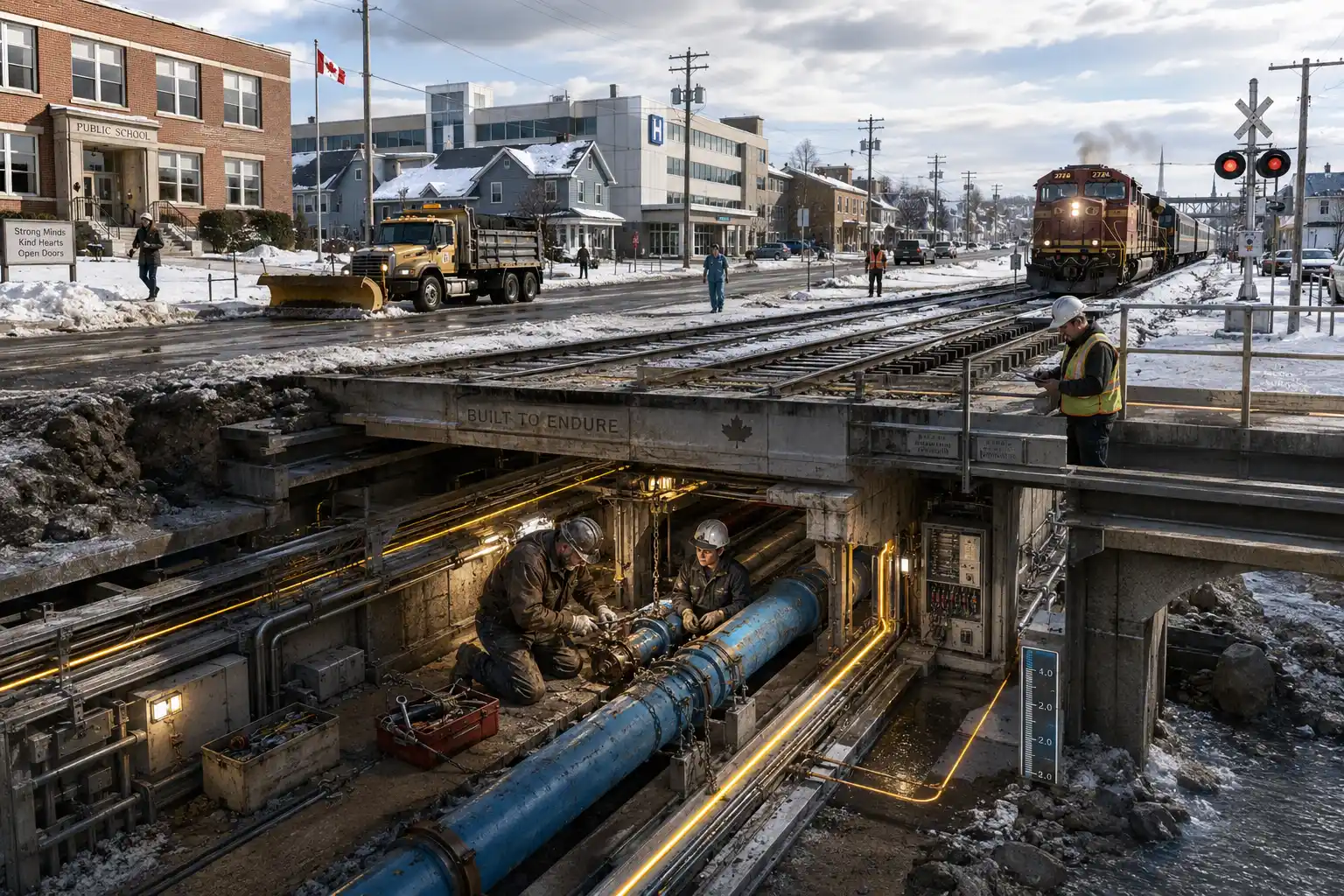
Appendix P — The Buried Builder Identity of Canada
The Problem Solvers the Country Forgot to Name
Canada was not only announced.
It was made.
It was made through rock, water, steel, timber, snow, voltage, roads, rail, farms, mines, ports, ships, aircraft, classrooms, machine shops, laboratories, hangars, hospitals, public works yards, military bases, repair garages, technical colleges, and job sites where people solved problems that did not care about slogans.
Cold had to be solved.
Distance had to be solved.
Power had to be solved.
Food had to be solved.
Transport had to be solved.
Communication had to be solved.
Shelter had to be solved.
Defence had to be solved.
Maintenance had to be solved.
A country like Canada could not exist by mood. It could not exist by moral language alone. It could not exist by branding, apology, aspiration, or institutional messaging. It had to become livable across a hard geography.
Someone had to build the systems.
Someone had to clear the roads.
Someone had to wire the houses.
Someone had to raise the bridges.
Someone had to run the turbines.
Someone had to survey the land.
Someone had to repair the machines.
Someone had to teach the apprentices.
Someone had to keep the furnace alive, the rail moving, the road open, the hospital functioning, the farm productive, the port operating, the grid stable, the mine safe, the aircraft maintained, and the classroom full enough of order that the next generation could learn.
This appendix exists because that identity has been buried.
Not completely.
The evidence remains everywhere.
The dams still generate. The rail lines still cross distance. The roads still stitch together impossible geography. The ports still move goods. The farms still feed. The mines still produce. The airports still connect. The public systems still depend on people who arrive before most citizens notice anything has been maintained.
But the story moved elsewhere.
Canada became easier to describe as values than capability.
Easier to describe as kindness than competence.
Easier to describe as diversity than continuity.
Easier to describe as management than making.
Easier to describe as moral posture than material achievement.
And when a country loses the language for honouring the people who make it physically possible, something serious has happened.
The country has not merely forgotten an industry.
It has forgotten a human type.
The builder.
The maintainer.
The problem solver.
The person who knows how reality works well enough to act inside it.
1. Why This Appendix Exists
This appendix is not a complete moral history of Canada.
It is not a replacement for Indigenous history, Quebec history, immigration history, women’s history, Black Canadian history, labour history, environmental history, religious history, regional history, or the history of institutional harm.
Those histories matter. Many of them are addressed elsewhere in this book.
But this appendix has a narrower task.
It names one Canadian identity that has become difficult to speak about without interruption:
the builder identity.
The engineers.
The tradespeople.
The machinists.
The hydro workers.
The aircraft designers.
The rail workers.
The miners.
The farmers.
The welders.
The electricians.
The surveyors.
The shipbuilders.
The public-works crews.
The shop teachers.
The soldiers and military technicians.
The mechanics.
The northern logistics workers.
The factory workers.
The lab workers.
The people who knew the systems.
The people who made Canada physically possible.
A civilization can tell many truths and still erase one of its load-bearing memories.
That is what happened here.
This appendix exists because the builder identity needs its own room.
Not as the only Canada.
Not as an innocent Canada.
Not as a myth that cancels other truths.
But as the missing spine of a country that increasingly knows how to describe itself morally, administratively, and symbolically, while struggling to remember the people who could build, maintain, repair, and understand its material systems.
The governing sentence is simple:
Canada did not only lose industries. It lost the public language for honouring the people who could build, maintain, repair, and understand the country’s material systems.
That is the loss.
2. Canada Was a Solved-Problem Civilization
Canada’s geography demanded solutions.
It demanded a particular kind of people.
The country was too cold, too large, too uneven, too wet, too rocky, too forested, too distant, too northern, too sparsely populated, and too regionally divided to become real without enormous practical intelligence.
A smaller, warmer, denser country can hide more easily inside administration. Canada could not.
The map itself required builders.
It required roads across shield and prairie.
Rail through distance.
Ports through weather.
Hydro through river systems.
Ferries through water.
Airstrips in remote places.
Telecommunications across enormous space.
Resource towns in harsh conditions.
Farm systems under short seasons.
Hospitals and schools across scattered communities.
Military logistics across coast, Arctic, and continent.
A Canadian town was often a solved problem before it became a community.
Where does the water come from?
Where does the heat come from?
How does food arrive?
How do children get to school?
How does a road stay open in February?
How does the grain move?
How does a miner breathe safely underground?
How does a fisherman return?
How does a northern community receive supplies?
How does a sick person reach care?
How does a language survive?
How does a bridge stand?
How does a city light?
How does a country hold together when distance wants to pull it apart?
Canada was built by people answering those questions.
The answers were rarely glamorous.
A culvert.
A transformer.
A plow.
A pump.
A switchyard.
A grain elevator.
A welding bead.
A roadbed.
A turbine.
A ferry schedule.
A classroom timetable.
A maintenance log.
A hangar.
A workshop.
A field.
A line crew.
A public works yard.
A country becomes real through such things.
Not because they are poetic.
Because life depends on them.
That is what Canada was: a solved-problem civilization.
Not perfectly solved.
Not fairly solved for everyone.
Not without harm.
But solved enough that millions of people could live, work, move, learn, worship, argue, immigrate, vote, raise children, complain, and dream inside systems they did not personally build.
Those systems were not natural.
They were made.
3. The Human Type Beneath the Systems
The builder identity is not about machines first.
It is about the human being shaped by contact with reality.
The builder learns that the world pushes back.
Steel has strength limits.
Concrete cures on its own terms.
Engines fail.
Ice forms.
Water finds weakness.
Wood warps.
A roof leaks.
A wire carries danger.
A road heaves.
A machine makes a sound before it breaks.
A patient’s monitor shows numbers, but the nurse sees the person.
A plane does not forgive casual maintenance.
A bridge does not care about intention.
The builder is formed by consequence.
He or she learns that confidence is not competence.
Language is not delivery.
Moral intention is not repair.
A plan is not a building.
A credential is not judgment.
A dashboard is not the system.
The builder type carries a certain moral education:
measure twice,
listen to the machine,
respect the weather,
do not cut the dangerous corner,
arrive on time,
bring the right tool,
keep the spare part,
know who depends on the work,
do not pretend something is fixed when it is not,
do not leave the next person with a hidden failure.
This is not merely technical.
It is ethical.
A staircase that collapses is a moral failure.
A water system that poisons people is a moral failure.
A road that is not maintained is a moral failure.
A hospital machine that is not checked is a moral failure.
A school that cannot teach reading is a moral failure.
A public institution that cannot answer citizens is a moral failure.
Competence is moral whenever others depend on the result.
That is why the builder identity matters.
It is the identity of people whose work joins truth to consequence.
4. The Builder Pipeline
Builders do not appear from nowhere.
They are formed.
The pipeline once ran through family, school, shop, garage, farm, job site, technical college, apprenticeship, military service, public works, small business, trades training, engineering school, factory floor, lab, rink, field, repair culture, and older workers who taught younger ones how to do things properly.
A child watched a parent fix something.
A teenager took shop.
A student learned drafting.
A young worker carried tools.
An apprentice was corrected.
A mechanic listened to an engine.
A farmer learned timing.
A soldier learned procedure.
A technician learned diagnostics.
A machinist learned tolerances.
An engineer learned load.
A nurse learned both the device and the body.
A public-works worker learned that the whole town notices when the water main breaks.
This pipeline was not perfect.
It excluded people. It often sorted by class and gender. It could be harsh. It could humiliate. It could confuse toughness with silence. It could waste talent outside the accepted channels.
But it formed capability.
Modern Canada weakened parts of this pipeline without building replacements of equal depth.
Shop class lost status.
Technical competence became less culturally central.
University became the default promise.
Credentials multiplied.
Apprenticeship became too narrow in public imagination.
Work became more portalized.
Young people became applicants before apprentices.
Many schools became better at language around identity than at forming contact with material reality.
The old pipeline needed repair.
Instead, too much of it was allowed to thin.
A country that wants builders must build builder pathways.
Not only elite STEM.
Not only software.
Not only branding around innovation.
Real pathways.
Tools.
Labs.
Shops.
Worksites.
Mentors.
Technical colleges.
Apprenticeships.
Public works.
Manufacturing.
Maintenance.
Field experience.
Hands on machines.
Responsibility before cynicism.
A young person must be allowed to become useful.
5. The Machines That Prove the Identity Was Real
The builder identity was not imaginary.
The machines prove it.
The dams prove it.
The railways prove it.
The transmission systems prove it.
The St. Lawrence Seaway proves it.
The Trans-Canada Highway proves it.
The ports prove it.
The grain elevators prove it.
The mines prove it.
The pulp and paper mills prove it.
The factories prove it.
The shipyards prove it.
The military systems prove it.
The early-warning systems prove it.
The aircraft prove it.
The satellites prove it.
The reactors prove it.
The public hospitals prove it.
The schools prove it.
The municipal water systems prove it.
The northern airstrips prove it.
The roads that stay open in weather prove it.
These were not vibes.
They were systems.
They required mathematics, materials, institutions, labour, discipline, logistics, capital, training, maintenance, and risk.
They required people who could imagine a future not as a slogan, but as a jobsite.
The future was once something Canada built at scale.
Not always wisely.
Not always justly.
Not without cost.
But with seriousness.
There was a period when Canada could look at a problem of continental scale and respond with engineering confidence:
we can connect it,
power it,
cross it,
communicate across it,
defend it,
settle it,
supply it,
maintain it.
That confidence should not be worshipped.
But neither should it be buried.
A country that cannot remember its own built achievements becomes dependent on imported imagination.
It begins to think of technology only as software, consumer devices, platforms, or apps.
But the older Canadian technology was heavier.
Power.
Transport.
Communications.
Defence.
Energy.
Water.
Public systems.
Organs, not gadgets.
A civilization that forgets its organs will eventually mistake the interface for the body.
6. The Builder Versus the Manager
Modern Canada has many managers.
Project managers.
Risk managers.
Communications managers.
Policy managers.
Brand managers.
Stakeholder managers.
Compliance managers.
Identity managers.
Crisis managers.
Process managers.
Some management is necessary. Complex systems need coordination. The builder needs planners, schedulers, accountants, regulators, inspectors, procurement officers, lawyers, administrators, designers, and public accountability.
But the manager becomes dangerous when detached from making.
The process begins to outrank the product.
The statement begins to outrank the repair.
The announcement begins to outrank the build.
The dashboard begins to outrank the patient.
The consultation begins to outrank the house.
The communications plan begins to outrank the bridge.
The risk framework begins to outrank competent judgment.
The portal begins to outrank the citizen.
The country then becomes fluent in describing problems and weak at solving them.
It can convene, consult, brand, announce, signal, manage, assess, report, and apologize.
But can it build the home?
Can it open the road?
Can it staff the hospital?
Can it recognize the immigrant engineer?
Can it maintain the water system?
Can it answer the phone?
Can it train the apprentice?
Can it complete the project?
The builder test cuts through managed reality.
Did the thing work?
Did the system deliver?
Did the road open?
Did the patient receive care?
Did the child learn?
Did the house get built?
Did the power stay on?
Did the institution become more human?
A country that rewards management language more than builder delivery will slowly become less real to itself.
7. Bombardier and the Broken National Map
Every country has symbols that reveal whether it still recognizes its own capacities.
Canada’s builder identity appears sharply in industries that connect engineering, labour, design, export, maintenance, and national imagination.
Aerospace is one of them.
Rail is another.
Hydro is another.
Nuclear is another.
Shipbuilding, mining, agriculture, public works, and northern logistics are others.
Bombardier belongs in this appendix not because one company can carry the whole builder identity, but because it reveals a pattern: Canada can produce industrial and technical excellence, yet often struggles to narrate that excellence as central to national identity.
A train is not just a product.
It is a civilization object.
It says a society knows motion, metal, electricity, safety, timing, manufacturing, maintenance, passengers, cities, routes, and scale.
An aircraft is not just a product.
It says a society knows lift, pressure, materials, design, engines, certification, maintenance, weather, distance, and risk.
A country that treats such capacities as business stories only misses the deeper point.
They are identity stories.
They reveal whether a people still believes it can make hard things.
The broken national map is this:
Canada can admire global technology brands elsewhere.
It can discuss innovation abstractly.
It can celebrate startups.
It can produce policy language around the economy of the future.
But it often struggles to honour its own heavy technical inheritance as national memory.
The builder identity is not just about what Canada produced.
It is about whether Canadians can still see themselves as a people capable of producing.
8. The Erasure by Convergence
The builder identity was not buried by one law, one party, one curriculum, one broadcaster, one grant, one immigration target, one ideology, one platform, one speech, or one bureaucrat.
That is why the erasure is hard to prove in the ordinary way.
It did not usually appear as an order.
It appeared as alignment.
A school removed shop.
A college lost prestige.
A university narrowed imagination toward credentials, software, management, or abstraction.
A broadcaster centered symbolic identity more than material competence.
A government celebrated values while forgetting capability.
A corporation adopted global HR language.
A platform rewarded moral drama.
A curriculum treated frontier and industrial Canada as a problem to be overcome rather than a memory to be understood.
A media class learned to speak about Canada through reconciliation, immigration, climate, crisis, and American cultural categories, while the builder disappeared from the national mirror.
A public institution learned to produce statements more confidently than services.
A housing market turned homes into assets before formation spaces.
A young person learned to manage a profile before learning to repair a machine.
A national story became safer when it described harm than when it described competence.
Each action could be explained.
Together, they produced a country that no longer knew who had built it.
No single action proves the erasure.
The final shape proves it.
This is convergence.
Many forces with different motives can produce the same outcome.
Immigration policy.
Media incentives.
University ideology.
Corporate language.
Public broadcasting.
School curriculum.
Algorithmic feeds.
DEI bureaucracy.
Housing pressure.
Credential inflation.
Loss of technical education.
Loss of national projects.
Software abstraction.
Urban dominance.
Collapse of local media.
Each can be defended in isolation.
Together, they can decenter a civilization.
That is the mechanism this appendix names.
The builder identity was not defeated in a single battle.
It was displaced by a thousand substitutions.
9. The 2015–2025 Acceleration
The builder identity had been weakening before 2015.
The shift was already visible in education, media, housing, public institutions, and the cultural movement from making to managing.
But the decade after 2015 accelerated the displacement.
National identity became more intensely moralized.
Institutional language became more standardized.
Public representation became more managed.
The screen became more dominant.
Platform culture moved faster.
Housing pressure became more severe.
Population growth changed scale and speed.
Temporary and permanent migration combined with weak housing and weak national transmission systems.
Public institutions became more fluent in values language while often less trusted in delivery.
The old Canadian self-description — builder, worker, farmer, soldier, tradesperson, engineer, small-town volunteer, shop teacher, public-works maintainer, resource worker, industrial problem-solver — became harder to hear inside the louder national vocabulary of the period.
This does not mean every change was false.
Some corrections were necessary.
Some absences needed to be repaired.
Some hidden harms needed to be named.
Some groups long ignored needed visibility.
But when correction becomes total atmosphere, it can crowd out memory that was not false.
The problem was not that Canada added truths.
The problem was that Canada lost proportion.
A serious country can remember harm and builders.
It can remember land and roads.
It can remember exclusion and competence.
It can remember newcomers and ancestors.
It can remember Indigenous suffering and Canadian making.
It can remember that some systems harmed people and that other systems kept people alive.
But the decade’s institutional language often made the older builder memory feel morally unspeakable.
That is why many Canadians did not merely disagree with the new story.
They felt homeless inside it.
They looked at the national mirror and saw no place for their fathers, mothers, grandparents, shops, farms, tools, uniforms, job sites, churches, roads, machines, small towns, hangars, mills, rail yards, public works departments, and family sacrifices.
A country can ask people to face hard truths.
It cannot ask them to disappear from the story entirely.
10. Boundary Note: Other Truths Are Addressed Elsewhere
This appendix has a narrow purpose.
It does not deny other Canadian histories.
It does not deny Indigenous history, land, law, or suffering.
It does not deny immigration history.
It does not deny women’s work.
It does not deny environmental damage.
It does not deny racism, exclusion, residential schools, institutional harm, or the need for repair.
Those truths matter.
They are addressed elsewhere in this book.
But this appendix exists because one truth has become especially difficult to state cleanly:
Canada was made by builders, and the people who made it physically possible have been pushed to the edge of the national story.
A country can tell many truths and still erase one.
A country can correct old omissions and create new ones.
A country can become better at naming harm and worse at honouring capability.
A country can learn to include more people while losing the language for the people who built, maintained, defended, farmed, wired, mined, taught, repaired, drove, welded, engineered, cleaned, cooked, nursed, and kept the systems running.
This appendix does not ask the builder identity to replace every other truth.
It asks that it stop being replaced.
11. The Moral Inversion of Building
Building itself has become morally complicated.
Sometimes rightly.
Building can destroy.
A road can open land to extraction.
A dam can flood territory.
A mine can poison water.
A factory can exploit workers.
A city can erase neighbourhoods.
A national project can trample local authority.
An engineering mindset can become arrogant when it treats land, communities, and history as obstacles.
Those warnings are real.
But the correction has sometimes gone too far.
Building became suspect.
Extraction became the whole story of resource work.
Industrial memory became embarrassment.
Rural competence became coded as backward.
Technical confidence became associated with domination.
The builder became morally secondary to the critic, the manager, the communicator, the consultant, the activist, the regulator, and the storyteller.
A society needs critique.
But critique does not replace construction.
A society needs environmental conscience.
But conscience does not build homes by itself.
A society needs consultation.
But consultation does not clear the road.
A society needs symbolic repair.
But symbols do not maintain water systems.
A society needs justice.
But justice must be housed, powered, staffed, supplied, transported, and maintained.
The repaired value is not reckless building.
It is disciplined building.
Build with humility.
Build with memory.
Build with law.
Build with stewardship.
Build with competence.
Build for maintenance.
Build for human life.
But build.
A country that cannot build cannot repair.
12. The Builder and the Child
A child looking at a machine is looking at civilization.
A crane.
A train.
A snowplow.
A tractor.
A ferry.
A bridge.
A turbine.
A plane.
A hospital monitor.
A kitchen mixer.
A bicycle chain.
A sewing machine.
A radio tower.
A computer motherboard.
A child asks:
How does it work?
A builder civilization protects that question.
It does not answer only with consumption.
It does not say:
buy it,
use it,
replace it,
upgrade it,
click it,
watch it,
post it.
It says:
open it,
study it,
draw it,
measure it,
repair it,
ask who made it,
ask what materials it needs,
ask what happens when it breaks,
ask who depends on it,
ask whether you could build something too.
The child who believes the world can be understood is different from the child who grows up only inside interfaces.
The builder identity begins in wonder.
Not propaganda.
Wonder.
Someone built this.
Maybe I can learn how.
That is why the loss of builder memory matters so much. If children no longer see builders as admirable, they may still become consumers of technology, commentators on systems, or users of tools.
But fewer will become maintainers of reality.
A civilization must teach children not only that systems exist, but that human beings made them and human beings can repair them.
13. The Builder Test
Every Canadian institution should face the builder test.
Does it make people more capable?
Does it deliver something real?
Does it respect the people who maintain it?
Does it teach young people how systems work?
Does it honour practical intelligence?
Does it connect speech to action?
Does it preserve memory of what was built?
Does it tell the truth about who paid the cost?
Does it repair damage?
Does it build future capacity?
Does it turn users into citizens?
Applicants into apprentices?
Profiles into persons?
Statements into work?
If not, it is not enough.
The builder test returns language to reality.
It asks whether a school forms capability.
Whether a government delivers.
Whether a company maintains.
Whether a university transmits competence.
Whether a media institution shows the people who keep the country functioning.
Whether a public institution can still answer a citizen.
Whether a national story makes room for the people whose hands made the story possible.
A country is not rebuilt by language alone.
The builder test asks what the language builds.
14. Repairing the Builder Identity
Repair begins by naming.
Canada must name the builder again.
In schools, children should learn not only harms and rights, but systems and competence.
They should learn how food moves, how power works, how roads are maintained, how houses are built, how water is cleaned, how aircraft fly, how bridges stand, how hospitals function, how farms operate, how ports move goods, how public institutions deliver, and how tools meet reality.
In media, the country should tell stories of builders without reducing them to stereotypes.
Not only heroic profiles.
Not propaganda.
Real stories.
The welder.
The engineer.
The apprentice.
The farmer.
The rail worker.
The technician.
The public-works crew.
The aircraft mechanic.
The shop teacher.
The nurse who knows the machine and the body.
The immigrant professional whose skill was wasted.
The young person who wants to build something but sees no ladder.
In public institutions, delivery should regain honour.
Answer the phone.
Fix the form.
Open the door.
Maintain the building.
Train the staff.
Restore the human counter.
Measure service by whether people are actually served.
In immigration, competence should not be wasted.
A country serious about builders does not invite formed people and then bury them beneath credential mazes while systems strain.
In work, apprenticeship should be restored.
In housing, building should become a national seriousness again.
In technology, children should be taught the physical systems beneath the interface.
In national memory, Canada should say clearly:
this country was built by people who solved real problems, and the next Canada will need people capable of solving harder ones.
This is not nostalgia.
It is capacity repair.
15. Closing: The People Who Made Canada Possible
The builder identity was not buried by one hand.
It was buried by convergence.
By every institution that found it easier to describe Canada as values than capability.
By every curriculum that taught critique without competence.
By every broadcaster that showed identity without showing the people who kept the systems running.
By every government that spoke of the future while failing to build it.
By every platform that rewarded performance over memory.
By every elite language that made ordinary Canadians feel morally homeless in the country their families built, defended, repaired, farmed, wired, mined, taught, nursed, cleaned, governed, and maintained.
No single action proves the erasure.
The final shape proves it.
Canada became a country where many of the people who made it physically possible could no longer recognize themselves in the national story.
That is why this appendix exists.
To say they were real.
To say they built.
To say they solved.
To say they maintained.
To say they kept life working.
To say Canada was not only announced, apologized for, branded, managed, diversified, or narrated.
Canada was made.
Made by hands.
Made by tools.
Made by weather.
Made by mathematics.
Made by machines.
Made by farms.
Made by roads.
Made by mines.
Made by rail.
Made by hospitals.
Made by schools.
Made by public systems.
Made by military service.
Made by repair.
Made by ordinary competence repeated across generations.
And if Canada is to survive as more than a post-national administrative space, it will have to remember the people who knew how to make it.
The buried builder identity should not remain buried.
It is one of the country’s load-bearing memories.
A civilization rises when it remembers not only what it believes, but what it can build.
Closing Note
Some of these people are old now. Some are gone. Some are still working quietly. Some were never photographed, interviewed, celebrated, or invited to explain what Canada was. But they existed. Anyone who worked with them knows the type: the person who read the drawing, heard the fault, fixed the system, carried the burden, and went home without turning responsibility into performance.
Related Reports
The Full Taxonomy of American Values: From the Founding to the Present https://x.com/SkillsGapTrain/status/2052054025412194768
The Full Taxonomy of European Values: From Antiquity to the Present https://x.com/SkillsGapTrain/status/2051995128966103119
The Full Taxonomy of Canadian Values: From Confederation to Today https://x.com/SkillsGapTrain/status/2051705815061725346
The Full Taxonomy of Christian Values: From Christ to the Present https://x.com/SkillsGapTrain/status/2051614401774625057
THE DAY THE FUTURE STOPPED https://x.com/SkillsGapTrain/status/2029991137172410634
Canadian Core Values Explicitly Named, Described, and Structurally Defined https://x.com/SkillsGapTrain/status/2025424368965410922
Firearms, Frontier Identity, and the Hidden Code of Canada (Part 1) https://x.com/SkillsGapTrain/status/1997708629479498175
Canada’s Breaking Point: The Civilizational Squeeze on Its Load-Bearing Nodes https://x.com/SkillsGapTrain/status/1971622900982861939
THE HIDDEN CODE OF CANADA https://x.com/SkillsGapTrain/status/1934397843718148554
True North, Armed & Free: Civilization’s Legacy — Canada’s Future https://x.com/SkillsGapTrain/status/1916880261536702506
True North, True Identity: Reclaiming Canada’s Real Civilization https://x.com/SkillsGapTrain/status/1916118889307771274
True North, Armed & Free: Why Gun Ownership Is Core to Canadian Identity https://x.com/SkillsGapTrain/status/1913178482672099684
Why Canada is the Greatest Nation on the Planet https://x.com/SkillsGapTrain/status/1854323924731101321
Defenders of Freedom: Canada’s Military, Peacekeeping, & Humanitarian Impact (1900-2024) https://x.com/SkillsGapTrain/status/1854005141810139557