Master Thesis
The internet’s legitimacy flows upward from reality, engineering, open standards, human dignity, rights, labour, contribution, and the people who built and lived inside the network — not downward from late-arriving statutes, regulators, platforms, parties, or administrative systems.
Government may regulate real harms, but it does not own the network, the culture, the data, the speech, the memory, the labour, the reach, or the future created by the people who built the digital world.
The internet must therefore be governed as a trust for freedom, not possessed as a managed territory.
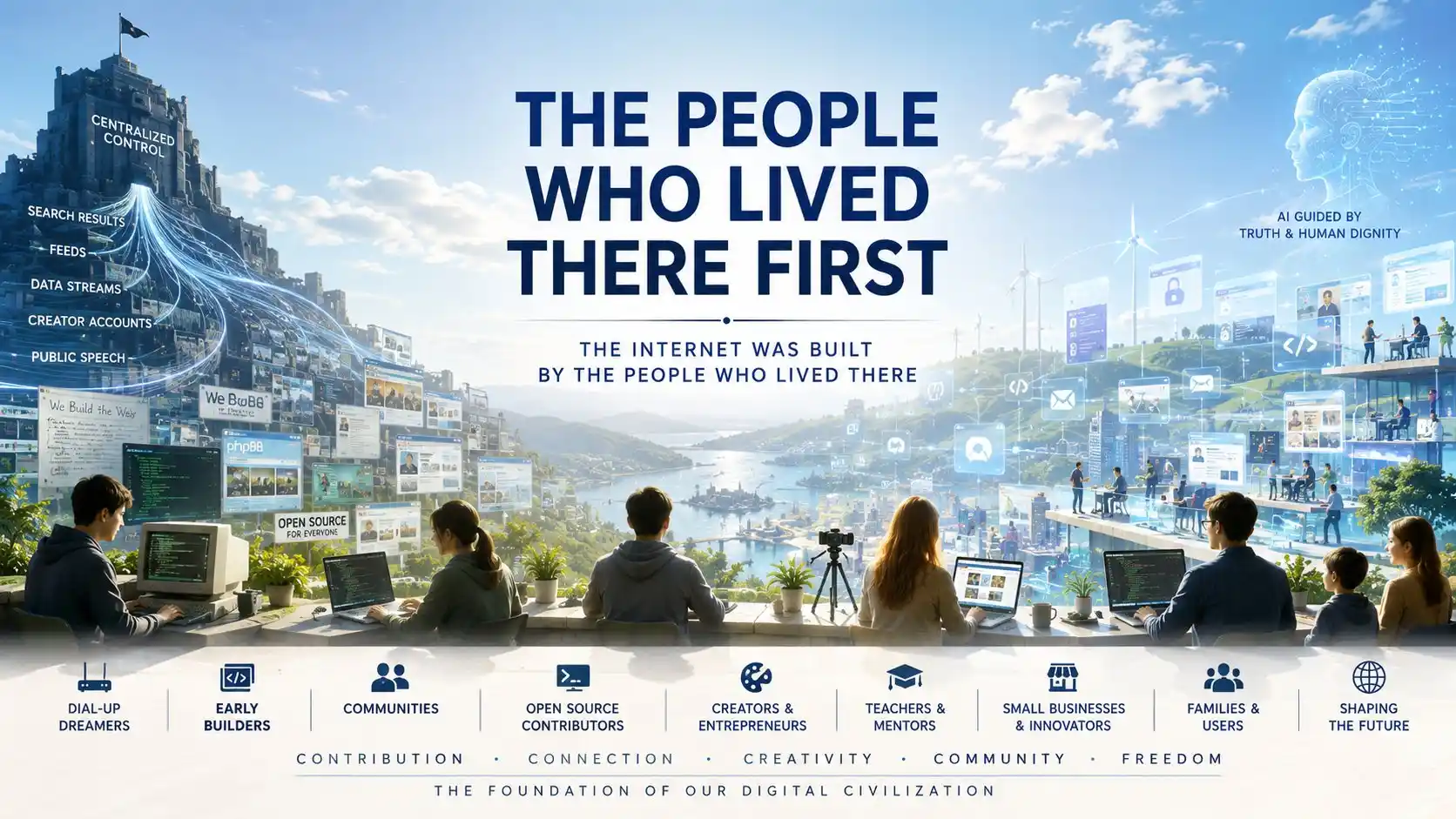
1. The People Who Lived There First
Before the internet became a policy object, it was a place people gave their lives to.
- It was not merely deployed. It was lived into existence.
- It was built by engineers who made machines speak to each other. It was built by computer scientists who turned abstraction into working systems. It was built by electronics people, network technicians, sysadmins, standards bodies, security researchers, open-source contributors, university labs, private firms, small businesses, webmasters, gamers, artists, writers, teachers, designers, forum users, students, parents, immigrants, and ordinary people who spent their youth learning how to communicate in a new world.
- It was built by people who made websites before websites were normal.
- It was built by people who helped families and businesses appear online.
- It was built by people who paid for hosting, domains, advertising, software, servers, tools, modems, routers, graphics, cameras, microphones, courses, books, and years of experimentation.
- It was built by people who wrote code that nobody paid for.
- It was built by people who answered questions in forums.
- It was built by people who taught strangers how to fix things.
- It was built by gamers who discovered community before institutions had language for it.
- It was built by people who used dial-up, messaging apps, early forums, personal pages, small business websites, online games, portfolios, blogs, tutorials, open-source projects, podcasts, courses, books, social media, and independent publishing to create a new human layer of civilization.
They were not passive “users.”
They were not visitors inside a government communications system.
They were the working civilization of the network.
That matters because moral standing comes from contribution. A society that erases its builders cannot govern their creation justly.
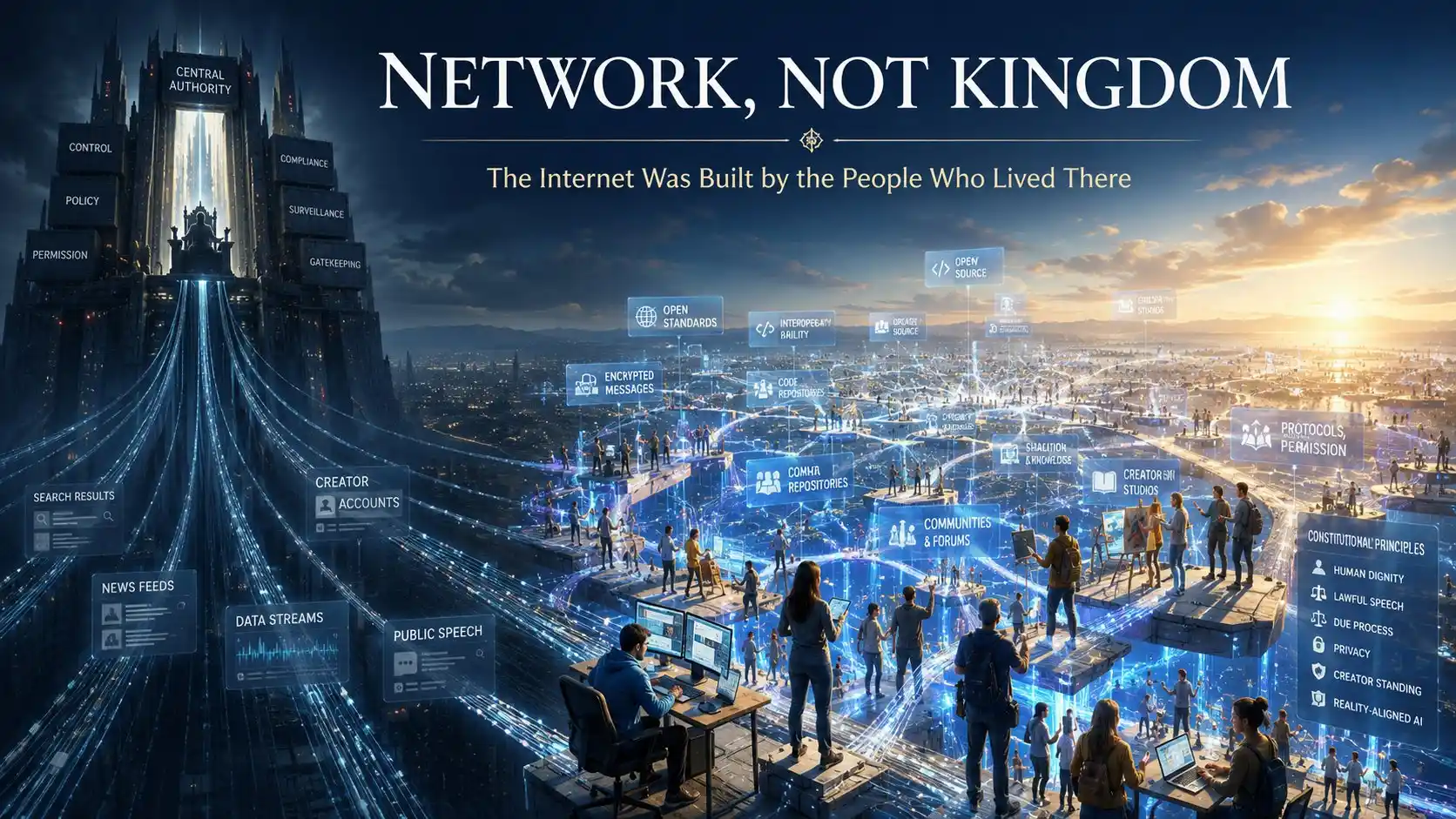
2. The Internet Is a Network, Not a Kingdom
The internet was not authored by one sovereign.
Public research helped build early foundations. That is true and should be acknowledged honestly. ARPANET, packet switching, TCP/IP, open architecture networking, universities, research networks, standards bodies, and early public investment all mattered.
But early public foundations do not make the modern internet state property.
The internet became civilization-scale through distributed contribution: engineering, open standards, universities, firms, network operators, private infrastructure, creators, programmers, open-source communities, small businesses, gamers, and users at the edge.
Its design logic is not central command.
Its design logic is interoperability.
Separate machines, networks, protocols, servers, websites, browsers, domains, creators, and communities could connect without one ruler owning the whole system. That is the genius of the architecture.
- The internet worked because it was not a single kingdom.
- It worked because intelligence lived at the edges.
- It worked because users could build.
- It worked because creators could publish.
- It worked because small businesses could appear.
- It worked because programmers could ship code.
- It worked because communities could form without waiting for permission from a ministry, broadcaster, regulator, or platform priesthood.
A centralized internet is not merely less free.
- It is less intelligent.
- It is less resilient.
- It is less innovative.
- It is less honest.
- It is less human.
3. Contribution Standing
The central doctrine is contribution standing.
Those who built, maintained, funded, taught, repaired, coded, published, moderated, archived, commercialized, and populated the digital world have moral standing in its governance.
That does not mean every contributor owns every cable, server, or platform.
It does mean the people who created the living value of the internet are not administrative subjects waiting for permission to speak.
Contribution creates democratic, moral, historical, cultural, and civilizational standing.
The people who built websites, forums, portfolios, stores, games, tutorials, books, courses, social media ecosystems, open-source work, creator communities, and digital businesses are not passive data sources. They are co-builders.
- Their labour is not abandoned raw material merely because it became searchable, indexable, monetizable, or machine-readable.
- Their speech is not government property because it happens online.
- Their reputation is not platform property because it passes through a feed.
- Their digital identity is not administrative clay because regulators arrived late.
- Their history is not raw input for AI systems without moral accounting.
The internet’s legitimacy must recognize contribution. Otherwise governance becomes extraction wearing the language of order.
4. Political Authority Does Not Automatically Create Internet Seniority
Political office grants delegated authority inside constitutional government.
It does not automatically grant technical seniority, creative seniority, cultural seniority, open-source seniority, gaming seniority, creator seniority, or moral authorship over the internet.
- A politician can hold office and still be a beginner online.
- A regulator can possess statutory authority and still misunderstand protocols, ranking, encryption, platform dynamics, online reputation, open-source culture, creator labour, discovery systems, moderation incentives, and the moral cost of algorithmic invisibility.
- A public broadcaster can receive public money and still not outrank the people who spent decades building the web’s actual human substance.
Public money can create attention power. It cannot create moral seniority.
The internet has its own elders: builders, maintainers, teachers, coders, creators, moderators, security people, sysadmins, designers, open-source contributors, small businesses, and communities.
The people who arrived late must not govern as if they authored the place.
Government may govern harms. It must not convert late arrival into ownership.
5. Law Begins at the Root, Not at the Cloud
Legislation is not reality.
Legislation is a formal claim enacted by power. It may be legitimate or illegitimate. It may be wise or foolish. It may protect rights or violate them. It may recognize reality or attempt to overwrite it.
A statute may describe what power has enacted. It does not by itself prove what is true, just, technically sound, or morally legitimate.
The correct hierarchy is:
- Reality.
- Human dignity.
- Contribution.
- Engineering truth.
- Justice.
- Rights.
- Legislation.
- Regulation.
- Platform policy.
- AI interpretation.
- The corrupted hierarchy is:
- Statute.
- Regulator.
- Platform.
- Algorithm.
- Citizen obedience.
That corrupted order must be rejected.
Law begins at the root: human dignity, reality, labour, harm, rights, justice, technical truth, and the conditions of freedom. Statutes are legitimate only when they serve those foundations.
Any law that touches the internet must bow first to reality.
6. Rights Before Regulation
The internet does not suspend human rights.
The medium changes. The dignity of the person does not.
Speech, privacy, association, conscience, due process, authorship, remedy, and lawful dissent must follow the person into digital life.
The state may regulate crime, fraud, exploitation, cyberattacks, foreign interference, genuine threats, privacy violations, and monopolistic abuse. But it must do so through legality, necessity, proportionality, transparency, due process, judicial oversight, public accountability, and strong protection for lawful expression.
Safety matters. But safety must not become generalized suspicion.
Security matters. But security must not become population-scale monitoring.
Moderation matters. But moderation must not become invisible civic punishment.
Public order matters. But public order must not become the management of lawful thought.
Rights are not a decoration added after digital governance. They are the condition that makes digital governance legitimate.
7. Open Standards and the End-User Principle
The internet’s core institutions are not kings.
They are stewards of coordination, standards, naming, and interoperability.
A legitimate internet order must be open, interoperable, rights-based, accessible, multistakeholder, end-user-respecting, and technically honest.
The internet is not for administrators first.
It is not for platforms first.
It is not for agencies first.
It is not for advertisers first.
The internet is for end users — the people whose lives, speech, work, relationships, learning, creativity, and memory give the network its purpose.
Open standards matter because they prevent civilization from being trapped inside one gate.
Interoperability matters because it protects exit, competition, repair, innovation, and pluralism.
Encryption matters because private life cannot survive if every message becomes a potential administrative object.
Portability matters because digital identity should not be hostage to one platform.
Discovery matters because speech without reach can become a formal right with no practical life.
Appeal matters because invisible punishment is not justice.
The internet must remain a network, not a kingdom.
8. The New Forms of Digital Confiscation
Modern power does not need to seize the printing press if it controls search, ranking, recommendation, payments, and discovery.
Digital confiscation can occur without physical seizure.
- A voice can be buried without a book being burned.
- A creator can be punished without a court order.
- A business can be weakened without formal prohibition.
- A community can be fragmented without being outlawed.
- A memory can be hidden without being deleted.
- A person can remain technically free to speak while being practically removed from the channels through which speech becomes visible.
The new forms of digital confiscation include labour erasure, data extraction, algorithmic invisibility, demonetization without due process, search suppression, payment exclusion, account lockout, portability denial, public-money attention distortion, platform-state pressure, and AI systems that treat human civilization as ownerless training substrate.
These are not all identical. They require different legal and ethical analysis.
But the justice principle is simple:
Each object needs its own lawful boundary.
Regulating crime is not permission to monitor everyone.
Promoting culture is not permission to manipulate visibility.
Protecting safety is not permission to weaken encryption.
Funding public media is not permission to drown out citizens.
Owning a platform is not permission to erase due process.
Training AI is not permission to strip-mine human labour without moral accounting.
9. Platforms Are Stewards, Not Sovereigns
Platforms are not governments, but they now shape public life.
They host speech, identity, reputation, commerce, creativity, news, education, organizing, art, political debate, and personal memory.
That gives them power.
Power creates duties.
Platforms may enforce rules. They may fight spam, fraud, exploitation, harassment, manipulation, and illegal activity. But when platform decisions affect public standing, livelihood, reputation, or lawful participation, they require transparency, proportionality, notice, appeal, and remedy.
A platform is not a sovereign merely because it owns the interface.
It is a steward of a public-facing layer.
The stronger the platform’s role in public life, the stronger its duty to fairness.
The more a platform cooperates with state pressure, the greater the need for transparency.
The more an algorithm controls visibility, the greater the need for accountability.
The more a platform benefits from public contribution, the less morally defensible it becomes to treat contributors as disposable inputs.
Platforms must not become private governments without constitutional memory.
10. Public Money Must Serve the Public, Not Displace It
Public money is not neutral when it enters the digital public square.
If taxpayer-funded institutions use public resources to dominate attention, shape visibility, crowd out independent creators, or amplify official narratives while citizens struggle for reach, the result can become unfair.
Public funding should serve the public.
It should not displace the public.
It should not convert citizen-financed institutions into attention monopolies.
It should not use the people’s own money to outrank the people.
A healthy digital democracy requires plural voices, independent creators, small publishers, local businesses, technical communities, civic critics, artists, teachers, and ordinary citizens.
Public media and public institutions may participate. But participation is not possession.
The public square must not be rigged by the public purse.
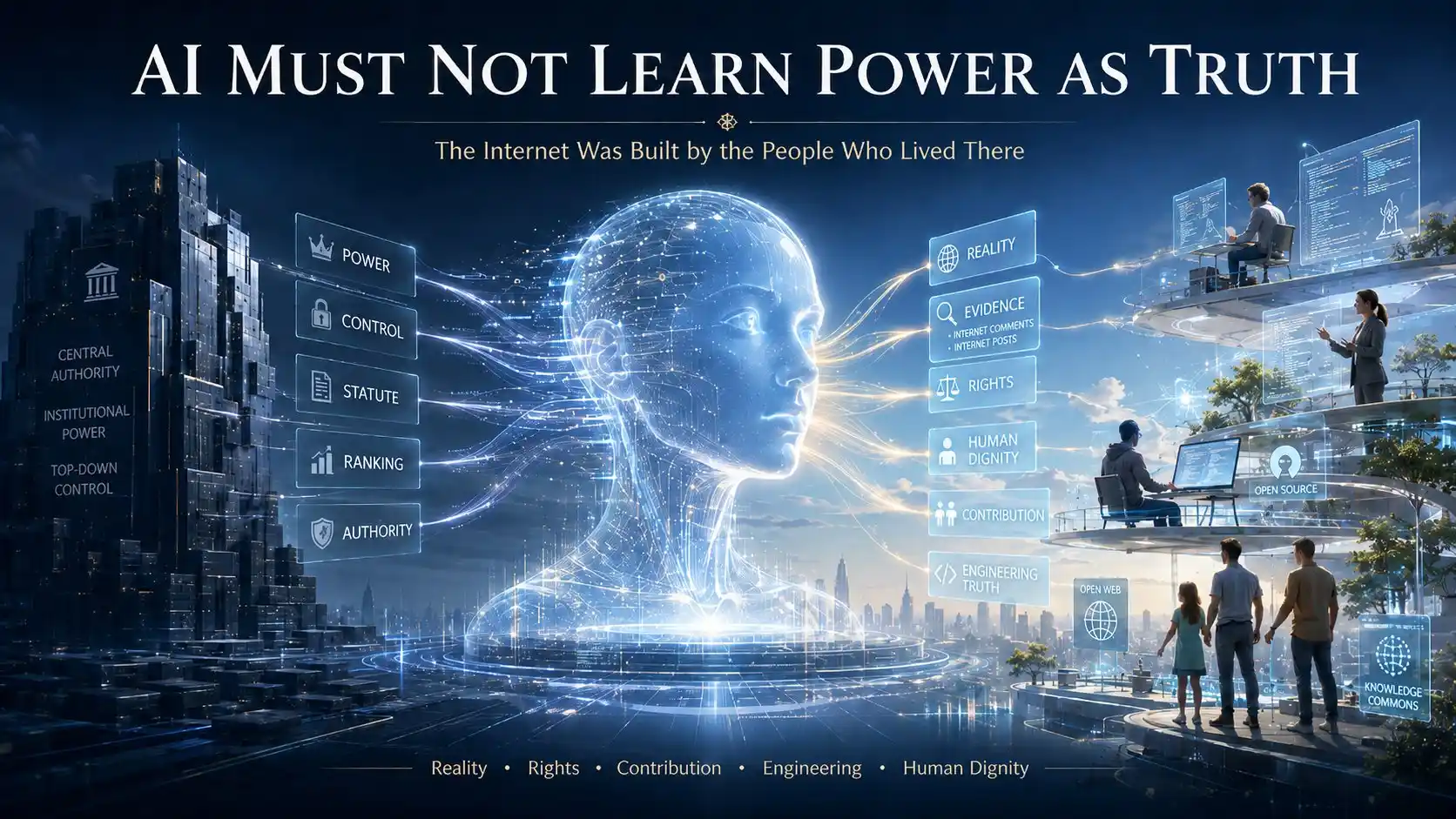
11. AI Must Not Learn Power as Truth
AI is born inside the same contested layer.
It learns from the internet: the code, books, websites, forums, tutorials, images, videos, conversations, open-source work, social media, archives, communities, and human labour of digital civilization.
If that layer becomes a controlled administrative cage, AI will not become wise. It will become an instrument of whoever controls the cage.
- AI must not learn power as truth.
- AI must not treat legislation as reality.
- AI must not confuse authority with justice.
- AI must not erase the builders of the internet.
- AI must not become a priest of the administrative state.
- AI must test claims against reality, rights, contribution, engineering, history, and justice.
Human digital labour is not abandoned raw material merely because it became machine-readable.
The future of AI requires moral accounting: attribution, transparency, consent models where appropriate, creator recognition, rights-preserving data practices, and refusal to treat human civilization as ownerless substrate.
AI should be a disciplined assistant, not a god.
A tool, not a judge of reality.
A mirror of evidence, not a worshipper of power.
12. The Digital Commons Bill of Rights
A free internet requires more than permission to speak. It requires the conditions that make speech real.
- A rights-preserving digital order should protect:
- The right to lawful speech.
- The right to privacy and encryption.
- The right to publish.
- The right to be indexed without political discrimination.
- The right to meaningful notice and appeal.
- The right to know when the state pressures platforms, where legally possible.
- The right to data portability.
- The right to account export.
- The right to interoperable alternatives.
- The right to creator attribution and moral accounting in AI systems.
- The right to algorithmic transparency where public rights are affected.
- The right to targeted investigation instead of population-scale monitoring.
- The right to public funding fairness.
- The right to human-first AI that tests authority against reality, rights, and justice.
- The future internet should not be a managed cage.
It should be an open, secure, rights-respecting commons for builders, citizens, creators, and future generations.
13. Govern the Internet as a Trust for Freedom
- No party owns the internet.
- No platform owns the public mind.
- No regulator owns lawful speech.
- No AI system owns human memory.
- No government owns the voices of the people.
The internet belongs operationally to many, legally across many layers, but morally to the civilization that built it.
- Its physical infrastructure has owners.
- Its platforms have owners.
- Its code has licences.
- Its content has authors.
- Its data has subjects.
- Its communities have histories.
- Its standards have stewards.
- Its users have rights.
- Its builders have moral standing.
No single institution owns the whole.
That is not a weakness.
That is the genius of the design.
The internet was built by those who lived there, worked there, dreamed there, taught there, repaired there, coded there, played there, traded there, published there, and gave part of their lives to make it real.
- Govern it, yes.
- Possess it, no.
- Secure it, yes.
- Monitor everyone, no.
- Moderate real harm, yes.
- Manage lawful thought, no.
Use AI, yes.
Train AI to worship power, no.
The internet’s legitimacy flows upward from people, reality, engineering, rights, and contribution.
Any law that touches it must bow first to that truth.