Model Act Generated from the NSIR / CLIP Clean-System Framework
Long Title
An Act to establish lawful, measurable, auditable, coordinated, and output-oriented housing delivery systems; to require housing need-to-completion mapping, authority mapping, approval timeline reporting, servicing-capacity mapping, infrastructure dependency mapping, project failure-point reporting, bottleneck review, public dashboards, appeal and remedy pathways, and completed-homes accountability; and to ensure that public housing systems convert policy intention, funding, zoning, infrastructure, approvals, and permits into completed homes.
Preamble
Whereas housing is a foundational human need and a critical condition of family formation, work, education, health, mobility, community life, economic productivity, and public trust;
Whereas a housing system is not merely a market, a ministry, a municipal process, a zoning bylaw, a funding program, a construction sector, or an infrastructure program, but a multi-level public system involving land, law, planning, finance, servicing, permits, builders, labour, utilities, transportation, environmental constraints, Indigenous rights, public consultation, and administrative capacity;
Whereas housing failure may occur even where governments announce plans, allocate funds, create programs, approve targets, or issue permissions, if those actions do not convert into completed dwellings people can occupy;
Whereas activity is not output, approval is not occupancy, and announcement is not construction;
Whereas lawful housing throughput requires visible authority, clear approval pathways, sufficient servicing capacity, infrastructure coordination, predictable timelines, transparent bottleneck reporting, appeal and review mechanisms, and measurement from housing need to completed homes;
Whereas housing systems must respect constitutional rights, Indigenous rights, treaty obligations, environmental protection, local legitimacy, safety, accessibility, public infrastructure limits, and procedural fairness;
Whereas the answer to housing scarcity is not reckless deregulation, but lawful throughput: a public system that can build while remaining lawful, auditable, reviewable, and democratically correctable;
Therefore, Parliament enacts as follows.
Part 1 — Short Title, Purpose, and Core Principles
1. Short Title
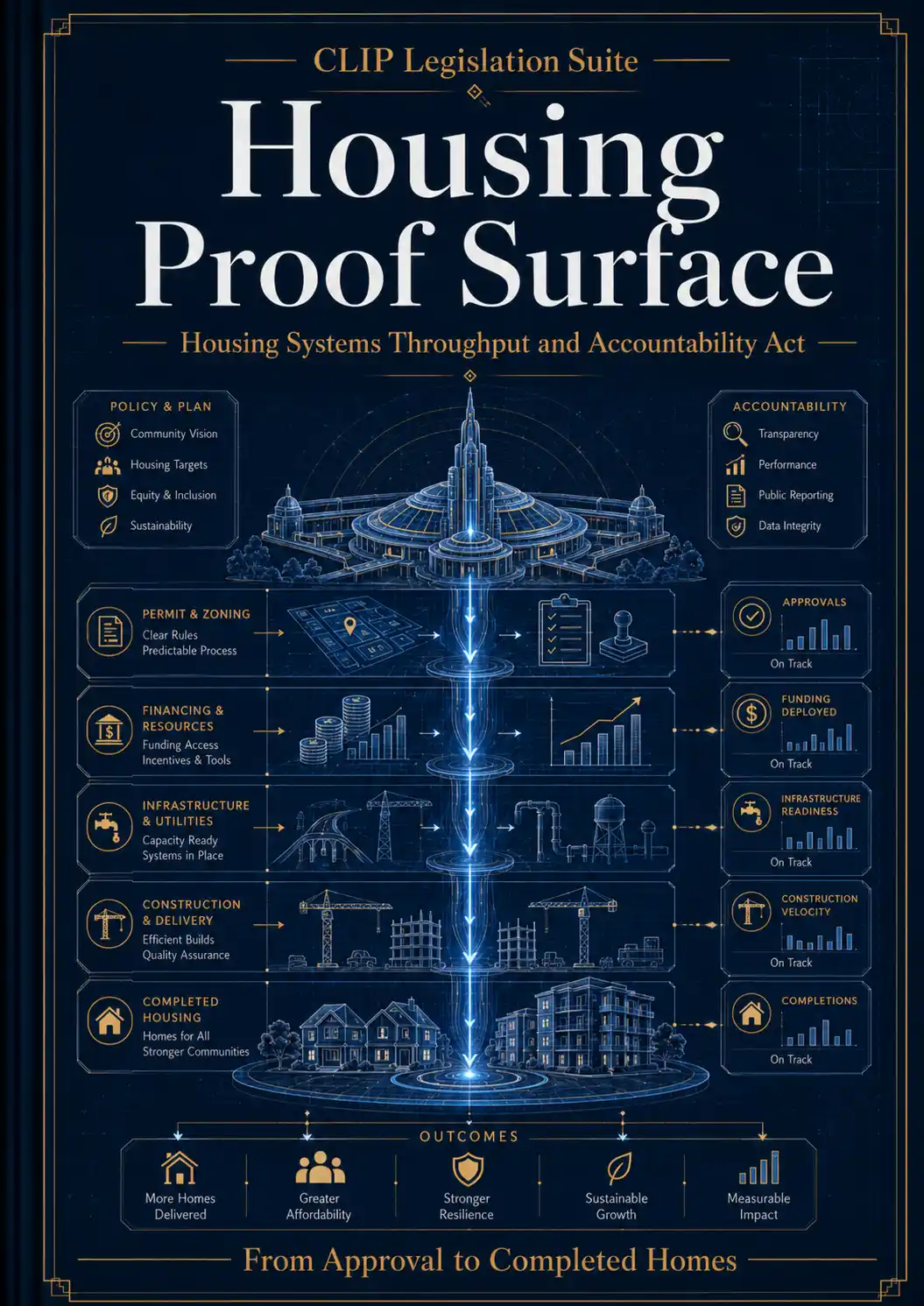
This Act may be cited as the Housing Systems Throughput and Accountability Act.
2. Purpose
The purpose of this Act is to ensure that housing systems:
- identify housing need;
- map public authority affecting housing delivery;
- map the pathway from need to occupancy;
- identify approval, servicing, infrastructure, financing, labour, land, and construction bottlenecks;
- distinguish announcements, funding, approvals, construction starts, completions, and occupancy;
- report approval timelines and failure points;
- coordinate municipal, provincial, territorial, federal, Indigenous, utility, infrastructure, and regulatory responsibilities;
- preserve lawful planning, environmental protection, Indigenous rights, safety, accessibility, and public consultation;
- create lawful throughput targets;
- provide review, appeal, escalation, and remedy pathways;
- measure completed homes and system repair, not symbolic activity.
3. Core Rule
A responsible authority shall not claim housing delivery progress unless it distinguishes between:
- housing need identified;
- land designated;
- zoning enabled;
- infrastructure capacity confirmed;
- application submitted;
- application deemed complete;
- approval granted;
- permit issued;
- financing secured;
- construction started;
- construction completed;
- dwelling occupied.
4. Lawful Housing Throughput Principle
Housing throughput means the lawful conversion of housing need, land, infrastructure, approvals, financing, labour, materials, construction, inspection, and occupancy into completed homes.
Throughput shall be pursued without bypassing constitutional rights, Indigenous rights, treaty obligations, environmental law, safety law, accessibility law, public health, procedural fairness, or lawful local planning authority.
5. Output Integrity Principle
A public authority shall not treat targets, strategies, funding announcements, rezoning, approvals, permits, or construction starts as substitutes for completed and occupiable homes.
6. System Visibility Principle
A housing system shall be visible enough for the public, applicants, residents, builders, municipalities, Indigenous governments, utilities, regulators, auditors, legislators, courts, journalists, and civil society to understand where housing is delayed, blocked, converted, completed, or lost.
7. No False Choice Principle
Nothing in this Act requires a choice between:
- housing and rights;
- speed and safety;
- density and infrastructure;
- consultation and completion;
- environmental protection and lawful building;
- local planning and national need;
- affordability and quality.
The purpose of this Act is to make the housing delivery system honest, visible, coordinated, and repairable.
Part 2 — Definitions
8. Definitions
In this Act:
“approval pathway” means the sequence of public decisions, reviews, permits, consultations, studies, conditions, servicing checks, inspections, and authorizations required for a housing project to proceed from application to construction and occupancy.
“authority map” means a documented account of the public authorities, legal powers, duties, discretion, approvals, conditions, permits, review bodies, appeal bodies, utility authorities, infrastructure bodies, and accountability mechanisms affecting housing delivery.
“bottleneck” means a recurring or material constraint, delay, uncertainty, conflict, capacity gap, legal obstacle, infrastructure deficit, servicing limit, approval failure, financing obstacle, labour shortage, utility delay, inspection delay, appeal delay, or administrative defect that prevents housing need from converting into completed homes.
“completed home” means a dwelling unit that has passed required inspections, received occupancy authorization where required, is connected to necessary services, and is legally capable of being occupied.
“critical housing system” means a housing system whose failure, delay, shortage, unaffordability, or non-delivery materially affects shelter, affordability, population growth, labour mobility, homelessness, public finance, health, family formation, regional stability, or public trust.
“housing delivery system” means the organized arrangement of law, land, planning, zoning, infrastructure, servicing, utilities, finance, approvals, permits, inspections, labour, materials, builders, public authorities, Indigenous rights processes, public consultation, environmental review, appeals, and reporting through which housing need becomes completed homes.
“housing need” means the number, type, location, tenure, accessibility level, affordability level, and timing of homes required to meet present and projected population, household, labour, shelter, affordability, and community needs.
“housing throughput” means the rate and reliability at which housing need, land, approvals, servicing, construction, inspection, and occupancy convert into completed homes.
“infrastructure dependency” means a required condition for housing delivery, including water, wastewater, stormwater, electricity, roads, transit, schools, health services, broadband, emergency services, parks, utilities, or other physical or service infrastructure.
“lawful throughput target” means a housing delivery target tied to completed homes and system capacity, pursued through lawful planning, servicing, infrastructure coordination, rights compliance, safety, public reporting, and bottleneck repair.
“responsible authority” means a public authority legally responsible for housing policy, planning, zoning, permitting, infrastructure, servicing, utilities, funding, inspection, approval, appeal, monitoring, or reporting.
“servicing capacity” means the physical, technical, financial, and regulatory capacity of infrastructure systems to support housing, including water, wastewater, stormwater, electricity, transportation, roads, transit, emergency access, schools, and other required services.
“system map” means a documented representation of the housing delivery pathway, including housing need, authority, land, zoning, applications, approvals, infrastructure dependencies, servicing capacity, funding, construction, inspection, occupancy, bottlenecks, appeals, and feedback loops.
Part 3 — Application
9. Application
This Act applies to housing systems, housing approval pathways, housing infrastructure systems, housing funding systems, housing permitting systems, servicing systems, and public authorities materially affecting housing delivery.
10. High-Impact Housing Systems
A housing system shall be classified as high-impact where it materially affects:
- shelter access;
- housing affordability;
- rental supply;
- ownership supply;
- social housing;
- supportive housing;
- student housing;
- seniors housing;
- Indigenous housing;
- workforce housing;
- emergency shelter;
- population growth accommodation;
- regional labour mobility;
- homelessness;
- housing-enabling infrastructure;
- other prescribed housing interests.
11. Critical Housing Systems
A responsible authority shall designate a housing system as critical where housing shortage, delay, infrastructure failure, affordability failure, approval failure, or non-completion creates serious harm to shelter, public finance, public health, labour markets, family formation, homelessness, regional stability, or public trust.
Critical housing systems shall be subject to enhanced system mapping, bottleneck review, throughput reporting, and repair planning.
12. Prohibition on Avoidance
A public authority shall not divide, relabel, reclassify, delegate, outsource, or move housing functions into another process for the purpose of avoiding this Act.
Part 4 — Housing Need-to-Completion System Map
13. System Mapping Requirement
Every high-impact housing system shall maintain a housing need-to-completion system map.
14. Contents of System Map
The system map shall identify:
- housing need;
- land availability;
- zoning and land-use permissions;
- public authorities involved;
- Indigenous rights, treaty, consultation, or partnership considerations;
- infrastructure dependencies;
- servicing capacity;
- application steps;
- complete-application requirements;
- approval gates;
- permit stages;
- inspection stages;
- financing dependencies where public financing is involved;
- utility dependencies;
- construction dependencies;
- appeal and review pathways;
- bottlenecks;
- completion reporting;
- feedback loops;
- responsible authority for repair.
15. Citizen-Readable Map
The responsible authority shall publish a citizen-readable version of the housing system map explaining:
- how housing need is calculated;
- how land becomes buildable;
- what approvals are required;
- who makes decisions;
- what infrastructure must exist;
- what timelines apply;
- where delays occur;
- how decisions can be appealed or reviewed;
- how completion is measured;
- how bottlenecks are repaired.
16. Restricted Annex
Where publication would create a serious and demonstrable risk to privacy, commercial confidentiality, procurement integrity, safety, Indigenous confidentiality, or lawful confidentiality, the responsible authority shall maintain a restricted annex for authorized reviewers.
Confidentiality shall not eliminate auditability.
Part 5 — Authority Mapping and Coordination
17. Authority Map Requirement
Every high-impact housing system shall maintain an authority map.
18. Contents of Authority Map
The authority map shall identify:
- federal authorities;
- provincial or territorial authorities;
- municipal authorities;
- Indigenous governments or bodies;
- planning authorities;
- utility authorities;
- infrastructure authorities;
- transportation authorities;
- environmental authorities;
- health and safety authorities;
- permitting bodies;
- inspection bodies;
- appeal or review bodies;
- public funding bodies;
- legal powers and limits;
- responsible officials;
- escalation pathways.
19. Coordination Duty
Where housing delivery depends on multiple authorities, the responsible authorities shall establish a coordination process identifying:
- lead coordinating authority;
- decision sequence;
- shared evidence;
- timeline dependencies;
- infrastructure dependencies;
- dispute-escalation process;
- public reporting process.
20. Jurisdictional Bottleneck Review
Where housing delivery is materially delayed by jurisdictional conflict, duplication, sequencing failure, or unclear authority, the responsible authorities shall conduct a jurisdictional bottleneck review.
21. No Unmapped Veto
A public authority shall not exercise a practical veto, delay power, condition power, or approval control affecting high-impact housing delivery unless the authority is identified in the authority map and subject to reasons, review, or reporting requirements.
Part 6 — Housing Need and Target Integrity
22. Housing Need Assessment
A responsible authority shall prepare or adopt a housing need assessment for each prescribed area.
23. Contents of Housing Need Assessment
The assessment shall identify:
- current population;
- projected population;
- household formation;
- household size;
- current housing stock;
- rental vacancy;
- affordability pressure;
- homelessness and shelter demand;
- overcrowding;
- student, senior, workforce, Indigenous, supportive, and accessible housing needs where applicable;
- geographic distribution of need;
- infrastructure constraints;
- required completions over prescribed periods.
24. Lawful Throughput Targets
A responsible authority shall establish lawful throughput targets tied to completed homes.
Targets shall distinguish:
- total homes needed;
- homes approved;
- homes permitted;
- homes under construction;
- homes completed;
- homes occupied;
- affordable homes completed;
- social or supportive homes completed;
- accessible homes completed where applicable.
25. Target Review
Housing throughput targets shall be reviewed at prescribed intervals and updated where need, population, infrastructure, financing, labour, land, or completion data materially changes.
26. No Announcement Substitution
Funding announcements, policy commitments, zoning changes, ministerial statements, municipal plans, memoranda, or targets shall not be reported as completed homes.
Part 7 — Land, Zoning, and Buildable Capacity
27. Buildable Land Inventory
A responsible authority shall maintain a buildable land inventory for prescribed areas.
28. Contents of Buildable Land Inventory
The inventory shall identify:
- land designated for housing;
- permitted density;
- ownership category;
- infrastructure availability;
- servicing constraints;
- environmental constraints;
- transportation access;
- hazard or safety constraints;
- Indigenous rights or consultation considerations;
- public land suitable for housing;
- land requiring rezoning;
- land requiring infrastructure investment;
- land unlikely to produce housing within the prescribed period.
29. Effective Capacity
A responsible authority shall distinguish nominal zoned capacity from effective buildable capacity.
Effective buildable capacity shall account for infrastructure, servicing, land assembly, environmental constraints, financing, market feasibility, construction feasibility, and approval pathway conditions.
30. Zoning-to-Completion Review
Where zoning reform does not produce expected completions, the responsible authority shall conduct a zoning-to-completion review identifying why zoned capacity failed to convert into completed homes.
Part 8 — Servicing Capacity and Infrastructure Dependencies
31. Servicing Capacity Map
Every high-impact housing system shall maintain a servicing capacity map.
32. Contents of Servicing Capacity Map
The servicing capacity map shall identify:
- water capacity;
- wastewater capacity;
- stormwater capacity;
- electricity capacity;
- road capacity;
- transit capacity;
- emergency access;
- schools and community infrastructure where relevant;
- health and social-service infrastructure where relevant;
- broadband or digital infrastructure where relevant;
- utility constraints;
- required upgrades;
- funding source;
- responsible authority;
- expected completion timeline.
33. Infrastructure Dependency Register
A responsible authority shall maintain an infrastructure dependency register for major housing areas and prescribed projects.
34. Contents of Infrastructure Dependency Register
The register shall identify:
- housing area or project;
- required infrastructure;
- authority responsible;
- funding status;
- approval status;
- procurement status;
- construction status;
- expected completion date;
- risk of delay;
- housing units affected;
- mitigation or sequencing options.
35. No Approval Without Servicing Clarity
A responsible authority shall not represent housing capacity as deliverable unless servicing capacity is available, funded, scheduled, or identified as a constraint requiring repair.
36. Servicing Bottleneck Escalation
Where servicing constraints block significant housing delivery, the responsible authority shall escalate the constraint for infrastructure repair planning and public reporting.
Part 9 — Application, Approval, Permit, and Inspection Pathways
37. Approval Pathway Map
A responsible authority shall maintain an approval pathway map for housing applications.
38. Complete-Application Test
A responsible authority shall determine whether a housing application is complete within the prescribed period.
39. Deficiency Notice
Where an application is incomplete, the responsible authority shall issue a deficiency notice identifying:
- missing information;
- reason required;
- legal or policy basis;
- how to correct the deficiency;
- timeline for resubmission;
- contact point.
40. Approval Gates
The approval pathway shall identify, where applicable:
- pre-application stage;
- complete-application determination;
- zoning or land-use review;
- servicing review;
- environmental or hazard review;
- design review;
- public consultation;
- Indigenous consultation where required;
- infrastructure dependency review;
- permit review;
- inspection stage;
- occupancy authorization.
41. Bounded Timelines
Each approval gate shall have a prescribed timeline appropriate to project class, complexity, legal requirements, servicing issues, and consultation duties.
42. Pause or Delay
A timeline may be paused only for prescribed reasons, including incomplete information, legal consultation duty, infrastructure dependency, environmental or safety issue, applicant delay, court order, emergency, or other lawful reason.
43. Reasons for Delay
Where a timeline is paused or delayed, the responsible authority shall provide reasons identifying:
- reason for delay;
- authority relied on;
- information or action required;
- responsible party;
- expected duration;
- pathway to resume review.
44. Permit-to-Occupancy Tracking
A responsible authority shall track the movement of projects from permit issuance to construction start, inspection, completion, and occupancy.
Part 10 — Public Consultation, Local Legitimacy, and Rights
45. Consultation Pathway
A responsible authority shall publish the consultation pathway for housing decisions requiring public consultation.
46. Consultation Integrity
Consultation shall be timely, accessible, relevant to lawful decision criteria, and capable of informing the decision where law requires public participation.
47. No Consultation Theatre
A process shall not satisfy this Act if consultation is symbolic, inaccessible, unbounded, duplicative, unrelated to lawful decision criteria, or incapable of producing a decision.
48. Local Impact Review
Where housing development materially affects infrastructure, traffic, safety, environment, public services, displacement, heritage, or community conditions, the responsible authority shall identify the issue, evidence, mitigation options, and decision criteria.
49. Indigenous Rights
Nothing in this Act limits Indigenous rights, treaty rights, consultation duties, accommodation duties, or any requirement of consent where required by law.
Where housing delivery affects Indigenous rights, lands, services, governance, treaty interests, or Indigenous housing priorities, the responsible authority shall identify the applicable legal duties and consultation or partnership pathway.
Part 11 — Appeal, Review, Escalation, and Remedy
50. Review Pathway
A high-impact housing system shall provide a clear review, appeal, escalation, complaint, or remedy pathway for affected persons, applicants, communities, Indigenous governments, or public bodies where available by law.
51. Contents of Review Pathway
The review pathway shall identify:
- who may request review;
- what decisions may be reviewed;
- applicable timelines;
- evidence that may be submitted;
- decision-maker on review;
- remedies available;
- urgent escalation where delay causes serious harm;
- systemic bottleneck escalation.
52. Reasons Requirement
A responsible authority shall provide reasons for material housing decisions, including:
- incomplete application decisions;
- delay or pause decisions;
- approval;
- conditional approval;
- refusal;
- servicing denial;
- permit refusal;
- inspection failure;
- occupancy refusal;
- bottleneck escalation decisions.
53. No Unreviewable Delay
Material delay in a high-impact housing pathway may be subject to escalation, review, reasons, or bottleneck analysis.
54. Remedy
Where a housing decision or delay is unlawful, unreasonable, procedurally unfair, based on incorrect information, or inconsistent with prescribed timelines without lawful reason, the responsible authority shall provide a remedy within its lawful authority.
Remedies may include:
- reasons;
- reconsideration;
- corrected record;
- expedited review;
- referral to proper authority;
- timeline repair;
- bottleneck escalation;
- appeal or tribunal referral;
- systemic correction plan.
Part 12 — Bottleneck Review and Failure-Point Reporting
55. Bottleneck Review Requirement
Where housing delivery repeatedly fails to convert need, land, zoning, funding, approvals, permits, construction, or inspections into completed homes, the responsible authority shall conduct a bottleneck review.
56. Bottleneck Categories
A bottleneck may include:
- unclear authority;
- zoning constraint;
- land constraint;
- servicing constraint;
- infrastructure dependency;
- financing constraint;
- labour constraint;
- materials constraint;
- approval delay;
- permit delay;
- inspection delay;
- utility delay;
- consultation delay;
- environmental or safety issue;
- appeal delay;
- applicant delay;
- procurement delay;
- construction delay;
- occupancy delay;
- data or reporting defect.
57. Contents of Bottleneck Review
A bottleneck review shall identify:
- bottleneck type;
- affected housing pathway;
- affected homes or units;
- affected population;
- authority responsible;
- legal cause;
- administrative cause;
- infrastructure cause;
- financial cause;
- market or construction cause;
- data cause;
- severity;
- frequency;
- detectability;
- repair option;
- responsible authority;
- timeline for repair.
58. Project Failure-Point Reporting
For prescribed housing projects or housing areas, the responsible authority shall report the stage at which projects fail, stall, withdraw, or lose feasibility.
Failure points may include:
- land acquisition;
- rezoning;
- servicing;
- financing;
- application completeness;
- public consultation;
- Indigenous consultation;
- environmental review;
- permit review;
- inspection;
- construction cost escalation;
- utility connection;
- occupancy authorization.
59. Systems Repair Plan
Where a bottleneck review identifies recurring system failure, the responsible authority shall prepare a systems repair plan.
60. Contents of Systems Repair Plan
The plan shall identify:
- failure mode;
- affected housing type;
- affected geography;
- repair action;
- legal amendment required;
- administrative repair required;
- infrastructure investment required;
- staffing or capacity required;
- data improvement required;
- coordination improvement required;
- deadline;
- dashboard indicator;
- review date.
Part 13 — Funding, Public Land, and Output Conversion
61. Funding-to-Completion Tracking
Where public funds are used to support housing, the responsible authority shall track whether funding converts into completed homes.
62. Funding Report
A funding report shall distinguish:
- funds announced;
- funds committed;
- funds contracted;
- funds disbursed;
- projects funded;
- units approved;
- units under construction;
- units completed;
- units occupied;
- affordability period;
- reasons for non-completion.
63. Public Land Housing Register
Where public land is designated or considered for housing, the responsible authority shall maintain a public land housing register.
64. Contents of Public Land Housing Register
The register shall identify:
- land parcel or area;
- responsible public authority;
- housing suitability;
- infrastructure capacity;
- zoning status;
- environmental or safety constraints;
- Indigenous rights or consultation considerations;
- procurement or disposition status;
- expected housing yield;
- affordability requirements where applicable;
- timeline;
- completion status.
65. Output Conversion Review
Where public funds, public land, or public programs fail to produce expected completed homes, the responsible authority shall conduct an output conversion review.
Part 14 — Housing Throughput Dashboard
66. Public Housing Throughput Dashboard
The government shall maintain a public housing throughput dashboard.
67. Dashboard Indicators
The dashboard shall include, at an appropriate level of aggregation:
- housing need;
- housing targets;
- land designated for housing;
- effective buildable capacity;
- infrastructure capacity constraints;
- applications submitted;
- applications deemed complete;
- average approval timelines;
- timeline pauses and reasons;
- permits issued;
- construction starts;
- inspections completed;
- occupancy authorizations;
- completed homes;
- affordable homes completed;
- social or supportive homes completed;
- accessible homes completed where applicable;
- projects stalled;
- project failure points;
- bottleneck categories;
- repair actions;
- public funds converted into completed homes.
68. Reporting Distinctions
The dashboard shall clearly distinguish:
- announced homes;
- planned homes;
- zoned capacity;
- approved homes;
- permitted homes;
- started homes;
- completed homes;
- occupied homes.
69. Protection of Sensitive Information
Dashboard reporting shall not disclose information where disclosure would create a serious and demonstrable risk to privacy, safety, Indigenous confidentiality, lawful commercial confidentiality, procurement integrity, cybersecurity, or legal privilege.
Part 15 — Audit Trails, Records, and Data Integrity
70. Housing Recordkeeping Duty
A responsible authority shall preserve records sufficient to reconstruct housing need assessment, authority mapping, approval pathways, servicing constraints, timelines, reasons, decisions, appeals, bottlenecks, funding-to-completion, and completion reporting.
71. Audit Trail
Housing systems shall preserve audit trails sufficient to reconstruct:
- application submission;
- completeness determination;
- authority involved;
- data used;
- decision criteria;
- consultation record;
- servicing determination;
- infrastructure dependency;
- approval or refusal;
- permit issuance;
- inspection;
- occupancy authorization;
- delay reason;
- appeal or review;
- bottleneck escalation;
- repair action.
72. Data Quality
Housing data used for public reporting shall be accurate, current, sourced, auditable, and corrected where materially wrong.
73. No Metric Distortion
A responsible authority shall not use housing metrics in a manner that obscures non-completion, double counts units, inflates effective capacity, hides infrastructure constraints, or reports activity as output.
Part 16 — Independent Review and Public Challenge
74. Independent Review
A critical housing system shall be subject to independent review by persons with appropriate expertise in housing, planning, infrastructure, public administration, systems engineering, Indigenous rights where relevant, environmental review, construction, finance, data governance, and audit.
75. Red-Team Review
A critical housing system shall be subject to red-team review.
The review shall ask:
- how the housing system could fail to produce completed homes;
- how approvals could fail to become occupancy;
- how infrastructure constraints could be hidden;
- how zoning capacity could be overstated;
- how funding could fail to convert into homes;
- how appeal or consultation could become unbounded delay;
- how public reporting could distort outputs;
- how bottlenecks could resist repair;
- how authority could become unclear;
- how public trust could fail.
76. Public Challenge Process
The responsible authority shall establish a process through which affected persons, municipalities, Indigenous governments, builders, renters, homeowners, civil society, journalists, public servants, auditors, experts, utilities, and other affected parties may submit evidence of housing system failure, bottleneck, delay, data error, infrastructure constraint, approval failure, or output-conversion failure.
Part 17 — Security, Confidentiality, and Bounded Accountability
77. Protected Information
Nothing in this Act requires public disclosure of information where disclosure would create a serious and demonstrable risk to privacy, personal safety, Indigenous confidentiality, procurement integrity, lawful commercial confidentiality, cybersecurity, legal privilege, or public security.
78. Bounded Accountability
Where information cannot be made public, the responsible authority shall provide:
- a public summary at the highest safe level of abstraction;
- a restricted record for authorized reviewers;
- audit access sufficient to verify legality, accountability, and compliance;
- written reasons for withholding public disclosure where lawful.
79. No Secrecy Without Review
Confidentiality shall not eliminate the requirement for authorized audit, legal review, Indigenous rights review, safety review, oversight, public accountability, or systems repair.
Part 18 — Oversight, Compliance, and Orders
80. Oversight Body
An authorized oversight body shall monitor compliance with this Act.
The oversight body may be established by regulation or assigned to an existing public authority with appropriate independence, expertise, and legal powers.
81. Powers of Oversight Body
The oversight body may:
- require records;
- inspect housing system maps;
- inspect authority maps;
- inspect servicing capacity maps;
- inspect approval timeline data;
- inspect bottleneck reviews;
- inspect funding-to-completion records;
- review public dashboard data;
- investigate complaints;
- require systems repair plans;
- require public reporting;
- refer matters to courts, tribunals, auditors, housing authorities, infrastructure authorities, Indigenous consultation bodies, procurement authorities, or legislative committees where appropriate.
82. Compliance Orders
An oversight body may issue a compliance order requiring a responsible authority to:
- prepare or update a housing system map;
- prepare or update an authority map;
- prepare or update a servicing capacity map;
- publish approval timeline data;
- provide reasons for delay;
- conduct a bottleneck review;
- prepare a systems repair plan;
- correct dashboard data;
- preserve audit records;
- report on completion outcomes.
83. No Order to Bypass Rights
An oversight body shall not order a responsible authority to bypass constitutional rights, Indigenous rights, treaty obligations, environmental law, safety law, accessibility law, procedural fairness, or judicial review.
Part 19 — Regulations
84. Regulations
The Governor in Council may make regulations:
- prescribing high-impact housing systems;
- prescribing critical housing systems;
- establishing housing need assessment standards;
- establishing system map standards;
- establishing authority map standards;
- establishing servicing capacity map standards;
- establishing approval timeline reporting requirements;
- establishing bottleneck review procedures;
- establishing dashboard indicators;
- establishing funding-to-completion reporting requirements;
- establishing public land register requirements;
- establishing phased implementation timelines;
- exempting systems where equivalent or stronger review exists.
85. No Regulation May Defeat Purpose
No regulation made under this Act shall defeat the purpose of ensuring lawful, measurable, auditable, coordinated, and output-oriented housing delivery systems.
Part 20 — Statutory Review, Pilot Phase, and Coming into Force
86. Statutory Review
A committee of Parliament shall review this Act within three years after coming into force and every five years thereafter.
The review shall examine:
- whether the Act improves housing system visibility;
- whether it improves lawful housing throughput;
- whether it improves need-to-completion tracking;
- whether it improves approval timeline transparency;
- whether it improves servicing capacity visibility;
- whether it improves bottleneck repair;
- whether it improves completed-home reporting;
- whether it preserves rights, consultation, safety, and environmental standards;
- whether it creates unnecessary bureaucracy;
- whether amendments are required.
87. Pilot Phase
This Act shall be implemented through a pilot phase applying first to prescribed housing systems, including:
- major urban housing approval systems;
- housing-enabling infrastructure systems;
- public land housing systems;
- social and supportive housing systems;
- rental housing delivery systems;
- Indigenous housing partnership systems;
- student and workforce housing systems;
- high-growth regional housing systems;
- emergency shelter-to-housing systems;
- housing data and dashboard systems.
88. Coming into Force
This Act comes into force on a day fixed by order of the Governor in Council.
Different provisions may come into force on different days.
Schedule A — Housing Need-to-Completion System Map Template
A housing system map shall identify:
- housing need;
- target geography;
- responsible authorities;
- authority map;
- land availability;
- zoning status;
- effective buildable capacity;
- servicing capacity;
- infrastructure dependencies;
- application pathway;
- approval gates;
- permit pathway;
- inspection pathway;
- occupancy pathway;
- appeal or review pathway;
- bottlenecks;
- completion reporting;
- repair actions.
Schedule B — Servicing Capacity Map Template
A servicing capacity map shall identify:
- housing area;
- projected housing units;
- water capacity;
- wastewater capacity;
- stormwater capacity;
- electricity capacity;
- transportation capacity;
- transit capacity;
- emergency access;
- schools or community infrastructure where relevant;
- utility dependencies;
- required upgrades;
- responsible authority;
- funding status;
- approval status;
- construction status;
- expected completion date;
- units blocked by constraint.
Schedule C — Approval Timeline Report Template
An approval timeline report shall identify:
- project or application class;
- application submitted date;
- completeness decision date;
- deficiency notices;
- approval gate dates;
- timeline pauses;
- reasons for pauses;
- responsible authority for each gate;
- decision date;
- permit date;
- inspection date;
- occupancy date;
- total time from application to occupancy;
- bottlenecks identified.
Schedule D — Housing Bottleneck Register
A housing bottleneck register shall identify:
- bottleneck category;
- affected geography;
- affected housing type;
- affected units;
- triggering condition;
- likely harm;
- severity;
- frequency;
- detectability;
- responsible authority;
- existing control;
- missing control;
- repair action;
- deadline;
- status;
- review date.
Schedule E — Funding-to-Completion Report Template
A funding-to-completion report shall identify:
- program name;
- responsible authority;
- funds announced;
- funds committed;
- funds contracted;
- funds disbursed;
- projects funded;
- homes approved;
- homes permitted;
- homes under construction;
- homes completed;
- homes occupied;
- affordability requirements;
- reasons for delay or non-completion;
- repair action.
Schedule F — Housing Throughput Dashboard Metrics
The housing throughput dashboard shall distinguish:
- housing need;
- announced homes;
- planned homes;
- zoned capacity;
- effective buildable capacity;
- applications submitted;
- applications complete;
- homes approved;
- permits issued;
- construction starts;
- inspections completed;
- occupancy authorizations;
- completed homes;
- occupied homes;
- affordable homes completed;
- stalled homes;
- bottlenecks repaired.
Final Standard
The Housing Systems Throughput and Accountability Act exists because housing systems must be judged by completed homes, not political announcements.
A housing system should know where need exists.
It should know where land is buildable.
It should know where infrastructure is missing.
It should know where approvals slow.
It should know where permits stall.
It should know where construction fails.
It should know where funding fails to become homes.
And it should repair the system when the pathway breaks.
The standard is simple:
Activity is not output. Approval is not occupancy. Housing policy succeeds when people can live in completed homes.
\
Project Page: AI Does Not Fix Government. It Amplifies It (Part 1) https://x.com/SkillsGapTrain/status/2065348053645861271
Disclaimer: This is an open-source educational system that is being developed for learning, research, frontier systems engineering and prototyping, intended to help students, teachers, public-sector builders, policy analysts, political leaders, corporate leaders and responsible organizations explore next-generation governance systems for humanity; it is not legal advice, policy authority, certification, or deployment-ready public infrastructure. Executive Summary of Audit of current development status is located at bottom of Part 3 of Project Page.