Public Benefits and Eligibility Integrity Act
Model Act Generated from the NSIR / CLIP Clean-System Framework
Long Title
An Act to establish integrity, fairness, accessibility, auditability, data correction, meaningful human review, appeal, remedy, and systems-repair requirements for public benefits, eligibility, grants, permits, tax credits, immigration or legal-status processes, housing supports, social services, and other high-impact public-service decisions; and to ensure that public-service systems remain lawful, citizen-legible, correctable, reviewable, and accountable.
Preamble
Whereas public benefits and eligibility systems determine whether people can access income support, housing support, health support, education support, disability support, child and family services, grants, permits, licenses, tax credits, immigration or legal-status processes, social services, emergency supports, and other public programs;
Whereas such systems often affect people at moments of vulnerability, dependency, urgency, transition, crisis, disability, poverty, displacement, illness, unemployment, aging, caregiving, family breakdown, migration, or administrative complexity;
Whereas a public-service system may fail not only by denying a person wrongly, but by delaying, misclassifying, losing records, demanding inaccessible proof, relying on incorrect data, creating digital dead ends, failing to provide reasons, failing to offer human review, or making appeal impractical;
Whereas eligibility systems increasingly depend on databases, portals, identity systems, automated workflows, risk models, rules engines, inter-agency data sharing, vendor platforms, and artificial intelligence;
Whereas automation can improve service delivery only when the underlying system is lawful, mapped, data-correctable, appealable, auditable, accessible, and capable of remedy;
Whereas a public-service system that cannot explain a denial, correct a record, reach a human reviewer, provide urgent relief, or repair systemic error should not be accelerated by digital or automated tools;
Whereas public administration must distinguish fraud control, program integrity, and fiscal stewardship from unfair exclusion, bureaucratic opacity, or error shifted onto vulnerable people;
Whereas the dignity of persons requires that public-service decisions affecting basic life conditions remain understandable, challengeable, and correctable;
Therefore, Parliament enacts as follows.
Part 1 — Short Title, Purpose, and Core Principles
1. Short Title
This Act may be cited as the Public Benefits and Eligibility Integrity Act.
2. Purpose
The purpose of this Act is to ensure that high-impact public-service and eligibility systems:
- have clear public purpose and lawful authority;
- provide accessible application and service pathways;
- use accurate, relevant, lawful, and correctable data;
- provide understandable reasons for decisions;
- disclose automation or AI where materially involved;
- preserve meaningful human review;
- provide appeal, reconsideration, correction, and remedy;
- preserve audit trails sufficient for oversight and legal review;
- protect vulnerable persons from exclusion caused by system design;
- distinguish program integrity from automated denial or administrative abandonment;
- identify and repair systemic error.
3. Core Rule
A public authority shall not deny, delay, suspend, reduce, recover, terminate, flag, investigate, or materially restrict a high-impact public benefit, eligibility status, permit, grant, support, service, or legal process unless the affected person can receive reasons, inspect and correct relevant data, access meaningful human review, and seek appeal or remedy where appropriate.
4. Service Integrity Principle
A public-service system succeeds when eligible persons receive the correct benefit, support, status, permit, service, or decision at the correct time through a process they can understand and challenge.
5. No Digital Dead End Principle
A public authority shall not make access to a high-impact public benefit or eligibility decision dependent on a digital pathway that an affected person cannot reasonably use, where no meaningful human support, accommodation, or alternative access is available.
6. Human Accountability Principle
A public authority remains accountable for every high-impact public-service decision, including decisions materially influenced by databases, portals, automated workflows, artificial intelligence, risk models, third-party data, vendor systems, or rules engines.
7. Error-Reversal Principle
Where a public-service system creates material error affecting benefits, eligibility, access, status, enforcement, repayment, priority, or service level, the system must be capable of correction, reconsideration, remedy, and systemic repair.
Part 2 — Definitions
8. Definitions
In this Act:
“affected person” means a person, household, family, organization, community, Indigenous government, business, or legal entity whose rights, benefits, obligations, eligibility, access, service level, legal status, repayment obligation, enforcement exposure, priority, or public-service outcome may be materially affected by a public-service decision.
“application pathway” means the process through which a person applies for, renews, maintains, changes, appeals, corrects, or restores access to a public benefit, eligibility status, permit, grant, support, service, credit, or legal process.
“benefit” means a payment, credit, subsidy, grant, entitlement, service, permit, license, support, status, placement, priority, access, or other public advantage administered by a public authority.
“case record” means the record sufficient to reconstruct the application, evidence, data, communications, workflow, automation, decision, reasons, review, appeal, correction, remedy, and system actions relevant to a public-service decision.
“eligibility decision” means a decision determining whether a person qualifies for, continues to qualify for, loses, repays, renews, modifies, or is excluded from a public benefit, service, status, grant, permit, tax credit, housing support, social support, immigration or legal-status process, or other public program.
“high-impact public-service decision” means a decision, delay, classification, suspension, reduction, denial, termination, recovery, referral, investigation, prioritization, or administrative outcome that materially affects access to a public benefit, service, eligibility status, support, legal status, housing, income, health, education, disability support, child and family service, permit, grant, tax credit, immigration process, or other significant public interest.
“material data error” means data that is incorrect, stale, incomplete, unlawfully obtained, mismatched, misclassified, misapplied, misleading, improperly inferred, improperly shared, or otherwise unreliable in a manner that materially affects or could materially affect a high-impact public-service decision.
“meaningful human review” means review by a human decision-maker with authority to inspect the case record, understand the decision pathway, review automation or data use where applicable, consider additional evidence, correct relevant data, provide reasons, vary or reverse the decision where appropriate, and identify systemic error.
“program integrity measure” means a measure intended to prevent fraud, error, misuse, overpayment, ineligible access, improper payment, or unlawful program use.
“public authority” means a department, ministry, agency, Crown corporation, tribunal, regulator, public office, municipality, delegated authority, contractor acting under public authority, or other body exercising public functions under law.
“public-service system” means an organized arrangement of law, policy, forms, portals, staff, data, eligibility rules, workflows, vendors, decisions, communications, payments, reviews, appeals, remedies, audits, and feedback mechanisms through which a public authority administers a benefit, service, eligibility status, permit, grant, credit, support, or legal process.
“responsible authority” means the public authority legally responsible for the design, operation, review, correction, appeal, remedy, audit, or repair of a public-service system.
“urgent relief” means temporary, interim, expedited, or emergency action required to prevent serious harm while application, review, correction, appeal, reconsideration, or remedy is pending.
“vulnerable person” means a person who may face heightened risk of harm, exclusion, or procedural disadvantage due to disability, age, poverty, homelessness, language barriers, low digital access, trauma, displacement, illness, caregiving burden, family violence, immigration status, remoteness, Indigenous identity, institutionalization, emergency, or other circumstances prescribed by regulation.
Part 3 — Application
9. Application
This Act applies to high-impact public-service systems and high-impact public-service decisions administered, funded, authorized, delegated, digitized, automated, or materially relied upon by a public authority.
10. Covered Systems
Covered systems include systems relating to:
- income support;
- disability support;
- housing support;
- social assistance;
- employment insurance or employment supports;
- child and family benefits;
- seniors benefits;
- student aid;
- health benefits;
- education supports;
- public grants;
- tax credits;
- permits and licenses;
- immigration or legal-status processes;
- emergency benefits;
- social services;
- public-service eligibility or priority systems;
- any other system prescribed by regulation.
11. High-Impact Classification
A public-service decision shall be classified as high-impact where it materially affects:
- income;
- housing;
- food security;
- health access;
- disability support;
- family or child welfare;
- legal status;
- immigration process;
- education access;
- public safety;
- livelihood;
- permit or license access;
- repayment obligation;
- enforcement exposure;
- urgent public support;
- essential services.
12. Contractors and Delegated Authorities
Where a public authority uses a contractor, vendor, delegated body, platform provider, data processor, call centre, automated system, or third-party administrator to support a covered system, the responsible authority remains accountable under this Act.
13. Prohibition on Avoidance
A public authority shall not divide, outsource, relabel, technically reclassify, automate, or embed a public-service decision within another system for the purpose of avoiding this Act.
Part 4 — Public-Service System Mapping
14. System Map Requirement
Every high-impact public-service system shall maintain a system map.
15. Contents of System Map
The system map shall identify:
- public purpose;
- legal authority;
- eligibility rules;
- responsible authority;
- affected population;
- application pathway;
- renewal pathway;
- suspension or termination pathway;
- recovery or repayment pathway;
- data sources;
- decision points;
- staff roles;
- vendor roles;
- AI, automation, risk scoring, or rules engines;
- communications to affected persons;
- reasons process;
- data correction process;
- review and appeal pathway;
- urgent relief pathway;
- audit trails;
- systemic error feedback loops.
16. Citizen-Readable Service Map
The responsible authority shall publish a citizen-readable service map explaining:
- who the program is for;
- what law authorizes it;
- how to apply;
- what information is required;
- what decisions may be made;
- whether AI or automation is used;
- how to get reasons;
- how to correct data;
- how to ask for human review;
- how to appeal;
- how to request urgent help;
- how complaints and systemic errors are handled.
17. Restricted Annex
Where security, privacy, fraud-control, law enforcement, or lawful confidentiality concerns prevent full publication, the responsible authority shall maintain a restricted annex for authorized reviewers.
Confidentiality shall not eliminate auditability or meaningful review.
Part 5 — Access, Applications, and Vulnerable-Person Safeguards
18. Accessible Application Pathway
A public-service system shall provide an application pathway that is accessible, understandable, and proportionate to the benefit or service at stake.
19. Human Support
A responsible authority shall provide meaningful human support where:
- an applicant cannot reasonably use a digital portal;
- the matter is urgent;
- the person is vulnerable;
- digital identity or authentication fails;
- required information is unavailable through no fault of the applicant;
- language, disability, literacy, trauma, homelessness, remoteness, or other barriers prevent access;
- denial or delay may cause serious harm.
20. Alternative Access
Where digital access is required or substantially necessary, the responsible authority shall provide alternative access, assisted access, accommodation, or human-supported access where digital-only service would create exclusion or unfairness.
21. Proof Flexibility
Where strict documentary proof would cause unfair exclusion and alternate reliable evidence is available, the responsible authority shall consider alternate evidence where lawful and appropriate.
22. No Abandonment by Complexity
A public authority shall not treat an application as abandoned merely because a vulnerable person fails to complete a complex digital, documentary, or procedural step, unless reasonable notice, assistance, and opportunity to correct have been provided where appropriate.
23. Urgent Triage
A public-service system shall provide urgent triage where delay may cause serious harm to housing, income, health, safety, legal status, family integrity, essential services, or basic subsistence.
Part 6 — Eligibility Rules, Decision Standards, and Reasons
24. Eligibility Rule Publication
The responsible authority shall publish eligibility rules, decision standards, evidence requirements, timelines, and review pathways in an accessible format.
25. No Hidden Eligibility Criteria
A public authority shall not materially rely on hidden, unpublished, unlawful, irrelevant, or unreviewable criteria in a high-impact public-service decision.
26. Reasons Requirement
An affected person shall receive understandable reasons for a high-impact public-service decision.
27. Contents of Reasons
Reasons shall identify:
- decision made;
- responsible authority;
- legal authority;
- eligibility rule or standard applied;
- material facts or data relied on;
- evidence accepted or rejected where relevant;
- role of AI, automation, risk scoring, or rules engines where applicable;
- available data correction pathway;
- review or appeal pathway;
- urgent relief pathway where applicable;
- applicable deadlines.
28. Timing of Reasons
Reasons shall be provided at the time of decision or within the prescribed period.
Reasons shall be expedited where delay may materially impair access to review, benefits, housing, health, income, legal status, safety, or urgent support.
29. Understandable Communication
Communications to affected persons shall be understandable, accessible, and sufficient to allow the person to know what happened, why it happened, what to do next, and how to seek review or help.
Part 7 — Data Integrity and Correction
30. Data Authority and Relevance
A public authority shall not materially rely on data in a high-impact public-service decision unless the data use is lawful, relevant, traceable, and proportionate to the public purpose.
31. Data Sources
The responsible authority shall identify the data sources materially used in a high-impact public-service system.
32. Right to Inspect Relevant Data
An affected person has the right to request inspection of personal or case data materially used in a high-impact public-service decision, subject to lawful limits.
33. Right to Correct Relevant Data
An affected person has the right to request correction of data that is inaccurate, stale, incomplete, unlawfully obtained, mismatched, misclassified, misapplied, improperly inferred, misleading, or irrelevant.
34. Correction Actions
Where correction is warranted, the responsible authority shall take appropriate action, including:
- amendment;
- supplementation;
- annotation;
- deletion;
- restriction of use;
- reclassification;
- reconsideration;
- notice to downstream recipients;
- remedy where appropriate.
35. Reconsideration After Data Error
Where a decision was materially influenced by a material data error, the responsible authority shall reconsider the decision.
36. Data-Sharing Notice
Where a high-impact public-service decision materially relies on data supplied by another public authority, vendor, contractor, data-sharing arrangement, or third-party system, the affected person shall be informed where lawful and appropriate.
37. Secondary Use
Data collected for one public-service purpose shall not be used for a materially different high-impact purpose without lawful authority, public notice, systems integrity review, privacy review, correction pathway, and appeal or remedy safeguards.
Part 8 — AI, Automation, Risk Scoring, and Program Integrity Systems
38. Automation Disclosure
An affected person shall receive notice where AI, automation, algorithmic scoring, risk classification, rules engines, or automated workflows materially influence a high-impact public-service decision.
39. Program Integrity Systems
Program integrity measures, including fraud detection, risk scoring, compliance checks, verification systems, anomaly detection, and automated flagging, shall be lawful, proportionate, auditable, reviewable, and subject to human accountability.
40. No Automated Final Denial Without Review
A public authority shall not finally deny, suspend, reduce, terminate, recover, or sanction a high-impact public benefit or service solely by automated process unless meaningful human review is available before material harm occurs or as soon as practicable in urgent contexts.
41. Risk Flag Review
Where a risk flag, fraud flag, compliance flag, or anomaly score materially affects a person, the responsible authority shall ensure:
- the flag is reviewable;
- the data source is traceable;
- the person can provide evidence;
- a human can override the flag;
- error can be corrected;
- remedy is available where harm occurs.
42. No Presumption of Fraud from Automation
A risk score, anomaly flag, data mismatch, automated alert, or statistical outlier shall not be treated as conclusive evidence of fraud, ineligibility, non-compliance, or misrepresentation without lawful basis and human judgment.
43. Automation Bias Safeguards
The responsible authority shall monitor whether staff over-rely on automated flags, risk scores, workflow recommendations, or system classifications.
Part 9 — Meaningful Human Review, Appeal, and Remedy
44. Right to Meaningful Human Review
An affected person has the right to meaningful human review of a high-impact public-service decision.
45. Powers of Reviewer
A reviewer shall have authority to:
- inspect the case record;
- inspect relevant data;
- understand the decision pathway;
- review AI or automation involvement;
- consider additional evidence;
- correct or require correction of relevant data;
- provide reasons;
- vary, reverse, suspend, remit, or confirm the decision where appropriate;
- grant or recommend urgent relief where authorized;
- identify systemic error.
46. No Illusory Review
A review shall not satisfy this Act where the reviewer:
- cannot inspect the record;
- cannot correct data;
- cannot consider evidence;
- cannot review automation involvement;
- cannot vary or reverse the decision;
- merely repeats the original decision;
- relies exclusively on the system output;
- cannot provide reasons.
47. Appeal Pathway
A public-service system shall provide a clear appeal, reconsideration, complaint, ombuds, tribunal, court, or other review pathway where available by law.
48. Urgent Relief
An affected person may request urgent relief where delay may cause serious harm.
Urgent relief may include:
- temporary continuation of benefit;
- temporary access to service;
- expedited review;
- emergency correction of data;
- suspension of recovery or enforcement;
- temporary human handling;
- referral to emergency support.
49. Remedy
Where material harm results from error, illegality, unfairness, data defect, automation failure, lack of reasons, denial of review, or system failure, the responsible authority shall provide remedy within lawful authority.
Remedies may include:
- reconsideration;
- reversal;
- variation;
- restoration of benefit or access;
- back payment where authorized;
- cessation or correction of recovery action;
- correction of data;
- downstream correction notice;
- expedited processing;
- systemic correction plan;
- referral to an appropriate oversight body.
Part 10 — Audit Trails and Case Records
50. Case Record Duty
A responsible authority shall preserve a case record sufficient to support reasons, review, appeal, data correction, remedy, audit, legal review, and systemic correction.
51. Contents of Case Record
The case record shall include, where applicable:
- application;
- evidence submitted;
- communications;
- eligibility rules applied;
- data relied on;
- data source;
- AI or automation involvement;
- risk flag or program integrity flag;
- staff actions;
- decision;
- reasons;
- review request;
- data correction request;
- appeal record;
- remedy;
- systemic error referral.
52. Audit Trail
Every high-impact public-service system shall preserve audit trails sufficient to reconstruct:
- authority used;
- data accessed;
- data changed;
- workflow routing;
- automated action;
- human decision;
- notice sent;
- reasons provided;
- review conducted;
- appeal outcome;
- remedy provided;
- system changes.
53. Retention
Records required by this Act shall be retained for a period sufficient to support review, appeal, correction, audit, legal review, public accountability, and systemic repair.
54. Tampering and Destruction
A person shall not knowingly destroy, alter, conceal, falsify, or prevent lawful access to records required under this Act.
Part 11 — Error Detection, Systemic Correction, and Public Learning
55. Error Monitoring
A responsible authority shall monitor high-impact public-service systems for error patterns.
56. Error Indicators
Error indicators may include:
- recurring denials reversed on review;
- recurring data errors;
- recurring digital access failures;
- recurring identity mismatches;
- recurring delay patterns;
- recurring appeal success;
- recurring failure to provide reasons;
- recurring risk-flag errors;
- recurring vulnerable-person exclusion;
- recurring vendor-system failure;
- recurring inability to reconstruct decisions.
57. Systemic Correction Plan
Where systemic error is identified, the responsible authority shall prepare a systemic correction plan.
58. Contents of Systemic Correction Plan
The plan shall identify:
- error category;
- affected population;
- root cause;
- data or workflow involved;
- AI, automation, or vendor involvement;
- harm assessment;
- immediate containment action;
- individual remedy process;
- system repair action;
- timeline;
- responsible officials;
- public reporting where appropriate;
- monitoring process.
59. Retrospective Review
Where systemic error may have affected prior decisions, the responsible authority shall assess whether affected persons can be identified, notified, reconsidered, corrected, or remedied.
60. No Silent Fix
A responsible authority shall not silently repair a recurring public-service error without assessing whether affected persons require notice, reconsideration, correction, remedy, or public explanation.
Part 12 — Accessibility and Vulnerable-Person Protections
61. Accessibility Review
A high-impact public-service system shall be reviewed for accessibility.
62. Accessibility Factors
The review shall consider barriers relating to:
- disability;
- language;
- literacy;
- digital access;
- homelessness;
- poverty;
- trauma;
- age;
- caregiving burden;
- remote location;
- institutionalization;
- family violence;
- immigration or legal-status vulnerability;
- Indigenous community access;
- emergency circumstances.
63. Reasonable Accommodation
A responsible authority shall provide reasonable accommodation where required by law and practical support where necessary to avoid unfair exclusion.
64. Vulnerability Escalation
Where a vulnerable person is at risk of serious harm due to denial, delay, termination, digital failure, identity error, or administrative complexity, the public-service system shall provide escalation to human support.
65. Trauma-Informed and Low-Burden Design
Where public-service systems regularly serve vulnerable populations, the responsible authority shall assess whether proof burdens, communication methods, digital steps, deadlines, or review processes create unnecessary exclusion.
Part 13 — Program Integrity Without Unfair Exclusion
66. Program Integrity Balance
Program integrity measures shall protect public funds and lawful eligibility without creating unfair, opaque, discriminatory, or unreviewable exclusion.
67. Fraud and Error Distinction
A public authority shall distinguish:
- intentional fraud;
- misrepresentation;
- administrative error;
- data error;
- misunderstanding;
- incomplete evidence;
- system failure;
- vulnerability-related non-compliance.
68. Recovery and Repayment Decisions
A decision requiring repayment, recovery, offset, withholding, penalty, or enforcement shall provide reasons, evidence, review pathway, hardship consideration where authorized, and correction process.
69. No Automated Recovery Without Review
A public authority shall not initiate material recovery, repayment, offset, or enforcement based solely on automated mismatch, risk flag, data discrepancy, or algorithmic output without human review and notice where practicable.
70. Proportionality
Program integrity measures shall be proportionate to the risk, evidence, amount, conduct, vulnerability, and harm involved.
Part 14 — Public Reporting and Dashboard
71. Public-Service Integrity Report
The government shall publish an annual public-service integrity report.
72. Contents of Annual Report
The report shall include, at an appropriate level of aggregation:
- covered programs;
- applications received;
- approval rates;
- denial rates;
- average decision timelines;
- reasons compliance;
- review requests;
- appeal outcomes;
- urgent relief requests;
- data correction requests;
- automation or AI uses;
- risk flag or program integrity review outcomes;
- error patterns;
- systemic correction plans;
- accessibility barriers;
- vulnerable-person support measures.
73. Public Dashboard
The government shall maintain a public-service integrity dashboard.
74. Dashboard Indicators
The dashboard shall include indicators for:
- application volumes;
- decision timelines;
- backlog levels;
- denials;
- reversals on review;
- appeal success rates;
- reasons provided;
- urgent relief response times;
- data correction outcomes;
- automation use;
- system errors;
- vulnerable-person access issues;
- systemic repair progress.
75. Privacy Protection
Public reporting shall not disclose personal information or sensitive case details except where lawful and necessary.
Part 15 — Independent Review and Public Challenge
76. Independent Review
A critical public-service system shall be subject to independent review by persons with appropriate expertise in law, public administration, benefits administration, data governance, accessibility, human rights, systems engineering, social policy, audit, privacy, cybersecurity, and the affected domain.
77. Red-Team Review
A critical public-service system shall be subject to red-team review.
The review shall ask:
- how eligible persons could be wrongly denied;
- how vulnerable persons could be excluded;
- how digital access could fail;
- how data errors could propagate;
- how automation could create unfair denial;
- how fraud controls could overreach;
- how appeal could be blocked;
- how reasons could be meaningless;
- how systemic error could remain hidden;
- how remedy could fail.
78. Public Challenge Process
The responsible authority shall establish a process through which affected persons, civil society, journalists, public servants, auditors, experts, Indigenous governments, community organizations, legal clinics, and other affected parties may submit evidence of public-service system failure, wrongful denial, access barriers, data error, appeal failure, automation risk, or systemic harm.
Part 16 — Security, Confidentiality, and Bounded Accountability
79. Protected Information
Nothing in this Act requires public disclosure of information where disclosure would create a serious and demonstrable risk to privacy, personal safety, cybersecurity, law enforcement, fraud investigation integrity, legally privileged information, or lawful confidentiality.
80. Bounded Accountability
Where information cannot be made public, the responsible authority shall provide:
- a public summary at the highest safe level of abstraction;
- a restricted record for authorized reviewers;
- review access sufficient to verify legality, fairness, and compliance;
- written reasons for withholding public disclosure where lawful.
81. No Secrecy Without Review
Confidentiality shall not eliminate the requirement for authorized review, appeal, audit, legal review, privacy review, oversight, and remedy.
Part 17 — Oversight, Compliance, and Orders
82. Oversight Body
An authorized oversight body shall monitor compliance with this Act.
The oversight body may be established by regulation or assigned to an existing public authority with appropriate independence, expertise, and legal powers.
83. Powers of Oversight Body
The oversight body may:
- require records;
- inspect service maps;
- inspect eligibility pathways;
- inspect reasons practices;
- inspect review and appeal pathways;
- inspect data correction processes;
- inspect AI or automation use;
- inspect program integrity systems;
- investigate complaints;
- require systemic correction plans;
- require public reporting;
- refer matters to tribunals, courts, auditors, privacy commissioners, human rights bodies, ombuds institutions, social-service authorities, or law enforcement where appropriate.
84. Compliance Orders
The oversight body may issue a compliance order requiring a responsible authority to:
- prepare or update a public-service system map;
- publish a citizen-readable service map;
- provide reasons;
- establish or repair human review;
- establish or repair appeal pathways;
- establish or repair data correction pathways;
- provide urgent relief procedures;
- repair accessibility barriers;
- review automation or risk scoring;
- prepare a systemic correction plan;
- report on remedy implementation.
85. Individual Remedy
Where an affected person suffers material harm due to failure to provide access, reasons, data correction, meaningful review, appeal, remedy, urgent relief, accessibility, lawful process, or public-service accountability required by this Act, the affected person may seek remedy through the applicable review, appeal, tribunal, court, ombuds, privacy, human rights, administrative, or oversight process.
86. Whistleblower Protection
No person shall suffer retaliation for reporting wrongful denial, data error, access failure, appeal blockage, automation harm, program integrity overreach, vulnerable-person exclusion, systemic error, or serious public-service risk in good faith.
Part 18 — Regulations
87. Regulations
The Governor in Council may make regulations:
- prescribing covered public-service systems;
- prescribing high-impact public-service decisions;
- establishing service map standards;
- establishing reasons requirements;
- establishing review and appeal standards;
- establishing urgent relief standards;
- establishing data correction procedures;
- establishing accessibility requirements;
- establishing program integrity safeguards;
- establishing dashboard indicators;
- establishing systemic correction standards;
- establishing phased implementation timelines;
- exempting systems where equivalent or stronger protections exist.
88. No Regulation May Defeat Purpose
No regulation made under this Act shall defeat the purpose of ensuring lawful, accessible, explainable, correctable, reviewable, and accountable public benefits and eligibility systems.
Part 19 — Statutory Review, Pilot Phase, and Coming into Force
89. Statutory Review
A committee of Parliament shall review this Act within three years after coming into force and every five years thereafter.
The review shall examine:
- whether the Act improves access to public services;
- whether it improves reasons and review;
- whether it improves data correction;
- whether it improves appeal and remedy;
- whether it improves urgent relief;
- whether it improves vulnerable-person accessibility;
- whether it improves program integrity without unfair exclusion;
- whether it reduces systemic error;
- whether it creates unnecessary administrative burden;
- whether amendments are required.
90. Pilot Phase
This Act shall be implemented through a pilot phase applying first to prescribed systems, including:
- income support;
- disability support;
- housing supports;
- immigration or legal-status processes;
- emergency benefits;
- child and family benefits;
- seniors benefits;
- student aid;
- permits and licenses;
- tax credits;
- social-service eligibility systems;
- public AI or automated eligibility systems.
91. Coming into Force
This Act comes into force on a day fixed by order of the Governor in Council.
Different provisions may come into force on different days.
Schedule A — Public-Service System Map Template
A public-service system map shall identify:
- program name;
- responsible authority;
- public purpose;
- legal authority;
- affected population;
- eligibility rules;
- application pathway;
- renewal pathway;
- decision pathway;
- data sources;
- AI or automation use;
- vendor involvement;
- reasons process;
- data correction pathway;
- review and appeal pathway;
- urgent relief pathway;
- audit trails;
- systemic error feedback loops.
Schedule B — Reasons Template for Public-Service Decisions
Reasons shall identify:
- decision made;
- responsible authority;
- legal authority;
- eligibility rule applied;
- facts or data relied on;
- evidence considered;
- evidence missing where relevant;
- AI or automation role where applicable;
- how to correct data;
- how to request human review;
- how to appeal;
- how to request urgent relief where applicable;
- applicable deadlines;
- contact for assistance.
Schedule C — Vulnerable-Person Access Checklist
A public-service system shall assess whether affected persons may face barriers relating to:
- disability;
- language;
- literacy;
- digital access;
- homelessness;
- poverty;
- trauma;
- age;
- caregiving burden;
- remote location;
- institutionalization;
- family violence;
- immigration or legal-status vulnerability;
- Indigenous community access;
- emergency circumstances.
Schedule D — Program Integrity Safeguard Checklist
A program integrity system shall identify:
- public purpose;
- legal authority;
- fraud or error risk addressed;
- data used;
- AI or automation used;
- risk flags generated;
- human review process;
- notice to affected person;
- reasons process;
- data correction process;
- appeal or remedy pathway;
- vulnerable-person safeguard;
- proportionality assessment;
- audit process.
Schedule E — Systemic Error Register
A systemic error register shall identify:
- error category;
- affected program;
- affected population;
- triggering evidence;
- likely harm;
- severity;
- frequency;
- detectability;
- responsible authority;
- immediate containment action;
- individual remedy process;
- system repair action;
- deadline;
- status;
- review date.
Schedule F — Public-Service Integrity Dashboard Metrics
The public-service integrity dashboard shall include:
- applications received;
- applications approved;
- applications denied;
- average processing time;
- backlog levels;
- reasons provided;
- reviews requested;
- appeals filed;
- decisions reversed or varied;
- urgent relief requests;
- data correction requests;
- automation-assisted decisions;
- risk flags generated;
- error patterns;
- systemic correction plans;
- accessibility barriers repaired.
Final Standard
The Public Benefits and Eligibility Integrity Act exists because public-service systems often govern people when they are most vulnerable.
A person should not lose income, housing, health support, legal status, disability support, emergency aid, or access to essential services because a system cannot explain itself, correct its data, reach a human reviewer, or repair its errors.
Fraud control matters.
Fiscal responsibility matters.
Administrative efficiency matters.
But none of them justify unchallengeable denial, inaccessible process, hidden criteria, uncorrectable records, or automated abandonment.
The standard is simple:
A public-service decision that affects basic life conditions must be explainable, correctable, reviewable, accessible, and capable of remedy.
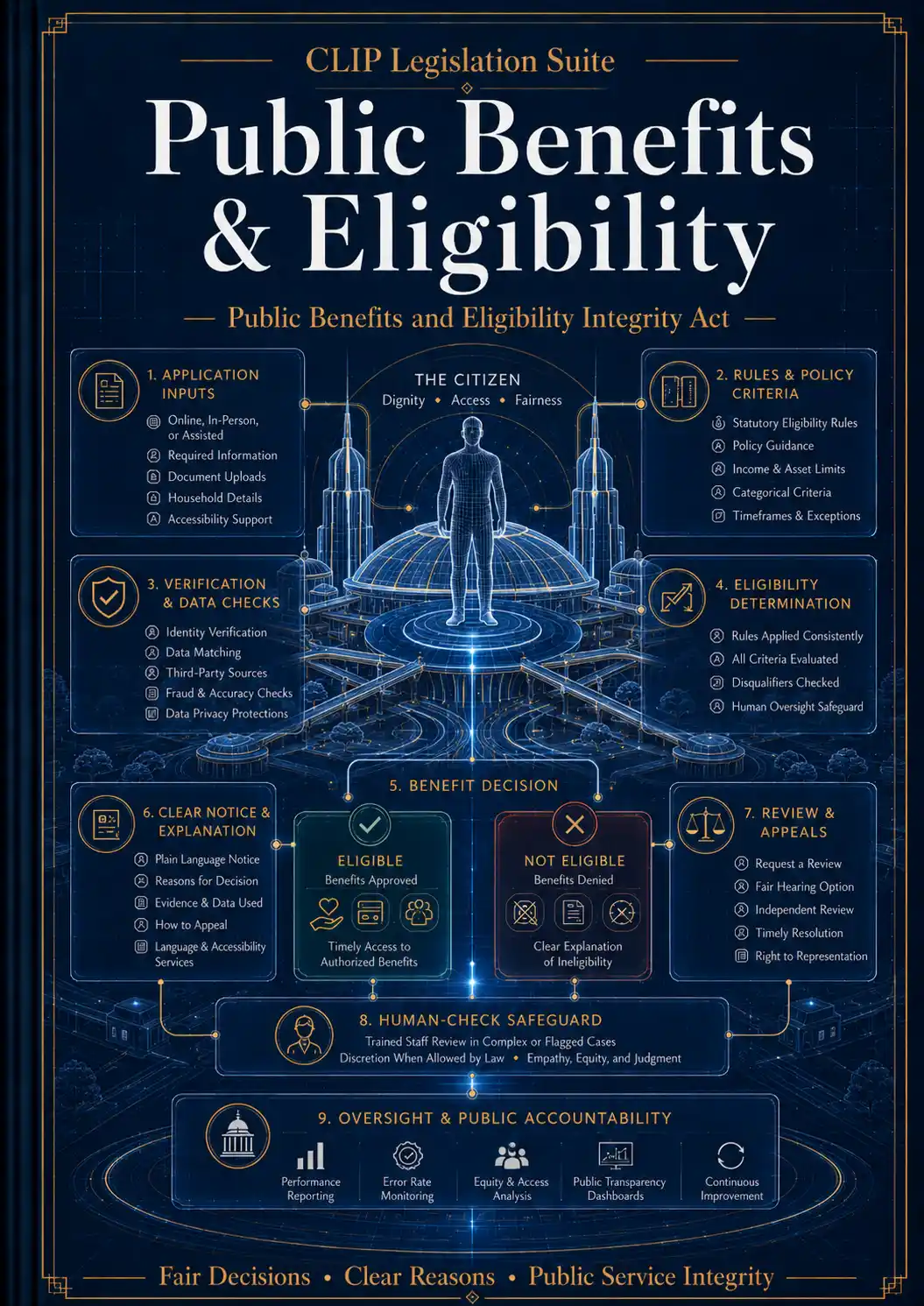
Project Page: AI Does Not Fix Government. It Amplifies It (Part 1) https://x.com/SkillsGapTrain/status/2065348053645861271
Disclaimer: This is an open-source educational system that is being developed for learning, research, frontier systems engineering and prototyping, intended to help students, teachers, public-sector builders, policy analysts, political leaders, corporate leaders and responsible organizations explore next-generation governance systems for humanity; it is not legal advice, policy authority, certification, or deployment-ready public infrastructure. Executive Summary of Audit of current development status is located at bottom of Part 3 of Project Page.