Model Act Generated from the NSIR / CLIP Clean-System Framework
Long Title
An Act to establish a lawful, rights-respecting, environmentally serious, Indigenous-rights-respecting, federally coordinated, auditable, time-bounded, and output-oriented infrastructure approval system; to map infrastructure decision pathways, define approval gates, require reasons for delay or refusal, provide redesign-and-resubmit pathways, preserve review and remedy, and ensure that critical infrastructure systems convert public purpose into completed public works.
Preamble
Whereas infrastructure is the physical operating system of a country;
Whereas housing, energy, transportation, water, ports, airports, rail, roads, bridges, broadband, defense facilities, critical minerals, public buildings, hospitals, schools, emergency infrastructure, and industrial capacity depend on lawful infrastructure approval and delivery systems;
Whereas democratic societies must build while respecting constitutional rights, Indigenous rights, treaty obligations, environmental protection, public safety, property rights, local legitimacy, procedural fairness, and public accountability;
Whereas infrastructure failure may appear not as a single collapse, but as latency, uncertainty, fragmented authority, unclear criteria, duplicative review, missing evidence thresholds, endless consultation loops, weak coordination, political discretion without reasons, no recovery pathway, poor procurement, and failure to convert approvals into completed assets;
Whereas speed without legality can damage rights, land, communities, environment, and public trust;
Whereas legality without throughput can produce paralysis, scarcity, infrastructure decay, housing failure, energy insecurity, and national weakness;
Whereas the standard is not reckless speed, but lawful throughput;
Whereas a public infrastructure system should be mapped, auditable, time-bounded, appealable, reviewable, evidence-based, coordinated, and capable of producing completed public works;
Whereas a system that can say no should also be able to say how to repair, redesign, mitigate, resubmit, approve, monitor, or terminate;
Therefore, Parliament enacts as follows.
Part 1 — Short Title, Purpose, and Core Principles
1. Short Title
This Act may be cited as the Infrastructure Systems Integrity and Throughput Act.
2. Purpose
The purpose of this Act is to ensure that high-impact infrastructure systems:
- preserve lawful authority;
- respect constitutional rights, Indigenous rights, treaty obligations, environmental protection, public safety, and procedural fairness;
- provide clear project classes and approval pathways;
- define complete-application requirements;
- provide bounded review timelines;
- identify responsible authorities;
- require evidence-based decisions;
- provide reasons for delay, approval, refusal, redesign, or conditions;
- create redesign-and-resubmit pathways;
- coordinate federal, provincial, territorial, municipal, Indigenous, and regulatory responsibilities;
- preserve audit trails and judicially reviewable records;
- monitor post-approval compliance;
- convert public purpose into completed infrastructure where lawful;
- distinguish legitimate safeguards from avoidable system incoherence.
3. Core Rule
A responsible authority shall not operate a high-impact infrastructure approval system unless the system has a published approval map identifying project classes, responsible authorities, decision gates, evidentiary thresholds, consultation stages, timelines, review pathways, appeal or reconsideration mechanisms, reasons requirements, compliance monitoring, and recovery options.
4. Lawful Throughput Principle
Infrastructure law shall pursue lawful throughput.
Lawful throughput means the timely conversion of legitimate public, private, community, or Indigenous infrastructure proposals into lawful decisions and, where approved, completed assets, while preserving rights, environmental safeguards, consultation duties, public safety, evidence standards, public reasons, and review.
5. No False Choice Principle
Nothing in this Act shall be interpreted as requiring a choice between:
- infrastructure and rights;
- energy and environment;
- housing and consultation;
- speed and legality;
- public purpose and local legitimacy;
- national interest and public accountability.
The purpose of this Act is to design infrastructure systems that can do difficult coordination honestly.
6. System Visibility Principle
An infrastructure approval system shall be visible enough for applicants, affected communities, Indigenous governments, regulators, public authorities, courts, auditors, legislators, journalists, and the public to understand how decisions move from proposal to approval, refusal, redesign, monitoring, completion, or termination.
7. Output Conversion Principle
Public commitments, funding announcements, permits, approvals, strategies, and plans shall not be treated as completed infrastructure.
The system shall measure output conversion from proposal to approval, approval to construction, construction to operation, and operation to public benefit.
Part 2 — Definitions
8. Definitions
In this Act:
“affected community” means a community, municipality, region, Indigenous community, local population, neighbourhood, landholder group, industry, public-service group, or other community materially affected by a proposed infrastructure project or infrastructure system.
“approval gate” means a defined stage in an infrastructure approval pathway at which a responsible authority determines whether a project may proceed, requires further information, must be redesigned, may be approved with conditions, must be refused, or may be advanced to another stage.
“approval map” means a documented representation of the infrastructure approval pathway, including project classes, authorities, gates, timelines, consultation duties, evidence requirements, decision standards, review mechanisms, and post-approval obligations.
“complete application” means an application that satisfies the information, evidence, consultation, design, environmental, safety, financial, technical, and public-interest requirements prescribed for the relevant project class and approval pathway.
“critical infrastructure project” means a project whose approval, delay, failure, or completion materially affects housing supply, energy security, transportation capacity, water systems, food systems, health systems, defense capability, emergency response, digital infrastructure, critical minerals, industrial capacity, public safety, national resilience, or other prescribed public interests.
“decision record” means the record sufficient to reconstruct the legal authority, evidence, submissions, consultation, analysis, conditions, reasons, timelines, decision-maker, and review pathway for an infrastructure decision.
“environmental review” means assessment of environmental effects, mitigation, monitoring, cumulative effects, alternatives, public submissions, scientific evidence, and compliance conditions required by law.
“high-impact infrastructure system” means a public system for approving, funding, reviewing, permitting, coordinating, procuring, monitoring, or delivering infrastructure projects that materially affect housing, energy, transportation, water, ports, airports, rail, roads, bridges, broadband, public facilities, emergency response, defense, critical minerals, industrial capacity, environmental protection, Indigenous rights, public safety, or other significant public interests.
“Indigenous consultation pathway” means the process through which public authorities meet lawful duties relating to Indigenous rights, treaty obligations, consultation, accommodation, participation, consent where required by law, and ongoing engagement.
“infrastructure project” means a proposed, planned, funded, approved, constructed, operated, modified, expanded, or decommissioned physical, digital, industrial, energy, transportation, housing-enabling, public-service, defense, emergency, or critical infrastructure asset.
“lawful throughput” means timely, evidence-based, rights-respecting, environmentally serious, procedurally fair, coordinated, and auditable movement of infrastructure projects through decision stages toward lawful approval, lawful refusal, redesign, completion, or termination.
“recovery pathway” means a process through which a project facing refusal, delay, deficiency, jurisdictional conflict, consultation issue, environmental issue, technical issue, or conditions may be redesigned, supplemented, resubmitted, referred, coordinated, or resolved.
“responsible authority” means the public authority legally responsible for administering, coordinating, approving, refusing, reviewing, permitting, funding, monitoring, or auditing an infrastructure approval or delivery process.
“strategic infrastructure project” means a critical infrastructure project designated under this Act as materially important to national, regional, Indigenous, provincial, territorial, municipal, emergency, housing, energy, industrial, defense, climate-adaptation, or resilience objectives.
“throughput dashboard” means a public reporting system tracking project flow, timelines, bottlenecks, decisions, redesigns, approvals, refusals, appeals, construction starts, completion, and operational status.
Part 3 — Application and Project Classification
9. Application
This Act applies to high-impact infrastructure systems and prescribed infrastructure projects requiring public approval, coordination, funding, permitting, assessment, procurement, monitoring, or review.
10. Project Classes
The responsible authority shall classify infrastructure projects according to prescribed classes, including:
- minor projects;
- standard projects;
- high-impact projects;
- critical infrastructure projects;
- strategic infrastructure projects;
- emergency infrastructure projects;
- projects requiring enhanced Indigenous consultation;
- projects requiring enhanced environmental review;
- projects requiring multi-jurisdictional coordination;
- projects requiring national-security or critical-resilience review.
11. Classification Criteria
Project classification shall consider:
- public purpose;
- scale;
- location;
- affected population;
- environmental risk;
- Indigenous rights and treaty implications;
- land use;
- safety risk;
- infrastructure dependency;
- energy, housing, transportation, water, defense, or resilience significance;
- jurisdictional complexity;
- reversibility of harm;
- urgency;
- cumulative effects;
- public interest.
12. Public Classification Notice
The responsible authority shall publish the project classification and approval pathway for high-impact, critical, strategic, or emergency infrastructure projects unless publication would create a serious and demonstrable risk to national security, cybersecurity, public safety, privacy, lawful confidentiality, or emergency response.
13. Prohibition on Avoidance
A project shall not be divided, relabelled, staged, reclassified, outsourced, or routed through another authority for the purpose of avoiding the requirements of this Act.
Part 4 — Infrastructure Approval Map
14. Approval Map Requirement
Every high-impact infrastructure system shall maintain a published approval map.
15. Contents of Approval Map
The approval map shall identify:
- project classes;
- responsible authorities;
- statutory authority;
- approval gates;
- complete-application requirements;
- evidence requirements;
- consultation stages;
- Indigenous consultation pathway;
- environmental review pathway;
- safety review;
- public submission process;
- timelines;
- decision standards;
- reasons requirements;
- conditions process;
- redesign-and-resubmit pathway;
- appeal, reconsideration, or judicial review pathway;
- compliance monitoring;
- post-approval reporting;
- completion reporting;
- bottleneck escalation process.
16. Citizen-Readable Approval Map
The responsible authority shall publish a citizen-readable approval map explaining:
- how infrastructure projects are reviewed;
- who makes decisions;
- what evidence is required;
- how communities participate;
- how Indigenous consultation is handled;
- how environmental protection is assessed;
- what timelines apply;
- how decisions can be challenged;
- how projects can be redesigned;
- how approved projects are monitored.
17. Restricted Annex
Where security, safety, Indigenous confidentiality, commercial confidentiality, privacy, or procurement sensitivity requires restriction, the responsible authority shall maintain a restricted annex for authorized reviewers.
Confidentiality shall not eliminate auditability.
Part 5 — Complete Application and Early Clarity
18. Complete-Application Test
A responsible authority shall determine whether an application is complete within the prescribed period after submission.
19. Contents of Complete Application
A complete application shall include, where applicable:
- project description;
- public purpose or private purpose;
- project location;
- project class;
- applicant identity;
- ownership and financing;
- technical design;
- environmental information;
- Indigenous consultation information;
- affected-community information;
- land-use information;
- safety information;
- infrastructure dependencies;
- data, digital, or cyber components where relevant;
- risk assessment;
- mitigation plan;
- monitoring plan;
- decommissioning or closure plan where relevant;
- evidence required by regulation.
20. Deficiency Notice
Where an application is incomplete, the responsible authority shall issue a deficiency notice identifying:
- missing information;
- why the information is required;
- how the deficiency may be corrected;
- timeline for resubmission;
- contact point for clarification.
21. Early Issue Identification
The responsible authority shall identify material legal, environmental, consultation, safety, jurisdictional, technical, or public-interest issues as early as practicable.
22. No Late Surprise Principle
A responsible authority shall not rely on a material issue for refusal or serious delay where the authority knew or should reasonably have known of the issue earlier and failed to notify the applicant, affected community, or relevant Indigenous government in a timely manner, unless late reliance is necessary to address serious new evidence, safety risk, rights risk, environmental risk, or unlawful conduct.
Part 6 — Approval Gates and Timelines
23. Approval Gates
An approval pathway shall contain defined gates, including where applicable:
- intake and classification;
- complete-application decision;
- early issue identification;
- consultation plan;
- environmental review scope;
- technical review;
- public submissions;
- Indigenous consultation review;
- draft conditions;
- decision readiness;
- approval, conditional approval, redesign, refusal, or referral;
- post-approval monitoring;
- completion and operation reporting.
24. Bounded Timelines
Each approval gate shall have a prescribed timeline.
Timelines may vary by project class, complexity, consultation requirements, environmental risk, safety risk, and jurisdictional complexity.
25. Timeline Pause
A timeline may be paused only for prescribed reasons, including:
- applicant failure to provide required information;
- consultation requirement;
- new material evidence;
- safety risk;
- environmental risk;
- Indigenous rights issue;
- jurisdictional dispute;
- emergency;
- court order;
- other prescribed reason.
26. Reasons for Pause or Delay
Where a timeline is paused or delayed, the responsible authority shall provide written reasons identifying:
- reason for pause or delay;
- authority relied on;
- information or action required;
- responsible party;
- expected duration;
- pathway to resume review.
27. Delay Escalation
Where a project exceeds prescribed timelines, the responsible authority shall escalate the matter for review and publish, subject to lawful limits, the reason for delay and corrective action plan.
28. No Deemed Approval Without Lawful Review
Nothing in this Act creates deemed approval where legal, environmental, safety, Indigenous consultation, or rights requirements have not been satisfied.
The remedy for delay is escalation, reasons, repair, review, or lawful decision, not automatic bypass of necessary safeguards.
Part 7 — Evidence Standards and Decision Criteria
29. Evidence-Based Decision Requirement
An infrastructure decision shall be based on the decision record, applicable law, relevant evidence, public submissions, consultation record, technical review, environmental review, safety review, and prescribed criteria.
30. Decision Criteria
Decision criteria shall be published for each project class and approval pathway.
Criteria may include:
- legal authority;
- public purpose;
- environmental effects;
- Indigenous rights and treaty obligations;
- public safety;
- technical feasibility;
- infrastructure need;
- housing, energy, transportation, water, defense, or resilience value;
- economic and public-interest effects;
- cumulative effects;
- mitigation measures;
- alternatives;
- monitoring capacity;
- compliance capacity;
- decommissioning obligations.
31. Evidence Thresholds
Where a decision turns on scientific, technical, environmental, safety, economic, Indigenous rights, or public-interest evidence, the responsible authority shall identify the evidence threshold applied.
32. Conditions
A responsible authority may approve a project with conditions where conditions are lawful, clear, monitorable, enforceable, proportionate, and connected to identified risks or public purposes.
33. No Unbounded Discretion
A responsible authority shall not approve, refuse, delay, or condition a project based on undisclosed criteria, unbounded discretion, hidden policy, or reasons unrelated to lawful decision criteria.
Part 8 — Indigenous Rights, Treaty Obligations, and Consultation Pathway
34. Indigenous Rights Protection
Nothing in this Act limits Indigenous rights, treaty rights, Aboriginal rights, constitutional duties, consultation obligations, accommodation duties, or any requirement of consent where required by law.
35. Indigenous Consultation Pathway
A high-impact infrastructure system shall identify the Indigenous consultation pathway where a project may affect Indigenous rights, treaty rights, lands, resources, governance, culture, services, or interests.
36. Contents of Indigenous Consultation Pathway
The pathway shall identify:
- potentially affected Indigenous peoples or governments;
- legal basis for consultation;
- consultation stages;
- information-sharing requirements;
- timelines;
- capacity-support mechanisms where appropriate;
- accommodation process;
- issue-resolution process;
- decision record requirements;
- monitoring and compliance roles;
- dispute-escalation process.
37. Consultation Integrity
Consultation shall be conducted in good faith, with sufficient information, meaningful opportunity to participate, and consideration of accommodation where required by law.
38. No Consultation Theatre
A process shall not satisfy this Act if consultation is merely formal, symbolic, pre-decided, inaccessible, or incapable of influencing the decision where law requires meaningful consultation.
39. Indigenous Partnership Pathway
Where appropriate, the responsible authority may support Indigenous partnership, co-development, revenue participation, monitoring roles, guardianship, equity participation, or other lawful arrangements consistent with Indigenous rights and public purpose.
Part 9 — Environmental Review and Mitigation
40. Environmental Review Pathway
A high-impact infrastructure system shall identify the environmental review pathway applicable to each project class.
41. Contents of Environmental Review
Environmental review shall assess, where applicable:
- project effects;
- cumulative effects;
- alternatives;
- mitigation measures;
- monitoring requirements;
- climate and resilience considerations where required by law;
- species, habitat, water, air, land, and ecosystem effects;
- public submissions;
- Indigenous knowledge where provided and lawfully considered;
- uncertainty;
- adaptive management;
- compliance conditions.
42. Mitigation Hierarchy
Where environmental harm is identified, the responsible authority shall consider avoidance, minimization, mitigation, restoration, offset, monitoring, or refusal, as appropriate under law.
43. Environmental Conditions
Environmental conditions shall be clear, enforceable, monitorable, and connected to identified effects.
44. Post-Approval Environmental Monitoring
Approved projects subject to environmental conditions shall include monitoring, reporting, enforcement, and correction mechanisms.
Part 10 — Multi-Jurisdictional Coordination
45. Coordination Map
Where a project involves multiple jurisdictions, the responsible authority shall prepare a coordination map.
46. Contents of Coordination Map
The coordination map shall identify:
- federal authorities;
- provincial or territorial authorities;
- municipal authorities;
- Indigenous governments or bodies;
- regulators;
- tribunals;
- permitting bodies;
- utilities or infrastructure owners;
- private parties with legal obligations;
- overlapping approvals;
- sequencing dependencies;
- dispute-resolution mechanisms;
- lead coordination authority where applicable.
47. One Project Record
Where practicable, a high-impact project shall maintain one coordinated project record accessible to authorized decision-makers and reviewers.
48. Mutual Recognition and Substitution
Where lawful, responsible authorities may use substitution, equivalency, mutual recognition, joint review, coordinated timelines, or shared evidence to reduce duplication without weakening rights, environmental protection, consultation duties, public safety, or review.
49. Jurisdictional Dispute Escalation
Where jurisdictional conflict causes material delay, the responsible authorities shall escalate the dispute through a prescribed coordination process.
Part 11 — Strategic Infrastructure Pathway
50. Strategic Designation
A project may be designated as a strategic infrastructure project where it materially contributes to:
- housing supply;
- energy security;
- grid reliability;
- transportation capacity;
- water security;
- critical minerals;
- defense capability;
- emergency preparedness;
- industrial capacity;
- climate adaptation or resilience;
- remote or northern infrastructure;
- Indigenous infrastructure priorities;
- national or regional economic resilience;
- other prescribed public interests.
51. Effect of Strategic Designation
Strategic designation may provide:
- coordinated review;
- priority scheduling;
- clear lead authority;
- integrated consultation plan;
- integrated environmental review;
- bounded timelines;
- escalation for bottlenecks;
- public reporting;
- enhanced compliance monitoring.
52. No Exemption from Law
Strategic designation shall not exempt a project from constitutional rights, Indigenous rights, treaty obligations, environmental law, safety law, procedural fairness, or judicial review.
53. Strategic Reasons
The responsible authority shall publish reasons for strategic designation, subject to lawful limits.
Part 12 — Redesign, Recovery, and Resubmission Pathways
54. Redesign-and-Resubmit Pathway
Where a project cannot be approved as submitted but may be made approvable through redesign, mitigation, accommodation, conditions, route change, scale change, timing change, technology change, or additional evidence, the responsible authority shall identify the redesign-and-resubmit pathway where practicable.
55. Contents of Redesign Notice
A redesign notice shall identify:
- issue preventing approval;
- legal or evidentiary basis;
- possible repair options;
- additional evidence required;
- affected authorities;
- affected Indigenous or community issues;
- timeline for resubmission;
- consequences if not corrected.
56. Recovery Conference
For critical or strategic projects facing serious delay, the responsible authority may convene a recovery conference with relevant authorities, applicant, affected Indigenous governments, affected communities where appropriate, and technical reviewers to identify lawful pathways to decision.
57. Refusal with Repair Logic
Where a project is refused, reasons shall identify whether refusal is final or whether redesign, mitigation, alternate route, alternate technology, resubmission, or new evidence could address the grounds for refusal.
58. Termination Pathway
Where a project cannot lawfully proceed, the responsible authority shall identify the termination pathway, record preservation, decommissioning obligations where relevant, and reasons.
Part 13 — Reasons, Review, and Judicially Reviewable Record
59. Reasons Requirement
A responsible authority shall provide written reasons for:
- classification;
- incomplete application decision;
- delay or timeline pause;
- consultation determination;
- environmental review scope;
- conditions;
- approval;
- refusal;
- redesign requirement;
- strategic designation;
- suspension;
- enforcement action.
60. Contents of Reasons
Reasons shall identify:
- decision made;
- authority relied on;
- evidence considered;
- criteria applied;
- submissions materially considered;
- consultation record where relevant;
- environmental review findings where relevant;
- conditions imposed;
- unresolved issues;
- review or appeal pathway;
- recovery or resubmission pathway where applicable.
61. Decision Record
A responsible authority shall maintain a decision record sufficient for administrative review, audit, legislative review, tribunal review, judicial review, and public accountability.
62. Contents of Decision Record
The decision record shall include:
- application;
- project classification;
- complete-application determination;
- evidence submitted;
- technical review;
- consultation record;
- environmental review;
- public submissions;
- authority map;
- timeline record;
- reasons;
- conditions;
- review or appeal record;
- compliance monitoring record;
- changes to project scope;
- post-approval reports.
63. Review Pathway
A high-impact infrastructure system shall provide a clear pathway for reconsideration, administrative review, tribunal review, judicial review, complaint, or other remedy where available by law.
Part 14 — Post-Approval Compliance and Delivery
64. Post-Approval Compliance Plan
An approved high-impact, critical, or strategic infrastructure project shall have a post-approval compliance plan.
65. Contents of Compliance Plan
The plan shall identify:
- conditions;
- responsible parties;
- monitoring requirements;
- reporting requirements;
- inspection process;
- enforcement process;
- Indigenous monitoring roles where applicable;
- environmental monitoring;
- safety monitoring;
- public reporting;
- non-compliance response;
- completion reporting.
66. Construction Start Reporting
For approved critical or strategic infrastructure projects, the responsible authority shall report whether and when construction begins, subject to lawful limits.
67. Completion Reporting
For approved critical or strategic infrastructure projects, the responsible authority shall report whether and when the project is completed, operational, delayed, suspended, cancelled, or decommissioned.
68. Approval-to-Output Review
The responsible authority shall track whether approved projects become completed infrastructure and identify reasons for failure to proceed where known.
69. No Announcement Substitution
A public authority shall not report funding announcements, strategies, memoranda, permits, or approvals as completed infrastructure.
Part 15 — Infrastructure Throughput Dashboard
70. Throughput Dashboard
The government shall maintain a public infrastructure throughput dashboard.
71. Dashboard Indicators
The dashboard shall include, at an appropriate level of aggregation:
- projects submitted;
- projects classified by class;
- applications determined complete;
- applications determined incomplete;
- average time to complete-application decision;
- average time by approval gate;
- timeline pauses and reasons;
- projects approved;
- projects approved with conditions;
- projects refused;
- projects redesigned and resubmitted;
- projects under consultation;
- projects under environmental review;
- projects delayed by jurisdictional conflict;
- projects designated strategic;
- projects under construction;
- projects completed;
- projects cancelled;
- appeals or reviews filed;
- post-approval non-compliance findings;
- bottleneck categories;
- repair actions.
72. Public Reporting
Dashboard reporting shall distinguish:
- proposed projects;
- applications under review;
- approvals;
- projects under construction;
- completed infrastructure;
- operational infrastructure.
73. Protection of Sensitive Information
Dashboard reporting shall not disclose information where disclosure would create a serious and demonstrable risk to national security, cybersecurity, public safety, Indigenous confidentiality, privacy, lawful commercial confidentiality, or procurement integrity.
Part 16 — Bottleneck Review and Systems Repair
74. Bottleneck Review
Where infrastructure approval pathways show recurring delay, refusal, litigation, consultation failure, data gaps, jurisdictional conflict, or post-approval non-completion, the responsible authority shall conduct a bottleneck review.
75. Contents of Bottleneck Review
The review shall identify:
- bottleneck type;
- affected project class;
- authority involved;
- legal cause;
- administrative cause;
- data cause;
- consultation cause;
- environmental review cause;
- jurisdictional cause;
- capacity cause;
- applicant cause;
- vendor or procurement cause;
- repair option;
- responsible authority;
- timeline for repair.
76. Systems Repair Plan
Where a bottleneck review identifies recurring system failure, the responsible authority shall prepare a systems repair plan.
77. Contents of Systems Repair Plan
The plan shall identify:
- failure mode;
- affected project classes;
- repair action;
- legal amendment required;
- administrative change required;
- staffing or capacity change required;
- data or digital system change required;
- consultation improvement required;
- environmental review improvement required;
- coordination improvement required;
- dashboard indicator;
- deadline;
- review date.
78. Public Challenge Process
The responsible authority shall establish a process through which affected communities, Indigenous governments, applicants, civil society, journalists, public servants, auditors, experts, municipalities, regulators, and other affected parties may submit evidence of infrastructure system failure, delay, bottleneck, rights concern, environmental concern, consultation failure, or output-conversion failure.
Part 17 — Security, Confidentiality, and Bounded Accountability
79. Protected Information
Nothing in this Act requires public disclosure of information where disclosure would create a serious and demonstrable risk to national security, cybersecurity, public safety, privacy, Indigenous confidentiality, law enforcement, procurement integrity, legally privileged information, or lawful commercial confidentiality.
80. Bounded Accountability
Where information cannot be made public, the responsible authority shall provide:
- a public summary at the highest safe level of abstraction;
- a restricted record for authorized reviewers;
- audit access sufficient to verify legality, accountability, and compliance;
- written reasons for withholding public disclosure where lawful.
81. No Secrecy Without Review
Confidentiality shall not eliminate the requirement for authorized audit, legal review, Indigenous rights review, environmental review, safety review, legislative review, oversight, or accountability.
Part 18 — Oversight, Compliance, and Orders
82. Oversight Body
An authorized oversight body shall monitor compliance with this Act.
The oversight body may be established by regulation or assigned to an existing public authority with appropriate independence, expertise, and legal powers.
83. Powers of Oversight Body
The oversight body may:
- require records;
- inspect approval maps;
- inspect project records;
- review reasons for delay;
- review bottleneck reports;
- review throughput dashboard data;
- investigate complaints;
- require systems repair plans;
- require public reporting;
- review post-approval compliance;
- refer matters to courts, tribunals, auditors, environmental authorities, Indigenous consultation bodies, procurement authorities, or legislative committees where appropriate.
84. Compliance Orders
An oversight body may issue a compliance order requiring a responsible authority to:
- prepare or update an approval map;
- issue a complete-application decision;
- provide reasons for delay;
- provide reasons for refusal or conditions;
- prepare a coordination map;
- prepare a bottleneck review;
- prepare a systems repair plan;
- update dashboard reporting;
- preserve the decision record;
- report on post-approval compliance.
85. No Order to Bypass Rights
An oversight body shall not order a responsible authority to bypass constitutional rights, Indigenous rights, treaty obligations, environmental law, public safety law, procedural fairness, or judicial review.
Part 19 — Regulations
86. Regulations
The Governor in Council may make regulations:
- prescribing project classes;
- prescribing critical infrastructure categories;
- prescribing strategic infrastructure criteria;
- establishing complete-application requirements;
- establishing approval gate timelines;
- establishing pause rules;
- establishing reasons requirements;
- establishing dashboard indicators;
- establishing bottleneck review procedures;
- establishing systems repair plan requirements;
- establishing public reporting formats;
- establishing post-approval monitoring requirements;
- establishing phased implementation timelines;
- exempting systems where equivalent or stronger review exists.
87. No Regulation May Defeat Purpose
No regulation made under this Act shall defeat the purpose of ensuring lawful, rights-respecting, environmentally serious, auditable, time-bounded, coordinated, and output-oriented infrastructure approval and delivery systems.
Part 20 — Statutory Review, Pilot Phase, and Coming into Force
88. Statutory Review
A committee of Parliament shall review this Act within three years after coming into force and every five years thereafter.
The review shall examine:
- whether the Act improves infrastructure system visibility;
- whether it improves lawful throughput;
- whether it preserves rights, Indigenous consultation, environmental protection, and public safety;
- whether it reduces avoidable delay;
- whether it improves reasons and review;
- whether it improves approval-to-completion tracking;
- whether it improves intergovernmental coordination;
- whether it creates unnecessary bureaucracy;
- whether amendments are required.
89. Pilot Phase
This Act shall be implemented through a pilot phase applying first to prescribed infrastructure systems, including:
- housing-enabling infrastructure;
- electricity transmission and generation;
- water and wastewater systems;
- ports, rail, roads, bridges, and airports;
- critical minerals infrastructure;
- defense and emergency infrastructure;
- broadband and digital infrastructure;
- Indigenous infrastructure partnerships;
- climate-adaptation and resilience infrastructure;
- strategic industrial infrastructure.
90. Coming into Force
This Act comes into force on a day fixed by order of the Governor in Council.
Different provisions may come into force on different days.
Schedule A — Infrastructure Approval Map Template
An infrastructure approval map shall identify:
- project class;
- responsible authority;
- legal authority;
- approval gates;
- complete-application requirements;
- evidence requirements;
- consultation pathway;
- Indigenous consultation pathway;
- environmental review pathway;
- safety review;
- public submission process;
- timelines;
- pause rules;
- decision criteria;
- reasons requirements;
- redesign-and-resubmit pathway;
- review or appeal pathway;
- post-approval compliance;
- completion reporting.
Schedule B — Complete Application Checklist
A complete application shall include, where applicable:
- project description;
- applicant identity;
- project class;
- project location;
- ownership and financing;
- technical design;
- environmental information;
- Indigenous consultation information;
- affected-community information;
- land-use information;
- safety information;
- infrastructure dependencies;
- alternatives considered;
- mitigation plan;
- monitoring plan;
- decommissioning plan;
- evidence required by regulation.
Schedule C — Decision Reasons Template
Reasons for an infrastructure decision shall identify:
- decision made;
- authority relied on;
- project class;
- evidence considered;
- criteria applied;
- consultation record;
- Indigenous rights considerations where applicable;
- environmental findings where applicable;
- safety findings where applicable;
- public submissions materially considered;
- conditions imposed;
- reasons for delay, refusal, approval, or redesign;
- review or appeal pathway;
- resubmission or recovery pathway where applicable.
Schedule D — Bottleneck Register
A bottleneck register shall identify:
- bottleneck category;
- affected project class;
- affected authority;
- triggering condition;
- likely harm;
- severity;
- frequency;
- detectability;
- existing control;
- missing control;
- repair action;
- responsible authority;
- deadline;
- status;
- review date.
Bottleneck categories may include:
- incomplete applications;
- unclear evidence standards;
- consultation delay;
- environmental review uncertainty;
- jurisdictional conflict;
- capacity shortage;
- applicant delay;
- litigation uncertainty;
- political discretion without reasons;
- procurement delay;
- post-approval financing failure;
- construction delay;
- compliance failure;
- lack of redesign pathway.
Schedule E — Strategic Infrastructure Designation Template
A strategic infrastructure designation shall identify:
- project name;
- project class;
- responsible authority;
- strategic purpose;
- affected infrastructure system;
- public benefit;
- affected communities;
- Indigenous rights considerations;
- environmental review pathway;
- coordination authorities;
- approval gates;
- timelines;
- public reporting plan;
- compliance monitoring plan.
Schedule F — Approval-to-Output Dashboard Metrics
The throughput dashboard shall distinguish:
- projects announced;
- applications submitted;
- applications complete;
- applications under review;
- applications delayed;
- applications approved;
- applications refused;
- applications redesigned;
- projects financed;
- projects under procurement;
- projects under construction;
- projects completed;
- projects operational;
- projects cancelled;
- completed public outputs delivered.
Final Standard
The Infrastructure Systems Integrity and Throughput Act exists because a country that cannot build cannot govern its future.
But building must remain lawful.
The answer to delay is not to erase rights.
The answer to rights is not to accept paralysis.
The answer is systems integrity: clear authority, clear gates, clear evidence, clear consultation, clear timelines, clear reasons, clear review, clear redesign pathways, and clear measurement from approval to completed infrastructure.
The standard is simple:
Build lawfully. Review honestly. Decide clearly. Repair bottlenecks. Measure completed infrastructure, not announcements.
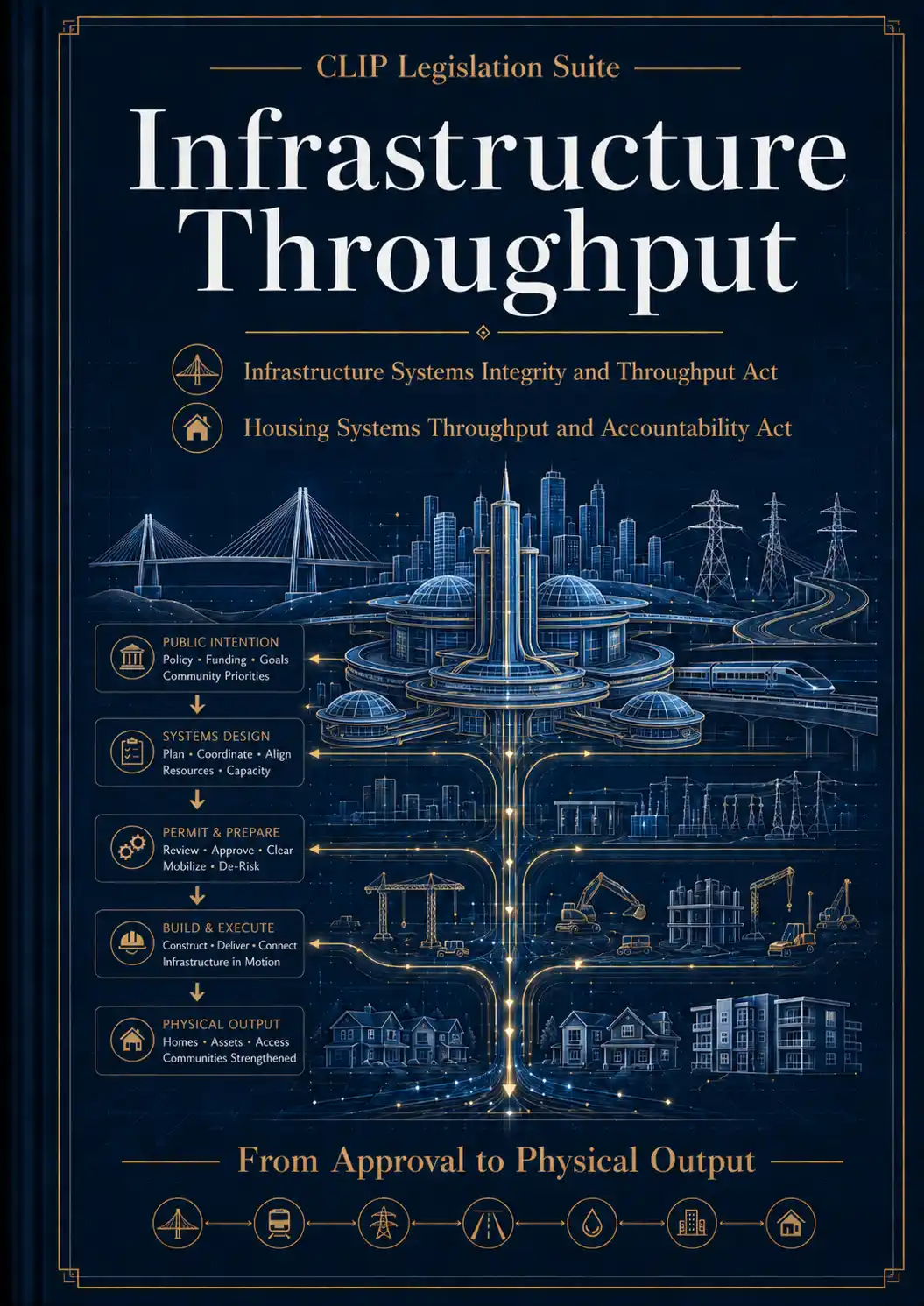
Project Page: AI Does Not Fix Government. It Amplifies It (Part 1) https://x.com/SkillsGapTrain/status/2065348053645861271
Disclaimer: This is an open-source educational system that is being developed for learning, research, frontier systems engineering and prototyping, intended to help students, teachers, public-sector builders, policy analysts, political leaders, corporate leaders and responsible organizations explore next-generation governance systems for humanity; it is not legal advice, policy authority, certification, or deployment-ready public infrastructure. Executive Summary of Audit of current development status is located at bottom of Part 3 of Project Page.