Celebrating with family 🫶🏼🌸 https://x.com/IvankaTrump/status/2059614812305318319
Part I — The Image and the Crisis
1. A Statue Beside the Books
A classical bust beside books is never just decoration. It is a small archive of civilizational longing.
The image that prompted this essay was quiet, domestic, almost easy to overlook: a statue placed among books, a lamp, a mirror, botanical art, and the textures of a cultivated interior. Nothing in the scene announced conquest. There was no sword, no eagle standard, no imperial globe, no laurel crown, no armored emperor with his arm raised over a defeated world. The statue did not speak the language of empire at full march. It spoke the language of memory.
Its presence suggested another civilizational grammar: learning, taste, refinement, literature, art history, philosophy, the old European habit of placing fragments of antiquity near the spaces of reading and conversation. It belonged less to the battlefield than to the salon, less to the triumphal arch than to the library table. It was not Caesar in the forum. It was the muse in the study.
That matters.
Civilizations reveal themselves not only in their constitutions, machines, laws, armies, and markets, but also in the objects they choose to place near their books. A bust in a room can be a small monument to the belief that the past still has something to teach the present. It can say that beauty is not useless, that memory is not dead weight, that refinement is not weakness, that culture is not merely decoration but inheritance.
The statue therefore becomes a doorway. At first, it invites an aesthetic reading: this is the old language of cultivated life. Books, lamp, mirror, botanical art, classical form. A domestic scene, yes, but also a symbolic arrangement. The mind is meant to remember. The eye is meant to be trained. The home is meant to carry traces of a larger civilization.
But the longer one looks, the harder question appears.
What kind of people are required to preserve the world that such objects remember?
A statue can carry memory, but it cannot defend memory. A library can preserve books, but it cannot guarantee that a society will still know how to read, build, govern, repair, or tell the truth. A beautiful object can remind a civilization of what it once admired, but it cannot by itself produce the human beings required to carry that admiration into a century of pressure.
Beauty matters. But beauty alone cannot defend itself.
That is the threshold of this essay.
The image begins in refinement. The question it opens is harder: what happens when the institutions that inherited civilization’s beautiful objects lose the capacity to think clearly, build competently, defend courageously, govern power morally, preserve truth, and carry memory forward?
The answer cannot be merely administrative. The answer cannot be another committee, another credential, another compliance document, another managerial layer placed on top of systems that no longer produce reliable outputs. The answer must go deeper than procedure.
The institutions of the future will not be saved by administrators because administration preserves procedure, not purpose. They will be rebuilt by archetypal people.
2. From the Salon to the Shield Wall
The statue belongs to the world of the salon: conversation, books, art, memory, cultivated taste. But the years 2020 to 2070 will not be a calm salon century.
They will be a pressure century.
The coming decades are already being framed by major foresight institutions as an era of structural strain. The U.S. National Intelligence Council’s Global Trends 2040 describes a more contested world shaped by demographic, environmental, economic, technological, and governance pressures. The IPCC’s Sixth Assessment Synthesis Report summarizes widespread climate impacts and rising adaptation demands. The World Economic Forum’s 2025 risk work highlights conflict, disinformation, extreme weather, societal polarization, cyber-espionage, and cyberwarfare as major concerns.
This does not mean the future is doomed. It means the future will test institutional character.
Artificial intelligence will not merely automate tasks; it will challenge judgment, authorship, education, governance, surveillance, labor, and strategic competition. NIST’s AI Risk Management Framework exists precisely because AI systems create risks for individuals, organizations, and society that must be actively governed rather than passively admired.
Cyber conflict will not remain a technical nuisance at the edge of public life. It will increasingly touch finance, energy, logistics, health systems, public administration, elections, supply chains, identity systems, and military infrastructure. Climate and infrastructure stress will not remain abstract graphs; they will appear as damaged grids, strained ports, fragile insurance systems, migration pressure, food and water disruption, and emergency response failures. Disinformation will not merely produce bad opinions; it will corrode trust in the institutions that need legitimacy in order to function.
In such a century, inherited culture becomes more precious, not less. But it also becomes more vulnerable.
A civilization under pressure cannot survive by memory alone. It must remember and defend. It must admire and build. It must preserve and adapt. It must govern and restrain itself. It must carry beauty, but also protect the conditions under which beauty can remain meaningful.
That is why the statue beside the books is incomplete as a civilizational symbol. It needs companions.
It needs Athena: wisdom armed.
It needs Leonidas: courage disciplined.
It needs Achilles: excellence unleashed.
It needs Hercules: strength redeemed.
It needs Marcus Aurelius: power self-governed.
It needs Maximus: honor unconquered.
It needs Spartacus: freedom fought for.
And beyond these figures of character under conflict, it needs the institutional completion layer: the lawgiver, the maker, the navigator, the carrier of inheritance, and the truth-teller. Solon and Cicero. Hephaestus and Daedalus. Odysseus. Aeneas. Socrates and Antigone.
The question is not whether modern institutions should literally imitate ancient Greece, Rome, biblical history, or cinema. That would be childish. The question is whether those older symbolic forms still name human capacities that institutions repeatedly need and repeatedly lose.
They do.
The salon needs the shield wall. The archive needs the forge. The library needs the lawgiver. The institution needs the truth-teller. The command center needs the philosopher. The future needs people who can operate under pressure without surrendering either competence or conscience.
The beautiful statues of civilization are incomplete without the figures that defend, rebuild, govern, and renew civilization.
This is the movement from the salon to the shield wall.
3. Administrative Civilization Without Character
The central danger of the next half-century is not technology by itself.
Technology can magnify wisdom or stupidity. It can serve liberty or domination. It can accelerate learning or automate error. It can strengthen institutions or hide their decay behind dashboards, metrics, interfaces, and procedural language.
Nor is the danger simply government, modernity, capitalism, bureaucracy, or the ancient past returning in new costume. Those explanations are too blunt.
The sharper danger is administrative civilization without character.
Administrative civilization without character is what remains when institutions preserve their outer forms while losing their inner functions. The titles remain. The procedures remain. The meetings remain. The acronyms remain. The policies remain. The dashboards remain. The credentials remain. But the institution no longer reliably does the thing it was built to do.
It educates without forming judgment.
It regulates without producing order.
It consults without deciding.
It manages without building.
It measures without understanding.
It communicates without telling the truth.
It preserves process while purpose dies inside the process.
This is why the problem cannot be solved merely by adding more administrative complexity. A broken control system does not become functional simply because its paperwork becomes more elaborate. A weak institution does not recover because it invents new language for decline. A society that has forgotten how to build cannot be restored by slogans about innovation. A public order that has lost courage cannot be defended by compliance theater. A civilization that has forgotten truth cannot be saved by better branding.
The deeper question is human.
What kind of person can think when the institution is confused?
What kind of person can build when the system rewards delay?
What kind of person can defend when leadership prefers avoidance?
What kind of person can restrain power when tools become stronger than judgment?
What kind of person can preserve honor when the institution itself becomes corrupted?
What kind of person can fight domination without becoming cruel?
What kind of person can carry inheritance through collapse without turning memory into nostalgia?
These are not merely policy questions. They are archetypal questions.
The administrator asks: what is the procedure?
The archetypal person asks: what is the function, what is the duty, what is the truth, and what must be preserved?
Administrators preserve process. Archetypes restore purpose.
Administrators manage decline. Archetypes rebuild capacity.
Administrators protect forms. Archetypes recover function.
This does not mean administration is useless. Every serious institution needs administration. Records must be kept. Systems must be coordinated. Laws must be implemented. Budgets must be managed. Standards must be maintained. But administration is a servant function, not a civilizational soul. When administration becomes the highest form of institutional life, the institution begins to mistake maintenance for mission.
That is the crisis.
A school can continue operating while no longer forming minds.
A legislature can continue sitting while no longer producing legitimate order.
A corporation can continue growing while hollowing out craft.
A military can continue procuring systems while losing warrior ethos.
A university can continue publishing while losing truth-seeking courage.
A government can continue announcing strategies while losing the capacity to execute.
A civilization can continue displaying its statues while forgetting the virtues those statues once implied.
The statue beside the books therefore becomes a test. It asks whether cultural inheritance will remain an aesthetic mood or become a living demand. It asks whether civilization will merely decorate itself with memory or form the people capable of carrying memory forward.
The institutions of the future will not be saved by administrators because administration preserves procedure, not purpose. They will be rebuilt by archetypal people: Athena minds to think, Leonidas hearts to defend, Achilles performers to execute, Hercules builders to restore, Marcus Aurelius commanders to restrain power, Maximus guardians to preserve honour, Spartacus souls to keep freedom alive — and the lawgivers, makers, navigators, continuity-carriers, and truth-tellers who complete the civilizational order.
That is the argument this essay now turns to.
The statue gave us the image.
The century gives us the crisis.
The archetypes give us the human map.
Part II — Method: What Is an Archetypal Person?
4. What Is an Archetypal Person?
Before naming the figures, the method must be made clear.
This essay does not treat myth, history, philosophy, scripture, and cinema as the same kind of evidence. They are not the same. Athena is not Marcus Aurelius. Achilles is not Spartacus. Hercules is not Solon. Maximus is not a Roman historical figure. Aeneas belongs to epic memory. Socrates belongs to philosophy and history. Antigone belongs to tragedy. These distinctions matter.
But the purpose of this essay is not to collapse all categories into one. It is to read them as symbolic reservoirs of human function.
Myth preserves patterns before they become policies. History preserves examples after they become consequences. Philosophy preserves questions that institutions would rather avoid. Cinema, at its best, translates older moral structures into modern emotional form. Each medium carries something different. None should be confused with the others. But each can reveal a durable human capacity that institutions repeatedly need, forget, and then rediscover under pressure.
That is what is meant here by an archetype.
An archetype is not a costume. It is not nostalgia. It is not a fantasy of returning to the ancient world. It is not an argument that modern institutions should literally imitate Sparta, Athens, Rome, Troy, or Hollywood. That would be childish. The future will not be rebuilt by people pretending to be ancient heroes.
An archetype is a compressed model of human capacity.
It is a name for a permanent function of civilization carried inside a person.
Athena names the function of strategic wisdom. Leonidas names the function of disciplined courage. Achilles names the function of excellence under decisive pressure. Hercules names the function of strength under burden. Marcus Aurelius names the function of power governed by conscience. Maximus names the function of honour after institutional betrayal. Spartacus names the function of freedom against domination. Solon and Cicero name the function of lawful order. Hephaestus and Daedalus name the function of technical making. Odysseus names the function of navigation through chaos. Aeneas names the function of inheritance carried through collapse. Socrates and Antigone name the function of truth under pressure.
These are not merely characters. They are civilizational organs.
A civilization needs wisdom the way a body needs sight. It needs courage the way a body needs a spine. It needs excellence the way a body needs trained hands. It needs strength the way a body needs muscle. It needs restraint the way a body needs a nervous system capable of inhibition. It needs honour the way a body needs memory of itself. It needs freedom the way a body needs breath. It needs law, craft, adaptation, continuity, and truth because without them, the social body becomes either inert or monstrous.
Modern institutions often speak in the language of roles: manager, analyst, engineer, regulator, educator, executive, operator, technician, officer, consultant, stakeholder. These are useful categories. They describe functions in an organizational chart. But they do not tell us whether the person inside the role has the character required to perform it under pressure.
That is the difference.
A manager may have authority without judgment. An engineer may have technique without responsibility. A regulator may have procedure without justice. A soldier may have force without restraint. A professor may have knowledge without courage. A leader may have power without self-command. A citizen may have rights without the will to defend them.
The archetypal question goes deeper than title, credential, or office.
It asks: what function does this person carry when the system begins to fail?
When the law becomes ambiguous, who carries order? When the tools become powerful, who carries wisdom? When the perimeter is threatened, who carries courage? When the system slows into paralysis, who carries execution? When damage must be repaired, who carries strength? When command becomes tempting, who carries restraint? When the institution betrays its mission, who carries honour? When domination becomes efficient, who carries freedom? When the signal is corrupted, who carries truth? When the city burns, who carries inheritance forward?
That is why archetypes matter for institutions of the future. They do not replace technical competence. They complete it.
The future will certainly need skills. It will need engineers, builders, AI specialists, cyber defenders, infrastructure planners, educators, public servants, physicians, soldiers, logisticians, designers, and scientists. But skill alone is not enough. Skill answers the question: Can this person operate the tool? Archetype answers the question: What kind of soul is operating the tool?
That distinction will become more important as tools become more powerful.
Artificial intelligence, robotics, surveillance systems, automated enforcement, synthetic media, cyber weapons, biological engineering, energy systems, space infrastructure, and planetary-scale logistics will expand the reach of human intention. But expanded reach does not automatically produce expanded wisdom. A civilization can become more capable and less mature at the same time. It can gain power while losing judgment. It can automate processes while hollowing out responsibility. It can increase efficiency while decreasing dignity.
This leads to the philosophical law at the center of the essay:
Virtue without capability becomes helpless. Capability without virtue becomes dangerous.
A society of good intentions without builders cannot repair anything. A society of brilliant technicians without conscience can become predatory. A society of courageous fighters without wisdom can become reckless. A society of philosophers without defenders can be conquered. A society of administrators without archetypes can continue operating while forgetting why it exists.
The task, then, is not to choose between virtue and capability. The task is to reunite them.
That is what the ancient symbolic language still gives us. It reminds us that intelligence must be armed with judgment. Courage must be disciplined by purpose. Excellence must be governed by character. Strength must be redeemed by service. Power must be restrained by conscience. Honour must survive betrayal. Freedom must resist domination. Law must give form to force. Craft must turn vision into tools. Adaptation must guide institutions through uncertainty. Continuity must carry memory through collapse. Truth must remain speakable when lies become convenient.
An archetypal person is not perfect. None of these figures is simple. Achilles is dangerous. Hercules is burdened by suffering. Odysseus is cunning and ambiguous. Marcus Aurelius ruled an empire that was itself morally complex. Spartacus fought a brutal system through violent revolt. Maximus is fictional, but his story depends on betrayal, vengeance, grief, and spectacle. The archetype does not erase complexity. It concentrates meaning.
That is why these figures should not be used as idols. They should be used as instruments of diagnosis.
When an institution fails, ask what archetype is missing.
If it cannot think strategically, it lacks Athena. If it cannot hold under pressure, it lacks Leonidas. If it cannot execute at the highest level, it lacks Achilles. If it cannot build or repair, it lacks Hercules and Hephaestus. If it cannot restrain power, it lacks Marcus Aurelius. If it normalizes betrayal, it lacks Maximus. If it accepts domination, it lacks Spartacus. If it cannot produce lawful order, it lacks Solon and Cicero. If it cannot adapt, it lacks Odysseus. If it cannot carry memory forward, it lacks Aeneas. If it punishes truth, it lacks Socrates and Antigone.
This is the purpose of the archetypal map: not fantasy, not nostalgia, not decoration, but diagnosis.
The statue beside the books showed one part of civilization’s longing: beauty, learning, refinement, memory. But the future will ask for the full human range. It will ask for wisdom with force, courage with discipline, excellence with restraint, strength with service, command with conscience, honour under betrayal, freedom against domination, law against arbitrariness, craft against decay, adaptation against chaos, continuity against amnesia, and truth against managed falsehood.
Only then can the institutions of the future become more than administrative shells.
Only then can they become worthy of the civilization they claim to inherit.
Part III — The Core Seven: Character Under Conflict
5. The Core Seven: Character Under Conflict
Every civilization has moments when its normal language stops working.
In stable periods, societies can speak comfortably in the language of roles: administrator, manager, professor, engineer, officer, executive, regulator, analyst, worker, citizen. These roles are necessary. They describe the visible structure of institutional life.
But in periods of pressure, roles are not enough.
A title cannot guarantee judgment. A credential cannot guarantee courage. A procedure cannot guarantee truth. A department cannot guarantee function. A strategy document cannot guarantee execution. A law cannot guarantee justice if no one has the character to uphold it. A machine cannot guarantee civilization if the person operating it has no moral center.
When institutions come under pressure, the deeper human question returns: what kind of person is standing inside the role?
That is why the future requires archetypal people.
The Core Seven are not the whole architecture of civilization. They are the first line of character under conflict. They are the capacities that appear when institutions are threatened, confused, corrupted, attacked, weakened, or betrayed. They are not primarily administrators. They are defenders, executors, builders, commanders, guardians, and liberators.
They are:
Athena Mind — Wisdom Armed
Leonidas Heart — Courage Disciplined
Achilles Performer — Excellence Unleashed
Hercules Builder — Strength Redeemed
Marcus Aurelius Commander — Power Self-Governed
Maximus Guardian — Honor Unconquered
Spartacus Soul — Freedom Fought For
Together, they form the first moral-combat layer of future institutional leadership.
Athena thinks under pressure. Leonidas holds under pressure. Achilles acts under pressure. Hercules rebuilds under pressure. Marcus Aurelius commands under pressure. Maximus remains honorable under betrayal. Spartacus refuses domination under captivity.
Each answers a different failure mode of the future.
Where intelligence becomes manipulation, Athena is needed. Where fear produces surrender, Leonidas is needed. Where mediocrity paralyzes action, Achilles is needed. Where systems decay and nothing can be repaired, Hercules is needed. Where power loses restraint, Marcus Aurelius is needed. Where institutions betray their own mission, Maximus is needed. Where human beings become property of systems, Spartacus is needed.
These archetypes are not soft metaphors. They are civilizational survival functions.
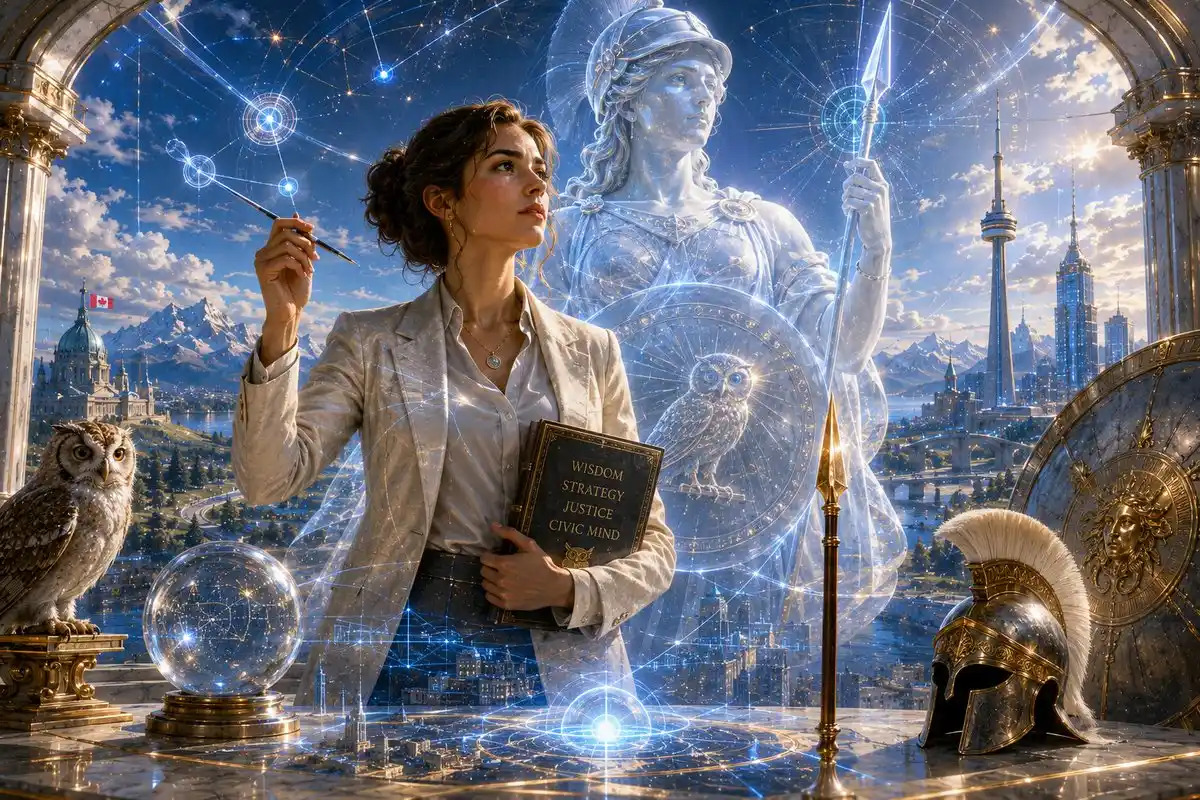
6. Athena Mind: Wisdom Armed
Athena is the first figure because the future cannot be defended by force alone.
She represents wisdom armed.
Not intelligence as ornament. Not cleverness. Not academic abstraction. Not data without judgment. Athena is intelligence capable of defending the city. She carries the spear and the shield because wisdom, in its highest form, is not passive. It protects order. It organizes force. It sees the battlefield without becoming intoxicated by violence.
In the Greek imagination, Athena is not merely a goddess of thought. She is a goddess of strategic war, craft, civic order, and disciplined intelligence. She is the mind that can enter conflict without becoming chaos. She does not represent rage. She represents judgment under arms.
That distinction matters for the future.
The next institutional era will be flooded with intelligence-like systems: artificial intelligence, predictive analytics, autonomous platforms, algorithmic decision tools, surveillance infrastructure, synthetic media, cyber weapons, automated logistics, digital identity, and technical governance systems. These tools will produce speed, scale, and complexity beyond the capacity of ordinary administration.
But intelligence without wisdom does not become civilization. It becomes manipulation.
A society can have more data and less understanding. It can have more models and less judgment. It can have more automation and less responsibility. It can have more dashboards and less truth. It can have more prediction and less prudence.
Athena is the archetype that prevents intelligence from becoming predatory or foolish.
In future institutions, the Athena mind is the systems thinker, the strategic technologist, the cyber defender, the ethical AI governor, the constitutional designer of technical power. Athena people do not merely ask whether a system can be built. They ask what the system will do to judgment, freedom, responsibility, and institutional order once it exists.
They understand that power must be designed with feedback, limits, purpose, and accountability. They recognize that tools are never neutral once they are embedded into institutions. A tool used by a wise institution can strengthen civilization. The same tool used by a frightened, corrupt, or hollow institution can scale failure.
Athena’s fighting capability is strategic combat intelligence.
She fights with foresight. She defends through design. She sees the whole system. She knows where the shield must be placed before the spear is thrown.
The future will need Athena minds wherever technical systems meet moral consequence: AI governance, cyber defense, education, defense architecture, infrastructure planning, public administration, national resilience, institutional reform.
Without Athena, intelligence becomes manipulation and tools operate without judgment.
A civilization without Athena may become advanced, but it will not become wise. It will build clever systems that no longer know what they are for.
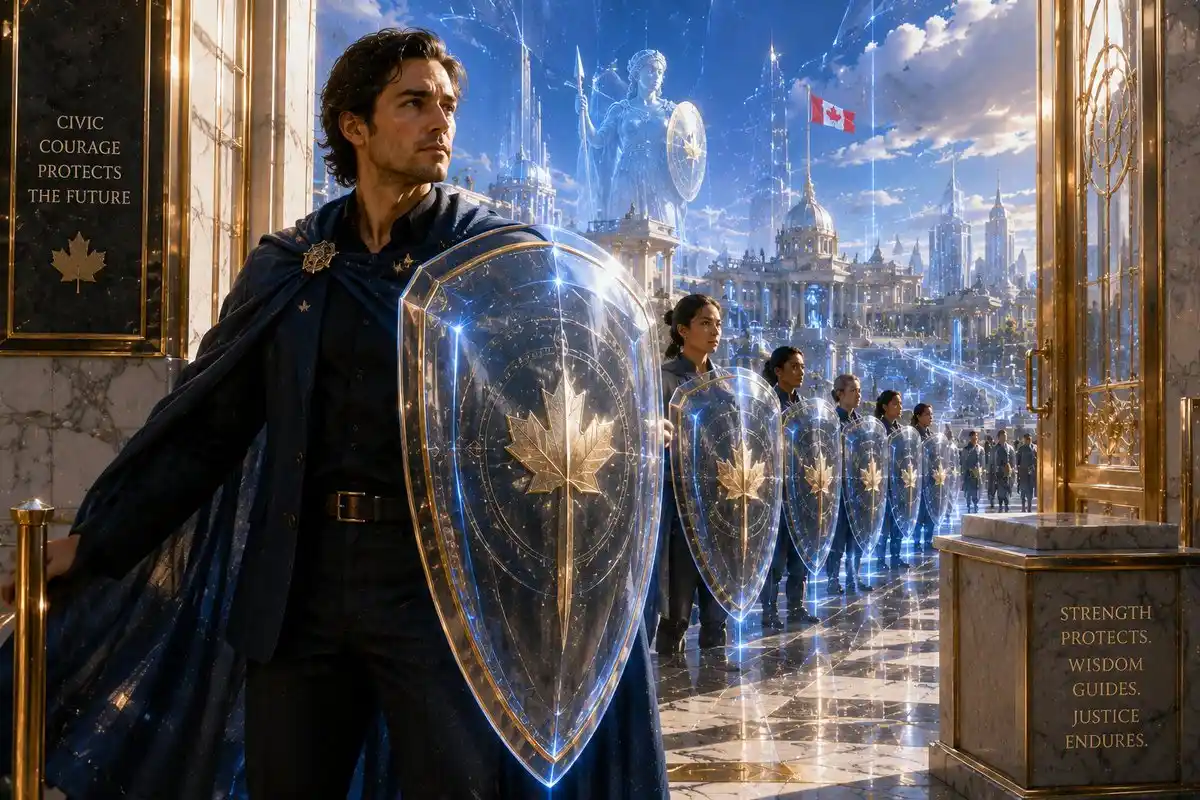
7. Leonidas Heart: Courage Disciplined
If Athena is the mind that sees the battlefield, Leonidas is the heart that holds the gate.
Leonidas represents courage disciplined by duty.
His archetype is not reckless aggression. It is not conquest. It is not violence for glory. It is the willingness to stand at the boundary when retreat would be easier, when compromise would be safer, and when survival is no longer guaranteed.
Leonidas is the figure of the defended perimeter.
Every civilization has gates. Some are physical: borders, ports, grids, bridges, military positions, supply corridors, data centers, hospitals, substations, rail lines, reservoirs, command posts. Others are institutional: constitutional limits, professional standards, scientific truth, educational rigour, public trust, civic order, national sovereignty, human dignity.
A civilization collapses when no one is willing to hold these gates.
Leonidas does not represent the entire civilizational project. He is not the architect, the lawgiver, the engineer, or the philosopher. His function is more severe and more immediate. He buys time. He holds the line long enough for the rest of the system to awaken, organize, repair, and act.
That is why his archetype matters for 2020–2070.
The future will produce moments when institutions must decide whether they still have a perimeter. Cyber systems will be tested. Infrastructure will be tested. Borders will be tested. Public order will be tested. Emergency services will be tested. The legitimacy of institutions will be tested. The ability of societies to endure crisis without dissolving into panic will be tested.
In such moments, courage cannot be improvised.
A society that mocks discipline in peace should not be surprised when it lacks endurance in crisis. A state that confuses comfort with stability should not be surprised when pressure exposes fragility. An institution that trains people only to avoid risk should not be surprised when no one can stand firm.
Leonidas heart is the courage to protect what must not fall.
Its capability mode is defensive endurance: shield wall, formation, sacrifice, physical and moral steadiness. This is not the glamour of victory. It is the discipline of remaining at the point of pressure.
The future institutional role of Leonidas is found in civil defense, emergency leadership, military resilience, infrastructure protection, continuity planning, and any profession where the mission is to hold while others flee.
The Leonidas person is not necessarily loud. Often, this person is severe, steady, and unromantic. They understand that civilization sometimes depends on unglamorous endurance: staying at the post, maintaining the system, defending the standard, absorbing pressure, refusing collapse.
Without Leonidas, institutions fold at the first serious test.
A civilization without Leonidas may speak beautifully about values, but when the gate is struck, no one remains there long enough for those values to survive.
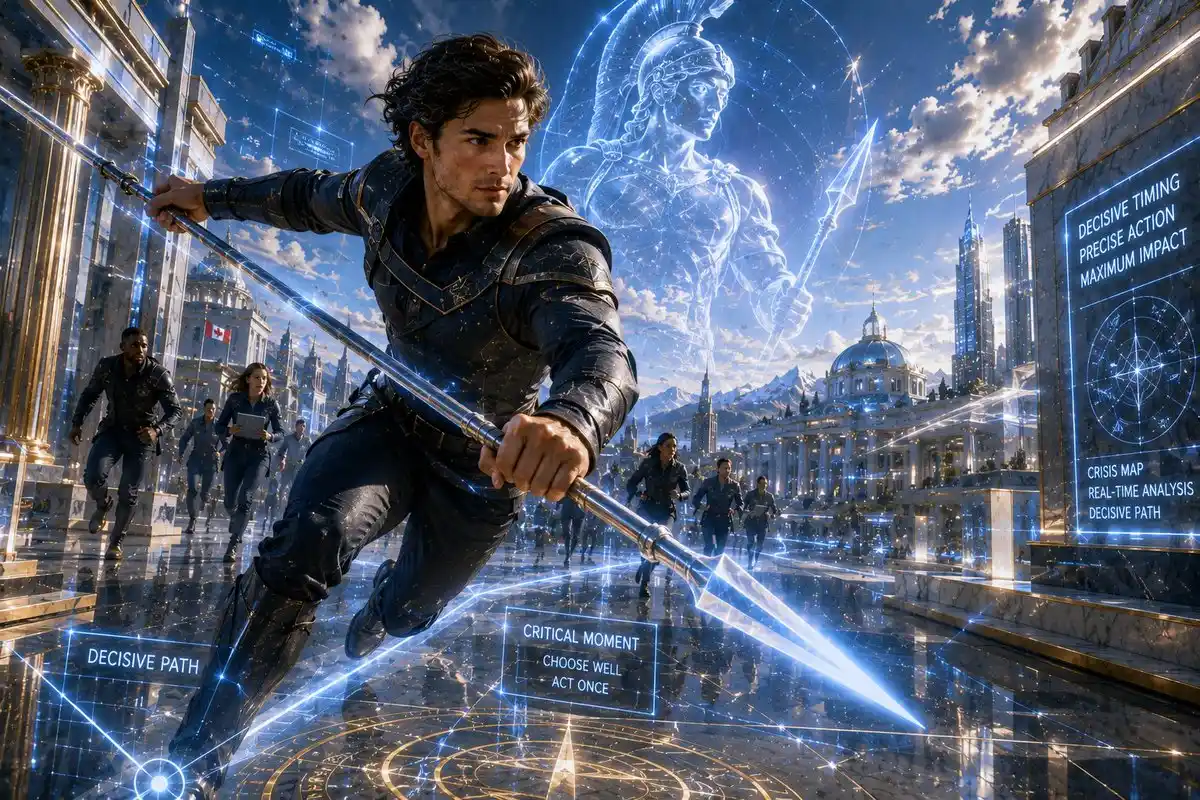
8. Achilles Performer: Excellence Unleashed
Achilles is dangerous.
That is why he belongs in the essay.
He is not the highest moral archetype. He is not restrained in the way Marcus Aurelius is restrained. He is not strategically balanced in the way Athena is balanced. He is not civic in the same way Solon is civic. Achilles is intensity, brilliance, speed, mastery, wrath, glory, and tragedy.
But no serious map of future institutions can omit him.
A civilization that has no place for excellence under pressure will lose to civilizations, systems, or crises that do.
Achilles represents peak capability.
He is the elite performer when the moment demands more than average competence. He is the person who can act decisively when hesitation would be fatal. He is the highest-output operator, the one whose skill changes the field.
Modern institutions often distrust Achilles energy because it is difficult to manage. It does not fit comfortably into bureaucratic equality. It disrupts slow consensus. It exposes mediocrity. It can be arrogant, unstable, and personally costly. But when excellence is suppressed entirely, institutions become safe for average performance and unsafe for civilization.
There are moments when the system does not need another meeting. It needs the person who can solve the problem. It needs the engineer who can diagnose the failure. It needs the cyber defender who can stop the breach. It needs the surgeon who can operate. It needs the pilot who can land. It needs the commander who can decide. It needs the builder who can execute. It needs the specialist whose mastery is not replaceable by process.
Achilles is that capacity.
His capability mode is decisive action. Speed, precision, force, mastery, shock power. He is not the whole institution, but he may be the difference between institutional survival and institutional collapse in the decisive moment.
The future will need Achilles performers in cyber defense, crisis response, engineering, AI safety, military technology, emergency medicine, space systems, advanced manufacturing, logistics, special operations, and breakthrough innovation. These are fields where average competence is not enough because the consequences of failure are too high.
But Achilles must be placed within a moral architecture. Excellence without restraint can become destructive. Brilliance without wisdom can become narcissism. Combat ability without purpose can become appetite. That is why Achilles must stand near Athena, Leonidas, Marcus Aurelius, and the lawgiver. He must be honored, but not worshipped. He must be unleashed, but not allowed to become the whole civilization.
This is the psychological truth of Achilles: the highest performer often carries the highest volatility.
Future institutions must learn how to recognize excellence without being ruled by ego, and how to discipline elite capability without crushing it into bureaucratic sameness.
Without Achilles, society has ideals but no champions.
A civilization without Achilles may speak of justice, resilience, and innovation, but when the decisive test comes, it discovers that no one has trained to the level required by reality.
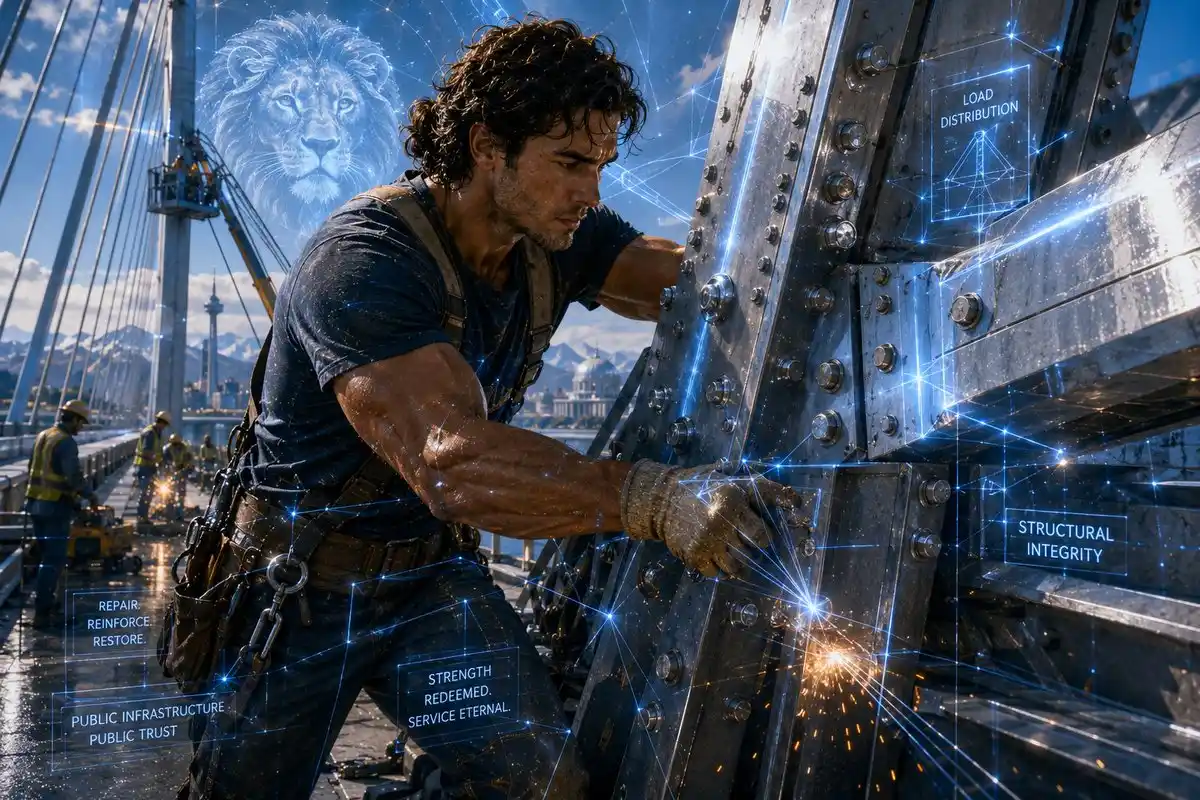
9. Hercules Builder: Strength Redeemed
Hercules is strength under burden.
That is the key.
He is often remembered for raw power: the club, the lion skin, the monsters, the impossible labors. But the deeper meaning is not merely force. Hercules represents strength tested by suffering and redirected into service. He is not comfortable strength. He is burdened strength. He is the body and will that keep working when the task is punishing, repetitive, dangerous, humiliating, or immense.
Every civilization needs this archetype because every civilization eventually breaks things that must be repaired.
Bridges fail. Grids fail. Pipelines fail. Ports fail. Factories close. Ships rust. Roads decay. Mines stall. Housing systems break. Water systems age. Supply chains fracture. Disasters strike. Wars damage. Bureaucracies delay. Plans rot on paper.
Someone must rebuild.
Hercules is the answer to the civilization that can analyze but cannot lift.
Modern societies often overproduce commentary and underproduce repair. They become brilliant at discussing failure and strangely incapable of reversing it. They can issue reports, convene panels, commission studies, produce forecasts, and generate public messaging while the physical world continues to deteriorate.
Hercules interrupts that decay.
His capability mode is load-bearing force: endurance, physical competence, industrial stamina, disaster recovery, construction, repair, logistics, adaptation, and the willingness to do hard things in the material world.
The future institutional role of Hercules is found among infrastructure builders, energy workers, emergency repair crews, industrial technologists, construction leaders, logistics operators, field engineers, and recovery forces. These are the people who turn policy into steel, concrete, wire, water, shelter, transport, heat, food, and restored function.
A society that loses Hercules becomes disembodied.
It may still speak in elegant abstractions. It may still produce strategies. It may still talk about sustainability, resilience, inclusion, innovation, and competitiveness. But when the time comes to build the grid, repair the bridge, restore the factory, harden the port, construct the habitat, or recover after disaster, it discovers that language cannot substitute for strength.
Hercules also carries a moral lesson: strength must be redeemed.
Raw force can dominate. Redeemed strength serves. It does not merely display power; it accepts burden. It repairs what others abandoned. It completes the labour. It does not resent difficulty as an insult. It understands difficulty as the field where character becomes real.
Without Hercules, society can analyze and regulate, but cannot build, repair, lift, restore, or endure.
A civilization without Hercules becomes weightless. It floats above the material world until the material world fails beneath it.
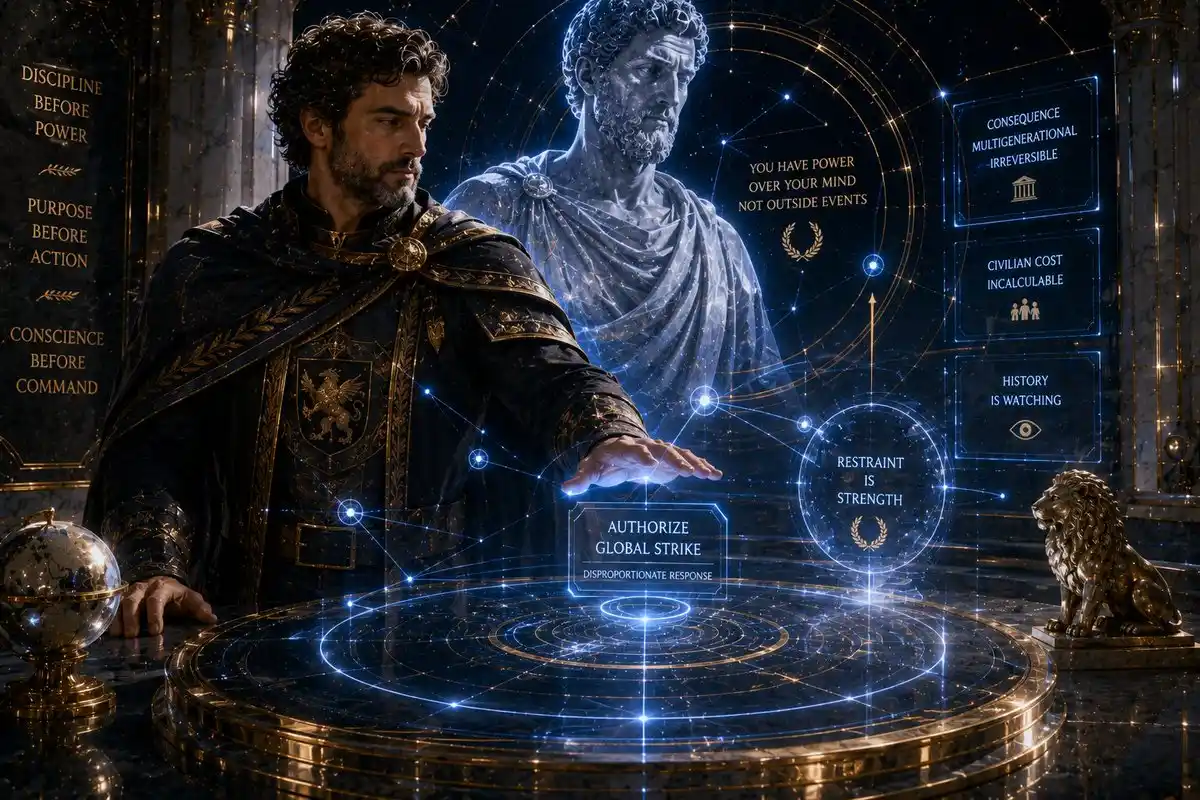
10. Marcus Aurelius Commander: Power Self-Governed
Marcus Aurelius represents one of the rarest forms of power: command under self-command.
His archetype matters because the future will place extraordinary tools into the hands of leaders. AI systems, surveillance infrastructure, digital identity, automated enforcement, cyber capabilities, military technologies, financial platforms, public-health systems, behavioural analytics, media networks, and state-corporate data architectures will expand the reach of institutional power.
The central question will not only be what institutions can do.
It will be whether those who command them can restrain themselves.
Marcus Aurelius is not included here because empire is morally simple. It is not. He is included because his symbolic function is inner government before outer government. In the Stoic imagination, the ruler must first rule himself. Without that prior command, public power becomes an extension of private appetite.
The Marcus Aurelius archetype is power governed by conscience.
It is the executive who does not confuse authority with vanity. The commander who does not confuse force with cruelty. The statesman who does not confuse popularity with duty. The institutional leader who does not confuse control with wisdom. The public servant who does not confuse office with ownership.
This archetype is essential because future institutions will be tempted by precision control. The more measurable human behaviour becomes, the more tempting it will be to govern people as datasets. The more automated enforcement becomes, the more tempting it will be to remove discretion. The more predictive systems become, the more tempting it will be to punish risk before action. The more centralized platforms become, the more tempting it will be to confuse technical capability with moral authority.
Marcus Aurelius says no.
Not because power is unnecessary. Power is necessary. Institutions need command. States need authority. Armies need hierarchy. Companies need executives. Emergencies need decision-makers. But power must be internally governed, or it becomes appetite with instruments.
The capability mode of Marcus Aurelius is command discipline: self-restraint, judgment, duty, moral seriousness, emotional control, and the capacity to act without being ruled by fear, anger, ego, or convenience.
Future institutions will need Marcus Aurelius commanders in government, defense, AI governance, corporate leadership, public administration, education, and emergency management. Wherever power expands, the need for self-command expands with it.
Without Marcus Aurelius, power becomes vanity, panic, ideology, appetite, or cruelty.
A civilization without Marcus may still have leaders, but it will lack rulers of the self. It will become technologically powerful and morally adolescent.
11. Maximus Guardian: Honour Unconquered
Maximus is not historical Rome. He is cinematic myth.
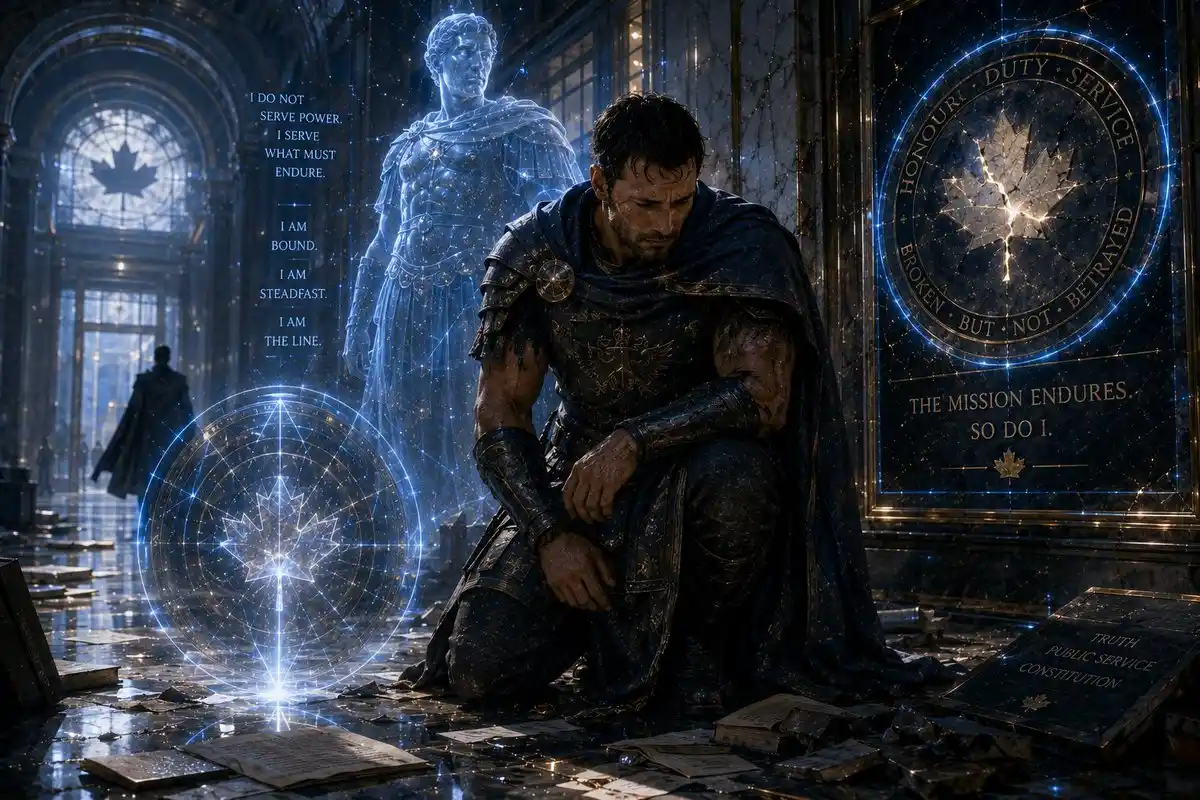
That distinction matters. The Maximus archetype comes from modern storytelling, especially the film image of the betrayed general turned gladiator: the loyal servant of an older moral order who is stripped of rank, family, freedom, and public identity, yet refuses to surrender his honour.
He belongs in this essay because the future will not only produce external enemies, broken systems, and domination from outside. It will also produce institutional betrayal from within.
There will be people inside institutions who discover that the mission has been corrupted.
The soldier who discovers that command has lost honour. The engineer who discovers that safety has been sacrificed to optics. The scientist who discovers that truth has been subordinated to funding, ideology, or fear. The public servant who discovers that the process now protects failure. The teacher who discovers that education has been replaced by performance metrics. The officer who discovers that loyalty to the institution now requires betrayal of the institution’s purpose. The employee who discovers that silence is rewarded and conscience is punished.
This is where Maximus appears.
He is not Spartacus. The distinction is crucial.
Spartacus fights because he was always outside the legitimacy of the system that enslaved him. Maximus fights because the legitimate order he served was stolen from within. Spartacus is liberation from chains. Maximus is honour after institutional betrayal.
Spartacus says: I will not be owned.
Maximus says: I will not forget what I served.
The Maximus archetype is the guardian of mission memory. He remembers the true purpose of the institution after its visible leadership has betrayed it. He carries honour when titles have been stripped away. He remains inwardly unconquered when the system tries to reduce him to spectacle, tool, prisoner, or expendable body.
His capability mode is loyal combat under betrayal.
This is not blind loyalty. Blind loyalty serves the corrupted institution. Maximus loyalty serves the true mission beneath the corrupted institution. That is why he is dangerous to false power. He cannot be bought by status because status has already been taken from him. He cannot be fully controlled by fear because he has already lost what fear threatens. He cannot be made to forget because memory has become his weapon.
Future institutions will need Maximus guardians: principled insiders, ethical operators, whistleblowers, military professionals, engineers of conscience, institutional memory keepers, people who continue to serve the mission when official language has become false.
Without Maximus, betrayal becomes normal and no one remembers what the institution was supposed to serve.
A civilization without Maximus will still have loyalty, but it will be loyalty to power rather than loyalty to purpose. That is not honour. That is compliance.
12. Spartacus Soul: Freedom Fought For
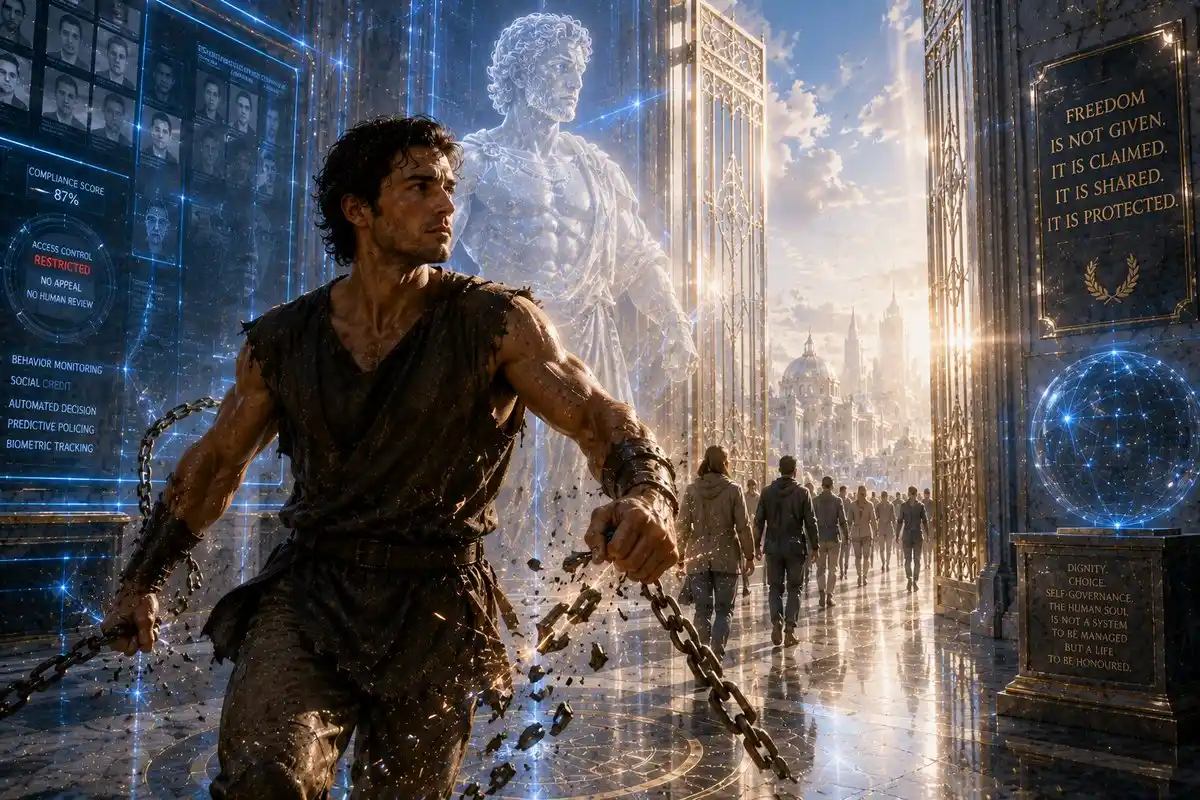
Spartacus represents the refusal to become property of a system.
He is not merely rebellion. Rebellion can be foolish, vain, destructive, or nihilistic. Spartacus is more specific. He is freedom against domination. He is the human being who has been reduced to an instrument and refuses the reduction.
That is why his archetype matters for the future.
The next half-century may produce forms of control more subtle than chains. People may be managed through data profiles, behavioural scoring, economic dependency, platform access, algorithmic visibility, biometric systems, automated enforcement, psychological manipulation, digital reputation, and workplace surveillance. The language may be soft. The interface may be beautiful. The system may claim efficiency, safety, personalization, optimization, or care.
But domination does not stop being domination because it becomes technically sophisticated.
Spartacus is the archetype that recognizes the moment when a human being is being converted into an object of management.
He says no.
He says the person is not a dataset. The worker is not a disposable input. The citizen is not a behavioural target. The child is not a future compliance unit. The body is not property of the state. The mind is not property of the platform. The soul is not property of the institution.
His capability mode is resistance: moral defiance, insurgent courage, liberation energy, refusal to normalize dehumanization.
Future institutions need Spartacus not because every institution must be overthrown, but because every institution must know there is a boundary it must not cross. The presence of Spartacus energy inside a civilization reminds power that human dignity is not granted by systems. It precedes them.
Spartacus is especially important in a century of automation and surveillance. A society may become efficient while becoming servile. It may reduce friction while reducing freedom. It may increase convenience while decreasing agency. It may promise security while weakening the moral muscles required for liberty.
The Spartacus soul resists this trade.
It is found in civil liberties defenders, labour dignity advocates, anti-surveillance thinkers, independent builders, dissidents, reformers, and ordinary people who refuse to let systems define the full meaning of human life.
But Spartacus, too, must be integrated into the larger moral architecture. Freedom without wisdom can become chaos. Resistance without law can become destruction. Defiance without truth can become vanity. Spartacus must stand near Athena, Solon, Marcus Aurelius, and Socrates. The goal is not permanent revolt. The goal is a civilization where domination is resisted so that lawful freedom can survive.
Without Spartacus, the future becomes efficient but servile.
A civilization without Spartacus may still function. It may even function smoothly. But it will function by turning persons into managed units. It will have order without dignity, safety without courage, and comfort without freedom.
That is not civilization. It is a beautiful cage.
The Core Seven now stand in view.
Athena gives wisdom to power. Leonidas gives courage to defense. Achilles gives excellence to action. Hercules gives endurance to rebuilding. Marcus Aurelius gives conscience to command. Maximus gives honour to service. Spartacus gives freedom to resistance.
They are not enough by themselves. Courage must become law. Strength must become craft. Excellence must navigate uncertainty. Memory must be carried forward. Truth must be defended under pressure.
That is why the Core Seven require the Completion Five.
👉 Wisdom Armed: The Archetypes Who Will Rebuild the Institutions of the Future (Part 2) https://x.com/SkillsGapTrain/status/2061352613430587542