Navantia UK unveils LASV75 autonomous vessel design
Navantia UK’s LASV75: Could a Stealthier Hull and Modular C-UAS Fit Transform the Autonomous Warship?
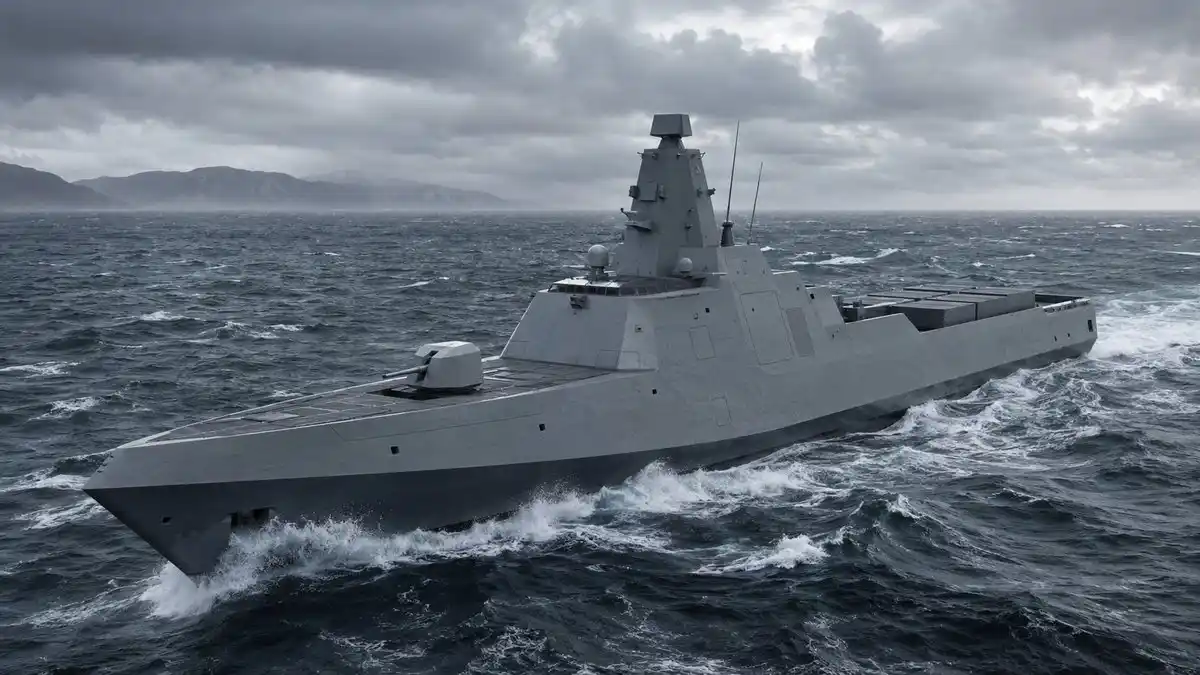
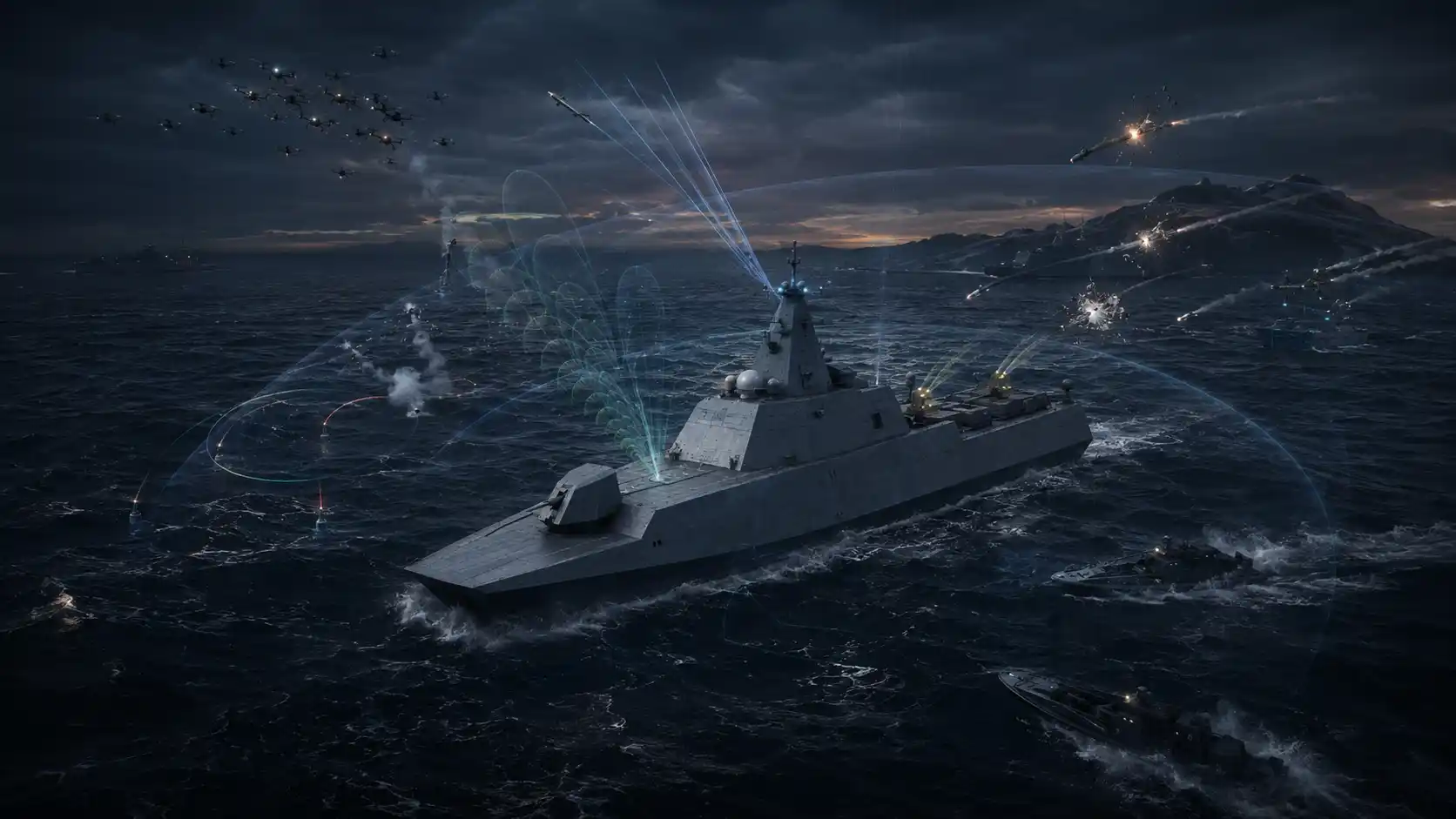
Navantia UK’s LASV75 is not simply another unmanned surface vessel concept. At 75 metres and over 1,000 tonnes depending on payload and range, it sits in a very different category from the small USVs usually associated with autonomy. The company has described it as a large, persistent, reconfigurable platform for the future hybrid navy, with potential roles including surveillance, early warning, electronic surveillance, countermeasures, escort duties, optional VLS, modular mission payloads, and a modular mast carrying sensors such as a 3D air-surveillance radar.
That scale changes the question. This is not just about whether an unmanned vessel can go to sea. It is about whether a vessel of this size can become a credible distributed combatant: a platform able to carry sensors, effectors, counter-drone systems, electronic-warfare payloads, and possibly missile cells, while remaining affordable and scalable enough to be built in numbers.
The most useful way to examine LASV75 is from first principles. A warship is not defined by whether it has a crew. It is defined by what it can sense, how long it can remain on station, how difficult it is to detect and disable, what payloads it can carry, and how easily it can be repaired, upgraded, and produced.
By that logic, LASV75 should not be viewed as a drone boat. It should be viewed as a possible unmanned combat architecture.
The key question is therefore not simply: can LASV75 carry weapons?
The better question is: can it be engineered into a stealthier, survivable, modular unmanned escort for a drone-saturated and electronic-warfare-heavy battlespace?
1. Why LASV75 is more than a drone boat
Most unmanned surface vessels are discussed as sensors, decoys, minesweepers, or small expendable platforms. LASV75 is different because of its size. A 75-metre, 1,000-tonne-plus unmanned vessel is large enough to carry meaningful payloads, not just cameras and communications equipment.
That matters because the future hybrid navy will not only need unmanned scouts. It will need unmanned nodes that can persist, sense, deceive, absorb risk, and in some cases fight. A small USV can be useful, but it cannot easily host a serious radar, a modular mast, large mission payloads, vertical launch cells, electronic-warfare packages, and medium-calibre defensive weapons at the same time.
LASV75 sits in the middle ground between a small drone boat and a crewed corvette. That is what makes it interesting. It is not a replacement for a frigate, but it could become a distributed escort, a sensor-effector node, a counter-UAS platform, or a modular payload carrier that expands the defended area around a task group.
The value of the concept is not autonomy alone. Autonomy removes the crew from risk. The deeper value is that the vessel could distribute combat functions across more hulls without requiring every hull to be a full crewed warship.
2. The first-principles test: protected engagement volume
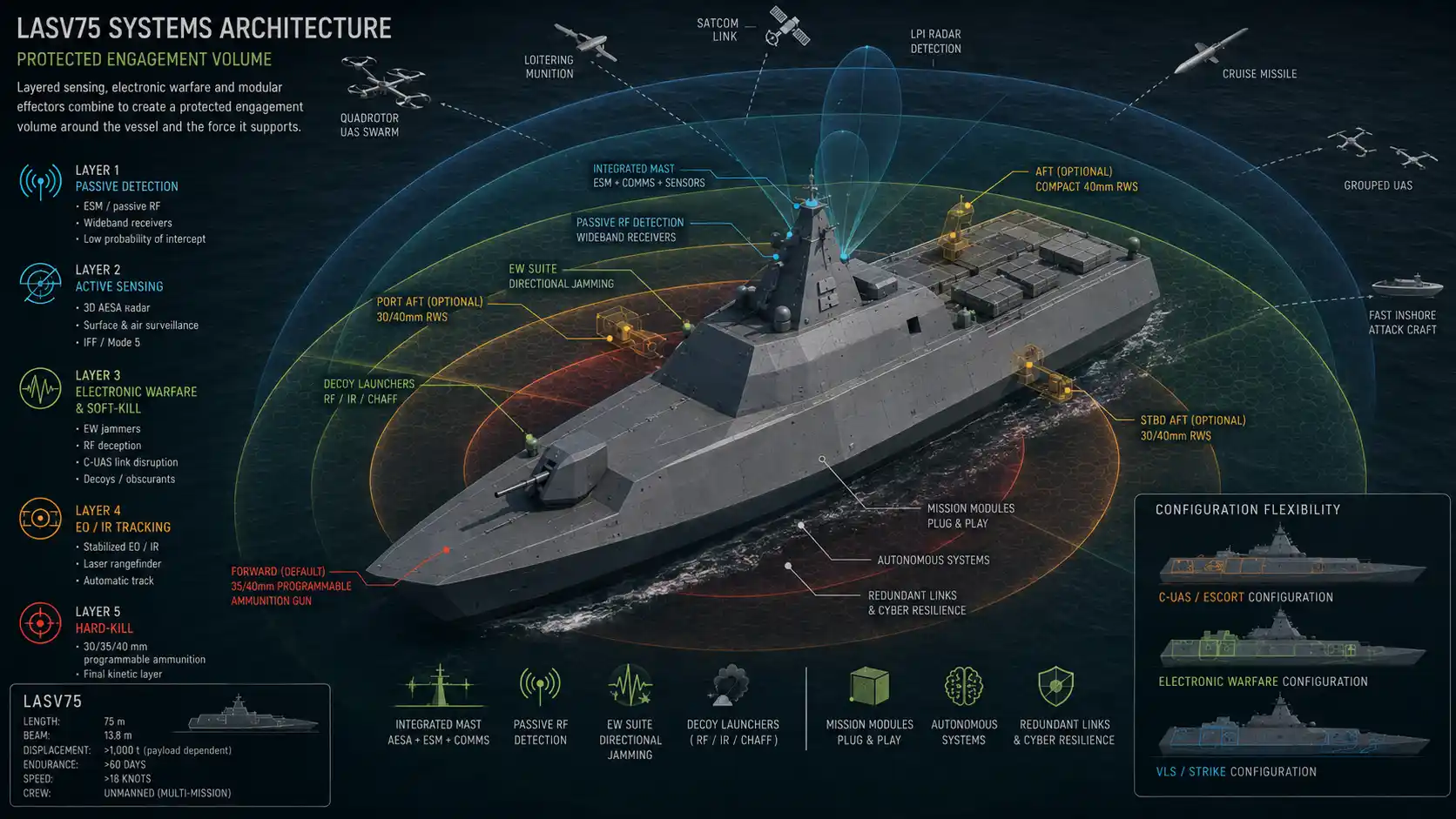
If LASV75 is to become more than a concept model, the design should be judged by one central metric: protected engagement volume.
That means the vessel must be able to detect, track, classify, jam, deceive, and engage threats across a useful envelope around itself and the force it supports. A gun alone is not enough. A radar alone is not enough. A stealthy hull with exposed antennas and poorly placed weapons is not enough. The ship has to work as a system.
The key engineering questions are simple:
-
Can it see the threat early?
-
Can it classify the threat correctly?
-
Can it engage without blind arcs?
-
Can it survive electronic attack?
-
Can it keep fighting after limited damage?
-
Can it preserve modular payload capacity?
That is the real test. The winning LASV75 configuration would not necessarily be the one with the most weapons. It would be the one with the best combination of stealth, sensing, soft-kill, hard-kill, survivability, and payload flexibility.
3. Could the flat upper hull sides become part of the stealth system?
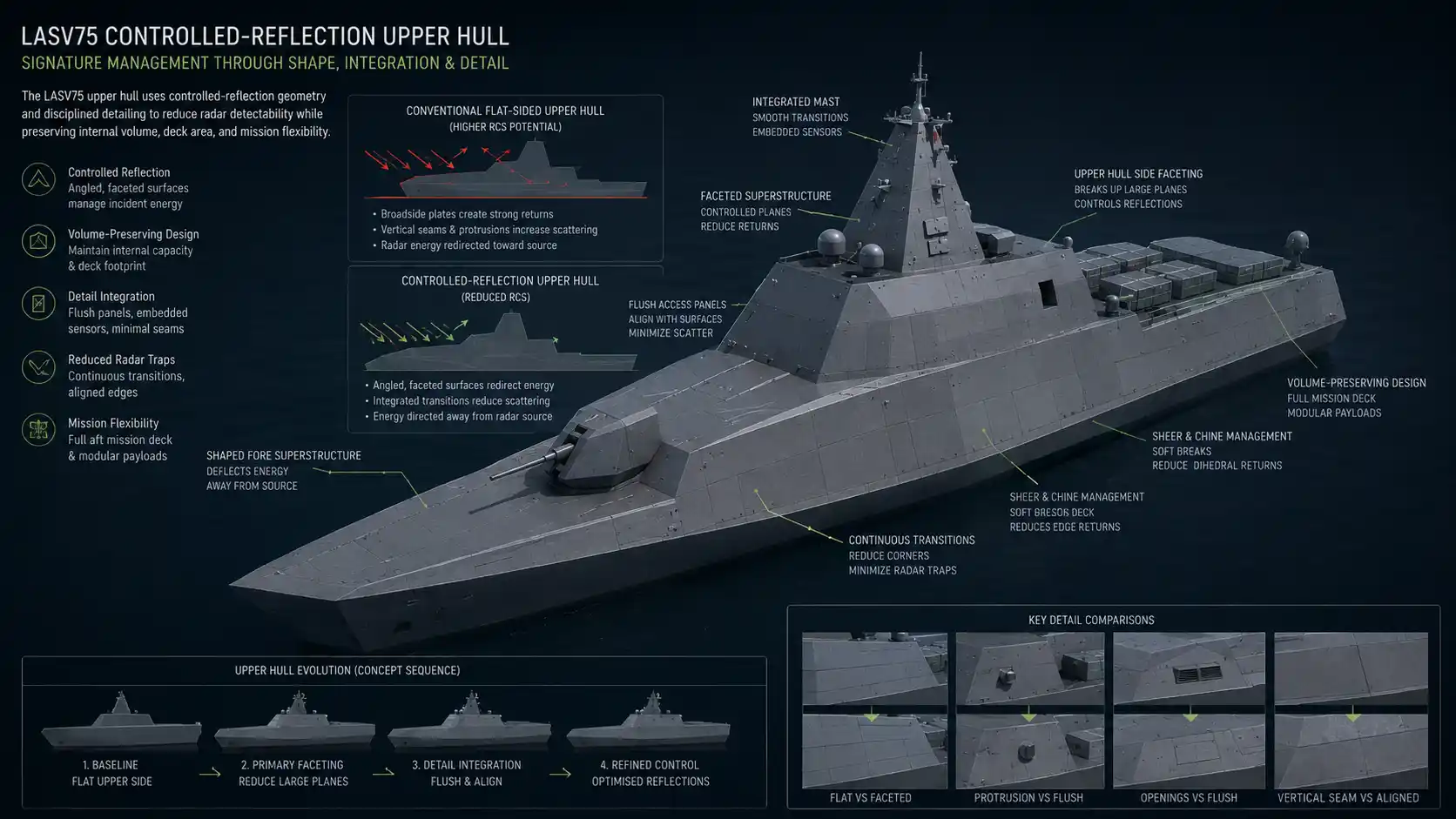
The model appears to show relatively flat and clean upper hull sides. That immediately raises a useful design question: if those surfaces are so large and regular, could they become part of the vessel’s signature-management system?
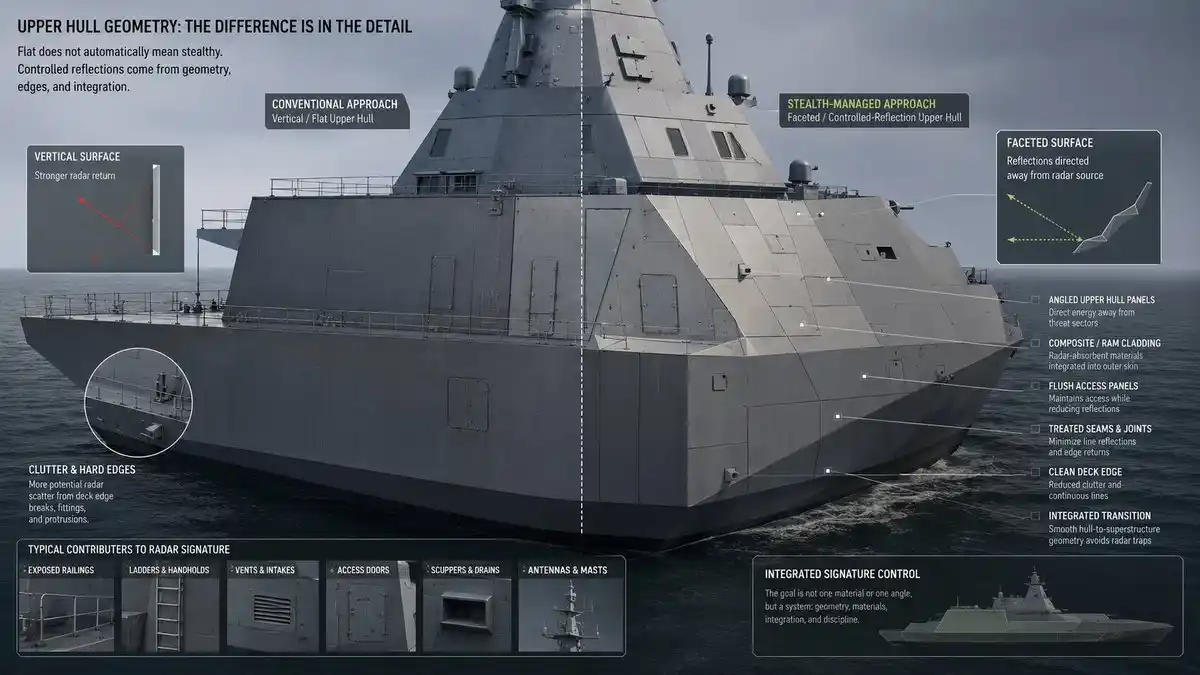
In principle, yes. Large flat surfaces provide predictable geometry. Composite laminate, radar-absorbent cladding, or faceted outer panels could be applied to selected upper-hull areas, especially above the waterline and around the transition between hull, deck edge, and superstructure.
But flat does not automatically mean stealthy. A vertical flat plate can return radar energy strongly if it faces the emitter. For radar-cross-section reduction, the key is not whether the surface is smooth; it is where the surface sends the reflected energy.
That means the details matter: panel angle, edge alignment, seams, access doors, scuppers, vents, railings, ladders, antennas, weapon mounts, mission-bay openings, and deck-edge breaks.
The best solution would not be a cosmetic “stealth coating.” It would be integrated signature-control cladding: faceted composite or metallic fairings over selected topside areas, flush access panels, treated seams, and a hull-superstructure transition designed to avoid radar traps. The material would also need to survive saltwater exposure, UV, impact, flexing, thermal cycling, and normal maintenance.
The upper hull sides could be improved. But the engineering answer is not simply “add composite.” It is to make the upper hull part of a controlled-reflection architecture.
4. Could the hull sides be sloped or faceted without sacrificing payload volume?
This is one of the most important questions. LASV75’s upper hull could theoretically be redesigned with more pronounced sloping or faceted geometry to reduce radar signature. But the degree of shaping would depend on how much low observability Navantia wants to trade against internal volume, deck width, stability, and modular payload capacity.
The simplest stealth improvement would be to angle the upper hull sides so radar energy is reflected away from likely threat emitters. This could be done with inward-sloping tumblehome, outward-flared upper sections, or add-on faceted panels above the main structural hull.
But a ship is a floating volume. Every decision about slope affects stability, usable deck area, internal payload space, reserve buoyancy, structural complexity, and seakeeping. A dramatic stealth hull may reduce radar return, but it can also reduce the very mission volume that makes a 75-metre unmanned platform valuable.
That matters because LASV75 is not just a stealth demonstrator. It is presented as a modular vessel able to accept mission containers, optional VLS, additional power-generation modules, electronic-warfare payloads, sensors, and other mission systems. In that context, internal volume is not a bonus. It is the core of the concept.
The most realistic compromise would be moderate faceting rather than extreme tumblehome. The lower hull should remain optimized for seakeeping, endurance, stability, and buildability. The upper hull, bow shoulder, deck edge, mission-bay area, and superstructure transition could then receive sloped panels or composite fairings.
That would improve signature reduction without undermining the vessel’s central advantage: scalable modular payload capacity.
In other words, LASV75 does not need to become a Visby-class corvette to benefit from low-observable shaping. It needs a practical unmanned-warship version of stealth.
Current / near-vertical upper side:
|
|
______|
Inward tumblehome:
/
/
___/
Structural hull with added faceted stealth fairing:
/|
/ |
____/ |
Slight outward flare / volume-preserving stealth shaping:
\
\
_________\
“A stealthier LASV75 would not necessarily need inward tumblehome. In fact, for a 75-metre modular unmanned vessel, the better solution may be a volume-preserving outward flare or faceted outer fairing that keeps internal payload space while controlling radar reflections from the upper hull and deck edge.”
5. Could the superstructure become a signature-managed sensor body?
The model already appears to show some low-observable thinking: sloped faces, a relatively clean superstructure, an integrated mast concept, and fewer exposed fittings than a conventional patrol vessel. But a future high-threat version could go further.
A more optimized design could use an enclosed integrated mast, fixed radar panels where possible, flush EO/IR and communications apertures, reduced external antennas, hidden service openings, covered weapon positions, and cleaner transitions between the hull, deckhouse, mast, and mission areas.
Composite or composite-clad superstructure panels could also help, especially if they reduce topside weight or allow better shaping.
The comparison with Sweden’s Visby-class corvette is useful, but it should not be taken too literally. Visby is a highly specialized stealth combatant. LASV75 appears to be designed around modularity, rapid buildability, payload flexibility, and interoperability.
That means the better target is not a fully bespoke stealth sculpture. It is a signature-managed modular superstructure.
The mast, sensors, weapons, cooling, access panels, payload modules, and electromagnetic layout should be designed as one architecture. The more systems are bolted on after the fact, the more signature and integration problems the vessel inherits.
The high-end LASV75 should look less like a platform carrying payloads and more like a single integrated sensor-effector body.
6. Why programmable ammunition is the right hard-kill layer
The model appears to show usable deck volume behind and around the superstructure, and that space could potentially support counter-UAS or close-in-defence systems. But the first question should not be simply whether LASV75 can carry a gun. The better question is what kind of hard-kill layer makes sense for a modular unmanned escort.
A heavy Phalanx-type CIWS is possible in theory, but it may not be the most natural fit. LASV75’s value lies in modularity, endurance, scalability, and payload flexibility. A large, heavy, highly specialized close-in weapon may solve one problem while creating others: weight, power demand, integration complexity, magazine burden, radar signature, and maintenance.
A more balanced solution would be a 30 mm, 35 mm, or 40 mm remote weapon system using programmable airburst ammunition. That class of weapon is attractive because it can engage drones, small boats, loitering munitions, and some low-end air threats without imposing the same integration burden as heavier missile or CIWS installations.
Programmable ammunition matters because the target set is changing. Small drones and loitering munitions may not present the same engagement problem as aircraft or missiles. They can be small, slow, cheap, numerous, and awkward to hit with conventional point-detonating rounds. Airburst ammunition changes the geometry of the engagement by creating an effect in the target’s path rather than requiring a perfect direct hit.
That does not make the gun a complete solution. Hard-kill ammunition is finite, and in a swarm scenario the ship cannot afford to shoot at everything as the first response. Electronic warfare, decoys, passive detection, and emissions control still matter. The gun should be the final hard-kill layer in a wider defensive system, not the only layer.
A Bofors-type 40 mm programmable-ammunition system, a Millennium-style 35 mm system, or a modern 30/40 mm remote station would all fit the logic of a modular unmanned escort. The exact calibre matters less than the architecture around it: sensor cueing, EO/IR confirmation, fire-control quality, magazine depth, reload concept, power, cooling, maintenance access, and safe firing arcs.
The real design question is therefore not simply: can the weapon fit?
It is: can the weapon see, slew, fire, reload, cool, and survive without compromising the sensors, stealth shaping, mission modules, or stability of the vessel?
On an unmanned vessel, that question is even more important. There is no onboard crew to clear jams, fight fires, reload manually, or improvise around battle damage. The weapon system has to be reliable, remotely diagnosable, and integrated into the ship’s autonomous damage-control logic.
LASV75 could support a serious counter-UAS hard-kill layer. But the most elegant answer is probably not simply “add a CIWS.” It is to integrate a medium-calibre programmable-ammunition system into a layered defensive architecture built around sensors, soft-kill, stealth, and survivability.
7. Where should the guns go: bow, stern, or side mounts?
Once programmable ammunition is accepted as the right hard-kill layer, the harder question becomes geometry.
Where should the guns go?
A bow-mounted medium-calibre gun is the cleanest location. It has good forward arcs, can sit relatively low, and can be integrated into the vessel’s forward deck geometry. It is easier to blend into a shaped gunhouse, faceted shield, or low-observable deck treatment. A forward mount also avoids much of the clutter created by mission containers, VLS spaces, antennas, and payload-handling areas aft.
The stern position is more complicated. Behind the superstructure, there may be containers, mission modules, VLS structures, sensors, communications equipment, and deck-handling zones. If an aft gun has to be mounted high to clear those obstacles, it creates a stealth and stability penalty. A high pedestal adds topweight, increases radar signature, complicates structure, and risks becoming one of the most obvious scattering features on the ship.
That does not make an aft gun impossible. It means the aft gun must be engineered as part of the ship’s architecture, not simply bolted onto a raised platform.
A compact 40 mm mount may be more suitable aft than a longer Millennium-style turret if the priority is stealth and packaging. A larger or longer mount may offer strong performance, but it needs deck clearance, traverse arcs, maintenance access, ammunition routing, blast safety, and separation from sensors and mission equipment. On a stealth-managed unmanned escort, the mount’s physical geometry matters almost as much as its calibre.
Side-mounted guns are another option. Two smaller 30 mm or 40 mm mounts, one covering port and one covering starboard, could provide broad lateral and rear-sector coverage. This could be especially attractive if the superstructure, containers, or mast block a single centerline aft weapon. Side mounts also create redundancy: losing one does not remove the entire close-in-defence layer.
But the tradeoff is significant. Two side mounts mean more weight, more magazines, more power demand, more maintenance burden, more combat-system integration, and more signature-management challenges. They also require careful sensor cueing so that each mount receives reliable targeting data without blind sectors.
The cleanest way to frame the options is through three combat fits.
The clean stealth fit would use one compact 40 mm programmable-ammunition gun forward, supported by EO/IR, compact radar, passive RF detection, decoys, and electronic warfare. This is the most disciplined default version. It gives LASV75 credible self-defence while preserving aft mission space, low signature, and modularity.
The escort fit would use one forward 35/40 mm gun and one aft compact 40 mm gun behind the superstructure. This gives true fore-and-aft hard-kill coverage. The engineering challenge is keeping the aft mount low, shaped, and integrated enough that it does not damage the vessel’s stealth, stability, or payload flexibility.
The high-threat C-UAS fit would use one forward Millennium-type 35 mm or compact 40 mm gun, plus two aft side-mounted 30/40 mm mounts, one covering port and one covering starboard. This would provide strong rear-sector and lateral coverage against drones, loitering munitions, and small-boat swarms. But it would bring the greatest penalties in weight, magazine duplication, power demand, fire-control complexity, maintenance burden, and radar signature.
That is the key tradeoff. The best configuration is not necessarily the one with the most barrels. It is the one that creates the best protected engagement volume without undermining stealth, endurance, stability, and payload flexibility.
8. Could LASV75 use a bow-and-stern gun fit without creating a stealth penalty?
A bow-and-stern programmable-ammunition layout is one of the most attractive higher-end options for LASV75. In theory, it would give the vessel forward and rearward hard-kill coverage, making it more useful as an unmanned escort rather than merely a self-defending sensor node.
The forward mount is the easier half of the problem. A medium-calibre programmable-ammunition gun near the bow can be placed low, given strong arcs, and integrated into the vessel’s forward geometry. It can be shaped, shielded, and treated as part of the vessel’s low-observable design.
The aft mount is the real engineering test.
If the aft gun sits behind the superstructure, it may need to clear containers, mission modules, VLS structures, or deck-handling areas. That can force the weapon higher. A high-mounted gun improves arcs, but it also adds topweight and creates a more visible radar feature. The pedestal, gunhouse, barrel, rails, ammunition path, and maintenance access can all become signature problems if they are not integrated from the start.
One way to reduce that penalty would be to rearrange the aft mission area itself. If the first two containers or mission modules were shifted closer to the superstructure, the vessel could create a cleaner weapon zone farther aft. A compact 40 mm programmable-ammunition gun could then sit behind those modules on the centerline, with better stern and quarter coverage, without needing an excessively tall pedestal.
That may be a more elegant solution than simply mounting the aft gun higher. It preserves the idea of a bow-and-stern escort fit, but treats the aft weapon as part of the ship’s layout rather than an afterthought. The containers become part of the geometry problem: move them forward, and the gun can sit lower; leave them spread aft, and the gun may need height, which increases topweight and radar signature.
This arrangement would still have limits. The containers and superstructure would block much of the forward arc, so the aft gun would mainly defend the stern and port/starboard quarters. But that is still valuable for an unmanned escort. The forward gun protects the bow sector; the aft gun protects the rear sector; electronic warfare, decoys, and distributed sensors fill the space between them.
For this layout, a compact 40 mm mount would probably be more suitable aft than a longer or bulkier Millennium-type system. The forward position could accept the higher-performance 35/40 mm weapon, while the aft position would prioritize low height, clean shaping, ammunition access, and minimal radar penalty. In other words, the aft gun should be designed around packaging discipline, not just maximum firepower.
The main principle is simple: the aft weapon must not become the ship’s biggest radar reflector. If the gun destroys the vessel’s signature discipline, the design has solved one problem by creating another.
9. Sensors, weapons, and electronic warfare must be one system
The highest-value improvement may not be adding another weapon. It may be rearranging the sensor-effector geometry.
Sensors want height. Weapons want clear arcs. Stealth wants clean shapes. Modularity wants open deck and payload volume. These needs compete for the same space.
A better LASV75 would use an integrated mast with fixed radar panels, distributed EO/IR sensors, passive RF detection, and electronic-warfare antennas arranged to support the weapon arcs. The guns should not block the sensors, and the sensors should not create blind arcs for the guns.
The design target should be layered defence: passive RF and radar detection at the outer layer; electronic attack, decoys, and deception in the middle layer; EO/IR confirmation and tracking closer in; and 30/35/40 mm programmable ammunition as the final hard-kill layer.
That matters because drones are not only defeated with guns. Hard-kill ammunition is finite. In a swarm scenario, every round and every engagement matters. Some threats should be jammed. Some should be deceived. Some should be forced away from the ship. The gun should be the final layer, not the only layer.
For an unmanned vessel, soft-kill systems are even more important. There is no crew onboard to improvise repairs or manually respond to every failure. The ship needs automation, redundancy, emissions control, cyber-resilient communications, and layered defensive logic.
10. Soft-kill is the magazine-depth solution
A future high-threat environment will not be solved only by guns. Drone swarms, loitering munitions, small boats, electronic attack, and missile threats can all force a ship to spend defensive resources quickly. A vessel that has to shoot every threat is already in trouble.
That makes electronic warfare and soft-kill systems essential.
A serious LASV75 counter-UAS package should include passive RF detection, directional jamming, drone-control-link disruption, decoys, obscurants, electronic-support measures, emissions-control modes, and cyber-resilient command links. GNSS-denial or spoofing may also be relevant where operationally and legally appropriate.
The goal is not to replace hard-kill weapons. The goal is to reduce how often they are needed. Some threats should be detected passively. Some should be jammed. Some should be deceived. Some should be forced to reveal their controller or datalink. Only the threats that continue through the outer layers should meet programmable ammunition.
That is why soft-kill is the magazine-depth solution. It gives the vessel more ways to survive without carrying endless ammunition or missiles.
For LASV75, this is especially important because the vessel is unmanned. It cannot rely on crew improvisation. Its defensive system has to be layered, automated, remotely monitored, and resilient enough to keep functioning under electronic attack.
11. Survivability should mean mission continuity, not heavy armor
LASV75 does not need to be armored like a crewed frigate. But it cannot be fragile. The right goal is mission survivability: the ability to absorb limited damage, isolate faults, preserve critical systems, and either continue the mission or withdraw.
That suggests selective protection rather than blanket armour.
The vessel would benefit from separated power-generation zones, redundant power and data routes, distributed antennas, fire-isolated mission bays, protected combat-system electronics, autonomous fire and flood detection, backup navigation modes, fallback communications, and simple tow or recovery provisions.
The key test is brutal but useful: can a cheap drone mission-kill an expensive unmanned combatant?
If the answer is yes, the design is not ready.
A future LASV75 should be difficult to disable cheaply. It does not have to survive like a battleship. It has to fail gracefully, keep communicating, protect its critical systems, and avoid being knocked out by the first inexpensive hit.
That is the survivability logic for unmanned naval combatants. Not maximum armor. Maximum useful persistence.
12. The missing iteration: from modular vessel to integrated combatant
The strongest criticism of LASV75 may not be that the concept is too ambitious. It may be that it needs one more design iteration to fully connect its ambition with its geometry.
The ingredients are visible: size, range, modular payload space, optional VLS, a modular mast, electronic-warfare potential, and enough deck volume to consider serious counter-UAS weapons. But a future high-threat escort cannot simply be a large unmanned hull with useful payloads added on top. It has to become an integrated combatant.
That means the next design iteration should focus on four things.
First, the hull and superstructure should be treated as one signature-managed body. The question is not whether the sides are flat, sloped, or flared in isolation. The question is whether the upper hull, deck edge, mission bay, mast, sensors, and weapons all participate in the same controlled-reflection architecture.
Second, the aft mission area should be designed around weapon geometry from the beginning. If mission containers are shifted closer to the superstructure to create a lower aft weapon zone, that decision should be built into the vessel’s architecture, not improvised later. The stern should become a deliberate defensive sector, not leftover deck space.
Third, the mast, sensors, electronic warfare, and guns should be arranged as one sensor-effector system. A future unmanned escort cannot afford blind arcs, blocked sensors, or weapons that look impressive but cannot be cued properly under electronic attack.
Fourth, survivability should be engineered as mission continuity. LASV75 does not need to become a heavily armoured corvette, but it does need separated power, redundant data routes, protected combat electronics, autonomous damage monitoring, and the ability to keep communicating after limited damage.
This is the version that countries such as Sweden, South Korea, Canada, and the UK would likely study seriously: not just a modular autonomous vessel, but a stealth-managed unmanned escort with its geometry, sensors, weapons, electronic warfare, and survivability designed together.
In other words, LASV75 does not need to become bigger or more heavily armed to become more important. It needs to become more integrated.
The next iteration should not ask, “What else can we put on it?”
It should ask: how do we make the whole ship fight as one system?
13. The real breakthrough is architectural flexibility
Navantia’s modular approach may be the most powerful part of the concept. The vessel should not be judged as one fixed configuration. It should be judged as a repeatable architecture that can accept different combat packages.
One version could emphasize counter-UAS. Another could emphasize electronic warfare. Another could carry VLS or other effectors. Another could support ASW sensors or unmanned systems. Another could act as a decoy and deception node.
This is where LASV75 becomes strategically interesting. It is not just one unmanned vessel. It could become a family of unmanned combatants sharing the same hull, interfaces, logistics, production base, and support model.
That is the advantage of a 75-metre modular platform. It is large enough to carry meaningful payloads, but potentially cheaper, less politically risky, and more scalable than a crewed frigate or corvette.
The best future version would combine disciplined engineering changes rather than dramatic gimmicks: moderately faceted upper hull treatment, integrated signature-control cladding, a cleaner low-observable mast, distributed sensors, soft-kill electronic warfare, selective survivability, and carefully integrated programmable-ammunition guns.
LASV75 should not be judged as a miniature frigate, a missile barge, or a large drone boat. Its real promise is more interesting than that.
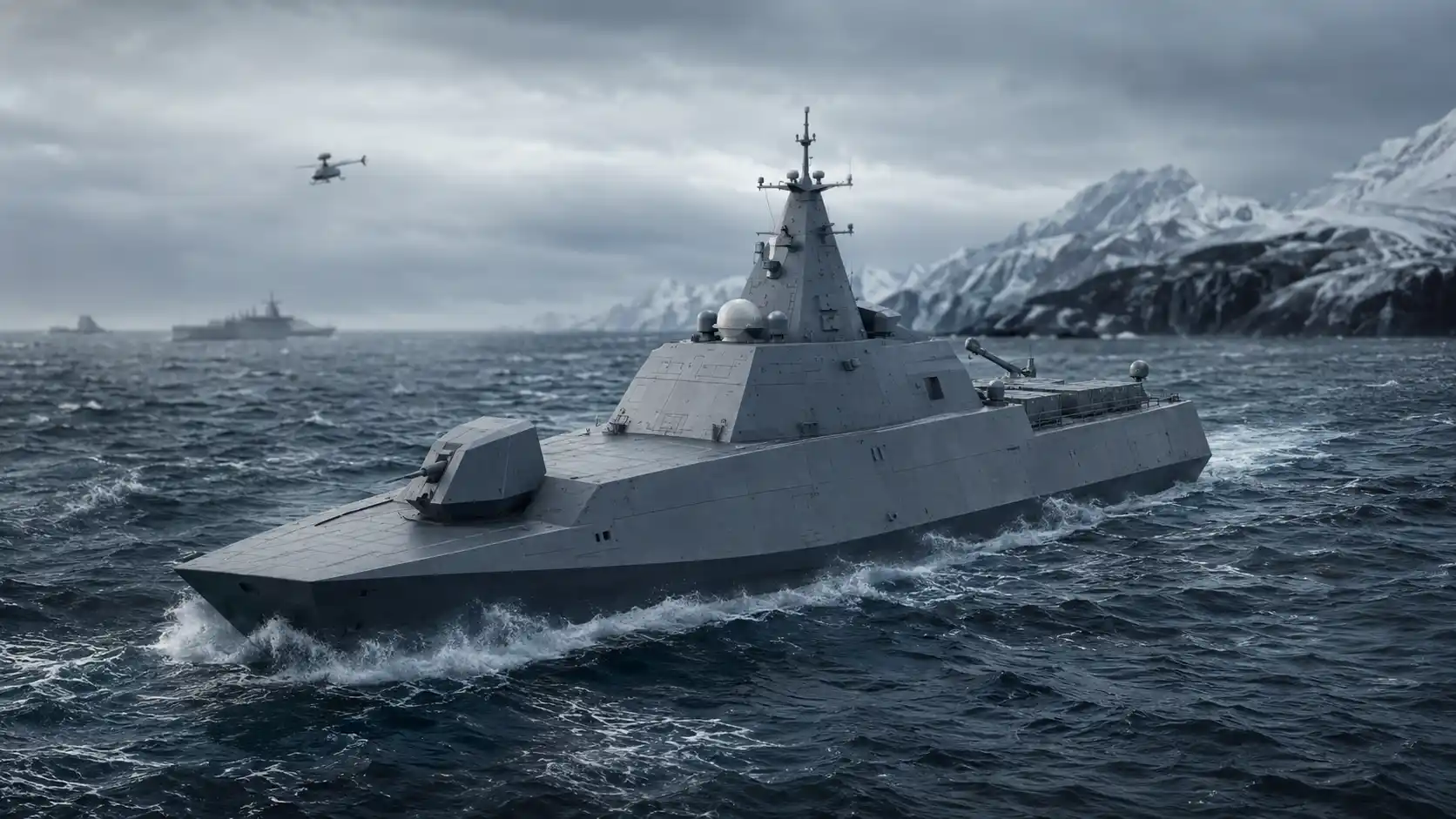
It could become a stealth-managed, modular unmanned escort: a persistent platform able to distribute sensors, effectors, electronic warfare, decoys, and counter-UAS capability across the fleet without requiring a crewed combatant in every position.
The winning design would not be the one with the most weapons. It would be the one with the best protected engagement volume: enough sensing, enough soft-kill, enough programmable ammunition, enough survivability, and enough low-observable discipline to remain useful inside a contested battlespace.
If Navantia UK can preserve modularity while improving signature control, sensor-effector geometry, counter-UAS firepower, electronic warfare, and mission survivability, LASV75 could become more than an autonomous vessel concept.
It could become the blueprint for the hybrid navy’s unmanned escort layer.