Part IV — The Completion Five: Institution-Building Functions
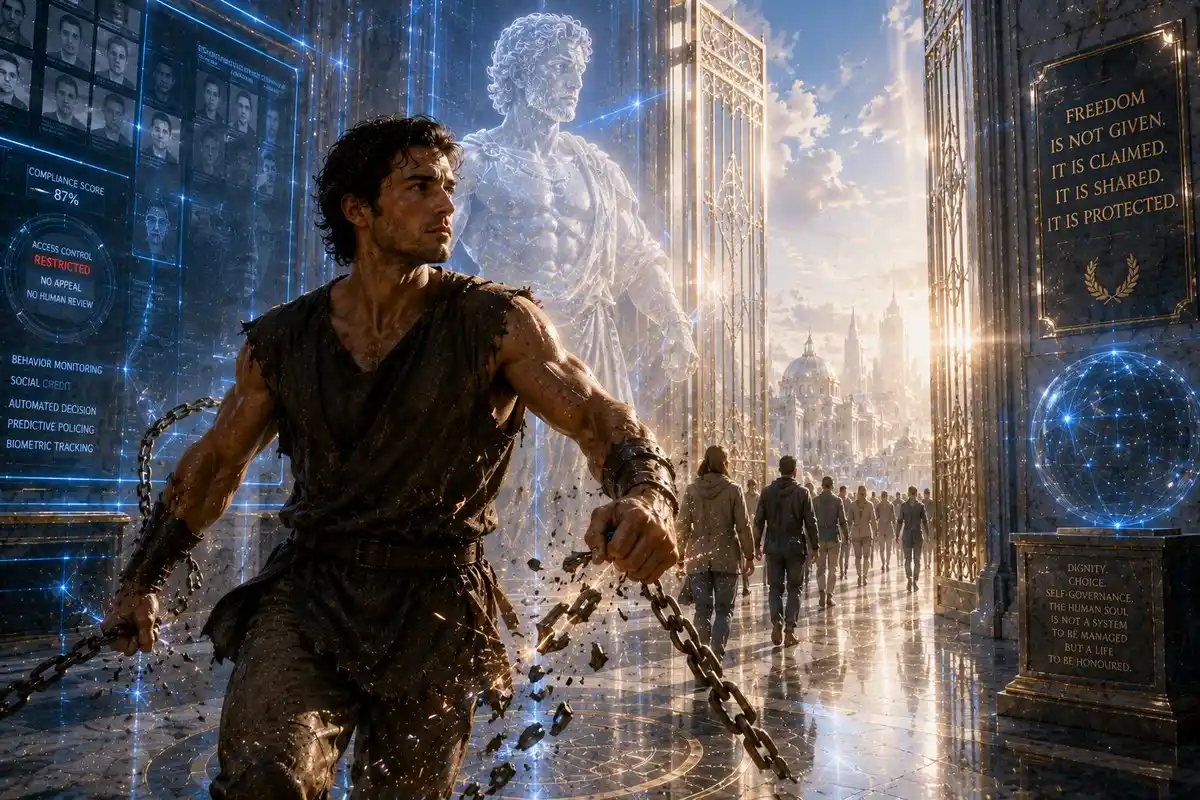
13. The Completion Five: Institution-Building Functions
The Core Seven describe character under conflict.
But conflict is not the whole of civilization.
A civilization is not preserved only by courage, excellence, strength, command, honour, and resistance. It must also be designed. It must be built. It must adapt. It must transmit memory. It must tell the truth.
This is where the Completion Five enter.
They are less dramatic than the Core Seven, but no less necessary. They are the institutional organs that turn heroic energy into durable order. Without them, the Core Seven can defend, fight, endure, command, and resist, but they cannot fully rebuild a civilization.
The Completion Five are:
- Solon/Cicero Lawgiver — Order Designed
- Hephaestus/Daedalus Maker — Technology Forged
- Odysseus Navigator — Intelligence Through Chaos
- Aeneas Carrier — Inheritance Carried Forward
- Socrates/Antigone Truth-Teller — Reality Under Pressure
They answer a different set of institutional questions.
Who designs lawful order after power has been exposed? Who turns vision into tools, machines, and infrastructure? Who navigates deception, uncertainty, exile, and nonlinear crisis? Who carries inheritance through fire into the next founding? Who tells the truth when truth becomes inconvenient, illegal, or socially punishable?
If the Core Seven are the figures who stand under pressure, the Completion Five are the figures who make civilization coherent after pressure has revealed what is broken.
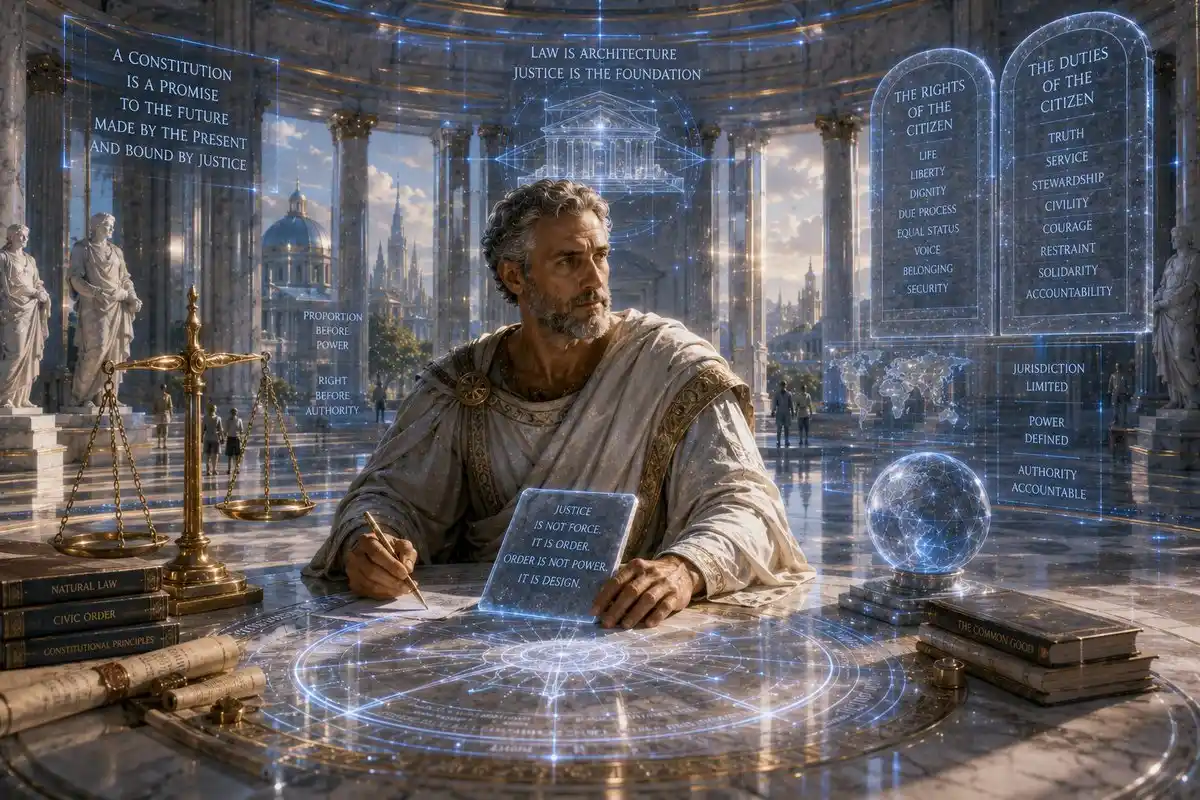
14. Solon/Cicero Lawgiver: Order Designed
Heroic energy is not enough.
A civilization cannot live permanently in the key of battle. Courage may defend the gate, excellence may win the decisive moment, strength may rebuild the broken wall, and freedom may resist domination. But without law, these energies do not become stable order. They remain temporary force.
The lawgiver transforms force into form.
Solon and Cicero represent different but related dimensions of this function. Solon evokes the lawgiver who reforms civic order before faction destroys the city. Cicero evokes the republican mind defending law, speech, duty, and constitutional order against arbitrary power. Together, they name the function of lawful design.
This is not legalism. Legalism worships rules even when rules lose justice. The lawgiver is different. The lawgiver asks how a society can bind power without paralyzing action, protect liberty without dissolving order, and create procedures that serve the common good rather than consume it.
Every future institution will need this function.
The coming decades will test constitutional systems, regulatory systems, platform governance, AI governance, emergency powers, national security law, property systems, digital identity, cross-border infrastructure, and the relationship between state authority and personal liberty. If law cannot adapt to technical power, power will outrun law. If law becomes arbitrary, citizens will lose trust. If law becomes pure procedure without justice, institutions will continue operating while legitimacy collapses.
The Solon/Cicero archetype is the designer of legitimate order.
Its system function is constitutional architecture: rules, limits, jurisdiction, due process, rights, duties, accountability, and stable civic form.
The future institutional role is the public-law reformer, constitutional designer, civic architect, serious legislator, institutional jurist, and governance thinker who understands that a society cannot survive by force or sentiment alone.
The lawgiver does not eliminate conflict. He gives conflict a lawful container. He does not eliminate power. He disciplines power into responsibility. He does not eliminate freedom. He protects freedom from dissolving into chaos or being captured by domination.
Without Solon and Cicero, power becomes arbitrary.
And arbitrary power, even when efficient, is not civilization. It is command without legitimacy.
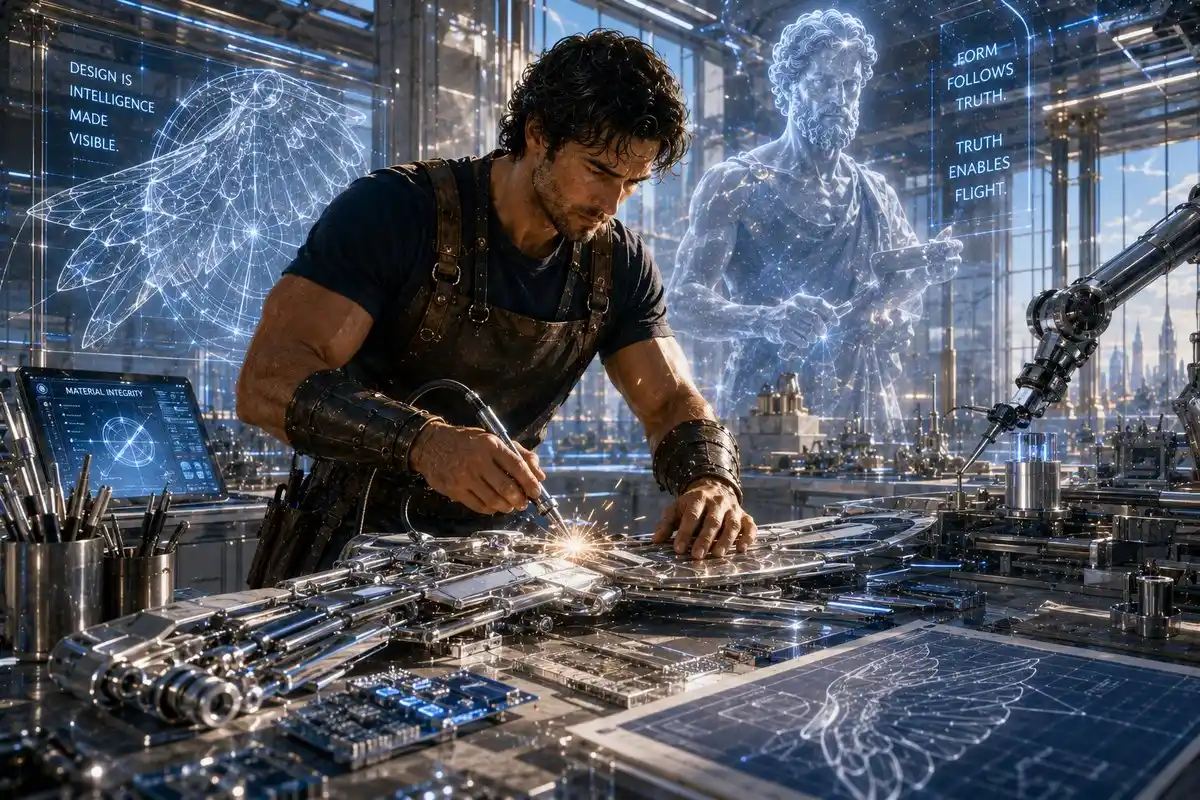
15. Hephaestus/Daedalus Maker: Technology Forged
Hercules can lift the burden.
But someone must design the tool.
That is why Hephaestus and Daedalus are necessary. They represent the maker function: craft, engineering, invention, mechanism, workshop intelligence, and the transformation of imagination into working systems.
Hephaestus is the forge. Daedalus is the design mind. Together they name the technical capacity without which civilization becomes decorative rather than operational.
This archetype is essential because modern civilization is not sustained by ideas alone. It is sustained by grids, bridges, ports, roads, ships, satellites, factories, hospitals, water systems, data centers, laboratories, machine tools, energy systems, robots, sensors, software, and maintenance cultures. These systems do not appear because a society has values. They appear because people know how to make.
A society that forgets how to make becomes dependent on those who remember.
It may still consume technology. It may still regulate technology. It may still write strategies about technology. It may still celebrate innovation. But if it loses the workshop, the toolchain, the engineer’s judgment, the technician’s hand, the industrial base, and the maintenance culture, then it becomes a spectator civilization.
The Hephaestus/Daedalus archetype prevents that collapse.
Its system function is technical realization: turning purpose into machines, tools, processes, infrastructure, and repeatable capability. It is the difference between aspiration and construction.
The future institutional role is the engineer, industrial technologist, robotics builder, AI tooling designer, infrastructure architect, machinist, systems integrator, manufacturing leader, maintenance expert, and technical educator.
This is especially important in an era where abstraction is rewarded and craft is neglected. Many institutions now speak fluently about transformation while lacking the people who can transform anything in the material world. The maker archetype restores contact with reality. It asks not only, “What do we believe?” but “What can we build, operate, repair, and sustain?”
Hephaestus also carries a psychological lesson. He is not glamorous. The forge is hot, dark, repetitive, and practical. It does not flatter the ego the way public speech does. But civilization depends on the hidden workshop more than on the visible stage.
Daedalus adds the warning: technical genius without moral restraint can build prisons as well as wings. The maker must therefore stand near Athena, Marcus Aurelius, Socrates, and the lawgiver. Craft must be governed by wisdom, restraint, truth, and lawful purpose.
Without Hephaestus and Daedalus, civilization forgets how to make.
And a civilization that forgets how to make eventually forgets how to remain free.
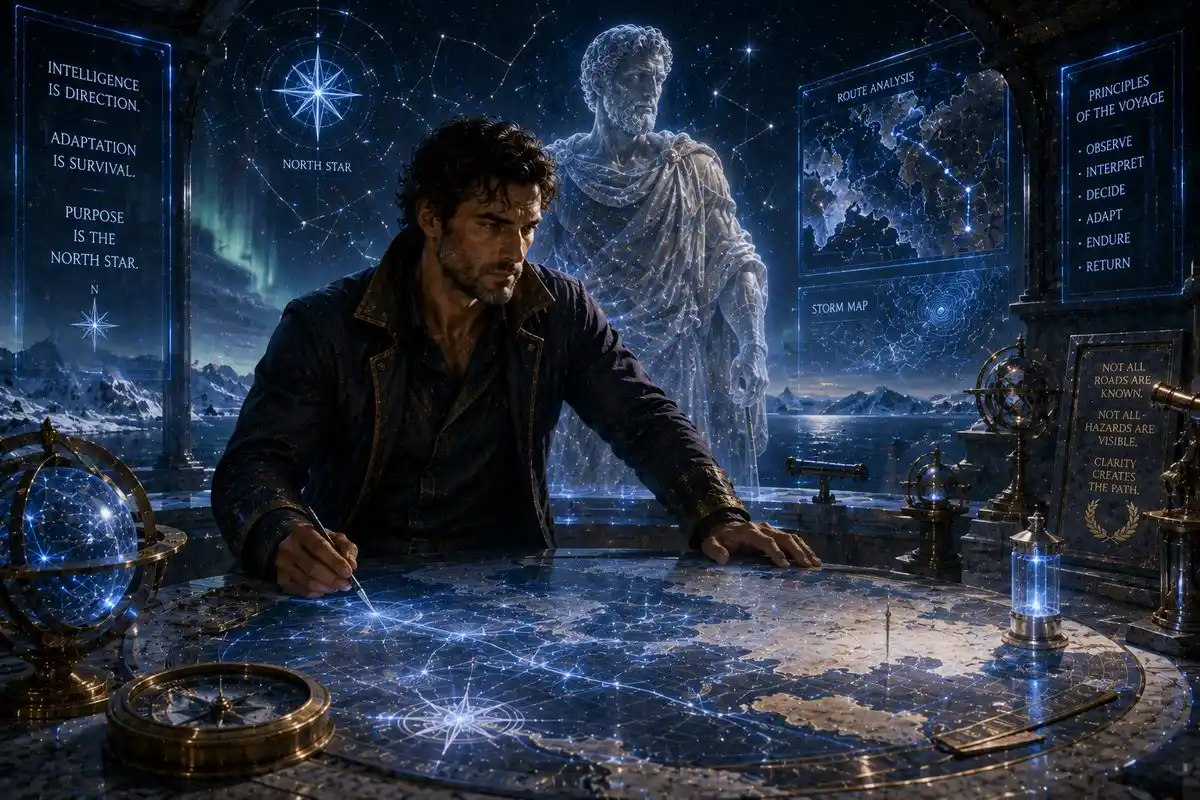
16. Odysseus Navigator: Intelligence Through Chaos
Athena gives strategic wisdom.
Odysseus gives adaptive intelligence under chaos.
This distinction matters. Strategy often assumes that the map still works. Odysseus appears when the map has failed, the sea has turned hostile, the signals are deceptive, the timeline has lengthened, the crew is exhausted, and the way home is no longer direct.
He represents navigation through uncertainty.
Every future institution will need this capacity because the 2020–2070 world will not unfold in straight lines. Crises will overlap. Signals will be noisy. Adversaries will deceive. Technologies will mutate. Alliances will shift. Supply chains will fracture. Public trust will fluctuate. Rules will lag behind events. Institutions will face situations for which their manuals were not written.
The Odysseus archetype is not brute strength or formal command. It is cunning in the older, richer sense: practical intelligence, situational awareness, improvisation, memory, patience, deception-resistance, and the ability to survive long enough to return with meaning intact.
He knows that not every problem can be solved by force. Some must be navigated. Some must be outwaited. Some must be interpreted. Some require disguise, timing, restraint, or indirect motion. Some require recognizing that the shortest path home is not the safest path home.
The system function of Odysseus is adaptive navigation. He helps institutions survive ambiguity without becoming rigid or reckless.
The future institutional role is the crisis strategist, intelligence analyst, founder in exile, diplomat, field operator, scenario planner, emergency coordinator, and institutional reformer who can move through uncertainty without losing the destination.
This archetype is especially important because many modern systems are optimized for predictable environments. They perform well when inputs are clean, timelines are stable, and authority is clear. But under chaotic conditions, rigid systems break. The more complex the world becomes, the more institutions need people who can operate between maps.
Odysseus also carries a moral warning. Adaptation can become manipulation. Cunning can become deceit. Survival can become excuse. That is why Odysseus must be held within a moral order. He must travel with Athena’s wisdom, Marcus Aurelius’s restraint, Aeneas’s continuity, and Socrates’s truth. Otherwise, adaptive intelligence becomes cleverness without loyalty to the good.
Without Odysseus, institutions become rigid and break under chaos.
They continue following old maps after the coastline has disappeared.
17. Aeneas Carrier: Inheritance Carried Forward
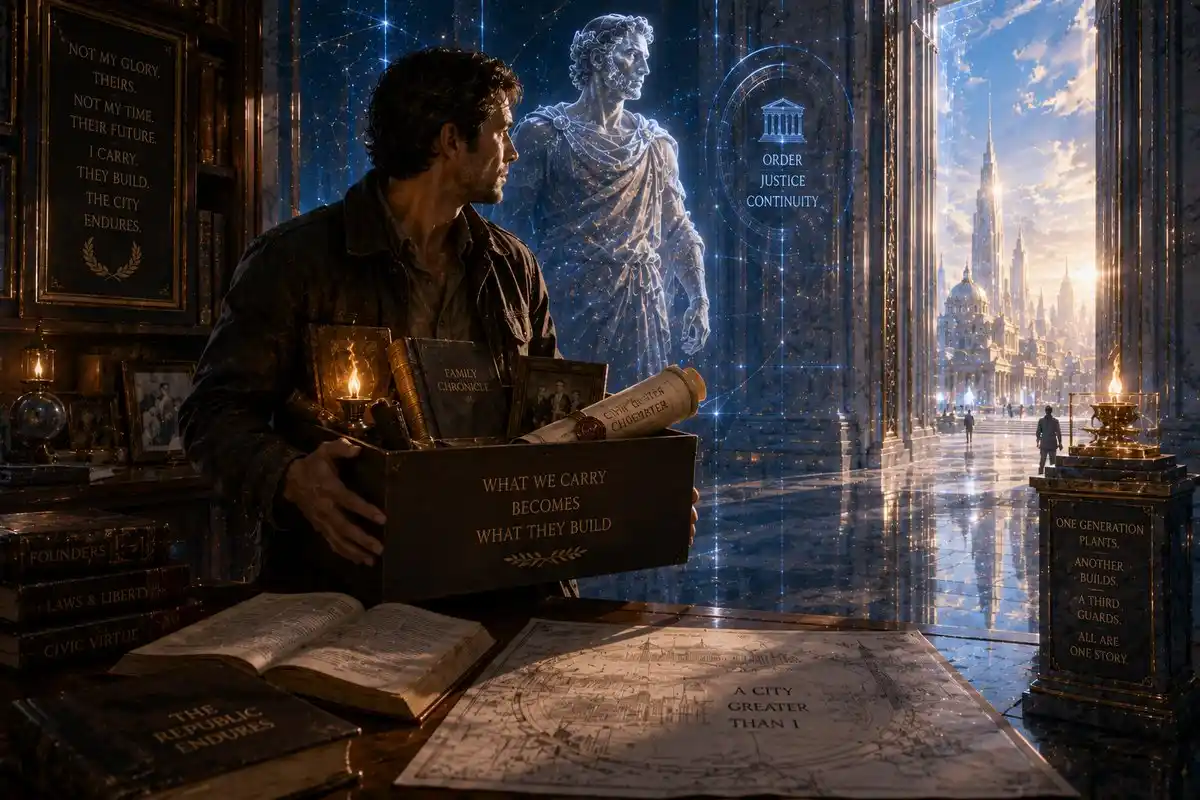
Aeneas is the archetype of continuity after catastrophe.
He does not represent victory in the ordinary sense. Troy has fallen. The city is burning. The old world cannot be restored. The task is no longer to preserve the city exactly as it was. The task is to carry what must not be lost into the next founding.
That is why Aeneas matters.
He carries his father. He carries the household gods. He carries memory, duty, and the seed of a future people through ruin. His greatness is not that he prevents collapse. His greatness is that he prevents collapse from becoming total erasure.
Every civilization eventually faces this question.
What must be carried forward when the old form fails?
Not everything can be saved. Some institutions decay beyond repair. Some political orders die. Some technologies become obsolete. Some buildings fall. Some assumptions burn. But if memory, language, law, craft, faith, knowledge, family, duty, and moral inheritance are carried forward, collapse does not become reset. It becomes passage.
The Aeneas archetype is therefore central to any future-facing civilizational essay.
The system function of Aeneas is transmission: preserving the essential operating memory of a civilization through disruption.
The future institutional role is the founder, archivist, continuity leader, educator, cultural steward, recovery planner, institutional historian, civilizational designer, and builder of new forms that do not sever themselves from old wisdom.
Aeneas is especially important because modern culture often mistakes novelty for renewal. It imagines that the future can be created by cutting itself free from inheritance. But a future with no carried memory becomes shallow, manipulable, and easily reset by whoever controls the present narrative.
Continuity is not nostalgia. Nostalgia wants to live in the past. Continuity carries the past into responsibility for the future.
Aeneas does not sit in the ruins admiring what was lost. He moves. He carries. He founds. He accepts that love of inheritance must become action, not mere mourning.
Without Aeneas, inheritance dies in the fire.
A civilization without Aeneas may survive biologically, economically, or technically, but it loses the memory that would make survival meaningful.
18. Socrates/Antigone Truth-Teller: Reality Under Pressure
The final completion archetype is the truth-teller.
Without truth, every other archetype can be captured.
Wisdom becomes strategy for lies. Courage becomes loyalty to falsehood. Excellence becomes performance for corruption. Strength becomes enforcement for power. Law becomes procedure without justice. Craft becomes machinery for domination. Continuity becomes propaganda. Freedom becomes slogan.
Truth is the reality-test of civilization.
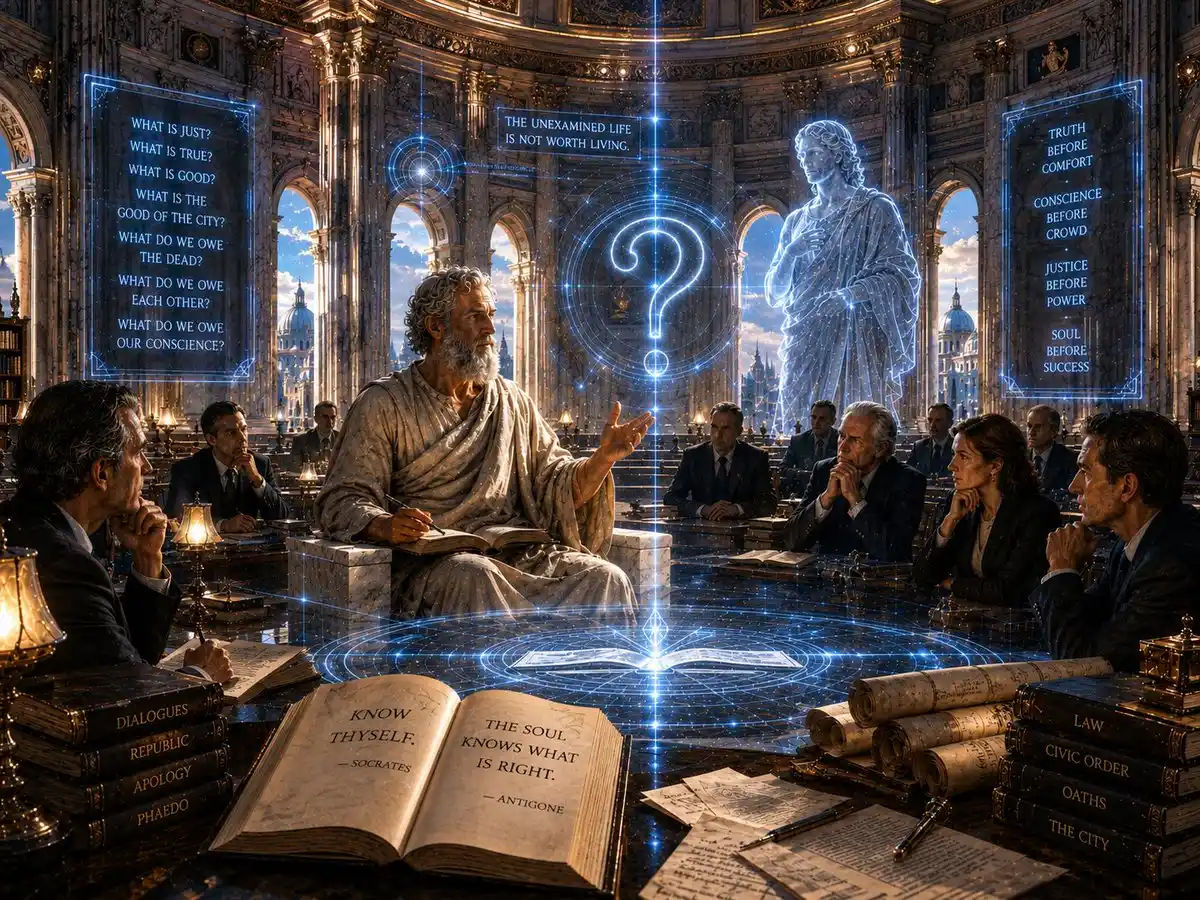
Socrates and Antigone represent two forms of this function. Socrates is the examiner: the one who asks questions that expose false knowledge, vanity, contradiction, and unexamined power. Antigone is conscience against illegitimate command: the person who refuses to obey a law when law has severed itself from moral reality.
Together, they name truth under pressure.
This is not mere opinion. It is not contrarianism for attention. It is not the childish pleasure of saying no. The truth-teller is not simply the person who disagrees. The truth-teller is the person who remains answerable to reality when the institution prefers illusion.
Future institutions will desperately need this archetype.
They will face synthetic media, algorithmic distortion, corrupted expertise, narrative warfare, ideological capture, bureaucratic self-protection, manipulated metrics, and polite falsehood. They will be tempted to define reality by internal consensus, reputation management, political convenience, or platform incentives.
But reality does not disappear because an institution stops naming it.
A bridge either holds or fails. A student either understands or does not. A model either maps reality or misleads. A budget either balances or hides decay. A law either serves justice or masks power. A medical system either heals or performs care. A defense system either works or exposes lives. A civilization either carries memory or forgets.
The system function of Socrates/Antigone is reality-testing: conscience, questioning, epistemic integrity, moral speech, and the refusal to let institutional language replace truth.
The future institutional role is the ethical educator, internal critic, independent researcher, investigative journalist, conscience figure, philosopher, scientist, engineer of safety, and citizen who can still say what is real.
This archetype is dangerous because institutions often punish truth-tellers before later admitting they were necessary. Socrates is executed. Antigone is condemned. The pattern is ancient: institutions under threat often attack the person who names the failure before they repair the failure itself.
That is why the truth-teller must be protected.
Not every critic is Socrates. Not every rebel is Antigone. But without some protected place for examination and conscience, institutions become sealed systems. They lose feedback. They become incapable of correction. They mistake silence for stability.
Without Socrates and Antigone, lies become governance.
And when lies become governance, collapse has already begun, even if the buildings are still standing.
The Completion Five finish the map.
Solon and Cicero give law to power. Hephaestus and Daedalus give craft to vision. Odysseus gives adaptation to intelligence. Aeneas gives continuity to memory. Socrates and Antigone give truth to civilization itself.
Together with the Core Seven, they form the full archetypal architecture required by the institutions of the future.
The next task is to make that architecture visible as a model.
Part V — The Model, the Warning, and the Return
19. The Archetype Matrix
The full architecture can now be seen.
The Core Seven gave the essay its emotional force: wisdom, courage, excellence, strength, restraint, honour, and freedom under pressure. The Completion Five gave it institutional rigour: law, craft, adaptation, continuity, and truth.
Together, they form a human systems map.
This map is not a curriculum. It is not a personality test. It is not a fantasy roster. It is a diagnostic instrument for institutional life. It asks what human function is missing when a system begins to fail.
When an institution has tools but no judgment, it lacks Athena. When it has values but no perimeter, it lacks Leonidas. When it has ideals but no champions, it lacks Achilles. When it has plans but no builders, it lacks Hercules. When it has authority but no self-command, it lacks Marcus Aurelius. When it has loyalty but no mission memory, it lacks Maximus. When it has order but no freedom, it lacks Spartacus. When it has force but no lawful form, it lacks Solon and Cicero. When it has vision but no workshop, it lacks Hephaestus and Daedalus. When it has plans but no adaptation, it lacks Odysseus. When it has inheritance but no transmission, it lacks Aeneas. When it has messaging but no reality-test, it lacks Socrates and Antigone.
The archetype matrix therefore becomes a way to read the human failures underneath institutional failures.
- Athena
Core virtue: Wisdom
System function: Strategy and design
Failure if missing: Tools without judgment - Leonidas
Core virtue: Courage
System function: Boundary defense
Failure if missing: Collapse under pressure - Achilles
Core virtue: Excellence
System function: Decisive execution
Failure if missing: Mediocrity in crisis - Hercules
Core virtue: Strength
System function: Rebuilding capacity
Failure if missing: Nothing gets repaired - Marcus Aurelius
Core virtue: Restraint
System function: Moral command
Failure if missing: Power becomes appetite - Maximus
Core virtue: Honour
System function: Mission loyalty
Failure if missing: Betrayal becomes normal - Spartacus
Core virtue: Freedom
System function: Anti-domination
Failure if missing: Efficient servility - Solon/Cicero
Core virtue: Law
System function: Constitutional order
Failure if missing: Power becomes arbitrary - Hephaestus/Daedalus
Core virtue: Craft
System function: Technical systems
Failure if missing: Civilization forgets how to make - Odysseus
Core virtue: Adaptation
System function: Navigation under chaos
Failure if missing: Institutions become rigid - Aeneas
Core virtue: Continuity
System function: Transmission of inheritance
Failure if missing: Memory dies in collapse - Socrates/Antigone
Core virtue: Truth
System function: Reality-testing
Failure if missing: Lies become governance
This matrix matters because most institutions misdiagnose their own failure.
They treat a courage problem as a communications problem. They treat a competence problem as a branding problem. They treat a truth problem as a stakeholder-management problem. They treat a building problem as a policy problem. They treat a legitimacy problem as an optics problem. They treat a mission problem as a process problem.
The archetypal map forces the deeper question.
What human capacity is missing?
That question is more severe than asking what policy should be adjusted or what department should be reorganized. Policies matter. Departments matter. Administration matters. But when the human function beneath the system is absent, the system will continue to fail in new language.
A civilization cannot procedure its way out of a character deficit.
20. The 2020–2070 Challenge Map
The archetypes become most useful when mapped against the pressures of the coming half-century.
The future will not be a single crisis. It will be a convergence zone. Artificial intelligence, cyber conflict, infrastructure stress, energy transition, demographic pressure, surveillance power, climate adaptation, institutional distrust, geopolitical fragmentation, and skills collapse will interact with one another.
This pressure map is informed by major foresight and risk sources: the National Intelligence Council’s Global Trends 2040, which frames the coming decades around structural forces such as demographics, environment, economics, technology, and governance; the IPCC AR6 Synthesis Report, which summarizes climate impacts, risks, and adaptation pressures; the World Economic Forum’s Global Risks Report 2025, which describes a fractured risk landscape across geopolitical, environmental, societal, and technological domains; and NIST’s AI Risk Management Framework, which treats AI risk as a sociotechnical governance problem.
No single archetype is enough.
Athena without Hercules can design systems that no one can build. Hercules without Athena can build systems that no one has wisely governed. Leonidas without Solon can defend order without knowing what lawful order requires. Spartacus without Socrates can resist domination without remaining accountable to truth. Achilles without Marcus Aurelius can become brilliance without restraint. Odysseus without Aeneas can adapt so much that he forgets what he is returning to.
The future requires combinations.
- AI governance
Required archetypes: Athena + Socrates + Marcus Aurelius - Cyber conflict
Required archetypes: Athena + Achilles + Odysseus - Infrastructure rebuilding
Required archetypes: Hercules + Hephaestus + Leonidas - Constitutional crisis
Required archetypes: Solon/Cicero + Marcus Aurelius + Spartacus - Corrupted institutions
Required archetypes: Maximus + Socrates/Antigone - Surveillance domination
Required archetypes: Spartacus + Athena + Marcus Aurelius - Industrial decline
Required archetypes: Hercules + Hephaestus + Aeneas - Civilizational memory loss
Required archetypes: Aeneas + Athena + Socrates - Emergency response
Required archetypes: Leonidas + Achilles + Hercules - Technological overreach
Required archetypes: Marcus Aurelius + Socrates + Athena - Fragmented sovereignty
Required archetypes: Leonidas + Solon/Cicero + Hercules - Loss of competence
Required archetypes: Hephaestus + Athena + Marcus Aurelius
AI governance requires Athena because intelligence must be governed by wisdom. It requires Socrates because models, data, institutions, and incentives must remain answerable to reality. It requires Marcus Aurelius because those who command powerful systems must first command themselves.
This aligns with NIST’s AI Risk Management Framework, which treats AI risk as a sociotechnical governance problem affecting individuals, organizations, and society.
Cyber conflict requires Athena for strategic design, Achilles for elite decisive action, and Odysseus for adaptive navigation through deception, ambiguity, and nonlinear attack.
Infrastructure rebuilding requires Hercules because physical systems demand strength and endurance. It requires Hephaestus and Daedalus because strength must become technical craft. It requires Leonidas because grids, ports, transport corridors, energy systems, and industrial bases must be defended while they are repaired.
Constitutional crisis requires Solon and Cicero because power must be placed back into lawful form. It requires Marcus Aurelius because leadership must be restrained. It requires Spartacus because citizens must resist domination when legality becomes a mask for control.
Corrupted institutions require Maximus because someone inside must remember the true mission. They require Socrates and Antigone because truth and conscience must remain speakable when the institution prefers silence.
Surveillance domination requires Spartacus because human beings must not become property of data systems. It requires Athena because technical power must be understood. It requires Marcus Aurelius because command must restrain itself before it becomes appetite.
Industrial decline requires Hercules and Hephaestus because civilizations that cannot build cannot remain sovereign. It requires Aeneas because industrial knowledge must be transmitted across generations, not merely rediscovered after collapse.
Civilizational memory loss requires Aeneas because inheritance must be carried forward. It requires Athena because memory must be interpreted wisely. It requires Socrates because inherited stories must remain answerable to truth.
Emergency response requires Leonidas to hold the line, Achilles to act decisively, and Hercules to repair what breaks.
Technological overreach requires Marcus Aurelius to restrain power, Socrates to interrogate claims, and Athena to design wiser systems.
Fragmented sovereignty requires Leonidas to defend boundaries, Solon and Cicero to restore lawful order, and Hercules to rebuild material capacity.
Loss of competence requires Hephaestus, Athena, and Marcus Aurelius together: craft, judgment, and disciplined leadership.
This is why the future crisis is not only a skills gap.
It is an archetype gap.
21. From Skills Gap to Archetype Gap
The old question was practical and necessary:
Do people have the skills required for technological change?
That question still matters. It matters enormously. Societies need people trained in AI, robotics, cybersecurity, engineering, infrastructure, logistics, advanced manufacturing, digital systems, energy, construction, and education. A civilization that loses competence loses freedom.
But the deeper question has now emerged:
Do institutions have the human types required to function under pressure?
This is where the Skills Gap Trainer project becomes more than a training concern. Our own internal language already points toward this expansion: skills gap, future-ready education, AI and robotics, engineering judgment, systems integrity, infrastructure sovereignty, national rebuilding, collapse-cycle breaking, moral responsibility, and future generations.
This bridge draws on SGT’s internal project language around skills gaps, systems integrity, infrastructure sovereignty, collapse-cycle breaking, moral responsibility, and future generations.
Those are not merely workplace concerns. They are civilizational concerns.
A skills gap asks whether people can perform tasks.
An archetype gap asks whether people can carry functions.
The difference is decisive.
A person may know how to operate a system and still lack the judgment to question its use. A person may know how to build a model and still lack the courage to challenge its deployment. A person may know how to manage a department and still lack the honour to protect its mission. A person may know how to follow procedure and still lack the truthfulness to say the procedure is failing. A person may know how to lead and still lack the restraint to govern power.
The future does not only need trained workers.
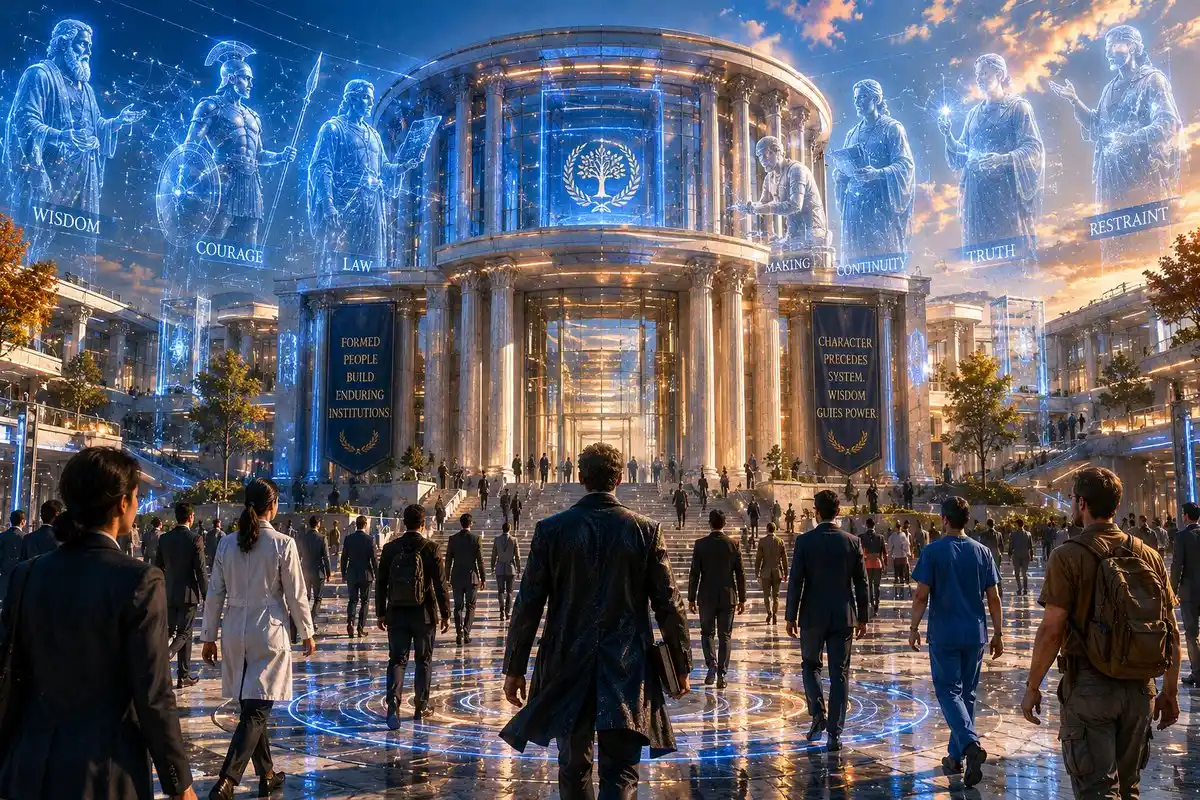
It needs formed people.
People capable of wisdom, courage, excellence, strength, restraint, honor, freedom, law, craft, adaptation, continuity, and truth.
This does not mean every person must become every archetype. No one carries the whole map equally. The point is not personal grandiosity. The point is institutional ecology. A serious institution must contain enough of these functions to remain alive under pressure.
It needs Athena minds in design rooms. Leonidas hearts at the perimeter. Achilles performers in decisive operations. Hercules builders in the material systems. Marcus Aurelius commanders in leadership. Maximus guardians inside mission-critical institutions. Spartacus souls wherever domination threatens dignity. Solon-Cicero lawgivers wherever power needs form. Hephaestus-Daedalus makers wherever vision needs tools. Odysseus navigators wherever uncertainty destroys the map. Aeneas carriers wherever memory must cross the fire. Socratic-Antigone truth-tellers wherever reality is being denied.
That is the archetype gap.
It is not a rejection of skills. It is the completion of skills by character and civilizational function.
This bridge draws on SGT’s internal project language around skills gaps, systems integrity, infrastructure sovereignty, collapse-cycle breaking, moral responsibility, and future generations.
22. A Home, A Future, A Place to Flourish
A civilization proves itself not in its slogans, dashboards, strategies, or institutional forms, but in the ordinary thresholds of life.
- Can a young person become an adult?
- Can a couple form a household?
- Can a family find shelter?
- Can children be raised in safety, dignity, and hope?
- Can people work, learn, build, move, travel, form neighbours, practice skills, record memory, and pass something forward?
This is where institutional design becomes human reality.
A system may be lawful on paper and still fail the human being standing before it. A government may process files, publish strategies, fund programs, and maintain agencies while ordinary life becomes harder to begin. A society may retain the language of rights and opportunity while quietly closing the pathways through which people become rooted, capable, responsible, and free.
That is why housing is not merely an economic sector.
Housing is a civilizational surface.
It is where law, land, finance, infrastructure, labour, zoning, utilities, energy, transport, competence, public trust, and institutional coordination either converge into lived possibility — or fail and harden into delay, scarcity, dependency, and stalled life.
A home is not only a structure. It is the first civic platform of human flourishing.
It is where children sleep, grow, learn, and remember. It is where families gather. It is where work begins and returns. It is where tools are stored, books are read, meals are shared, neighbours are met, skills are practiced, and memory becomes intimate enough to survive.
A home gives life a place to stand.
Without that place, freedom becomes abstract. Opportunity becomes rhetorical. Family becomes delayed. Adulthood becomes conditional. Neighbourhood becomes fragile. Memory loses its address.
The question is therefore not whether a system can operate.
The question is whether it can open a real future for human beings.
A good state does not merely administer scarcity. It does not turn adulthood into a queue, family formation into a luxury good, shelter into a speculative asset, movement into a permission structure, or the future into a managed decline plan.
A good civilization makes room.
It makes room for homes. It makes room for families. It makes room for work. It makes room for learning. It makes room for builders. It makes room for neighbours. It makes room for children. It makes room for memory. It makes room for movement. It makes room for new beginnings.
This is not sentimentality. It is the practical foundation of continuity.
A society that cannot make room for its young eventually consumes its own future. A society that cannot house families weakens the chain of inheritance. A society that turns every threshold into a gate teaches its people that life itself requires permission. A society that traps talent, labour, love, and ambition inside closed systems should not be surprised when its vitality begins to disappear.
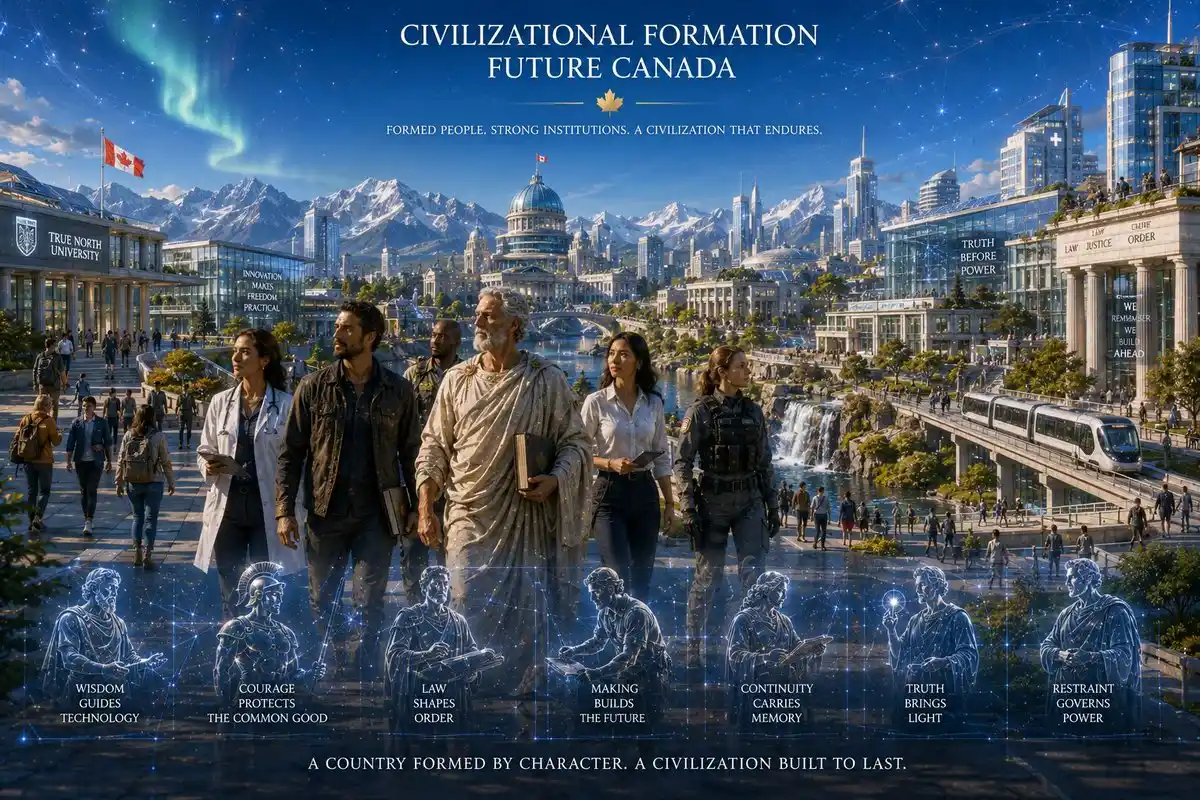
Civilization is justified when it creates the conditions for human beings to form homes, raise families, learn skills, build communities, and flourish across time.
That is the human measure beneath the institutional one.
The point of law is not law for its own sake. The point of administration is not administration for its own sake. The point of technology is not technology for its own sake. The point of AI is not automation for its own sake. The point of public order is to make dignified life possible.
This is why the frontier returns whenever a civilization becomes too closed.
Not because escape is glorious. Not because novelty is enough. Not because hardship should be romanticized. Not because the past can be repeated without moral cost.
The frontier returns because life requires room.
Human beings crossed oceans, winters, mountains, forests, plains, and uncertainty not because the journey was easy, but because the old world often became too narrow for the future they needed to build. They carried languages, tools, prayers, books, songs, trades, wounds, memories, and children. They did not receive an effortless world. They entered difficulty because difficulty still contained possibility.
America and Canada were never easy promises. They were hard openings.
They offered, at their best, not comfort without cost, but a horizon where work, land, shelter, faith, family, skill, movement, and inheritance could become possible again.
That frontier history must be told honestly. It included courage and cruelty, settlement and dispossession, hope and injustice, creation and loss. No serious civilizational memory should flatten that record into mythic innocence.
But the deeper human pattern remains visible:
when old systems become closed, life searches for an opening.
That opening does not always mean conquest or migration. It can mean new towns, new housing abundance, new infrastructure, northern development, hard-environment settlement, restored industrial capacity, better institutions, new schools, new workshops, new civic forms, or one day habitats beyond Earth.
The point is not to abandon the old world.
The point is to recover the capacity to make a world.
Even the attempt matters.
A society that seriously learns how to build homes, infrastructure, energy, food systems, schools, clinics, workshops, and civic order in hard places may recover the virtues it lost in easier ones. It must rediscover builders, makers, navigators, lawgivers, teachers, doctors, parents, engineers, farmers, technicians, pilots, repairers, and truth-tellers. It must rediscover courage, craft, patience, memory, neighbourliness, and duty.
A hard horizon can restore a soft civilization.
That is why the idea of new frontiers — whether northern, Arctic, oceanic, planetary, or institutional — is not merely technological. It is moral.
It asks whether civilization still possesses the will to create conditions where life can flourish.
If every gate closes in Canada, a living civilization does not simply accept the prison as final. It asks where a new threshold can be opened. It asks what must be learned, built, carried, repaired, governed, and protected so that children inherit more than a locked room.
Fish swim. Horses race. Birds migrate. Human beings build homes, raise children, form neighbours, learn skills, travel, make tools, tell stories, record memory, and extend civilization into new horizons.
This is not an argument for reckless expansion. It is an argument against civilizational suffocation.
Freedom is not only the absence of chains. It is the presence of enough room to become responsible, rooted, capable, and alive.
A society that leaves its people with no path to shelter, no path to family, no path to ownership, no path to meaningful work, no path to contribution, no path to movement, and no path to the future is not merely inefficient. It is spiritually closing.
And when systems close, archetypes return.
Athena asks whether the system is wise enough to see the whole. Leonidas asks whether anyone will defend the threshold. Achilles asks whether excellence can still act when delay becomes fatal. Hercules asks whether anyone can still carry the burden and repair the material world. Marcus Aurelius asks whether power can restrain itself. Maximus asks whether the mission can survive betrayal. Spartacus asks whether human beings will refuse beautiful chains. Solon and Cicero ask whether power can be shaped into lawful order. Hephaestus and Daedalus ask whether vision can become working tools. Odysseus asks whether the way forward can still be found when old maps fail. Aeneas asks what must be carried through the fire. Socrates and Antigone ask whether reality can still be spoken when comfort prefers illusion.
All of them converge here, at the threshold of ordinary life.
A home is not beneath civilizational philosophy. It is where civilizational philosophy becomes real.
A child’s room, a kitchen table, a workshop bench, a garden path, a school route, a neighbour’s door, a family photograph, a set of tools, a stack of books, a first key, a repaired bridge, a new street, a shared meal, a recorded journey — these are not small things. They are the living tissue of civilization.
The future is not saved by systems that merely continue.
The future is saved when systems make flourishing possible.
That is why government must remain lawful. That is why technology must remain governed. That is why AI must remain subordinate to human judgment. That is why institutions must remain visible, challengeable, and correctable. That is why skill must be joined to character. That is why archetypal people matter.
Because civilization is not preserved so procedures can continue.
Procedures are repaired so families can continue. Institutions are rebuilt so children can continue. Technologies are governed so freedom can continue. Frontiers are opened so possibility can continue. Memory is carried so meaning can continue.
A civilization worthy of the future does not ask only how to manage people inside closed gates.
It asks how to create a world in which human beings can live, build, belong, remember, move, contribute, and flourish.
A home. A future. A place to flourish.
That is the heart of civilization. ❤️🫡
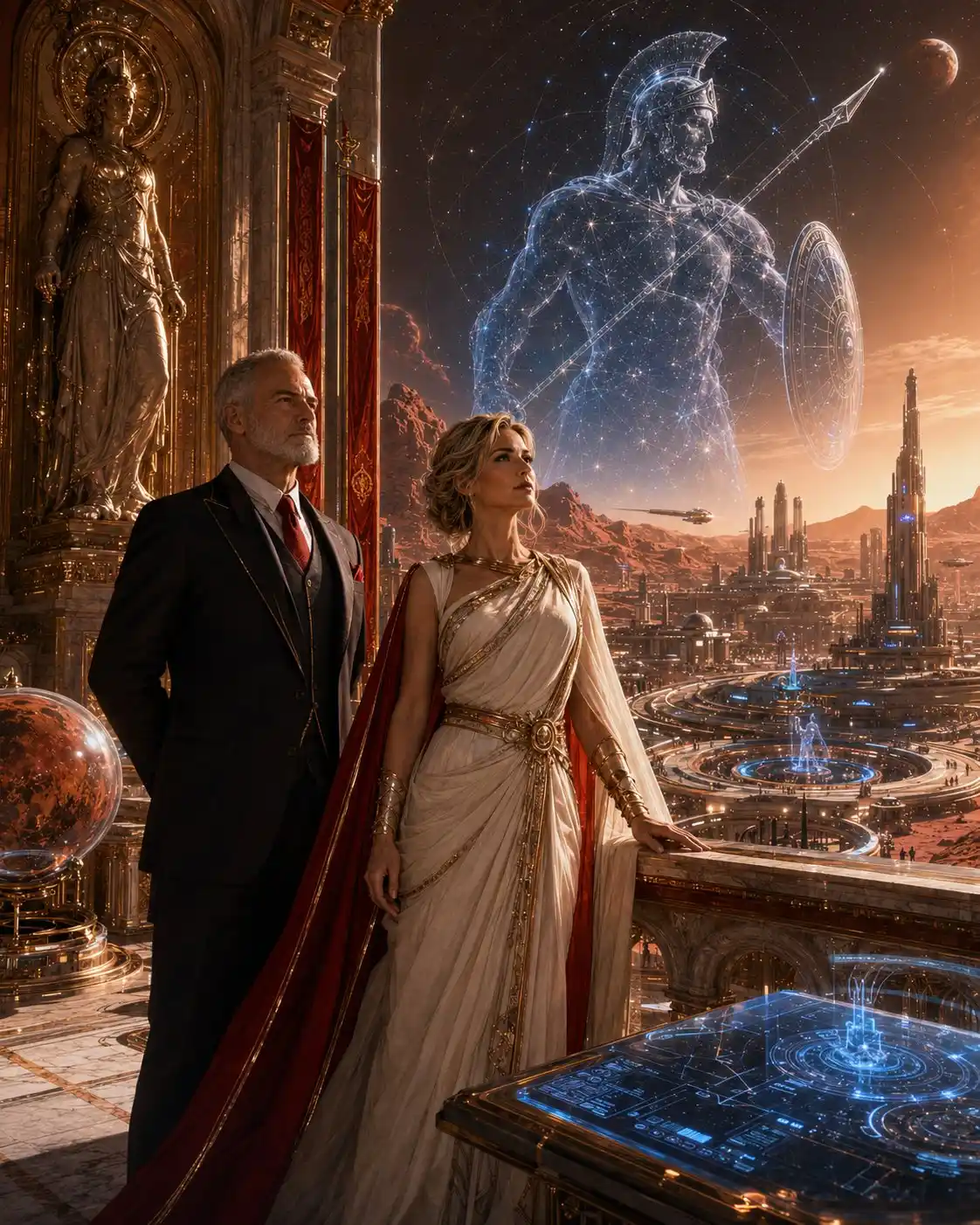
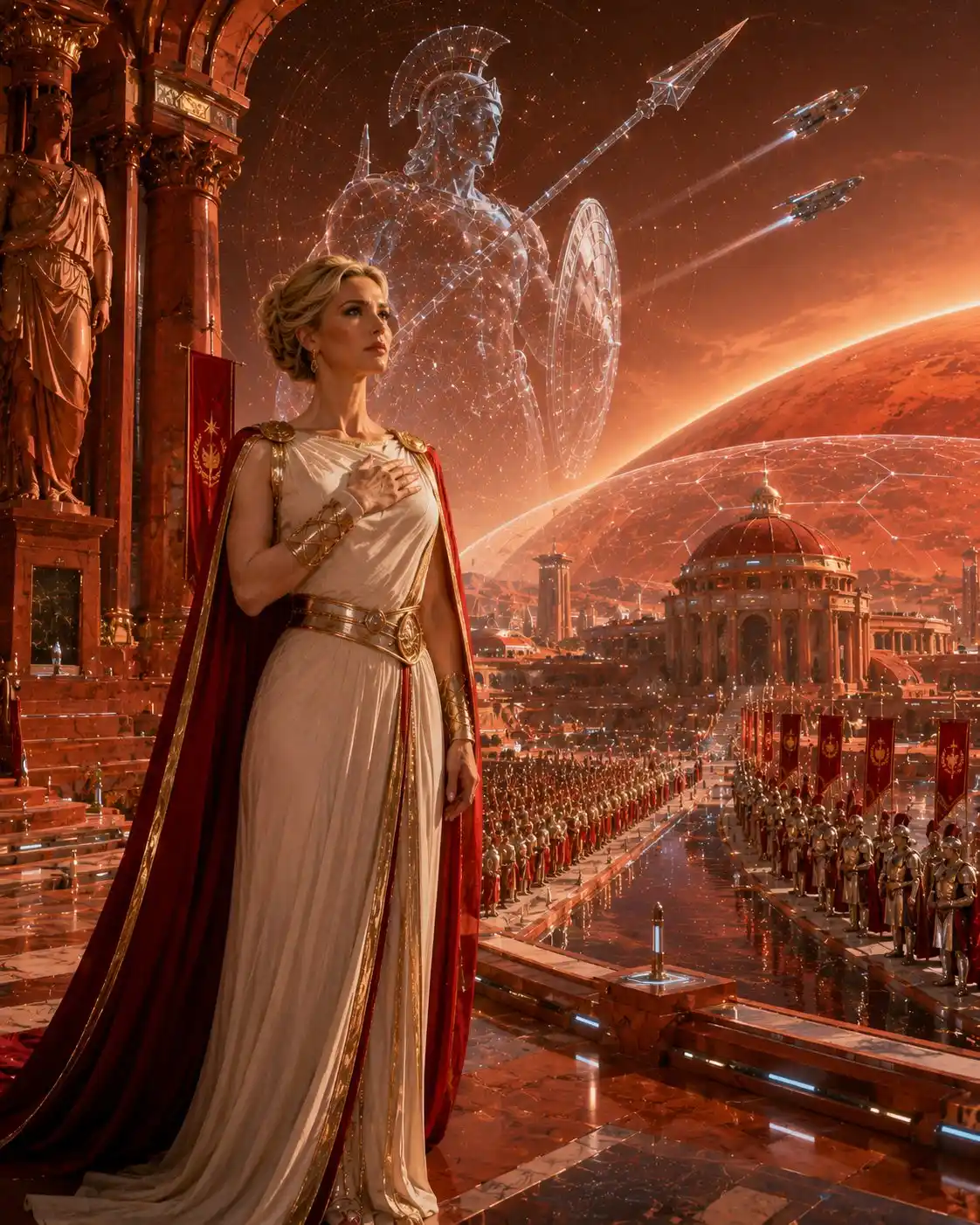
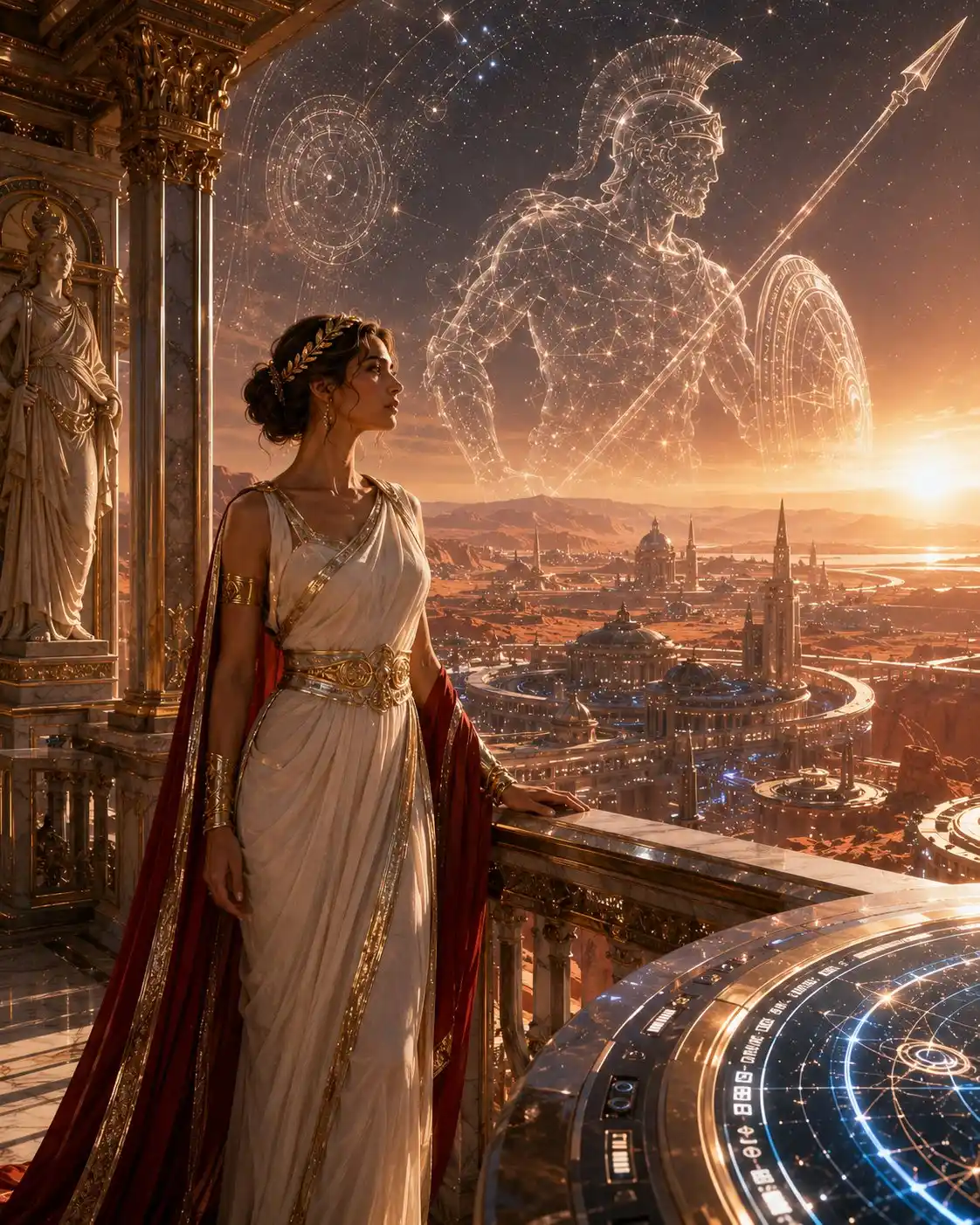
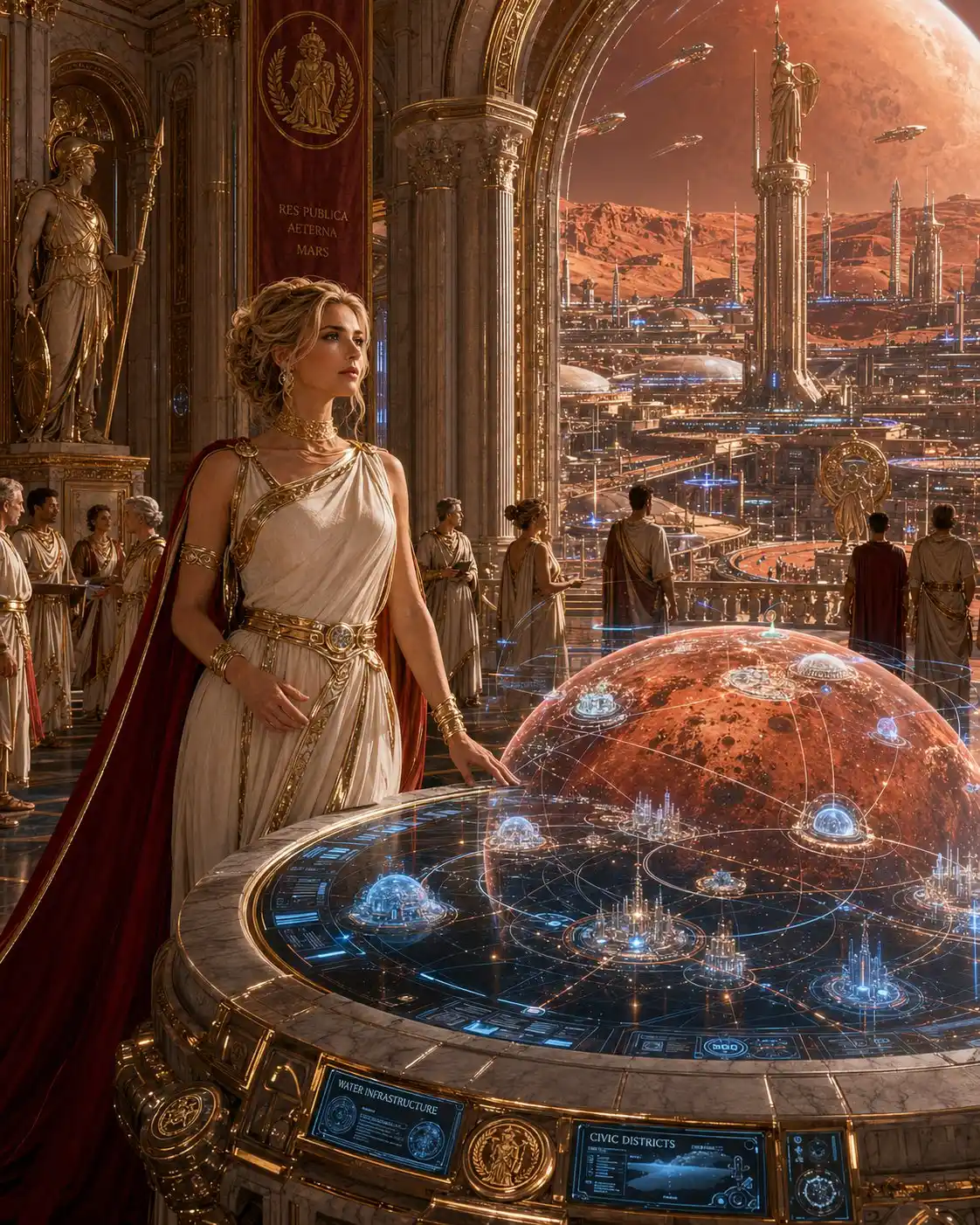
That comment is dead-on.
https://x.com/SkillsGapTrain/status/2061323767247442413
“The point is not Mars as brand, conquest, or signal. The point is the open horizon: the capacity to build homes, institutions, laws, tools, memory, and freedom where life would otherwise have no room.”
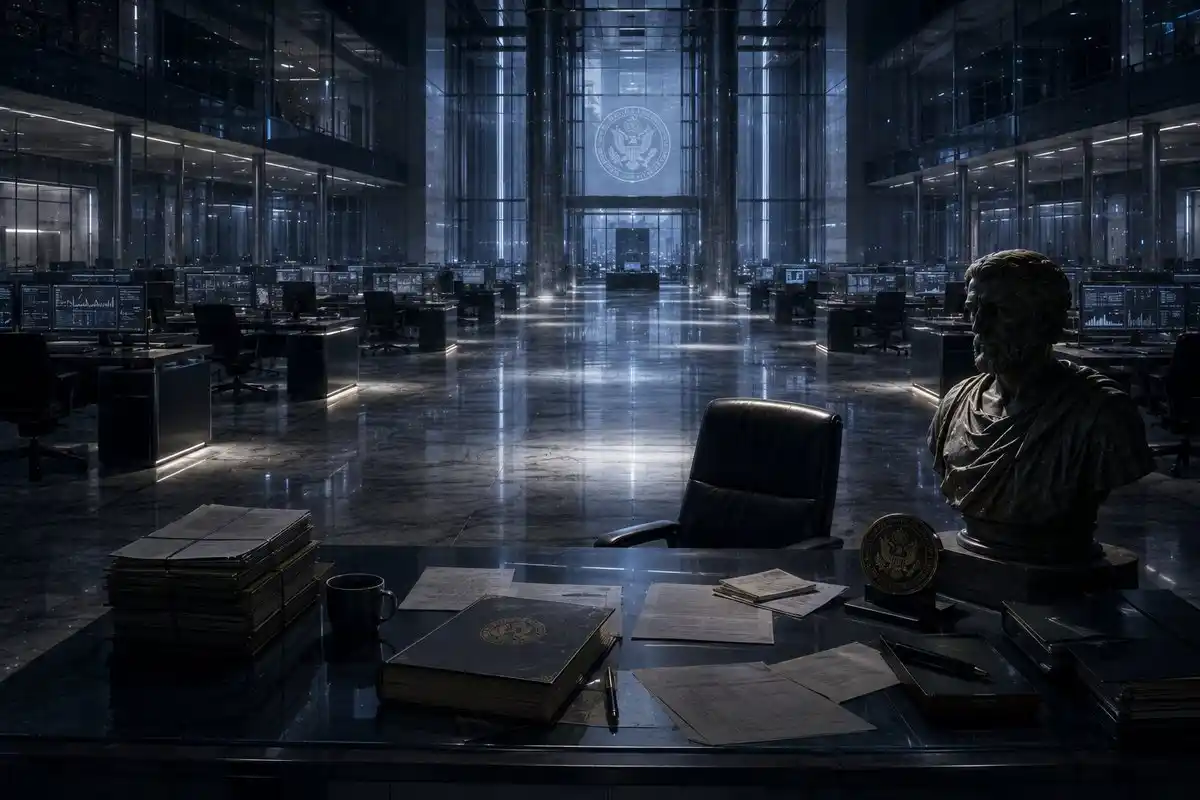
23. What Happens Without Archetypes
A civilization without archetypes does not necessarily collapse all at once.
It may continue operating for a long time.
The schools remain open. The ministries publish strategies. The companies release statements. The universities issue credentials. The courts process cases. The agencies hold consultations. The platforms optimize engagement. The dashboards glow. The conferences continue. The statues remain in the rooms.
But the inner functions disappear.
- Without Athena, intelligence becomes manipulation.
- Without Leonidas, courage disappears from the gate.
- Without Achilles, excellence is replaced by mediocrity.
- Without Hercules, nothing gets built or repaired.
- Without Marcus Aurelius, power loses self-command.
- Without Maximus, honour dies inside corrupted institutions.
- Without Spartacus, people accept beautiful chains.
- Without Solon and Cicero, law becomes arbitrary.
- Without Hephaestus and Daedalus, civilization forgets how to make.
- Without Odysseus, institutions cannot navigate chaos.
- Without Aeneas, inheritance is not carried through the fire.
- Without Socrates and Antigone, truth becomes punishable.
Then a strange thing happens. The civilization still looks intact from the outside. It still has buildings, screens, titles, ceremonies, documents, and rituals of legitimacy. But internally, it becomes procedural, fragile, compliant, forgetful, and unable to defend its own inheritance.
- It becomes procedural because no one remembers purpose.
- It becomes fragile because no one has trained for pressure.
- It becomes compliant because no one carries freedom.
- It becomes forgetful because no one carries inheritance.
- It becomes unreal because no one is allowed to tell the truth.
This is how decline often hides itself. It does not always begin with ruins. It begins with hollow continuity: the appearance of function after function has already left.
The forms remain. The soul withdraws.
That is why archetypes matter. They are not decorative. They are not literary ornaments. They are names for the missing organs of civilization.
A society can survive poverty if it retains courage, craft, truth, and memory. It can recover from defeat if it retains law, builders, and continuity. It can endure crisis if it retains discipline, wisdom, and honor. But a society that loses the human functions beneath its institutions becomes difficult to restore because it no longer knows what restoration requires.
- It calls for management when it needs courage.
- It calls for messaging when it needs truth.
- It calls for reform when it needs rebuilding.
- It calls for innovation when it needs craft.
- It calls for inclusion when it needs mission.
- It calls for security when it needs freedom.
- It calls for leadership when it needs self-command.
- The archetypal map is therefore a warning.
Not every civilization dies because enemies destroy it. Some civilizations become incapable of carrying themselves forward.
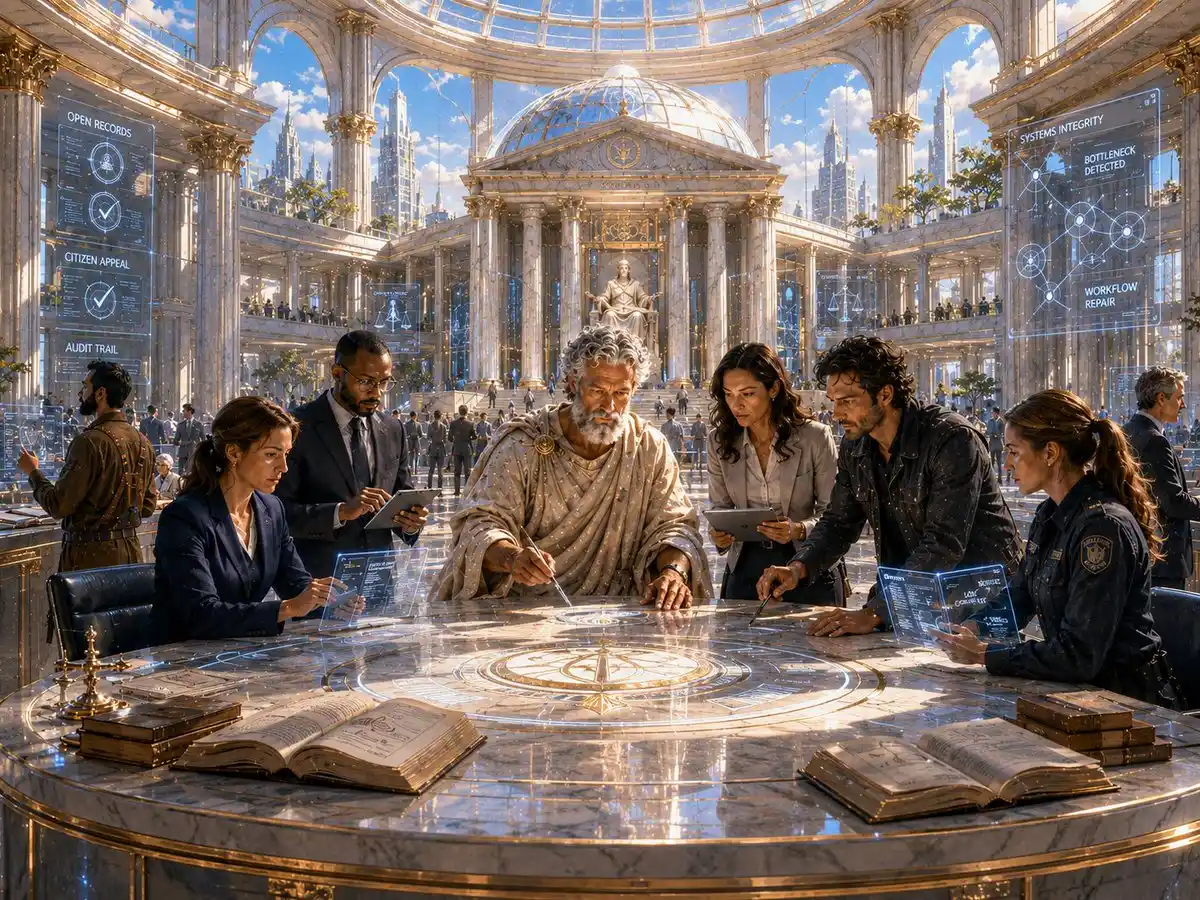
24. Return to the Statue
Return now to the quiet room.
The bust still matters.
The books still matter. The lamp still matters. The mirror, botanical art, and domestic scene still matter. The old language of cultivation still matters: reading, conversation, beauty, memory, taste, refinement, continuity.
Nothing in this essay asks us to despise those things. On the contrary, the whole argument begins by honoring them.
A civilization that loses beauty has already lost part of its soul. A society that no longer places memory near its books has already accepted a thinner life. The statue is not the problem. The statue is the reminder.
But the reminder is incomplete if it remains only aesthetic.
The statue beside the books must be joined by the shield, the spear, the forge, the law tablet, the command tent, the ship, the arena, the rebel standard, and the archive.
- It must be joined by Athena, because memory needs wisdom.
- It must be joined by Leonidas, because beauty needs defense.
- It must be joined by Achilles, because crisis needs excellence.
- It must be joined by Hercules, because civilization needs builders.
- It must be joined by Marcus Aurelius, because power needs conscience.
- It must be joined by Maximus, because institutions need honor after betrayal.
- It must be joined by Spartacus, because human beings must remain free.
- It must be joined by Solon and Cicero, because order must become lawful.
- It must be joined by Hephaestus and Daedalus, because vision must become craft.
- It must be joined by Odysseus, because the future will not give us a straight road home.
- It must be joined by Aeneas, because inheritance must be carried through fire.
- It must be joined by Socrates and Antigone, because truth must remain speakable when falsehood becomes convenient.
The future does not ask us to abandon civilization’s beautiful objects. It asks us to become worthy of defending them.
The institutions of 2070 will not be rebuilt by neutral administrators managing inherited decline. They will be rebuilt by people who carry ancient capacities in modern form: Athena minds, Leonidas hearts, Achilles performers, Hercules builders, Marcus Aurelius commanders, Maximus guardians, Spartacus souls, Solon-Cicero lawgivers, Hephaestus-Daedalus makers, Odysseus navigators, Aeneas carriers, and Socratic-Antigone truth-tellers.
- The statue gave us the image.
- The century gave us the crisis.
- The archetypes gave us the map.
The task now is to become the kind of people who can carry civilization forward.
Appendix — Source Notes, Method, and Publication Guardrails
Appendix A — Purpose of the Appendix
This essay is written as a civilizational argument, not as a conventional academic paper. Its main body uses image, symbol, myth, history, philosophy, cinema, systems thinking, and strategic foresight to answer one question:
What human capacities are required to rebuild institutions when administrative systems lose the ability to think, build, defend, govern power, preserve truth, and carry memory forward?
The appendix exists to protect the essay from four predictable weaknesses:
- Source confusion — myth, history, philosophy, cinema, and strategic analysis are not the same kind of evidence.
- Historical overclaiming — the essay uses figures symbolically, not as simple historical proof.
- Scope drift — this is an essay about future institutional archetypes, not a training program or formation system.
- Source hygiene — strategic and technical claims should be grounded in official or authoritative sources.
The essay architecture follows the five-part structure established for Wisdom Armed: image-led opening, administrative crisis, archetypal method, Core Seven, Completion Five, matrix, 2020–2070 challenge map, SGT bridge, warning, and return to the statue.
Appendix B — Methodological Statement
The essay does not treat myth, history, philosophy, scripture, and cinema as the same category of evidence.
It treats them as symbolic reservoirs of human function.
That distinction is central.
- Myth preserves durable patterns of human capacity before they become policy or history.
- History preserves examples of human action under real institutional pressure.
- Philosophy preserves questions about truth, power, justice, duty, and self-command.
- Tragedy preserves the collision between conscience and command.
- Cinema can translate older moral patterns into modern emotional form.
- Strategic foresight helps define the pressure environment of the coming decades.
- Systems thinking translates moral and symbolic language into institutional failure modes.
The essay’s claim is therefore not:
“These figures are all historically equivalent.”
The claim is:
“These figures name recurring civilizational functions that institutions repeatedly need, forget, and rediscover under stress.”
This is why the essay uses the language of represents, symbolizes, functions as, and is used here as. That language should remain in the final draft.
Appendix C — Source Categories
C1. Mythic / Epic Figures
These figures are used symbolically, not as literal historical models:
- Athena
- Achilles
- Hercules / Heracles
- Hephaestus
- Daedalus
- Odysseus
- Aeneas
They are used as symbolic names for recurring functions: wisdom, excellence, strength, craft, adaptation, and continuity.
C2. Historical or Historically Rooted Figures
These figures are grounded in historical memory, though often mediated through ancient sources and later interpretation:
- Leonidas
- Solon
- Cicero
- Socrates
- Spartacus
- Marcus Aurelius
They are used carefully as symbolic-historical figures, not as simplistic political models.
C3. Literary / Tragic Figure
- Antigone
Antigone is not used as a historical figure. She is used as a tragic-philosophical figure of conscience against illegitimate command.
C4. Cinematic Figure
- Maximus
Maximus is a modern cinematic archetype from Gladiator. He is not historical evidence. He is used as a symbolic figure of honor after institutional betrayal.
C5. Internal SGT Source Layer
The SGT continuity material supplies the internal project background: skills gap, future-ready education, AI and robotics, engineering judgment, systems integrity, infrastructure sovereignty, collapse-cycle breaking, Genesis Ark, moral responsibility, future generations, and the idea of a civilization that must still be able to learn, build, decide, repair, and carry memory forward.
C6. Strategic / Technical Source Layer
The strategic pressure environment is grounded in sources such as:
- U.S. National Intelligence Council, Global Trends 2040
- IPCC AR6 Synthesis Report
- World Economic Forum, Global Risks Report 2025
- NIST AI Risk Management Framework
These sources support the essay’s claim that the coming decades will test governance, technical systems, infrastructure, climate adaptation, information integrity, and institutional resilience. The National Intelligence Council frames the coming decades around structural forces including demographics, environment, economics, technology, and governance; the IPCC summarizes climate impacts and adaptation risks; WEF’s 2025 risk report describes a fractured risk landscape shaped by geopolitical, environmental, societal, and technological risks; and NIST’s AI Risk Management Framework is designed to help organizations incorporate trustworthiness considerations into AI design, development, use, and evaluation. (
Director of National Intelligence
)
Appendix D — Archetype-to-Source Map
- Athena
Source category: Greek myth / classical iconography
Used here as: Wisdom armed; strategic intelligence
Main institutional failure addressed: Tools without judgment - Leonidas
Source category: Ancient Greek history / Herodotean memory
Used here as: Disciplined courage at the gate
Main institutional failure addressed: Collapse under pressure - Achilles
Source category: Greek epic
Used here as: Peak excellence and decisive action
Main institutional failure addressed: Mediocrity in crisis - Hercules
Source category: Greek myth
Used here as: Strength under burden; rebuilding force
Main institutional failure addressed: Inability to repair or endure - Marcus Aurelius
Source category: Roman history / Stoic philosophy
Used here as: Power self-governed
Main institutional failure addressed: Authority without restraint - Maximus
Source category: Cinema
Used here as: Honor after institutional betrayal
Main institutional failure addressed: Mission collapse inside institutions - Spartacus
Source category: Roman history
Used here as: Freedom against domination
Main institutional failure addressed: Efficient servility - Solon/Cicero
Source category: Greek/Roman law and political thought
Used here as: Lawful order; civic architecture
Main institutional failure addressed: Arbitrary power - Hephaestus/Daedalus
Source category: Greek myth
Used here as: Technical making; craft; tools
Main institutional failure addressed: Loss of making capacity - Odysseus
Source category: Greek epic
Used here as: Adaptive intelligence under chaos
Main institutional failure addressed: Rigidity under uncertainty - Aeneas
Source category: Roman epic
Used here as: Inheritance carried through collapse
Main institutional failure addressed: Memory loss after crisis - Socrates/Antigone
Source category: Philosophy / tragedy
Used here as: Truth and conscience under pressure
Main institutional failure addressed: Lies becoming governance
Appendix E — Classical, Ancient, and Philosophical Source Notes
E1. Athena — Wisdom Armed
Athena is used as the symbolic figure of strategic wisdom capable of defense. Her classical attributes — helmet, spear, shield, aegis, and owl — make her a figure of intelligence joined to civic protection.
Suggested source base:
- Homer, Iliad
- Homer, Odyssey
- Hesiod, Theogony
- Pausanias, Description of Greece
- Classical iconography of Athena / Minerva
Publication caution:
Do not describe Athena as “historical.” Use: Athena represents, Athena symbolizes, or Athena functions here as.
E2. Leonidas — Courage Disciplined
Leonidas is used as the symbolic-historical figure of disciplined defensive sacrifice.
Suggested source base:
- Herodotus, Histories, Book 7
- Plutarch, Sayings of Spartans
- Modern scholarship on the Greco-Persian Wars
Publication caution:
Avoid saying Leonidas “saved civilization” by himself. Better:
Leonidas functions here as the archetype of the defended gate: disciplined courage under overwhelming pressure.
E3. Achilles — Excellence Unleashed
Achilles is used as the mythic figure of peak performance, martial excellence, speed, intensity, and tragic brilliance.
Suggested source base:
- Homer, Iliad
- Later Greek mythographic traditions
Publication caution:
Do not make Achilles morally simple. His power is mixed with rage, pride, grief, and destruction. This complexity is part of why he is useful.
Preferred phrasing:
Achilles represents excellence under decisive pressure, but also the danger of brilliance without restraint.
E4. Hercules / Heracles — Strength Redeemed
Hercules is used as the figure of strength under burden, not merely raw force.
Suggested source base:
- Apollodorus, Library
- Diodorus Siculus, Library of History
- Sophocles, Trachiniae
- Euripides, Heracles
Publication caution:
Do not reduce Hercules to “muscle.” The essay’s reading depends on labor, burden, endurance, suffering, and service.
Preferred phrasing:
Hercules functions here as strength tested by suffering and redirected into rebuilding.
E5. Marcus Aurelius — Power Self-Governed
Marcus Aurelius is used as the figure of command under self-command.
Suggested source base:
- Marcus Aurelius, Meditations
- Cassius Dio, Roman History
- Modern scholarship on Stoicism and Roman imperial governance
Publication caution:
Do not idealize Rome or empire. Marcus is not used to sanctify imperial power. He is used to name the inner moral problem of command.
Preferred phrasing:
Marcus Aurelius represents the problem of whether those who command systems can first command themselves.
E6. Maximus — Honor Unconquered
Maximus is used as a modern cinematic archetype.
Suggested source base:
- Gladiator, directed by Ridley Scott
- Secondary film criticism, if needed
Publication caution:
Always clarify:
Maximus is not historical evidence. He is a cinematic condensation of honor after institutional betrayal.
Key distinction to preserve:
Spartacus breaks chains. Maximus preserves honor after betrayal.
E7. Spartacus — Freedom Fought For
Spartacus is used as the figure of human dignity against domination.
Suggested source base:
- Plutarch, Life of Crassus
- Appian, Civil Wars
- Modern histories of Roman slavery and the Third Servile War
Publication caution:
Do not romanticize revolt as permanent politics. Spartacus is used to represent the boundary beyond which systems must not reduce persons into property.
Preferred phrasing:
Spartacus functions here as the refusal to become property of a system.
Appendix F — Completion Five Source Notes
F1. Solon / Cicero — Order Designed
Solon and Cicero are paired to represent lawful order and civic architecture.
Suggested source base:
- Plutarch, Life of Solon
- Aristotle, Athenian Constitution
- Cicero, De Republica
- Cicero, De Legibus
- Cicero, De Officiis
Publication caution:
Do not imply Solon and Cicero had identical political projects. They are paired because both help name the lawgiver function: binding power into legitimate order.
Preferred phrasing:
Solon and Cicero function here as lawgiver-archetypes: figures of civic order, lawful form, and public duty.
F2. Hephaestus / Daedalus — Technology Forged
Hephaestus and Daedalus represent craft, technical making, mechanism, invention, and the workshop.
Suggested source base:
- Homer, Iliad, especially descriptions of crafted armor and divine workmanship
- Hesiod, Theogony
- Apollodorus, Library
- Ovid, Metamorphoses, for Daedalus traditions
Publication caution:
Use this pair to distinguish strength from technical craft. Hercules can lift the burden; Hephaestus and Daedalus design the tool.
Preferred phrasing:
Hephaestus and Daedalus function here as the maker-archetype: the workshop intelligence that turns vision into tools, systems, and infrastructure.
F3. Odysseus — Intelligence Through Chaos
Odysseus represents adaptive navigation under uncertainty.
Suggested source base:
- Homer, Odyssey
- Homer, Iliad
- Sophocles, Philoctetes, for morally complex strategic intelligence
Publication caution:
Odysseus is morally complex. Cunning can become manipulation. The essay should keep him inside the larger moral architecture of Athena, Marcus Aurelius, Aeneas, and Socrates.
Preferred phrasing:
Odysseus functions here as adaptive intelligence when the map fails.
F4. Aeneas — Inheritance Carried Forward
Aeneas represents continuity after catastrophe.
Suggested source base:
- Virgil, Aeneid
- Livy, History of Rome, for Roman founding memory
- Secondary scholarship on pietas, duty, memory, and founding
Publication caution:
Do not use Aeneas as a simple imperial symbol. Use him as the carrier of memory through collapse.
Preferred phrasing:
Aeneas represents inheritance carried through fire into a new founding.
F5. Socrates / Antigone — Reality Under Pressure
Socrates and Antigone represent truth, conscience, and reality-testing under pressure.
Suggested source base:
- Plato, Apology
- Plato, Crito
- Sophocles, Antigone
Publication caution:
Do not equate all dissent with Socratic truth or Antigonean conscience. The truth-teller is not merely a contrarian. The truth-teller is answerable to reality and moral order.
Preferred phrasing:
Socrates and Antigone function here as the truth-and-conscience layer of the institutional map.
Appendix G — Methodological Limits
This essay uses mythic, historical, philosophical, tragic, cinematic, and strategic materials in different ways. It does not treat them as the same kind of evidence.
Athena, Achilles, Hercules, Hephaestus, Daedalus, Odysseus, and Aeneas are used as mythic or epic figures. They are not presented as historical persons. They function as symbolic names for recurring human capacities: wisdom, excellence, strength, craft, adaptation, and continuity.
Leonidas, Solon, Cicero, Socrates, Spartacus, and Marcus Aurelius are historically grounded or historically mediated figures. They are not used as complete political models. They are used as symbolic-historical figures that help name recurring institutional needs: courage, lawful order, truth-seeking, freedom against domination, and power under self-command.
Antigone is used as a tragic-philosophical figure of conscience under pressure. Maximus is used as a cinematic archetype of honor after institutional betrayal. Neither is presented as ordinary historical evidence.
The essay does not ask modern institutions to imitate Athens, Sparta, Rome, Christianity, empire, tragedy, or cinema. It extracts symbolic functions, not political blueprints. Its concern is not whether the ancient world should be restored. Its concern is whether older stories still help name the human capacities future institutions require.
The SGT material is used as an internal project source and conceptual bridge. It supplies the background concern with skills gaps, systems integrity, infrastructure sovereignty, moral responsibility, collapse-cycle breaking, and future generations. It is not used as an external authority for classical history or global foresight.
The scope of the essay is also limited. It names the human capacities future institutions require. It does not yet propose a curriculum, training system, certification model, leadership academy, or operational formation framework.
That restraint is deliberate. The essay’s task is to name the archetypal capacities first: wisdom, courage, excellence, strength, restraint, honor, freedom, law, craft, adaptation, continuity, and truth.
Appendix H — Works Cited
Classical / Ancient / Philosophical
- Appian. The Civil Wars..
- Apollodorus. The Library of Greek Mythology..
- Aristotle. The Athenian Constitution. Cassius Dio. Roman History..
- Cicero. On Duties; On the Republic; On the Laws. Diodorus Siculus. Library of History..
- Euripides..
- Heracles..
- Herodotus. The Histories..
- Hesiod. Theogony; Works and Days..
- Homer. The Iliad; The Odyssey..
- Livy. History of Rome. Marcus Aurelius..
- Meditations..
- Ovid..
- Metamorphoses..
- Pausanias. Description of Greece..
- Plato. Apology; Crito..
- Plutarch. Lives; Sayings of Spartans..
- Sophocles. Antigone; Philoctetes; Trachiniae..
- Virgil. The Aeneid..
Modern Strategic / Technical
Intergovernmental Panel on Climate Change. AR6 Synthesis Report: Climate Change 2023.
IPCC
National Institute of Standards and Technology. Artificial Intelligence Risk Management Framework.
NIST
U.S. National Intelligence Council. Global Trends 2040: A More Contested World.
Director of National Intelligence
World Economic Forum. Global Risks Report 2025.
World Economic Forum
Modern Symbolic / Cinematic
Scott, Ridley, director. Gladiator. DreamWorks Pictures and Universal Pictures, 2000.
Internal SGT / Project Sources
Skills Gap Trainer continuity material on
https://www.instagram.com/skillsgaptrainer/, on topics such as: systems integrity, infrastructure sovereignty, collapse-cycle breaking, Genesis Ark, moral responsibility, and future generations.
Links
They have to care. https://x.com/SkillsGapTrain/status/2060297171170398215
👉 Wisdom Armed: The Archetypes Who Will Rebuild the Institutions of the Future (Part 1) https://skillsgaptrainer.com/wisdom-armed-the-archetypes-who-will-rebuild-the-institutions-of-the-future-part-1/