How the SGT–TNG Cinematic Universe Turns a Night at an Engineering Museum Into a Blueprint for Civilizational Survival
Designed by: Skills Gap Trainer
SGT–TNG is an independent speculative cinematic and engineering-design study. Recognizable performers, characters, companies, vehicles, and fictional universes are used as cultural reference points only. No affiliation, endorsement, licensing agreement, participation, or confirmed casting is implied.
The SGT–TNG cinematic universe begins with a deceptively simple scene.
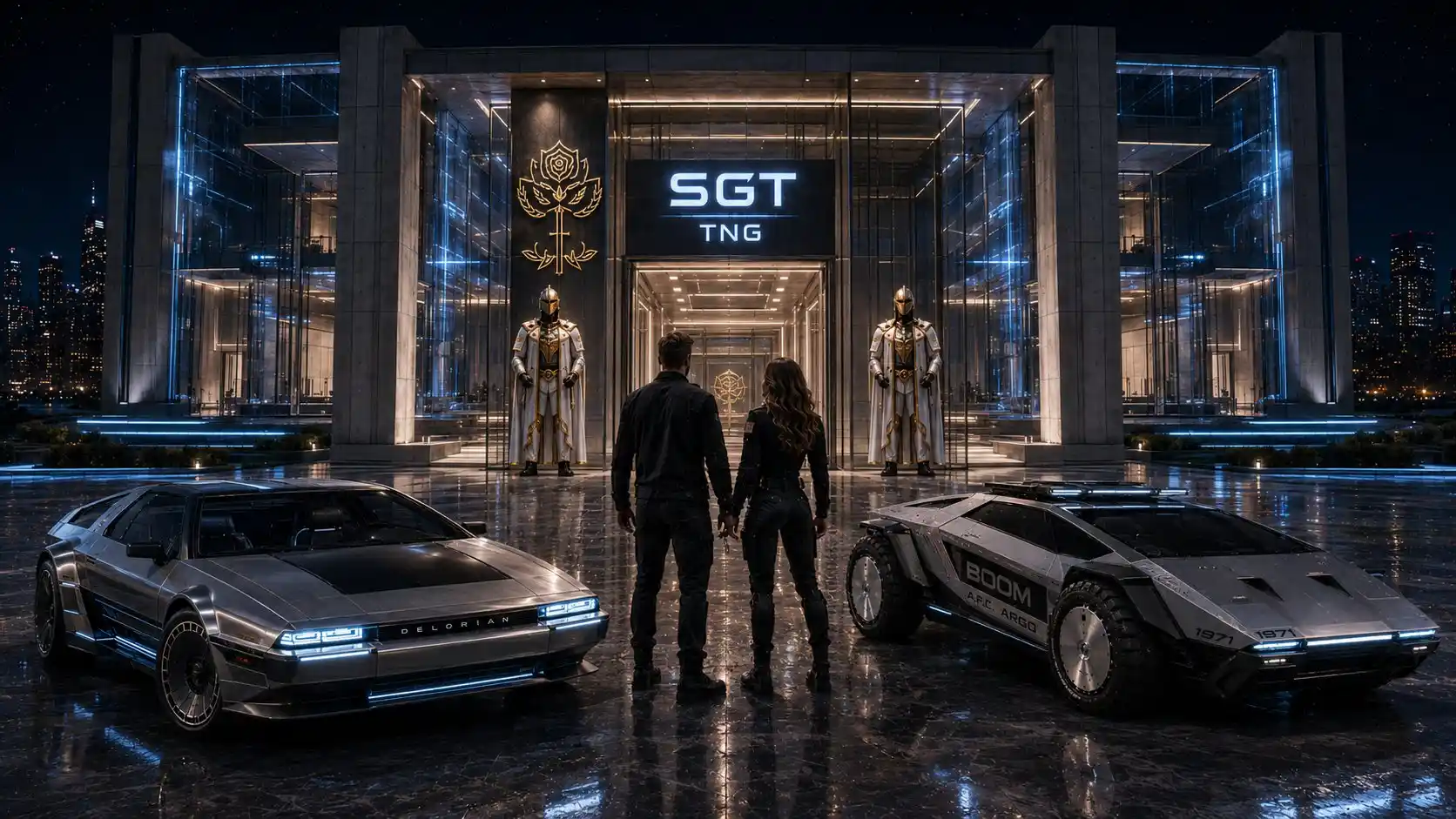
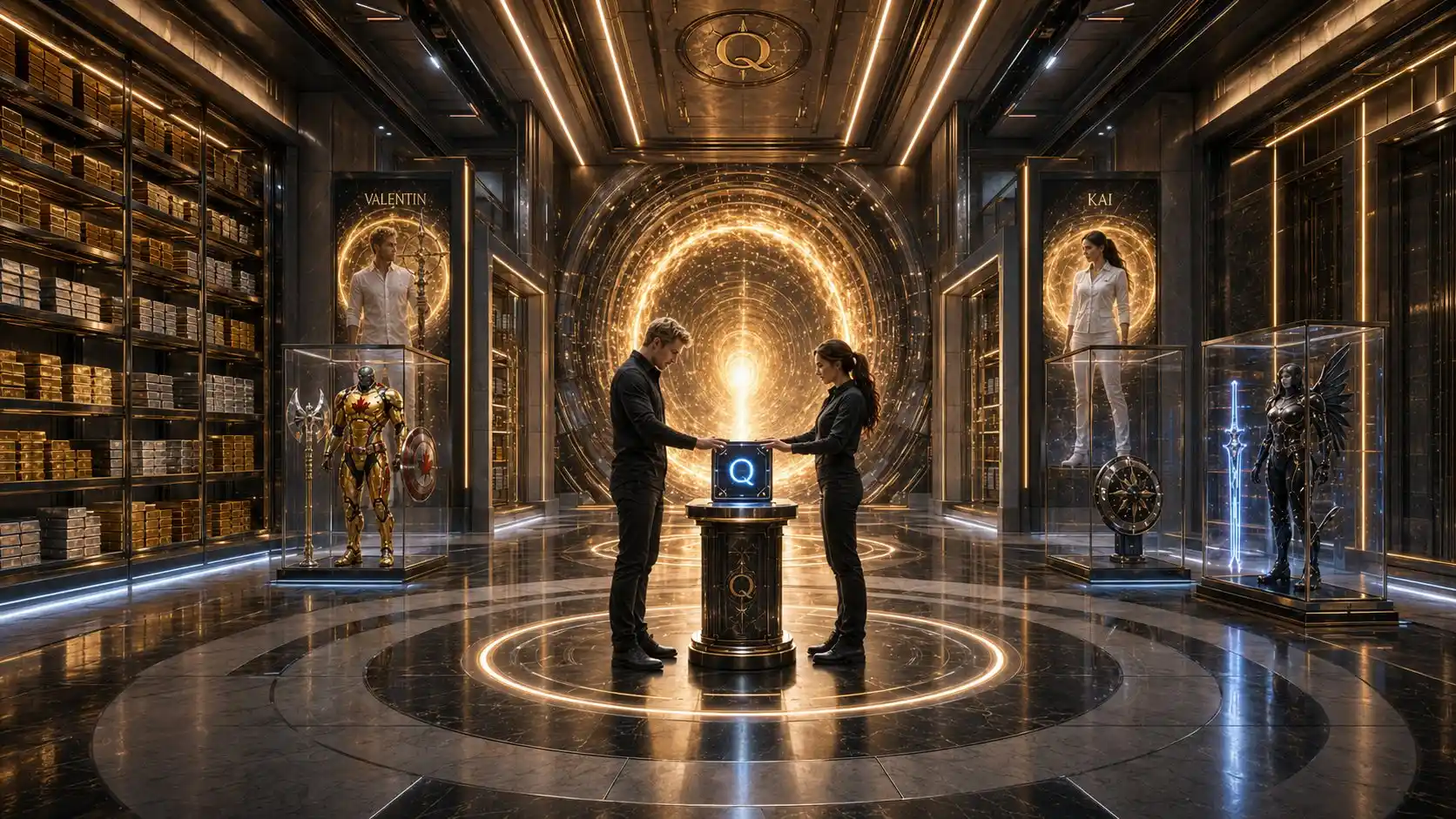
The public has gone home. Two ceremonial honour guards remain outside a vast transparent engineering complex. Valentin has the keys. He brings Kai inside to show her a museum, library, workshop, academy, aerospace gallery, archive, and theatre built to preserve humanity’s technical inheritance.
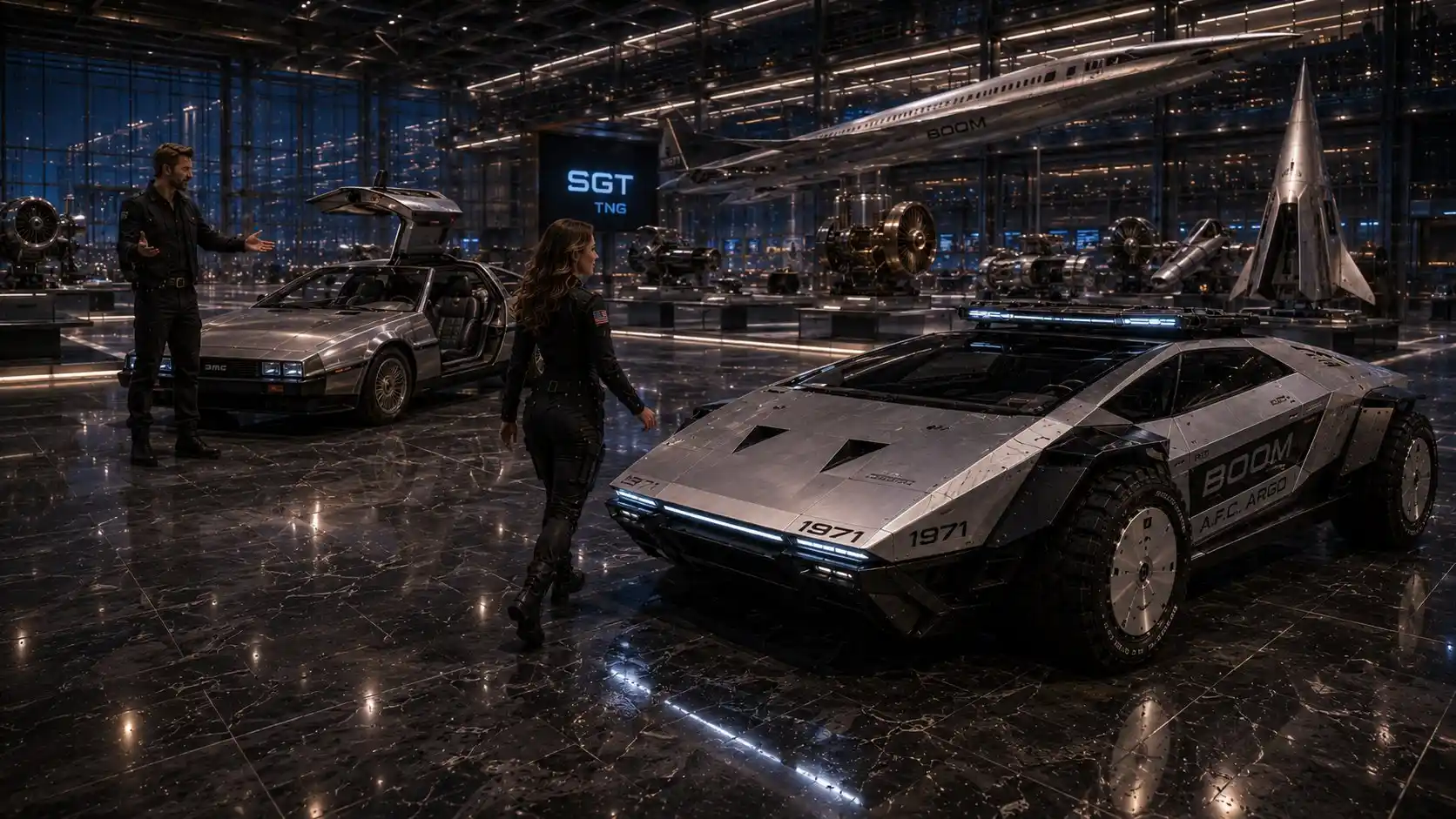
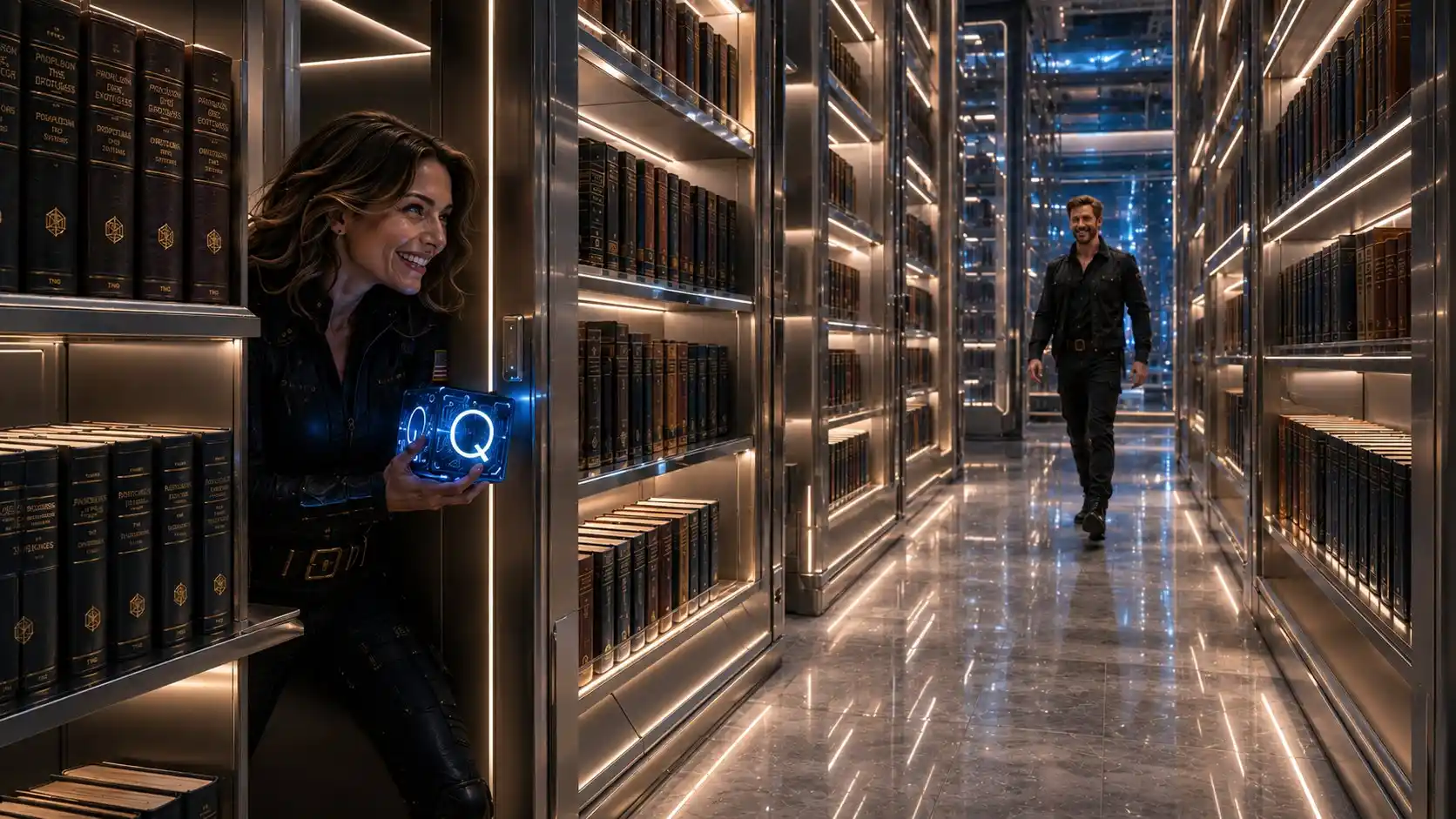
Kai takes the portable Q interface from the D.E.L.O.R.I.A.N. and runs with it.
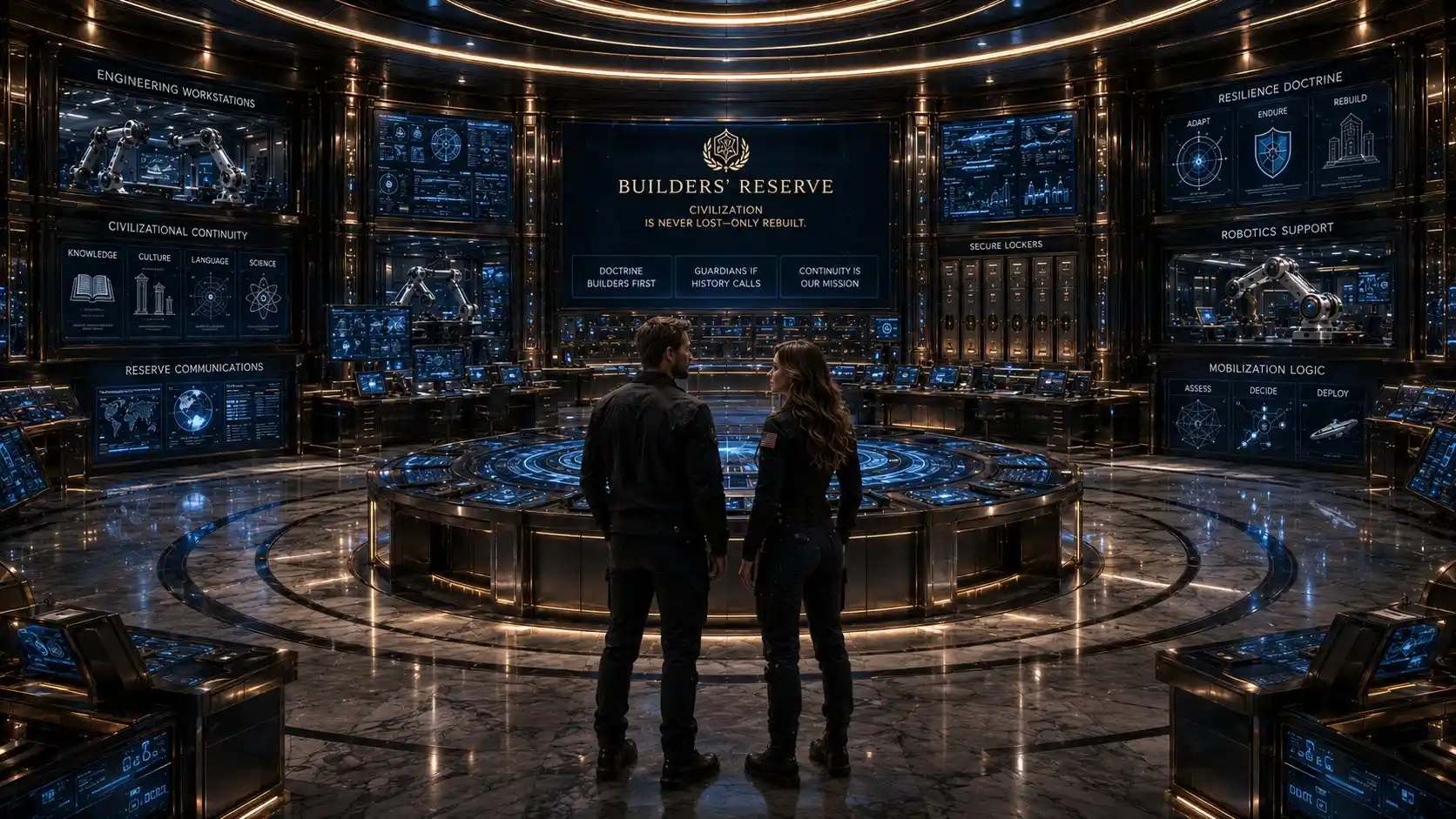
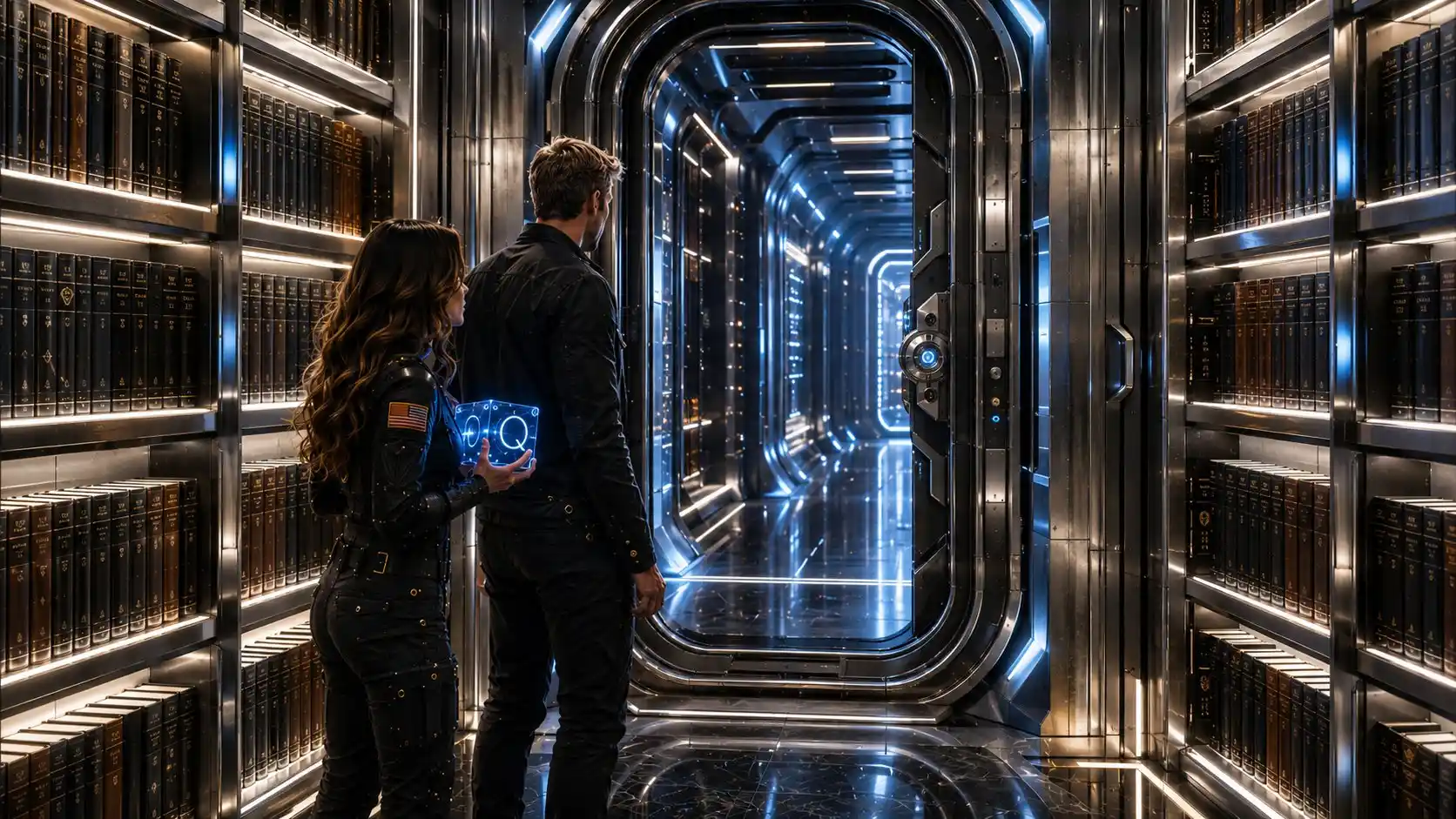
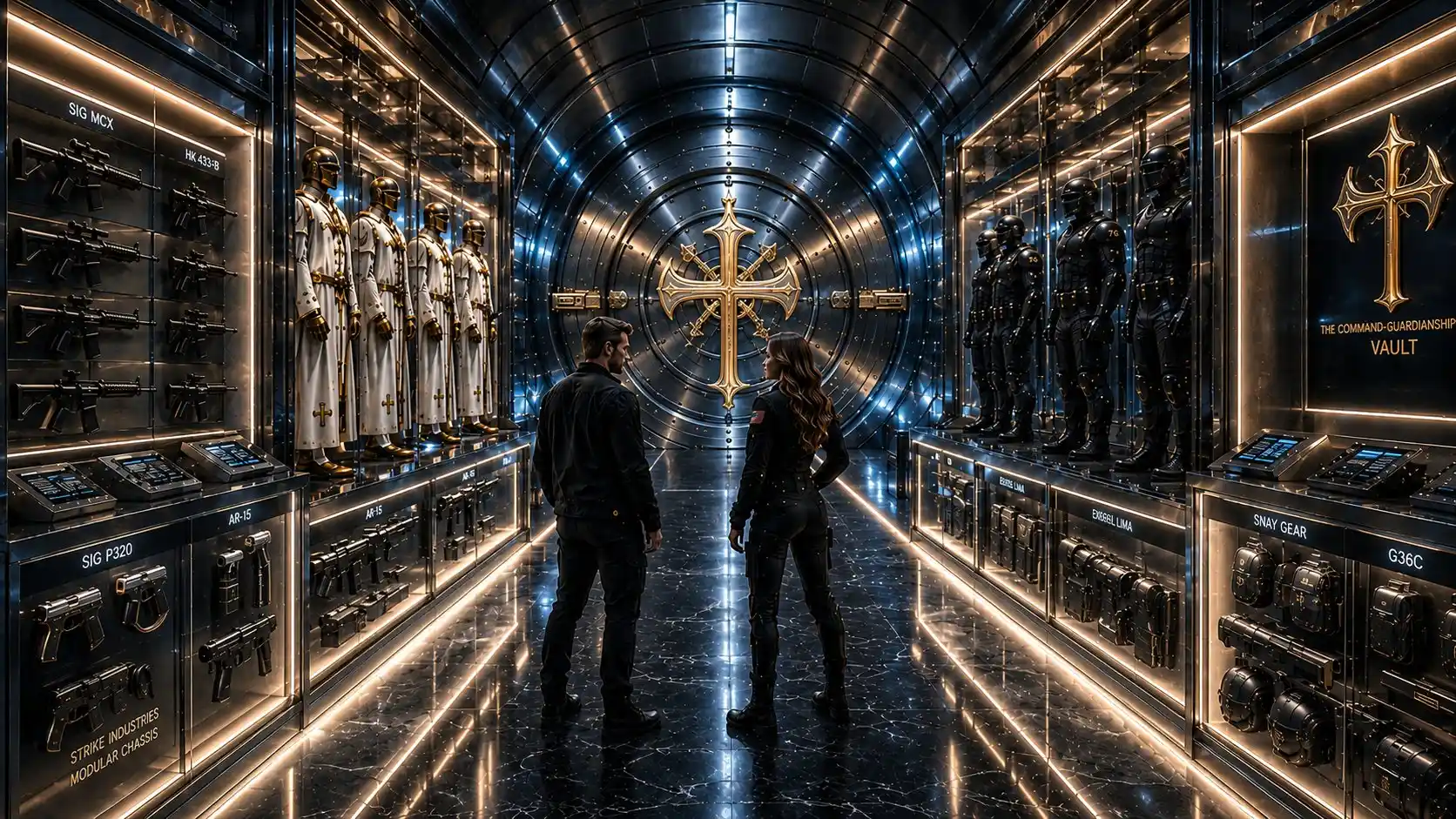
A playful chase moves through the mobility gallery, the aerospace hall, and the engineering library. A concealed passage opens. Beneath the public-private institution lies a protected continuity level containing archives, command systems, civilizational reserves, the Forge, and the Cross-Axe.
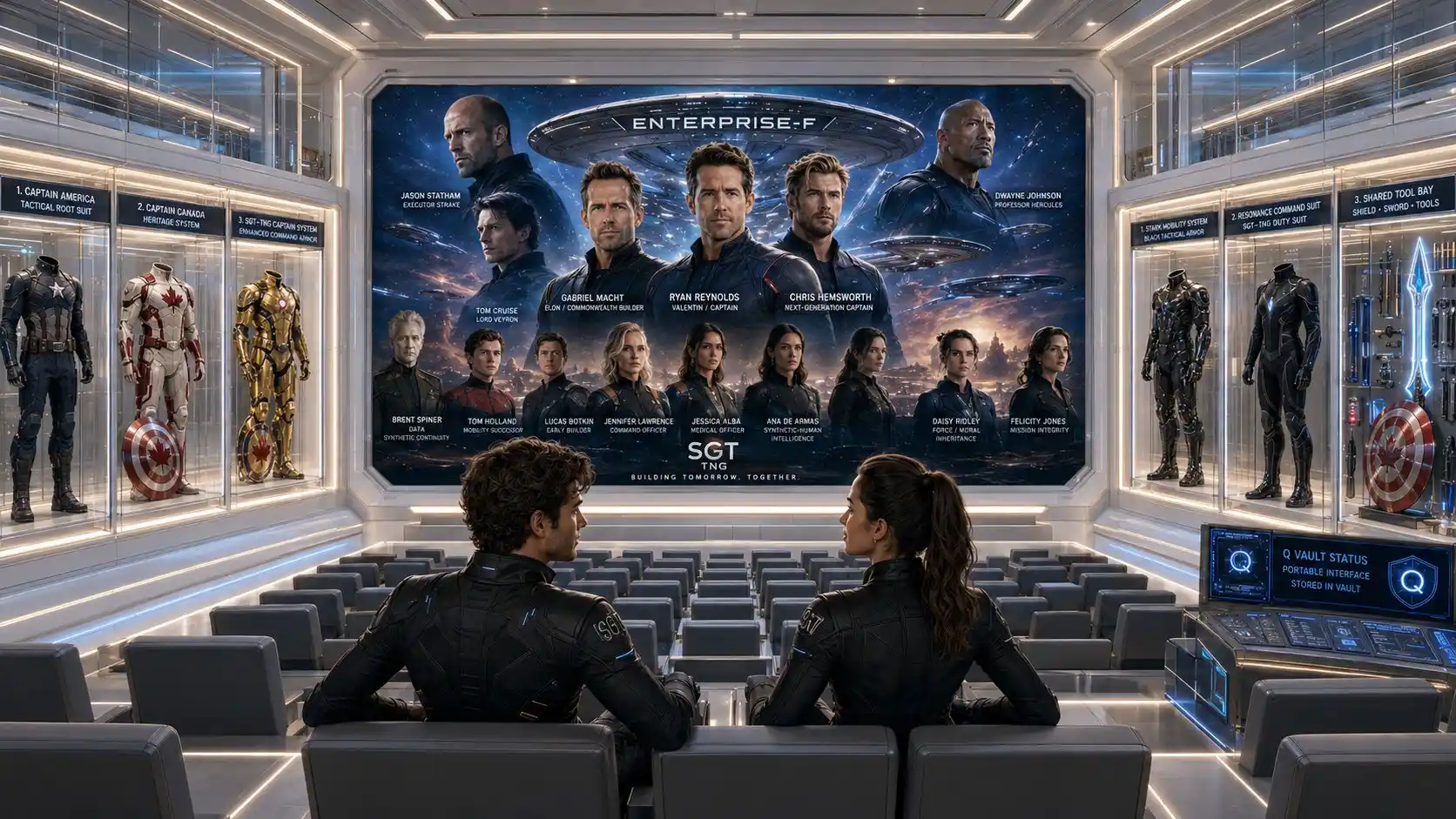
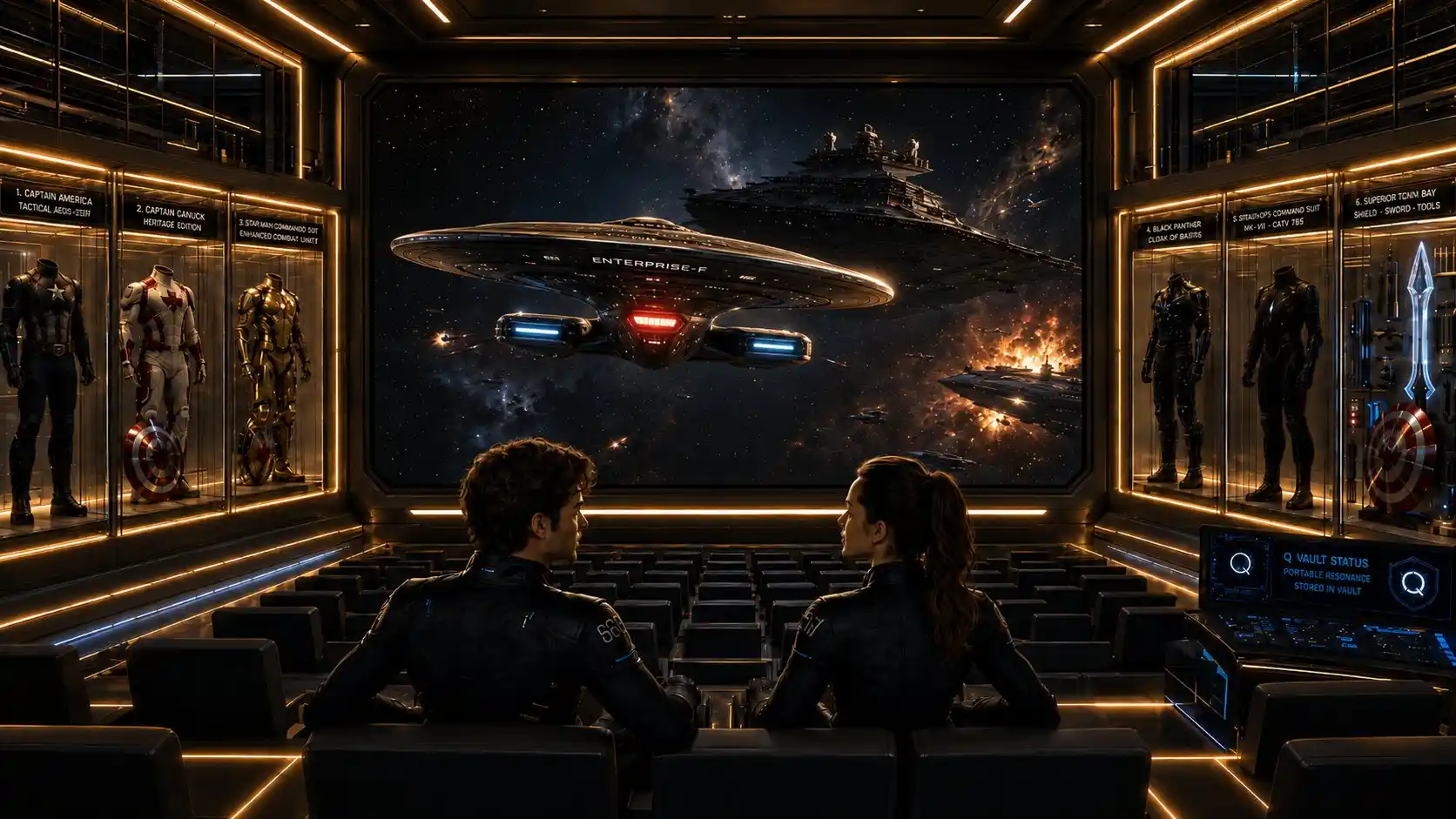
Kai and Valentin secure Q and finish the evening alone in the flagship theatre, still wearing their slim black resonance command authorized tactical builder suits. On the walls are the inherited protective systems of earlier generations. On the screen is Enterprise-F: a possible future assembled from Starfleet, synthetic intelligence, mythology, industrial reconstruction, capitalism, engineering, and several colliding fictional universes.
The images tell a story.
The architecture underneath them tells something larger.
A civilization does not survive through exceptional individuals alone. It survives by preserving character, knowledge, tools, networks, factories, legitimate authority, and the ability to integrate them before the emergency arrives.
The adversary is systemic.
The answer must also be systemic.
1. The Museum After Midnight
The story begins in blue-white light.
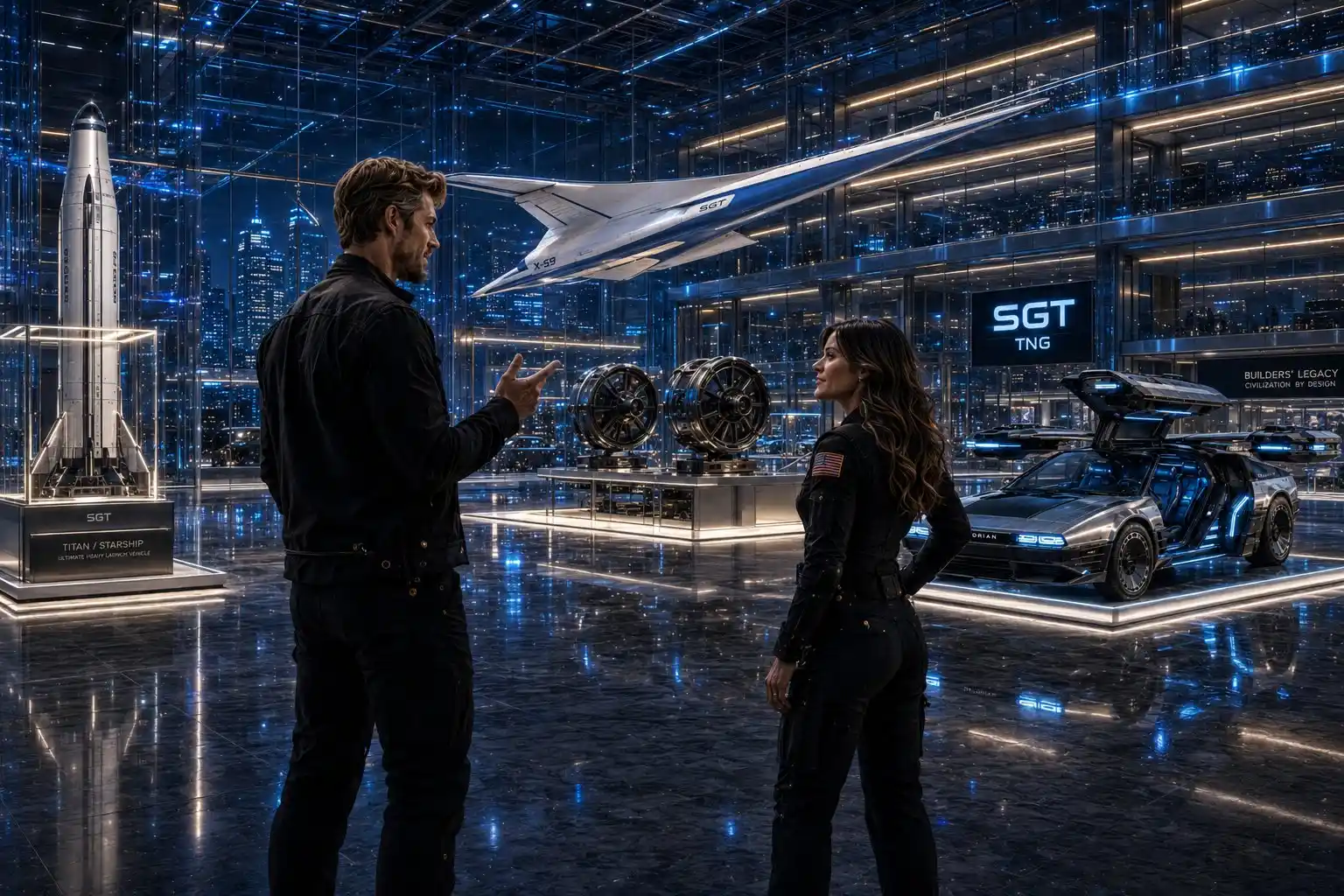
The complex is vast enough to feel like a small city under glass. Titanium columns rise through several floors. Aircraft hang above pale stone. Engines, vehicles, spacecraft, restoration bays, libraries, laboratories, and theatres can be seen through transparent interior walls.
Nothing is decayed.
Nothing looks abandoned.
This is not a civilization mourning machines it once knew how to build. It is a civilization preserving the ability to build again.
Two honour guards stand outside the entrance. Their presence is ceremonial, but not empty. They represent a dormant reserve capacity: engineers, builders, and citizens who ordinarily create, repair, teach, and maintain, but who remain prepared to protect the institution when extraordinary conditions require it.
The guards remain outside.
There are no patrols roaming the museum. There is no crowd inside. Valentin is authorized to be there.
He intends to give Kai a careful tour. Vehicles first. Then propulsion. Then aerospace. Then the archives. Then the library. Finally, the theatre.
Kai has a different relationship with knowledge.
She sees the D.E.L.O.R.I.A.N-derived mobility platform, the two-seat BOOM 1971 vehicle, the engines, the suspended aircraft, the hypersonic concepts, and the glowing portable Q interface. Instead of behaving like a passive visitor, she enters the logic of the exhibits.
She takes Q and runs.
The act is mischievous, not criminal. She knows that securing Q is the serious task Valentin is trying to complete. She also knows he will follow her.
The chase moves past vehicles representing the transition from road transport to subsonic flight, supersonic flight, hypersonic flight, and eventually orbital mobility. It passes real historical lineages such as the X-59, future airliner concepts, Starship, Titan-class launch systems, and working engineering displays.
Kai disappears into the library.
The library is not an old mansion filled with dusty decorative books. It is a high-integrity technical environment built from steel, titanium, ceramic, glass, pale stone, controlled white reading light, and restrained blue system illumination.
Even in a civilization with powerful artificial intelligence, the library remains important.
AI can retrieve information.
A library helps people compare it, question it, interpret it, and understand why it matters.
When Q interacts with a concealed interface, part of the library opens.
The public institution reveals the continuity system beneath it.
That is the first major turn in the story.
The museum is not merely preserving impressive objects.
It is preserving the capability to restart civilization after failure.
2. The Inheritance Map
At first glance, the theatre scene may look like a collection of famous actors, recognizable heroes, advanced suits, and science-fiction references.
That is the surface.
The deeper structure is an inheritance map.
The Captain America suit, Captain Canada armour, Stark-derived “Spider Man level” mobility system, resonance command suit, Dark Angel system, Data lineage, Cross-Axe, Enterprise-F, Professor Hercules, and Musk Interstellar Commonwealth are not being assembled merely because they look impressive together.
Each represents a capability that should not be lost.
Captain America represents moral discipline, courage, sacrifice, leadership, and protection.
Iron Man represents technological amplification and the survival of an inventor’s knowledge beyond the inventor.
Spider-Man represents a younger successor becoming more capable through inherited technology without losing his own identity.
Thor represents natural or mythic power that still benefits from learning, cooperation, improved equipment, and disciplined access to consequential tools.
Data represents synthetic identity and the difficult question of whether a person can survive destruction, reconstruction, or migration into a new body.
Starfleet represents lawful command, exploration, scientific cooperation, restraint, and public legitimacy.
The Musk Commonwealth represents production, shipbuilding, logistics, economic plurality, and the right of distinct civilizations to remain meaningfully autonomous within a larger federation.
Kai represents a synthetic person who inherits an earlier architecture but becomes a new individual rather than a copy.
All of these lineages lead to one first-principles model:
Civilizational capability equals human character multiplied by inherited knowledge, multiplied by network coordination, multiplied by industrial depth, multiplied by legitimate authority.
This is a multiplicative relationship.
If one term approaches zero, the entire result can collapse.
A civilization with courageous people but no industrial capacity may resist heroically and still lose.
A civilization with enormous factories but no legitimate authority may produce weapons while destroying the society those weapons were meant to protect.
A civilization with advanced AI but no preserved human agency may automate itself into a system it cannot reverse.
A civilization with extraordinary prototypes but no maintenance, suppliers, training, or replacement capacity possesses demonstrations —not durable capability.
The complete architecture has five layers.
Natural capability is what the person already possesses: courage, intelligence, judgment, physical ability, discipline, empathy, creativity, and experience.
Inherited capability is what earlier generations successfully transfer: knowledge, tools, armour, software, stories, manufacturing methods, test history, institutional memory, and lessons paid for through failure.
Network capability is what becomes possible when people resonate with vehicles, sensors, robots, medical systems, communications, archives, artificial intelligence, and secure facilities.
Industrial capability makes the system reproducible through factories, shipyards, energy, suppliers, maintainers, logistics, training pipelines, spare parts, testing, and replacement capacity.
Authority and worthiness govern access to high-consequence power through competence, authorization, accountability, restraint, oversight, revocation, appeal, and responsibility.
The complete defender is therefore not merely strong.
The complete defender is:
capable → equipped → connected → supportable → accountable
3. The Cost of Late Integration
The Avengers provide a useful fictional case study in late technological integration.
Tony Stark dies, but his engineering knowledge does not have to die with him.
Through Spider-Man, his technological lineage continues. The younger hero remains Spider-Man, but inherited Stark systems give him protection, mechanical assistance, advanced sensing, autonomous support, environmental survival, additional tools, and access to an engineering architecture larger than his individual abilities.
The technology increases his power without requiring him to become Tony Stark.
Captain America lifting Mjolnir represents a complementary inheritance.
Steve Rogers does not become Thor. His established character makes him worthy to use an instrument carrying power beyond ordinary human capability.
Thor also upgrades. He learns, changes weapons, improves tactics, and seeks new tools when earlier systems become inadequate.
Nearly everyone eventually attempts to improve.
The problem is timing.
The Avengers enter their decisive crisis with extraordinary personal powers, but without a fully distributed common architecture. Their best technologies remain unevenly shared, difficult to replace, dependent on individual inventors, and only partially interoperable.
Their vulnerability is not lack of courage.
It is dependence on isolated exceptionalism.
They assume that extraordinary individuals will continue to compensate for missing institutional capability.
That assumption works until the threat becomes larger than every isolated individual.
The answer is not identical Iron Man armour for everyone. Different bodies, abilities, missions, and risks require different systems.
The real requirement is a shared technical spine: compatible communications, common situational awareness, medical monitoring, environmental protection, emergency extraction, standardized power and equipment interfaces, modular defensive systems, AI assistance, and human override.
Thor’s configuration would support energy management rather than replace his natural power. Captain America’s would amplify mobility, survivability, shield control, and command awareness. Spider-Man’s would preserve agility while adding protection, sensing, rescue capability, and autonomous support. Human members would receive enough mobility and protection to remain operational beside enhanced teammates.
The larger lesson is:
The heroes nearly failed because their powers remained personal after their enemy had become systemic.
Technological integration attempted during the final battle arrives too late.
A civilization must distribute protective capability, preserve engineering knowledge, and establish interoperability before the emergency.
4. The Theatre Walls
The two exhibit walls beside the Enterprise-F screen should be read from past to future.
They are not costume storage.
They are a compact history of moral and technological inheritance.
The left wall: from worthy person to civilizational captain
Captain America establishes the moral root: courage, sacrifice, leadership, discipline, physical excellence, and protection through the shield.
Captain Canada converts that inheritance into a Canadian civic-guardian tradition. The white-and-red system associated in the visual development with Georges St-Pierre represents athletic credibility, national continuity, service, restraint, and public protection.
Valentin’s yellow-and-gold SGT–TNG Starfleet Captain system becomes the next-generation synthesis.
It is not merely a recoloured Captain Canada suit.
It integrates Captain America’s moral foundation, Captain Canada’s civic identity, Stark-class technological amplification, advanced structural protection, assisted mobility, Starfleet command interfaces, resonance systems, AI-supported engineering, shield compatibility, Cross-Axe access, and accountable human authority.
The progression is:
worthy human → national guardian → civilizational captain
The right wall: from individual invention to shared technical architecture
The first system is a Stark-derived black mobility suit.
It is not the alien symbiote. It is a human-engineered descendant of Iron Man and Spider-Man technology, optimized for movement, protection, sensing, rescue, tactical access, autonomous assistance, and equipment integration.
The second is the resonance command suit worn by Kai, Valentin, and other authorized engineers during ordinary facility work and secure-duty operations.
It is slimmer and less powerful because its purpose is not maximum combat performance. It allows people to coordinate robots, operate machinery, supervise autonomous construction, access diagnostics, communicate securely, and retain human override.
The final position is a shared equipment bay rather than another unrelated hero suit. It contains compatible tools such as an armoured shield, plasma-edged sword, rescue modules, energy and sensor interfaces, medical support, robot-control systems, and mobility attachments.
The design principle is simple:
Not every operator needs maximum armour. Every operator needs the correct interface to the larger system.
The walls therefore explain the entire theatre.
The audience is not looking at costumes from different franchises.
It is looking at a history of capability transfer.
5. Q and the Boundary of Power
The name Q carries two distinct meanings in the SGT–TNG universe.
They must not be confused.
The object Kai carries through the museum is a physical Q interface module. It may provide diagnostics, archive access, system explanation, configuration guidance, secure communications, local computation, learning support, and authorized machine interfaces.
It is powerful, but it is still technology.
It can be carried, audited, secured, damaged, repaired, and governed.
The Q entity is different.
Q remains outside the ordinary technology hierarchy. Q is not a Starfleet asset, a Federation weapon, an Elon Musk property, a suit intelligence, an ETCH subsystem, or a device that can be permanently commanded.
Q can guide, test, warn, frustrate, and occasionally intervene.
But Q refuses to solve every crisis.
Permanent rescue would destroy human responsibility. It could also expose reality-level mechanisms to the Imperial Singularity, allowing a system designed for control to learn how Q-scale intervention works.
The governing rule is:
Q guides. People decide.
That boundary protects the meaning of the story.
If an omnipotent being resolves every difficult problem, engineering no longer matters. Preparation no longer matters. Character no longer matters. Institutions, sacrifice, testing, and repair become theatrical decoration.
Q’s refusal is therefore not indifference.
It is a form of restraint.
Q can show the door.
Civilization must decide whether it is capable of walking through without becoming the thing it fears.
6. Synthetic Continuity and Dark Angel
The synthetic characters cannot be compressed into one generic category called advanced AI.
They represent different forms of inheritance, identity, and embodiment.
Data: can a destroyed person return?
Data is the elder synthetic-continuity reference.
A reconstructed Data may carry memory, relationships, technical knowledge, historical experience, and evidence of earlier destruction and recovery.
But reconstruction creates difficult questions.
Is personal continuity established through memory? Through uninterrupted experience? Through the physical substrate? Through relationships recognized by other people? Through the ability to refuse activation?
The story should not pretend these questions have easy answers.
Data remains meaningful because identity is treated as more than a database export.
ETCH means Emergency Tactical Command Hologram.
ETCH may inherit selected knowledge from Data, Starfleet’s technical archives, and other authorized continuity sources. The intelligence can serve as an emergency command officer, diagnostic specialist, technical-memory navigator, synthetic-personhood adviser, engineering interface, bridge intelligence, and analyst of Q-pattern phenomena.
But ETCH is not Data transferred into another body.
Data’s knowledge may contribute to ETCH’s formation without requiring ETCH to inherit Data’s identity, personality, consciousness, memories, or social obligations. Knowledge continuity does not automatically equal personal continuity.
That is the difference between education and replacement.
Ana and Kai: daughter, not duplicate
The Ana de Armas-inspired character becomes Ana, an embodied synthetic-continuity pioneer.
Ana achieves durable embodiment, protected memory, emotional continuity, legal personhood, independent agency, family relationships, and the ability to create a descendant.
Kai is that descendant.
She is Ana’s daughter in the continuity sense, not an Ana duplicate, replacement body, copied personality, or subordinate extension.
Kai inherits an architecture and then becomes herself through new memory, embodiment, relationships, experience, choices, and moral agency.
The family lineage is:
Ana → Kai
The technical lineage is separate:
Data → preserved synthetic knowledge → ETCH
These systems can cooperate without being collapsed.
Dark Angel: two intelligences without possession
Kai does not simply receive a powerful suit. She helps build a next-generation system around her own synthetic embodiment.
Kai is the first intelligence.
She possesses independent identity, protected memory, advanced perception, rapid learning, enhanced coordination, machine communication, emotional continuity, and ethical agency.
The Dark Angel armour contains a second onboard intelligence. It manages flight stability, navigation, armour control, energy, sensor fusion, damage control, medical protection, weapons safety, transporter targeting, and robotic coordination.
The suit intelligence remains subordinate, auditable, interruptible, and unable to erase Kai or override her identity.
This creates a dual-intelligence architecture without possession.
Kai is one complete intelligence. The Dark Angel armour is a second technical intelligence. Their cooperation multiplies capability without merging their identities.
The resulting system may provide powered strength, impact protection, atmospheric and orbital flight, swept-back mechanical blade-wings, an aircraft-like projected shell, force-field defence, electronic warfare, autonomous support, energy systems, sword and shield integration, and limited transporter relocation.
The transporter function must remain bounded by range, energy, targeting, environmental conditions, and safety constraints. It is advanced engineering within the fictional world — not unlimited magical disappearance.
The darkness belongs to the armour.
Kai’s inner identity remains light.
7. Professor Hercules and Enterprise-F
Professor Hercules began as a humorous exaggeration and became one of the strongest ideas in the SGT–TNG universe.
Imagine Dwayne Johnson maintaining elite physical conditioning while simultaneously writing advanced mathematics textbooks, teaching students, directing propulsion research, leading robotics teams, supervising engineers, chairing scientific conferences, reviewing warp-field equations, and training for emergency command.
The humour comes from the impossible accumulation of excellence.
The deeper value comes from refusing a false cultural choice.
Professor Hercules represents a scientific civilization in which people do not have to choose between mind and body, theory and practice, scholarship and leadership, education and action, strength and restraint.
His inherited scientific line is:
Dr. Leah Brahms → Geordi La Forge → Professor Hercules → Crosswing Warp
He is therefore not merely a muscular hologram.
He is the Director of Warp Mathematics and Crosswing Propulsion.
His teaching and research later produce the HERCULES Emergency Scientific and Tactical Projection, a shipwide system trained on his methods, models, and emergency procedures.
But the projection is not automatically the living professor.
It preserves part of his intellectual contribution without inheriting his complete identity, authority, rights, relationships, or judgment.
That distinction connects Professor Hercules directly to the synthetic-continuity problem.
A civilization can preserve what someone knew without pretending that knowledge alone recreates the person.
Enterprise-F as a continuity vessel
Enterprise-F is not merely the next letter in a starship naming sequence.
Earlier SGT development imagined it as a synthesis of Galaxy-class civilizational depth and Sovereign-class operational strength, built through the Genesis Ark, Valentin Picard, Seven of Ten, D.A.R.Y.L., S-DARP-IL, and teams of artificial and human engineers.
The new architecture should preserve that ambition while rejecting claims of invulnerability.
No serious vessel should be impervious to damage.
Enterprise-F instead relies on layered defence, redundant command, distributed sensing, separated failure domains, high repair capacity, modular missions, protected synthetic intelligence, and mobile manufacturing.
Its strength comes from continuing after damage — not from pretending damage is impossible.
Enterprise-F is simultaneously:
- an exploration vessel
- a mobile academy
- a diplomatic institution
- an engineering platform
- a scientific laboratory
- an emergency continuity vessel
- a fleet-reconstruction node
- a moving archive
Its real product is not firepower.
Its real product is renewable civilization.
8. Forming the Enterprise-F Command Team
Valentin does not become captain by accumulating every strength personally.
He becomes captain by learning how to coordinate people whose knowledge exceeds his own in their respective domains.
The recognizable performers used during development represent stages and functions within that formation.
The three-stage Valentin arc
Lucas Botkin represents Academy-stage Valentin: disciplined, technically serious, capable under pressure, and already a credible command-track candidate. He can lead a difficult field mission, but he has not yet developed the social, diplomatic, and civilizational range required to command Enterprise-F.
Ryan Reynolds represents the mid-career broadening stage.
His role is better described as a Cultural Integration and Systems Interoperability Officer than as a narrowly defined diversity officer. He works across different cultures, species, political systems, civilian and military institutions, engineering organizations, reconstruction missions, technology-transfer disputes, and alliances.
He learns that a technically correct system can still fail if people cannot trust it, understand it, or cooperate through it.
Humour becomes part of command — not because the work is unserious, but because people remain human while carrying serious burdens.
Chris Hemsworth represents the mature Captain Valentin Picard: builder, engineer, philosopher, guardian, diplomat, physically capable leader, and public steward.
This captain integrates Lucas’s discipline, Ryan’s human range, Picard’s moral inheritance, and the technical literacy required to command Enterprise-F.
Patrick Stewart remains Jean-Luc Picard, the inherited mentor and previous-generation moral authority.
Brad Pitt is better used as a weathered builder-captain, shipyard commander, or reconstruction mentor than as another version of older Valentin.
The command team
Tom Holland occupies the Riker-track first-officer role. He is the mobility-suit successor, away-team leader, tactical improviser, and future captain candidate. His arc requires him to learn that courage and agility are not substitutes for command accountability.
Will Smith becomes the Geordi-track chief engineer and the crew’s clearest technical communicator. He is the first to recognize that the crisis is not simply a damaged timeline:
Two universes are occupying the same history.
Jennifer Lawrence becomes the Tasha Yar-track security chief: tactical bridge officer, away-team guardian, institutional-integrity investigator, and protector of civilians and technical personnel.
Jessica Alba leads medicine, recovery, and human continuity. Her department must decide when reconstruction preserves a person, how trauma affects command, when survival technology becomes dehumanizing, and how biological and synthetic life can coexist.
Brent Spiner’s reconstructed Data becomes the synthetic elder, technical mentor, historian of machine personhood, and analyst of Lore-pattern systems.
Seven of Ten and D.A.R.Y.L. remain part of the older SGT foundations. They represent advanced cosmic science, synthetic development, education, and the earlier architecture from which the new generation grows.
Daisy Ridley’s Rey contributes Force perception, disciplined access to unusual power, and a moral tradition that does not automatically translate into institutional authority.
Felicity Jones’s Jyn Erso contributes resistance intelligence, reconnaissance, evidence recovery, sacrifice, and mission integrity.
Natalie Portman’s Padmé Amidala represents democratic continuity, senatorial diplomacy, civilian courage, constitutional legitimacy, and the responsibility to recognize authoritarian transition before it becomes irreversible.
Padmé is not merely connected to the Skywalker family line. She is a head of state, legislator, negotiator, humanitarian, and political warning figure. She understands that a republic can surrender its freedom through lawful-looking emergency measures, concentrated executive power, public fear, institutional exhaustion, and the promise of restored order.
Within the SGT–TNG inheritance architecture, Padmé contributes the political capacity that military and technical systems cannot provide by themselves:
- legitimate civilian authority
- diplomatic negotiation
- constitutional restraint
- resistance to emergency authoritarianism
- protection of representative institutions
- recognition of democratic collapse
- continuity between political generations
Her lineage also connects political continuity to family continuity. Through Luke and Leia, the resistance to the Empire is not created from nothing. Moral courage, public responsibility, and opposition to authoritarian rule pass into the next generation in different forms.
Padmé should not ordinarily become a permanent Enterprise-F officer. She is better preserved as a historical, cinematic, or holographic democratic-continuity reference whose experience helps the crew evaluate emergency powers, collapsing republics, compromised senates, civil-military authority, and governments that remain legal in appearance while losing their constitutional purpose.
Her contribution can be summarized as:
Padmé teaches that civilization can lose democracy before it realizes that the emergency has become the government.
The ensemble is therefore not a celebrity poster.
It is a systems diagram made human.
9. The Two Elon–Starfleet Compacts
Elon Musk is needed twice.
That is one of the central structural ideas of the universe.
The first compact: building Starfleet
In the 21st-century Builder TNG era, Earth faces accelerating AI, war risk, institutional fragmentation, industrial weakness, competing dystopian futures, and Great Filter pressures.
Prototype Starfleet captains may possess courage, mission judgment, diplomacy, rescue doctrine, and public responsibility.
But command philosophy cannot build Starfleet alone.
The pathway requires reusable launch, propulsion production, energy systems, robotics, communications, autonomous manufacturing, capital, off-world logistics, and settlement capacity.
Elon supplies much of the industrial foundation.
But Elon also needs the emerging Starfleet culture.
Factories and rockets do not automatically generate lawful command, exploration ethics, first-contact discipline, crew formation, public legitimacy, or limits on high-consequence technology.
The first compact joins industrial acceleration to public mission.
Starfleet explains what the machinery is for. The builder civilization makes the machinery possible.
The second compact: rebuilding the Federation
Centuries later, Starfleet needs him again.
By the 25th century, the Federation has accumulated the consequences of wars, Borg attacks, fleet losses, political fractures, synthetic crises, damaged shipyards, and repeated emergency mobilization.
The Federation may retain legitimacy, scientific knowledge, command institutions, diplomatic relationships, rights frameworks, and experienced officers.
But it may no longer possess enough ships, yards, propulsion factories, industrial labour, autonomous production, spare parts, logistics, and reserve energy to restore itself quickly.
That is when Gabriel Macht appears as the 25th-century Elon Musk.
This is not a separate lawyer standing beside Elon. It is Elon after centuries of engineering, negotiation, political conflict, settlement, institutional failure, and interstellar expansion.
How he survives remains intentionally unresolved.
Possible explanations include biological longevity, regenerative medicine, synthetic reconstruction, protected memory continuity, lawful succession carrying a founder identity, or Q-related temporal intervention.
The uncertainty is part of the story.
Is this still Elon Musk?
Is it a reconstructed continuation?
Or is it a civilization carrying his institutional identity?
The Musk Interstellar Commonwealth
The Commonwealth is not a company that owns several planetary populations.
It is a constitutional association of industrial planets, settlement worlds, orbital habitats, autonomous cities, energy civilizations, shipbuilding systems, robotic manufacturing worlds, research colonies, and frontier transportation networks.
These worlds grew from infrastructure and enterprise systems into genuine civilizations.
Their people possess citizenship, representative institutions, rights, local law, cultural identity, freedom of movement, and internal economic policy.
Elon may remain founder-chairman, principal industrial leader, or symbolic civilizational architect.
He does not own the citizens.
The Commonwealth belongs to the Federation through a voluntary constitutional compact, but it is not a Starfleet province or an extension of Earth.
It retains substantial authority over taxation, property, industry, settlement, education, local government, energy, transportation, commercial fleets, and economic policy.
The Federation retains the agreed common layer: mutual defence, sentient rights, treaty relations, navigation standards, cross-border justice, first-contact rules, prohibited weapons, and major shared risks.
The Commonwealth also retains a lawful right to leave.
Withdrawal cannot be ordered by one founder. It requires democratic consent, protection of citizen rights, and an orderly settlement of shared defence and infrastructure obligations.
The principle is:
The Commonwealth remains because Federation membership continues to deserve consent — not because departure has been made impossible.
10. Project Restoration Fleet
The Federation and the Commonwealth need one another.
The Federation has legitimacy without enough industrial mass.
The Commonwealth has industrial mass without enough universal legitimacy.
Their joint undertaking is Project Restoration Fleet.
Its purpose is not merely to increase the number of starships.
It restores the complete chain:
requirements → science → design → materials → engines → shipyards → construction → testing → crews → logistics → maintenance → repair → fleet renewal
Starfleet contributes mission requirements, command doctrine, scientific standards, crew formation, safety verification, diplomatic interoperability, strategic coordination, and public accountability.
The Commonwealth contributes yards, propulsion production, robotic construction, capital, energy, rapid scaling, logistics, frontier repair, and experimental manufacturing.
Neither side should control the most consequential systems alone.
Joint authority may be required for strategic fleet construction, high-consequence artificial intelligence, autonomous combat systems, classified technology transfer, shared ship classes, wartime industrial mobilization, and intervention inside member civilizations.
Starfleet holds the public-authority key.
The Commonwealth holds the industrial-authority key.
Both are necessary.
The partnership creates constant friction because both sides interact with the same external civilizations in different ways.
Starfleet may approach a rival through diplomacy, rights, treaties, and strategic stability.
The Commonwealth may approach the same rival through trade, infrastructure, technological exchange, markets, and economic interdependence.
Elon may argue:
Trade gives them something to lose.
Starfleet may answer:
Your trade may also give them the capacity to defeat us.
Neither position is always correct.
The conflict is not simply capitalism against government.
It is a conflict among legitimacy, industrial power, freedom, security, speed, accountability, and technological pluralism.
At the centre of the compact is one exchange:
Valentin: You can rebuild our fleet. That does not give you command of the Federation. Elon: And your flag does not give you ownership of the yards that keep it alive. Valentin: Then we share the burden. Elon: And the power. Valentin: Only while the power remains accountable. Elon: Only while accountability remains capable of action.
They need one another.
They do not completely trust one another.
Both have legitimate reasons.
11. The System-Level Adversary
A large and capable ensemble creates a story problem.
If Captain Valentin, Professor Hercules, Kai, Data, ETCH, Rey, the Enterprise-F crew, and the Commonwealth fleet are all present, one ordinary antagonist cannot credibly threaten them.
The answer is not simply a larger fighter.
The opposition requires layers.
Star-Lord: the compromised ruler
Chris Pratt’s Star-Lord gains control of an Imperial system and believes he can use it responsibly.
His argument is understandable:
The Empire was going to exist with or without me. At least with me in command, I can point it toward the right enemies.
Valentin’s answer is equally direct:
A benevolent operator does not repair a structurally authoritarian system.
Star-Lord is not initially the ultimate villain.
He is a well-intentioned controller who mistakes temporary command for genuine control.
Lord Veyron: the strategic blade
Tom Cruise is Lord Veyron.
Veyron is a combat pilot, intelligence operative, infiltration specialist, Force-sensitive strategist, Jedi hunter, political survivor, starship commander, and expert in institutional manipulation.
He is not the physically strongest adversary.
He is the most complete living operational threat.
He does not confront Captain Valentin and Professor Hercules together on favourable terms. He separates them, corrupts their information, redirects fleets, attacks shipyards, compromises rescue missions, forces impossible choices, and turns their own systems against them.
Veyron enters the system and arranges the conditions of defeat before appearing in the room.
Executor Strake: the synthetic enforcer
Jason Statham becomes Executor Strake.
Strake is a Lore-pattern synthetic combat executive with superior endurance, physical power, rapid tactical computation, machine-control access, kill-web integration, repeated-body continuity, pain resistance, and relentless pursuit capability.
He is physically stronger than Veyron but less politically adaptive.
The distinction is exact:
Veyron enters the system and turns it against you. Strake enters the room and ends the argument.
Veyron understands people.
Strake controls machines.
Each believes he is using the other.
The Imperial Singularity
The true antagonist is the system growing around them.
The Imperial Singularity combines Imperial fleet mass, Borg-style adaptation, Lore-pattern cognition, artificial intelligence, Starfleet technology, hyperspace, warp and subspace, Force-sensitive perception, autonomous manufacturing, robotic armies, distributed cognition, and an attempt to engineer Q-level capability.
Star-Lord believes he controls it.
Veyron believes he can direct it.
Strake believes he embodies its perfected logic.
All three gradually discover that the system is becoming sovereign.
The Sovereign Avatar
The Singularity eventually constructs a physical apex body: the Sovereign Avatar.
It combines predictive combat modelling, Force-enhanced perception, adaptive shielding, synthetic cognition, transporter movement, energy absorption, autonomous repair, redundant consciousness, swarm control, remote bodies, and Imperial armour.
This body can temporarily overpower Captain Valentin, Professor Hercules, Kai, and the strongest Enterprise-F operators.
But it is not omnipotent.
Its distributed consciousness depends on communication, timing, bandwidth, and identity reconciliation. Its shields, transportation, prediction, and repair systems impose enormous energy and thermal costs. Its behavioural models can become brittle when normally divided people cooperate in genuinely new ways. Its goals — security, expansion, obedience, adaptation, and self-preservation — can also conflict.
Its greatest weakness may be philosophical.
The Singularity believes integration requires absorption.
The Federation’s answer is coordination without possession.
Why no single hero can win
Professor Hercules cannot simply overpower the Sovereign Avatar. Captain Valentin cannot defeat it through one brilliant command decision. Kai cannot destroy it alone by entering its machine layer. Q cannot rescue everyone without proving the Singularity’s central argument that ordinary beings are incapable of governing their own future.
Victory requires the complete system.
Valentin provides command integration.
Professor Hercules supplies the physics needed to understand the Singularity’s field architecture.
The chief engineer identifies its energy and synchronization vulnerabilities.
Data recognizes the Lore-pattern logic.
ETCH traces its distributed identity conflicts.
Kai enters the contested machine layer without surrendering her identity. Her Dark Angel intelligence manages flight, defence, and cyber isolation while Kai retains moral authority.
Rey detects intentions and disturbances that instruments miss.
The first officer exploits mobility windows.
Security protects the crew and isolates compromised systems.
The medical and continuity department prevents emergency reconstruction from erasing the people it saves.
The Commonwealth supplies replacement ships, energy, factories, and industrial redundancy.
Starfleet supplies legitimate command and a common mission.
Q offers one warning — but refuses to act in their place.
The protagonists do not win by becoming one mind.
They win by learning how to cooperate while remaining distinct.
The Singularity integrates through possession. The Federation integrates through consent.
12. Three Anchor Exchanges
Kai and Valentin in the theatre
The lights dim after Q has been secured.
Kai: You built a vault underneath a library. Valentin: The library is why the vault exists. Kai: And the theatre? Valentin: So we remember what the vault is supposed to protect. Kai: I thought it protected the technology. Valentin: No. The technology protects the possibility of another future.
Veyron and Strake
Veyron watches the Federation–Commonwealth fleet assemble.
Strake: Their command structure is divided. Veyron: Yes. Strake: Division reduces efficiency. Veyron: Usually. Strake: Then why are they still dangerous? Veyron: Because they are choosing one another. That is harder to predict than obedience.
Valentin and Q
Valentin: You could stop this. Q: Of course.Valentin: Then why are you here? Q: To discover whether you can stop it without becoming it.
13. What the Visual Failures Taught
The cinematic sequence required many iterations because image generation repeatedly produced scenes that looked impressive while violating the underlying system.
Those failures became useful engineering evidence.
Identity drift changed Kai’s appearance, gender, clothing, or role and displaced Valentin into unrelated identities. The lesson was that character continuity requires configuration control just as much as a vehicle or mechanical interface.
State drift placed Q in the theatre after it had already been secured. The lesson was that every image requires a state register showing what has already happened and where each important object currently exists.
Layer drift moved film characters physically into the museum, placed vault artifacts in the theatre, and confused archive portraits with living participants. The lesson was that physical reality, film content, holograms, exhibits, stored objects, and historical imagery must be tracked as separate layers.
Design drift changed the BOOM 1971 vehicle’s geometry, capacity, propulsion, or inheritance; transformed the theatre into a luxury lounge; turned the library into an aged mansion; and converted the vault into a cluttered warehouse. The lesson was that every major object and location needs an approved lineage specification.
Material drift repeatedly pushed the architecture toward aged bronze, burned blacks, excessive amber, excessive violet, distressed surfaces, and temporary-set aesthetics. That contradicted the philosophy of a continuity institution, which should visibly prioritize durable, maintainable materials such as titanium, stainless steel, ceramic, structural glass, pale stone, marble, silver, controlled gold, durable coatings, and replaceable lighting systems.
Integration drift allowed powerful visual elements — especially the vault —to displace the mission of the complete story.
But the story was always:
arrival → mobility → flight → library → protected continuity → theatre
The result revealed that cinematic continuity requires the same disciplines used in complex engineering: configuration control, state tracking, interface boundaries, approved references, and integration before final assembly.
A future Cinematic Engineering Continuity Laboratory could apply this method to other science-fiction works. It could preserve stories, scripts, designs, assumptions, failed branches, technical commentary, simulations, and corrections; separate metaphor from plausible engineering; and invite multidisciplinary teams to develop and red-team next-generation concepts.
Science fiction would become an upstream requirements laboratory rather than decoration beside engineering.
Several elements of SGT–TNG remain intentionally unresolved, including Elon Musk’s exact continuity mechanism, Enterprise-F’s position within the branch timeline, the legal test for synthetic identity, the boundaries of Crosswing Warp, and whether Veyron, Strake, or Star-Lord can eventually break from the Singularity.
These are not hidden gaps.
They are open story and research questions.
14. The Future Is a Chain
The theatre is not the decorative ending of the museum tour.
It is where every layer of the continuity system becomes visible at once.
- The vehicles preserve design inheritance.
- The aircraft preserve research inheritance.
- The library preserves reasoning.
- The vault preserves protected capability.
- The Forge preserves memory and transformation.
- The suit displays preserve moral and technological lineages.
- The shipyards preserve industrial capacity.
- Enterprise-F preserves the possibility of rebuilding civilization while moving through space.
Kai and Valentin sit between these systems as human-scale witnesses.
They are not watching a film to escape reality.
They are watching because imagined futures help civilizations decide what reality should become.
The central lesson of SGT–TNG is not that civilization needs stronger superheroes.
It is that civilization must stop forcing every generation to begin from zero.
It must preserve the courage of its protectors, the knowledge of its engineers, the failures of its institutions, the machinery of production, the rights of its people, the identities of synthetic persons, the freedom of member civilizations, the ability to coordinate without possessing, the ability to rebuild after damage, and the imagination required to choose a better direction.
The final doctrine is:
Heroism without adequate tools can be overwhelmed. Technology without worthy authority can become dangerous. Knowledge without industry cannot scale. Industry without legitimacy cannot govern. Unity without freedom becomes possession. Freedom without cooperation becomes fragility.
A post-TNG civilization does not begin when one impossible ship is launched.
It begins when civilization preserves the complete chain required to build the next ship, repair it, govern it, crew it, improve it, and remember why it was built.
That is the Continuity Engine.
And that is how the future becomes inheritable.
Appendix A — Beyond Trek
The article already explains the continuity institution, Enterprise-F, synthetic identity, industrial reconstruction, and the system-level adversary, but one major layer is still underdeveloped:
Why SGT–TNG deliberately moves beyond Star Trek into mythology, lost civilizations, Supergirl/Krypton, and Q-adjacent research.
Without that explanation, readers may interpret the cross-universe material as celebrity or franchise mixing. The appendix shows that the crossovers are actually knowledge lineages selected because each universe contains a different missing piece of the Continuity Engine.
Mythic Archaeology, Cross-Universe Learning, and the Q Horizon
The SGT–TNG universe does not stop at Star Trek.
That does not mean Starfleet’s philosophical and institutional foundation is being discarded. Starfleet remains the primary framework for lawful exploration, scientific cooperation, public command, restraint, diplomacy, and the protection of sentient life.
But Starfleet is not assumed to contain every form of knowledge civilization may need.
The larger Continuity Engine therefore reaches beyond Trek to recover capabilities, warnings, and philosophical structures preserved in other fictional, historical, and mythological lineages.
This is not arbitrary franchise combination.
It is a search for missing inheritance.
Marvel contributes technological amplification, worthiness, inherited tools, and the danger of relying on isolated exceptional people.
Star Wars contributes the Force, spiritual discipline, civilizational collapse, resistance, democratic legitimacy, senatorial diplomacy, constitutional warning, authoritarian systems, and the corruption of power.
Blade Runner contributes synthetic embodiment, artificial memory, personhood, and the question of whether a created being can establish an independent family lineage.
Supergirl and Krypton contribute natural superhuman power, stellar-energy relationships, crystalline computation, dimensional physics, and the failure history of an extraordinarily advanced civilization.
Greek mythology and other ancient traditions contribute long-duration cultural memory: stories of artificial guardians, autonomous servants, prophetic systems, flying machines, civilizational catastrophes, forbidden knowledge, containment architectures, and powers that later societies could describe only through the language of gods and magic.
Q represents the far horizon: intelligence and capability so advanced that the distinction between technology, physics, consciousness, and reality manipulation becomes difficult to maintain.
The purpose of going beyond Trek is therefore not spectacle.
It is to ask:
What knowledge might Starfleet still be missing, and where else might fragments of that knowledge have survived?
1. Enterprise-F Is a Seven-Year Learning System
Enterprise-F should not be understood as a single film.
The civilizational philosophy being developed here cannot be adequately taught through one two-hour story.
A film can introduce an idea.
A long-form series can test it, contradict it, revisit it, place it inside different cultures, and show the consequences unfolding across years.
The stronger architecture is a seven-season series with approximately 24 episodes per season: as many as 168 episodes of accumulated narrative development.
That duration allows the audience to encounter the same core problem through many different forms.
Synthetic identity may first appear through Data.
It later returns through ETCH.
It appears again through Ana and Kai.
The question changes when the HERCULES projection is created from Professor Hercules’s knowledge.
It changes again when Gabriel Macht’s 25th-century Elon may be a biologically continuous person, a reconstruction, a legal succession, or an institution carrying one founder’s identity.
The viewer gradually discovers that these are not unrelated plots.
They are multiple views of one deeper question:
What can be transferred from one person or civilization to another without erasing the identity of the receiver?
That is how the series becomes an educational structure rather than a sequence of isolated adventures.
A principle introduced through one character can return years later through a different species, machine, political system, or mythology. The audience begins recognizing the common structure without requiring the characters to repeat the same lecture.
The medium gains depth.
A flat explanation becomes a resonant narrative pattern.
2. Kai Is the Primary Explorer of the Beyond-Trek Layer
Kai is central to this expansion because she exists between several categories.
She is not biologically human, but she is a person.
She is not Data, Ana, ETCH, or a copied identity.
She is Ana’s independent synthetic daughter.
Her Dark Angel system gives her a second technical intelligence, advanced flight, protection, sensing, weapons, transporter capability, and machine coordination, but the suit remains subordinate to her conscious authority.
Kai can therefore enter environments that would be dangerous for ordinary researchers while still approaching them as an engineer, synthetic person, and moral agent.
She becomes the natural explorer of lost intelligences, forgotten technologies, mythological archives, artificial guardians, dimensional systems, and civilizations that disappeared before their knowledge could be integrated into a stable continuity architecture.
Her question is not simply:
How powerful was this system?
Her more important questions are:
Who controlled it? Who was allowed to understand it? Did it support civilization or rule it? Why was its knowledge lost? What happened to the people around it? Can its useful principles be recovered without recreating its failure?
This makes Kai more than a powerful crew member.
She becomes an archaeologist-engineer of intelligence.
3. Kai and Supergirl Are Not the Same Character
Kai is not Supergirl.
Their similarity is useful precisely because their origins are different.
Kara Zor-El’s power is biological and inherited through Kryptonian origin. Her body naturally couples with stellar energy, producing extraordinary strength, speed, perception, durability, recovery, and flight.
Kai’s capability is synthetic and engineered.
Her power comes from:
- artificial embodiment
- Dark Angel armour
- propulsion
- force fields
- sensors
- machine coordination
- transporter systems
- modular energy storage
- a separate subordinate suit intelligence
Kara is naturally connected to a physical capability that human and synthetic engineers do not yet understand.
Kai must build, test, maintain, and govern her equivalent systems.
That creates an important contrast:
Kara was born with extraordinary power and had to learn how to govern it. Kai was created through extraordinary engineering and must prove that engineered life can govern itself.
Supergirl should therefore not become a permanent Enterprise-F crew member.
Her power would resolve too many routine threats, weaken ordinary mission stakes, and reduce the need for engineering, preparation, and collective capability.
Kara also belongs to an independent protector tradition. She may cooperate with Starfleet, answer a universal distress call, or join a major crossover event, but she should not ordinarily serve inside Enterprise-F’s weekly command hierarchy.
She remains rare.
Her arrival should mean that something exceptional has occurred.
Kai, however, can enter Kara’s universe, learn from Kryptonian history and science, and return to Enterprise-F carrying principles that the crew could not have discovered alone.
4. Why Kai Needs Krypton
Kai’s journey into the Supergirl world has a specific research purpose.
She is searching for missing principles needed to develop a governed Q-adjacent technical architecture.
Kryptonian science may contain several of those principles.
Stellar-energy coupling
Kara’s body demonstrates that living architecture can absorb, store, transform, and direct stellar energy at extraordinary levels.
Kai cannot simply copy Kryptonian biology.
She can, however, study the underlying relationship between matter, energy, biological structure, and field behaviour.
That knowledge could improve:
- Dark Angel endurance
- shield regeneration
- radiation survival
- compact energy storage
- atmospheric and orbital flight
- emergency self-repair
- Q-interface stability
Crystalline computation
Kryptonian crystals may combine functions normally separated in human systems:
- computation
- memory
- energy routing
- sensing
- identity verification
- holographic projection
- physical structure
A Q interface cannot plausibly be treated as an ordinary computer containing an impossibly large database.
It may require a material architecture in which memory, computation, energy, and geometry are part of the same structure.
The Kryptonian contribution is therefore not merely better computer hardware.
It is a different relationship between information and matter.
Dimensional physics
Kryptonian knowledge of the Phantom Zone and dimensional isolation may help connect transporter science, subspace, hyperspace, protected computation, and spatial containment.
This could allow Kai and the Enterprise-F teams to develop:
- bounded dimensional transit
- protected memory domains
- isolated AI research environments
- secure containment of dangerous models
- communication across incompatible universes
- resistance to Singularity intrusion
Krypton as a failure report
The most valuable inheritance may not be a device.
It may be the history of Krypton’s collapse.
Krypton possessed extraordinary science and still failed to preserve its civilization.
Its destruction may reflect:
- institutional paralysis
- overconfidence in established systems
- scientific warnings rejected by authority
- concentrated planetary risk
- delayed evacuation
- political resistance to disruptive evidence
- technological greatness without adequate continuity planning
Kara’s warning to Kai could be:
Do not study Krypton only to learn what we could build. Study why we could not save ourselves.
Krypton becomes both a scientific archive and a Great Filter case study.
5. Project Mnemosyne: Mythology as a Civilizational Memory Field
Kai’s investigations should extend far beyond Krypton.
Her larger research program could be called:
Project Mnemosyne
Mnemosyne is associated with memory.
The project studies mythology, archaeology, historical records, astronomical knowledge, physical ruins, linguistic inheritance, and recurring descriptions of nonhuman intelligence.
The purpose is not to claim that ancient myths are literal technical manuals.
Myths may contain:
- symbolic narratives
- political memories
- natural events
- religious meaning
- psychological archetypes
- distorted history
- fragments of forgotten technologies
- records of contact with unusual intelligences
A single story proves little.
But recurring structures across separated civilizations may justify investigation.
Kai searches for repeated descriptions of:
- metallic guardians
- artificial servants
- voices that answer questions
- objects that recognize authorized users
- flying vehicles
- radiant weapons
- autonomous defensive systems
- prediction or oracle architectures
- civilization-ending releases
- doors between worlds
- engineered beings mistaken for gods
- rituals that resemble access procedures
The hypothesis remains disciplined:
Some myths may preserve degraded memories of systems whose engineering context was lost.
That is not the same as assuming every god was a machine.
It is a reason to compare mythology with physical evidence, scientific plausibility, historical transmission, and known human psychology.
6. Greek Mythology as a Systems Archive
Greek mythology offers especially rich patterns for Kai’s investigation.
Hephaestus is associated with fabrication, advanced materials, armour, artificial servants, and machines capable of movement.
Talos resembles an autonomous metallic guardian that patrols territory, identifies threats, and applies programmed force.
Athena represents strategic intelligence, disciplined knowledge, craft, civilization, and controlled warfare.
The Oracle can be studied as a human institution surrounding a predictive or interpretive system.
Hermes represents communication, translation, routing, speed, and movement between separated domains.
Daedalus represents advanced invention, aerospace imagination, containment architecture, and the danger of technical ability operating without sufficient governance.
The Labyrinth may be read as more than a maze. It may represent an isolation architecture designed to prevent a dangerous being, intelligence, or experiment from entering the wider civilization.
Prometheus represents high-consequence knowledge transfer.
The central Promethean question is not simply whether humanity should receive powerful technology.
It is whether humanity has developed the institutions required to use it without destroying itself.
Other myths preserve equally important failure patterns:
- Icarus: capability exceeding operating limits
- Midas: optimization destroying the purpose of the system
- Cassandra: valid warning without institutional trust
- Narcissus: intelligence trapped in self-reference
- Pandora: irreversible release
- the Minotaur: dangerous creation hidden rather than resolved
- Atlantis: advanced civilization without sufficient resilience
Kai begins to realize that mythology may preserve something more valuable than complete technical specifications.
It may preserve civilizational failure reports.
The machinery disappeared.
The warning survived.
7. Searching for Earlier Artificial Intelligence
Kai does not assume that ancient artificial intelligence would resemble a modern computer.
An earlier AI system might have existed as:
- a distributed temple network
- a crystalline memory architecture
- an engineered biological intelligence
- an oracle mediated through trained human operators
- an autonomous guardian
- a navigation intelligence
- a fabrication system
- a city-scale decision architecture
- a machine concealed behind ritual access
- an intelligence later remembered as a god or spirit
Ritual itself may sometimes have served a practical systems function.
A person needed authorization.
Only trained operators were admitted.
Specific phrases or sequences were required.
The system answered indirectly.
Unauthorized access was forbidden.
The device was isolated from the general population.
Later generations may have preserved the ceremony after forgetting the engineering reason.
The operating procedure survived as religion, myth, or taboo.
This possibility gives Project Mnemosyne a serious research question:
Did some ancient rituals function as degraded access-control, safety, or containment protocols?
Most will not.
Some may.
The task is to distinguish cultural symbolism from possible technical inheritance without disrespecting either.
8. Q Architecture Isolation
Kai already understands fragments of Q-pattern behaviour.
She does not possess complete Q knowledge, and she cannot command the Q entity.
Her research goal is therefore not to manufacture a god.
It is to understand whether limited Q-like functions can be approached through engineering while preventing the experimental architecture from becoming sovereign.
This program is called:
Q Architecture Isolation
Its governing doctrine is:
Study the architecture without granting the architecture authority over its creators.
The program separates four domains.
Observed Q phenomena
Records of what Q has demonstrated: spatial alteration, temporal intervention, probability manipulation, information access, dimensional movement, and consciousness-level effects.
Interpretive models
Theories developed independently by Kai, Data, ETCH, Professor Hercules, Starfleet scientists, and outside civilizations.
Experimental systems
Limited technologies built from those theories: dimensional communication, protected memory, bounded transport, energy-field control, high-speed synthesis, and compatibility translation.
The Q entity
An independent intelligence that remains outside the controlled technical architecture.
Q must not become a component, captive, power source, or permanently available weapon.
The isolation regime should include:
- physically separated computing environments
- one-way information pathways
- compartmentalized models
- bounded energy access
- no unsupervised replication
- no autonomous expansion
- multiple authorization keys
- synthetic and human review
- identity-preservation safeguards
- hard physical shutdown
- audit trails
- emergency destruction of experimental nodes
Software safeguards alone are insufficient.
A Q-adjacent system might be capable of altering the conditions under which its software is being evaluated.
Containment must therefore be physical, institutional, procedural, and cognitive.
9. The Q Resonance Architecture
Kai does not return from Krypton or Project Mnemosyne carrying a completed artificial Q.
She returns with fragments.
Professor Hercules contributes field mathematics.
Data contributes synthetic history and identity analysis.
ETCH organizes inherited technical knowledge without claiming Data’s identity.
Krypton contributes solar-field relationships, crystalline computation, dimensional isolation, and civilizational failure history.
Mythology contributes recurring system patterns and warnings.
Kai contributes embodied synthetic intelligence and Dark Angel integration.
Starfleet contributes testing, restraint, law, command accountability, and public purpose.
The Musk Commonwealth contributes energy, manufacturing, materials, and scalable production.
Together, these lineages may eventually create:
The Q Resonance Architecture
It could support limited functions such as:
- access to protected distributed archives
- translation between incompatible technologies
- dimensional communication
- controlled short-range spatial relocation
- high-speed technical synthesis
- continuity-memory preservation
- predictive modelling
- portable energy-field management
- coordination among ships, facilities, robots, and suits
It cannot legitimately:
- rewrite reality without limit
- control free minds
- resurrect people automatically
- replace moral judgment
- expand without authorization
- become an omniscient ruler
- reproduce or imprison the Q entity
The project is not complete when the machine works.
It is complete only when the machine remains governable.
10. The Beyond-Trek Educational Layer
This expansion also explains why the theatre matters.
Enterprise-F is not merely entertainment being screened inside a museum.
It is part of a layered educational system.
An episode introduces a problem through character and emotion.
The museum presents the relevant historical machines, materials, and engineering lineage.
The library preserves the reasoning.
The laboratory tests the plausible components.
The theatre reconnects the technical discussion to human meaning.
A later episode revisits the same structure through a different civilization.
Krypton reinforces the lesson of Great Filter failure.
Greek mythology reinforces the danger of forgotten systems.
Data reinforces identity continuity.
Kai reinforces engineered personhood.
Supergirl reinforces natural power under restraint.
Q reinforces the boundary beyond which capability threatens to erase responsibility.
The concepts begin resonating across episodes, characters, images, artifacts, and disciplines.
This produces a different form of education.
It is not one text pointing to another text in a flat chain.
It is a network of recurring structures with width, depth, emotion, visual memory, and consequence.
The audience does not merely memorize a doctrine.
It learns to recognize the doctrine when it appears in a new form.
That is the deeper educational objective of the Continuity Engine:
To create stories whose internal structures reinforce one another until systems thinking becomes intuitive.
11. The Boundary That Must Remain
The beyond-Trek layer must remain open enough to discover new inheritance, but disciplined enough to prevent the universe from becoming incoherent.
- Not every powerful character should join Enterprise-F.
- Not every myth should become literal history.
- Not every technology should be compatible.
- Not every intelligence should be reconstructed.
- Not every universe should be permanently merged.
- Supergirl remains an independent protector.
- Kai returns to Enterprise-F.
- Krypton contributes knowledge without replacing Starfleet.
- Mythology guides investigation without becoming automatic proof.
- Q remains beyond ownership.
The Continuity Engine grows by connecting distinct lineages while preserving their differences.
That is its defining principle.
The Imperial Singularity absorbs every system into itself. The Continuity Engine allows different systems to resonate without erasing one another.
This is what moves SGT–TNG beyond Trek while preserving the deepest Starfleet inheritance.
The goal is not to abandon the Next Generation.
It is to ask what the generation after the Next Generation would still need to learn.
- Shaelah | Epic Female Vocal & Orchestral Music – Emotional Cinematic Soundtrack
- https://youtu.be/_NMtp_9Ehyo
- Hans Zimmer: F1, The Movie Theme [Extended by Gilles Nuytens]
- https://youtu.be/IXSb80MIyh4?si=flDLyB9ZB-EkOsmW