The Concord of Wings: A First-Principles Architecture for Preserving Civilizational Strength, Governing Its Shadows, and Building the Future Together
Designed by: Skills Gap Trainer / August 12, 2026
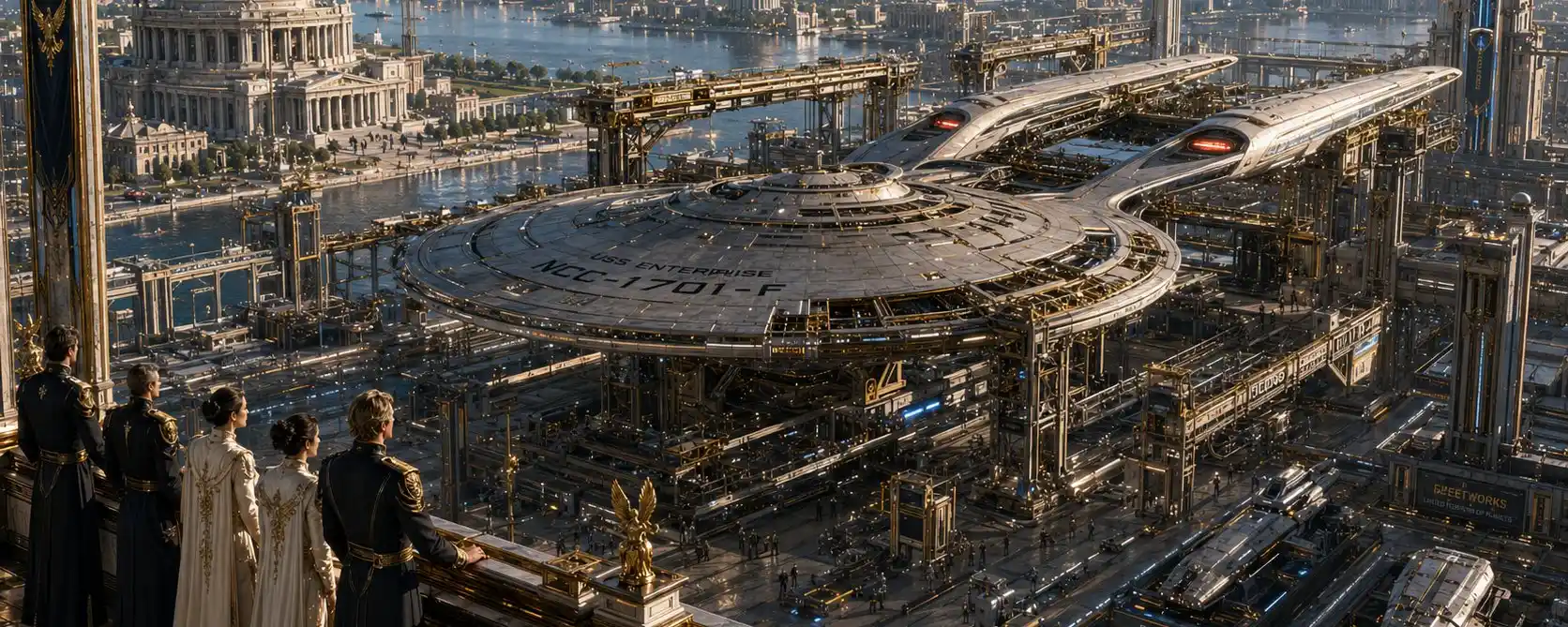
Executive Summary
Humanity already possesses many of the component capabilities associated with a spacebuilding civilization: mature aerospace engineering, multinational scientific institutions, global manufacturing networks, nuclear and renewable energy, orbital operations, robotics, digital communications, medicine, technical standards, heavy shipbuilding, and increasingly capable space programs. The International Space Station is a real example of nationally owned modules operating as one integrated platform under a multilayered legal and operational framework. The Consultative Committee for Space Data Systems demonstrates that agencies from many countries can create shared technical standards that reduce risk and enable cross-support. NATO demonstrates that interoperability does not require identical equipment or the surrender of national command. ITER and CERN show that states can pool money, hardware, scientific labour, and intellectual property inside long-duration institutions without dissolving themselves into one government. [5][6][7][8][9][10]
Those examples prove that bounded integration is possible. They do not prove that it is automatically fair, resilient, efficient, or suitable for a future worldbuilding fleet.
The central obstacle is not merely propulsion. It is the organization of power.
Large civilizations and imperial systems historically accumulated capabilities that fragmented institutions often struggled to sustain: logistics, infrastructure, taxation, administration, rank, technical education, strategic memory, and the ability to mobilize resources over long periods. Rome is a visible example, but not the only one. The British maritime empire created a global network of ports, finance, shipping, and naval power, while also enforcing profound racial, political, and economic inequalities. Imperial China sustained long administrative continuity, yet historical scholarship cautions against treating it as a permanently omnipotent centralized machine. The United States later combined federal constitutional checks with continental scale, alliance leadership, industrial mobilization, and aerospace power. Modern Germany, Japan, South Korea, China, India, Canada, and multinational European institutions preserve different technical and organizational strengths, each with its own failure modes. [1][2][3][4][19][20][21][22][23]
The answer cannot be to romanticize empire. Neither can it be to discard every attribute associated with strong state capacity. A civilization unable to coordinate, defend, build, train, maintain, and remember will not become peaceful by becoming incapable. It will become dependent, vulnerable, or stationary.
The opposite model also contains failure modes. Constitutional pluralism, distributed authority, transparent review, and independent science improve legitimacy and correction. Poorly designed pluralism can nevertheless produce veto without ownership, fragmented command, low industrial ambition, slow emergency action, and a culture in which every hierarchy is treated as suspect even when a mission requires one.
The highest-performance architecture is therefore not an indiscriminate fifty-fifty mixture. It assigns different characteristics to the layer where they perform best:
• Humanist and constitutional principles govern moral ends.
• Plural institutions govern peacetime legitimacy and correction.
• Mission-oriented hierarchy governs bounded execution.
• Distributed authorization governs irreversible or capture-prone decisions.
• Independent evidence governs claims that can be manipulated.
• Industrial institutions govern production, maintenance, and technical succession.
• A shared worldbuilding mission provides a constructive direction for ambition.
The operational doctrine is:
Centralized execution where speed is necessary. Distributed authorization where capture would be dangerous. Independent verification wherever truth can be manipulated.
This article calls the proposed architecture the Concord of Wings. It is not a world government, not a disarmed federation, and not an imperial command system with softer language. It is a bounded professional alignment system in which states, institutions, and civilizational capability lineages retain meaningful identity and sovereignty while becoming interoperable in carefully defined domains: safety, rescue, science, orbital traffic, docking, medicine, infrastructure, evidence, logistics, construction, and long-duration space operations.
The Concord requires five kinds of discipline.
First, it requires constitutional discipline: no office may silently accumulate command, evidence, succession, law, and force.
Second, it requires engineering discipline: safety-critical interfaces must be testable, independently certifiable, and capable of graceful degradation.
Third, it requires industrial discipline: charters must produce factories, yards, trained workers, spares, power, and maintained systems rather than conferences alone.
Fourth, it requires incentive discipline: participants must gain real value while retaining protected domains, withdrawal rights, and fair access.
Fifth, it requires adversarial discipline: the architecture must survive deception, conflicting sensors, political fear, cyber compromise, emergency pressure, and attempted capture.
The deeper doctrine is:
Preserve the civilizational capacity to organize, build, and defend, but deny any person or institution an unlimited right to own civilization.

Caption: A peaceful family scene establishes that fleets, institutions, and protective orders exist to preserve human life rather than perpetuate themselves.
Conceptual role: The opening plate keeps the argument anchored in ordinary human continuity. Space expansion is not justified by spectacle alone. It is justified only if greater capability protects life, knowledge, freedom, friendship, and the possibility of future generations.
1. The Desired Outcome and the First-Principles Test
A successful spacebuilding civilization is not simply a civilization that can launch large rockets. It must be able to operate beyond Earth for long periods without collapsing into dependency, command confusion, technical fragility, or political capture.
From first principles, the desired outcome has six components.
1.1 Human continuity
The system must preserve life, dignity, family, cultural memory, scientific freedom, and the ability of future generations to revise inherited institutions. A fleet that survives physically by becoming politically totalitarian has failed its human purpose.
1.2 Survival capacity
The civilization must protect people and infrastructure from war, disaster, technical failure, radiation, disease, cyberattack, and supply interruption. Legitimacy without survival capacity may not endure.
1.3 Productive depth
Worldbuilding requires energy, materials, machine tools, electronics, robotics, launch systems, shipyards, laboratories, medical systems, agriculture, maintenance, and a trained workforce. Goodwill cannot substitute for production.
1.4 Legitimate command
People must know who may decide, under what mandate, for how long, within which domain, and under whose review. Complex missions require command. Free societies require command boundaries.
1.5 Independent correction
No institution has perfect information. The architecture must permit technical dissent, legal challenge, evidence preservation, and post-crisis correction without making every action dependent on permanent consensus.
1.6 Plural contribution
No single civilization currently contains every capability required for sustained spacebuilding. The system must combine strengths without converting interoperability into cultural or political absorption.
These requirements create tension. Concentration improves execution but raises capture risk. Distribution improves correction but raises latency and coordination risk. Integration reduces duplication but creates dependency. Sovereignty protects autonomy but can preserve incompatibility. The article is therefore not searching for a morally pure arrangement. It is searching for a high-performance architecture that fails less catastrophically than its alternatives.
The governing axioms are:
• Human life has intrinsic value and cannot be reduced to an input for state power.
• Civilizations require enough strength to survive real threats.
• Complex systems fail, sometimes in correlated ways.
• No leader, institution, sensor, model, or nation has complete information.
• Large projects require coordination, continuity, and accountable hierarchy.
• Rival interests and historical distrust will not disappear through declaration.
• Peace that works only under goodwill is fragile.
• Force without legitimacy becomes predatory.
• Legitimacy without execution can become performative.
• Spacebuilding requires decades of industrial and institutional continuity.
From those axioms, the required architecture follows: bounded centres, distributed strategic authorization, independent evidence, modular sovereignty, industrial depth, safe withdrawal, and a mission large enough to reward cooperation.
2. Definitions: Empire, Civilization, Sovereignty, and Starfleet
The word empire must be used precisely.
An empire is a large political and logistical system that organizes multiple territories, populations, or productive domains around a concentrated strategic centre, normally with unequal authority between centre and periphery.
A great power is a state with enough economic, military, technological, or diplomatic capacity to shape outcomes beyond its territory. A great power may exercise imperial influence without maintaining a formal empire.
A nation-state claims political legitimacy through a relationship between state institutions and a national community.
A civilization is broader: a long-duration pattern of institutions, languages, memories, moral traditions, technical practices, and social organization that may cross state boundaries.
A civilizational capability lineage is accumulated institutional knowledge and demonstrated productive practice that may survive after a formal empire disappears. It is not a race, personality type, or claim that every citizen shares the same traits.
Sovereignty is final legal authority within a defined political order. Sovereignty does not require technical isolation; states routinely preserve sovereignty while accepting treaties, standards, contracts, and shared infrastructure.
Modular sovereignty is the retention of final authority over defined modules, rights, or domains inside a shared system while accepting common interfaces and limited joint governance where integrated operation requires it.
Interoperability is the ability of different organizations, people, procedures, and systems to work together effectively. NATO explicitly treats interoperability as broader than identical hardware; it includes doctrine, training, procedures, information, and human relationships. [5]
Mission command is a bounded operational structure in which legitimate authority defines mission purpose and constraints, while trained subordinate leaders exercise disciplined initiative within those boundaries.
Centralized execution means an identified commander or program office can coordinate time-sensitive operations.
Distributed authorization means one actor cannot independently approve actions that would capture, disable, weaponize, or irreversibly redirect the shared system.
Independent verification means decisive claims can be tested through evidence not generated, interpreted, and preserved exclusively by the same actor whose conduct is in question.
A mutually diagnostic institution allows separate bodies to detect failures in shared obligations without granting unlimited access to one another’s internal societies or sovereign systems.
A worldbuilding fleet is a set of vessels and supporting institutions primarily designed for science, construction, rescue, logistics, habitation, repair, and long-duration continuity.
A spacebuilding civilization is a society capable of producing, maintaining, financing, governing, and renewing such a fleet across generations.
Starfleet is used here as an outcome metaphor: not a fictional uniform or universal planetary state, but the visible product of a civilization that has achieved high capability, bounded authority, industrial continuity, technical trust, and cooperation under stress.
3. Comparative History: Capability Without Myth
Rome remains the clearest opening case because its roads, military logistics, law, monuments, and administrative reach visibly linked state capacity to imperial command. Roman road networks connected centres, frontiers, information flows, trade, and military movement. They were productive infrastructure and instruments of control at the same time. [1]
Rome’s lesson is not that all centralized capacity is Roman or that every road is imperial. Its lesson is that useful capability can be structurally coupled to domination.
The British Empire presents a different architecture. It was maritime, commercial, financial, and distributed across ports, shipping routes, companies, colonies, dominions, and naval power. It demonstrated that global coordination can operate through networks rather than one continuous territorial block. It also demonstrated that networked power can remain profoundly unequal. Mobility, trade, law, and investment were not shared on equal terms, and the imperial system repeatedly converted commercial access into political dependency. [2]
The United States developed another combination: federal constitutional checks, continental scale, industrial mobilization, alliance leadership, and aerospace power. Its system proves that a strong centre can coexist with divided constitutional authority. It also demonstrates that formal equality among allies can conceal real asymmetry when one state provides the largest share of command, finance, transport, intelligence, or security. The lesson is not to eliminate leadership but to make asymmetry explicit, bounded, and reviewable. [4][5]
Imperial China offers a warning against simple historical stereotypes. The late imperial state had long bureaucratic continuity, but scholarship disputes the common image of an all-powerful, uniformly penetrating central administration. Authority and capacity varied by period, region, fiscal structure, and local institutions. The modern lesson is that long-duration coordination and infrastructure scale are real capabilities, but they should not be explained through a timeless national essence. [3]
German industrial and technical strength is likewise institutional rather than biological or mystical. Modern vocational education combines federally issued training rules, regional school frameworks, workplace learning, chamber-based examinations, and recognized qualifications. The relevant capability is a system that links education, firms, standards, and certification. The shadow is that highly organized expertise can become rigid, exclusionary, or obedient to immoral political direction if technical competence is separated from lawful dissent. [19]
Japan and South Korea demonstrate different forms of advanced shipbuilding, industrial coordination, supplier integration, and quality control. Current OECD and UNCTAD assessments show that China, South Korea, and Japan remain central to global shipbuilding, with China dominant in scale and Korea and Japan maintaining major positions in high-value and technologically complex segments. These are institutional and industrial facts, not fixed cultural personalities. [20][21][29]
India’s space program demonstrates that a country can develop launch, planetary, scientific, and docking capabilities through sustained national institutions without reproducing the exact industrial model of the United States, Russia, Europe, or China. ISRO’s successful SpaceX docking and undocking work is directly relevant to future assembly, servicing, and station operations. [23]
CERN, ITER, the ISS, NATO, and CCSDS provide non-imperial but incomplete precedents. They show that states can share standards, facilities, hardware, data, training, command procedures, and scientific benefits while retaining distinct legal identities. They also show that multinational institutions can suffer cost growth, asymmetric dependence, slow decision-making, and hidden leadership concentration. [5][6][7][8][9][10]
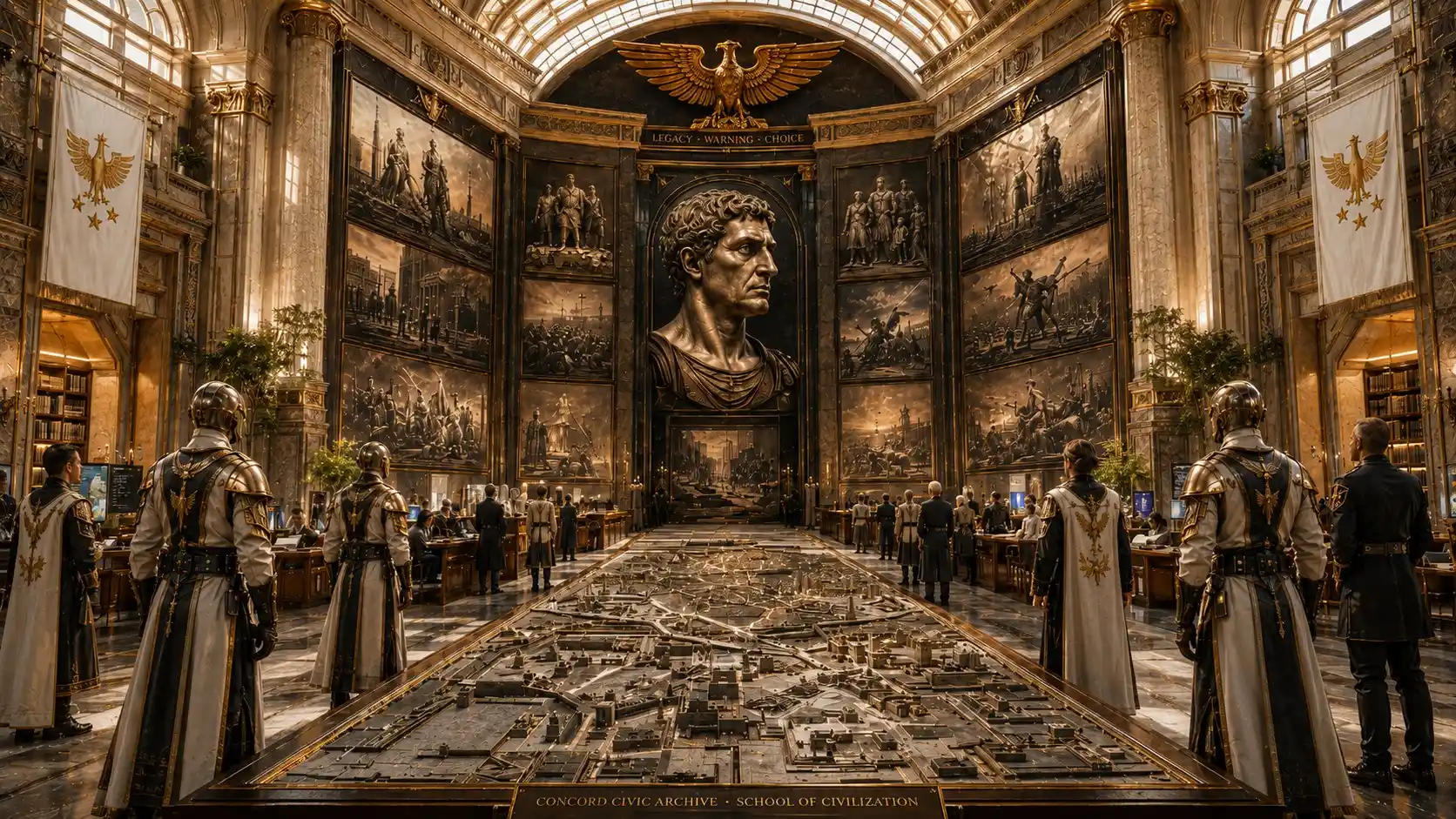
Caption: A future archive displays Roman logistics, law, roads, rank, and military order together with the emperor-centred hierarchy that made those capabilities politically dangerous.
Conceptual role: The plate treats empire as a systems case rather than a costume source. The future does not erase the past. It decomposes it into useful capability, destructive coupling, and redesign requirements.
4. The Dark Mirror: Survival, Mobilization, and Excessive Coupling
The dark mirror is a survival-and-mobilization machine.
Its strengths are substantial:
• a legible strategic centre;
• visible rank and responsibility;
• rapid command transmission;
• readiness for sacrifice;
• long institutional memory;
• concentrated logistics;
• monumental confidence;
• deterrence through visible organization;
• the ability to continue projects beyond individual careers.
These qualities matter for space expansion. A damaged vessel cannot wait indefinitely for every constituency to revisit first principles. A shipyard cannot function if no one owns schedule, configuration, and delivery. A multi-generational technical institution requires apprenticeship, archives, rank, discipline, and succession.
The dark system fails when too many functions occupy the same node.
If the ruler embodies the state, criticism of the ruler becomes treason against the state. If the protective force depends personally on the ruler, it can become a political selector. If truth moves only through the command chain, bad information is rewarded when it pleases the centre. If victory proves legitimacy, expansion and confrontation become recurring methods of political renewal.
In engineering language, the dark mirror contains common-mode failure. Political authority, security, evidence, succession, and symbolism are tightly coupled. When the centre becomes captured, delusional, corrupt, or simply mistaken, independent correction is weak.
The system’s central danger is not merely cruelty. It is efficient error propagation.
A tightly coupled empire can move quickly, coherently, and courageously in the wrong direction.
The correct response is not to remove all hierarchy. It is to decouple the functions whose combination creates catastrophic capture.
5. The Light Mirror: Legitimacy, Correction, and the Risk of Paralysis
The light mirror is a legitimacy-and-correction machine.
Its strengths include:
• lawful authority;
• independent institutions;
• distributed knowledge;
• scientific challenge;
• public accountability;
• cultural plurality;
• peaceful succession;
• voluntary alignment;
• the possibility of reversing error without destroying the state.
The United States Constitution does not establish rigidly isolated branches. It creates divided powers and overlapping checks intended to resist arbitrary concentration. That distinction matters: constitutional design is not the absence of a centre. It is a system in which the centre cannot absorb every function. [4]
The light mirror fails when it confuses virtue with the absence of power.
It can produce:
• unclear decision ownership;
• endless consultation;
• veto without delivery responsibility;
• weak deterrence;
• delayed emergency response;
• underinvestment in heavy industry;
• public institutions that review but do not build;
• transparency rules that destroy legitimate operational security;
• a belief that goodwill will survive deliberate deception.
A civilization of open courtyards, independent panels, and moral language does not automatically become Starfleet. It may become ethical, eloquent, and stationary.
The correct conclusion is not that constitutional systems are weak. It is that constitutionalism must govern capable institutions rather than replace them with procedural symbolism.
6. The Highest-Performance Synthesis
The optimum is functional allocation, not compromise by dilution.
Moral ends
Human life, dignity, truth, lawful authority, freedom of conscience, and the protection of future generations govern the purpose of the system.
Peacetime governance
Authority remains plural, legal, distributed, and reviewable. Political institutions establish public objectives. Courts or equivalent legal bodies determine legality. Professional bodies control matters within their competence.
Science and verification
Evidence must be reproducible where possible, independently preserved, and protected from political command. Security-sensitive information may be compartmented, but no actor may use secrecy to become the sole source of strategic truth.
Industrial mobilization
Programs require accountable executives, configuration control, milestones, budgets, technical authority, and the power to terminate non-performing work.
Immediate protective action
Guardians and emergency operators need rapid authority within clear geographical, temporal, and mission boundaries.
Strategic authorization
Actions capable of starting war, seizing common infrastructure, abandoning populations, or irreversibly changing the mission require distributed approval across political, legal, technical, and operational interfaces.
Post-crisis review
Evidence preservation and investigation must be independent of the actor whose decision is under review.
Long-duration missions
A vessel requires one mission commander, one mission charter, and one operational chain. No commander may unilaterally own law, evidence, succession, life support, strategic force, and every contributing module.
The synthesis can be summarized as:
Light ends, dark capacity, engineering control.
“Dark capacity” does not mean domination. It means honestly retaining hierarchy, secrecy, force, endurance, and sacrifice where survival requires them. “Light ends” means those capabilities remain subordinate to human purpose and lawful correction. “Engineering control” means the boundary is encoded in interfaces, logs, authorizations, redundancy, and recovery rather than entrusted to personality alone.
The centre
The earlier light inversion made a mistake when it treated every centre as a throne.
A high-performance system requires a centre of coordination. The centre may be a mission chair, command station, charter table, vessel model, or emergency operations node. The governing principle is:
There is a centre, but no person permanently owns the centre.
The centre must be:
• attached to an office or mission rather than a bloodline;
• occupied only by authorized persons;
• time-limited when authority is exceptional;
• connected to a lawful succession chain;
• unable to control every critical domain;
• reviewable through preserved evidence;
• returned to ordinary status when the emergency or mission ends.
Centralized execution does not require centralized ownership.
7. The White Mantle: A Symbolic Checksum, Not the Operating System
The White Mantle Guardian is a bounded case study in how a civilization can express force without worshipping it.
The black tactical foundation represents real danger, mortality, physical competence, and the acknowledged human shadow.
The white mantle represents force subordinated to public duty.
Gold represents burden, judgement, and exceptional accountability — not privilege or divine licence.
The cross expresses the Christian source of this particular symbolic tradition: sacrificial protection, moral constraint, and refusal to treat political power as ultimate. In a plural Concord, that symbol cannot become a legal requirement for all participants. The universal constitutional rule is broader:
Force must be subordinated to life, truth, lawful authority, and sacrificial responsibility.
Other civilizations may express the same rule through different symbols and traditions.
The wings represent flight, aerospace lineage, vigilance, rescue, and ascent rather than imperial supremacy.
The visor represents evidence-assisted perception. Sensors and AI may improve warning, but they do not become oracles. Human judgement remains accountable, and critical claims require diverse evidence paths.
The weapon remains at the perimeter. It proves capacity but does not confer political authority.
The Guardian is not:
• a Christianized Roman legionary;
• a futuristic crusader;
• a sovereign military caste;
• an ideological police force;
• an armed administrator of ordinary life;
• the personal interpreter of all law.
The Guardian protects human life, lawful constitutional processes, engineers, scientists, diplomatic teams, evacuation routes, yards, launch sites, and strategic infrastructure.
The Guardian does not choose leaders, determine scientific truth, command all engineering systems, monitor civilian ideology, or independently authorize strategic violence.
The Guardian must remain formidable. The moral achievement is not weakness. It is governable strength.

Caption: The black operational system and white ceremonial layer are assembled separately, showing that force is real but its public meaning and institutional boundary are deliberately designed.
Conceptual role: The plate prevents the article from treating symbolism as decoration. It shows that ceremony can remind power of its limits, but it also makes clear that the Guardian is one protected interface inside a much larger constitutional and engineering system.
8. Civilizational Capability Lineages
Each lineage should be evaluated through four fields: demonstrated capability, institutional source, known shadow, and required correction.
Roman capability lineage
Demonstrated capability: logistics, infrastructure, law, strategic roads, rank, and long administrative memory.
Institutional source: taxation, military organization, engineering practice, provincial administration, and a strong strategic centre.
Shadow: conquest, slavery, unequal status, and excessive coupling of ruler, army, truth, and legitimacy.
Correction: retain scale and continuity while distributing evidence, legal review, succession, and strategic authorization.
Anglo-American capability lineage
Demonstrated capability: maritime reach, aviation, spaceflight, alliance formation, global logistics, and constitutional checks.
Institutional source: navies, ports, finance, industry, federal structures, research universities, private firms, and alliance networks.
Shadow: strategic overreach, unequal partnership, dependency, and the temptation to convert contribution size into permanent ownership.
Correction: acknowledge leadership explicitly, cap control, preserve withdrawal, and separate operational lead from constitutional ownership.
German and continental European capability lineage
Demonstrated capability: vocational formation, standards, industrial science, multinational research, and formal governance.
Institutional source: apprenticeships, chambers, firms, technical universities, standards bodies, CERN, ESA, and European research institutions. [10][19]
Shadow: rigidity, technocracy, and the danger that expertise becomes insulated from public legitimacy or moral challenge.
Correction: protect dissent, rotate leadership, publish decision rights, and connect technical standards to visible human purposes.
Japanese capability lineage
Demonstrated capability: complex manufacturing, shipbuilding, compact systems, design discipline, and supplier quality.
Institutional source: industrial firms, supplier networks, engineering education, production systems, and maritime industries. [20][21]
Shadow: demographic pressure, consolidation, excessive hierarchy, and organizational reluctance to challenge established assumptions.
Correction: strengthen workforce renewal, dissent channels, modular supplier diversity, and flexible certification.
South Korean capability lineage
Demonstrated capability: high-value shipbuilding, electronics, rapid industrial execution, and large integrated projects.
Institutional source: major industrial groups, yards, export discipline, engineering education, and state-industry coordination. [20][29]
Shadow: concentration, cyclic exposure, workforce stress, and dependence on a small number of dominant firms.
Correction: broaden supplier depth, protect labour continuity, and ensure joint systems are not dependent on one corporate cluster.
Chinese capability lineage
Demonstrated capability: manufacturing scale, infrastructure delivery, industrial coordination, and long-horizon planning. Asia and Oceania produced more than half of global manufacturing value added in 2024, with eastern Asia dominating the region. [22]
Institutional source: large domestic markets, state planning, industrial clusters, infrastructure finance, technical education, and dense supply chains.
Shadow: opaque central control, standards capture, surveillance risk, and asymmetric dependency.
Correction: independent testing, bounded disclosure, supplier diversification, safe withdrawal, and no hidden universal administrator.
Indian capability lineage
Demonstrated capability: launch systems, planetary science, digital systems, pharmaceuticals, and in-space docking.
Institutional source: ISRO, scientific institutions, engineering talent, national programs, and a large technical workforce. [23]
Shadow: uneven infrastructure, fragmented industrial depth, and a gap between flagship capability and broad maintenance capacity.
Correction: strengthen production, testing, apprenticeship, and lifecycle support around successful mission institutions.
Canadian and smaller-power capability lineages
Demonstrated capability: coalition operation, robotics, northern logistics, aerospace participation, scientific institutions, and specialized contributions.
Institutional source: alliance participation, national agencies, universities, firms, and contribution to international platforms such as the ISS.
Shadow: underinvestment, dependency on larger partners, and administrative drift.
Correction: preserve indispensable niche capability while increasing productive depth and bargaining clarity.
The Concord should not rank civilizations by moral worth. It should ask which institutions produce useful capability, which failure modes accompany them, and how corrected contributions can operate together.
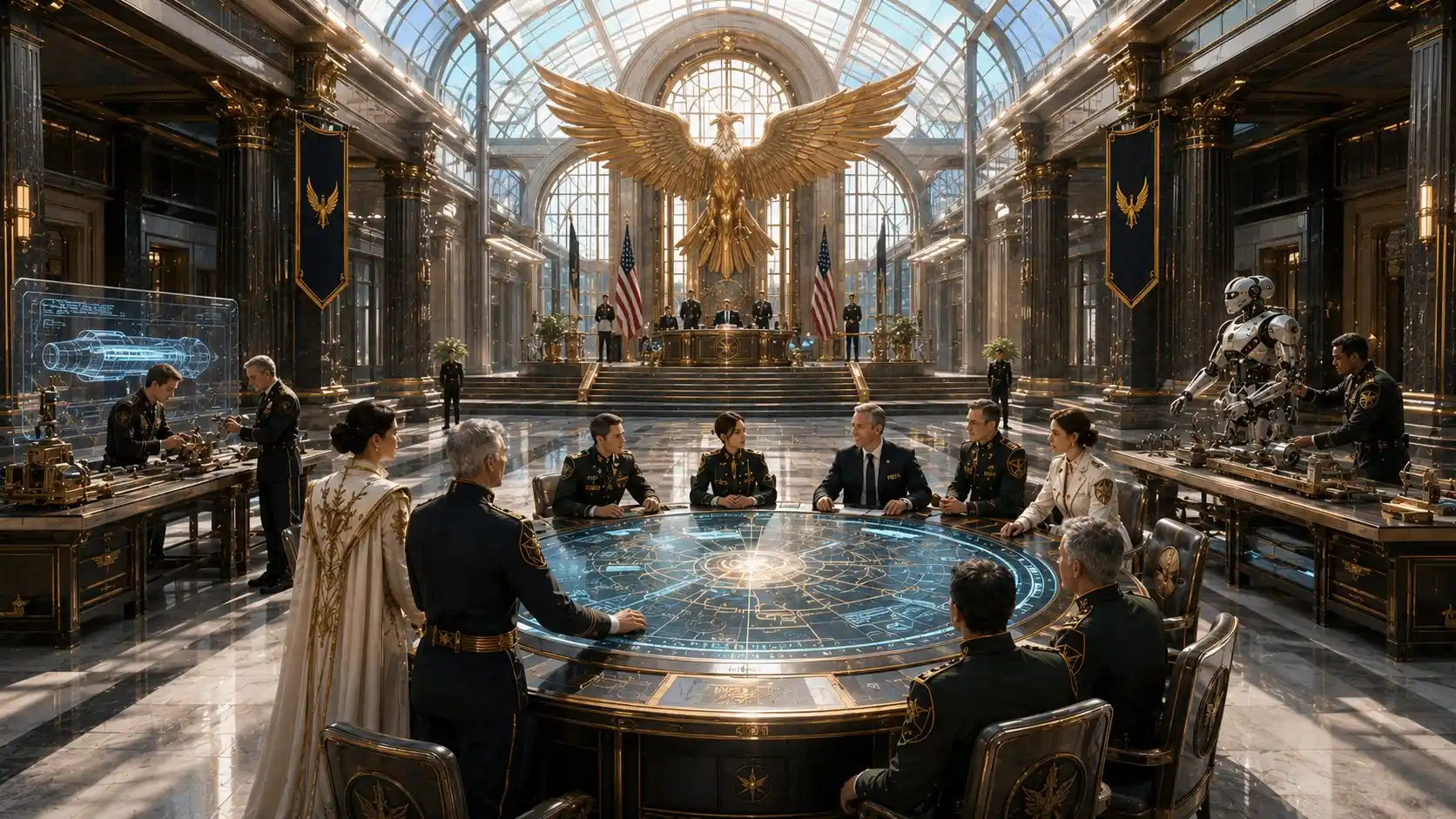
Caption: Civilizational traditions appear through working propulsion, medical, legal, manufacturing, shipbuilding, robotics, and habitat systems rather than costumes or national pageantry.
Conceptual role: The plate shows professional alignment without cultural deletion. The centre remains open, and no civilization becomes the final owner of the shared project.
9. Professional Alignment Before Political Unity
Universal ideological agreement is not a prerequisite for technical cooperation.
Professional alignment can begin in domains where failure is costly and shared rules are useful:
• units and data formats;
• docking interfaces;
• power exchange;
• emergency signals;
• rescue systems;
• orbital traffic protocols;
• medical compatibility;
• radiation and contamination controls;
• structural safety cases;
• AI auditability;
• identity and access assurance;
• incident logging;
• supply-chain traceability;
• planetary protection;
• human override requirements.
CCSDS already provides a multinational process for space communications and data standards intended to improve interoperability and cross-support while reducing development risk and cost. Participation is voluntary, and recommendations become binding only when adopted by agencies or programs. That is a useful model because it separates technical development from automatic political supremacy. [7]
Standards can still become instruments of power. A dominant participant may write an interface around its own products, require certification through its own laboratories, or use safety disclosure to obtain unrelated strategic information.
The Concord therefore requires standards governance:
• published objectives and conflict-of-interest rules;
• separation of safety requirements from vendor implementation;
• multiple conforming designs where feasible;
• transparent change control;
• independent testing laboratories;
• appeals and alternative compliance pathways;
• concentration limits on certification authority;
• periodic review for hidden proprietary dependence.
Political unity is not required before professional interoperability. But technical interoperability must not become political capture by engineering means.
10. Constitutional and Treaty Architecture
This section specifies the mechanics that the earlier version left incomplete.
10.1 Institutional structure
The Concord should use a dual-key governing system.
The Member Council represents sovereign participants. Each member has one vote.
The Contribution Council reflects material responsibility, but no member may hold more than twenty percent of its voting weight, regardless of contribution size.
An Independent Technical Authority certifies shared interfaces, safety cases, configuration changes, and evidence systems. It cannot set political objectives.
A Legal and Integrity Chamber reviews jurisdiction, emergency authority, evidence preservation, conflicts of interest, and lawful refusal. It cannot command routine operations.
A Mission Directorate executes approved missions through a clear command chain.
A Public Accountability Office publishes non-sensitive performance, cost, incident, and concentration data.
10.2 Decision thresholds
Routine administrative decisions require a simple majority of the Member Council and a simple majority of the Contribution Council.
Major procurement, standards changes, and admission of new shared infrastructure require sixty percent in each chamber plus Technical Authority concurrence.
Mission-charter changes, new strategic defensive capabilities, suspension of a member, or transfer of common infrastructure require a two-thirds majority in both chambers plus Legal and Integrity review.
Expulsion, permanent weaponization, dissolution, or transfer of sovereignty requires a three-quarters majority in both chambers and ratification through each affected member’s domestic legal process.
No member may veto ordinary operation simply because it dislikes a lawful decision outside its protected domain. Members retain vetoes only over clearly defined sovereign modules, catastrophic-risk actions, and changes to the founding charter.
10.3 Emergency adjudication
A fast crisis cannot wait for a conventional court, but it also cannot be left entirely to the operational commander.
The Concord should establish an Emergency Review Panel composed of:
• one rotating legal member;
• one independent technical member;
• one member-state representative selected from a pre-approved roster and not directly involved in the dispute.
The panel operates in three time tiers:
• Immediate life safety: the mission commander acts within the approved emergency envelope and records the action.
• Strategic hold: within fifteen minutes, the panel may confirm, limit, or freeze an irreversible command while evidence is assembled.
• Extended emergency: within two hours, the panel issues a written interim ruling. Within twenty-four hours, a full review panel confirms, modifies, or terminates exceptional authority.
These times are proposed design targets, not universally proven thresholds. They should be validated through exercises.
10.4 Emergency authority
Emergency authority automatically expires after seventy-two hours unless renewed by both governing chambers or by a narrower emergency renewal process already defined in law.
Renewal must identify:
• the continuing threat;
• the powers still required;
• the powers ending;
• the evidence basis;
• the next review time.
10.5 Liability
Routine mission risk should be governed through cross-waivers similar in spirit to existing space cooperation, while gross negligence, willful misconduct, evidence destruction, unauthorized seizure, and unlawful force remain subject to fault-based liability.
Liability rules must distinguish:
• design responsibility;
• manufacturing defect;
• operational error;
• command error;
• shared-interface failure;
• unforeseeable external event.
10.6 Dispute resolution
Technical disputes first enter independent expert review.
Contract disputes enter a three-member arbitral panel.
Constitutional disputes enter the Legal and Integrity Chamber, with domestic ratification requirements preserved where sovereignty is affected.
A member that rejects a final ruling may withdraw from the affected program, but it may not continue using shared assets while refusing shared obligations.
10.7 Anti-capture rules
No member may control more than twenty percent of strategic authorization weight.
No single vendor may be the sole certified source for more than one safety-critical subsystem category without an approved exception and compensating stockpile or redesign plan.
No software identity may possess universal administrative access across command, evidence, life support, and strategic systems.
No operational commander may appoint the body that reviews the commander’s own conduct.
10.8 Withdrawal
Members may withdraw with three years’ notice from non-critical programs and five years’ notice from critical common infrastructure, unless another arrangement is negotiated.
A withdrawing member must:
• complete safety-critical obligations;
• preserve and transfer required records;
• provide interface-transition support;
• settle liabilities;
• avoid disabling remaining systems;
• receive agreed compensation for transferable assets;
• retain protected background intellectual property.
Safe withdrawal reduces the fear that cooperation is irreversible annexation.
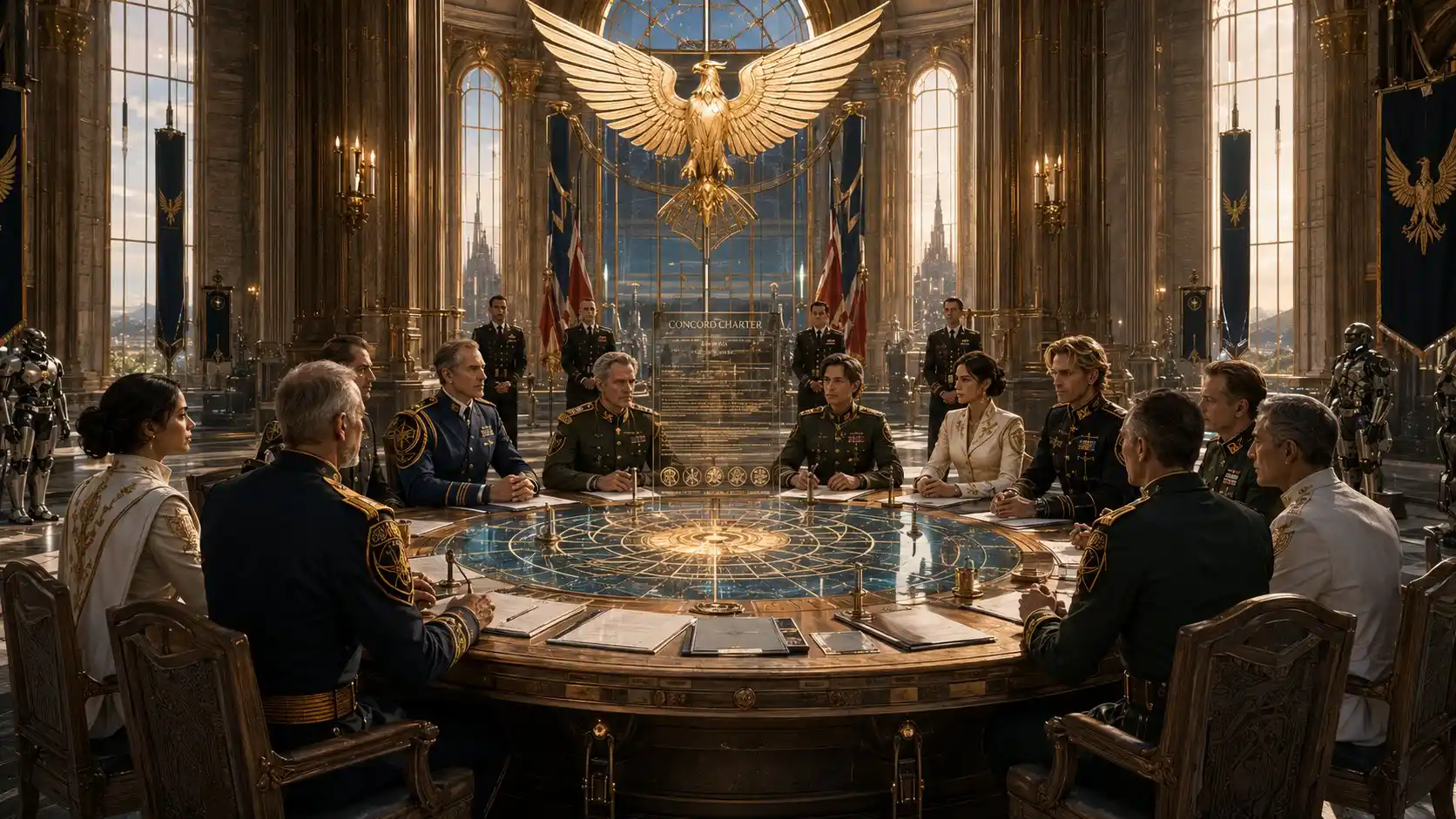
Caption: Political leaders, generals, admirals, engineers, legal stewards, and scientific authorities gather around a shared mission architecture whose centre is powerful but cannot be permanently owned by any one participant.
Conceptual role: The plate translates professional alignment into constitutional machinery. It shows centralized coordination, distributed authorization, independent technical authority, and protected sovereign domains operating around one common mission without creating a final emperor or hidden universal administrator.
11. Incentive Compatibility
Powerful states, firms, and institutions will participate only if the Concord creates value under incomplete trust.
11.1 What participants gain
Participants gain access to shared yards, rescue assets, standards, laboratories, orbital traffic services, training, data, procurement, and long-duration missions. They reduce duplication, expand markets for conforming systems, share risk, and gain prestige through visible contribution rather than territorial control.
11.2 What participants retain
They retain domestic sovereignty, non-shared defence, cultural identity, protected background intellectual property, control over non-shared systems, defined security compartments, and a lawful withdrawal path.
11.3 Contribution formula
A practical funding formula could combine four elements:
• twenty-five percent equal base contribution among full members;
• twenty-five percent ability to pay, measured through an agreed economic index;
• twenty-five percent expected usage and benefit;
• twenty-five percent independently valued in-kind industrial contribution.
This is a proposed starting formula, not a final rule. The cap on voting weight prevents the largest contributor from converting financial dominance into constitutional ownership.
11.4 Intellectual property
Background IP remains with its owner.
Generated IP belongs to the creating party unless the work is inseparable, in which case it enters a joint rights pool.
Safety-critical interface information must be licensed broadly enough for independent verification and maintenance.
Publicly funded fundamental research should default toward publication after security review.
Commercial exploitation rights may be allocated by contribution and licensing agreement.
ITER’s separation of background and generated intellectual property provides a useful precedent, although the Concord would need stronger provisions for competitive suppliers and safe withdrawal. [8][9]
11.5 Procurement
Procurement should use lifecycle cost, reliability, maintainability, supplier diversity, workforce development, and interoperability — not lowest initial price alone.
Critical systems should have qualified second sources where technically and economically feasible.
Where a second source is not feasible, the program must maintain one or more compensating controls: long-duration spares, escrowed design data, sovereign manufacturing rights, modular substitution, or a funded redesign path.
11.6 Free riding
A base contribution funds shared safety, rescue, standards, and evidence infrastructure.
Additional mission capacity is allocated through contributions, procurement, reciprocal agreements, or purchased access.
Emergency rescue remains a duty rather than a spot-market service, but persistent non-contribution can reduce non-emergency privileges.
11.7 Re-entry after suspension
A suspended member must complete remediation, evidence disclosure within the shared domain, independent verification, and restitution before re-entry.
Re-entry should be staged: observer status, limited technical participation, restored access, and finally full governance rights.
12. Industrial Substrate and Quantitative Design Envelopes
The earlier article identified the correct categories but not the scale. This section adds order-of-magnitude planning envelopes.
These ranges are design envelopes, not forecasts or promises. They are intended to expose the industrial consequences of the doctrine.
12.1 Current reference points
The ISS has a mass of roughly 420 metric tons, about 388 cubic metres of habitable volume, and approximately 75 to 90 kilowatts of electrical power. It is supported by frequent logistics missions and a vast terrestrial operations network. [11]
Gateway’s Power and Propulsion Element is designed around roughly 60 kilowatts of solar electric power, while NASA’s lunar fission work targets a 40-kilowatt-class surface power system. These are meaningful advances but remain far below the power required for a genuinely industrial orbital yard. [12][13]
NASA has demonstrated a 98 percent water-recovery goal on the ISS, an important benchmark for long-duration life support. Radiation remains a major constraint; NASA’s current technical guidance uses a career effective dose limit of 600 millisieverts and requires mission-specific shielding and operational controls. [14][15]
NASA logistics research has examined more than 130 metric tons of ISS logistics and more than 50,000 crew-hours, illustrating how much hidden labour and mass are required to sustain a mature orbital platform. [16]
12.2 Mission Class A: Interoperable orbital node
Purpose: rescue, servicing, standards validation, logistics, and small-scale assembly in low Earth orbit.
Design envelope:
• Total assembled mass: 500 to 1,500 metric tons.
• Continuous electrical power: 0.5 to 2 megawatts.
• Permanent crew: 12 to 40.
• Visiting surge population: up to 80.
• Annual delivered mass: 200 to 800 metric tons.
• Water recovery target: at least 95 percent, with a stretch target near 98 percent.
• Critical interfaces: at least two independently implemented docking, data, and power paths.
• Mission duration: continuous operation with replaceable crews.
This node is approximately one to four ISS masses and requires several times ISS power because assembly, repair, and industrial payloads consume more energy than habitation alone.
12.3 Mission Class B: Cislunar worldbuilding yard
Purpose: lunar logistics, habitat assembly, propellant handling, repair, construction, and rescue.
Design envelope:
• Total distributed mass: 2,000 to 10,000 metric tons across yard, depots, tugs, and habitats.
• Continuous electrical power: 5 to 25 megawatts.
• Permanent population: 40 to 150.
• Annual delivered or transferred mass: 500 to 2,000 metric tons.
• Mission endurance: multi-year continuous operation.
• Logistics reserve: at least twelve months for critical consumables and twenty-four months for irreplaceable spares.
• Critical system independence: survival after loss of any one member-provided module.
These numbers are not achievable through one symbolic flagship mission. They imply sustained launch, in-space transport, maintenance, and manufacturing programs.
12.4 Mission Class C: Concord worldbuilding vessel
Purpose: deep-space science, rescue, construction, habitat deployment, medical support, and long-duration exploration.
Design envelope:
• Dry mass: 1,000 to 5,000 metric tons per vessel.
• Electrical power: 10 to 50 megawatts for high-capability vessels.
• Crew and mission specialists: 50 to 200.
• Mission duration: one to three years without immediate return.
• Pressurized volume: 2,000 to 10,000 cubic metres.
• Water recovery: 98 percent design target for missions beyond 180 days.
• Food closure: partial only in early generations; stored and resupplied food remains necessary.
• Medical capability: stabilization, surgery, isolation, and long-duration rehabilitation.
• Repair capability: additive and subtractive manufacturing, electronics repair, pressure-system repair, and module replacement.
• Radiation strategy: storm shelter, operational exposure management, mission-specific shielding, and cumulative-dose tracking.
Power systems in the tens of megawatts are far beyond current crewed platforms and should be treated as low-readiness architecture goals. They require staged demonstration of reactors, power conversion, heat rejection, shielding, and high-power electric propulsion. NASA’s nine-level Technology Readiness Level system provides the correct discipline: no critical technology should be treated as operational merely because its principle is understood. [18]
12.5 Mature network scale
A mature Concord fleet would require annual mass delivery or in-space production on the order of 5,000 to 20,000 metric tons across low Earth orbit and cislunar space.
It would require:
• multiple heavy-launch providers;
• orbital transfer vehicles;
• depots;
• distributed yards;
• multi-megawatt power;
• tens of thousands of terrestrial workers;
• thousands of space-qualified technical workers;
• training pipelines measured in decades;
• recurring maintenance budgets, not only construction budgets.
These ranges should be used to test seriousness. A political proposal that cannot describe how power, mass, workforce, and maintenance scale is not yet a worldbuilding architecture.
12.6 Budget classes
Exact cost estimates would be misleading before mission architecture and launch economics are defined. Order-of-magnitude classes are still useful.
• Phase I standards and safety pilots: low single-digit billions of dollars distributed across participants over five years.
• Phase II shared civil infrastructure: tens of billions over roughly a decade.
• Phase III modular worldbuilding systems: tens to low hundreds of billions across a decade or more.
• Phase IV yards and heavy logistics: low hundreds of billions over fifteen to twenty-five years.
• Phase V fleet development: sustained multi-decade investment potentially reaching the high hundreds of billions or more across all participants.
These are program classes, not budget requests. They should be refined through architecture studies, independent cost estimates, and milestone-based release of funds.
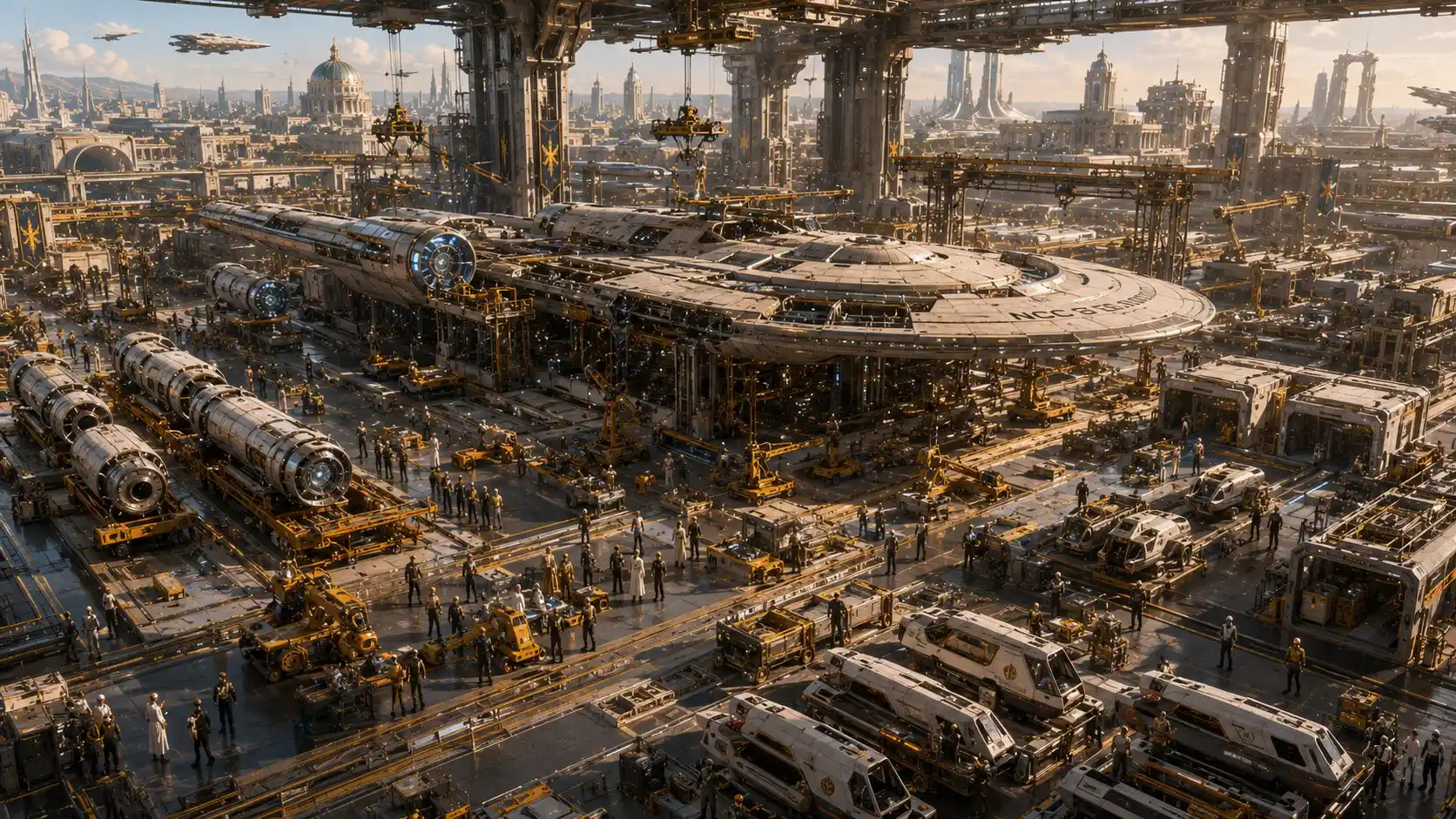
Caption: The keel, power modules, habitats, rescue craft, machine systems, and builders dominate the frame while protective forces remain at the boundary.
Conceptual role: The plate is the industrial proof of the article. The Concord succeeds only if it creates maintained productive capacity rather than symbolic unity.
13. The Fleet Without an Emperor
The first Concord vessel should be an institutional demonstrator before it becomes a deep-space flagship.
It requires one mission charter and one operational commander. It must not be governed by continuous plebiscite during routine operations. But the commander cannot independently own propulsion, evidence, life support, strategic force, succession, and legal interpretation.
The vessel requires:
• integrated command;
• partitioned technical authority;
• engineering and medical stop-work power;
• multi-source navigation;
• protected local life-support control;
• redundant communications;
• separate evidence repositories;
• bounded defensive systems;
• defined succession;
• maintainability and repair;
• safe-mode operation when trust or connectivity fails.
The ISS legal framework already demonstrates nationally registered elements operating within one integrated station while partners retain defined jurisdiction and control. That is not the complete Concord model, but it is an important precedent. [6]
Leadership must be explicit. Hidden asymmetry is more dangerous than acknowledged asymmetry.
The charter must state:
• who leads;
• for how long;
• by what authority;
• with which limits;
• under what succession;
• subject to which independent checks.
The vessel is not a national trophy, disguised battleship, floating world government, or ownerless committee platform.
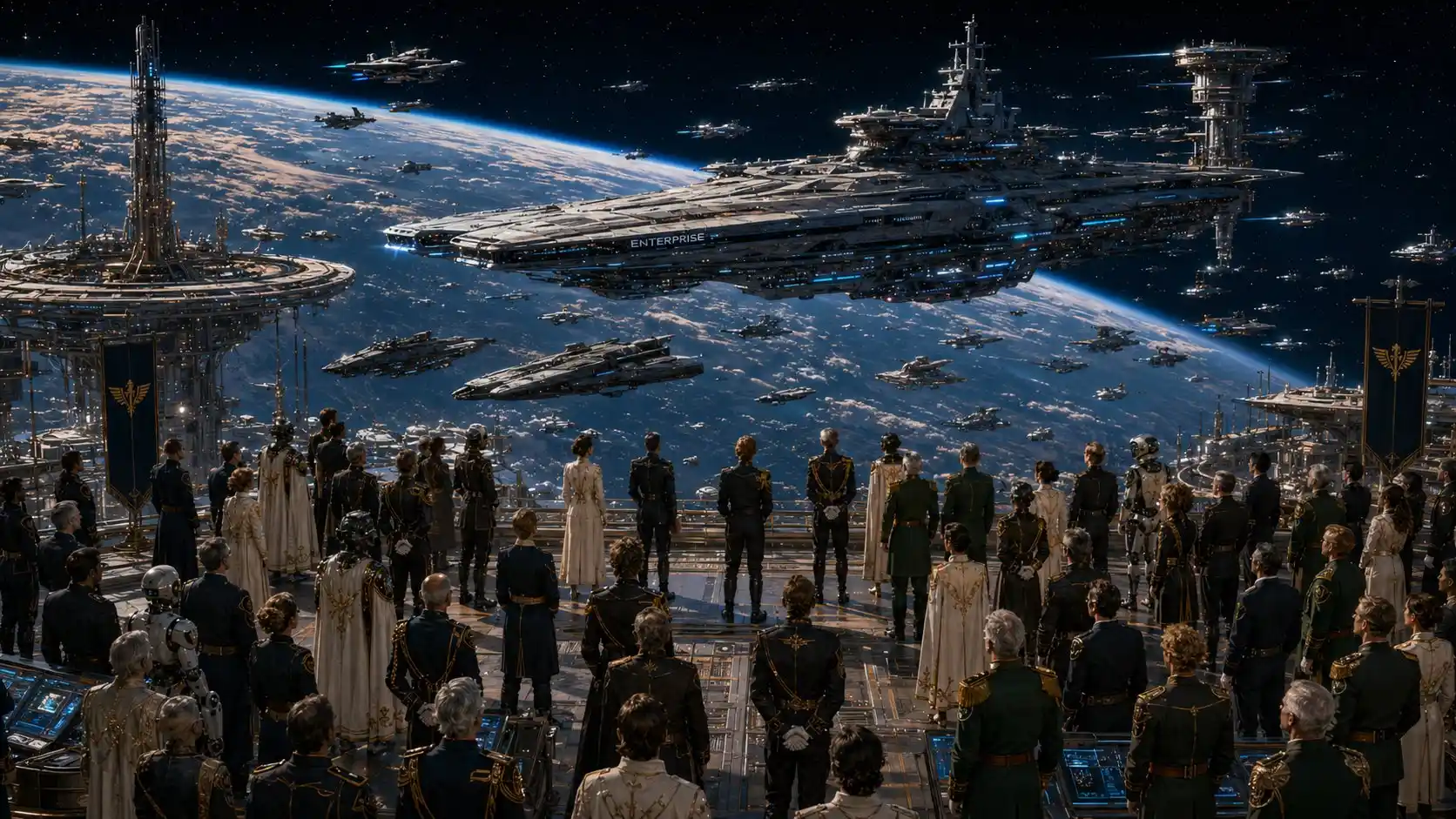
Caption: The completed vessel stands before engineers, doctors, navigators, maintainers, scientists, and civic representatives, with no ruler claiming the centre.
Conceptual role: The plate demonstrates that alignment has advanced from standards and charters to a real machine capable of integrated performance without total ownership.
- FROM EMPIRE TO STARFLEET (Part II)
- https://x.com/SkillsGapTrain/status/2077524016622137635