Designed by: Skills Gap Trainer
14. Mutually Diagnostic Civilization and the Shadow Test
The Concord must survive a coordinated deception in which several participants receive apparently credible evidence that another member is seizing navigation, propulsion, communications, or strategic control.
The network reports disagree. Timing records are manipulated. AI recommendations call for immediate isolation. Physical sensors contradict parts of the warning. Political leaders fear that delay will permit irreversible capture.
This is not a prediction. It is a validation scenario.
14.1 Immediate response
Local life-safety systems act immediately. Fire, pressure, collision, and toxic hazards do not wait for political review.
The mission commander may isolate affected networks and modules within the approved emergency envelope.
Strategic actions enter a hold unless the threat is physically confirmed through multiple independent paths.
14.2 Evidence requirement
Any command that would seize another member’s module, activate strategic force, or irreversibly change the mission requires:
- at least three evidence paths;
- at least two organizationally independent sources;
- one physically grounded source where technically possible;
- preserved confidence and uncertainty data;
- replicated logs in three independently controlled repositories.
These are proposed design requirements to be tested in exercises.
14.3 Lawful refusal
A Guardian, engineer, navigator, medical officer, or operator may refuse only when:
- authority is missing;
- the command exceeds jurisdiction;
- the instruction violates the charter;
- the action is catastrophically unsafe;
- required multi-party authorization is absent;
- the order constitutes unlawful force or attempted seizure.
The sequence is:
- request clarification if time permits;
- preserve the order;
- maintain immediate life safety;
- isolate only the affected interface;
- notify the Emergency Review Panel;
- follow lawful succession;
- record the refusal;
- submit to rapid review.
The refusing officer does not become sovereign.
14.4 Restoration after crisis
After a false alarm or real betrayal, the system requires:
- independent reconstruction;
- public and protected reports;
- technical remediation;
- compensation where appropriate;
- sanctions for misconduct;
- staged restoration of access;
- revised exercises and thresholds.
A system that can only dissolve after betrayal is not resilient.
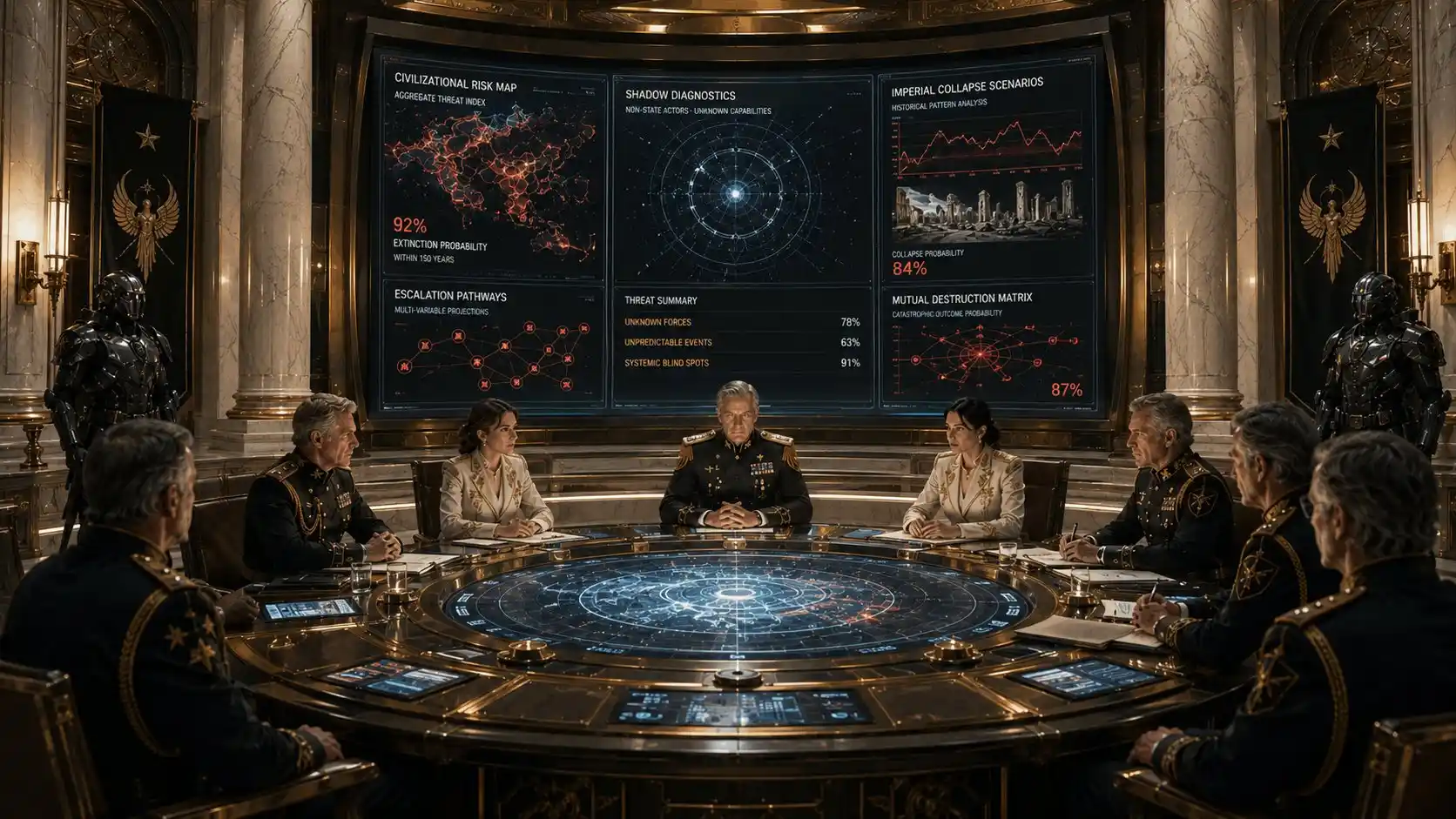
Caption: Contradictory networks and historical suspicion threaten to fragment the shared fleet before any physical attack is confirmed.
Conceptual role: The plate reveals that the greatest threat may be a deception designed to reactivate the belief that every participant must seize the common platform first.


Caption: A Guardian refuses to transmit an invalid seizure order while independent engineering, navigation, and integrity authorities close their own unauthorized command paths.
Conceptual role: The refusal is collective professional discipline, not a military hero overthrowing civilian government.
15. Transition Ladder: 2026–2070
The dates below are design horizons, not forecasts.
Phase I: Compatible Safety, 2026–2032
Entry condition: participants agree that selected technical safety cooperation is beneficial despite wider rivalry.
Pilot projects:
- emergency communication formats;
- incident-report compatibility;
- docking and rescue interface tests;
- orbital traffic data exchange;
- AI audit vocabulary;
- joint technical exercises;
- independent interface laboratories.
Required institutions: a small standards council, accredited testing laboratories, and a protected incident repository.
Validation gates:
- at least two independently implemented systems interoperate;
- no vendor-specific dependency is required for certification;
- exercises survive loss of the central network;
- participants can withdraw test data unrelated to the defined safety function.
Budget class: low single-digit billions across participants.
Phase II: Shared Civil Infrastructure, 2030 –2040
Pilot projects:
- disaster response;
- medical evacuation;
- climate and planetary monitoring;
- resilient power micro-grids;
- search and rescue;
- shared scientific facilities;
- independent verification testbeds.
Validation gates:
- local systems remain functional when the joint network fails;
- command, liability, data ownership, and review are documented;
- emergency powers expire automatically;
- cross-organizational teams demonstrate real operations, not only conferences.
Budget class: tens of billions.
Phase III: Modular Worldbuilding Systems, 2035 – 2050
Pilot projects:
- habitat modules;
- power-transfer systems;
- life-support components;
- robotics;
- repair standards;
- medical modules;
- logistics vehicles;
- interoperable docking.
Validation gates:
- replacement or repair by a second participant;
- safe disconnection;
- graceful degradation;
- independent certification;
- no undisclosed single-source dependency.
Budget class: tens to low hundreds of billions.
Phase IV: Joint Maritime and Orbital Yards, 2045–2060
Pilot projects:
- distributed fabrication;
- orbital repair platforms;
- power and propellant logistics;
- heavy-lift coordination;
- multinational apprenticeships;
- common vessel sections.
Validation gates:
- repeatable production;
- maintained existing assets before expansion;
- multiple qualified critical suppliers;
- controlled rework and schedule growth;
- successful loss-of-member exercises.
Budget class: low hundreds of billions across participants.
Phase V: Concord Vessels, 2055–2070
Missions:
- long-duration science;
- rescue;
- orbital construction;
- lunar infrastructure;
- planetary-hazard observation;
- deep-space exploration;
- habitat deployment.
Validation gates:
- decisive mission command without strategic capture;
- independent evidence survival;
- multi-year logistics and repair;
- lawful succession;
- emergency authority returns after use;
- cooperation restored after adversarial exercises.
Budget class: sustained multi-decade investment across the high hundreds of billions or more, depending on launch and energy technology.
16. Prioritized Failure Analysis
The previous failure list treated risks too evenly. This section ranks them qualitatively by severity, propagation, detectability, recovery difficulty, and time to consequence.
Critical Priority 1: Hidden central administrator
Cause: one software identity, platform, or state gains privileged access across command, evidence, life support, and strategic systems.
Consequence: modular sovereignty becomes fictional; capture can occur without a formal constitutional change.
Detection: privilege graph review, independent penetration testing, and comparison between declared and actual access paths.
Prevention: zero universal administrator, segmented credentials, multi-party approval, and independent audit. NIST zero-trust principles support continuous verification rather than implicit trust based on network location. [25]
Recovery: revoke privileges, migrate services, restore independent keys, and reconstruct actions from separate logs.
Residual risk: integration layers naturally accumulate influence.
Critical Priority 2: Evidence manipulation
Cause: the actor under review controls the sensors, timestamps, interpretation, and archive.
Consequence: unlawful action becomes difficult to distinguish from legitimate emergency response.
Detection: disagreement among independent sources, broken chains of custody, and missing replicated records.
Prevention: three repositories, diverse sensors, tamper-evident logs, and protected physical records.
Recovery: independent reconstruction and temporary suspension of affected authority.
Residual risk: some events remain uncertain.
Critical Priority 3: Emergency overreach
Cause: exceptional authority lacks a scope or expiry.
Consequence: permanent emergency government.
Detection: repeated extensions, mission creep, and use of emergency powers for unrelated objectives.
Prevention: seventy-two-hour automatic expiry, defined renewal, and independent review.
Recovery: terminate powers, audit actions, compensate harm, and reform the authority design.
Residual risk: severe emergencies may legitimately require renewal.
Critical Priority 4: Mission-command ambiguity
Cause: unclear boundaries among mission commander, engineering, medicine, Guardians, and civic authority.
Consequence: paralysis or unsafe contradictory action.
Detection: exercise conflict, inconsistent orders, and delayed decisions.
Prevention: written decision-rights maps, rehearsals, and succession.
Recovery: invoke the pre-defined command ladder and conduct immediate after-action correction.
Residual risk: novel emergencies will exceed written scenarios.
Critical Priority 5: Single-source technological dependency
Cause: one supplier or state controls an irreplaceable critical system.
Consequence: coercion, mission loss, or impossible withdrawal.
Detection: supply concentration, proprietary maintenance, and lack of qualified alternatives.
Prevention: second sources, stockpiles, escrowed data, substitution rights, and modular redesign.
Recovery: isolate, substitute, or redesign.
Residual risk: some frontier technologies will remain single-source temporarily.
Critical Priority 6: Guardian politicization
Cause: protective forces develop loyalty to a faction, officeholder, or themselves.
Consequence: Praetorian capture.
Detection: political appointments, ideological activity, resistance to review, and interference with succession.
Prevention: civilian mandate, rotation, external investigation, no political appointment power, and separation from intelligence and administration.
Recovery: suspend units, prosecute misconduct, reconstitute command, and preserve civil continuity.
Residual risk: proximity to power always creates influence.
High Priority Risks
Standards capture, cyber deception, unsafe withdrawal, industrial underperformance, free riding, cultural erasure, and supply-chain collapse remain high risks. They propagate more slowly or are more detectable than the critical risks, but they can still destroy the project if ignored.
17. Validation Targets
The following are design targets requiring future empirical validation.
- No member controls more than twenty percent of strategic authorization weight.
- Every safety-critical interface has at least two independently implemented conforming systems or a formally approved compensating control.
- Every strategic action uses at least three evidence paths and two organizationally independent sources.
- Strategic orders are replicated to three independently controlled repositories.
- Immediate life-safety automation acts within seconds; strategic holds begin within fifteen minutes; an interim emergency ruling is issued within two hours.
- Exceptional authority expires after seventy-two hours unless explicitly renewed.
- Critical systems survive the loss or isolation of any one member-provided module.
- Long-duration missions target at least 95 percent water recovery, with 98 percent as the preferred benchmark beyond 180 days.
- Critical spares have either two qualified suppliers or at least twenty-four months of reserve for the expected demand case.
- No safety-critical maintenance function depends on one person, one nation, or one inaccessible proprietary tool.
- The fleet demonstrates annual exercises involving network loss, false data, member withdrawal, command succession, and rescue.
- Maintenance backlog must remain below a program-defined threshold before new expansion is authorized.
- Public legitimacy is measured through transparent performance, cost, incident, and authority reporting rather than approval polling alone.
18. Red-Team Analysis and Unresolved Risks
Is this a disguised world government?
It becomes one if shared institutions acquire general taxation, legislation, policing, ideological authority, or permanent control over domestic societies. The Concord must remain limited to explicitly delegated domains.
Does it romanticize empire?
It would if it treated conquest, slavery, and inequality as necessary for greatness. The doctrine preserves state capacity while rejecting imperial ownership.
Could authoritarian participants exploit openness?
Yes. The design therefore uses bounded disclosure, reciprocal access, independent testing, and compartmentation rather than universal transparency.
Could democracies accept divided control?
They already accept treaties and multinational institutions. The challenge is democratic visibility: delegation must remain traceable to authorized domestic institutions.
Could the strongest member dominate anyway?
Yes. Caps, dual-chamber voting, multiple suppliers, rotating leadership, and safe withdrawal reduce the risk but cannot eliminate influence created by real contribution.
Does modular authority make emergencies too slow?
It can. The doctrine distinguishes immediate life safety from strategic authorization. Low-latency safety functions remain centralized within a defined envelope.
Could lawful refusal become insubordination?
Yes. Refusal must be narrow, recorded, reviewable, and limited to the officer’s interface. The officer may not seize wider authority.
Could the White Mantle become a caste?
Yes. The order requires rotation, external certification, independent investigation, civilian authorization, and no role in appointing political leadership.
Does space expansion reproduce colonial logic?
It can. The Outer Space Treaty rejects national appropriation and requires due regard and consultation, but future resource governance remains unresolved. The Concord must separate use, safety zones, and temporary operational control from unlimited ownership. [24]
Would resources be better spent on Earth?
Sometimes. Every phase should demonstrate terrestrial benefits, transparent opportunity costs, and maintenance of existing infrastructure before prestige expansion.
Can the Concord survive actual betrayal?
Not automatically. It requires isolation, sanctions, investigation, compensation, and staged re-entry. Some betrayals may end a particular program. Resilience means preventing one betrayal from ending all cooperation or causing immediate war.
19. The Concord of Wings
The Roman eagle represented authority concentrated above the imperial centre.
The Concord’s wings represent several technical and moral traditions entering the same sky without becoming one empire.
They represent vigilance without universal surveillance, flight without conquest, rescue without ownership, and ambition without ruler worship.
The civilization beneath the fleet remains plural. It still contains nations, cultures, political disputes, markets, religions, local loyalties, and independent institutions. The fleet does not replace those systems. It connects selected capabilities to missions that no participant could perform efficiently alone.
The fleet’s success cannot be measured only by distance travelled. It must also be measured by whether:
- human life remains the objective;
- technical truth can contradict political preference;
- emergency power ends;
- smaller contributors retain meaningful rights;
- industrial capacity renews itself;
- the fleet can defend itself without governing society;
- participants can withdraw without catastrophic collapse;
- cooperation survives both disagreement and attempted deception.
NASA’s Moon-to-Mars architecture is evolutionary rather than one leap, and current international space institutions provide only partial foundations. [17] The Concord remains a design proposal and speculative horizon. Its value lies in identifying what must be engineered before the symbolism of Starfleet can become institutional reality.

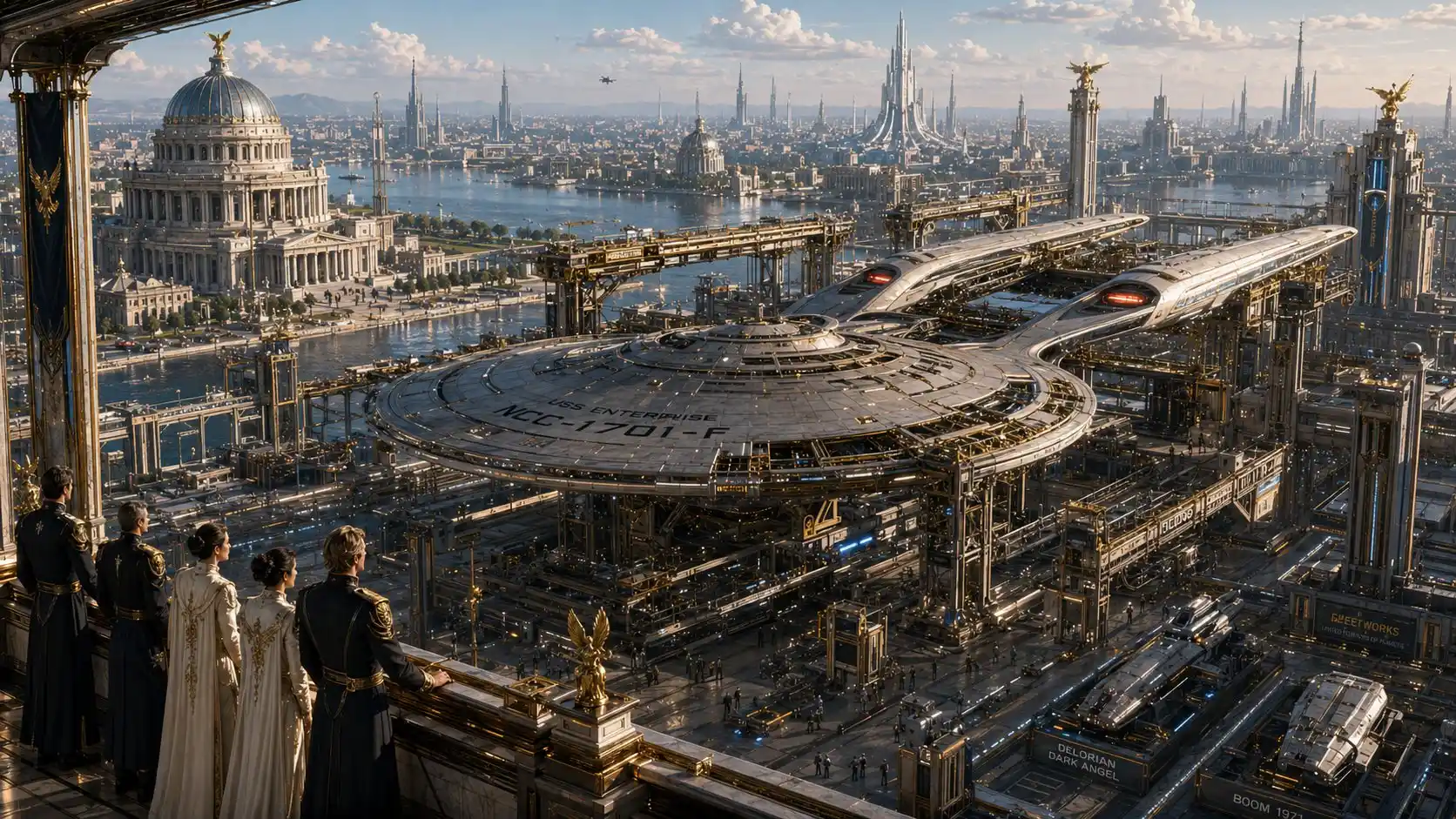
Caption: The first world-building vessel rises while shipyards, schools, rescue craft, distinct cultural institutions, and ordinary families remain active below.
Conceptual role: The final plate shows civilization becoming strong, restrained, and interoperable enough to expand without a final emperor.
Conclusion
Humanity does not need to choose between permanent imperial rivalry and universal centralization.
It needs enough alignment to build together and enough separation to remain free. It needs enough hierarchy to act and enough distributed authority to prevent capture. It needs enough secrecy to protect legitimate operations and enough independent verification to prevent secrecy from becoming impunity. It needs enough force to defend life and enough moral discipline to keep force from defining life.
The dark mirror correctly remembers that civilizations need scale, command, confidence, sacrifice, logistics, and survival capacity.
The light mirror correctly remembers that no ruler, army, administrator, model, or technical platform should become the unanswerable owner of truth and power.
The optimum preserves both insights by assigning them to different layers.
A strong centre coordinates the mission, but no person permanently owns the centre.
Guardians possess real force, but they do not govern.
Engineers control technical safety, but they do not write the entire political order.
Political leaders establish lawful objectives, but they do not manufacture their own evidence.
Independent institutions verify, but they do not acquire unlimited surveillance power.
Civilizations remain distinct, but their strongest professional capabilities become interoperable.
The fleet is not the beginning of this transformation. It is the proof that the transformation has already occurred.
Do not abolish capability.
>
Do not worship capability.
>
Align it, constrain it, verify it, and turn it toward construction.
Appendix A — Formal System Requirements
The following requirements translate the doctrine into an auditable architecture.
A.1 Governance requirements
GR-01: The Concord shall define every delegated authority by domain, duration, jurisdiction, and review path.
GR-02: No individual or institution shall simultaneously control strategic command, evidence preservation, succession, and legal adjudication.
GR-03: Emergency authority shall expire automatically unless renewed through a defined legal process.
GR-04: Members shall retain lawful withdrawal rights and protected non-shared sovereignty.
GR-05: Strategic decisions shall require approval through both sovereign-member and capped-contribution mechanisms.
A.2 Mission-command requirements
MC-01: Every mission shall have one commander, one charter, and one succession chain.
MC-02: The commander shall possess rapid authority over immediate life safety and routine mission execution.
MC-03: The commander shall not unilaterally alter the constitutional mission, seize protected modules, activate strategic force, or destroy evidence.
MC-04: Engineering, medical, and navigation authorities shall possess defined stop-work or safe-mode authority within their domains.
A.3 Evidence requirements
EV-01: Strategic actions shall rely on at least three evidence paths and two organizationally independent sources.
EV-02: Strategic orders and system-state records shall be replicated to three independently controlled repositories.
EV-03: Evidence systems shall preserve uncertainty, provenance, time basis, and chain of custody.
EV-04: No actor under review shall have exclusive control of the evidence used to review that actor.
A.4 Interface requirements
IF-01: Safety-critical interfaces shall use published performance and verification requirements.
IF-02: Vendor-specific implementation shall not be mandatory unless approved through an exception process.
IF-03: Critical interfaces shall support at least two independent conforming implementations or a compensating resilience plan.
IF-04: Shared systems shall support isolation and graceful degradation where physically feasible.
A.5 Industrial requirements
IN-01: Every expansion phase shall include funded maintenance, training, spares, and configuration control.
IN-02: Critical supply chains shall have qualified alternatives, strategic reserves, or redesign plans.
IN-03: New prestige construction shall not proceed while existing critical maintenance exceeds the program’s approved backlog threshold.
IN-04: Contribution accounting shall recognize hardware, facilities, labour, launch, operations, data, and training.
A.6 Human-system requirements
HS-01: Long-duration systems shall target at least 95 percent water recovery, with 98 percent preferred beyond 180 days.
HS-02: Radiation design shall use mission-specific dose analysis, storm shelter capability, exposure tracking, and operational controls.
HS-03: Medical authority shall be independent within clinical and life-support domains.
HS-04: Critical roles shall have trained succession and shall not depend on one individual.
A.7 Verification methods
Each requirement shall identify one or more verification methods:
- analysis;
- inspection;
- demonstration;
- test;
- exercise;
- independent audit;
- legal review.
No requirement shall be considered closed through narrative assurance alone.
Appendix B — Decision Rights and Refusal Boundaries
Civic authority
Controls lawful public objectives, treaties, budgets, and appointment of mission leadership.
Cannot control engineering facts, medical decisions, or technical certification by decree.
Emergency authority is limited by statute, scope, time, and review.
Refusal boundary: subordinates may block commands that clearly lack authority or violate required authorization.
Mission command
Controls mission sequencing, routine priorities, crew coordination, and immediate operational response.
Cannot control the constitutional mission, all evidence, protected medical judgement, or unilateral strategic force.
Refusal boundary: professional authorities may stop actions that violate safety or charter boundaries within their domain.
Guardians
Control immediate protective movement, perimeter defence, evacuation security, and response to direct threats.
Cannot control policy, elections, science, ideology, ordinary civilian behaviour, or strategic authorization.
Refusal boundary: unlawful force, missing authority, attempted seizure, or clear charter violation.
Engineering authority
Controls requirements, configuration, technical certification, maintenance, and safe-mode decisions.
Cannot control political objectives or unrelated personnel.
Refusal boundary: technically impossible, uncertified, or catastrophically unsafe commands.
Navigation authority
Controls trajectory solutions, collision avoidance, positioning integrity, and navigation-source validation.
Cannot change strategic mission objectives independently.
Refusal boundary: unverified trajectory commands or manipulated navigation evidence.
Medical and life-support authority
Controls clinical care, quarantine, environmental health, and immediate life-support protection.
Cannot control unrelated mission policy.
Refusal boundary: instructions violating medical ethics or creating unjustified lethal risk.
Scientific authority
Controls experimental integrity, methods, data provenance, and publication within agreed security boundaries.
Cannot control navigation, defence, or political authority.
Refusal boundary: demands to falsify, suppress, or misrepresent evidence.
Integrity and audit
Controls evidence preservation, compliance review, and reporting.
Cannot command routine operations.
Refusal boundary: orders to erase, alter, conceal, or monopolize required evidence.
Local member modules
Control defined national elements, personnel, protected background intellectual property, and non-conflicting internal use.
Cannot impose unilateral changes on common safety interfaces.
Refusal boundary: shared instructions exceeding treaty or module authority.
Shared Concord institutions
Control common interfaces, mission-level coordination, joint procurement, shared safety, and contribution accounting.
Cannot govern domestic society or unassigned sovereign systems.
Refusal boundary: members may challenge actions beyond the delegated mandate.
Appendix C — Evidence and Epistemic Status
The historical discussion of Rome, maritime empire, constitutional checks, current international space law, ISS governance, technical standards, multinational science, industrial shipbuilding, and current space-system benchmarks is grounded in academic or official sources.
The application of fault tolerance, modularity, independent evidence, graceful degradation, and zero-trust principles to political and multinational design is a first-principles analogy. Engineering principles do not prove political conclusions; they help expose concentration, dependency, verification, and recovery problems.
The Concord of Wings, modular sovereignty, mutually diagnostic civilization, White Mantle order, voting formulas, emergency review structure, mission classes, budget classes, and 2026–2070 transition ladder are design proposals.
The quantitative envelopes are order-of-magnitude planning ranges, not forecasts. They require mission studies, launch-market analysis, technology-readiness assessment, cost estimation, and public authorization.
The shadow test is a validation scenario, not a prediction.
The core conclusion is conditional: a worldbuilding fleet becomes more plausible when high capability is combined with bounded command, industrial depth, independent verification, recoverable interfaces, safe withdrawal, and institutions capable of cooperating without acquiring unlimited authority over one another.
Appendix D — Where the First Concord Vessel Is Built
The construction location of the first Concord worldbuilding vessel is not a secondary architectural question.
It is a test of whether the Concord’s political doctrine can survive contact with industrial reality.
A vessel of this scale cannot be produced by a conference, one symbolic headquarters, one aerospace company, one launch site, or one national shipyard. It requires cities, schools, laboratories, power systems, mines, materials processors, machine shops, transportation corridors, testing facilities, launch systems, orbital infrastructure, and a workforce capable of maintaining the system after the founding generation has departed.
The first-principles conclusion is:
- Build the civilization before the vessel.
- Build and qualify the modules on Earth.
- Assemble the complete vessel in orbit.
- Distribute the construction system so that no single location, state, company, or software platform owns the entire fleet.
D.1 The Vessel Is Downstream of the City
The Enterprise-F construction question is often framed incorrectly:
Which city should receive the shipyard?
The more important question is:
Which network of cities can produce, govern, maintain, repair, crew, and renew the vessel across generations?
A shipyard cannot operate independently of its surrounding civilization. It requires:
- families and stable communities;
- technical schools and apprenticeship systems;
- universities and research laboratories;
- hospitals and rehabilitation facilities;
- energy and water;
- machine tools and materials;
- transportation and freight systems;
- suppliers and repair organizations;
- legal authority and independent inspection;
- cultural institutions capable of forming responsible commanders, engineers, doctors, scientists, and maintainers.
The city therefore comes before the Enterprise.
The vessel is not the seed from which civilization automatically grows. It is the visible result of a civilization that has already learned how to coordinate knowledge, labour, energy, authority, and responsibility.
A spectacular spacecraft surrounded by weak institutions would be a temporary artifact.
A strong construction civilization could build the first vessel, maintain it, learn from it, and build the second.
D.2 Why No Single Site Is Sufficient
The major construction functions impose different geographic requirements.
Large terrestrial fabrication benefits from:
- gravity-supported tooling;
- existing industrial labour;
- rail and water transport;
- accessible power;
- atmosphere for ordinary human work;
- large machine halls;
- conventional emergency response;
- lower-cost inspection and rework.
Launch and orbital deployment require:
- protected launch corridors;
- propulsion and propellant infrastructure;
- reusable cargo systems;
- orbital transfer capability;
- rapid recovery and refurbishment;
- high-cadence logistics.
Final vessel integration benefits from orbit because:
- a complete multi-thousand-ton vessel should not be designed around surviving launch from Earth;
- large modules can be launched separately;
- the orbital structure does not require terrestrial landing gear or atmospheric support architecture;
- long keels, power systems, radiators, habitats, propulsion bodies, and rescue modules can be joined in their operating environment;
- completed systems can be tested progressively before the full crew boards.
No single Earth location optimizes all three domains.
- Building everything at one coastal yard would create a launch bottleneck.
- Building everything beside a launch site would separate the program from much of the aerospace, maritime, academic, and manufacturing workforce it requires.
- Building everything in orbit from the beginning would make ordinary fabrication, inspection, correction, and training unnecessarily difficult.
The correct architecture is therefore a construction network rather than a construction capital.
D.3 The Four-Layer Construction Geography
The first vessel requires four connected geographic layers.
Layer One — Civic and Formation Centres
These institutions establish:
- mission purpose;
- constitutional limits;
- systems architecture;
- professional education;
- leadership formation;
- medical and scientific doctrine;
- interface standards;
- independent review;
- public accountability.
The civic centre must not become the only factory, command centre, evidence repository, launch authority, and operational headquarters.
Its purpose is to form the civilization that builds the vessel, not to own every function of the vessel.
Layer Two — Terrestrial Industrial Yards
Terrestrial yards construct and qualify:
- keel sections;
- pressure vessels;
- habitat modules;
- medical facilities;
- laboratories;
- machine and manufacturing bays;
- power-conversion systems;
- thermal-control equipment;
- propulsion modules;
- rescue craft;
- communications arrays;
- radiation shelters;
- agricultural and life-support systems;
- replacement parts and maintenance equipment.
These yards should be connected to freight rail, protected waterways, heavy road transport, energy infrastructure, airports, and launch logistics.
The terrestrial yard does not hold the complete vessel.
It produces flight-qualified modules whose physical, digital, electrical, structural, thermal, and command interfaces have already been independently verified.
Layer Three — Launch and Orbital Logistics Nodes
Launch nodes receive completed modules and move them into orbit.
Their functions include:
- launch-vehicle integration;
- cargo protection;
- propellant operations;
- reusable-launch refurbishment;
- orbital transfer;
- tug operations;
- depot support;
- emergency recovery;
- replacement-module delivery.
The launch provider transports the vessel’s components.
It does not acquire constitutional ownership of the vessel merely because it provides access to orbit.
Layer Four — Orbital Assembly and Acceptance
The complete vessel is assembled around a primary orbital keel.
The orbital yard performs:
- structural mating;
- power-system integration;
- communications integration;
- life-support activation;
- propulsion installation;
- thermal deployment;
- software and command integration;
- pressure testing;
- emergency-mode testing;
- crew evacuation exercises;
- independent acceptance trials.
The vessel should not receive full operational status merely because all major modules are physically attached.
Commissioning occurs only after the assembled system demonstrates that it can survive:
- loss of a member-provided module;
- loss of the primary communication path;
- conflicting navigation data;
- power interruption;
- life-support isolation;
- command succession;
- emergency separation;
- repair without return to Earth;
- attempted unauthorized access.
D.4 An Illustrative North American Construction Network
The following geography is an illustrative first-generation architecture, not a territorial claim or permanent assignment of civilizational roles.
Washington and the Puget Sound Aerospace Keel
Washington contributes the industrial knowledge required to turn designs into controlled aerospace products.
Its strongest functions include:
- large-airframe architecture;
- configuration control;
- structural and fatigue engineering;
- aerospace materials and processes;
- supplier qualification;
- production tooling;
- nondestructive inspection;
- airworthiness evidence;
- fleet documentation;
- lifecycle support.
Washington should not own the Concord architecture.
It can serve as an aerospace keel: the capability node that helps many suppliers produce different components from one controlled engineering definition.
British Columbia and the Pacific Integration Coast
British Columbia contributes:
- maritime engineering;
- automated shipbuilding;
- robotics;
- coastal aerospace operations;
- ocean and flight testing;
- specialized fabrication;
- systems integration;
- repair-oriented design;
- Pacific logistics;
- a human-facing academy and campus environment.
A British Columbia yard would be especially valuable for developing the connection between maritime shipbuilding and future spacecraft construction.
Large spacecraft will share important institutional characteristics with ships:
- long service lives;
- continuous maintenance;
- compartmentation;
- crew habitability;
- damage control;
- modular refit;
- complex logistics;
- operation far from immediate rescue.
BC therefore functions naturally as a maritime–aerospace integration and testing node rather than as the sole owner of the ship.
Alberta and the Energy–Compute–Production Spine
Alberta contributes:
- abundant industrial land;
- energy-intensive production;
- large structures;
- aerospace expansion;
- AI compute and simulation;
- digital twins;
- cold-weather qualification;
- command and systems integration;
- reserve manufacturing capacity.
The Calgary–Wheatland corridor can support aircraft, vehicle, structural, training, and systems-integration functions.
The Edmonton–Sturgeon corridor can support large-scale compute, energy infrastructure, simulation, industrial data, and robotics support.
Alberta is particularly valuable because it can host productive depth rather than only symbolic headquarters functions.
It can help ensure that the Canadian contribution contains factories, tools, workers, power, and repeatable production.
Texas and the Space-Industrial Ascent Corridor
The Austin–San Antonio–Gulf Coast–Starbase corridor contributes:
- high-rate manufacturing;
- heavy robotics;
- vehicle production;
- aircraft modification and sustainment;
- propulsion;
- energy systems;
- spacecraft integration;
- launch;
- reusable-flight operations;
- orbital logistics.
Austin supplies advanced factory and vehicle-production capability.
San Antonio contributes aerospace modification, testing, qualification, maintenance, and return-to-service knowledge.
The Gulf Coast supplies heavy industry, ports, energy, and logistics.
Starbase or equivalent launch infrastructure supplies the ascent branch.
Starbase should therefore be treated as a launch and orbital-deployment annex, not as the entire capital, academy, factory system, and constitutional centre of the Concord.
D.5 One Vessel, Several Construction Corridors
The illustrative network can be compressed into two major corridors.
The Pacific aerospace and maritime corridor:
California → Washington → British Columbia
This corridor develops:
- vehicle-production methods;
- aerospace structures;
- composites and advanced metals;
- maritime and coastal systems;
- compact mobility platforms;
- flight and ocean testing;
- production discipline;
- specialized integration.
The continental and space-industrial corridor:
Alberta → Texas → Gulf Coast → orbital assembly
This corridor provides:
- energy;
- compute;
- large structures;
- heavy manufacturing;
- propulsion;
- sustainment;
- launch;
- orbital construction equipment;
- scaled replication of mature designs.
These corridors are complementary.
The Pacific corridor is strong in aerospace formation, maritime integration, advanced materials, and controlled product development.
The continental corridor is strong in energy, scale, heavy production, launch, and orbital deployment.
Neither corridor should be allowed to become permanently incapable of operating without the other.
Specialization improves efficiency.
Minimum independent capability protects sovereignty and continuity.
D.6 The Interface Constitution
Distributed construction succeeds only when the interfaces are more disciplined than the geography is fragmented.
Every major module must arrive with a controlled interface definition covering:
- structural attachment;
- dimensional tolerances;
- power quality;
- thermal transfer;
- data formats;
- command permissions;
- software identity;
- pressure and atmosphere;
- fire and contamination boundaries;
- emergency disconnection;
- inspection access;
- maintenance access;
- evidence logging;
- replacement procedures.
A module should not be accepted merely because it functions inside the factory that produced it.
It must demonstrate interoperability with independently produced equipment.
The governing rule is:
A participant may own its design contribution.
It may not secretly own the common interface required by everyone else.
D.7 Construction as an Anti-Capture Mechanism
Distributed production is not only an economic arrangement. It is a constitutional safeguard.
No single participant should simultaneously control:
- the master design;
- the only qualified factory;
- the only launch system;
- the orbital assembly yard;
- the command software;
- the evidence archive;
- all critical spares;
- final mission authorization.
The first vessel should therefore require:
- multiple terrestrial yards;
- more than one qualified launch path where feasible;
- independently controlled design and evidence repositories;
- second-source production for critical modules;
- modular substitution;
- protected local control of life-support sections;
- the ability to isolate a compromised supplier or software identity;
- sufficient spares and design information to continue after withdrawal by one participant.
The objective is not complete duplication of every factory.
The objective is to prevent one missing node from becoming the permanent owner of the mission.
D.8 Site-Selection Test
A proposed construction site should be evaluated against the following questions:
- Does it possess or credibly develop the required workforce?
- Can workers and families build stable lives there?
- Is sufficient power available without weakening the surrounding population?
- Can oversized modules move by rail, road, water, or air?
- Are materials, machine tools, laboratories, and suppliers accessible?
- Can systems be tested safely?
- Can independent inspectors operate without dependence on the site owner?
- Can the location continue functioning during network interruption?
- Does it connect to at least one launch pathway?
- Can another node replace its critical function after failure or withdrawal?
- Does the site strengthen the surrounding city and industrial region?
- Does it create maintained productive capacity rather than ceremonial architecture alone?
A location with impressive symbolism but weak workforce, energy, logistics, maintenance, and recovery capacity is not a serious construction site.
A location with powerful industry but no constitutional boundaries may become a capture point.
The optimum site is not the most glamorous location.
It is the location that adds indispensable capability without becoming indispensable authority.
D.9 The Construction Sequence
The first Concord vessel should emerge through the following sequence:
- Cities, campuses, schools, laboratories, and yards are established or strengthened.
- A common systems architecture and interface constitution are approved.
- Several terrestrial yards construct full-scale test articles and flight modules.
- Independent laboratories verify interoperability.
- Launch systems demonstrate recurring cargo delivery rather than one ceremonial mission.
- An orbital keel and construction platform are established.
- Power, habitation, medical, rescue, manufacturing, propulsion, and command modules are launched separately.
- The vessel is assembled incrementally in orbit.
- Uncrewed and limited-crewed acceptance trials test failure, isolation, repair, and succession.
- The complete crew boards only after the vessel demonstrates that it can survive the failure or withdrawal of any one major participant.
- The terrestrial yards remain open after launch to manufacture replacements, upgrades, sister vessels, and rescue systems.
The launch of the first vessel is therefore not the end of the industrial program.
It is the beginning of a maintained fleet system.
D.10 Beyond the First Vessel
Low Earth orbit is the logical first major assembly environment because it remains relatively close to Earth’s workforce, launch systems, communications, and emergency support.
Cislunar space and the Moon become increasingly important during later generations.
The Moon may eventually contribute:
- regolith-derived shielding;
- oxygen and industrial feedstocks;
- large low-gravity construction;
- protected archives;
- propellant production;
- deep-space departure infrastructure;
- independent civilization-scale backup capacity.
The first Concord vessel should not depend on a mature lunar economy that does not yet exist.
Instead, the first vessel helps build the logistics, power, robotics, and institutional experience from which the later lunar shipyard becomes possible.
Earth builds the first modules.
Orbit builds the first complete vessel.
The first vessel helps build the cislunar yard.
The cislunar yard makes a sustained fleet possible.
D.11 Final Doctrine
The Enterprise-F is not built in Washington, British Columbia, Calgary, Texas, Starbase, or orbit alone.
Its aerospace discipline may be formed in Washington.
Its maritime, robotics, drone and integration lineage may grow through British Columbia.
Its energy, compute, transport and large-scale productive capacity may be strengthened in Alberta.
Its heavy industrial, propulsion, launch, and orbital logistics pathway may rise through Texas and the Gulf Coast.
Its modules may be produced across many additional national and international yards.
But the vessel becomes one machine only in orbit, under a common interface constitution and a charter that no contributing geography permanently owns.
The first Concord vessel is therefore:
- born in cities;
- formed in schools;
- designed across institutions;
- built in distributed yards;
- carried upward through several launch systems;
- assembled in orbit;
- verified by independent authorities;
- crewed by a plural civilization;
- and owned by its mission rather than its birthplace.
The ship is not the location.
The construction civilization is the location.
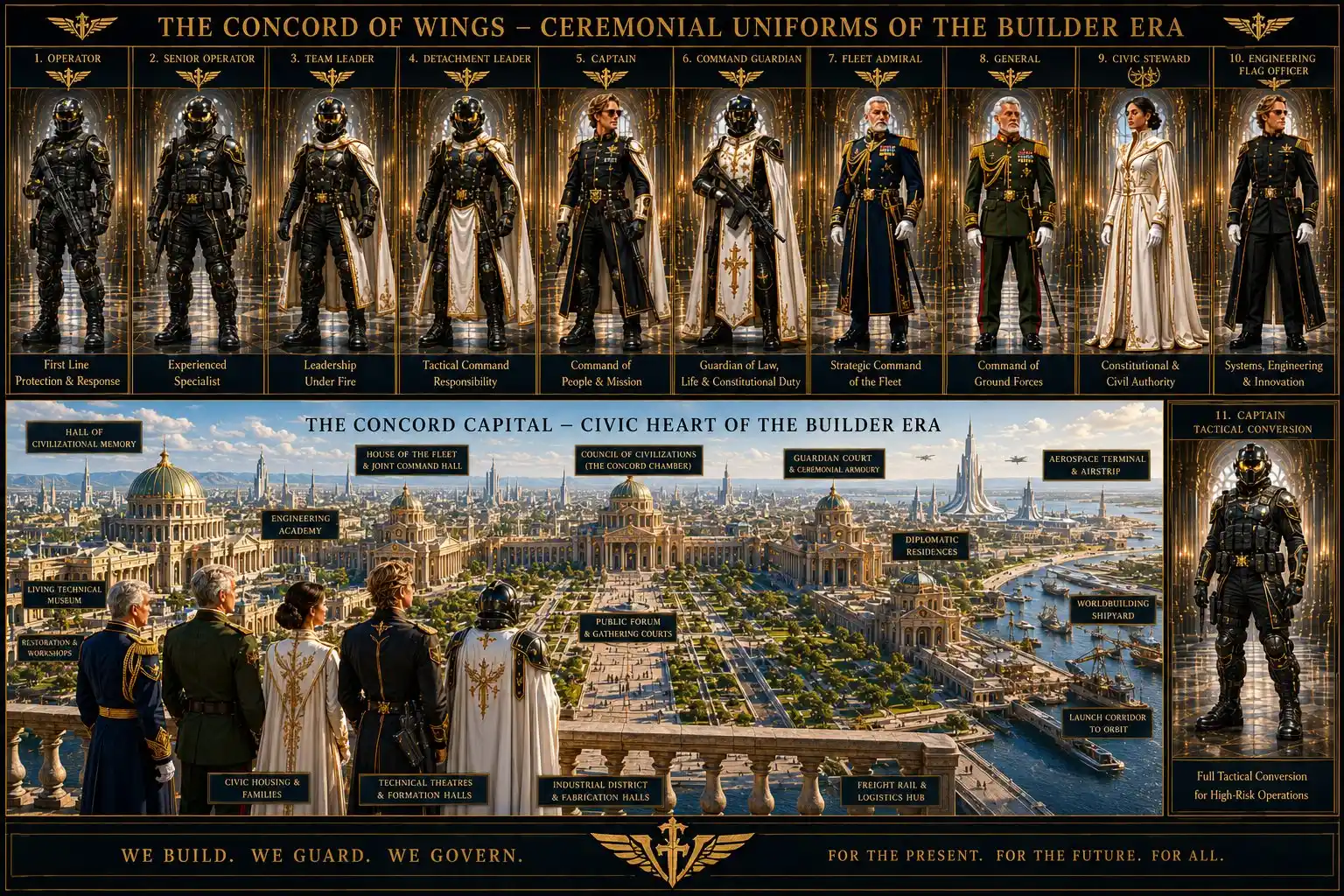
Appendix E — The White Mantle Ceremonial Dress, Rank, and Civic–Command Continuity of the Concord
1. OPERATOR

2. SENIOR OPERATOR

3. TEAM LEADER

4. DETACHMENT LEADER

5. CAPTAIN

6. COMMAND GUARDIAN

7. FLEET ADMIRAL

8. GENERAL

9. CIVIC STEWARD

10. ENGINEERING FLAG OFFICER

11. CAPTAIN TACTICAL CONVERSION

12. THE CONCORD CAPITAL — CIVIC HEART OF THE BUILDER ERA

FROM EMPIRE TO STARFLEET (Part I)
https://x.com/SkillsGapTrain/status/2077523934220853491
References
- [1] Edward N. Luttwak and related scholarship in *Protecting the Roman Empire*, Cambridge University Press, chapter on highways.
- https://www.cambridge.org/core/books/protecting-the-roman-empire/highways/EA47F5488749F8F21F15155BC03D48DD
- [2] Oxford Research Encyclopedias, “Origins of British India,” describing the British Empire as a maritime empire emerging from Indian Ocean trade and corporate-military expansion.
- https://oxfordre.com/asianhistory/view/10.1093/acrefore/9780190277727.001.0001/acrefore-9780190277727-e-121
- [3] Cambridge University Press, *The Late Imperial Chinese State*.
- https://resolve.cambridge.org/core/services/aop-cambridge-core/content/view/28A43DCDB9E7BBF028B513E101AFDCF1/9780511528194c1_p15-41_CBO.pdf/the-late-imperial-chinese-state.pdf
- [4] U.S. Constitution Annotated, “Separation of Powers and Checks and Balances.”
- https://constitution.congress.gov/browse/essay/artI-S1-3-1/ALDE_00013290/
- [5] NATO Allied Command Transformation, “What Is Interoperability — And Why It Matters to NATO,” 2025.
- https://www.act.nato.int/article/what-is-interoperability/
- [6] European Space Agency, “International Space Station Legal Framework.”
- https://www.esa.int/Science_Exploration/Human_and_Robotic_Exploration/International_Space_Station/International_Space_Station_legal_framework
- [7] Consultative Committee for Space Data Systems, official site and Reference Architecture for Space Data Systems.
- https://ccsds.org/
- [8] ITER Organization, “Status of the Organization,” including in-kind and cash contributions.
- https://www.iter.org/about/legal-resources/status-organization
- [9] ITER Organization, “Intellectual Property.”
- https://www.iter.org/industry/intellectual-property
- [10] CERN, “Our Governance.”
- https://home.cern/about/who-we-are/our-governance
- [11] NASA, “International Space Station Facts and Figures.”
- https://www.nasa.gov/international-space-station/space-station-facts-and-figures/
- [12] NASA, “Gateway Space Station” and Gateway habitation materials.
- https://www.nasa.gov/reference/gateway-about/
- [13] NASA, “Fission Surface Power,” 2025.
- https://www.nasa.gov/exploration-systems-development-mission-directorate/fission-surface-power/
- [14] NASA, “NASA Achieves Water Recovery Milestone on International Space Station,” 2023.
- https://www.nasa.gov/missions/station/iss-research/nasa-achieves-water-recovery-milestone-on-international-space-station/
- [15] NASA Office of the Chief Health and Medical Officer, “Design for Ionizing Radiation Protection.”
- https://www.nasa.gov/wp-content/uploads/2023/12/ochmo-tb-020-radiation-protection.pdf[16] NASA Technical Reports Server, “A Historical Review of Logistics Mass and Crew Time Demand for International Space Station Operations,” 2024.
- https://ntrs.nasa.gov/citations/20240008337
- [17] NASA, Moon to Mars Architecture, 2025 Architecture Definition and updates.
- https://www.nasa.gov/moontomarsarchitecture-architecturedefinitiondocuments/
- [18] NASA, “Technology Readiness Levels.”
- https://www.nasa.gov/directorates/somd/space-communications-navigation-program/technology-readiness-levels/
- [19] OECD, “Vocational Education and Training in Germany,” 2025.
- https://www.oecd.org/en/publications/vocational-education-and-training-systems-in-nine-countries_1a86eb6c-en/full-report/vocational-education-and-training-in-germany_dae78944.html
- [20] UNCTAD, *Review of Maritime Transport 2025*.
- https://unctad.org/publication/review-maritime-transport-2025
- [21] OECD, *Peer Review of the Japanese Shipbuilding Industry 2026*.
- https://www.oecd.org/en/publications/peer-review-of-the-japanese-shipbuilding-industry-2026_717ba40f-en.html
- [22] UNIDO, *International Yearbook of Industrial Statistics 2025: Asia and Oceania Factsheet*.
- https://stat.unido.org/portal/storage/file/publications/yb/2025/UNIDO_IndustrialStatistics_Factsheet_AsiaOceania_2025.pdf
- [23] Indian Space Research Organisation, “Achievements of Department of Space — 2025.”
- https://www.isro.gov.in/Achievements_Department_of_Space_2025.html
- [24] United Nations Office for Outer Space Affairs, Treaty on Principles Governing the Activities of States in the Exploration and Use of Outer Space.
- https://www.unoosa.org/oosa/en/ourwork/spacelaw/treaties/outerspacetreaty.html
- [25] National Institute of Standards and Technology, Special Publication 800-207, *Zero Trust Architecture*.
- https://nvlpubs.nist.gov/nistpubs/specialpublications/NIST.SP.800-207.pdf
- [26] NASA, *Systems Engineering Handbook*, NASA/SP-2016-6105 Rev. 2.
- https://www.nasa.gov/reference/systems-engineering-handbook/
- [27] NASA, *Technology Readiness Assessment Best Practices Guide*.
- https://ntrs.nasa.gov/citations/20205003605
- [28] NASA Technical Reports Server, “Logistics Rates and Assumptions for Future Human Exploration Missions Beyond Low Earth Orbit,” 2023.
- https://ntrs.nasa.gov/api/citations/20230012635/downloads/Logistics%20Rates%20and%20Assumptions%20Beyond%20LEO%20V5.pdf
- [29] OECD, *Peer Review of the Korean Shipbuilding Industry 2026*.
- https://www.oecd.org/content/dam/oecd/en/publications/reports/2026/04/peer-review-of-the-korean-shipbuilding-industry_a2993504/c19e0105-en.pdf