Model Act Generated from the NSIR / CLIP Clean-System Framework
Long Title
An Act to establish integrity, accessibility, auditability, privacy, cybersecurity, correction, fallback, review, and public-control requirements for digital identity and access systems used in public administration; to prevent digital identity systems from becoming hidden, unchallengeable, exclusionary, or over-expanded gateways to public services; and to ensure that identity, authentication, eligibility, and access infrastructure remains lawful, purpose-limited, correctable, reviewable, and democratically accountable.
Preamble
Whereas identity systems determine how people prove who they are, access services, receive benefits, exercise rights, enter public systems, interact with government, and participate in civic life;
Whereas digital identity systems may improve service delivery, reduce fraud, simplify access, increase security, and support efficient public administration;
Whereas digital identity systems may also become powerful access-control infrastructure if they determine who can enter public systems, receive benefits, access records, obtain permits, appeal decisions, or interact with essential services;
Whereas a person should not lose access to public services, legal status processes, benefits, health supports, housing supports, education, taxation, permits, appeals, or essential civic functions because an identity system fails, excludes, mismatches, locks an account, misclassifies a person, or cannot be challenged;
Whereas identity infrastructure must not silently expand from access support into surveillance, enforcement, scoring, eligibility control, mobility restriction, or cross-system profiling without lawful authority, public notice, rights review, privacy review, cybersecurity review, and democratic accountability;
Whereas clean public systems require identity and access systems to be lawful, purpose-limited, accessible, secure, auditable, correctable, interoperable where appropriate, non-exclusionary, and subject to meaningful human review;
Whereas public authorities must retain control over identity infrastructure used for public administration and must not depend on systems they cannot audit, explain, secure, correct, suspend, or exit;
Therefore, Parliament enacts as follows.
Part 1 — Short Title, Purpose, and Core Principles
1. Short Title
This Act may be cited as the Digital Identity and Access Integrity Act.
2. Purpose
The purpose of this Act is to ensure that digital identity and access systems used in public administration:
- serve a clear and lawful public purpose;
- are limited to defined identity and access functions;
- do not create unfair exclusion from public services;
- preserve non-digital, assisted, or alternative access where required;
- provide correction pathways for identity errors and access failures;
- preserve audit logs sufficient for review and accountability;
- protect privacy and cybersecurity;
- prohibit hidden expansion into unrelated public functions;
- preserve meaningful human support and human review;
- maintain public control, vendor auditability, interoperability, and exit capability;
- remain democratically accountable.
3. Core Rule
A public authority shall not require or materially rely on a digital identity or access system for a high-impact public service unless the system is lawful, purpose-limited, accessible, secure, auditable, correctable, reviewable, and supported by reasonable fallback access where digital-only access would create exclusion, unfairness, or serious harm.
4. Access Integrity Principle
Digital identity shall support access to public services.
It shall not become an unchallengeable gatekeeper that prevents affected persons from reaching benefits, rights, appeal, correction, remedy, records, legal processes, or essential services.
5. Purpose Limitation Principle
A digital identity system shall be used only for the public purposes for which it is lawfully authorized.
Material expansion to new services, new data uses, new enforcement functions, new automated decisions, new jurisdictions, new vendors, or new identity attributes requires review under this Act.
6. Non-Exclusion Principle
A public authority shall not design, procure, operate, or rely on a digital identity system in a manner that excludes persons from high-impact public services because of disability, poverty, homelessness, low digital literacy, remote location, lack of devices, language barriers, identity-document gaps, account lockout, authentication failure, data mismatch, or system outage, unless meaningful support, accommodation, review, or alternative access is available.
7. Human Accountability Principle
A public authority remains responsible for access decisions, identity verification, authentication failures, account lockouts, service exclusions, data mismatches, and identity-related harms caused or materially influenced by digital identity systems.
No public authority may avoid responsibility by attributing an access failure to a vendor, credential provider, identity platform, database, authentication tool, automated workflow, or digital portal.
Part 2 — Definitions
8. Definitions
In this Act:
“access decision” means a decision, action, classification, denial, delay, authentication result, account status, credential status, or system output that materially determines whether a person may access a public service, public benefit, public record, appeal pathway, correction pathway, legal process, permit, license, status process, or other public function.
“affected person” means a person, household, organization, community, Indigenous government, business, public body, or legal entity whose rights, benefits, obligations, eligibility, access, legal status, service level, mobility, privacy, property, livelihood, safety, or public interest may be materially affected by a digital identity or access system.
“alternative access” means a non-digital, assisted-digital, human-supported, paper-based, in-person, telephone, community-based, representative-supported, or other reasonable pathway sufficient to preserve access, fairness, review, correction, appeal, or remedy where digital access is unavailable, unsuitable, inaccessible, or harmful.
“authentication” means a process used to verify that a person, account, credential, device, representative, or entity is authorized to access a public service, record, portal, transaction, or system.
“credential” means a document, digital certificate, token, account, identifier, attribute, login, biometric factor, cryptographic key, or other instrument used to establish, verify, or support identity or access.
“digital identity system” means a digital system used to establish, verify, authenticate, credential, authorize, manage, mediate, federate, or control a person’s identity, attributes, status, eligibility, or access to public services.
“digital identity record” means the record sufficient to reconstruct identity proofing, credential issuance, authentication events, access decisions, data matches, account lockouts, corrections, appeals, reviews, vendor actions, system changes, and security events relevant to a person’s identity or access.
“federated identity system” means a system in which identity, authentication, credentials, attributes, or access decisions are shared, recognized, reused, or accepted across multiple public authorities, jurisdictions, programs, vendors, platforms, or services.
“high-impact public service” means a public service, benefit, eligibility process, legal-status process, permit, license, health service, housing support, income support, education support, tax process, social service, emergency service, appeal process, identity process, enforcement process, public record, or civic function that materially affects rights, benefits, obligations, legal status, access to essential services, livelihood, privacy, mobility, safety, or other significant public interests.
“identity attribute” means a characteristic, data point, credential element, status, number, biometric, document, address, relationship, eligibility marker, risk marker, demographic field, or other information used to establish, verify, classify, authenticate, or manage identity or access.
“identity error” means incorrect, stale, incomplete, mismatched, misclassified, duplicated, missing, unlawfully obtained, improperly linked, improperly inferred, improperly shared, or otherwise unreliable identity information that materially affects or could materially affect access to a public service.
“identity proofing” means the process of collecting, verifying, validating, matching, or assessing identity evidence before issuing, updating, denying, suspending, or revoking a credential or account.
“meaningful human support” means access to a human public servant or authorized representative capable of explaining the identity or access issue, assisting with access, escalating urgent problems, correcting records, initiating review, or connecting the affected person to appeal or remedy.
“public authority” means a department, ministry, agency, Crown corporation, tribunal, regulator, public office, municipality, delegated authority, contractor acting under public authority, or other body exercising public functions under law.
“responsible authority” means the public authority legally responsible for the design, procurement, deployment, operation, review, correction, appeal, suspension, or decommissioning of a digital identity or access system.
“vendor identity system” means a digital identity or access system materially supplied, hosted, operated, configured, processed, maintained, integrated, or controlled by a vendor, platform provider, cloud provider, credential provider, authentication provider, biometric provider, or other non-public entity.
Part 3 — Application
9. Application
This Act applies to digital identity systems, access systems, authentication systems, credential systems, account systems, federated identity systems, identity-proofing systems, biometric identity systems, identity-verification services, and vendor identity systems used by or on behalf of a public authority.
10. High-Impact Identity Use
A digital identity or access system shall be classified as high-impact where it materially affects, or is reasonably likely to materially affect:
- access to public benefits, housing, health, education, income support, disability support, tax credits, grants, permits, licenses, immigration processes, legal-status processes, or social services;
- access to essential public services;
- appeal, review, correction, complaint, tribunal, or remedy pathways;
- public records, personal records, or legal documents;
- enforcement, investigation, inspection, sanctions, policing, border administration, corrections, or child welfare;
- emergency benefits or emergency services;
- mobility, liberty, property, livelihood, privacy, legal status, or civic participation;
- cross-government data sharing or federated access;
- AI, automation, risk scoring, eligibility systems, or digital public administration;
- any other matter prescribed by regulation.
11. Critical Identity Systems
A responsible authority shall designate a digital identity system as critical where failure, breach, lockout, misuse, identity error, vendor failure, exclusion, outage, or non-reversibility could create serious harm to rights, essential services, public safety, legal status, privacy, public finance, public trust, or continuity of government.
Critical identity systems shall be subject to enhanced cybersecurity review, privacy review, accessibility review, independent audit, red-team testing, service-continuity planning, and exit planning.
12. Prohibition on Avoidance
A public authority shall not divide, relabel, outsource, federate, integrate, technically reclassify, or embed an identity or access function within another system for the purpose of avoiding this Act.
Part 4 — Lawful Purpose and Authority
13. Purpose Statement
Every high-impact digital identity system shall have a public purpose statement.
14. Contents of Purpose Statement
The statement shall identify:
- the public purpose served;
- the legal authority relied on;
- the services or systems affected;
- the affected population;
- identity attributes used;
- authentication or credential functions performed;
- data-sharing functions;
- vendor involvement;
- limits on use;
- review and correction pathways.
15. Authority Map
Every high-impact digital identity system shall maintain an authority map identifying:
- statutory authority;
- regulatory authority;
- responsible public authority;
- delegated authority;
- vendor roles;
- credential issuers;
- authentication providers;
- access decision-makers;
- review bodies;
- oversight bodies;
- limits on authority;
- affected rights and interests.
16. No Hidden Expansion
A responsible authority shall not materially expand a digital identity system to new services, new public purposes, new identity attributes, new data-sharing arrangements, new enforcement uses, new automated decision systems, new vendors, new jurisdictions, or new affected populations without:
- lawful authority;
- public notice;
- updated purpose statement;
- updated authority map;
- privacy review;
- cybersecurity review;
- accessibility review;
- systems integrity review;
- public reporting where appropriate.
17. Prohibited Purpose Drift
A digital identity system created for access, authentication, credentialing, or service delivery shall not be repurposed for surveillance, enforcement, eligibility scoring, behavioural scoring, mobility restriction, generalized risk classification, or unrelated profiling without express legal authority and enhanced review.
Part 5 — System Mapping and Data-Flow Mapping
18. System Map Requirement
Every high-impact digital identity system shall maintain a system map.
19. Contents of System Map
The system map shall identify:
- public purpose;
- legal authority;
- responsible authority;
- affected persons;
- services connected;
- identity proofing process;
- credentials issued;
- authentication process;
- account management process;
- access decision points;
- identity attributes used;
- databases connected;
- vendors and subcontractors;
- cloud or hosting dependencies;
- biometric components where applicable;
- AI or automation components where applicable;
- audit logs;
- correction pathways;
- review and appeal pathways;
- alternative access;
- cybersecurity controls;
- privacy controls;
- service-continuity plan;
- exit plan.
20. Data-Flow Map Requirement
Every high-impact digital identity system shall maintain a data-flow map.
21. Contents of Data-Flow Map
The data-flow map shall identify:
- identity attributes collected;
- source of attributes;
- legal authority for collection;
- identity proofing data;
- authentication data;
- access logs;
- device or location data where collected;
- biometric data where collected;
- data shared with other public authorities;
- data shared with vendors;
- data shared across jurisdictions;
- data retained;
- data deleted or de-identified;
- correction pathway;
- secondary uses;
- AI or analytics use;
- security controls;
- audit logs;
- risks created by identity errors or data matching.
22. Citizen-Readable Summary
The responsible authority shall publish a citizen-readable summary explaining:
- what the identity system does;
- who runs it;
- who may be affected;
- what services it connects to;
- what identity data it uses;
- whether biometric data is used;
- whether AI or automation is used;
- how to access human support;
- how to correct identity errors;
- how to appeal or request review;
- how privacy and cybersecurity are protected;
- what alternative access exists;
- how the system can be suspended or exited.
Part 6 — Access, Fallback, and Anti-Exclusion Safeguards
23. Alternative Access Requirement
Where a digital identity system is required or substantially necessary to access a high-impact public service, the responsible authority shall provide reasonable alternative access, assisted access, accommodation, or human-supported access.
24. No Digital-Only Exclusion
A person shall not be denied access to a high-impact public service solely because the person cannot reasonably use a digital identity system, where alternative access is necessary to prevent unfairness, exclusion, or serious harm.
25. Human Support Requirement
Meaningful human support shall be available where:
- identity proofing fails;
- authentication fails;
- an account is locked;
- a credential is suspended or revoked;
- data is mismatched;
- a person lacks standard identity documents;
- a person is vulnerable;
- access is urgent;
- the service affects essential needs, legal status, benefits, safety, housing, income, health, or appeal rights.
26. Vulnerable-Person Access Safeguards
A responsible authority shall assess whether the identity system creates barriers for persons facing:
- disability;
- poverty;
- homelessness;
- lack of identity documents;
- name changes;
- language barriers;
- low digital literacy;
- limited connectivity;
- remote location;
- trauma;
- age-related barriers;
- family violence;
- immigration or legal-status vulnerability;
- Indigenous community access barriers;
- institutionalization;
- other prescribed circumstances.
27. No Appeal Blockage
A digital identity system shall not prevent an affected person from accessing review, appeal, correction, complaint, legal process, tribunal process, ombuds process, or remedy.
Where identity is disputed, the responsible authority shall provide an alternate path sufficient to preserve the person’s procedural rights.
28. Emergency Access
Where identity failure would prevent access to urgent housing, health, income, safety, legal-status, emergency, or essential public support, the responsible authority shall provide emergency access, temporary credentialing, human verification, or other lawful interim measure where appropriate.
Part 7 — Identity Proofing, Credentials, and Account Integrity
29. Identity Proofing Standards
Identity proofing in high-impact public systems shall be lawful, necessary, proportionate, accessible, secure, auditable, and appropriate to the service risk.
30. Proportionality of Proof
A responsible authority shall not require identity proof greater than reasonably necessary for the public purpose, service risk, fraud risk, privacy risk, security risk, and affected interest.
31. Credential Issuance
A credential shall not be issued, refused, suspended, revoked, or materially restricted without recordkeeping sufficient to support reasons, review, correction, and audit.
32. Credential Suspension or Revocation
Where a credential is suspended, revoked, locked, limited, or disabled in a manner that materially affects access to high-impact public services, the affected person shall receive notice, reasons where appropriate, human support, review, and correction pathway.
33. Account Lockout
A public authority shall provide a timely pathway to resolve account lockouts affecting high-impact public services.
34. Representative Access
Where a person lawfully relies on a representative, caregiver, guardian, support worker, legal representative, community organization, or authorized agent, the digital identity system shall provide a lawful and auditable pathway for representative access where appropriate.
35. Multiple Identity Records
Where duplicate, conflicting, outdated, or mismatched identity records materially affect access, the responsible authority shall provide a process to reconcile records and correct resulting decisions where appropriate.
Part 8 — Identity Data Correction and Review
36. Right to Inspect Identity Data
An affected person has the right to request inspection of personal or case data materially used by a high-impact digital identity system.
37. Right to Correct Identity Data
An affected person has the right to request correction of identity data that is inaccurate, stale, incomplete, mismatched, misclassified, duplicated, missing, unlawfully obtained, improperly linked, improperly inferred, or misleading.
38. Correction Actions
Where correction is warranted, the responsible authority shall take appropriate action, including:
- amendment;
- supplementation;
- annotation;
- deletion;
- de-linking;
- record merge;
- record separation;
- credential update;
- account restoration;
- restriction of use;
- downstream notice;
- reconsideration of affected access decisions;
- remedy where appropriate.
39. Downstream Correction
Where corrected identity data has been shared with another public authority, vendor, contractor, platform, tribunal, enforcement body, or decision system and may materially affect access or decisions, the responsible authority shall take reasonable steps to notify downstream recipients.
40. Review of Access Denial
Where identity error, authentication failure, data mismatch, account lockout, credential issue, or system failure materially denies access to a high-impact public service, the affected person shall have access to meaningful human review.
41. Remedy for Identity Error
Where identity error causes material harm, the responsible authority shall provide remedy within lawful authority, including restoration of access, expedited service, correction of records, reconsideration of decisions, and downstream correction notice where appropriate.
Part 9 — Privacy, Security, and Biometric Safeguards
42. Privacy Review
Before deployment or material expansion of a high-impact digital identity system, the responsible authority shall complete a privacy review.
43. Contents of Privacy Review
The privacy review shall assess:
- lawful collection;
- purpose limitation;
- data minimization;
- sensitive data;
- biometric data;
- data sharing;
- secondary use;
- retention;
- deletion;
- access controls;
- correction rights;
- privacy breach response;
- re-identification risk;
- surveillance or profiling risk.
44. Cybersecurity Review
Before deployment or material expansion of a high-impact digital identity system, the responsible authority shall complete a cybersecurity review.
45. Contents of Cybersecurity Review
The cybersecurity review shall assess:
- threat model;
- authentication strength;
- access controls;
- encryption;
- credential security;
- account recovery risks;
- logging;
- vulnerability management;
- incident response;
- supply-chain risk;
- cloud or hosting risk;
- insider threat;
- service continuity;
- recovery process.
46. Biometric Use
A public authority shall not use biometric data in a high-impact digital identity system unless the use is expressly authorized by law, necessary and proportionate to the public purpose, subject to privacy and cybersecurity safeguards, accessible alternatives where appropriate, and meaningful review.
47. Biometric Alternatives
Where biometric identity verification is used for high-impact public services, the responsible authority shall provide alternatives where biometric use would be inaccessible, unsafe, inaccurate, discriminatory, disproportionate, or otherwise inappropriate.
48. Biometric Prohibition Without Review
A public authority shall not materially expand biometric identity use to new services, enforcement functions, surveillance uses, or cross-system identification without express authority and enhanced review.
Part 10 — Federation, Interoperability, and Cross-System Risk
49. Federated Identity Review
Before a digital identity system is federated across public authorities, programs, jurisdictions, or vendors, the responsible authority shall complete a federated identity review.
50. Contents of Federated Identity Review
The review shall assess:
- legal authority;
- public purpose;
- participating authorities;
- services connected;
- identity attributes shared;
- data minimization;
- access controls;
- account recovery;
- privacy risk;
- cybersecurity risk;
- exclusion risk;
- correction process;
- appeal process;
- auditability;
- termination or disconnection process.
51. No Cross-System Expansion Without Review
A digital identity credential used for one public service shall not be made mandatory for materially different public services without public notice, review, and lawful authority.
52. Interoperability
A digital identity system shall support interoperability where necessary to preserve service continuity, public control, auditability, accessibility, and exit capability.
53. Disconnection Capability
A public authority shall maintain the ability to disconnect, suspend, limit, or de-federate identity connections where necessary to address security, privacy, legality, exclusion, error, or public accountability risks.
Part 11 — AI, Automation, Risk Scoring, and Access Control
54. Automation Disclosure
Where AI, automation, risk scoring, anomaly detection, rules engines, or automated workflows materially influence identity proofing, authentication, fraud detection, account lockout, credential issuance, or access decisions, the affected person shall receive notice where appropriate and lawful.
55. No Automated Final Exclusion Without Review
A public authority shall not finally deny, suspend, revoke, or materially restrict access to a high-impact public service solely by automated identity or risk process unless meaningful human review is available before material harm occurs or as soon as practicable in urgent contexts.
56. Risk Flags
Where a risk flag, fraud flag, anomaly score, document mismatch, biometric mismatch, or identity confidence score materially affects access, the responsible authority shall ensure:
- the flag is reviewable;
- the data source is traceable;
- the person can provide evidence;
- a human can override the flag;
- error can be corrected;
- remedy is available where harm occurs.
57. No Generalized Identity Scoring
A digital identity system shall not create or support generalized social scoring, loyalty scoring, behavioural scoring, unrelated risk scoring, or cross-context profiling unrelated to a specific lawful public purpose.
58. Automation Bias Safeguards
The responsible authority shall monitor whether staff or systems over-rely on automated identity confidence scores, biometric matches, document verification outputs, fraud flags, or risk indicators.
Part 12 — Audit Logs, Records, and Accountability
59. Audit-Log Duty
Every high-impact digital identity system shall preserve audit logs sufficient to reconstruct identity proofing, credential issuance, authentication, access decisions, account actions, corrections, reviews, vendor actions, system changes, and security events.
60. Contents of Audit Logs
Audit logs shall include, where applicable:
- identity proofing action;
- credential issuance;
- credential suspension or revocation;
- authentication attempt;
- account lockout;
- access denial;
- access grant;
- data match or mismatch;
- biometric verification event;
- risk flag;
- staff action;
- vendor action;
- data correction;
- review or appeal;
- system change;
- security event;
- data sharing;
- federation connection or disconnection.
61. Log Integrity
Audit logs shall be protected against unauthorized alteration, deletion, concealment, or tampering.
62. Retention
Audit logs and identity records shall be retained for a period sufficient to support review, correction, appeal, audit, legal review, privacy review, cybersecurity investigation, public accountability, and systemic repair.
63. Tampering and Destruction
A person shall not knowingly destroy, alter, conceal, falsify, or prevent lawful access to records required under this Act.
Part 13 — Vendor Identity Systems and Public Control
64. Vendor Auditability
A public authority shall not procure, deploy, or rely on a vendor identity system for high-impact public services unless the contract preserves public auditability, public record control, privacy, cybersecurity, data portability, interoperability, service continuity, and exit capability.
65. Required Contract Terms
A contract for a high-impact vendor identity system shall require:
- public audit rights;
- access to relevant logs;
- identity proofing documentation;
- authentication documentation;
- security documentation;
- privacy documentation;
- data portability;
- interoperability;
- incident reporting;
- subcontractor disclosure;
- material change notification;
- decommissioning support;
- exit transition assistance;
- support for correction, review, and appeal;
- compliance with this Act.
66. Vendor Secrecy
Trade secret, intellectual property, commercial confidentiality, or contractual secrecy shall not prevent authorized audit, legal review, privacy review, cybersecurity review, appeal review, public records review, or oversight of a high-impact digital identity system.
67. Exit Plan
A responsible authority shall maintain an exit plan for each high-impact vendor identity system.
68. Contents of Exit Plan
The exit plan shall identify:
- exit triggers;
- data export process;
- credential transition process;
- account transition process;
- record preservation;
- audit-log preservation;
- service continuity;
- alternative access;
- vendor cooperation;
- public communication;
- decommissioning process;
- deletion or retention requirements;
- timeline for exit.
Part 14 — Incident Reporting, Service Continuity, and Rollback
69. Incident Reporting Duty
A responsible authority shall report material incidents involving high-impact digital identity systems.
70. Reportable Incidents
A reportable incident includes:
- identity data breach;
- credential compromise;
- unauthorized access;
- account takeover;
- service outage;
- authentication failure at scale;
- wrongful account lockout at scale;
- biometric mismatch pattern;
- identity matching failure;
- unauthorized data sharing;
- audit-log failure;
- vendor failure;
- inability to restore access;
- inability to correct identity data;
- security vulnerability affecting high-impact services.
71. Service Continuity Plan
Every critical digital identity system shall maintain a service continuity plan.
72. Contents of Service Continuity Plan
The plan shall identify:
- essential services affected;
- outage response;
- backup authentication;
- alternative access;
- human support escalation;
- data backup;
- audit-log preservation;
- incident response;
- vendor obligations;
- public communication;
- affected-person notice;
- recovery timeline;
- post-incident review.
73. Suspension and Rollback
A responsible authority shall suspend, limit, disconnect, roll back, or decommission a high-impact digital identity system where there are reasonable grounds to believe the system:
- lacks lawful authority;
- creates serious exclusion;
- exposes sensitive data;
- prevents review or correction;
- creates unacceptable cybersecurity risk;
- produces material identity error at scale;
- lacks auditability;
- prevents alternative access;
- creates unacceptable vendor dependency;
- cannot be operated in compliance with this Act.
Part 15 — Public Register and Dashboard
74. Digital Identity Systems Register
The government shall establish and maintain a public register of high-impact digital identity systems.
75. Contents of Register
The register shall include:
- system name;
- responsible authority;
- public purpose;
- legal authority;
- affected population;
- services connected;
- identity attributes used;
- biometric use where applicable;
- AI or automation use where applicable;
- vendor involvement;
- alternative access pathway;
- correction pathway;
- review pathway;
- privacy review status;
- cybersecurity review status;
- accessibility review status;
- service continuity status;
- exit plan status;
- date of last review;
- next review date.
76. Identity Access Integrity Dashboard
The government shall maintain an identity access integrity dashboard.
77. Dashboard Indicators
The dashboard shall include, at an appropriate level of aggregation:
- high-impact identity systems identified;
- critical identity systems identified;
- connected services;
- privacy reviews completed;
- cybersecurity reviews completed;
- accessibility reviews completed;
- alternative access pathways available;
- identity correction requests;
- access denial review requests;
- account lockout incidents;
- service outages;
- data breaches;
- unresolved correction gaps;
- unresolved vendor dependency risks;
- systems suspended, limited, or decommissioned.
78. Privacy Protection
Public reporting shall not disclose personal information or sensitive identity details except where lawful and necessary.
Part 16 — Independent Review, Red-Team Testing, and Public Challenge
79. Independent Review
A critical digital identity system shall be subject to independent review by persons with appropriate expertise in law, public administration, identity systems, cybersecurity, privacy, accessibility, data governance, human rights, systems engineering, audit, and the affected domain.
80. Red-Team Review
A critical digital identity system shall be subject to red-team review.
The review shall ask:
- how people could be wrongly excluded;
- how identity errors could propagate;
- how account lockouts could block essential services;
- how digital-only access could harm vulnerable persons;
- how biometric systems could fail;
- how vendors could weaken public control;
- how data could be reused beyond purpose;
- how identity systems could become surveillance infrastructure;
- how audit logs could fail;
- how rollback or exit could fail.
81. Public Challenge Process
The responsible authority shall establish a process through which affected persons, civil society, journalists, public servants, auditors, experts, Indigenous governments, community organizations, legal clinics, and other affected parties may submit evidence of identity error, access exclusion, privacy risk, cybersecurity risk, hidden expansion, vendor dependency, correction failure, or systemic harm.
Part 17 — Security, Confidentiality, and Bounded Accountability
82. Protected Information
Nothing in this Act requires public disclosure of information where disclosure would create a serious and demonstrable risk to cybersecurity, privacy, personal safety, national security, law enforcement, legally privileged information, or lawful confidentiality.
83. Bounded Accountability
Where information cannot be made public, the responsible authority shall provide:
- a public summary at the highest safe level of abstraction;
- a restricted record for authorized reviewers;
- audit access sufficient to verify legality, fairness, security, and compliance;
- written reasons for withholding public disclosure where lawful.
84. No Secrecy Without Review
Confidentiality shall not eliminate the requirement for authorized audit, legal review, privacy review, cybersecurity review, appeal review, oversight, and remedy.
Part 18 — Oversight, Compliance, and Orders
85. Oversight Body
An authorized oversight body shall monitor compliance with this Act.
The oversight body may be established by regulation or assigned to an existing public authority with appropriate independence, expertise, and legal powers.
86. Powers of Oversight Body
The oversight body may:
- require records;
- inspect system maps;
- inspect data-flow maps;
- inspect audit logs;
- inspect privacy reviews;
- inspect cybersecurity reviews;
- inspect accessibility reviews;
- inspect vendor contracts;
- investigate incidents;
- require correction pathways;
- require alternative access;
- require suspension of unsafe systems;
- require public reporting;
- refer matters to tribunals, courts, auditors, privacy commissioners, human rights bodies, cybersecurity authorities, procurement authorities, ombuds institutions, or law enforcement where appropriate.
87. Compliance Orders
The oversight body may issue a compliance order requiring a responsible authority to:
- prepare or update a system map;
- prepare or update a data-flow map;
- publish a citizen-readable summary;
- establish alternative access;
- repair an access failure;
- repair a correction pathway;
- repair a review pathway;
- conduct privacy review;
- conduct cybersecurity review;
- update vendor contracts;
- prepare an exit plan;
- suspend unsafe deployment;
- report on repair progress.
88. Individual Remedy
Where an affected person suffers material harm due to identity error, access denial, account lockout, authentication failure, credential failure, lack of alternative access, lack of correction, lack of review, privacy breach, cybersecurity failure, or unlawful process required by this Act, the affected person may seek remedy through the applicable review, appeal, tribunal, court, ombuds, privacy, human rights, administrative, or oversight process.
89. Whistleblower Protection
No person shall suffer retaliation for reporting identity-system failure, access exclusion, privacy risk, cybersecurity risk, hidden expansion, vendor concealment, auditability gap, identity error, correction failure, or serious public-system risk in good faith.
Part 19 — Regulations
90. Regulations
The Governor in Council may make regulations:
- prescribing high-impact digital identity systems;
- prescribing critical identity systems;
- establishing system map standards;
- establishing data-flow map standards;
- establishing privacy review requirements;
- establishing cybersecurity review requirements;
- establishing accessibility review requirements;
- establishing alternative access requirements;
- establishing audit-log requirements;
- establishing vendor contract requirements;
- establishing incident reporting thresholds;
- establishing public register requirements;
- establishing dashboard indicators;
- establishing phased implementation timelines;
- exempting systems where equivalent or stronger protections exist.
91. No Regulation May Defeat Purpose
No regulation made under this Act shall defeat the purpose of ensuring lawful, purpose-limited, accessible, secure, auditable, correctable, reviewable, and democratically accountable digital identity systems.
Part 20 — Statutory Review, Pilot Phase, and Coming into Force
92. Statutory Review
A committee of Parliament shall review this Act within three years after coming into force and every five years thereafter.
The review shall examine:
- whether the Act improves access integrity;
- whether it reduces identity-related exclusion;
- whether it improves correction of identity errors;
- whether it improves privacy and cybersecurity;
- whether it prevents hidden expansion;
- whether it improves alternative access;
- whether it improves auditability;
- whether it reduces vendor dependency risk;
- whether it creates unnecessary administrative burden;
- whether amendments are required.
93. Pilot Phase
This Act shall be implemented through a pilot phase applying first to prescribed systems, including:
- digital identity systems used for public benefits;
- digital identity systems used for tax, permits, or licensing;
- digital identity systems used for immigration or legal-status processes;
- digital identity systems used for health, housing, or social services;
- digital identity systems used for public AI or automated eligibility systems;
- digital identity systems used across multiple departments or jurisdictions;
- vendor identity platforms supporting high-impact public services.
94. Coming into Force
This Act comes into force on a day fixed by order of the Governor in Council.
Different provisions may come into force on different days.
Schedule A — Digital Identity System Map Template
A digital identity system map shall identify:
- system name;
- responsible authority;
- public purpose;
- legal authority;
- affected population;
- services connected;
- identity proofing process;
- credentials issued;
- authentication process;
- identity attributes used;
- biometric use where applicable;
- databases connected;
- vendors and subcontractors;
- AI or automation use;
- audit logs;
- correction pathway;
- review pathway;
- alternative access;
- privacy controls;
- cybersecurity controls;
- service continuity plan;
- exit plan.
Schedule B — Identity Data-Flow Map Template
An identity data-flow map shall identify:
- identity attributes collected;
- legal authority;
- data source;
- collection method;
- identity proofing data;
- authentication data;
- biometric data where applicable;
- access logs;
- public authorities receiving data;
- vendors receiving data;
- cross-jurisdictional sharing;
- retention;
- deletion or de-identification;
- correction pathway;
- secondary uses;
- AI or analytics use;
- audit logs;
- known risks.
Schedule C — Alternative Access Checklist
A responsible authority shall assess whether alternative access is required because of:
- disability;
- low digital literacy;
- lack of device;
- lack of connectivity;
- homelessness;
- lack of identity documents;
- language barriers;
- remote location;
- poverty;
- trauma;
- age-related barriers;
- family violence;
- account lockout;
- authentication failure;
- identity mismatch;
- urgent need for essential service.
Schedule D — Identity Error Correction Process
An identity error correction process shall include:
- request intake;
- confirmation of receipt;
- human support pathway;
- data inspection;
- evidence submission;
- correction decision;
- reasons where correction is refused;
- account restoration where applicable;
- downstream correction notice;
- appeal or review pathway;
- urgent escalation where serious harm may occur.
Schedule E — Identity Incident Response Template
An identity incident response plan shall identify:
- incident type;
- affected system;
- affected services;
- affected persons;
- responsible authority;
- vendor obligations;
- containment process;
- access restoration process;
- affected-person notice;
- public communication;
- privacy response;
- cybersecurity response;
- correction process;
- audit-log preservation;
- post-incident review;
- systemic repair.
Schedule F — Citizen-Readable Identity System Summary
A citizen-readable identity system summary shall answer:
- What does this identity system do?
- Which public authority is responsible?
- What services does it connect to?
- What identity data does it use?
- Does it use biometric data?
- Does it use AI or automation?
- How can I get human support?
- What happens if I am locked out?
- How can I correct identity data?
- How can I appeal or request review?
- What alternative access exists?
- How are privacy and cybersecurity protected?
- Can the system be suspended, disconnected, or replaced?
- When will the system next be reviewed?
Final Standard
The Digital Identity and Access Integrity Act exists because identity is the gate to public life.
A digital identity system may help people access government.
But it must not become a hidden lock on rights, benefits, services, appeals, records, legal status, or civic participation.
Identity infrastructure must be lawful.
It must be limited.
It must be secure.
It must be correctable.
It must be accessible.
It must be reviewable.
And it must never become an unchallengeable gatekeeper over human beings.
The standard is simple:
No person should lose access to essential public services because an identity system cannot recognize, correct, support, or review them.
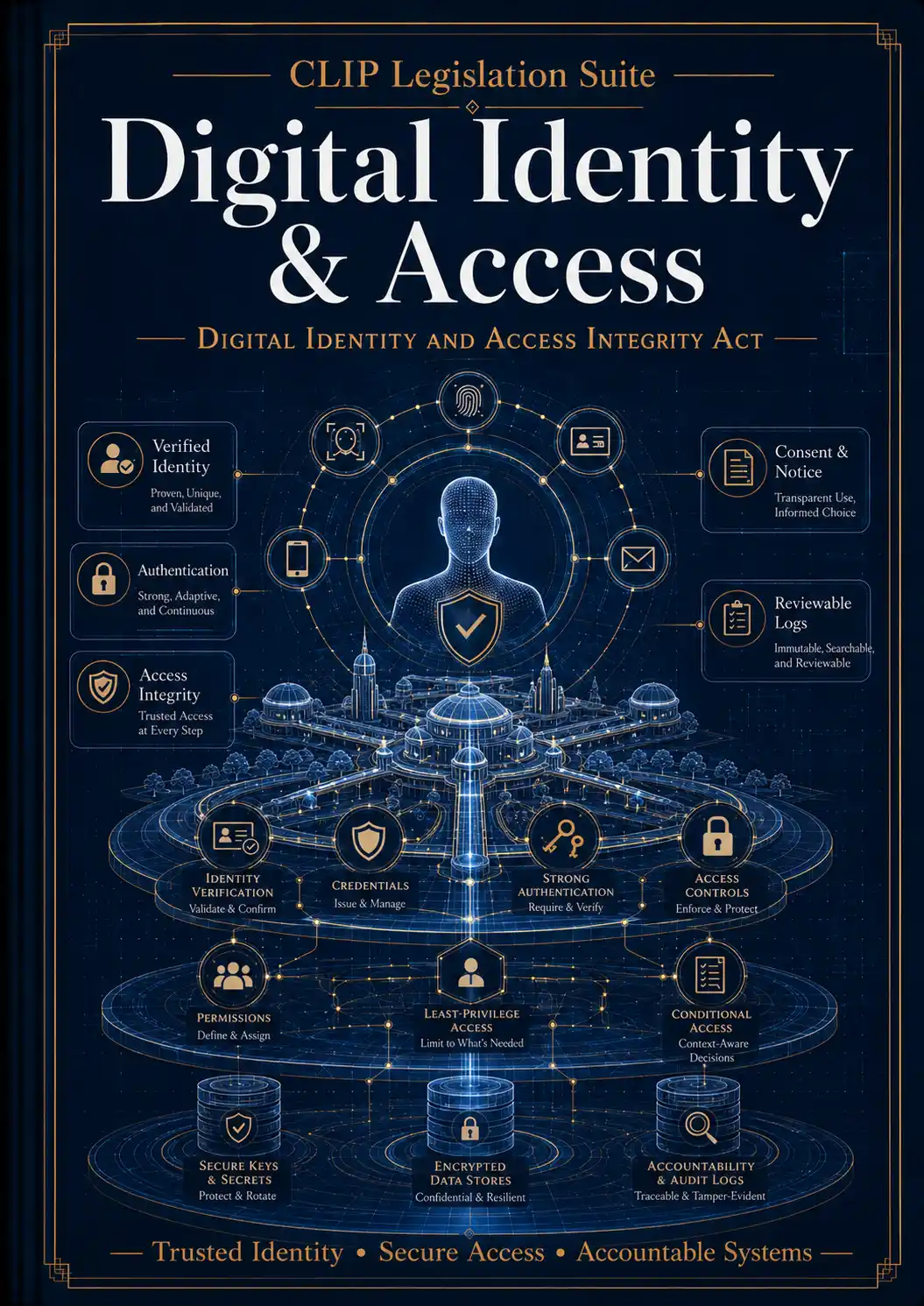
Project Page: AI Does Not Fix Government. It Amplifies It (Part 1) https://x.com/SkillsGapTrain/status/2065348053645861271
Disclaimer: This is an open-source educational system that is being developed for learning, research, frontier systems engineering and prototyping, intended to help students, teachers, public-sector builders, policy analysts, political leaders, corporate leaders and responsible organizations explore next-generation governance systems for humanity; it is not legal advice, policy authority, certification, or deployment-ready public infrastructure. Executive Summary of Audit of current development status is located at bottom of Part 3 of Project Page.