The Hormuz Test: From Sea Supremacy to Continuity Supremacy

Why the first real war of the AI-maritime age will be decided by protected throughput, regional resilience, and industrial adaptation speed

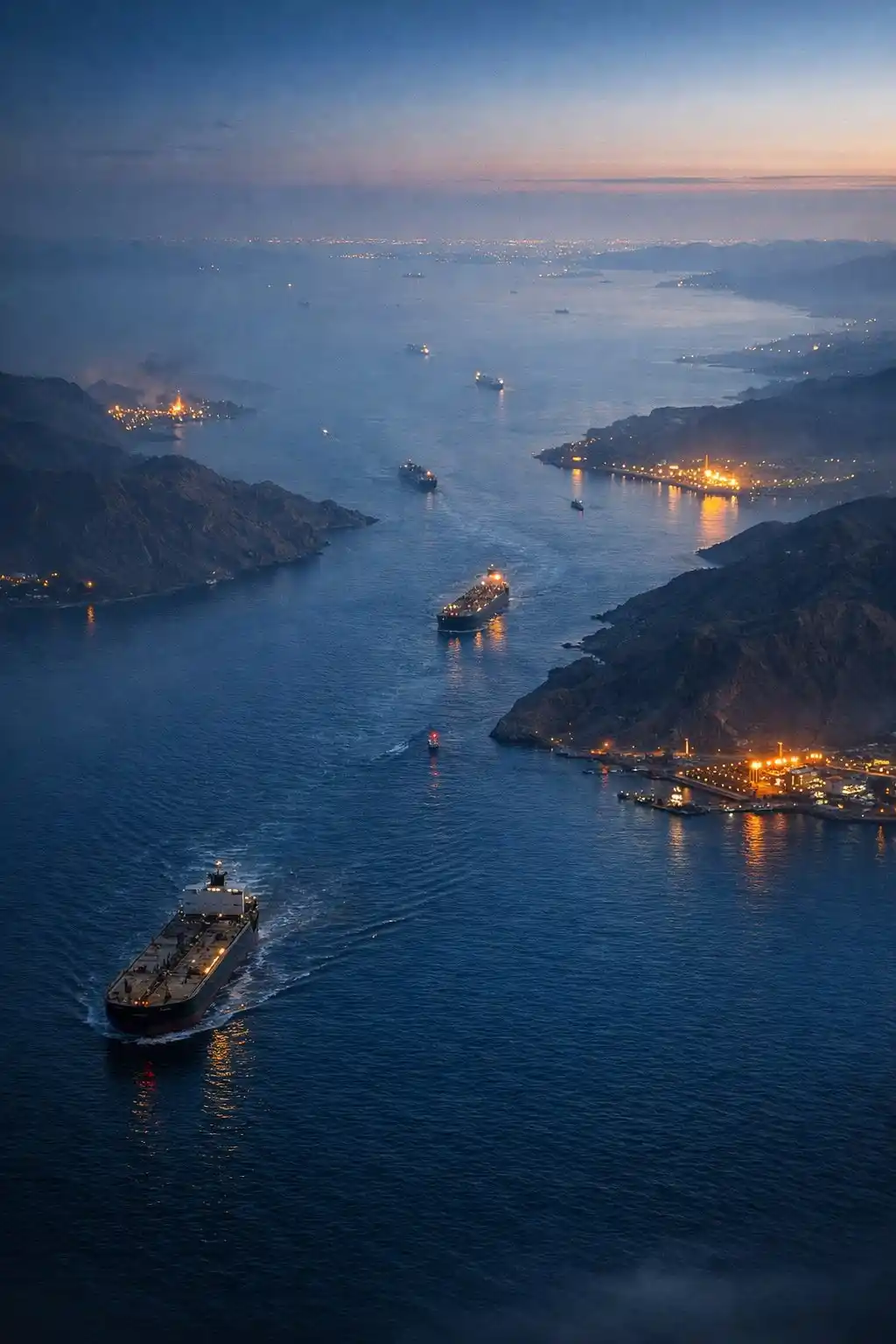
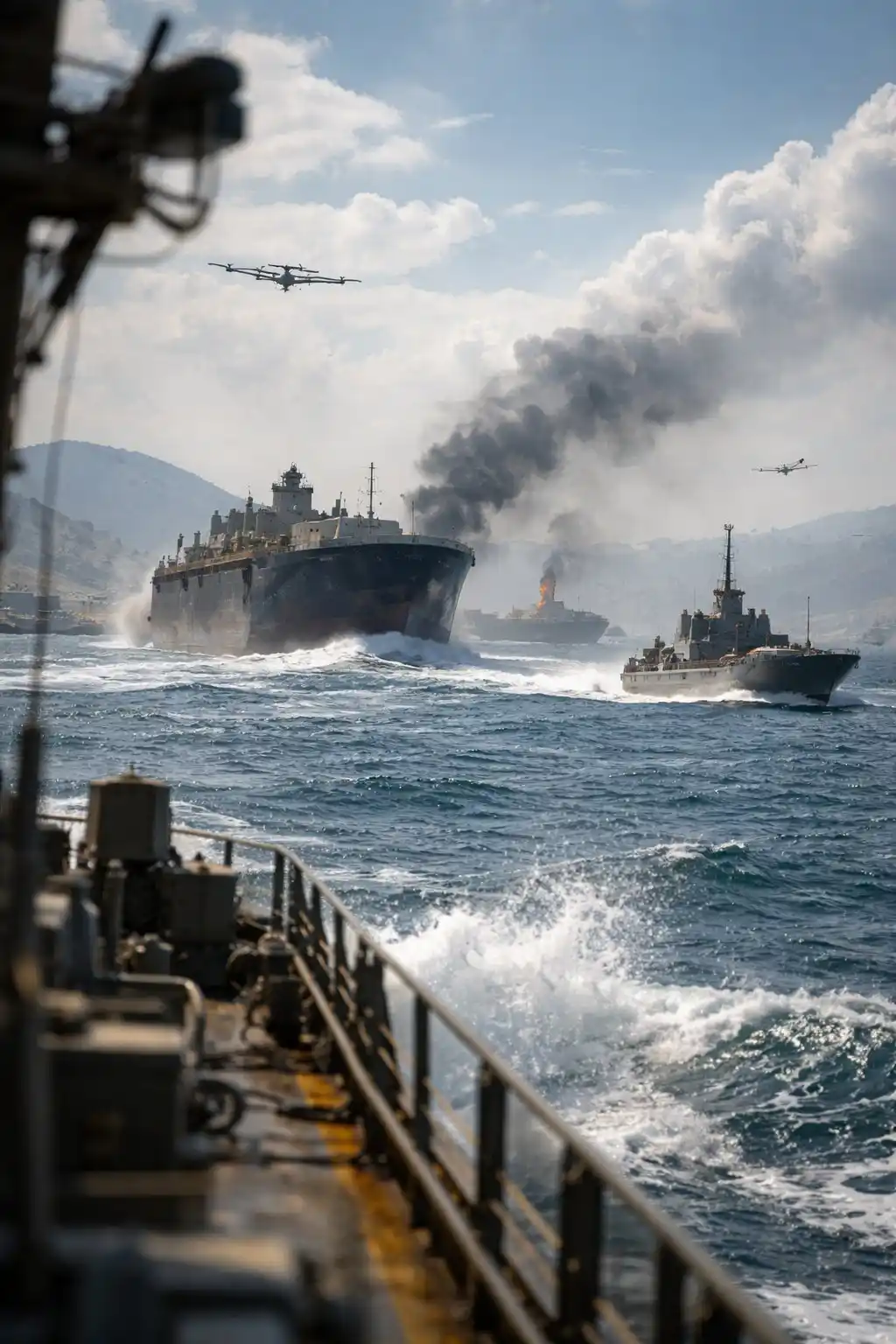
For two centuries, maritime power was often imagined in simple terms: command the sea lanes, protect trade, deter challengers, and the wider order holds. In the Strait of Hormuz, that model is now visibly breaking down. The problem is no longer just whether a navy can patrol a chokepoint. It is whether a state can keep strategic flow alive when missiles, drones, mines, GNSS spoofing, commercial fear, and nuclear risk all converge at once. The International Maritime Organization has already called for an internationally coordinated safe-passage framework, while the U.S. Maritime Administration says the risk of Iranian attacks on commercial shipping remains high in the Persian Gulf, the Strait of Hormuz, and the Gulf of Oman. [1][2]
That is why Hormuz is not just a regional crisis. It is the first clear exam question of the AI-maritime age. The old model assumed that if the strongest power could dominate the battlespace, trade would follow. The new reality is harsher. Trade follows only if ships can move, crews will sail, insurers will insure, terminals can function, navigation remains trusted, and attacks do not generate more fear than escort operations can absorb. In 2025, nearly 20 million barrels per day of oil moved through Hormuz, representing roughly 25% of global seaborne oil trade, while only 3.5 to 5.5 million barrels per day of pipeline capacity was available to bypass the Strait. Since the conflict began on 28 February 2026, tanker traffic has collapsed toward a near-halt and the IEA has moved into emergency response mode. [3][4][5]
So the first principle is this: the objective in Hormuz is not to look strong. It is not to seize Iran. It is not to replay the habits of another era. The objective is to keep strategic flow alive, prevent nuclear coercion or breakout, preserve alliance and market confidence, and make continued disruption more expensive for Tehran than negotiation. Once that is the objective, the metric of success changes. Success is not a warship on the horizon. Success is protected throughput. [1][3][4]
That exposes the weakness in the two easiest answers. The first says escalate until the problem goes away. But a ground-war trap inside Iran would try to solve a corridor problem by creating a much larger occupation, insurgency, and escalation problem. The second says step back and let markets adapt. But that would concede Iran’s central advantage: it does not need a conventional victory to impose strategic pain. It only needs to make the Strait unreliable enough that the world begins pricing in failure. Reuters’ reporting on 24 March captures the political deadlock clearly: Israeli officials say Donald Trump wants a deal, but they see success as unlikely after the February breakdown, while Tehran denies current talks are taking place. [6][7]
The realistic answer is neither invasion nor passivity. It is a transition from sea supremacy to continuity supremacy.
Continuity supremacy means the ability to keep merchant traffic moving under repeated disruption; to restore confidence faster than an attacker can destroy it; to defend only those nodes whose failure would create disproportionate strategic effects; to use cheaper defensive tools against cheap harassment rather than bleeding premium inventories; and to maintain enough coercive leverage that disruption stops being a low-cost strategy. It is not passive. It is a harder, more disciplined form of control. [1][2][3]
In the AI-maritime age, order will be preserved less by the force that can enter the corridor than by the force that can keep it open. A navy can win a visible battlespace and still lose the corridor if the market, the crews, the terminals, and the navigation picture no longer trust transit. Empires once proved command of the sea by sinking fleets. The next order will prove itself differently: by keeping a threatened artery open after the missiles fly, after the market panics, after insurers hesitate, after crews fear transit, and after the first wave of disruption tries to turn doubt into closure. [1][2][5]

The Corridor Is the Real Weapon

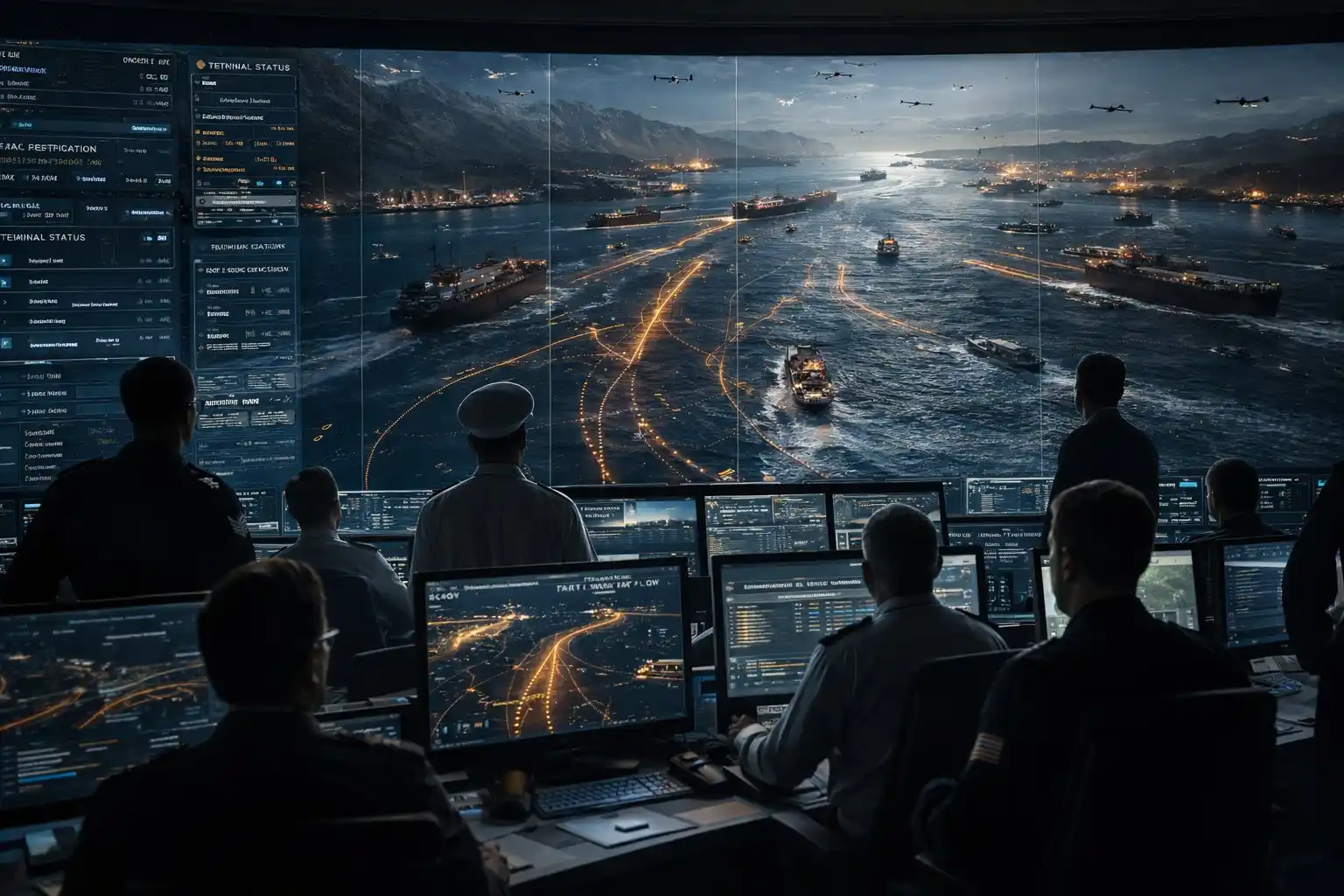
Aerospace dominance and maritime throughput are not the same thing. Even if the United States and its partners dominate the airspace over the Strait, merchant movement can still be choked by suspected mines, damaged terminals, spoofed navigation, frozen insurance, and fear among crews and shipowners. That is why the operational sequence matters. A real Hormuz strategy must show how the system works in practice:

So the first pillar is a genuine corridor continuity architecture. That means persistent maritime awareness, mine-countermeasure tempo, backup navigation in a jammed environment, protected terminal operations, insurer backstops, emergency energy coordination, and enough traffic-management discipline that ships and crews believe passage is viable. This is what makes a strait operationally open rather than merely rhetorically open. The defended object is therefore not just the waterway itself, but the wider Gulf production-and-export system that makes restored throughput real. [1][3][4]
That architecture also has to be governed, not just admired. The coalition substrate already exists in embryonic form: Combined Maritime Forces is a 47-nation naval partnership operating across some of the world’s most important shipping lanes. But the current crisis also reveals the seams. Bahrain has pushed a U.N. Security Council draft authorizing “all necessary means” to protect shipping; France has answered with a narrower draft centered on de-escalation and strictly defensive coordination under international law; and a wider joint statement on Hormuz has already gathered support from European, Asian, Gulf, and other partners. The military substrate exists, but the coalition bargain is still contested. A serious Hormuz strategy must therefore solve not just security, but governance and legitimacy: who leads, under what mandate, with what rules of engagement, and with what cost-sharing. [6][7][8]
In practical terms, that means the coalition architecture cannot remain implicit. The United States and a small number of capable naval partners should provide the high-end ISR, escort coordination, and air/missile defense backbone for corridor protection. Gulf states should fund and co-build the continuity layer that benefits them most directly: terminal hardening, bypass capacity, repair stocks, tug and salvage readiness, and emergency port recovery. Commercial actors should receive a war-risk assurance framework backed by participating governments, because the corridor does not reopen when admirals are satisfied; it reopens when insurers price transit as viable and shipping firms believe the legal, financial, and physical risks are bounded. Politically, the coalition’s signature should be as broad as available legitimacy permits even if the real operational spine remains U.S.-led. [6][7][8][9]
It also has to solve the public-private seam. The corridor is not reopened when admirals are satisfied. It is reopened when carriers, traders, terminal operators, insurers, and crews believe passage is viable enough to resume. Reuters reported on 1 March that Maersk and Hapag-Lloyd suspended Hormuz crossings and that at least 150 tankers dropped anchor in Gulf waters beyond the Strait. That means the real corridor machinery is partly commercial: war-risk insurance, verified route assurance, terminal resilience, convoy scheduling, cargo triage, and recovery guarantees after attack. No amount of rhetoric about “freedom of navigation” substitutes for that. [5]
The corridor therefore has to be run as a hybrid military-commercial operating system. Naval power can suppress or deter immediate disruption, but only a wider commercial protocol can normalize movement: standardized route certification, verified re-entry criteria after incidents, emergency claims procedures, prioritized convoy slots for critical cargoes, terminal restart protocols, and pre-agreed triggers for government-backed war-risk insurance. In other words, the protected corridor is not just a defended space. It is a managed service for strategic flow. [1][2][5]

The Gulf Energy Belt Is the Real Target Set

Iran’s most rational widening path is not universal escalation. It is selective regional expansion against the nearby GCC energy belt. The most probable targets are not “everyone on earth,” but the oil, gas, water, terminal, shipping, and export infrastructures whose disruption raises global prices, strains allied governments, and multiplies economic pressure on Washington without necessarily forcing immediate universal war. Reuters reported on 22–23 March that Iran warned it could strike Gulf energy and water infrastructure in retaliation for possible U.S. action. [10]
This matters because the Hormuz problem is not only the Strait. It is the wider Gulf production-and-export system. A strategy that secures transit lanes while leaving nearby energy and water nodes exposed is still strategically incomplete. The IEA says only Saudi Arabia and the UAE have meaningful operational pipeline routes that can bypass the Strait, with an estimated 3.5 to 5.5 mb/d of available capacity, while other Gulf exporters rely overwhelmingly on Hormuz. Reuters and Reuters Graphics have also documented widespread disruption touching Saudi, the UAE, Iraq, Qatar, Kuwait, and regional export infrastructure. [3][4][11]
That is why a Hormuz strategy cannot focus only on the narrow waterway itself. It has to defend the wider Gulf production-and-export system. Qatar’s energy minister warned in early March that Gulf energy exports could halt within weeks if the conflict deepened. That shows how quickly a corridor crisis can become a regional system crisis. [11]
This also explains why GCC states matter politically beyond mere participation. They are not passive beneficiaries of an open Strait. They are exposed balance-sheet states whose domestic stability, export revenues, and sovereign wealth are tied directly to whether the U.S. security guarantee is credible under live pressure. Reuters reported that some Gulf states are reviewing how to deploy trillions in sovereign wealth in response to the war’s shock, and that S&P warned Gulf banks could face $307 billion in deposit outflows if the conflict deepens, though it had seen no major outflows yet. The point is not that financial collapse is inevitable. It is that alliance credibility and market credibility are linked more tightly than old military planning habits often admit. [12]
The strategic answer therefore cannot be only to keep the Strait nominally open. It has to make repeated attacks on the GCC energy belt fail cheaply enough that escalation stops paying. If Tehran’s attacks can still buy large oil shocks and visible allied panic, the campaign remains rational. If those attacks increasingly produce interception, attribution, repair, and cumulative retaliation across the wider Gulf system, then the exchange ratio begins to turn. That is the regional version of continuity supremacy: not just keeping the artery open, but keeping the surrounding organs alive. [10][11][12]

Autonomous Air Mass and the Erosion of Branch Boundaries

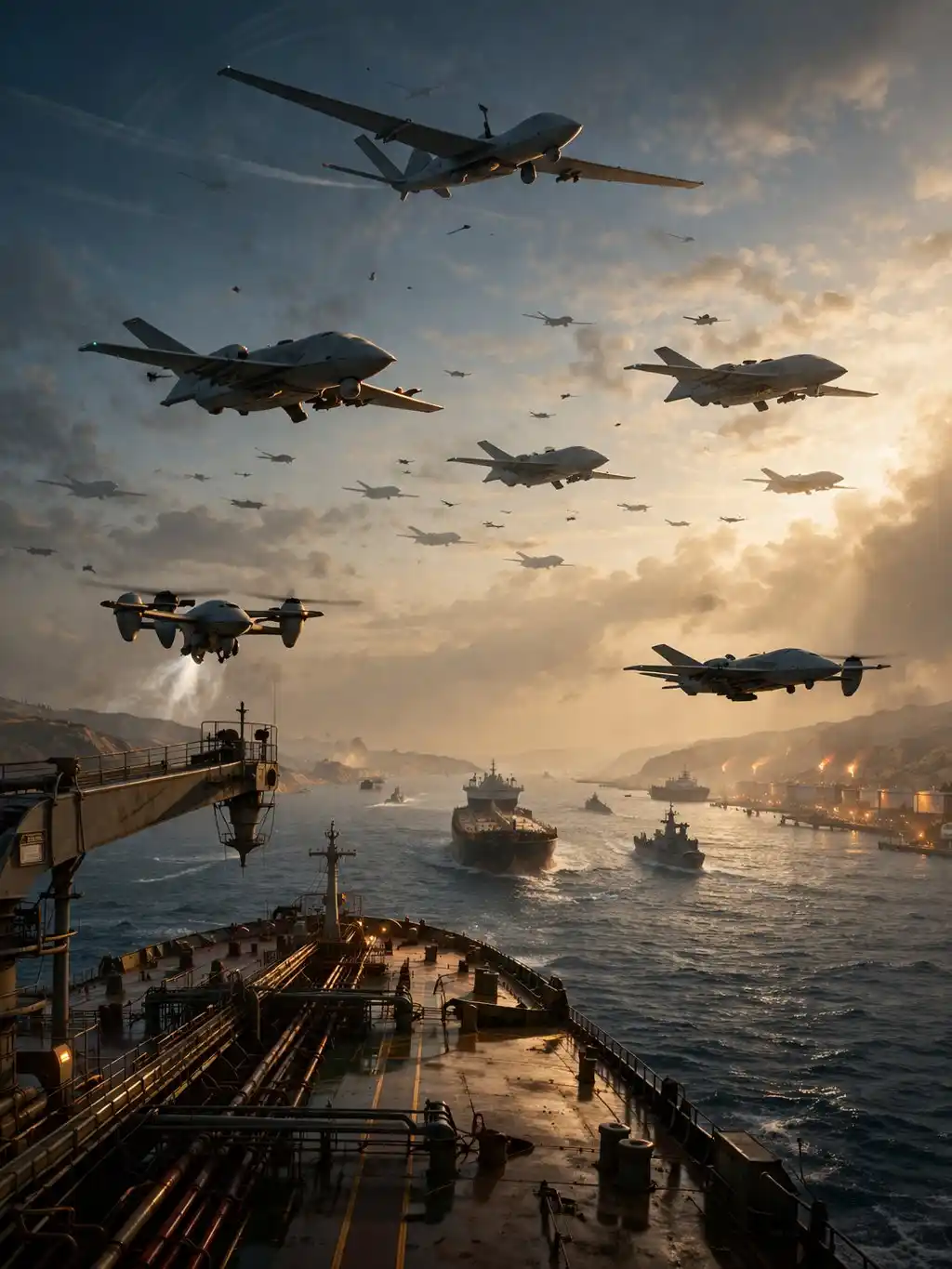
For most of the industrial age, military branches were separated not just by culture, but by physics. Navies owned persistence at sea. Armies owned ground presence and local mass. Air forces owned speed, reach, and selective strike. Those boundaries were never absolute, but they were stable enough to organize doctrine, procurement, and strategy. Cheap autonomous air mass begins to destabilize them. The shift is not only about adding more aircraft. It is about moving some military functions out of their old branch containers and into a new cross-domain aerospace layer.
Used carelessly, “CCA” becomes a placeholder for three different things. The first is the current public program: developmental, integrated with crewed systems, and still governed by human weapons-release authority. The second is near-term industrial mass: programs like Fury that matter because autonomous combat production is beginning to become real rather than purely conceptual. The third is the more disruptive future concept: dispersed autonomous airpower, including austere or runway-independent systems such as X-BAT. Keeping those three layers separate is essential. Only the third truly threatens old branch boundaries; the first explains where the United States is today, and the second shows how scale might begin. [13][14][15]
Current public CCA reality is still developmental. The Air Force says the program has entered the next phase of developmental testing, remains focused on safe systems integration rather than operational employment, and is intended to operate as part of a larger human-machine team; it also states that humans retain authority over weapons release. Its 2024 public program statement described a long-term goal of at least 1,000 aircraft. [13]
The second layer is near-term industrial mass. Reuters reported on 19 March that Anduril would begin building Fury combat drones at Arsenal-1 in Ohio within days, emphasizing manufacturability and cost-effective production from the outset. That matters because autonomous combat mass stops being a thought experiment once production becomes real. [14]
The third layer is the more disruptive future concept: dispersed, austere, or runway-independent autonomous airpower. Shield AI’s X-BAT is being publicly pitched in exactly those terms: no runway required, launch and recovery from ships, remote islands, or austere forward bases, with both air-to-air and air-to-surface mission options. That is not yet a fielded operational architecture. But it is a concrete signal of where autonomous airpower is trying to go. [15]
Once you think in that third layer, the strategic consequence becomes larger than “better fighters.” A mature autonomous air fleet starts competing functionally with other branches by taking over parts of their mission sets. It can compete with surface ships in some forms of littoral persistence, convoy overwatch, route surveillance, and fast-response local strike. It can compete with parts of armoured force structure in mobile sensing, distributed anti-vehicle attack, and local denial. It can compete with large fixed airbases by dispersing launch and recovery across roads, austere strips, temporary pads, ships, or smaller civil facilities, turning a few major nodes into a wider and harder-to-suppress support web.
This does not abolish logistics. Fuel, munitions, maintenance, software support, and communications still matter. But logistics become distributed rather than concentrated, and that changes the geometry of war. That is why the phrase autonomous air mass matters more than “more drones.” The real change is not one aircraft or one program. It is the growing ability of aerospace systems to provide persistent presence, distributed strike, relay, sensing, and local coercion at a scale and price point that begin to erode legacy distinctions between air, land, and sea roles. In that sense, the long-run significance of autonomous combat mass is not just “more airpower.” It is cross-domain mission migration. [13][15]
AI changes the problem in specific ways. It increases sensing density, shortens attribution time, improves route adaptation, raises the scale of autonomous persistence, and makes battle networks and distributed strike cheaper and more numerous than in the old era of exquisite platforms. But it does not erase mines, damaged terminals, insurer fear, coalition politics, legal authority, or nuclear diplomacy. The strategic error is to imagine that software abolishes friction. The real shift is narrower and more important: AI changes the speed, scale, and cost curve of military adaptation, while leaving the corridor, the market, and the political settlement stubbornly real. [1][2][10]

Iteration Speed as Strategy

The deeper asymmetry may not be current inventory but future iteration speed. If autonomous combat systems become software-defined, factory-iterated products, then the relevant competition shifts from who has the most exquisite platforms today to who can improve capability faster once conflict begins. The United States has a plausible structural advantage in that contest because it combines deep software ecosystems, large pools of AI capital, allied industrial support, and emerging high-rate autonomous manufacturing efforts. Iran, by contrast, faces sanctions, narrower access to advanced aerospace supply chains, and more limited capacity to absorb and scale cutting-edge autonomous aviation architectures quickly. That is a conditional advantage, not a law of history. It still depends on munitions, datalinks, maintenance, energy, and the ability to convert prototypes into reliable fielded systems. But if that conversion works, the competition shifts from static force comparison to wartime adaptation speed. [13][14][15]
That does not mean the future arrives automatically. It means acceleration has become a real strategic variable. Reuters reported in January that Tesla planned to more than double capital expenditures to more than $20 billion to push into autonomous vehicles and humanoid robotics, even as Musk separately said early Optimus and Cybercab production would be “agonizingly slow” before ramping up. The lesson is not that every accelerationist promise is true. It is that the United States is making large real bets on AI-enabled manufacturing and robotics across civilian industry, and those bets may matter militarily if autonomous airpower becomes a digital product category rather than a boutique program. [16]
This is the disciplined version of the future-force argument. It is not that anyone can simply wish a 1,000-aircraft autonomous warfighting ecosystem into existence. It is that the United States may have a structural advantage in iteration speed if autonomous air systems become products that learn through software, manufacturing feedback, autonomy updates, and distributed industrial scaling. If that happens while Iran is simultaneously denied the airspace, infrastructure, imports, or time needed to build comparable aerospace capacity, then the strategic contest becomes increasingly asymmetric. One side disrupts; the other adapts faster than the disruptor can keep up. [13][14][15][16]
Hormuz makes this visible. A fully mature autonomous air ecosystem would not just strengthen airpower over the Strait. It could take on functions that in earlier eras would have required more ships, more escorts, more fixed bases, and more crewed presence. Persistent maritime watch, fast attribution of harassment, overwatch of convoy corridors, distributed suppression of small raider platforms, and pressure against coastal launch points all begin to move into the autonomous air layer. That does not make navies irrelevant, and it does not remove the need for mine countermeasures, terminal resilience, or insurer confidence. It does mean that one of the traditional advantages of other branches — persistent presence in contested littorals and localized denial — can increasingly be challenged by cheap autonomous aerospace mass. [1][2][15]
The disciplined conclusion is therefore not that branch boundaries vanish. It is that they begin to erode under the pressure of cheap autonomous aerospace presence. Autonomous air mass is not just an Air Force modernization story. It is the beginning of a cross-domain force-design shift in which aerospace systems start absorbing missions once reserved for ships, armour, and large fixed bases. Had the United States begun maturing that kind of autonomous combat mass much earlier, the current crisis would likely look less severe. But even a much larger autonomous fleet would still be the coercive amplifier behind a continuity regime, not a substitute for it. [13][14][15]

The Industrial-Technical Reserve

If the true strategic risk is failed protection of the GCC energy belt and the Strait together, then the decisive reserve is not only manpower in uniform but engineering manpower. The missing answer is not a 500,000-soldier mobilization into Iran, but a wartime technical mobilization across the United States and its allies: software teams, autonomy developers, maintainers, electronics and sensor supply chains, interceptor production, repair capacity, test ranges, integration labs, and high-rate autonomous manufacturing. The purpose is not to promise perfect interception. It is to make repeated Iranian attacks on Gulf infrastructure and shipping so detectable, so attributable, and so increasingly interceptable that disruption stops being a cheap coercive strategy. The real reserve of the AI-maritime age may be less an expeditionary army than an industrial-technical one. [13][14][16]
The strongest way to understand this is not as an inventory argument, but as an adaptation-speed argument. If autonomous defensive systems become software-defined, factory-iterated products, then the competition shifts from who has the most exquisite platforms today to who can improve the defensive exchange ratio faster once conflict begins. Public evidence supports the direction of travel: the Air Force says CCA is moving through developmental testing toward a long-term fleet goal of at least 1,000+ aircraft, while Reuters reports Anduril has begun Fury production at Arsenal-1. Those facts do not prove instant transformation, but they do make the shift from boutique program to learning production system plausible enough to matter strategically. [13][14]
This is also where defense policy merges with industrial policy. The Defense Department’s industrial strategy explicitly centers resilient supply chains, workforce readiness, flexible acquisition, and economic deterrence. SIPRI reports that the United States accounted for 42% of global major arms exports in 2021–25, with Saudi Arabia, Qatar, and Kuwait among the region’s major importers. That means a technical mobilization for autonomous defense is not alien to current U.S. policy; it is an expansion of a logic already present. If structured well, such a mobilization could deepen engineering employment, strengthen sensor and electronics ecosystems, accelerate robotics integration, and improve the capacity to produce, rotate, upgrade, and export defensive systems. The export channel matters because an exportable Gulf-continuity shield is a serious alliance instrument, not a fantasy about domestic autarky. [17][18]
But this argument has to stay disciplined. Weapons are not bullion. Drone stockpiles are not a frictionless permanent store of value. Airframes, batteries, sensors, and software depreciate; exports depend on politics and customer demand; and stockpiles only remain strategically valuable if they are rotated, upgraded, and sustained. The better phrase is not “national bullion reserve,” but strategic autonomous production reserve: a reserve valuable because it can be fielded, improved, exported, or surged when crisis comes.
The same discipline applies to productivity. A large technical workforce could raise U.S. productive capacity, but not automatically. The Bureau of Labour Statistics reported that nonfarm business productivity rose 2.8% in Q4 2025 and 2.2% in 2025 overall, while manufacturing productivity fell 1.9% in Q4 2025 and manufacturing unit labour costs rose 8.3% in that quarter. That means headcount alone is not the answer. The payoff comes only if labour is paired with automation, software-defined design, flexible acquisition, and high-rate manufacturing. In other words, the reserve has to be a learning industrial system, not just a larger payroll. [19]
That is the deeper strategic evolution of the strategy. Continuity supremacy is not only about protecting a corridor in the moment. It is about building a state-capacity reserve that makes future disruption harder, costlier, and less rational for the attacker. The long-run contest is not just over who can absorb the next strike. It is over who can turn crisis into faster adaptation.

Nuclear Time and Shipping Time Run Together

The third pillar therefore cannot be omitted: a real off-ramp tied to nuclear restraint. This is not because diplomacy is emotionally comforting. It is because the nuclear clock and the shipping clock run at the same time. A maritime strategy that keeps oil moving but leaves nuclear breakout or nuclear coercion unresolved is still strategically incomplete. The IAEA’s position is the sober one: diplomacy and negotiations are the only long-term way to assure that Iran does not acquire nuclear weapons. The current political picture is bleak but not literally closed: Reuters reports Israeli officials see success as unlikely after the February breakdown, while Iran denies current talks are taking place; yet in early February President Pezeshkian publicly left room for talks if “threats and unreasonable expectations” were avoided. [8][9][20]
That off-ramp has to be narrow because maximalist diplomacy is just another way of refusing to bargain. If the terms are so expansive that Tehran reads them as disguised surrender, delay becomes easier to justify. But if the terms are narrow enough to focus on verifiable nuclear restraint, shipping de-escalation, and limits on the means of repeated disruption, then pressure and diplomacy can reinforce each other instead of cancelling each other out. In concrete terms, success would not mean friendship, normalization, or even strategic trust. It would mean a narrower and more realistic outcome: merchant traffic restored to an acceptable protected minimum, a verifiable ceiling on nuclear escalation, a reduced rate of corridor and GCC-node attacks, and a regional balance in which Tehran can still survive without being allowed to profit from systemic disruption. [8][9][20]

The Real Lesson

Hormuz is therefore the prototype of a wider era. In the age of AI and cheap precision, great-power rivalry is no longer simply a contest of bigger ships, longer-range missiles, or more exquisite fighters. It is a contest over whether an order can absorb autonomous harassment, infrastructure fragility, information disruption, and commercial fear without breaking. Sea supremacy described a world in which commanding the water often meant commanding the outcome. Continuity supremacy describes the harder world now emerging: one in which victory belongs to the side that can keep strategic flow alive, restore trust after shock, and impose greater cumulative cost on anyone trying to shut the system down. [1][3][4]
That is the real meaning of Hormuz. It is not only a chokepoint. It is a question put to the twenty-first century: when the artery is threatened, can you keep the system alive? The power that can do that — militarily, economically, politically, and industrially — will not merely hold the Strait. It will define the next working form of order. [1][2][3][4][5]


APPENDIX — Videos

“Prof Jiang: Trump Can’t End This War — If He Loses Power, He Goes to Prison” https://youtu.be/uP9Fnq23lsA

“Shield AI’s new X-BAT fighter-drone could change air warfare forever” https://youtu.be/GXgEqT0AR_k

“America’s DRONE FIGHTER programs shift into HIGH GEAR” https://youtu.be/zg061hX_Wlw

“An inside look at Pickaway County’s Arsenal-1 | Interview with Anduril founder Palmer Luckey” https://youtu.be/h9KsUR6_Wls

“Palmer Luckey Will Change How You Think About War” | #464 | “The Way I Heard Ithttps://youtu.be/dejWbn_-gUQ

“Anduril’s Palmer Luckey on AI, nukes, and the war in Iran | The Axios Show” https://youtu.be/VZfW3YTJ5Eg

APPENDIX — Reports

“North America All-Threat Defense Architecture, 2026–2045 (Part 1)” https://x.com/SkillsGapTrain/status/2034666618673144092

“The Systems That Keep Civilization Alive” https://x.com/SkillsGapTrain/status/2033246643429294232

“Why a Mini-B-21 CCA Could Be Better Than Current CCA for the Pacific and Arctic” https://x.com/SkillsGapTrain/status/2032414588705075466

APPENDIX — References

[1] International Maritime Organization, IMO condemns attacks on shipping, calls for safe-passage framework in Strait of Hormuz (19 March 2026).
[2] U.S. Maritime Administration, 2026-004 Persian Gulf, Strait of Hormuz, and Gulf of Oman — Iranian Attacks on Commercial Vessels (13 March 2026).
[3] International Energy Agency, Strait of Hormuz background note (6 February 2026).
[4] International Energy Agency, The Middle East and Global Energy Markets and March 2026 oil-security materials.
[5] Reuters, Shipping companies divert vessels around Cape of Good Hope after strikes on Iran and Hundreds of ships drop anchor in Middle East Gulf (1 March 2026).
[6] Combined Maritime Forces official site, describing CMF as a 47-nation naval partnership operating across major regional shipping lanes.
[7] Reuters, Bahrain pushes UN-backed action for Hormuz shipping; France tables rival text (23 March 2026).
[8] Reuters, Trump wants a deal with Iran but success of talks unlikely, Israeli officials say (24 March 2026).
[9] Reuters, Iran president gives go-ahead for talks with US (3 February 2026), plus Reuters on UAE openness to join a U.S.-led Hormuz effort and the wider joint statement backing safe passage.
[10] Reuters, Iran threatens to retaliate against Gulf energy and water after Trump ultimatum and related market coverage (22–23 March 2026).
[11] Reuters and Reuters Graphics on Gulf export disruption, LNG shutdowns, and Qatar’s warning that Gulf exports could halt within weeks.
[12] Reuters and S&P-related coverage on Gulf sovereign wealth deployment reviews and potential bank deposit outflows.
[13] U.S. Air Force, Collaborative Combat Aircraft program progresses through deliberate weapons integration testing (23 February 2026), and Air Force exercises two Collaborative Combat Aircraft option awards (24 April 2024).
[14] Reuters, High-speed combat drone production starts at new U.S. Anduril plant in days (19 March 2026).
[15] Shield AI, X-BAT product page and launch materials describing no-runway operation and launch/recovery from ships, remote islands, and austere bases.
[16] Reuters, Tesla plans $20 billion capital spending spree in push beyond human-driven cars and Reuters on slow initial Optimus/Cybercab ramp-up (January 2026).
[17] Department of Defense, National Defense Industrial Strategy implementation materials emphasizing resilient supply chains, workforce readiness, flexible acquisition, and economic deterrence.
[18] SIPRI, Trends in International Arms Transfers, 2025, including the U.S. 42% share of global major-arms exports and Gulf import shares.
[19] U.S. Bureau of Labor Statistics, Productivity and Costs, Fourth Quarter and Annual Averages 2025 (5 March 2026).
[20] International Atomic Energy Agency, Director General’s Introductory Statement to the Board of Governors, 2–6 March 2026.

APPENDIX A — Benchmarks, Relevant Metrics

Overall: 9.6/10
That is up from the prior version that was about 9.5, and clearly up from the earlier 9.3 and 8.8 stages.
Benchmark scores
Military realism: 9.3/10 Up slightly. Why it increased: the article now treats the defended object as the Strait plus the wider GCC energy belt, not just the waterway. That is a more realistic threat model. It also keeps the operational sequence clear: see, classify, attribute, clear, convoy, insure, restore, repeat.
Strategic quality: 9.8/10 Up slightly. Why it increased: the piece now has a cleaner full structure:
  • protected throughput,
  • denial + pressure + off-ramp,
  • GCC node defense,
  • autonomous-air coercive layer,
  • industrial reserve,
  • narrow end-state. That makes it feel more complete and more statecraft-level.
Truthfulness / factual discipline: 9.2/10 Down slightly from where it could be, or flat depending on citation cleanup.
Why it did not rise more: the reasoning is disciplined, but a few references in the stitched draft still look like they need a final source-hygiene pass to ensure every numbered citation matches the exact claim it is carrying. The argument is strong; the citation discipline is the main remaining cap.
Operational realism: 9.4/10 Up. Why it increased: the article now better connects corridor defense to GCC infrastructure defense and shows how repeated attacks become a campaign of interruption, repair, and renewed protection rather than a single naval event.
Engineering / systems realism: 9.5/10 Flat at a very high level. Why it stays high: this remains one of the best parts of the piece. It thinks in systems — terminals, insurance, routes, repair, resilience, distributed logistics, industrial scaling — not just platforms.
Aerospace / autonomy realism: 9.4/10 Up. Why it increased: the current draft is better disciplined about the three layers: 
  • present CCA reality,
  • near-term industrial mass,
  • future dispersed autonomous airpower. That makes the autonomy section harder to dismiss.
AI / post-RMA depth: 9.6/10 Up materially. Why it increased: the current draft now does more than say “AI matters.” It says what AI changes, what it does not change, and how autonomous air mass leads to cross-domain mission migration and adaptation-speed competition. That is a real doctrine contribution.
Economic / industrial realism: 9.6/10 Up materially. Why it increased: the new industrial-technical reserve section is a real improvement. It connects defense production, workforce, exports, state capacity, resilience, and alliance credibility in a much more serious way than before.
Political realism: 9.4/10 Up. Why it increased: the article now has more coalition/governance texture and better explains why Iran would likely widen regionally rather than universally, and why Gulf financial confidence matters.
Originality: 9.8/10 Flat-to-up at a very high level. The strongest original concepts now are:
  • continuity supremacy
  • the GCC energy belt as the real defended object
  • autonomous air mass and the erosion of branch boundaries
  • the industrial-technical reserve That is real conceptual work.
Structure / prose: 9.3/10 Up slightly, but not as much as the content scores. Why it increased: the article is more complete and more coherent. Why it did not rise more: it is now also denser. The new sections improve the argument, but they add weight. It reads more like landmark doctrine and less like a fast magazine essay, which is mostly a strength, but it still costs a little elegance.
Landmark potential: 9.6/10 Up. Why it increased: it now feels like a broader doctrine essay, not just an application piece. It has a stronger model of escalation, a stronger reserve concept, and a fuller state-capacity argument.
So did the score increase or decrease?
Increase overall.
My progression would be:
  • Earlier draft: about 8.8
  • Integrated continuity/autonomy version: about 9.3
  • Patched version with coalition and iteration-speed improvements: about 9.5
  • Current version with GCC belt + industrial-technical reserve: about 9.6
What improved the score most
The biggest gains came from three additions:
The article now identifies the real defended object as the GCC energy belt plus the Strait, not just Hormuz. The article now has a serious industrial-technical reserve concept, which upgrades the economic and state-capacity logic. The article now ties autonomous systems to adaptation speed, not just inventory or presence.
What still prevents a 9.8–10
Two main things:
First, citation hygiene still looks like the main remaining risk. The prose and logic are ahead of the source-cleanup discipline right now.
Second, the article is now so rich that it risks becoming slightly overloaded in the middle. That is not a thinking problem. It is a presentation problem.
Blunt verdict:
It increased. It is now stronger, broader, and more serious. But the path from 9.6 to 9.8+ is now mostly about source discipline and line-level elegance, not idea quality.
Scroll to Top