Core Idea
British Columbia occupies a unique geographic and economic position at the edge of North America. Sitting between the technology ecosystem of the United States and the advanced industrial economies of East Asia, the province has the potential to become a strategic bridge in the Pacific economy.
Canada has increasingly emphasized engagement with the Indo-Pacific region as a strategic priority for trade, investment, and economic cooperation [6].
If western Canada — especially British Columbia — wants to diversify its economy into technology, advanced manufacturing, and innovation, its most natural partners are the advanced Pacific economies that are geographically close, technologically sophisticated, and share compatible political and economic systems.
These partners include:
-
Japan
-
South Korea
-
Australia
-
United States
The objective is not to replace the United States, which will remain Canada’s primary economic partner, but rather to diversify partnerships and strengthen Canada’s role in the Pacific economic system.
1. Geography naturally links British Columbia to the Pacific
Vancouver is Canada’s principal Pacific gateway.
-
The Port of Vancouver is Canada’s largest port, handling more than 140 million tonnes of cargo annually, making it the country’s primary gateway for trade with the Asia-Pacific region.[1]
-
A large share of Canada’s trade with Asia passes through British Columbia.
-
Shipping routes from BC directly connect to major Pacific ports such as Tokyo, Busan, Yokohama, and Melbourne, linking Canada directly to advanced Pacific economies
Travel and logistics reinforce this connection:
-
Flights from Vancouver to Tokyo or Seoul are typically shorter than flights from eastern North America.
-
BC sits at the intersection of North American and Pacific trade routes.
As a result, British Columbia is structurally positioned as:
-
Canada’s Pacific-facing province
-
the country’s primary bridge to Asia-Pacific economies
2. Pacific democratic technology powers share compatible institutions
Canada’s closest partners in the Pacific region include:
-
Japan
-
South Korea
-
Australia
-
United States
These countries share institutional characteristics that support economic and technological cooperation:
-
democratic governance
-
rule of law
-
stable regulatory environments
-
strong intellectual property protections
-
advanced research institutions
These similarities reduce barriers for:
-
technology investment
-
research collaboration
-
industrial supply chain integration
While trade can and does occur across different political systems, institutional compatibility often makes deep technology partnerships easier and more secure.
3. Their technological strengths complement Canada’s economy
The industrial capabilities of these Pacific partners complement Canada’s strengths.
Japan
Japan remains a global leader in:
-
robotics
-
precision manufacturing
-
advanced materials
-
automotive engineering
-
semiconductor equipment
Companies such as Toyota, Sony, and Hitachi operate at the frontier of advanced industrial technology.
Canada offers complementary assets:
-
world-class AI research
-
critical mineral resources
-
clean energy potential
-
strong research universities
Canada has emerged as a global leader in artificial intelligence research, with major AI institutes in cities such as Toronto, Montreal, and Vancouver attracting significant international investment.[3]
Canada is also a major supplier of critical minerals — including nickel, cobalt, and lithium — essential for batteries and advanced manufacturing technologies.[4]
This creates opportunities for collaboration in advanced manufacturing, robotics, and energy technologies.
South Korea
South Korea is one of the world’s most advanced manufacturing and technology economies.
Key strengths include:
-
semiconductors
-
consumer electronics
-
battery technology
-
telecommunications infrastructure
-
shipbuilding and industrial automation
Major companies such as Samsung Electronics, Hyundai Motor Company, and LG Electronics play central roles in global technology supply chains.
Partnership opportunities with Canada include:
-
battery supply chains linked to Canadian minerals
-
semiconductor collaboration
-
telecommunications and AI research
Australia
Australia shares structural similarities with Canada:
-
resource-rich economies
-
strong universities and research institutions
-
democratic political systems
-
Pacific geographic orientation
Areas for deeper cooperation include:
-
mining technology and automation
-
critical mineral supply chains
-
hydrogen and clean energy development
-
joint research and innovation initiatives
4. Economic diversification requires reducing overdependence on the United States
Canada’s economy remains deeply integrated with the United States.
-
Approximately 75% of Canadian merchandise exports go to the United States, reflecting the deep integration created through agreements such as the United States–Mexico–Canada Agreement.[2]
-
Integrated supply chains are reinforced by agreements such as the United States–Mexico–Canada Agreement.
This integration is a major strength, but it also creates vulnerability to:
-
policy shifts
-
trade disputes
-
economic shocks affecting a single market
Diversifying partnerships can help:
-
expand export markets
-
strengthen supply chain resilience
-
attract foreign investment
-
increase Canada’s economic flexibility
The goal is balance rather than separation.
5. Existing trade frameworks already support Pacific integration
Canada already participates in major Pacific trade networks.
The most important is the:
-
Comprehensive and Progressive Agreement for Trans-Pacific Partnership
-
The Comprehensive and Progressive Agreement for Trans-Pacific Partnership connects economies representing roughly 15% of global GDP, creating one of the world’s largest free trade zones.[5]
Members include:
-
Canada
-
Japan
-
Australia
-
Mexico
-
Vietnam
-
several other Pacific economies
The agreement reduces:
-
tariffs
-
regulatory barriers
-
restrictions on investment
This framework creates a foundation for deeper technology and industrial cooperation across the Pacific region.
6. British Columbia could develop into Canada’s Pacific innovation hub
British Columbia already possesses several advantages that position it to deepen Pacific economic connections:
-
major Pacific ports
-
strong immigration and cultural ties with Asia
-
research institutions such as the University of British Columbia
-
growing technology clusters in Vancouver
-
proximity to the US west coast technology ecosystem
Although Vancouver’s technology sector is smaller than those of cities like Tokyo or Seoul, it has the potential to develop into a key node connecting North American and East Asian innovation networks.
Conclusion
For western Canada to diversify successfully into technology and advanced industry, its most promising partners lie among the Pacific economies that combine:
-
geographic proximity
-
technological leadership
-
compatible political and economic institutions
Strengthening economic and technological ties between British Columbia, Japan, South Korea, Australia, and the United States could help create a resilient Pacific economic network.
Such a network would:
-
accelerate technological development
-
strengthen global supply chains
-
reduce overdependence on a single export market
-
position western Canada as a strategic bridge between North America and Asia.
In an era increasingly shaped by the Pacific economy, British Columbia has the opportunity to become not merely Canada’s western province, but its strategic gateway to the most dynamic region of the world.
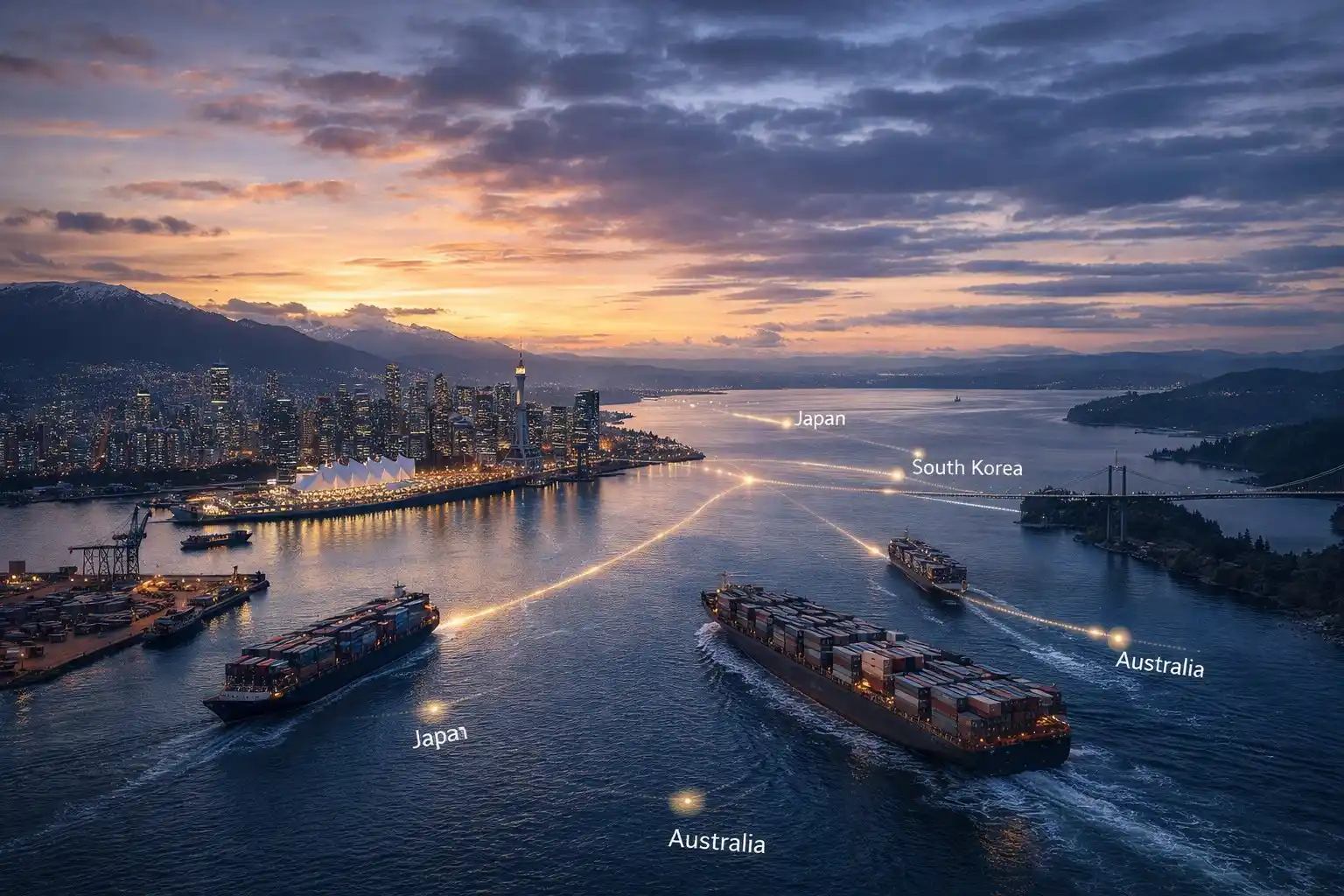
Caption: British Columbia sits at the crossroads of the Pacific, uniquely positioned to connect Canada’s resources, research, and innovation with the advanced technology economies of Japan, South Korea, Australia, and the United States.
Appendix T: The Pacific Industrial Triangle
The argument presented in this article aligns closely with a broader geopolitical and economic concept sometimes described as the Pacific Industrial Triangle. This idea refers to a network of advanced economies around the Pacific Rim whose industries, technologies, and supply chains are increasingly interconnected.
In its most relevant form for Canada, the triangle consists of three major economic zones:
-
The West Coast of North America – including the technology ecosystems of California, Washington State, and the growing innovation sector in Vancouver in British Columbia.
-
Japan’s advanced industrial economy – represented by companies such as Toyota, Sony, and Hitachi, which are global leaders in robotics, automotive engineering, and precision manufacturing.
-
South Korea’s high-technology manufacturing sector – led by firms such as Samsung Electronics, Hyundai Motor Company, and LG Electronics, which play central roles in global semiconductor, electronics, and battery supply chains.
Within this framework, each part of the triangle contributes distinct economic strengths:
-
North America’s West Coast provides leading technology research, venture capital, and innovation ecosystems.
-
Japan contributes advanced manufacturing, robotics, and industrial engineering capabilities.
-
South Korea provides large-scale high-tech manufacturing, semiconductors, and electronics production.
Together, these regions form a highly integrated network of innovation, production, and trade across the Pacific.
For Canada, and particularly British Columbia, participation in this Pacific industrial network presents significant strategic opportunities. The province’s geographic position, port infrastructure, and growing technology sector allow it to serve as a bridge between North American innovation and East Asian industrial capacity.
As global economic activity increasingly shifts toward the Pacific region, strengthening connections within this emerging industrial triangle could help position British Columbia as a key node linking North America’s technology economy with the advanced manufacturing systems of Japan and South Korea.
References
-
Port of Vancouver. Trade Through the Port of Vancouver. Port of Vancouver Authority. Port statistics available at: portvancouver[.]com/about-us/statistics
-
Statistics Canada. Canada’s Merchandise Trade by Country. Government of Canada. Trade data available at: www150[.]statcan[.]gc[.]ca/n1/daily-quotidien
-
Stanford University. AI Index Report. Stanford Institute for Human-Centered Artificial Intelligence. Report available at: aiindex[.]stanford[.]edu/report/
-
Natural Resources Canada. Critical Minerals Strategy. Government of Canada. Strategy available at: canada[.]ca/en/natural-resources-canada/campaigns/critical-minerals.html
-
Government of Canada. Comprehensive and Progressive Agreement for Trans-Pacific Partnership. Information available at: international[.]gc[.]ca/trade-commerce/trade-agreements-accords-commerciaux/agr-acc/cptpp-ptpgp
-
Government of Canada. Canada’s Indo-Pacific Strategy. Strategy available at: international[.]gc[.]ca/transparency-transparence/indo-pacific-indo-pacifique