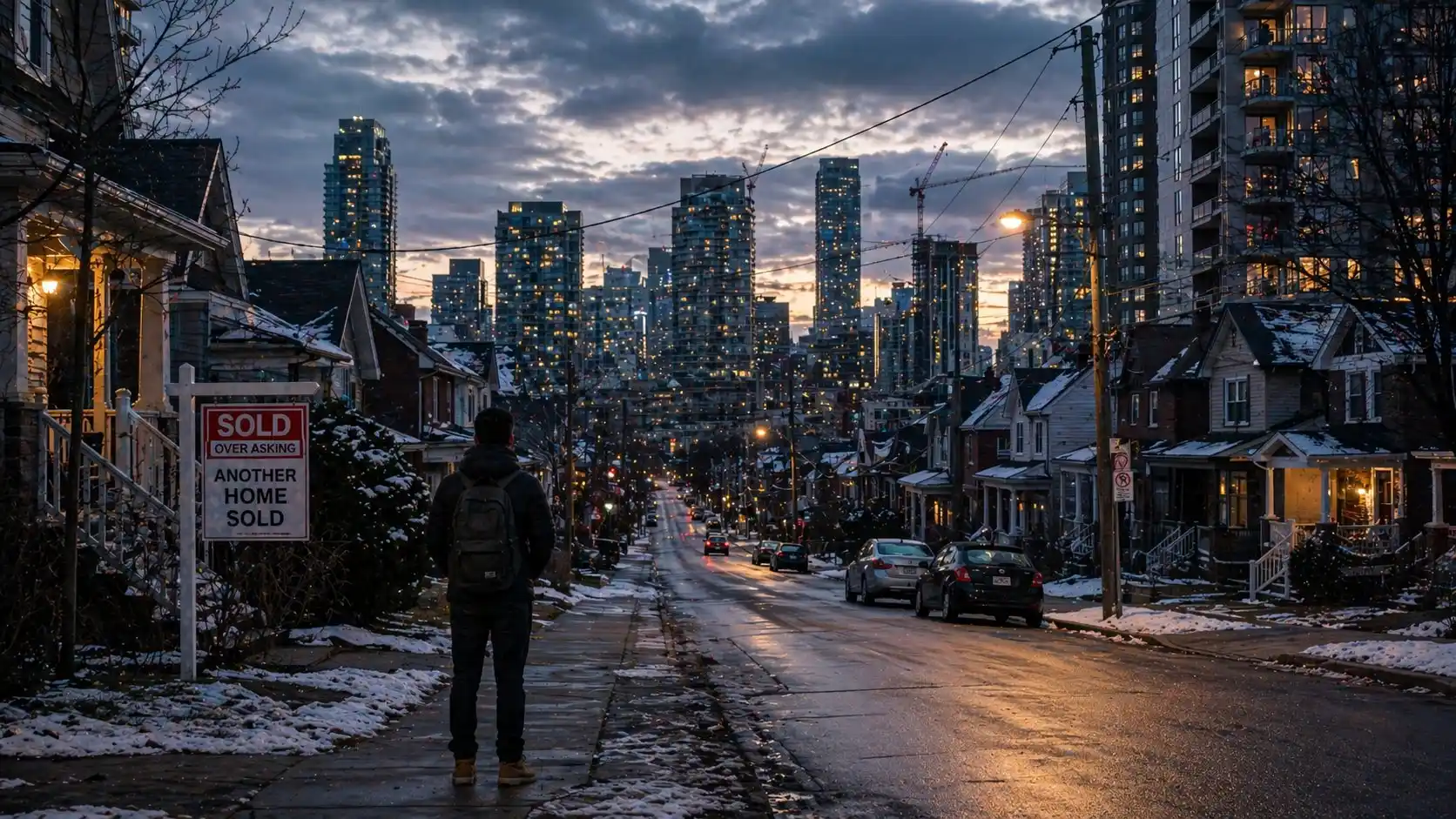
Chapter 5 — Housing: Where the Shift Becomes Visible
Core claim: housing is the clearest place where the shift became socially visible, because ordinary shelter stopped behaving like something a serious country still knew how to provide.
If the break described in the previous chapters ever needed a single surface on which to make itself visible, housing would be it. [8][9][10][21]
Not because housing explains everything. Not because every Canadian problem can be reduced to a bungalow, a tower, a rent cheque, or a mortgage. Because housing is where a society reveals, with unusual clarity, what it believes ordinary life is allowed to cost. [9]
A country can hide many failures for a long time. It can hide weak productivity behind resource rents, administrative decline behind polished language, and institutional exhaustion behind inherited infrastructure. But it cannot easily hide what happens when ordinary shelter stops behaving like something a serious country knows how to provide. At that point the problem ceases to be technical. It becomes moral. A society is declaring, whether it admits it or not, how much friction it is willing to place between a person and the conditions of adulthood. [9][17][18][19][20]
That is why housing matters so much here.
It is not simply one policy domain among others. It is the clearest place where the lock-in becomes legible to people who will never read a planning statute, a central-bank balance sheet, or a tribunal ruling. They do not need to. They can feel the change in the price of entry, in the years lost to saving, in the shrinking size of the first home, in the conversion of a second bedroom into a luxury, in the growing dependence on parental help, in the quiet humiliation of earning too much to feel poor and too little to live normally. They can feel it in the extension of adolescence by economics. They can feel it in delayed marriages, delayed children, deferred exits from family homes, and in the new respectability of permanent precarity. [9][10][11][12]
Housing is where the structure stops sounding abstract.
The older Canada inherited by the lock-in period did not treat shelter as a perfectly benevolent system. There were exclusions, inequities, bad design, speculative bursts, and uneven regional outcomes. But over long stretches of the twentieth century, housing still behaved more like something society could produce. Demand rose; supply could respond. Land was not infinitely free, but it was less politically trapped. Builders were not omnipotent, but they were not yet required to pass through quite so many layers of moral and procedural filtration before a home could exist. The social expectation remained more intelligible: if a country grew, it built.
That expectation is one of the most important things Canada lost.
What changed was not only price. It was the relationship between price and response.
In a healthier provision order, rising demand sends a signal outward. More homes are built. More land is brought into productive use. More infrastructure follows. Supply does not perfectly meet pressure, but it does not freeze while pressure compounds. The system bends. In the later order, the bend becomes harder. Demand rises, but more of its force is absorbed into land values, procedural queues, legal exposure, municipal conflict, and planning discretion. The response slows. Price ceases to be a signal for enough new supply and becomes, more often, a reward for those already positioned inside the bottleneck.
That is the decisive change.
A house can become more expensive without becoming more useful. That is one of the simplest truths in this report and one of the most politically avoided. A modest home does not shelter more people because its price doubles. The roof does not improve itself. The walls do not become wiser. The plumbing does not become more moral. What changes is access. What becomes more valuable is not necessarily the structure, but the right to occupy that location, under that planning regime, within that scarcity order. When that process repeats over years and decades, the country begins mistaking repricing for wealth creation.
This is where the mythology begins.
Rising house prices are narrated as prosperity. Owners are told they are richer. Governments quietly enjoy assessment growth, collateral growth, tax-base growth, and the political comfort of homeowners who see paper appreciation as proof of competent stewardship. Financial institutions expand against that appreciation. Families begin to imagine not only shelter, but retirement, inheritance, and emergency stability through a house whose value has been repriced by scarcity more than enlarged by production. The numbers look triumphant. The society, underneath them, becomes more brittle. [11][12]
Because paper wealth and productive wealth are not the same thing.
A country becomes richer in the deeper sense when it adds capacity: more homes, better homes, more infrastructure, more tools, more durable public systems, more real ability to house and move and employ its population. But when the same stock of shelter becomes radically more expensive without corresponding physical improvement, something else is happening. Wealth is being redistributed through access. Timing starts to matter more than output. Entry date matters more than contribution. Family position matters more than ordinary progression. The system begins to reward being early more than it rewards building anew.
This is the point where a housing market becomes a social sorting machine. [9]
The political hinge of that change lies beneath the price charts. The country did not wake up one morning and choose affordability crisis. It changed the terms under which land could move into housing supply. Planning systems thickened. Zoning frameworks hardened. Review and approval layers multiplied. Agricultural and environmental constraints were embedded into broader decision chains. Local politics acquired more points of leverage over whether land would remain inert, underused, or converted into housing. Public hearings, appeals, studies, discretionary approvals, neighborhood vetoes, tribunal pathways, infrastructure-cost layering, and jurisdictional fragmentation accumulated. Again, the point is not that every rule was irrational on its own. The point is cumulative. The supply side became more political, slower, and less elastic.
Once that happens, pressure has to go somewhere.
It goes into price.
And when price rises in a politically constrained system, the gains do not distribute evenly. They flow first to those already inside. Earlier owners acquire balance-sheet advantages. Families already holding property gain an asset that can be refinanced, leveraged, transferred, or mentally booked as security. Parents can help children with down payments — sometimes generously, sometimes just enough to create a generational gap between those with family backing and those without it. Existing owners can tell themselves the system is difficult but still fundamentally fair because they lived through earlier difficulty and emerged as winners. Meanwhile, those arriving later meet a ladder whose lower rungs have been quietly removed. [9][10]
This is where housing becomes generational without ever needing to announce itself as such.
One household experiences appreciation. Another experiences exclusion. One generation sees a nest egg. Another sees a gate.
The younger household trying to enter does not encounter a neutral market. It encounters a historical order. Prices reflect not merely present demand but decades of institutional decisions about land, approval, and scarcity. By the time the late entrant arrives, the country has already converted portions of ordinary shelter into an asset class and portions of family wealth into an access channel. The result is not just inequality in outcomes. It is inequality in timing. Earlier entry becomes destiny disguised as prudence.
That is why housing now governs so much more than housing.
It governs when adulthood begins.
In a normal provision system, leaving home is difficult but recognizable. Forming a household is tied to work, earnings, partnership, and ordinary luck. Children arrive or do not arrive for reasons that are personal, moral, biological, relational, and economic, but shelter is not quite so dominant a gate. In a scarcity system, housing rises above the background and becomes a master filter. Can you leave? Can you stay out? Can you move in together? Can you rent without instability? Can you afford another bedroom? Can you imagine children without treating space itself as a luxury good? Can you picture a future that is not one rent hike, one mortgage shock, or one eviction away from reversion? [9][10]
When the answer to those questions weakens, adulthood stretches.
It does not stretch because younger people have become frivolous. It stretches because the architecture of ordinary life has been priced against them. The delayed household is not merely a cultural choice. The delayed child is not merely a preference signal. The prolonged stay in the parental home is not merely emotional immaturity. These things can occur for many reasons, but in a scarcity order they also become rational adaptations to a system that has made secure shelter more difficult to obtain and more dangerous to lose. [9]
This is the human meaning of inelastic supply.
It is not a chart word. It is not an economist’s abstraction. It means a society that no longer knows how to make enough room when more people need a place to live. It means price becoming a substitute for provision. It means adulthood becoming more conditional. It means that ordinary life begins to depend more heavily on parental assets, inherited position, or earlier entry than a country likes to admit. It means that “working hard and getting established” turns from a social expectation into a narrowing privilege. [9]
None of this is politically innocent.
Because once large numbers of people come to depend on rising land values for security, the scarcity order acquires defenders who do not need to think of themselves as defenders of scarcity. They think of themselves as prudent adults, responsible owners, ordinary families protecting what they have. Their balance sheets tell them they are succeeding. Their neighborhoods tell them that growth must be handled delicately. Their governments speak the language of stewardship and quality of life. Their institutions describe the problem as complexity, consultation, sustainability, or infrastructure lag. Meanwhile, each layer of delay helps preserve the value of being already inside. [11][12]
This is how a provision problem becomes a political coalition.
And this is where the command story re-enters.
Housing did not become a scarcity system because anonymous forces conspired in secret. It became one because real institutions, led by real people, changed the terms of supply and then normalized the resulting order. Provincial governments strengthened planning frameworks. Municipal governments thickened approvals. Ministers, premiers, mayors, tribunals, planning boards, and administrative leaders governed a long period in which more and more of the built environment had to pass through a politics of filtration before it could exist. The people living inside the results later encountered those results as fate. But the results had authors.
The consequences of that authorship are visible everywhere.
In rising age thresholds for ownership. In widening dependence on family transfers. In the divergence between earnings and entry cost. In the compression of first homes into smaller units, longer commutes, or permanent renting. In the delayed household. In the later first child. In the growing sense that security belongs to those who arrived earlier and uncertainty to those who arrived later. [9]
Housing, in other words, became one of the main channels through which the country transferred advantage forward from incumbency and backward onto the young.
That is why this chapter cannot end with affordability rhetoric. Affordability is too weak a word for what is being described. It makes the crisis sound like arithmetic. In reality it is historical. It is institutional. It is political. It is generational. A society decided, over time, to make the conversion of land into shelter slower, more contestable, more mediated, and more dependent on administrative permission. Then it discovered that the resulting scarcity was highly profitable to those already inside it. Then it grew used to that profitability. Then it built language around it. Then it began to mistake the repricing of shelter for the creation of wealth. And then, finally, it looked at the people who arrived too late to benefit and asked what had gone wrong with them.
That is how a housing system becomes a moral indictment of a ruling order.
Because shelter is the first condition of stable life. A country that cannot provide ordinary access to it without extraordinary luck, inheritance, or timing is not merely under-building. It is quietly redefining citizenship. It is deciding whose future may remain ordinary and whose future must become strategic. It is deciding which generation gets a home as a social expectation and which generation gets it as a prize.
This is why housing is the clearest visible proof of the lock-in.
It shows the inheritance. It shows the break. It shows the rulers. It shows the winners. And it shows, with painful precision, who paid. [8][9][10]
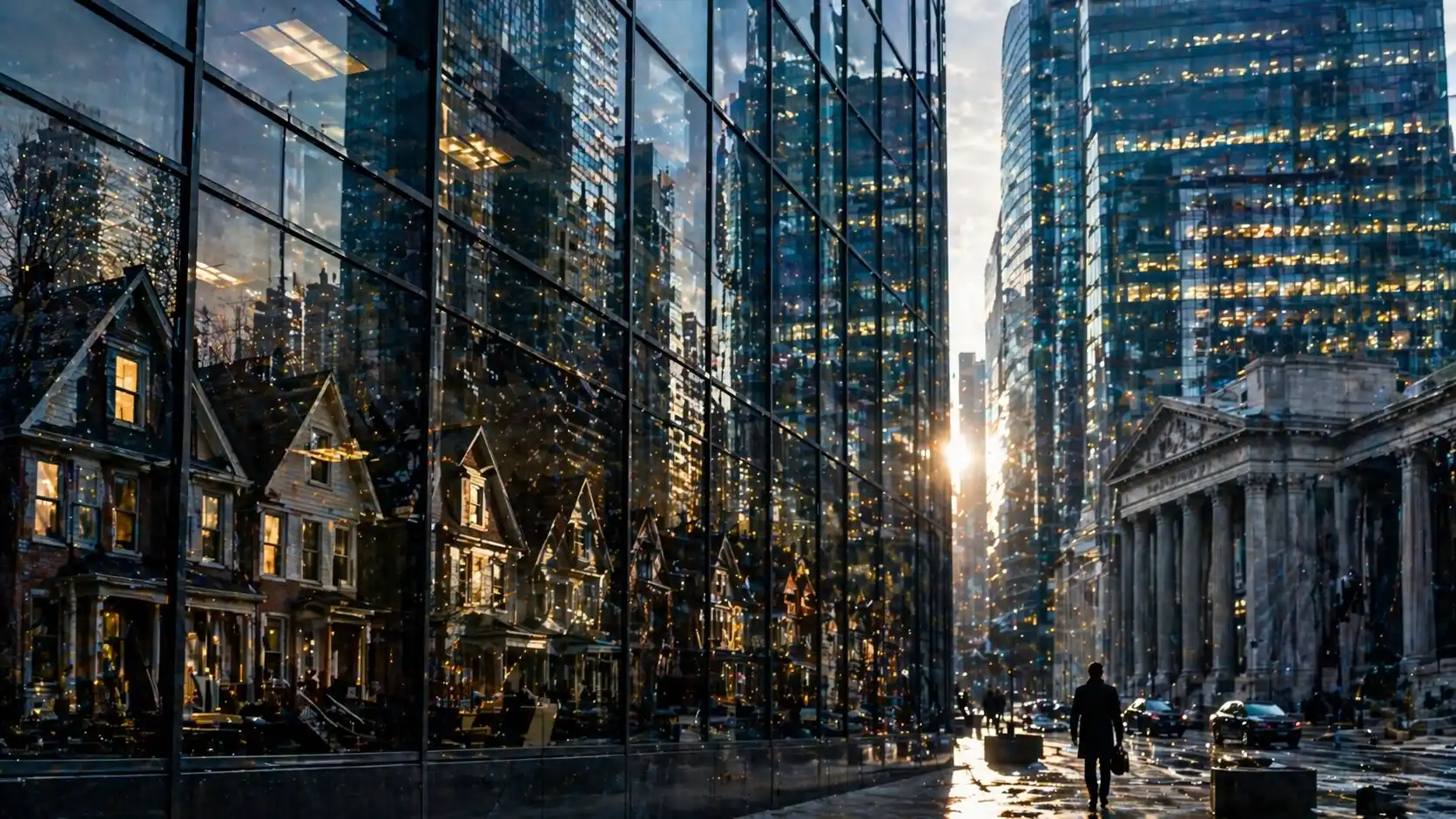
Chapter 6 — Finance: How Scarcity Was Amplified
Core claim: finance did not create the first bottleneck; it turned scarcity into a self-protecting wealth order.
A housing shortage can still look like a mistake. [11][12][15][16]
A financing system built on top of that shortage looks like a regime.
That is the distinction this chapter is about.
The previous chapter argued that Canada’s housing crisis was not simply a matter of prices going up. It was a deeper change in the way land, shelter, and entry were governed. Supply became more political. Delay became more normal. Scarcity stopped behaving like a temporary problem and started behaving like a durable condition. But a bottleneck, by itself, does not yet explain the full modern order. It explains why access tightened. It does not fully explain why the tightening became so profitable, so socially stabilizing for incumbents, and so difficult for governments to reverse.
For that, finance enters the story.
Finance did not create the original break. It did something more dangerous. It made the break self-reinforcing.
Once housing became harder to expand, the country faced a choice. It could treat the bottleneck as a warning and push aggressively toward renewed provision. Or it could adapt itself to the bottleneck and learn how to live off its consequences. Canada, over time, did too much of the second. Instead of forcing the system back toward elasticity, it increasingly built a financial order around inelasticity. Debt deepened. Collateral values rose. Mortgage insurance supported larger and safer balance sheets. Securitization machinery expanded. Housing equity became family strategy, retirement strategy, emergency strategy, status signal, and inheritance engine. The result was not just more borrowing. It was a new moral economy of shelter. [8][11][12][16]
A house was no longer only where you lived.
It became where your security lived.
That transformation changed the politics of the country.
In a society where housing is mainly shelter, high prices create pressure for more supply. In a society where housing is also the main middle-class asset, high prices generate a divided instinct. They hurt those trying to enter, but they comfort those already inside. A government facing that electorate no longer confronts one public. It confronts a split one. On one side are those who need homes. On the other are those whose balance sheets, retirement assumptions, family plans, and emotional sense of competence are now tied to continued appreciation. The system therefore acquires a strange dual character: publicly it speaks the language of concern, but structurally it becomes wary of any solution that would behave like a real solution. [11][12]
This is one of the reasons the lock-in survived.
The earlier bottleneck created scarcity. Finance taught scarcity how to pay.
Credit is the first amplifier.
In a normal account, credit simply helps people buy homes. In a scarcity order, credit does something more consequential: it allows prices to travel further away from ordinary earning power without forcing an immediate collapse in demand. Low rates, longer amortization expectations, more flexible underwriting periods, mortgage innovation, and policy support do not abolish the underlying bottleneck. They help buyers stretch themselves to survive inside it. What might otherwise become a direct political emergency is partially absorbed into household leverage. Pain is redistributed over time. The monthly payment becomes the bridge between an impossible price and a still-functional transaction. And because the transaction still occurs, the system can call itself healthy.
But it is not health. It is adaptation through debt. [11][12]
That adaptation has a psychological advantage for the ruling order. It makes a structural failure look like an individual financing challenge. The conversation moves away from “why doesn’t the country build enough?” and toward “how can households qualify?” A society that should be asking provision questions begins asking underwriting questions. Ministers, lenders, central bankers, and housing agencies can then present themselves as managers of access rather than custodians of scarcity. They are no longer visibly presiding over a shortage. They are helping people cope with one.
The shift sounds technical. It is political.
Once enough of the public begins to rely on borrowing against scarcity instead of dissolving scarcity through new supply, the system acquires a second form of protection. Households become emotionally invested not only in homeownership, but in the financial architecture that allows stretched entry at swollen prices. They may complain about cost while quietly depending on the very credit conditions that let the market remain inflated. They become critical and complicit at once. This is how the regime learns to stabilize itself not just through ideology, but through household strategy. [9]
Collateral is the second amplifier. [11][12]
In a healthier productive order, collateral is a financial tool. In a scarcity order, it becomes a social sorting mechanism. When homes rise in value because access has become more constrained, existing owners do not merely enjoy abstract paper gains. They gain borrowing power. Equity becomes spendable confidence. Renovations, business loans, education support, retirement planning, emergency liquidity, and intergenerational transfer can all be routed through the home. The same house that was once shelter becomes a balance-sheet platform. Families already inside the market now possess an asset that can actively shape the life chances of their children. [10][11][12]
This is where housing scarcity becomes family strategy.
The younger household with parental equity behind it is not entering the same market as the younger household without it. Both face the same sticker price, but only one arrives carrying the hidden inheritance of a prior era’s easier entry. One comes with leverage accumulated through decades of appreciation. The other comes with wages. The first can bridge. The second must absorb. The first is told it has family support. The second is told it needs discipline, patience, or better planning. A country that organizes access this way is no longer merely unequal in wealth. It is becoming hereditary in timing. [9]
That is a harsher statement than public debate usually allows, but it is closer to the truth.
The social meaning of the home changes again here. It ceases to be merely an individual asset and becomes a dynastic one. Parents do not just age in place. They hold a strategic resource. Children do not simply hope to buy. They increasingly wait to see whether family balance sheets will decide what the market no longer grants on ordinary income alone. Once this happens at scale, the ideology of merit begins to hollow out. The country can still speak in the language of work, saving, responsibility, and prudence, but entry itself is more and more mediated by prior position. [9][10][11][12]
Finance does not only amplify scarcity. It transmits it across generations.
Insurance and guarantees form the third amplifier.
In ordinary public language, these mechanisms sound responsible and stabilizing. And in limited ways they are. They help lenders manage risk. They can support liquidity. They can widen access within a functioning supply system. But within a scarcity system, they do something more ambiguous. They allow a constrained market to sustain a larger and more durable volume of transactions than it otherwise might. They spread risk in ways that make elevated valuations more administratively survivable. They make the whole architecture look safer and more manageable than a purely private system might. That appearance of safety matters enormously, because it reduces the pressure for structural correction.
A system can therefore become deeply distortive while still appearing prudential.
This is the paradox of modern Canadian housing finance. It can speak in the language of safety while helping preserve a scarcity order whose social effects are increasingly severe. This is not because every official intends exclusion. It is because the function of a stabilizing architecture changes when the thing being stabilized is already distorted. Insurance, securitization, and guarantee systems do not ask the political question by themselves. They ask the technical one: how can this machine keep operating? But if the machine is repricing access rather than expanding provision, continued operation is not neutrality. It is a choice with consequences.
The fourth amplifier is debt itself. [11][12]
A heavily indebted society is easier to govern in some ways than a lightly indebted one, because debt pushes people inward. It makes them more risk-sensitive, more fearful of instability, more dependent on interest-rate conditions, asset values, and monthly continuity. A household stretched to carry a mortgage at elevated prices may still be angry, but it is also less free. It has less tolerance for sharp correction, less appetite for economic experimentation, less room for job risk, family disruption, activism, mobility, or childbearing under uncertainty. Debt narrows the horizon. It trains the household to think in payment cycles rather than in social design. [11][12]
This is one reason housing finance reshapes public life beyond housing.
The public becomes more conservative in the literal sense: more committed to preserving the conditions under which its balance sheet remains survivable. Even those who entered late and at bad prices can become defenders of high valuations once their own survival depends on them. The ladder, once climbed at great strain, becomes something to protect. A society built on debt and inflated collateral therefore develops a powerful emotional constituency for continuation, even among people who can privately recognize the system as absurd. [11][12]
That constituency is one of the hidden pillars of the lock-in.
It helps explain why reform is so often theatrical. Governments can promise relief, announce tweaks, tighten here, loosen there, speak in the language of fairness, and still avoid the one move that would behave like serious correction: pushing hard enough on supply, land conversion, approval reform, and speculative expectations that repriced access would stop being the central source of middle-class reassurance. The political danger is obvious. Too much real repair would feel like loss to people whose lives have been built around the scarcity order’s rewards.
That is how a failed housing system acquires defenders who do not think of themselves as defending failure.
Inheritance is the fifth amplifier.
Not inheritance in the narrow sense only, though wills and transfers matter greatly. Inheritance in the broader sense: the ability of older balance sheets to project power into the future. A society where home values have outpaced ordinary wages for long enough is a society where parental assets become a hidden admissions system for adulthood. Some people inherit money directly. Others inherit the security of parents who can co-sign, gift, absorb temporary setbacks, or provide housing well into adulthood. Still others inherit neighborhood stability, educational advantages, and the psychological effects of growing up inside ownership. The market then sorts not only by present productivity, but by prior family position. [9][11][12][17][18][19][20]
This is where finance fuses with class and generation.
A younger Canadian without family property does not merely face a higher price. He or she faces a market increasingly shaped by the accumulated advantage of earlier entrants. Meanwhile, older cohorts can continue to describe themselves as prudent, successful, responsible, and deserving because the financialized system speaks in the language of personal achievement even when much of the gain has been socially produced by scarcity. This is one of the deepest moral confusions of the lock-in: a collective failure of provision is translated into a private story of virtue.
The result is not only distorted economics. It is distorted judgment.
The homeowner who sees a balance sheet swell under scarcity begins to experience the country differently from the renter whose future is being priced away. The official who manages mortgage risk begins to experience the system differently from the late entrant who cannot clear the down-payment wall. The minister announcing calibrated reforms begins to experience the country differently from the household delaying its second child because the next bedroom costs half a lifetime of earnings. The scarcity order separates not just interests, but perceptions. It allows one portion of the society to call the system stable while another experiences it as a slow-motion expulsion from normal life. [9][11][12]
Finance makes that separation durable.
That is why this chapter cannot be written as a simple anti-bank or anti-credit sermon. The real point is subtler. Finance becomes dangerous here not because lending exists, but because lending is layered onto a structurally constrained supply system and then asked to perform social miracles. It cannot. It can only distribute access within the bottleneck. And once it does so at scale, it begins rewarding the bottleneck for existing. Rising collateral values generate security for insiders. Security generates political caution. Political caution protects scarcity. Scarcity sustains elevated values. Elevated values justify more financial adaptation. The circle closes. [11][12]
What begins as a housing shortage becomes a wealth regime.
By this point the country has moved far away from the older assumption that homes are primarily to be built, occupied, and renewed as part of social provision. They still serve those functions, of course. But another function has taken command: homes are now expected to carry an impossible amount of economic meaning. They are shelter, retirement account, inheritance vehicle, collateral base, class marker, political constituency, and emotional proof of life progress all at once. No society can load that many functions onto one asset class without distorting both its politics and its morality. [11][12]
Canada did.
And the generations that governed during the long lock-in did not merely witness this transformation. They ruled while it hardened. They governed the institutions that adapted to the bottleneck, stabilized the collateral order, expanded the debt relation, and normalized the emotional dependence of the middle class on rising housing values. They did not invent scarcity out of thin air. But they helped build a financial world in which scarcity became livable for insiders, even as it became crushing for those arriving later. [11][12]
That is why finance belongs here, after housing and before productivity. [17][18][19][20]
Housing shows where the break becomes visible. Finance shows how the break became self-protecting.
Once a scarcity order can generate wealth for those already inside it, the entire moral atmosphere of the country changes. The beneficiaries no longer experience the system as a failure in need of correction. They experience it as reality, then as prudence, then as success. And because they experience it that way, they are able to look at the people left outside the ladder and misread them. The younger renter appears less stable than the older owner. The indebted entrant appears less disciplined than the established incumbent. The delayed family appears less serious than the family formed decades earlier under easier structural conditions. A society that has built wealth on scarcity begins, almost inevitably, to moralize the outcomes of its own design. [9]
That is where the next chapters must go.
Because once finance has amplified the bottleneck into a wealth order, the damage does not stop at shelter. It begins to change the wider economy: what gets invested in, what gets built, what kinds of firms expand, what risks are rewarded, what kinds of careers seem rational, what kinds of ambition seem dangerous, and what happens to a country that finds it easier to reprice existing assets than to deepen productive capacity.
That is the larger bill for using credit to adapt to scarcity instead of overcoming it.
It is not only that households borrowed too much.
It is that a civilization learned to borrow against its own inability to build enough. [11][12][15]
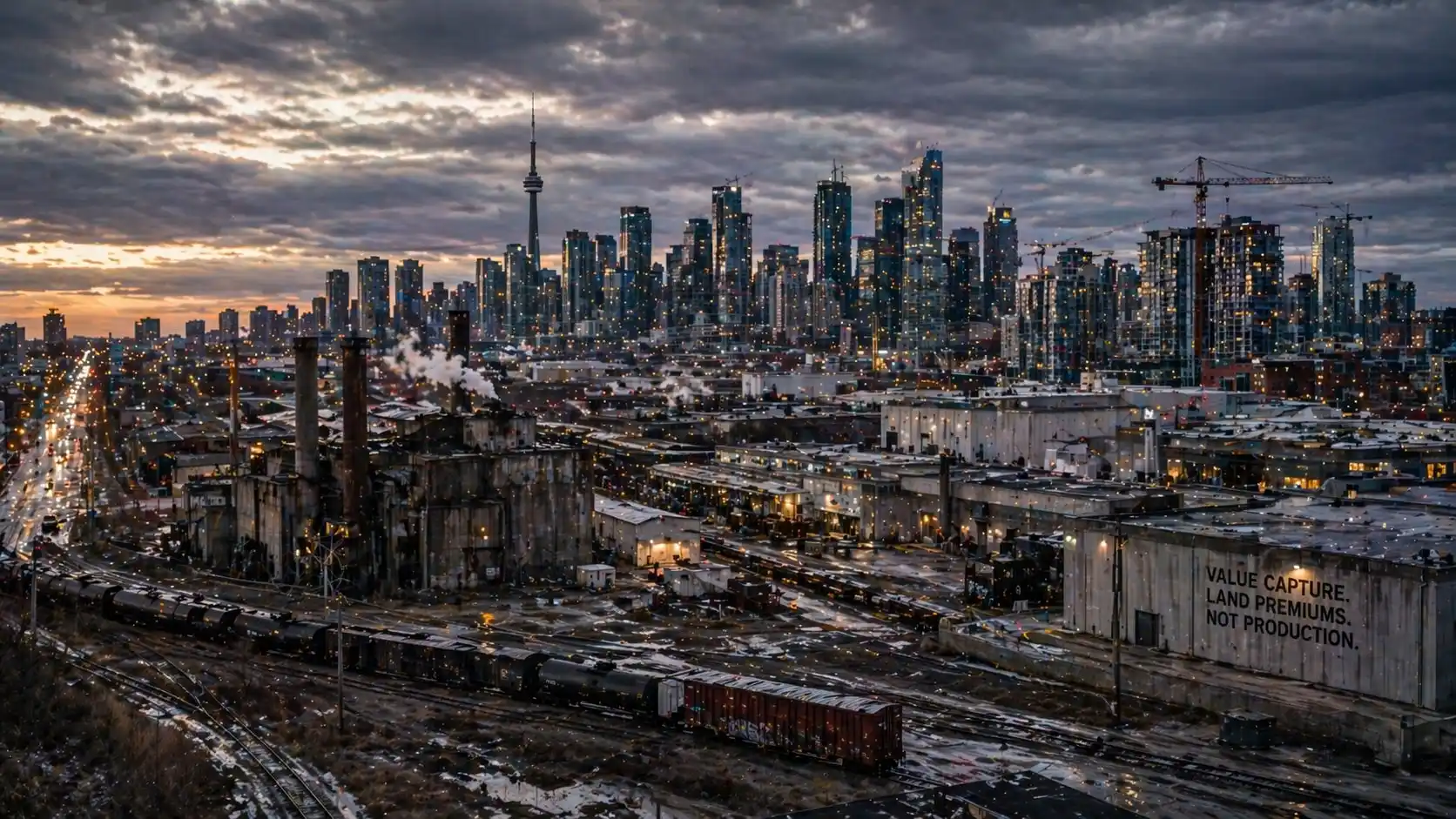
Chapter 7 — Industry, Productivity, and the Price of Repricing Access
Core claim: once the country learned to reprice access more easily than it could deepen capacity, apparent prosperity began masking productive thinning.
A country can make itself look richer while making itself weaker. [13][14][17][18]
That is one of the hardest truths for a modern society to accept, because the signals of wealth are so visible and the signals of weakness are often hidden inside systems that still seem to function. House prices rise. Balance sheets swell. Financial assets expand. Governments speak of resilience. Consumer life continues. Service sectors grow. Airports remain busy. Towers go up in some city cores. Public institutions continue to issue documents in the language of stewardship and confidence. From a distance, the nation still appears prosperous enough to flatter itself. [11][12]
But prosperity can be counterfeit in a precise sense. It can be real on paper and hollow in production.
This chapter is about that hollowing.
The previous chapter argued that finance turned a housing bottleneck into a durable wealth order. But once a country begins to organize more and more of its social energy around the repricing of access — especially access to land and shelter — the damage does not stop at households. It begins to reshape the whole economy. Capital flows differently. Risk is evaluated differently. Investment choices change. Labour incentives change. The prestige of sectors changes. The visible economy can continue to pulse even as the underlying ability to build, deepen, and extend productive capacity begins to thin. [9]
That is the larger price of living off scarcity.
Housing is where the lock-in becomes intimate. Industry and productivity are where it becomes national. [17][18][19][20]
The basic logic is not mysterious. A society has only so much capital, talent, managerial attention, political urgency, and institutional bandwidth. When a growing share of those resources is drawn toward bidding up existing land, defending inflated asset values, arbitraging scarcity, and administering access to constrained systems, less remains available for the harder work of productive expansion. Money that might have gone into plants, tools, logistics, engineering structures, industrial renewal, deeper capital stock, or new productive ecosystems is increasingly absorbed elsewhere. Instead of financing more output, the system finances the right to stand inside bottlenecks.
Over time, that changes what the country becomes.
It becomes more talented at valuation than at provision.
That is not just an economic statement. It is civilizational.
A builder-oriented country expects rising demand to call forth more capacity. A repricing country grows used to the opposite: rising demand justifies higher prices, higher claims on existing assets, higher leverage, thicker administrative mediation, and more positional competition for a limited stock of access. Once that pattern hardens, the national imagination changes with it. The future starts to look less like a field for construction and more like a contest over admission. The public still speaks the language of growth, but more and more of what it means in practice is not more building. It is more expensive entry.
This is where productivity enters the story. [17][18][19][20]
Productivity is often discussed in ways that lose ordinary readers immediately. The term can sound bloodless, economistic, almost moralizing: a lecture from somewhere above daily life about output per hour, business dynamism, and the need to become more efficient. But stripped of technocratic varnish, the issue is simple. A productive society gets better at making useful things, moving them, powering them, maintaining them, and widening the material base from which ordinary life becomes possible. A less productive society struggles to deepen its capacities and must increasingly rely on inflation of existing claims, imported advantages, or inherited systems to preserve the appearance of prosperity. [17][18][19][20]
In that sense, productivity is not a side issue in this report. It is a test of whether the country is still renewing itself. [17][18][19][20]
By that test, the lock-in shows again.
A country that finds it easier to make land more expensive than to make housing more abundant will often find it easier, in other domains too, to manage claims on value than to expand value at the productive frontier. It will grow more comfortable with intermediation, overhead, signaling, interpretation, compliance, and service expansion that floats above a weaker material base. None of those things is valueless in itself. The danger comes when they begin to outgrow the builder side of the economy that ultimately supports them.
That imbalance is one of the most underappreciated features of Canadian decline.
The modern economy can hide it because service growth is visually deceptive. Offices fill. consultancies expand. administrative careers multiply. regulatory, communications, legal, financial, and institutional work accumulates. Public systems thicken. Universities graduate more people into knowledge-heavy occupations. The whole structure looks sophisticated. But sophistication is not self-validating. A country can become highly articulate about systems it is becoming less capable of physically renewing. It can become excellent at managing procedures around output while weakening the conditions that make output itself robust.
That is the condition Canada increasingly drifted toward.
The clearest way to feel this is to ask what happens when capital loses faith in the ordinary profitability of building.
In a healthier productive order, high demand and rising prices in key sectors do not simply invite speculative extraction. They also invite serious capacity expansion. Entrepreneurs, firms, utilities, manufacturers, logistics operators, builders, and financiers can see a path from need to output. The more strained the system becomes, the more urgent it is to build through the strain. But when institutions are thick, land is political, approvals are slow, labour formation is weak, regulatory pathways are uncertain, and the easier return lies in holding or financing existing assets, that productive instinct weakens. The country still invests, but the character of investment changes. More of it is pulled toward defense, management, and repricing. Less of it is directed toward real expansion at the frontier.
That is why the housing story and the productivity story cannot be separated. [17][18][19][20]
A society that channels extraordinary volumes of credit and savings into inflated urban land and residential real estate is making a choice, even if that choice emerges through many institutions rather than one explicit decree. It is treating the scarcity of shelter as a safer and more intelligible source of wealth than the risk of new productive build. That choice reshapes not only home-ownership, but the wider investment culture. It teaches firms, families, and governments what kind of gain feels dependable. It tells the ambitious graduate what kind of career seems prudent. It tells the lender what kind of asset is respectable. It tells the state what kinds of returns it has become politically dependent on. [9]
And once a nation becomes dependent on those returns, productive disappointment starts to feel normal.
This is how under-performance becomes ambient.
Factories do not need to vanish for the industrial mind to weaken. It is enough for production to cease feeling central to the country’s self-understanding. Goods-producing sectors can continue to exist while the society gradually loses the reflex that treats them as the heart of sovereign seriousness. Energy can still be extracted while corridor logic weakens. Construction can still happen while throughput slows and project overhang grows. Firms can still operate while capital deepening lags and external dependency rises. The machine still runs, but the renewal instinct thins. [17][18][19][20]
That thinning is what this chapter means by the price of repricing access.
A repricing society does not stop building entirely. It builds less decisively, less elastically, less confidently, and often more expensively. At the same time, it becomes better at making asset holders feel richer. The public then experiences two realities at once. On paper, the country looks wealthier. In physical capacity, it often looks more hesitant. This contradiction is survivable for a long time, especially if inherited infrastructure still carries enough of the load. But survivable is not the same as healthy. A nation can coast on earlier seriousness while quietly reducing the amount of new seriousness it is capable of organizing.
That is the deeper industrial loss.
It is not only that manufacturing weakens, or that goods-producing sectors lag, or that supply chains become more externalized, or that business investment per worker disappoints. It is that the country begins to adapt to those things rather than revolt against them. It speaks as though the shift from making to mediating were an advanced form of modernity. It grows comfortable with the idea that serious production is somebody else’s specialization, while Canada’s comparative advantage lies in stability, management, finance, education, soft regulation, real estate, services, and moral branding. This can sound civilized. It can even sound post-industrial and sophisticated. But a country that overlearns that lesson eventually discovers that service elegance cannot fully compensate for a weakening material base. [17][18][19][20]
At that point, dependence grows.
Dependence on external supply chains. Dependence on imported goods. Dependence on foreign production ecosystems. Dependence on the continued valuation of domestic real estate. Dependence on public administration and services that presume an underlying productive engine they are no longer strengthening at the same pace.
The danger here is not that every service occupation is parasitic. That would be foolish. The danger is imbalance. Any advanced society needs finance, law, management, administration, education, health systems, regulation, and cultural institutions. The question is whether those layers remain tethered to a sufficiently strong builder and production base, or whether they begin floating above one that is weakening. Once the second condition sets in, the country can grow more verbally complex while becoming less materially confident.
This is one of the quiet humiliations of the lock-in.
A society rich enough to sound knowledgeable about everything becomes less able to make itself stronger where it counts.
And again the generational question returns.
Because this did not happen in a vacuum of stewardship. It happened while real leadership cohorts occupied real institutions. Boomer-majority leadership groups held office in the decades when the economy was increasingly reorganized around scarcity, financial insulation, administrative growth, and weaker productive dynamism. They did not single-handedly invent globalization or the China shock or the wider transformations of the world economy. But they governed Canada’s adaptation to those conditions. They presided over the national choice — sometimes conscious, sometimes emergent — to tolerate weak renewal in the builder economy while deeper and deeper amounts of confidence, wealth, and middle-class psychology were attached to the repricing of existing assets.
That governing choice matters.
Because a country can face the same global conditions in more than one way. It can answer external competition by deepening domestic productivity, accelerating infrastructure, renewing industrial formation, and routing investment toward new capacity. Or it can answer by drifting further into property dependence, household leverage, service expansion, and managed under-performance. Canada did not choose only one path at every moment. But the pattern that hardened is clear enough: it became easier to live off the paper gains of constrained access than to force the harder disciplines of renewed production. [17][18][19][20]
This is where the moral tone of the report begins to darken again.
Because once an economy teaches itself that wealth can be extracted more easily from scarcity than created through expansion, the ruling class changes character. It becomes less builder-like, even if it still talks about growth. It becomes less committed to uncomfortable acts of national deepening and more committed to protecting the asset values, institutional positions, and social insulation generated by the order that already exists. At that point, national decline no longer needs dramatic incompetence. It can proceed through sophisticated adaptation.
The country does not stop. It settles.
That settlement imposes a cost on everyone, but not equally.
Older asset holders may continue to feel the country is working, even if work has become thinner for others. Senior institutional strata may continue to see prudence where younger entrants see blockage. Public systems can continue to expand in management layers while offering weaker confidence that the next generation will enter adulthood with the same ordinary ease. An airport can function. A board can meet. A pension fund can grow. A downtown skyline can appear active. Meanwhile, the deeper economy becomes worse at what high-capacity countries once considered the basis of adulthood and sovereignty: producing more real room. [32]
That phrase matters.
More real room means more than homes. It means more industrial room, more logistical room, more energy room, more public-room for ambition, more room for builders, more room for late entrants, more room for family formation, more room for risk that is actually productive rather than merely speculative. A lock-in economy is, at bottom, an economy that stops making enough room and then teaches its population how to live morally inside the squeeze. [10]
This is why the industry and productivity story belongs in a report that begins with housing and generational rule. [17][18][19][20]
It proves that the housing crisis is not a sealed-off tragedy. It is a visible front of a wider civilizational pattern. The same order that makes shelter harder to provide also makes productive renewal easier to postpone. The same order that rewards those already holding scarce assets also weakens the urgency of building more. The same order that lets a society feel richer through repricing also makes it less capable of responding confidently to its own future.
That is the price of repricing access.
It is not only that homes become unaffordable. It is that the whole country begins to behave as though bidding for position were a more natural path to security than building new capacity. Once that inversion becomes normal, decline no longer needs to be announced. It becomes the unspoken background condition of public life.
The next question, then, is no longer simply what the country lost.
It is why the people who ruled through that loss still believed, or at least behaved as though they believed, that they were stewarding success. [13][14][17]
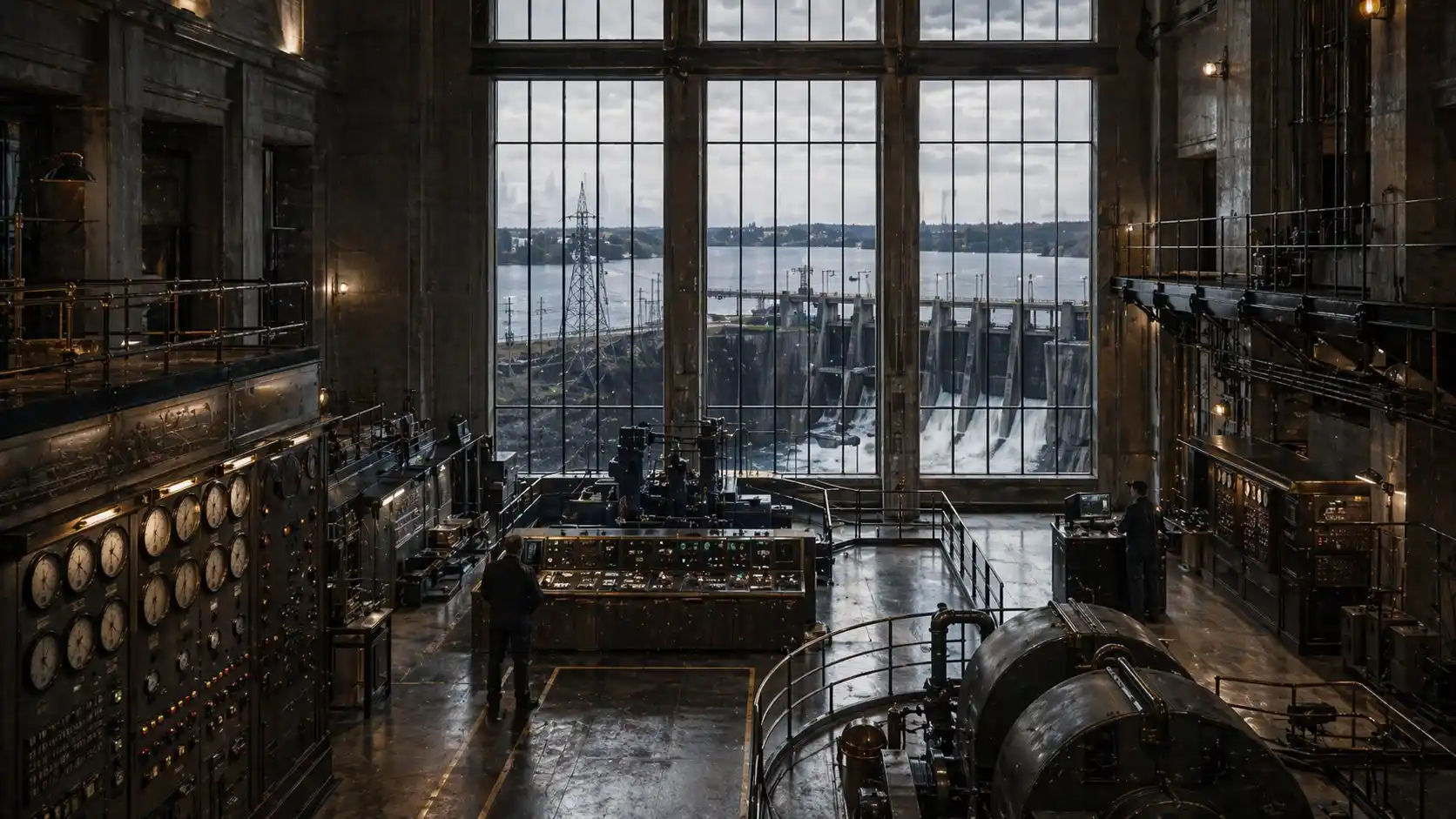
Chapter 8 — Governing Inherited Strength
Core claim: the ruling order often mistook continued possession of inherited systems for proof that it was still renewing them at the level that had built them.
The most flattering mistake a ruling class can make is to confuse possession with authorship. [1][8][17][18]
It is an easy mistake to make when the systems around you are still working.
The lights still come on. The water still runs. The airport still routes bodies. The mortgage still clears. The port still moves containers. The university still grants degrees. The hospital still opens its doors. The highway still carries freight across a distance too large for sentiment to bridge.
A country surrounded by functioning inheritances can look more competent than it is. A governing class standing inside those inheritances can look more creative than it has been. The machine continues, and the continuation itself becomes a kind of moral camouflage. It invites the people presiding over it to believe that because they have managed to remain in charge of a still-working civilization, they must also be the natural authors of its strength.
That is one of the central illusions this report has been building toward.
Canada’s lock-in was not only a systems failure. It was also a failure of self-understanding. The generations that governed during the hardening decades did not begin from rubble. They began from a country already carrying enormous material, institutional, and civilizational weight. They inherited power systems, corridors, public legitimacy for large projects, housing elasticity that had not yet been fully strangled, technical traditions, industrial remnants, and a social memory — still alive if already thinning — that serious countries answered pressure by building through it. What they received was not perfection. But it was real capacity. And that fact changes the moral meaning of what came later.
A weak country that fails to renew itself tells one story.
A strong country that inherits real capacity and then gradually learns to live off it tells another.
That second story is the Canadian one.
To see why, it helps to separate three very different things that are constantly collapsed in public memory: building, maintaining, and administering. [9]
Building creates a margin that did not previously exist. It adds room. It changes the country’s physical or institutional possibilities. It increases elasticity. It widens the corridor, deepens the grid, expands the housing stock, strengthens the logistical chain, or makes new forms of ordinary life possible. Building is not merely activity. It is an increase in civilizational capacity.
Maintaining is different. It preserves what already exists. It repairs, updates, manages, and extends the useful life of earlier accomplishments. Maintenance matters enormously. A serious civilization dies without it. But maintenance is not the same thing as creation. It keeps inheritance alive. It does not, by itself, prove that the culture still knows how to generate inheritance at the same level. [9]
Administration is different again. It organizes, supervises, regulates, sequences, interprets, and narrates what exists. Administration can support build or suffocate it. It can coordinate capacity or substitute for it. It can keep a system legible, or it can become a compensatory layer that grows as the productive confidence beneath it weakens. [9]
The great self-protective collapse in modern Canada has been the tendency to blur these three things together.
A ruling class inherits something large. It maintains enough of it for the system to keep functioning. It administrates it intensively. Then it speaks as though those facts together prove it is still the kind of class that built it.
That is the confusion this chapter is here to strip away.
Because the question is not whether later governments did anything. Of course they did. They funded, regulated, supervised, appointed, expanded, corrected, managed, and often complicated. The question is whether they renewed inherited strength at the level required to keep Canada a builder civilization — or whether, over time, they increasingly governed the shell of one while transforming its internal logic into something more procedural, more scarcity-dependent, more financialized, and less confident in real expansion.
The evidence assembled so far points strongly in the second direction.
Housing, the most intimate and widely felt proof pack in this report, already shows the pattern. A country that once treated shelter more like something society could produce gradually turned it into something society rationed. Land became more political. Approval pathways thickened. Price detached from usefulness. Earlier owners were rewarded. Later entrants were filtered. Adulthood itself became more conditional. Yet this transformation occurred inside a nation that still congratulated itself on homeownership, middle-class security, and the moral seriousness of its public institutions. That is exactly what inherited strength makes possible: the ability to degrade a system while still speaking as though one is preserving its virtues. [9]
Finance deepened the pattern.
Once the land bottleneck hardened, the country did not primarily revolt against it. It adapted to it. Credit expanded, collateral inflated, mortgage systems thickened, family wealth transmission became more decisive, and balance-sheet reassurance replaced renewed provision as one of the main ways the society experienced success. Again, this did not happen in a vacuum. It happened inside a country whose older builder inheritance still provided enough order and enough plausible wealth for the financial adaptation to appear competent rather than parasitic. A weaker country could not have hidden the distortion as effectively. Canada could, because it was still living off earlier seriousness. [11][12]
Industry and productivity show the same thing at a different scale. [9][17][18][19][20]
The economy did not stop. It settled. It tolerated weaker capital deepening, weaker goods-side urgency, slower productive renewal, and a broader drift toward repricing, mediation, and service-side growth that rested on a material base being renewed less confidently than before. Yet this, too, could be narrated as modern sophistication rather than national thinning because the inherited shell remained large enough to flatter the people governing it. The old strength hid the new weakness. That is one of the defining structural advantages enjoyed by a late administrative order: it can spend the reputational capital of the civilization it did not fully create. [17][18][19][20]
This is where the generational question stops being merely demographic and becomes moral.
A leadership cohort that begins from thin capacity and fails is one thing. A leadership cohort that begins from thick inherited capacity and gradually weakens the conditions of renewal is another. The second case is harder to judge because the inheritance masks the damage. The public still experiences many of the outputs. The rulers still appear competent enough. The country still has enough functioning systems that decline can be narrated as complexity, modernization, globalization, or inevitability rather than as a governing failure. But that very masking effect increases responsibility rather than reducing it. It means the rulers were granted a margin — and used that margin to drift.
The deepest accusation here is not simply that they failed to build enough.
It is that many of them came to believe that governing an inherited civilization was morally equivalent to continuing one.
That belief matters because it shapes what kinds of errors people are even capable of seeing in themselves. A generation that believes it built the order it mostly inherited will read criticism as ingratitude. It will hear structural accusation as disrespect. It will interpret younger frustration as entitlement rather than as a possible response to blocked access. It will see rising asset values as proof of stewardship. It will treat maintenance as authorship, because the line between the two has become psychologically unbearable to hold. To admit otherwise would be to admit that one’s era may have consumed more civilizational margin than it created.
That is why so much of the Canadian myth structure is organized around moral self-exoneration.
-
“We built this country.”
-
“We paid our dues.”
-
“We made hard choices.”
-
“We preserved what mattered.”
-
“We created prosperity.”
-
“We handed the next generation a stable society.”
Each of these claims contains some truth at some scale for some people. Taken together as a civilizational self-portrait, they become much less reliable. The more closely the report follows actual command, actual policy hardening, actual benefit capture, and actual burden transfer, the less those claims look like simple historical statements and the more they look like protective stories told by a class that governed inside inherited strength and mistook that circumstance for proof of authorship.
This confusion also explains something else: the extraordinary resistance to naming generational command directly.
If a ruling stratum has genuinely built the world it presides over, then criticism of its stewardship will naturally sound like a criticism of its creation. That criticism can be answered by pointing to bridges, dams, homes, schools, airports, utilities, and institutions. The evidence of authorship is everywhere. But if much of what surrounds the class is inherited, then the same pointing gesture becomes less secure. The bridge may predate its deepest authority. The housing elasticity may have been lost under its watch rather than built by it. The corridor may have been maintained but not meaningfully extended. The productive culture may have been thinned rather than renewed. Under those conditions, direct age-structured criticism becomes dangerous because it attacks not just decisions but identity. It asks the ruling cohort to separate what it governed from what it truly made.
Many societies avoid that question because it is too destabilizing.
Canada has been especially prone to avoiding it because inherited order remained functional for so long. The country could continue presenting itself as prudent, humane, moderate, and serious while many of the core builder conditions were being slowly converted into something else. The absence of spectacular collapse became a flattering mirror. It let the governing class conclude that because it had not destroyed the shell, it must still possess the soul.
But continuity of operation is not the same thing as continuity of civilization.
A machine can outlive the mentality that built it.
That sentence belongs at the center of this chapter because it captures the full asymmetry of inheritance. Great systems are not fragile in the way modern political ego often imagines. They can continue to function for years or decades after the culture that created them has weakened. A well-built grid does not immediately fail when the public philosophy around it thins. A transport system does not instantly collapse when a country becomes more verbally sophisticated than materially confident. A university does not cease to exist the moment its prestige structure drifts away from builder seriousness. Inheritance has inertia. That inertia is what makes late decay so hard to judge honestly.
It also makes it easy for a ruling class to live above its own civilizational income.
That, in essence, is the accusation here.
Not that later Canada produced nothing. Not that every person in power was a fraud. Not that no serious work continued.
But that the governing order increasingly relied on inherited strength while reducing the nation’s confidence in the acts by which such strength is reproduced. It governed a still-functioning country and often spoke as if that functioning proved full continuity with the era that had built the margin. It mistook survival for renewal.
That confusion had consequences.
It encouraged complacency in housing because the society still looked wealthy. It encouraged complacency in finance because the system still looked stable. It encouraged complacency in productivity because consumption could continue. It encouraged complacency in public administration because the state still sounded serious. It encouraged complacency in identity because the country still felt respectable. It encouraged complacency in generational judgment because the ruling class still believed it had earned an authority that, in part, was inherited. [17][18][19][20]
Once that moral complacency hardens, younger generations become easier to misread. They appear less competent, less mature, less serious, less grateful, less family-oriented, less resilient. But such judgments are often comparisons against a world partly built by earlier capacity under easier structural conditions. A cohort that inherits room tends to moralize differently from a cohort that inherits gates. If the former forgets the difference, it begins mistaking its advantage for superior character. That is how inheritance becomes ideology. [9]
This is why the chapter cannot remain at the level of economics.
The real issue is civilizational honesty.
Can a country distinguish what it built from what it inherited? Can a ruling class admit when it has prolonged the life of older systems without renewing the principles that made them? Can a generation acknowledge that it may have presided over the conversion of builder margin into scarcity rents, administrative complexity, and delayed entry for its successors while still telling itself a story of earned moral authority? [9]
Those are not rhetorical questions here. They are the central moral tests of the report.
Because once that distinction is faced clearly, a different portrait of modern Canada comes into view. Not a failed state, not a wasteland, not an absurd caricature of decadence — but a country whose ruling layers inherited a high-capacity civilization, governed during its long lock-in, benefited from its residual strength, and too often treated continued occupancy of the structure as proof that they remained its rightful builders. [9]
They often governed more than they renewed.
That is the sentence this chapter was meant to earn.
And once it is admitted, the next question becomes unavoidable: if the lock-in persisted not only because it paid people, but because it paid them enough to confuse themselves about what they had actually done, then who exactly gained from it — and how deeply did those gains bind them to the order they claimed merely to steward? [1][8][17]
👉 Who Locked Down Canada (Part 1) https://skillsgaptrainer.com/who-locked-down-canada-part-1/
👉 Who Locked Down Canada (Part 3) https://skillsgaptrainer.com/who-locked-down-canada-part-3/
👉 Who Locked Down Canada (Part 4) https://skillsgaptrainer.com/who-locked-down-canada-part-4/