Boomer Command, Canadian Myth, and the Transfer of Burden, 1970–2026
Abstract
What this report argues
What this report does not argue
Method and evidence note
System spine
-
Inheritance of builder-era strength
-
Institutional break in the late 1960s to mid-1980s
-
Cross-sector command occupancy
-
Housing scarcity and land filtering
-
Financial amplification of scarcity
-
Industrial and productivity weakening
-
Benefit capture by incumbents and insiders
-
Burden transfer onto later entrants
-
Blame transfer onto the burdened
-
Myth protection and generational fuzziness

Contents
-
Prologue — The Country That Still Runs on Yesterday’s Build
-
Chapter 1 — The Missing Variable
-
Chapter 2 — What Canada Inherited
-
Chapter 3 — The Break
-
Chapter 4 — The Command Map
-
Chapter 5 — Housing: Where the Shift Becomes Visible
-
Chapter 6 — Finance: How Scarcity Was Amplified
-
Chapter 7 — Industry, Productivity, and the Price of Repricing Access
-
Chapter 8 — Governing Inherited Strength
-
Chapter 9 — Benefit Capture
-
Chapter 10 — Burden Transfer
-
Chapter 11 — Blame Transfer
-
Chapter 12 — The Canadian Myths
-
Chapter 13 — Why “Boomer” Was Kept Fuzzy
-
Chapter 14 — Counterarguments
-
Chapter 15 — Final Verdict
-
Appendix A — Chapter-to-Reference Map
-
Appendix B — Command-Layer Source Anchors
-
Appendix C — Numbered References

1. Prologue — The Country That Still Runs on Yesterday’s Build
-
If you look only at housing, you see an affordability crisis.
-
If you look only at productivity, you see weak investment.
-
If you look only at infrastructure, you see delay.
-
If you look only at youth, you see frustration, drift, and blocked adulthood.
-
If you look only at politics, you see a stale argument about parties, personalities, and headlines.

Chapter 1 — The Missing Variable
Chapter 2 — What Canada Inherited

Chapter 3 — The Break
That is another core feature of the break: the rise of the permission mentality.
Chapter 4 — The Command Map
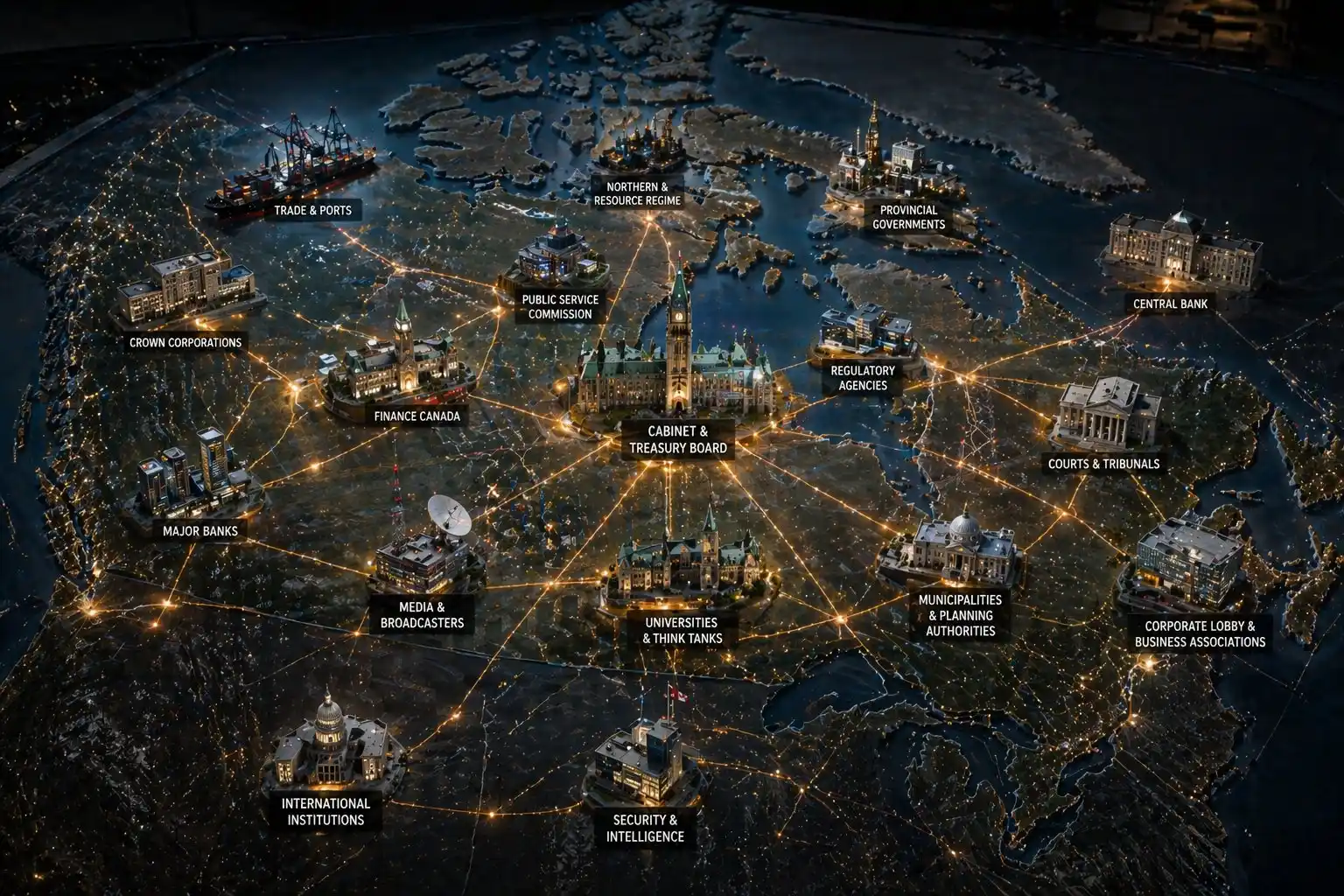
This is not because they caused all decline. It is because they reveal how rule functions in a late administrative order. Health ministries, regional authorities, hospital executive layers, licensing bodies, and professional regulators can become large, morally armored, and procedurally dense without becoming correspondingly elastic in service. They are another place where throughput and administration can separate. They are another place where insider stability can coexist with outsider frustration. And they are another place where a population can be told that the problem is complexity, demand, or human limitation while the governing design itself remains comparatively insulated from direct historical judgment.
👉 Who Locked Down Canada (Part 2) https://skillsgaptrainer.com/who-locked-down-canada-part-2/
👉 Who Locked Down Canada (Part 3) https://skillsgaptrainer.com/who-locked-down-canada-part-3/
👉 Who Locked Down Canada (Part 4) https://skillsgaptrainer.com/who-locked-down-canada-part-4/