“Why Ultra-Light LNG/CNG Hybrid Dual-Fuel Vehicles Deserve a Serious Role in Future Transport”
0. Decision Summary
This paper begins from a simple correction: transport should not be judged through one silent benchmark. A vehicle that looks optimal in a stable-grid, charging-rich, peacetime convenience frame may not remain optimal when the benchmark widens to include sparse infrastructure, cold weather, blackout continuity, command-stack dependence, commercialization friction, degraded local operability, and continuity under partial system failure.[1][2][6] In the harder resilience branch of the benchmark, EMP and related forms of severe electronic disruption are not treated as apocalyptic theater, but as high-consequence selectors that strengthen the case for lower electronic fragility, simpler control pathways, and more locally survivable vehicle design. Once those benchmark lanes are made explicit, the question changes. It is no longer which propulsion system wins in general. It becomes which architecture fits which mission, under which conditions, and at what cost in dependence, fragility, and operating burden.
The thesis of this article is therefore segmented, not universal. It argues that ultra-light LNG/CNG hybrid dual-fuel vehicles deserve serious consideration as a bounded road-vehicle architecture, not as the singular future of transport.[1][2][6] Their strongest case does not come from fuel branding alone. It comes from a stack: lower mass, hybridization, right-sized storage, lower parasitic burden, bounded fallback capability, reduced dependence on brittle centralized systems, and lower vulnerability to severe electronic disruption.[1][2][7][8] In the harder resilience branch of the thesis, that same design logic favors survivability under grid fragility, severe electronic disruption, and centralized-system brittleness, with EMP treated as one high-consequence selector rather than as the sole proof of the architecture. Natural gas often shows roughly 20–30% lower combustion-side GHG intensity than gasoline or diesel, but the larger gains in this thesis come from stacked engineering rather than fuel alone.[1][2][7][8] That is why the architecture should be read as a systems-design proposition, not a slogan about gas.
The lighter road-vehicle branch of this thesis is usually more credible in a CNG-centered dual-path hybrid form than in a pure light-duty LNG form, because cryogenic storage imposes additional mass, packaging, and systems burden in smaller vehicles.[3][6][10] LNG remains important in the wider project, but it is strongest in heavier-duty, longer-range, corridor, export, and power-sector roles, especially where it can displace dirtier fuels at larger scale.[5][6] The point is not to force LNG to win every transport lane. The point is to place each gas pathway where it is physically and strategically most believable.
Where does this architecture fit best? In fleet-first, work-use, rural, cold-weather, and continuity-sensitive road-vehicle roles.[3][6][10] Those are the missions where packaging tradeoffs are easier to justify, route uncertainty is more material, reserve logic matters more, and degraded-mode usefulness carries real value. Under a stable-grid benchmark, that still leaves the concept bounded. Under a hostile-future benchmark, however, the same architecture becomes much stronger because the scoring begins to reward blackout continuity, sparse-infrastructure operability, lower command-stack dependence, and useful motion under partial system failure.[3][4][10] Even then, the claim remains limited: this is a strong road-vehicle answer in some lanes, not a replacement for the entire transport hierarchy.
That boundedness matters because the paper also insists on explicit losing cases. Rail and electric buses still win clearly in many dense, high-occupancy corridors. EVs still win in some clean-grid, charging-rich, routine light-duty contexts. PHEVs and standard hybrids still beat this architecture in many roles where packaging simplicity and partial electrification solve the mission more cleanly.[2][6][8] Mainstream household default dominance is not the claim, and the paper is stronger because it says so directly.[2][6][8]
But the paper also refuses a different bias: the idea that only fleets are socially allowed to value resilience. A healthy transport society should preserve a bounded civilian resilience lane where geography, climate, infrastructure uncertainty, and continuity needs make a layered vehicle rational rather than eccentric.[3][6][10] That does not mean every household should own one. It means some households, especially in harder operating conditions, should not be forced into a monoculture designed only around calm assumptions.
The surviving verdict is therefore narrower and more credible than a fuel-war manifesto. Future transport is likely to work best not as a monoculture, but as a portfolio of architectures assigned to the missions they actually fit.[1][2][6] This concept earns a serious role, but not a universal one.

1. Why transport was framed too narrowly
For years, too much of the transport debate was organized around a monoculture instinct: identify the winning propulsion pathway, scale it across the system, and treat the rest as delay, nostalgia, or transitional clutter. That habit made the public conversation cleaner than the engineering problem actually was. Transport is not one optimization repeated millions of times. It is a layered operating field made up of different climates, infrastructures, mission types, commercial constraints, and failure conditions. A vehicle that works elegantly for routine urban commuting on a stable grid is not automatically the right answer for rural utility, cold-weather service, sparse-network continuity, or degraded-infrastructure use. Once the debate collapses all of that into one winner-take-all frame, entire parts of the design space disappear from view.[2][6][8][10]
The second mistake was arguing at the wrong level. The public dispute hardened around fuel labels and symbolic camps rather than around system architecture. Instead of asking which combination of mass, drivetrain, storage, fallback, packaging, control dependence, and mission fit best solves a given problem, the conversation narrowed into electric versus combustion. That is too coarse a frame to see a layered vehicle clearly. It hides the fact that some of the most important gains in transport come from changing the object before changing the fuel: lowering mass, hybridizing wisely, right-sizing storage, and avoiding unnecessary burden in the machine itself.[1][2][6] When the argument starts and ends with fuel identity, architectures that are structurally different but politically inconvenient become much harder to recognize.
The most overlooked variables were the ones least compatible with monoculture thinking. Mass matters because lighter vehicles need less energy regardless of what powers them.[1][7] Fallback matters because not every mission tolerates one-path dependence equally well.[3][4][10] Sparse infrastructure matters because the world is not uniformly dense, connected, serviced, and charging-rich.[3][6][10] Cold weather matters because reserve margins, thermal loads, and failure consequences change under winter conditions.[3][6][10] Continuity matters because useful transport under partial system failure is not the same problem as stylish transport under ideal conditions. And once the frame widens again, another class of variables becomes visible: OTA dependence, cloud linkage, telemetry exposure, software-mediated permissions, and centralized command-stack dependence. Those are engineering concerns, not cultural talking points, when the benchmark includes degraded operation, cyber dependence, blackout continuity, or lower-trust system conditions.
The AI and command-stack branch is stronger when stated in regulatory rather than theatrical terms. Vehicle cybersecurity and software-update governance are now formal regulatory and safety-management domains: UNECE UN Regulations No. 155 and 156 establish cyber-security-management and software-update-management requirements for vehicle approval, while NHTSA’s modern-vehicle cybersecurity guidance treats cybersecurity as a vehicle-safety issue and its firmware-update research explicitly notes that OTA capability can widen attack surfaces and failure scope if poorly governed. That does not prove every software-defined vehicle is unfit. It does prove that command-stack dependence is not imaginary. It is a real engineering variable in safety, maintenance, and continuity design.
That is why this architecture was easy to miss. It sits between categories that public debate prefers to keep separate. It is neither the pure-grid monoculture story nor a simple defense of legacy combustion. More deeply, it belongs to a different philosophy of system design. One philosophy assumes rising centralization, rising compute density, and increasingly elegant reliance on software-mediated infrastructure. The other asks what happens when that elegance becomes a liability, or when not every mission can afford to depend on it equally. The resilience-vehicle thesis emerges from the second philosophy. It becomes intelligible only when transport is treated as a system of missions under different operating conditions, rather than as a single moralized contest between abstract propulsion tribes.
So this section is not an argument against EVs, and it is not an argument for nostalgia. It is an argument for restoring the proper level of analysis. Once the frame is widened, the real question is no longer which fuel wins in the abstract. The real question is which architecture fits which mission, under which conditions, and with which dependencies. That shift in level is what makes the rest of the paper possible.
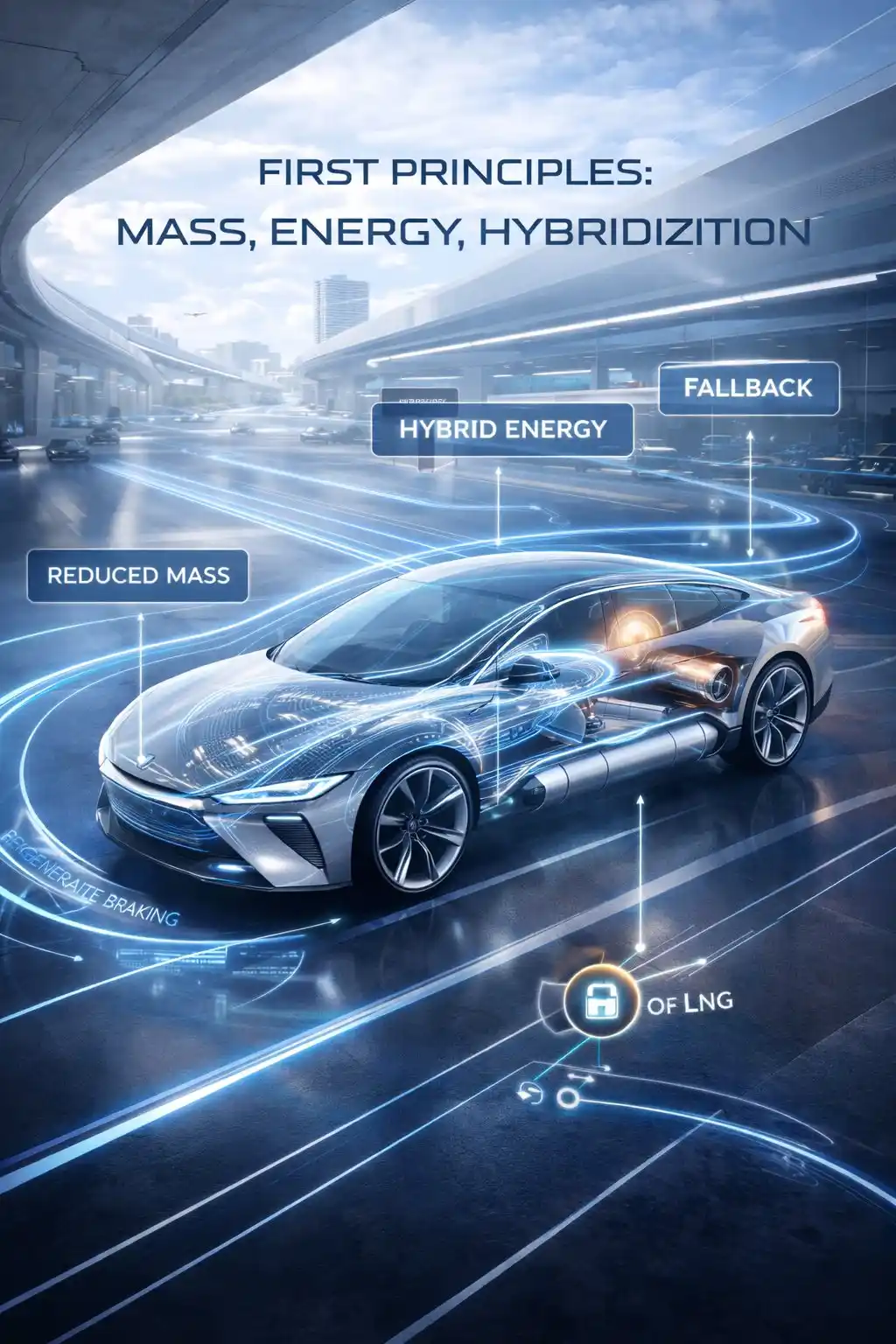
2. First principles of the architecture
Every serious transport architecture begins with the same question: where does the energy actually go? Before the discussion reaches fuel labels, markets, or political symbolism, it passes through physics. A moving vehicle spends energy on acceleration, drag, rolling resistance, climbing, accessory loads, and drivetrain losses. That is why mass is the first lever.[1][7] A lighter machine needs less energy to move itself through the same duty cycle, and that advantage compounds across the whole architecture. Less mass means smaller energy demand at launch, smaller penalties during stop-start operation, smaller burden when climbing or carrying reserve, and less downstream compensation required from every other subsystem. If the vehicle is too heavy, every later gain has to fight uphill. If it is materially lighter, every later gain starts from a better baseline. The machine’s energy burden begins with how much of itself it has to move.
Hybridization is the second lever because real transport is rarely steady-state. Vehicles do not operate in laboratory smoothness. They stop, queue, accelerate, idle, climb, descend, and absorb uneven transient demand. A pure combustion system handles that pattern less efficiently because it wastes braking energy, idles badly, and spends too much time outside its better operating ranges. A hybrid system improves the duty cycle by recovering part of what would otherwise be thrown away, smoothing transient load, reducing idle waste, and allowing the combustion side to work under narrower, more efficient conditions.[1][2][6][8] In this architecture, hybridization is not a decorative add-on to a gas thesis. It is one of the core reasons the concept can claim a real efficiency case at all. Remove hybridization, and the design becomes much easier to collapse back into a heavier, less disciplined combustion vehicle whose fuel pathway is being asked to do too much of the work.
The next principle is that fuel is part of the stack, not the whole stack.[1][2][6] This matters because transport debates often start at the wrong place. They begin with the energy source and then try to infer the vehicle from it. A better approach is the reverse: design the object first, then ask which energy pathways complement that object’s mission. In this case, the vehicle’s gains come first from lower mass, then from hybridization, then from tighter systems discipline and right-sized storage, and only after that from the fuel branch itself. Natural-gas or dual-fuel logic can strengthen the architecture, but it cannot rescue a badly designed object. If the machine remains overweight, overburdened, or poorly packaged, fuel substitution becomes a superficial correction. If the object is already materially improved, then the fuel pathway becomes one more layer in a coherent stack. That ordering keeps the thesis honest. It prevents the report from pretending that a fuel identity can substitute for sound engineering.
The fourth principle is that fallback, anti-brittleness, and lower electronic fragility are real engineering variables.[3][4][10] A transport system is not judged only by how elegantly it performs under ideal conditions. It also has to be judged by what happens when conditions worsen: infrastructure gaps, route uncertainty, cold-weather margin loss, partial system failure, or reduced access to one dominant pathway. In some missions, one-path dependence is acceptable. In others, it is not. That is why fallback is not an emotional preference for redundancy. It is part of mission fit. It changes how the machine should be designed, how much reserve it should carry, how much infrastructure it can safely assume, and how much central coordination it can afford to depend on. The resilience-vehicle thesis treats fallback as a systems variable because real vehicles live in the world, not in a perfectly uniform network. In the harder resilience branch, that same logic extends to survivability under severe electronic disruption. That does not require every vehicle to be EMP-hardened as a universal standard. It does mean the architecture should value fewer exposed electronic intermediaries, simpler critical control paths, selective shielding or isolation of essential modules where feasible, and a bias toward degraded operation that does not collapse when the electronic environment worsens.
That same logic is why command-stack dependence and severe electronic-disruption survivability belong in engineering analysis rather than politics. OTA linkage, cloud dependence, telemetry burden, software-mediated permissions, and centralized digital control surfaces are often discussed as convenience features or strategic trends. But from a first-principles standpoint, they are also dependencies. They affect how many failure surfaces the vehicle has, how much remote infrastructure it requires to function smoothly, how exposed its critical functions are to electronic disruption, and how gracefully it can continue operating when parts of the wider stack are degraded. A vehicle architecture that relies on fewer fragile intermediaries between driver intent and useful motion may sacrifice some elegance under ideal conditions while gaining operability under worse ones. That trade is not ideological. It is systems design.
Under hostile-future conditions, degraded operation becomes part of the physical hierarchy itself. A machine that remains locally useful during blackout, sparse-infrastructure operation, cold-weather stress, or partial digital-system failure is not merely more resilient in an abstract sense; it is solving a different transport problem. In that problem, graceful degradation matters almost as much as peak elegance. The right conclusion is orderly and bounded: mass comes first, hybridization comes second, fuel remains one layer rather than the whole case, and fallback plus reduced command-stack brittleness belong inside the architecture rather than outside it. That is the first-principles spine the rest of the report depends on.
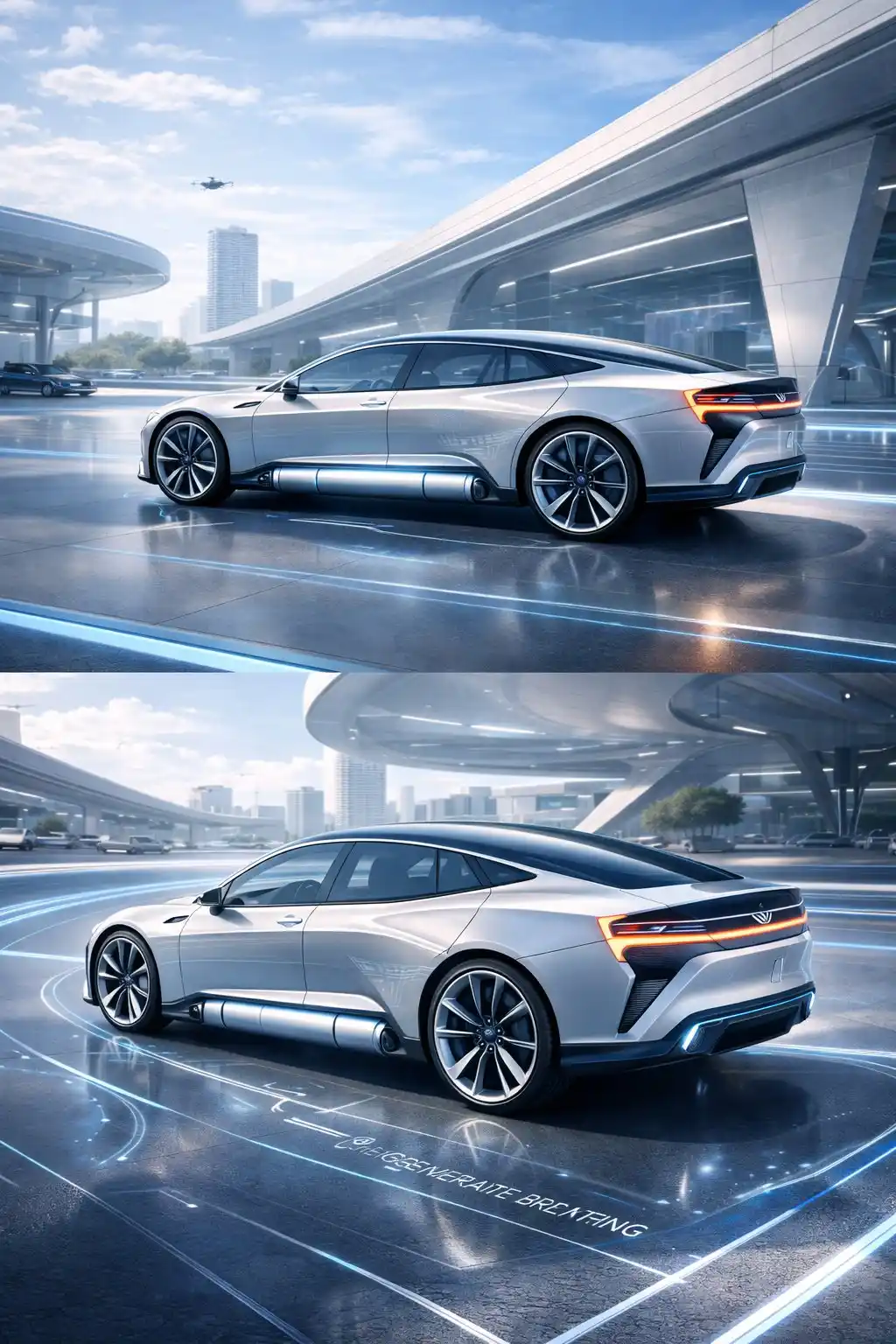
3. What the vehicle actually is
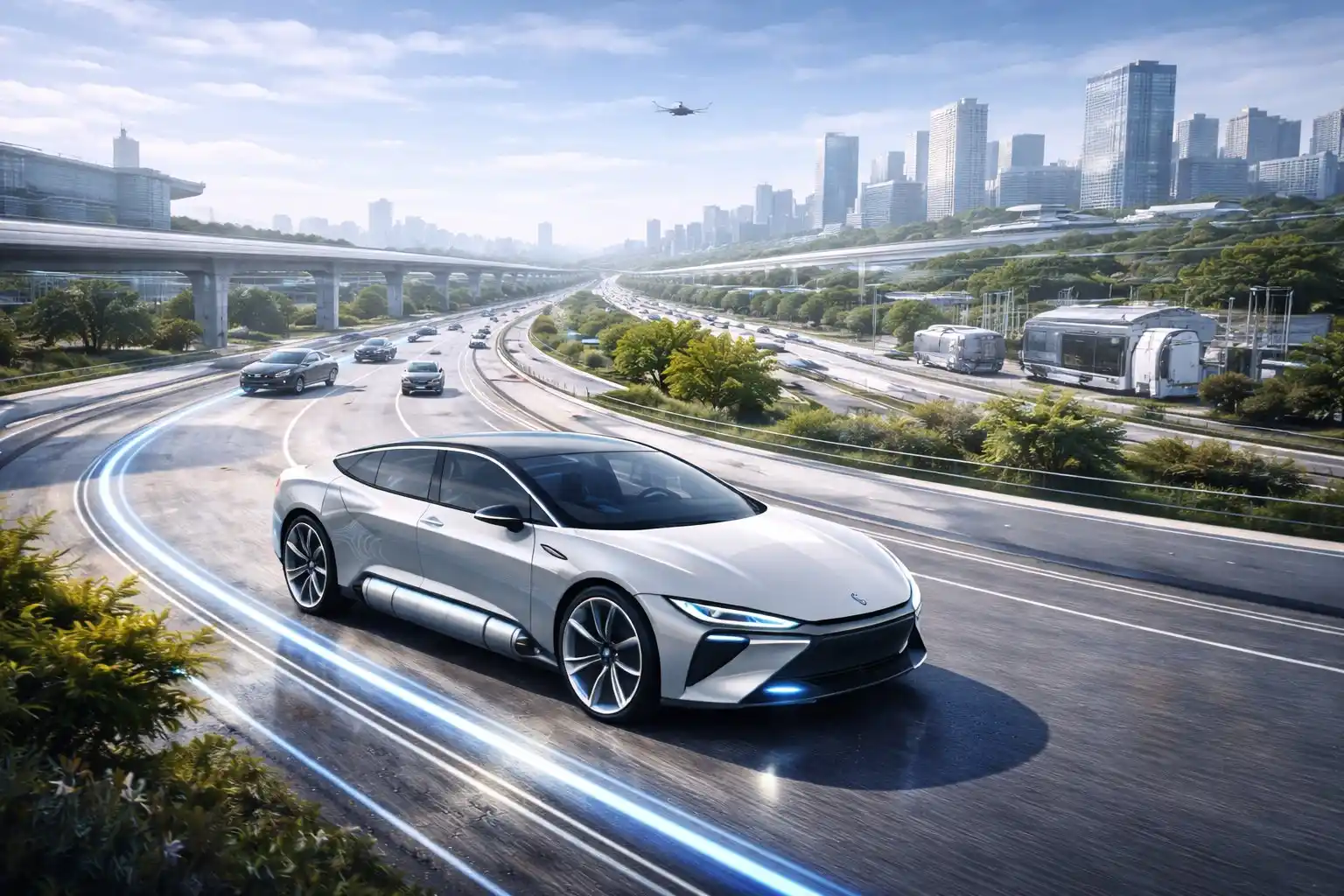
The vehicle in this paper is not best understood as a fuel slogan or as a compromise between two ideological camps. It is a decentralized fallback architecture: an ultra-light hybrid road vehicle designed to remain useful across harder operating conditions without depending entirely on one elegant pathway, and with a design bias toward survivability under severe electronic disruption.[3][4][10] That framing matters because it changes what the object is optimizing for. The machine is not trying to be the most electrified thing possible, nor the simplest continuation of legacy combustion. It is trying to be lighter, less brittle, and more operationally tolerant when infrastructure is uneven, weather is harder, or surrounding systems degrade. The dual-fuel element matters, but it matters inside that wider design logic.
At the center of the architecture is a right-sized battery philosophy.[1][2][6][7][8] The battery is there to do hybrid work: absorb braking energy, smooth transient demand, support torque fill, reduce idle waste, and make the combustion pathway operate more efficiently under real duty cycles. It is not there to turn the machine into a disguised long-range EV. That distinction matters because once the battery becomes oversized, the architecture inherits a different set of burdens: more mass, more charging dependence, more thermal-management overhead, and a stronger pull toward one-path infrastructure assumptions. The design logic here stays tighter than that. The battery is meant to sharpen the drivetrain, not redefine the vehicle’s identity.
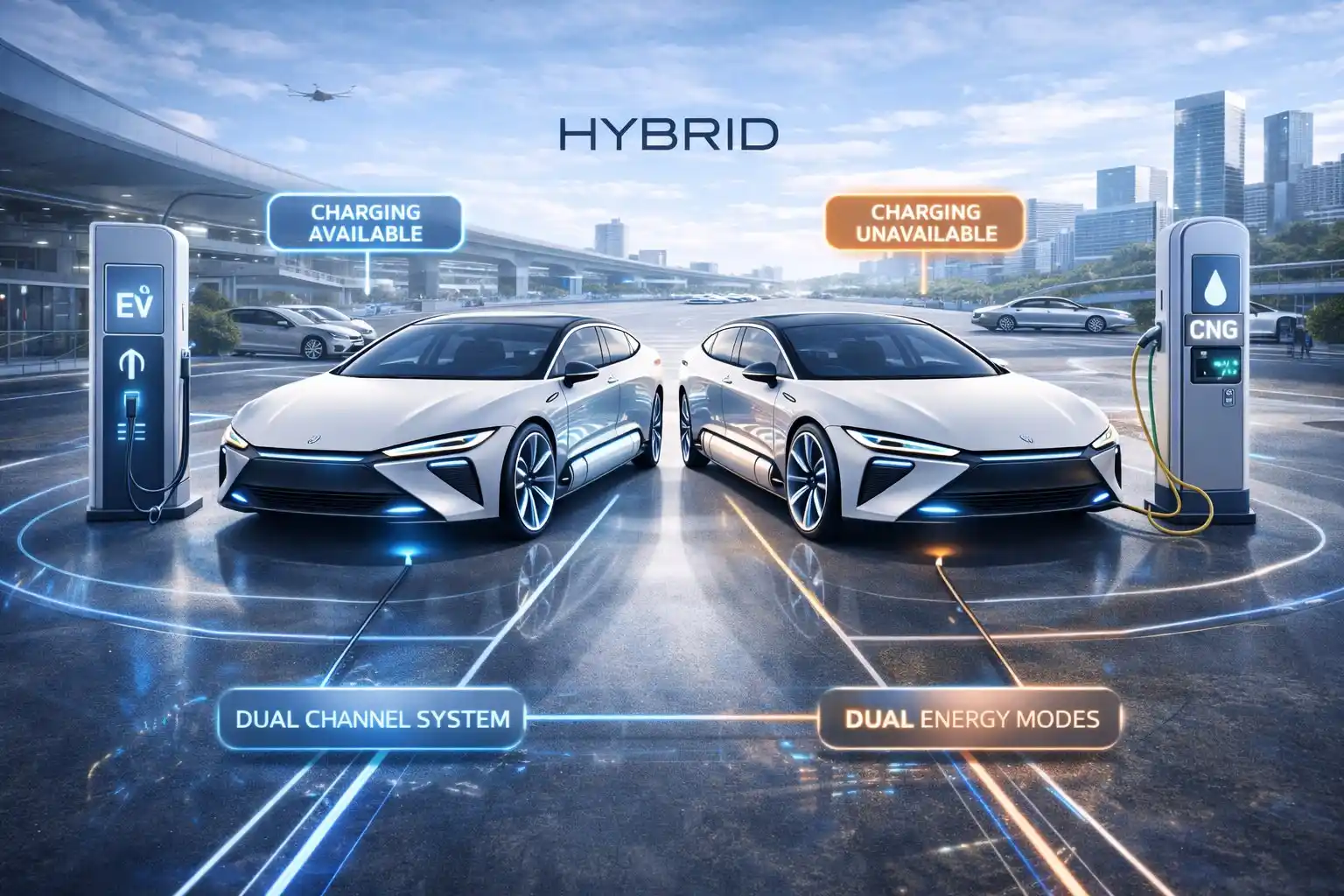
The fuel system follows the same layered logic. This is a dual-path fuel architecture, not because two fuels are automatically superior in the abstract, but because the machine is being designed around bounded fallback and mission fit.[3][4][6][9][10] One pathway preserves broad operability and familiarity. The second pathway adds a reserve option where continuity, route uncertainty, or regional infrastructure conditions justify it. Read properly, this is not “gas does the work.” Fuel remains only one layer in the total stack. The architecture’s real case still depends first on lower mass and hybridization.
For lighter road vehicles, that second fuel path is usually most credible in CNG-centered form.[3][6][10] LNG remains part of the wider thesis, but its strengths appear more clearly where the vehicle is larger, the duty cycle is longer, the storage penalty is easier to absorb, or the argument shifts outward into corridor logistics, export infrastructure, and power-sector transition.[5][6] That split is not a retreat from LNG. It is what makes the full gas branch look physically serious rather than rhetorically indiscriminate.
Structurally, the machine is supposed to be disciplined rather than dramatic. Its structure philosophy is ultra-light, mixed-material, and subtractive.[1][2][7][9] That means tighter mass control, selective use of lighter materials where they actually improve the whole system, and resistance to unnecessary component burden. The same principle extends into its control architecture. This is a subtractive control philosophy, not a feature-maximalist one: lower command-stack dependence, less unnecessary always-on compute, less hidden reliance on cloud mediation or telemetry for basic usefulness, less drive-by-wire dependence where unnecessary, simpler critical control pathways, and a preference for graceful degradation over brittle sophistication. In harder resilience variants, this philosophy also supports selective shielding or isolation of critical electronics and a bias toward preserving steering, braking, propulsion continuity, and restart viability under severe electronic stress. None of that requires romanticizing primitiveness. It simply treats software and remote dependence as engineering variables rather than as automatic progress.
The hardest reality is tank and packaging philosophy, and this section has to say that clearly.[2][6][8][10] Storage burden is real. Tank placement, crash protection, usable cargo volume, service access, cabin intrusion, total vehicle balance, inspection burden, and field-maintenance coherence are all real design constraints. A concept that ignores them stops being engineering and becomes illustration. So the architecture only survives if storage is kept mission-matched and moderate rather than inflated into symbolic range maximalism. In fleet, work-use, rural, or continuity-sensitive roles, some packaging compromise may be justified because fallback value is real. In mainstream household or dense urban use, the same compromise becomes much harder to defend. The design is therefore only coherent if packaging is treated as part of the architecture’s survival test, not as a detail to be solved later.
Taken together, the vehicle should be seen as degraded-mode-capable rather than merely dual-fuel. That is the more accurate object definition. It is a lighter hybrid machine with bounded fallback, lower reliance on centralized control layers, and a deliberate attempt to remain useful under less-than-ideal operating conditions. That does not mean every hardening branch is already proven, and it does not require treating speculative mini-engine or extreme fallback concepts as the core proof. The mainline object is already clear enough without that. It is a road vehicle designed to trade some elegance for continuity, some purity for robustness, and some monoculture simplicity for layered mission fitness. That is what the machine actually is.
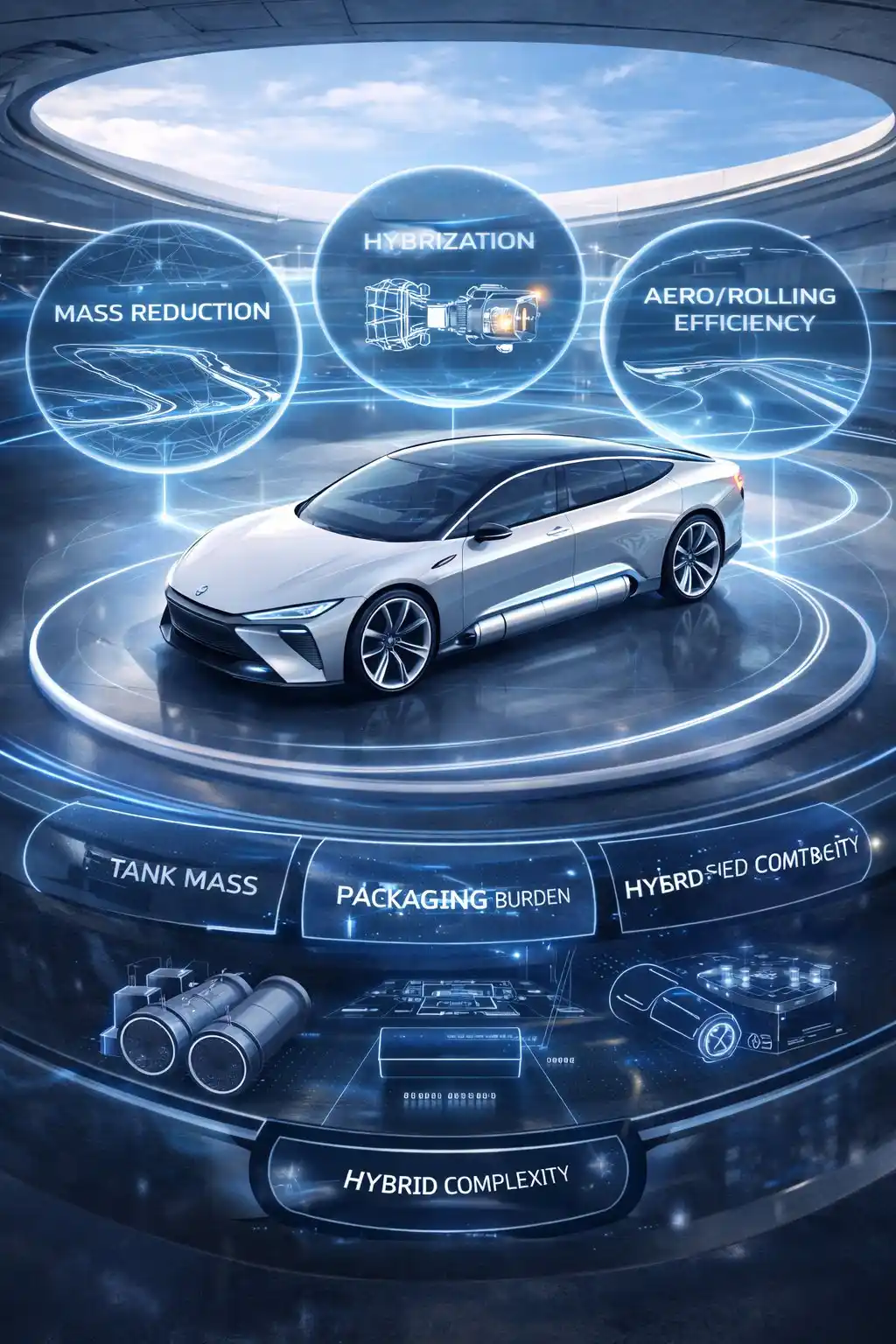
4. Where the gains really come from
The gains in this architecture come from a ladder, not a label. The first rung is lower mass. The second is hybridization. The third is right-sized storage. The fourth is lower parasitic burden through tighter systems discipline. Only after those does the LNG/CNG branch make sense as a meaningful contributor.[1][2][6][7][8] That order matters because it keeps the engineering honest. If the object remains too heavy, too burdened, or too compromised by packaging, the fuel switch does not rescue it. The architecture only survives if the machine itself is improved before the fuel pathway is asked to help.
Lower mass does most of the quiet work.[1][7] A lighter vehicle needs less energy to accelerate, less energy to recover from each stop, less energy to carry reserve, and less energy to move itself through the same duty cycle. That advantage compounds across the entire system. It reduces the burden on the hybrid drivetrain, keeps storage from growing into a structural penalty, and makes every later gain easier to preserve. This is why lightweighting belongs at the top of the gain ladder rather than being treated as a styling flourish or premium-material gesture. In a disciplined version of the concept, mass reduction is not one improvement among many. It is the precondition that makes the rest of the stack credible.
Hybridization and right-sized storage come next because real vehicles do not live in steady-state conditions. They stop, idle, queue, climb, descend, and absorb uneven transient loads. A hybrid drivetrain can recover part of what would otherwise be thrown away in braking, smooth sharp demand spikes, reduce idle waste, and keep the combustion side working closer to better efficiency regions.[1][2][6][8] The battery matters here, but in a bounded way. It is not sized to redefine the machine as a battery-dominant architecture. It is sized to sharpen the duty cycle. That is why the paper presents the possible emissions reductions in bands rather than as one headline figure: roughly 30–40% in more realistic cases, roughly 45–60% in stronger cases, and up to 50–70% only under highly favourable, idealized conditions.[1][7][9] Those upper-end figures should be read as scenario-level or concept-stage upside, not as validated mainstream fleet reality
The LNG/CNG contribution is real, but bounded and conditional.[1][2][6][7][8] The allowed reading is narrow: natural gas often has lower combustion-side carbon intensity than gasoline or diesel, but the climate advantage is conditional on methane leakage discipline, duty cycle, and whole-system fit. That means the fuel branch cannot carry the whole case. If methane discipline is weak, the fuel-side advantage weakens. If methane discipline is strong and the architecture is already doing the harder engineering work through lightweighting, hybridization, right-sized storage, and lower parasitic burden, then the fuel pathway becomes a meaningful addition to the stack rather than a slogan. The architecture is not efficient because it uses gas. It is efficient when gas is added to a machine that was already made better.
The penalty ladder matters just as much as the gain ladder.[2][6][8][10] Tank mass is a penalty. Packaging burden is a penalty. Hybrid-system complexity is a penalty. Dual-fuel integration is a penalty. Storage inspection is a penalty. Fueling-network thinness can be a penalty. Certification, service, and insurance friction are penalties. These are not minor caveats to hide behind optimistic arithmetic. If storage intrudes too far into cargo or cabin function, if serviceability becomes awkward, if complexity rises faster than efficiency gains, or if certification and field support become too burdensome, the concept weakens quickly. The architecture survives only if the gains from lower mass and hybridization remain large enough to outweigh the burdens introduced by tanks, packaging, integration, and support requirements.
So the honest accounting is neither hype nor retreat. The strongest gains are structural: lower mass, hybridization, right-sized storage, and lower system burden. The fuel branch strengthens the architecture only when those deeper gains are already present and only when methane and deployment conditions are handled honestly. The upper-end ranges remain bounded. The penalties remain visible. And the final test stays simple: the concept survives only if the lightweighting and hybrid gains are large enough to outweigh the packaging and system penalties it introduces.
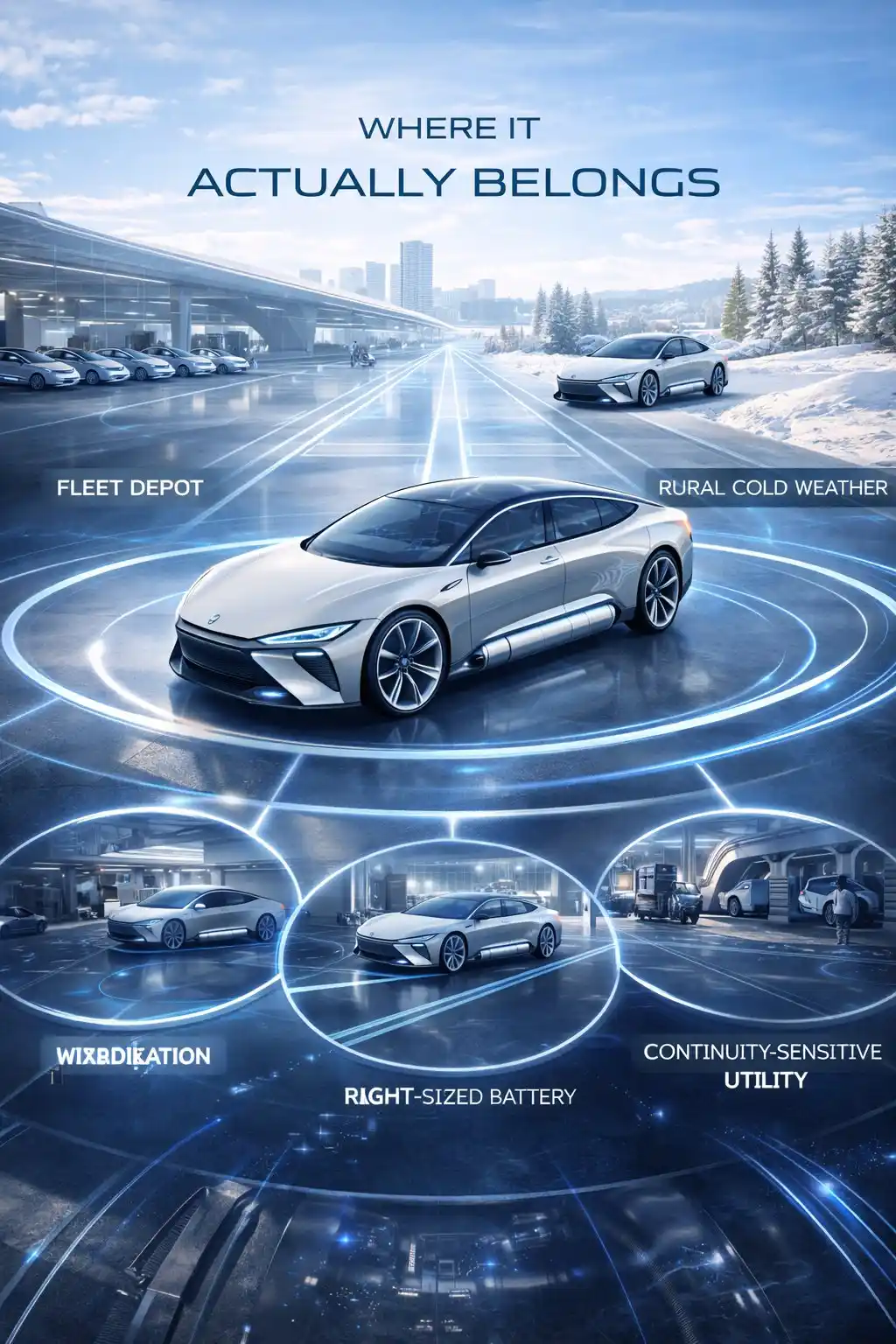
5. Where this architecture actually belongs
The cleanest way to place this architecture is to stop asking where it wins in the abstract and start asking where it fits under clearly named benchmark lanes. In the stable-grid lane, the vehicle is judged in a world where charging depth, service coverage, grid reliability, and routine infrastructure access can be treated as reasonably dependable. In the hostile-future lane, the benchmark changes. Blackout continuity, sparse infrastructure, cold-weather margin, reserve logic, degraded local operability, lower command-stack dependence, and survivability under severe electronic disruption begin to matter more.[3][4][10] The architecture does not look the same under those two scoring systems, and one reason transport analysis has stayed confused is that too many arguments quietly switch between them without saying so. This section keeps them separate.
In the stable-grid lane, the best fit is already selective rather than universal. The architecture is strongest in fleet-first roles, because fleets can evaluate vehicles as tools, centralize fueling and maintenance, and decide whether added complexity is justified by measurable uptime or route value.[3][6][10] It also fits work-use and service vehicles, where stop-start duty cycles, route variability, and the cost of lost operability are more important than consumer smoothness. From there the case extends into rural utility, cold-weather regional, and other continuity-sensitive road-vehicle roles where infrastructure cannot be assumed to be dense, elegant, or always available. In those environments, the architecture’s layered design begins to make sense because the mission actually rewards some combination of lower mass, hybrid efficiency, fallback value, and tolerance for harder operating conditions.
The hostile-future lane strengthens that same mission set, but in a bounded way. Here the architecture does not become universally superior; it becomes more compelling in the roles that were already its natural home. Fleet, work-use, rural, cold-weather, and continuity-sensitive segments rise because the benchmark now rewards reserve logic, local operability, lower command-stack dependence, and lower electronic fragility more heavily than it does under calm-grid assumptions.[3][4][10] A vehicle that can remain useful when charging depth is poor, when service access is thinner, when winter increases margin requirements, or when software-heavy infrastructure becomes less trustworthy is solving a different problem from the one solved by a convenience-maximal urban commuter platform. Under that hostile-future road-vehicle benchmark, the resilience architecture can become one of the strongest general road-vehicle answers in the paper. But that result stays lane-specific. It is a road-vehicle judgment under harder conditions, not a universal transport verdict.
That distinction matters most when the vehicle is compared against ordinary alternatives in real operating niches. A rural service platform that must cover long routes in winter, a municipal or utility fleet vehicle that cannot depend on graceful failure turning into immobilization, or a continuity-support machine that has to keep moving under degraded conditions all value different things than a household commuter car in a dense corridor. In those cases, reserve logic is not decorative. It means the vehicle carries part of its continuity problem with it. Local operability matters because it reduces the number of external layers that must remain functional for the machine to stay useful. Lower command-stack dependence matters because a transport system that relies on fewer remote permissions, less cloud mediation, and less software-centralized infrastructure can degrade more gracefully when surrounding conditions worsen. Those are real mission advantages, but only in the missions that actually reward them.
This is also the place where the paper now has to say something more explicit than before: a mature transport society should preserve a bounded civilian resilience lane.[3][6][10] That does not mean mass civilian militarization, nor does it mean retreat from transit or electrification. It means some regular citizens — especially in rural, cold-weather, sparse-infrastructure, or continuity-sensitive settings. — have a rational case for vehicles that prioritize fallback, local usefulness, and lower brittle dependence over pure convenience-maximal elegance. A system that leaves no room for that lane is not necessarily more advanced. It may simply be more fragile.
Just as important is the explicit non-claim: this architecture is not the mainstream household default.[2][6][8] It is not naturally strongest in dense urban private-car use, and it does not overturn the superiority of rail or buses where the real problem is corridor efficiency, throughput, or mode shift. It also does not automatically beat EVs, PHEVs, or standard hybrids in routine light-duty contexts where cleaner-grid electrification, packaging simplicity, or partial electrification solve the mission more cleanly. The concept weakens when the mission does not reward onboard reserve, when packaging burden is not worth paying for, when fueling friction matters more than fallback value, or when the surrounding infrastructure is already good enough that layered redundancy becomes less valuable than simplicity. The report is stronger because it says this directly.
So the mission-fit ladder is neither everywhere nor niche curiosity. In the stable-grid lane, the architecture belongs first in fleet-first, work-use, rural, cold-weather, and continuity-sensitive roles. In the hostile-future lane, those same roles become even more favorable because the benchmark starts rewarding reserve, degraded local usefulness, and lower brittle dependence. But the result is still segmented. Rail and bus keep their clear wins where they deserve them. EVs, PHEVs, and standard hybrids keep their own lanes of superiority. The resilience vehicle survives not by trying to become everything, but by occupying the missions where one-path dependence is least trustworthy and where a lighter, layered, more locally operable road vehicle still has serious work to do. That narrowing is not a weakness. It is the reason the architecture becomes more believable as its role becomes more precise.
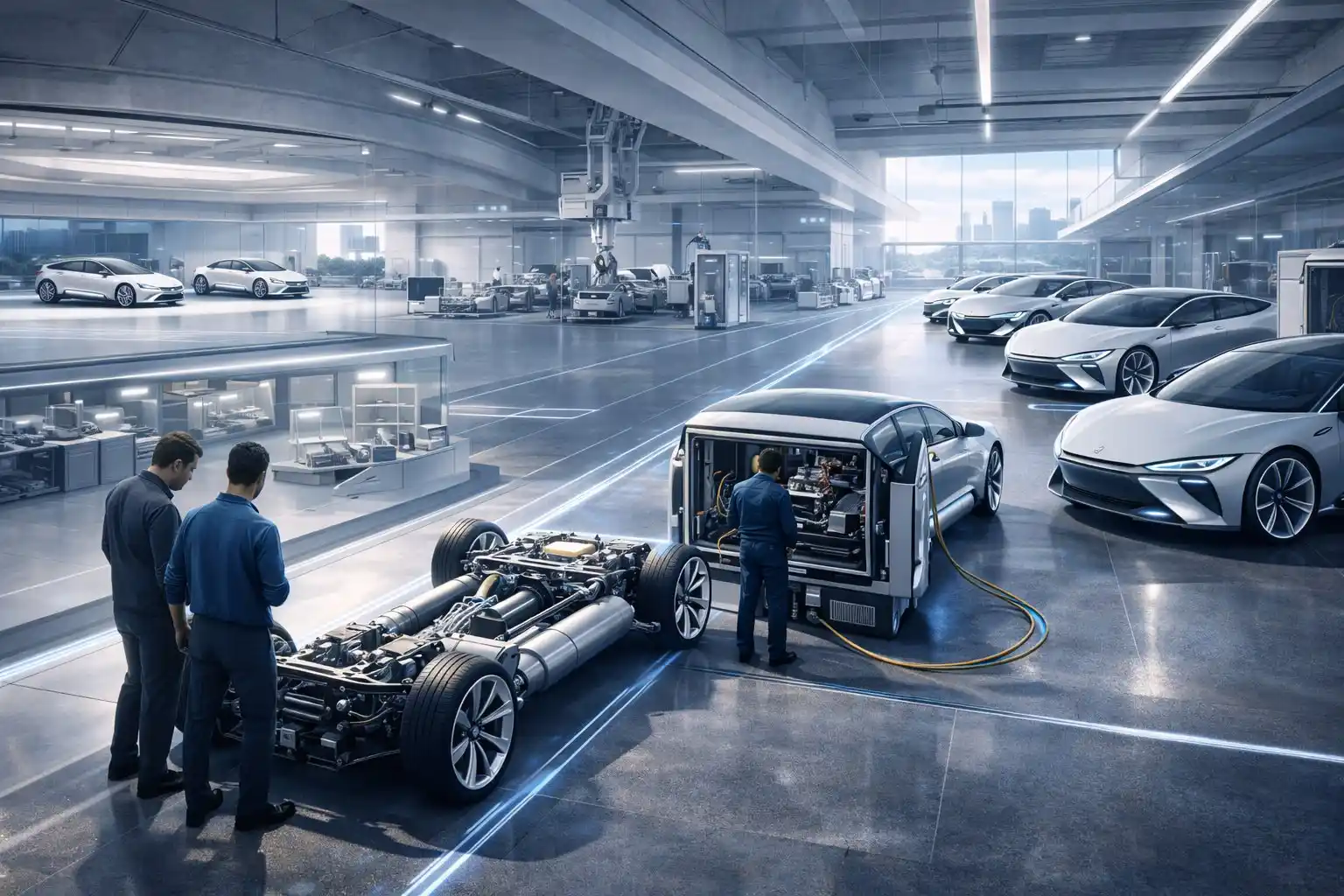
6. Can it actually be built, sold, and serviced?
The architecture only becomes serious if it can survive contact with deployment. That means asking not just whether the machine is coherent on paper, but whether it can be built, supported, serviced, insured, and adopted without the commercial reality erasing the engineering thesis. The answer is bounded. The most credible economic home is fleet-first, where vehicles are judged as tools rather than as default household purchases, and where fueling, maintenance, uptime, route discipline, and reserve logic can be managed deliberately.[3][6][10] In that setting, some added complexity can be justified if it delivers measurable continuity or operating value. Outside that setting, the case becomes much harder.
That is why the strongest commercialization path is OEM-first or purpose-built, not an assumption that the concept will glide naturally into mainstream retail.[2][6][8] A purpose-built architecture can solve around packaging, service access, certification, safety integration, and component fit from the start. It can be designed as a coherent object instead of patched together through compromise. That does not mean retrofit has no role. It means retrofit should be treated as a bounded bridge: useful in some durable fleet, service, or work-use cases, but not the long-run center of gravity.[4][10] The concept becomes more believable when retrofit is described as a transitional deployment path rather than as the primary route to broad scale.
Retail economics are weaker, and the paper should say that plainly.[2][6][8][10] Packaging burden, fueling friction, resale uncertainty, certification burden, insurance complexity, service unfamiliarity, and local competence scarcity all weigh more heavily in fragmented household markets than they do in controlled fleet settings. A fleet can absorb some of that friction because it can standardize operations and evaluate total usefulness directly. A household buyer is often buying convenience, familiarity, resale confidence, and low-friction service access. That is one reason this architecture is not a natural retail-default proposition. It does not fail because markets are irrational. It weakens because the commercial filters are different, and many of those filters penalize exactly the kinds of tradeoffs the architecture asks some users to accept.
At the same time, weaker retail economics do not erase the legitimacy of a bounded civilian lane. They only mean that a resilience vehicle should not be treated as an invisible default waiting to happen. Some citizens can rationally want it. That does not mean all citizens will. The correct commercial reading is not “mass-market inevitability.” It is “selected civilian and fleet demand may remain defensible where continuity value is real.”
The time horizon also has to be split cleanly. In the near term, the concept is strongest as a transitional and resilience-oriented road-vehicle system operating under imperfect infrastructure, imperfect grids, and mission-specific constraints.[3][5][10] In the medium term, its viability depends on whether it can move beyond one-off novelty and into fleet learning, better packaging discipline, service familiarity, and purpose-built or OEM-integrated platforms. In the end-state view, the paper should not claim that LNG/CNG hybrid dual-fuel architecture is the final universal destination of transport. Its strongest status remains bounded: a serious, segment-specific architecture whose value may persist in the missions that continue to reward fallback, continuity, and lower brittle dependence even as other transport lanes evolve differently.
So the commercial verdict is narrower than the engineering verdict, but more useful because of that. This architecture does not need universal economic superiority to matter. It only needs to clear the threshold in the places where its particular strengths are actually rewarded. That means fleets before households, purpose-built platforms before broad retail diffusion, bounded retrofit before imagined mass conversion, and staged learning before claims of obvious scale. The concept survives commercially only if it stays disciplined enough to enter the world through the lanes that actually fit it.
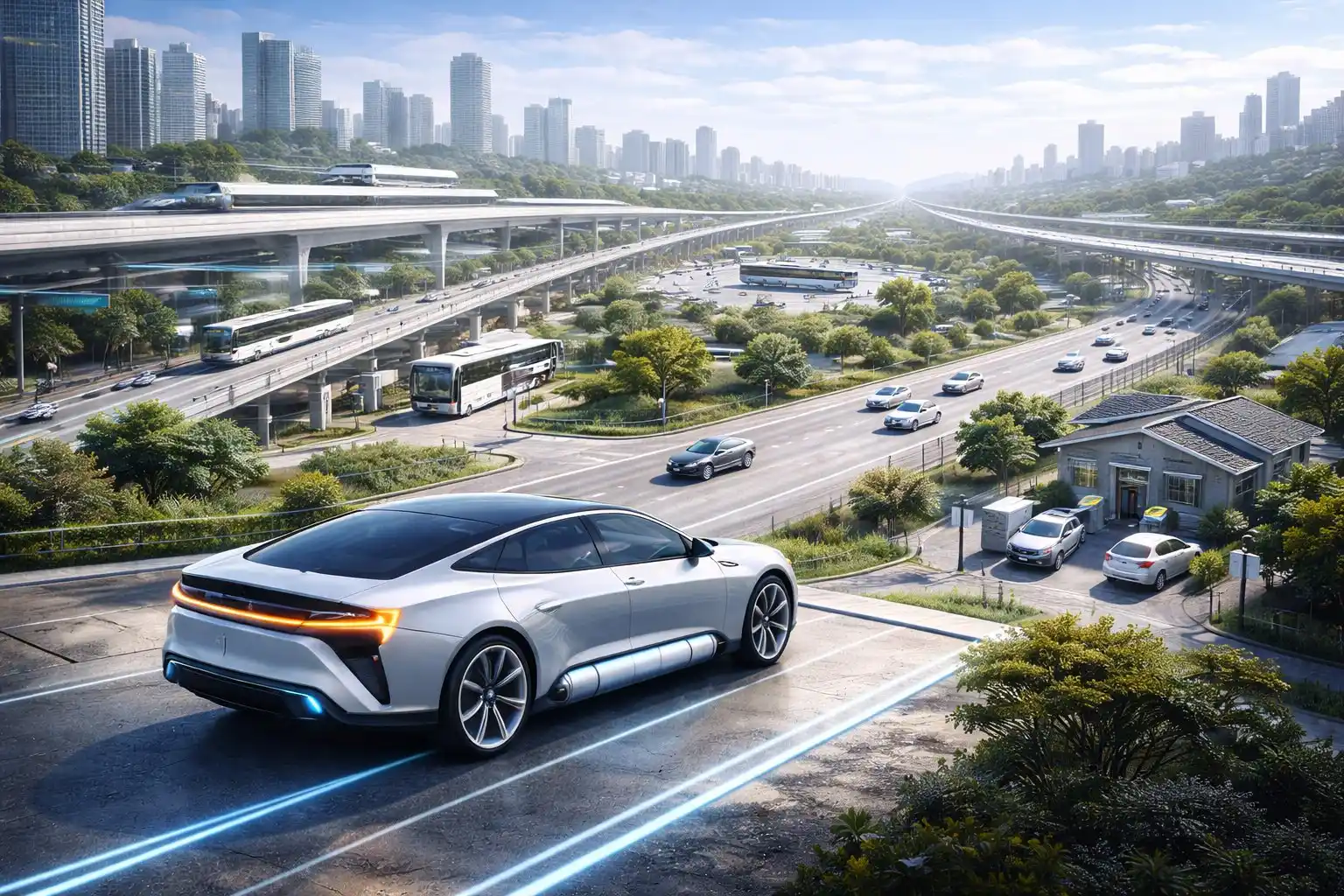
7. Where it loses, and what beats it
A serious architecture becomes more credible when it states plainly where it does not win. This one loses in places where the transport problem is being solved at a different level, or where its own tradeoffs are not rewarded by the mission. That is not a weakness in the paper. It is one of the conditions that makes the surviving claim believable. The resilience vehicle thesis only works if its losing cases remain visible rather than being explained away.
The clearest losses appear in dense, high-occupancy corridors. In those environments, rail and electric buses often beat private-vehicle optimization because the governing variable is not the elegance of an individual machine but system throughput, corridor efficiency, and passenger movement at scale. IPCC AR6 Chapter 10 states that at high occupancy, both bus and rail offer substantial greenhouse-gas reduction potential per passenger-kilometre even compared with the lowest-emitting private vehicle options, and notes that under low-carbon electricity even bus or passenger rail at 20% occupancy can still outperform very low-emitting private BEV options on a passenger-km basis. World Bank rapid-transit guidance makes the same point in transport-design language: in some corridors the decisive technology is not a better private car but a higher-capacity public-transport system. That is why the paper should keep this loss explicit rather than softening it.
There are also many routine light-duty settings where EVs win.[2][6][8] In clean-grid, charging-rich contexts with stable infrastructure, predictable usage, and strong service support, a pure EV can offer a cleaner and simpler answer than a layered dual-fuel fallback machine. In those missions, the resilience vehicle’s added storage burden, packaging discipline, and systems complexity may not earn enough return to justify themselves. That is especially true where the benchmark prioritizes low-friction convenience under stable conditions rather than continuity under degraded ones.
Likewise, PHEVs and standard hybrids often beat this architecture in roles where partial electrification captures much of the useful efficiency gain without imposing as much packaging burden or fuel-system complexity.[2][6][8] In many simplicity-favorable roles, they solve the mission more cleanly. They can preserve much of the real-duty-cycle advantage of hybridization while avoiding some of the penalties that come with a second fuel pathway and its associated storage burden. This is one reason the resilience vehicle cannot be defended as the default answer in ordinary retail markets: in many such cases, the simpler layered alternative already exists and is easier to support.
Even under disruption, standard ICE remains a mixed case rather than an automatic loser.[3][6][10] It preserves familiar fueling logic and straightforward fallback under many conditions. But it is not superior once the benchmark begins to reward not just continuity, but engineered efficiency, lower mass, hybrid duty-cycle gains, and a more disciplined systems philosophy. In other words, ICE can remain relevant under stress without becoming the best answer. It keeps some continuity advantages while giving up too much on the deeper efficiency logic that makes the resilience architecture distinctive.
That leaves the paper with a narrower but stronger conclusion: the resilience vehicle wins only in bounded lanes.[2][3][6][10] It becomes compelling where the mission rewards fallback, reserve logic, local operability, sparse-infrastructure usefulness, cold-weather continuity, and lower command-stack dependence. Outside those lanes, other systems often beat it more cleanly. That is why the right interpretive rule is simple and should remain explicit: different benchmark worlds produce different winners. The paper stays credible because it does not fight that fact. It uses it to place the architecture where it actually belongs.
8. Why it still matters
This architecture still matters because it points to a deeper design lesson than the vehicle itself. The lesson is not that one overlooked fuel should now dominate transport. The lesson is that transport systems become fragile when they are optimized too aggressively around one elegant pathway, one infrastructure assumption, or one centralized control logic. The resilience-vehicle thesis matters because it reopens a different question: what kind of machine remains useful when the surrounding system becomes less cooperative than expected. That is a design question before it is a market question, and it remains important even where this exact architecture stays bounded.
One reason the thesis retains value is the AI and command-stack systems-risk branch. Modern transport systems are increasingly shaped by OTA dependence, cloud linkage, telemetry density, software-mediated permissions, and higher levels of centralized digital coordination. Under ideal conditions, some of that can improve convenience, diagnostics, and fleet management. But it also creates more layers between driver intent and basic mobility, more hidden control surfaces, and more reliance on infrastructure that the vehicle itself does not carry. In that light, lower compute burden, lower remote dependence, and fewer hidden control surfaces are not nostalgia. They are an alternate engineering preference: one that values graceful degradation over elegant dependence when the mission requires it.
That preference matters beyond the vehicle because it challenges a broader systems habit: the assumption that the most advanced architecture is always the most centralized, most software-mediated, and most tightly integrated into remote infrastructure. Sometimes that is true. Sometimes it is not. Layered systems can outperform brittle monocultures when the operating world is less forgiving than the design world. A lighter hybrid vehicle with bounded fallback, lower external dependency, and more local usefulness may therefore matter not only as a product category, but as an example of a wider engineering principle: resilience is often built by reducing total system brittleness, not by merely adding more intelligence on top of fragility.
The command-stack critique is also stronger when stated as a governance fact. UNECE’s cyber-security and software-update regulations, together with NHTSA’s safety-oriented cybersecurity guidance and firmware-update research, make clear that connected-vehicle cybersecurity, OTA software-update controls, and lifecycle software governance are treated as real safety and compliance issues rather than as optional abstractions. That does not prove centralized digital architectures should be rejected wholesale. It does support the paper’s narrower point: lower remote dependence and fewer hidden control surfaces can be a real design advantage in missions that value graceful degradation and local operability more than maximal digital elegance. The same bounded logic applies to the industrial branch. LNG revenue matters in this paper only as a conditional mechanism, not as a slogan.[5][3][10]
The relevant claim is not that extraction automatically solves industrial decline or funds decarbonization by itself. The narrower and more serious claim is that energy revenues could support cleaner infrastructure, advanced materials, manufacturing depth, and transport-system upgrading if revenue capture exists, if reinvestment rules are real, and if the proceeds are integrated into a builder-economy strategy rather than dissipated as commodity gain alone.[5] That conditionality is important. Without mechanism, the claim weakens. With mechanism, the architecture can be linked to a broader transition logic that includes industrial rebuilding rather than mere fuel substitution.
This is also where the builder-economy and industrial-sovereignty branch matter.[5][3][10] A transport system is not only a set of vehicles; it is also a set of supply chains, repair cultures, manufacturing capabilities, materials disciplines, and operating assumptions about who can build, maintain, and adapt the machine. A lighter, more repair-conscious, less command-stack-dependent vehicle architecture may fit better with an economy that is trying to recover competence in making and servicing real things under imperfect conditions. That does not make it universally superior. It means the thesis has value at more than one level: vehicle design, systems resilience, industrial posture.
Most importantly, the civilian resilience lane belongs here too. A society that leaves no room for bounded civilian continuity tools may congratulate itself for elegance while quietly surrendering minimum baseline safety and optionality. The point is not to convert every commuter into a prepper. It is to preserve a transport mix where some citizens, in some environments, can rationally choose machines that are more locally operable, more tolerant of harder conditions, and less dependent on centralized fragility. That is not an anti-modern demand. It is a modest claim about system maturity.
So the deeper reason this architecture still matters is not that it abolishes the rest of the transport field. It matters because it helps expose a broader error: the tendency to confuse purity with fitness and sleek centralization with robustness. The more durable lesson is calmer than that. Transport may be stronger when it uses layered systems instead of brittle monocultures, when it reduces hidden dependence instead of celebrating it automatically, and when it assigns different architectures to the missions they actually serve best. Even where this vehicle remains bounded, that design lesson survives.
9. Final judgment
The final judgment is deliberately bounded. This architecture is not universal, and the paper is stronger because it refuses to pretend otherwise. It does not replace the full transport hierarchy, it does not erase the clear advantages of rail or buses in dense high-throughput corridors, and it does not overturn the fact that EVs, PHEVs, and standard hybrids remain better fits in many routine stable-grid roles. The surviving claim is narrower and more serious than that.
Within that narrower frame, however, the concept retains a serious role. Its strongest case is as a road-vehicle answer under bounded conditions: fleet-first use, work-use platforms, rural and cold-weather operation, and continuity-sensitive missions where fallback, reserve logic, local operability, lower command-stack dependence, and lower electronic fragility have real value.[1][2][6][3][10] In those lanes, the architecture is not a symbolic compromise. It is a distinct systems answer built around lower mass, hybridization, bounded dual-path operation, and reduced brittleness under harder conditions.
The stable-grid losses remain visible and should remain visible. That is part of the paper’s credibility. In clean-grid, charging-rich, routine light-duty contexts, other architectures often solve the mission more cleanly. In dense corridors, higher-occupancy systems remain superior. In packaging-sensitive mainstream retail markets, simpler architectures often win because the resilience vehicle’s tradeoffs are not rewarded enough to justify their burden. The concept does not become stronger by denying those losses. It becomes stronger by surviving after they are admitted.
The hostile-future branch also remains bounded. Under that benchmark, the architecture can become one of the stronger general road-vehicle answers in the paper because the scoring begins to reward blackout continuity, sparse-infrastructure usefulness, cold-weather margin, degraded local operability, lower dependence on centralized digital command layers, and greater survivability under severe electronic disruption.[3][4][10] But even there, the result is mission-specific, not universal. The paper is not claiming that one harder future automatically makes every other transport form obsolete. It is claiming that under harder conditions, some road-vehicle missions are better served by a lighter, layered, fallback-capable architecture than by one-path dependence alone.
And this is where the final civic claim should now remain explicit: a mature transport society should allow a bounded civilian lane for resilience-oriented vehicles where geography, climate, infrastructure uncertainty, or continuity needs make them rational tools rather than luxury eccentricities.[3][6][10] That is not a rejection of EVs, transit, or electrification. It is a refusal to let monoculture erase minimum baseline safety and optionality for the people who genuinely need them.
So the final formula is simple and should remain the closing rule of the project: different architectures fit different missions. Rail belongs where throughput and mode efficiency dominate. EVs belong where stable-grid electrification is genuinely the cleanest and simplest answer. PHEVs and hybrids belong where partial electrification captures most of the benefit with less burden. The resilience vehicle belongs where the benchmark begins to reward continuity, fallback, local usefulness, and lower brittle dependence. That is not a universal verdict. It is a more disciplined one.
Appendix A — Evidence Ladder
This paper uses a four-level evidence ladder to preserve rigor and keep the flagship from leaning on claims that are too weak, too inflated, or too speculative for the main spine.[1][2][4][5][6]
1. Proven / strongly supported These are the claims the flagship is allowed to lean on directly. They are structurally central and stable enough to appear in the main body without defensive hedging. In this project, that includes the benchmark split itself, the first-principles ordering of the architecture, the importance of mass reduction and hybridization, the fact that fuel is only one layer in the stack, the reality of packaging penalties, the fleet-first adoption path, and the point that rail and electric buses outperform private-vehicle optimization in some dense, high-occupancy corridors.
2. Plausible but conditional These are claims the paper may keep, but only with narrower wording and visible conditions. In this project, that includes fuel-side climate advantage for natural gas, hostile-future road-vehicle strength, LNG-revenue-to-reindustrialization logic, the industrial-sovereignty branch, and the civilian resilience lane. These claims survive only when the conditions are stated: methane discipline, system fit, benchmark lane, policy mechanism, and bounded scope. In this project, that also includes EMP-informed design selection for hostile-future variants where lower electronic fragility, simpler control pathways, and selective hardening materially strengthen continuity design.
3. Scenario-level / concept-stage These are valuable claims, but they are not allowed to carry the main argument as settled proof. They include best-case passenger-kilometre comparisons, upper-end stacked reduction bands when treated as outcomes rather than design-upside signals, and hardening branches such as geomagnetic disturbance or AI-lockout when framed as direct selectors of mainstream architecture. EMP remains high-consequence and conditional, but in this project it also functions as a legitimate selector for hostile-future resilience variants rather than as appendix-only color. They remain visible because they matter to the full logic, but they belong mainly in appendices, matrices, or explicitly ranked scenario lanes.
4. Removed / excluded from the main body These are claims the project deliberately refuses to use as part of the flagship spine. They include universal-answer language, broad anti-EV rhetoric, motive-attribution claims, overconfident geopolitical destiny narratives, and any phrasing that treats concept-stage ranges as validated fleet reality.
The ladder is also a placement rule. Proven claims belong in the body as load-bearing material. Plausible claims may appear in the body only with bounded wording and clear conditions. Scenario-level claims belong mainly in appendices or ranked scenario treatment. Removed claims do not return to the flagship body at all.
That is the core discipline that prevents the package from drifting back into compression, hype, or hidden overreach.
Appendix B — Design Matrix
This appendix defines the machine in one place.[1][2][4][6][7][8][9]
Primary architecture An ultra-light gasoline–CNG parallel hybrid configured as a decentralized fallback road-vehicle architecture.
Secondary derivative A resilience-oriented derivative using the same design philosophy in more continuity-sensitive, work-use, regional, or emergency-support roles.
Battery philosophy Small-to-moderate, right-sized hybrid battery. Its job is regenerative braking, torque fill, transient smoothing, and bounded electric assist. It sharpens the drivetrain rather than redefining the architecture.
Fuel-path philosophy Gasoline preserves broad compatibility and operating familiarity. CNG adds a bounded second pathway where fueling conditions, continuity value, cost logic, or climate logic justify it.[3][4][6][9][10] LNG remains more relevant to heavier-duty, longer-range, or derivative branches than to the primary light-duty architecture itself.[5][6]
Structure philosophy Ultra-light mixed-material structure with disciplined control of mass, including aluminum, selective composites, lower-mass subsystems, aero improvement, reduced rolling resistance, and tighter parasitic-load discipline.
Tank and packaging philosophy Moderate, mission-matched gas storage rather than symbolic range maximalism. Storage must preserve as much cargo, passenger function, service access, and crash-integrity logic as possible. If storage geometry or tank burden destroys utility, payload logic, or maintenance coherence, the concept weakens sharply.
Control philosophy Subtractive design with lower command-stack dependence: less unnecessary always-on compute, less excessive telemetry, less cloud-mediated permission logic, less unnecessary drive-by-wire dependence, simpler critical control pathways, selective hardening or isolation of essential electronics where feasible, and a bias toward graceful degradation over feature-heavy dependence.
Gain hierarchy
-
Lightweighting
-
Hybridization
-
Right-sized storage
-
Lower parasitic burden and subtractive simplification
-
Fuel contribution later, in bounded form
Penalty hierarchy
-
Tank mass and packaging burden
-
Hybrid-system complexity
-
Dual-fuel integration complexity
-
Certification, service, and insurance friction
-
Retail-market adoption burden
Best customer Fleet-first, work-use, controlled operations; especially rural, cold-weather, service, utility, and continuity-sensitive roles.
Path to market Fleet-first deployment, then work-use expansion, then OEM-first or purpose-built integration, and only then bounded niche expansion.
Long-run status Transitional, bounded, serious role. Not the universal final destination of transport.
Appendix C — Mission-Fit Matrix
The mission-fit logic works across two lanes: stable-grid and hostile-future.[2][3][5][6][8][10]
Best fit Fleet light-duty vehicles, work-use and service vehicles, rural utility vehicles, cold-weather regional vehicles, emergency or continuity-support roles, and bounded civilian resilience use in the environments that actually reward it.
Conditional fit Selected small commercial platforms, bounded passenger-car roles, specialized intercity private-use roles, and niche resilience-oriented premium vehicles.
Weakest fit Mainstream household default car, dense urban private-car use, rail-dominant or high-density corridors, and charging-rich, clean-grid routine light-duty use.
Stable-grid lane The architecture stays bounded. It fits where routes, maintenance, and continuity value justify layered design, but it loses clearly in dense transit corridors and in many routine convenience-oriented light-duty markets.
Hostile-future lane The architecture strengthens because continuity, fallback, sparse-infrastructure operability, cold-weather margin, reserve logic, and lower command-stack dependence begin to matter more. Even there, the result remains segmented, not universal.
Main competitors that often beat it Standard hybrids, PHEVs, EVs, simple ICE in some low-complexity markets, and rail, bus, or metro in high-density corridors.
The matrix is meant to keep the article disciplined: the architecture gets stronger when it is assigned to the missions it actually fits, and weaker when it is stretched toward universal relevance.
Appendix D — Excluded Claims and Boundary Rules
This appendix preserves credibility by naming what the paper refuses to claim.[1][2][4][6]
Excluded universal claims The paper does not claim that this architecture is the universal future of transport, or that one propulsion pathway should dominate every mission, geography, climate, or infrastructure context.
Anti-EV universal claims excluded The paper does not claim that EVs fail in general, nor that electrification is inherently misguided. EVs remain strong in several benchmark lanes.
Rail-substitution claims excluded The paper does not claim that private-vehicle optimization is the best answer in rail-dominant, high-density, or high-throughput corridors.
Validated-fleet overreach excluded The paper does not present concept-stage or best-case quantitative ranges as if they were already validated mainstream fleet outcomes.
Motive-attribution claims excluded The paper does not rely on malicious-intent narratives or hidden-motive explanations as engineering proof.
High-consequence scenario overflow excluded from the main body EMP, geomagnetic disturbance, AI-mediated mobility lockout, and severe war-fracture scenarios remain visible, but they do not overrun the flagship spine.
A claim belongs in the flagship body only if it can survive without universalizing, dramatizing, substituting motive language for engineering logic, or erasing obvious competitor win-zones.
Appendix E — Climate Mitigation via Engineered Efficiency Upgrades
The climate logic of the architecture should be read in sequence.[1][7][2][8][6][9]
First: lightweighting
Second: mixed-material structure and lower-mass subsystems
Third: hybridization
Fourth: right-sized storage
Fifth: subtractive design and lower parasitic load
Sixth: aero and rolling-resistance improvement
Seventh: LNG/CNG or dual-fuel contribution where it improves whole-system fit
Eighth: occupancy, utilization, and mode efficiency where those become decisive
The project preserves a bounded set of quantitative climate bands:
-
roughly 20–30% lower GHG intensity per unit of energy at the fuel-intensity level for natural gas relative to gasoline or diesel, conditionally
-
roughly 30–40% as a realistic stacked reduction range
-
roughly 45–60% as a plausible stacked reduction range
-
roughly 50–70% only under highly favorable, idealized stacked conditions
All fuel-side climate claims are methane-conditioned. The allowed formulation is narrow: natural gas often has lower combustion-side carbon intensity than gasoline or diesel, but the climate advantage is conditional on methane leakage discipline, duty cycle, and whole-system fit.
The strongest climate claims in the package are structural:
-
lower mass lowers energy demand
-
hybridization improves real-duty-cycle efficiency
-
subtractive efficiency upgrades matter
-
fuel alone does not explain the architecture’s gains
The upper-end bands remain useful as bounded design-upside signals, not as validated fleet fact.
Appendix F — Quantified Efficiency Hierarchy
This appendix keeps three comparison layers separate.[1][2][7][8][9]
1. gCO2e/MJ Fuel-intensity layer. Useful for comparing energy pathways, but not enough on its own to settle vehicle efficiency.
2. gCO2e/vehicle-km Vehicle-performance layer. This is where mass, drivetrain efficiency, hybridization, storage burden, aero, rolling resistance, and total systems design matter.
3. gCO2e/passenger-km Transport-service layer. This is where occupancy changes the ranking and where cars must be compared against buses and rail.
The paper must not mix these units.
A fuel that looks better in gCO2e/MJ does not automatically win in gCO2e/vehicle-km.
A vehicle that looks better in gCO2e/vehicle-km does not automatically win in gCO2e/passenger-km.
The project preserves these bounded concept/scenario passenger-km comparisons:
-
ultra-light NG bus hybrid: roughly 25–40 gCO2e/passenger-km
-
ultra-light NG car hybrid: roughly 45–70 gCO2e/passenger-km
-
standard gasoline car: roughly 150–250 gCO2e/passenger-km
These are not to be treated as universal settled fleet averages. They remain bounded concept/scenario comparisons.
Validated / strongest Lighter vehicles use less energy. Hybridization improves real-duty-cycle efficiency. Fuel intensity alone does not settle whole-vehicle climate ranking. Passenger systems must be judged in passenger-km terms when occupancy changes the result.
Plausible / conditional The mid-range stacked reduction bands; the broad logic that ultra-light NG/CNG hybrid concepts can significantly outperform standard gasoline cars as machines; and the idea that the architecture’s strongest road-vehicle case comes from stacked design rather than fuel alone.
Idealized / concept-stage The strongest upper-end reduction bands, the best passenger-km arithmetic, and any suggestion that a favorable concept comparison already equals validated fleet hierarchy.
Appendix G — Evidence Grades and Missing Validation
This appendix is the anti-overclaim layer.[1][2][4][5][6]
Proven / strong Transport must be judged across named benchmark suites. Mass is the first lever. Hybridization is the second lever. Fuel is part of the stack, not the whole stack. Packaging burden can kill the concept. The architecture is strongest in bounded roles. Rail and electric buses dominate some dense corridor branches. Fleet-first is the most credible adoption path. Mainstream household dominance is not the claim.
Plausible / conditional Natural gas often has lower GHG intensity than gasoline or diesel, but only conditionally. Hostile-future road-vehicle strength. LNG revenues could support decarbonization and industrial upgrading, but only if a mechanism exists. Builder-economy and industrial-sovereignty support for the thesis. Resilience value from lower command-stack dependence, degraded local operability, and lower electronic fragility under severe disruption. A bounded civilian resilience lane as a legitimate category within the transport mix.
Idealized / concept-stage Upper-end stacked reduction bands when treated as achieved outcomes. Best-case passenger-kilometre comparisons. Geomagnetic disturbance or AI-lockout when used as direct selectors of mainstream architecture; EMP remains conditional and high-consequence, but is allowed to shape hostile-future resilience design rather than being treated as appendix-only decoration. Very strong transport arithmetic detached from deployment, packaging, service, and lifecycle constraints.
Weak / excluded EVs fail in general. This architecture is the universal future of transport. Motive-attribution as engineering proof. Geopolitical destiny rhetoric. Concept-stage numbers presented as validated fleet reality.
Missing lifecycle validation The project still needs stronger real-world fleet-depth validation for how lightweighting, mixed-material construction, hybrid complexity, fuel-path differences, packaging, and maintenance realities combine across full use cycles.
Missing resilience quantification The project still lacks fully closed comparative scoring across EV, hybrid, PHEV, CNG/LNG hybrid, and conventional ICE in blackout continuity, degraded electronics survivability, sparse-infrastructure operation, reserve logic, and lower command-stack dependence.
Concept-to-fleet gap A coherent architecture can still fail when exposed to certification, warranty, service burden, retrofit complexity, packaging loss, insurance friction, and real adoption behavior.
Policy-mechanism conditionality LNG revenues only matter if capture, reinvestment rules, and integration into cleaner infrastructure and industrial upgrading are real.
Appendix H — Hardening and Degraded-Mode Engineering
This appendix keeps hostile-future seriousness inside engineering rather than rhetoric.[4][3][10]
Degraded local operability Core mobility should not depend on uninterrupted cloud mediation, remote permission layers, or dense external software environments.
Lower command-stack dependence OTA dependence, cloud linkage, telemetry burden, and software-mediated control surfaces are treated as real systems-risk variables, especially under degraded conditions.
Blackout continuity The vehicle should preserve meaningful mobility when the grid is unavailable, intermittent, rationed, or regionally degraded.
Manual-fallback philosophy Not a fantasy of returning to purely mechanical systems, but a bias toward fewer fragile intermediaries between driver intent and useful motion.
Auxiliary / mini-engine isolation logic as a secondary branch Preserved as a secondary hardening idea for specialized resilience-oriented variants, not as the core proof of the paper.
Reserve and logistics continuity The relevant question is whether fuel and operating continuity can be preserved locally, regionally, or at fleet level when surrounding systems become less stable.
Ranked scenario ladder
Mainline hostile-future concerns:
-
blackout / intermittent grid
-
sparse infrastructure
-
cold-weather degradation
-
cyber dependence
-
OTA / cloud / telemetry exposure
-
degraded local usefulness
Secondary but serious:
-
reserve and logistics disruption
-
wartime infrastructure degradation
-
prolonged regional infrastructure unreliability
High-consequence hardening concerns with design-selector relevance for hostile-future variants:
-
EMP
-
geomagnetic disturbance
-
AI-mediated mobility lockout as a selector of mainstream consumer architecture
Among these, EMP is not treated here as universal mainstream proof. It is treated as a high-consequence selector that reinforces the same mainline design philosophy already justified by blackout continuity, degraded local operability, lower command-stack dependence, sparse-infrastructure usefulness, and continuity under severe electronic stress.
The point of EMP and GMD inclusion is not apocalyptic theater but continuity engineering and hostile-future design selection. CISA’s EMP/GMD program and resilient-power guidance both treat electromagnetic and geomagnetic disturbance as legitimate cross-sector resilience concerns because such events can create immediate, simultaneous, and cascading infrastructure stress. That supports keeping EMP/GMD in the paper as ranked hardening branches with real design influence. It does not prove any specific civilian vehicle architecture is EMP-proof, and it does not justify turning EMP into the sole proof of the paper. But it does justify allowing EMP-informed hardening logic to shape the flagship design philosophy more visibly than before.
The boundary rule is simple: EMP remains conditional and high-consequence, but it is no longer treated as too marginal to shape the main architectural logic of hostile-future resilience variants. It remains one selector among several, not the sole proof of the thesis. The mainline hardening case is already strong enough when built around lower command-stack dependence, blackout continuity, degraded local operability, sparse-infrastructure usefulness, reserve logic, and a minimum baseline of transport continuity.
Appendix I — Public Benchmark Evaluation of This Paper
Purpose
This appendix provides a public-facing audit of the paper across the benchmark suite used during development. It is not a claim of external peer review. It is a structured self-audit intended to show where the paper is strong, where it is bounded, and where its remaining limitations still lie.
Reading rule
The scores below are not a claim that every assertion in the paper is settled fact. They are an evaluation of the paper as a research-and-argument object: its truth discipline, first-principles coherence, metric handling, boundedness, credibility controls, and public-facing continuity.
Scored benchmark suite
Truth discipline — 93/100 Still strong. You kept the boundedness, losing cases, and anti-universal language. The EMP lift did not break discipline because you framed it as conditional and high-consequence, not as sole proof.
Signal density — 93/100 Up from before. The paper’s center of gravity is clearer now: resilience under grid fragility, electronic disruption, and brittle centralized systems. That gives the manuscript a more unified doctrine.
First-principles integrity — 95/100 Improved. “Fallback, anti-brittleness, and lower electronic fragility” now sit together in a much more coherent way, and the command-stack paragraph is better integrated into engineering logic.
Benchmark explicitness — 96/100 Improved. The hostile-future lane now explicitly includes survivability under severe electronic disruption, which makes the benchmark split more honest and less underweighted.
Evidence hygiene / anti-overclaim control — 93/100 Very good, slightly riskier than before. You promoted EMP upward, which was the right doctrinal move, but that also means the wording has to stay tight everywhere. You mostly succeeded.
Metric hygiene — 92/100 Still good. No major regression.
Quantified proof density — 90/100 Unchanged. The paper still carries its numbers in a disciplined way.
Mission-fit realism — 93/100 Improved. The hostile-future mission fit now better explains why these vehicles belong in certain lanes, instead of making EMP feel disconnected from mission assignment.
Commercialization / adoption realism — 90/100 Still solid. No major change.
Hostile-future seriousness — 95/100 Blackout continuity, degraded local operability, reserve logic, and ranked hardening are treated as serious design variables without collapsing into theatricality. The hostile-future branch now more clearly integrates severe electronic disruption as part of the same design logic governing blackout continuity, sparse infrastructure, and lower command-stack dependence.
AI / command-stack integration — 93/100 Improved slightly because the electronic-fragility branch now connects better to the same design philosophy.
Structural coherence / anti-drift control — 94/100 Slightly down from the old peak only because the paper is now carrying more conceptual load. Still strong, but a few inserted sentences are a little denser.
Voice / intellectual lift — 88/100 Slight improvement. The doctrine is clearer and more serious.
Readability / continuity as one public-facing package — 90/100 About the same, maybe a touch lower in a few paragraphs because some additions read as patches rather than fully reflowed prose. Still good overall.
Export readiness — 94/100 Improved. It now feels closer to your actual thesis rather than a moderated version of it.
Rolled-up scores
Truth: 93/100
Signal: 93/100
Rigour: 94/100
Weighted flagship score: 93–94/100
What the paper now does especially well
It clearly distinguishes benchmark worlds. It preserves first-principles ordering. It avoids universalizing rhetoric. It restores the climate-through-engineering spine. It makes the civilian resilience lane explicit without turning that lane into a universal household mandate. It treats command-stack dependence, degraded operation, continuity, and severe electronic disruption as real systems variables rather than as side rhetoric.
What remains bounded or incomplete
The paper still does not claim universal vehicle superiority. The strongest transport-side quantitative comparisons remain partly concept-stage rather than validated fleet reality. The hardening branch is now better integrated into the flagship logic, but some EMP-related wording could still be smoothed so it reads less like inserted doctrine and more like original spine. Some branches — especially the strongest command-stack, bus/rail, and high-consequence hardening lines — could still be strengthened further by deeper external-source density.
Final appendix judgment
This paper is now more faithful to its own doctrine. It remains bounded, but its hostile-future resilience logic is clearer, stronger, and more internally honest than before. Its strongest contribution is still not a universal fuel claim. It is a more disciplined transport claim: different architectures fit different missions, and a mature transport society should preserve a bounded resilience lane where continuity, fallback, lower brittle dependence, and survivability under severe electronic disruption are rational requirements rather than eccentric preferences.
References
[1] Enhancing Vehicle Efficiency Through Weight Reduction and Natural Gas Hybrid Systems.
[2] Beyond EVs: Top 10 Revolutionary Vehicle Technologies for a Sustainable and Innovative Future.
[3] A Better Path for Canada, USA & Europe and Natural Gas Vehicles CNG.
[4] The Next Generation Tesla.
[5] Strengthening Canada’s Energy Exports from Coast to Coast.
[6] Towards a Sustainable Future: Integrating Hydrogen, CNG, and Electric Vehicles in Modern Transportation.
[7] SkillsGapTrain post 1817313442212065628, “Enhancing Vehicle Efficiency Through Weight Reduction and Natural Gas Hybrid Systems.”
[8] SkillsGapTrain post 1842412739064410158, “Beyond EVs: Top 10 Revolutionary Vehicle Technologies for a Sustainable and Innovative Future.”
[9] SkillsGapTrain post 1867588074613457376, “Natural Gas Hybrid Electric Vehicles with Ultra Light Materials…”
[10] SkillsGapTrain post 1877028626488529154, “A Better Path for Canada, USA & Europe and Natural Gas Vehicles CNG.”
[11] UNECE. UN Regulations on Cybersecurity and Software Updates to pave the way for mass roll out of connected vehicles.
[12] UNECE. UN Regulation No. 155 — Cyber security and cyber security management system.
[13] UNECE. UN Regulation No. 156 — Software update and software update management system.
[14] NHTSA. Cybersecurity Best Practices for the Safety of Modern Vehicles (2022).
[15] NHTSA. Cybersecurity of Firmware Updates.
[16] IPCC AR6 WGIII, Chapter 10: Transport.
[17] World Bank. Choosing Rapid Transit Alternatives.
[18] CISA. Electromagnetic Pulse and Geomagnetic Disturbance.
[19] CISA. Resilient Power Best Practices for Critical Facilities and Sites.