THE DAY THE FUTURE STOPPED

How Canada Built a Technological Civilization — and Why It Decayed

  • I — THE MACHINES THAT STILL RUN
  • II. THE RISE OF SCIENCE FICTION (1820–1950)
  • II.1 The Future Did Not Exist As A Destination
  • II.2 The Discovery That Nature Had Rules
  • II.3 The European Inheritance of the Future
  • II.4 The Industrial Revolution: Progress Becomes Visible
  • II.5 When Imagination Began Following Engineering
  • II.6 Engineering as Adventure
  • II.7 The Engineers Raised on the Future
  • II.8 The Moment the Future Became a Responsibility
  • III. THE AGE OF BUILDERS (1945–1975)
  • III.1 The Pipeline That Produced Builders
  • III.2 The Ecosystem of Competence
  • III.3 Nuclear Reactor Mechanics
  • III.4 Technological Expressions Of A Capable Technical Civilization
  • IV. THE MEGAPROJECT ERA
  • IV.1 When the Future Was Built at Continental Scale (1945–1975)
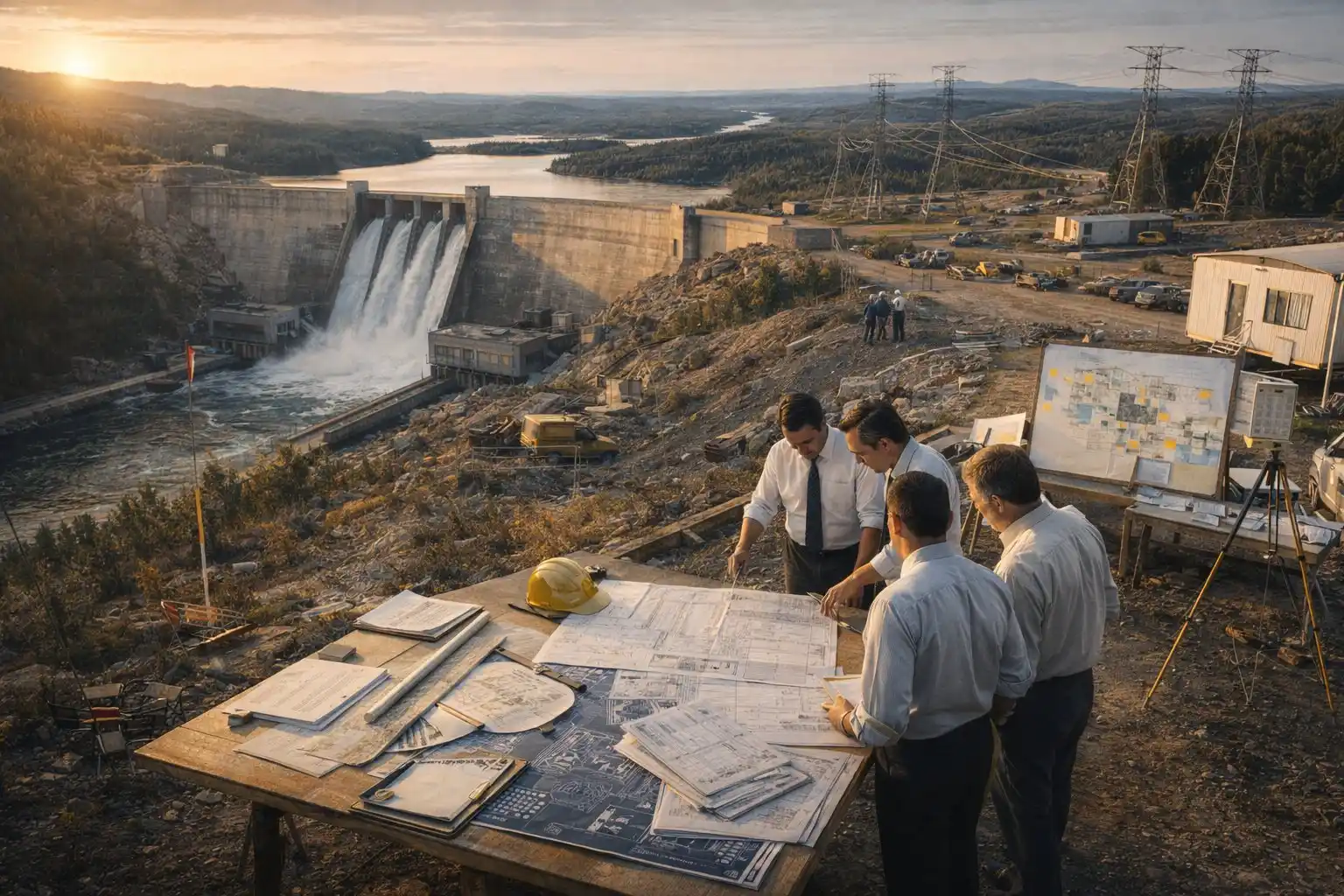
  • IV.2 Hydroelectric System Engineering
  • IV.3 Avro Arrow Engineering
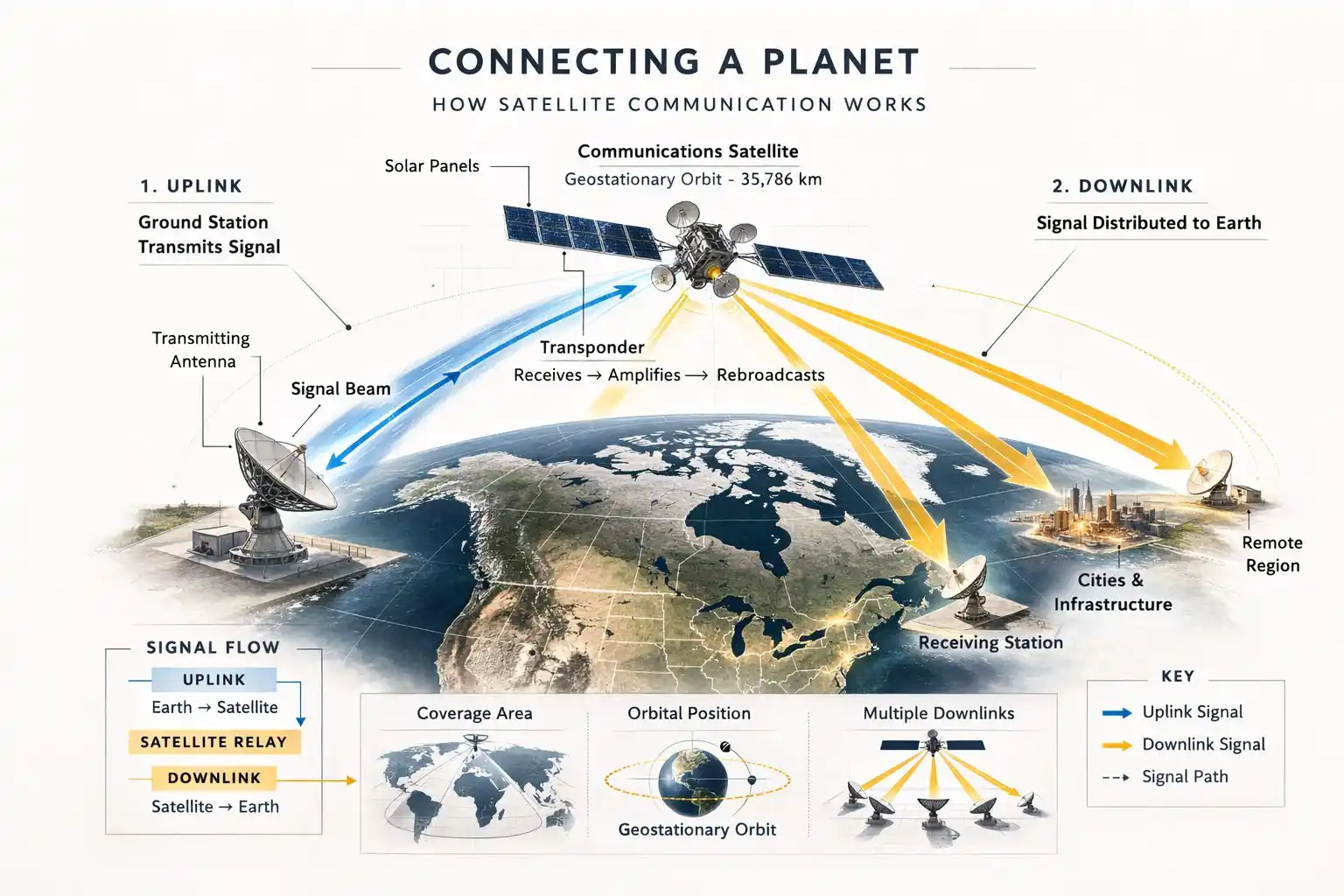
  • IV.4 Satellite Communication Physics
  • IV.5 The Systems of a Builder Civilization — Evidence Backbone
  • IV.6 The Systems of a Builder Civilization
  • IV.7 Systems Thinking
  • V. THE INFLECTION POINT
  • V.1 When the Trajectory Began to Bend (1968–1985)
  • V.2 The Convergence of 1970
  • V.3 The Legitimacy Inversion
  • V.4 The Permission Structure in One Project
  • V.5 The Lost Future
  • VI. THE LOST FUTURE (1985–Present)
  • VII. WHY SOME CIVILIZATIONS BUILD THE FUTURE — and Others Stop
  • VII.1 The Builder Question
  • VII.2 Engineering as Civilizational Identity
  • VIII. CANADA: THE UNFINISHED BUILDER CIVILIZATION
  • IX. NOTES


I — THE MACHINES THAT STILL RUN
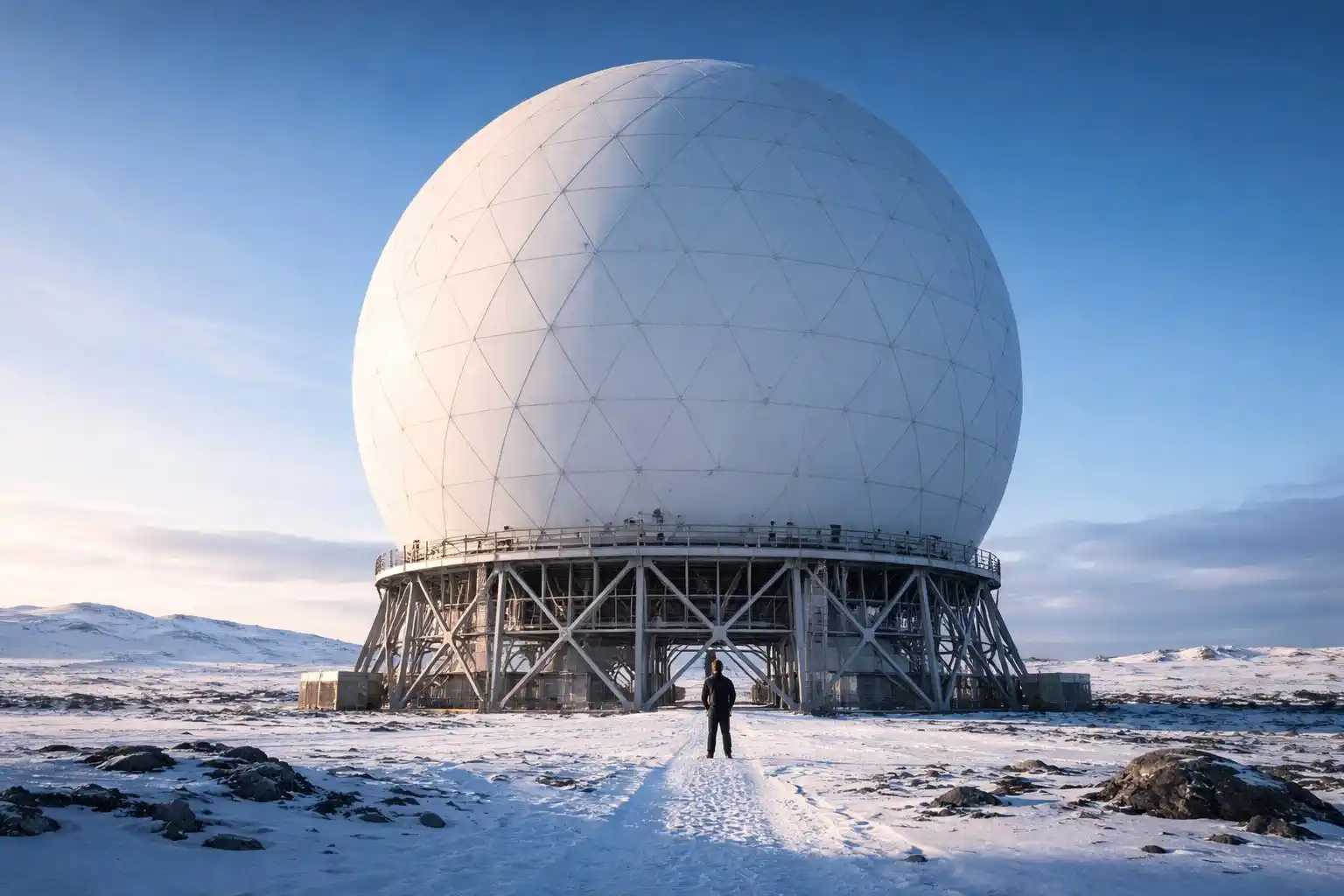
There are places in Canada where the twentieth century is still running literally.
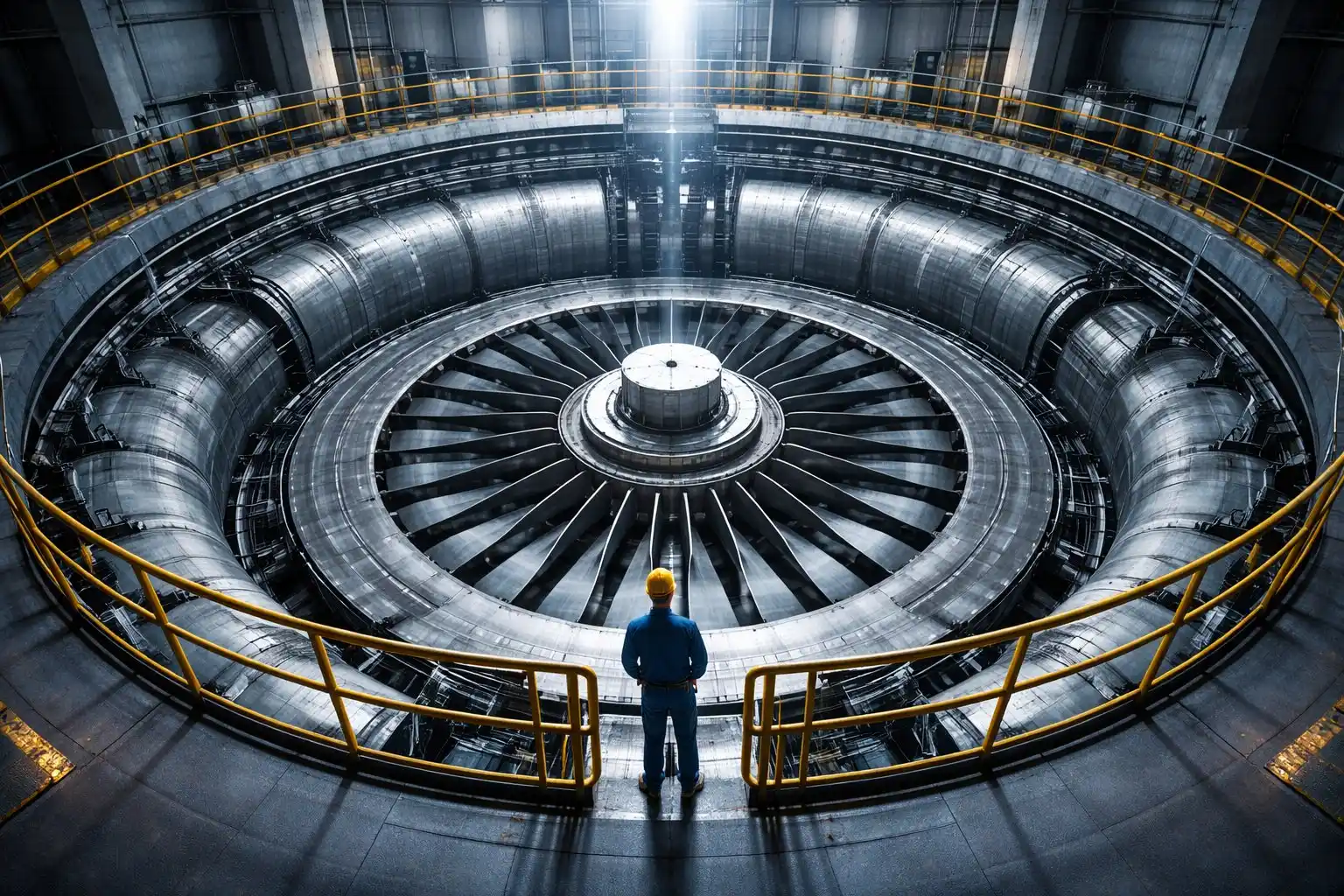
Stand close to the casing of a hydro generator and you feel it: a steady, sub-audible tremor, like a sleeping animal. The machine doesn’t care what decade it is. It keeps converting falling water into rotating steel, into current, into light. It keeps doing the oldest modern magic turning a river into a city.
The magic of hydroelectric power is not mystical. It is mechanical discipline applied to gravity.
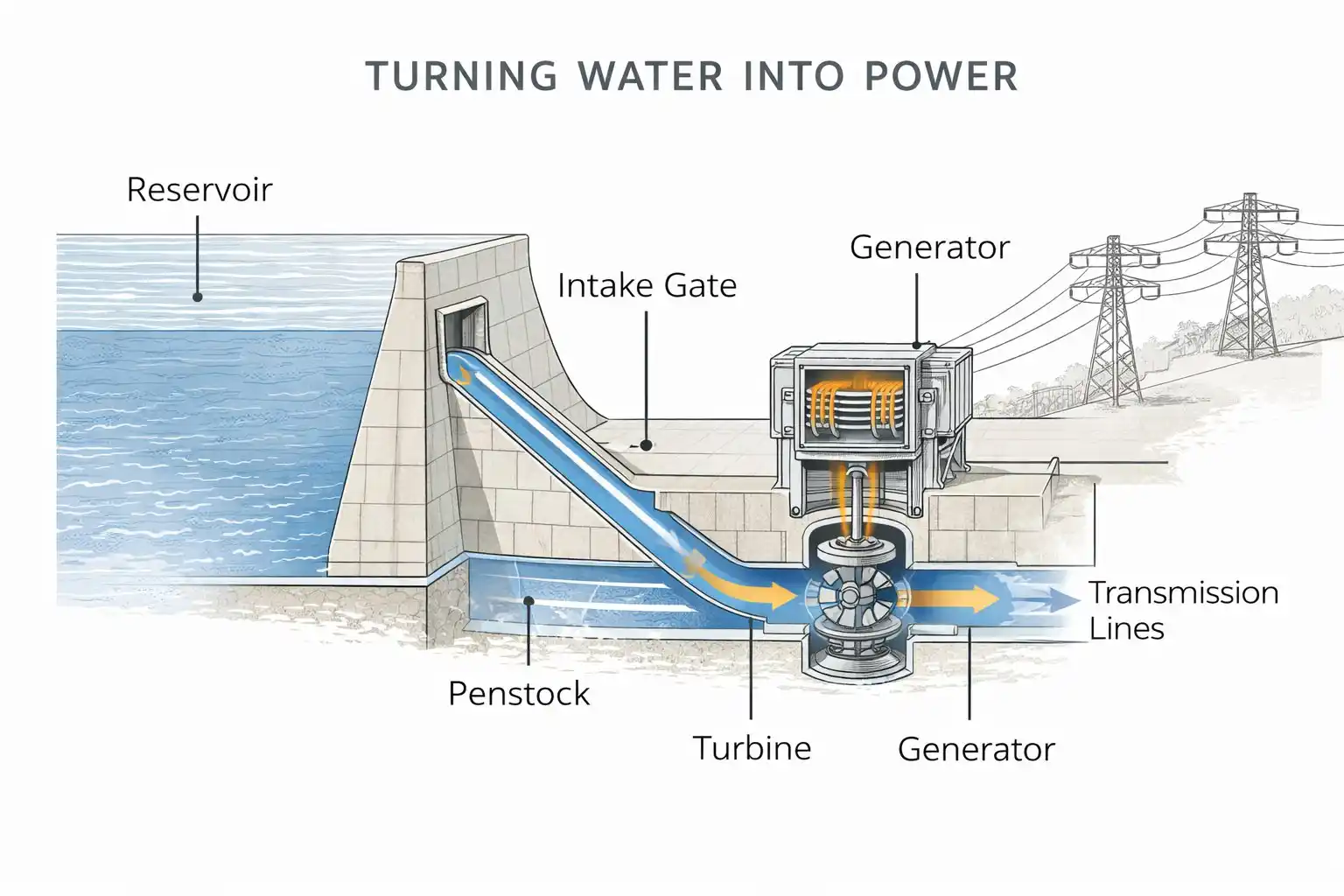
A river held behind a dam stores potential energy in the height of its water. Engineers call this “head” the vertical distance the water can fall. When gates open, that falling mass of water is forced through enormous steel turbines buried inside the station’s concrete core. The turbine blades are shaped like the propellers of a ship, but optimized for water pressure rather than air. As the water rushes past them, it spins the turbine shaft with immense torque.
That shaft is connected directly to an electrical generator: a rotor turning inside a ring of copper windings and magnetic fields. When the rotor spins, the magnetic field moves across the coils and induces electric current. Mechanical motion becomes electricity.
The generators inside major Canadian hydro stations are the size of houses. Each rotation sends thousands of amperes into transmission systems that step the voltage up — sometimes to hundreds of thousands of volts — so the energy can travel hundreds of kilometers with minimal loss.
What begins as falling water becomes the pulse of a nation’s electrical grid.
Cities light up. Railways move. Factories operate. Data centers hum.
All of it begins with a river turning a turbine.
Step back and the sound changes. The vibration becomes a deep, patient thrum under concrete. The air has the faint mineral bite of wet stone and cooling metal. Somewhere above, gates and spillways manage pressures that would destroy a smaller structure. Somewhere below, a turbine the size of a small house is spinning with the calm indifference of physics: torque, inertia, heat, flow.
This is what a technological civilization feels like when you touch it. Not sleek. Not digital. Not something that arrives in a package with rounded corners. Heavy. Continuous. Built to last longer than the careers of the people who designed it.
You can see it in old photographs, but you can also see it in the eyes. One foreman — name scribbled on the back in faded pencil — stands on the rebar mat like it’s the deck of a ship. His posture says: we’re doing this because it has to exist. Around him: cigarettes, frost, and the grim, quiet joy of people who can turn a blueprint into a continent.
In those artifacts — dams, switchyards, radar chains, satellites, laboratories — you can still touch a Canadian mood that is now hard to find: a belief that the future wasn’t a mood. It was a contract. A schedule. A jobsite. The future was something you could be late for.
Today we call “technology” the things that ship in a box. But the older Canada meant something heavier: the systems that keep a nation alive — power, comms, transport, defense, energy. Not gadgets. Organs. The kind of technology that doesn’t fit in your hand because it holds up everything else.
And once, not so long ago, Canada built those systems with a speed and confidence that now looks almost fictional.
The scene could begin anywhere, because the country left so many entry points into its own lost momentum. It could begin in 1945, in the afterglow of the Second World War, when Canadian engineers came home with the strangest souvenir: proof. They’d watched radar turn darkness into data. They’d watched logistics move mountains of fuel and steel on deadlines that didn’t forgive excuses. They’d learned a dangerous lesson: when a society decides a thing must be built, it builds it.
It could begin at Chalk River, where heavy water, neutron flux, and heat transfer stopped being abstract nouns and became hardware. A reactor is not an opinion. It is plumbing under pressure, metallurgy under radiation, and safety written in procedure. Canada wasn’t watching the nuclear age arrive it was machining its parts.
It could begin with the long spine of the Trans-Canada Highway: the argument made concrete that a land empire could be stitched together by asphalt and steel, that distance could be managed rather than endured. Or it could begin at a lock wall and a control panel, where the St. Lawrence becomes a system: gates, levels, schedules, throughput — geography domesticated into a corridor.
Or begin in the Arctic, where building a “line” of radar stations meant delivering generators, fuel, antennas, and men into a landscape that eats metal. You don’t “install” an early-warning network in permafrost. You fight for itagainst weather, corrosion, supply chains, and the calendar. Each station is a small city of equipment and procedure, built so that a warning can travel south faster than fear.
Or begin in orbit. Alouette proved Canada could put a scientific instrument in space. Anik did something even stranger: it turned space into domestic infrastructure. For a country shaped like Canada — wide, scattered, and hard to wire — geostationary orbit became part of the national map.
If you want to understand what that meant, imagine the moment when “remote” stops being an adjective and becomes a solvable engineering problem. Imagine a community where distance used to be silence — no reliable link, no steady signal — and then one day the sky becomes a mirror. A dish points upward. A carrier locks. A voice arrives. A broadcast becomes routine. A nation speaks to itself across a continent as if the continent were small.
Or it could begin with a plane.
There was a moment — brief, bright, and still radioactive with controversy — when Canadian aerospace engineers attempted something that nations are not supposed to attempt unless they are superpowers. The Arrow wasn’t just “an aircraft program.” It was a wager placed at supersonic speed. Thousands of engineers betting their reputations that a middle power could design, test, and integrate a machine at the edge of the era’s limits — airframe, avionics, engines, radar, production tolerances — without a superpower’s margin for error.
The Arrow was not just a machine; it was a statement that Canada could generate the entire stack — design, manufacturing, systems integration — at the edge of what was possible. It was a civilization flexing its technical muscle.
Canada remembers the Arrow as tragedy. But the real mystery isn’t the cancellation it’s the existence. A society had to be a certain way to even attempt it. What was that society made of? And where did it go?
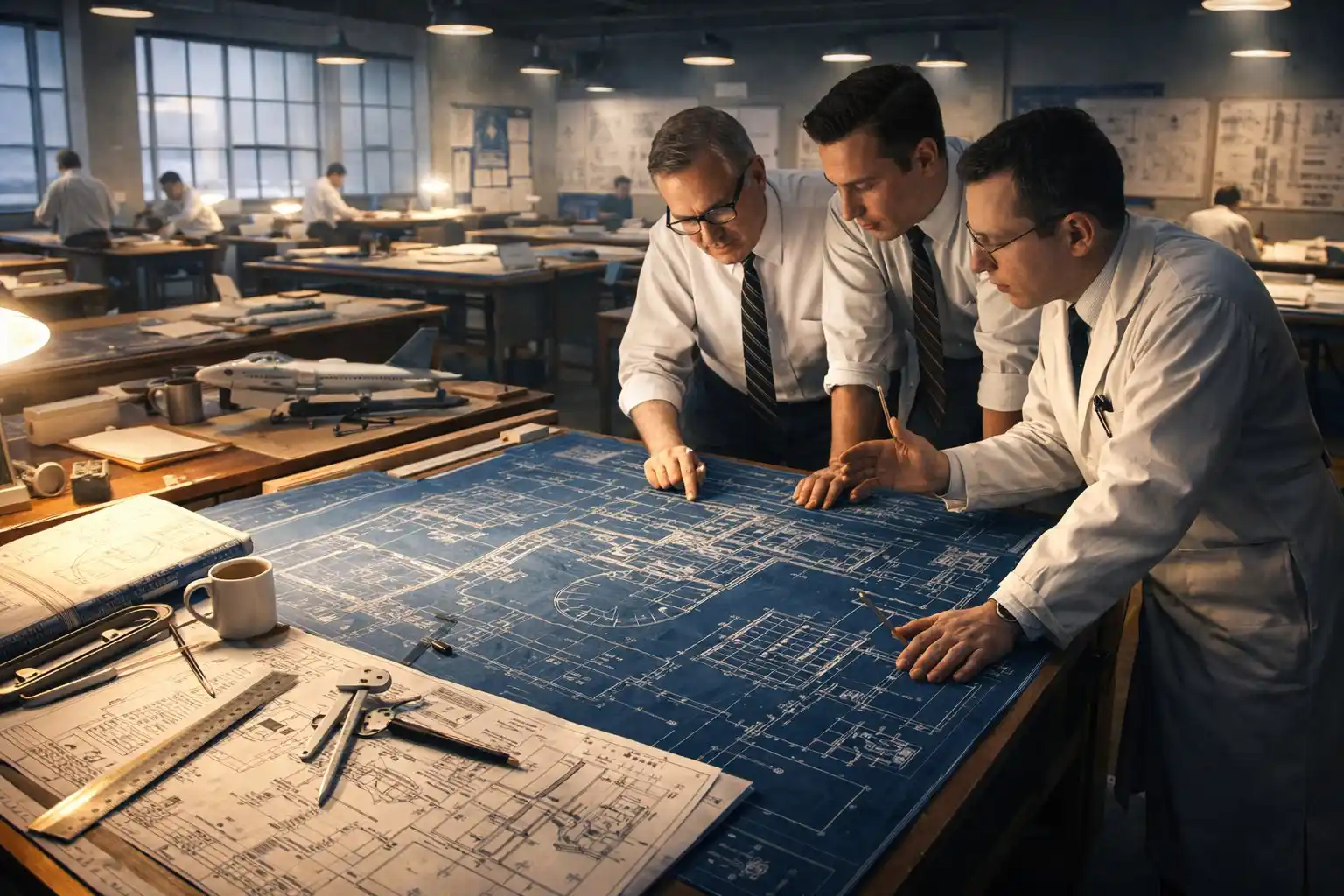
Because here is what happens when you lay these achievements on a table radar chains, nuclear research, hydroelectric megaprojects, highways and seaways, pipelines, satellites, aerospace. You begin to see something that doesn’t appear when you study them one by one.
Put the artifacts in one frame and you see the outline of a living thing: rivers converted into electricity; the sky wired for warning; the nation speaking to itself from orbit; roads and seaways turning distance into throughput. It wasn’t random achievement. It was a metabolism a civilization stack built out of infrastructure, institutions, and people who believed competence was a form of patriotism.
This is the Canada you can still feel in the artifacts.
And then you look around at the present day and feel the uncanny contrast. The country that once built entire technological organs now struggles to build almost anything on time. Now the same country can spend ten years arguing about a bridge. Transit, housing, power lines, pipelines, procurementCanada still builds, but the default tempo has changed: slower, risk-averse, lawyered, narratively contested.
The machine still runs, but the building impulse stalls.
That contrast is the mystery at the heart of this book.
Not “Why did a few projects end?” Projects always end. The deeper question is: what changed in the human and institutional system that made big building normal? What happened to the pipeline that produced the engineers, the managers, the tradespeople, the risk tolerance, the legitimacy, and the future-confidence needed to build civilization-scale systems? What happened to the story the country told itself about why those systems mattered?
Because a civilization doesn’t build megaprojects just because it can. It builds them because it believes it should.
Somewhere along the way, that belief degraded. Not in a single scandal. Not by a single decision. More like corrosion: slow, procedural, invisible until the structure starts to fail.
You can feel the difference in language. The builder era spoke in verbs: design, test, pour, lift, connect, commission. The later era learns a new dialect: consult, mitigate, litigate, pause, review, defer. A society can become rich and educated and still lose the habit of decisive construction. It can keep the machines running while forgetting the operating system that built the machines in the first place.
And the artifacts are still here.
They keep humming in the dark — dams and lines and stations and labs — waiting like a loaded generator: proof that the capacity was real, and that forgetting is not the same thing as losing.

II — THE RISE OF SCIENCE FICTION (1600–1950)

II.1 The Future Did Not Exist As A Destination

For most of human history, the future did not exist as a destination. It was expected to resemble the past.
For thousands of years, most societies assumed that the structure of life would remain essentially unchanged. Kingdoms might rise or collapse. Harvests might succeed or fail. Wars might redraw borders. But the fundamental mechanics of daily existence — how people travelled, communicated, produced food, or generated power — remained remarkably stable.
Innovation existed, but it moved slowly.
Generations often lived and died within technological environments that had changed little from those of their grandparents.
The idea that knowledge could accumulate — generation after generation — until it transformed the physical world had not yet taken hold.
That idea had to be invented.
And it was invented in Europe.

II.2 The Discovery That Nature Had Rules

The shift began during the Scientific Revolution of the seventeenth century, when thinkers such as Galileo Galilei, Johannes Kepler, and Isaac Newton proposed something radical: nature obeyed rules.
Before this moment, the natural world was often interpreted through tradition, theology, or philosophical speculation. But these scientists demonstrated that reality could be described mathematically.
The movement of planets. The fall of objects. The behaviour of light.
All followed patterns that could be measured and predicted.
This discovery was not only scientific.
It was psychological.
If nature followed intelligible rules, then reality was no longer a mystery to endure it was a system to investigate.
Knowledge was no longer a static inheritance from the past.
It could grow.
And if knowledge could grow, then the future might contain things that had never existed before.

II.3 The European Inheritance of the Future

The discovery that nature followed rules did not remain confined to laboratories.
Once the scientific revolution demonstrated that the universe behaved according to intelligible laws, a deeper transformation began to unfold across Europe. Over the course of several centuries, scientific insight gradually evolved into something larger: a civilization organized around the belief that reality itself could be understood, predicted, and deliberately reshaped.
This transformation did not occur in a single country or through a single discovery. It emerged through a chain of intellectual developments that unfolded across different parts of Europe, each contributing a piece of a new worldview.
The idea of the future itself was changing.

Italy — The Mathematical Universe

In seventeenth-century Italy, the work of thinkers such as Galileo Galilei introduced a radical new method for understanding nature. Galileo’s experiments showed that motion could be described mathematically. Falling objects, swinging pendulums, and planetary movement were not mysterious events guided by hidden forces.
They followed patterns that could be measured, calculated, and predicted.
The implications were profound.
If physical phenomena obeyed mathematical laws, then the universe was not an unknowable mystery. It was an intelligible system.
Reality could be investigated through observation, instruments, and calculation rather than explained through tradition or speculation. Knowledge about the physical world could accumulate over time, building a deeper understanding of how nature operated.
For the first time, human beings possessed a reliable method for uncovering the structure of the universe itself.

Central Europe — Predictive Science

In the German and Central European scientific world, Johannes Kepler extended this transformation by demonstrating that planetary motion followed precise mathematical relationships.
The movement of planets was no longer described through philosophical models or symbolic cosmologies. Kepler showed that the planets traced predictable paths governed by measurable laws.
Nature was not chaotic.
It was ordered.
And if the motion of celestial bodies could be predicted centuries into the future, then prediction itself became a new intellectual power.
Prediction is the foundation of engineering. When the behaviour of matter and motion can be forecast reliably, systems can be designed to harness those behaviours. Machines can be constructed with confidence that they will perform as intended.
The universe was becoming not only intelligible, but operational.

England — The Scientific Method Becomes a System

In England, thinkers such as Francis Bacon and Isaac Newton expanded the implications of this new scientific worldview.
Bacon argued that knowledge should be built through systematic observation and experimentation. Nature was not to be interpreted through inherited authority but investigated through disciplined inquiry.
Newton then demonstrated that the laws governing motion on Earth were the same laws governing the motion of the heavens. Gravity, inertia, and force were not isolated phenomena but universal principles that applied across the entire cosmos.
The intellectual consequence was revolutionary.
Nature followed rules.
Those rules could be discovered.
And once discovered, they could be applied.
Knowledge was no longer static. It could accumulate across generations, gradually revealing the structure of reality itself.
This idea introduced a new possibility into human civilization: the possibility of sustained progress.

France — Engineering as Statecraft

In France, scientific knowledge took on a different form. While England emphasized discovery and theory, France developed institutions dedicated to applying scientific knowledge to large technical systems.
Engineering became a national discipline.
Schools such as the École Polytechnique trained generations of engineers capable of designing canals, roads, bridges, fortifications, and industrial infrastructure. These institutions treated engineering not as a craft practiced by individuals but as a coordinated activity capable of shaping entire landscapes.
Technical competence became a form of state power.
Rivers could be redirected. Transportation networks could be planned across vast territories. Military defenses could be engineered with mathematical precision.
Engineering had become a language through which governments could reorganize the physical world.

Britain — Industrial Civilization

Britain then combined scientific knowledge and engineering practice with industrial production.
Beginning in the eighteenth century, machines powered by steam began transforming manufacturing, transportation, and energy production. Factories reorganized labour. Railways collapsed distance between cities. Steamships linked continents through global trade routes.
For the first time in human history, technological systems began reshaping society within a single lifetime.
Engineering was no longer confined to laboratories or workshops. It was restructuring entire economies.
Distance, time, and energy were becoming variables that could be manipulated through machines.
The industrial revolution demonstrated something unprecedented: scientific knowledge could be translated into systems powerful enough to reorganize civilization itself.

The Atlantic World — Builder Societies

As British and European institutions spread across the Atlantic world, this engineering culture travelled with them.
New societies emerging in North America inherited more than languages and legal systems. They inherited an intellectual tradition built on scientific investigation, engineering discipline, and industrial problem-solving.
Countries such as the United States, Canada, and Australia developed under conditions that demanded large technical solutions.
Distances were vast. Populations were scattered. Natural resources lay far from the cities that would eventually consume them.
Railways had to cross mountains and plains. Ports had to be constructed to link inland regions to global trade. Power systems had to harness rivers capable of generating immense quantities of energy.
In these environments, engineering became more than a profession. It became a method of national survival.
Canada, with its immense geography and relatively small population, would eventually become one of the clearest expressions of this builder civilization.

A Civilization Learns to Build the Future

By the nineteenth century, a remarkable transformation had occurred.
Across several centuries of scientific discovery, engineering practice, and industrial expansion, European civilization had gradually developed a new relationship with time itself.
The future was no longer assumed to resemble the past.
It could be constructed.
Scientific knowledge revealed the rules of nature. Engineering translated those rules into machines. Industrial systems multiplied the scale at which those machines could operate.
A new cultural assumption began to spread.
Tomorrow could be larger than today.
And in the decades that followed, a new cultural invention would help carry this assumption even further into the public imagination.
Science fiction.
Writers would begin imagining the technological futures that engineers might one day attempt to build.

II.4 The Industrial Revolution: Progress Becomes Visible

The Industrial Revolution made this new idea impossible to ignore.
Beginning in the eighteenth century, steam engines, railways, and factories began transforming the physical landscape of Europe and North America.
  • Machines multiplied human labour.
  • Railways collapsed distance.
  • Factories reorganized production.
  • Cities expanded as industrial activity concentrated populations around new technological systems.
For the first time in human history, people began to experience something new: technological momentum.
The future no longer felt static.
It felt larger than the present.
The physical environment itself was changing within a single lifetime. A person born into a world of horse-drawn transport might live long enough to see railways crossing continents, telegraph wires carrying messages at the speed of electricity, and factories producing goods on an unprecedented scale.
The Industrial Revolution therefore accomplished something that centuries of scientific discovery alone could not.
It made progress visible.
Scientific laws had revealed how nature worked. Engineering and industry now demonstrated that those laws could be used to reorganize the material world.
Energy, motion, and distance were becoming variables that engineers could manipulate.
This transformation altered how societies imagined the future. Instead of assuming tomorrow would resemble yesterday, people began to suspect that the future might contain machines and systems that had never existed before.
And once that possibility entered public imagination, a new kind of storytelling began to appear.
Stories not about magical worlds.
But about technological ones.

II.5 When Imagination Began Following Engineering

As engineers transformed the world, writers began asking a new question:
What happens if the machines keep improving?
This question produced an entirely new cultural invention.
Science fiction.
Earlier myths had imagined worlds governed by gods, spirits, or sorcery. Science fiction imagined something different: futures shaped by science, engineering, and technological discovery.
One of the earliest and most influential examples appeared in 1818, when a young English writer named Mary Shelley published Frankenstein.
Shelley wrote during a period of intense scientific curiosity in early industrial Britain. Experiments with electricity fascinated researchers, public lectures demonstrated strange electrical phenomena, and industrial technology was rapidly reshaping cities and factories.
Her novel imagined a scientist using electricity and anatomy to create artificial life.
But the deeper significance of the story was philosophical.
Shelley was asking what might happen when scientific capability outruns human wisdom.
Technology was no longer merely a tool.
It had become a force capable of reshaping civilization itself.
Later writers expanded this idea in different directions.
In nineteenth-century France, the novelist Jules Verne treated engineering as a form of exploration. France during Verne’s lifetime was deeply shaped by an engineering culture built around railways, canals, industrial science, and prestigious technical schools that trained engineers for national infrastructure projects.
Verne studied contemporary science carefully and based many of his stories on plausible technological extensions of existing engineering knowledge.
His novels imagined submarines travelling beneath the oceans, machines capable of drilling through the Earth’s crust, and spacecraft launched toward the Moon.
These inventions did not feel magical.
They felt achievable.
Across the English Channel, the British writer H. G. Wells approached the future from a different angle. Wells lived in a society already transformed by industrial systemsrailways, factories, global shipping networks, and rapidly expanding cities.
Instead of focusing only on machines themselves, Wells asked a deeper question:
What would technological power do to society?
His stories explored time travel, alien invasions, and invisible men not as fantasy, but as thought experiments about how science and technology might reshape human civilization.
Together, Verne and Wells created the intellectual architecture of modern science fiction.
Their stories translated scientific possibility into public imagination.
And that imagination would soon begin influencing the people who would actually build the future.

II.6 Engineering as Adventure

Later writers expanded the idea.
Jules Verne treated engineering as exploration. His novels imagined submarines travelling beneath the oceans, machines capable of drilling through the Earth’s crust, and spacecraft launched toward the Moon. Verne studied contemporary science closely. His imagined machines were not magical devices. They were plausible extensions of existing engineering.
Readers encountered something new: a future that felt technically achievable.
Across the English Channel, H. G. Wells asked a different question. What would technological power do to society itself? Wells imagined time travel, alien invasions, and invisible men not as fantasy, but as experiments in technological consequence.
Together Verne and Wells created the intellectual architecture of science fiction.

The Cultural Machine of the Future

By the early twentieth century, science fiction had become a widespread cultural engine.
Magazines such as Amazing Stories and Astounding Science Fiction created communities of readers fascinated by technological possibility.
Young readers encountered ideas about:
  • rockets
  • satellites
  • robotics
  • interplanetary travel
long before these subjects appeared in university curricula.
For many future engineers, science fiction magazines were the first introduction to advanced technology.
The genre quietly trained the public imagination to accept radical futures.

II.7 The Engineers Raised on the Future

By the 1930s and 1940s, science fiction entered what historians later called the Golden Age.
Writers such as Isaac Asimov, Robert Heinlein, and Arthur C. Clarke began describing entire technological civilizations.
Their protagonists were not kings or warriors.
They were engineers.
  • Scientists.
  • Astronauts.
  • Builders.
Many of the scientists and engineers who later built the space age grew up reading these stories.
The relationship between imagination and engineering became a feedback loop:
Writers imagine machines → Engineers grow up inspired → Engineers build real machines → Writers imagine even larger systems
Imagination and engineering began advancing together.

II.8 The Moment the Future Became a Responsibility

When the Second World War ended in 1945, the world entered a period of extraordinary technological acceleration.
  • Radar.
  • Jet propulsion.
  • Nuclear physics.
  • Electronic computing.
All had advanced rapidly under wartime pressure.
The scientists and engineers who built these systems returned to civilian life with something unusual:
experience.
They had learned that large technological systems could be built.
And many believed those capabilities should now be applied to peaceful construction.
  • Hydroelectric systems.
  • Highways.
  • Aerospace programs.
  • Nuclear research.
  • Satellite communication networks.
A generation was about to treat the future not as speculation, but as a construction project.
The age of builders was about to begin.

III. THE AGE OF BUILDERS (1945–1975)

III.1 The Pipeline That Produced Builders

Civilizations capable of building large technological systems do not produce their engineers by accident. Builders emerge from a long pipeline of institutions that shape how individuals think about work, responsibility, and competence.
The process often begins long before formal education. In many mid-twentieth-century households, practical skill carried quiet prestige. Adults repaired machines, maintained tools, and treated mechanical understanding as a normal part of adulthood. Children grew up watching problems solved with patience, measurement, and experimentation. The physical world was not mysterious; it was something that could be understood.
Schools reinforced this relationship with reality. Mathematics and physics were taught not merely as abstract subjects but as languages for describing how the world works. Laboratories and technical courses exposed students to the discipline of testing ideas against measurable results. Shop classes, drafting tables, and early engineering programs allowed young people to experience the satisfaction of making systems function.
Beyond the classroom, wartime mobilization had created an enormous training ground for technical competence. Military service exposed millions of young men and women to radar, aviation maintenance, logistics systems, radio communication, and field engineering. The armed forces functioned, in effect, as a vast technical academy where discipline and engineering knowledge blended into a culture of practical problem-solving.
Industry completed the pipeline. Manufacturing firms, utilities, aerospace companies, and research laboratories provided careers for people capable of designing and maintaining complex systems. Apprenticeships and industrial training programs allowed technicians, machinists, and engineers to refine their skills while working on real projects that demanded precision and reliability.
Together these institutions formed a continuous ecosystem for producing builders. Families encouraged practical competence. Schools translated curiosity into knowledge. The military and universities refined technical discipline. Industry applied that discipline to real machines operating in the world.
The result was a society capable of generating large numbers of individuals who were comfortable working at the boundary between theory and reality people who could imagine new systems and then build them.

III.2 The Ecosystem of Competence

The builders of the mid-twentieth century did not appear by accident.
They emerged from an ecosystem that consistently produced technically competent individuals.
Families valued practical skill and mechanical understanding. Schools emphasized mathematics and scientific reasoning. Universities trained engineers capable of translating theory into functioning machines.
Industry offered careers that rewarded technical competence, while military service exposed many young people to complex technological systems such as radar, aviation maintenance, and logistics networks.
These institutions formed a pipeline through which curiosity became expertise and expertise became infrastructure.
A builder civilization is therefore not simply a collection of machines.
It is a culture that repeatedly produces the people capable of designing and operating those machines.

III.3 Nuclear Reactor Mechanics

Chalk River Laboratories became one of the world’s most advanced nuclear research centers. Canadian scientists and engineers developed reactor technologies that would later power electrical grids and produce medical isotopes used around the world. [8]
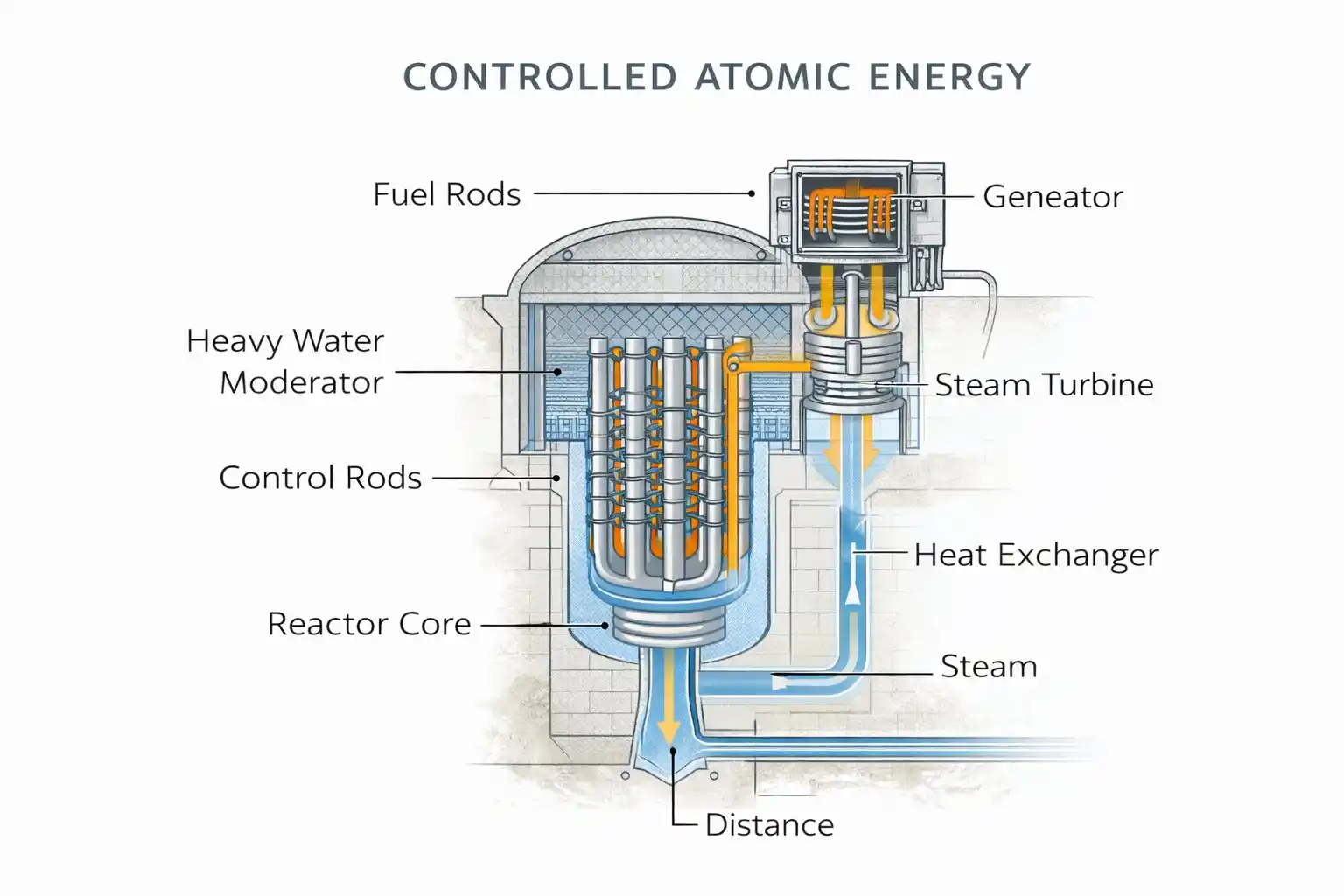
At the heart of a nuclear reactor is a carefully controlled chain reaction. Certain heavy atoms — most commonly uranium — are unstable. When struck by a neutron, they split apart in a process known as nuclear fission, releasing both energy and additional neutrons. If those neutrons strike other uranium atoms, the reaction continues, producing a steady cascade of atomic splitting.
The challenge for engineers is not creating the reaction, but controlling it.
In the reactor designs developed at Chalk River and later refined into the Canadian CANDU system, heavy water plays a crucial role. Heavy water — ordinary water in which the hydrogen atoms contain extra neutrons — acts as a moderator, slowing the fast-moving neutrons produced during fission. Slower neutrons are more likely to trigger additional fission events, allowing the chain reaction to proceed smoothly and predictably.
As the uranium fuel undergoes fission, enormous heat is released inside the reactor core. That heat is transferred into pressurized water circulating through pipes around the fuel assemblies. The heated water then produces steam, which drives turbines in much the same way as the falling water of a hydroelectric station.
Those turbines spin electrical generators, converting thermal energy from atomic reactions into the electrical power that flows into the grid.
In this way, the reactor becomes a kind of artificial sun contained inside steel and concrete an engine that releases the energy locked within matter itself and turns it into the electricity that powers modern civilization.

III.4 Technological Expressions Of A Capable Technical Civilization

Avro Canada represented a national aerospace culture operating at the frontier of jet technology. [5] The CF-105 Arrow program assembled thousands of engineers and technicians working on one of the most advanced interceptor aircraft designs of its time. [6]
Canada’s early satellite programs transformed distance into an engineering variable. [1] Communications satellites allowed television, telephone signals, and data to travel instantly across enormous geographic distances. [2]
Hydroelectric megaprojects converted entire river systems into power plants. [3] Dams and transmission networks generated vast amounts of electricity that powered cities, industries, and transportation systems. [4]
These were not isolated achievements. They were expressions of a civilization capable of coordinated technical ambition.
In a builder civilization, competence becomes a public virtue.
Every technological era carries its own emotional atmosphere. The builder era smelled like machine oil, solder, concrete dust, and cold air. It sounded like radio chatter, drafting pencils on paper, turbine halls humming with rotational energy.
But the builder era also possessed a powerful mythology.
The mythology said that tomorrow would be larger than today. That technological progress would expand the boundaries of human capability. The frontier had moved upward into the sky, into orbit, into the atom.
Engineers were not simply maintaining civilization. They were expanding it.
Canada was not alone in experiencing this surge of technological ambition. Across the Western world, governments and engineers were attempting projects of extraordinary scale. The most dramatic example was the Apollo program in the United States. [9] Within a single decade, hundreds of thousands of engineers, technicians, and scientists collaborated to design rockets powerful enough to send human beings to the Moon. [10] Apollo required more than engineering skill. It required political commitment, industrial coordination, and a society willing to sustain an ambitious technological project over many years. The success of the lunar missions demonstrated what builder civilizations could achieve when their institutions, industries, and imagination aligned.
And it is at this moment that the story begins to turn.
Because even at the height of the builder civilization, subtle changes were beginning to appear.
Technological power was growing so rapidly that it began to generate anxiety as well as excitement. Nuclear weapons demonstrated the destructive potential of scientific progress. Industrial growth produced environmental consequences that could no longer be ignored.
Institutions began to change. Regulatory systems expanded. Political priorities shifted. Cultural narratives about technology became more complicated.
The momentum that had defined the builder era began to slow.
The civilization that had once built the future with confidence was about to encounter its first major inflection point. And understanding that turning point will require looking closely at the decades that followed.
The moment when the future stopped accelerating.

IV. THE MEGAPROJECT ERA


IV.1 When the Future Was Built at Continental Scale (1945–1975)
If the nineteenth century invented the idea of technological progress, the decades after the Second World War attempted something far more ambitious: building the future at industrial scale.
Across North America and Western Europe, the mid-twentieth century became the greatest building surge in modern history. Governments, universities, and engineering firms aligned around a shared assumption: large technical systems were the foundation of modern civilization.
Entire infrastructures — transportation, energy, communications, aerospace — were designed and built in rapid succession.
The emotional atmosphere of the era was unmistakable.
Nations were expanding civilization itself.
For Canada the moment was particularly dramatic.
A country often imagined as remote suddenly emerged as one of the most ambitious builders of technical systems in the world. The scale of Canada’s geography demanded engineering solutions of unusual magnitude.
The result was a cascade of megaprojects that reshaped the technological structure of the country.
To understand the builder civilization at its peak, these projects must be viewed as a system.
They functioned as the organs of a technological nation.
One of the earliest challenges of the Cold War was perception.
With the emergence of nuclear weapons, military strategists recognized that the greatest danger might arrive not from armies crossing borders, but from aircraft approaching across enormous distances.
Early warning became a technological imperative.
For Canada — whose northern territories stretched deep into the Arctic — the challenge was geographical as well as strategic.
The shortest flight path between the Soviet Union and North America crossed the polar region.
The response was the construction of vast radar networks across the northern frontier.
The Pinetree Line, Mid-Canada Line, and Distant Early Warning Line formed a continental detection grid stretching across thousands of kilometers of tundra and ice. [11]
Radar stations were constructed in remote environments where infrastructure barely existed. Engineers transported generators, antennas, and radar equipment across landscapes that challenged even basic transportation.
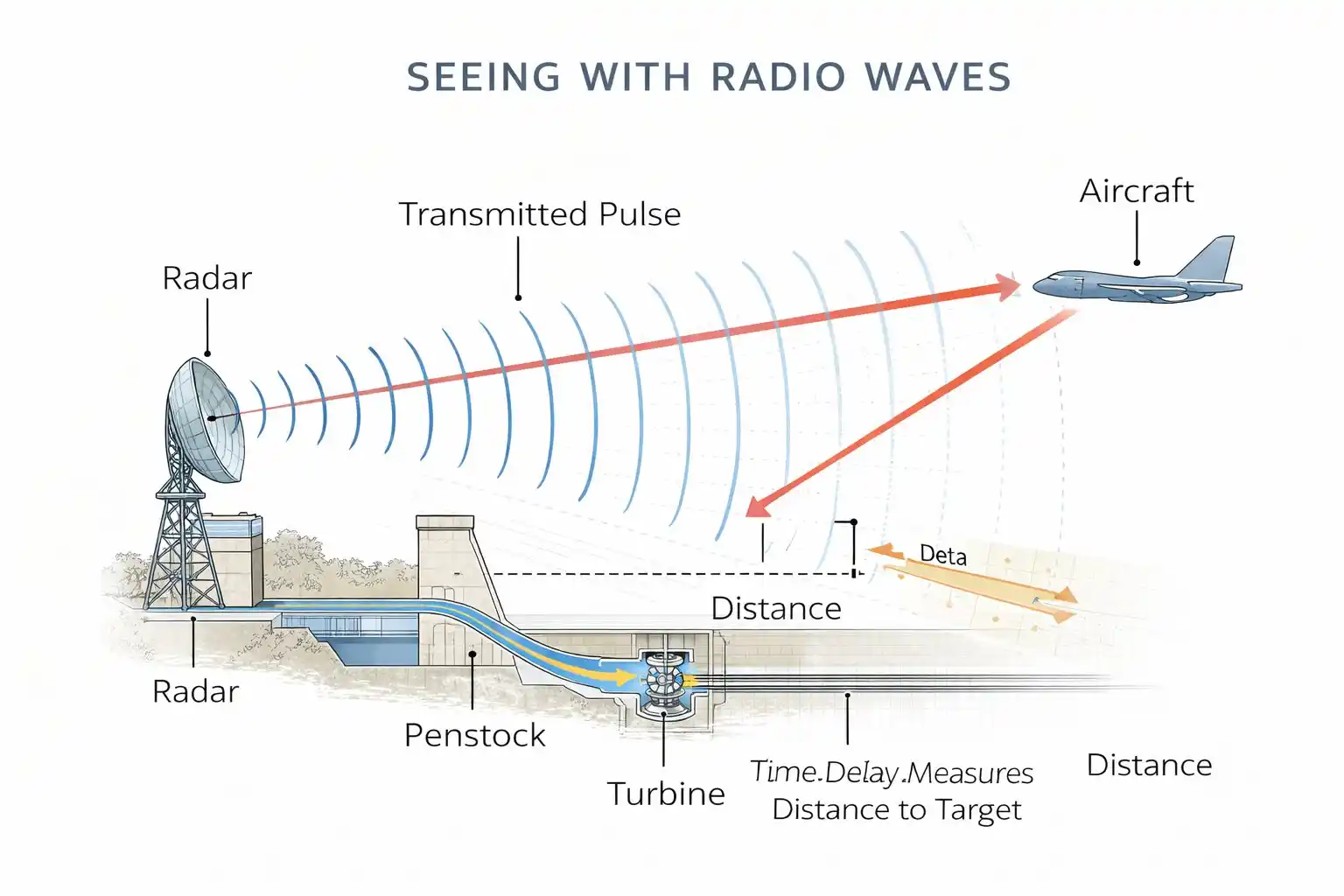
The result was unprecedented: a continent-scale sensor network capable of detecting aircraft approaching from the polar horizon.
At the same time another transformation was unfolding within Canada’s energy systems.
Canada possessed one of the greatest energy assets of the industrial age: vast moving water.
The mid-twentieth century became the age of hydroelectric megaprojects. [12]
Massive dams rose along major river systems across the country. [13] Reservoirs formed behind immense concrete walls. Turbines converted falling water into electrical power capable of driving industries and illuminating expanding cities.
These projects demanded complex coordination across multiple engineering disciplinescivil engineering, geology, hydrology, electrical engineering, and logistics.
The resulting power systems transformed Canada’s economic landscape.
Reliable electricity allowed industrial production to expand and urban populations to grow. Aluminum smelters, manufacturing plants, railways, and communication systems all depended on the enormous electrical capacity generated by hydroelectric dams.
Energy alone does not create a technological civilization.
Movement does.

IV.2 Hydroelectric System Engineering

Behind the monumental walls of concrete, the true engine of a hydroelectric system is pressure. When engineers build a dam, they are not simply blocking a river they are storing gravitational energy. The water collected behind the dam forms a reservoir whose surface stands far above the turbines below. That vertical difference in height is known as hydraulic head, and it determines how much energy the system can extract from the falling water.
When intake gates open, water rushes downward through massive steel conduits called penstocks. These tunnels funnel the water toward turbines housed deep inside the generating station. As the pressurized flow strikes the curved blades of the turbine, it forces the entire assembly to spin with enormous torque. The turbines are connected to generator shafts that rotate within rings of copper windings and magnetic fields.
Inside the generator, this rotation performs a quiet transformation that powers modern civilization. Moving magnetic fields induce electric current in the coils of wire, converting the mechanical energy of spinning water into electricity. The raw electrical output is then routed through transformers that increase the voltage dramatically — sometimes to hundreds of thousands of volts — allowing the energy to travel efficiently across long-distance transmission lines.
From these stations, power moves outward through the electrical grid, flowing across provinces and into cities, factories, railways, and homes. What begins as falling water in a northern reservoir becomes the invisible circulation system of a modern nation.
Canada’s immense distances demanded equally ambitious transportation systems.
  • The Trans-Canada Highway became the physical spine of the country. [15] Stretching from the Atlantic to the Pacific, it connected communities separated by thousands of kilometers.
  • Building the highway required bridges across major rivers, tunnels through mountain ranges, and thousands of kilometers of engineered roadway.
  • The highway did more than improve transportation.
  • It changed how Canadians imagined their country.
  • For the first time it became possible to travel continuously across the nation by road.
Another frontier opened in nuclear science.
  • Chalk River Laboratories emerged as one of the world’s leading nuclear research centers. [7] Scientists and engineers there developed advanced reactor technologies and conducted research in nuclear physics, materials science, and isotope production.
  • From this research emerged the CANDU reactor system an innovative nuclear power technology that would later be exported internationally.
Perhaps the most dramatic expression of Canada’s technical ambition appeared in aerospace.
  • Avro Canada assembled one of the largest aerospace engineering teams in the Western world. Thousands of engineers and technicians worked on advanced jet aircraft designs, culminating in the development of the CF-105 Arrow.
  • Although the Arrow program would ultimately be cancelled, it demonstrated that Canada possessed the capability to compete at the frontier of aerospace engineering.

 

IV.3 Avro Arrow Engineering
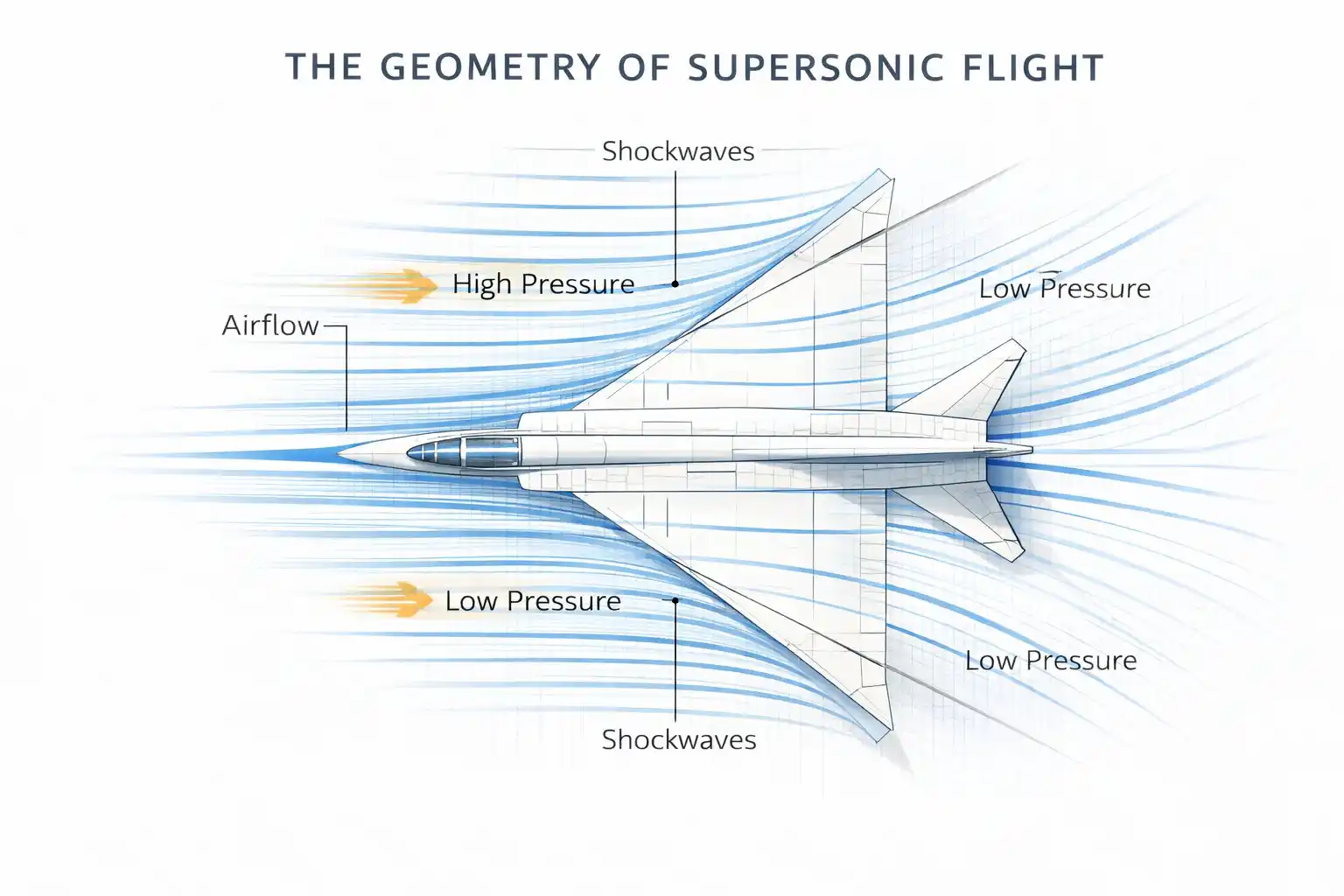
Designing an aircraft capable of defending the northern skies of North America required solving a set of aerodynamic problems that only a handful of nations had attempted at the time. The Arrow’s distinctive triangular delta wing was not simply a stylistic choice. At supersonic speeds, air behaves differently than it does for ordinary aircraft. Shock waves form along the leading edges of wings, dramatically increasing drag and structural stress. The delta wing allowed engineers to distribute those forces across a broad surface while maintaining stability at extremely high velocities.
The Avro Canada CF-105 Arrow was a supersonic interceptor designed to exceed Mach 2, more than twice the speed of sound, for high-altitude defense of North American airspace. During its limited flight-test program in 1958–1959, the aircraft reached speeds approaching Mach 2 (about Mach 1.98). Engineers expected the Arrow to achieve even higher speeds — potentially above Mach 2 and possibly approaching Mach 2.5once the planned Orenda Iroquois engines were fully integrated, but the program was cancelled before these performance limits could be tested.
At such speeds the skin of the aircraft experiences intense aerodynamic heating, and control surfaces must remain stable in turbulent supersonic airflow. Avro’s engineers therefore developed advanced structural designs and flight control systems capable of maintaining precision even as shock waves rippled across the aircraft’s body.
Equally important was the Arrow’s electronic brain. Intercepting high-altitude bombers required sophisticated radar guidance systems capable of detecting targets hundreds of kilometers away. The aircraft’s onboard radar could track incoming aircraft and guide air-to-air missiles toward them, transforming the interceptor from a simple fighter plane into a high-speed node within a larger continental defense network.
In this sense the Arrow was not merely an airplane. It was part of a technological system an integration of aerodynamics, electronics, propulsion, and radar that reflected the ambition of an era when nations believed the frontiers of engineering could still be pushed outward at extraordinary speed.
Another revolutionary technology soon expanded the country’s communications infrastructure.
Communications satellites offered an elegant solution to the problem of continental distance.
With the launch of Anik A1 in 1972, Canada became the first nation to operate a domestic geostationary communications satellite system.
Signals transmitted from orbit allowed television broadcasts, telephone calls, and data transmissions to reach even the most remote communities.
In effect, Canada’s communications infrastructure expanded into orbit.

IV.4 Satellite Communication Physics
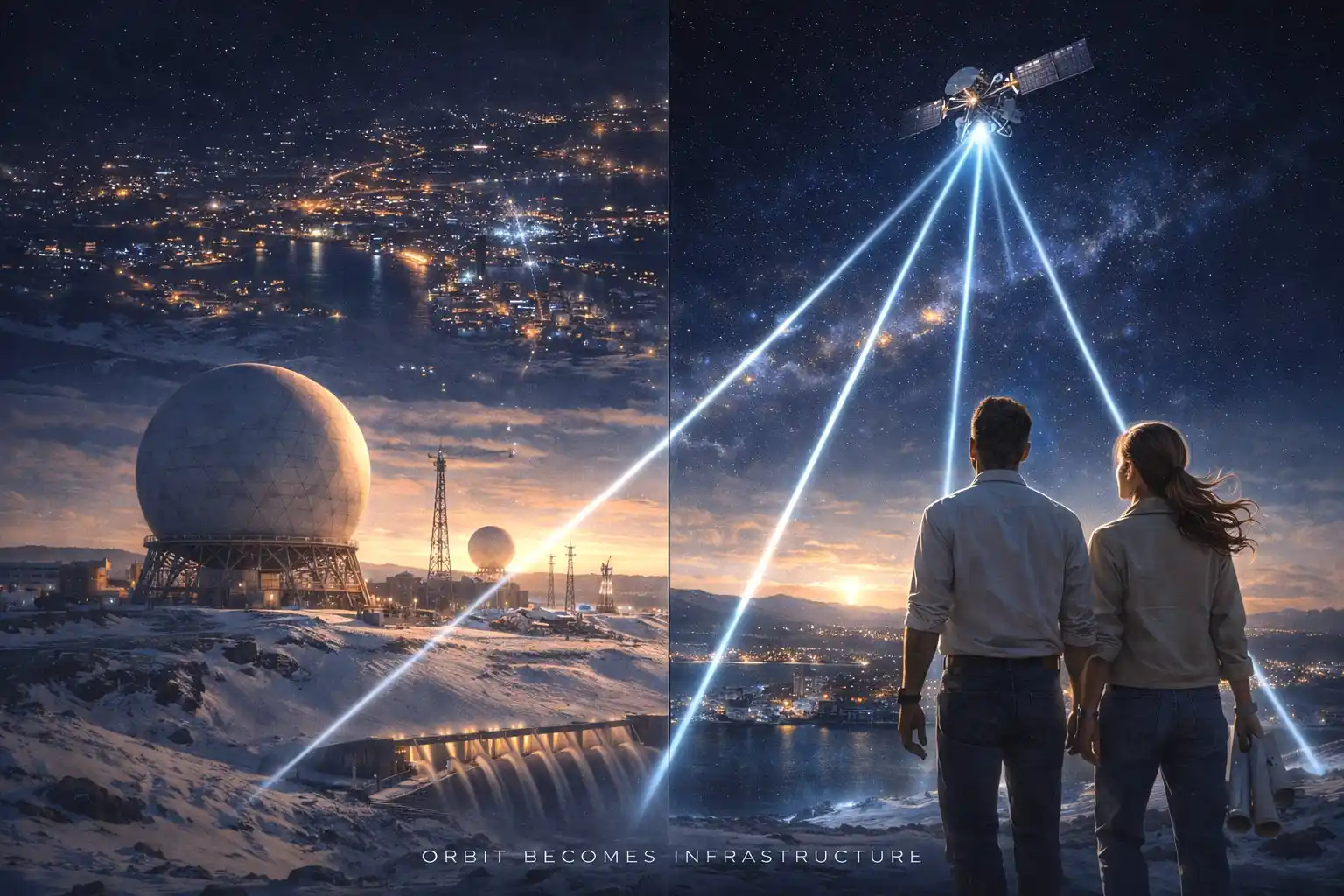
The key to satellite communication is orbit. A satellite launched into space is not simply floating above the Earth it is falling around it. By moving sideways at enormous speed, the spacecraft continuously falls toward the planet while the curvature of the Earth falls away beneath it. The result is a stable orbit in which the satellite circles the globe every twenty-four hours.
Engineers discovered that if a satellite is placed approximately 35,786 kilometers above the equator, its orbital period matches the rotation of the Earth itself. From the ground, the satellite appears motionless in the sky. This is known as a geostationary orbit, and it transformed the problem of global communication.
Ground stations transmit radio signals upward to the satellite in a process called uplink. Inside the spacecraft, electronic systems known as transponders receive the signal, amplify it, shift its frequency, and send it back toward Earth in a downlink beam covering thousands of kilometers. In effect, the satellite acts as a relay station in space, allowing signals to leap across continents and oceans that would otherwise require thousands of kilometers of cables or radio towers.
For a country like Canada — vast, sparsely populated, and stretching across immense distances — this technology solved a fundamental geographic problem. A single satellite positioned above the equator could connect communities separated by forests, mountains, and Arctic tundra. Television broadcasts, telephone calls, and data signals could travel instantly from southern cities to remote northern settlements.
Orbit itself had become part of the nation’s infrastructure.
Viewed individually these achievements appear impressive.
Viewed together they reveal a civilization operating at full technological momentum.
Energy systems powered industry and cities.
Transportation networks connected distant regions.
Radar systems defended continental airspace.
Nuclear research expanded scientific knowledge and electrical generation.
Satellites extended communications across vast territories.
For a brief moment in history, Canada functioned as a fully integrated technological civilization.

IV.5 The Systems of a Builder Civilization — Evidence Backbone

Seen from a distance, the mid-century projects described in this chapter can feel like isolated achievements impressive works of engineering scattered across a large country.
But place them side by side and a different picture appears.
Canada had assembled the core systems of a technological civilization.
Within a single generation the country built:
Continental energy systems. Massive hydroelectric projects across Quebec, Labrador, Manitoba, and British Columbia converted entire river systems into electrical power. Facilities such as Churchill Falls alone generate over 5,400 megawatts of electricity, enough to power millions of homes. [17]
A national transportation spine. The Trans-Canada Highway created the first continuous road link across the country — over 7,800 kilometers of highway connecting the Atlantic and Pacific coasts. [18]
A continental shipping corridor. The St. Lawrence Seaway, opened in 1959, transformed inland North America into part of the global ocean trade system, allowing large cargo ships to travel nearly 3,700 kilometers inland to the Great Lakes industrial region. [16]
An Arctic early-warning network. The Distant Early Warning Line constructed during the 1950s consisted of more than 60 radar stations stretching across thousands of kilometers of Arctic tundra. [19]
A nuclear research infrastructure. Chalk River Laboratories became one of the world’s leading nuclear research centers, helping develop the CANDU reactor system and producing medical isotopes used in over 40 countries. [7]
A domestic satellite communication system. With the launch of Anik A1 in 1972, Canada became the first country to operate a domestic communications satellite system using geostationary satellites, linking remote communities across vast distances. [20]
An advanced aerospace engineering capability. The Avro Arrow program assembled thousands of engineers and technicians and produced one of the most advanced interceptor aircraft prototypes of the late 1950s.
Taken individually, each of these projects appears remarkable. Taken together, they reveal something larger.
Canada was not simply building infrastructure.
In the mid-1950s the country had a population of only about sixteen million people smaller than many modern metropolitan regions.
Yet within a single generation, it was assembling the layered operating system of a technological nation energy, transportation, communication, defense, and scientific capability working together across continental scale.
IV.6 The Systems of a Builder Civilization
And yet, even as these systems reached completion, subtle changes were beginning to appear.
Institutional structures evolved.
Public attitudes toward technology became more cautious.
The momentum that had defined the megaproject era began to slow.
The civilization that had built the future with such confidence was approaching an inflection point.
And that turning point would reshape the relationship between technology, institutions, and society for decades to come.
IV.7 Systems Thinking
Seen individually, each of these projects appears as a remarkable achievement: a dam harnessing a river, a radar line stretching across the Arctic, a satellite relaying signals from orbit, a reactor unlocking energy from the atom. But the deeper significance of the builder era emerges only when these systems are viewed together.
They were not isolated projects.
They formed layers of a technological civilization.
Hydroelectric dams generated enormous quantities of electricity from the gravitational force of rivers. Transmission networks carried that power across vast distances to cities, industries, and rail systems. Transportation corridors — highways, ports, and railways — moved people, materials, and machines across the continent.
Radar networks extended perception across the Arctic sky, turning thousands of kilometers of empty atmosphere into a monitored defensive horizon. Satellites carried communication signals through orbit, allowing television broadcasts, telephone calls, and data to cross distances that geography once made nearly impossible.
Each layer depended on the others.
Electricity powered radar stations, laboratories, and industrial manufacturing. Transportation systems moved the steel, turbines, and machinery required to build power stations and scientific facilities. Communication networks coordinated operations across thousands of kilometers of territory. Satellite systems relied on ground stations connected to national electrical grids. Defense systems required both energy and communications infrastructure to function effectively.
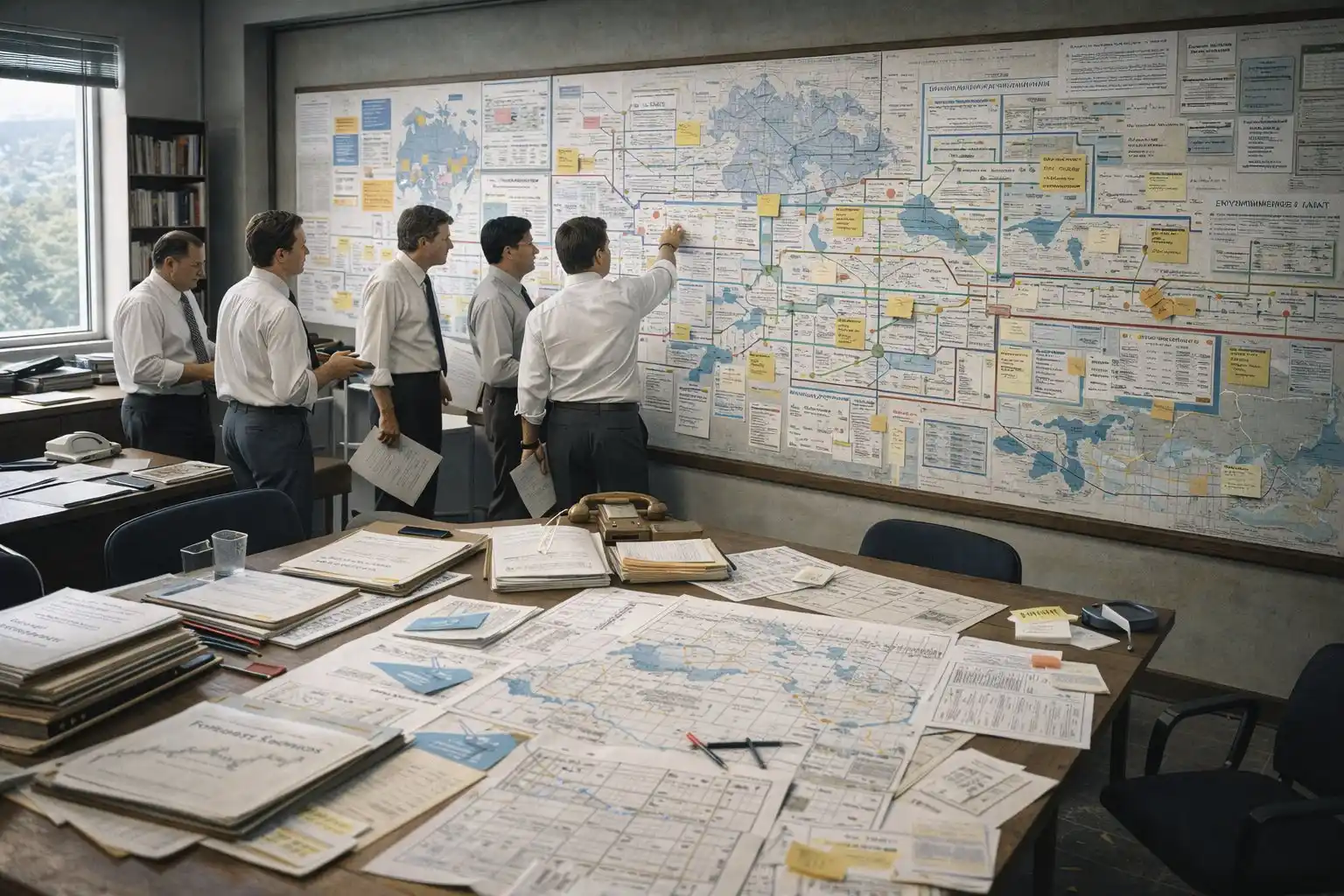
Taken together, these systems formed what can be understood as a technological stack a layered architecture that allowed a modern nation to operate across immense geography.
Energy generation formed the base layer.
  • Transmission networks carried that energy outward.
  • Transportation systems moved materials and people across continental space.
  • Communication networks allowed institutions and communities to coordinate across thousands of kilometers.
  • Defense systems monitored the surrounding environment, extending national awareness far beyond populated regions.
None of these systems functioned independently. Each depended on the stability and reliability of the others.
What emerged was not simply infrastructure.
It was the physical operating system of a modern technological civilization.
The builders of the mid-twentieth century understood this intuitively. They were not only constructing machines. They were assembling a national metabolism — energy, movement, communication, perception — until the entire country could function as a coordinated system across enormous distances.
For a brief moment in history, Canada operated at full technological momentum.
And once a society has built such a system, it leaves behind a peculiar kind of evidence.
Not monuments to past ambition.
But machinery that continues working long after the generation that built it has disappeared.

V. THE INFLECTION POINT


V.1 When the Trajectory Began to Bend (1968–1985)
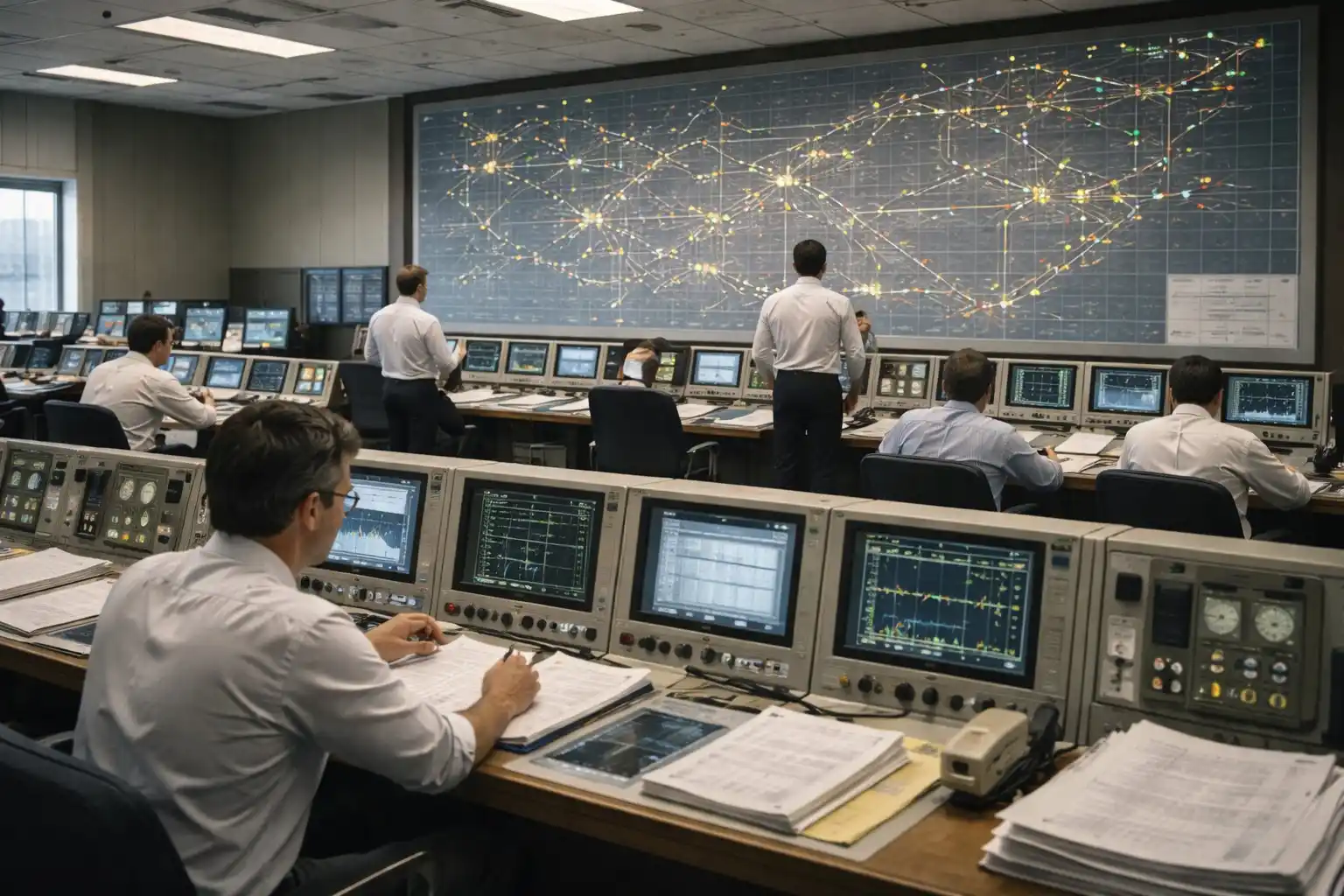
For a civilization that believes it is accelerating toward the future, the moment when momentum begins to slow is rarely obvious.
There is no ceremony announcing the end of momentum.
The machines built during the builder era continue operating. The dams still produce electricity. Radar stations still scan the horizon. Satellites continue transmitting signals across the continent.
But the institutional atmosphere begins to change.
Project timelines quietly begin to lengthen. Approval processes multiply. Public narratives about technology grow more cautious.
Historians examining the megaproject era have identified a consistent turning point.
Between roughly 1968 and 1975 the momentum of large-scale construction began to change across Western societies. [21]
The shift appeared simultaneously across several Western societies including Canada, the United States, Britain, and France.
Programs that had previously advanced rapidly began encountering institutional resistance. Large engineering projects became politically contested. Decision-making structures that once moved with relative speed began to slow.
To understand this change requires treating it as an investigation rather than a judgment.
The question is not whether technological progress ended.
Scientific research continued. Industries evolved. New technologies emerged especially in electronics, computing, and communications.
The question is more precise.
Why did the capacity for civilization-scale projects weaken?
One explanation begins with generational change.
The generation that built the megaproject civilization had been shaped by wartime urgency. Engineers and scientists trained during the Second World War had worked inside systems where deadlines were absolute and national survival depended on rapid technological solutions.
When wartime urgency faded, the psychological environment changed.
A new generation entered universities and government institutions with different assumptions. For them, technological progress was no longer interpreted solely as opportunity.
It was also associated with risk.
Nuclear weapons revealed the destructive scale of modern science. Industrial growth produced environmental consequences that could no longer be ignored.
Environmental movements demanded new regulatory oversight of major projects. Governments responded by constructing complex regulatory systems designed to evaluate ecological impact and social consequences.
These reforms addressed real environmental and social concerns.
But they also fundamentally altered the procedural landscape of infrastructure construction.
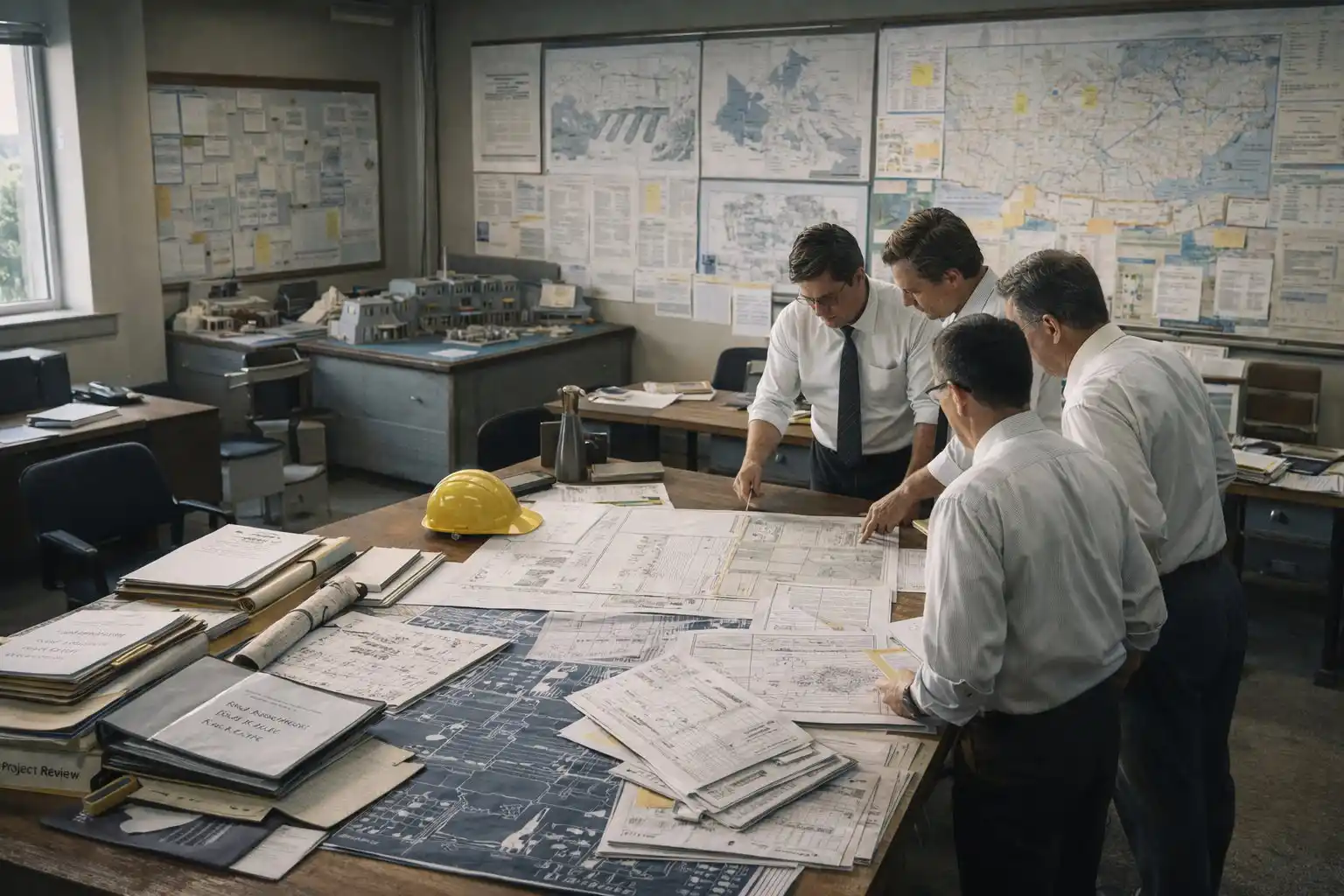
Projects that once moved from proposal to construction within a few years now required extensive review processes, environmental assessments, public hearings, and legal approvals.
Each additional layer increased the time required to move from engineering concept to physical construction.
At the same time, universities themselves were undergoing cultural transformation.
Academic disciplines expanded beyond the natural sciences and engineering into new areas of social and cultural analysis. These fields enriched intellectual life, but they also shifted the cultural center of universities.
Engineering and applied science gradually lost their central cultural prestige.
Meanwhile, government administrative structures expanded dramatically.
New departments, agencies, and regulatory authorities were created to oversee environmental protection, social policy, and economic management.
These bureaucracies were created for legitimate reasons.
Yet they introduced additional layers of procedural complexity between technical proposals and construction.
Decision-making became distributed across multiple institutions.
Coordination became more difficult.
Economic conditions also played a role.
The early 1970s introduced powerful economic shocks. The collapse of the Bretton Woods financial system in 1971 destabilized international monetary arrangements. [23] The oil crisis of 1973 destabilized global energy markets and triggered widespread economic uncertainty. [22]
Governments confronted inflation, unemployment, and fiscal pressure.
Large public infrastructure projects, once symbols of national ambition, increasingly became subjects of budgetary caution.
In Canada these structural changes appeared in distinctive ways.
The late 1960s and early 1970s were a period of political transformation. Debates about national identity, language policy, and constitutional reform reshaped public discourse.
Public discourse increasingly focused on cultural and constitutional questions rather than technological ambition.
Infrastructure and engineering projects did not disappear, but they no longer occupied the same symbolic place in national imagination.
Perhaps the most subtle shift occurred in how the future itself was imagined.
During the mid-twentieth century, science fiction and popular media often portrayed the future as an era of exploration and expansion space travel, advanced cities, and new technological frontiers.
By the late twentieth century, speculative fiction increasingly explored darker possibilities: environmental collapse, technological dystopia, and social instability.
The future remained technologically sophisticated.
But it was no longer automatically optimistic.
This change in imagination mattered.
The relationship between technology and culture had shifted.
The trajectory of the builder civilization began to bend.
The systems built during the megaproject era continued operating. Electricity still flowed through transmission networks. Satellites still transmitted signals across continents.
But the cultural and institutional environment that had produced those systems was no longer the same.
The builder civilization had reached its inflection point.
And understanding what came next requires examining the decades that followed an era when technological innovation continued, but the physical landscape of civilization changed more slowly.
The era when the future became less visible.

V.2 The Convergence of 1970

The slowing of the builder civilization did not result from a single decision or a single event. Instead, several structural forces converged within a short historical window during the late 1960s and early 1970s. Together, they altered the institutional environment in which large technological projects were conceived and executed.
One factor was the rapid expansion of regulatory systems. Environmental protection laws, public consultation requirements, and safety regulations emerged in response to legitimate concerns about industrial pollution and infrastructure impacts. These reforms improved oversight, but they also introduced additional layers of approval that lengthened project timelines and increased uncertainty for planners and engineers.
At the same time, the global economic environment shifted. The oil crisis of 1973, rising inflation, and the collapse of the Bretton Woods financial system created fiscal pressures across Western governments. Large infrastructure programs that had once been funded with confidence were now evaluated within tighter budgetary constraints.
Institutional culture also evolved. As technological systems grew more complex and politically sensitive, organizations became increasingly cautious. Decision-makers faced greater legal exposure and public scrutiny, encouraging risk-averse behavior within both government agencies and private firms. Projects that once advanced through decisive leadership now required extended negotiation across multiple stakeholders.
Finally, cultural attitudes toward technology began to change. The same scientific power that had produced nuclear energy, advanced industry, and aerospace achievements also revealed potential dangers. Environmental degradation, nuclear weapons, and industrial accidents contributed to a broader shift in public perception, in which technological ambition was sometimes viewed with skepticism rather than celebration.
Individually, none of these changes would have halted the builder civilization. Together, however, they reshaped the incentives surrounding large-scale construction. By the mid-1970s the institutional rhythm that had once propelled megaprojects forward had begun to slow, replaced by a system that prioritized caution, consultation, and incremental development.
The future did not disappear.
But the speed at which societies attempted to build it had changed.

V.3 The Legitimacy Inversion

The builder era did not run on optimism. It ran on legitimacy.
A society can possess engineers, money, and raw materials — and still fail to build — if it cannot answer a prior question:
Who has the authority to say: “This project should exist”?
In the mid-century builder civilization, the legitimacy chain was comparatively direct. Technical necessity carried public weight. If a dam, highway, radar network, or transmission corridor solved a national constraint, it possessed an implicit permission: it was necessary, therefore it was justified.
Engineers and planners stood near the front of the chain. Politics authorized. Finance followed. Construction began.
Over the late twentieth century, that chain quietly inverted.
Not because societies became irrational, and not because any single institution “took control,” but because legitimacy became distributed across a thicker architecture of authorities — moral, legal, procedural, and financial.
The right to build moved upstream.
In the builder era, the default assumption was simple:
build unless blocked.
In the later era, the assumption gradually became:
do not build unless proven harmless.
That sounds subtle. It is not.
It transforms the metabolism of construction, because proof is not an engineering variable alone. It becomes a governance variable, a legal variable, and eventually a financial variable.
This is where the modern permission structure becomes visible.
A project is no longer evaluated primarily as an engineering question can it be built, and what will it cost?
It is evaluated as a legitimacy question:
can it survive every framework with the authority to deny it?
Once legitimacy becomes the scarce resource, the project pipeline begins to deform.
The chain begins to look like this:
scenario analysis → disclosure → risk weighting → cost of capital → project viability
A proposal is modeled against future scenarios. Those scenarios trigger disclosure requirements. Disclosure alters how risk is categorized. Risk categories alter the price of capital.
And the price of capital determines whether the project survives long enough to reach construction.
This is not a conspiracy.
It is an architecture.
Finance becomes a gatekeeper not because financiers oppose building, but because modern financial systems penalize uncertainty. And legitimacy thickening manufactures uncertainty by default.
When approvals can be delayed indefinitely, when standards shift midstream, when projects can be overturned procedurally after construction has begun, risk stops being hypothetical. It becomes structural.
The inversion is therefore not merely cultural.
It is civilizational.
Builders once stood near the beginning of the legitimacy chain, where momentum is created.
Increasingly they stand at the end where momentum is spent.
Between roughly 1965 and 1990, societies did not forget how to build.
They changed who was allowed to say yes.

V.4 The Permission Structure in One Project
If this sounds abstract, watch the machinery operate in a single project.
Consider a major linear infrastructure project — a transmission corridor, a rail expansion, a pipeline, a port — not as a political symbol, but as an engineering act: steel, concrete, and machinery arranged to move energy, goods, or people across distance.
In the builder era, such a project would have been argued primarily in three languages:
engineering — can it be built safely? economics — will it pay for itself? politics — does the state authorize it?
In the modern era, another language arrives first.
Legitimacy.
Not “is it possible?”
But “is it permitted?”
Before the first weld, the project enters a system no single institution fully controls.
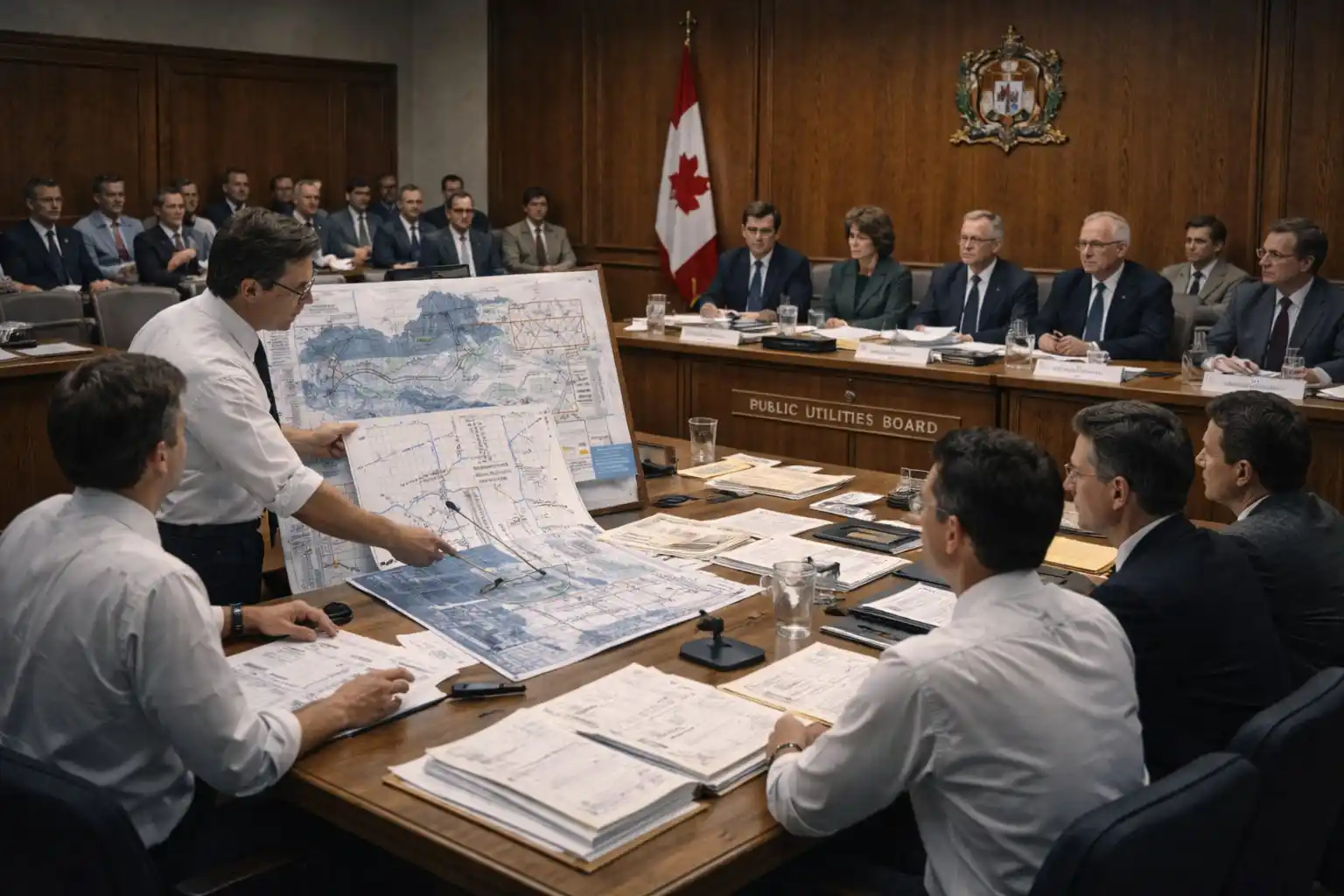
It moves through agencies, courts, consultation frameworks, municipal politics, media narratives, and capital markets each with its own standards, each capable of slowing momentum without ever formally saying no.
That is the permission structure shift.
You can see it in how projects must become stories before they become structures.
An engineering proposal becomes an environmental assessment. An assessment becomes consultation.
Consultation becomes legal exposure. Legal exposure becomes political risk. Political risk becomes financial risk.
And financial risk — priced into the cost of capital — becomes the quiet executioner of construction.
Even when the state says yes, the system does not necessarily converge.
A project can be approved and still be stopped. It can be delayed and still be “alive.” It can be legally required to restart parts of its process years after beginning.
Each loop adds time.
Time adds cost. Cost adds controversy. Controversy adds scrutiny. Scrutiny adds risk.
The project becomes less like a line and more like a maze.
In the builder era, a project moved like a relay race:
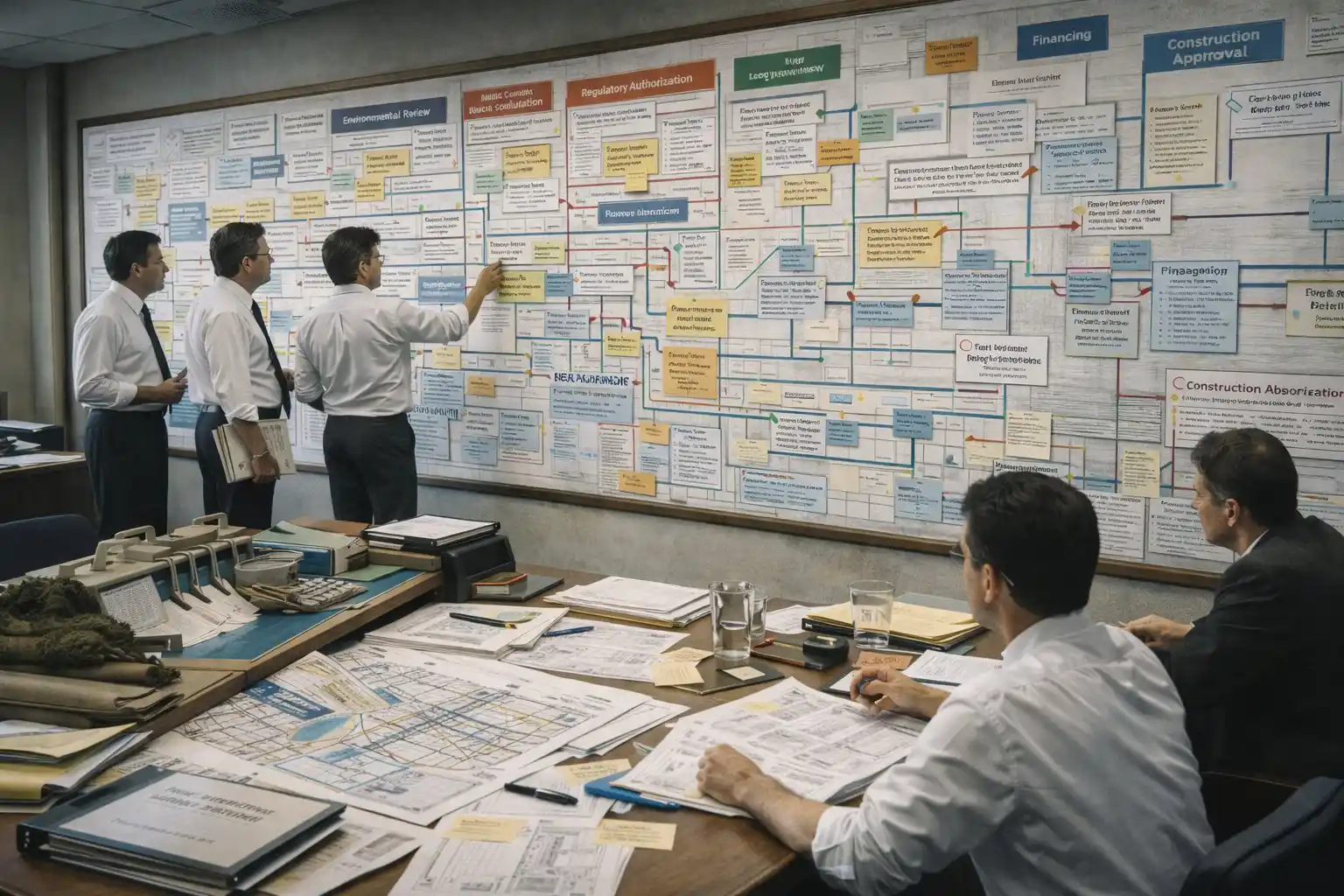
need → design → authorization → financing → construction
Today it often moves like a tribunal:
narrative legitimacy → procedural legitimacy → legal legitimacy → financial legitimacy → construction legitimacy
Each layer exists for reasons that sound defensible in isolation environmental protection, fairness, safety, consultation, accountability.
The shift is not that these values exist.
The shift is that they now operate upstream of building.
That upstream thickness changes the lived experience of trying to build.
A mid-century builder could stand at a jobsite and feel history moving forward.
A modern builder often experiences something different.
The challenge is not only technical.
It is institutional.
You are not only fighting geology and physics.
You are fighting the calendar, the court schedule, the stakeholder map, the disclosure regime, the reputational cycle, and the financing cycle.
This is why contemporary Canada can contain extraordinary engineering talent and still feel unable to build at the tempo its landscape requires.
It is not that builders disappeared.
It is that builders were moved to the end of the legitimacy chain.
Where they must wait for every upstream authority to finish arguing about whether the project deserves to exist.
That is what the permission structure shift means in practice:
The country still has hands that can build.
But it struggles to produce a clean yes.

V.5 The Lost Future

Seen up close, the change can feel procedural another review, another hearing, another year added to the timeline.
Step back, and the pattern becomes unmistakable.
The civilization that once turned rivers into power systems and orbit into infrastructure did not lose its engineers, its materials, or its knowledge.
What changed was the atmosphere in which decisions about the future were made.
Permission thickened.
Momentum thinned.
And slowly, almost invisibly, the places where the future once appeared — in concrete, steel, and continental systems — grew quieter.
The machines already built kept running.
But fewer new ones joined them.
The future did not vanish.
It simply became harder to authorize.

VI. THE LOST FUTURE (1985–Present)

By the mid-1980s the future had not disappeared.
But something strange had happened to it.
For nearly two centuries, the future had been a visible phenomenon. It appeared in the physical world as railways cutting through mountains, electrical grids lighting cities, aircraft crossing oceans, and rockets climbing toward orbit. Each generation could point to machines and structures that had not existed in the previous one.
The future had weight. It occupied space. It could be photographed.
And then, gradually, it became harder to see.
This did not mean technological progress stopped. In many fields it accelerated dramatically. The late twentieth century witnessed extraordinary advances in microelectronics, computing, telecommunications, biotechnology, and materials science.
Tiny silicon devices began performing calculations faster than entire rooms of earlier machines. Information could move across continents in fractions of a second through networks of satellites and fiber-optic cables.
Digital technologies reorganized commerce, communication, and entertainment.
The world was becoming more technologically sophisticated than ever before.
Yet the physical landscape of civilization seemed to change more slowly.
Ask someone to identify the great technological monuments of the late twentieth century, and the answers are rarely obvious. The earlier era had produced Hoover Dam, the interstate highway system, the Apollo rockets, nuclear power stations, and continental radar networks.
Those machines had scale.
They dominated landscapes and reshaped economies.
The new technologies of the digital age often operated invisibly.
Their infrastructure was hidden in microchips, buried cables, and server rooms.
The future had become smaller.
It fit inside pockets.
This transformation created a curious paradox.
Technological progress continued sometimes at breathtaking speed. But the visible evidence of that progress became less dramatic.
Civilizations can change in two very different ways.
One form of technological change is intimate. It improves the tools individuals carry and use in daily life: faster computers, smarter phones, better medical instruments, more efficient appliances. These innovations spread through markets and private companies, often requiring little coordination beyond supply chains and consumer demand.
The other form of technological change is civilizational.
Civilizational technologies reshape the structure of society itself. They create electrical grids, transportation networks, dams, nuclear power systems, ports, pipelines, and space infrastructure. These systems require long time horizons, large investments, and cooperation between governments, engineers, industries, and citizens.
They are not simply inventions.
They are commitments.
After 1985 the Western world did not lose the ability to innovate.
But it gradually lost the habit of building civilizational systems at the same scale and speed that had defined the mid-twentieth century.
The difference became visible in the rhythm of construction.
During the builder era, large infrastructure projects often moved from planning to completion within a decade. Engineers expected complexity. They expected risk. But they also expected momentum.
In the later decades of the twentieth century, that rhythm changed.
Projects extended across longer timelines. Regulatory procedures expanded. Legal challenges multiplied. Costs increased as delays accumulated.
None of these changes occurred for trivial reasons. Environmental protection, public consultation, and safety oversight addressed genuine concerns that earlier builders had sometimes ignored.
Yet the cumulative effect was unmistakable.
The tempo of civilization slowed.
Meanwhile, technological innovation migrated toward fields that required less visible construction.
The frontier of progress moved from landscapes to laboratories.
The microprocessor replaced the megaproject as the symbol of technological advancement.
Software companies could transform global communication without pouring concrete or erecting transmission towers across continents. Venture capital replaced public infrastructure budgets as the primary engine of innovation.
A civilization that had once built dams and rockets now built algorithms.
This transition produced enormous benefits.
Digital networks connected billions of people. Information became accessible on a scale unimaginable in earlier centuries. Scientific research advanced rapidly with the assistance of powerful computational tools.
Yet something subtle was lost.
The builder era had been sustained not only by technical capability but by a particular emotional atmosphere.
It was an era of earned confidence.
Citizens believed that large collective efforts could succeed. Engineers trusted institutions to support long-term projects. Governments possessed enough legitimacy to coordinate ambitious undertakings.
Confidence of this kind is difficult to measure, but easy to recognize when it disappears.
It fades gradually.
A project is delayed. Another is cancelled. A third becomes mired in controversy.
Each individual event appears manageable.
But over time a pattern emerges.
Ambition begins to look dangerous.
The safest decision becomes postponement.
Civilizations rarely abandon technological capability outright.
More often they lose the cultural permission to use it.
Science fiction quietly registered this shift long before policymakers recognized it.
In the middle of the twentieth century, much speculative fiction imagined futures defined by exploration and expansion. Starships traveled between worlds. Engineers built orbital stations and planetary cities. Humanity appeared as an outward-moving species.
By the late twentieth century speculative fiction increasingly explored darker technological futures. [24]
Technology became associated with surveillance, ecological collapse, or social fragmentation. The future remained technologically sophisticated, but it was no longer assumed to be optimistic.
These narratives reflected genuine anxieties.
But they also shaped the cultural imagination.
A society that repeatedly imagines the future as dangerous becomes cautious about building it.
Canada experienced this transformation in its own distinctive way.
The country did not lose its technical competence. Canadian scientists and engineers continued contributing to aerospace research, telecommunications systems, nuclear technologies, and advanced materials.
Canadian satellites remained essential components of global communications. Canadian nuclear reactors produced electricity and medical isotopes. Canadian engineers participated in international space missions and scientific research programs.
Yet the national mood surrounding large infrastructure projects changed.
Megaprojects still occurred, but they rarely carried the same sense of civilizational ambition that had characterized the earlier builder era.
Instead they were often debated primarily in terms of cost, environmental risk, and political controversy.
These concerns were legitimate.
But they also altered how Canadians imagined technological progress.
The future no longer appeared as a vast landscape waiting to be constructed.
It appeared as a series of complicated decisions requiring caution.
The lost future was therefore not the disappearance of capability.
It was the fading of a collective expectation.
The engineers still existed.
The knowledge still existed.
The resources still existed.
What had weakened was the cultural ecosystem that made large technological ambition feel normal.
And that leads directly to the central question of this book.
If civilizations can lose the habit of building the future…
Can they learn it again?

VII. WHY SOME CIVILIZATIONS BUILD THE FUTURE — and Others Stop

VII.1 The Builder Question
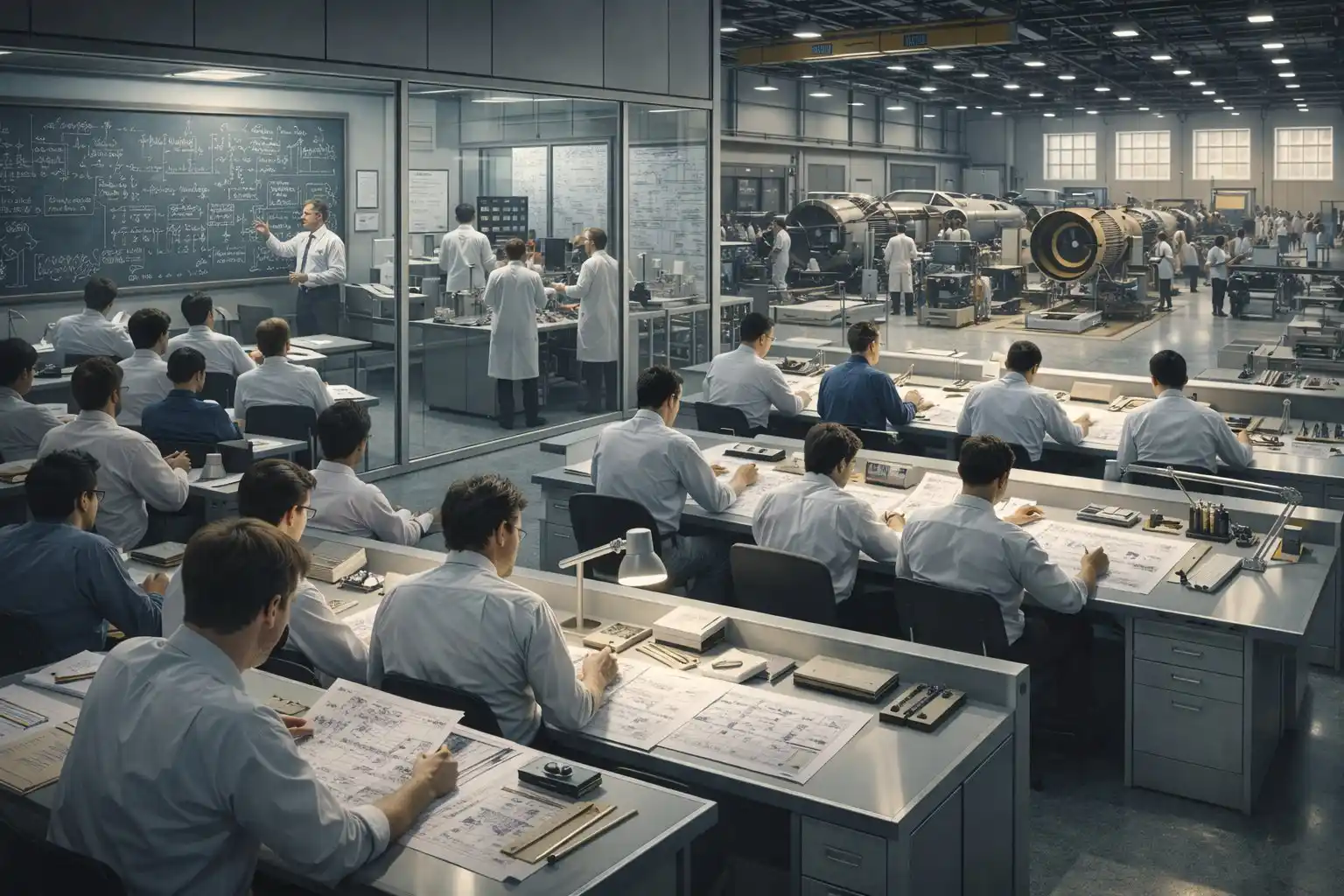
Every technological civilization eventually confronts the same quiet question.
Why do some societies build extraordinary futures while others gradually lose the ability to build them?
At first glance the answer might seem obvious. Nations build when they possess wealth, resources, and skilled workers. When those elements disappear, construction slows.
But history tells a more complicated story.
There have been moments when relatively small societies built astonishing systems of technology and infrastructure. And there have been moments when wealthy, sophisticated nations struggled to complete projects that earlier generations would have considered routine.
The difference is rarely explained by resources alone.
The difference lies in the cultural operating system of a civilization.
Technological societies do not function only through machines. They function through human habits patterns of education, institutional trust, and imagination that determine how a population approaches difficult problems.
Engineers do not appear spontaneously.
They are produced by ecosystems.
A civilization that consistently builds large technological systems tends to share several underlying characteristics.
The first is a culture that respects competence.
In builder civilizations, practical knowledge carries prestige. Mathematics, physics, and engineering are treated as serious intellectual pursuits rather than narrow technical specialties. Students who excel in these disciplines are encouraged to pursue them. Institutions reward mastery of difficult skills.
This cultural respect for competence has subtle but powerful consequences.
When societies value technical ability, young people invest time and effort into mastering complex subjects. Universities train large numbers of engineers and scientists. Industries develop deep reservoirs of technical expertise.
The pipeline of builders remains open.
The second characteristic is institutional continuity.
Large technological systems require time horizons longer than electoral cycles or corporate quarterly reports. A hydroelectric complex may take twenty years from design to completion. A space program may require decades of sustained research and testing before achieving its most significant results.
Societies capable of building such systems develop institutions that protect long-term projects from short-term turbulence.
Engineers are allowed to pursue technical solutions without constant interruption. Governments maintain stable commitments to infrastructure development. Public expectations support the idea that large achievements require patience.
The third characteristic is social trust.
Technological civilization depends on cooperation between individuals who may never meet one another.
Engineers design structures that others will construct decades later. Maintenance crews rely on the accuracy of blueprints created by earlier generations. Citizens depend on systems whose inner workings they may never fully understand.
This network of cooperation requires trust trust that institutions function honestly, that professionals perform their duties competently, and that public systems operate in the collective interest.
When trust collapses, large systems become difficult to build.
Every decision becomes contested. Every project becomes vulnerable to paralysis.
The fourth characteristic is imagination.
Civilizations build the future only when they can imagine it.
Speculative storytelling has played a surprisingly important role in this process. Science fiction has often served as a rehearsal space where societies explore technological possibilities before attempting them in reality.
Writers imagine new machines, new energy systems, new forms of transportation, and new frontiers of exploration. Young readers absorb those visions and begin to see engineering as a form of adventure.
Some of those readers later become the engineers who attempt to build those futures.
The boundary between imagination and engineering is thinner than it appears.
The builder civilizations of the twentieth century were sustained by precisely this feedback loop.
Scientists inspired writers.
Writers inspired engineers.
Engineers built systems that once existed only in fiction.
But imagination alone cannot sustain technological momentum.
Civilizations must also maintain a certain tolerance for risk.
Large engineering projects are never perfect. They involve uncertainty, experimentation, and occasional failure. Early bridges collapse. Early aircraft crash. Early reactors require redesign. Every frontier carries danger.
Builder societies recognize this reality without allowing it to halt progress.
They treat failure as information rather than catastrophe.
A society that cannot tolerate the possibility of mistakes gradually loses the ability to attempt ambitious projects at all.
The twentieth century builder era possessed all of these ingredients simultaneously.
Competence was respected. Institutions supported long-term planning. Public trust allowed coordination across complex systems. And popular imagination celebrated exploration and discovery.
That combination produced the extraordinary technological achievements of the mid-century period.
But cultural ecosystems are fragile.
When one component weakens — when trust declines, institutions fragment, or imagination turns pessimistic — the entire system begins to shift.
The result is rarely an immediate collapse.
Instead momentum gradually fades.
The machinery of civilization continues operating. Existing infrastructure continues functioning. Engineers continue working.
But the cultural energy required to launch new megaprojects becomes harder to assemble.
This is the condition many advanced societies now confront.
They possess knowledge, talent, and resources that would have astonished earlier generations.
Yet they struggle to mobilize those resources toward large collective undertakings.
The challenge is not technological.
It is civilizational.
And that realization brings the story of this book back to Canada.
Canada was once one of the clearest examples of a functioning builder civilization. Its geography required ambitious engineering solutions. Its institutions produced capable scientists and engineers. Its society believed that building large systems was part of national purpose.
Hydroelectric networks powered industries across the country. Radar systems guarded the northern frontier. Satellites connected remote communities. Nuclear laboratories advanced scientific knowledge.
These achievements did not occur by accident.
They were the result of a cultural ecosystem that valued competence, trusted institutions, and believed the future could be constructed.
The question facing Canada today is therefore not simply whether the country possesses the resources to build again.
It is whether the cultural ecosystem that once produced builders can be renewed.
Civilizations are not static.
They evolve, adapt, and sometimes rediscover forgotten capacities.
The same nation that once built continental railways, Arctic radar networks, and satellite communication systems still possesses the underlying ingredients of technological civilization: skilled engineers, powerful universities, abundant natural resources, and a stable political framework.
What remains uncertain is whether those ingredients can once again combine into a builder culture.
If they can, the future may become visible again.
Not as a slogan or a marketing campaign.
But as something solid and unmistakable.
A dam rising across a river.
A new energy system lighting a continent.
A spacecraft leaving Earth for destinations that once existed only in imagination.
The future, after all, is not a place we arrive.
It is something we build.

VII.2 Engineering as Civilizational Identity
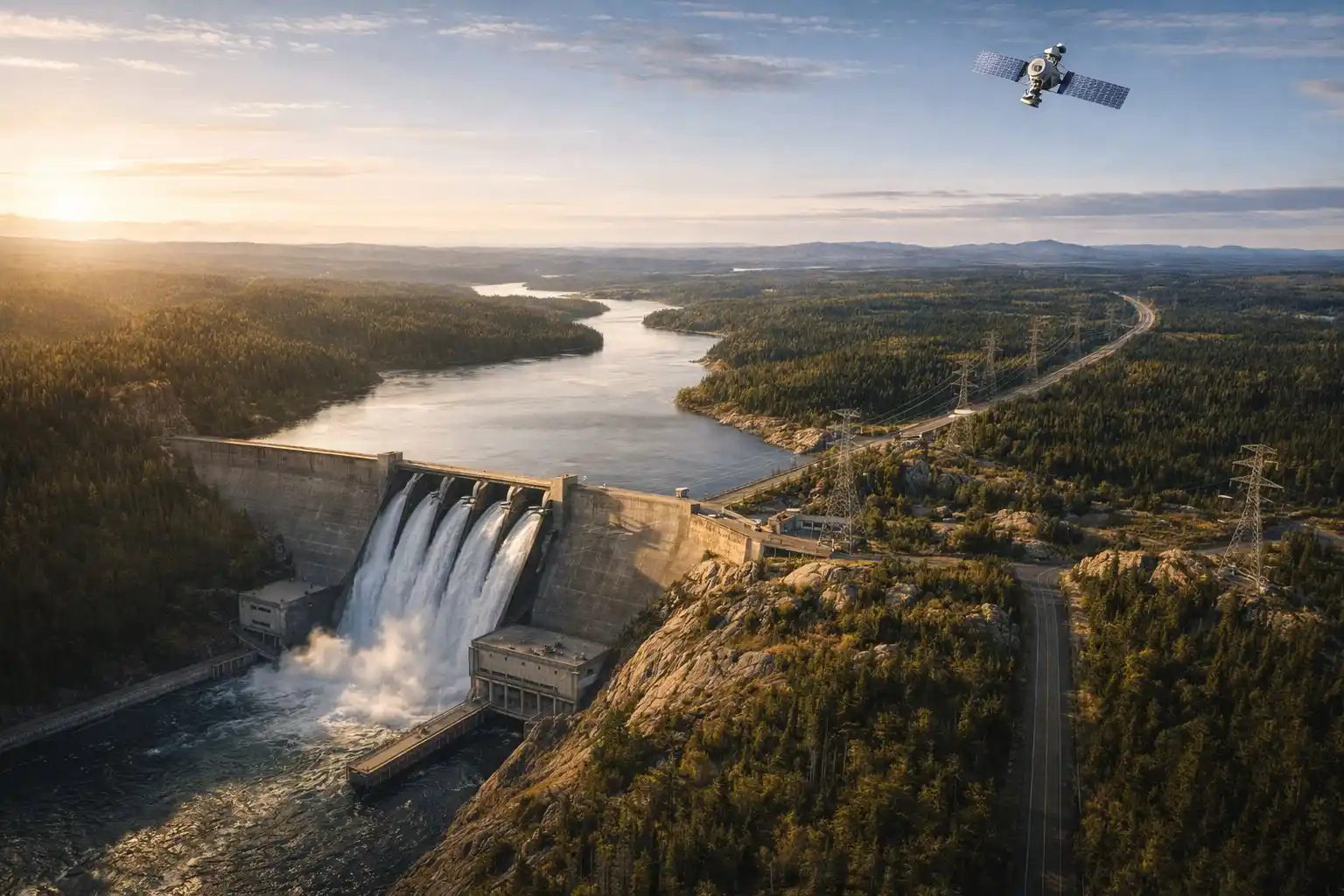
Seen across history, builder civilizations share a small set of fragile cultural conditions. They cultivate respect for competence, rewarding individuals who can translate theory into functioning systems. They maintain institutions capable of thinking across long time horizons, protecting projects whose benefits may not appear for decades. They encourage imagination — through science, education, and storytelling — so that societies can picture futures larger than the present. And they sustain a tolerance for risk, accepting that ambitious undertakings inevitably involve uncertainty and occasional failure.
When these elements align, something remarkable becomes possible. Engineers design systems that reshape landscapes. Institutions coordinate effort across generations. Citizens accept the temporary costs of projects whose rewards may only become visible years later. The result is a civilization capable of building its future in concrete, steel, orbit, and electricity.
When those conditions weaken, the ability to build does not vanish immediately. The knowledge remains. The infrastructure continues to function. But the cultural ecosystem that produces builders gradually fades, and the pace of large technological ambition slows.
The central question, then, is not whether modern societies still possess the technical capacity to construct extraordinary systems. They do. The deeper question is whether they still possess the confidence, institutions, and imagination required to attempt them.
Civilizations pause.
But history suggests they can begin again.

VIII. CANADA: THE UNFINISHED BUILDER CIVILIZATION

Canada did not invent the builder tradition from nothing. It inherited it. The intellectual foundations of technological civilization had been forming for centuries across Europe and the Atlantic world. The Scientific Revolution revealed that nature followed discoverable laws. The Industrial Revolution demonstrated that those laws could be applied through engineering to reorganize energy, distance, and production. Science fiction then carried those possibilities into the public imagination, teaching generations to picture futures built from machines, infrastructure, and exploration. By the middle of the twentieth century this scientific, engineering, and imaginative tradition had produced what might be called a builder civilizationsocieties confident that the future could be constructed through disciplined knowledge. Canada was one of the places where that tradition reached continental scale.
Canada provides an unusually clear lens through which to study technological civilization. Few countries combine such vast geography with such a relatively small population. Communities are separated by enormous distances, climates are often severe, and natural resources frequently lie far from the cities where they are consumed. Under these conditions, functioning as a modern nation requires more than political institutions alone. It requires engineering.
Railways had to cross continental distances. Hydroelectric systems had to harness powerful rivers flowing through sparsely populated regions. Communication networks had to reach communities scattered across forests, mountains, and Arctic tundra. Satellites eventually became part of the national infrastructure because the distances were simply too great for traditional systems alone.
In this sense, Canada acts as a natural laboratory for studying how technological systems allow modern societies to exist at scale. The country’s geography makes the invisible machinery of civilization easier to see. Where smaller nations might rely on dense populations and short distances, Canada must rely on infrastructure energy networks, transportation corridors, communication systems, and scientific institutions that extend human coordination across thousands of kilometers.
The artifacts of that effort remain visible across the landscape. Dams, transmission lines, satellite networks, Arctic installations, laboratories, and aerospace programs reveal the quiet truth that Canada’s survival as a modern country has always depended on engineering.
Across the Canadian landscape there are artifacts that do not quite fit the country many people imagine today.
Drive north through Quebec and the earth suddenly opens into immense engineered rivers vast hydroelectric systems where entire watersheds are redirected through concrete spillways and turbines that hum with the force of continental water. Fly across northern Ontario and you can still trace the silent line of radar installations that once stretched across the Arctic sky, part of a defensive nervous system built to watch the horizon of a new technological age.
Walk through the laboratories at Chalk River. Visit satellite control rooms that once linked distant northern communities through orbiting communications systems. Stand on the crest of a hydroelectric dam and listen to the turbines turning below.
In those places a strange realization begins to form.
Canada once stood at the center of some of the most ambitious technological systems on Earth.
These structures are still here. They still generate electricity, transmit signals, and support the daily life of millions of people. Yet the story of how they came to exist has gradually faded from public memory.
Many Canadians encounter these systems today as if they were natural features of the landscape impressive and useful, but inevitable. They appear as background infrastructure rather than the result of deliberate civilizational effort.
But nothing about them was inevitable.
They were built.
And the society that built them possessed a particular kind of confidence.
Canada did not become a technological civilization by accident. From the beginning, geography forced the country to confront engineering problems on a continental scale.
Distances between communities were enormous. Harsh climates imposed severe limits on infrastructure. Resources lay in remote regions that required railways, ports, pipelines, and power systems before they could support economic development.
To function as a nation at all, Canada had to become technically competent.
Railway engineers carved routes through the mountains and across the shield. Surveyors mapped vast territories with instruments carried through forests and tundra. Hydroelectric engineers learned to harness enormous river systems that flowed through sparsely populated regions.
Communications engineers developed networks capable of connecting settlements separated by thousands of kilometers.
These achievements were not minor works of infrastructure.
They were the foundation of a modern civilization.
By the middle of the twentieth century Canada had developed one of the most capable engineering cultures in the world. Universities produced scientists and engineers trained in advanced disciplines. Public institutions coordinated national infrastructure programs. Industry developed the ability to manufacture complex technical systems.
And a generation of young people grew up believing that building large things — bridges, dams, aircraft, satellites — was simply part of what serious countries did.
The builder civilization was not mythology.
It was daily reality.
Over time, however, the cultural memory that sustained this confidence began to weaken.
The systems themselves continued to operate. Power plants generated electricity. Satellites transmitted signals. Laboratories conducted research. But the story that had once explained these achievements — the belief that a society could deliberately build its future — slowly faded from the public imagination.
The reasons were numerous and complex.
Economic structures shifted toward service industries and digital technologies. Political debate increasingly focused on social and constitutional questions rather than technological ambition. Regulatory systems expanded to address legitimate environmental and social concerns.
Each change had understandable motivations.
But together they altered the national atmosphere surrounding large engineering projects.
Megaprojects began to feel unusual.
Risky.
And the tools for building still exist.
The machines that built Canada’s technological civilization have not vanished. The rivers still fall. The engineers still graduate. The laboratories still exist. What remains uncertain is whether the cultural permission to build — the confidence that once turned ideas into continental systems — can be rediscovered. The future does not arrive automatically. It appears only when societies decide it should exist, and begin the difficult work of building it.

IX. NOTES

  1. Canadian Space Agency. The Anik Satellite Program and the Development of Canadian Satellite Communications.
  2. Arthur C. Clarke. “Extra-Terrestrial Relays: Can Rocket Stations Give Worldwide Radio Coverage?” Wireless World, 1945.
  3. Richard White. The Organic Machine: The Remaking of the Columbia River. Hill and Wang, 1995.
  4. Vaclav Smil. Energy and Civilization: A History. MIT Press, 2017.
  5. Randall Wakelam. Cold War Fighters: Canadian Aircraft Procurement, 1945–1954. UBC Press, 2011.
  6. Palmiro Campagna. Storms of Controversy: The Secret Avro Arrow Files Revealed. Dundurn Press, 1998.
  7. Robert Bothwell. Canada Enters the Nuclear Age. University of Toronto Press, 1988.
  8. Atomic Energy of Canada Limited historical archives.
  9. Charles Murray and Catherine Bly Cox. Apollo: The Race to the Moon. Simon & Schuster, 1989.
  10. NASA Historical Office. The Apollo Program Summary Report.
  11. Joseph Jockel. No Boundaries Upstairs: Canada, the United States, and the Origins of North American Air Defence. UBC Press, 1987.
  12. Vaclav Smil. Energy Transitions: History, Requirements, Prospects. Praeger, 2010.
  13. The Canadian Encyclopedia. “Hydroelectricity.”
  14. Transport Canada. History of the Trans-Canada Highway.
  15. The Canadian Encyclopedia. “Trans-Canada Highway.”
  16. St. Lawrence Seaway Management Corporation. History of the Seaway.
  17. Newfoundland and Labrador Hydro. Churchill Falls Generating Station Overview.
  18. Government of Canada Infrastructure Records.
  19. Department of National Defence (Canada). The Distant Early Warning Line in Canada.
  20. Canadian Space Agency. Anik A1 Mission History.
  21. Robert J. Gordon. The Rise and Fall of American Growth. Princeton University Press, 2016.
  22. Daniel Yergin. The Prize: The Epic Quest for Oil, Money, and Power. Free Press, 1991.
  23. Barry Eichengreen. Globalizing Capital: A History of the International Monetary System. Princeton University Press, 1996.
  24. Fredric Jameson. Archaeologies of the Future. Verso, 2005.
  25. Robert Heinlein, Isaac Asimov, and Arthur C. Clarke memoirs and interviews documenting science fiction’s influence on early space-age engineers.

Related Content:

“🇨🇦 Canadian Core Values Explicitly Named, Described, and Structurally Defined” https://x.com/SkillsGapTrain/status/2025424368965410922

“Population Growth Is Not Civilizational Continuity” https://x.com/SkillsGapTrain/status/2028289558081577163

“🇨🇦 Canada at the Continuity Threshold” https://x.com/SkillsGapTrain/status/2022094914327392578

“🇨🇦 Firearms, Frontier Identity, and the Hidden Code of 🇨🇦 Canada” https://x.com/SkillsGapTrain/status/1997708629479498175

“🇨🇦 Why Our Civilization Is Fading — and How Prosperity Can Rekindle It” https://x.com/SkillsGapTrain/status/1979157896643694884

“🇨🇦 Canada’s Breaking Point: The Civilizational Squeeze on Its Load-Bearing Nodes” https://x.com/SkillsGapTrain/status/1971622900982861939

“Engineering Progress vs. Postmodern Deconstruction: 🇨🇦 Canada’s 1970s Philosophical Schism” https://x.com/SkillsGapTrain/status/1887299542065795429

“Indigenous Population and Land in 🇨🇦 Canada: A Statistical Reality Check” https://x.com/SkillsGapTrain/status/1969529813921907008

“🇨🇦 True North, Armed & Free: Civilization’s Legacy — Canada’s Future” https://x.com/SkillsGapTrain/status/1916880261536702506

“🇨🇦 True North, True Identity: Reclaiming 🇨🇦 Canada’s Real Civilization” https://x.com/SkillsGapTrain/status/1916118889307771274

“True North, Armed & Free: Why Gun Ownership Is Core to 🇨🇦 Canadian Identity” https://x.com/SkillsGapTrain/status/1913178482672099684

“The Longest-Running Operating System” https://x.com/SkillsGapTrain/status/2020368394155901301

“Why Canada 🇨🇦 is the Greatest Nation on the Planet” https://x.com/SkillsGapTrain/status/1854323924731101321

Scroll to Top