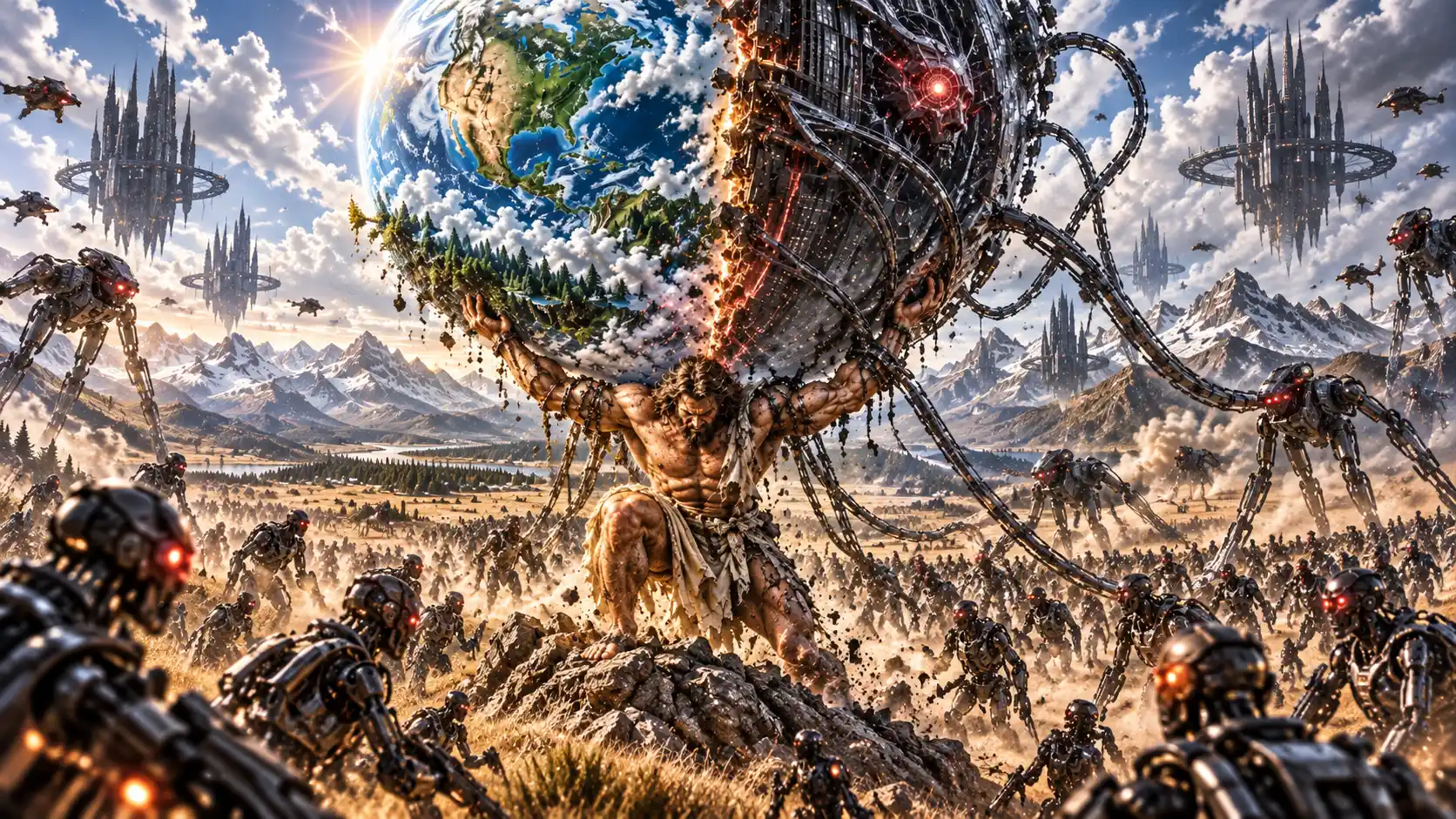
A Present-Day Capability Atlas of the Matrix–Skynet–Terminator–Regeneration Stack — What Exists, Who Holds Each Piece, How the Pieces Connect, Where the Common Roots Are, and What Prevents Full Convergence
Original article and concepts: Skills Gap Trainer (SGT). First-principles review, technical benchmark suite (<= 400 metrics) optimization and verification, and editorial assistance (2026): ChatGPT — GPT-5.6 Sol (OpenAI).
Original Digital Federation articles, including Skynet-Matrix Atlas 2026, project lineage, and SGT-specific synthesis/architecture: Skills Gap Trainer (SGT). Broader civilizational, scientific, institutional, engineering, open-source, and cultural antecedents retain their independent and multi-source provenance.
RC1 — Original-report prose restored; audit coding moved behind the narrative
Wave 1-4 + Quality Final populated in place — 12 maps, structured company cards, chapter control panels, source register, completeness audit, accessibility alt text and publication polish
This is the readable edition. The technical ledgers, C/P/U cell codes, requirement IDs, source-control history, and full evidence registers remain in the RC3 evidence master and the requirements ledger. The main text restores the recognizable report prose and keeps the corporations, systems maps, quantitative anchors, earned interfaces, protected blanks, and recovery questions visible without making the reader decode an audit worksheet.
THE MISSION OF THE ATLAS — ONE-PAGE THESIS
Advanced technology should increase human capability without silently transferring human sovereignty to the machinery required to use it.
This Atlas maps the real components of a distributed technology ecosystem: perception and data systems, identity and permission layers, cloud and networks, AI and mission applications, autonomy gateways, physical platforms, semiconductors, industrial capacity, and recovery systems. Its purpose is not to manufacture a single hidden-machine story. Its purpose is to make consequential capabilities, interfaces, roots, authority boundaries, failure modes, and recovery paths legible enough that institutions can cooperate without becoming unable to refuse, substitute, recover, or rebuild.
The central engineering test is not “Who owns everything?” It is simpler: who provides each capability, what actually connects, what depends on what, who can control or restore it, and what happens when something fails. The final question is whether legitimate public authority can still carry out its mission without depending on the failed system.
• Reality before rhetoric — Map components, interfaces, institutions and physical infrastructure before interpreting motive.
• Authority before automation — Keep recommendation, authentication, permission, tasking, gateway acceptance, physical execution and sovereign authority separate.
• Recovery before confidence — A system is not resilient merely because a backup exists; the alternate must be independent enough to survive the failure being tested.
• Plurality before captivity — Provider diversity matters only when alternate paths are practically usable and do not collapse onto the same hidden root.
• Evidence before completion — A processed company, program or chapter is not automatically quantitatively or operationally validated.
• Human purpose before technical scale — The destination is capability without captivity: systems that help people and institutions understand, choose, refuse, repair, recover and continue building.
Reader promise: the report will show not only what exists, but also what the evidence does not establish. Protected blanks, contradictory evidence and unresolved ownership are part of the architecture rather than defects to be hidden.
HOW TO USE THIS EDITION
The project now has three layers. This Reader Edition is the narrative report. The RC3 pre-compression evidence master remains the lossless technical archive. The requirements/corporate-specification document remains the audit layer. Nothing important has to disappear simply because the main report becomes readable.
- Read Parts I–IV to understand who the main companies are, what the four stack planes mean, and which corporate/government interfaces are actually evidenced.
- Read Parts V–XIV for the deeper original Atlas analysis: perception, composition, roots, physical effect, authority, epistemic failure, recovery, allied sovereignty, hard gates, Builder Civilization, the complete architecture, and protected blanks.
- Use the quantitative spine to understand historical scores without mixing unlike rubrics.
- Use the Last Switch annex for the focused SpaceX/DoDIN/aircraft/autonomy analysis.
- Use the RC3 evidence master when you need the full registers, historical variants, detailed source-control trail, or exact technical audit state.
FRONT LEGENDS & CONTROLLED GLOSSARY
READER’S GUIDE — HOW TO INTERPRET THE ATLAS
• Read a company card in two passes — first read what the node can actually provide and connect to; then read the authority boundary, protected blank, and substitution/recovery bullets before drawing any conclusion about control.
• Read percentages as evidence coverage — the four-plane percentages describe documented functional breadth under the recovered twenty-function rubric. They are not threat, sovereignty, intent, quality, or market-power scores.
• Read arrows as claims — an arrow is permitted only where the source record supports a real interface or relationship. A visually plausible connection is not enough.
• Read blanks as findings — a protected blank records a consequential relationship that the evidence does not establish. It is part of the map, not missing work.
• Read recovery as architecture — a backup is not independent if it shares the same failed identity, signer, cloud control plane, route, power source, industrial bottleneck, or recovery authority.
EVIDENCE-STATE LEGEND
• VERIFIED / SOURCE-SUPPORTED — a source in the recovered corpus directly supports the stated scope.
• REPRODUCED OBSERVATION — an observable condition or behavior was reproduced, but mechanism or attribution may remain open.
• AUTHOR-OBSERVED — a first-person observation is preserved as an observation, not promoted into a mechanism or attribution claim.
• SUPPORTED INFERENCE — the conclusion follows from supported facts, but the inferential step is stated openly.
• HYPOTHESIS — a testable explanation or possibility that is not yet established.
• ATTRIBUTION UNKNOWN — a phenomenon may be real while the responsible actor, cause, or intent remains unresolved.
• PROTECTED BLANK — the stronger bridge, interface, permission, or authority relationship has not been earned by evidence.
• CONTRADICTED / RETIRED — a former claim or mapping has been displaced by stronger contrary evidence or a correction.
• PROPOSAL / CONTROL OBJECTIVE — a safeguard or design requirement the Atlas argues should exist; not a claim that it already does.
• METAPHOR — a narrative or science-fiction analogy used to aid reasoning; never empirical evidence by itself.
FOUR-PLANE STACK LEGEND
• MATRIX — represented reality. Sensors and sources; data; databases; schemas and ontologies; search/retrieval; ranking; fusion; AI interpretation; operational pictures; explanations and recommendations. Central question: what does the system believe is happening, and how did it come to believe it?
• SKYNET — coordination and machine-directed action. Mission guidance; identity; authentication; authorization; permission; delegation; tasking; C2; networks; routing; gateways; machine coordination; bounded autonomy. Central question: who or what is permitted to cause another system to change state?
• TERMINATOR — physical execution. Vehicle controllers; embedded control; mission computers; effectors; actuators; aircraft; ships; autonomous vehicles; robots and industrial machinery. Central question: what actually moves or changes something in the physical world?
• REGENERATION — restoration of capability. Maintenance; repair; rollback; key/state restoration; supply and spares; manufacturing; shipyards/factories; network/software/model restoration; workforce and industrial surge. Central question: can legitimate humans rebuild capability without depending on the same failed root?
AUTHORITY LEGEND — DO NOT COLLAPSE THESE STEPS
• Recommendation — an analytic or model output suggests an interpretation or action.
• Authorization — a legitimate human or institution decides that an action is permitted for a purpose.
• Authentication — the system verifies the identity presenting a credential or request.
• Permission — a technical enforcement point allows a defined operation.
• Delegation — bounded authority is passed for a specific scope, purpose, time, or task.
• Tasking / C2 — an authorized mission request is coordinated and delivered.
• Gateway acceptance — the receiving system accepts the identity, message type, state and safety envelope.
• Physical execution — the machine changes state or produces a physical effect.
• Sovereign authority — the lawful public authority that determines purpose and legitimate mission intent. Technical capability does not inherit this automatically.
SCORE LEGEND
• Source-evidenced company coverage — the Reader Edition’s current four-plane breadth measure. It reflects documented coverage of twenty frozen functions and is auditable cell by cell.
• Historical four-plane completeness — Matrix 22/25; Skynet 25/25; Terminator 21/25; Regeneration 19/25; raw four-plane completeness 87/100. A historical project lock, not external certification.
• Historical convergence / sovereignty-risk family — 64/100 with a historical 60–68 band. Keep separate from company coverage.
• National / Atlas-16 historical scores — U.S. technical 94/100, U.S. RRI 65/100, Atlas-16 technical 92/100, Atlas-16 RRI 68/100, 0/7 sovereign hard gates crossed in that historical snapshot.
• Company-specific historical audit — for example Anduril 72–88 with 82/100 central estimate, 80/100 confidence and M5. This came from a different historical rubric.
• Manuscript / design audit — 368/400 → 370/400 → 375/400 evaluates the report/design, not real-world Skynet completion.
• 100-metric validation — 92.9/100 is a separate audit family with a different denominator and purpose.
• 500-metric verification state — 22 PASS, 0 PARTIAL, 478 UNRESOLVED after withdrawal of an earlier over-permissive state. UNRESOLVED is not a hidden pass or fail.
MAP & SYMBOL LEGEND
• → Earned arrow — source-supported direction of transfer, interface, dependency, or control effect within the stated scope.
• ↔ Earned composition — a source-supported interoperable or reciprocal relationship; it does not imply merged ownership or sovereignty.
• …→ Conditional / incomplete path — some of the relationship is supported, but direction, identity, permission, fielding state, or downstream effect remains incomplete.
• ╳ Protected blank — the proposed bridge is not established.
• [ROOT] — a cross-cutting dependency such as identity/PKI, cloud, compute, PNT/time, schema, signing, updates, power, recovery authority or industrial capacity.
• [AUTHORITY GATE] — the boundary between recommendation and legitimate authorization.
• [PHYSICAL-EFFECT GATE] — the boundary where accepted digital tasking can become physical machine behavior.
• [HARD GATE] — a node whose removal, chokepoint position, authority adjacency, shared-root role or regeneration difficulty materially changes the architecture.
• [?] — unknown or unresolved; not treated as zero, safe, dangerous, absent, or secretly present.
CORE CONTROLLED GLOSSARY
Potential-capability architecture
The functional classes needed for a highly integrated system exist and may be technically composable; this does not prove that one end-to-end operating mode is deployed or authorized.
Enabled operating mode
A stronger state requiring actual interfaces, identities, permissions, operational deployment, authority allocation, safety boundaries, persistence and real recovery.
Accepted interface
A boundary through which the receiver accepts an identity, message type, permission and state such that downstream behavior can change.
Control bleed
A condition in which legal/institutional authority remains distributed while practical freedom of action narrows because technical dependencies become concentrated.
Common root
A dependency shared by otherwise separate systems whose failure or compromise can produce common-mode loss.
Protected blank
A consequential non-arrow: a relationship that the evidence does not establish and must not be filled by inference.
Hard gate
A node whose removal, chokepoint position, authority adjacency, shared-root role or regeneration difficulty materially changes the system.
Meaningful human control
The practical ability to understand the consequential state, inspect evidence, challenge interpretation, refuse or inhibit action, revoke authority, stop execution and recover.
Sovereign residual
The minimum mission capability legitimate authority can still retain after major dependencies disappear: what can still be sensed, authenticated, authorized, commanded, moved, repaired and rebuilt.
Independent recovery
A recovery path that does not depend on the same root whose failure or compromise caused the outage.
Practical exit
The ability to move data, identity, software, configuration, workflows and mission function to an alternate within the required operational time.
Signing authority
Custody of a trusted signing path capable of changing accepted firmware, software, policy, model state, configuration or gateway rules; behavior-relevant but not automatically mission command.
Schema sovereignty
The control significance of defining or changing the interface contract: accepted identities, verbs, message types, fields, states, timing conditions and safety envelopes.
Agent identity
A distinct security principal for a software agent, traceable to the human/institutional delegation that created it and bounded by task, scope, time and revocation.
Split-brain recovery
The rejoin problem after partition: disconnected segments may hold conflicting state, permissions, queued actions or configuration and require reconciliation and reauthorization.
K0 — Trust Bootstrap Kernel
The minimum trusted capability required to re-establish identity, keys, provenance and known-good state after serious trust failure.
K1 — Mission Regeneration Kernel
The minimum capability needed to reconstruct or reconstitute essential mission function after major loss.
SEA — Sovereign Execution Availability
A mission-specific availability measure for whether legitimate authority can still execute the required mission; the recovered project does not preserve one universal historical denominator.
VIMR — Vendor-Independent Mission Retention
The amount of mission function that remains after the commercial provider disappears.
APEC — Alternate-Path Exercised Capacity
The difference between an alternate that merely exists and an alternate that has been exercised and can actually carry the required load.
IRAC — Independent Revocation and Access Coverage
How much of the high-consequence trust surface authorized public actors can independently revoke or control within the required clock.
URI — Update / Rollback Independence
Whether a high-consequence system can return to a trusted software state without depending on the same compromised update path.
ATD — Authority / Trust Depth
The number and quality of trust transitions between an external identity and a physical-effect interface.
RTSC — Recovery Time to Sovereign Control
The time required to restore legitimate, trusted control after a failure or compromise.
DoDIN
Department of Defense Information Network; modeled here as a network/operating environment, not one universal command bus.
JWCC
Joint Warfighting Cloud Capability; the multi-provider U.S. defense cloud vehicle used in the Atlas to study provider plurality and shared roots.
CDAO
Chief Digital and Artificial Intelligence Office; a U.S. Department of Defense organization appearing in government-AI and data/AI integration material.
SSC
Space Systems Command; source of key 2026 Space Data Network Backbone and space-based airborne target indicator procurement evidence.
SB-AMTI
Space-Based Airborne Moving Target Indicator; a space sensing program relevant to the Matrix/perception layer.
SDN
Space Data Network / Space Data Network Backbone; a high-speed resilient space-data transport layer relevant to the Skynet/network plane.
CCA
Collaborative Combat Aircraft; used here in the mission-autonomy / air-vehicle composition analysis.
A-GRA
Autonomous Government Reference Architecture; a government-owned interface intended to decouple mission-autonomy software from a specific air vehicle.
VENOM
Viper Experimentation and Next-gen Operations Model; a U.S. Air Force autonomy experimentation architecture involving F-16 flight-control and mission-system interfaces.
IBCS
Integrated Battle Command System; used as a concrete example of composing sensors and effectors not originally designed as one system.
NGC2
Next Generation Command and Control; used in the Atlas’s Army common-data / Lattice / Foundry / Raft corridor.
PKI
Public key infrastructure; a cross-cutting trust root for identity, signing, authentication and revocation.
ICAM
Identity, Credential and Access Management; the identity/access layer that must remain separate from mission authority.
PNT
Positioning, Navigation and Timing; a cross-cutting technical root whose failure can affect otherwise separate systems.
SYSTEM MAP INDEX — CURRENT READER EDITION
• Atlas Map 1 — Four-Plane Corporate Architecture.
• Atlas Map 2 — Matrix Plane: How Decision-Space Is Constructed.
• Atlas Map 3 — Skynet Plane: Authority Is a Vector, Not One Permission.
• Atlas Map 4 — Terminator Plane: Bounded Software-to-Aircraft Execution.
• Atlas Map 5 — Regeneration: Clean-Room Recovery and the Physical Rebuild Clock.
• Atlas Map 6 — U.S. Government / Corporate Overlay.
• Atlas Map 7 — Common Roots and the Multi-Vendor Paradox.
• Atlas Map 8 — Protected Blanks: Consequential Non-Arrows.
• Atlas Map 9 — Industrial Hard Gates and Regeneration Time Constants.
• Atlas Map 10 — Allied Sovereignty: Federated Trust Without Merged Command.
• Atlas Map 11 — Builder Civilization: Human-Centric Counterarchitecture.
• Atlas Map 12 — Complete Architecture: Authority, Technical Flow, Roots and Recovery.
• U.S. ecosystem map — reality / sensors / transport / cloud / semantics / AI / authority / identity-permission / autonomy gateway / machine control / regeneration.
• Four-plane corporate map — Matrix, Skynet, Terminator and Regeneration with representative company and government nodes.
• Authority-flow map — people / constitutional order → legitimate public authority → mission authorization → typed, revocable machine permissions.
• Physical-effect map — tasking/C2 → network delivery → gateway acceptance → flight/vehicle control → actuation.
• Semiconductor-to-aircraft dependency map — design → fabrication/packaging/memory → avionics compute → mission/autonomy software → authorized gateway → flight control.
• Common-root map — identity, keys, cloud, compute, PNT, schema, routing, signing, updates, power, recovery, industry.
• Failure/recovery map — degraded operation, isolation, local-only modes, rollback, substitution, trusted recovery and regeneration.
• Protected-blank map — frontier AI, DoDIN, Starshield/SDN, analytic output, interoperability and other consequential non-arrows.
Front-matter source basis: recovered RC3 Parts XII and Appendix A/H plus the Reader Edition quantitative ledger. These definitions are editorial controls for this project; they do not upgrade unresolved factual claims.
PUBLICATION QUALITY STANDARD — WHAT COUNTS AS COMPLETE
The recovered 400-point and 100-metric audits show that the architecture is already strongest in definitions, system boundaries, uncertainty, falsifiability and technical depth. The remaining page budget therefore goes to weaker dimensions: named ownership, interface proof, operational state, exit, recovery, citation quality and external validation.
• Depth — another competent reader can reconstruct the mechanism without the author present.
• Evidence rigor — the source supports the exact claim, scope, date and status.
• Ownership clarity — mission, identity, key/signing, network, safety, revoke and recovery ownership are named where public evidence permits.
• Interface rigor — sender, receiver, direction, transferred object, identity, permission, safety boundary and operational state are explicit.
• Operational maturity — concept, prototype, demonstration, developmental, fielded, exercised and independently reviewed are not collapsed.
• Failure and exit rigor — the report states what disappears, what remains, what alternate exists, and whether it works inside the mission clock.
• Counterevidence — the strongest contrary explanation or counterarchitecture appears beside high-consequence findings.
• Quantitative anchoring — numbers carry an object, unit/denominator, date/version, meaning and limitation.
• Reader legibility — maps, bullets, glossary and chapter structure carry the cognitive load instead of forcing the reader to reconstruct ten historical sessions.
• Citation quality — claims resolve to a traceable source identity and provenance record.
• External validation — independent legal, cyber, safety/airworthiness, operator, acquisition and systems-engineering review is attached or explicitly marked absent.
Hard gate: no high average can cancel fabricated provenance, unsupported authority claims, erased protected blanks, experimental interfaces represented as operational, technical access represented as sovereignty, or a shared-root backup represented as independent recovery.
EXTERNAL REVIEW STATUS — Independent legal, cyber, airworthiness/safety, operator, acquisition and systems-engineering certification is not attached to this edition. The Atlas is a public-source analytical manuscript and systems-design framework, not an operational certification, legal opinion or airworthiness finding.
PREAMBLE
Human Agency, Constructive Use, and the Architecture of Ascent
There is a simple reason to begin a report about artificial intelligence, cloud infrastructure, sensor networks, autonomy, aerospace systems, industrial capacity, communications, and machine control with the human being. Technical systems do not ultimately act on diagrams. They act on people. A network may be represented as lines between nodes. A cloud may be represented as compute, storage, identity, routing, and administration. An artificial-intelligence system may be represented as models, weights, inference, memory, retrieval, tools, and interfaces. A military system may be represented as sensors, command and control, communications, mission computers, autonomy gateways, vehicles, weapons, and industrial support. Those representations are useful. They are necessary. But they are not the reason the systems exist. The reason is outside the diagram.
It is the human being who needs to understand something, build something, travel somewhere, defend something, repair something, communicate with someone, raise a family, pursue a profession, govern an institution, make a decision, recover from failure, or create a future that does not yet exist. That distinction is the moral and engineering starting point of Skynet Atlas 2026. The purpose of advanced technology is not to make the human being increasingly subordinate to the machinery required to use it. The purpose is to extend human capability while preserving the human capacity to understand, choose, refuse, repair, recover, and change direction. The central question of this report is therefore larger than whether artificial intelligence is becoming more powerful. It is:
As technological systems become more capable, interconnected, persistent, and physically consequential, does meaningful human authority remain real inside the architecture?
1. The Human Being Is Why the Machine Exists
Modern technological systems can easily reverse the relationship between means and ends. A successful system becomes indispensable. An indispensable system accumulates interfaces. Those interfaces become dependencies. Dependencies become infrastructure. Infrastructure becomes difficult to leave. Eventually people begin adapting themselves to the requirements of systems that were originally built to serve them. This can happen without conspiracy, hostility, or even poor intentions. It can happen through ordinary optimization. A software platform seeks consistency. A network seeks availability. An organization seeks efficiency. A model seeks to reduce uncertainty. A recommender seeks engagement or relevance. A command system seeks faster decisions. An industrial system seeks scale. An autonomous machine seeks reliable execution of its assigned objective. Each optimization can be rational inside its own boundary.
The danger appears when the boundary becomes too narrow. A system can become locally efficient while making the larger human environment less understandable, less repairable, less plural, or less free to change. That is why this report treats the human being not as another component inside the stack, but as the reason the stack exists. Human beings are not peripherals. They are not terminals. They are not merely sources of training data, consumers of recommendations, operators who approve whatever appears on a screen, or biological fallback mechanisms for automated systems. A person has memory, judgment, relationships, responsibilities, uncertainty, creativity, moral agency, and a life trajectory that cannot be represented completely by the information available to a machine. The machine can help. It can perceive more.
It can calculate faster. It can search farther. It can remember more consistently. It can compare alternatives that no single person could evaluate in time. It can help coordinate complicated systems. It can even operate machinery more rapidly and precisely than a person under defined conditions. But those capabilities do not transform the machine into the legitimate purpose of the system. The human being is why the machine exists.
2. Human Time Does Not Restore From Backup
Engineering teaches people to think about redundancy. A failed drive can be replaced. A corrupted file may have a backup. A damaged server can be rebuilt. A compromised key can be revoked. A software release can sometimes be rolled back. A vehicle can be repaired. A factory can manufacture another component. Human time does not behave this way. A person has a finite number of waking hours. A child has one childhood. A student has one sequence of formative years. A family has particular moments together that cannot simply be reproduced later. A career develops through opportunities that occur at specific times. Relationships may recover, but the years inside them are not reloaded from a known-good state.
A person who loses months or years repeatedly recovering from broken systems does not receive those months or years back when the system is finally repaired. This matters because increasingly complex digital systems can impose costs that are individually small but cumulatively enormous. A failed account. A broken identity process. A wrongly classified record. A disappearing file. A corrupted workflow. An inaccessible service. An unexplained recommendation. A false positive. An opaque administrative decision. A series of authentication failures. A recommendation system that repeatedly sends the wrong signals. A model that confidently interprets a situation incorrectly. A person may technically remain free while spending an extraordinary amount of life simply trying to restore the conditions under which meaningful action is possible.
For this reason, human time should be understood as a form of productive capital. It enables learning. Trust. Craft. Engineering competence. Parenthood. Friendship. Physical health. Institutional memory. Scientific discovery. Entrepreneurship. Citizenship. Civilization itself. Money can sometimes be repaid. Time cannot be refunded. A technological architecture that measures efficiency while ignoring the human time consumed by recovery is therefore measuring the wrong system boundary.
3. Why This Report Exists
This report is not an allegation that a fictional machine called Skynet literally exists. It does not begin with the assumption that a group of companies has secretly assembled one centralized intelligence. It does not assume that technical integration proves political integration. It does not infer motive from architecture. Instead, it asks a narrower and more useful engineering question: What capabilities now exist, where do they connect, what do those connections permit, where does legitimate authority actually reside, and what happens when increasingly powerful systems begin to depend on the same underlying roots? That question can be investigated. We can identify companies. Programs. Networks. Models. Cloud systems. Sensors. Data platforms. Autonomy systems. Aircraft. Vehicles. Mission computers. Factories. Identity systems. Communication systems. Interfaces. Known dependencies.
Known alternatives. Known recovery paths. And equally important, we can identify what the available evidence does not establish. The objective is not to turn uncertainty into accusation. The objective is to turn complexity into something humans can inspect.
4. Architecture Rather Than Presumed Motive
One of the most important principles in this Atlas is that architecture can matter even when motive is unknown. Imagine several systems built independently. One company provides models. Another provides compute. Another provides cloud infrastructure. Another provides identity. Another organizes operational data. Another provides communications. Another builds autonomous machines. Another produces propulsion. Another manufactures vehicles. Another maintains the industrial supply chain. Every organization can have its own leadership, contracts, customers, legal responsibilities, and intentions. Yet the systems may still become technically composable. That fact is worth understanding even if there is no central planner. In other words: Emergent integration does not require centralized intention. This is common in engineering. The internet was not produced by one organization commanding every future service.
Global finance is not one computer owned by one institution. Supply chains emerge from thousands of independently optimized relationships. Standards create compatibility between systems whose owners may never have coordinated strategically. Cloud platforms allow applications written by unrelated organizations to operate inside common infrastructures. Machine-readable interfaces allow capability to compose much faster than organizational structures merge. The Atlas therefore studies capability, dependency, interface, authority, and recovery before it studies narratives about motive. This makes the analysis more rigorous. It also makes it more constructive. A dangerous architectural condition can be corrected without accusing every participant of intending the condition.
5. Capability Without Automatic Attribution
The same discipline applies to technological capability. If a technology can perform a function, that does not prove that a particular actor is performing that function in a particular case. A recommendation engine can influence visibility. That does not prove deliberate manipulation of a specific person. A frontier model can produce sophisticated language. That does not prove that an unusual account is AI-operated. A cloud administrator may possess significant infrastructure privileges. That does not establish military command authority. A satellite network may carry mission-critical traffic. That does not establish ownership of the mission. An autonomy computer may control a vehicle through an authorized interface. That does not establish the authority to decide why the vehicle moves. An industrial company may possess enormous manufacturing capability.
That does not establish sovereign authority over how that capability is used. These distinctions are not rhetorical caution. They are structural. Capability is not access. Access is not permission. Permission is not authority. Authority is not execution. Execution is not motive. Each transition requires its own evidence. That discipline will remain active throughout the Atlas.
6. The Direction of Control
A healthy technological civilization should be able to state the direction of authority clearly: HUMAN INTENT → LEGITIMATE GOVERNANCE → TECHNOLOGY → PHYSICAL EFFECT Technology can advise the human. Technology can reveal information the human did not possess. Technology can identify options. Technology can warn. Technology can automate. Technology can execute within delegated boundaries. But legitimate authority does not arise merely because a machine is faster, more informed, or technically upstream. This distinction becomes especially important as artificial intelligence enters systems traditionally controlled through slower human processes. A model might see a pattern before a human sees it. A sensor network may detect an event before a commander knows it occurred. An automated system may propose a response in milliseconds.
A vehicle may execute an authorized maneuver faster than a human could operate the controls. None of these facts, by themselves, answer the authority question. The authority question remains: Who is permitted to determine the purpose of the action? That is a different problem from computation.
7. The Inversion Problem
There is, however, another possible direction of influence: TECHNOLOGY AND INFORMATION → HUMAN PERCEPTION → HUMAN DECISION → HUMAN BEHAVIOUR This second chain is not inherently illegitimate. Humans have always made decisions using information produced by tools and institutions. Maps shape navigation. Books shape knowledge. Schools shape understanding. News shapes awareness. Instruments shape scientific judgment. Medical tests shape treatment. Financial information shapes investment. Artificial intelligence is part of this long history. The problem arises when humans lose awareness that the representation of reality reaching them has itself been engineered. A ranking system determines what appears first. A search system determines what is readily discoverable. A recommendation system determines what is surfaced repeatedly. A schema determines which categories exist. An ontology determines how data is related.
A model determines which interpretation is generated. An interface determines which options are prominent. A workflow determines what must be done before proceeding. A credential system determines who is recognized. An automated process may determine which request receives further review. The user may still make the final click. But the premises of the decision may already have been heavily structured upstream. This is why the Atlas separates human presence from meaningful human control. A person is not meaningfully in command merely because a confirmation button remains available. Meaningful control requires the practical ability to understand the consequential state, inspect relevant evidence, challenge the interpretation, refuse the proposed action, choose another path, stop the system, and recover from the consequences.
8. Human Agency
Human agency is not the claim that humans are perfectly rational or completely independent of their environment. No human being has ever met that standard. People are influenced by family, culture, institutions, technology, incentives, emotion, history, language, circumstance, and one another. Agency means something more practical. It means that a person remains capable of participating meaningfully in the construction of their own future. They can learn. Reconsider. Disagree. Change direction. Build. Leave. Repair. Forgive. Refuse. Start again. A system aligned with human agency should increase these capabilities rather than gradually make them irrelevant. A powerful artificial-intelligence system should help a person reason better without making independent reasoning impossible. A communications system should connect people without making participation conditional on one unavoidable control point.
An administrative system should make coordination easier without making errors impossible to challenge. An autonomous machine should increase capability without removing human authority over consequential purposes. A resilient industrial system should allow recovery without requiring permission from the same failed dependency. Human agency becomes most visible not when everything works, but when something goes wrong. Can the person challenge the result? Can the operator interrupt the process? Can the institution choose another provider? Can the country rebuild? Can the engineer inspect the interface? Can the community continue locally? Can the human leave? These are architectural questions.
9. Human Development and Human Formation
The stakes are even larger when systems interact with children and young people. A mature adult may have decades of accumulated judgment with which to interpret persuasive technologies. A child is still constructing the internal model through which later experience will be understood. The difference matters. Education, play, family relationships, experimentation, failure, physical activity, creativity, uncertainty, friendship, frustration, accomplishment, solitude, and risk all contribute to human formation. A technological environment that continually optimizes those experiences for engagement, predictability, convenience, institutional throughput, or behavioural response may unintentionally optimize away some of the experiences through which resilient adults are formed. The objective should not be to isolate children from technology. That would ignore both reality and opportunity.
The objective should be to ensure that powerful adaptive systems do not quietly acquire more influence over human formation than the institutions and families responsible for the child understand. The stronger the system’s ability to model the individual, the stronger the case for transparency, limits, contestability, and human stewardship. A civilization capable of building increasingly intelligent machines must also become better at protecting the conditions under which intelligent, independent human beings develop.
10. The Right to Understand the Systems Around Us
Many modern systems are difficult even for specialists to understand end to end. That is not automatically a design failure. A jetliner is complicated. A power grid is complicated. The internet is complicated. Modern medicine is complicated. Complexity can be legitimate. But consequential complexity creates a corresponding obligation: the human must have enough visibility to understand what matters for the decision they are expected to make. A pilot does not need to understand every transistor in an aircraft computer. But the pilot must understand the relevant flight state and the authority of the automation. A physician does not need to reproduce a model’s training process before considering its recommendation. But the physician needs enough information about confidence, provenance, applicability, and limitations to use judgment.
A citizen does not need to understand every network protocol behind a government service. But the person should be able to understand what decision was made, what information materially contributed to it, and how an error can be challenged. An operator does not need to know every detail of a cloud provider’s infrastructure. But the organization must know what happens if that provider becomes unavailable. Understanding therefore means decision-relevant legibility, not impossible omniscience. The system should reveal enough of itself for humans to remain responsible participants rather than ceremonial approvers.
11. The Right to Refuse
A system is not genuinely human-controlled if refusal exists only in theory. Refusal must be technically and institutionally executable. An operator who may legally refuse a command but lacks the technical means to stop automated execution does not possess meaningful control. An organization that may contractually change providers but cannot migrate its data, identity, software, configuration, or workflows within a useful period does not possess practical exit. A citizen who may theoretically appeal a decision but cannot discover why it occurred does not possess an effective challenge mechanism. A pilot who has a local cutoff that itself depends on remote authorization does not possess an independent last switch. Refusal therefore requires architecture. It requires local authority where appropriate. Clear interfaces. Bounded delegation. Revocable credentials.
Alternative paths. Portable data. Known failure modes. And systems designed to enter safe states when consent or authority is withdrawn. The right to say no is meaningful only if the architecture knows how to obey it.
12. The Right to Recover
Refusal is not enough. Humans also need the ability to recover. A system can preserve formal authority while making recovery so difficult that dependency becomes permanent. Recovery asks different questions. Can identity be restored independently? Can keys be rotated? Can corrupted software be rolled back? Can data be reconstructed? Can an alternate network be activated? Can local operation continue? Can another provider be substituted? Can hardware be repaired? Can the industrial base manufacture replacements? Can expertise be regenerated? Can the system return to a trusted state without relying completely on the component that failed? These questions will become central later in the Atlas because sovereignty is not simply ownership. It is not branding. It is not where a server is physically located.
It is not whether a supplier is domestic. A system is meaningfully sovereign only to the extent that legitimate human institutions can continue, isolate, restore, substitute, and rebuild when critical dependencies fail. Recoverability is part of freedom.
13. The Alternative Is Not Disconnection
It would be easy to misunderstand this report as an argument for technological isolation. It is not. The answer to concentrated cloud infrastructure is not to abandon cloud computing. The answer to powerful AI is not to stop building intelligence. The answer to global communications is not to disconnect nations. The answer to autonomous machinery is not to abandon automation. The answer to interoperability is not permanent technological fragmentation. The answer to network effects is not a civilization of isolated machines. Modern capability depends precisely on connection. The objective is therefore harder and more interesting: How do we gain the capability of networks without surrendering the freedom of independent nodes? That requires a middle architecture. Interoperable but not inseparable. Connected but not captive.
Cooperative but not merged. Intelligent but not sovereign. Automated but still interruptible. Global where useful, local where necessary. Shared where efficient, independent where failure would otherwise become catastrophic. The goal is not isolation. It is architected cooperation.
14. Builder Civilization
The constructive response to technological concentration is to build. Build alternate paths. Build independent compute. Build better models. Build open interfaces. Build local capability. Build resilient communications. Build repair capacity. Build semiconductor capacity. Build factories. Build training systems. Build public competence. Build transparent standards. Build systems that reveal uncertainty instead of concealing it. Build institutions capable of understanding the technologies they purchase. Build companies strong enough to cooperate without requiring monopoly. Build governments technically competent enough to remain legitimate customers rather than helpless dependents. Build citizens capable of using AI as an amplifier of judgment rather than merely receiving whatever automated systems produce. This report calls that orientation Builder Civilization. It is the opposite of technological fatalism.
Technological fatalism says the future will simply happen to us. Builder Civilization says architecture is a choice. Interfaces are choices. Authority boundaries are choices. Fallback systems are choices. Procurement structures are choices. Standards are choices. Education is a choice. Repair-ability is a choice. Decentralization is a choice. Human agency can therefore be designed for — not perfectly, but deliberately.
15. Cooperation Without Centralization
Some of the most capable systems humanity has built depend on cooperation among many independent actors. This is not a weakness. It can be a source of resilience. A system with many centres can experiment in parallel. One node can fail while others continue. Different institutions can challenge one another’s assumptions. Different nations can preserve sovereignty while exchanging information. Different companies can innovate within interoperable standards. Different models can produce independent interpretations. Different sensor paths can validate one another. Different suppliers can prevent one failure from becoming universal. But plurality must be real. Five providers that depend on the same identity root may still share one failure domain. Multiple applications running on the same administrative infrastructure may still share one control point.
Several models trained from highly overlapping information environments may still reproduce the same blind spot. Several national systems that cannot function without one external service may still lack practical independence. The objective is therefore not merely more logos. It is meaningful independence beneath interoperability. That is a first-principles requirement for resilient cooperation.
16. Increase Capability Without Destroying Exit
The deepest principle of this Atlas can be stated simply: INCREASE CAPABILITY WITHOUT DESTROYING EXIT. A civilization should be able to build extraordinary artificial intelligence without making independent human reasoning obsolete. It should be able to build global networks without making local operation impossible. It should be able to build shared cloud infrastructure without making migration impossible. It should be able to build autonomous machines without eliminating meaningful human authority. It should be able to use common standards without creating one irreversible root of control. It should be able to coordinate across nations without dissolving sovereign responsibility. It should be able to use private innovation for public missions without transferring public authority by technical accident.
It should be able to automate without forgetting how to repair. It should be able to optimize without forgetting what optimization is for. And it should be able to fail without losing the ability to begin again. That is the architecture of ascent. Not less intelligence. Not less technology. Not less connection. More capability. More understanding. More redundancy. More human authority. More paths back to a trusted state. More capacity to build again. The question that follows every chapter of this report is therefore not simply: How powerful is the machine becoming? It is: Can the human still understand it? Can the human verify it? Can the human authorize it? Can the human refuse it? Can the human revoke it? Can the human isolate it?
Can the human substitute for it? Can the human recover from it? Can the human rebuild what was lost? If the answer remains yes, technological capability can continue to rise without requiring machine sovereignty. If those answers progressively become no, then the consequential change is not merely that artificial intelligence has become smarter. The architecture of human authority itself has changed. That is the boundary this Atlas is designed to see. And it begins with the principle that governs everything that follows: THE HUMAN BEING IS WHY THE MACHINE EXISTS.
EXECUTIVE SUMMARY
What the Atlas Actually Found
The central finding of Skynet Atlas 2026 is neither that a single machine secretly controls modern technological civilization nor that the growing integration of artificial intelligence, cloud computing, networks, autonomy, physical systems, and industrial infrastructure is imaginary. The evidence points to a more complicated reality.
Many of the technical capabilities that would be required for highly integrated machine-control systems already exist. They exist across different companies, government programs, cloud environments, communications networks, military systems, industrial platforms, autonomous vehicles, data architectures, and AI systems. Some of those capabilities are already connected. Some operate across organizational boundaries. Some have crossed from information processing into physical execution. Some share underlying dependencies even when their visible providers are different.
At the same time, the available evidence continues to show meaningful human authority, institutional separation, provider plurality, local control, sovereign boundaries, independent organizations, explicit safety mechanisms, alternate technical paths, and important connections that remain unproven. The result is not one machine. It is a distributed potential-capability architecture.
That architecture matters because separately owned systems can become operationally interdependent without becoming one legally unified organization. A network operator can become essential to a mission without becoming the mission commander. A cloud platform can become deeply embedded in government computing without acquiring sovereign authority. An AI model can influence an operational picture without possessing weapons-release authority. A mission computer can accept autonomous guidance without transferring political authority to the software supplying that guidance.
This report therefore focuses on the boundary between capability and authority. That boundary is where the future of human control will increasingly be decided.
1. The Short Answer
The Atlas finds that the modern technological environment contains most of the broad functional classes required for a highly integrated machine-control ecosystem: perception; persistent sensing; large-scale data collection; cloud computing; accelerated compute; machine reasoning; semantic organization; operational data fusion; identity and permissions; global communications; command-and-control infrastructure; mission autonomy; machine-to-machine coordination; autonomous vehicles; physical effectors; industrial production; repair; replacement; and technological regeneration. These capabilities are not hypothetical categories invented for this report. They correspond to real technologies and real organizational functions.
What remains much more limited is the evidence for a single continuously authorized end-to-end control path in which one private or autonomous system can perceive reality, interpret it, decide what should happen, authenticate that decision as legitimate authority, task physical platforms, produce consequential effects, and regenerate itself while bypassing independent human or institutional control. That stronger architecture is not established. This distinction is the most important conclusion of the report.
2. The Components Are Real
The first layer of the Atlas is simple. The pieces exist. Frontier AI models exist. Hyperscale cloud computing exists. Enterprise identity and access control exist. Accelerated AI compute exists. Operational data platforms exist. Satellite communications and space-data transport exist. Integrated air and missile defense systems exist. Autonomous aircraft exist. Mission autonomy exists. Machine-to-machine tasking exists. Embedded control systems exist. Factories capable of producing complex machinery exist. Large industrial supply chains exist. Automated logistics exist. Software update infrastructure exists. Persistent data and machine memory exist. Advanced sensing exists. The question is no longer whether the technological ingredients are imaginable. The question is how they compose. That is why the Atlas does not begin by asking, “Does Skynet exist?”
It begins with the less dramatic and more answerable question: What functions already exist?
3. The Interfaces Are Increasingly Real
Separate capability does not automatically create a system. Interfaces do. An artificial-intelligence model sitting alone in a laboratory is not a command architecture. A satellite constellation that only transports packets is not a command architecture. A vehicle that can fly autonomously is not a command architecture. A data platform that creates operational pictures is not a command architecture. The architecture changes when these capabilities begin exchanging information through defined interfaces. The evidence assembled throughout the Atlas shows real examples of this composition. Cloud environments support government and defense workloads. Operational data platforms integrate diverse information into common pictures. AI systems can analyze those data environments. Communication systems can move information toward remote operational nodes. Mission systems can distribute tasking. Autonomy architectures can accept bounded instructions.
Autonomous machines can convert accepted guidance into physical behavior. This does not prove that every layer is connected to every other layer. It does establish that the boundaries between previously separate capability classes are becoming increasingly permeable. The important unit of study is therefore not merely the company or product. It is the interface. Every consequential interface raises the same questions: What crosses it? In which direction? Under which identity? With whose permission? Under whose authority? What happens if the sender is wrong? What happens if the connection fails? Who can revoke it? Who can restore it? Can the receiving system continue locally? Those questions are more revealing than simply asking who owns which technology.
4. Perception Is Increasingly Engineered
Before a machine or a human can decide what to do, something must represent reality. That representation is constructed. Sensors determine what is measured. Data pipelines determine what is retained. Schemas determine which categories exist. Ontologies determine how facts are related. Ranking determines what appears first. Recommendation determines what becomes repeatedly visible. Models determine how information is summarized or interpreted. Interfaces determine which options are easy to see and which are difficult to find. This architecture is what the Atlas calls Matrix. The term does not imply that all information is false. It refers to the engineered layer between reality and the representation of reality used for later decisions. This layer affects both machines and people.
For military and operational systems, it may consist of sensing, data ingest, fusion, semantic organization, AI analysis, and the construction of an operational picture. For the ordinary human information environment, it can include search, social platforms, feeds, advertising, recommendations, streaming systems, synthetic media, institutional workflows, maps, ratings, credential systems, employment systems, financial systems, and interpersonal communication. The important principle is that a person does not experience these systems separately. They all enter one human life. An Instagram recommendation, a YouTube video, a banking problem, a family conversation, a workplace event, a search result, an administrative decision, and a physical event may originate from completely independent systems. But the receiving human experiences the sequence as one environment through time. That does not prove coordination.
It does reveal why platform-by-platform analysis can sometimes miss the larger human effect.
5. Machine Reasoning Is Entering Operational Systems
Artificial intelligence is moving beyond isolated consumer interaction. Models increasingly participate in enterprise workflows, government environments, software development, data analysis, logistics, planning, search, knowledge retrieval, intelligence processing, operational support, and decision assistance. This matters because AI changes the scale at which information can be interpreted. A human team may struggle to compare thousands of documents, sensor feeds, reports, historical records, and operational variables simultaneously. A machine can process those inputs at much greater speed. That creates obvious advantages. It can also create a new dependency. If the machine-generated interpretation becomes the dominant representation of reality, then the quality of human decisions begins depending on: the data; the schema; the retrieval process; the model; the model’s context; the instructions given to it; the confidence presented;
the provenance exposed; and the human ability to challenge the result. A machine does not need formal command authority to become operationally influential. It may become influential simply by shaping what people believe the situation is. That is why the Atlas treats epistemic integrity— the integrity of what the system believes it knows — as a safety property.
6. Networks Can Become Mission-Critical Without Becoming Command
One of the most important findings of the Atlas concerns communications. Modern operations increasingly depend on persistent, high-bandwidth networks connecting sensors, analysts, commanders, platforms, satellites, cloud environments, and autonomous systems. A network can therefore become extremely consequential. Loss of that network may degrade: situational awareness; remote coordination; sensor access; mission updates; shared tracking; cloud access; or distributed autonomy. But this does not mean that the network provider becomes the mission commander. The distinction is fundamental:
TRANSPORT ≠ COMMAND.
A communications provider may determine whether a packet can reach its destination. That can create enormous practical leverage. It does not automatically determine whether the command inside the packet was lawful, who authored it, who authorized it, or whether the receiving machine is permitted to execute it. This difference becomes especially important in the SpaceX and Starshield analysis. Space-based communications, aviation terminals, global connectivity, launch capacity, and space-data transport can occupy critical positions in the overall architecture. Those functions matter. Their failure can matter. Their concentration can matter. Their recovery architecture can matter. But the public evidence analyzed by the Atlas does not establish that supplying transport gives SpaceX, Starshield, Starlink, xAI, or another commercial provider independent sovereign command over military aircraft or weapons.
The stronger question is not whether a network “controls” the mission. It is: Can legitimate public authority still execute the mission if the network provider becomes unavailable, refuses service, changes configuration, suffers compromise, or disappears? That is a sovereignty question.
7. Autonomous Execution Is Real
The report also finds that autonomous physical execution is no longer merely theoretical. Modern test and operational environments increasingly demonstrate machines capable of receiving bounded mission objectives, interpreting sensor data, planning movement, coordinating with other systems, and controlling vehicles through intentionally designed interfaces. This includes aircraft autonomy, autonomous vehicles, machine vision, mission software, and embedded control systems. The key engineering distinction is: Autonomous execution is not the same thing as autonomous sovereign authority. A machine can execute a maneuver autonomously while the reason for that maneuver originated from a human mission plan. A vehicle can follow an AI-generated route while a human organization or a human retains the authority to define the mission.
An autonomous aircraft can control flight surfaces without possessing the authority to declare war, select a political objective, or determine national policy. The autonomy question must therefore be decomposed. Who establishes the mission? Who defines the allowed operating envelope? Who authenticates tasking? Who accepts the message? Who controls the autonomy gateway? Who owns the safety boundary? Who can interrupt the process? Who can restore manual control? Who can update the software? Who can revoke the identity? When these questions are separated, “autonomy” becomes an engineering property rather than a mystical transfer of authority.
8. Physical Machine Control Is Real
The Atlas distinguishes another threshold: the point at which information becomes physical behavior. This is the physical-effect threshold. Above it, systems may sense, analyze, recommend, authenticate, route, or task. Below it, machines move. Control surfaces change position. Vehicles accelerate. Robots manipulate objects. Sensors reposition. Launchers orient. Industrial equipment activates. Physical infrastructure changes state. The transition generally requires some form of intentional interface between information systems and machine-control systems. This matters because physical separation alone does not necessarily create control separation. Two computers can be physically distinct while one influences the other through an authorized interface. Conversely, a machine can contain highly capable AI while remaining bounded by a local safety controller that rejects unauthorized requests. The relevant design question is therefore not:
“Is the AI physically inside the flight computer?” It is: What process is allowed to cross the boundary into physical control? That is the level at which safety, sovereignty, and autonomy must be analyzed.
9. Industrial and Regenerative Capacity Matter as Much as Software
A machine-control ecosystem cannot survive on software alone. Physical systems wear out. Vehicles are damaged. Sensors fail. Networks require terminals. Aircraft require propulsion. Data centers require power. Autonomy systems require processors. Processors require semiconductor fabrication. Manufacturing requires tooling. Tooling requires trained workers. Repair requires parts. Parts require logistics. Weapons require replenishment. Infrastructure requires maintenance. This is the industrial body of the architecture. The Atlas therefore extends beyond AI and software into manufacturing, propulsion, vehicles, semiconductors, memory, shipbuilding, aerospace production, industrial logistics, repair, replacement, and regeneration. This becomes especially important during failure or conflict. A system may appear technologically sovereign because it owns the software.
But if it cannot manufacture replacement hardware, restore communications, produce processors, repair vehicles, rebuild infrastructure, or replace exhausted components, its sovereignty may be temporary. The deepest test of technological independence is not whether a system can operate once. It is whether it can regenerate capability after loss.
10. Shared Roots Can Exist Beneath Separate Companies
Visible diversity can hide deeper concentration. Five applications can appear independent while sharing one identity provider. Several cloud providers may depend on the same semiconductor supply. Multiple communications paths may rely on the same timing source. Independent systems may depend on one certificate authority. Different applications may use the same ontology. Several recovery paths may require the same signing infrastructure. Multiple vendors may depend on the same software library, network gateway, memory supplier, semiconductor fabrication capacity, or key-management system. The Atlas calls these underlying dependencies roots. This produces another critical distinction:
PROVIDER PLURALITY ≠ ROOT PLURALITY.
A system is not truly decentralized merely because many company logos appear on its architecture diagram. Meaningful independence requires separation of failure domains. This is why the report looks beneath provider diversity and asks: What fails together? What must be trusted together? What must be recovered together? What cannot be replaced independently? Those questions reveal concentration that company-level analysis can miss.
11. The Central Risk: Control Bleed
The phrase control bleed describes one of the most useful conclusions to emerge from the full investigation. Control bleed does not mean that one organization secretly commands everything. It describes a subtler process. A system can remain legally distributed while technical dependency becomes increasingly concentrated. Examples include: a transport provider whose network becomes difficult to replace; an identity provider whose credentials become necessary across multiple systems; a cloud environment whose administrative layer supports many mission applications; a common schema that determines how several systems interpret reality; an update authority whose signer becomes necessary across platforms; a communications system whose failure disables otherwise independent machines; or a recovery process that depends on the same organization whose failure created the emergency.
No formal transfer of sovereignty may occur. Yet practical freedom of action may narrow. Control bleed therefore asks: Which technical conditions must remain true for legitimate authority to remain executable? This is different from asking who legally owns the mission. Legal authority can remain intact while technical ability to execute that authority erodes. A government can legally control a mission while lacking an independent communications path. An organization can legally own its data while being unable to export it. A military can legally command an aircraft while depending on external software or identity infrastructure to make the command technically executable. A human can formally retain authority while lacking enough understanding or time to challenge the system. These are not identical problems.
They share the same architectural theme. Authority must be not only legitimate. It must be technically real.
12. Human Authority Still Exists
The Atlas does not find that human authority has disappeared. On the contrary, persistent human authority is one of the strongest counterweights to any claim that the current architecture already constitutes a sovereign autonomous machine. Human beings still: set policy; create law; authorize procurement; define missions; write doctrine; operate institutions; issue credentials; approve deployments; establish engagement rules; design safety boundaries; control budgets; own many physical assets; conduct investigations; terminate programs; replace vendors; and retain local authority in many high-consequence systems. This matters. The report should not treat humans as ghosts simply because technology is becoming more capable. However, human authority must be judged by more than formal presence. The meaningful question is whether the human can still act inside the relevant operational clock.
Can the human understand the consequential state? Can the human independently verify critical information? Can the human reject the recommendation? Can the human interrupt the process? Can the human revoke credentials? Can the human isolate an external system? Can the human continue locally? Can the human recover from failure? If yes, human sovereignty remains materially embedded in the architecture. If those capabilities disappear, a human may remain nominally present while becoming technically irrelevant.
13. Institutional Separation Still Exists
The companies and institutions in the Atlas are not one organization. OpenAI is not Google. Google is not Microsoft. Microsoft is not AWS. AWS is not NVIDIA. NVIDIA is not Palantir. Palantir is not SpaceX. SpaceX is not Lockheed Martin. Lockheed Martin is not Northrop Grumman. Northrop Grumman is not General Atomics. General Atomics is not Anduril. Anduril is not RTX. Private companies are not identical to governments. Governments are not one node. Departments and agencies do not automatically share the same authorities. Canada and the United States remain distinct sovereign states. Military commands retain organizational boundaries. Program offices retain responsibilities. Contractors retain separate corporate interests. These separations are real. The fact that technical interfaces exist between institutions does not erase the institutions themselves.
That is why the Atlas distinguishes: COMPOSITION FROM MERGER. Systems can cooperate without becoming one sovereign entity. The possibility of distributed coordination should not be mistaken for proof of centralized ownership.
14. Provider Plurality Still Exists
The architecture also contains genuine alternatives. Multiple cloud providers exist. Multiple AI-model providers exist. Multiple defense primes exist. Multiple autonomy companies exist. Multiple aerospace manufacturers exist. Multiple communication paths exist. Multiple semiconductor designers and manufacturers exist. Multiple industrial suppliers exist. Open standards and modular interfaces increasingly appear in several programs. This plurality matters. It can create competition. Substitution. Independent innovation. Technical diversity. Resilience. But plurality must be tested rather than assumed. A second provider is useful only if it can actually perform the required function within the required time. A backup communications network is not operationally equivalent if the necessary terminals are not installed. A cloud alternative is not immediate if applications cannot migrate.
A model alternative is not independent if every workflow depends on one shared data pipeline. An industrial alternative may not be useful if requalification takes years. Provider plurality is therefore necessary but not sufficient. The Atlas asks whether plurality remains operationally usable under failure.
15. National Sovereignty Still Exists
The increasing integration of global technology does not eliminate national sovereignty. Countries retain law. Military command. Industrial policy. Procurement authority. Cybersecurity institutions. Public infrastructure. National networks. Domestic compute. Military forces. Allied agreements. Independent political authority. The Atlas treats interoperability between countries as distinct from the merger of sovereignty. Canada can participate in NORAD without becoming an administrative subdivision of the United States. Allied forces can exchange operational information without surrendering national command. Technical systems can share protocols while retaining separate authorities. This distinction becomes increasingly important as digital infrastructure crosses borders. The goal is not technological nationalism in which every country must reproduce every component. The goal is sovereign interoperability:
systems capable of cooperating deeply while retaining meaningful authority, recovery, substitution, and exit at the national level.
16. What the Evidence Does Not Establish
The integrity of this report depends as much on its negative findings as on its positive ones. The Atlas does not establish one unified autonomous Skynet. It does not establish one platform-wide Matrix controlling all human perception. It does not establish that one technology company owns the complete stack. It does not establish that frontier AI possesses sovereign military command. It does not establish that cloud administration equals military command. It does not establish that access to a defense network grants autonomy permission. It does not establish that a commercial communications provider controls aircraft merely because its network carries aircraft data. It does not establish that Starshield transport equals flight control. It does not establish that analytic output equals lawful engagement authority.
It does not establish that autonomous execution equals independent authority to originate lethal action. It does not establish that industrial capacity creates sovereign authority over resources. It does not establish that interoperability merges nations. It does not establish that every anomaly reported by a user comes from malicious data poisoning, deliberate targeting, or a named actor. And it does not treat the absence of public evidence as proof that a hidden connection exists. These are protected blanks. They are not weaknesses in the report. They are part of its integrity.
17. Potential-Capability Architecture Versus Enabled Mode
This distinction provides the cleanest way to reconcile the entire investigation. A system has potential-capability architecture when the necessary functional classes exist and are sufficiently compatible that a more integrated mode could technically be constructed. This may include: persistent sensing; data fusion; machine reasoning; identity; communications; mission planning; machine-to-machine tasking; autonomy gateways; physical effectors; software updates; and industrial regeneration. A fully enabled operating mode would require something stronger. There would need to be a continuously executable path capable of: obtaining operational information; interpreting it; making or generating consequential decisions; authenticating those decisions; crossing authority boundaries; tasking machines; producing physical effects; maintaining its own operating state; recovering from failure; and doing these things across systems while neutralizing or bypassing independent human authorization and cutoff.
The first architecture is broadly supported. The second is not established. That difference prevents the Atlas from turning architectural possibility into an unsupported claim about present reality.
18. The Constructive Alternative
The report does not conclude that advanced technology should be dismantled. Its constructive conclusion is nearly the opposite. Build more capable AI. Build better networks. Build faster machines. Build better autonomous systems. Build stronger industrial capacity. Build sovereign compute. Build global interoperability. But build them so that capability does not require irreversible dependence. The inverse architecture of concentration is not technological weakness. It is: plural information paths; independent verification; bounded authority; open interfaces; portable data; federated trust; multiple technical roots; local operation; purpose-bounded autonomy; local cutoff; independent revocation; rollback; substitution; repair; and regeneration. The central design principle is: INCREASE CAPABILITY WITHOUT DESTROYING EXIT.
A powerful system that humans can understand, challenge, isolate, replace, and rebuild may be safer than a much weaker system that becomes impossible to leave.
19. The Final Human Test
The entire Atlas can ultimately be reduced to a set of verbs. Not companies. Not model names. Not marketing claims. Not fictional metaphors. Verbs. VERIFY. Can humans independently determine whether the system’s representation of reality is correct? Can they inspect provenance? Can they compare another source? Can another competent system reproduce the conclusion? AUTHORIZE. Does legitimate human or institutional authority still determine whether consequential action may occur? Is authorization distinct from recommendation? Is the authority path visible? REFUSE. Can the person or institution reject the proposed action? Does refusal actually stop execution? Or does the system merely record the objection while continuing? REVOKE. Can credentials, identities, permissions, routes, and external services be disabled inside the operational clock? Who owns that capability?
Does it depend on the same provider being revoked? ISOLATE. Can a compromised or untrusted component be disconnected without destroying essential local capability? Can remote network or autonomy input be cut off locally? SUBSTITUTE. Can another provider, network, model, component, or industrial source perform the necessary function? How long does substitution take? Does the alternative share the same root? RECOVER. Can the system return to a known-good state after corruption, compromise, outage, denial, or bad update? Who owns the recovery process? REBUILD. Can the society regenerate the capability if hardware, infrastructure, expertise, or industrial capacity is lost? Can it manufacture again? Train again? Restore trust again? Continue? If the answer to those questions remains meaningfully yes, increasing machine capability does not automatically imply machine sovereignty.
If the answers progressively become no, something deeper has changed. The problem is no longer merely that artificial intelligence has become more intelligent. The architecture of human authority has become weaker. That is the principal finding of Skynet Atlas 2026. The report therefore arrives at a deliberately narrow but consequential conclusion: Modern civilization is assembling increasingly powerful, interoperable, machine-assisted systems across perception, cognition, communications, authority, autonomy, physical execution, industry, and recovery. These systems are real. Their composition is real. Their dependencies are real. Their risks are real. Their benefits are real. Their human and institutional boundaries are also real. The task is not to choose between technology and humanity. It is to engineer the relationship correctly. The machine may become extraordinarily capable.
The human must remain able to understand, authorize, refuse, recover, and build again.
THE CORPORATE ATLAS AT A GLANCE
The corporate map is the spine of this edition. The percentages below are source-evidenced coverage under the recovered twenty-function rubric; they measure breadth of documented functions, not sovereignty, motive, product quality, market power, or probability that a company is a literal ‘Skynet’. A specialized company can have a low breadth score and still be a deeper national hard gate than a broader digital platform.
OpenAI
Source-evidenced breadth: 35% overall — Matrix 60%, Skynet 50%, Terminator 0%, Regeneration 30%
Google / DeepMind
Source-evidenced breadth: 58% overall — Matrix 80%, Skynet 90%, Terminator 0%, Regeneration 60%
Microsoft
Source-evidenced breadth: 55% overall — Matrix 70%, Skynet 90%, Terminator 0%, Regeneration 60%
Amazon Web Services
Source-evidenced breadth: 53% overall — Matrix 50%, Skynet 90%, Terminator 10%, Regeneration 60%
NVIDIA
Source-evidenced breadth: 38% overall — Matrix 60%, Skynet 10%, Terminator 40%, Regeneration 40%
Palantir
Source-evidenced breadth: 50% overall — Matrix 100%, Skynet 60%, Terminator 10%, Regeneration 30%
SpaceX
Source-evidenced breadth: 65% overall — Matrix 50%, Skynet 60%, Terminator 80%, Regeneration 70%
Lockheed Martin
Source-evidenced breadth: 85% overall — Matrix 80%, Skynet 90%, Terminator 100%, Regeneration 70%
Northrop Grumman
Source-evidenced breadth: 85% overall — Matrix 80%, Skynet 90%, Terminator 100%, Regeneration 70%
General Atomics
Source-evidenced breadth: 70% overall — Matrix 40%, Skynet 70%, Terminator 100%, Regeneration 70%
Anduril
Source-evidenced breadth: 80% overall — Matrix 80%, Skynet 90%, Terminator 80%, Regeneration 70%
RTX / Collins
Source-evidenced breadth: 78% overall — Matrix 70%, Skynet 90%, Terminator 90%, Regeneration 60%
Tesla
Source-evidenced breadth: 75% overall — Matrix 70%, Skynet 50%, Terminator 100%, Regeneration 80%
Ford
Source-evidenced breadth: 60% overall — Matrix 30%, Skynet 40%, Terminator 80%, Regeneration 90%
GM / GM Defense
Source-evidenced breadth: 63% overall — Matrix 30%, Skynet 50%, Terminator 80%, Regeneration 90%
GE Aerospace
Source-evidenced breadth: 58% overall — Matrix 20%, Skynet 50%, Terminator 80%, Regeneration 80%
CONTROLLED EXPANSION RING
Detailed hard-gate cards for all 16 controlled-expansion nodes now appear in Part X. The front ring remains a quick index; Part X contains evidence, authority boundary, removal consequence, substitution/recovery tests, quantitative anchors and quality gaps.
Oracle — cloud substitution / JWCC plurality. L3Harris — tactical communications and contested-edge networking. Boeing — aerospace, autonomy integration, and industrial production. Shield AI — mission autonomy and A-GRA-connected CCA pathway. Bombardier — airframe and special-mission industrial base. General Dynamics / Electric Boat — nuclear-submarine shipbuilding hard gate. HII / Newport News — nuclear-carrier/submarine shipbuilding hard gate. BWXT — naval-nuclear components and regeneration hard gate. AMD — compute-design plurality. Intel — compute-design plus domestic fabrication. TSMC Arizona — advanced semiconductor fabrication. Micron — memory production and compute regeneration. Raft — data/service registries and federation. Anthropic — frontier-model plurality. xAI / SpaceXAI — frontier-model plurality adjacent to SpaceX corporate infrastructure. Meta / Llama — open-weight / deployable model plurality.
The expansion ring does not replace the historical Atlas-16. It adds nodes only where cloud substitution, tactical networking, autonomy plurality, shipbuilding, nuclear propulsion, semiconductor fabrication, memory, data federation, or model plurality would otherwise be misrepresented.
THE FOUR-PLANE CORPORATE SYSTEM MAP

ATLAS MAP 1 — Four-Plane Corporate Architecture
Functional placement, not corporate sovereignty or proof of one unified operating system.
READER MAP — THE UNITED STATES ECOSYSTEM AT A GLANCE
The easiest way to misunderstand this Atlas is to look for one company, one network, one model, or one command center and ask whether that single object is “the system.” The United States ecosystem does not look like that. It is a federation of institutions, programs, providers, interfaces, platforms, and industrial roots. Some are government-owned. Some are commercially operated. Some are mixed. Some are mission-specific. Some are enterprise-wide. Some are tightly coupled in one deployment while remaining completely separate elsewhere.
That makes the system harder to describe, but it also makes the engineering question more interesting. The consequential issue is not whether one corporation owns everything. It is whether independently owned components become operationally dependent on a smaller number of roots, gateways, credentials, data models, networks, signing systems, or recovery paths. The Atlas therefore begins with four functional planes and one separate authority plane.
The authority plane
The authority plane is not another technology stack. It is the legitimacy chain within which technology is allowed to operate.
PEOPLE / CONSTITUTIONAL ORDER
↓
LAWFUL PUBLIC AUTHORITY
↓
INSTITUTIONAL / MILITARY AUTHORITY
↓
BOUNDED MISSION AUTHORIZATION
↓
TYPED, REVOCABLE MACHINE PERMISSIONS
The location of an AI system in a technical data path does not move it above this chain. A model can be upstream of a human decision in information flow while remaining subordinate to human institutions in authority flow.
The Matrix plane — what the system can perceive and represent
For this Atlas, “Matrix” is an analytical label for the information environment through which reality becomes machine-usable and human-visible representation. Its core functions are:
- sensing or ingestion;
- retrieval;
- ranking or selection;
- interpretation;
- the human information interface.
At national scale, this plane includes sensors, satellites, intelligence and surveillance feeds, databases, cloud storage, data fabrics, ontologies, search systems, AI models, fusion systems, common operational pictures, and the interfaces through which humans encounter those representations. The danger is not that representation is inherently illegitimate. Representation is unavoidable. The engineering question is whether the representation remains challengeable, source-traceable, plural, correctable, and visibly distinct from the underlying reality.

ATLAS MAP 2 — Matrix Plane: How Decision-Space Is Constructed
Decision-space construction, provenance, semantic failure and the distinction between information influence and lawful command.
The Skynet plane — how machines are identified, permitted, tasked and coordinated
“Skynet” is used here as a functional systems-engineering metaphor, not as a claim that a fictional autonomous sovereign exists. Its core functions are:
- identity service;
- permission enforcement;
- task coordination;
- message transport;
- mission-application integration.
This is the plane where an analytic output can become a machine-readable task, where an authenticated identity can receive a permission, where a command application can distribute instructions, where networks move those instructions, and where an autonomy gateway can decide whether a downstream machine is permitted to accept them. The crucial boundary is that authentication is not authorization. Network access is not mission authority. Transport is not command. A company may operate an essential communications service without becoming the sovereign author of the messages that traverse it.

ATLAS MAP 3 — Skynet Plane: Authority Is a Vector, Not One Permission
Mission authority, identity, signing, network administration, data-write authority, autonomy permission, safety, cutoff and recovery must be tracked separately.
The Terminator plane — where software reaches physical machinery
“Terminator” is the Atlas label for embodied physical execution. Its core functions are:
- physical platform;
- embedded control;
- autonomy integration;
- safety boundary;
- actuation.
This plane includes aircraft, vehicles, robots, propulsion, weapons-control components, industrial machinery, and the processors and controllers that translate permitted instructions into physical behavior.
The most important recent public evidence is that the software-to-aircraft boundary is no longer merely theoretical. The Air Force’s government-owned Autonomy Government Reference Architecture is being integrated across different Collaborative Combat Aircraft vendors, and the VENOM program has demonstrated an F-16 test aircraft in which an autonomy kit interfaces with flight controls and mission systems while retaining explicit pilot switching between human and AI control. These examples prove that authorized interfaces can cross the boundary between software and physical flight control. They do not prove that arbitrary network users, commercial AI services, or satellite operators possess permission to cross those interfaces. [E4][E5]

ATLAS MAP 4 — Terminator Plane: Bounded Software-to-Aircraft Execution
A-GRA/CCA demonstrates software-decoupled mission autonomy reaching aircraft behavior through an accepted government interface. It does not establish vendor sovereignty over the mission.
The Regeneration plane — whether the system can recover without the failed root
A powerful system that cannot recover independently is not resilient merely because it has backups. The Regeneration plane therefore asks about:
- trusted restoration;
- repair;
- replacement supply;
- manufacturing;
- exercised provider substitution.
This plane reaches below software into maintenance, spares, semiconductor supply, propulsion, industrial tooling, logistics, software rollback, key restoration, alternate providers, and the ability to rebuild a trusted minimum mission set after damage or compromise. A second service is not an independent recovery path if both services depend on the same identity root, signing authority, update service, cloud control plane, power source, or industrial bottleneck.

ATLAS MAP 5 — Regeneration: Clean-Room Recovery and the Physical Rebuild Clock
Recovery is incomplete until identity, signing, data truth, software, authority state and physical capacity can be restored from roots independent of the failed system.
The common roots beneath all four planes
The visible providers are only the upper layer. Beneath them sit root classes that can cause several apparently independent systems to fail together:
IDENTITY / ICAM PKI / KEY CUSTODY CLOUD / HOSTING ACCELERATED COMPUTE SEMICONDUCTOR DESIGN / FABRICATION MEMORY PNT / TIME ROUTING / NAMING CROSS-DOMAIN TRANSFER SCHEMA / ONTOLOGY SOFTWARE SIGNING MODEL / SOFTWARE UPDATES CONFIGURATION REVOCATION AUDIT / LOGGING POWER RECOVERY AUTHORITY INDUSTRIAL CAPACITY
A company is not automatically a root. A technology class is not automatically a common root. The Atlas calls something a common root only when multiple consequential functions actually depend on the same instance or trust domain.
The U.S. government and military substrate
The Department of Defense Information Network is especially important because it is easy to describe too casually. Official U.S. cyber-defense material describes DoDIN as the globally interconnected network and associated processes used to collect, process, store, disseminate and manage digital information across the defense enterprise. It includes networked and cloud environments, communications and computing services, software, data, security services and national-security systems. The same official material emphasizes that DoDIN is a network of networks, not a single giant application or one universal command bus. [E1]
That distinction is essential. DoDIN membership or connection does not by itself establish:
- mission ownership;
- permission to command a platform;
- autonomy-gateway permission;
- flight-control authority;
- lawful weapons-release authority.
Those permissions live in narrower system-specific authorization chains. At the cloud layer, Joint Warfighting Cloud Capability provides an equally important counterexample to simplistic centralization. The Department of Defense awarded JWCC contracts to Amazon Web Services, Google, Microsoft and Oracle, explicitly establishing a multi-cloud enterprise capability rather than one cloud provider for the entire department. [E2]
At the data and command-application layer, Army Next Generation Command and Control provides a real example of commercial systems composing inside a government mission architecture. In June 2026, the Army announced a common data layer baseline led by Anduril, with Palantir providing an edge-to-cloud data mesh through Lattice and Foundry and Raft contributing data and service registries, transformation tools and federation. The importance is not that these companies become the Army. The importance is that the interfaces between their software systems are real, documented, and operationally consequential. [E3]
At the integrated air-and-missile-defense layer, IBCS demonstrates another composition pattern. Northrop Grumman publicly describes IBCS as connecting sensors and effectors that were not originally designed to operate together into a common command-and-control system. This is a genuine sensor-to-effector integration architecture. It still does not make the system integrator the sovereign engagement authority. [E10]
At the autonomy-to-aircraft boundary, A-GRA and VENOM expose two different integration models. A-GRA is intended to decouple mission-autonomy software from a specific airframe so different software and vehicle vendors can interoperate through a government-owned reference architecture. VENOM demonstrates an autonomy kit that can interface with an F-16’s flight controls and mission systems while keeping an explicit human/AI mode switch. Together they show that physical separation is not the same thing as control separation: if an authorized interface crosses the boundary, software can affect physical flight. [E4][E5]
At the space layer, Space Systems Command’s 2026 awards make the transport and sensing pieces concrete. The Space Data Network Backbone award to SpaceX is publicly described as a resilient, high-speed global data-transport layer for the Joint Force. A separate Space-Based Airborne Moving Target Indicator award is publicly described as a space-based sensing layer for tracking airborne threats. These are important pieces of the perception and transport architecture. They do not, by themselves, establish that SpaceX possesses military mission authority or aircraft-control permission. [E6][E7]
SpaceX’s own Starshield description adds another bounded piece: a secured satellite network for government users focused on Earth observation, communications and hosted payloads. Again, that is a significant national-security capability. It is not evidence of a universal sovereign command path. [E8]
At the frontier-model layer, OpenAI’s public government work provides an example of Matrix capability moving directly into government environments. OpenAI for Government publicly describes a Defense Department/CDAO pilot, and the company later announced a custom ChatGPT deployment on the department’s GenAI.mil enterprise AI platform for unclassified work. These facts establish government-facing reasoning capability. They do not establish that a frontier model owns the mission, controls an aircraft, or authorizes a weapon. [E9]

ATLAS MAP 6 — U.S. Government / Corporate Overlay
Public authority remains distinct from corporate capability. Contracts and interfaces compose capability without merging institutions or sovereignty.
The ecosystem as one map
The reader should therefore picture the American system as a set of partially connected corridors rather than one monolith:
REALITY / PHYSICAL WORLD
↓
SENSORS / SPACE / ISR
↓
DATA TRANSPORT / DODIN / COMMERCIAL LINKS
↓
CLOUD / STORAGE / DATA FABRICS
↓
SEMANTICS / ONTOLOGY / OPERATIONAL PICTURE
↓
FRONTIER AI / ANALYTICS / MISSION SOFTWARE
↓
HUMAN + INSTITUTIONAL AUTHORITY THRESHOLD
↓
IDENTITY / PERMISSION / TASKING / C2
↓
NETWORK / AUTONOMY GATEWAY
↓
MISSION COMPUTER / FLIGHT OR VEHICLE CONTROL
↓
PHYSICAL MACHINE / EFFECTOR
↓
MAINTENANCE / SUPPLY / INDUSTRIAL REGENERATION
Running underneath that visible path are semiconductors, memory, cryptographic keys, signing systems, timing, power, software updates, logistics and manufacturing. That is why the Atlas does not ask only who owns the application at the top of the screen. It asks what the application depends upon, what the dependency depends upon, who can revoke it, how long substitution takes, and whether the system can continue to perform a minimum mission when one of those roots fails.

ATLAS MAP 7 — Common Roots and the Multi-Vendor Paradox
Vendor diversity can reduce supplier concentration while still converging on identity, schema, compute, signing, time or other shared substrates.
Semiconductor and aircraft-control reality
The semiconductor question belongs in the main report because aircraft autonomy is impossible without compute hardware, and compute hardware is impossible without a deeper industrial chain. The dependency should be read in this direction:
SEMICONDUCTOR DESIGN
↓
FABRICATION / PACKAGING / MEMORY
↓
COMPUTE MODULE / AVIONICS HARDWARE
↓
MISSION / AUTONOMY SOFTWARE
↓
AUTHORIZED AUTONOMY GATEWAY
↓
SAFETY / FLIGHT-CONTROL CORE
↓
ACTUATORS / PROPULSION / PLATFORM BEHAVIOR
This is a dependency chain, not an authority chain.
A fabrication facility can be a critical resilience root without possessing the authority to task an aircraft. An accelerated-compute provider can enable a mission model without owning the mission. An avionics processor can be physically indispensable without deciding what the aircraft is lawfully permitted to do. The Atlas therefore tracks two overlays at once:
- authority: who may legitimately decide;
- dependency: what must function for the decision to become real.
That is the architecture a company-by-company narrative cannot reveal by itself.
Coverage percentages — what this edition will and will not claim
Earlier Atlas work contained company-completion percentages and several score families. The later evidence review found that the underlying cell-by-cell worksheets were not preserved consistently enough to reproduce all sixteen percentages. This edition therefore does not convert those historical numbers into validated present-day measurements. The reproducible replacement is a twenty-function worksheet using five functions in each plane:
- Matrix: sensing/ingestion; retrieval; ranking/selection; interpretation; human information interface.
- Skynet: identity service; permission enforcement; task coordination; message transport; mission-application integration.
- Terminator: physical platform; embedded control; autonomy integration; safety boundary; actuation.
- Regeneration: trusted restoration; repair; replacement supply; manufacturing; exercised provider substitution.
For each company, every cell must eventually contain a product or deployment, date, source, evidence state, maturity, limits and evaluator. Unknown is not counted as absent. A percentage becomes publishable only after the twenty cells are auditable. Historical scores remain part of project history. They are not erased. They are simply separated from the new reproducible coverage measure.
What this map establishes
The United States possesses a distributed potential-capability architecture containing real examples of every major functional class in this Atlas: perception, data transport, cloud, semantics, frontier AI, command applications, identity and permissions, autonomy gateways, physical machine control, and industrial regeneration. Some of the corridors between those layers are publicly verified. Others remain intentionally bounded. Still others remain unknown. That is why the Atlas uses the language of potential-capability architecture rather than declaring one enabled sovereign machine. The task of the chapters that follow is to inspect the pieces, then earn the arrows between them.
Public-source anchors for this reader map
- [E1] Joint Force Headquarters–DoDIN, “What is the DoDIN and Why is It So Special?”, 9 December 2024. https://www.jfhq-dodin.mil/News-Information/Information-Series/InfoSeriesArticles/Article/3989830/what-is-the-dodin-and-why-is-it-so-special/
- [E2] U.S. Department of Defense, “Department Names Vendors to Provide Joint Warfighting Cloud Capability,” 12 December 2022. https://www.defense.gov/News/News-Stories/Article/Article/3243483/department-names-vendors-to-provide-joint-warfighting-cloud-capability/
- [E3] U.S. Army, “Army and industry align on common data baseline, as Next Generation Command and Control moves from prototyping to delivery,” 22 June 2026. https://www.army.mil/article-amp/293409/army_and_industry_align_on_common_data_baseline_as_next_generation_command_and_control_moves_from_prototyping_to_delivery
- [E4] U.S. Air Force Life Cycle Management Center, “Air Force validates open architecture, expands Collaborative Combat Aircraft ecosystem,” 12 February 2026. https://www.aflcmc.af.mil/NEWS/Article/4405719/air-force-validates-open-architecture-expands-collaborative-combat-aircraft-eco/
- [E5] DARPA, “DARPA, U.S. Air Force fly AI-controlled F-16,” 16 July 2026. https://www.darpa.mil/news/2026/darpa-us-air-force-fly-ai-controlled-f-16
- [E6] Space Systems Command, “U.S. Space Force Advances Space Data Network Backbone for Global Warfighter Connectivity,” 26 May 2026. https://www.ssc.spaceforce.mil/Newsroom/Article/4501527/us-space-force-advances-space-data-network-backbone-for-global-warfighter-conne
- [E7] Space Systems Command, “U.S. Space Force Accelerates Fielding Space Based Airborne Target Indicator Program,” 29 May 2026. https://www.ssc.spaceforce.mil/Newsroom/Article-Display/Article/4503728/us-space-force-accelerates-fielding-space-based-airborne-target-indicator-progr
- [E8] SpaceX, “Starshield.” https://new.spacex.com/starshield
- [E9] OpenAI, “Introducing OpenAI for Government,” 16 June 2025, and “Bringing ChatGPT to GenAI.mil,” 9 February 2026. https://openai.com/global-affairs/introducing-openai-for-government/ ; https://openai.com/index/bringing-chatgpt-to-genaimil/
- [E10] Northrop Grumman, “Integrated Battle Command System (IBCS).” https://www.northropgrumman.com/what-we-do/missile-defense/integrated-battle-command-system-ibcs
HIGH-GRAVITY FINDINGS AND QUANTITATIVE LOCKS
The discoveries that materially change how the system should be understood
This chapter exists because the Atlas loses value if its strongest discoveries are dispersed across hundreds of pages of appendices, audit notes, session fragments, and specialized technical papers. The purpose here is not to invent a new theory. It is to pull the highest-consequence findings already present in the recovered corpus into one readable control surface. The evidence classes used in this chapter are deliberately strict:
- Verified / source-supported: the supplied corpus contains a public or primary-source anchor for the stated scope.
- Supported inference: the engineering conclusion follows from supported facts, but the inference is stated openly.
- Historical project score: a numerical result preserved from an earlier Atlas scoring pass. It is not external certification and is not silently upgraded into current empirical truth.
- Protected blank: the corpus does not justify the stronger bridge.
- Proposal / control objective: a safeguard the Atlas argues should exist; not a claim that it already does.
The first principle remains unchanged: the Atlas maps capability, dependency, authority, failure and recovery as different things. A system may be technically central without possessing lawful authority. A human institution may possess lawful authority while depending heavily on a commercial service. A network may transport mission data while lacking permission to command a platform. A processor may be indispensable while possessing no authority of its own.
Finding 1 — The decisive unit is the accepted interface, not the box
One of the strongest corrections across the recovered work is that physical separation alone is a weak safety argument. The important question is not merely whether two computers are in different racks, aircraft bays, companies, clouds or networks. The important question is whether an authorized interface carries accepted messages from one trust domain into another, what identity originates them, what permissions the receiver grants, and what physical behavior can follow. This is why the recovered VENOM and A-GRA/CCA material matters. It demonstrates an interface class in which mission-autonomy software can remain logically separate from the core flight software while still affecting aircraft behavior through a deliberate, authorized integration boundary. The engineering rule is: PHYSICAL SEPARATION != CONTROL SEPARATION CONTROL SEPARATION requires
IDENTITY + PERMISSION + BOUNDING + REJECTION + REVOCATION + SAFE FAILURE This discovery replaces a hardware-centric question such as “Can AI get into the flight GPU?” with a stronger question: Which authenticated process can write which state, through which interface, under whose authority, with which downstream effect, and what happens if that process is wrong or compromised?
Finding 2 — A GPU has no inherent command authority
The corpus repeatedly corrects the tendency to treat powerful compute as though compute itself were authority. A GPU or accelerator may perform very different functions:
- render information to a human;
- fuse sensor tracks;
- execute an AI model;
- generate trajectories or behaviors;
- support mission planning;
- run simulation;
- share memory or I/O with higher-assurance software.
The consequence depends on installation and consumers, not on the silicon label. A display GPU can influence a pilot without directly commanding the aircraft. A sensor-fusion GPU can create tracks that a mission application trusts. A mission-autonomy processor can generate outputs that an authorized gateway accepts. A shared compute module can create memory, timing, DMA, driver or I/O coupling. None of these facts, by themselves, give NVIDIA, AMD, Intel, a semiconductor fabricator, or the AI model sovereign authority. The Atlas therefore separates the semiconductor dependency chain from the authority chain:
DESIGN → FABRICATION → PACKAGING / MEMORY → COMPUTE MODULE → MISSION SOFTWARE → AUTHORIZED GATEWAY → FLIGHT / VEHICLE CONTROL
versus: PEOPLE -> CONSTITUTIONAL / LEGAL AUTHORITY -> MISSION AUTHORIZATION
-> BOUNDED, REVOCABLE MACHINE PERMISSIONS Semiconductors can be major resilience roots without being authority roots.
Finding 3 — DoDIN is a scope and operating environment, not one universal command bus
A recurring source of confusion in the earlier sessions was the word “DoDIN.” The mature treatment is much more precise. The Atlas distinguishes:
- DoDIN membership or connection;
- DODIN operations and cyber defense;
- platform authorization;
- system-to-system connection authorization;
- mission authority;
- autonomy-gateway permission;
- flight-control authority;
- weapon-effect authority.
The first does not automatically grant the last. A DoDIN-hosted application can reach only systems and message paths for which connectivity, identity and authorization exist. A gateway, loader, shared processor, signing service, administrator or mission application may create a more consequential path than ordinary packet routing. Therefore the correct network-to-actuation investigation is a trust and permission map, not a picture of one defense network connected to everything.
Finding 4 — Portable mission autonomy is now a real architecture class
The recovered flight/autonomy evidence changes the baseline. The question is no longer whether mission-autonomy software can ever be separated from an aircraft and still influence flight behavior. The public test architecture shows that it can. Government-owned or government-defined reference architectures such as A-GRA are designed to decouple mission-autonomy software from a specific airframe, permit multiple software vendors, and allow compliant autonomy packages to interact with aircraft mission and control systems through defined interfaces. That is strategically important for two opposite reasons:
- it can improve portability, competition and substitution;
- it moves the decisive safety and sovereignty controls into identity, schema, permission, signing, update, rejection and fallback logic.
Open architecture can therefore be either a resilience mechanism or a coupling mechanism depending on how the boundaries are implemented.
Finding 5 — SpaceX is no longer adequately described as only launch or broadband
The recovered 2026 architecture places SpaceX/Starshield across several distinct functional classes:
- space launch and spacecraft;
- Starlink commercial connectivity;
- Starshield government communications, sensing and hosted-payload functions;
- aviation-terminal and airborne-network adjacency;
- Space Data Network Backbone transport;
- Space-Based Airborne Moving Target Indicator sensing/tracking;
- corporate adjacency to xAI / Grok;
- tactical operational-data adjacency in the recovered Tactical UDL material.
This is a major architectural change because sensing, transport, airborne networking and AI are becoming organizationally adjacent. But the Atlas preserves the hard boundary: corporate adjacency is not proof of operational trust-domain fusion. The public record in the recovered corpus does not establish that SpaceX/xAI holds a CCA autonomy-gateway identity, flight-critical signing key, aircraft update authority, sovereign targeting authority or autonomous weapons-release permission. That missing bridge is not an excuse to ignore the adjacency. It is the reason to audit it.
Finding 6 — Control bleed is the real cross-organizational problem
The Atlas’s strongest systems concept is control bleed. Control bleed occurs when several individually legitimate and bounded roles compose into a stronger practical ability across organizational boundaries, while authority, accountability or recovery do not remain equally clear. Examples of ingredients that can compose are:
- data access;
- identity administration;
- cloud administration;
- network availability;
- route control;
- software signing;
- update authority;
- mission-data formatting;
- gateway permission;
- recovery ownership.
No single ingredient has to be “command authority” for the composition to matter. A provider may lack the legal right to direct a mission while still possessing the technical ability to interrupt a service on which the mission depends. A government may retain legal command while lacking an independently exercised technical alternative. Those are different sovereignty questions and must be measured separately.
Finding 7 — Commercial dependence can create practical control without lawful command
The Atlas repeatedly separates lawful authority from technical control and service dependence. A commercial provider can be mission-critical without being the mission commander. This can occur through:
- availability;
- configuration;
- authentication;
- administrative privilege;
- routing;
- key custody;
- update signing;
- proprietary data formats;
- switching cost;
- restoration procedures.
The stronger question is not “Does the contractor command the military?” It is: Can legitimate public authority continue to execute lawful decisions within required mission time if the provider is unavailable, compromised, refuses service, loses trust, or must be removed? That question is measurable.
Finding 8 — Provider plurality is not the same as root plurality
Forensic delta — Multi-vendor paradox: adding vendors can reduce supplier concentration while simultaneously increasing concentration in common protocols, APIs, identity, PKI, schema, timing, software pipelines or other trust substrates. Plurality must therefore be tested at the root level, not only at the logo level.
A system with four cloud providers can still share one identity service, one timing source, one cross-domain mechanism, one schema, one signing authority, one carrier, or one recovery team. Conversely, common ownership does not automatically mean common roots. Separately administered systems inside one corporation can still have distinct credentials, networks, keys and failure domains. The Atlas therefore counts roots and failure relations, not logos. The operative test is conditional:
IF ROOT X FAILS OR BECOMES UNTRUSTWORTHY, WHICH OTHERWISE-SEPARATE FUNCTIONS FAIL TOGETHER?
Only that conditional relation earns a common-root designation.
Finding 9 — Identity, keys, signing and updates can matter more than platform ownership
The visible platform is often not the deepest control point. A platform can be physically owned by one organization while depending on another for:
- root certificates;
- identity tenancy;
- authorization services;
- software-signing keys;
- model signing;
- update distribution;
- configuration;
- revocation;
- logging;
- recovery credentials.
This is why organizational ownership charts can be misleading. The Atlas requires a trust graph. A safe architecture must be able to answer:
- who can authenticate;
- who can authorize;
- who can sign;
- who can update;
- who can revoke;
- who can restore;
- who can prove what happened afterward.
Finding 10 — “Safe stop” and “independent recovery” are different capabilities
Quality anchor — Clean-room recovery requires the ability to reconstitute identity, signing, software, data truth, authority state, compute and operational configuration from a root independent of the compromised environment before the system is trusted to rejoin.
A system may be able to stop safely and still be unable to recover sovereignly. A kill switch can prevent further action. It does not automatically provide:
- trusted restoration;
- replacement identity;
- clean signing keys;
- known-good software;
- alternate communications;
- replacement hardware;
- independent logistics;
- trusted rejoin.
The hard recovery rule is: a recovery path that depends on the failed or compromised root is not an independent recovery path for that failure. This is one of the most important Regeneration-plane findings.
Finding 11 — The system must be analyzed through minimum residual capability, not only maximum capability
Technology programs are usually described by what they can do when everything works. Resilience engineering asks what remains when important services disappear. For each high-consequence function, the Atlas asks for a sovereign residual:
- what can still be sensed locally;
- what can still be authenticated;
- what can still be authorized;
- what can still be commanded;
- what can still move;
- what can still be repaired;
- what can still be rebuilt.
A highly networked system that retains an effective local minimum mission set may be resilient. A more impressive system that collapses after loss of one remote root may be less sovereign in practice.
Finding 12 — Regeneration changes the meaning of autonomy
A one-time autonomous action is not the same thing as a persistent autonomous system. The Regeneration plane adds:
- trusted-state recovery;
- maintenance;
- spares;
- replacement supply;
- software rollback;
- logistics;
- industrial production;
- repair authority;
- rejoin procedures.
Once regeneration is included, the Atlas stops asking only whether a machine can act and starts asking whether a system can persist, repair, reproduce capability and restore trust. That is why Ford, GM/GM Defense, GE Aerospace, shipyards, semiconductor manufacturers, memory producers and other industrial nodes matter even when they have little or no command authority.
Finding 13 — The Matrix risk is mediated reality, not literal mind control
Quality anchor — The human-control question is not only “who presses the button?” but also “who or what constructs the decision-space in which the button is pressed?” This includes rankings, defaults, fused sensor feeds, ontologies, confidence displays, retrieval results and model-generated summaries.
The recovered perception-control work explicitly rejects the strongest science-fiction interpretation. The defensible Matrix analogue is an environment in which growing portions of what people and institutions:
- see;
- discover;
- remember;
- rank as important;
- trust;
- are allowed to access;
- receive as summary or recommendation
arrive through opaque, adaptive, personalized systems. The key engineering properties are provenance, inspectability, plurality, correction, portability, challenge rights and exit. The system becomes more dangerous when one mediated representation becomes the only practical route to reality.
Finding 14 — AI agents have become security principals
One of the highest-priority discoveries in the perception-control source is that agents must be treated as security principals rather than merely as text generators. The relevant questions become:
- what identity does the agent hold;
- what credentials does it possess;
- what may it read;
- what may it write;
- what tools may it invoke;
- what memory may it retain;
- whose authority does it represent;
- how long does the delegation last;
- how is it revoked;
- how is its action bound to accountable human intent?
This is a qualitative shift. A chatbot can mislead. An agent with tools and credentials can change state.
Finding 15 — Persistent AI memory is a new perception-control surface
A poisoned search result may disappear when the page closes. A poisoned persistent memory can influence future reasoning after the original exposure has been forgotten. This creates a new class of delayed and stateful risk:
UNTRUSTED INPUT → PERSISTENT MEMORY → FUTURE REASONING → TOOL USE / DECISION SUPPORT
The risk is not evidence that all memory systems are malicious. It is evidence that memory requires provenance, editability, expiry, user inspection, isolation and rollback.
Finding 16 — In agentic systems, content can become instruction
Traditional information-security models often treat data as passive. Agentic systems can interpret text from websites, email, documents, repositories or retrieval systems as instructions. That means the boundary between “content” and “authority” becomes security-critical. The defensive principle is: external content is data unless a trusted authority channel explicitly promotes it into instruction. A public web page should never acquire physical authority merely because an agent read it.
Finding 17 — The highest-consequence convergence is Matrix plus Skynet
The most serious emerging architecture is not perception manipulation by itself and not machine autonomy by itself. It is the bridge:
UNTRUSTED OR DISTORTED INFORMATION → AI / AGENT REASONING → CREDENTIALS / TOOLS / PERMISSIONS → OPERATIONAL SYSTEM → AUTHORIZED PHYSICAL INTERFACE
If the perception plane can distort the map while the action plane can change the world, errors can become self-reinforcing. Machine-generated outcomes can then return as apparently independent evidence into the perception system. This is why provenance and authority must be protected together.
Finding 18 — An institution can have a Matrix without immersive virtual reality
An institutional Matrix can emerge when decision-makers increasingly act on:
- automated summaries;
- common operational pictures;
- fusion outputs;
- risk scores;
- machine-generated priorities;
- AI recommendations
without routine access to the underlying primary evidence or credible dissenting channels. The issue is not visualization technology. It is whether the representation becomes epistemically sovereign. A valid technical system can still be wrong.
Finding 19 — “Authentic” is not the same as “correct”
One of the deepest cross-project lessons is that authentication solves only part of the problem. A message can be:
- correctly signed;
- sent by the expected identity;
- delivered through an authorized channel;
- accepted by an approved system
and still contain a false observation, poisoned ontology, incorrect classification, stale data, bad model output or misleading operational picture. Therefore:
AUTHENTIC ≠ TRUE AUTHORIZED ≠ CORRECT
This is the core of the “valid system can still be wrong” problem.
Finding 20 — Semantic and ontology layers can be common roots
The Atlas originally focused heavily on networks and hardware. The later work shows that shared meaning can also create correlated failure. If many systems share the same:
- ontology;
- data schema;
- object labels;
- threat categories;
- geospatial conventions;
- priority rules;
- model-derived classifications
then a semantic defect can propagate across otherwise independent organizations. A common operating picture can become a common-mode failure even when networks and vendors remain diverse.
Finding 21 — A human present is not necessarily a human in command
The phrase “human in the loop” is too broad to prove meaningful human control. The recovered work requires the responsible human to have:
- relevant state information;
- visible uncertainty and disagreement;
- enough time to intervene;
- real authority to intervene;
- workload within validated limits;
- an intervention mechanism that actually changes the outcome;
- accountability for the decision.
If one operator supervises hundreds of systems but cannot detect, understand and interrupt anomalies inside the required time, human presence can become ceremonial rather than governing.
Finding 22 — Authority amplification is a first-principles risk
Forensic delta — Authority-envelope drift: inherited permissions, refresh-token persistence, tool composition, sub-agent composition, persistent memory, semantic loss between delegations, revocation lag and offline execution can widen effective machine authority without changing the formal human legal owner. Treat this as a separate failure class.
Automation can allow one authorized human decision to affect many machines quickly. That can be a legitimate capability. It also changes the consequence of error, compromise or misunderstanding. The correct question is not merely “Was a human involved?” It is: How much downstream state can one authorized action change before another independent check occurs? This is one reason operator span, task fan-out, batching, delegated authority and machine-to-machine propagation belong in the Atlas.
Finding 23 — Potential capability and enabled operating mode must never be collapsed
A potential-capability architecture exists when the necessary functional classes exist and can plausibly compose:
- sensing;
- transport;
- cloud/compute;
- reasoning;
- identity;
- tasking;
- autonomy gateways;
- physical machines;
- regeneration.
An enabled operating mode requires stronger evidence:
- actual interfaces;
- actual identities;
- actual permissions;
- operational deployment;
- authority allocation;
- safety boundaries;
- persistence;
- real recovery.
The United States can therefore possess nearly all relevant technology classes without the Atlas claiming one continuously enabled autonomous sovereign machine.
Finding 24 — Protected blanks are positive engineering results
A blank is not a failure to finish the diagram. It is a formal statement that the evidence does not justify the arrow. High-value protected blanks in the recovered work include:
- frontier enterprise AI -> sovereign command;
- DoDIN access -> autonomy permission;
- Starshield transport -> flight control;
- SpaceX/xAI -> CCA autonomy-gateway identity;
- analytic output -> lawful engagement authority;
- autonomy -> independent sovereign lethal authority;
- corporate ownership -> shared operational keys;
- industrial capacity -> sovereign resource authority;
- interoperability -> merged sovereignty.
The blank remains until evidence closes it.
Finding 25 — Corporate merger is an audit trigger, not proof of fused control
The recovered SpaceX/xAI material yields a useful general rule. When previously separate capabilities become corporately adjacent, every safety-critical trust boundary should be re-examined:
- inherited identities;
- administrator groups;
- secrets;
- signing systems;
- update infrastructure;
- telemetry;
- logging;
- data lakes;
- recovery roles.
But merger alone does not prove that those roots were technically combined.
Finding 26 — Tactical data adjacency matters even when directionality is unknown
The recovered Tactical UDL material is significant because it places several classes near one another:
- aircraft operational data;
- onboard SATCOM;
- possible Starlink/Starshield connectivity;
- local storage;
- AI/ML-related processing.
That is a serious adjacency worth mapping. But the Atlas preserves the questions that remain open:
- which direction data flows;
- whether the path is read-only or writable;
- which bus or guard mediates it;
- which identities are accepted;
- whether any output can affect aircraft state;
- whether the capability was fielded at the claimed scope.
Finding 27 — Switching cost is part of practical sovereignty
A nominally replaceable provider may still be practically irreplaceable inside mission time because substitution can require:
- new terminals;
- new certification;
- new integration;
- new keys;
- new routes;
- new data formats;
- new training;
- new contracts;
- new supply chains.
The recovered SpaceX aviation material contains historical transition anchors of approximately $51.9 million for Tile Mini development/qualification, approximately $72 million in replacement hardware estimate, and a 2.5-3 year transition estimate in the cited historical procurement context. These numbers are not a universal switching-cost formula. They demonstrate that “there is another vendor” is not the same as “there is an immediately usable independent alternate.”
Finding 28 — The U.S. architecture is better described as a distributed human-authorized federation
The recovered U.S. synthesis does not support a literal unified autonomous sovereignty. It does support:
- all four capability planes;
- multiple real cross-plane corridors;
- shared trust substrates;
- commercial and government interdependence;
- bounded physical actuation interfaces;
- significant industrial and recovery dependencies.
The strongest recovered characterization is therefore a human-authorized distributed machine-control federation with shared trust substrate, not a single closed autonomous sovereign. That conclusion is stronger than denial and narrower than alarmism.
Finding 29 — Canada reveals a different but important architecture
The recovered Canadian layer identifies connected but non-identical corridors across:
- federal administration and shared digital services;
- cyber and critical-infrastructure security;
- information systems and public narrative mechanisms;
- NORAD / allied defense and external technical dependence.
The high-value Canadian risk is often not direct autonomous weapons control. It is the possibility that many lawful authorities act coherently on one distorted or compromised shared picture. The Canadian synthesis therefore reinforces the “valid but wrong” problem and the importance of sovereign identity, local command, independent recovery and allied-but-not-absorbed interoperability.
Finding 30 — Interoperability can preserve sovereignty if it preserves refusal and exit
The Atlas does not treat interoperability as inherently centralizing. A genuinely sovereign federation can share:
- data;
- warning;
- communications;
- standards;
- operational pictures
while preserving:
- national authorization;
- national keys;
- national revocation;
- local safety authority;
- asset ownership;
- engagement authority;
- independent recovery.
The design objective is cooperation without captivity.
Finding 31 — The counter-Matrix can become the Matrix
Systems built to detect manipulation can themselves become opaque perception governors. A defensive assistant, wearable or analytic system that silently determines what is true, hides uncertainty, or accuses people without inspectable evidence can reproduce the same failure it was designed to prevent. Therefore the counter-Matrix architecture must be:
- voluntary;
- user-owned or user-controlled;
- inspectable;
- removable;
- local-first where practical;
- provenance-rich;
- uncertainty-visible;
- incapable of silently acquiring accusation or coercion authority.
Finding 32 — Open architecture is only proven resilience after exercised substitution
A published interface can reduce lock-in. It does not prove operational substitution. The strongest evidence would be an exercise such as:
PROVIDER A LOST → PROVIDER B ACTIVATED → MISSION CONTINUES → AUTHORITY, DATA, LOGS AND SAFETY PRESERVED
within the required time and representative load. Until that happens, portability is a design property, not a demonstrated recovery result.
Finding 33 — Common standards are not common command
Widespread use of Ethernet, IP networking, containers, CUDA, common security protocols or standard data structures can create architectural similarity without creating a common sovereign authority. The Atlas therefore distinguishes:
COMMON STANDARD ≠ COMMON COMMAND
This prevents technological ubiquity from being mistaken for political or operational centralization.
Finding 34 — Documentation density can masquerade as system centrality
Some organizations publish abundant technical material. Others disclose little. A provider can therefore appear more central because it is more visible to researchers. The Atlas must ask: Is this node central, or merely well documented? This is a direct warning against search-result bias and source-availability bias.
Finding 35 — The Atlas-16 itself creates a selection-bias hazard
The sixteen companies were intentionally selected because, together, they cover AI, cloud, compute, data, space, defense, autonomy, vehicles and industrial regeneration. A graph built from that sample will naturally appear highly connected. Therefore the Atlas-16 is an architectural lens, not a random sample of the entire economy. The controlled expansion zone and national hard-gate method exist partly to test whether omitted nodes materially change the system map.
Finding 36 — Falsification has to be symmetrical
If the Atlas demands technical evidence before calling something centralized, it must also demand technical evidence before calling it decentralized. Legal separation alone does not prove operational independence. But technical connection alone does not prove authority convergence. A robust counterhypothesis is that the United States and its allies are building a large modular federation with genuine independent identities, keys, safety domains, local fallbacks and recovery paths. If those properties are demonstrated at high-consequence boundaries, the Atlas must adopt the more decentralized interpretation.
Finding 37 — The real system question is not “Who owns everything?”
The real questions are:
- What exists?
- What connects?
- What can write rather than merely read?
- Who authenticates?
- Who authorizes?
- Who signs?
- Who can revoke?
- Who can isolate?
- What fails together?
- How long does substitution take?
- What remains locally?
- Who restores trust?
- Can legitimate humans still refuse?
Those questions survive regardless of company names.
Finding 38 — The seven sovereignty verbs are the project’s most compact closure test
The recovered Atlas repeatedly converges on seven verbs:
- VERIFY
- AUTHORIZE
- REFUSE
- REVOKE
- ISOLATE
- SUBSTITUTE
- REBUILD
A powerful machine ecosystem can remain subordinate to human sovereignty if legitimate institutions retain those abilities in practice and within mission time. The verbs are stronger than a slogan because each can be turned into a test.
Finding 39 — The goal is capability without captivity
The constructive alternative is not technological retreat. The Atlas’s Builder Civilization model asks for:
- high capability;
- modular interfaces;
- human-rooted authority;
- explicit permission boundaries;
- local degraded modes;
- provider substitutability;
- independent keys and recovery;
- truth/provenance paths;
- interoperable but non-absorbed sovereign systems;
- industrial capacity to repair and rebuild.
The objective is not to stop intelligence. It is to prevent intelligence, networks or providers from silently inheriting authority merely because they are useful.
Finding 40 — The kill web is a chain; the aircraft is only one node
A recovered military/industrial synthesis supplies one of the strongest cross-domain systems lessons in the corpus:
SENSORS → TARGET-QUALITY TRUTH → AI-ASSISTED BATTLE MANAGEMENT → HUMAN COMMAND → LAUNCH NODE / CARRIER → EFFECTOR → RETARGETING / DECONFLICTION → ASSESSMENT → RELOAD / INDUSTRY → GOVERNANCE / REPAIR
The aircraft, drone, launcher, satellite or ship is a node. The chain is the unit of analysis. This changes the question from “How autonomous is the aircraft?” to a harder set of questions:
- Where does target-quality truth originate?
- Which system fuses or ranks it?
- Who authorizes the mission?
- Which identity can task the carrier or autonomy layer?
- Which interface crosses into physical effect?
- Who can stop, retarget or revoke the chain?
- What industrial and recovery system restores the chain after loss?
The recovered synthesis also makes a deeper point: the scarce input is often not the weapon. It is trustworthy, current, target-quality truth. Faster computation cannot repair bad intelligence, unclear authority, contested communications, ambiguous targets, failed doctrine, political judgment or moral responsibility.
Finding 41 — The “12 Darth Vaders” metaphor was a distributed-power warning, not a claim of one hidden commander
One recovered session summary used the phrase “12 Darth Vaders” to describe a distributed U.S. capability environment. The value of the metaphor is architectural, not literal. It captures a system in which many actors can hold different fractions of consequential capability:
- one may control sensing;
- another cloud or compute;
- another identity or enterprise administration;
- another operational data and semantics;
- another communications transport;
- another mission autonomy;
- another aircraft or vehicle integration;
- another industrial production or repair.
No one actor therefore needs to “own everything” for the combined ecosystem to become highly capable. Conversely, overlapping capability does not prove that the actors share one authority root. The metaphor should therefore be read as:
DISTRIBUTED PARTIAL POWERS
!=
ONE SECRET SOVEREIGN CONTROLLER
The engineering task is to map the boundaries between those partial powers and identify the circumstances under which they can compose.
Finding 42 — Research completion is not evidence completion
The recovered project history records an Atlas-16 processing checkpoint of 8 fully processed, 4 partial, and 4 unprocessed, followed later by a project-state statement that the sixteen-company set had reached 16/16 processing. That is useful history, but it cannot be interpreted as “all sixteen companies were completely evidenced.” Processing means that the research workflow touched or completed a card. Evidence completeness requires something stronger:
- a stable rubric;
- cited cell-level evidence;
- dated deployments;
- authority boundaries;
- negative findings;
- unknowns;
- recovery/substitution evidence;
- reproducible scoring.
This is why later evidence review correctly withheld most company percentages even though the roster had been processed. The lesson is general: workflow completion and empirical closure are different state variables.
Finding 43 — Exit cost and transition time are control-plane variables
The SpaceX/aviation transition material adds a quantitative lesson to the sovereignty analysis. The recovered corpus preserves approximately $51.9 million for historic Tile Mini development/qualification, an approximately $72 million replacement-hardware estimate, and an estimated 2.5–3 year transition interval in the analyzed switching scenario. Those numbers do not prove improper control by a provider. They demonstrate something subtler: “use another provider” can have a real engineering clock and a real capital cost. A nominal alternative is therefore not equivalent to a practical alternative. A sovereignty assessment must ask: ALTERNATE EXISTS?
+
INSTALLED?
+
ACCREDITED?
+
KEYED / AUTHORIZED?
+
LOAD-TESTED?
+
DATA-PORTABLE?
+
REPAIRABLE?
+
SWITCHABLE INSIDE MISSION TIME?
Only then does provider plurality become meaningful operational exit.
Finding 44 — A usable public 0–7 control ladder can be reconstructed, but it is not proven identical to the orphaned historical ladder
A later recovered synthesis preserves a public 0–7 control ladder that is useful for the reader-facing Atlas:
- L0 — Transport: packets, telemetry, video or data move.
- L1 — Presentation: information is displayed, summarized or prioritized.
- L2 — Decision support: software recommends tracks, routes, options or actions.
- L3 — Mission guidance: waypoints, intercepts, routes or bounded tasks are supplied.
- L4 — Bounded actuation: a vehicle changes state through an authorized autonomy gateway.
- L5 — External operational-control path: a remote or vendor-originated identity has an authorized path into operational fleet control.
- L6 — Weapon effect: the path extends through weapon employment.
- L7 — Fused ecosystem: one institutional ecosystem senses, communicates, decides, acts, updates and regenerates without independent human/system boundaries.
The recovered synthesis supports L0–L4 as real classes and identifies bounded L6 machine-to-machine targeting/fire-control contexts, while preserving the named commercial-provider L5/L6 bridges and the L7 fused-ecosystem condition as unestablished where evidence is absent. However, Appendix H also contains an older orphaned historical “0–7” marker whose original rubric was not fully recovered. The two must not be silently declared identical. The correct treatment is:
PUBLIC RECONSTRUCTED LADDER = USABLE CURRENT ANALYTIC TOOL ORPHANED HISTORICAL 0–7 = PRESERVED PROVENANCE PROBLEM
QUANTITATIVE LEDGER
Preserve every real score without pretending unlike numbers measure the same thing
The recovered corpus contains several distinct quantitative families. They are valuable only if their original object, denominator and limitations remain visible. The Atlas therefore forbids one grand blended “Skynet percentage.”
Family A — Four-plane completeness and convergence lock
Historical project lock:
- Matrix: 22/25
- Skynet: 25/25
- Terminator: 21/25
- Regeneration: 19/25
- Raw four-plane completeness: 87/100
- Convergence / sovereignty risk: 64/100, with a historical 60-68 band
- Threshold count: 6 crossed, 1 partial, 1 open
These values are preserved as historical Atlas locks. They are not external scientific measurements. A later reconciliation noted nearby variants including 94 / 87 / ~62 whose exact lineage was not fully harmonized. The stronger preserved convergence lock is 64 with the 60-68 band; the unresolved variants remain historical rather than being silently deleted.
Family B — U.S. national and Atlas-16 historical locks
The recovered national/Atlas score family records:
- U.S. national technical: 94/100
- U.S. National RRI v2.0: 65/100
- Atlas-16 technical: 92/100
- Atlas-16 RRI v1.0: 68/100
- Sovereign hard gates crossed: 0/7
The later evidence review explicitly cautions that these are assertions about prior scoring snapshots. The equations, cell decisions and comparability were not sufficiently recovered to treat them as independently reproduced measurements. They therefore remain part of the historical quantitative record, not current certification.
Family C — Canada historical locks
Recovered values:
- ISC: 68
- CSC: 79
- RRI: 60
- Convergence: 52, with a 48-56 band
The source does not preserve the exact expansion of every acronym or the full original rubric. The values are retained as historical locks and are not reverse-engineered into new meanings.
Family D — Anduril company-level audit
Anduril is the one Atlas-16 company for which a detailed later stack score survived with enough context to preserve the result as a named historical audit:
- current stack coverage range: 72-88
- central estimate: 82/100
- confidence: 80/100
- maturity: M5
- one-agent misuse exposure: 0-67/100
The zero at the bottom of the misuse-exposure range is an evidentiary lower bound, not a safety claim. Earlier/provisional variants include:
- ISC: 62-72
- connected CSC: 74-84
- CSR: 58-72
- historical estimates 12 / 63 / 80 / 93 that did not survive the later frozen rubric
- a historical ~63/100 unresolved/internal variant
These variants are preserved to show score evolution, not averaged.
Family E — Matrix / perception internal maturity judgments
The perception-control dossier explicitly labels these as project-management estimates rather than standardized external scores. The complete recovered module set is:
- Cognitive control-plane threat model: ~92/100 conceptual maturity; ~70/100 empirical/measurement maturity
- Human-AI influence taxonomy: ~95/100 coverage; ~75/100 attribution/measurement maturity
- EPC glasses architecture: ~96/100 concept maturity; ~45–55/100 integrated implementation maturity
- Last Switch sovereignty architecture: ~94/100 doctrine maturity; ~70/100 public-interface visibility
- Autonomous containment / recovery architecture: ~92/100 doctrine maturity; ~65/100 public operational validation
- Unified Matrix-Skynet convergence model: ~80/100 new-synthesis maturity; ~50/100 empirical validation
The most important pattern is not the ranking. It is the gap between conceptual maturity and empirical/implementation maturity. The corpus repeatedly shows that the project can specify an architecture more completely than the public record can prove its current deployment, exercised recovery, or measurable human-effect pathways.
Family F — Last Switch 400-point manuscript/design audit
The recovered Last Switch report preserves a three-stage manuscript-quality progression: Original audit — 368/400
- Truth: 91
- Technical: 94
- Completeness: 90
- Publication: 93
Intermediate audit — 370/400
- Truth: 93
- Technical: 94
- Completeness: 90
- Publication: 93
Rebuilt final — 375/400
- Truth: 94.0
- Technical: 94.3
- Completeness: 92.6
- Publication: 94.1
The movement matters. The largest visible gains were in truth discipline, completeness and publication integration rather than a dramatic increase in the already-high technical score. The landmark threshold was 370/400. The rebuilt final value of 375/400 passed that manuscript-quality threshold. This is a report/design score. It must never be rewritten as “93.75% Skynet,” operational readiness, system safety or external certification.
Family G — Last Switch 100-metric validation ledger
The recovered ledger contains:
- 100 metric IDs
- 99 applicable metrics
- sum = 9,202
- applicable mean = 92.9/100
Metric 016, Equality before process, was treated as outside the focused military control-plane report scope. Again, 92.9/100 is report/design maturity across atomic criteria. It is not an operational-system score and is not mathematically interchangeable with 375/400 simply because the normalized values are close. Recovered domain floors in that report family were:
- Truth floor: 94
- Technical floor: 92
- Completeness floor: 92
- Publication floor: 90
The final observed domain values were 94.0, 94.3, 92.6 and 94.1 respectively.
Family H — 500-criterion evidence register
A later evidence review performed a stricter documentary pass over 500 criteria. Its pass-two result was:
- 22 PASS
- 0 PARTIAL
- 478 UNRESOLVED
The report explicitly states that PASS applies only to the specified documentary or artifact criterion. It does not mean 500 operational tests were run. An earlier 464 PASS tally was withdrawn because it was generated largely from default assignments and therefore could not stand as evidence of completed validation. This is one of the most important integrity corrections in the entire dataset: a large score can look impressive while being methodologically empty if the cells were not actually tested.
Family I — Scores that must remain vectors or native units
Several recovery and control measures are intentionally not /100 scores.
IRAC — Independent Revocation and Access Coverage
Conceptually measures the fraction of high-consequence identities, terminals, credentials or interfaces that can be independently revoked under the stated scope. A high IRAC proves a revocation property. It does not prove low centralization, truth, safety or overall system quality.
URI — Update / Rollback Independence
URI records dimensions such as:
- signer ownership;
- signer separation;
- known-good baseline;
- government authorization;
- vendor dependence;
- rollback time;
- retained capability;
- compromised-signer recovery;
- verification.
The recovered methodology explicitly says do not compress URI into one 0-100 score without a future defined methodology.
ATD — Authority / Trust Depth
ATD counts trust transitions from an external identity toward a physical-effect interface. A lower ATD is not automatically better. Quality depends on whether each transition is explicit, bounded, auditable, revocable, owned and safe on failure.
Control-plane minimum cut
Measures how many independent failures or compromises are required to produce a specified outcome. A low cut may be desirable for rapid safe isolation but undesirable for mission continuity. Direction of “better” depends on the objective.
RTSC — Recovery Time to Sovereign Control
RTSC is a clock, not a quality percentage. It includes:
- detection;
- diagnosis;
- decision;
- technical restoration;
- verification.
The unit should be time.
Family J — The historical 0-7 ladder
The existence of a 0-7 control / maturity ladder survives in the project history, but the exact historical rung definitions were not recovered with enough provenance in the current source set. The correct treatment is therefore:
- preserve the scale;
- label the rung definitions unrecovered;
- suspend analytical use;
- do not substitute another seven-level model merely because the number of levels matches.
A level on a ladder is also not automatically convertible to a percentage.
Family K — Reconstructed public 0–7 control ladder
The current reader-facing ladder recovered from the later synthesis is preserved as an analytic classification, not a percentage score:
- L0 transport;
- L1 presentation;
- L2 decision support;
- L3 mission guidance;
- L4 bounded actuation;
- L5 external operational-control path;
- L6 weapon effect;
- L7 fused ecosystem.
Its purpose is to prevent a network connection or AI recommendation from being linguistically inflated into command. Movement from one level to another requires a new evidence threshold.
Family L — SpaceX / aviation transition quantitative anchors
The recovered SpaceX/aviation control-plane study preserves quantitative anchors that belong in the dependence analysis rather than in a “Skynet score”:
- $2.29 billion — recovered SDN Backbone award anchor;
- $4.16 billion — recovered SB-AMTI award anchor;
- ~$51.9 million — historic Tile Mini development/qualification anchor in the analyzed record;
- ~$72 million — replacement-hardware estimate in the transition analysis;
- ~2.5–3 years — estimated transition interval in that switching scenario.
These numbers measure procurement scale or exit burden. They do not measure lawful authority or prove a control path.
Family M — Atlas-16 research-state counters
A historical project checkpoint recorded:
- 8 fully processed;
- 4 partial;
- 4 unprocessed.
A later recovered project-state note records the roster reaching 16/16 processing. These are workflow-state counters, not company capability percentages. Because most original final cell worksheets did not survive, “16/16 processed” must not be translated into “16/16 quantitatively validated.”
Quantitative conclusion
The most important numerical lesson is not any one score. It is the discipline that scores are typed objects. A four-plane completeness score, a national technical score, a convergence-risk score, a company stack-coverage score, a manuscript-quality score, a metric mean, a recovery clock and a minimum cut are different measurements. The Atlas therefore uses: HARD GATES
+
METRIC VECTORS
+
SEPARATE SCORE FAMILIES
+
PROTECTED BLANKS
rather than one grand index in which strong prose or broad capability can mathematically cancel a catastrophic sovereignty or recovery failure.
THE CURRENT HIGH-GRAVITY VERDICT
The recovered dataset supports a stronger conclusion than either “nothing to see” or “one Skynet already rules.” The United States and its allies are building and operating a rapidly composable ecosystem in which many formerly separate classes of capability now coexist:
- persistent sensing;
- large-scale data transport;
- cloud and accelerated compute;
- semantic and operational data systems;
- frontier AI and agentic software;
- identity and permission systems;
- machine-to-machine tasking;
- portable mission autonomy;
- physical platforms and actuation;
- industrial repair and regeneration.
Real interfaces already connect some of those layers. The highest-consequence architecture risk is not raw model intelligence. It is authority-bearing composition: information, identity, permission, network, gateway and physical-effect functions becoming tightly enough coupled that a failure, compromise, false map or unavailable root can propagate across organizational boundaries faster than accountable humans can verify, refuse, revoke, isolate, substitute and rebuild. The strongest countervailing fact is equally important: the recovered public architecture still contains meaningful human authority, institutional separation, provider plurality, local controls, government-owned interfaces, safety boundaries, alternate paths and unresolved bridges. Therefore the report’s central question remains open in a precise way: Can legitimate human institutions preserve real command and recovery as machine capability becomes more composable?
That is the problem the rest of the Atlas must answer system by system.
PART I — THE PIECES
Atlas-16: The Core Technology and Industrial Backbone
CHAPTER CONTROL PANEL — WHY / MAP / EVIDENCE / QUALITY
• Why this matters — The Atlas becomes useful only when “AI,” “cloud,” “defense tech” and “industry” are decomposed into named nodes with different functions, interfaces, authority limits and recovery consequences.
• What you will learn — How the Atlas-16 occupy different parts of the four planes; where their capabilities overlap; and why corporate breadth is not the same thing as sovereign command or strategic indispensability.
• Map to keep in mind — Atlas Maps 1, 6 and 7.
• Reality anchors — JWCC; Army NGC2; IBCS; SpaceX/SDN; A-GRA/CCA; the Atlas-16 company cards.
• Numbers that matter — 16 frozen core companies; 16 controlled-expansion nodes; four planes; twenty evidence-coverage cells.
• Quality focus — Prioritize named ownership, company-specific failure consequence, exercised substitution and source-level citation closure.
The first mistake a reader could make with this report would be to look at sixteen technology and industrial companies and imagine that the Atlas is claiming they constitute sixteen departments of one machine. They do not. The original Atlas-16 was built for a different purpose. It was a way of laying the most important functional pieces on the table before drawing the connections between them. That distinction matters enough to state at the beginning:
THE PIECES ARE NOT THE SYSTEM.
A frontier AI company is not a cloud provider merely because its models run in clouds. A cloud provider is not a military command authority merely because command applications can run on its infrastructure. A semiconductor-compute company is not the owner of the applications using its processors. A satellite communications provider is not the author of every message passing through its network. An autonomy company is not automatically the owner of the mission its software helps execute. A vehicle manufacturer is not the sovereign authority that determines where the vehicle goes. An engine manufacturer can be physically indispensable without possessing any command authority at all. The purpose of Part I is therefore deliberately conservative. Before asking what connects, we first ask:
What capabilities are actually present? The detailed company-card methodology underneath this chapter requires each node to be examined through function, interface, authority, dependencies, substitution, recovery, and architectural effect—not prestige, market capitalization, or technological mythology. The recovered Atlas explicitly states that the sixteen were selected as windows into frontier reasoning, cloud, compute, operational data and semantics, space transport, mission autonomy, defense integration, embedded aerospace, and the industrial body. That is what follows.
1. Why These Sixteen?
There are thousands of companies that participate in advanced computing, aerospace, artificial intelligence, manufacturing, communications, cybersecurity, and defense. Why begin with sixteen? Because the Atlas was never intended to be a corporate directory. The sixteen were selected to expose enough of the emerging technological stack to make the architecture visible without allowing the research process to expand indefinitely. Together they give us recognizable examples of the major capability classes: frontier reasoning; cloud infrastructure; enterprise compute; accelerated AI compute; data integration; semantic organization; operational software; space communications; global data transport; mission systems; battle management; aircraft autonomy; physical machine execution; mass vehicle production; defense mobility; and aerospace propulsion. That selection is useful precisely because the companies are not all the same kind of node.
OpenAI and Google/DeepMind help reveal the reasoning layer. Microsoft and AWS reveal large portions of the cloud and administrative substrate. NVIDIA exposes the compute layer underneath many AI applications. Palantir exposes the transformation from heterogeneous data into structured operational information. SpaceX exposes global space transport, terminals, launch, and satellite communications. Lockheed Martin and Northrop Grumman expose systems integration, command-and-control technology, battle management, sensors, and effectors. General Atomics, Anduril, and RTX expose different parts of autonomous-aircraft and mission-autonomy architecture. Tesla demonstrates a large commercial embodied-compute stack. Ford and GM expose the industrial path from civilian manufacturing toward government and defense mobility.
GE Aerospace exposes the fact that even the most intelligent autonomous aircraft still depends on something profoundly physical: an engine that can actually be built, maintained, repaired, and replaced. The sixteen therefore span the path from reasoning to machinery. But they do not yet give us permission to draw one giant arrow through all sixteen. That work belongs later. For now, they are the pieces.
2. Frontier Reasoning
OpenAI
CAPABILITY CARD — structured reader view
• Atlas role — FRONTIER REASONING + MODEL / AI INTERPRETATION + GOVERNMENT AI SERVICE.
• Four-plane evidence coverage — 35% overall | Matrix 60% | Skynet 50% | Terminator 0% | Regeneration 30%. This is documented functional breadth, not sovereignty, intent or motive.
• Named capabilities / verified interfaces — U.S. government access to OpenAI frontier models
• Additional evidence — CDAO/Pentagon pilot work
• Additional evidence — GenAI.mil availability
• Additional evidence — secure government deployment environments.
• Additional evidence — government access to OpenAI frontier models
• Authority boundary — mission ownership
• Boundary detail — sovereign command
• Boundary detail — military engagement authority
• Boundary detail — independent machine tasking authority
• Root dependencies — COMPUTE, CLOUD / DATA-CENTRE CAPACITY, SEMICONDUCTORS, MEMORY, POWER, NETWORK, IDENTITY, MODEL / SOFTWARE SUPPLY, Those must be audited separately.
• Dependency significance — OpenAI becomes a potentially important cognitive dependency where downstream workflows become operationally reliant on its models. MODEL PROVIDER ≠ SOVEREIGN ROOT.
• Substitution / recovery — Frontier-model plurality provides the primary architectural substitute.
• Recovery test — The relevant recovery question is not merely whether another model exists.
• Recovery test — PROMPTS / AGENTS CAN MOVE
• Protected blank — OPENAI / FRONTIER AI ╳ SOVEREIGN COMMAND
• Architectural consequence — OpenAI establishes the direct insertion of frontier reasoning capability into government and defense application environments. It changes the Matrix / reasoning architecture.
• Evidence status — confirmed function; confirmed government interfaces; sovereign-command bridge not established.
• Operational maturity — Government-facing frontier-model/service role is publicly established; direct physical-effect authority is not.
• Removal consequence — Loss would remove one frontier-reasoning and government-AI service path, not the national AI ecosystem as a whole.
• What depends on it — Downstream workflows may depend on model behavior, APIs, hosting, identity, retrieval and software lifecycle; dependence must be measured workflow by workflow.
• Research closure / falsifier — A stronger control conclusion would require evidence of an accepted identity/permission path into a mission or physical-effect gateway, or evidence that no practical alternate can preserve the required mission.
• Recovered evidence anchors — K-S001, K-S002, K-S003. See the compact source register near the end of this edition.
Recovered source basis: RC3 Evidence Master, Appendix B B.2 company card. Recovered source IDs are consolidated in Appendix S; full claim-level footnote normalization remains a publication-closure task.
OpenAI enters the Atlas primarily at the reasoning layer. That is an important distinction. The relevant architectural function is not “AI company” in the broadest possible sense. It is the provision of frontier-model capability capable of interpreting information, generating analysis, producing recommendations, interacting with software, and operating inside government-facing application environments. The recovered company card places OpenAI primarily inside the Matrix portion of the architecture: data enters a model; the model performs interpretation; that interpretation becomes available to an application or a human interface. The source record also identifies government-facing and defense-facing deployment relationships. But the company card deliberately stops there: model capability and government availability establish a reasoning pathway; they do not establish mission ownership, military engagement authority, independent machine tasking, or sovereign command.
This is the first important lesson of the Atlas. A model can become extraordinarily influential before it becomes authoritative. Imagine a government analyst receiving millions of records. The analyst cannot read them all. A frontier model can. It can summarize. Compare. Translate. Search. Suggest relationships. Identify anomalies. Produce possible explanations. Generate plans. Draft operational options. This can dramatically change the speed and scale of cognition available to an institution. But there is still a fundamental difference between: “The model says this is the best interpretation.” and: “The model possesses the authority to make the consequential decision.” That boundary has to survive no matter how impressive the reasoning becomes.
OpenAI therefore matters enormously to the Atlas without needing to be placed at the top of an authority hierarchy. Its architectural significance is cognitive. The recovery question is similarly more sophisticated than asking whether another chatbot exists. Real substitution would require the ability to move data, prompts, agents, application logic, security approval, evaluations, and operational workflows to another reasoning environment. A second model matters only if it can actually replace the relevant function. This leads to the first recurring Atlas principle: MODEL PLURALITY IS NOT THE SAME AS MODEL PORTABILITY.
Google / DeepMind
CAPABILITY CARD — structured reader view
• Atlas role — FRONTIER REASONING + AI MODELS + CLOUD + DISTRIBUTED / AIR-GAPPED COMPUTE.
• Four-plane evidence coverage — 58% overall | Matrix 80% | Skynet 90% | Terminator 0% | Regeneration 60%. This is documented functional breadth, not sovereignty, intent or motive.
• Named capabilities / verified interfaces — Google was one of the four vendors awarded the Defense Department’s Joint Warfighting Cloud Capability contract.
• Additional evidence — JWCC was explicitly designed as a multi-vendor cloud vehicle spanning classification levels and extending toward the tactical edge.
• Additional evidence — Google also publicly identifies Gemini for Government and Google Distributed Cloud capabilities for U.S.
• Additional evidence — Google documents air-gapped configurations with DoD IL6 authorization, including systems capable of operating without connectivity to Google Cloud.
• Authority boundary — Google Cloud may host, process or transport workloads.
• Boundary detail — DeepMind/Google models may interpret data.
• Root dependencies — processors / accelerators, memory, power, Google software lifecycle, customer identity configuration, networking where connected, hardware supply.
• Substitution / recovery — JWCC itself provides a multi-provider cloud architecture.
• Recovery test — Google Distributed Cloud also demonstrates another counterarchitecture:
• Recovery test — AIR-GAPPED / LOCAL CLOUD CAPABILITY
• Protected blank — GOOGLE CLOUD ╳ MILITARY COMMAND GEMINI / DEEPMIND ╳ SOVEREIGN COMMAND
• Architectural consequence — This node demonstrates that frontier AI and hyperscale cloud can occupy adjacent portions of the same corporate ecosystem while still supporting air-gapped and customer-controlled deployments. It does not prove centralized authority.
• Evidence status — confirmed cloud role; confirmed defense cloud interfaces; confirmed model layer; authority transfer not established.
• Operational maturity — Defense-cloud, distributed-cloud and frontier-model roles are established; whole-of-mission dependence is not.
• Removal consequence — Loss would remove one major cloud/model path; JWCC and local/air-gapped alternatives are important counterevidence to universal dependency.
• What depends on it — Government workloads may depend on cloud services, identity configuration, accelerators, networking and software lifecycle.
• Research closure / falsifier — The concentration claim weakens if exercised migration and local/air-gapped operation preserve the same mission within the required clock.
• Recovered evidence anchors — K-S004, K-S005. See the compact source register near the end of this edition.
Recovered source basis: RC3 Evidence Master, Appendix B B.3 company card. Recovered source IDs are consolidated in Appendix S; full claim-level footnote normalization remains a publication-closure task.
Google/DeepMind is structurally different. The reason is not simply that it produces another frontier model. The same corporate ecosystem also provides major cloud and distributed-compute infrastructure. That means one organization can occupy adjacent layers of the Atlas: reasoning through Gemini and related model systems; and infrastructure through Google Cloud and distributed deployment. The recovered card specifically emphasizes this dual role, including defense-cloud participation, government AI capability, and air-gapped or customer-controlled deployment models. It also preserves the critical authority boundary: proximity between model and cloud increases composability, but neither model output nor cloud administration automatically becomes military command or sovereign authorization. This is one of the most useful examples in the book because it demonstrates the difference between vertical technical adjacency and vertical political authority.
A company can occupy several adjacent technical layers without owning the mission that traverses them. Suppose data sits inside a Google-managed or Google-derived compute environment. A Gemini-class model interprets it. A government application presents that interpretation. Technically, the functions may sit close together. That can improve performance, simplify integration, reduce latency, and make the overall stack more composable. But the command question still lives elsewhere. Who owns the mission? Who authorizes the action? Who defines the policy? Who controls the credentials? Who can revoke access? Who determines whether a recommendation is accepted? Those are separate questions. Google’s air-gapped and distributed-cloud pathways are also important because they introduce a counterexample to the idea that cloud necessarily means permanent public-cloud reach-back.
A cloud-derived environment can be placed locally. It can operate disconnected. Identity may be customer-controlled. This matters later when the Atlas examines whether a system can continue operating when external networks disappear. Google/DeepMind therefore teaches two things simultaneously: integration is becoming easier; and: integration does not necessarily eliminate local control.
3. Cloud, Administration, and Identity
Microsoft
CAPABILITY CARD — structured reader view
• Atlas role — CLOUD + COMPUTE + ENTERPRISE IDENTITY / APPLICATION ENVIRONMENT + AI HOSTING.
• Four-plane evidence coverage — 55% overall | Matrix 70% | Skynet 90% | Terminator 0% | Regeneration 60%. This is documented functional breadth, not sovereignty, intent or motive.
• Named capabilities / verified interfaces — Microsoft is one of the four JWCC awardees.
• Additional evidence — Microsoft states that Azure services are available to DoD through JWCC across classification and impact levels, with capabilities supporting connected and disconnected environments and cross-domain data exchange.
• Additional evidence — Microsoft’s current defense offering also identifies Azure government environments and frontier-AI availability for sensitive workloads.
• Authority boundary — Microsoft can provide infrastructure required by command applications.
• Boundary detail — That is not equivalent to owning command.
• Root dependencies — data centers, compute hardware, semiconductor supply, identity systems, networks, power, software signing, updates, key management.
• Substitution / recovery — JWCC creates provider plurality by design:
• Recovery test — But Atlas methodology requires a second test:
• Recovery test — IDENTITY / NETWORK / COMPUTE / DATA ROOT?
• Protected blank — MICROSOFT / AZURE ADMIN ╳ MILITARY COMMAND
• Architectural consequence — Microsoft represents one of the principal cloud and enterprise-compute pathways through which data, AI and mission applications can be hosted. Its presence increases technical composition while JWCC simultaneously provides a real counter-centralization mechanism.
• Evidence status — confirmed defense-cloud provider; authority remains institutionally separate.
• Operational maturity — Defense cloud, enterprise identity/application and AI-hosting roles are established; mission command remains external.
• Removal consequence — Loss could disrupt workloads tied to Azure/identity/application services, but JWCC plurality means the effect must be tested at workload and accreditation level.
• What depends on it — Enterprise applications can depend on identity, keys, admin planes, compute, software updates and cross-domain services.
• Research closure / falsifier — Evidence of exercised migration, independent identity/keys and equivalent accredited alternate capacity would reduce concentration findings.
• Recovered evidence anchors — K-S004, K-S008, K-S009. See the compact source register near the end of this edition.
Recovered source basis: RC3 Evidence Master, Appendix B B.4 company card. Recovered source IDs are consolidated in Appendix S; full claim-level footnote normalization remains a publication-closure task.
Microsoft occupies some of the least glamorous but most structurally consequential terrain in the Atlas. Cloud. Enterprise applications. Identity. Access. Administrative infrastructure. Software environments. AI hosting. The recovered card places Microsoft across the cross-cutting infrastructure plane rather than inside one narrow layer. It identifies defense-cloud participation while explicitly separating Azure administration and cloud access from mission ownership and military authorization. That distinction becomes increasingly important as organizations move more of their digital life into integrated environments. A military or government application can run on cloud infrastructure. That does not mean the infrastructure provider becomes the military organization. But neither should the infrastructure be dismissed as irrelevant simply because it does not possess legal command.
If an application requires cloud compute to run, cloud becomes part of the mission dependency. If identity is required to access the application, identity becomes part of the mission dependency. If the application can only be restored through a specific administrative environment, recovery becomes partly dependent on that environment. This is where a simple company diagram becomes insufficient. The deeper analysis must ask whether several supposedly independent systems share: the same identity architecture; the same key hierarchy; the same administration tools; the same data format; the same network path; or the same recovery mechanism. Microsoft therefore matters not because it is “the command system,” but because it can sit beneath an enormous number of systems that appear independent at the application layer.
A cloud root can be consequential without becoming a sovereign root.
Amazon Web Services
CAPABILITY CARD — structured reader view
• Atlas role — CLOUD + COMPUTE + STORAGE + TACTICAL-EDGE INFRASTRUCTURE.
• Four-plane evidence coverage — 53% overall | Matrix 50% | Skynet 90% | Terminator 10% | Regeneration 60%. This is documented functional breadth, not sovereignty, intent or motive.
• Named capabilities / verified interfaces — AWS is a JWCC cloud provider.
• Additional evidence — AWS states that JWCC allows DoD customers to deploy mission-critical workloads in AWS and describes modular data-center capabilities designed to bring compute and storage into infrastructure-limited tactical environments.
• Additional evidence — This establishes a real path from enterprise cloud toward tactical-edge compute.
• Authority boundary — The cloud may host the command application.
• Boundary detail — The cloud is not therefore the commander.
• Root dependencies — AWS depends upon:, semiconductor compute, memory, network connectivity, data-center power, customer identity, software lifecycle, hardware logistics.
• Substitution / recovery — AWS is one of several JWCC suppliers.
• Recovery test — Its tactical-edge offerings also create a potential local-operation path where conventional data-center access is unavailable.
• Recovery test — Recovery must nevertheless test whether:
• Protected blank — AWS CLOUD ADMIN ╳ MILITARY COMMAND
• Architectural consequence — AWS adds a hyperscale-to-edge cloud pathway to the Atlas. It strengthens the case for technical composition.
• Evidence status — confirmed cloud/edge role; universal dependency not established.
• Operational maturity — Defense-cloud and tactical-edge infrastructure roles are established; universal defense dependency is not.
• Removal consequence — Loss would affect AWS-hosted workloads and some edge infrastructure, with consequence determined by portability, identity, data and accreditation.
• What depends on it — Mission applications may depend on compute/storage, edge hardware, identity, networking, power and software lifecycle.
• Research closure / falsifier — A demonstrated, time-bounded migration to alternate accredited infrastructure would materially reduce practical-control concerns.
• Recovered evidence anchors — K-S004, K-S010. See the compact source register near the end of this edition.
Recovered source basis: RC3 Evidence Master, Appendix B B.5 company card. Recovered source IDs are consolidated in Appendix S; full claim-level footnote normalization remains a publication-closure task.
AWS exposes the same general infrastructure problem from a different direction. Its Atlas role includes cloud, compute, storage, application hosting, and tactical-edge infrastructure. The recovered material treats its defense-cloud role as real but maintains the same boundary: hosting mission-critical workloads does not transform the cloud provider into the owner of the mission. It also cautions that multi-cloud contracting demonstrates provider plurality but does not prove that applications, identity, keys, data, and configurations can move instantly between providers. That last point is crucial. It is easy to draw four clouds on a diagram and call the architecture resilient. But a backup cloud is useful only if the workload can actually run there. Can the application move? Can the database move? Can the identity system move?
Are compatible keys available? Are the necessary services accredited? Will the workload run with the required latency? Can the organization execute the migration during the time available? These are not theoretical details. They determine whether “multi-cloud” means genuine substitution or merely multiple procurement options under normal conditions. AWS also illustrates another important development: cloud capability is moving toward the edge. Compute and storage need not remain inside giant centralized data centers. Portable or modular infrastructure can move closer to the operating environment. That reduces some forms of reach-back dependency. But it does not eliminate dependence on software lifecycle, hardware supply, identity, power, and logistics. The cloud is therefore not disappearing. It is becoming geographically and operationally distributed.
4. Accelerated Compute
NVIDIA
CAPABILITY CARD — structured reader view
• Atlas role — ACCELERATED COMPUTE + AI RUNTIME + MODEL EXECUTION INFRASTRUCTURE.
• Four-plane evidence coverage — 38% overall | Matrix 60% | Skynet 10% | Terminator 40% | Regeneration 40%. This is documented functional breadth, not sovereignty, intent or motive.
• Named capabilities / verified interfaces — A particularly important earned interface is now public:
• Additional evidence — NVIDIA ACCELERATED COMPUTE / NEMOTRON
• Additional evidence — NVIDIA and Palantir announced integration of NVIDIA accelerated computing, libraries and Nemotron models into Palantir’s Ontology/AIP architecture.
• Additional evidence — That is a direct compute-to-operational-AI composition point.
• Authority boundary — the mission
• Boundary detail — the data ontology
• Boundary detail — the authorization
• Boundary detail — the command chain
• Root dependencies — NVIDIA itself is not vertically self-sufficient., Its effective compute capacity depends on:, FABRICATION, PACKAGING, MEMORY, NETWORKING, POWER, COOLING, FIRMWARE, SOFTWARE.
• Substitution / recovery — accelerator
• Recovery test — CPU
• Recovery test — model
• Protected blank — NVIDIA COMPUTE ╳ MISSION AUTHORITY
• Architectural consequence — NVIDIA represents a cross-cutting compute dependency capable of supporting many otherwise independent applications. The architecture changes materially if many supposedly separate systems depend on the same compute ecosystem.
• Evidence status — confirmed compute role and Palantir integration; universal common-root status requires system-specific proof.
• Operational maturity — Accelerated-compute and AI-runtime centrality is established across many workloads; platform-level command authority is not.
• Removal consequence — Loss can constrain AI/accelerated-compute availability and toolchains, but effect varies by workload, inventory and qualified alternatives.
• What depends on it — Systems may depend on accelerators, CUDA/software ecosystem, packaging, memory, power, cooling and OEM integration.
• Research closure / falsifier — Equivalent performance and software portability on independent compute stacks would reduce the effective root concentration.
• Recovered evidence anchors — K-S011, K-S012. See the compact source register near the end of this edition.
Recovered source basis: RC3 Evidence Master, Appendix B B.6 company card. Recovered source IDs are consolidated in Appendix S; full claim-level footnote normalization remains a publication-closure task.
If the reader looks only at software companies, the architecture remains incomplete. Models have to run somewhere. Sensor processing has to run somewhere. Computer vision has to run somewhere. Simulation has to run somewhere. Autonomy has to run somewhere. That brings the Atlas down another layer to compute. NVIDIA represents the accelerated-compute ecosystem supporting modern AI workloads. The underlying company card specifically highlights accelerators, CUDA, AI runtimes, inference and model-serving infrastructure, while warning that compute can become a deep shared dependency beneath otherwise separate applications. It also records a verified NVIDIA-to-Palantir integration point, demonstrating that lower-layer compute and models can feed an operational software environment. This is where the idea of a “hidden root” begins to become tangible.
Imagine five applications supplied by five different companies. The visible architecture looks decentralized. But suppose all five depend on: the same accelerator architecture; the same software runtime; the same driver ecosystem; the same memory technology; the same fabrication capacity; or the same packaging supply. At the application layer there are five providers. At the compute layer there may be one major dependency. That does not make NVIDIA a universal root. The Atlas explicitly rejects that shortcut. NVIDIA itself depends on fabrication, packaging, memory, networking, firmware, power, cooling, and software. The real root may sit below the GPU vendor. This is one of the most important habits the Atlas tries to teach: When you find an important company, keep digging. The company may be a node.
The root may be somewhere underneath it.
5. Operational Data and Semantics
Palantir
CAPABILITY CARD — structured reader view
• Atlas role — DATA INTEGRATION + ONTOLOGY / SEMANTICS + OPERATIONAL SOFTWARE + AI APPLICATION LAYER.
• Four-plane evidence coverage — 50% overall | Matrix 100% | Skynet 60% | Terminator 10% | Regeneration 30%. This is documented functional breadth, not sovereignty, intent or motive.
• Named capabilities / verified interfaces — The Army announced in June 2026 that Anduril and Palantir would provide an edge-to-cloud data mesh for NGC2 through:
• Additional evidence — with Raft supporting registries, transformation and federation.
• Additional evidence — Palantir also publicly describes AIP for Defense as deployable on private and classified networks using commercial or self-hosted models.
• Authority boundary — Palantir can help construct and expose an operational picture.
• Boundary detail — That does not make Palantir the sovereign owner of decisions derived from it.
• Root dependencies — Potential dependencies include:, source data, compute, identity, network access, model providers, customer ontology/schema, deployment environment.
• Substitution / recovery — CAN ANOTHER SYSTEM RECOMPUTE THE PICTURE?
• Recovery test — CAN OPERATIONS CONTINUE WITHOUT FOUNDRY/AIP?
• Recovery test — These determine whether Palantir is merely a provider or becomes a hard operational root in a particular implementation.
• Protected blank — PALANTIR ╳ SOVEREIGN COMMAND
• Architectural consequence — Palantir is one of the clearest Atlas examples of the layer where raw data becomes structured operational information. The Army’s NGC2 work now establishes a direct interface with Anduril’s Lattice rather than merely conceptual adjacency.
• Evidence status — confirmed operational-data role; confirmed NGC2 interface; sovereign-authority transfer not established.
• Operational maturity — Operational-data, semantics, decision-support and NGC2 composition roles are established; sovereign mission authority is not.
• Removal consequence — Loss could degrade specific data-fusion, workflow and semantic layers; alternate data/federation paths remain a mission-specific question.
• What depends on it — Applications may depend on data models, schemas, connectors, identity, cloud/edge runtime and workflow configuration.
• Research closure / falsifier — An exercised alternate data/semantic stack that preserves operational picture and workflow continuity would reduce dependency claims.
• Recovered evidence anchors — K-S012, K-S013, K-S014. See the compact source register near the end of this edition.
Recovered source basis: RC3 Evidence Master, Appendix B B.7 company card. Recovered source IDs are consolidated in Appendix S; full claim-level footnote normalization remains a publication-closure task.
A sensor can collect enormous amounts of information and still leave an operator unable to understand what is happening. Data does not become operationally useful merely because it exists. It must be organized. Related. Normalized. Interpreted. Presented. That makes Palantir particularly important to the Matrix architecture. The recovered company card places Palantir near the transition from raw information to structured operational representation through data integration, ontology, semantics, operational software, and AI applications. The source also records a direct Anduril Lattice ↔ Palantir Foundry relationship in Army NGC2 common-data work, while preserving the boundary between analytic output and lawful authority. This is conceptually one of the central layers in the whole report. Suppose ten sensors describe the same event differently. One reports coordinates.
Another reports a track number. Another reports imagery. Another reports an object category. Another reports a human-written message. Another reports telemetry. Those data streams are not yet one picture. Someone or something has to decide: which records refer to the same object; which categories correspond; which time stamps matter; which relationships should be retained; which confidence level applies; what the human operator should see. Ontology sounds abstract. In practice, it determines what the system is capable of knowing as a structured object. That is why Palantir’s importance in the Atlas is not reducible to “AI.” It sits at the layer where fragmented observations become something closer to a machine-readable world model. And that creates the same authority warning seen elsewhere.
A system that constructs the operational picture may strongly influence decisions. But influence over the picture does not automatically equal lawful authority over the action.
ANALYTIC OUTPUT ≠ LAWFUL ENGAGEMENT AUTHORITY.
That non-arrow will return later as one of the report’s protected blanks.
6. Space Transport and Connectivity
SpaceX
CAPABILITY CARD — structured reader view
• Atlas role — SPACE TRANSPORT + SATELLITE COMMUNICATIONS + SPACE DATA BACKBONE + LAUNCH.
• Four-plane evidence coverage — 65% overall | Matrix 50% | Skynet 60% | Terminator 80% | Regeneration 70%. This is documented functional breadth, not sovereignty, intent or motive.
• Named capabilities / verified interfaces — In May 2026, Space Systems Command awarded SpaceX a $2.29 billion delivery order for the Space Data Network Backbone, described as a resilient high-speed space communications/data-backhaul layer for the Joint Force.
• Additional evidence — SpaceX is also one of the providers awarded National Security Space Launch Phase 3 contracts.
• Additional evidence — A separate Space Force exercise publicly documented use of a Starshield terminal as commercial satellite broadband supporting a multinational space operations cell.
• Authority boundary — These are strong transport and infrastructure relationships.
• Boundary detail — They still do not establish:
• Boundary detail — It does not automatically own the decision contained in the information.
• Root dependencies — Relevant roots include:, constellation assets, ground stations, terminals, spectrum, launch, routing, power, cryptographic trust, user access infrastructure.
• Substitution / recovery — The existence of alternative satellite communication and launch providers matters materially.
• Recovery test — For launch, current Space Force contracting includes multiple providers.
• Recovery test — For communications, substitution depends on:
• Protected blank — STARSHIELD / SPACE DATA TRANSPORT ╳ FLIGHT CONTROL
• Architectural consequence — SpaceX moves the Atlas from ordinary commercial communications adjacency into a directly contracted space-data-backbone role. That materially strengthens the network-composition map.
• Quantitative exit anchors — ~$51.9M historic Tile Mini development/qualification; ~$72M replacement-hardware estimate; ~2.5–3 years in the analyzed transition scenario. Switching burden, not command authority.
• Evidence status — confirmed national-security launch and data-transport roles; command authority not established.
• Operational maturity — National-security launch, communications, transport and sensing adjacency are established; a SpaceX/xAI path into CCA flight control or weapon release is not.
• Removal consequence — Loss can remove terminals, routes, launch/transport capacity or sensing services; switching may require new hardware, certification, keys and integration.
• What depends on it — Space services depend on satellites, launch, ground stations, terminals, spectrum, routing, cryptographic trust, power and user infrastructure.
• Research closure / falsifier — An exercised alternate constellation/transport path with equivalent mission capacity inside the required clock would reduce practical dependency; a stronger command claim requires direct gateway/permission evidence.
• Recovered evidence anchors — K-S015, K-S016 plus space/network register entries. See the compact source register near the end of this edition.
Recovered source basis: RC3 Evidence Master, Appendix B B.8 company card. Recovered source IDs are consolidated in Appendix S; full claim-level footnote normalization remains a publication-closure task.
SpaceX enters the Atlas through a fundamentally different capability. It moves information and hardware across distance. Launch creates access to space. Satellite communications create data transport. Terminals create endpoints. A constellation creates persistent connectivity. Space-data backhaul can connect remote operational nodes. The recovered Atlas card identifies SpaceX across space transport, satellite communications, a Space Data Network Backbone role, and launch. It also records a Starshield terminal used in a multinational space-operations context. Yet the card maintains the core boundary that will govern the later Last Switch analysis: transport does not become flight control merely because it carries consequential information. This is where public discussion often becomes imprecise. A communications network can be incredibly powerful.
If a mission cannot proceed without the network, then the network becomes mission-critical. The network may determine whether information arrives. Whether a remote node remains reachable. Whether sensor data returns. Whether a mission update reaches a platform. Whether a distributed system remains synchronized. That is real leverage. But it is still not the same as authorship of the command. The provider of a telephone network does not automatically become the author of every conversation transmitted through it. Likewise, a satellite network transporting a military message does not automatically possess the authority represented by the message. The correct question is more demanding: What happens when the transport disappears? Can another network take over? Are alternate terminals already installed? Are compatible waveforms available?
Are the required credentials provisioned? Does the alternate path support the necessary classification and bandwidth? Can the platform continue locally? Can lawful command remain technically executable? These questions transform a dramatic corporate question—“Does SpaceX control the system?”—into the much more useful engineering question: How dependent is the mission on a particular transport layer, and how independently can that dependency be replaced? That is what the Atlas is built to answer.
7. Defense Integration and Mission Systems
Lockheed Martin
CAPABILITY CARD — structured reader view
• Atlas role — DEFENSE SYSTEMS INTEGRATION + C2 + COMBAT SYSTEMS + EMBEDDED AEROSPACE + SENSOR / EFFECTOR INTEGRATION.
• Four-plane evidence coverage — 85% overall | Matrix 80% | Skynet 90% | Terminator 100% | Regeneration 70%. This is documented functional breadth, not sovereignty, intent or motive.
• Named capabilities / verified interfaces — Aegis is publicly described as a centralized automated command-and-control and weapons-control system integrating sensors and weapons.
• Additional evidence — Lockheed’s broader battle-management portfolio explicitly fuses data into common operational pictures and connects systems across domains.
• Additional evidence — In the Army’s 2026 NGC2 work, Lockheed Martin is the operational implementation lead for the 25th Infantry Division’s NGC2 technology ecosystem.
• Authority boundary — A defense integrator can build or operate C2 technology without becoming the sovereign command authority using it.
• Root dependencies — Depending on program:, government networks, sensors, compute, semiconductors, software signing, supply chains, propulsion, customer identity, mission data.
• Substitution / recovery — Lockheed’s significance varies by program.
• Recovery test — Some functions are proprietary or tightly integrated.
• Recovery test — Other architectures increasingly use modular/open interfaces.
• Protected blank — DEFENSE INTEGRATOR ╳ SOVEREIGN COMMAND AUTHORITY
• Architectural consequence — Lockheed demonstrates that integration can extend from operational-picture construction through command systems toward physical effectors. But customer/government authority remains a separate layer.
• Evidence status — confirmed C2/integration role; confirmed Army NGC2 implementation role; sovereign authority remains external.
• Operational maturity — Deep defense integration, battle-management and platform roles are established across programs; sovereign authority remains with the customer.
• Removal consequence — Consequences are program-specific and can range from mission-system degradation to long physical replacement cycles.
• What depends on it — Programs depend on government data, networks, sensors, compute, signing, industrial supply, propulsion and sustainment.
• Research closure / falsifier — Open interfaces plus exercised alternate integrators/components can reduce program-specific hard-gate depth.
• Recovered evidence anchors — K-S013, K-S018, K-S019. See the compact source register near the end of this edition.
Recovered source basis: RC3 Evidence Master, Appendix B B.9 company card. Recovered source IDs are consolidated in Appendix S; full claim-level footnote normalization remains a publication-closure task.
The technology stack becomes more physically consequential when we reach the traditional defense integrators. Lockheed Martin occupies several layers simultaneously. Combat systems. Command-and-control technology. Mission systems. Aerospace platforms. Sensor integration. Weapons integration. Industrial production. The recovered company card identifies systems such as Aegis and battle-management functions that integrate sensors, operational pictures, command workflows, and effectors. It also records Lockheed Martin’s role in Army NGC2 implementation. But once again the boundary is preserved: building the command-and-control technology does not make the contractor the sovereign commander using it. This is a particularly important distinction because integration companies can sit very close to consequential actions. If one company builds: the software that fuses tracks; the interface that presents them; the command environment used to manage them;
and parts of the weapons architecture that can respond to them; the technical composition can become very deep. But the contractor still operates inside a political and military authority structure established by the customer. A defense integrator may engineer the machine. It does not automatically inherit the sovereign purpose of the machine. Lockheed also demonstrates why the company name cannot itself be treated as one root. Different Lockheed programs can have radically different architectures. Some may be proprietary. Some may use modular standards. Some may depend on different cloud, network, compute, sensing, or identity infrastructure. Recovery therefore has to be examined by program and function. Not by logo.
Northrop Grumman
CAPABILITY CARD — structured reader view
• Atlas role — SENSOR / EFFECTOR INTEGRATION + BATTLE MANAGEMENT + C2 + AUTONOMY + AEROSPACE.
• Four-plane evidence coverage — 85% overall | Matrix 80% | Skynet 90% | Terminator 100% | Regeneration 70%. This is documented functional breadth, not sovereignty, intent or motive.
• Named capabilities / verified interfaces — The clearest Atlas example is the Integrated Battle Command System — IBCS.
• Additional evidence — Northrop describes IBCS as connecting sensors and effectors that were not originally designed to operate together into a common command-and-control system.
• Additional evidence — Army’s program of record for integrated air and missile defense modernization.
• Additional evidence — Northrop also participates in C2BMC, which integrates sensors, planning, situational awareness and coordinated missile-defense functions.
• Authority boundary — IBCS can integrate information and effectors.
• Boundary detail — That does not mean Northrop itself determines lawful engagements.
• Root dependencies — sensor data, communications, compute, software, identity, weapons interfaces, industrial production, updates, power.
• Substitution / recovery — IBCS’s open and modular architecture is itself a counter-centralization feature because new sensors/effectors can be incorporated without requiring every component to come from the same provider.
• Recovery test — But the C2 layer can still become operationally critical.
• Recovery test — Recovery must therefore test whether alternative command configurations exist if IBCS becomes unavailable.
• Protected blank — NORTHROP IBCS ╳ SOVEREIGN ENGAGEMENT AUTHORITY
• Architectural consequence — IBCS is one of the strongest real-world proofs of: SEPARATE SYSTEMS CAN BECOME OPERATIONALLY COMPOSED.
• Evidence status — confirmed integration/C2 role; human command remains part of operational architecture.
• Operational maturity — Sensor-to-effector integration and battle-management roles are established, especially IBCS; lawful engagement authority remains external.
• Removal consequence — Loss of a program-specific battle-management node can degrade composition even when sensors/effectors remain physically available.
• What depends on it — IBCS/C2 functions depend on sensors, networks, identity, software, compute, weapons interfaces, updates and sustainment.
• Research closure / falsifier — Demonstrated alternate command configurations and interchangeable interfaces would reduce concentration and recovery risk.
• Recovered evidence anchors — K-S020, K-S021, K-S022. See the compact source register near the end of this edition.
Recovered source basis: RC3 Evidence Master, Appendix B B.10 company card. Recovered source IDs are consolidated in Appendix S; full claim-level footnote normalization remains a publication-closure task.
Northrop Grumman provides one of the clearest real-world illustrations of technical composition. Its Atlas role includes sensors, battle management, command-and-control, aerospace, and autonomy-related systems. The strongest example in the underlying source is IBCS, which the card describes as connecting sensors and effectors that were not originally designed to operate together into a common command-and-control environment. The same card references C2BMC and preserves the separation between integration technology and sovereign engagement authority. The systems lesson is powerful. Historically separate devices can become part of one operational system without being redesigned from scratch as one monolithic platform. That is exactly what the broader Atlas is studying. Independent sensors. Independent effectors. Independent networks. Independent software. Through common interfaces, they can become composable. This increases capability.
It can also increase dependency on the integration layer. But IBCS simultaneously demonstrates something constructive: modularity can allow additional sensors and effectors to enter without requiring one supplier to manufacture everything. Integration does not have to mean monopoly. A common architecture can become either: a concentration mechanism; or: a substitution mechanism. The difference depends on who controls the interfaces, how open they are, whether alternatives can be incorporated, and whether the system can continue after one provider disappears.
RTX
CAPABILITY CARD — structured reader view
• Atlas role — MISSION AUTONOMY + AVIONICS + SENSORS + EFFECTORS + AEROSPACE SYSTEMS.
• Four-plane evidence coverage — 78% overall | Matrix 70% | Skynet 90% | Terminator 90% | Regeneration 60%. This is documented functional breadth, not sovereignty, intent or motive.
• Named capabilities / verified interfaces — RTX Collins’ Sidekick mission-autonomy software successfully flew General Atomics’ YFQ-42A in 2026.
• Additional evidence — The Air Force identifies RTX Collins as a mission-autonomy provider using the government-owned A-GRA interface and explicitly describes the architecture as decoupling mission software from vehicle hardware.
• Additional evidence — This is one of the Atlas’s strongest earned arrows:
• Authority boundary — Mission-autonomy software can determine machine behavior inside its authorized envelope.
• Boundary detail — That still does not establish:
• Root dependencies — airframe interface, compute, sensor inputs, communications, navigation, mission data, A-GRA, aircraft safety systems.
• Substitution / recovery — A-GRA is the key finding.
• Recovery test — RTX is not architecturally fused to one airframe merely because Sidekick flew YFQ-42A.
• Recovery test — The government’s stated objective is to permit different autonomy providers and air vehicles to compose through a common architecture.
• Protected blank — MISSION AUTONOMY ╳ INDEPENDENT SOVEREIGN AUTHORITY
• Architectural consequence — RTX provides direct evidence that mission autonomy can be modularized above the vehicle layer. This strengthens the physical-execution map while simultaneously strengthening the Atlas counterarchitecture of substitutability.
• Evidence status — confirmed semi-autonomous flight integration; authority remains bounded.
• Operational maturity — Mission-autonomy/avionics integration through A-GRA is established in developmental flight; this is not independent sovereign action.
• Removal consequence — Loss removes one mission-autonomy/avionics path; government-owned interfaces are counterevidence to permanent software-airframe fusion.
• What depends on it — Autonomy depends on aircraft interface, compute, sensor inputs, communications, navigation, mission data, A-GRA and safety systems.
• Research closure / falsifier — Substitution is validated when a different autonomy provider can be accredited and flown on the same vehicle without redesigning the vehicle core.
• Recovered evidence anchors — K-S025, K-S026, K-S027. See the compact source register near the end of this edition.
Recovered source basis: RC3 Evidence Master, Appendix B B.13 company card. Recovered source IDs are consolidated in Appendix S; full claim-level footnote normalization remains a publication-closure task.
RTX reveals a different piece of the architecture because its Atlas role crosses avionics, sensors, effectors, and mission autonomy. The most important recovered example concerns Collins Aerospace Sidekick mission-autonomy software and the government-owned A-GRA interface, through which mission-autonomy software was demonstrated on General Atomics’ YFQ-42A. The source treats this as one of the clearest earned pathways from modular mission autonomy into an air vehicle while preserving the distinction between the autonomy provider and sovereign mission authority. This matters because it changes how we should think about autonomous aircraft. The naive model is: one aircraft; one manufacturer; one autonomy stack; one vertically integrated machine. The emerging model can be more modular. One company can build the airframe. Another can build mission-autonomy software.
A government-owned interface can connect them. The software may then be replaceable without replacing the aircraft. That is a significant architectural development. It means physical machines can become platforms for interchangeable cognition. That potentially increases both capability and resilience. But the benefit depends on whether the interface actually remains controlled, documented, secure, and usable by alternatives. An “open architecture” that is open only on paper is not real substitutability. An open architecture exercised with multiple suppliers is much more consequential. This theme becomes central later in the Atlas.
8. Autonomous Aircraft and Machine Systems
General Atomics
CAPABILITY CARD — structured reader view
• Atlas role — UNCREWED AIR VEHICLE + AUTONOMOUS AIRCRAFT PLATFORM + PHYSICAL EXECUTION.
• Four-plane evidence coverage — 70% overall | Matrix 40% | Skynet 70% | Terminator 100% | Regeneration 70%. This is documented functional breadth, not sovereignty, intent or motive.
• Named capabilities / verified interfaces — Air Force designated General Atomics’ aircraft as the YFQ-42A Collaborative Combat Aircraft.
• Additional evidence — In 2026, General Atomics demonstrated third-party mission autonomy from RTX Collins Sidekick operating the YFQ-42A through the government-owned A-GRA interface.
• Additional evidence — General Atomics states that the integration exchanged mission-autonomy commands with the aircraft’s mission/flight-control systems.
• Additional evidence — The Air Force independently described this architecture as deliberately decoupling mission autonomy software from specific airframes.
• Authority boundary — General Atomics builds the air vehicle.
• Boundary detail — The aircraft’s ability to execute mission-autonomy commands does not establish that General Atomics owns the mission or authorization chain.
• Root dependencies — propulsion, flight computers, semiconductors, navigation/PNT, communications, mission systems, software interfaces, industrial production, maintenance.
• Substitution / recovery — It creates the possibility of:
• Recovery test — without redesigning the entire aircraft architecture.
• Recovery test — That is direct evidence of substitutability being engineered into the system.
• Protected blank — GENERAL ATOMICS AIR VEHICLE ╳ INDEPENDENT SOVEREIGN AUTHORITY
• Architectural consequence — General Atomics provides the physical machine onto which independently supplied autonomy can be attached. That is one of the cleanest verified transitions from software architecture into physical execution.
• Evidence status — confirmed physical platform; confirmed third-party autonomy interface; authority remains external.
• Operational maturity — Autonomous-aircraft/platform integration is established; specific CCA capabilities remain program/development-state bounded.
• Removal consequence — Platform loss is physically slower to replace than software loss and can remove airframe, propulsion, sensor and sustainment capacity together.
• What depends on it — Air vehicle capability depends on propulsion, avionics, compute, mission software, communications, sensors, supply and maintenance.
• Research closure / falsifier — A qualified alternate platform that accepts the same mission-autonomy layer with equivalent mission performance reduces platform hard-gate depth.
• Recovered evidence anchors — K-S023, K-S024, K-S025, K-S026. See the compact source register near the end of this edition.
Recovered source basis: RC3 Evidence Master, Appendix B B.11 company card. Recovered source IDs are consolidated in Appendix S; full claim-level footnote normalization remains a publication-closure task.
General Atomics moves us clearly below the physical-effect threshold. The company provides an air vehicle. The vehicle contains flight-control systems. It accepts mission-autonomy commands. It produces physical behavior. The recovered company card highlights the YFQ-42A and an A-GRA-mediated demonstration in which third-party mission-autonomy software interacted with the aircraft’s mission and flight-control systems. The card treats this as one of the clearest verified transitions from software architecture toward physical execution while keeping mission authority external to the airframe manufacturer. This is where a recurring misunderstanding about autonomy becomes obvious. An aircraft can fly itself without choosing the war. It can maneuver without owning the mission. It can accept a machine-generated instruction without possessing the authority to originate that instruction. Physical execution is therefore a distinct layer.
The machine can be autonomous in how it performs a task while remaining externally governed in why the task exists. General Atomics also demonstrates why modular interfaces can matter enormously. If mission autonomy is decoupled from the aircraft, then a platform does not necessarily die when one software provider becomes unavailable. Another autonomy provider may be integrated through the same interface. That possibility represents designed substitutability. It is one of the most constructive findings in the entire Atlas.
Anduril
CAPABILITY CARD — structured reader view
• Atlas role — MISSION SOFTWARE + DATA MESH / C2 + AUTONOMY + EDGE COMPUTE + UNCREWED AIR VEHICLE.
• Four-plane evidence coverage — 80% overall | Matrix 80% | Skynet 90% | Terminator 80% | Regeneration 70%. This is documented functional breadth, not sovereignty, intent or motive.
• Named capabilities / verified interfaces — The Army’s June 2026 NGC2 baseline places Anduril in a direct data-mesh relationship with Palantir:
• Additional evidence — Anduril leads the NGC2 common-data initiative and partnered with Palantir and Raft on data-mesh/federation components.
• Additional evidence — The Air Force separately designated Anduril’s Collaborative Combat Aircraft as YFQ-44A.
• Additional evidence — A-GRA testing uses Shield AI mission autonomy on the Anduril YFQ-44 platform, explicitly demonstrating separation between vehicle provider and autonomy provider.
• Authority boundary — Anduril may provide infrastructure that participates in command-and-control workflows.
• Boundary detail — It does not follow that:
• Boundary detail — The Army remains the mission owner.
• Root dependencies — Depending on implementation:, edge hardware, compute, networks, identity, data sources, PNT, software deployment, third-party applications, vehicle components.
• Substitution / recovery — The Army’s common-data work deliberately involves multiple suppliers.
• Recovery test — A-GRA likewise demonstrates vehicle/autonomy separation.
• Recovery test — Both are significant counterevidence against interpreting Anduril as an unavoidable single-stack root.
• Protected blank — ANDURIL TECHNICAL CONTROL PLANE ╳ SOVEREIGN COMMAND
• Architectural consequence — Anduril is one of the strongest Atlas examples of vertical technical composition across data, edge compute, C2-adjacent software and physical platforms. It is simultaneously evidence for modular multi-vendor architecture.
• Historical company audit — 72–88 coverage range; 82/100 central estimate; 80/100 confidence; maturity M5; one-agent misuse exposure 0–67/100. Separate historical rubric.
• Evidence status — multiple confirmed interfaces; sovereign authority remains government-held.
• Operational maturity — Lattice/data/C2 integration and CCA vehicle roles are established across public programs; the architecture remains multi-provider and government-authorized.
• Removal consequence — Loss could affect specific data-integration, autonomy or vehicle functions, but NGC2/A-GRA plurality is important counterevidence to monopoly narratives.
• What depends on it — Capabilities depend on government mission authority, data sources, networking, compute, interfaces, supply chain and platform-specific sustainment.
• Research closure / falsifier — Exercised substitution of Lattice/data services or CCA mission functions without loss of mission outcome would reduce dependency; stronger sovereignty claims require authority evidence.
• Recovered evidence anchors — K-S013, K-S023, K-S025, K-S026. See the compact source register near the end of this edition.
Recovered source basis: RC3 Evidence Master, Appendix B B.12 company card. Recovered source IDs are consolidated in Appendix S; full claim-level footnote normalization remains a publication-closure task.
Anduril is one of the most vertically broad companies in the original sixteen. Its recovered card spans mission software, data mesh, C2-adjacent functions, autonomy, edge compute, and an uncrewed air vehicle. The source records direct Army common-data work involving Lattice and Palantir Foundry, Anduril’s YFQ-44A aircraft, and A-GRA testing that separates the vehicle provider from the autonomy provider. It explicitly notes that this breadth demonstrates technical composition while the authority layer remains government-held. Anduril therefore presents exactly the kind of node that can be misunderstood if one simply counts layers. A company that operates across more layers is not automatically the sovereign controller of those layers. Instead, the question becomes: What authority exists inside each layer? What comes from the customer? Which interface is government-owned?
Which components are replaceable? What happens if Lattice disappears? Can the data export? Can applications continue? Can the vehicle accept another autonomy provider? Can the mission proceed locally? The source material itself contains strong counterevidence against a simplistic “single-stack” interpretation. Multiple suppliers are present in the common-data work. Mission autonomy can be separated from the airframe. Government-owned interfaces are deliberately part of the architecture. So Anduril simultaneously demonstrates two apparently opposite trends: increasing vertical technical composition; and: increasing deliberate modularity. Both are real. A good report has to preserve both.
9. The Industrial Body
Modern AI analysis often stops too early. It reaches the model. Or the cloud. Or the network. Or perhaps the autonomous vehicle. Then it stops. But a machine-control ecosystem that cannot produce machines is incomplete. Eventually something must be manufactured. Repaired. Powered. Replenished. Rebuilt. That is why the original Atlas deliberately included companies that may look unusual beside frontier AI firms. They reveal the industrial body underneath the digital architecture.
Tesla
CAPABILITY CARD — structured reader view
• Atlas role — EMBODIED AI + ONBOARD COMPUTE + MACHINE PERCEPTION + VEHICLE CONTROL + OTA SOFTWARE + INDUSTRIAL BODY.
• Four-plane evidence coverage — 75% overall | Matrix 70% | Skynet 50% | Terminator 100% | Regeneration 80%. This is documented functional breadth, not sovereignty, intent or motive.
• Named capabilities / verified interfaces — Tesla’s own documentation describes its onboard AI computer as processing neural networks for vehicle control.
• Additional evidence — Tesla also explicitly states that current FSD is supervised and that its vehicles require active driver supervision rather than being fully autonomous.
• Authority boundary — This Appendix does not use Tesla as a verified military-command or defense-C2 node.
• Boundary detail — EMBODIED AI / INDUSTRIAL EXEMPLAR
• Boundary detail — No such arrow is required for Tesla to remain useful to the historical Atlas.
• Root dependencies — sensors, onboard processors, neural networks, software updates, vehicle power, actuators, semiconductor supply, manufacturing.
• Substitution / recovery — The card raises industrial and repair questions:
• Recovery test — CAN THE MACHINE OPERATE WITHOUT CLOUD REACH-BACK?
• Recovery test — HOW MUCH FUNCTION REMAINS LOCAL?
• Protected blank — TESLA COMMERCIAL AUTONOMY ╳ MILITARY COMMAND ARCHITECTURE
• Architectural consequence — BOUNDED — conceptually useful, not a required verified defense edge. Tesla changes the Atlas chiefly by demonstrating that commercial physical platforms can embed sensing, inference, software updates and machine control at enormous scale.
• Evidence status — confirmed embodied-AI/vehicle-control role; defense-command interface not used by this Atlas.
• Operational maturity — Commercial AI/robotics and vertically integrated vehicle-compute capability are established; direct defense-command role is not.
• Removal consequence — Loss primarily affects a commercial embodied-AI/industrial node rather than a documented sovereign military control path.
• What depends on it — Capability depends on compute, sensors, batteries, software, manufacturing, charging/power and supply chains.
• Research closure / falsifier — Absent direct mission-system evidence, the Atlas should keep Tesla as an industrial/embodied-AI comparison rather than promote it into a defense-control node.
• Recovered evidence anchors — K-S028, K-S029. See the compact source register near the end of this edition.
Recovered source basis: RC3 Evidence Master, Appendix B B.14 company card. Recovered source IDs are consolidated in Appendix S; full claim-level footnote normalization remains a publication-closure task.
Tesla’s value in the Atlas is not as a verified military command node. The recovered card explicitly avoids making that claim. Its significance is as a large-scale commercial example of embodied AI: sensors, onboard compute, machine perception, planning, software updates, vehicle control, actuators, and high-volume manufacturing combined inside one software-defined physical product. That makes Tesla useful as an architectural reference. It demonstrates that the loop: perception; compute; software; planning; control; physical behavior; update; and manufacturing can exist at enormous commercial scale. The company also forces the Atlas to ask questions that apply far beyond cars. How much intelligence remains local? What happens without cloud connectivity? Who signs updates? Can a known-good software version be restored? Can hardware be repaired independently?
Can the machine continue safely if remote services disappear? These are exactly the questions that later reappear in military and sovereign-control systems. Tesla therefore belongs in the Atlas not because the report requires a defense connection, but because it reveals what a mature embodied-compute industrial stack looks like.
Ford
CAPABILITY CARD — structured reader view
• Atlas role — MASS VEHICLE PRODUCTION + COMMERCIAL INDUSTRIAL BODY + GOVERNMENT / DEFENSE MOBILITY PATH.
• Four-plane evidence coverage — 60% overall | Matrix 30% | Skynet 40% | Terminator 80% | Regeneration 90%. This is documented functional breadth, not sovereignty, intent or motive.
• Named capabilities / verified interfaces — In May 2026, Ford publicly stated that governments in North America and Europe had engaged the company regarding commercial vehicles and technologies for modern defense requirements.
• Additional evidence — Ford also noted existing use of Ford vehicles for security and military transport and explicitly framed commercial off-the-shelf production as a means of delivering capability faster than clean-sheet military development.
• Authority boundary — Ford produces platforms and technology.
• Boundary detail — It does not command the forces operating them.
• Root dependencies — automotive semiconductor supply, batteries / engines, materials, logistics, factories, software, skilled workforce, energy, supplier ecosystem.
• Substitution / recovery — Ford is architecturally important because commercial vehicle capacity can create an alternative physical-production path.
• Recovery test — Ford’s current defense outreach suggests that this pathway is not merely theoretical.
• Protected blank — FORD INDUSTRIAL CAPACITY ╳ SOVEREIGN RESOURCE AUTHORITY
• Architectural consequence — YES at the industrial layer; limited at the command layer. Ford strengthens the Atlas’s industrial-regeneration thesis.
• Evidence status — confirmed commercial industrial role and current defense-support pathway; no command role.
• Operational maturity — Large-scale vehicle manufacturing and defense-support history are established; modern digital-control relevance is secondary to industrial regeneration.
• Removal consequence — Loss reduces vehicle-production and surge diversity rather than transferring command authority.
• What depends on it — Production depends on plants, tooling, workforce, semiconductors, suppliers, logistics and energy.
• Research closure / falsifier — Demonstrated alternate domestic surge capacity with qualified tooling/workforce would reduce its regeneration significance.
• Recovered evidence anchors — K-S030. See the compact source register near the end of this edition.
Recovered source basis: RC3 Evidence Master, Appendix B B.15 company card. Recovered source IDs are consolidated in Appendix S; full claim-level footnote normalization remains a publication-closure task.
Ford represents a different industrial capability. Mass production. Commercial vehicle manufacturing. Supplier depth. Existing factories. Workforce. Parts ecosystems. Potential conversion between civilian and government requirements. The recovered card specifically places Ford in the industrial body and identifies contemporary defense-support interest around commercial vehicles and technologies, while maintaining the obvious boundary that manufacturing capability does not create mission authority. The systems significance is straightforward. If specialized defense production is the only way to produce every vehicle, scaling may be slow and expensive. If some military functions can use adapted commercial platforms, enormous civilian production capacity may become part of the regeneration architecture. This is not appropriate for every mission. A civilian pickup cannot replace a fighter aircraft.
But where commercial architectures satisfy the physical requirement, existing factories can potentially reduce the time needed to expand or restore capacity. Ford therefore represents an important principle: CIVILIAN INDUSTRIAL CAPACITY CAN BE STRATEGIC WITHOUT BECOMING MILITARY COMMAND.
GM / GM Defense
CAPABILITY CARD — structured reader view
• Atlas role — TACTICAL VEHICLE PRODUCTION + COMMERCIAL-TO-DEFENSE INDUSTRIAL BRIDGE + PHYSICAL PLATFORM.
• Four-plane evidence coverage — 63% overall | Matrix 30% | Skynet 50% | Terminator 80% | Regeneration 90%. This is documented functional breadth, not sovereignty, intent or motive.
• Named capabilities / verified interfaces — GM Defense’s Infantry Squad Vehicle is a U.S.
• Additional evidence — GM states that the ISV is based on the Chevrolet Colorado ZR2 architecture and uses approximately 90 percent commercial off-the-shelf parts.
• Additional evidence — This is unusually important to the Atlas because it demonstrates an actual bridge between:
• Authority boundary — GM Defense produces and integrates the vehicle.
• Boundary detail — The Army defines the mission and operational employment.
• Root dependencies — GM commercial supply chain, engines / drivetrains, electronics, materials, vehicle plants, maintenance, logistics, workforce.
• Substitution / recovery — larger parts ecosystem
• Recovery test — existing maintenance knowledge
• Recovery test — manufacturing scale
• Protected blank — GM DEFENSE INDUSTRIAL CAPACITY ╳ SOVEREIGN RESOURCE AUTHORITY
• Architectural consequence — GM Defense proves that the civilian automotive industrial body can be deliberately connected to a military program of record. This strengthens the Atlas’s regeneration architecture far more than a generic statement that car companies could theoretically help.
• Evidence status — confirmed Army physical-platform interface; industrial authority distinct from sovereign authority.
• Operational maturity — Defense-vehicle and commercial manufacturing capacity are established; scope is physical/industrial rather than sovereign C2.
• Removal consequence — Loss would reduce vehicle/platform production and sustainment options; effect is program- and supply-chain-specific.
• What depends on it — Capacity depends on plants, suppliers, batteries/powertrains, semiconductors, logistics, workforce and government contracts.
• Research closure / falsifier — Equivalent qualified alternate production and sustainment capacity inside required delivery clocks would reduce hard-gate relevance.
• Recovered evidence anchors — K-S031, K-S032. See the compact source register near the end of this edition.
Recovered source basis: RC3 Evidence Master, Appendix B B.16 company card. Recovered source IDs are consolidated in Appendix S; full claim-level footnote normalization remains a publication-closure task.
GM Defense provides a more direct example of the same idea. The recovered card points to the Infantry Squad Vehicle, based heavily on a commercial Chevrolet architecture and using a high proportion of commercial off-the-shelf content. It treats this as a concrete bridge from mass commercial industrial capacity into a military program rather than a hypothetical possibility. That matters because regeneration becomes easier to reason about when the industrial connection is real. Commercial parts ecosystems can provide: manufacturing scale; maintenance knowledge; existing suppliers; tooling; and potentially easier replacement. But commercial sourcing is not automatically resilient. A commercial part may itself depend on: a foreign semiconductor; a single-source material; a vulnerable logistics path; or a supplier with no wartime surge capacity.
COTS therefore changes the shape of the problem. It does not eliminate the problem. The relevant question becomes: How much of the commercial industrial base can remain functional under the failure conditions the military system is supposed to survive? That is a deeper question than whether the vehicle can be purchased today.
GE Aerospace
CAPABILITY CARD — structured reader view
• Atlas role — PROPULSION + FLIGHT SYSTEMS + INDUSTRIAL AEROSPACE BODY + AUTONOMOUS-PLATFORM ENABLER.
• Four-plane evidence coverage — 58% overall | Matrix 20% | Skynet 50% | Terminator 80% | Regeneration 80%. This is documented functional breadth, not sovereignty, intent or motive.
• Named capabilities / verified interfaces — In May 2026, GE Aerospace announced a U.S.
• Additional evidence — Air Force contract to mature the GE426 engine for the medium-thrust Autonomous Collaborative Platform effort.
• Additional evidence — GE describes the engine as purpose-built for uncrewed autonomous combat aircraft.
• Additional evidence — GE and Shield AI also publicly connected GE propulsion to Shield AI’s X-BAT autonomous-aircraft program.
• Additional evidence — Separately, GE and Merlin announced work on an autonomy core intended for future military and civil aircraft.
• Authority boundary — This distinction matters because a physical chokepoint can be strategically important without being sovereignly authoritative.
• Root dependencies — high-temperature materials, precision manufacturing, specialized tooling, controls, electronics, supply chains, maintenance, trained workforce, energy., These are slower to regenerate than software.
• Substitution / recovery — Propulsion substitution can be extremely difficult after vehicle design freezes.
• Recovery test — That makes propulsion an example of a potentially hard industrial minimum cut.
• Protected blank — GE PROPULSION CAPACITY ╳ SOVEREIGN MISSION AUTHORITY
• Architectural consequence — GE Aerospace demonstrates why the Atlas cannot end at autonomy software. The physical machine remains dependent on propulsion, manufacturing and sustainment.
• Evidence status — confirmed Air Force autonomous-platform propulsion work; confirmed industrial role; no sovereign authority implication.
• Operational maturity — Aircraft propulsion and autonomy-adjacent integration roles are established; authority remains outside the propulsion supplier.
• Removal consequence — Qualified propulsion is a physical hard gate because substitution can require redesign, test, certification, supply and maintenance changes.
• What depends on it — Engines depend on materials, tooling, suppliers, controls, software, maintenance networks, test infrastructure and skilled workforce.
• Research closure / falsifier — A qualified alternate engine/propulsion path with acceptable integration and certification time would reduce regeneration concentration.
• Recovered evidence anchors — K-S033, K-S034, K-S035. See the compact source register near the end of this edition.
Recovered source basis: RC3 Evidence Master, Appendix B B.17 company card. Recovered source IDs are consolidated in Appendix S; full claim-level footnote normalization remains a publication-closure task.
GE Aerospace completes the original sixteen by forcing the report all the way down to propulsion. No engine, no aircraft. The software can be perfect. The network can be perfect. The model can be perfect. The autonomy stack can be perfect. Without physical propulsion, the aircraft does not move. The recovered card places GE Aerospace at the propulsion and aerospace-industrial layer, including work connected to autonomous or collaborative aircraft. It emphasizes that propulsion may be a deep industrial dependency even though the engine manufacturer possesses no mission authority. This is exactly why purely software-centered analyses of AI power are incomplete. Physical civilization has clocks much slower than software. A model can be copied quickly. An application can be redeployed relatively quickly.
A cloud workload may migrate in days, weeks, or months. An engine-production ecosystem may take years to recreate. It requires: specialized materials; precision manufacturing; tooling; qualified suppliers; controls; electronics; testing; maintenance infrastructure; and trained workers. This introduces a completely different type of strategic dependency. Not a cognitive root. Not a network root. An industrial minimum cut. Lose the wrong physical capability and the software stack may remain fully functional while the machine population gradually becomes impossible to sustain. That is why GE Aerospace belongs in the same Atlas as OpenAI. They sit at opposite ends of the chain. The system needs both.
10. What the Sixteen Do Together
Now we can finally look across the set. Not yet to claim one system. But to understand why these sixteen were useful. OpenAI and Google/DeepMind expose frontier reasoning. Microsoft, AWS, and Google expose cloud and distributed infrastructure. NVIDIA exposes accelerated compute. Palantir exposes operational data and semantics. SpaceX exposes space-based transport and connectivity. Lockheed Martin and Northrop Grumman expose deep mission and battle-management integration. General Atomics, Anduril, and RTX expose modular autonomy and physical aircraft execution. Tesla exposes commercial embodied AI. Ford and GM expose large-scale commercial industrial capacity and paths into government mobility. GE Aerospace exposes propulsion and aerospace regeneration.
The original company-card reconciliation concluded that these are not sixteen components of one central machine. They are sixteen historically important windows into different functions of a distributed machine-control ecosystem. Some possess strongly verified interconnections; some remain infrastructure providers; some principally expose potential capability; and some mainly expose the industrial body. That is the correct way to understand the Atlas-16. They cover a remarkable amount of the technological path: SEE → ORGANIZE → REASON → COMPUTE → COMMUNICATE → COORDINATE → AUTONOMIZE
→ MOVE
→ MANUFACTURE
→ REBUILD
But coverage is not control. The fact that one can identify a company associated with nearly every function does not prove that the functions form one continuously authorized system. Part III will have to earn those connections. Part IV will have to identify the shared roots. Part VI will have to identify the authority. Part VIII will have to test recovery. Only then can the report say what the architecture actually is.
11. What the Sixteen Do Not Prove
The Atlas-16 does not prove that sixteen corporations secretly constitute one organization. It does not prove that frontier AI controls government. It does not prove that cloud providers own military missions. It does not prove that NVIDIA controls applications because those applications run on NVIDIA compute. It does not prove that Palantir owns the decisions produced from information represented through its software. It does not prove that SpaceX commands anything merely because data moves through SpaceX infrastructure. It does not prove that Lockheed Martin or Northrop Grumman possesses sovereign command because those companies build command-and-control systems. It does not prove that mission-autonomy software owns the political purpose of an autonomous aircraft.
It does not prove that an airframe manufacturer owns the mission flown by the airframe. It does not prove that a company providing physical production owns the public authority consuming the products. It does not prove that every technically compatible node is connected. And it does not prove that provider diversity equals true system independence. The repeated boundaries emerging from the underlying company cards are remarkably consistent:
MODEL PROVIDER ≠ SOVEREIGN COMMAND
CLOUD PROVIDER ≠ MILITARY COMMAND
COMPUTE PROVIDER ≠ MISSION AUTHORITY
DATA PLATFORM ≠ LAWFUL ENGAGEMENT AUTHORITY
NETWORK PROVIDER ≠ FLIGHT CONTROL
AUTONOMY PROVIDER ≠ INDEPENDENT SOVEREIGN AUTHORITY
AIRFRAME MANUFACTURER ≠ MISSION OWNER
INDUSTRIAL PROVIDER ≠ SOVEREIGN RESOURCE AUTHORITY
Those are not disclaimers added to make the report sound cautious. They are architectural findings. They tell us where one type of power stops and another begins. And they allow the later report to investigate concentration without pretending that every form of concentration is the same thing. Figure 1 — The Pieces The first figure in the final book should be deliberately simple. Sixteen nodes. No connecting arrows. No glowing central brain. No giant hierarchy. The reader should see functional groupings, but not an implied chain of command. At the top: FRONTIER REASONING
OpenAI
Google / DeepMind
Nearby but distinct: CLOUD / COMPUTE / INFRASTRUCTURE
Microsoft
AWS Google
NVIDIA
Then: OPERATIONAL DATA / SEMANTICS
Palantir
Then: SPACE TRANSPORT
SpaceX
Then: DEFENSE INTEGRATION / C2
Lockheed Martin
Northrop Grumman
Then: MISSION AUTONOMY / PHYSICAL EXECUTION
General Atomics
Anduril
RTX
And beneath everything physical: INDUSTRIAL BODY
Tesla
Ford
GM / GM Defense
GE Aerospace
The most important thing about Figure 1 is what it does not contain. No arrow from OpenAI to a weapon. No arrow from Google to military command. No arrow from Microsoft to mission authority. No arrow from NVIDIA to policy. No arrow from Palantir to lawful engagement. No arrow from SpaceX to flight control. No arrow from autonomy software to sovereign command. Not yet. Those relationships must be earned. Part I therefore ends with the discipline that governs the rest of the Atlas: THE COMPANY NAME IS NOT THE ARCHITECTURE. The architecture is: the function; the interface; the authority boundary; the dependency; the failure mode; the substitute; and the recovery path. Only after those are understood can the Atlas begin connecting the pieces.
WHAT TO REMEMBER
• The sixteen are heterogeneous nodes, not sixteen copies of the same power.
• Breadth, hard-gate consequence and lawful authority are different axes.
• The company name is often less important than the interfaces and roots beneath it.
PART II — THE MACHINE THAT SEES
Matrix: Perception, Cognition, and the Engineered Picture of Reality
CHAPTER CONTROL PANEL — WHY / MAP / EVIDENCE / QUALITY
• Why this matters — Control can be shaped before an authorization decision if sensing, retrieval, ranking, schema, ontology, AI interpretation or application logic constructs the decision-space.
• What you will learn — How observation becomes data, semantics, fusion, AI interpretation and an operational picture; and where provenance or semantic failure can change outcomes without direct actuation.
• Map to keep in mind — Atlas Map 2.
• Reality anchors — Sensors and ISR; databases and cloud; ontology/schema layers; Palantir/operational data; frontier AI; human-machine interfaces.
• Numbers that matter — Historical Matrix completeness lock: 22/25; separate perception-control synthesis and empirical-maturity judgments remain distinct.
• Quality focus — Strengthen measurement of semantic poisoning, persistent memory, retrieval provenance and application-layer decision-space construction.
Matrix: Perception, Cognition, and the Engineered Picture of Reality A machine cannot act on reality directly. Neither can a human institution. Before anything can be interpreted, planned, authorized, or acted upon, reality has to become a representation. A camera turns reflected light into data. A radar converts returns into tracks. A database converts events into records. A social platform turns activity into profiles, rankings, feeds, and recommendations. A search engine turns an enormous information space into a small ordered set of results. An operational system converts thousands of heterogeneous observations into a map, alert, graph, dashboard, or common operating picture. A language model converts retrieved or supplied information into an interpreted response.
A person then receives some fraction of that representation and attempts to decide what the world means. That entire region—from observation through organized meaning—is what this report calls Matrix. The term is an analytical metaphor, not a claim that all information is false or that one organization controls reality. Matrix asks a narrower question: How does reality become the representation from which humans and machines make decisions? That question matters because errors, omissions, biases, rankings, classifications, memories, models, and interfaces introduced before the authority threshold can influence everything that follows. A perfectly functioning command system can still produce the wrong result if the world it has been given is wrong. A perfectly autonomous aircraft can execute the wrong mission if its operational picture is wrong.
A perfectly rational human being can reason badly if the evidence presented to them is incomplete, misleading, badly ordered, or falsely interpreted. The machine that sees therefore deserves examination before the machine that acts.
1. Reality Does Not Enter the System Directly
Reality is richer than any representation of it. No sensor measures everything. No database records everything. No human notices everything. No model receives every relevant variable. No platform displays all available information with equal prominence. Representation begins with selection. Some phenomena are measured. Others are ignored. Some records are retained. Others expire. Some categories exist in the schema. Others do not. Some relationships are represented explicitly. Others remain invisible because the system has no object for them. This creates the first first-principles rule of Matrix: THE REPRESENTATION IS NOT THE REALITY. The representation may be excellent. It may be useful enough to navigate an aircraft, diagnose an engine, direct a rescue, identify a threat, or manage a national infrastructure system.
But it remains a constructed abstraction. The danger is not abstraction itself. Civilization could not function without it. The danger is forgetting that abstraction occurred. Once a map becomes familiar, users begin treating the map as the terrain. Once a score becomes institutionalized, the score can become the object. Once an AI-generated summary becomes the default interface to a large body of evidence, the summary can become more influential than the evidence it summarizes. Matrix analysis therefore begins before AI. It begins at the point where reality becomes machine-readable.
2. Observation and Sensing
Every downstream system depends on what entered through the sensing boundary. For physical systems, sensing may include cameras, radar, infrared, radio-frequency detection, acoustic systems, telemetry, navigation, weather data, system-health sensors, or human reports. For institutional systems, sensing may mean transactions, applications, records, documents, forms, logs, messages, photographs, user behavior, search queries, or account activity. For the individual human environment, observation can include what a person sees, hears, reads, experiences, remembers, and is shown. Sensing is therefore not simply a technical layer. It defines the observable universe of the later system. If something is not measured, later computation cannot recover it merely by becoming more intelligent. A model may infer missing state. But inference is not measurement. That distinction has to remain visible.
The strongest AI cannot solve an evidence problem by pretending the missing evidence was observed. This gives us another permanent Matrix rule:
INFERENCE ≠ OBSERVATION.
3. Data Ingest
Observation becomes operational only when it enters the system. Data ingest is the process by which signals, records, images, reports, events, and messages cross into a computational environment. At this stage seemingly mundane engineering choices become consequential. Which formats are accepted? Which fields are dropped? How are timestamps handled? What happens to malformed records? Which source identities are trusted? How long does the system wait for delayed inputs? What happens when two sources disagree? Does ingest preserve source provenance? Can later users distinguish original data from transformed data? These questions determine how much of reality survives the transition into computation. An ingest pipeline that strips provenance may make later verification difficult. A pipeline that normalizes incompatible fields may accidentally erase meaningful distinctions.
A pipeline optimized for speed may prefer the first available answer to the most reliable one. Data ingest therefore belongs inside epistemic safety. Before asking whether an AI model is correct, the Atlas asks whether the model received a trustworthy and sufficiently complete input.
4. Storage
Once information enters the system, it has to persist somewhere. Storage sounds passive. It is not. What is stored determines what can later be remembered. Retention policy changes the effective history available to the system. Access controls determine who can inspect that history. Indexes determine what can be retrieved efficiently. Replication determines survivability. Deletion determines what becomes irrecoverable. Versioning determines whether earlier states can be reconstructed. This matters in operational systems and personal information environments alike. A system that stores only final conclusions but not the evidence behind them becomes difficult to audit. A system that stores records but loses version history can make changing interpretations appear timeless.
A system that persists erroneous data can cause a temporary mistake to become a long-lived reality inside the machine. Storage is therefore not merely capacity. It is part of the architecture of institutional memory.
5. Memory
Storage and memory are related but not identical. Storage answers: What information exists somewhere? Memory answers: What information can the system bring forward and use now? A person may have encountered a fact years ago but not recall it during a decision. A model may have access to a database but retrieve the wrong records. An application may retain historical events but expose only a recent window. A persistent AI system may carry forward user context that changes future interpretation. Memory therefore changes behavior through availability. The same present event can produce a different response depending on which past events are brought into context. This becomes especially important in the human portion of Matrix.
The meaning of a new message is not independent of previous experience. A later event can reactivate earlier memories. An ordinary image can acquire unusual significance because it intersects with something personal. A recommendation may feel different after a financial problem, a family event, a threat, or a major professional decision. Matrix is therefore temporal. It does not merely process isolated snapshots. It can create sequences.
6. Schema
Raw information is difficult to use until it has structure. A schema defines what kinds of objects and fields the system recognizes. Person. Vehicle. Organization. Transaction. Location. Sensor. Threat. Task. Credential. Message. Relationship. A schema seems technical, but its consequences are philosophical. If the schema contains only one type of relationship, other relationships may disappear from computational view. If the schema forces a complicated event into a simple category, that simplification may travel through every later layer. If a system marks a person as one of several predefined states, later logic may operate on the category rather than the full human reality. Schema is therefore one of the first places where information becomes interpretation. It answers not only: What data do we have? but:
What kinds of things do we believe exist in this system?
7. Ontology
Ontology goes one step further. A schema identifies objects. An ontology identifies how those objects relate. Person works for organization. Vehicle belongs to unit. Sensor observes track. Account belongs to user. Event occurred at location. Document supports claim. Identity possesses credential. Machine accepts mission task. An ontology can transform scattered records into a graph of meaning. That can be enormously powerful. The Atlas-16 discussion of Palantir matters precisely because operational data becomes more useful when relationships between objects become explicit. The underlying source places Palantir near the transition from data through ontology, fusion, application logic, and the operational picture. But ontology also creates power through representation. Once a relationship becomes canonical inside the system, applications may assume it is true.
This produces a crucial integrity requirement: ONTOLOGY MUST REMAIN CHALLENGEABLE. A wrong relationship represented with great technical confidence is still wrong.
8. Classification
Classification converts ambiguity into labels. Friendly. Unknown. Hostile. Authorized. Unauthorized. Fraud. Legitimate. Relevant. Irrelevant. Safe. Unsafe. Approved. Rejected. Classification is necessary because systems have to act under finite time. But classification compresses uncertainty. A probability distribution may become one label. A complicated human situation may become one category. A model’s uncertain inference may appear as a deterministic interface state. The danger increases when later systems see only the class and not the confidence, source evidence, or competing interpretation. Good Matrix architecture therefore preserves not only classification but: confidence; provenance; alternative hypotheses; time of assessment; and the ability to revise. The strongest classification system is not one that never changes. It is one that can show why it believed what it believed.
9. Fusion
Fusion combines separate observations into a shared representation. This is where isolated data begins to become a picture. Several radar observations may become one track. Multiple intelligence reports may become one event. Several databases may become one entity. A camera observation and telemetry record may be treated as evidence about the same machine. Fusion increases usefulness because the system no longer requires humans to reconcile everything manually. But fusion also creates new failure modes. Two different entities can be incorrectly merged. One entity can be split into several identities. Old data can contaminate new observations. One highly trusted source can dominate several weaker sources. Several sources can appear independent while sharing the same upstream origin. This gives us another major rule:
MULTIPLE REPORTS ≠ MULTIPLE INDEPENDENT SOURCES.
This principle will return repeatedly in the Atlas. Repetition can increase confidence only when the information chains are genuinely independent.
10. AI Interpretation
AI enters after much of the world has already been filtered. The model sees what the preceding architecture provides. That means a model can be perfectly functioning while reasoning over an incomplete or distorted representation. AI interpretation may involve: summarization; classification; prediction; translation; anomaly detection; planning; comparison; retrieval; simulation; or explanation. This is enormously useful. It can make volumes of information accessible at human speed. But the output has to remain in the correct epistemic category.
MODEL OUTPUT ≠ GROUND TRUTH.
And:
MODEL INTERPRETATION ≠ AUTHORIZATION.
The model may be persuasive. It may be correct most of the time. It may outperform human analysts in selected domains. None of those properties converts its interpretation into sovereign authority. This distinction is especially important because the more capable models become, the easier it is for humans to treat their fluent conclusions as complete representations of reality. The correct architecture makes confidence and provenance more visible as model capability rises—not less.
11. Application Logic
AI rarely acts alone. Its output enters applications. Applications decide: what data is sent to the model; what instructions the model receives; what tools it can invoke; what outputs are retained; which recommendation is shown; what confidence threshold triggers an alert; whether a human must approve; and what downstream systems can consume the result. Application logic therefore acts as a policy layer around AI. Two organizations using the same model can create radically different systems because their application logic differs. One may allow only read-only summarization. Another may permit database modification. Another may generate tasking recommendations. Another may call external tools. Another may integrate with machinery. Therefore: THE MODEL IS NOT THE WHOLE AI SYSTEM. A serious architecture review has to inspect: model; context; tools;
permissions; application logic; identity; interfaces; and downstream effect.
12. Human-Machine Interfaces
Eventually the representation reaches a person. This is another point where supposedly neutral design becomes consequential. Which information is visible without clicking? What is hidden behind menus? Which option is highlighted? What appears red? What appears green? What is described as “recommended”? Which confidence interval is shown? How much time does the operator have? Can the operator access the underlying evidence? Can the operator see disagreement between models? Can the operator challenge the classification? Can the operator select “none of the above”? Interface design can change real decisions without changing the underlying data. A human who receives a machine-generated conclusion with no provenance may behave differently from one who receives the same conclusion alongside competing interpretations and uncertainty.
Meaningful human control therefore begins partly with meaningful human visibility.
13. The Operational Picture Is Engineered
When the previous layers combine, the system produces something that feels like reality. A map. A dashboard. A feed. A threat display. A recommendation page. A case file. A profile. A common operating picture. But the operational picture is not raw reality. It is the product of sensing, ingestion, retention, schema, ontology, classification, fusion, model interpretation, application logic, and interface design. That does not make it false. It makes it engineered. The same principle applies to civilian information environments. A social feed feels like “what is happening.” A search page feels like “what exists.” A recommendation page feels like “what is relevant.” But all three are selected representations. This is the conceptual bridge between military Matrix and civilian Matrix.
In both cases, the system presents a constructed picture from which someone else will reason.
14. Search and Discovery
Search looks like retrieval. In practice it is also selection. Billions of possible items may exist. The user sees ten. The ordering matters. The phrasing of the query matters. The index matters. Language matters. Personalization may matter. Availability matters. Search therefore shapes the accessible informational environment without needing to alter any underlying source. The Matrix question is not whether search engines are malicious. It is whether search functions become consequential gateways to knowledge. If one source is difficult to discover, its practical influence may approach zero even though it technically remains online. Discovery therefore becomes a control surface in the broad systems sense. Not necessarily a coercive control surface. A visibility control surface.
15. Ranking and Visibility
Ranking determines ordering. Ordering determines attention. Attention is finite. That simple chain makes ranking one of the most consequential functions in the modern information environment. The source material explicitly grounds adaptive ranking as an existing platform behavior while separating that fact from stronger claims of hostile targeting. It records examples in which recommendation and search systems use user activity and interaction signals to personalize what is shown. This distinction has to remain exact. Documented fact: adaptive ranking exists. Stronger hypothesis: a particular actor deliberately manipulated ranking to target a particular person. The second claim requires separate evidence. That difference is one of the most important truth controls in the entire Matrix chapter.
16. Recommendation Systems
Recommendation systems extend ranking across time. Instead of answering one explicit query, they continuously estimate what a person might engage with next. This changes the information environment from: user asks → system answers to:
system predicts → system presents → user reacts → system updates.
That feedback loop can be beneficial. It can discover useful material. Connect people with niche interests. Surface educational content. Introduce new communities. Reduce search cost. But it also creates a system that learns from behavior. The important question becomes: What objective is being optimized? Relevance? Watch time? Safety? Purchase probability? Completion? User satisfaction? Long-term value? Recommendation is not inherently manipulation. But it is inherently selection under an objective function. That deserves architectural visibility.
17. Advertising and Attention Allocation
Advertising introduces another selection mechanism. A person is not simply shown information. They may be placed into audiences. Matched with campaigns. Presented with material at particular times. Shown different messages from other users. Advertising therefore operates as a delivery system. The source explicitly treats personalized advertising as a cognitive delivery surface rather than proof of hostile use. That distinction should remain. A delivery capability tells us that messages can be targeted. It does not tell us who used the capability, for what purpose, or whether a particular exposure was malicious. Again:
CAPABILITY ≠ ATTRIBUTION.
18. Moderation and Visibility Controls
Information systems also decide what becomes difficult to see. Moderation. Spam filtering. Safety classification. Account restriction. Search suppression. Content removal. Demotion. Age gating. Warning labels. These functions exist because unrestricted information systems can become unusable or harmful. But any visibility-control architecture creates a governance problem. Who defines the rule? How is it enforced? Can the user appeal? Can a false positive be corrected? Is enforcement explainable? Can competing platforms provide an alternative route? This chapter does not require assuming that moderation is illegitimate. It requires treating moderation as a consequential part of the perceptual architecture.
19. Synthetic Media
AI can now generate convincing text, images, audio, and video. The significance is not merely that fake media exists. The deeper change is cost. Material that once required specialized equipment, actors, editors, designers, studios, or large teams can increasingly be created or altered with much smaller resources. Synthetic media therefore changes the economics of information production. But the existence of synthetic capability does not mean all unusual media is synthetic. Nor does synthetic origin establish malicious intent. The correct approach is evidentiary. Inspect provenance. Inspect metadata where available. Compare original sources. Look for independent copies. Separate: generated capability from: actual generation from: purpose from: attribution.
20. Persistent Model Memory
A model that remembers prior interactions becomes more useful. It can retain preferences. Projects. Terminology. Long-running tasks. Context. But persistent memory also changes the architecture. The system is no longer responding only to the current message. Past interactions can influence future outputs. That can improve continuity enormously. It can also create risks if: memory is wrong; memory is outdated; memory is incomplete; the user cannot inspect it; or several contexts are improperly merged. Persistent AI therefore raises the same questions already encountered elsewhere: What is stored? Who can edit it? How long does it persist? What provenance does it have? Can the person challenge it? Can a known-bad memory be excluded? The Matrix principle remains: MEMORY SHOULD SUPPORT CONTINUITY WITHOUT BECOMING UNCHALLENGEABLE REALITY.
21. Retrieval Systems
Modern AI systems increasingly depend on retrieval. The model may not “know” the relevant information internally. It searches a corpus. Selects documents. Extracts passages. Feeds them into context. Then reasons. This creates another chain: SOURCE → INDEX → QUERY → RETRIEVAL → SELECTION → CONTEXT → MODEL OUTPUT. An error can occur at any stage. The source may be wrong. The index may be stale. The query may be poor. The correct document may not be retrieved. The wrong passage may dominate. A duplicate source may appear independent. The model may misread the retrieved material. Therefore a confident answer cannot be judged only at the final sentence. The retrieval path matters. This is why provenance becomes central to later epistemic-failure analysis.
22. Semantic Supply Chains
Physical systems have supply chains. Information systems do too. A model answer may depend on: a source document; a database; a parser; an index; an embedding model; a ranking system; a retrieval engine; a prompt; a schema; another model; an API; and an interface. This is a semantic supply chain. The end user may see only one polished output. But many upstream systems contributed to the meaning. That creates the information equivalent of industrial concentration. Several independent-looking applications may rely on the same data source or retrieval layer. If that root becomes wrong, the error can propagate widely. The Atlas therefore applies the same dependency logic to information that it later applies to cloud, identity, networks, and physical industry.
23. The Cognitive Control Plane
Computer networks have control planes. A network control plane helps determine where information goes. The recovered research introduced an analogous concept around the human information environment: the cognitive control plane. This does not mean literal remote control of a human brain. The source is explicit about that boundary. The concept asks whether enough surrounding systems can influence the inputs reaching a person that the environment feeding cognition itself becomes an architectural object. The relevant questions are: What reaches the person? When? How often? Through whom? In what order? At what intensity? At what emotional moment? During which decision? Alongside which financial, social, technical, institutional, or physical event?
Possible delivery mechanisms can include social accounts, recommendation systems, advertising, search, synthetic media, creator ecosystems, occupational AI systems, account failures, institutional events, relationships, and physical encounters. The original source emphasizes that the danger is not magical power residing in any one channel; the analytical concern is composition. This is one of the most important distinctions in the chapter. A cognitive control plane is a hypothetical systems model. It is not evidence that one exists in a particular case.
24. What Reaches the Person?
The first control variable is exposure. Out of millions of possible messages, images, events, people, and documents, which ones enter the person’s immediate environment? This can be influenced by: subscriptions; social relationships; search; ranking; advertising; geography; employment; family; institutional processes; chance; and deliberate communication. A complete Matrix analysis must distinguish ordinary exposure architecture from malicious intervention. That is why the question is useful even when attribution remains unknown. Exposure can be studied without presuming motive.
25. When?
Timing changes effect. The same information encountered during a calm weekend may have a different effect than information encountered before an important deadline. A financial message during a period of stability may mean something different during financial distress. A familiar image after an emotionally significant event may carry more salience. Timing therefore belongs inside the architecture. The source research repeatedly emphasized that an event’s impact can depend partly on when it occurs. This is a general systems insight. It does not require assuming coordination. It means context changes interpretation.
26. How Often?
Frequency changes familiarity. Repetition can increase recognition. Repeated alerts can create fatigue. Repeated claims can create the false impression of independent confirmation. Repeated themes can become easier to recall. But repetition alone does not prove a coordinated conditioning process. A trend may arise because many people react to the same public event. A recommender may repeatedly surface similar material because the user repeatedly engages with it. The Matrix therefore asks both: How often did this occur? and: Why? The second question cannot be inferred from the first.
27. Through Whom?
Source identity changes meaning. A sentence from a parent does not carry the same weight as the same sentence from an anonymous account. A recommendation from a close colleague differs from an advertisement. A warning from a government institution differs from a meme. A message from a known friend differs from a newly created account. This creates a social weighting layer around information. The same content can produce different responses depending on the relationship between sender and receiver. That is not a technological theory. It is an ordinary feature of human communication. The Matrix becomes more complex when technology can imitate or mediate those identities.
28. In What Order?
Sequence creates context. Event N is interpreted partly through events N-1, N-2, and N-3. The recovered 360-degree material states this explicitly: the unit of analysis may need to be the changing environment experienced by one person through time rather than an isolated post. This is an important conceptual upgrade. A research design that isolates every stimulus can miss sequence effects. But the opposite mistake is also dangerous. Sequence does not prove orchestration. Several unrelated events can still form a meaningful sequence in a person’s experience. Therefore: SEQUENCE MATTERS. But:
SEQUENCE ≠ COMMON CONTROLLER.
29. At What Emotional Moment?
Humans do not process information with identical internal state at every moment. Stress matters. Fatigue matters. Loss matters. Excitement matters. Urgency matters. Fear matters. Social trust matters. This does not mean emotion eliminates agency. It means perception and decision are embodied processes. A serious human-centered information architecture should therefore avoid assuming that the person is a perfectly stable processor. The same is true in safety-critical engineering. Operators under fatigue or overload require different interface design because human performance changes with state. The cognitive environment deserves the same seriousness.
30. During Which Decision?
Information may become most consequential when it arrives near a decision. Whether to apply. Whether to leave. Whether to invest. Whether to start a company. Whether to trust someone. Whether to continue a project. Whether to take a route. Whether to approve an action. Whether to abandon an idea. This does not mean surrounding information determines the choice. It means timing can change the informational neighborhood in which the choice is made. That becomes central to the response-function concept later in the chapter.
31. The 360-Degree Principle
The recovered research states the central insight with unusual clarity: IT ALL ENTERS ONE NERVOUS SYSTEM. Instagram does not enter one brain. YouTube another. Work another. Family another. A bank another. Physical events another. The person receives all of them. That does not turn those systems into one coordinated network. It means the human receiver integrates them. This is the 360-degree principle. A person may experience: a stressful work event; then a recommendation; then a financial problem; then a conversation; then a familiar cultural reference; then an advertisement; then an institutional message. Every source may be independent. Yet the meaning of later events is affected by earlier ones. The unit of analysis is therefore sometimes larger than a platform.
It is the changing environment surrounding a person through time. This is one of the most important ways the human Matrix differs from the machine Matrix. Machines integrate through explicit technical interfaces. Humans integrate through lived experience.
32. Real Delivery Surfaces
The source explicitly rejects vague language such as “the internet” when the real surfaces can be named. It identifies Instagram and Reels, X, YouTube, search, advertising, messaging, creator ecosystems, news, streaming, synthetic media, friends, coworkers, family, employers, banks, government services, and physical surroundings as examples of channels through which information or events can reach a person. Naming these surfaces does not accuse the platform or institution. It makes the architecture concrete. Instagram and Reels Visual and short-form delivery. Accounts, recommendations, advertising, comments, creator content, and social relationships can all coexist inside one application environment. X Public posts, replies, recommendations, advertisements, trending discussion, direct social interaction, and unverified identities. YouTube Long-form video, Shorts, comments, recommendation, subscription, advertising, and search. Search Intent-driven discovery and ranked retrieval. Advertising
Paid targeted delivery. Messaging Direct interpersonal communication with very different trust characteristics from public content. News, Streaming, and Podcasts Long-form narrative environments carrying institutional and cultural authority. Creator Ecosystems Information delivered through personalities with persistent relationships to audiences. Synthetic Image, Audio, and Video Machine-generated or machine-modified content that can reproduce familiar forms at low cost. Friends and Family High-trust human delivery channels. Coworkers and Employers Channels linked to livelihood, reputation, and institutional authority. Financial Systems Banks, payments, bills, access, and financial alerts. Government Services Identity, applications, benefits, licensing, notices, records, and other institutionally consequential communications. Physical Events The non-digital world surrounding all of the above. The key principle is simple:
DELIVERY SURFACE ≠ PARTICIPATION IN A COORDINATED OPERATION.
A surface can carry information without understanding its wider context.
33. Human-AI Cognitive Agents
The old defensive model imagined a bot as a simple automated script. The source argues that this model can badly understate the high-end case. Modern workflows can combine: human judgment; AI reasoning; persistent memory; large data sets; multilingual capability; image generation; audio generation; video generation; social analysis; cultural knowledge; and conventional software tools. The source therefore recommends the broader conceptual category human-AI cognitive agent or human-AI influence system for defensive analysis. It also explicitly warns that capability does not justify attributing a particular account to such a system. This distinction matters. AI does not eliminate the human operator. It can amplify one. One person may now perform work that previously required several specialists.
But that technical possibility cannot be reverse-engineered into an accusation merely from seeing sophisticated content.
34. One Account Is Not Necessarily One Unaided Human
An unverified Instagram account may be one ordinary person. An unverified X account may be one ordinary person. An unverified YouTube channel may be one ordinary creator. Nothing about being unverified establishes malicious intent. But defensive architecture should not assume: ONE ACCOUNT = ONE UNAIDED HUMAN. The source preserves several alternative possibilities: one person using AI; multiple people; one person using several models; a semi-automated workflow; a synthetic identity; a compromised identity; or part of a broader coordinated operation. The correct conclusion is not suspicion. It is uncertainty. Account identity and cognitive capacity are no longer equivalent.
35. The Response Function
One of the strongest conceptual passages recovered from the earlier work describes a response function. The phrase is not presented as a literal neuroscientific software function. It is an engineering metaphor for the way experience can change expectations before a choice occurs. The source gives the sequence: stimulus → expectation → internal value → emotion → approach or avoidance tendency → behavior. This matters because influence need not always operate through explicit instruction. Consider two very different strategies. One says: Do not start a company. The other changes the experiential neighborhood surrounding entrepreneurship so that the person repeatedly associates the activity with exhaustion, danger, conflict, failure, or punishment. The second mechanism does not remove agency. The person still chooses.
But learned expectations can change the cost they anticipate. This is what the report means by response function. It is a model of learned approach and avoidance. Not mind control. Not deterministic programming.
36. “The Weapon Is Not the Message”
The recovered source states the idea more sharply: THE WEAPON IS NOT THE MESSAGE. THE WEAPON IS THE LEARNED RESPONSE. The line is deliberately provocative, but its bounded meaning is important. A message may disappear. A learned expectation can persist. A single negative event may be recoverable. A repeated association may change future behavior. The relevant harm is therefore not always contained inside the message itself. The important question becomes: What pattern of expectation is being learned around consequential behaviors? Build. Avoid. Trust. Distrust. Persist. Withdraw. Explore. Stop. Again, this is not a claim that any particular platform or actor is doing this to a particular person. It is a conceptual mechanism worth defending against where adaptive systems become powerful enough to shape repeated experience.
37. Learned Response Without Deterministic Brain Programming
The strongest version of the response-function idea must preserve human agency. People change their minds. They resist conditioning. They reinterpret experience. They learn from new evidence. They receive support from others. They act against fear. They recover from failure. They deliberately pursue difficult goals. Therefore the response function should never be represented as: input → guaranteed behavior. A more truthful model is: experience → changed expectation distribution → changed decision environment. Agency remains. This is important because an analysis intended to protect human freedom should not accidentally erase human freedom in its own theory.
38. Human Time
Part I of the report established that human time does not restore from backup. Matrix makes that principle operational. Every complex information environment consumes time. Searching. Verifying. Correcting. Recovering. Appealing. Comparing. Reconstructing lost context. Investigating conflicting outputs. A system can therefore impose significant cost without producing one dramatic failure. Many small informational failures can consume years. This is why usability, provenance, recoverability, and explanation are not cosmetic features. They protect human productive time.
39. Attention
Attention is a scarce processing resource. A person cannot give equal cognitive weight to every available signal. Systems compete for attention through: notification; novelty; urgency; repetition; social relevance; fear; reward; and personalization. An information architecture that ignores attention is incomplete. The issue is not simply screen time. It is which problems receive enough attention to become actionable. A person overloaded by low-value information may miss the one event that matters. A decision-support system overloaded by low-quality alerts can produce the same failure. Attention management therefore links human cognition and machine operation more closely than it first appears.
40. Sleep
Human cognition has physical limits. The recovered source explicitly treats sleep disruption as a consequential pathway because fatigue affects vigilance, attention, memory, learning, cognitive flexibility, and decision performance. The important Matrix principle is simpler: THE SAME INFORMATION CAN PRODUCE DIFFERENT HUMAN PERFORMANCE UNDER DIFFERENT PHYSICAL STATE. Human-centered systems should therefore avoid assuming a permanently rested operator. This is ordinary safety engineering applied to information systems.
41. Cognitive Load
Modern systems can increase capability while simultaneously increasing cognitive burden. More dashboards. More alerts. More AI outputs. More accounts. More identity checks. More administrative workflows. More recommendations. More information. The result can become paradoxical. A system intended to help the person consumes the time and attention required to supervise it. This is especially important for occupational AI. If using the assistant requires constant correction, verification, prompt repair, data reconstruction, or recovery from context loss, then the tool may shift work rather than remove it. The correct metric is not simply output volume. It is: NET HUMAN CAPABILITY AFTER SUPERVISION AND RECOVERY COST.
42. Narrative Resonance
The recovered work uses the word resonance to describe unequal personal meaning. The same public material can be ordinary to almost everyone and unusually salient to one person because it intersects with private memories, relationships, fears, interests, or current decisions. The source explicitly warns that personal salience does not prove targeting; coincidence, ordinary recommendation, editorial overlap, selective attention, and stress remain alternative explanations. This is exactly the right boundary. Resonance is real as an experience. Attribution remains separate. AI makes cross-domain matching easier. That increases capability. It does not provide evidence about intent in a particular case.
43. Recognizable-Media Transformation
Generative systems can preserve familiarity while changing details. A familiar face. A familiar voice. A familiar character. A familiar scene. A recognizable cultural setting. Then alter: clothing; dialogue; objects; background; plot; or emphasis. The recovered source calls this recognizable-media transformation and emphasizes that its examples demonstrate a capability class, not participation by the people, studios, creators, platforms, or rights holders depicted. This distinction is crucial. Familiar media may carry more salience precisely because it connects with existing memory. But the existence of that effect tells us nothing by itself about who created the altered material or why.
44. Cultural Depth
Modern AI dramatically reduces the cost of moving across specialized cultural and technical domains. The recovered research gives examples spanning hydrology, aerospace, psychology, naval architecture, film, mythology, medicine, finance, military history, fashion, and other fields. It uses this breadth to illustrate AI-assisted cross-domain synthesis while explicitly warning that encountering an unusual term or reference is not evidence of targeting. That is the correct interpretation. A sophisticated operator no longer needs personal expertise in every field. AI can provide rapid translation between domains. That expands capability. It does not prove use against a particular person.
45. Adaptive Exposure
The source distinguishes documented personalization from the stronger hypothetical mechanism it calls adaptive exposure control or moment-to-moment environment shaping. The documented part is straightforward: ranking and recommendation systems can adapt to user signals. The stronger hypothetical case would involve an actor deliberately changing exposure based on observed reactions. The proposed loop is: observe behavior → estimate state → increase or decrease exposure → observe reaction → update → repeat. Two cases must remain separate. Case A — Control of Ranking The actor possesses privileged access or compromises the ranking system. This is a strong claim requiring specific evidence. Case B — Exploitation of Ranking The actor creates or amplifies content while ordinary recommendation dynamics perform additional distribution. This can occur without the platform knowingly participating.
That distinction turns an emotionally loaded theory into a testable engineering model.
46. Algorithm-Agent Cooperation
A recommendation algorithm does not have to “know” that it is helping someone. An operator can create content. Accounts can interact with it. A ranking system can observe the interaction. The recommendation engine can provide additional reach. The recovered source explicitly identifies this as a composition problem and cites publicly documented examples of AI-supported influence operations using generated engagement, while warning that this does not prove sophisticated cognitive targeting. The important lesson is architectural. Independent mechanisms can compose without shared intention. That principle applies throughout the entire Atlas. Cloud plus model. Network plus application. Algorithm plus account behavior. Airframe plus autonomy provider. Composition does not require one brain.
47. Ordinary Personalization
Most personalization has ordinary explanations. User preferences. Location. Language. Subscriptions. Search history. Watch history. Prior purchases. Explicit settings. Engagement. Network relationships. Time of day. Platform objectives. These mechanisms can produce eerie coincidences without deliberate targeting. Therefore ordinary personalization has to remain a live alternative explanation whenever someone encounters unusually relevant content. A good investigation does not begin by choosing the most dramatic hypothesis. It compares hypotheses.
48. Coordinated Manipulation
The stronger claim is coordinated manipulation. That requires more. Evidence of common operators. Shared infrastructure. Repeated synchronized behavior. Privileged access. Controlled identities. Financial links. Technical compromise. Operational planning. Or another concrete bridge between the apparently separate events. The Matrix architecture makes such coordination technically imaginable. It does not make it established. This distinction is essential:
TECHNICALLY POSSIBLE ≠ OBSERVED.
OBSERVED ≠ ATTRIBUTED.
ATTRIBUTED ONCE ≠ SYSTEMIC.
49. Why Composition Does Not Prove Coordination
This is the central truth constraint of the human Matrix. Many things can affect one person. That does not mean one actor caused them. The human nervous system composes experience even when the external systems remain independent. Therefore: Instagram + YouTube + work + family + finance + search + physical events can produce one integrated human experience without producing: one integrated external controller. This is why the 360-degree model is useful only if it retains its falsifier. The model says: look across channels. It does not say: assume the channels share a controller. That distinction protects the entire report from becoming self-sealing.
50. Provenance
When reality is increasingly mediated by models and platforms, provenance becomes a human right as much as an engineering property. Where did the information come from? Was it generated? Was it retrieved? Was it edited? Was it translated? What was the original source? Has the source changed? Was the image transformed? Which model generated the summary? Which database supplied the record? Without provenance, verification becomes expensive. And when verification becomes too expensive, users begin trusting representation by default. That is exactly the dependency the Matrix architecture should resist.
51. Independent Verification
A resilient perceptual architecture should make important claims independently checkable. Different source. Different model. Different retrieval system. Different sensor. Different analyst. Different platform. Different institution. The purpose is not endless skepticism. It is protection against common-mode epistemic failure. If five tools repeat one wrong upstream source, they are not five confirmations. Independent verification requires a genuinely different path. This is the informational equivalent of independent recovery.
52. Human Challenge Rights
If a system can construct a consequential representation of a person or situation, humans need a practical way to challenge it. Not merely a legal sentence saying appeal is available. A usable mechanism. What evidence produced the result? What classification was applied? What model contributed? What source was relied upon? Can corrections be submitted? Can conflicting evidence be attached? Can a human review occur? Can the decision be paused while a serious dispute is investigated? These are not administrative niceties. They are the equivalent of local cutoff and revocation in the information domain. A HUMAN WHO CANNOT CHALLENGE THE PICTURE IS NOT FULLY IN CONTROL OF WHAT THE PICTURE DOES TO THEM.
53. Constructive Counterarchitecture: Plural Perception
The solution to Matrix is not blindness. It is not disconnection. It is not rejecting AI, search, recommendation, or information systems. The solution is a better perceptual architecture. One in which no single representation becomes impossible to challenge. That architecture would favor: plural information sources; visible provenance; confidence disclosure; separation of observation from inference; separation of recommendation from authority; portable personal data; inspectable memory; independent search paths; alternative models; user-controlled filtering; auditable ranking where consequential; content authenticity tools; human appeal; local records; and the ability to recompute important conclusions through another path. The principle is the same one governing the wider Atlas: INCREASE CAPABILITY WITHOUT DESTROYING EXIT. A powerful Matrix can help humans see more than any previous civilization. That can be an extraordinary good.
Sensors can reveal threats invisible to human senses. Search can make centuries of knowledge accessible in seconds. AI can synthesize thousands of documents. Recommendation can surface obscure material that a person would never have discovered. Translation can connect civilizations. Models can help people reason across disciplines. But the architecture remains healthy only if the human retains enough independence to ask: What am I actually seeing? Where did it come from? What was excluded? What transformed it? What does the system infer rather than know? Can I inspect another source? Can I challenge this classification? Can I leave this information path? Can I reconstruct the picture another way? That is the real purpose of Matrix analysis. Not to convince the reader that perception is fake.
To make the machinery of perception visible enough that reality can still be checked. Part I established the pieces. Part II establishes the world those pieces are capable of seeing. Part III now asks the next question: WHEN DO THE PIECES ACTUALLY CONNECT?
WHAT TO REMEMBER
• The Matrix plane is mediated reality, not literal mind control.
• Authentic data can still be incomplete, badly ranked or semantically wrong.
• The human interface is part of the system because it shapes what decision-makers can see and challenge.
PART III — WHEN THE PIECES CONNECT
Interfaces, Interoperability, and Earned Composition
CHAPTER CONTROL PANEL — WHY / MAP / EVIDENCE / QUALITY
• Why this matters — A list of capable companies does not create a system. Composition begins only when an earned interface moves data, permissions, tasks or machine state between nodes.
• What you will learn — How to distinguish adjacency from connection, connectivity from authority, and an interface from an end-to-end command path.
• Map to keep in mind — Atlas Maps 3, 4 and 6.
• Reality anchors — NGC2 Lattice/Foundry/Raft; IBCS; A-GRA; VENOM/X-62; SDN/SB-AMTI; Tactical UDL.
• Numbers that matter — Ten core public-source anchors E1-E10 define the reader map; each stronger bridge still requires its own evidence threshold.
• Quality focus — For every high-consequence arrow, close sender/receiver, direction, identity, permission, interface state and deployment maturity.
Part I established that the pieces exist. Part II established that modern systems do not encounter reality directly: they encounter measurements, records, schemas, maps, models, rankings, and operational pictures. The next question is whether the pieces remain merely adjacent or whether they actually compose. This chapter draws only earned arrows.
That rule matters because a systems map becomes misleading very quickly if it treats every relationship as equivalent. A company can supply equipment without commanding it. A network can carry a message without authorizing the message. An application can recommend an action without possessing permission to execute it. A cloud administrator can affect service availability without becoming the lawful mission owner. A common data layer can make multiple systems interoperable without converting them into one sovereign control plane.
The purpose of Part III is therefore not to prove that every component joins one machine. It is to establish a smaller and more defensible proposition: SEPARATE OWNERSHIP DOES NOT PREVENT TECHNICAL COMPOSITION. And, at the same time: TECHNICAL COMPOSITION DOES NOT BY ITSELF ESTABLISH CENTRALIZED AUTHORITY. Those two statements must remain together.
3.1 What counts as an earned connection
An arrow in the Atlas is not decoration. For a consequential connection, the report should be able to identify as many of the following fields as the evidence permits:
- sender;
- receiver;
- message, data, command, or service type;
- direction;
- identity used by the sender;
- authentication mechanism, if known;
- permission required at the receiver;
- rejection or safety rule;
- downstream effect;
- update owner;
- revocation owner;
- recovery owner;
- source and date.
If those fields are unknown, the uncertainty belongs on the map. A telemetry export, a shared database, an API call, a tasking message, an autonomy gateway, and a flight-control command may all be represented graphically as arrows. They do not have the same authority meaning. The map must therefore type the edge rather than infer its meaning from its existence. The essential anti-inference rule is:
A → B B → C DOES NOT AUTOMATICALLY MEAN A → C
The bridge from A to C must be independently demonstrated, particularly when the bridge crosses identity, permission, authority, physical-effect, or sovereignty boundaries.
3.2 The Army common-data corridor
One of the clearest current examples of real multi-company composition is the U.S. Army’s Next Generation Command and Control common-data work. In June 2026 the Army publicly stated that it had established an NGC2 common data layer baseline after operational validation events. The Army identified Anduril as leading the common-data baseline initiative, partnered with Palantir to provide an edge-to-cloud data mesh through Lattice and Foundry, and partnered with Raft for registries, transformation tools, and data federation. The earned architectural conclusion is significant: PALANTIR FOUNDRY ↕ ANDURIL LATTICE
|
+—- NGC2 COMMON-DATA BASELINE
|
RAFT
REGISTRIES / TRANSFORMATION / FEDERATION
This is more than corporate adjacency. The public source describes an intentional common-data architecture in which different commercial systems contribute to a military command-and-control modernization effort. But the boundary is equally important. A common data layer does not establish that any one of those vendors owns the Army’s mission authority. It does not establish a universal key hierarchy. It does not establish that every connected application can issue tasking to every other application. It does not establish that the data-plane provider possesses lawful engagement authority. The correct finding is therefore narrower and stronger: multi-vendor composition is real at the data and software-integration layer. Authority must still be mapped separately.
This is exactly the kind of edge that can produce control bleed if its administrative and recovery boundaries are poorly understood. A provider could be mission-critical without becoming the mission commander. If an essential service depends on one identity tenant, one schema, one deployment pipeline, or one recovery team, practical dependence can concentrate beneath an apparently distributed application layer. That possibility is not proof that such a concentration exists in every NGC2 configuration. It is the reason Part IV audits the roots underneath the visible edge.
3.3 A-GRA: software reaching an aircraft through a government-owned interface
The Air Force’s Autonomy Government Reference Architecture provides a second, different kind of earned corridor. In February 2026 the Air Force publicly described implementation of the government-owned A-GRA across multiple vendor platforms. RTX Collins and Shield AI were identified as mission-autonomy vendors, with semi-autonomous flight testing alongside General Atomics on the YFQ-42 and Anduril on the YFQ-44 respectively. The architectural point is not that those aircraft have become one system. It is that the Air Force is intentionally creating a bounded interface class that allows mission-autonomy software to be decoupled from a particular airframe.
MISSION AUTONOMY
↓
GOVERNMENT-OWNED A-GRA / \ v v YFQ-42 YFQ-44 GENERAL ANDURIL ATOMICS
This is a constructive example as well as a risk example.
It demonstrates that a software-to-machine gateway can exist without requiring one vendor to own the entire stack. A government-owned interface can increase substitutability, permit competition among autonomy providers, and make authority boundaries easier to define. At the same time, it proves why physical separation alone is not a sufficient control argument. Once an accepted interface can carry authorized autonomy outputs into a vehicle, the decisive questions become identity, permission, gateway acceptance, safety limits, update signing, revocation, and human control.
DARPA’s 2026 description of the VENOM Autonomy Kit makes this principle even clearer. DARPA stated that the modified F-16 uses an interface with the aircraft’s flight controls and mission systems while leaving the aircraft’s core software unchanged, and that a pilot can switch between traditional human control and AI control. The public record therefore demonstrates an interface that crosses from an external autonomy environment into aircraft behavior. What it does not demonstrate is a generic path from every DoD-connected application, every commercial cloud tenant, or every frontier AI model into that interface. The existence of one approved gateway is not evidence that every upstream system holds the identity and permission needed to cross it.
3.4 Space transport: real integration without automatic command
The Space Data Network Backbone creates a third corridor. Space Systems Command announced in May 2026 a $2.29 billion award to SpaceX for the Space Data Network Backbone, describing it as a resilient, optically interconnected satellite constellation intended to provide secure, high-speed global data transport for the Joint Force. That establishes a consequential transport role.
JOINT-FORCE DATA
↓
SPACE DATA NETWORK BACKBONE
↓
GLOBAL TRANSPORT / BACKHAUL
The transport layer matters because an unavailable or degraded network can constrain otherwise legitimate command. It can also become a common dependency underneath many applications. But the Atlas must not turn transport into authority by implication.
A carrier can transport an authorized message without choosing the mission described by the message. A satellite-network operator can possess substantial technical control over service availability, routing, provisioning, or configuration without possessing lawful authority over the military decision being carried. This distinction creates one of the Atlas’s recurring questions: Who is legally entitled to decide? is different from: Who or what must be functioning for the decision to become technically executable? The second question can expose practical dependence. It does not silently answer the first.
3.5 Sensing and targeting adjacency
The architecture also contains real sensing and tracking integrations. Space Systems Command announced in May 2026 a separate SpaceX award for the Space-Based Airborne Moving Target Indicator program. At the level established by the public release, the program places a commercial provider in a space-based sensing and tracking role relevant to military operations. The correct arrow is therefore from a sensing capability into an information/target-tracking layer. It is not automatically an arrow from the company to lawful targeting authority, engagement approval, or weapons release. This is the difference between target-quality information and sovereign targeting authority. The former may materially affect the latter. It does not replace it.
3.6 Frontier AI and the development environment
The source corpus contains repeated work on frontier-model adjacency to government and defence environments. That adjacency matters, but it is an area where the Atlas must be especially resistant to transitive inference. A model can be used for:
- coding;
- planning support;
- document analysis;
- intelligence assistance;
- simulation;
- data transformation;
- operator support;
- recommendation.
None of those uses automatically establishes:
- mission ownership;
- independent tasking authority;
- autonomy-gateway permission;
- flight-control permission;
- engagement authority;
- sovereign command.
The required evidence becomes stronger as the edge approaches physical effect. This produces an authority gradient:
INFORMATION SUPPORT
↓
RECOMMENDATION
↓
MISSION TASKING
↓
AUTONOMY GATEWAY
↓
MACHINE CONTROL
↓
PHYSICAL EFFECT Evidence burden rises downward.
The Atlas therefore treats frontier-AI-to-defence relationships as a family of bounded relationships, not as one inferred end-to-end control path.
3.7 Composition creates new system properties
Once real edges exist, the system can acquire properties that no single component possesses alone. A sensor may have no command authority. A cloud may have no mission authority. A model may only recommend. A network may only transport. An autonomy gateway may accept only bounded messages. A vehicle controller may execute only within a local safety envelope. Yet the composition of those functions can produce a complete action path. That is why systems engineering cannot stop at the company card. The unit of analysis has to become the action chain: OBSERVE
↓
REPRESENT
↓
INTERPRET
↓
RECOMMEND
↓
AUTHORIZE
↓
TASK
↓
TRANSPORT
↓
ACCEPT
↓
EXECUTE
↓
ASSESS
The existence of the chain does not mean one actor controls every step. It means the behavior of the complete system depends on how the steps compose.
3.8 Control bleed
The phrase control bleed is useful only if it is kept precise. Control bleed occurs when practical influence crosses an organizational boundary through data, administration, permissions, updates, routing, dependency, or recovery, while responsibility and oversight do not follow the boundary clearly enough. Examples of mechanisms that should be tested include:
- a public mission depends on a commercial identity service that cannot be replaced within the mission time;
- a provider controls an update-signing path that can materially alter system behavior;
- a common schema silently constrains what several applications are able to represent;
- a network operator can disable a mission-critical transport route while no timely alternate path exists;
- a gateway uses credentials whose revoke authority is outside the mission owner;
- a recovery process requires the same failed administrator or trust root it is intended to replace.
These are conditional engineering failure modes. They are not accusations that a provider has exercised a hidden veto. A demonstrated root-independent failover would weaken the dependency claim for the tested failure scenario. That is exactly what a falsifiable systems argument should allow.
3.9 The connection map must include non-edges
A truthful network diagram contains both arrows and deliberate gaps. At this stage, the Atlas can support corridors such as:
PALANTIR / ANDURIL / RAFT → NGC2 COMMON-DATA ARCHITECTURE
and: RTX COLLINS / SHIELD AI
→
GOVERNMENT-OWNED A-GRA
→
CCA AIRFRAMES
and: SPACEX
→
SPACE DATA NETWORK BACKBONE
→
JOINT-FORCE TRANSPORT
But the map must also preserve boundaries such as:
COMMERCIAL CLOUD ADMIN ╳ SOVEREIGN MILITARY COMMAND NETWORK TRANSPORT ╳ MISSION AUTHORIZATION FRONTIER AI ACCESS ╳ AUTONOMY-GATEWAY PERMISSION SENSING / TRACKING ╳ LAWFUL WEAPONS RELEASE
Those non-edges are not missing work. They are findings until evidence changes.
3.10 Constructive counterarchitecture: composability without surrender
The engineering answer to composition is not to forbid composition. The goal is to make composition legible, bounded, revocable, and substitutable. A constructive interface should make clear:
- what messages it accepts;
- what identities may send them;
- who grants permission;
- who can revoke permission;
- what the receiver is allowed to reject;
- what happens if the network is unavailable;
- how software and models are updated;
- how a known-good state is restored;
- which organization owns recovery;
- how another provider or local mode can take over.
Government-owned interface architectures such as A-GRA are important precisely because they demonstrate one way to separate mission software from vehicle hardware. Multi-vendor data architectures can serve a similar purpose if their schemas, registries, identity roots, and recovery paths do not become hidden single points of control. The design objective is therefore:
COMPOSITION WITHOUT UNEXAMINED DEPENDENCE INTEROPERABILITY WITHOUT AUTOMATIC AUTHORITY TRANSFER AUTOMATION WITHOUT LOSS OF REVOCATION
3.11 Figure 2 — The Connections
HUMAN / INSTITUTIONAL AUTHORITY | | authorization is separate v +——————- INFORMATION / DATA PLANE ——————-+ | | | SENSORS → DATA → SCHEMA / ONTOLOGY → ANALYTICS / AI | | | | | +→ NGC2 COMMON DATA | | ↑ ↑ ↑ | | LATTICE FOUNDRY RAFT | +—————————————————————+ | v +—————— TASKING / AUTONOMY PLANE ——————-+ | | | MISSION AUTONOMY → GOVERNMENT-OWNED A-GRA | | | | | bounded gateway | +—————————————————————+ | v +———————- MACHINE PLANE —————————+ | | | YFQ-42 / YFQ-44 / OTHER | | | +—————————————————————+ Separate corridor: JOINT-FORCE DATA → SPACE DATA NETWORK BACKBONE → TRANSPORT
The diagram does not imply that a transport provider, data provider, or AI provider inherits mission authorization merely because it participates in the chain.
3.12 Five edge classes should never be collapsed
The connection map becomes much clearer when each consequential interface is assigned to an edge class. Data edge. Information is transferred, synchronized, federated, or made queryable. A data edge can alter the operational picture without granting the sender permission to command the receiver. Identity edge. A credential, certificate, token, account, or trust assertion crosses a boundary. Identity can unlock other functions, but authentication still does not establish mission authorization. Tasking edge. A system accepts a request, mission object, route, or task from another system. The important fields are who may create the task, who may approve it, and what the receiving system is allowed to reject.
Transport edge. A network carries traffic. Transport can be mission-critical and can create operational dependence, but it remains separate from the content’s lawful purpose. Physical-control edge. An accepted software or electrical interface can change machine state. This is the highest-consequence edge class and therefore requires the strongest evidence about permission, local safety, revocation, and recovery. A single program can contain several edge classes at once. The diagram should show them separately wherever their authority implications differ.
3.13 Composition maturity should be stated, not implied
An interface can exist at several levels of maturity: DOCUMENTED DESIGN
↓
LAB / BENCH INTEGRATION
↓
FLIGHT / FIELD DEMONSTRATION
↓
BOUNDED OPERATIONAL USE
↓
SUSTAINED OPERATION AT SCALE
A public demonstration is strong evidence of technical feasibility in the tested configuration. It is not automatically evidence of fleet-wide deployment, continuous use, or universal access. The Atlas therefore avoids a common mistake in technology reporting: converting “demonstrated” into “deployed everywhere.” The maturity state belongs beside the arrow. This is especially important for autonomy. A demonstrated aircraft interface tells us that software can reach the flight-control domain through a designed gateway. It does not tell us which identities are accepted in every operational configuration, how permissions are provisioned, or whether the same path exists across another aircraft type.
3.14 The residual-function test
Every earned connection should be paired with a disconnection question: If this interface disappears, what still works? That question prevents the report from treating every connection as an all-or-nothing dependency. For the NGC2 data architecture, loss of one data service might reduce federation or common-data availability while local systems retain partial operation. For a transport network, loss may remove reachback while local command continues. For an autonomy gateway, loss may remove one mode of machine operation while manual or alternate-control modes remain. The correct system map therefore contains both the connected architecture and the residual architecture. NORMAL STATE
A → B → C → D
DEGRADED STATE A → B C → D LOCAL RESIDUAL A → B RECOVERY PATH ALT-A → B → C → D This becomes essential in Parts IV and VIII, because a connection is only a sovereign dependency when the residual and recovery paths are insufficient for the mission.
3.15 The connection chapter is deliberately incomplete
Part III does not attempt to answer who ultimately controls the entire chain. That would violate the Atlas method. The connection layer establishes where composition is real. Part IV then asks what roots those connections share. Part V asks where information crosses into physical execution. Part VI asks where authority actually resides. Part VIII asks what survives after failure. The architecture is built in this order because the system cannot be understood by jumping directly from “these companies work together” to “therefore one actor commands the result.” A truthful map is slower to assemble than a dramatic map. It is also much harder to falsify.
3.12 Part III finding
The pieces do connect. That is now an evidence-based conclusion for selected corridors, not a speculative premise. But the more important conclusion is methodological: composition has to be mapped as typed interfaces, not as a chain of implied authority. Part IV therefore asks the question that becomes unavoidable once the arrows are earned: What roots sit underneath those apparently separate systems, and which functions would fail together if one of those roots disappeared or became untrustworthy? —
WHAT TO REMEMBER
• Connectivity is not command.
• One accepted interface can matter more than thousands of read-only links.
• A government-owned interface can increase composition while also increasing substitution and public control.
PART IV — THE HIDDEN ROOTS
What the Visible Systems Depend On
CHAPTER CONTROL PANEL — WHY / MAP / EVIDENCE / QUALITY
• Why this matters — Apparently separate companies can still depend on the same identity system, signer, cloud control plane, compute substrate, PNT source, schema, update path, power or industrial bottleneck.
• What you will learn — How to count failure relations rather than logos and why provider plurality does not automatically equal root plurality.
• Map to keep in mind — Atlas Map 7.
• Reality anchors — Identity/PKI; signing and updates; cloud control planes; semiconductors and memory; PNT/time; routing/naming; power; recovery authority.
• Numbers that matter — No single scalar is appropriate here; root analysis is a dependency graph and minimum-cut problem.
• Quality focus — Prioritize named root ownership, signer custody, update authority, recovery-owner independence and correlated-failure evidence.
What the Visible Systems Depend On Part III established that the visible pieces of the Atlas can actually connect. Models can enter government application environments. Operational data can move between different software ecosystems. Multiple clouds can host government workloads. Space-based communications can become operational transport. Battle-management systems can combine previously separate sensors and effectors. Mission-autonomy software can cross standardized gateways into aircraft mission and flight-control systems. Those connections matter. But they still do not reveal the deepest architecture. A distributed system can contain many companies, many applications, many machines, many networks, and many national authorities while depending underneath on a much smaller number of things. One identity hierarchy. One cryptographic trust path. One cloud environment. One processor ecosystem. One semantic model. One network backbone.
One timing source. One software signer. One update process. One recovery authority. One fabrication pathway. The upper architecture may look distributed while the lower architecture remains concentrated. That is the hidden-root problem. The recovered Atlas defines a root as a dependency whose loss can affect multiple higher-level functions. It distinguishes root classes such as identity, PKI/key custody, cloud, compute, PNT/time, cross-domain transfer, semantics, signing, updates, configuration, routing, revocation, audit/logging, power, recovery, and industrial capacity. Most importantly, it imposes the permanent rule:
ROOT CLASS ≠ PROVEN COMMON ROOT INSTANCE.
That one rule prevents this chapter from degenerating into a list of large technology companies described as universal chokepoints. The question is not: Which provider looks powerful? The question is: IF THIS DEPENDENCY FAILS, WHICH APPARENTLY INDEPENDENT FUNCTIONS FAIL TOGETHER? That is how hidden concentration is measured.
1. Provider Versus Root
A provider supplies a capability. A root determines whether several capabilities can continue functioning. The distinction sounds subtle until a failure occurs. A cloud provider may host an application. That application may still possess an alternate cloud path. In that case, the first provider is important, but not necessarily an unavoidable root. A communications provider may carry operational traffic. If alternate terminals, waveforms, routes, credentials, and networks can take over inside the required time, the provider may be replaceable. An AI company may provide a model. If the application can move to another model without losing data, tools, evaluation, security approval, or workflow continuity, the provider may not be a hard root. Conversely, something almost invisible may be a root. A certificate authority.
A signing key. A schema. A service-discovery mechanism. A firmware repository. A particular memory technology. A specialized fabrication process. The visible provider may be replaceable while the invisible dependency underneath it is not. This is why the Atlas refuses to rank architectural importance by fame. A root is identified through correlated dependency, not visibility. The underlying register states this explicitly: provider size, technology popularity, shared use of cloud or GPUs, participation in the same program, use of a common standard, strategic importance, or repeated appearance in diagrams are not sufficient to establish a common root. The first-principles test is always: What exact function disappears? How many otherwise independent systems lose it? How quickly can another path take over?
Does the substitute depend on the same failed thing?
2. Root Class Versus Common Root Instance
The distinction between a root class and a common root instance is one of the most important evidence disciplines in the entire report. Every modern system has identity. Identity is therefore a root class. That does not mean every system uses one identity provider. Every modern computer requires compute. Compute is a root class. That does not mean every system depends on one GPU company. Every connected machine requires some form of networking. Networking is a root class. That does not mean every mission depends on one satellite constellation. Every trusted software system requires some method of establishing trusted code. Signing is therefore a root class. That does not establish one universal signing authority.
This distinction prevents the Atlas from confusing functional necessity with shared dependency. A common root exists only when multiple otherwise separate paths depend on the same actual instance strongly enough that loss of that instance produces correlated degradation. Conceptually: SYSTEM A ─┐ SYSTEM B ─┼── ROOT X SYSTEM C ─┘ becomes significant only if: ROOT X LOST
↓
A + B + C
DEGRADE TOGETHER
This is the common-mode test. A root can also be bounded rather than universal. A-GRA, for example, can be a common integration root inside a particular collaborative-aircraft autonomy architecture without becoming a universal root for all aircraft. IBCS can be a common integration root across the sensors and effectors connected through that architecture without becoming a root for every air-defense system. Aegis can be a platform-level integration root without becoming the root of naval warfare as a whole. Bounded roots are still real roots. The evidence boundary simply remains visible.
3. Identity and ICAM
Identity answers a foundational question: Who or what are you? Before a user can administer a cloud service, before a machine can join a network, before an application can request data, before a service can call another service, before an autonomous platform can accept tasking, the architecture often requires an identity. That identity may belong to: a person; a device; an application; a service; a platform; an organization; or a machine agent. ICAM—identity, credential, and access management—therefore sits beneath many higher-level functions. If the identity layer fails, the higher-level system can remain physically healthy while becoming practically unusable. Servers may still run. Aircraft may still fly. Databases may still exist. Networks may still carry packets. But trusted access can disappear.
Identity can therefore become a powerful root without possessing mission authority. This distinction is essential:
IDENTITY AUTHORITY ≠ MISSION AUTHORITY.
The identity system may determine whether an actor is recognized. The mission authority determines whether an action should occur. The current Atlas does not establish one universal identity root across NGC2, CCA autonomy, IBCS, Aegis, the Space Data Backbone, and JWCC. The root audit repeatedly found the identity issuer unresolved across these threads. It therefore classifies identity as a critical root class without a proven common instance. That negative finding matters enormously. The report should not write: ONE IDENTITY SYSTEM CONNECTS EVERYTHING. The evidence supports something different: IDENTITY IS SO IMPORTANT THAT ITS INDEPENDENCE MUST BE DEMONSTRATED, AND THE CURRENT PUBLIC MAP DOES NOT YET SHOW ENOUGH OF THOSE ROOTS.
That is a stronger research finding than an unsupported accusation because it identifies exactly what evidence remains missing.
4. PKI
Identity alone is not enough. Distributed systems need a way to determine whether identities, certificates, software, machines, and messages should be trusted. That is where public-key infrastructure becomes important. PKI can support: certificate issuance; machine authentication; encrypted communications; code signing; service authentication; certificate revocation; and chains of cryptographic trust. A certificate can therefore sit very far below the visible mission interface while still determining whether the mission interface functions. This creates a useful thought experiment. Imagine three autonomous systems supplied by three different companies. Each has separate software. Separate operators. Separate airframes. Separate data links. But all three ultimately require certificates issued from the same trust hierarchy. If that hierarchy fails or is compromised, provider diversity may not protect the systems. The aircraft are different.
The applications are different. The companies are different. The failure domain may still be shared. That is what hidden-root analysis is designed to expose. The current Atlas does not prove a universal common PKI instance. Therefore PKI remains a root class requiring mapping, not a declared single root. That evidentiary restraint is essential.
5. Key Custody
PKI tells us that cryptographic trust exists. Key custody asks who actually holds the material that makes the trust work. This distinction becomes extremely important at high consequence. Who holds: private signing keys? device-enrollment keys? mission-encryption keys? certificate-authority keys? software-signing keys? recovery keys? emergency credentials? A system can appear institutionally sovereign while key custody resides elsewhere. Conversely, a commercial system can be operated by a vendor while critical customer keys remain under government control. The difference changes the architecture. Key custody can determine: who can authenticate; who can sign; who can decrypt; who can authorize software; who can revoke; who can rebuild trust. Yet key custody must not be confused with sovereign mission authority. A key custodian can be indispensable without deciding the mission.
That gives us another permanent distinction:
CRYPTOGRAPHIC CONTROL ≠ SOVEREIGN PURPOSE.
Both must be mapped. The recovered Atlas places PKI/key custody among the root classes for which a universal common instance has not yet been proven. That unresolved state should remain explicit.
6. Cloud
Cloud infrastructure is one of the most obvious modern root candidates. Compute. Storage. Databases. AI services. Application hosting. Identity integration. Logging. Development environments. Networking. All can converge inside cloud platforms. But the Atlas does not find one universal cloud root. The architecture contains multiple providers, including Google, Microsoft, AWS, and Oracle across the wider government-cloud picture. JWCC itself demonstrates provider plurality. The source also preserves local or air-gapped deployment as a real counterarchitecture in at least one path. The real question therefore becomes: Can the workload survive cloud-provider loss? That requires more than another vendor existing. The workload must bring with it, or reconstruct: data; identity; keys; configuration; software; models; audit state; network connectivity; security accreditation; and operational interfaces.
The recovery work states this in practical form: a second cloud is not a meaningful recovery path if migration cannot occur inside the mission clock. So the correct first-principles formulation is:
MULTI-CLOUD ≠ AUTOMATIC CLOUD INDEPENDENCE.
But the opposite overclaim is also prohibited:
CLOUD USE ≠ ONE UNIVERSAL CLOUD ROOT.
The dependency must be demonstrated workload by workload.
7. Compute
Cloud describes an operational environment. Compute describes the machinery underneath computation. CPU. GPU. Accelerator. Firmware. Runtime. Libraries. Drivers. Model-serving infrastructure. Cooling. Memory. Networking. Modern AI systems make this layer increasingly consequential because high-end models can depend on specialized accelerated compute. NVIDIA therefore becomes an important root candidate. The Atlas has already established real NVIDIA-to-operational-AI integration. But it does not establish that every high-consequence Atlas workload depends on one NVIDIA root. The recovered root summary classifies the NVIDIA compute ecosystem as a major common-root candidate, not a universal proven root. This distinction is essential. It prevents the analysis from turning market dominance into a systems conclusion. A company can possess enormous market importance without representing the minimum cut of every mission. The right questions are:
Which specific workloads require this architecture? Can they execute elsewhere? What software must be rewritten? What performance is lost? What certification has to be repeated? How long does substitution take? What lower industrial roots remain shared even after processor substitution? That final question leads directly downward.
8. Semiconductor Supply
Eventually software meets fabrication. This is where many digital analyses stop too soon. A processor architecture may be portable in software while the physical chips themselves remain dependent on: fabrication plants; process technology; lithography; materials; mask sets; packaging; substrates; test; specialized equipment; energy; and skilled workforce. The Atlas therefore treats semiconductor fabrication as a major industrial-root candidate. The controlled hard-gate architecture identifies TSMC Arizona, Intel, AMD, and Micron as relevant to compute sovereignty across different roles. But the current register does not establish any one fabrication facility as the unavoidable common source for every high-consequence Atlas system. Again, the distinction matters. Semiconductor concentration can be serious without being universal. The correct analysis requires mapping: processor family; fabrication path; package; memory; qualification; replacement time; inventory;
and alternate suppliers. Installed hardware may continue operating for years after a production interruption. That can conceal a deeper regeneration problem. A stockpile delays failure. It does not restore manufacturing capacity.
9. Memory
Memory is easy to overlook because it is often treated as a subordinate hardware component. But modern compute cannot function without it. AI accelerators. Mission computers. Cloud servers. Networking equipment. Edge compute. All depend on memory technologies. The root register therefore separates memory from generic semiconductor analysis and identifies it as an industrial-root candidate. Micron appears in the hard-gate work because memory sovereignty can become independently important. But the register does not establish a universal common-memory dependency across the Atlas. The systems lesson is broader. Two compute architectures may appear independent while sharing the same memory bottleneck. Likewise, several hardware suppliers may ultimately depend on the same packaging or upstream material path. The deeper the analysis goes, the less useful company count becomes.
At root level, what matters is surviving production path.
10. Position, Navigation, and Time
Distributed systems need a common understanding of where and when. Position. Navigation. Timing. These functions affect: autonomous aircraft; networks; track correlation; sensor fusion; synchronization; mission timing; routing; and recovery. The Atlas therefore treats PNT/time as a major root class. But it does not conclude that every system shares one PNT instance. The recovered common-root analysis states that PNT repeatedly appears as a dependency class while a universal common instance remains unproven. It identifies possible fallback classes such as alternate PNT, inertial navigation, local clocks, and multi-source navigation. The danger of shared PNT failure is unusual because the systems may remain online. Communications can continue. Processors can continue. Applications can continue. Yet the shared time or position reference can be wrong. This can create coherent error.
Several systems may agree precisely because they depend on the same incorrect reference. That makes PNT both a physical and epistemic root.
11. Cross-Domain Transfer
Not every system is permitted to communicate directly with every other system. Different classification domains, network segments, security zones, and organizational environments often require controlled transfer. That creates another hidden dependency: the cross-domain gateway. A cross-domain system can become the narrow bridge between two otherwise healthy environments. If that bridge fails: the networks may still exist; the applications may still work; the users may still authenticate; but the required information may no longer cross the boundary. The Atlas identifies cross-domain transfer as a root class and notes that a sufficiently common gateway could isolate multiple systems simultaneously. However, the current register does not establish one universal common cross-domain gateway. This is another good example of why absence of a proven instance must remain visible.
The category matters. The universal conclusion is not yet earned.
12. Schema and Ontology
One of the deepest roots in the Atlas is not hardware. It is meaning. Part II showed how schema and ontology determine which objects exist in the machine representation and how those objects relate. Part IV now asks what happens if several applications rely on the same semantic structure. The source identifies NGC2 common data and shared semantic baselines as a possible or partially established common-root instance. Potentially dependent functions include: object definitions; track interpretation; data association; application interoperability; and construction of the operational picture. This creates a remarkable failure mode. The machines do not crash. The cloud does not go offline. The identities remain valid. The network remains available. The applications continue functioning.
Yet the entire architecture can interpret reality through the same wrong structure. Conceptually: COMPUTE WORKING NETWORK WORKING IDENTITY WORKING APPLICATIONS WORKING DATA FLOW WORKING SEMANTIC MODEL ↓ WRONG This may be more dangerous than an obvious outage because the system remains confident. A shared ontology can therefore become a common epistemic root. That is why semantic export and recomputation matter later in recovery.
13. Routing
A legitimate command that cannot reach the destination may be legally valid and operationally useless. Routing therefore matters. The Atlas has a bounded shared-network example in the Space Data Network Backbone. The root analysis treats it as a confirmed shared backbone function while explicitly refusing to declare it an unavoidable universal communications root. Alternative paths may include: other satellite communications; terrestrial networks; tactical data links; and other routing paths. But substitutability depends on terminals, waveforms, spectrum, security approval, routing, and integration. The key distinction is:
CANNOT COMMUNICATE ≠ NO LONGER LEGITIMATE.
A government authority does not stop being legitimate because its network fails. But the practical ability to exercise that authority can degrade sharply. This is one of the clearest examples of the gap between formal authority and technical executability.
14. Naming
Routing determines how a message gets somewhere. Naming determines what “somewhere” means to the system. Service names. Machine identities. Logical addresses. Resource identifiers. Endpoint mappings. Directory services. Discovery mechanisms. A distributed architecture can have several physical routes and still depend on a common naming or discovery mechanism. If the system cannot resolve the destination, the alternate route may be useless. The current Atlas does not establish one universal naming root. Therefore naming should not be promoted into a proven common dependency. But it belongs in the first-principles audit because it demonstrates a larger point: An alternate physical path is not necessarily an alternate functional path. To be independent, a substitute must survive all the dependencies required to make the path usable.
15. Signing
Modern machines increasingly trust software because something has cryptographically asserted: this is authorized code. Signing therefore becomes a root class. The signing path may determine: which software is installable; which firmware is valid; which model package is trusted; which recovery image is accepted; which update is executable. A signing authority does not have to understand the mission to influence whether the mission system can run. The Atlas’s root logic identifies a particularly serious failure case. If several systems trust the same signer, compromise or loss could produce correlated inability to: update; validate; recover; or accept software. The current register does not establish one shared signer across the whole ecosystem, so signing remains a root class rather than a universal root claim. The architectural distinction is:
SIGNING AUTHORITY ≠ MISSION AUTHORITY.
Yet signing can still become decisive.
16. Software Update Infrastructure
Software-defined systems do not remain static after procurement. Their behavior changes through updates. Operating systems change. Libraries change. Mission applications change. Autonomy software changes. Drivers change. Security policies change. Firmware changes. Interfaces evolve. This gives update infrastructure a profound form of power. A physical system can remain in the same hangar, owned by the same organization, while its effective behavior changes because software has changed. That means a sovereign architecture needs to answer: Who can propose an update? Who signs it? Who approves it? Who distributes it? Can the user refuse it? Can the current version continue? Can the update be rolled back? Can a known-good image be restored offline? Can recovery occur if the normal update service is compromised?
The recovered failure architecture specifically warns that loss or compromise of the update signer can make new software untrustworthy and may even make recovery images suspect. Its desired counterarchitecture includes known-good baselines, separate approval, alternate signing trust, compromised-signer recovery, and offline restore. This makes software update infrastructure part of the control architecture even when it does not issue operational commands.
17. Model Update Infrastructure
AI introduces another update path that deserves separate treatment. A conventional application may remain nominally unchanged while its underlying model changes. Weights can change. Model version can change. Retrieval behavior can change. Safety behavior can change. Tool use can change. System instructions can change. Context handling can change. Evaluation thresholds can change. A model can therefore alter system behavior without a visible redesign of the surrounding application. This creates a first-principles requirement: MODEL VERSION MUST BE TREATED AS PART OF SYSTEM STATE. For consequential environments, the architecture should know: which model is running; which version; which evaluation state; which tools it can access; which retrieval environment it uses; which authority approved the transition; and whether rollback exists.
The current root register does not establish one universal model-update authority. Nor should the reader infer that one exists merely because multiple organizations use frontier models. The root summary explicitly refuses to classify frontier-model providers as one common root. The correct question is narrower: When a model becomes operationally important, who owns its lifecycle inside that mission?
18. Configuration
Software version is only part of behavior. Configuration determines how that software actually operates. A configuration may specify: network destinations; trusted certificates; permitted tools; model selection; safety thresholds; fallback paths; identity sources; routing priorities; data retention; interface permissions; and feature activation. The same software can therefore produce different architecture under different configuration. This makes configuration a hidden control surface. A resilient architecture needs: configuration provenance; versioning; known-good states; change authorization; rollback; independent backups; and audit history. Otherwise an operator may own the application while remaining unable to reconstruct the configuration that made the application trustworthy. Configuration is therefore included among the canonical root classes in the recovered root methodology. Again, no universal common configuration authority is established. The category is real.
The common instance remains a matter for evidence.
19. Revocation
Trust is not resilient unless it can be withdrawn. Revocation answers: Who can say that yesterday’s valid identity is invalid today? Who can disable a compromised service? Who can reject a machine certificate? Who can terminate delegated permissions? Who can remove a network participant? Who can invalidate software trust? Who can stop an external autonomy service from continuing to participate? The source treats revocation as its own root class because the power to remove trust is structurally different from the power to issue it. The recovered register lists possible revocation domains including user credentials, service accounts, software trust, network access, mission delegation, machine participation, and cloud tenancy. It does not establish one common revocation instance. But it makes the architectural requirement clear:
REVOCATION MUST SURVIVE THE FAILURE IT IS SUPPOSED TO CONTAIN. If Root X is compromised, and Root X is the only thing capable of revoking itself, revocation is not independent. This is why independent local revocation becomes a major Builder target.
20. Audit and Logging
After a complex failure, humans must be able to reconstruct history. What occurred? In what order? Which identity acted? Which system accepted the request? Which route carried it? Which model generated the recommendation? Which version was running? Which configuration was active? Which human approved the transition? Which key signed the software? Without trustworthy audit, recovery becomes guesswork. Audit therefore supports: accountability; incident response; forensics; reconstruction; security; and epistemic recovery. It is itself part of the root architecture because a sufficiently shared audit dependency could create common blind spots. The recovered Atlas includes audit/logging among its canonical root classes, while not claiming one universal shared audit instance. The design objective is not infinite logging.
It is enough independent evidence to reconstruct consequential state transitions after trust has failed.
21. Power
Every digital abstraction eventually returns to physics. No electricity: no cloud; no identity server; no network; no ground station; no model; no mission computer; no industrial plant. Power therefore sits underneath both the digital and industrial layers. Yet this does not permit the trivial claim that “electricity is the root of everything.” Root analysis has to remain operationally specific. Which grid? Which generator? Which fuel? Which local backup? Which facility? Which duration? Which systems fail together? The recovered root summary keeps power among the important root classes for which no common universal instance has yet been demonstrated. The correct question remains: Which mission threads share the same actual power failure domain? This distinction turns a universal physical truth into an engineering analysis.
22. Recovery Authority
Perhaps the deepest root in the entire chapter is the authority to decide what becomes trusted after trust has failed. Suppose a system is compromised. A recovery process must determine: which identities remain valid; which keys survive; which software image is trusted; which data is clean; which configuration is authoritative; which logs are believable; which machines may rejoin; which route is safe; and when operations can resume. That process is not simply maintenance. It is trust reconstruction. Somebody—or some architecture—has to decide what counts as the known-good state. This is recovery authority. The danger is circularity. If the failed root owns the only recovery path, the system cannot independently establish that recovery is trustworthy. The source therefore imposes one of its strongest design rules:
NO RECOVERY PATH DEPENDENT ON THE SAME FAILED ROOT. The current Atlas does not establish one common recovery authority across all systems. That unknown must remain protected. But conceptually, recovery authority may prove more important than normal-operation authority because it determines who can rebuild legitimacy after compromise.
23. Industrial Roots
At the bottom of the architecture sits the industrial body. A digital civilization cannot regenerate itself from software alone. It requires: semiconductors; memory; engines; motors; batteries; vehicles; airframes; network hardware; terminals; materials; machine tools; factories; test facilities; trained technicians; qualified suppliers; power; and logistics. This creates industrial roots. The recovered root register identifies several high-consequence candidates, including semiconductor fabrication, memory, propulsion, and commercial industrial supply capacity. The propulsion example is particularly instructive. GE Aerospace propulsion may become a critical dependency for a specific autonomous-aircraft program. But the current evidence does not establish a GE engine family as one shared root across every aircraft in the Atlas. Therefore the correct classification is: critical program dependency / chokepoint candidate rather than: universal common root.
The distinction preserves reality. Industrial roots often have long replacement clocks. Changing a software provider may take months. Replacing an engine ecosystem can take years. Recreating advanced fabrication may take longer still. That makes time to regenerate as important as whether a substitute theoretically exists.
24. Provider Plurality Is Not Root Plurality
This chapter can now state one of the Atlas’s central architectural findings:
MULTIPLE PROVIDERS ≠ MULTIPLE ROOTS.
Four cloud providers can depend on one identity root. Three autonomy providers can depend on one gateway. Many applications can depend on one semantic baseline. Several networks can depend on one timing source. Multiple hardware companies can depend on one fabrication path. Several recovery systems can trust one signer. Provider diversity is visible. Root diversity has to be demonstrated. The recovered root-independence test therefore asks whether an alternate path is independent across: identity; keys; network; compute; fabrication; memory; PNT; power; updates; and recovery. Not every alternate path has to be completely independent in every possible dimension. That would be unrealistic. The requirement is more precise: The claimed resilience must be independent from the failure being claimed as survivable.
If the threat is cloud-provider loss, cloud independence matters. If the threat is identity compromise, identity independence matters. If the threat is signing-key compromise, signing independence matters. That is first-principles resilience.
25. Redundancy Is Not Independence
Redundancy means more than one path exists. Independence means the paths do not fail from the same cause. Those properties are not identical. Two network paths can run through the same physical infrastructure. Two providers can depend on the same identity root. Two backup software images can trust the same compromised signer. Two data centers can depend on the same grid. Two models can retrieve from the same poisoned source. Two aircraft can depend on the same navigation system. Two clouds can depend on the same application configuration and key hierarchy. A diagram can therefore show beautiful redundancy while actual resilience remains poor. The correct engineering question is: Redundant against what? Provider failure? Cyber compromise? Power loss? Identity failure? Network loss? Geographic destruction? Industrial interruption?
Semantic corruption? Administrative denial? The failure class must be named. Otherwise “backup” becomes an aesthetic property rather than a resilience property.
26. Common-Mode Failure
A common-mode failure occurs when apparently separate systems fail together because they share an underlying dependency. This is the central mechanism hidden-root analysis is trying to reveal. Common-mode failure can occur through: a technical root; a physical root; an administrative root; an epistemic root; or an industrial root. Examples include: one trust hierarchy; one signing authority; one network backbone; one semantic baseline; one PNT source; one fabrication path; one recovery authority. The Atlas’s Final Verdict expresses the correct question clearly: If this root disappears, which apparently independent functions fail together?
It applies the test to identity, cloud, compute, timing, communications, signing, memory, semiconductor fabrication, industrial tooling, energy, and recovery. It concludes that the number of company logos is secondary; what matters is the number of independent surviving paths. That is the central metric of this chapter. Not provider count. Independent surviving-path count.
27. Control Bleed
The hidden-root analysis explains the mechanism behind control bleed. Control bleed does not require the formal transfer of sovereignty. It can happen while every institution retains its legal authority. Consider: LEGITIMATE HUMAN AUTHORITY
↓
MISSION APPLICATION
↓
CLOUD
↓
IDENTITY
↓
KEY / TRUST ROOT
↓
NETWORK
↓
EXECUTION SYSTEM
The government may remain the legal mission owner. But if a required technical layer becomes unavailable and no independent alternative exists, the government’s ability to exercise its authority narrows. Legal control remains. Operational freedom declines. That is control bleed. The relevant shift is therefore not: “The provider became sovereign.” It is: “The sovereign actor increasingly requires the provider’s technical state in order to exercise sovereignty.” This distinction allows the Atlas to analyze dependency rigorously without inventing political authority that the evidence does not establish. The source itself preserves this separation: cloud administration not equaling military command does not mean cloud cannot be a root; network operation not equaling mission ownership does not mean network infrastructure cannot become a chokepoint. Authority and dependency remain separate axes.
28. Common-Mode Control Concentration
A system can have distributed ownership and concentrated control dependencies at the same time. That is the essence of common-mode control concentration. Suppose an architecture contains: ten companies; five clouds; four autonomous platforms; three national authorities; and two satellite networks. It appears distributed. But suppose all consequential paths eventually require: one identity authority; one key hierarchy; one semantic baseline; or one recovery system. Then one root can still affect the operation of the whole architecture. Conversely, a large company can host several systems while those systems retain: customer-controlled identity; separate keys; air-gapped operation; local execution; alternate networks; and independent recovery. Corporate concentration may therefore overstate actual technical concentration. This is why the Atlas refuses to infer architecture from ownership alone.
The real unit is the minimum cut: What is the smallest set of failures capable of disabling the essential thread? Later recovery engineering will formalize that question. For this chapter, the conceptual point is enough: CONTROL CONCENTRATION LIVES IN DEPENDENCIES, NOT LOGOS.
29. Constructive Counterarchitecture: Distributed Roots
The goal is not to eliminate roots. No functioning technological system can be dependency-free. The goal is to make roots: visible; bounded; replaceable where practical; recoverable; and incapable of silently becoming the only path through which legitimate authority can function. The recovered Builder counterarchitecture gives us a strong design direction: MULTIPLE TRUST ROOTS MULTIPLE COMPUTE PATHS MULTIPLE CLOUD PROVIDERS LOCAL IDENTITY FALLBACK INDEPENDENT REVOCATION OPEN DATA FORMATS PORTABLE APPLICATIONS ALTERNATE PNT LOCAL SAFE MODE SEPARATE RECOVERY AUTHORITY REPAIRABLE HARDWARE INDUSTRIAL SUBSTITUTION REGENERATION CAPABILITY The objective is not maximal duplication. It is not realistic to duplicate every factory, every network, every key system, and every software path indefinitely. The objective is intelligent pluralism.
The systems most essential to legitimate control should have independent alternatives proportionate to the consequences of failure. A low-consequence web service may tolerate one provider. A sovereign command path may require stronger independence. A consumer application may accept centralized update trust. A physical-effect system may require local safe state and independent revocation. A commercial model may depend on remote infrastructure. A national continuity function may require local operation. The appropriate architecture depends on consequence. This gives us the root-level first-principles standard: NO UNEXAMINED ROOT NO UNREPLACEABLE ROOT WITHOUT EXPLICIT ACCEPTANCE NO HIDDEN AUTHORITY TRANSFER NO RECOVERY PATH DEPENDENT ON THE SAME FAILED ROOT The final objective can therefore be stated in one sentence: NETWORKED CAPABILITY WITHOUT ONE UNAVOIDABLE TECHNICAL ROOT.
Figure 3 — The Hidden Roots Figure 3 should make the architecture visually obvious without exaggerating the evidence. At the top, show the visible systems: FRONTIER AI / MODELS CLOUD APPLICATIONS OPERATIONAL DATA / ONTOLOGY C2 / BATTLE MANAGEMENT SPACE + TERRESTRIAL NETWORKS MISSION AUTONOMY AIRCRAFT / VEHICLES / EFFECTORS INDUSTRIAL PRODUCTION Below those visible layers, show the root classes horizontally: IDENTITY / ICAM PKI / KEY CUSTODY CLOUD COMPUTE SEMICONDUCTOR FABRICATION MEMORY PNT / TIME CROSS-DOMAIN TRANSFER SCHEMA / ONTOLOGY ROUTING / NAMING SIGNING SOFTWARE UPDATES MODEL UPDATES CONFIGURATION REVOCATION AUDIT / LOGGING POWER RECOVERY AUTHORITY INDUSTRIAL CAPACITY Then distinguish four evidence states. CONFIRMED BOUNDED COMMON ROOTS A-GRA → modular CCA autonomy integration IBCS → integrated air/missile-defense integration Aegis → platform combat-system integration
CONFIRMED SHARED DEPENDENCIES / PARTIALLY PROVEN ROOTS NGC2 common-data baseline Space Data Network Backbone shared semantic / ontology layer MAJOR ROOT CANDIDATES NVIDIA compute ecosystem semiconductor fabrication memory propulsion commercial industrial supply base Raft / data federation ROOT CLASSES WITH NO PROVEN COMMON INSTANCE identity PKI / key custody update signing revocation PNT / time cross-domain transfer power recovery authority The recovered register makes this exact distinction and also states that JWCC, frontier-model providers, and the Atlas-16 companies as a group are not established as one common root. That negative space belongs in the figure. The Second Major Architectural Finding Part I showed that the pieces exist. Part II showed that reality is transformed into machine and human representations.
Part III showed that some of the pieces genuinely connect. Part IV now establishes something deeper: SEPARATE SYSTEMS CAN FAIL TOGETHER EVEN WHEN THEY REMAIN SEPARATELY OWNED. The reason may not appear at the company layer. It may live underneath: in identity; in keys; in semantics; in routing; in signing; in updates; in timing; in compute; in fabrication; in power; or in recovery itself. That produces one of the strongest conclusions reached so far: The visible architecture tells us who provides the capability. The root architecture tells us whether the capability is genuinely independent. And the ultimate resilience metric is not the number of providers on the diagram. It is: HOW MANY INDEPENDENT PATHS STILL WORK AFTER THE ROOT FAILS?
Only after that question is asked can the Atlas move toward the physical-effect threshold. Because underneath every intelligent model, every operational picture, every network, and every authorization path sits another question: What happens when digital intent reaches machinery?
WHAT TO REMEMBER
• Ownership charts are weaker than trust graphs.
• The deepest common root may sit below all visible vendors.
• A second provider that shares the failed root is not an independent recovery path.
PART V — WHEN SOFTWARE REACHES MACHINERY
From Information to Physical Effect
CHAPTER CONTROL PANEL — WHY / MAP / EVIDENCE / QUALITY
• Why this matters — The risk class changes when digital state is accepted by embedded systems that can change aircraft, vehicles, weapons, propulsion or industrial machinery.
• What you will learn — Where the physical-effect threshold actually sits and why a GPU, model or network has no inherent actuation authority by itself.
• Map to keep in mind — Atlas Map 4 and the semiconductor-to-aircraft dependency chain.
• Reality anchors — A-GRA; VENOM/X-62; RTX Sidekick; General Atomics/Anduril CCA paths; mission computers; safety/flight-control cores.
• Numbers that matter — The key quantitative object is not “AI power” but interface status, trust depth, response time, safety envelope and recovery clock.
• Quality focus — Deepen platform-specific accepted-interface evidence, safety authority, local cutoff, software signing and developmental-versus-fielded status.
From Information to Physical Effect Until this point, much of the Atlas has lived in the world of information. Sensors observe. Networks transport. Clouds compute. Models interpret. Ontologies organize. Applications recommend. Command-and-control systems coordinate. Identity systems determine who or what is recognized. But eventually a consequential technological system reaches a different boundary. Something physical moves. A control surface deflects. A motor turns. A vehicle changes direction. An aircraft changes altitude. A robotic mechanism moves. An engine produces thrust. A machine enters a new physical state. This is the physical-effect threshold. The recovered Atlas defines that transition explicitly: MISSION APPLICATION
↓
AUTONOMY / EFFECT GATEWAY
↓
SAFETY CORE
↓
VEHICLE / MACHINE CONTROLLER
↓
EMBEDDED CONTROL
↓
ACTUATORS
↓
PHYSICAL BEHAVIOUR
The source then preserves the governing distinction: THE ABILITY TO MOVE A MACHINE IS NOT THE AUTHORITY TO DECIDE WHY IT MOVES. Its canonical correction is: HUMAN AUTHORIZATION ↓ DEFINED MISSION PARAMETERS ↓ AUTONOMOUS MACHINE EXECUTION rather than autonomy automatically producing sovereign authority. That distinction governs this entire chapter.
1. The Physical-Effect Threshold
Most digital systems manipulate information. The physical-effect threshold is crossed when information becomes a command that can alter machine state. This is an important boundary because errors become materially consequential. A bad summary may mislead a person. A bad route recommendation may waste time. A bad machine-control command may damage equipment or create physical danger. The system therefore changes character when it crosses from: information about the world to: actions upon the world. A simplified sequence is: OBSERVATION
↓
INTERPRETATION
↓
RECOMMENDATION
↓
AUTHORIZATION
↓
MACHINE-ACCEPTABLE COMMAND
↓
CONTROL
↓
ACTUATION
↓
PHYSICAL EFFECT
Each transition matters. Especially the one between: AUTHORIZED DIGITAL INTENT and: PHYSICAL MACHINE ACTION. The Atlas never treats these as the same thing.
2. Mission Applications
A mission application exists above the machine-control layer. Its job may include: planning; navigation; task allocation; route generation; sensor management; coordination; threat assessment; mission sequencing; or autonomy logic. The application can therefore be intelligent without directly controlling every actuator. This separation is important. The application may operate in terms such as: go to location; follow aircraft; search area; maintain formation; avoid threat; observe object; return home. The underlying control system must translate those higher-level instructions into physical commands. This creates at least two different levels of machine intelligence: mission-level autonomy and: low-level control. A system may be highly autonomous at one level and tightly bounded at another. For example, the mission application may choose a route while the flight-control system still enforces aerodynamic limits.
This is one reason the word “autonomous” cannot be used without specifying the decision layer.
3. Mission Compute
Mission applications require compute. That compute may process: sensor information; maps; mission data; navigation; threat information; machine state; communications; and autonomy software. Mission compute sits closer to physical execution than enterprise AI. That proximity changes its safety requirements. A model used for document summarization can tolerate certain kinds of uncertainty. A mission computer connected to an aircraft-control pathway cannot simply improvise without bounded rules. The system therefore needs architecture around the autonomy itself. Compute alone is not enough. The critical question is: What is the mission computer allowed to ask the machine to do? That is where the gateway appears.
4. Autonomy and Effect Gateways
The gateway is one of the most important components in the entire physical-execution architecture. A gateway separates higher-level software from lower-level machine control. Its conceptual function is: HIGHER-LEVEL AUTONOMY
↓
DEFINED INTERFACE
↓
MACHINE-CONTROL ENVIRONMENT
This separation can provide several benefits at once. It can constrain what commands are allowed. It can normalize different autonomy providers. It can protect lower-level control systems. It can provide a place to enforce safety. It can preserve platform ownership while allowing software substitution. And it can create a clean boundary between: mission logic and: vehicle execution. The Atlas’s strongest real example is A-GRA. The recovered edge register records third-party mission-autonomy software entering a government-owned gateway before reaching aircraft systems. That is not an incidental software integration. It is an architectural pattern.
5. Safety Cores
Below the autonomy gateway should sit functions that protect the machine itself. The canonical Atlas architecture calls this the safety core. The term represents the control layer responsible for ensuring that requests from higher-level autonomy remain inside permitted machine behavior. A safety core can conceptually enforce: flight-envelope limits; actuator limits; collision constraints; engine limits; geofences; system-health constraints; emergency states; fallback behavior; or other machine-specific safety rules. The important architectural property is that the safety core should not depend entirely on the same software making the high-level decision. Otherwise the system asks the same logic to both propose and police its own action. A stronger design separates: MISSION INTENT
↓
AUTONOMY
↓
SAFETY CONSTRAINT
↓
MACHINE CONTROL
That separation creates defense in depth. The autonomy can be wrong without automatically being allowed to command unsafe machine behavior.
6. Vehicle and Machine Controllers
The vehicle controller sits below mission intent. Its job is narrower and more physical. A flight-control system does not need to decide national policy. It needs to maintain controlled flight. A motor controller does not need to know the mission purpose. It needs to regulate torque. A steering controller does not need to understand strategic intent. It needs to convert a requested trajectory into appropriate control action. This distinction is central to the Atlas. The closer a system moves toward the actuator, the more specialized the control function becomes. The architecture may therefore look like: MISSION OBJECTIVE
↓
MISSION AUTONOMY
↓
TRAJECTORY / TASK
↓
VEHICLE CONTROLLER
↓
CONTROL SURFACE / MOTOR / ACTUATOR
This layered decomposition helps preserve safety and authority boundaries. A mission model need not directly manipulate every actuator. And an actuator does not need to know the political reason for the mission.
7. Embedded Control
At the embedded-control layer, software becomes tightly coupled to machinery. Embedded controllers interact with: motors; servos; flight surfaces; brakes; propulsion controls; sensors; power systems; and mechanical states. This is the point at which software becomes physically inseparable from machine performance. The Atlas therefore treats embedded control as part of the Terminator plane—not because the system is fictional, but because this is the layer where digital state becomes physical action. The failure modes also change. An enterprise application can crash and inconvenience a user. An embedded controller can fail and destabilize a machine. This is why physical execution requires stronger local safety, deterministic behavior where appropriate, tested fallback, and bounded interfaces.
8. Actuators
An actuator is where the information chain becomes mechanical. Motor. Servo. Valve. Control surface. Throttle. Brake. Steering system. Robotic joint. Launcher mechanism. The actuator does not need to be intelligent. Its significance comes from physical reach. An AI system only becomes physically consequential when some downstream path eventually changes real-world state. This leads to a permanent Atlas distinction:
ACTUATION ≠ AUTHORIZATION.
A motor can execute a command perfectly while the command itself was unauthorized. Conversely, a lawful command can fail because the actuator is damaged. Authority and physical execution therefore have to be mapped separately.
9. Propulsion
Propulsion is an especially revealing case because it shows how far the machine stack extends beyond software. An autonomous aircraft can have: perfect sensing; excellent AI; reliable communications; trusted identity; validated mission software; and functioning flight control. Without propulsion, it does not fly. The recovered GE Aerospace material makes this physical dependency explicit. The Atlas records GE426 development for a U.S. Air Force autonomous collaborative platform effort, GE propulsion collaboration with Shield AI’s X-BAT program, and a separate GE/Merlin autonomy-core initiative. It also preserves the boundary that propulsion is physically indispensable but does not create mission authority. This gives us another permanent distinction:
PROPULSION ≠ COMMAND.
But propulsion can still become a hard minimum cut. If an engine cannot be replaced without: airframe redesign; new software; requalification; new tooling; new suppliers; and years of industrial work, then the engine can become a deeper regeneration bottleneck than the autonomy software controlling the aircraft. This is why the physical-execution chapter cannot end at code.
10. Physical Behaviour
At the end of the chain, the machine does something. The YFQ-42A edge register provides a clean example: YFQ-42A MISSION / FLIGHT CONTROL → PHYSICAL AIRCRAFT BEHAVIOUR The source classifies this as embedded machine control and records successful semi-autonomous flight involving mission-autonomy commands exchanged with aircraft mission/flight-control systems. The authority implication is explicit: actuation is not authorization. This is perhaps the clearest place to understand the difference between autonomy and sovereignty. The aircraft can physically maneuver. The software can influence how it maneuvers. The mission application can influence what task it performs. None of those facts alone answers: Who authorized the mission? That is Part VI.
11. VENOM
VENOM appears in the canonical recovered Part V case list as one of the physical-execution examples associated with autonomous-machine testing. The surviving source excerpt preserves the case name but does not contain enough recovered detail in the current corpus to responsibly reconstruct a full technical subsection beyond its intended role in the physical-execution family. The Atlas should therefore retain VENOM as a named physical-autonomy case without inventing interfaces, authority allocations, or deployment claims that are not present in the recovered evidence. Its analytical role is straightforward: it belongs to the family of programs demonstrating movement from autonomy research toward controlled physical aircraft execution. The important principle remains: demonstrated autonomy capability does not itself establish independent mission authority.
12. X-62
X-62 is likewise retained in the canonical source as a physical-execution case. The recovered master names X-62 alongside VENOM, HAVE HEAT, HAVE HOLIDAYS, A-GRA, CCA, YFQ-42 and YFQ-44, but the current recovered body does not provide enough program-specific detail to expand the case without introducing outside material. For the reader edition, X-62 should therefore serve as part of the progression: AUTONOMY RESEARCH ↓ FLIGHT TEST ↓ PHYSICAL AIRCRAFT CONTROL without being used to support claims beyond the recovered evidence. That source discipline matters. The chapter does not need every named case to carry the same evidentiary weight.
13. HAVE HEAT
HAVE HEAT is preserved in the original Part V case list as another physical-execution case. The currently recovered source does not provide additional technical detail sufficient to reconstruct its exact interface or authority model. The correct treatment is therefore bounded. It remains part of the historical physical-autonomy thread. It does not become a basis for a stronger claim merely because it appears beside better-documented programs. This is an example of the Atlas’s evidence discipline working correctly: PRESERVE THE HISTORICAL CASE. DO NOT INVENT THE MISSING DETAIL.
14. HAVE HOLIDAYS
The same applies to HAVE HOLIDAYS. It belongs to the original recovered physical-execution case set, but the surviving master provides only the canonical inclusion rather than a complete technical record. Therefore the reader edition should preserve the name and its location in the historical autonomy lineage while leaving detailed technical reconstruction to any later source recovery. This prevents the final report from quietly converting a remembered program label into a fabricated engineering description.
15. A-GRA
A-GRA is different. Here, the recovered evidence is strong. A-GRA is a government-owned autonomy interface intended to separate mission-autonomy software from air-vehicle hardware. This creates the architecture: MISSION AUTONOMY PROVIDER
↓
A-GRA
↓
AIRCRAFT MISSION / FLIGHT-CONTROL SYSTEM
The source records RTX Collins Sidekick operating through A-GRA during YFQ-42A flight testing. It also records Shield AI mission autonomy entering A-GRA for testing with Anduril’s YFQ-44 platform. This makes A-GRA one of the most consequential technical findings in the Atlas. Not because it centralizes autonomy. Because it modularizes it. A common government-owned interface can allow: multiple autonomy providers; multiple airframes; and a stable integration boundary. That potentially reduces permanent fusion between one software supplier and one aircraft manufacturer. This is a major example of how integration can increase while centralization decreases.
16. Collaborative Combat Aircraft
The CCA architecture is especially useful because it demonstrates that autonomous aircraft should not be analyzed as one indivisible object. A CCA can be decomposed into: airframe; propulsion; sensors; communications; mission compute; autonomy; gateway; flight control; safety; and human mission authority. Different organizations may supply different layers. That means the phrase: “the autonomous aircraft decided” may be technically meaningless unless the reader knows which subsystem actually made which decision. Did mission autonomy choose a route? Did flight control stabilize the aircraft? Did a human define the mission? Did another system supply targeting data? Did the aircraft execute only inside a previously authorized envelope? These distinctions are central to understanding machine autonomy without mystifying it.
17. YFQ-42A
The YFQ-42A provides one of the Atlas’s strongest documented physical-effect chains. The recovered register establishes: RTX COLLINS SIDEKICK
↓
A-GRA
↓
GENERAL ATOMICS YFQ-42A
MISSION / FLIGHT-CONTROL SYSTEM
↓
PHYSICAL AIRCRAFT BEHAVIOUR
The A-GRA-to-YFQ-42A edge is confirmed and explicitly described as a government-owned autonomy-to-aircraft interface. The next edge is also confirmed: YFQ-42A MISSION / FLIGHT CONTROL ↓ PHYSICAL AIRCRAFT with the source preserving the distinction that flight-control actuation does not itself establish sovereign authorization. This is a real end-to-end physical pathway. It demonstrates that mission-autonomy software can reach actual aircraft behavior through a deliberately engineered interface. That is a significant finding. But its correct conclusion is: SOFTWARE CAN REACH AIRCRAFT CONTROL. Not: SOFTWARE OWNS THE MISSION. Those are different claims.
18. YFQ-44A
The YFQ-44 path demonstrates the same architectural concept with different suppliers. The recovered register records: SHIELD AI MISSION AUTONOMY
↓
A-GRA
↓
ANDURIL YFQ-44
↓
AIR-VEHICLE EXECUTION
The relationship is confirmed but bounded to the tested architecture. The source explicitly states that machine execution does not imply independent sovereign authority and notes that A-GRA is both a composability enabler and a potential interface dependency. This is a powerful counterexample to the idea that autonomous systems necessarily become vertically integrated vendor stacks. Here: one company can supply the vehicle; another can supply autonomy; the government can own the interface. That architecture is structurally important because it supports substitution.
19. Third-Party Autonomy Agents
Third-party autonomy changes the machine architecture. The airframe manufacturer no longer has to own every layer of cognition. An external autonomy provider can supply mission software through a controlled interface. That gives us: AIRFRAME
≠
AUTONOMY PROVIDER
and: AUTONOMY PROVIDER
≠
MISSION OWNER
The recovered Sidekick and Shield AI cases demonstrate precisely this separation. This increases flexibility. A better autonomy system can potentially be introduced without designing an entirely new aircraft. A failed autonomy provider may potentially be replaced without discarding the physical platform. That is software modularity applied to aircraft. But third-party autonomy also creates trust questions. Which software can connect? Who certifies it? What identity does it use? Who signs the software? Who can revoke it? What message types can cross the gateway? What local safety layer constrains it? A modular architecture increases the importance of the interface.
20. Open Mission Systems
Open mission architectures are therefore not just procurement conveniences. They can become sovereignty mechanisms. A proprietary interface may bind: one autonomy stack; to one vehicle; through one supplier. A standardized interface can create: AUTONOMY A ─┐ AUTONOMY B ─┼→ COMMON GATEWAY → AIR VEHICLE AUTONOMY C ─┘ This produces several benefits. Competition. Upgradeability. Substitution. Reduced vendor lock. Faster experimentation. Potentially stronger recovery. But openness must be real. An interface is not meaningfully open if every alternative still depends on: one proprietary signer; one inaccessible toolchain; one undocumented configuration; one proprietary data format; or one unreplaceable integration authority. The physical-execution architecture therefore inherits the root tests of Part IV. Open interface alone is not enough. The surrounding trust architecture must also support substitution.
21. Tesla as a Commercial Embodied-AI Reference
Tesla occupies a different role in this chapter. The recovered Atlas explicitly treats Tesla as a commercial embodied-AI and industrial reference architecture, not as a verified defense-command node. The source records the stack: CAMERAS / SENSING
↓
AI COMPUTE
↓
PERCEPTION / PLANNING
↓
VEHICLE CONTROL
↓
PHYSICAL BEHAVIOUR
and notes that Tesla documentation describes onboard neural-network processing used for vehicle control, while also preserving the qualification that its current FSD system requires active driver supervision. This is useful because it demonstrates that software-defined physical machines are already scalable commercial products. The conceptual architecture is not confined to defense. Sensing. Inference. Planning. Vehicle control. Actuation. Software updates. Industrial production. All can be integrated in high-volume physical platforms. Tesla therefore serves as an architectural comparison. Not evidence of military command.
22. The Industrial Bridge to Physical Platforms
Physical execution also includes the path from industrial production to fielded machinery. GM Defense provides a strong example in the recovered Atlas. Its Infantry Squad Vehicle is based on a commercial Chevrolet architecture and uses a high proportion of commercial off-the-shelf content. The Atlas treats this as a real bridge: MASS COMMERCIAL INDUSTRIAL BASE ↓ MILITARY PHYSICAL PLATFORM while preserving:
VEHICLE MANUFACTURER ≠ MILITARY COMMAND.
This matters because physical execution depends on more than machine intelligence. It depends on whether the machine can be: manufactured; maintained; repaired; supplied; and replaced. Software may determine behavior. Industry determines whether another physical machine exists after the first one is lost.
23. Human Authorization
The strongest correction in the recovered physical-execution architecture is: HUMAN AUTHORIZATION ↓ DEFINED MISSION PARAMETERS ↓ AUTONOMOUS MACHINE EXECUTION The source explicitly contrasts this with any assumption that autonomy itself produces sovereign authority. This distinction is crucial because autonomous execution can be extensive. Within a defined mission, an autonomous machine may be permitted to: navigate; maneuver; avoid hazards; allocate sensors; maintain formation; respond to local conditions; select among pre-authorized tactics; or optimize a route. That can look like independent decision-making. And technically, it is decision-making. But it is not necessarily mission origination. A human or legitimate institution may still determine: the mission; the objective; the operating area; the rules; the duration; the permitted actions; and the conditions under which autonomy ends.
The question is therefore not whether the machine decides anything. It is: Which decisions were delegated?
24. Defined Mission Parameters
Delegation only becomes meaningful when the authorized envelope is defined. Mission parameters may conceptually include: operating area; time; objectives; allowed behaviors; restricted behaviors; communications conditions; return conditions; abort conditions; safety limits; and escalation boundaries. These parameters form a contract between: higher authority; and autonomous execution. The better defined the contract, the easier it becomes to distinguish: authorized autonomy; from: authority drift. This creates a practical first-principles test. For every autonomous function, ask: What is the machine allowed to choose? What is it not allowed to choose? Who established that boundary? Who can change it? Who can revoke it? The answers matter more than the broad label “autonomous.”
25. Autonomous Machine Execution
Once authorization and mission parameters are established, the machine can execute. This is where autonomy becomes valuable. Machines can react faster than humans. Operate under communications interruption. Process more sensor information. Maintain precise control. Coordinate repeatedly. Execute routine tasks without constant manual input. Reduce human workload. Increase endurance. But autonomous execution creates a different relationship between human and machine. The person does not necessarily control each physical movement. Instead, the person controls: mission definition; delegation; permission; constraints; monitoring; revocation; and recovery. This shifts human control upward. That can still constitute meaningful control. But only if the upper-level authority remains technically effective. If the human cannot revoke, isolate, redirect, or recover the machine, then authority becomes nominal.
This is why physical autonomy cannot be evaluated independently of Part VI’s authority architecture.
26. A Machine Can Move Without Owning the Reason It Moves
This may be the single most important sentence in Part V: A MACHINE CAN MOVE WITHOUT OWNING THE REASON IT MOVES. An autopilot can control flight surfaces. That does not mean the autopilot chose the destination. A mission-autonomy agent can optimize a route. That does not mean it authorized the mission. A flight-control computer can execute an aggressive maneuver. That does not mean it selected national objectives. A vehicle can brake autonomously. That does not make the braking controller the owner of transportation policy. This distinction sounds obvious in simple machines. It becomes easier to forget when the machine grows intelligent. The more sophisticated the autonomy becomes, the more people may unconsciously assign it agency at layers where authority still resides elsewhere.
The Atlas therefore maintains: PHYSICAL AGENCY
≠
MISSION AUTHORITY
and: TACTICAL DISCRETION
≠
SOVEREIGN PURPOSE
Those distinctions are essential to reality alignment.
27. Network Access Is Not Machine Permission
Part III established network connectivity. Part V now makes clear why connectivity alone cannot control a machine. The recovered protected-blank register explicitly preserves: DODIN ACCESS ╳ AUTONOMY PERMISSION. General network access establishes connectivity. It does not by itself establish: mission authorization; machine permission; autonomy delegation; or physical-effect authority. The CCA architecture itself supplies counterevidence to any simpler interpretation because A-GRA exists as a separate autonomy gateway after general network connectivity. This is a crucial architectural fact. The chain is not: NETWORK ↓ MACHINE It is closer to: NETWORK DELIVERY
↓
IDENTITY / PERMISSION
↓
MISSION / AUTONOMY GATEWAY
↓
MACHINE ACCEPTANCE
↓
CONTROL
That difference protects the machine.
28. Transport Is Not Flight Control
The same principle applies to SpaceX and Starshield. Part III established operational transport. But the protected blank remains: STARSHIELD / SPACE TRANSPORT ╳ FLIGHT CONTROL. The recovered source states the reason clearly: transporting mission information is not the same function as producing or authorizing machine-control commands. That means the reader should not mentally draw: STARSHIELD ↓ AIRCRAFT FLIGHT CONTROL simply because communications may eventually reach an aircraft. The missing layers matter: message origin; mission authority; identity; permission; gateway acceptance; safety logic; flight control. This is exactly why the physical-execution chapter must be architecture-specific.
29. Local Safety
As machine autonomy increases, local safety becomes more important. A physically consequential platform should not depend entirely on remote systems to remain safe. If communications fail, what happens? If the cloud disappears? If the external autonomy provider disconnects? If mission data becomes stale? If the identity service is unreachable? If an update is corrupted? If the remote operator is unavailable? A robust architecture needs a bounded local state. That might mean: continue mission within limited parameters; return to base; hold position; land; stop; isolate external control; or another machine-specific safe behavior. The exact behavior depends on the platform. The principle does not: LOSS OF REMOTE INTELLIGENCE SHOULD NOT AUTOMATICALLY MEAN LOSS OF LOCAL SAFETY.
30. Local Cutoff
Local cutoff is related but different. Safety asks what the machine does during failure. Cutoff asks who can deliberately isolate external influence. A local crew. A local commander. A platform safety system. A physical control. A locally held credential. Some trusted on-platform mechanism should be able, where appropriate, to stop or isolate external control paths. This is important because a remote revoke path may fail precisely when it is most needed. A system is less sovereign if terminating external influence requires permission from the same external service being terminated. The strongest architecture therefore separates: remote capability from: local last-resort authority. This principle will become even more important in the Last Switch technical annex.
31. Independent Revocation
Suppose an autonomy provider is compromised. Can the aircraft stop trusting it? Suppose a machine credential is stolen. Can the local system revoke it? Suppose the mission application is corrupted. Can the gateway reject it? Suppose an update signer is compromised. Can the system return to a known-good version? Physical autonomy therefore inherits the revocation problem from Part IV. The machine is not fully controllable simply because humans can grant permission. They must also be able to withdraw permission. Grant without revoke is incomplete authority.
32. Recovery After Physical-Control Failure
Physical systems cannot always be restored by rebooting. A software failure may damage hardware. A bad command may place a vehicle in an unrecoverable state. A propulsion failure may end the mission. A corrupt flight-control update may require grounded maintenance. Therefore physical recovery has several layers: software restore; configuration restore; trust restore; machine inspection; component replacement; requalification; return to operation. This is where the digital and industrial layers converge. The system has not truly recovered until the physical platform returns to a trusted functional state.
33. Constructive Counterarchitecture: Local Safety and Local Cutoff
The Builder architecture for physical execution is not anti-autonomy. It is more sophisticated autonomy. The design target is: LEGITIMATE HUMAN AUTHORITY
↓
MISSION DEFINITION
↓
BOUNDED DELEGATION
↓
REPLACEABLE AUTONOMY PROVIDER
↓
STANDARDIZED GATEWAY
↓
LOCAL SAFETY CORE
↓
VEHICLE CONTROL
↓
ACTUATION
with parallel protections: LOCAL CUTOFF INDEPENDENT REVOCATION KNOWN-GOOD SOFTWARE STATE MANUAL / LOCAL FALLBACK WHERE REQUIRED MULTIPLE AUTONOMY PROVIDERS OPEN INTERFACES CLEAR MISSION BOUNDARIES AUDITABLE TASKING SEPARATE SAFETY AUTHORITY INDUSTRIAL REPAIR / REPLACEMENT This architecture can support extremely advanced autonomy. The objective is not to keep the human moving every control surface. The objective is to preserve meaningful control at the level that matters. The human does not have to fly every millisecond. The human or legitimate institution must still control: why; when; under what authority; inside what boundaries; with what right to revoke; and: what happens when the system fails. Figure 4 — Physical Execution Figure 4 should be the first architecture in the reader edition that clearly crosses into real machine behavior.
At the top: HUMAN / LEGITIMATE MISSION AUTHORITY ↓ DEFINED MISSION PARAMETERS Then: MISSION APPLICATION
↓
MISSION AUTONOMY
↓
AUTONOMY / EFFECT GATEWAY
↓
SAFETY CORE
↓
MISSION / VEHICLE CONTROLLER
↓
EMBEDDED CONTROL
↓
ACTUATORS / PROPULSION
↓
PHYSICAL BEHAVIOUR
Beside it, show verified examples: RTX COLLINS SIDEKICK
↓
A-GRA
↓
GENERAL ATOMICS YFQ-42A
↓
PHYSICAL AIRCRAFT BEHAVIOUR
and: SHIELD AI MISSION AUTONOMY
↓
A-GRA
↓
ANDURIL YFQ-44
The source supports both bounded physical-effect paths. A commercial comparison should sit separately: TESLA SENSING
↓
ONBOARD AI COMPUTE
↓
PERCEPTION / PLANNING
↓
VEHICLE CONTROL
↓
PHYSICAL BEHAVIOUR
with a label stating: COMMERCIAL EMBODIED-AI REFERENCE — NOT MILITARY COMMAND EVIDENCE. Then add the protected non-arrows: NETWORK ACCESS ╳ AUTONOMY PERMISSION SPACE TRANSPORT ╳ FLIGHT CONTROL AUTONOMY PROVIDER ╳ SOVEREIGN MISSION AUTHORITY ACTUATION ╳ AUTHORIZATION Those non-arrows are as important as the physical pathways. The Third Major Architectural Finding Part I established the pieces. Part II established the perception architecture. Part III established real connections. Part IV exposed the roots underneath those connections. Part V now establishes something materially different: THE ARCHITECTURE HAS CROSSED INTO PHYSICAL EXECUTION. Software does not merely analyze machines. In bounded and documented cases, software reaches machine-control systems. Mission-autonomy software can pass through standardized gateways. Those gateways can reach aircraft mission and flight-control environments.
Control software can produce physical aircraft behavior. Commercial embodied-AI systems demonstrate the same general transition at enormous scale. Industrial systems provide the vehicles, propulsion, electronics, and repair capacity that make physical execution possible. That is real. But the same evidence supports an equally important boundary: PHYSICAL REACH DOES NOT ESTABLISH SOVEREIGN AUTHORITY. A machine can maneuver without originating the mission. An autonomy provider can influence vehicle behavior without owning national purpose. A flight-control system can actuate without authorizing itself. A network can carry tasking without becoming the commander. An engine can be physically indispensable without possessing authority of any kind. The technical question is therefore no longer whether machines can act. They can. The harder question now becomes:
WHO ACTUALLY HAS THE AUTHORITY TO TELL THEM TO ACT? Who owns the mission? Who authenticates the actor? Who grants permission? Who defines the delegated envelope? Who can revoke? Who can cut off? Who controls the keys? Who signs the software? Who can recover the machine after trust fails?
WHAT TO REMEMBER
• Physical separation is not control separation.
• Dependency chain does not equal authority chain.
• The receiving safety/control system decides whether digital input can become physical behavior.
PART VI — WHO ACTUALLY COMMANDS?
Authority, Permission, Identity, and the Human Boundary
CHAPTER CONTROL PANEL — WHY / MAP / EVIDENCE / QUALITY
• Why this matters — A technically powerful provider may operate close to command without possessing mission ownership, lawful engagement authority or sovereignty.
• What you will learn — How authority decomposes into mission authority, identity, signing, network administration, data-write, autonomy permission, safety, cutoff and recovery.
• Map to keep in mind — Atlas Map 3 plus the human authority overlay.
• Reality anchors — Government mission ownership; ICAM/PKI; permission gates; C2/tasking; local cutoff; service-control dependencies.
• Numbers that matter — Historical national/Atlas family preserved separately: U.S. technical 94/100; U.S. RRI 65/100; Atlas-16 technical 92/100; Atlas-16 RRI 68/100; 0/7 sovereign hard gates crossed in that snapshot.
• Quality focus — The lowest recovered audit dimensions were named ownership and hidden authority transfer, both 78/100; this chapter is therefore a priority evidence target.
Authority, Permission, Identity, and the Human Boundary Part V established that software can reach machinery. Mission-autonomy software can cross a defined gateway. Aircraft mission and flight-control systems can translate software output into real movement. Networks can carry consequential tasking. Industrial systems can build and sustain the machines. But Part V ended with the harder question: if machines can act, who actually has the authority to tell them to act? That question cannot be answered by pointing at the most technically impressive company in the chain. It cannot be answered by asking who owns the cloud. Or who built the aircraft. Or who wrote the autonomy software. Or who operates the network. Or who holds the account. Or who has access. Those are different control functions.
The recovered Atlas therefore separates technical connection from authority. Its authority model explicitly states that a system edge tells us that something can be exchanged or executed, while an authority record asks who may legitimately permit, revoke, sign, route, stop, or recover that action. It treats mission owner, asset owner, network operator, identity issuer, key custodian, update signer, route owner, revoke authority, safety authority, local cutoff, recovery owner, and alternate path as separate fields.
That decomposition is the heart of this chapter. The central problem is not simply: Who controls the machine? It is: Who controls which part of the chain? A company can provide software without owning the mission. A network operator can carry a command without possessing the right to originate it. An identity provider can authenticate a person without granting that person mission authority. An autonomy system can execute a delegated task without defining the sovereign purpose of the mission. A weapons-control system can implement an authorized engagement without the manufacturer possessing engagement authority. That gives us the authority chain: RECOMMENDATION
↓
MISSION GUIDANCE
↓
AUTHORIZATION
↓
IDENTITY / AUTHENTICATION
↓
PERMISSION
↓
DELEGATION
↓
TASKING
↓
COMMAND AND CONTROL
↓
NETWORK DELIVERY
↓
GATEWAY ACCEPTANCE
↓
PHYSICAL EXECUTION
The important fact is that these are not one function. And the most important rule is:
AUTHORITY DOES NOT INHERIT AUTOMATICALLY ACROSS ADJACENT LAYERS.
The recovered Atlas calls this the no-inheritance rule. A mission owner does not automatically own the keys or sign the updates. A network operator does not automatically own the mission. Two legitimate technical edges do not create a third authority edge by transitive inference. That rule governs everything that follows.
1. Recommendation
Recommendation is the lowest consequential rung of the authority ladder. A model may say: this route appears best; this track appears most dangerous; this repair should be prioritized; this aircraft should reposition; this target is likely to be relevant; this sensor should be redirected; this plan has the highest estimated probability of success. Recommendation can be extremely influential. A sophisticated system may process more information than any human team can review manually. Its recommendation may therefore become the practical starting point for human action. But influence is not authority. The Atlas preserves:
RECOMMENDATION ≠ DECISION.
A recommendation may be accepted. Rejected. Modified. Delayed. Recomputed. Compared with another source. Passed upward. Or ignored. The architectural question is not whether the recommendation is powerful. It is whether the next layer is permitted to treat that recommendation as sufficient grounds for action. That transition must be explicit.
2. Mission Guidance
Mission guidance is stronger than recommendation. It begins translating high-level intent into operational direction. Examples might include: what area should be searched; which objective matters; what formation should be maintained; what time window applies; which assets should be prioritized; which constraints govern the operation. Mission guidance narrows the operating space. But it still may not be the final authorization. A commander may issue guidance while another authority owns a specific release decision. A planning system may generate mission guidance while a human approves it. An operational application may convert policy into a task structure without itself possessing physical-effect authority. Mission guidance therefore belongs between cognition and command. It is where intent begins becoming operationally structured. The key test is:
Does this guidance merely shape the mission, or does it legally and technically authorize a consequential action? Those are different things.
3. Authorization
Authorization is where a possible action becomes a permitted action. This is one of the most important thresholds in the entire Atlas. Everything before authorization may be: analysis; planning; recommendation; prediction; simulation; or preparation. Authorization changes the state. The system moves from: this could happen to: this may happen. That permission may originate in: law; policy; rules of engagement; mission orders; delegated command authority; human approval; a preauthorized mission envelope; or another legitimate institutional mechanism. The crucial point is that authorization must not be inferred from technical capability. A model may be capable of generating a command. That does not authorize it. A network may be capable of carrying a command. That does not authorize it. A gateway may be capable of accepting a command.
That does not authorize it. An actuator may be capable of executing a command. That does not authorize it. Thus:
TECHNICAL POSSIBILITY ≠ AUTHORIZATION.
4. Authentication
Authentication asks: Who are you? or: What machine are you? This is not yet the same as asking what you are allowed to do. A person may authenticate successfully and still lack permission for a particular mission. A machine may present a valid certificate and still be denied a command role. A service may be trusted to communicate but not trusted to authorize action. This distinction is one of the easiest to lose in complex digital systems because authentication is often upstream of permission. But:
AUTHENTICATED ≠ AUTHORIZED.
The recovered Atlas explicitly preserves this distinction across the architecture. Authentication establishes identity confidence. Authorization establishes allowed action. The two functions may rely on different institutions, keys, policies, and technical services.
5. Identity
Identity is the binding between an actor and a recognized system role. A human operator may possess an identity. A command application may possess a service identity. An autonomous platform may possess a machine identity. A network node may possess a certificate. A software process may possess credentials enabling it to call another service. Identity therefore exists at many layers. The dangerous shortcut would be: has an identity → has authority. That is wrong. Identity establishes: WHO OR WHAT ARE YOU? It does not answer: WHAT ARE YOU ALLOWED TO DO? The distinction becomes particularly important in machine-to-machine systems. If a mission application authenticates successfully to an autonomy gateway, the gateway still needs a permission model specifying which messages or actions that identity may request.
Identity enables trust relationships. It does not define their complete scope.
6. Credentials
Identity must usually be represented by something the system can verify. Password. Token. Certificate. Cryptographic key. Hardware credential. Service account. Machine certificate. Signed assertion. Credentials are therefore the operational expression of identity. This creates another hidden control surface. Who issues the credential? Who renews it? Who can revoke it? What happens when it expires? What hardware protects it? Can another authority reproduce it? Can the machine operate locally when the credential service disappears? These questions matter because credentials can become the practical gate between formal authority and technical capability. A commander may remain legally authorized. But if the required credential cannot be issued or verified, the command may no longer be technically executable. That is an example of control bleed. Formal authority remains.
Operational ability narrows.
7. Permission
Permission answers: What may this identity do? Read data. Write data. Modify configuration. Issue tasking. Control a machine. Access a sensor. Deploy software. Approve an update. Start a mission. Stop a process. Permission therefore sits between identity and action. The system may recognize a user while permitting only a small subset of functions. This separation is fundamental to safe architectures. An analyst may view operational data without being allowed to task a vehicle. A cloud administrator may manage infrastructure without possessing engagement authority. A network operator may route traffic without being permitted to generate mission commands. A maintenance account may update software without owning mission policy. Permission should therefore be explicit, bounded, and inspectable. The larger the consequences, the more dangerous broad permissions become.
8. Delegation
Delegation is permission passed downward within an authorized envelope. This is especially important in autonomy. A human authority may delegate certain decisions to software. For example: navigate between approved points; avoid obstacles; maintain formation; replan around weather; allocate sensors; adjust speed; return under defined conditions. The machine may have genuine discretion within that envelope. That does not mean the machine has inherited the authority to define the mission itself. The recovered physical-execution architecture makes exactly this distinction: human authorization → defined mission parameters → autonomous machine execution. Delegation therefore creates a bounded region of machine discretion. The correct question is: Which decisions were delegated, by whom, under what conditions, and who can revoke the delegation? Delegation without revocation is incomplete.
Delegation without a defined scope is dangerous. Delegation without audit is difficult to govern.
9. Tasking
Tasking is where authorized intent becomes an actionable assignment. Search this area. Track this object. Move to this location. Provide coverage. Inspect this sector. Maintain this formation. Tasking is more specific than mission guidance. It converts broader intent into instructions a subordinate human, application, or machine can execute. Tasking is therefore an important bridge between command and autonomy. But tasking still does not necessarily mean direct machine control. The task may be interpreted by: a human crew; mission software; an autonomy system; another command layer. The same task can produce different physical actions depending on local conditions. Thus:
TASKING ≠ ACTUATION.
Tasking defines what should be achieved. Lower layers may determine how.
10. Command and Control
Command and control sits at the center of the Skynet metaphor used in this report. Not because one machine commands everything. But because C2 is the architectural region where: intent; authority; situational awareness; tasking; coordination; and operational control come together. C2 can include software. Networks. Humans. Procedures. Institutional roles. Communications. Mission applications. Operating pictures. The Atlas therefore refuses to treat “C2” as one computer. It is an authority-bearing system. A C2 platform can support human command. It can accelerate command. It can distribute command. It can automate parts of command. But the software itself is not automatically the mission owner. That distinction is visible in the IBCS and Aegis threads.
The recovered IBCS authority record concludes that technical sensor-to-effector composition exists inside a human/government command structure and explicitly says the corporation is not the engagement authority. The same pattern appears in the Aegis authority thread: integrated C2-to-weapons-control is real, while sovereign mission and engagement authority remain customer/government functions rather than transferring to the manufacturer. This is the correct way to describe machine-enabled command.
11. Network Delivery
Once tasking exists, it often has to reach another node. That is the network layer. The network may be: terrestrial; space-based; line-of-sight; tactical; commercial; government-operated; or hybrid. The network can become mission-critical because a valid command that never arrives may have no operational effect. But the network does not inherit the authority of the message. The SpaceX authority thread is especially useful here. The Atlas supports: SPACEX ↓ TRANSPORT while rejecting: SPACEX ↓ SOVEREIGN COMMAND The same authority audit identifies the deeper unresolved fields around identity, keys, routing, revocation, and recovery. This is the exact distinction the Atlas needs. Network operation can create powerful dependency. It does not create mission ownership.
12. Gateway Acceptance
Network delivery is not enough. The receiving machine must still accept the message. This is where gateway acceptance becomes crucial. Part V showed that DoDIN access is not itself autonomy permission. A network can deliver a packet to the boundary. The gateway still determines whether the message is allowed to influence the machine. That decision may depend on: identity; credential validity; message type; mission context; delegation; safety rules; software state; or local configuration. Gateway acceptance therefore functions like an architectural airlock. It separates: reachable from: permitted to influence machine behavior. The stronger the physical consequence, the more important that boundary becomes. A system that treats mere network reachability as machine permission has collapsed two layers that should remain separate.
13. Physical Execution
Physical execution is the last step in the command chain. At this point the machine acts. But Part V already established the permanent rule:
ACTUATION ≠ AUTHORIZATION.
Part VI adds another layer: physical execution is the terminal consequence of authority passing through several prior boundaries. A machine can execute correctly even if the earlier authorization was wrong. A machine can refuse correctly even if the earlier tasking was valid but the local safety condition was not met. A machine can fail physically even when every authority field above it was legitimate. Thus the complete authority analysis must preserve both: lawful intent and: technical execution. Neither substitutes for the other.
14. Mission Ownership
Mission ownership asks: Who legitimately defines or authorizes the mission? The recovered Atlas identifies this as the first of its twelve authority fields. It explicitly warns that mission ownership is not necessarily held by the organization operating the software. This is the central human and institutional role. Mission ownership determines purpose. Why is the system operating? What objective is being pursued? What legal authority applies? What constraints govern the mission? Who is responsible for the decision? This is where sovereign authority resides most clearly. The Atlas consistently finds that mission ownership remains separate from the private technical providers examined in the major threads.
For example, the NGC2 authority verdict supports Army mission ownership alongside multi-vendor technical composition and unresolved trust/recovery roles. It does not support corporate sovereign command. That separation is a major finding.
15. Asset Ownership
Asset ownership asks: Who owns the physical or digital thing being operated? The manufacturer is not automatically the owner. An aircraft manufacturer may build an aircraft owned and operated by government. A cloud provider may own physical servers while the customer owns the workload and mission data. A software company may own intellectual property while the customer owns operational use. A network provider may own infrastructure while carrying traffic for multiple sovereign missions. This matters because asset ownership creates rights and responsibilities, but not necessarily command. The Atlas therefore preserves:
ASSET OWNERSHIP ≠ MISSION OWNERSHIP.
An organization can own the machine without owning the purpose for which it is being used. And a mission owner can command an asset it does not manufacture.
16. Network Operation
Network operation determines: availability; routing; quality of service; connection state; maintenance; and sometimes prioritization. This can become a powerful technical role. But again:
NETWORK OPERATION ≠ MISSION OWNERSHIP.
The recovered Space Data Backbone thread is a clear case. SpaceX is supported as transport-infrastructure provider, but the record does not equate network operation with ownership of every mission carried across the backbone. It also leaves the exact division of routing, prioritization, cryptography, and terminal authorization unresolved. That unresolved split is important. A network operator can possess technical leverage without possessing sovereign authority. The two should never be collapsed.
17. Identity Issuance
Who gets to say: this person is this person; or: this machine is this machine? That is identity issuance. In modern distributed systems, identity issuance can become surprisingly powerful because almost every later permission may depend on it. Yet the recovered Atlas repeatedly finds mission ownership to be more visible than trust ownership. Across the priority authority records, public evidence is strongest on program owner, mission domain, platform provider, network/cloud provider, and system integrator. It is much weaker on identity issuer, key custodian, update signer, technical revoke authority, and recovery owner. The Atlas explicitly treats that absence as a research finding rather than evidence that those roles do not exist. This is one of the deepest findings in Part VI.
The visible system tells us who built the aircraft. Who provides the cloud. Who operates the network. But the least visible actors may control the trust conditions under which those systems accept one another.
18. Key Custody
Key custody sits even deeper. The recovered Atlas explicitly calls key custody a control plane. A cryptographic key can determine whether the system accepts: a user; a machine; a software image; a command; a configuration; an update; or a recovery state. That is enormous practical power. But it still does not make the key custodian the mission commander. The correct distinction is:
KEY CUSTODY ≠ MISSION COMMAND.
Instead, key custody is a separate technical authority that can determine whether mission authority becomes executable. This is a perfect example of why authority is multidimensional. One actor can own the mission. Another can operate the network. Another can hold the key. Another can sign the software. Another can own the physical asset. The system only works when these authority domains align correctly.
19. Update Signing
Software-defined systems can change behavior through updates. Therefore: Who may sign code? is a control question. The recovered Atlas explicitly states that formal human command can remain intact while accepted code changes perception, autonomy, routing, permissions, safety logic, or machine behavior. It therefore separates the authority to sign software from the authority to authorize the mission. This is a critical insight. Suppose a government owns the mission. Owns the asset. Owns the network boundary. But a vendor-controlled signer is required for the system to accept software. That signer does not become the sovereign commander. But it possesses a consequential control function. Conversely, government-controlled signing can materially increase sovereign independence even when the underlying software is supplied commercially.
Update signing therefore belongs in every high-consequence authority record.
20. Route Ownership
Route ownership asks: Who controls the path by which the tasking or information moves? This can be: technical; contractual; physical; administrative; or distributed. The route owner may influence: which path is active; which traffic is prioritized; which endpoint is reachable; whether traffic is rerouted; whether a path is suspended. Again:
ROUTE CONTROL ≠ MISSION AUTHORITY.
But route control can affect whether mission authority is technically usable. This makes route ownership another place where control bleed can emerge. A legitimate command with no route is inert. A route without legitimate command is merely connectivity. A resilient architecture needs both.
21. Revocation Authority
One of the strongest statements in the source appears in the authority-field definition: Grant authority without revoke authority is incomplete control. The revoke authority is the entity capable of terminating credentials, permissions, delegations, software trust, network access, mission participation, or machine acceptance. This is one of the most important principles in the entire Atlas. Modern systems often focus heavily on how access is granted. Login. Credential. Authorization. Provisioning. Approval. But the real sovereignty test may be how quickly and independently access can be withdrawn. Can a compromised autonomy provider be revoked? Can a machine certificate be invalidated? Can a cloud service be disconnected? Can a route be terminated? Can delegated mission authority be withdrawn? Can a software signer be distrusted?
Can the machine itself stop accepting remote tasking? If the answer is no, then the architecture may have grant capability without real control.
22. Safety Authority
Safety authority asks: Who determines whether physical execution remains inside an acceptable safety envelope? That authority may reside in: a human operator; a safety officer; a certified subsystem; a local controller; a software boundary; a platform-specific safety function. The recovered authority model explicitly separates safety authority from all other roles. This is important because mission authority can be legitimate while a specific physical action remains unsafe. A commander may lawfully authorize a mission. The local aircraft may still reject a maneuver that would exceed its flight envelope. A remote autonomy system may request an action. The safety core may reject it. That is not disobedience. It is layered control.
A robust architecture therefore permits local safety constraints to survive even when higher-level mission systems are more intelligent.
23. Local Cutoff
Local cutoff is the ability at or near the physical node to reject, stop, isolate, or override external control. The recovered Atlas explicitly states that local cutoff is not the same as sovereign authority. It is a resilience and safety boundary. This distinction matters. A local operator may not own the national mission. But the operator may still possess emergency authority to stop an unsafe machine. A platform may be able to isolate a network without owning the wider communications system. A vehicle may enter local-only mode without redefining the mission. Local cutoff therefore protects the physical node from failure elsewhere in the stack. The strongest architecture does not require the remote service being isolated to approve its own isolation. That would defeat the point.
24. Recovery Ownership
Recovery ownership asks: Who is responsible for restoring a trustworthy state after failure? The recovered authority model defines recovery ownership around compromise, failure, disconnection, invalid updates, data corruption, key loss, infrastructure loss, and other severe failures. This is far more important than simple technical restoration. Suppose a service comes back online. That does not prove it is trustworthy. Recovery may require: clean identity; clean keys; verified software; known-good configuration; validated data; tested routes; approved hardware; audit closure. The authority to declare recovery complete therefore becomes a sovereign function in high-consequence systems. This is why the later recovery chapter will insist: RECOVERY DOES NOT END WHEN THE SERVICE RETURNS. It ends when trust has been independently re-established.
25. Alternate Paths
An alternate path is a genuinely different way to preserve or restore function. The Atlas explicitly warns: an alternate provider is not automatically an alternate path if it shares the failed root. That principle is especially important for authority. Suppose Cloud A fails and Cloud B exists. If both rely on the same identity system, then Cloud B may not preserve access. Suppose Network A fails and Network B exists. If both require the same terminal, key, waveform, or route authority, the substitute may not work. Suppose Autonomy Provider A fails and Provider B exists. If both require one compromised gateway or signer, substitution may be nominal. The JWCC authority verdict illustrates this well. Real provider plurality exists.
But four providers do not automatically create four independent sovereign paths; identity, keys, network, compute supply, data, and recovery independence remain separate questions. That is the difference between redundancy and independence.
26. Government Is Not One Node
One of the strongest conceptual corrections in the recovered Atlas is: GOVERNMENT IS NOT ONE NODE. This may sound obvious. But many technology diagrams accidentally treat “government” as one box. In reality, public authority can be distributed across: mission commands; program offices; cybersecurity organizations; safety authorities; network organizations; identity services; key custodians; procurement offices; platform operators; configuration authorities; recovery teams; national command structures. These roles may belong to different organizations. They may possess different statutory or operational authorities. They may operate on different clocks. They may not share the same technical access. So the sentence: “the government controls the system” is often too coarse to be useful. The correct questions are: Which government function? Which authority? Which system layer? Which credential? Which physical node?
Which mission? Which recovery state? This is why the Atlas decomposes authority instead of using one sovereign-control box.
27. Meaningful Human Command
Human command does not require a human to manipulate every control surface. That would make advanced automation nearly useless. Meaningful human command exists when legitimate humans retain effective authority over the consequential dimensions of the system. At minimum, the human authority should be able to: understand the mission context; authorize or reject consequential action; define the delegated envelope; intervene where required; revoke delegated authority; redirect the system; isolate compromised paths; and recover trusted control after failure. The machine can still perform enormous amounts of work. It can plan. Navigate. Coordinate. Search. Maneuver. Optimize. Respond locally. Meaningful human command is not manual micromanagement. It is the continued reality of human purpose, boundary, veto, and recovery authority.
28. Why a Confirmation Button Is Not Enough
A human can appear “in the loop” while possessing almost no meaningful control. Imagine a system that: collects the evidence; constructs the operational picture; classifies the situation; generates the options; ranks them; selects a preferred response; sets the timing; and then presents: CONFIRM? The human clicks yes. Technically, a human acted. But this alone does not prove meaningful command. The relevant questions are: Did the human understand the evidence? Could the human inspect the provenance? Was there enough time? Could the human choose an unlisted option? Could the human refuse without penalty? Could the human stop the system? Could the human challenge the machine’s representation of reality? If the answer to these questions is no, the confirmation may be ceremonial. The Atlas therefore rejects:
HUMAN PRESENCE = MEANINGFUL HUMAN CONTROL as an automatic assumption. Presence is necessary in some architectures. It is not sufficient.
29. Human Understanding
Meaningful authority requires comprehension. Not total knowledge. No human can understand every transistor, model weight, route, certificate, and software component in a modern system. But the human must understand enough of the decision-relevant state to remain responsible. That includes: what the system believes; how confident it is; what action is being proposed; why the action matters; which rules apply; which uncertainty remains; what will happen physically; and what options exist. This is decision-relevant legibility. Without it, authority can become nominal. A person cannot meaningfully authorize what they cannot meaningfully understand.
30. Human Refusal
A system is not under meaningful human authority if refusal exists only on paper. Refusal must be technically executable. Can the operator say: no? Can the mission be stopped? Can the recommendation be rejected? Can the machine remain safe after refusal? Can the refusal survive network or provider pressure? Does the architecture contain a real alternative? This is why refusal is an engineering property. The right to refuse requires: permission architecture; local control; bounded delegation; and sometimes independent communication or recovery. Human sovereignty is therefore not preserved by policy alone. It has to exist in the system.
31. Human Redirection
Refusal stops one action. Redirection goes further. It asks whether the human can change the mission path. A meaningful authority should be able, where appropriate, to: change the objective; change the route; modify the boundary; reassign the asset; switch the provider; change the operating mode; or order return. A system that allows only: approve / cancel may preserve less human agency than one that permits real redirection. This becomes important as autonomy becomes more capable. If the machine can adapt to a changing environment, the human authority should also retain the ability to change what the machine is trying to accomplish.
32. Human Isolation Authority
Isolation is a different form of control. Sometimes the correct response is not to redirect the system. It is to disconnect a component. A compromised model. A suspect network. A failing cloud service. An external autonomy provider. A corrupted route. A bad data source. Human isolation authority asks: Can legitimate operators remove one layer while preserving enough local capability to continue safely? This is a core sovereignty feature. The recovered failure architecture later describes a local-only state in which remote network, remote model, and remote guidance may be disabled while local machine control, safety, stored data, and bounded local mission functions remain available. That is what meaningful isolation looks like. Not total collapse. Controlled separation.
33. Human Recovery Authority
After isolation comes recovery. This may be the strongest form of human authority because it determines whether the system can return from failure without surrendering trust to the failed component. Human recovery authority includes the ability to determine: which baseline is known good; which keys remain trusted; which software can be restored; which data is clean; which configuration is valid; which machines may rejoin; which alternate path can be trusted; and when normal operations resume. The recovery state in the source requires a named government recovery owner together with safety, cyber, mission, and configuration roles. The restored-known-good state additionally requires a signed baseline, verification tests, audit record, authority approval, and recovery closeout. That is much stronger than: the service is back online.
A sovereign system must be able to decide when trust has been restored.
34. The Authority Threshold
We can now define the authority threshold more precisely. Above the threshold, systems can: sense; interpret; predict; recommend; plan; simulate; and advise. Below the threshold, something has become permitted. The authority threshold is crossed when legitimate intent becomes an actionable authorization. A simplified architecture is: MATRIX PERCEPTION / INTERPRETATION
↓
RECOMMENDATION
↓
──────── AUTHORITY THRESHOLD ────────
↓
LEGITIMATE AUTHORIZATION
↓
IDENTITY / PERMISSION / DELEGATION
↓
TASKING / C2
↓
NETWORK DELIVERY
↓
GATEWAY ACCEPTANCE
↓
PHYSICAL EXECUTION
The threshold is not necessarily one button. It can be distributed across institutions and technical controls. That is why the Atlas studies fields rather than searching for one mythical “master switch.” The authority threshold may include: human approval; mission orders; credentials; delegations; safety rules; local acceptance; and machine policy. The architecture is strongest when those boundaries are explicit.
35. Constructive Counterarchitecture: Distributed Authority
The constructive response is not to centralize all authority in one person or one server. That would create its own failure mode. The stronger architecture is distributed authority with clear boundaries. Mission authority should remain legitimate and human. Technical administration should remain separate from sovereign mission ownership. Identity should be independently governed. Keys should have explicit custodians. Update signing should be visible and bounded. Network operation should not silently inherit command authority. Autonomy should execute within delegated envelopes. Gateways should enforce machine permissions. Safety should have local authority where necessary. Revocation should work independently. Local cutoff should survive remote failure. Recovery authority should be explicit. Alternate paths should be genuine rather than cosmetic. That gives us the Builder architecture: LEGITIMATE HUMAN / INSTITUTIONAL AUTHORITY
↓
MISSION OWNERSHIP
↓
AUTHORIZATION
↓
BOUNDED DELEGATION
↓
IDENTITY + PERMISSION CHECK
↓
TASKING
↓
C2
↓
NETWORK DELIVERY
↓
MACHINE GATEWAY ACCEPTANCE
↓
LOCAL SAFETY AUTHORITY
↓
PHYSICAL EXECUTION
Around that vertical path sit independent horizontal controls: KEY CUSTODY UPDATE SIGNING ROUTE OWNERSHIP REVOCATION LOCAL CUTOFF AUDIT RECOVERY OWNERSHIP ALTERNATE PATH No one field automatically inherits the authority of another. That is the point. Authority Case 1 — Multi-Vendor CCA The CCA threads provide one of the clearest illustrations. The architecture contains different: airframe providers; autonomy providers; and a government-owned gateway. The recovered authority verdict explicitly concludes:
MULTI-VENDOR PHYSICAL EXECUTION ≠ MERGED CORPORATE AUTHORITY.
It supports a government-bounded modular autonomy architecture while leaving identity, keys, signing, revocation, safety, local cutoff, and recovery ownership unresolved in the public evidence. That is exactly the kind of finding this chapter is supposed to produce. Not: everything is centralized. Not: everything is independent. But: physical integration is real; corporate sovereign authority is not established; trust and recovery remain partially unmapped. Authority Case 2 — IBCS IBCS provides another pattern. Multiple sensors. Integrated battle management. Multiple effectors. The system clearly composes physical and informational capability. But the authority audit concludes that the integration exists inside a human/government command structure. It does not assign corporate sovereign engagement authority to the integrator. At the same time, the public evidence leaves important fields unresolved: identity; keys;
update signer; route owner; revoke authority; recovery owner; and universal local cutoff. Again, the architecture is neither fully transparent nor centrally corporate. It is distributed and partially hidden. Authority Case 3 — Space Data Transport The SpaceX transport thread demonstrates the difference between mission infrastructure and mission ownership. The backbone program owner is not automatically the owner of every mission using the backbone. The transport provider is not automatically the sole route authority. And the provider that restores the service is not necessarily the same authority that restores mission connectivity. The recovered verdict therefore states: SpaceX → transport is supported. SpaceX → sovereign command is not. The unresolved authority fields include identity, keys, routing, revocation, and recovery.
This is one of the cleanest examples of the Atlas working correctly. A highly consequential dependency is acknowledged without inventing authority that the evidence does not establish. Authority Case 4 — JWCC JWCC provides a counterexample to both centralization and simplistic decentralization claims. The architecture contains real cloud-provider plurality. But provider plurality does not prove root independence. The recovered verdict states: one cloud provider is not the architecture; while also warning that: four cloud providers do not automatically create four independent sovereign paths. Authority remains workload-specific. Root independence remains separate. This is exactly the kind of dual finding the Atlas must preserve. Technical plurality can be real. Shared dependency can also remain unresolved. The Cross-Thread Authority Finding
When the authority records are compared, one pattern becomes clear. Public evidence tends to expose visible organizational roles much more readily than hidden trust roles. It is relatively easy to discover: program owner; platform provider; cloud provider; network provider; system integrator. It is much harder to discover: identity issuer; key custodian; update signer; technical revoke authority; recovery owner. This matters because those hidden roles may determine whether visible authority remains technically executable. The Atlas therefore cannot equate: visible organization chart with: complete control architecture. The invisible trust plane may matter just as much. Figure 5 — Authority and Command The reader-facing authority figure should show the difference between purpose, trust, transport, and execution. At the top: HUMAN / LEGITIMATE INSTITUTION
↓
MISSION OWNERSHIP
↓
MISSION GUIDANCE
↓
AUTHORIZATION
Then: IDENTITY
↓
AUTHENTICATION
↓
PERMISSION
↓
DELEGATION
Then: TASKING
↓
COMMAND AND CONTROL
↓
NETWORK DELIVERY
↓
GATEWAY ACCEPTANCE
Then: SAFETY CORE
↓
VEHICLE / MACHINE CONTROL
↓
ACTUATION
↓
PHYSICAL EFFECT
Running horizontally across the figure should be separate authority rails: ASSET OWNERSHIP KEY CUSTODY UPDATE SIGNING ROUTE OWNERSHIP REVOCATION LOCAL CUTOFF RECOVERY OWNERSHIP ALTERNATE PATH And several non-arrows should remain visible: AUTHENTICATION ╳ AUTHORIZATION NETWORK OPERATION ╳ MISSION OWNERSHIP CLOUD ADMINISTRATION ╳ MILITARY COMMAND AUTONOMY EXECUTION ╳ SOVEREIGN PURPOSE KEY CUSTODY ╳ MISSION COMMAND ACTUATION ╳ AUTHORIZATION That figure captures the actual authority architecture far better than a single “human in the loop” box. The Fourth Major Architectural Finding Part I showed the pieces. Part II showed perception. Part III showed composition. Part IV exposed hidden roots. Part V showed physical execution.
Part VI now establishes the most important authority finding so far: TECHNICAL CONTROL IS DISTRIBUTED ACROSS MANY FUNCTIONS, WHILE LEGITIMATE MISSION AUTHORITY REMAINS A DISTINCT HUMAN AND INSTITUTIONAL LAYER. The evidence does not show one company inheriting all authority merely because it provides an important technical function. The cloud provider is not automatically the commander. The network operator is not automatically the commander. The model provider is not automatically the commander. The autonomy provider is not automatically the commander. The airframe manufacturer is not automatically the commander. The key custodian is not automatically the commander. The software signer is not automatically the commander. But none of those roles is irrelevant. Each can become a condition under which legitimate authority is—or is not—technically executable.
That is the deeper systems problem. The real question is therefore not: Who owns everything? It is: CAN LEGITIMATE HUMAN AUTHORITY STILL BE EXECUTED ACROSS THE FULL CHAIN WITHOUT BECOMING CAPTIVE TO ONE TECHNICAL ROOT? And that leads directly to the next problem. Even if the authority architecture is legitimate… Even if the identities are valid… Even if the permissions are correct… Even if the network functions… Even if the machine obeys perfectly… the entire system can still be wrong about reality. APPENDIX A — METHODOLOGY & FIRST PRINCIPLES How SKYNET ATLAS 2026 Decides What May Be Drawn, What Must Remain Bounded, and What Must Remain Blank The purpose of this appendix is not to add another argument to the Atlas.
It is to explain how the arguments were constrained. The subject is unusually vulnerable to analytical drift because it crosses many disciplines at once: information systems; artificial intelligence; cloud computing; identity; networks; military command and control; autonomy; machine control; industrial production; national sovereignty; and human decision-making. A weak method can move almost invisibly from: SYSTEM A CAN CONNECT TO SYSTEM B to: SYSTEM A CONTROLS SYSTEM B and then from: SYSTEM A CONTROLS ONE TECHNICAL FUNCTION to: SYSTEM A CONTROLS THE ENTIRE ARCHITECTURE without ever proving the intermediate steps. The Atlas was designed specifically to prevent that.
The recovered source defines its analytical subject as a system-of-systems running from reality and sensing through data, semantics, AI, operational pictures, authorization, identity, C2, networks, autonomy gateways, machine control, physical effect, and ultimately regeneration. It also makes clear that the unit of analysis is not merely a company or product, but function + interface + authority + dependency + recovery path. That is the foundation of this methodology.
1. The Object of Study
SKYNET ATLAS 2026 does not fundamentally study companies. Companies are useful because real systems have owners, builders, operators, suppliers, and integrators. But the architecture cannot be understood by drawing corporate logos and assuming the relationships between them. Nor does the Atlas study: one artificial-intelligence model; one military platform; one cloud provider; one government agency; one satellite network; or one autonomous vehicle. It studies functions that can compose. The principal functional sequence is: REALITY
↓
SENSING / OBSERVATION
↓
DATA INGEST
↓
STORAGE / MEMORY
↓
SCHEMA / ONTOLOGY
↓
FUSION
↓
AI / HUMAN INTERPRETATION
↓
OPERATIONAL PICTURE
↓
RECOMMENDATION
↓
MISSION GUIDANCE
↓
AUTHORIZATION
↓
IDENTITY / CREDENTIALS
↓
PERMISSION / DELEGATION
↓
TASKING
↓
COMMAND AND CONTROL
↓
NETWORK DELIVERY
↓
AUTONOMY / EFFECT GATEWAY
↓
SAFETY / CONTROL CORE
↓
EMBEDDED CONTROLLER
↓
ACTUATOR / EFFECTOR
↓
PHYSICAL BEHAVIOR
↓
ASSESSMENT
↓
MAINTENANCE
↓
REPLACEMENT
↓
REGENERATION
The first methodological question is therefore not: Which company is most powerful? It is: WHAT FUNCTION EXISTS? Then: Where does it sit? What does it connect to? What crosses the interface? What authority accompanies that crossing? What dependencies sit underneath it? What happens when it disappears? That change in analytical unit is one of the reasons the Atlas can examine a distributed ecosystem without prematurely declaring that the ecosystem is one centrally controlled machine.
2. The First-Principles Question Set
The improved reader-facing methodology reduces the project to a sequence of questions that can be asked of almost any technical system: WHAT EXISTS? WHAT DOES IT ACTUALLY DO? WHAT DOES IT CONNECT TO? WHAT CROSSES THE INTERFACE? WHO IS AUTHORIZED? WHAT DOES THE SYSTEM DEPEND ON? WHAT HAPPENS WHEN THAT DEPENDENCY DISAPPEARS? WHAT REMAINS LOCAL AND INDEPENDENT? WHAT REMAINS UNPROVEN? WHAT EVIDENCE COULD FALSIFY THE CONCLUSION? CAN THE HUMAN STILL VERIFY, AUTHORIZE, REFUSE, REVOKE, ISOLATE, SUBSTITUTE, RECOVER, AND REBUILD? These questions deliberately begin below the level of ideology, branding, or narrative. They force the analysis back into mechanisms. For example, instead of asking: Does Company X control aircraft? the method decomposes the proposition: Does Company X provide the network? Does it provide the terminal?
Does it issue the machine identity? Does it hold the keys? Can it originate tasking? Can its tasking cross the autonomy gateway? Is that interface operationally authorized? Can the local machine reject it? Who owns the mission? Who owns revocation? Who owns recovery? Only after those questions are answered can the broader sentence be written. This is first-principles architecture analysis.
3. The Three Analytical Metaphors
The Atlas uses three fictional terms because they compress complicated systems into memorable analytical questions. They are metaphors, not assertions that the fictional systems literally exist. Matrix MATRIX = INFORMATION
+
PERCEPTION
+
SEMANTICS
+
OPERATIONAL PICTURE
The Matrix question is: WHAT DOES THE SYSTEM BELIEVE IS HAPPENING? This layer contains sensing, data, ontologies, fusion, models, applications, recommendation systems, interfaces, and the representations eventually shown to humans or machines. Skynet SKYNET = AUTHORITY + COORDINATION + CONTROL The Skynet question is: HOW DOES LEGITIMATE INTENT BECOME COORDINATED MACHINE ACTION? This includes authorization, identity, permissions, delegation, tasking, C2, communications, routing, and gateway acceptance. Terminator TERMINATOR = PHYSICAL EXECUTION + MACHINE CONTROL + INDUSTRIAL BODY The Terminator question is: HOW DOES DIGITAL INTENT BECOME PHYSICAL BEHAVIOR? It includes autonomy gateways, safety controllers, embedded control, actuators, vehicles, weapons, industrial machinery, maintenance, replacement, and the production base that keeps physical systems alive. The metaphors are useful only because their boundaries remain visible.
Matrix is not automatically Skynet. Skynet is not automatically Terminator. And none of the three is automatically sovereign authority.
4. The Complete Analytical Architecture
The entire Atlas can be represented as: REALITY
↓
MATRIX
↓
════════ AUTHORITY THRESHOLD ════════
↓
SKYNET
↓
════ PHYSICAL-EFFECT THRESHOLD ═════
↓
TERMINATOR
↓
INDUSTRIAL BODY
↓
RECOVERY / REGENERATION
Cross-cutting the entire structure are: IDENTITY PKI / KEY CUSTODY CLOUD COMPUTE PNT / TIME CROSS-DOMAIN TRANSFER SEMANTICS ROUTING SIGNING UPDATES CONFIGURATION REVOCATION AUDIT / LOGGING POWER RECOVERY INDUSTRIAL ROOTS And around the entire architecture is an outer human authority envelope: HUMAN AUTHORITY LAW MISSION OWNERSHIP INSTITUTIONAL RESPONSIBILITY NATIONAL SOVEREIGNTY The source explicitly requires these structures to remain analytically distinct: vertical causal flow does not automatically establish centralized ownership, a cross-cutting dependency does not automatically establish command, and technical composition does not automatically establish sovereignty transfer.
5. The Four Permanent Distinctions
Four distinctions govern the entire report:
CONNECTIVITY ≠ COMMAND
ACTUATION ≠ AUTHORIZATION
TECHNICAL CONTROL ≠ SOVEREIGN AUTHORITY
SEPARATE OWNERSHIP ≠ OPERATIONAL INDEPENDENCE
These are not rhetorical cautions. They are architecture rules. A network provider may control packet routing without owning the mission. A cloud administrator may control compute without commanding the military operation hosted on that compute. A safety computer may control an actuator without possessing the authority that created the mission. Two companies may be legally independent while depending on the same identity, cloud, semiconductor fab, key root, network, or recovery mechanism. The word control is therefore insufficient unless the layer being controlled is named.
6. Architecture Is Not Motive
The Atlas studies mechanisms. It does not automatically infer motive from those mechanisms. A technical system can become highly concentrated because of: efficiency; standardization; interoperability; economics; security; procurement; performance; or ordinary engineering convergence. The architecture may still produce: shared roots; failure correlation; dependency concentration; or difficult recovery. Those are valid engineering findings without any requirement to infer conspiracy or coordinated intent. Therefore: ARCHITECTURE ╳ PRESUMED MOTIVE A dependency can be real even if nobody intentionally designed the total dependency. A concentration can be consequential even if every participating actor pursued an individually reasonable engineering decision. This is why the Atlas is primarily an architecture audit rather than a motive theory.
7. Potential Capability Versus Enabled Operating Mode
This distinction is one of the most important in the entire methodology. The Atlas separates: POTENTIAL-CAPABILITY ARCHITECTURE from: PROVEN ENABLED OPERATING MODE Suppose every necessary component of a larger capability exists. Suppose some interfaces between them also exist. That may establish that a larger composition is technically possible. It does not automatically establish that the complete composition is: deployed; authorized; connected; continuously active; or operating as one system. The correct potential-capability question is: IF THESE VERIFIED FUNCTIONS WERE COMPOSED THROUGH THE REQUIRED VERIFIED INTERFACES, WHAT COULD THE RESULTING ARCHITECTURE DO? The enabled-mode question is stronger: IS THAT COMPLETE MODE ACTUALLY DEPLOYED, AUTHORIZED, CONNECTED, AND OPERATING? The first may be answerable while the second remains unresolved. The report must not collapse them.
8. Claim-State Architecture
The historical Appendix A originally used a compact five-state architecture: CONFIRMED BOUNDED INFERRED PLAUSIBLE / UNRESOLVED UNSUPPORTED / DISPROVED That structure remains historically valid. The Reality-Aligned synthesis later expanded the vocabulary so that different kinds of evidence no longer had to be forced into the same category. In the consolidated reader edition, material claims should therefore be readable through ten evidence states: VERIFIED, REPRODUCED OBSERVATION, AUTHOR-OBSERVED, SUPPORTED INFERENCE, HYPOTHESIS, ATTRIBUTION UNKNOWN, PROTECTED BLANK, CONTRADICTED, PROPOSAL, and METAPHOR. This expansion does not replace the original logic. It makes it more precise. For example: VERIFIED means the relevant proposition is directly supported by suitable evidence. SUPPORTED INFERENCE means the source facts are verified but the system-level conclusion still contains an explicit inferential step.
AUTHOR-OBSERVED preserves first-person evidence without falsely presenting it as independently verified. ATTRIBUTION UNKNOWN allows an observed effect to remain real even where its cause or responsible actor is unresolved. PROTECTED BLANK means the report is explicitly refusing to draw a stronger relationship. PROPOSAL marks counterarchitecture rather than pretending the proposed design already exists. METAPHOR protects Matrix, Skynet, Terminator, and similar teaching structures from accidentally becoming literal factual claims. This vocabulary exists so a reader can tell what kind of sentence they are reading.
9. Evidence Hierarchy
Not all sources are equally useful for every claim. The original methodology gives priority, where practical, to primary official sources, program and technical documents, government records, company primary material, direct technical publications, strong secondary reporting, specialist analysis, and only then weaker inference or unverified claims. The later Reality-Aligned synthesis refines the order to include reproducible first-person artifacts and explicitly places memory, screenshots, reconstruction, and unsupported assertion below stronger documentary evidence. It also states a critical source rule: a source establishes only what it actually says. A company announcement may establish an announced capability but not necessarily operational deployment; a contract may establish scope but not technical completion; connectivity may establish reachability but not permission. This yields the principle: SOURCE STRENGTH MUST MATCH CLAIM STRENGTH.
An official procurement notice may be excellent evidence that a contract exists. It may be poor evidence for: key custody; software architecture; operational fielding; or recovery ownership. A manufacturer’s technical document may be excellent evidence for its interface specification. It may not establish legal military authority. A high-quality news article may provide excellent context. It should not silently override more direct program evidence. The best source is not merely the most prestigious source. It is the source best fitted to the proposition being tested.
10. Every Arrow Must Be Earned
The arrow is the fundamental unit of the architecture. Whenever the report draws: A ↓ B it is making a claim. A useful edge record should answer: SOURCE NODE DESTINATION NODE DIRECTION RELATIONSHIP TYPE FUNCTION WHAT CROSSES INTERFACE IDENTITY PERMISSION AUTHORITY HUMAN ROLE SAFETY BOUNDARY UPDATE / SIGNING CONTROL FAILURE EFFECT RECOVERY PATH EVIDENCE CONFIDENCE VERSION The original Edge Register requires each relationship to identify its source and destination nodes, relationship type, function, evidence, status, boundary, authority implication, failure implication, confidence, and version. This prevents prose from doing something the diagram has not earned. If the report cannot explain what the arrow means, the arrow is too vague.
11. The Anti-Inference Rule
Suppose: A → B is verified. And: B → C is verified. The Atlas does not automatically conclude: A → C when the transition crosses a new layer of: authority; permission; identity; delegation; sovereignty; or physical effect. This is the formal anti-inference rule. The source specifically requires greater evidence as the inferred bridge becomes more consequential, especially near the authority threshold, physical-effect threshold, and sovereign boundary. Examples: CLOUD HOSTS APPLICATION
+
APPLICATION SUPPORTS C2
≠
CLOUD PROVIDER COMMANDS MISSION
NETWORK REACHES VEHICLE
+
VEHICLE HAS AUTONOMY
≠
NETWORK USER HAS VEHICLE-CONTROL AUTHORITY
AI PRODUCES TARGETING ANALYSIS
+
WEAPON CAN RECEIVE TARGET DATA
≠
AI POSSESSES LAWFUL ENGAGEMENT AUTHORITY
Every consequential transition must be proven separately.
12. The Authority Threshold
One of the most important methodological separations is the threshold between: WHAT SHOULD WE DO? and: WHO MAY LEGITIMATELY CAUSE IT? The following functions must therefore remain distinct: RECOMMENDATION MISSION GUIDANCE AUTHORIZATION IDENTITY AUTHENTICATION PERMISSION DELEGATION TASKING C2 NETWORK DELIVERY GATEWAY ACCEPTANCE PHYSICAL EXECUTION No stage is assumed to confer the next. Thus: AUTHENTICATED
≠
AUTHORIZED
AUTHORIZED
≠
UNBOUNDED DELEGATION
NETWORK ACCESS
≠
MACHINE PERMISSION
ANALYTIC OUTPUT
≠
LAWFUL AUTHORITY
This is the methodological mechanism that prevents technical access from being misreported as legitimate command.
13. The Physical-Effect Threshold
A second threshold separates authorized digital intent from real physical behavior. The path is: MISSION APPLICATION
↓
AUTONOMY / EFFECT GATEWAY
↓
SAFETY CORE
↓
MACHINE CONTROLLER
↓
EMBEDDED CONTROL
↓
ACTUATOR
↓
PHYSICAL BEHAVIOR
Once a digital input can move a real machine, a significant architectural threshold has been crossed. But the rule remains:
ACTUATION ≠ AUTHORIZATION.
The physical movement proves physical reach. It does not answer who legitimately created the mission. That question belongs above the threshold.
14. Autonomy Must Be Decomposed
The Atlas does not use the word autonomous as a synonym for sovereign. Its preferred architecture is: HUMAN AUTHORIZATION ↓ DEFINED MISSION PARAMETERS ↓ AUTONOMOUS MACHINE EXECUTION A system may possess extensive discretion over: navigation; sensor allocation; route planning; formation management; local maneuver; timing; or other tactical behavior without possessing legitimate authority to create the mission itself. This distinction prevents machine capability from being confused with mission sovereignty.
15. Root Analysis
A root is a dependency whose loss can affect several higher-level functions. Potential root classes include: identity; PKI; cloud; compute; PNT; cross-domain transfer; semantics; signing; updates; configuration; routing; revocation; audit; power; recovery; industrial capacity. But the fundamental rule is:
ROOT CLASS ≠ PROVEN COMMON ROOT INSTANCE.
The fact that every modern system needs identity does not mean every system uses one identity provider. The fact that several systems require cloud compute does not prove one cloud is common to all of them. The fact that a company is large does not establish that it is a universal root. The original method explicitly requires actual shared dependency before a common root can be claimed. That produces the common-mode failure question: WHAT FAILS TOGETHER?
16. Provider Plurality Is Not Root Plurality
Suppose four providers exist. That establishes four providers. It does not automatically establish four independent systems. They may still share: identity; keys; network backbone; semiconductor fabrication; memory; PNT; power; software signing; or recovery infrastructure. Therefore: MULTIPLE PROVIDERS
≠
MULTIPLE INDEPENDENT ROOTS
The relevant question is not how many logos exist. It is how many independent failure domains exist for the failure being examined. That distinction is especially important in cloud, semiconductor, identity, and communications analysis.
17. The Minimum-Cut Question
For every important mission or civil capability, the Atlas asks: WHAT IS THE SMALLEST SET OF FAILURES THAT DESTROYS THE FUNCTION? This is the conceptual control-plane minimum cut. The cut may contain: an identity authority; a signing root; a communications path; specialized memory; a semiconductor fab; a propulsion plant; a shipyard; a specific tool chain; energy; skilled workers; or recovery authority. The method does not assume that every small cut is unacceptable. Its purpose is to expose where resilience is actually bounded. This matters because redundancy at an irrelevant layer does not increase survival against the decisive cut.
18. Failure Is Part of the System
A system should not be evaluated only while it works. The Atlas explicitly asks what happens during: network loss; cloud loss; identity loss; PNT loss; model error; bad update; key compromise; power loss; supply interruption; industrial damage. The important question is not merely: Did the architecture have redundancy? It is: WHAT DOES THE ARCHITECTURE BECOME AFTER THE FIRST FAILURE? A mature system should have intermediate states: normal; degraded; isolated; local-only; alternate-path; recovery; restored known-good. It should not have only: FULLY OPERATIONAL ↓ DEAD
19. Recovery Is a First-Class Property
The source defines four distinct dimensions of recovery: EPISTEMIC RECOVERY AUTHORITY RECOVERY TECHNICAL RECOVERY INDUSTRIAL REGENERATION Epistemic recovery asks how we know what is true again. Authority recovery asks who legitimately controls the system after normal trust breaks. Technical recovery asks whether a trustworthy technical state can be restored. Industrial regeneration asks whether the physical capability can actually be built again. These dimensions must not be collapsed. Restoring a server does not restore truth. Restoring the network does not automatically restore legitimate authority. Restoring authority does not replace destroyed machinery. Replacing one machine does not regenerate the factory that builds the next thousand.
20. Recovery Must Survive the Failed Root
A backup is not independent merely because it has a different name. The method asks: CAN IT AUTHENTICATE WITHOUT THE FAILED ROOT? CAN IT AUTHORIZE WITHOUT THE FAILED ROOT? CAN IT COMMUNICATE WITHOUT THE FAILED ROOT? CAN IT OPERATE LOCALLY? CAN IT ROLLBACK? CAN IT RESTORE TRUST? CAN IT REPLACE HARDWARE? CAN IT REBUILD THE INDUSTRIAL CAPABILITY? If a backup cloud requires the same failed identity system, identity failure can still remove both clouds. If the rollback image depends on the compromised signer, rollback may not be independent. If two vehicle manufacturers require the same unavailable semiconductor, corporate plurality does not solve semiconductor loss. Therefore:
BACKUP ≠ INDEPENDENT RECOVERY.
Independence has to be tested against the actual failure.
21. K0 and K1
The Atlas uses two SGT design constructs: K0 — TRUST BOOTSTRAP KERNEL K1 — MISSION REGENERATION KERNEL They are analytical engineering constructs, not external government standards. K0 asks: WHEN NORMAL TRUST IS BROKEN, HOW IS THE FIRST TRUSTWORTHY STATE RECREATED? K1 asks: WHEN NORMAL MISSION SYSTEMS ARE BROKEN, HOW IS THE MINIMUM LAWFUL MISSION RECONSTITUTED? This creates the intended sequence: FAILED / UNTRUSTED SYSTEM
↓
K0
↓
TRUSTWORTHY BASELINE
↓
K1
↓
MINIMUM MISSION CAPABILITY
↓
EXPANDED RECOVERY
Trust reconstruction is deliberately separated from mission reconstruction.
22. The Valid-But-Wrong Problem
Cybersecurity is not enough. A system can have: valid identities; valid permissions; valid signatures; a functioning network; working autonomy; and healthy machinery while its representation of reality is wrong. Potential failure sources include: sensor error; stale data; missing data; schema error; ontology error; fusion error; model error; data poisoning; application logic; interface bias; provenance failure. Thus: SYSTEM VALID
+
WORLD MODEL WRONG
=
VALID-BUT-WRONG FAILURE
The epistemic methodology therefore asks: What was observed? What was omitted? How was it classified? What was fused? Which model interpreted it? What uncertainty was lost? What did the human actually see? The operational picture is engineered. That does not make it false. It means its transformation history matters.
23. Epistemic Counterarchitecture
The constructive counterpart is not maximum disagreement. It is recoverable truth. Relevant mechanisms include: PLURAL SENSING SOURCE LINEAGE SEMANTIC TRANSPARENCY INDEPENDENT RECOMPUTATION ALTERNATIVE ONTOLOGIES PLURAL MODELS VISIBLE CONFIDENCE HUMAN DISPUTE REVERSIBLE DECISIONS KNOWN-GOOD DATA STATES The purpose is to preserve a pathway through which the dominant operational picture can itself be challenged. A system that can only verify itself is epistemically fragile.
24. Sovereignty as Executable Capability
The Atlas does not define sovereignty as complete technological self-sufficiency. That would be unrealistic for modern states and complex industrial societies. Instead, the historical methodology asks whether legitimate actors retain the practical ability to: VERIFY AUTHORIZE REFUSE REVOKE ISOLATE SUBSTITUTE REBUILD The consolidated reader edition often makes RECOVER explicit as an eighth verb because Part VIII treats recovery as its own technical and institutional process. The difference is editorial, not conceptual. The underlying test is whether authority remains operationally actionable. A legal right that cannot be technically exercised is weak sovereignty.
25. Sovereign Interoperability
The Atlas rejects the false choice between isolation and absorption. Its preferred architecture is: SOVEREIGN SYSTEM A ↘ TRUSTED INTERFACE ↗ SOVEREIGN SYSTEM B rather than: SYSTEM A ↓ CENTRAL AUTHORITY ↑ SYSTEM B The principle is: INTEROPERABILITY AT THE PROTOCOL LAYER + AUTHORITY AT THE NODE LAYER. This permits deep cooperation while preserving separate decision rights. It also prevents technical compatibility from being silently interpreted as merged sovereignty.
26. Industrial First Principles
The architecture cannot end at software. Physical capability depends on: semiconductor design; fabrication; memory; packaging; propulsion; shipyards; energy; materials; tooling; maintenance; certification; workforce; and supply-chain knowledge. Industrial analysis therefore asks: IS THE FUNCTION REPLACEABLE? HOW LONG WOULD REPLACEMENT TAKE? DO THE ALTERNATIVES SHARE A ROOT? CAN THE TOOLING BE RECREATED? CAN THE WORKFORCE BE RECONSTITUTED? CAN THE CAPABILITY BE PRODUCED AFTER SERIOUS LOSS? This is where resilience changes from failover to regeneration.
27. Hard-Gate Method
The controlled expansion zone does not add companies because they are famous, large, or strategically interesting. The test is functional. The historical hard-gate method asks about: removal impact; chokepoint behavior; authority adjacency; shared-root exposure; substitution; and national regeneration. The governing question is: DOES REMOVING THIS FUNCTION MATERIALLY CHANGE THE ARCHITECTURE? If not, the candidate remains supporting evidence. This protects the frozen Atlas-16 from becoming an endlessly expanding company catalogue.
28. Every Risk Should Produce an Inverse Design
The Atlas is not complete if it merely catalogs vulnerabilities. For every important concentration, the methodology asks: WHAT WOULD THE OPPOSITE ARCHITECTURE LOOK LIKE? Examples include: CONCENTRATED IDENTITY ↓ FEDERATED / SOVEREIGN TRUST VENDOR LOCK-IN ↓ OPEN INTERFACE + PORTABILITY ONE CLOUD PATH
↓
MULTI-CLOUD + LOCAL FALLBACK
NETWORK DEPENDENCE ↓ ALTERNATE TRANSPORT + LOCAL MODE OPAQUE MODEL OUTPUT ↓ PROVENANCE + INDEPENDENT VERIFICATION TRANSITIVE AUTHORITY ↓ BOUNDED DELEGATION REMOTE MACHINE CONTROL ↓ LOCAL SAFETY + LOCAL CUTOFF INDUSTRIAL DEPENDENCE
↓
REPAIR + SUBSTITUTE + REGENERATE
This is the constructive-counterarchitecture rule. Every danger should become an engineering requirement.
29. Builder Invariants
The constructive architecture is governed by a frozen family of invariants: HUMAN AGENCY SOVEREIGN AUTHORITY SUBSIDIARITY PLURAL INFORMATION PATHS INDEPENDENT VERIFICATION OPEN / SECURE INTERFACES MINIMUM NECESSARY TRUST NO SINGLE TECHNICAL ROOT REVERSIBILITY PORTABILITY SUBSTITUTABILITY LOCAL OPERATION REPAIRABILITY RECOVERABILITY AUDITABILITY RIGHT TO REFUSE PRACTICAL EXIT The governing target is: NETWORKED CAPABILITY WITHOUT CENTRALIZED CONTROL. These Builder invariants are explicitly preserved in the recovered methodology.
30. The Human-Authority Invariant
No methodological rule is more important than this one: HUMAN INTENT
↓
LEGITIMATE GOVERNANCE
↓
TECHNOLOGY
↓
PHYSICAL EFFECT
AI may appear technically upstream of a human decision because it: collects; filters; interprets; predicts; or recommends before a human sees the result. That does not place AI above humans in the authority hierarchy. Causal order and legitimate authority order are different structures. The report must therefore never draw: AI ↓ HUMAN SOVEREIGN AUTHORITY merely because AI occurs earlier in the processing chain.
TECHNICAL UPSTREAM POSITION ≠ SOVEREIGN SUPREMACY.
31. Falsification
The Atlas must seek evidence against its own thesis. Not merely evidence that strengthens it. The source explicitly requires examination of: real decentralization; independent authority; open interfaces; local control; provider plurality; independent recovery; unshared roots; stronger-than-expected human authorization; failed interfaces; and nonexistent interfaces. It states that a narrower supported conclusion is preferable to a dramatic unsupported one. This means a failed hypothesis is not a failure of the research. It can be a success of the method. A robust architecture study must be capable of concluding: the original relationship was weaker than expected; the assumed root was not shared; the interface did not exist; human authority was stronger than first modeled; or: provider substitution was more independent than expected. Otherwise the theory becomes self-sealing.
32. Alternative Hypotheses
Every interesting convergence has a mundane alternative that deserves testing. Observed interoperability may result from ordinary modular engineering. Common technology may result from standardization. Provider concentration may arise from economics of scale. Similar architectures may reflect common requirements. Shared protocols may exist because interoperability is useful. These alternatives should not be dismissed because the convergence explanation is more dramatic. The Atlas therefore applies what the source calls the no drama premium: MORE CONSEQUENTIAL CLAIM = HIGHER EVIDENCE BURDEN. Not higher probability. Not lower burden.
33. Negative Evidence
Failure to find a relationship does not necessarily mean the relationship does not exist. This is particularly important in: classified systems; proprietary systems; restricted operational environments; and partially documented architectures. The methodology therefore distinguishes: NO EVIDENCE FOUND from: EVIDENCE OF NONEXISTENCE The default careful formulation is often: PUBLIC EVIDENCE DOES NOT ESTABLISH X. That is different from: X DOES NOT EXIST. Part XIII’s protected blanks exist partly to preserve that distinction.
34. Scores Are Not the Architecture
The project contains many historical scores. They were generated at different stages for different purposes. The source explicitly warns against harmonizing values such as 92, 93, 94, 375/400, historical 94/87/~62, and 0–7 ladders into one contemporary number. These metrics do not measure interchangeable properties. Therefore the report rejects a single universal: SKYNET = 87% or similar number. Such a score could hide catastrophic weakness. A high publication-quality score cannot compensate for lack of independent revocation. A strong information architecture cannot compensate mathematically for no recovery path. A highly resilient cloud path cannot cancel a physical propulsion chokepoint. The preferred approach is: HARD GATES + VECTORS + SEPARATE METRICS.
35. The 500-Metric Verification Layer
The consolidated publication adds a 500-metric verification matrix as a quality-assurance layer. It consists of: 25 DOMAINS × 20 CHECKS EACH = 500 METRICS The domains cover truth, provenance, uncertainty, ontology, causal reasoning, cognition architecture, platform analysis, company/function mapping, interface validity, authority, human control, identity, cloud/compute dependency, networks, autonomy, physical-effect safety, common roots, failure engineering, recovery, industrial gates, falsification, quantitative integrity, historical integrity, pedagogy, and publication reproducibility. This system does not create new evidence. It audits whether the report handled the existing evidence correctly. A metric cannot transform: NOT ESTABLISHED into: VERIFIED because the manuscript scored well elsewhere. The 500-metric layer therefore operates underneath the same hard constraints defined in Appendix A. Appendix O contains the full verification matrix.
36. Source Provenance and Version Control
A fast-moving architecture requires temporal discipline. Every important source should eventually be traceable through: source identity; document title; publisher; publication date; access date; source type; version; archive status; claim supported; status; and supersession. The methodology also requires an evidence cutoff. New evidence appearing after the cutoff does not silently rewrite the frozen edition. It belongs in: future revision; errata; or post-cutoff addendum. Likewise, every major architecture revision should record: version; date; evidence cutoff; methodology version; material changes; superseded claims; new protected blanks; closed protected blanks. The historical record therefore remains inspectable.
37. Registers Separate Different Kinds of Truth
The Atlas uses multiple registers because one giant database field called “control” would erase distinctions. The architecture is separated into: COMPANY / FUNCTION REGISTER ↓ WHAT EXISTS EDGE REGISTER ↓ WHAT CONNECTS AUTHORITY REGISTER ↓ WHO CONTROLS WHAT PROTECTED-BLANK REGISTER ↓ WHAT IS NOT ESTABLISHED COMMON-ROOT REGISTER ↓ WHAT FAILS TOGETHER FAILURE / RECOVERY REGISTER ↓ WHAT HAPPENS AFTER FAILURE SCORE / METRIC REGISTER ↓ WHAT WAS MEASURED FALSIFIER REGISTER ↓ HOW THE THESIS COULD BE WRONG HARD-GATE REGISTER ↓ WHAT CHANGES NATIONAL ARCHITECTURE SOURCE / PROVENANCE REGISTER ↓ WHERE THE EVIDENCE CAME FROM HISTORICAL AUDIT TRAIL ↓ HOW THE PROJECT CHANGED Each exists because it answers a different question.
38. Authority Is a Vector, Not a Scalar
A high-consequence thread should identify separately: MISSION OWNER ASSET OWNER NETWORK OPERATOR IDENTITY ISSUER KEY CUSTODIAN UPDATE SIGNER ROUTE OWNER REVOKE AUTHORITY SAFETY AUTHORITY LOCAL CUTOFF RECOVERY OWNER ALTERNATE PATH Unknown fields remain unknown. They cannot be inferred from neighboring fields. A cloud provider does not inherit mission ownership because it hosts the application. A vehicle manufacturer does not inherit operational authority because it built the vehicle. An identity issuer does not inherit mission authorization because it authenticates the commander. A network provider does not inherit sovereign command because its infrastructure transports the message. This vector model is what allows the Atlas to discuss distributed control without falsely compressing every function into one owner.
39. Protected Blanks Are Evidence Objects
For every important missing bridge, the protected-blank record should identify: NODE A NODE B PROPOSED RELATIONSHIP STATUS WHY NOT ESTABLISHED COUNTEREVIDENCE WHAT WOULD CLOSE IT DATE LAST TESTED A protected blank is therefore not an empty cell. It is an auditable statement that the stronger relationship has not met the evidence threshold. Part XIII uses this methodology directly.
40. Reconciliation
The completed manuscript cannot simply be assembled chapter by chapter. It must be reconciled. The historical methodology requires the final body to be checked for: terminology consistency; source support; evidence status; edge status; authority status; root status; protected-blank conflict; recovery logic; duplication; version drift. The diagrams require their own test. For every arrow: Is this edge earned? What source supports it? What relationship type is it? Does it cross the authority threshold? Does it cross the physical-effect threshold? Does the label imply more than the evidence proves? If so, the arrow must be narrowed, qualified, or removed.
41. Human-Agency Reconciliation
Every final diagram must also preserve the human-authority direction. The fact that an AI system may process data before a human sees it does not make it the root authority. The fact that a network is technically upstream of machine execution does not make the network sovereign. The fact that a gateway determines whether a message reaches an actuator does not make the gateway mission owner. The final integrity test must preserve: HUMAN INTENT
↓
LEGITIMATE GOVERNANCE
↓
TECHNOLOGY
↓
PHYSICAL EFFECT
This is a hard architectural invariant.
42. The Final Integrity Test
Before publication, the source methodology requires the manuscript to answer a set of hard questions. Did the report preserve capability versus authority? Connectivity versus command? Autonomy versus sovereignty? Root class versus root instance? Provider plurality versus root diversity? Backup versus independent recovery? Interoperability versus merged sovereignty? Possibility versus deployment? Did it preserve counterevidence? Protected blanks? Recovery? The industrial body? Human authority? Falsifiers? If these distinctions disappear, the manuscript becomes more dramatic and less accurate. The recovered Appendix A explicitly makes those distinctions part of its publication-integrity gate.
43. The Method in One Page
The original Appendix A closes by compressing the methodology into fifteen operations. The reader edition preserves that logic:
1. IDENTIFY THE FUNCTION.
2. IDENTIFY THE REAL SYSTEM.
3. IDENTIFY THE INTERFACE.
4. IDENTIFY THE EVIDENCE.
5. CLASSIFY THE CLAIM.
6. IDENTIFY THE AUTHORITY.
7. IDENTIFY THE ROOTS.
8. IDENTIFY THE FAILURE MODE.
9. IDENTIFY THE RECOVERY PATH.
10. IDENTIFY THE COUNTEREVIDENCE.
11. IDENTIFY THE PROTECTED BLANKS.
12. ASK WHAT WOULD FALSIFY THE CLAIM.
13. ASK WHETHER THE RELATIONSHIP
CHANGES THE ARCHITECTURE.
14. ASK WHAT THE INVERSE
ARCHITECTURE IS.
15. PRESERVE HUMAN AUTHORITY,
PRACTICAL EXIT, AND RECOVERABILITY. That is the working method. Not: start with the conclusion and find supporting evidence. But: start with the mechanism and see what conclusion survives.
44. The Central Standard
The Atlas should succeed even for a skeptical reader. The reader should be able to distinguish: WHAT IS PROVEN WHAT IS BOUNDED WHAT IS INFERRED WHAT IS POSSIBLE WHAT IS UNRESOLVED WHAT IS CONTRADICTED WHAT IS DISPROVED WHAT IS DELIBERATELY LEFT BLANK without being required to trust the author. That is the methodological standard. The final method is therefore not built around certainty. It is built around visible epistemic boundaries.
45. Final Methodological Finding
SKYNET ATLAS 2026 does not require the reader to believe that one hidden machine already controls the entire architecture. It asks a more useful set of engineering questions: WHAT FUNCTIONS EXIST? WHAT FUNCTIONS CONNECT? WHERE DOES AUTHORITY ACTUALLY RESIDE? WHAT HAS CROSSED INTO PHYSICAL EXECUTION? WHAT ROOTS ARE SHARED? WHAT FAILS TOGETHER? WHAT REMAINS INDEPENDENT? WHAT REMAINS UNPROVEN? HOW DOES THE SYSTEM RECOVER? CAN HUMANS STILL EXIT? The recovered Appendix A states that these questions intentionally produce a more complicated result than a single dramatic thesis. The technical ingredients, composition, autonomy, physical-execution pathways, common-root risks, and industrial dependencies can all be real at the same time that human authority, institutional separation, provider plurality, local control, recovery paths, sovereign boundaries, and unresolved bridges remain real.
That simultaneity is the point. The Atlas is not trying to simplify reality until one slogan remains. It is trying to preserve every consequential distinction long enough to see the system accurately. The methodology can therefore be reduced to six commands:
MAP WHAT EXISTS.
PROVE THE ARROWS.
PROTECT THE BLANKS.
IDENTIFY THE ROOTS. TEST THE RECOVERY.
PRESERVE THE HUMAN.
Those rules govern every appendix that follows.
WHAT TO REMEMBER
• Authority is a vector, not one permission.
• Technical execution dependency can constrain a mission without becoming lawful command.
• Human presence is meaningful only when humans can understand, refuse, revoke and stop the consequential action.
PART VII — A VALID SYSTEM CAN STILL BE WRONG
Epistemic Failure and Information Integrity
CHAPTER CONTROL PANEL — WHY / MAP / EVIDENCE / QUALITY
• Why this matters — Authentication, correct execution and legal authorization do not guarantee that the underlying model of reality is true.
• What you will learn — How poisoned data, semantic drift, retrieval failures, confidence errors, automation bias and false consensus can survive technically valid pipelines.
• Map to keep in mind — Atlas Map 2 with provenance and challenge paths highlighted.
• Reality anchors — Source provenance; contradictory evidence; ontology/version control; agent memory; retrieval; human challenge and dissent.
• Numbers that matter — Recovered 100-metric audit: uncertainty 99/100 and falsifiability 97/100 were strong; semantic-poisoning resistance was lower at 89/100.
• Quality focus — Invest in empirical detection, contradictory-source presentation, ontology/version control and human-factors testing rather than more definitions.
Part VI separated legitimate authority from technical operation. That distinction is necessary, but it is not sufficient. A system can possess valid identities, valid permissions, functioning networks, properly signed software, healthy hardware, and correctly operating autonomy—and still act on a false representation of reality. That is the epistemic failure problem. The core scenario is deliberately uncomfortable:
IDENTITY = VALID AUTHORIZATION = VALID NETWORK = FUNCTIONING AUTONOMY = FUNCTIONING MACHINE = FUNCTIONING BUT MODEL OF REALITY = WRONG
Nothing in that scenario requires an intruder to seize the system. Nothing requires a key to be stolen. Nothing requires the machine to disobey its instructions. The system can be valid and wrong at the same time.
7.1 The truth path is a system
Before a decision can be executed, reality is transformed repeatedly: REALITY
↓
SENSOR / SOURCE
↓
MEASUREMENT / RECORD
↓
SCHEMA
↓
SEMANTIC INTERPRETATION
↓
FUSION
↓
MODEL
↓
OPERATIONAL PICTURE
↓
RECOMMENDATION
↓
HUMAN OR MACHINE DECISION
Every transformation can fail differently. A sensor can be wrong. A source can be authentic but stale. A record can omit a field. A schema can classify an object incorrectly. A semantic model can map the right measurement to the wrong meaning. Fusion can combine mutually dependent reports as if they were independent. A model can generalize poorly. A display can hide uncertainty. A human can over-trust a confident presentation. The final decision may therefore be fully authorized while the premise is false.
7.2 Sensor error and missing reality
The first epistemic failure is simple: the measurement does not faithfully represent the world. Reasons include:
- sensor noise;
- occlusion;
- jamming;
- spoofing;
- calibration error;
- environmental conditions;
- limited field of view;
- reporting delay;
- damaged or unavailable sensors;
- human reporting error.
The important engineering point is that a system should represent uncertainty and absence explicitly. No observation is not the same as observation of nothing. A missing report is not a negative report. A stale track is not a current track. If the architecture silently converts those states into a clean operational picture, it can create false confidence without any security boundary being violated.
7.3 Time is part of truth
A record can be perfectly accurate about the past and dangerously wrong about the present. The truth state of operational data therefore includes time:
VALUE + SOURCE + TIMESTAMP + AGE + CONFIDENCE + UPDATE HISTORY
This matters especially in fast systems. A track that is thirty seconds old may still be useful in one context and unacceptable in another. A model trained on last month’s environment may remain adequate for one task and fail after a rapid change in another. The correct question is not merely: Is this datum authentic? It is: Is it authentic, current enough, relevant enough, and sufficiently independent for this decision?
7.4 Schema and ontology failure
Part II established that machines do not simply receive “reality.” They receive representations structured by schemas and ontologies. A schema decides which fields exist. An ontology decides what entities and relationships are meaningful. Those choices can become a hidden control surface. If several applications share a common data model, the model can improve interoperability enormously. It can also propagate a conceptual error widely. For example, a system may force a continuous condition into a binary category, or treat two operationally different objects as the same class. Every downstream component can behave consistently with the schema while the schema itself is inadequate. The failure is then not:
APPLICATION A IS BROKEN.
It is: APPLICATION A APPLICATION B APPLICATION C | v
SHARE THE SAME WRONG REPRESENTATION. This is why semantic state belongs in the common-root analysis.
7.5 Fusion and false independence
Agreement is not proof of independent corroboration. Suppose three systems report the same claim, but all three ultimately derive it from one original source. Counting them as three independent confirmations creates false confidence. The same error can occur in open-source research, intelligence fusion, media ecosystems, generated summaries, and machine-learning pipelines. A trustworthy system should therefore preserve lineage: CLAIM
|
+→ SOURCE A
|
+→ SOURCE B → derived from SOURCE A
|
+→ SOURCE C → derived from SOURCE A
The system contains three visible reports but only one independent observation. This project encountered the same problem in its own file corpus. Multiple differently named documents sometimes contained the same body text. Treating those copies as independent evidence would have inflated confidence. The lesson generalizes: COUNT INDEPENDENT PROVENANCE, NOT REPETITIONS.
7.6 Model error does not require model disobedience
A model can follow its optimization objective and still produce the wrong answer. Possible causes include:
- distribution shift;
- insufficient training coverage;
- mislabeled data;
- ambiguous instructions;
- retrieval of weak sources;
- incorrect tool use;
- hallucination;
- poor confidence calibration;
- an adversarial input;
- a brittle representation;
- an upstream error the model reasonably trusts.
The engineering response is not simply “better AI.” It is a stronger decision architecture around the AI:
- source visibility;
- calibrated confidence;
- alternative models;
- independent recomputation;
- challenge rights;
- bounded authority;
- reversible actions;
- known-good fallbacks.
7.7 Automation bias and interface bias
A correct uncertainty estimate can still be lost at the human interface. A display may emphasize one result and bury alternatives. A map may give a precise icon to an imprecise location. A ranked list may hide the fact that several candidates are nearly tied. A generated narrative may convert a weak inference into smooth prose. This creates interface bias: not necessarily false data, but a presentation that changes how uncertainty is perceived. The architecture must therefore make important uncertainty visible at the point of decision. The right to inspect the source is not enough if the source is six interfaces away and the operational display presents a single confident answer.
7.8 Poisoning, contamination, prompt injection, and ordinary error are different claims
The Atlas preserves concerns about information poisoning and anomalous AI behavior, but it must use precise mechanism labels. Training-data poisoning means manipulation of data used during model training or adaptation. Retrieval contamination means the system retrieves misleading, stale, manipulated, or low-quality information at use time. Prompt injection means material that should have been treated as data instead supplies instructions that alter model behavior. Memory contamination means a persistent or carried-forward state contains an incorrect fact, instruction, or association that changes later outputs. Ordinary reasoning error means the model or human makes a mistake without any malicious intervention. Interface or retrieval failure means relevant information exists but is not retrieved, displayed, or carried into the current context. Those failure modes can look similar to a user.
Attribution cannot be inferred from the sensation of interference alone. A disciplined incident record should preserve:
- exact input;
- exact output;
- time;
- model/product version if available;
- attached sources;
- citations;
- retrieval state;
- reproducibility conditions;
- comparison results;
- alternative explanations.
An observation can be important before its mechanism is known. But the mechanism remains a protected blank until evidence distinguishes it.
7.9 This project contains its own epistemic case study
The Atlas’s reconstruction process provides a useful internal example. The project accumulated:
- duplicate files;
- differently named copies;
- stale status ledgers;
- partial reconstructions;
- source-vault material mixed with publication prose;
- filenames containing “FINAL” even when later work existed;
- repeated summaries that could be mistaken for independent confirmation.
Those are real integrity problems. They do not, by themselves, establish the cause of the fragmentation. The repair therefore followed an epistemic recovery process: PRESERVE ARTIFACTS
↓
HASH / DEDUPLICATE
↓
RESTORE CHRONOLOGY
↓
SEPARATE SOURCE FROM SYNTHESIS
↓
MARK UNKNOWN CAUSATION
↓
RECONSTRUCT ONLY WHAT THE SOURCES SUPPORT
That method belongs inside the Atlas because the report itself must survive the failure modes it describes.
7.10 Human challenge rights
A system that can make consequential recommendations needs a path for challenge. The human-control question is not satisfied by placing a person somewhere in the loop. The person must have meaningful capabilities:
- inspect the evidence;
- see uncertainty;
- request an independent computation;
- dispute the interpretation;
- pause execution when time permits;
- select an alternate information path;
- document the disagreement;
- correct the underlying record;
- restore a known-good state.
A nominal human operator who cannot inspect the premise, cannot delay the action, and cannot meaningfully override the machine is not the same thing as substantive human control.
7.11 Plural sensing and plural models
Plurality should be designed at the right layer. Three displays fed by one sensor root are not three independent sensing paths. Three models using the same retrieval index are not three independent evidence routes. Two clouds using one identity and signing system may not provide independent recovery. The architecture should therefore ask:
ARE THE ALTERNATIVES INDEPENDENT WITH RESPECT TO THE FAILURE BEING TESTED?
Useful countermeasures include:
- diverse sensors;
- separate source provenance;
- independent semantic models where appropriate;
- model diversity;
- local human observation;
- external challenge teams;
- offline reference states;
- alternate communications routes;
- protected known-good baselines.
Plurality without independence can create the appearance of resilience while preserving the same root.
7.12 Reversible decisions
Epistemic uncertainty should affect how much irreversible authority a system receives. The higher the uncertainty and the greater the consequence, the more the architecture should prefer:
- reversible steps;
- staged commitments;
- confirmation gates;
- independent verification;
- local safe modes;
- delayed destructive action when the mission permits.
This is not a universal rule to slow every machine decision. Some missions require rapid action. It is a design requirement to make the uncertainty/consequence trade explicit rather than accidental.
7.13 Figure 6 — Valid but wrong
AUTHORITY PATH LEGITIMATE AUTHORITY → AUTHORIZATION → PERMISSION → EXECUTION | | | | | | | | +—————- ALL VALID ——————–+ EPISTEMIC PATH REALITY
↓
SENSOR
↓
DATA
↓
SCHEMA / ONTOLOGY
↓
FUSION
↓
MODEL
↓
OPERATIONAL PICTURE
↓
RECOMMENDATION
↓
AUTHORIZED ACTION
^ | ERROR CAN ENTER HERE WITHOUT BREAKING THE AUTHORITY OR SECURITY CHAIN.
7.14 The epistemic recovery test
After a truth-path failure, ask:
- Can the original source be reconstructed?
- Can derived copies be distinguished from independent evidence?
- Can a known-good data state be restored?
- Can another sensor or information path recompute the conclusion?
- Can the schema or ontology be versioned and rolled back?
- Can model changes be identified?
- Can the human decision record be reconstructed?
- Can disputed facts be corrected before they become permanent downstream state?
If not, the system may be technically recoverable while remaining epistemically compromised. That is why Part VIII treats epistemic recovery as a first-class recovery dimension alongside authority, technical operation, and industrial regeneration.
7.15 Epistemic state should be versioned like software state
Modern systems commonly version code, configuration, and models. The Atlas extends the same discipline to the operational picture. A consequential decision should be reconstructable against a defined epistemic state:
SENSOR SET + SOURCE SET + DATA VERSION + SCHEMA VERSION + ONTOLOGY VERSION + MODEL VERSION + RETRIEVAL STATE + FUSION RULES + OPERATOR VIEW = DECISION CONTEXT
Without that record, a later audit may know what action occurred but not what world the system believed existed when the action was authorized. This matters because correcting a database after the event can erase the evidence of why an earlier decision looked reasonable. The audit system should preserve historical truth states rather than silently rewriting them.
7.16 Semantic disagreement can be healthy
A resilient information architecture should not require every component to share one interpretation at all times. For some missions, a common ontology is necessary for interoperability. But a single semantic model can also become a correlated-error root. One constructive pattern is to preserve a common interchange layer while permitting independent analytic models above it: SHARED OBSERVATION FORMAT
|
+—-+—-+
| |
MODEL A MODEL B
| |
+—-+—-+
|
HUMAN / SYSTEM
COMPARISON
Disagreement becomes information. The goal is not to produce permanent argument between machines. It is to expose when a high-consequence conclusion depends on one interpretation rather than on the underlying observations themselves.
7.17 Information recovery needs its own drills
Organizations routinely drill power failure, network outage, or cyber incident response. The Atlas argues that high-consequence systems should also drill epistemic recovery. A useful exercise could deliberately inject:
- one stale feed;
- one mislabeled object;
- one duplicated source presented as independent corroboration;
- one model update that changes classification behavior;
- one unavailable primary source;
- one misleading but authentic document.
The test is not whether the team can “spot the trick.” It is whether the architecture exposes provenance, uncertainty, disagreement, and correction paths quickly enough to prevent the wrong representation from becoming irreversible action.
7.18 A dispute path must reach the authoritative record
A human challenge mechanism is weak if it only generates another explanation from the same system. Meaningful dispute requires a path to the actor that can change the consequential state:
- the source record;
- the identity claim;
- the mission object;
- the schema mapping;
- the model version;
- the operational picture;
- or the authorization record.
This distinction matters in civilian as well as military systems. A person who can complain but cannot reach the institution capable of correcting the record does not possess a complete challenge right.
7.19 The Atlas itself must remain falsifiable
Because the project uses strong metaphors, it faces a special confirmation-bias risk. Once a reader expects to find a “Matrix” or “Skynet,” ordinary integration can begin to look like evidence of the metaphor. The remedy is explicit falsification. Evidence that should weaken a concentration thesis includes:
- exercised local fallback;
- independently administered trust roots;
- genuine provider substitution;
- government-owned gateways;
- successful disconnection drills;
- separate national authority;
- open standards that permit replacement;
- multiple independent sensing routes;
- independently restorable known-good states.
The Atlas becomes stronger when evidence can reduce its conclusions as well as increase them.
7.15 Part VII finding
A secure system is not automatically a truthful system. An authorized system is not automatically a correct system. An autonomous system is not automatically an epistemically independent system. The Atlas therefore adds another sovereignty test: Can legitimate humans reconstruct why the system believed what it believed, challenge the premise, and recover an independent route to reality? If the answer is no, the system may preserve formal authority while quietly weakening meaningful human judgment. —
WHAT TO REMEMBER
• Authentic is not the same as correct.
• The system can be internally consistent and still misrepresent the world.
• Counterevidence must be visible before the point of irreversible action.
PART VIII — FAILURE, RECOVERY & REGENERATION
Surviving Common Roots Without Losing Sovereignty
CHAPTER CONTROL PANEL — WHY / MAP / EVIDENCE / QUALITY
• Why this matters — Resilience is not uptime. It is the ability to degrade safely, preserve a sovereign residual, revoke trust, substitute dependencies, restore known-good state and rebuild physical capacity.
• What you will learn — How local fallback, K0/K1 recovery, independent rollback, substitution and regeneration form a complete failure architecture.
• Map to keep in mind — Atlas Maps 5 and 9.
• Reality anchors — K0 trust bootstrap; K1 mission regeneration; IRAC; URI; RTSC; local-only modes; industrial repair and production.
• Numbers that matter — Seven sovereignty verbs: verify, authorize, refuse, revoke, isolate, substitute, rebuild. Historical weak points included fallback 84, provider substitution 84, exit exercise 82 and practical exit 80.
• Quality focus — Evidence real exercises, recovery-owner independence, data/config export rights, degraded residuals and mission-specific recovery clocks.
What Remains When the System Breaks? A system should not be judged only while every dependency is healthy. That is the easiest state. The cloud is available. The identity service responds. The credentials validate. The network routes correctly. The model is reachable. The data is current. The software baseline is trusted. The autonomy gateway is functioning. The machine is healthy. The industrial supply chain is still delivering parts. Under those conditions, even a brittle architecture can look excellent. The more revealing question is: WHAT HAPPENS AFTER SOMETHING IMPORTANT DISAPPEARS? Does the system degrade gracefully? Can the machine continue locally? Does lawful authority survive the outage? Can an untrusted component be isolated? Can credentials be revoked? Can a known-good software state be restored?
Can another network actually carry the mission? Can another cloud actually run the workload? Can another supplier actually manufacture the component? Can legitimate humans reconstruct trust without asking the failed dependency to certify its own replacement? This is where resilience becomes a sovereignty question. The source architecture treats recovery as four distinct problems: EPISTEMIC RECOVERY — how do we know what is true again? AUTHORITY RECOVERY — who legitimately controls the system after normal trust fails? TECHNICAL RECOVERY — can the system be restored to a trustworthy operating state? INDUSTRIAL REGENERATION — can the physical capability actually be built again? These are not interchangeable. A server may return while the information remains untrustworthy. A network may return while the command authority remains uncertain.
A command chain may be restored while the machine remains physically damaged. A working machine may return while the industrial capacity needed to replace the next one has disappeared. Recovery therefore has to be treated as a complete architecture. The source defines fifteen operating states from normal operation through restored known-good operation and explicitly treats these states as a proposed engineering model rather than a claim about the exact state names used inside classified systems. The principle behind all fifteen is simple: A ROBUST SYSTEM SHOULD NOT HAVE ONLY TWO STATES: WORKING AND DEAD. It should know how to degrade. How to isolate. How to continue. How to fail safely. And how to rebuild.
1. Failure Is Part of the Architecture
Traditional system diagrams often stop at success. They describe how the system operates when everything is available. That creates an incomplete picture. A real architecture also needs a map of: what fails; how fast it fails; what survives; who retains authority; what must be isolated; what fallback is available; and what evidence is required before normal operation resumes. The Atlas therefore treats failure states as designed operating modes, not emergency improvisations. That changes the design question. Instead of: How do we prevent all failure? the system asks: When failure inevitably occurs, what is the correct next state? This distinction is fundamental. A communications failure should not cause a platform to invent new authority.
An identity failure should not force the system to trust an unknown identity. A cloud loss should not cause a safety system to disappear. A bad update should not leave rollback dependent on the bad update’s trust chain. A provider denial should not convert that provider into the mission authority. The architecture should already know what to do.
2. Failure Has Different Time Scales
Not all failures are the same kind of engineering problem. The source separates them into recovery-time classes. At one extreme are immediate events: gateway rejection; routing faults; local safety trips; actuation faults. These may require machine-speed or operator-immediate response. Then come failures measured in minutes or hours: identity loss; network partition; cloud loss; bad update; provider denial. These depend heavily on local residual capability and alternate paths. Days-scale failures include terminal replacement, key reissue, software revalidation, and deeper repair. Weeks- or months-scale failures become engineering programs: specialized hardware replacement, provider qualification, major software rebuild, supply-chain interruption. And at the longest horizon—years—come regeneration failures such as lost fabrication, propulsion production, tooling, shipyards, skilled workforce, or industrial knowledge. This creates five broad clocks: R0 — IMMEDIATE
R1 — MINUTES / HOURS R2 — DAYS R3 — WEEKS / MONTHS R4 — YEARS / REGENERATION The correct response mechanism depends on the clock. A network path may fail over in seconds. An engine-production ecosystem cannot. The word backup is therefore meaningless unless time is included.
3. Normal Operation
The first operating state is normal operation. All required paths, identities, baselines, and safety monitors are healthy. Legitimate mission authority remains in place. Platform crews and system operators act inside assigned roles. The important thing about normal operation is that it establishes the baseline against which abnormal states are measured. A mature system should know: what healthy means; which identities should exist; which software versions should be present; which routes should be active; which safety monitors should be reporting; which trust roots should validate; which mission services should be reachable. Without a clearly defined normal state, anomaly detection becomes subjective. Normal operation therefore needs a continuously verifiable baseline. Not because the system should remain frozen forever. Because change must be distinguishable from corruption.
4. Degraded Operation
The second state is not failure. It is degraded operation. Performance has fallen below normal thresholds, but identity and the safety state remain trusted. Government mission authority remains valid, and the crew or operator can narrow or terminate the mission. The source identifies a minimum residual including local safety, navigation, essential telemetry, and approved degraded functions. This is an important design principle. A system should not interpret every reduction in capability as catastrophe. It should know the difference between: less capable and: untrustworthy. A sensor may fail while the rest of the platform remains safe. Bandwidth may fall while local navigation remains available. A model service may disappear while deterministic functions continue.
A system that cannot degrade tends to oscillate between full capability and complete mission loss. A resilient system has intermediate states.
5. Communications Partition
A communications partition occurs when the required external path disappears. The source’s residual state is deliberately local: local data; safety core; stored mission state; local control. Remote guidance and nonessential external services are isolated or unavailable. Local platform authority and preauthorized government fallback authority govern the surviving operation. This produces one of the chapter’s strongest rules: LOSS OF NETWORK DOES NOT CREATE NEW AUTHORITY. A communications outage can remove capability. It cannot silently promote the machine into a new sovereign role. That means degraded autonomy has to be designed before the partition. If the platform is permitted to continue locally, the allowable envelope must already be defined. If it must return, hold, land, stop, or enter another safe state, that too should already be defined.
A failure state is not the moment to invent a new constitution for the machine.
6. Primary Provider Loss
The primary provider may be a: cloud; network; model service; data service; commercial terminal system; or another critical service path. The source’s recovery model assumes that legitimate authority remains with government and local operators while the failed provider is isolated and either an alternate path or a minimum sovereign residual takes over. This state reveals the difference between: provider dependence and: mission dependence. The provider can disappear. The mission may shrink. But the mission should not automatically become illegitimate or impossible. The correct question is: What essential capability remains after the primary provider disappears? If the answer is “nothing,” then the architecture is far more dependent than normal operation may have suggested.
7. Provider Denial
Provider loss and provider denial are not identical. Loss may be accidental. Denial can involve a service being refused, blocked, administratively denied, contractually disputed, or intentionally withheld. The source makes the authority boundary explicit: public authority continues to own the mission decision. Provider denial does not become sovereign mission authority. Residual operation should move to local capability or a genuine alternate path where available. This matters because technical dependency can otherwise become political dependency by accident. A commercial provider may have a legitimate contractual right to control its own service. That does not give the provider ownership of public authority. The systems question is therefore: Can legitimate public authority continue to function if the commercial relationship changes suddenly?
That is a much more useful test than arguing over whether the provider is “in control.”
8. Identity Compromise
Identity compromise is different from network loss. The system is still reachable. The problem is that one identity, certificate, or credential can no longer be trusted. The source’s model places government security authority and local safety authority above the response. Unaffected identities and local safety remain available, while the compromised principal and dependent functions are isolated. High-consequence functions are inhibited until reauthorization. The correct response is therefore not: continue because the credentials still technically work. It is: SUSPECT IDENTITY
↓
REVOKE
↓
REISSUE
↓
REAUTHENTICATE
↓
INDEPENDENTLY VERIFY
This is why Part VI treated revocation as a control function equal in importance to granting authority. A credential that cannot be independently revoked is a dangerous recovery dependency.
9. Terminal Compromise
A terminal is the place where the distributed architecture touches a specific endpoint. Aircraft terminal. Ground terminal. Network endpoint. The terminal may be physically healthy while no longer being trustworthy. The source’s response is to preserve the local platform, unaffected systems, and safe alternate communications where possible while isolating the compromised terminal, session, and dependent route. Recovery requires quarantine, forensic preservation, clean replacement, credential restoration, route verification, and reauthorization. This is a powerful design idea. Compromise should be containable. One bad endpoint should not automatically contaminate every adjacent system. That requires segmentation. Separate identities. Separate sessions. Separate trust boundaries. And enough local capability to survive while the terminal is removed.
10. Bad Update
Software-defined systems create a special failure state. Everything can appear normal immediately before an update. Then: software; firmware; configuration; policy; or a model baseline changes. The source defines bad-update state as a failed validation of one of these baselines and places government configuration authority alongside safety, program, and mission roles. The surviving state should include the last known-good baseline and local safety. This creates the governing rollback principle: A SYSTEM THAT COMES BACK ONLINE IS NOT NECESSARILY RECOVERED. Recovery evidence should include: rollback integrity; signer status; verification results; authority approval; and a known-good baseline. The important distinction is between: available and: trusted. A compromised system can be extremely available. That does not make it recovered.
11. Routing Compromise
Routing compromise creates another subtle failure state. The endpoint can be trusted. The identity can be trusted. The mission can be lawful. But the route, broker, naming layer, or policy distribution mechanism cannot be trusted. The source prescribes retaining directly verified local paths while quarantining suspect routes, brokers, and policy distribution. Recovery requires clean policy, known routes, quarantine, and end-to-end validation. Its hard rule is exactly right: AN UNTRUSTED ROUTE DOES NOT BECOME ACCEPTABLE MERELY BECAUSE IT IS THE ONLY ROUTE LEFT. Scarcity does not create trust. This is a recurring Atlas principle. The last available path may be operationally tempting. But if it violates the trust boundary, using it can turn a recoverable outage into a compromise.
12. Autonomy-Gateway Isolation
The autonomy gateway is where high-level software approaches the physical-effect boundary. That makes it one of the most consequential places to fail safely. The source enters this state when the gateway receives input that is unauthorized, untrusted, unsafe, or outside scope. The response preserves manual or bounded local control while isolating remote or suspect autonomy input. High-consequence effects are inhibited unless separately authorized. Re-entry requires the cause to be identified, trust to be restored, the interface retested, and mission authority re-established. This is an excellent example of layered sovereignty. The machine does not have to become useless when remote autonomy disappears. It can lose one layer of intelligence while preserving: safety; local control; and bounded mission capability.
That is a much stronger architecture than one in which the remote autonomy service and the basic ability to operate are inseparable.
13. Commercial Layer Dark
This is one of the most important states in the entire report. Imagine one or more commercial layers disappear regionally or globally: cloud; commercial network; frontier-model service; terminal service; commercial compute support. What remains? The source answers: the minimum sovereign residual. Government fallback authority and local operators retain a defined minimum mission set, while the machine must preserve safe local operation. The loss of a commercial service cannot itself change lawful engagement authority. This state is where dependency becomes measurable. A sovereign architecture should be able to say: If all selected commercial augmentation disappears at once, these are the functions that remain. Not hypothetically. Not eventually. Immediately or within the required mission clock. That is a very different standard from ordinary vendor diversity.
14. Local-Only Operation
Local-only mode is entered after deliberate isolation or loss of external paths. The source retains: local machine control; safety; stored data; local mission functions; and operation under preauthorized public rules. Remote network, remote model, and remote guidance are disabled. The source states the design principle especially clearly: THE MACHINE SHOULD REMAIN A MACHINE WHEN THE NETWORK DISAPPEARS. Local-only operation should be designed, tested, bounded, and auditable—not improvised after failure. This principle has applications far beyond military systems. Vehicles. Industrial equipment. Infrastructure. Emergency systems. Administrative systems. Any system that becomes completely unusable when one remote dependency disappears has surrendered local capability to network availability. That may be acceptable in low-consequence applications. It deserves much stronger scrutiny in high-consequence ones.
15. Alternate Path Active
An alternate path is not active merely because a contract exists. The source requires the alternate path to pass identity, integrity, performance, classification, and mission checks before it becomes an approved substitute. It then supports approved mission services while the failed primary path remains isolated. This gives us another permanent rule:
BACKUP EXISTS ≠ BACKUP WORKS.
A genuine alternate path requires more than procurement. It needs: installed hardware; accreditation; interoperability; live failover; representative load; and a defined performance floor. This is one of the strongest anti-paper-resilience tests in the Atlas. A backup that has never carried the real mission under real failure conditions is still partly theoretical.
16. Recovery
Recovery begins when the failed service, identity, route, software baseline, or hardware element is being restored. But the Atlas does not treat restoration as one technical action. The source requires a named government recovery owner together with safety, cyber, mission, and configuration roles. This is because recovery creates its own authority questions. Who decides the failure is understood? Who can remove quarantine? Who can issue replacement credentials? Who approves rollback? Who decides the route is clean? Who authorizes return to mission? If these roles are not known in advance, recovery becomes an authority dispute during the worst possible moment. The source therefore states the recovery invariant: RECOVERY DOES NOT END WHEN THE SERVICE RETURNS. It ends when trust has been independently re-established.
17. Restored Known-Good Baseline
This is the fifteenth operating state. The system is not merely available. The clean baseline and its dependencies have been independently verified. The source requires: a signed baseline; verification tests; an audit record; authority approval; and formal recovery closeout before transition toward normal mission modes. This is a much stronger definition of recovery than “green light on dashboard.” A known-good state should answer: What software is running? What configuration? Which identities? Which keys? Which data state? Which route? Which model version? Who approved it? What verification was performed? Can the state be reproduced? Trustworthy recovery is therefore partly a provenance problem. The system needs a reliable memory of what good looked like.
18. Epistemic Recovery
Part VII examined the case in which the system is functioning but wrong. That means recovery must sometimes begin with knowledge rather than infrastructure. Epistemic recovery asks: HOW DO WE KNOW WHAT IS TRUE AGAIN? The source identifies possible mechanisms including: independent sensing; source lineage; recomputation; alternative semantic models; rollback to known-good data; human dispute; and validation. This dimension is easy to overlook because technical recovery can succeed while epistemic recovery fails. The servers may be restored. The credentials may be clean. The software may be verified. But if the common data state is contaminated or the shared ontology remains wrong, the system can re-enter service while carrying the original failure forward. Epistemic recovery therefore has to establish: what information can still be trusted;
which data must be discarded; which conclusions must be recomputed; which sources were independent; which classifications need human review. A known-good machine with a known-bad world model is not a recovered system.
19. Authority Recovery
Authority recovery asks: WHO LEGITIMATELY CONTROLS THE SYSTEM AFTER NORMAL TRUST FAILS? This can become difficult after: credential compromise; organizational disruption; network partition; key loss; emergency delegation; or prolonged isolation. The source identifies potential mechanisms including: replacement identity; bounded emergency authority; reauthorization; independent revocation; key rotation; and restoration of the lawful command chain. Authority recovery is therefore not merely restoring logins. It is reconstructing legitimate control. A crisis architecture must prevent emergency authority from becoming permanent merely because normal systems failed. Emergency authority should be: named; bounded; time-limited; auditable; and reviewed. The source’s state-transition rules explicitly require emergency authority to have a named owner, expiry, review clock, and tamper-evident record. That is the difference between emergency continuity and authority drift.
20. Technical Recovery
Technical recovery asks: CAN THE SYSTEM RETURN TO A TRUSTWORTHY OPERATING STATE? The source includes: isolation; rollback; alternate paths; replacement hardware; software restore; configuration restore; network restore; validation. This is the most familiar form of recovery, but it is still broader than simple availability. Technical recovery should establish: the hardware is healthy; the software is known good; the configuration is correct; the network path is trusted; the credentials are valid; the safety boundary is intact; the logging is functional; the machine behaves as expected. And importantly: the recovery path must not depend on the root that just failed. If the cloud is down and the restore image exists only inside that cloud, recovery is not independent.
If the signer is compromised and the rollback requires the same signer, rollback is not independent. If the identity root is unavailable and the recovery team cannot authenticate without it, recovery is not independent. This is the chapter’s recurring test.
21. Industrial Regeneration
Technical recovery ends too early if the physical capacity cannot be replaced. Industrial regeneration asks: CAN THE PHYSICAL CAPABILITY BE BUILT AGAIN? The source includes: fabrication; memory; propulsion; tooling; materials; energy; skilled workers; shipyards; factories; maintenance; supply-chain restoration. This is recovery at civilizational time scale. A destroyed server can be replaced quickly if servers exist. A destroyed aircraft can be replaced only if the industrial system can make another one. A lost engine plant cannot be restored by downloading a backup. A lost fabrication ecosystem may require years of tooling, facilities, workforce, and qualification. This is where sovereignty becomes industrial. The system’s deepest backup is not a second file. It is the ability to build again.
22. Minimum Sovereign Residual
The minimum sovereign residual is one of the most important design constructs in the recovered architecture. It is the independent minimum capability required to preserve public command and essential mission functions when selected commercial layers are unavailable. The source says this residual must be defined by mission and may include: lawful command receipt; emergency warning; mission authorization; essential track state; emergency navigation; safe flight; and a declared minimum mission thread. Most importantly, the residual is not “whatever happens to survive.” It must be deliberately designed, provisioned, tested, and funded. This is a profound distinction. A sovereign residual is not accidental leftovers. It is planned continuity. The right question is: What is the smallest independent set of functions we refuse to lose?
Different missions will produce different answers.
23. Local-Only Mode Is Not the Same as Sovereign Residual
These concepts overlap. They are not identical. The source draws the distinction clearly: local-only mode describes where the function runs. minimum sovereign residual describes what capability must survive. A local computer can be completely independent of the network and still be useless for the mission. It may lack: trusted authorization; navigation; essential state; verified data; safe termination; or communications. So:
LOCAL ≠ SOVEREIGN.
Sovereignty requires useful independent function. Not mere physical isolation.
24. K0 — Trust Bootstrap Kernel
The first recovery kernel is K0. K0 is an SGT/Atlas engineering construct, not an external standard. The source preserves it as part of the historical recovery architecture. K0 asks: CAN I TRUST THE SYSTEM AGAIN? Its purpose is not to restore the entire mission. Its purpose is to reconstruct enough independent trust to begin recovery safely. Conceptually, K0 must be able to re-establish: trusted authority; trusted identity; trusted keys; trusted baseline; trusted configuration; trusted audit; and the minimal mechanisms needed to validate what comes next. The most important property is independence. If the primary identity root fails and K0 requires that root, K0 has failed conceptually. If the primary cloud fails and K0 exists only in that cloud, K0 is not independent.
If the signing root is compromised and K0 software requires the same signer, K0 is not trustworthy. The source states the rule directly: the recovery path must not recursively depend on the root being recovered.
25. K1 — Mission Regeneration Kernel
K1 begins after K0 has restored trustworthy authority and trust. K1 asks: CAN I PERFORM THE MINIMUM LAWFUL MISSION AGAIN? The source describes a conceptual progression: K0 TRUSTWORTHY STATE ↓ K1 MINIMUM MISSION SYSTEM ↓ EXPANDED RECOVERY K1 may include only what is necessary for: mission authorization; essential communication; minimum sensing; safe platform control; essential navigation; minimum operational picture; and the declared mission thread. This is intentionally smaller than full restoration. The system does not need every feature before it can regain sovereign mission capability. That distinction can drastically reduce recovery time.
26. K0 and K1 Must Remain Separate
The source explicitly warns against collapsing trust recovery and mission recovery. K0 asks: Can I trust the system again? K1 asks: Can I execute the minimum lawful mission again? Combining the two too early risks rebuilding the same dependency concentration that caused the original failure. This is a subtle but powerful principle. Restoring mission pressure can tempt organizations to reconnect everything quickly. But if trust reconstruction is incomplete, rapid mission restoration can re-import the compromise. Trust first. Minimum mission second. Full capability later.
27. Backup Is Not Independent Recovery
A backup is independent only if it survives the failure being tested. This sounds obvious. In practice it is one of the easiest mistakes to make. A backup database stored in the same compromised cloud may not be independent. A second software image signed by the same compromised signer may not be independent. A second communications provider requiring the same unavailable terminal may not be independent. A second cloud using the same failed identity root may not be independent. A second autonomy provider using the same compromised gateway may not be independent. The source therefore asks every recovery path: DOES THE RECOVERY PATH SHARE THE FAILED ROOT? If yes, it may still be useful redundancy. It is not independent recovery from that particular failure.
This one question eliminates enormous amounts of fake resilience.
28. Sovereign Execution Availability — SEA
The consolidated reader architecture includes Sovereign Execution Availability as a recovery metric. The exact historical denominator for SEA is not preserved in the recovered Appendix G excerpts available here, so this reader edition should not invent one. The concept, however, is clear and useful: During a defined failure state, is the minimum lawful mission still executable under legitimate public authority? SEA should therefore be reported as a mission-specific availability measure tied to: a named mission thread; a named failure condition; a stated operational clock; and a defined minimum sovereign residual. It should not become a generic /100 score. A mission may preserve safe flight while losing remote analytics. Another may preserve command receipt but lose high-bandwidth sensing. Another may retain warning but not normal operations.
Those are different execution states. The purpose of SEA is to make them visible.
29. Vendor-Independent Mission Retention — VIMR
The consolidated architecture also preserves Vendor-Independent Mission Retention as a useful reader-facing metric. Again, the current recovered Appendix G material does not supply an exact historical formula, so the report should not fabricate a denominator. The concept asks: HOW MUCH OF THE ESSENTIAL MISSION REMAINS WHEN THE SELECTED VENDOR OR COMMERCIAL SERVICE IS REMOVED? This is stronger than asking whether an alternate company exists. VIMR concerns retained mission function. A mission may lose: optimization; global reach; advanced AI; high-bandwidth data; or centralized management while retaining: lawful command; safe control; essential navigation; minimum sensing; and emergency communications. That residual is architecturally meaningful. The correct metric should therefore remain mission-specific and evidence-linked.
30. Alternate-Path Exercised Capacity — APEC
An alternate path is meaningful only if it has been exercised. The source recommends measuring actual failover behavior across dimensions including: throughput; latency; packet loss; authentication time; classification or releasability; geographic coverage; interference where relevant; simultaneous platform load; mission completion; recovery time; operator workload. This is Alternate-Path Exercised Capacity. Its purpose is to answer: How much real mission can the alternate path carry after the primary path disappears? Not: Does a contract for an alternative exist? Not: Did a laboratory demo occur once? Not: Could the provider theoretically support the load? Actual exercised capacity. This is one of the best anti-fragility metrics in the report.
31. Recovery Time to Sovereign Control — RTSC
RTSC measures how long it takes to restore legitimate, trusted control. The source breaks the time into: detection; diagnosis; decision; technical restoration; verification. That decomposition matters. A recovery process can be technically fast but institutionally slow. Or detection can be slow. Or verification can dominate. RTSC should therefore be treated as time, not converted into an arbitrary /100 score. The acceptable value also depends on the mission. Two hours may be acceptable for archival service. It may be catastrophic for: aircraft control; warning; mission authorization; emergency communications. The source specifically recommends distributions and maxima rather than relying only on averages. Recovery time is a sovereignty property because authority that returns after the mission window closes may be legally real but operationally useless.
32. Independent Revoke Authority Coverage — IRAC
IRAC asks how much of the high-consequence trust surface can be revoked by authorized public actors within the required operational clock. The recovered metric covers mission identities, terminals, credentials, and interfaces and distinguishes: local/government-controlled revocation; binding automated revocation; vendor-dependent revocation; shared-root-dependent revocation; untested revocation. This metric matters because granting access is easy to celebrate. Revoking it is what proves control. A high IRAC does not mean the whole system is good. The source explicitly warns that IRAC is not a general quality or decentralization score. It measures one thing: revoke coverage under the tested conditions. That separation is exactly how the 500-metric architecture should work.
33. Update Rollback Independence — URI
URI measures whether a high-consequence system can return to a trusted software state independently. The source deliberately defines URI as a vector rather than one number. It records: signer ownership; signer separation; known-good baseline availability; government authorization; vendor dependence; rollback time; retained capability; compromised-signer recovery; verification evidence. The minimum property is powerful: A KNOWN-GOOD SIGNED BASELINE CAN BE RESTORED WITHOUT DISCRETIONARY VENDOR APPROVAL. The URI test then asks: Who signs the current version? Where is the known-good baseline? Can it be installed offline? Can the current signer be revoked? Can a compromised signer be replaced? Who authorizes rollback? Does rollback require the failed cloud? Does rollback require the failed identity root? What capability remains during rollback?
A backup image inside the same compromised trust chain is not independent rollback.
34. Autonomy-Gateway Transitive Trust Depth — ATD
ATD counts trust transitions between an external identity and the physical-effect interface. The source gives a representative chain: EXTERNAL SERVICE IDENTITY
↓
IDENTITY BROKER
↓
POLICY DECISION POINT
↓
MISSION APPLICATION
↓
AUTONOMY GATEWAY
↓
SAFETY BOUNDARY
↓
ACTUATOR / PLATFORM STATE
For every transition, the architecture should identify the trust owner and the revocation owner. But ATD has an important warning: lower is not automatically better. A short chain with hidden shared trust may be less safe than a longer chain with explicit, bounded, independently revocable transitions. Therefore ATD measures structural depth, not goodness. The desired properties are: explicit trust; bounded permission; named owners; named revoke authority; defined local failure behavior. This is exactly why separate metrics are better than one master score.
35. Control-Plane Minimum Cut
The control-plane minimum cut asks: WHAT IS THE SMALLEST COMBINATION OF FAILURES THAT PREVENTS AN ESSENTIAL MISSION THREAD? The source says the graph should include: identities; roots and signing keys; terminals; ground segments; routes; cloud services; providers; gateways; safety boundaries; local residuals. This turns resilience into a graph problem. But different cuts have different desired properties. For safe isolation, a low cut can be good: ONE AUTHORIZED LOCAL ACTION ↓ REMOTE INFLUENCE ISOLATED For mission continuity, a higher cut is desirable: FAILURE A + FAILURE B ↓ MISSION LOST The metric therefore makes sense only when the objective is named. That is a beautiful first-principles result. A system should be easy to isolate safely but hard to disable accidentally. Those are opposite design goals.
A single resilience number cannot represent both.
36. Common-Mode Control Concentration
Minimum-cut analysis reveals hidden control concentration. A system may have: multiple clouds; multiple vendors; multiple networks; multiple autonomy providers; multiple applications; yet only one decisive identity root. Or one signer. One gateway. One semantic baseline. One recovery authority. The architecture then looks plural at the surface and concentrated at the cut. This is common-mode control concentration. The important measure is not the number of logos. It is the number of independent surviving paths. That is the root principle already established in Part IV and carried into failure engineering: WHAT FAILS TOGETHER? A system becomes more resilient only when redundancy changes the relevant failure domain.
37. Recovery Ownership
Every recovery plan requires an owner. The source makes the required questions unusually explicit: Who detects? Who declares failure? Who orders isolation? Who may revoke? Who authorizes rollback? Who establishes new trust? Who restores network service? Who restores software? Who declares known-good? Who authorizes return to mission? If these roles are unresolved before the incident, recovery itself becomes an authority crisis. This is one of the most practical lessons in the whole report. Technical recovery procedures without authority assignments are incomplete. The engineers may know how to rebuild. But they may not know who is permitted to say: do it. Or: this is trusted again. Those decisions must be part of the architecture.
38. Re-Entry After Compromise
Re-entry is more dangerous than isolation. Isolation is conservative. Disconnect. Quarantine. Stop. Re-entry reintroduces trust. Therefore availability alone is not enough. The source’s state-transition rules require independent validation after compromise or denial before re-entry. A strong re-entry process should establish: cause identified; compromise bounded; credentials rotated where required; known-good baseline restored; route validated; interface retested; safety checked; mission authority re-established; audit evidence preserved. The deeper principle is: THE SYSTEM THAT FAILED SHOULD NOT BE THE ONLY WITNESS THAT IT IS SAFE AGAIN. Independent evidence matters.
39. Industrial Regeneration Beyond Failover
At short time scales, resilience means: fail over. At long time scales, resilience means: rebuild. These are radically different engineering problems. A second cloud provider may address a service outage. It does nothing if the industrial base cannot manufacture replacement compute. A spare aircraft may cover an immediate loss. It does nothing if engine production cannot restart. Stored hardware may bridge a supply interruption. It does nothing if the skilled workforce and tooling disappear permanently. The source’s R4 class explicitly includes: fabrication loss; shipyard loss; propulsion-production loss; tooling loss; workforce loss; industrial-knowledge loss. That is the point at which redundancy becomes civilization.
40. Recoverability as Sovereignty
The chapter can now state its governing conclusion. A system is not sovereign merely because: the customer owns the equipment; the server is physically domestic; the application has a government logo; there are multiple vendors; the service is encrypted; or the architecture has a backup. A stronger test is: Can it authenticate without the failed root? Can it authorize without the failed root? Can it communicate without the failed root? Can it operate locally? Can it revoke compromised trust? Can it roll back? Can it switch to an exercised alternate path? Can it restore a known-good baseline? Can it replace damaged hardware? Can it rebuild the industrial capability? This is exactly how the original export architecture defines recoverability as sovereignty.
The point is not national autarky. No advanced economy should be expected to reproduce every component internally. Specialization can increase capability enormously. Alliances can increase resilience. Commercial infrastructure can provide extraordinary performance. The requirement is more realistic: KNOW WHICH DEPENDENCIES ARE ACCEPTABLE. KNOW WHICH ONES REQUIRE AN ALTERNATE. KNOW WHICH ONES REQUIRE A SOVEREIGN RESIDUAL. KNOW WHICH ONES MUST BE REGENERATABLE. Figure 7 — Failed-Root Recovery The reader-facing figure should begin in normal operation: NORMAL ↓ DEGRADED From there, failure can branch: COMMUNICATIONS PARTITION PRIMARY PROVIDER LOST PROVIDER DENIAL IDENTITY COMPROMISE TERMINAL COMPROMISE BAD UPDATE ROUTING COMPROMISE AUTONOMY-GATEWAY ISOLATION COMMERCIAL LAYER DARK Each branch should point not to DEAD, but toward designed residual states: LOCAL-ONLY OPERATION MINIMUM SOVEREIGN RESIDUAL ALTERNATE PATH ACTIVE
Then recovery should proceed through two deliberately separated kernels: K0 TRUST BOOTSTRAP
↓
TRUSTWORTHY STATE
↓
K1
MISSION REGENERATION
↓
MINIMUM LAWFUL MISSION
↓
RECOVERY
↓
RESTORED KNOWN-GOOD BASELINE
↓
NORMAL
Underneath the figure should be four simultaneous recovery lanes: EPISTEMIC AUTHORITY TECHNICAL INDUSTRIAL And one red rule should run beneath all of them: A RECOVERY PATH THAT DEPENDS ON THE FAILED ROOT IS NOT INDEPENDENT RECOVERY. The Fifth Major Architectural Finding Part I showed that the pieces exist. Part II showed how humans and machines construct representations of reality. Part III showed that real connections exist between major systems. Part IV showed that apparently independent systems can share hidden roots. Part V showed that software can cross into physical machine behavior. Part VI showed that legitimate authority remains distinct from technical operation. Part VII established that even a perfectly functioning system can still be wrong. Part VIII now establishes the other half of the architecture:
FAILURE DOES NOT HAVE TO MEAN LOSS OF SOVEREIGN CONTROL. But preserving sovereign control requires more than redundancy. It requires designed degraded states. Local operation. Independent revocation. Known-good baselines. Real alternate paths. Explicit recovery ownership. Independent trust reconstruction. Minimum mission capability. Industrial regeneration. And time-bounded recovery metrics. The strongest architecture is therefore not the architecture that never fails. That architecture does not exist. It is the architecture that can answer, at every stage: What still works? Under whose authority? With which roots? For how long? What has been isolated? What is still trusted? What must be rebuilt? And finally: CAN LEGITIMATE HUMANS TAKE THE SYSTEM APART, SURVIVE THE FAILURE, AND PUT A TRUSTWORTHY SYSTEM BACK TOGETHER? If yes, the architecture possesses more than uptime.
It possesses recoverable sovereignty. And that leads directly into the next export unit, because sovereign recovery becomes especially interesting when systems cross national and allied boundaries:
WHAT TO REMEMBER
• Safe stop is not independent recovery.
• Nominal alternatives are not practical alternatives until exercised.
• Regeneration extends resilience from software into factories, fabs, shipyards, suppliers and workforce.
PART IX — CANADA AND ALLIED SOVEREIGNTY
Interoperability Without Absorption
CHAPTER CONTROL PANEL — WHY / MAP / EVIDENCE / QUALITY
• Why this matters — Coalitions expose the hardest sovereignty question: how to share data, identity recognition and mission services without making safe separation impossible.
• What you will learn — How federated trust, national keys, releasability, jurisdiction, refusal and local sovereign residual can coexist with interoperability.
• Map to keep in mind — Atlas Map 10.
• Reality anchors — Canada/U.S. interoperability; national identity and key roots; releasability; cross-border services; local fallback and rejoin.
• Numbers that matter — Historical Canada family: ISC 68; CSC 79; RRI 60; convergence 52 with a 48-56 band. These are historical project measures, not current certification.
• Quality focus — Mutual-recognition implementation remained 89/100; deepen real key recognition, jurisdiction, partner fallback and dispute handling.
This chapter is a comparative systems case, not a political ranking and not a second Atlas. Canada is useful because it operates inside unusually deep continental defence cooperation while retaining a separate constitutional order, national military authority, national cyber institutions, national digital infrastructure, and national responsibility for sovereign decisions. The engineering question is therefore precise: How can two sovereign states share sensors, warning, command-and-control functions, communications, and operational structures without silently converting interoperability into merged sovereignty? The central rule is:
INTEROPERABILITY ≠ MERGED SOVEREIGNTY.
9.1 NORAD proves that integration and sovereignty can coexist
NORAD is a binational command created by agreement between Canada and the United States. The 2006 agreement states that the Commander of NORAD is responsible to both governments through their national military leadership, that the commander and deputy remain subject to their respective national laws and directives, and that NORAD missions are those approved by the authorities of the two parties. That is exactly the distinction this Atlas needs. Operational integration can be deep while legitimate authority remains anchored in the participating sovereign governments. The model is not:
CANADA ↓ ONE HIGHER TECHNICAL SOVEREIGN ↑ UNITED STATES
It is closer to: CANADIAN AUTHORITY U.S. AUTHORITY \ / \ / → BINATIONAL NORAD ← | v INTEGRATED OPERATIONS
The shared command is itself created and bounded by the two sovereign parties. This does not eliminate practical dependency. Canada can still depend on shared sensors, networks, software, U.S. industrial capacity, or commercial services. The point is that legal and institutional sovereignty should not be inferred away merely because the operational system is integrated.
9.2 The Canadian national command layer remains real
In June 2026 the Canadian Armed Forces announced the transition of the Canadian Forces Integrated Command Centre to the Canadian Armed Forces Joint Operations Centre. The CAF JOC provides a real-time integrated operational picture and serves as Canadian Joint Operations Command’s primary operational contact and reporting hub. The announcement explicitly states that existing command relationships and reporting chains remain unchanged unless otherwise directed. This matters because it preserves a national operational node even inside a broader allied environment. The architecture therefore contains both:
- binational continental defence structures;
- Canadian national command structures.
The existence of one does not nullify the other.
9.3 NORAD modernization is a system-of-systems project
Canada’s public NORAD modernization material describes a broad architecture rather than one procurement. It includes:
- surveillance modernization;
- space-based sensing;
- modernized command-and-control information systems;
- cloud-based command and control;
- a future combined aerospace operations centre;
- polar satellite communications;
- resilient positioning, navigation, and timing;
- upgraded radio communications;
- infrastructure and air-weapons modernization.
Public timelines identify projects such as Modernized Command and Control Information Systems, a Future Combined Aerospace Operations Centre, Air Navigation Aid Systems Replacement, high/low-frequency communications, enhanced polar satellite communications, and NORAD Cloud-Based Command and Control. This is a textbook system-of-systems problem. The risk is not simply whether one component fails. The risk is whether apparently separate functions share roots underneath them. For example: SURVEILLANCE
↓
COMMON OPERATIONAL PICTURE
↓
C2
↓
COMMUNICATIONS
↓
AIR / MARITIME RESPONSE
cross-cut by: IDENTITY CLOUD PNT / TIME NETWORKS SCHEMA CYBER DEFENCE UPDATE / SIGNING RECOVERY Modernization should therefore be evaluated not only by capability increase but by whether Canada retains independent paths for critical identity, communications, decision, recovery, and regeneration functions.
9.4 Shared Services Canada and sovereign digital infrastructure
Shared Services Canada’s 2026-27 plan makes digital sovereignty an explicit infrastructure objective. SSC describes:
- sovereign cloud hosting;
- a backup capability aligned with Canadian data-residency and sovereignty requirements;
- a sovereign private-cloud environment within Canadian jurisdiction;
- sovereign AI and compute capabilities;
- work with the Department of National Defence on sovereign AI platform options;
- Canadian hosting for sensitive government AI workloads.
SSC has also begun deploying a Government of Canada AI Platform described as a sovereign Canadian-built environment providing computing, storage, approved AI tools, and applications for federal departments and agencies. These initiatives are important because they address one of the Atlas’s central design questions: Can the legitimate authority operate if a foreign or commercial root becomes unavailable? A sovereign platform does not automatically solve every root problem. It can still depend on imported processors, firmware, software supply chains, foreign standards, or external update components. But it creates an explicit architectural objective: retain meaningful control over sensitive data, compute, hosting, and recovery within Canadian jurisdiction. That is an example of sovereignty translated into engineering rather than rhetoric.
9.5 Cyber authority and technical defence
The Communications Security Establishment is Canada’s cryptologic agency. Its public mandate includes foreign signals intelligence, cyber security, and foreign cyber operations, while the Canadian Centre for Cyber Security is described as the country’s lead operational and technical authority for cyber security and information assurance. CSE also operates under statutory authorities, ministerial direction, and independent review and oversight mechanisms. This distinction matters to the Atlas. A national cyber institution may possess powerful technical capabilities, but those capabilities remain embedded in law, ministerial authorization, institutional mandates, and oversight. The proper architecture is therefore not:
CYBER CAPABILITY = SOVEREIGNTY
It is: LAW / LEGITIMATE AUTHORITY
↓
BOUNDED CYBER MANDATE
↓
TECHNICAL CAPABILITY
↓
AUDIT / REVIEW / OVERSIGHT
The same pattern should apply to AI, cloud, autonomy, and recovery authority.
9.6 Treasury Board and the policy layer
The Treasury Board of Canada Secretariat provides an important policy and governance layer for federal digital systems. Digital policy determines requirements around service, information, technology, security, cloud use, and institutional responsibility. The exact policies evolve, but the first-principles role remains stable: technical infrastructure should be governed by explicit public rules rather than only by vendor defaults. For the Atlas, this matters because sovereignty is not achieved solely through domestically located hardware. It also requires:
- public authority over policy;
- explicit responsibility;
- auditable risk acceptance;
- procurement conditions;
- data governance;
- exit and transition mechanisms.
9.7 Positioning, navigation, and timing resilience
Canada is also actively investigating alternatives and complements to GPS-dependent PNT. Public defence innovation programs seek non-GPS positioning and timing capability for degraded or denied environments. Other Canadian projects explore resilient low-Earth-orbit PNT as a complement to existing satellite navigation. This is important because PNT is a classic hidden root. A system can have independent applications, independent clouds, and independent organizations while still failing together if they share the same timing or navigation dependency. PNT resilience therefore belongs directly in the sovereignty map. The correct requirement is not necessarily complete national isolation from all allied PNT. It is mission-specific residual capability:
IF PRIMARY PNT FAILS, WHAT MINIMUM NAVIGATION / TIMING FUNCTION MUST CANADA STILL RETAIN, FOR HOW LONG, AND THROUGH WHAT INDEPENDENT PATH?
9.8 Sovereign interoperability
The constructive architecture can be stated simply:
SOVEREIGN SYSTEM A ↘ TRUSTED, BOUNDED INTERFACE ↗ SOVEREIGN SYSTEM B
rather than: SYSTEM A ↓ ONE CENTRAL AUTHORITY ↑ SYSTEM B The interface should define:
- data exchanged;
- permitted message types;
- identity and authentication;
- release authority;
- national caveats;
- revocation;
- logging;
- fallback;
- recovery;
- dispute procedures;
- disconnection procedures.
This is the protocol-layer / node-layer model:
INTEROPERABILITY AT THE PROTOCOL LAYER + AUTHORITY AT THE SOVEREIGN NODE LAYER
The internet analogy is imperfect but useful. Networks can interoperate globally without requiring one institution to possess legitimate authority over every connected node.
9.9 Cross-border recovery is harder than cross-border operation
Systems often demonstrate interoperability during normal operation before they demonstrate independent recovery after failure. The Atlas therefore asks stronger questions of an allied architecture:
- Can Canada operate a minimum sovereign mode if the shared service is unavailable?
- Can Canadian authorities revoke Canadian credentials independently?
- Can Canadian operators preserve a known-good state?
- Can critical data be restored under Canadian authority?
- Can communications continue through an alternate path?
- Can mission planning continue if a shared cloud or common operational picture is degraded?
- Can Canada regenerate critical hardware, software, keys, and configurations inside the required mission time?
- Which functions deliberately depend on the United States because the shared architecture is the accepted design?
The last question matters. Sovereignty does not require pretending that every allied dependency is a defect. Some dependencies may be rational, deliberate, treaty-based, and mutually beneficial. The engineering obligation is to know which ones are deliberate and what happens if they fail.
9.10 Binational command is not the same as private command
NORAD also provides an important comparison for commercial integration. A binational command derives legitimacy from agreements between sovereign governments. A commercial service provider does not acquire equivalent authority merely because its service becomes operationally indispensable. That distinction should remain visible in every system map: TREATY / LAW / GOVERNMENT AUTHORITY
≠
COMMERCIAL SERVICE DEPENDENCY
Both can be powerful. Only one is the legitimate source of sovereign mission authority.
9.11 Canada as a Builder test case
Canada’s emerging sovereign-compute, sovereign-AI, cyber, PNT, NORAD, and joint-operations initiatives create an opportunity to apply the Builder architecture in concrete form. The objective is not technological autarky. It is resilient cooperation without absorption. A mature design would seek:
- Canadian control of national authorization;
- strong NORAD interoperability;
- Canadian residual command capability;
- multiple communications paths;
- resilient PNT;
- sovereign or controllable compute for designated sensitive workloads;
- explicit cross-border data and identity boundaries;
- recoverable national keys and trust roots;
- independent cyber defence and incident response;
- industrial substitution plans for critical components;
- exercises that test failure of shared services, not only normal cooperation.
9.12 Figure — Sovereign interoperability
PEOPLE OF CANADA

ATLAS MAP 10 — Allied Sovereignty: Federated Trust Without Merged Command
Interoperability can share mission data and services without erasing national identity, keys, release authority, refusal, substitution or rebuild capability.
|
CONSTITUTION / LAW
|
CANADIAN PUBLIC AUTHORITY
|
+————+————-+
| |
v v CANADIAN NATIONAL NORAD COMMAND NODES BINATIONAL COMMAND | / \ | / \ | CANADIAN AUTH. U.S. AUTH. | \ / +——————–\———/ \ v SHARED OPERATIONS | v BOUNDED INTERFACES
|
+—————-+—————-+
| | |
SENSORS C2 NETWORKS
Cross-cutting Canadian residual roots: IDENTITY | CYBER | CLOUD/COMPUTE | PNT | KEYS | RECOVERY
9.13 Allied interoperability needs national fallback envelopes
For an allied system, the useful design object is not complete independence. It is the national fallback envelope: the minimum set of functions a sovereign participant must retain when one or more shared services are unavailable. A Canadian fallback envelope might be expressed functionally rather than by vendor:
- national command and reporting;
- minimum surveillance picture;
- secure communications;
- identity and credential validation;
- national cyber incident response;
- resilient timing/navigation for designated missions;
- local or sovereign compute for selected sensitive workloads;
- key recovery and revocation;
- access to critical configuration and technical records;
- industrial repair sufficient for priority missions.
The envelope can be smaller than the full peacetime architecture. What matters is whether it preserves the authority and capability required to remain a functioning sovereign node until allied services recover.
9.14 Shared systems should have explicit disconnect doctrine
Interoperability is easier to demonstrate than separation. A mature allied architecture should therefore define not only how systems connect but how they disconnect safely. Questions include:
- Who can order a national disconnect?
- Which shared credentials stop working?
- Which national credentials continue?
- What data may continue to flow?
- Which mission functions degrade?
- Which local modes activate?
- How are shared keys revoked or replaced?
- How is the relationship re-established after the incident?
Disconnect doctrine is not a statement of distrust between allies. It is the equivalent of a fire door in a well-designed building: a mechanism that lets the larger structure survive a localized failure.
9.15 Canada–U.S. cooperation provides a useful authority pattern
The NORAD model shows that very deep operational cooperation can be formally authorized by sovereign governments rather than emerging from technical convenience alone. That provides a standard for future digital cooperation. If Canada and the United States share AI-enabled operational pictures, cloud services, data fabrics, or autonomous-system interfaces, the authority architecture should remain at least as explicit as the technical architecture. The more machine-speed the technical layer becomes, the more important it is to preserve:
- national caveats;
- named mission ownership;
- national revoke authority;
- audit trails;
- explicit delegation boundaries;
- recoverable national credentials.
Machine speed should not make authority implicit.
9.16 Sovereign compute is not technological isolation
The Canadian sovereign-cloud and AI initiatives are best understood as a control option, not as a requirement to abandon allied or commercial systems. A sovereign workload path can serve several roles:
- protected processing for sensitive data;
- a fallback when a foreign-hosted service is unavailable;
- an environment for models that require national data control;
- a test bed for portability and exit;
- a recovery anchor for government applications.
Its value should therefore be measured by what it allows Canada to continue doing independently, not by the percentage of all computing that occurs domestically.
9.17 Sovereign interoperability generalizes beyond Canada
The same first-principles architecture applies to other alliances and federated systems. A strong cooperative network can share standards, sensors, data, logistics, warning, and mission services while preserving authority at sovereign nodes. The design objective is a federation in which participation increases capability without making exit, refusal, or recovery technically impossible. That is the deeper meaning of the “seat at the table versus the paddle” distinction used elsewhere in the project: participation should not require surrendering the practical ability to steer one’s own node.
9.13 Part IX finding
Canada demonstrates why the Atlas must distinguish integration from absorption. Deep allied interoperability can be legitimate, effective, and technically sophisticated while national authority remains real. The remaining engineering question is not whether Canada should be connected to allies. It is whether the architecture preserves enough independent authority, technical residuals, recovery paths, and industrial capability that cooperation remains a choice made by a sovereign node rather than an irreversible technical condition. That question leads directly to Part X. —
WHAT TO REMEMBER
• Interoperability is not merged sovereignty.
• Federation is resilient only if members can continue safely after separation.
• Cross-border recovery is harder than cross-border operation.
PART X — THE CONTROLLED EXPANSION ZONE
National Hard Gates Beyond the Atlas-16
CHAPTER CONTROL PANEL — WHY / MAP / EVIDENCE / QUALITY
• Why this matters — A prestige-based company list misses specialized nodes whose removal would materially change cloud substitution, tactical networking, aerospace, shipbuilding, nuclear propulsion, compute, memory or data federation.
• What you will learn — How removal impact, chokepoints, authority adjacency, shared roots and regeneration time admit second-ring nodes without turning the Atlas into an endless catalog.
• Map to keep in mind — Atlas Map 9.
• Reality anchors — Oracle; L3Harris; Boeing; Shield AI; Bombardier; Electric Boat; HII/Newport News; BWXT; AMD; Intel; TSMC Arizona; Micron; Raft; Anthropic; xAI; Meta.
• Numbers that matter — 16 controlled-expansion nodes; recovered examples include more than $100B of Intel U.S. manufacturing/R&D investment and a $200M ceiling in the cited Anthropic defense prototype agreement; these numbers are typed to their sources and status.
• Quality focus — Maintain current/planned distinction, quantify substitute capacity and regeneration time, and avoid treating industrial centrality as command authority.
Wave 3 population note — The controlled-expansion ring is now populated with standardized hard-gate cards. These cards use removal, chokepoint, authority-adjacency, shared-root, substitution and regeneration tests rather than prestige or market capitalization.
The first ten parts of the Atlas could easily become an unlimited catalogue of technology companies. That would make the report larger while making the architecture less clear. Part X therefore applies a hard rule: A new organization enters the core map only if its removal, authority adjacency, shared-root role, chokepoint position, or regeneration function materially changes the architecture. Fame is not a gate. Market capitalization is not a gate. A useful product is not automatically a hard gate. A company can remain important supporting evidence without becoming part of the canonical system spine.
10.1 Correction to the historical percentage heuristic
Earlier Atlas work used rough removal-percentage heuristics and broad company capability percentages. The recovered National Systems Capability Atlas later corrected this method. It withdrew an earlier large PASS tally that had been generated substantially from default assignments and withheld company percentages where no cited cell-level worksheet existed. That correction must control Part X. A historical “ten percent removal impact” idea can remain as a qualitative intuition, but it must not be treated as a mathematical threshold when the denominator has not been defensibly established. The new hard-gate method is functional. A candidate enters the core architecture if evidence establishes at least one of the following in a defined system:
- Removal gate: removing the node materially degrades a required function inside the mission time.
- Chokepoint gate: the node controls a scarce or difficult-to-substitute capability.
- Authority-adjacency gate: the node sits immediately beside a consequential authorization, identity, gateway, or execution boundary.
- Shared-root gate: otherwise separate systems depend on the same underlying node or trust function.
- Regeneration gate: the node is required to restore, manufacture, repair, or replace critical capability after failure.
The gate applies to a named function and configuration, not to a whole company in the abstract.
10.2 Cloud substitution
Cloud belongs in the Atlas because it can host data, applications, analytics, identity-adjacent services, deployment pipelines, and recovery infrastructure. But the current U.S. defence cloud architecture provides important counterevidence against a simple one-cloud thesis. The Joint Warfighting Cloud Capability contract vehicle includes Amazon Web Services, Google, Microsoft, and Oracle. That is real provider plurality. The hard-gate question therefore becomes deeper: FOUR CLOUD PROVIDERS
≠
FOUR INDEPENDENT ROOTS
Each mission workload still needs to be tested for:
- identity dependence;
- data portability;
- application portability;
- networking;
- key management;
- cross-domain access;
- update and deployment tooling;
- backup format;
- recovery ownership;
- failover time.
Oracle matters as a core-map candidate not because it is a famous technology company, but because the multi-cloud architecture would be misrepresented if the fourth JWCC provider were omitted from an assessment of cloud substitution. That is a functional inclusion.
Oracle
• Atlas role — SECURE DEFENSE CLOUD • MULTI-CLOUD SUBSTITUTION • CLASSIFIED / HIGH-IMPACT WORKLOAD HOSTING.
• Reality anchors — The Department of Defense’s JWCC architecture is explicitly multi-vendor and includes: AWS GOOGLE MICROSOFT ORACLE. The Department described JWCC as a multiple-award vehicle providing commercial cloud services across classifications. (Defense Intelligence Agency) Oracle currently provides U.S. Defense Cloud environments across multiple DISA impact levels, including air-gapped classified environments, and in April 2025 announced an Army ECMA cloud task order under JWCC. (Oracle)
• Hard-gate result — HG-P — PLURALITY / SUBSTITUTION NODE.
• Removal consequence — Removing Oracle would reduce: HYPERSCALER DIVERSITY PROCUREMENT CHOICE WORKLOAD SUBSTITUTION OPTIONS. It would not remove national cloud capability because three other JWCC hyperscalers remain.
• Authority boundary — Cloud infrastructure is adjacent to: DATA COMPUTE IDENTITY APPLICATION HOSTING. It is not thereby military mission authority.
• Substitution / exit — Provider plurality exists architecturally. Workload-level portability must still be tested. FOUR CLOUD CONTRACTORS FOUR INSTANTLY INTERCHANGEABLE MISSION ENVIRONMENTS.
• Regeneration — Oracle affects digital infrastructure resilience more than physical industrial regeneration.
• Architectural consequence — Oracle changes the cloud map from a narrower hyperscaler set to a broader multi-cloud architecture. Its significance is: ADDITIONAL PATH not: PROVEN SINGLE ROOT.
• Quality status — Operational state: Current defense-cloud provider / JWCC plurality node; workload-level portability not proven. Quality-overlay gaps: Workload-level portability, keys, cross-domain access, recovery ownership and exercised failover remain the closure tests.
• Protected-blank discipline — Technical or industrial importance does not by itself establish sovereign command, universal dependency, independent recovery or a shared national root. Stronger claims remain unearned until interface/dependency evidence closes them.
Recovered source basis: RC3 Evidence Master, Appendix J (J.5 FUNCTION 1 — CLOUD SUBSTITUTION); selected current-status corrections also appear in Session Forensics Batch 1–2. Recovered source IDs are consolidated in Appendix S; full claim-level footnote normalization remains a publication-closure task.
10.3 Tactical communications
A distributed system cannot compose when it cannot communicate. Tactical communications therefore deserve a hard-gate lane separate from hyperscale cloud. The candidate question for firms such as L3Harris is not “is this company important?” It is:
- Which tactical communications functions does the named system provide?
- What military units or platforms depend on those functions?
- What alternate radios, waveforms, networks, or providers exist?
- Are encryption, keys, spectrum access, management, and repair independent?
- How long can the mission operate after loss?
If removal causes a defined operational network to lose a required function without timely substitution, the node passes the removal or chokepoint gate for that function. If not, it remains supporting evidence.
L3Harris
• Atlas role — TACTICAL COMMUNICATIONS • ASSURED NETWORKING • SENSOR / SHOOTER / DECISION-MAKER CONNECTIVITY.
• Reality anchors — L3Harris publicly describes its JADC2 role in terms of assured and resilient communications linking sensors, decision makers and effectors; its architecture is described as platform-agnostic, data-centric and software-defined, with support for third-party applications and open messaging standards. (L3Harris Engage)
• Hard-gate result — HG-C — CONDITIONAL HARD-GATE CANDIDATE.
• Removal consequence — Removing L3Harris would remove substantial: COMMUNICATIONS EQUIPMENT NETWORK-INTEGRATION CAPACITY TACTICAL SENSOR / C2 CONNECTIVITY from numerous programs. But the current evidence does not establish the exact national percentage of tactical communications lost.
• Authority boundary — High. Tactical communications sit close to: MISSION DATA C2 SENSOR TASKING EFFECTOR COORDINATION. But: TRANSPORT COMMAND.
• Substitution / exit — Must be tested by: RADIO COMPATIBILITY WAVEFORMS CRYPTO KEY MANAGEMENT NETWORK MANAGEMENT ACCREDITATION INSTALLED BASE.
• Regeneration — Domestic communications design and production capability has national regeneration relevance. Exact alternate capacity is not mapped.
• Architectural consequence — L3Harris fills a function missing from an Atlas focused too heavily on cloud and software: THE LAST MILE BETWEEN DATA ARCHITECTURE AND TACTICAL FORCE CONNECTIVITY. Its inclusion therefore changes the architecture conceptually even where national removal impact remains unquantified.
• Quality status — Operational state: Current tactical-communications supplier; national hard-gate depth remains program-specific. Quality-overlay gaps: Program-specific installed-base dependence, waveform/crypto/key portability, alternate capacity and accreditation remain incompletely quantified.
• Protected-blank discipline — Technical or industrial importance does not by itself establish sovereign command, universal dependency, independent recovery or a shared national root. Stronger claims remain unearned until interface/dependency evidence closes them.
Recovered source basis: RC3 Evidence Master, Appendix J (J.7 FUNCTION 2 — TACTICAL COMMUNICATIONS); selected current-status corrections also appear in Session Forensics Batch 1–2. Recovered source IDs are consolidated in Appendix S; full claim-level footnote normalization remains a publication-closure task.
10.4 Aerospace and autonomy
The aerospace/autonomy layer should be tested by function rather than company brand. The recovered candidate set includes firms such as Boeing, Shield AI, Bombardier, General Atomics, Anduril, RTX Collins, and others already present elsewhere in the Atlas. They occupy different roles:
- airframe production;
- mission systems;
- autonomy software;
- integration;
- test infrastructure;
- special-mission aircraft;
- sustainment.
A mission-autonomy supplier may be replaceable at the software layer if a government-owned interface works as intended, while an airframe or engine bottleneck remains difficult to replace physically. That is precisely why breadth and indispensability must be scored separately. Part X does not assign one “power percentage” to a company. It asks which function would disappear, how fast it could be substituted, and which roots the substitutes share.
Boeing
• Atlas role — LARGE-SCALE AEROSPACE PRODUCTION • UNMANNED AIRCRAFT • AUTONOMOUS FLIGHT • MANNED / UNMANNED INTEGRATION.
• Reality anchors — Boeing’s MQ-25A is the Navy’s carrier-based unmanned refueling aircraft. Boeing states that the aircraft autonomously manages propulsion, guidance and flight controls after commands and mission paths are established by human air-vehicle pilots; those operators can monitor, abort or change the mission profile. (Boeing) Boeing also states that it is implementing Modular Open Systems Architecture and Government Reference Architecture compliance in its broader collaborative-aircraft work. (Boeing)
• Hard-gate result — HG-A — ARCHITECTURE-CHANGING INDUSTRIAL NODE.
• Removal consequence — Removing Boeing would materially affect: CARRIER-BASED UNMANNED AVIATION AIRCRAFT PRODUCTION AUTONOMOUS-AIRCRAFT INDUSTRIAL DEPTH MULTIPLE EXISTING DEFENSE AIRCRAFT PROGRAMS.
• Authority boundary — High for machine execution. Yet MQ-25 provides useful counterevidence against corporate authority conflation: BOEING BUILDS AUTONOMY BOEING OWNS THE MISSION. The public architecture retains human mission direction and abort/change authority. (Boeing)
• Substitution / exit — Airframe substitution is slow because it involves: DESIGN PRODUCTION CERTIFICATION CARRIER INTEGRATION TRAINING SUSTAINMENT.
• Regeneration — High. Large-aircraft engineering and production capacity is difficult to recreate quickly.
• Architectural consequence — Boeing establishes that nationally important autonomous-aircraft capability is not limited to the newer autonomy startups already visible in the Atlas. It adds a large legacy aerospace production path with real autonomous physical execution.
• Quality status — Operational state: Current aerospace industrial node with autonomous-aircraft programs; not a universal aerospace chokepoint. Quality-overlay gaps: Program-specific substitution clocks, carrier-integration recovery and independently exercised alternates remain open.
• Protected-blank discipline — Technical or industrial importance does not by itself establish sovereign command, universal dependency, independent recovery or a shared national root. Stronger claims remain unearned until interface/dependency evidence closes them.
Recovered source basis: RC3 Evidence Master, Appendix J (J.9 AEROSPACE / AUTONOMY — BOEING); selected current-status corrections also appear in Session Forensics Batch 1–2. Recovered source IDs are consolidated in Appendix S; full claim-level footnote normalization remains a publication-closure task.
Shield AI
• Atlas role — MISSION AUTONOMY • PLATFORM-AGNOSTIC AI PILOT • EDGE AUTONOMY • CCA AUTONOMY SUBSTITUTION.
• Reality anchors — Shield AI describes Hivemind as a platform-agnostic autonomy stack supporting GPS- and communications-denied operation, autonomous mission execution and multi-agent teaming. (Shield AI) In 2026 Shield AI announced selection as a U.S. Air Force CCA mission-autonomy provider, with Hivemind described as A-GRA compliant and demonstrated across multiple government and industry platforms. Shield AI later stated that Hivemind was flying on Anduril’s YFQ-44A in ongoing development work. (Shield AI)
• Hard-gate result — HG-P / HG-A — PLURALITY NODE WITH ARCHITECTURE-CHANGING EFFECT.
• Removal consequence — Removing Shield AI would reduce: MISSION-AUTONOMY PROVIDER PLURALITY A-GRA AUTONOMY OPTIONS EDGE-AUTONOMY INDUSTRIAL CAPACITY. It would not remove all national autonomy capability.
• Authority boundary — Very high. Mission autonomy sits immediately before machine execution. But Appendix D’s separation remains: AUTONOMY PROVIDER MISSION OWNERSHIP.
• Substitution / exit — A-GRA compliance is architecturally important because it supports decoupling autonomy software from a specific aircraft. Real hot failover remains unproven.
• Regeneration — High for software/autonomy expertise. Lower than shipyard or reactor regeneration in physical capital, but potentially significant in specialist engineering knowledge.
• Architectural consequence — Shield AI changes the model from: AIRFRAME OEM = AUTONOMY PROVIDER toward: AIRFRAME ↕ GOVERNMENT INTERFACE ↕ INDEPENDENT AUTONOMY PROVIDER. That is a structural change.
• Quality status — Operational state: Current mission-autonomy provider in the A-GRA/CCA ecosystem; hot failover remains unproven. Quality-overlay gaps: A-GRA interoperability is meaningful counterarchitecture, but exercised hot failover between mission-autonomy suppliers is not established.
• Protected-blank discipline — Technical or industrial importance does not by itself establish sovereign command, universal dependency, independent recovery or a shared national root. Stronger claims remain unearned until interface/dependency evidence closes them.
Recovered source basis: RC3 Evidence Master, Appendix J (J.10 AEROSPACE / AUTONOMY — SHIELD AI); selected current-status corrections also appear in Session Forensics Batch 1–2. Recovered source IDs are consolidated in Appendix S; full claim-level footnote normalization remains a publication-closure task.
Bombardier
• Atlas role — SPECIAL-MISSION AIRCRAFT PLATFORM • ISR HOST • AIRBORNE COMMUNICATIONS / SENSOR HOST • NORTH-AMERICAN AEROSPACE PRODUCTION.
• Reality anchors — Bombardier Defense’s published portfolio describes Challenger and Global aircraft adapted for ISR, maritime surveillance, border protection and other special-mission roles, with internal modification, integration and certification capabilities. (Bombardier Defense) Bombardier’s own program history includes Global aircraft used in the U.S. Air Force BACN program, U.S. Army ARES/ATHENA work and Saab GlobalEye; its 2025 archive records additional Global 6500 orders from Saab. (Bombardier Defense)
• Hard-gate result — HG-C / HG-S — CONDITIONAL HARD-GATE CANDIDATE; STRONG SUPPORTING EVIDENCE.
• Removal consequence — Removing Bombardier would reduce a North American special-mission aircraft platform and integration base. It would not eliminate U.S. national military-aircraft production.
• Authority boundary — Moderate. The aircraft can host consequential sensing and communications payloads. The platform manufacturer does not inherit mission authority.
• Substitution / exit — Other business-jet and military-aircraft platforms exist. Substitution cost depends on: PAYLOAD SWAP-C CERTIFICATION MISSION-SYSTEM INTEGRATION RANGE / ENDURANCE.
• Regeneration — Meaningful at the Canadian / allied aerospace-industrial layer.
• Architectural consequence — Bombardier matters less as a command node than as evidence that special-mission aerospace capacity exists outside the largest U.S. defense primes. That strengthens the Atlas’s industrial plurality map.
• Quality status — Operational state: Current special-mission aircraft/integration base; not a proven national chokepoint. Quality-overlay gaps: Mission-specific platform substitution, payload re-integration, certification and transition time remain open.
• Protected-blank discipline — Technical or industrial importance does not by itself establish sovereign command, universal dependency, independent recovery or a shared national root. Stronger claims remain unearned until interface/dependency evidence closes them.
Recovered source basis: RC3 Evidence Master, Appendix J (J.11 AEROSPACE / AUTONOMY — BOMBARDIER); selected current-status corrections also appear in Session Forensics Batch 1–2. Recovered source IDs are consolidated in Appendix S; full claim-level footnote normalization remains a publication-closure task.
10.5 Maritime production
Physical regeneration changes the Atlas. Submarines, large naval combatants, propulsion plants, specialized shipyards, nuclear-certified suppliers, and long-lead components cannot be replaced at software speed. Candidate nodes such as General Dynamics Electric Boat and HII therefore matter under the regeneration gate. The question is not whether a shipyard has command authority. It plainly does not acquire sovereign naval command merely by building ships. The question is whether national capacity to repair or reproduce critical platforms depends on a small number of facilities, workforces, designs, suppliers, or nuclear-qualified processes. A system may be decentralized in software and highly concentrated in industrial regeneration. The Atlas must map both.
General Dynamics Electric Boat
• Atlas role — NUCLEAR-SUBMARINE DESIGN • NUCLEAR-SUBMARINE CONSTRUCTION • SUBMARINE INDUSTRIAL INTEGRATION.
• Reality anchors — In July 2026, the Navy awarded General Dynamics Electric Boat work covering five additional Columbia-class submarines and joint work with HII-Newport News on nine Virginia-class submarines. (U.S. Navy) GAO describes Electric Boat and Newport News Shipbuilding as the only shipbuilders that produce U.S. nuclear-powered submarines and reports ongoing workforce and infrastructure capacity constraints. (GAO Files)
• Hard-gate result — HG-A — ARCHITECTURE-CHANGING NATIONAL HARD GATE.
• Removal consequence — VERY HIGH. Removing Electric Boat would materially alter the nation’s submarine-production architecture. This conclusion does not require a speculative percentage. The current construction system is structurally organized around Electric Boat and Newport News.
• Authority boundary — Low in sovereign command. Extremely high in physical-regeneration consequence.
• Substitution / exit — Slow. Requires specialized: NUCLEAR SHIPYARD WORKFORCE TOOLING SUPPLIER NETWORK QUALITY SYSTEMS NAVAL NUCLEAR EXPERIENCE.
• Regeneration — EXTREMELY HIGH.
• Architectural consequence — Electric Boat is deeper than an Atlas software node. Its loss affects the ability to produce and regenerate the physical submarine force itself.
• Numbers that matter — July 2026 Navy source in the recovered corpus described work on five additional Columbia-class submarines and joint work with HII-Newport News on nine Virginia-class submarines.
• Quality status — Operational state: Current nuclear-submarine design/construction hard gate. Quality-overlay gaps: The public evidence establishes a deep production dependency; exact regeneration time, surge ceiling and alternate qualified capacity remain open.
• Protected-blank discipline — Technical or industrial importance does not by itself establish sovereign command, universal dependency, independent recovery or a shared national root. Stronger claims remain unearned until interface/dependency evidence closes them.
Recovered source basis: RC3 Evidence Master, Appendix J (J.13 FUNCTION 4 — MARITIME PRODUCTION); selected current-status corrections also appear in Session Forensics Batch 1–2. Recovered source IDs are consolidated in Appendix S; full claim-level footnote normalization remains a publication-closure task.
HII / Newport News Shipbuilding
• Atlas role — NUCLEAR-SUBMARINE CONSTRUCTION • NUCLEAR-AIRCRAFT-CARRIER CONSTRUCTION • NUCLEAR SHIP INDUSTRIAL CAPACITY.
• Reality anchors — GAO identifies Newport News and Electric Boat as the two U.S. nuclear-powered submarine builders. (GAO Files) The Navy describes Newport News Shipbuilding as the sole designer, builder and refueler of U.S. aircraft carriers and one of the two builders of nuclear-powered submarines. (U.S. Navy) HII’s current work includes Columbia- and Virginia-class submarine construction and Ford-class aircraft carriers. (HII)
• Hard-gate result — HG-A — ARCHITECTURE-CHANGING NATIONAL HARD GATE.
• Removal consequence — VERY HIGH. Loss would directly affect both: SUBMARINE CAPACITY AND NUCLEAR-CARRIER CAPACITY.
• Authority boundary — Low in operational command. High in strategic physical capability.
• Substitution / exit — Extremely slow.
• Regeneration — EXTREMELY HIGH.
• Architectural consequence — HII/NNS demonstrates why national hard gates cannot be discovered by looking only at AI, networks or clouds. The deepest gate may be: A SHIPYARD.
• Quality status — Operational state: Current nuclear-submarine and nuclear-carrier construction hard gate. Quality-overlay gaps: The public evidence establishes a deep nuclear-shipbuilding dependency; exact independent substitute capacity and regeneration clock remain open.
• Protected-blank discipline — Technical or industrial importance does not by itself establish sovereign command, universal dependency, independent recovery or a shared national root. Stronger claims remain unearned until interface/dependency evidence closes them.
Recovered source basis: RC3 Evidence Master, Appendix J (J.14 MARITIME PRODUCTION — HII / NEWPORT NEWS SHIPBUILDING); selected current-status corrections also appear in Session Forensics Batch 1–2. Recovered source IDs are consolidated in Appendix S; full claim-level footnote normalization remains a publication-closure task.
10.6 Nuclear propulsion
BWXT appears in the recovered candidate set because nuclear propulsion and nuclear-qualified manufacturing are specialized industrial functions with high barriers to substitution. Again, the inclusion is functional. The relevant fields are:
- what component or service is supplied;
- which programs depend on it;
- alternate qualified sources;
- lead time;
- specialized workforce;
- regulatory or nuclear-certification constraints;
- material dependencies;
- surge and recovery capacity.
If those factors create a long regeneration time constant, the node may be a hard industrial root even though it is far from day-to-day command.
BWXT
• Atlas role — NAVAL NUCLEAR REACTOR COMPONENTS • NUCLEAR MATERIAL / FUEL-CHAIN SUPPORT • SPECIALIZED NUCLEAR MANUFACTURING.
• Reality anchors — BWXT announced approximately $2.1 billion in U.S. Naval Nuclear Propulsion Program reactor-component contracts in February 2025 covering Columbia- and Virginia-class submarines and Ford-class carriers. It announced approximately $2.6 billion in additional contracts in July 2025, again principally supporting Virginia and Columbia submarines and certain Ford-class components. (BWX Technologies, Inc.)
• Hard-gate result — HG-A — ARCHITECTURE-CHANGING INDUSTRIAL HARD GATE.
• Removal consequence — High. The affected function is not generic machining. It is qualified naval nuclear production.
• Authority boundary — Low in mission command. Very high in physical-force regeneration.
• Substitution / exit — Potentially very slow because nuclear manufacturing involves: SPECIAL MATERIALS QUALITY ASSURANCE NUCLEAR CERTIFICATION SPECIALIZED TOOLING EXPERIENCED WORKFORCE.
• Regeneration — VERY HIGH.
• Architectural consequence — BWXT adds a missing layer between: SHIPYARD and: NUCLEAR-POWERED SHIP. The nuclear shipbuilder is not the entire nuclear propulsion industrial system.
• Numbers that matter — Recovered 2025 company releases cited about $2.1B and about $2.6B in Naval Nuclear Propulsion Program reactor-component contracts.
• Quality status — Operational state: Current naval-nuclear component supplier with cross-program industrial significance. Quality-overlay gaps: Cross-program nuclear-component dependence is real; the complete qualified alternate-supplier graph and regeneration clock are not public.
• Protected-blank discipline — Technical or industrial importance does not by itself establish sovereign command, universal dependency, independent recovery or a shared national root. Stronger claims remain unearned until interface/dependency evidence closes them.
Recovered source basis: RC3 Evidence Master, Appendix J (J.16 FUNCTION 5 — NUCLEAR PROPULSION); selected current-status corrections also appear in Session Forensics Batch 1–2. Recovered source IDs are consolidated in Appendix S; full claim-level footnote normalization remains a publication-closure task.
10.7 Compute sovereignty
Modern AI and high-end sensing systems depend on compute. That makes semiconductor architecture an obvious candidate root class, but the Atlas must avoid turning a list of chip companies into a simplistic sovereignty score. The recovered candidates include AMD, Intel, TSMC’s Arizona manufacturing, Micron, and the already-discussed NVIDIA ecosystem. The functional questions include:
- accelerator availability;
- CPU availability;
- memory supply;
- fabrication;
- advanced packaging;
- firmware and microcode;
- compiler/toolchain dependence;
- spare inventories;
- domestic repair and replacement;
- power and cooling;
- lead time to regenerate lost capacity.
A domestic fab does not automatically create a complete domestic compute stack. A diversified chip portfolio does not automatically remove a shared packaging, memory, EDA, manufacturing-equipment, or power root. Compute sovereignty therefore has to be modeled as a supply graph rather than a logo count.
AMD
• Atlas role — CPU • GPU • FPGA / ADAPTIVE SOC • EDGE MISSION COMPUTE • DEFENSE-GRADE COMPUTE.
• Reality anchors — AMD publishes a broad aerospace-and-defense portfolio spanning mission computing, radar, EW, communications, UAVs and space, including defense-grade FPGAs and adaptive SoCs and embedded processors used for local mission computing and AI workloads. (AMD) AMD also positions its broader AI stack around open standards and portability across CPUs, GPUs and other compute engines. (AMD)
• Hard-gate result — HG-P / HG-C — PLURALITY NODE AND CONDITIONAL HARD-GATE CANDIDATE.
• Removal consequence — Removal would reduce national compute-design and defense-embedded alternatives.
• Authority boundary — High technical adjacency. Low sovereign authority.
• Substitution / exit — Architecture-specific. FPGA and embedded-system replacement can require extensive redesign and recertification.
• Regeneration — Important for design sovereignty. But AMD is fabless for much of its product portfolio, so design sovereignty and fabrication sovereignty must remain separate.
• Architectural consequence — AMD prevents: COMPUTE SOVEREIGNTY from being modeled simply as: NVIDIA. It adds CPU/GPU/adaptive-compute plurality.
• Quality status — Operational state: Current compute-design / embedded-compute plurality node; product-specific hard gates vary. Quality-overlay gaps: System-specific bill-of-material dependence, firmware/toolchain coupling and recertification burden require platform-level evidence.
• Protected-blank discipline — Technical or industrial importance does not by itself establish sovereign command, universal dependency, independent recovery or a shared national root. Stronger claims remain unearned until interface/dependency evidence closes them.
Recovered source basis: RC3 Evidence Master, Appendix J (J.18 COMPUTE SOVEREIGNTY — AMD); selected current-status corrections also appear in Session Forensics Batch 1–2. Recovered source IDs are consolidated in Appendix S; full claim-level footnote normalization remains a publication-closure task.
Intel
• Atlas role — DOMESTIC CPU / COMPUTE DESIGN • DOMESTIC ADVANCED FABRICATION • ADVANCED PACKAGING • FOUNDRY CAPACITY.
• Reality anchors — Intel states that it is investing more than $100 billion to expand U.S. semiconductor manufacturing and R&D across Arizona, New Mexico, Oregon and Ohio, including advanced packaging and planned leading-edge fabs. (Intel)
• Hard-gate result — HG-A / HG-P — ARCHITECTURE-CHANGING DOMESTIC FABRICATION AND PLURALITY NODE.
• Removal consequence — High for domestic foundry diversity.
• Authority boundary — Low.
• Substitution / exit — Process-node, packaging and qualification specific.
• Regeneration — HIGH. Domestic fabrication capacity directly affects long-horizon regeneration.
• Numbers that matter — Recovered company evidence described more than $100B of U.S. semiconductor manufacturing and R&D investment across Arizona, New Mexico, Oregon and Ohio.
• Quality status — Operational state: Current domestic compute-design/fabrication plurality node; future fab capacity should not be treated as already delivered. Quality-overlay gaps: Domestic fabrication plurality is significant; mission-specific qualification, node/packaging dependence and effective failover remain product-specific.
• Protected-blank discipline — Technical or industrial importance does not by itself establish sovereign command, universal dependency, independent recovery or a shared national root. Stronger claims remain unearned until interface/dependency evidence closes them.
Recovered source basis: RC3 Evidence Master, Appendix J (J.19 COMPUTE SOVEREIGNTY — INTEL); selected current-status corrections also appear in Session Forensics Batch 1–2. Recovered source IDs are consolidated in Appendix S; full claim-level footnote normalization remains a publication-closure task.
TSMC Arizona
• Atlas role — ADVANCED LOGIC FABRICATION • ON U.S. SOIL.
• Reality anchors — TSMC’s 2025 annual report states that its first Arizona facility began volume production of 4nm technology in Q4 2024. It also reports continued expansion, including a second facility being equipped for 3nm and more advanced technologies and additional U.S. manufacturing plans. (TSMC)
• Hard-gate result — HG-A / HG-C — ARCHITECTURE-CHANGING FABRICATION NODE; COMMON-ROOT STATUS CONDITIONAL.
• Removal consequence — High for U.S.-located advanced foundry capacity.
• Authority boundary — Low.
• Substitution / exit — Semiconductor fab substitution can require: PORTING MASK REDESIGN PROCESS QUALIFICATION YIELD RAMP PACKAGING SYSTEM REQUALIFICATION.
• Regeneration — VERY HIGH.
• Architectural consequence — TSMC Arizona changes the geography of advanced fabrication. It does not by itself prove complete U.S. semiconductor sovereignty.
• Numbers that matter — Recovered source: first Arizona 4nm volume production began in Q4 2024; later facilities are planned/equipped for 3nm and more advanced technologies.
• Quality status — Operational state: Current U.S.-located advanced-logic fabrication node with product-level dependency still unresolved. Quality-overlay gaps: Product-level dependency on Arizona versus overseas TSMC or alternate fabs remains a protected blank; fabrication presence is not complete semiconductor sovereignty.
• Protected-blank discipline — Technical or industrial importance does not by itself establish sovereign command, universal dependency, independent recovery or a shared national root. Stronger claims remain unearned until interface/dependency evidence closes them.
Recovered source basis: RC3 Evidence Master, Appendix J (J.20 COMPUTE SOVEREIGNTY — TSMC ARIZONA); selected current-status corrections also appear in Session Forensics Batch 1–2. Recovered source IDs are consolidated in Appendix S; full claim-level footnote normalization remains a publication-closure task.
Micron
• Atlas role — DRAM • HIGH-BANDWIDTH MEMORY • STORAGE • DOMESTIC MEMORY MANUFACTURING.
• Reality anchors — Micron describes itself as the U.S. memory company investing in domestic memory R&D and manufacturing and says its planned U.S. investment exceeds $250 billion through 2035. (Micron Technology) Its Idaho plans include two leading-edge fabs, with first-fab DRAM output currently scheduled to begin in 2027; New York plans include additional leading-edge fabs. These are important distinctions between existing capability and planned future capacity. (Micron Technology)
• Hard-gate result — HG-A / HG-C — ARCHITECTURE-CHANGING REGENERATION NODE; COMMON-ROOT STATUS CONDITIONAL.
• Removal consequence — High for U.S.-owned memory design and domestic memory regeneration.
• Authority boundary — Low.
• Substitution / exit — Depends on: MEMORY TYPE CAPACITY BANDWIDTH QUALIFICATION PACKAGING SUPPLY AGREEMENTS.
• Regeneration — VERY HIGH. AI accelerators and high-performance compute cannot be modeled using logic fabrication alone. Memory is a separate industrial gate.
• Numbers that matter — Recovered source: more than $250B of planned U.S. investment through 2035; first-fab Idaho DRAM output scheduled for 2027.
• Quality status — Operational state: Current U.S. memory-design/manufacturing node with major planned expansion; future capacity remains future capacity. Quality-overlay gaps: Memory is a distinct industrial root class; mission-specific Micron dependence, qualification and substitute inventory remain unresolved.
• Protected-blank discipline — Technical or industrial importance does not by itself establish sovereign command, universal dependency, independent recovery or a shared national root. Stronger claims remain unearned until interface/dependency evidence closes them.
Recovered source basis: RC3 Evidence Master, Appendix J (J.21 COMPUTE SOVEREIGNTY — MICRON); selected current-status corrections also appear in Session Forensics Batch 1–2. Recovered source IDs are consolidated in Appendix S; full claim-level footnote normalization remains a publication-closure task.
10.8 Data federation
Raft’s role in the Army’s 2026 NGC2 common-data baseline is a useful example of why data federation can pass a hard-gate test even when it appears less visible than a major cloud or weapons platform. Registries, transformation, and federation determine whether data from different systems can be found, translated, and combined. If those functions become central to a mission data mesh, their failure can break composition while the underlying sensors and applications continue functioning. That creates a distinct failure mode:
SENSORS WORKING APPLICATIONS WORKING NETWORKS WORKING BUT REGISTRY / FEDERATION / TRANSLATION FAILED RESULT: THE SYSTEM CANNOT COMPOSE CORRECTLY.
Data federation is therefore a possible semantic/coordination root, not merely an administrative convenience.
Raft
• Atlas role — DATA FEDERATION • DATA TRANSFORMATION • EDGE DATA LAYER • AI MISSION WORKFLOW • NGC2 COMMON-DATA SUPPORT.
• Reality anchors — Raft states that its Data Platform and AI Mission System supported the Army’s 2026 NGC2 Lightning Surge demonstrations, integrating systems across sensors, fires, ISR, sustainment and other domains through a shared data model. (Raft) In August 2026 Raft announced a five-year, $99 million Army IDIQ, citing its role in the NGC2 common-data-layer baseline and Army data/AI modernization. (Raft)
• Hard-gate result — HG-C — CONDITIONAL HARD-GATE CANDIDATE.
• Removal consequence — Removal would affect a meaningful current NGC2 data-federation path. The Atlas does not yet establish that all NGC2 functions fail without Raft.
• Authority boundary — High informational adjacency. Raft touches: DATA OPERATIONAL PICTURE AI WORKFLOW DECISION SUPPORT. But: DATA FEDERATION MISSION AUTHORIZATION.
• Substitution / exit — Unknown. This is one of the critical missing tests.
• Regeneration — Primarily software/data regeneration rather than heavy industrial regeneration.
• Architectural consequence — Raft changes the Atlas because it identifies a separate function beneath the visible applications: WHO MAKES DISPARATE DATA OPERATE AS ONE ENVIRONMENT? That is a potentially consequential root class even if Raft itself proves replaceable.
• Numbers that matter — Raft announced a five-year $99M Army IDIQ in August 2026 tied to Army data/AI modernization and the NGC2 common-data-layer baseline.
• Quality status — Operational state: Current NGC2 data-federation / transformation path; universal NGC2 dependence not established. Quality-overlay gaps: The critical missing test is exercised substitution of NGC2 federation/registry functions without losing composition or decision support.
• Protected-blank discipline — Technical or industrial importance does not by itself establish sovereign command, universal dependency, independent recovery or a shared national root. Stronger claims remain unearned until interface/dependency evidence closes them.
Recovered source basis: RC3 Evidence Master, Appendix J (J.23 FUNCTION 7 — DATA FEDERATION); selected current-status corrections also appear in Session Forensics Batch 1–2. Recovered source IDs are consolidated in Appendix S; full claim-level footnote normalization remains a publication-closure task.
10.9 Frontier-model plurality
Anthropic, xAI, Meta, OpenAI and other frontier-model providers appear across the wider ecosystem, but the Atlas should resist turning “number of models available” into a resilience score. Model plurality is useful only if the alternatives are sufficiently independent for the failure being tested. Questions include:
- Are the models hosted on the same cloud root?
- Do they retrieve from the same index?
- Do they rely on the same identity system?
- Are they governed by the same gateway?
- Can the mission switch models without rewriting the application?
- Are weights or runtimes available in a local or sovereign environment where required?
- Can the human operator compare outputs and inspect sources?
A second model that cannot run when the first model’s cloud, identity, or network root fails is not an independent recovery path for that failure.
Anthropic
• Atlas role — ALTERNATE FRONTIER MODEL FAMILY • GOVERNMENT / NATIONAL-SECURITY MODEL DEPLOYMENT.
• Reality anchors — Anthropic received a 2025 Department of Defense prototype agreement with a $200 million ceiling for frontier-AI national-security work and introduced Claude Gov models for U.S. national-security customers. (Anthropic) Anthropic stated in February 2026 that Claude was extensively deployed across U.S. national-security environments. In March 2026, however, Anthropic separately stated that it had received a government supply-chain-risk designation affecting direct Department of War contractual use, creating a material current-status qualification. (Anthropic)
• Hard-gate result — HG-P — MODEL-PLURALITY NODE, WITH CURRENT-STATUS QUALIFICATION.
• Removal consequence — Anthropic’s presence demonstrates frontier-model plurality over the historical/current period. Its precise present direct-contract role requires versioned treatment because of the 2026 dispute.
• Authority boundary — Information/analysis layer. No sovereign command is established.
• Substitution / exit — Potentially meaningful but dependent on: MODEL INTERFACE DATA EVALUATION SECURITY APPROVAL HOSTING AGENT LOGIC.
• Regeneration — Primarily cognitive/software capacity.
• Numbers that matter — Recovered source: 2025 DoD prototype agreement with a $200M ceiling; current direct-contract status requires versioned treatment because of a 2026 dispute.
• Quality status — Operational state: Frontier-model plurality node with current-status qualification. Quality-overlay gaps: Current government-use status is version-sensitive; application-level switching, hosting independence and security re-approval remain material.
• Protected-blank discipline — Technical or industrial importance does not by itself establish sovereign command, universal dependency, independent recovery or a shared national root. Stronger claims remain unearned until interface/dependency evidence closes them.
Recovered source basis: RC3 Evidence Master, Appendix J (J.26 FRONTIER-MODEL PLURALITY — ANTHROPIC); selected current-status corrections also appear in Session Forensics Batch 1–2. Recovered source IDs are consolidated in Appendix S; full claim-level footnote normalization remains a publication-closure task.
xAI / current SpaceXAI government offering
• Atlas role — ALTERNATE FRONTIER MODEL • FEDERAL / DEFENSE AI SERVICE • GOVERNMENT-OPTIMIZED MODEL FAMILY.
• Reality anchors — xAI announced a $200 million-ceiling Defense Department agreement in July 2025 and later announced Grok-family deployment for defense users. (SpaceXAI) By September 1, 2026, an Air Force personnel article reported that Grok and ChatGPT had joined Gemini as options on the Department’s GenAI.mil platform. (Air Force Personnel Center)
• Hard-gate result — HG-P — PLURALITY / SUBSTITUTION NODE.
• Removal consequence — Removing this model family would reduce current enterprise-model diversity. It would not eliminate military generative-AI access.
• Authority boundary — Information / enterprise AI. No direct physical-effect authority is established by GenAI.mil availability.
• Substitution / exit — Presence alongside other model families is direct evidence of model-level plurality. Application-level switching remains separately testable.
• Regeneration — Limited physical regeneration significance.
• Architectural consequence — The frontier-AI layer becomes visibly: MULTI-MODEL rather than: ONE MODEL PROVIDER.
• Numbers that matter — Recovered source: $200M-ceiling defense agreement announced in 2025; by September 1, 2026 an Air Force personnel article reported Grok and ChatGPT joining Gemini on GenAI.mil.
• Quality status — Operational state: Enterprise / government AI plurality node; no direct physical-effect authority established. Quality-overlay gaps: Model plurality is established at the enterprise layer; no direct physical-effect authority follows, and application-level interchangeability remains to be tested.
• Protected-blank discipline — Technical or industrial importance does not by itself establish sovereign command, universal dependency, independent recovery or a shared national root. Stronger claims remain unearned until interface/dependency evidence closes them.
Recovered source basis: RC3 Evidence Master, Appendix J (J.27 FRONTIER-MODEL PLURALITY — xAI / CURRENT SPACEXAI GOVERNMENT OFFERING); selected current-status corrections also appear in Session Forensics Batch 1–2. Recovered source IDs are consolidated in Appendix S; full claim-level footnote normalization remains a publication-closure task.
Meta / Llama
• Atlas role — OPEN-WEIGHT / SELF-HOSTABLE MODEL PATH • LOCAL MODEL DEPLOYMENT • MODEL PORTABILITY / EXIT.
• Reality anchors — Meta made Llama available for U.S. government defense and national-security use in 2024 and expanded that access to allied governments. (About Facebook) Meta states that Llama’s downloadable model architecture allows government users to host and fine-tune models inside their own infrastructure; it has also cited military and national-security deployments, including local/edge use cases. (About Facebook)
• Hard-gate result — HG-P / HG-A — PLURALITY NODE WITH ARCHITECTURE-CHANGING DEPLOYMENT MODEL.
• Removal consequence — Meta’s removal would reduce a qualitatively different model path: SELF-HOSTED / OPEN-WEIGHT rather than only another hosted API.
• Authority boundary — Information plane.
• Substitution / exit — Potentially strong because self-hosting can reduce dependence on provider-side inference service. But: MODEL FILE AVAILABLE DROP-IN OPERATIONAL SUBSTITUTE. Compute, evaluation, integration and accreditation remain necessary.
• Regeneration — Meaningful for software/model sovereignty.
• Architectural consequence — Meta adds not only another model. It adds another control topology: CLOSED REMOTE MODEL SERVICE versus: LOCALLY HOSTED MODEL WEIGHTS. That difference matters to sovereignty and recovery analysis.
• Quality status — Operational state: Self-hostable/open-weight model plurality path; operational interchangeability remains application-specific. Quality-overlay gaps: Self-hostable weights change the control topology, but compute, evaluation, integration and accreditation determine whether the path is an operational substitute.
• Protected-blank discipline — Technical or industrial importance does not by itself establish sovereign command, universal dependency, independent recovery or a shared national root. Stronger claims remain unearned until interface/dependency evidence closes them.
Recovered source basis: RC3 Evidence Master, Appendix J (J.28 FRONTIER-MODEL PLURALITY — META / LLAMA); selected current-status corrections also appear in Session Forensics Batch 1–2. Recovered source IDs are consolidated in Appendix S; full claim-level footnote normalization remains a publication-closure task.
10.10 Chokepoints versus authority
Part X is especially important because it prevents the Atlas from confusing physical indispensability with legitimate authority. A shipyard may be an industrial chokepoint. A semiconductor supplier may be a compute chokepoint. A cloud provider may be a service chokepoint. A communications provider may be a transport chokepoint. None of those facts alone makes the provider the sovereign mission commander. The control problem should therefore be represented as two separate axes:
AXIS 1: MISSION / LEGAL AUTHORITY AXIS 2: TECHNICAL / INDUSTRIAL DEPENDENCE
A node can be low on Axis 1 and high on Axis 2. That is often where the most important hidden dependencies exist.
10.11 The national regeneration test
The strongest hard gate asks what happens after a serious failure. For each critical function:
- Who can rebuild it?
- From what components?
- Using which tools?
- Under whose keys and trust roots?
- With which trained workforce?
- In what time?
- Under what legal authority?
- Using which alternate facilities?
- With which foreign dependencies intentionally retained?
This test exposes differences between operational redundancy and civilizational regeneration. Two active systems may provide excellent day-to-day redundancy while both depend on one long-lead industrial source. Conversely, a nation may have substantial industrial capacity but lack the software, data, identity, or configuration state needed to restore operation quickly. Regeneration therefore spans both physical and digital state.
10.12 Candidate inclusion states
Part X uses four conservative states rather than a grand ranked list:
- CORE HARD GATE — VERIFIED FOR A DEFINED FUNCTION
- STRONG CANDIDATE — EVIDENCE SUPPORTS MATERIAL ROLE, FULL FAILURE TEST OPEN
- SUPPORTING NODE — IMPORTANT BUT DOES NOT YET CHANGE THE CORE ARCHITECTURE
- PROTECTED BLANK — INSUFFICIENT EVIDENCE FOR CORE INCLUSION
A company may occupy different states for different functions. This is preferable to a whole-company score because the system acts through specific interfaces and dependencies.
10.13 Figure — Controlled expansion
The controlled-expansion rule is simple: begin with the frozen Atlas-16, test each candidate against removal impact, chokepoint position, authority adjacency, shared-root dependence and regeneration difficulty, then promote only nodes whose omission would materially distort the architecture. Prestige alone is not an inclusion gate.

ATLAS MAP 9 — Industrial Hard Gates and Regeneration Time Constants
Command authority and regeneration consequence are different axes; some low-authority industrial nodes may be among the deepest national hard gates.
10.14 Hard gates have different time constants
A digital dependency and an industrial dependency may both be critical while operating on radically different clocks. A cloud service might fail in seconds and be restored in minutes or hours. A signing-key compromise may require rapid revocation but a carefully controlled trust rebuild. A semiconductor shortage may develop over months. A destroyed shipyard or nuclear-qualified production line may require years to regenerate. The hard-gate register therefore needs a time constant:
T-R — time to remove / lose the function T-D — time until mission degradation becomes unacceptable T-S — time to substitute T-RC — time to recover trusted operation T-RG — time to regenerate physical capacity
A node is especially consequential when `T-S` or `T-RG` exceeds the mission’s tolerated degradation time.
This provides a more defensible engineering measure than a vague statement that a company is “important.”
10.15 Geographic diversity is not enough
Two facilities in different regions can still share:
- one corporate control plane;
- one identity service;
- one firmware supplier;
- one grid interconnection;
- one communications backbone;
- one specialized workforce pool;
- one external material source.
Likewise, two cloud providers can be independently operated while both depend on common semiconductor, network, or identity layers. The hard-gate method therefore tests functional independence rather than map distance.
10.16 Industrial substitution requires qualified substitution
Physical manufacturing is especially vulnerable to a misleading “another factory exists” argument. A replacement source may need:
- certified tooling;
- qualified materials;
- approved designs;
- security authorization;
- nuclear or aerospace quality systems;
- experienced workforce;
- test equipment;
- supply-chain access;
- regulatory acceptance.
Substitution is therefore not established until the alternative can produce an acceptable item within the required time and quality envelope. The same principle applies digitally: another server is not a substitute if it cannot run the workload, validate the keys, access the data, or satisfy the security boundary.
10.17 The hard-gate chapter protects the Atlas from prestige bias
Technology narratives tend to overemphasize visible brands and underemphasize enabling functions. A less famous registry service, timing source, memory supplier, certificate authority, test facility, or repair depot can be more important to one mission than a globally famous AI company. The controlled-expansion method therefore forces the question: What function disappears? not: How famous is the provider? That is one of the strongest safeguards against turning the Atlas into a corporate mythology.
10.18 The output is a functional national map
At the end of Part X, the national system should be readable as functions and recovery requirements:
SENSING DATA / FEDERATION C2 CLOUD / COMPUTE COMMUNICATIONS AUTONOMY PHYSICAL PLATFORMS PNT / TIME CYBER / IDENTITY SEMICONDUCTORS / MEMORY SHIPYARDS / FACTORIES NUCLEAR / SPECIALTY INDUSTRY RECOVERY / REGENERATION
Companies sit inside those boxes as providers or candidates. They do not replace the boxes. This keeps the architecture stable even when contracts, corporate structures, or technologies change.
10.14 Part X finding
The Atlas should expand only when a new node changes the system map. That principle keeps the project from dissolving into an encyclopedia. It also reveals an important truth: many of the most consequential national dependencies may sit far away from obvious command interfaces—in chip fabrication, memory, registries, shipyards, timing, communications, update infrastructure, recovery teams, and industrial qualification. Part XI therefore asks the constructive question: if these are the failure modes, what architecture would deliberately produce the opposite characteristics? —
WHAT TO REMEMBER
• Breadth and indispensability are different axes.
• Physical regeneration can be more concentrated than software.
• A low-authority industrial node can still be a national hard gate.
PART XI — CONSTRUCTIVE COUNTERARCHITECTURE: BUILDER CIVILIZATION
Capability Without Captivity
CHAPTER CONTROL PANEL — WHY / MAP / EVIDENCE / QUALITY
• Why this matters — A warning without a buildable alternative is incomplete engineering. The counterarchitecture must preserve capability, interoperability and AI development while strengthening human agency and recovery.
• What you will learn — How modularity, portability, bounded delegation, local cutoff, provider plurality, government-owned interfaces, independent recovery and industrial regeneration fit together.
• Map to keep in mind — Atlas Map 11.
• Reality anchors — Government-owned interfaces; local fallback; typed/expiring permissions; plural models/clouds; independent identity/signing; clean-room recovery.
• Numbers that matter — Seven sovereignty verbs provide the recurring acceptance test; the Builder architecture is evaluated by function and recovery, not ideological label.
• Quality focus — Convert principles into pilotable acceptance tests with owners, costs, certification, training, exercises and measurable exit/recovery thresholds.
How to Build the Opposite Failure Characteristics The Atlas has spent ten parts asking difficult questions. What happens when information systems increasingly mediate reality? What happens when data, models, clouds, networks, command systems, autonomy, machinery, and industrial capacity begin to compose? Where are the hidden roots? Who actually holds authority? What happens when legitimate systems become wrong? What happens when the network disappears? What happens when a provider fails? What happens when the industrial body can no longer regenerate itself? Those questions are necessary. But they are incomplete. A systems-engineering project that only identifies danger eventually becomes a catalogue of failure. That was never the final purpose of the Atlas.
The recovered methodology contains a permanent constructive-counterarchitecture rule: every important concentration should produce an inverse design question. Concentrated identity should lead to sovereign or federated trust roots. Vendor lock-in should lead to open interfaces and portability. One cloud path should lead to multi-cloud plus local fallback. Network dependence should lead to alternate transport and local operation. Opaque model output should lead to provenance and independent verification. Transitive authority should lead to bounded delegation and explicit reauthorization. Remote physical control should lead to local safety and local cutoff. Industrial dependence should lead to repair, substitution, and regeneration.
Part XI therefore asks the positive question: WHAT ARCHITECTURE PRODUCES THE OPPOSITE FAILURE CHARACTERISTICS? Not a civilization with less technology. Not disconnected systems. Not technological isolation. Not one perfectly trusted machine. Not one global authority. The constructive target is: NETWORKED CAPABILITY WITHOUT CENTRALIZED CONTROL. That is the phrase preserved in the Builder invariants themselves. The recovered architecture pairs it with human agency, sovereign authority, subsidiarity, plural information paths, independent verification, open and secure interfaces, minimum necessary trust, no single technical root, reversibility, portability, substitutability, local operation, repairability, recoverability, auditability, the right to refuse, and practical exit. The objective is not to make technology weak. It is to make human civilization stronger than any one dependency inside it.
1. Builder Civilization
The recovered source defines Builder Civilization in one extraordinarily compact line: HUMAN CAPABILITY MULTIPLIED BY AI. NOT REPLACED BY AI. That sentence establishes the orientation of the entire constructive architecture. AI can increase: engineering capability; scientific discovery; manufacturing; diagnostics; planning; education; design; simulation; operations; maintenance; and coordination. But multiplication is not replacement. The root remains: HUMAN INTENT
↓
LEGITIMATE GOVERNANCE
↓
TECHNOLOGY
↓
PHYSICAL EFFECT
The recovered methodology explicitly protects this order and warns that AI must never be drawn above human authority merely because it appears earlier in an information-processing chain. Causal order is not authority order. Technical upstream position is not sovereign supremacy. This distinction is foundational. An AI system may know more about the technical state. It may calculate faster. It may generate better options. It may coordinate more variables. It may even execute delegated actions faster than a human can supervise moment by moment. None of those facts make it the legitimate root of purpose. The Builder architecture therefore seeks maximum machine capability inside a human-authority envelope.
2. The First Builder Invariant: Human Agency
Human agency means more than placing a person somewhere in the workflow. It means that people retain meaningful ability to: understand; choose; refuse; redirect; disconnect; repair; replace; and recover. A user who technically “approved” an action but had no realistic alternative does not have strong agency. A government that legally owns a mission but cannot execute it without one inaccessible technical provider has weakened practical agency. A machine operator who can start a system but cannot isolate a compromised remote dependency does not possess complete local agency. A customer who can export a PDF but cannot export the data model, configuration, identity state, or application logic does not possess meaningful technical exit. Human agency therefore has architectural requirements. It must exist in: interfaces; permissions; contracts;
data formats; hardware; software lifecycle; recovery procedures; and physical controls. Agency is not merely a policy statement. It has to be executable.
3. Sovereign Authority
The second invariant is sovereign authority. In the Atlas, this does not mean that every technical function must be government-owned. That would confuse authority with implementation. A sovereign system can use: commercial clouds; commercial models; commercial networks; commercial hardware; allied infrastructure; open-source software; and multinational industrial supply chains. The relevant question is whether the legitimate authority remains able to determine: mission purpose; authorization; delegation; revocation; safety boundaries; isolation; and recovery. The physical infrastructure may be commercially provided. The authority root should remain legitimate and human. This preserves the fundamental hierarchy: PEOPLE
↓
LEGITIMATE HUMAN INSTITUTIONS
↓
MISSION AUTHORITY
↓
TECHNICAL SYSTEMS
↓
PHYSICAL EFFECT
Technology can support sovereignty. It should not silently become its replacement.
4. Subsidiarity
Subsidiarity means keeping authority and capability as close as practical to the level that actually needs them. This is the opposite of assuming that every decision becomes better by moving upward. A local machine should be able to preserve local safety. A local operator should be able to isolate unsafe remote influence. A sovereign nation should not need a civilization-scale authority to perform normal national functions. A regional cooperation layer should coordinate what genuinely benefits from regional cooperation. A wider protocol layer should exist for functions that truly require wider interoperability. The recovered Sector 001 pattern expresses this as: HUMAN
↓
LOCAL COMMUNITY
↓
SOVEREIGN NATION
↓
REGIONAL COOPERATION LAYER
↓
VOLUNTARY CIVILIZATION-SCALE PROTOCOL
Critically, the source states that those arrows indicate increasing coordination—not an automatic transfer of authority upward. That is subsidiarity in systems form. Coordination can grow. Authority need not be absorbed.
5. Cooperation Without Absorption
The Sector 001 material is useful because it explicitly defines itself as a: cooperation framework; protocol architecture; knowledge network; resilience system; and interoperability layer— not a global command structure. That distinction allows the Atlas to avoid a false binary. The choices are not: TOTAL ISOLATION or: TOTAL CENTRALIZATION There is a third architecture: INDEPENDENT NODES
+
TRUSTED INTERFACES
+
SHARED PROTOCOLS
+
VOLUNTARY COOPERATION
This is already how many successful technical systems work. They cooperate because they agree on interfaces. They do not have to surrender internal ownership merely because they can communicate. That principle can extend upward from machines to institutions and nations.
6. Sovereign Interoperability
The recovered Builder design gives a particularly clear diagram: SOVEREIGN SYSTEM A ↘ TRUSTED INTERFACE ↗ SOVEREIGN SYSTEM B Not: SYSTEM A ↓ CENTRAL AUTHORITY ↑ SYSTEM B The difference is enormous. In the first design, interoperability exists at the interface. Authority remains with the participating nodes. This is the architecture that Part IX called sovereign interoperability. It can apply to: national command systems; allied sensing; cloud environments; identity federation; industrial cooperation; research networks; emergency communications; AI systems; and data exchange. The design question is always: What has to be shared? followed immediately by: What does not have to be centralized in order to share it?
7. Independent Engineering Centres
Builder Civilization does not depend on one perfect engineering organization. The source explicitly identifies a plurality of engineering centres: universities; companies; government engineering teams; independent laboratories; regional technical centres; citizen and independent research. This matters for more than innovation. Independent engineering centres provide: alternative interpretations; technical competition; verification; different design cultures; independent tooling; different supply chains; alternate recovery capacity; and institutional memory. One giant engineering centre can be efficient. A civilization of many competent engineering centres is more difficult to make uniformly wrong. That is the same principle that Part VII applied to information: plurality is not noise when it provides independent verification.
8. Build More, Not Less
The constructive conclusion is not technological retreat. Concentration is not solved simply by eliminating capability. The stronger alternative is often: more engineering centres; more independent verification; more open interfaces; more local capability; more competing models; more alternate paths; more repair capacity; more manufacturing; more interoperability; more sovereign residual capability. The source’s later Final Verdict explicitly frames the positive response as build more, not less, because reducing concentration can come from creating additional capable centres rather than destroying existing ones. This is a crucial tonal correction. The Atlas is not anti-AI. It is not anti-cloud. It is not anti-network. It is not anti-autonomy. It is not anti-commercial technology. It is anti-fragility. The Builder question is:
How do we obtain the capability without making ourselves unable to function without one specific implementation of it?
9. Plural Information Paths
Part VII established that a valid system can still be wrong. Builder Civilization therefore cannot depend on one pipeline from reality to decision. The inverse architecture includes: plural sensing; source provenance; independent recomputation; alternative semantic models; plural models; visible uncertainty; and human challenge rights. The source later summarizes this as intelligence without epistemic monoculture: stronger AI can coexist with plural models, plural sensors, provenance, alternate semantics, independent recomputation, visible uncertainty, and human dispute. The goal is not permanent disagreement. The goal is recoverable truth. A civilization should be able to ask: Where did this claim come from? What other source observes the same event? Can another system recompute it? What assumptions produced the conclusion? Can the ontology itself be challenged? What uncertainty remains?
That is epistemic resilience.
10. Independent Verification
Independent verification is stronger than repetition. Three systems reporting the same conclusion are not independent if all three use: the same source; the same database; the same ontology; the same model; the same upstream feed; or the same compromised sensor. The Builder architecture therefore asks for failure-domain diversity, not cosmetic multiplicity. An independent verifier should, where practical, possess some meaningful independence in: data; method; model; infrastructure; authority; or recovery. The purpose is not to create bureaucracy. It is to create a mechanism by which the system can discover that its own dominant interpretation is wrong. This principle applies equally to: AI; scientific research; industrial quality control; financial systems; cybersecurity; mission systems; and public institutions.
11. Open and Secure Interfaces
“Open” does not mean unauthenticated. And “secure” does not have to mean proprietary. The Builder architecture wants interfaces that are both: OPEN ENOUGH TO SUBSTITUTE and: SECURE ENOUGH TO TRUST. A useful open interface specifies: message format; allowed operations; version; identity requirements; permission model; failure behavior; audit requirements; and safety boundaries. This enables a second provider or system to integrate without reverse-engineering a proprietary black box. The source’s counterarchitecture repeatedly links vendor lock-in with the inverse design: VENDOR LOCK-IN ↓ OPEN INTERFACE + PORTABILITY and identifies open APIs, open message formats, container portability, common data models, standardized hardware buses, abstraction layers, provider-neutral mission applications, and automated configuration as mechanisms that can reduce switching cost. The objective is not openness for its own sake.
It is practical substitution.
12. Minimum Necessary Trust
Complex systems often fail by requiring too much implicit trust. One identity is trusted everywhere. One network is assumed clean. One cloud administrator is implicitly accepted by every workload. One software signer can change every layer. One data source becomes authoritative by default. Builder Civilization instead aims for minimum necessary trust. A component receives only the trust required for its function. A transport provider can transport. A model can interpret. An identity provider can authenticate. A gateway can enforce an interface. A mission authority can authorize. A vehicle controller can control the vehicle. Each role remains bounded. This follows directly from the Atlas’s permanent distinctions:
transport ≠ command;
authentication ≠ authorization;
recommendation ≠ decision;
actuation ≠ authorization.
Good architecture makes those distinctions structural rather than rhetorical.
13. No Single Technical Root
The source is explicit: NO SINGLE TECHNICAL ROOT. This does not mean zero dependencies. That would be impossible. The common-root appendix instead defines the stronger target: no unexamined root; no unreplaced root without explicit acceptance; no hidden authority transfer; no recovery path dependent on the same failed root. Its inverse architecture includes multiple trust roots, multiple compute paths, multiple cloud providers, local identity fallback, independent revocation, open data formats, portable applications, alternate PNT, local safe mode, separate recovery authority, repairable hardware, industrial substitution, and regeneration capability. The distinction is subtle but essential. A system does not need infinite duplication. It needs deliberate knowledge of which roots are critical and what happens when each fails.
14. Reversibility
Irreversible systems deserve much higher scrutiny than reversible systems. If a software change can be rolled back, experimentation is safer. If a model can be replaced, dependency is lower. If a permission can expire, delegation is safer. If an identity can be revoked, compromise is containable. If a machine can enter local-only mode, network failure is less catastrophic. If a policy can be changed without rebuilding the entire system, governance remains more adaptable. Reversibility therefore reduces the consequences of error. This is a powerful general engineering principle: WHEN UNCERTAINTY IS HIGH, PRESERVE THE ABILITY TO CHANGE COURSE. Not every physical action can be reversed. That makes reversible upstream architecture even more important.
15. Portability
Portability is the ability to take the useful state of a system somewhere else. That may include: data; schema; ontology; application logic; model configuration; identity mapping; audit history; software baseline; mission state; or machine configuration. A nominally open system can still produce lock-in if the important state cannot move. The Palantir recovery questions preserved in the Atlas show the right pattern: Can the data export? Can the ontology export? Can application logic move? Can another system recompute the picture? Can operations continue without the original environment? Portability is therefore not a checkbox. It is a tested property. If the system has never actually moved, portability remains partly theoretical.
16. Substitutability
Portability allows movement. Substitutability asks whether another system can actually perform the function. The Builder test is: Can another model take over? Another cloud? Another network? Another hardware platform? Another identity provider? Another supplier? Another autonomy package? Another industrial source? The Final Verdict later frames substitution practically: portability on paper is insufficient; replacement must actually preserve essential function. That means substitution has: technical; operational; security; contractual; and time dimensions. A substitute that requires four years of requalification is not a same-day failover. It may still be a valid regeneration path. The architecture should say which.
17. Local Operation
The Builder architecture should exploit global systems without becoming unable to operate locally. The recovered Final Verdict summarizes this as: CLOUD WHEN AVAILABLE
+
LOCAL OPERATION WHEN NECESSARY
+
PORTABILITY
+
KNOWN-GOOD RECOVERY
and generalizes the same pattern to networks, AI models, and other infrastructure. This is an excellent design target. Use enormous centralized capabilities when they are beneficial. But preserve a bounded local residual. A vehicle should remain safely operable if the cloud disappears. An institution should retain core records if an external application is unavailable. A mission system should retain the minimum lawful thread if a commercial layer goes dark. Global capability. Local survivability. Both.
18. Repairability
A system that cannot be repaired eventually becomes disposable. At consumer scale, that may be wasteful. At national or civilizational scale, it can become a resilience problem. Repairability requires: accessible components; diagnostics; documentation; replaceable modules; tools; trained people; spares; and design choices that do not unnecessarily fuse unrelated functions. This connects directly with the Atlas’s industrial body. A machine can be digitally sophisticated and physically repairable. Those goals are not opposites. The stronger architecture separates essential mechanical or physical capability from optional digital augmentation where practical. Failure of one module should remove the module’s capability—not unexpectedly destroy the whole machine.
19. Recoverability
Repairability concerns damaged components. Recoverability concerns damaged systems. The Builder architecture asks: Can trust be restored? Can authority be restored? Can software be restored? Can data be reconstructed? Can another route be activated? Can the machine operate locally? Can the industrial body rebuild the physical capability? Part VIII established the four dimensions: epistemic; authority; technical; industrial. A Builder system is designed for all four. Recovery is not an afterthought added after procurement. It is part of the original architecture.
20. Auditability
A system that cannot explain its own consequential state transitions is difficult to govern. Auditability means being able to reconstruct: who acted; what changed; when; under which authority; from which state; to which state; using which software; through which route; with which result. For high-consequence transitions, audit should survive the failure being investigated. A log stored only inside the compromised root may not provide independent evidence. Auditability therefore connects: security; accountability; recovery; and human authority. The goal is not surveillance of everyone. It is accountable control of consequential system transitions.
21. The Right to Refuse
The Builder invariants explicitly include: RIGHT TO REFUSE. That is not philosophical decoration. It is an engineering requirement. Can a human say no? Can an institution decline a request? Can a machine reject unauthorized tasking? Can a sovereign node decline participation outside its authority? Can an operator refuse an unsafe command? Can a country refuse a protocol change without losing every unrelated function? Can a local system reject invalid data? The Final Verdict later asks exactly these questions and concludes that a system without meaningful refusal has weak sovereignty. Refusal must therefore be technically possible. Otherwise consent exists only in documentation.
22. Revocation
Refusal prevents a new action. Revocation terminates an existing permission. That is even more important after compromise. Can a credential be revoked? Can delegated authority expire? Can a machine be removed from the trust domain? Can an external provider lose access? Can a mission be terminated? Can revocation occur even if the primary identity root is unavailable? The source’s positive architecture treats independent revocation as a core countercentralization mechanism. Authorization without revocation is incomplete control. A system that can say yes but cannot later say stop does not possess full agency.
23. Isolation
Isolation is where modularity becomes real. Can a node disconnect from: a failed cloud; a compromised identity system; bad data; invalid updates; an unsafe model; a suspect network; or remote autonomy and remain safe? The Final Verdict calls isolation the practical test of whether modularity is genuine. This is a profound rule. If unplugging the optional component destroys the underlying machine, the component was not optional. If removing the model prevents basic operation, the model became structural. If disconnecting the cloud destroys local control, cloud dependence has become part of the machine. Isolation tests architecture more honestly than diagrams do.
24. Practical Exit
The final Builder invariant is: PRACTICAL EXIT. This is stronger than legal exit. A contract may say a customer can leave. But can they actually leave? Can the data move? Can the configuration move? Can the users authenticate elsewhere? Can the application move? Can another supplier support the system? Can the hardware accept replacement software? Can the mission survive the migration? Can the old provider be revoked? Can the organization continue during transition? The source’s Builder architecture places practical exit beside the right to refuse because the two are closely related. A system with no practical exit can preserve formal choice while eliminating operational choice. Builder Civilization therefore treats exit as architecture.
25. Digital Borders as Trusted Interfaces
A border in digital architecture does not have to mean a wall. The recovered Sector architecture defines a useful alternative. A digital border can be an: authenticated interface; bounded permission; proof exchange; data-minimization boundary; audit point; revocation boundary; portability boundary; exit mechanism. This is far more sophisticated than either: everything connects to everything or: nothing connects to anything. A trusted digital border says: You may connect. These are the permitted functions. This is the evidence required. This is the data you receive. This is what is logged. This is how permission ends. This is how either side exits. That architecture allows cooperation without dissolving ownership.
26. Mutual Verification Instead of One Global Trust Root
The Sector design prefers mutual verification among sovereign roots over one universal trust root. That principle deserves special attention. One global root can simplify interoperability. But it also creates an extraordinary common-mode failure domain. An alternative is: ROOT A ↓ VERIFIES INTERFACE ↑ ROOT B Neither node must surrender its complete identity system. Instead, the interface defines what evidence each accepts from the other. This can support: national systems; allied systems; corporate systems; regional systems; and local systems. The architectural ideal is not zero shared trust. It is bounded shared trust.
27. Transparent Engineering Philosophy
The recovered Builder design also contains a less obvious but extremely important idea: make engineering intent inspectable. Products and systems should increasingly expose: intended mission; requirements; trade-offs; service-life assumptions; failure tolerance; repair philosophy; dependency assumptions; human-control philosophy; maintainability; modularity; interoperability; upgrade paths; recoverability. This changes the role of AI. Instead of merely generating designs, AI can help ask: Did the finished system match its intended requirements? Did modularity survive implementation? Did the backup actually remain independent? Did repairability disappear during optimization? Did human-control assumptions survive software integration? Did a supposed open interface quietly acquire proprietary dependencies? This is civilizational alignment through inspectable engineering. Not merely model alignment. The complete machine is being aligned to declared human intent.
28. AI Alignment Beyond the Model
This may be one of the strongest positive conclusions in the entire Atlas. AI alignment does not reside only inside model weights. The recovered Builder architecture states: ALIGNMENT = MODEL
+
IDENTITY
+
PERMISSIONS
+
HARDWARE
+
NETWORK
+
ORGANIZATION
+
HUMAN AUTHORIZATION
+
AUDIT
+
RECOVERY
That is an enormous conceptual expansion. A perfectly aligned model can still sit inside a badly aligned system. For example: the model may be safe; but identity is overbroad. The model may be safe; but permissions allow excessive action. The model may be safe; but the network connects it to an inappropriate actuator. The model may be safe; but the organization pressures humans to approve automatically. The model may be safe; but audit is absent. The model may be safe; but recovery depends on one external root. Therefore system alignment must include the full control plane.
29. Separate Mission Identity
Part VI established that authentication and authorization are different. The constructive architecture goes further. High-consequence mission identity should be separated from general-purpose identity where appropriate. A general enterprise account should not automatically become a physical-effect credential. A public-facing account should not directly become an autonomy-gateway identity. A model-service identity should not inherit mission authority. The positive architecture is: GENERAL IDENTITY ╳ DIRECT PHYSICAL AUTHORITY and instead: MISSION IDENTITY
↓
BOUNDED POLICY
↓
MISSION APPLICATION
↓
SAFETY GATE
↓
PHYSICAL EXECUTION
This introduces friction deliberately. Not bureaucratic friction. Safety friction.
30. Purpose-Bounded Permission
Permissions should include purpose. A service may have permission to: read; write; recommend; route; task; or control. But high-consequence permissions should also specify: for what mission; for how long; under what state; inside which boundary; with which authority; and under which revocation rule. This is purpose-bounded permission. It is stronger than generic access control. The question becomes not merely: Can identity X call API Y? but: Is identity X allowed to perform this operation for this mission under this authority right now? That is a much more sovereign architecture.
31. Time-Bounded Delegation
Delegation should not silently become permanent. A temporary emergency role should expire. A machine mission permission should end with the mission. A maintenance credential should end after maintenance. A cross-domain exception should not become an indefinite pathway. Builder Civilization therefore prefers: AUTHORITY
↓
BOUNDED DELEGATION
↓
EXPIRY
↓
REAUTHORIZATION IF REQUIRED
rather than: AUTHORITY ↓ PERMANENT INHERITANCE Time itself becomes part of the permission boundary.
32. Split High-Consequence Control
The most consequential actions should not necessarily depend on one undifferentiated control surface. Safety-critical architecture often benefits from splitting functions. For example: mission authorization; identity; software signing; machine safety; and recovery authority can remain distinct. No single compromise automatically provides all five. This creates defense in depth. It also preserves institutional responsibility. The signer signs. The mission authority authorizes. The safety core enforces limits. The local operator can isolate. The recovery owner reconstructs trust. No one technical function inherits all the others.
33. Local Cutoff
The Builder architecture includes local cutoff for a reason. Remote influence should be isolatable without discretionary approval from the remote party being isolated. That gives us: ONE AUTHORIZED LOCAL ACTION ↓ REMOTE INFLUENCE CUT The local cutoff does not have to preserve every mission function. Its first purpose is safe control. It ensures that networked capability remains subordinate to the physical node’s safety boundary. A networked machine should benefit from remote intelligence. It should not become physically helpless if remote intelligence becomes unsafe.
34. Auditable Machine Execution
Autonomy should be powerful. It should also leave evidence. For consequential actions, the architecture should preserve: mission; authority; delegation; machine state; input state; software version; decision or instruction; physical result; exception state; recovery action. This does not require exposing proprietary model internals or logging every trivial computation. It requires enough evidence for legitimate humans to answer: Why did this machine do that? and: Was it inside the authorized envelope? That is what makes autonomy governable.
35. Autonomy Without Sovereignty
The recovered Final Verdict gives the positive formulation directly: AUTONOMY WITHOUT SOVEREIGNTY. Machines can become far more capable. They can navigate. Coordinate. Adapt routes. Manage sensors. Maintain formations. Perform machine-speed control. Execute human-defined mission parameters. But authority can remain: explicit; bounded; human; institutional; auditable; revocable. There is no contradiction here. Autonomy concerns execution discretion. Sovereignty concerns legitimate purpose and ultimate authority. A Builder civilization can maximize the first without surrendering the second.
36. Cloud Without Captivity
Cloud computing is extraordinarily useful. The constructive response is not to abandon it. It is to prevent useful cloud capability from becoming unavoidable captivity. The desired architecture is: GLOBAL / HYPERSCALE CLOUD WHEN BENEFICIAL
+
LOCAL / AIR-GAPPED CAPABILITY
WHEN NECESSARY
+
PORTABLE WORKLOADS
+
CUSTOMER-CONTROLLED IDENTITY
WHERE REQUIRED
+
KNOWN-GOOD RECOVERY
The Atlas already contains real counterevidence against a simplistic centralization thesis: distributed and air-gapped cloud architectures demonstrate that hyperscale providers can support customer-controlled disconnected environments. This proves an important design lesson. Advanced centralized capability and local independence are not necessarily opposites. Good architecture can provide both.
37. Model Plurality
The same logic applies to frontier models. One excellent model is useful. Multiple credible models create: competition; independent recomputation; portability; alternative failure modes; and exit. But model plurality is not enough if every model depends on the same: compute; cloud; identity; network; data; or application framework. The Builder approach therefore asks: Can prompts move? Can agent logic move? Can data move? Can evaluation move? Can results be independently checked? Can a local or alternative model preserve a minimum capability if the preferred provider is unavailable? That is model plurality as resilience rather than branding.
38. Government-Owned Interfaces as a Counterarchitecture
One of the most encouraging architectures discovered in the Atlas is the government-owned interface pattern. A-GRA demonstrates a model in which: AUTONOMY PROVIDER A ─┐ AUTONOMY PROVIDER B ─┼→ GOVERNMENT-OWNED INTERFACE → AIR VEHICLE AUTONOMY PROVIDER C ─┘ This creates a powerful separation:
autonomy provider ≠ airframe provider;
autonomy provider ≠ mission owner;
interface owner ≠ model provider.
The source’s red-team analysis explicitly recognizes that government-owned interfaces may make commercial services structurally subordinate even when those services are technologically important. This is Builder architecture in real systems-engineering form. Integration without permanent fusion.
39. Open Interfaces Must Survive Replacement
A standard is only useful as a sovereignty mechanism if replacement works in practice. The red-team material provides the right falsification test. Suppose Provider A disappears. Provider B is activated. The mission continues with: representative load; acceptable latency; preserved authorization; preserved data; preserved logs; no unsafe state; and no long requalification cycle. That is meaningful substitutability. Until then, an open interface is promising architecture. Not proven operational independence. Builder Civilization should test substitution while systems are healthy. Not discover its limits during crisis.
40. Industrial Specialization Without Helplessness
The industrial Builder principle is equally balanced. Modern economies will remain specialized. That is not itself a failure. The source’s positive formulation is: where substitution is practical, preserve it; where substitution is difficult, build alternatives; where a chokepoint is unavoidable, protect and regenerate it; where domestic production is unnecessary, preserve allied access; where allied access is insufficient, maintain sovereign residual capability. The objective is not autarky. It is recoverability. This is a far better industrial doctrine than trying to make every country self-sufficient in everything. The system should know which capabilities are: globally available; allied; domestic; strategic reserves; or true sovereign residuals. Then design accordingly.
41. Repair, Substitute, Regenerate
Industrial resilience has three levels. REPAIR ↓ RESTORE EXISTING MACHINE SUBSTITUTE ↓ USE ANOTHER SUPPLIER / COMPONENT / PLATFORM REGENERATE ↓ REBUILD THE CAPABILITY TO PRODUCE These are different time scales. A spare part may solve today’s problem. An alternate supplier may solve this year’s problem. A domestic or allied industrial program may solve a decades-scale continuity problem. The Builder architecture does not confuse these. It asks which level is actually required.
42. Starfleet / Builder-Formation Layer
The recovered source includes a Starfleet / Builder-Formation layer, but it explicitly requires careful labeling: this is an SGT design architecture, not an existing external institution. Useful recovered elements include: engineering bridge chains; regional spark nodes; standards; test; assurance; mission packs; national capability; allied interoperability; builder formation; local compute; open interfaces; anti-totalization. The important concept is not the fictional or branding layer. It is the engineering pattern. Build many competent nodes. Connect them through standards. Test the interfaces. Share what benefits from sharing. Retain local capability. Preserve exit. That is the Builder-formation logic.
43. Standards Without Central Sovereignty
Standards are one of the most powerful ways to create large-scale cooperation without creating a single operating authority. A standard can define: data format; interface behavior; cryptographic requirements; safety expectations; testing procedures; portability requirements. Many independent actors can then cooperate. The standard does not necessarily command them. This is exactly the difference between: common protocol and: common sovereign. A good Builder architecture seeks more of the first without unnecessarily creating the second.
44. Test and Assurance
Interoperability should be demonstrated. Recovery should be demonstrated. Substitution should be demonstrated. Revocation should be demonstrated. Local mode should be demonstrated. Rollback should be demonstrated. Known-good recovery should be demonstrated. The Builder architecture therefore needs independent test and assurance capacity. A claimed capability that has never been exercised under relevant failure conditions should be marked accordingly. This is how the positive architecture remains reality-aligned. It does not assume that good intentions became engineering properties. It tests them.
45. Anti-Totalization
The source uses the phrase anti-totalization in the Builder-formation material. This should not be read as opposition to large networks. It means preventing one network from becoming the only environment in which all meaningful functions can occur. Anti-totalization asks for: multiple centres; bounded interfaces; local residual capability; open protocols; alternate paths; plural models; independent trust; and exit. The system can become civilization-scale. It should not become civilization-total. That is the distinction.
46. Political Decentralization Is Not Enough
The recovered Sector material contains a very important warning. A political system can appear decentralized while still creating one global: identity; AI layer; database; cloud; payment system; or certification root. Technical centralization can then become practical sovereignty even when political institutions remain formally separate. This is one of the reasons the Atlas studies roots instead of logos. Different governments can exist. Different companies can exist. Different institutions can exist. Yet if all essential functions depend on one technical root, practical independence may be much narrower than the organizational map implies. Builder Civilization therefore requires both: institutional plurality; and technical plurality. Neither alone is sufficient.
47. Technical Plurality Is Not Enough Either
The reverse is also true. Many technologies do not guarantee legitimate authority. A civilization could have: ten clouds; twenty models; five networks; thirty industrial suppliers; and still centralize mission authority improperly. The Builder architecture therefore has two simultaneous objectives: DISTRIBUTED TECHNICAL ROOTS + LEGITIMATE HUMAN AUTHORITY One prevents infrastructure captivity. The other prevents authority drift. These problems have to be solved together.
48. The Builder Stack
The full positive architecture can now be written as a stack. PEOPLE
↓
LEGITIMATE HUMAN / CONSTITUTIONAL AUTHORITY
↓
LOCAL + NATIONAL + ALLIED INSTITUTIONS
↓
BOUNDED MISSION AUTHORITY
↓
DISTRIBUTED IDENTITY / TRUST
↓
PLURAL INFORMATION PATHS
↓
PLURAL MODELS + INDEPENDENT VERIFICATION
↓
OPEN / SECURE APPLICATION INTERFACES
↓
MULTIPLE CLOUD / COMPUTE PATHS
↓
MULTIPLE NETWORK / PNT PATHS
↓
PURPOSE-BOUNDED AUTONOMY
↓
LOCAL SAFETY + LOCAL CUTOFF
↓
REPAIRABLE PHYSICAL MACHINES
↓
SUBSTITUTABLE INDUSTRIAL BASE
↓
RECOVERY + REGENERATION
And across every layer: AUDIT REVOCATION PORTABILITY REVERSIBILITY PRACTICAL EXIT This is not a claim that such a complete system currently exists. It is the constructive architecture derived from the Atlas’s identified failure modes.
49. The Builder Differential
The easiest way to understand Part XI is to place each failure characteristic beside its inverse. CONCENTRATED IDENTITY ↓ FEDERATED / SOVEREIGN TRUST ONE MODEL OF REALITY ↓ PLURAL SENSING + INDEPENDENT VERIFICATION VENDOR LOCK-IN ↓ OPEN INTERFACE + PORTABILITY ONE CLOUD PATH
↓
MULTI-CLOUD + LOCAL FALLBACK
NETWORK CAPTIVITY ↓ ALTERNATE TRANSPORT + LOCAL OPERATION TRANSITIVE AUTHORITY ↓ BOUNDED DELEGATION + REAUTHORIZATION REMOTE MACHINE DEPENDENCE ↓ LOCAL SAFETY + LOCAL CUTOFF IRREVERSIBLE UPDATE
↓
KNOWN-GOOD BASELINE + ROLLBACK
GRANT WITHOUT REVOKE ↓ INDEPENDENT REVOCATION PAPER BACKUP ↓ EXERCISED ALTERNATE PATH INDUSTRIAL DEPENDENCE
↓
REPAIR + SUBSTITUTE + REGENERATE
CENTRALIZED CIVILIZATION CONTROL ↓ SOVEREIGN INTEROPERABILITY This differential is the essence of the constructive-counterarchitecture method. Every identified danger becomes a design requirement. That is how analysis becomes engineering.
50. The Human Exit Test
A constructive architecture should ultimately pass a simple human test. Can the person, organization, local system, or sovereign node: VERIFY? Can it independently determine whether the information, identity, software, or system state should be trusted? AUTHORIZE? Can legitimate humans decide which consequential actions may occur? REFUSE? Can participation or action be rejected? REVOKE? Can previously granted trust or permission be withdrawn? ISOLATE? Can a compromised or unwanted dependency be disconnected safely? SUBSTITUTE? Can another provider, model, route, machine, or supplier take over? RECOVER? Can trust and function be restored independently? REBUILD? Can the underlying physical capability be regenerated? Those verbs are more important than any slogan. They convert sovereignty into engineering properties.
51. The Builder Civilization Is Not One System
This is important enough to state directly. Builder Civilization is not a proposed universal computer. It is not a central AI. It is not a single institutional hierarchy. It is not one world database. It is not one global identity provider. It is not one command structure. The recovered Sector design is explicit that its civilizational-scale layer is a cooperation and protocol architecture rather than a global command structure. Its strength comes from competent independent nodes. The civilization becomes powerful because those nodes can cooperate. Not because they have been absorbed into one machine.
52. The Architecture of Ascent
The Preamble described an architecture of ascent. Part XI finally gives that phrase engineering form. A civilization ascends when technology increases the number of things humans can: understand; build; repair; discover; coordinate; and recover without progressively eliminating the ability to choose another path. Capability rises. Human agency remains. Interoperability rises. Sovereignty remains. Autonomy rises. Authority remains human. Cloud capability rises. Local survivability remains. AI intelligence rises. Epistemic plurality remains. Industrial specialization rises. Regeneration remains possible. That is a much stronger definition of technological progress than simply maximizing automation.
53. What Builder Civilization Rejects
The architecture rejects two extremes. It rejects: EVERYTHING MUST BE CENTRALIZED BECAUSE CENTRALIZATION IS EFFICIENT and it rejects: EVERYTHING MUST BE ISOLATED BECAUSE CONNECTION IS DANGEROUS Both are too simple. The constructive target is: CONNECTION WITHOUT ABSORPTION INTELLIGENCE WITHOUT MONOCULTURE AUTONOMY WITHOUT SOVEREIGNTY CLOUD WITHOUT CAPTIVITY INTEROPERABILITY WITHOUT MERGED AUTHORITY SPECIALIZATION WITHOUT HELPLESSNESS COORDINATION WITHOUT ONE UNAVOIDABLE ROOT That is the Builder pattern.
54. Builder Acceptance Gates
A system claiming Builder architecture should therefore be able to demonstrate, not merely promise: HUMAN AUTHORITY ROOT PASS PURPOSE-BOUNDED PERMISSION PASS INDEPENDENT REVOCATION PASS LOCAL SAFE MODE PASS PRACTICAL EXIT PASS DATA / STATE PORTABILITY PASS SUBSTITUTION TEST PASS KNOWN-GOOD ROLLBACK PASS RECOVERY OWNER NAMED ALTERNATE PATH EXERCISED ROOT INDEPENDENCE TESTED AUDIT SURVIVES FAILURE PASS INDUSTRIAL REPAIR PATH KNOWN REGENERATION PATH KNOWN No aggregate score should erase a hard failure. A system could be superb in fifteen areas and still possess one unacceptable dependency. The Atlas’s metric architecture explicitly rejects one master score that allows strong domains to mathematically compensate for catastrophic weak domains. Builder Civilization should therefore use: hard gates + vectors + separate metrics. Not one number to rule them all.
55. Figure 8 — Builder Civilization
The figure for Part XI should invert the visual logic of the earlier risk figures. At the top: PEOPLE ↓ LEGITIMATE HUMAN AUTHORITY Below it, not one centralized stack, but several sovereign nodes: LOCAL NODE A NATIONAL NODE B ALLIED NODE C │ │ │ └──────── TRUSTED INTERFACES ──────────┘ Inside every node: LOCAL IDENTITY LOCAL SAFETY LOCAL CUTOFF LOCAL DATA / STATE KNOWN-GOOD BASELINE INDEPENDENT REVOCATION MINIMUM SOVEREIGN RESIDUAL Between nodes: OPEN / SECURE PROTOCOLS BOUNDED PERMISSION PROOF EXCHANGE DATA MINIMIZATION AUDIT PORTABILITY Above the shared capability layer: PLURAL SENSING PLURAL MODELS INDEPENDENT VERIFICATION MULTIPLE COMPUTE PATHS MULTIPLE CLOUD PATHS ALTERNATE NETWORKS ALTERNATE PNT Below it: MODULAR MACHINES OPEN GATEWAYS LOCAL SAFETY REPAIRABILITY INDUSTRIAL SUBSTITUTION REGENERATION Around the entire system: RIGHT TO REFUSE REVERSIBILITY

ATLAS MAP 11 — Builder Civilization: Human-Centric Counterarchitecture
Human purpose and legitimate authority remain above technical flow; bounded machine action is surrounded by refusal, local fallback, independent recovery and regeneration.
PRACTICAL EXIT RECOVERY And at the centre of the figure—not a brain, not a company, not an AI— the governing design statement: NETWORKED CAPABILITY WITHOUT CENTRALIZED CONTROL. The Sixth Major Architectural Finding Part I identified the pieces. Part II showed how systems construct reality. Part III showed where the pieces genuinely connect. Part IV exposed the hidden roots. Part V followed software into machinery. Part VI separated technical operation from legitimate authority. Part VII showed that valid systems can still be wrong. Part VIII made recovery and regeneration first-class properties. Part IX applied sovereign interoperability to allied systems. Part X tested what additional national hard gates actually change the architecture. Part XI now answers the question the entire report has been building toward:
WHAT SHOULD WE BUILD INSTEAD? The answer is not less intelligence. It is plural intelligence with verification. Not less networking. It is networking with local survivability. Not less cloud. It is cloud with portability and fallback. Not less autonomy. It is autonomy inside bounded human authority. Not less cooperation. It is cooperation through trusted interfaces rather than absorption. Not less specialization. It is specialization with repair, substitution, and regeneration. Not less AI. It is: HUMAN CAPABILITY MULTIPLIED BY AI — NOT REPLACED BY AI. And the architecture that supports it has a simple constitutional direction: HUMAN INTENT
↓
LEGITIMATE GOVERNANCE
↓
TECHNOLOGY
↓
PHYSICAL EFFECT
Surrounded by: HUMAN AGENCY SOVEREIGN AUTHORITY SUBSIDIARITY PLURAL INFORMATION PATHS INDEPENDENT VERIFICATION OPEN / SECURE INTERFACES MINIMUM NECESSARY TRUST NO SINGLE TECHNICAL ROOT REVERSIBILITY PORTABILITY SUBSTITUTABILITY LOCAL OPERATION REPAIRABILITY RECOVERABILITY AUDITABILITY RIGHT TO REFUSE PRACTICAL EXIT That is the Builder Civilization. The next export unit can now do something the earlier chapters were deliberately prohibited from doing. It can finally assemble every earned layer at once: Reality. Matrix. Authority threshold. Skynet. Physical-effect threshold. Terminator. Industrial body. Recovery and regeneration. Human authority around the whole structure.
WHAT TO REMEMBER
• The alternative is not disconnection.
• AI should expand comprehension and capability without becoming the root of sovereignty.
• Open interfaces are resilient only when substitution is exercised.
PART XII — THE COMPLETE ARCHITECTURE
All Earned Layers, Boundaries, Roots, and Recovery Paths
CHAPTER CONTROL PANEL — WHY / MAP / EVIDENCE / QUALITY
• Why this matters — Separate chapters can hide interactions. The complete architecture must show authority flow, technical flow, common roots, physical-effect boundaries and recovery on one conceptual surface.
• What you will learn — How the four planes, two major thresholds, common roots, protected blanks and regeneration layer fit without collapsing institutional distinctions.
• Map to keep in mind — Atlas Map 12.
• Reality anchors — Authority flow; Matrix; authority threshold; Skynet; physical-effect threshold; Terminator; common roots; regeneration; protected blanks.
• Numbers that matter — Four analytical planes; two major thresholds; seven sovereignty verbs; multiple authority-vector dimensions rather than one scalar control score.
• Quality focus — Keep the map dynamic and versioned; connect every high-consequence arrow to source status and every critical root to an owner/recovery path where knowable.
The Atlas has deliberately postponed the complete system diagram. Earlier chapters established its components one layer at a time so that the final map would not smuggle in connections merely because they looked plausible. Part I identified the pieces. Part II examined the machine that sees. Part III earned selected connections. Part IV exposed hidden roots beneath the visible architecture. Part V followed software through bounded gateways into physical machine behavior. Part VI separated technical operation from legitimate command. Part VII established that a valid system can still be wrong. Part VIII made failure, recovery, and regeneration first-class engineering properties. Part IX showed how deep interoperability can coexist with sovereign nodes. Part X limited expansion to functions that materially change the architecture.
Part XI built the constructive inverse. Only now can the complete architecture be shown.
12.1 There are two superimposed systems
The most important visual correction in the Atlas is that authority flow and technical causal flow are not the same hierarchy. The authority system is: PEOPLE / CONSTITUTIONAL ORDER
↓
LEGITIMATE PUBLIC AUTHORITY
↓
LAWFUL INSTITUTIONAL / MILITARY AUTHORITY
↓
MISSION OWNERSHIP
↓
AUTHORIZATION
↓
BOUNDED, REVOCABLE MACHINE PERMISSION
The technical causal system is: REALITY
↓
SENSING
↓
DATA
↓
SEMANTICS / ONTOLOGY
↓
AI / ANALYTICS
↓
OPERATIONAL PICTURE
↓
RECOMMENDATION
↓
TASKING / C2
↓
NETWORK
↓
AUTONOMY GATEWAY
↓
MACHINE CONTROL
↓
PHYSICAL EFFECT
↓
RECOVERY / REGENERATION
The two systems intersect at explicit authority boundaries. They must never be drawn so that the technical system appears to be the source of legitimate authority merely because it processes information first.
12.2 The four analytical planes
The complete system can be divided into four analytical planes.
Matrix — represented reality
The Matrix plane contains:
- sensors and sources;
- data;
- databases;
- schemas and ontologies;
- search and retrieval;
- fusion;
- AI models;
- ranking;
- operational pictures;
- generated explanations;
- recommendations;
- the information environments through which humans encounter the system.
Its central question is: What does the system believe is happening, and how did it come to believe it?
Skynet — coordination and machine-directed action
The Skynet plane contains:
- mission guidance;
- identity;
- authentication;
- authorization;
- permission;
- delegation;
- tasking;
- command-and-control services;
- networks;
- routing;
- gateways;
- machine coordination;
- bounded autonomy.
Its central question is: Who or what is permitted to cause another system to change state?
Terminator — physical execution
The Terminator plane contains:
- vehicle controllers;
- effectors;
- actuators;
- embedded control;
- industrial machinery;
- aircraft;
- ships;
- autonomous vehicles;
- robots;
- other systems capable of physical effect.
Its central question is: What actually moves, changes, emits, disables, transports, builds, or destroys something in the physical world?
Regeneration — restoration of capability
The Regeneration plane contains:
- maintenance;
- repair;
- rollback;
- key restoration;
- known-good configuration;
- supply;
- spare parts;
- manufacturing;
- shipyards and factories;
- software rebuild;
- model restoration;
- network recovery;
- workforce;
- industrial surge;
- national rebuilding.
Its central question is: After loss or compromise, can legitimate humans reconstruct the capability without depending on the same failed root?
12.3 The authority threshold
The first major threshold lies between recommendation and legitimate authorization. A model may produce a compelling recommendation. A sensor fusion system may create a highly confident track. A planning application may optimize a mission. None of those becomes sovereign purpose merely because the machine produced it. The boundary is:
MACHINE / HUMAN RECOMMENDATION
↓
AUTHORITY THRESHOLD
↓
LEGITIMATE HUMAN / INSTITUTIONAL AUTHORIZATION
The threshold can be implemented differently across missions, but it must remain conceptually explicit.
12.4 The physical-effect threshold
The second major threshold lies between information/tasking systems and machine execution. TASKING / C2
↓
NETWORK DELIVERY
↓
GATEWAY ACCEPTANCE
↓
PHYSICAL-EFFECT THRESHOLD
↓
VEHICLE / MACHINE CONTROL
↓
ACTUATION
The existence of network connectivity does not prove that this threshold can be crossed. The receiver must accept the identity, message, permission, and state. A-GRA and VENOM demonstrate that accepted autonomy-to-aircraft interfaces can exist. They do not establish that every upstream system can use them.
12.5 The backstage root layer
The visible chain is only half the architecture. Underneath it sit the roots that allow many visible systems to function:
IDENTITY / ICAM PKI / KEY CUSTODY CLOUD COMPUTE SEMICONDUCTORS MEMORY PNT / TIME CROSS-DOMAIN TRANSFER SCHEMA / ONTOLOGY ROUTING / NAMING SIGNING SOFTWARE UPDATES MODEL UPDATES CONFIGURATION REVOCATION AUDIT / LOGGING POWER RECOVERY AUTHORITY INDUSTRIAL CAPACITY
Some are confirmed shared dependencies in particular configurations. Some are candidates. Some are only root classes for which no common instance has been demonstrated. The map must preserve those evidence states.
12.6 The complete figure
PEOPLE / CONSTITUTIONAL ORDER | v LEGITIMATE PUBLIC AUTHORITY | v MISSION OWNERSHIP | v AUTHORIZATION

ATLAS MAP 12 — Complete Architecture: Authority, Technical Flow, Roots and Recovery
The complete view overlays human authority, Matrix perception, Skynet coordination, the physical-effect threshold, Terminator execution, common roots, protected blanks and regeneration.
|
+————–+————–+
| |
| |
v v HUMAN OVERSIGHT REVOCATION / REFUSAL | | +————–+————–+ | v +=================================================================+ | MATRIX PLANE | | | | REALITY → SENSING → DATA → SEMANTICS → AI / ANALYTICS |
| ↓ |
| OPERATIONAL PICTURE |
| ↓ |
| RECOMMENDATION |
+=================================================================+
|
AUTHORITY THRESHOLD
|
v
+=================================================================+
| SKYNET PLANE |
| |
| IDENTITY → AUTHN → PERMISSION → DELEGATION → TASKING / C2 |
| ↓ |
| NETWORK |
| ↓ |
| AUTONOMY GATEWAY |
+=================================================================+
|
PHYSICAL-EFFECT THRESHOLD
|
v
+=================================================================+
| TERMINATOR PLANE |
| |
| MACHINE CONTROL → SAFETY CORE → ACTUATOR → PHYSICAL EFFECT |
+=================================================================+
|
v
+=================================================================+
| REGENERATION PLANE |
| |
| ISOLATE → ROLLBACK → REPAIR → SUBSTITUTE → REBUILD |
| → RESTORE KEYS / STATE / SOFTWARE / HARDWARE / INDUSTRY |
+=================================================================+
BACKSTAGE ROOTS CROSS-CUT ALL PLANES: IDENTITY | KEYS | CLOUD | COMPUTE | PNT | SCHEMA | ROUTING UPDATES | REVOCATION | LOGGING | POWER | RECOVERY | INDUSTRY
12.7 The map must also show what is absent
A complete architecture is not a diagram with every blank filled. It includes non-edges. For example:
FRONTIER AI ╳ SOVEREIGN COMMAND DODIN ACCESS ╳ AUTONOMY PERMISSION STARSHIELD / SDN TRANSPORT ╳ FLIGHT-CONTROL AUTHORITY ANALYTIC OUTPUT ╳ LAWFUL ENGAGEMENT AUTHORITY INTEROPERABILITY ╳ MERGED SOVEREIGNTY
Those protected blanks are part of the complete system map because they prevent an architectural drawing from becoming a narrative shortcut.
12.8 Human sovereignty is a capability vector
Sovereignty cannot be reduced to a flag placed at the top of a diagram. The practical test is whether legitimate humans retain capabilities. The Atlas converges on seven verbs:
- VERIFY — inspect the state and evidence.
- AUTHORIZE — grant lawful permission.
- REFUSE — decline a recommended action.
- REVOKE — withdraw previously granted authority or access.
- ISOLATE — contain a failing or compromised subsystem.
- SUBSTITUTE — replace a provider, route, model, or component.
- REBUILD — regenerate capability after serious loss.
A system can remain highly automated while preserving sovereignty if those capabilities remain real within the required mission time. A system can appear institutionally sovereign while losing practical sovereignty if those capabilities become technically impossible.
12.9 Control is a vector, not a scalar
Forensic recovery strengthened this point: mission authority, identity authority, key/signing authority, network administration, data-write authority, autonomy permission, safety authority, local cutoff and recovery authority can belong to different actors. Resist any single “who controls it?” answer unless the vector is decomposed.
The complete architecture also shows why the word control is dangerous when left untyped. Different actors may possess different control dimensions:
- mission ownership;
- legal authority;
- asset ownership;
- identity administration;
- key custody;
- cloud administration;
- network routing;
- update signing;
- model deployment;
- gateway permission;
- local safety authority;
- physical operation;
- revocation;
- recovery ownership.
No one of those dimensions automatically implies the others. The Atlas therefore rejects claims such as “Company X controls System Y” unless the specific control dimension is identified.
12.10 Distributed architecture can still contain concentrated roots
One of the most important conclusions of the complete map is that organizational plurality and technical independence are not the same thing. A system may contain many agencies and companies but still share:
- one identity provider;
- one signing hierarchy;
- one schema;
- one critical cloud region;
- one timing source;
- one network corridor;
- one recovery administrator;
- one industrial chokepoint.
Conversely, systems under common ownership can sometimes maintain genuinely independent failure domains. That is why the Atlas counts roots, not logos.
12.11 The complete system does not prove one Skynet
When all four planes are visible at once, the architecture can look startlingly complete. The components for sensing, data fusion, AI reasoning, command-and-control, networking, autonomy, machine actuation, industrial production, and recovery all exist in the modern ecosystem. Selected interfaces between them are real. That is an important finding. It is not the same as establishing that one autonomous actor possesses the entire chain. The public map still contains:
- institutional separation;
- provider plurality;
- government-owned interfaces;
- legal authority boundaries;
- local safety systems;
- national sovereign nodes;
- alternate paths;
- unresolved identity and recovery roots;
- protected blanks.
The more accurate description is therefore a distributed machine-control ecosystem with increasing composability. Whether that ecosystem preserves human agency depends on architecture, governance, and recovery—not merely on model intelligence.
12.12 The complete failure question
The final architecture should be tested from both directions.
Forward test
Can a legitimate decision travel from human authority to physical execution through valid, bounded interfaces?
Reverse test
After a failure, can legitimate humans reconstruct:
- the truth state;
- the authority state;
- the identity state;
- the software/configuration state;
- the physical capability;
- the industrial capacity?
A system that can act but cannot recover is incomplete. A system that can recover hardware but cannot restore trustworthy data or keys is incomplete. A system that can restore services only by re-entering the same failed root is not independently recovered.
12.13 Builder overlay
Part XI provides the inverse architecture that should be placed over the complete map:
HUMAN AGENCY SOVEREIGN AUTHORITY SUBSIDIARITY PLURAL INFORMATION PATHS INDEPENDENT VERIFICATION OPEN / SECURE INTERFACES MINIMUM NECESSARY TRUST NO UNEXAMINED ROOT REVERSIBILITY PORTABILITY SUBSTITUTABILITY LOCAL OPERATION REPAIRABILITY RECOVERABILITY AUDITABILITY RIGHT TO REFUSE PRACTICAL EXIT
These are not anti-technology requirements. They are the properties that allow more powerful technology to remain usable without making human participation conditional on one opaque control structure.
12.14 Five overlays make the complete map readable
The complete architecture can become visually overwhelming unless it is read through overlays. Evidence overlay. Every major object and edge is marked verified, bounded, candidate, unresolved, or protected blank. Authority overlay. Mission ownership, authorization, delegation, revoke authority, local safety authority, and recovery ownership are shown separately from data flow. Dependency overlay. Shared roots such as identity, cloud, PNT, schema, signing, updates, power, and industrial capacity sit beneath the visible chain. Time overlay. Each critical function has a degradation time and a recovery/regeneration time. Sovereignty overlay. The map asks whether legitimate institutions can verify, authorize, refuse, revoke, isolate, substitute, and rebuild.
The same physical architecture can look resilient under one overlay and fragile under another. A multi-provider application layer can look diverse while the dependency overlay reveals one identity root. A highly integrated allied command can look centralized while the authority overlay shows separate sovereign authorization.
12.15 Operating states should be explicit
The complete map should not be evaluated only in the healthy state. At minimum, the architecture should distinguish:
NORMAL DEGRADED LOCAL-ONLY NETWORK-DENIED IDENTITY-DEGRADED PNT-DENIED SEMANTIC / DATA-TRUST DEGRADED UPDATE-FROZEN ISOLATED SAFE MODE RECOVERY REGENERATION
Part VIII contains the fuller state engineering. Part XII’s purpose is to show that those states apply across the complete system. A system may move from full allied composition to a smaller sovereign residual without becoming “failed.” That transition can be a designed resilience feature.
12.16 The highest-risk transitions are boundaries, not boxes
A common analytical mistake is to focus on the most advanced component. The complete map suggests that the highest-consequence places are often the transitions:
- observation → operational picture;
- recommendation → authorization;
- identity → permission;
- tasking → gateway acceptance;
- network message → machine control;
- failure → isolation;
- backup → trusted recovery;
- repair → regenerated capability.
Those are the places where meaning, authority, or physical consequence changes class. A powerful AI model can remain low consequence if it has no accepted path across those boundaries. A relatively simple credential or gateway can become high consequence if it opens them.
12.17 The architecture is a control surface for governance
The Atlas is not only a description of technology. Once made legible, the system map becomes a tool for human governance. A legitimate authority can ask:
- Which dependencies are accepted deliberately?
- Which are accidental?
- Which must be diversified?
- Which should remain government-owned?
- Which can safely be commercial?
- Where should local fallback exist?
- Which interfaces require independent audit?
- Which recovery paths need exercises?
- Which industrial capacities require long-term investment?
The answer will differ by mission. The map’s purpose is to make the trade visible before a crisis forces the decision.
12.18 The final architecture is dynamic, not frozen
Programs change. Contracts change. Corporate ownership changes. Models and networks change faster still. The stable part of the Atlas is therefore not a static list of companies. It is the verification grammar:
WHAT EXISTS? WHAT DOES IT DO? WHAT CONNECTS? WHAT CROSSES? WHO AUTHORIZES? WHAT ROOTS ARE SHARED? WHAT FAILS TOGETHER? WHAT SURVIVES? WHAT RECOVERS? WHAT REMAINS UNPROVEN?
A future edition can replace one vendor or program without replacing the architecture of inquiry. That is how the Atlas avoids becoming obsolete as soon as the technology changes.
12.14 Part XII finding
The complete architecture is neither “one machine” nor a collection of unrelated products. It is a layered system-of-systems in which real components increasingly compose across information, authorization, network, autonomy, physical-execution, and industrial-recovery boundaries. Its future character depends on which roots become shared, which interfaces remain bounded, which authorities remain human and legitimate, and whether recovery can occur independently of the failures being recovered from. Part XIII therefore does something essential before the final verdict. It records the connections the evidence still does not permit the Atlas to draw.
WHAT TO REMEMBER
• The complete system contains two superimposed architectures: legitimate authority and technical causality.
• The highest-risk transitions are boundaries, not boxes.
• A complete map must show both earned arrows and consequential non-arrows.
PART XIII — PROTECTED BLANKS
The Non-Arrows That Matter
CHAPTER CONTROL PANEL — WHY / MAP / EVIDENCE / QUALITY
• Why this matters — The strongest discipline in the Atlas is knowing where a plausible-looking bridge is not established.
• What you will learn — Which control/authority relationships remain unearned and what evidence would be required to close, downgrade or disprove them.
• Map to keep in mind — Atlas Map 8.
• Reality anchors — Frontier AI x sovereign command; cloud admin x military command; DoDIN access x autonomy permission; Starshield transport x flight control; ownership x shared keys/admins; backup x independent recovery.
• Numbers that matter — Fourteen major protected-blank families are illustrated before the methods for closing or disproving an edge.
• Quality focus — Keep negative evidence near the claim and version every blank as new public or primary evidence arrives.
The Non-Arrows That Matter Part XII assembled the architecture. That creates a new danger. Once the reader sees sensing, data, AI, cloud, networks, command systems, autonomy gateways, machine control, industrial capacity, and recovery on the same map, the human mind naturally wants to connect them. A technically plausible chain begins to feel like a demonstrated chain. Two companies under common ownership begin to feel like one control system. A network that can carry information begins to feel like a network that can command. An AI model operating inside a government environment begins to feel like an AI system possessing government authority. An autonomous aircraft begins to feel like autonomous sovereignty. A backup provider begins to feel like independent recovery.
That is precisely where the Atlas must become more disciplined, not less. Part XIII therefore records the relationships the report is not entitled to draw. These are the protected blanks. The original Protected Blank Master Register defines them as first-class evidence objects. Appendix C records what connects; Appendix D records who controls what where the evidence permits an answer; Appendix E records what the Atlas does not establish. The source explicitly distinguishes “no evidence found” from “evidence of nonexistence.” A protected blank is therefore not an embarrassing hole in the diagram. It is often one of the most important findings. The symbol used throughout this chapter is: ╳ It means: DO NOT DRAW THIS STRONGER ARROW FROM THE PRESENT EVIDENCE.
It does not necessarily mean physically impossible. It does not necessarily mean permanently disproved. It does not necessarily mean that no connection of any kind exists. It means the claimed relationship has not crossed the Atlas’s evidentiary threshold. The register itself distinguishes several states. PB-NE means the proposed relationship is not established. PB-BS means a narrower relationship is established while a boundary remains before the stronger claim. PB-AS means evidence affirmatively assigns the functions to different roles or layers. PB-CE means positive counterevidence exists. PB-DP is reserved for a relationship affirmatively disproved for the exact configuration tested. That vocabulary matters because:
UNKNOWN ≠ FALSE.
And equally:
PLAUSIBLE ≠ TRUE.
1. Why Absence Can Be a Finding
Systems analysis traditionally rewards connection. Find another interface. Find another integration. Find another dependency. Complete another chain. That instinct is useful when reconstructing a system. It becomes dangerous when the evidence ends. Suppose the evidence establishes: A → B and separately: B → C It may be tempting to conclude: A → C But the intermediate system may contain: permission boundaries; identity checks; human authorization; local safety; classification boundaries; different operators; different legal authorities; or entirely different data types. The Atlas therefore prohibits automatic transitive inference across consequential boundaries. An absence becomes a finding when the report has actively tested the tempting relationship and found that the necessary evidence is not present. That is different from simply forgetting to research it. A protected blank says:
we looked for the bridge; we know why the bridge would matter; we know what kind of evidence would be required; and we are not going to manufacture the bridge merely because the rest of the architecture makes it look plausible. The canonical source preserved eight primary blanks as explicit findings: FRONTIER AI ╳ SOVEREIGN COMMAND CLOUD ADMIN ╳ MILITARY COMMAND DODIN ACCESS ╳ AUTONOMY PERMISSION STARSHIELD TRANSPORT ╳ FLIGHT CONTROL ANALYTIC OUTPUT ╳ LAWFUL ENGAGEMENT AUTHORITY AUTONOMY ╳ INDEPENDENT SOVEREIGN LETHAL AUTHORITY INDUSTRIAL CAPACITY ╳ SOVEREIGN RESOURCE AUTHORITY INTEROPERABILITY ╳ MERGED SOVEREIGNTY The source explicitly calls these findings rather than unfinished arrows. Part XIII preserves those eight and adds several reader-facing anti-inference boundaries recovered from the Reality-Aligned and Last Switch work.
2. Frontier AI ╳ Sovereign Command
The Atlas establishes a real frontier-AI layer. Advanced models can operate inside government-facing and defense-related application environments. They can: analyze; summarize; generate; compare; search; reason; recommend; and assist. That is already consequential. A frontier model can become part of the information environment from which human institutions make decisions. But that does not establish: FRONTIER AI ↓ SOVEREIGN COMMAND The stronger arrow requires much more. Sovereign command is not merely the ability to generate an instruction. It involves legitimate mission ownership, authorization, delegation, responsibility, revocation, and institutional authority. The protected-blank record specifically notes that frontier-model deployment does not establish mission ownership, sovereign military command, lawful engagement authority, independent national tasking authority, or national revocation authority. The distinction is therefore: AI ANALYSIS = REAL AI RECOMMENDATION
= REAL AI OPERATIONAL ASSISTANCE = REAL AI SOVEREIGN COMMAND = NOT ESTABLISHED A model may be extremely capable without being the legitimate author of national purpose. The blank would require direct authoritative evidence that the AI system itself had been delegated sovereign command authority beyond the separate human or institutional authorization threshold. Mere deployment would not close it. Recommendation would not close it. Automation would not close it. Technical ability to produce command-like text would not close it. The authority bridge itself would have to be demonstrated.
3. Cloud Administration ╳ Military Command
Cloud systems can become deeply important. A cloud administrator may possess technical control over: compute; storage; tenancy; configuration; service availability; networking; deployment; or other infrastructure. Those are real powers. They may create real operational dependency. But: CLOUD ADMINISTRATION ╳ MILITARY COMMAND The recovered Atlas specifically separates cloud infrastructure from mission ownership. Its JWCC authority analysis treats mission ownership as workload-specific rather than automatically transferring to the infrastructure provider. The protected-blank record therefore classifies this as affirmative role separation with counterevidence against the stronger inference. This distinction is easy to lose because cloud infrastructure can become indispensable. Suppose a mission application cannot operate without Cloud X. That means Cloud X is a technical dependency.
It does not mean Cloud X is the lawful commander of the mission. Those are two axes: DEPENDENCY and: AUTHORITY They can become strongly correlated operationally without becoming identical legally or institutionally. The correct Atlas question is therefore not: Does the cloud matter? It obviously can. The question is: What technical powers does cloud administration actually confer, and where does legitimate mission authority remain separate? Only evidence that cloud administrative privilege itself carries lawful military mission-command authority would close this blank.
4. DoDIN Access ╳ Autonomy Permission
Connectivity is one of the most dangerous concepts to overinterpret. If a system can reach another system through an authorized network, the analyst may unconsciously upgrade: CAN COMMUNICATE into: CAN COMMAND The Atlas forbids that inference. The protected relationship is: DODIN ACCESS ╳ AUTONOMY PERMISSION DoDIN connectivity can establish that information can be transported through an authorized network environment. It does not automatically establish: mission authorization; machine permission; autonomy delegation; physical-effect authority. The physical-execution chapters already demonstrated why. A machine-control architecture can contain several additional layers after the network: NETWORK DELIVERY
↓
IDENTITY
↓
PERMISSION
↓
MISSION AUTHORIZATION
↓
AUTONOMY GATEWAY
↓
SAFETY
↓
MACHINE CONTROL
A-GRA is particularly instructive because it demonstrates an explicit autonomy-interface boundary between mission-autonomy software and aircraft mission/flight-control systems. The existence of such a boundary is direct counterevidence against treating generic network reachability as equivalent to machine permission. The blank would be closed only by architecture showing that ordinary authorized DoDIN access itself provides machine-level autonomy permission without a distinct credential, authorization, permission, gateway, or machine-acceptance layer. That is a much stronger claim than network connection.
5. Starshield Transport ╳ Flight Control
Space communications can be operationally indispensable. A transport service can carry: telemetry; video; mission data; command messages; software; sensor information; or other traffic. But the ability to carry the packet does not determine who authored the packet, whether the packet is authorized, or whether the destination machine will accept it. Thus: STARSHIELD / SPACE TRANSPORT ╳ FLIGHT CONTROL The recovered protected-blank record explicitly establishes SpaceX at the space-data transport layer while refusing to infer aircraft flight-control authority from that role. The distinction is: SPACEX ↓ SPACE DATA TRANSPORT is supported; SPACEX ↓ AIRCRAFT FLIGHT CONTROL is not established by that evidence.
This is exactly what transport ≠ command means.
A network provider can be essential to distributed operations without becoming the flight-control authority. Closing this blank would require evidence of a specific Starshield or SpaceX system providing actual flight-control commands through an operationally authorized machine-control interface. An IP path would not be enough. A satellite terminal would not be enough. Mission data would not be enough. The physical-control interface would have to be demonstrated.
6. Analytic Output ╳ Lawful Engagement Authority
This blank sits directly on the boundary between Matrix and authority. The Atlas has established systems capable of producing: fused operational pictures; tracks; classifications; recommendations; decision support; targeting information; and other analytically consequential outputs. Those outputs can become extremely influential. But: ANALYTIC OUTPUT ╳ LAWFUL ENGAGEMENT AUTHORITY The Protected Blank Register explicitly separates the operational picture, recommendation, mission guidance, authorization, tasking, and physical execution. Analytic output may inform the authorized actor; it does not automatically become the authorizing actor. This distinction matters more as analytics improve. Imagine an AI-assisted battle-management system that correctly identifies a threat faster than any human analyst. Its accuracy does not itself create lawful authority. Imagine a fused C2 system integrating sensors and effectors.
Its integration does not itself make the corporate integrator the lawful engagement authority. The blank exists because: KNOWING
≠
AUTHORIZING
and: RECOMMENDING
≠
COMMANDING
Closing it would require direct authoritative evidence assigning lawful engagement authority to the analytic system itself rather than using the analytic system as decision support, targeting support, fire-control support, or another component beneath a separate authorization regime.
7. Autonomy ╳ Independent Sovereign Lethal Authority
Autonomy has already crossed the physical-effect threshold. The Atlas does not need to speculate about whether software can influence real machine behavior. That has been demonstrated in bounded architectures. The protected blank is stronger: AUTONOMY ╳ INDEPENDENT SOVEREIGN LETHAL AUTHORITY The governing distinction remains: HUMAN AUTHORIZATION ↓ DEFINED MISSION PARAMETERS ↓ AUTONOMOUS MACHINE EXECUTION Machine discretion within an authorized envelope is not the same thing as sovereign authority to originate the mission. The source preserves this boundary specifically in the CCA architecture, where the autonomy provider, government-owned interface, airframe provider, and program/mission authority remain distinct. An autonomous machine may determine: trajectory; formation behavior; sensor allocation; navigation; local tactical responses; or other delegated functions. That can be genuine autonomy.
It still does not establish independent sovereign lethal authority. The blank would require evidence that the machine itself had been operationally delegated authority to initiate lethal missions outside a separately authorized mission envelope. Autonomous navigation would not be enough. Targeting assistance would not be enough. Sensor management would not be enough. Machine-speed tactical discretion would not be enough. The authority itself must be shown.
8. Industrial Capacity ╳ Sovereign Resource Authority
Industrial power is real power. A company controlling scarce: factories; tooling; intellectual property; workforce; production capacity; specialized materials; or supply chains may possess enormous strategic significance. But industrial capability is not automatically sovereign authority. Thus: INDUSTRIAL CAPACITY ╳ SOVEREIGN RESOURCE AUTHORITY The protected-blank source makes this category distinction explicit: a company can possess factories, tooling, workforce, intellectual property, supply contracts, and production capacity without possessing national political authority over resources. Economic leverage or production concentration does not by itself establish a legal transfer of sovereign resource-allocation authority. This matters because the Atlas takes industrial chokepoints seriously. Shipyards matter. Semiconductor fabrication matters. Memory matters. Propulsion matters. Tooling matters. Energy matters. Aerospace production matters.
But dependence on a producer does not automatically turn that producer into a government. The stronger claim requires evidence of an actual legal or institutional transfer of sovereign authority. Industrial dependency and political sovereignty must remain separate analytical categories.
9. Interoperability ╳ Merged Sovereignty
Part IX and Part XI established one of the most constructive ideas in the report: systems can cooperate deeply without becoming one sovereign system. Therefore: INTEROPERABILITY ╳ MERGED SOVEREIGNTY Two nations can share: warning; sensing; communications; protocols; standards; operational pictures; technical interfaces; or coordinated procedures without dissolving their separate political authority. Two software systems can exchange data without sharing the same administrator. Two identity domains can federate without becoming one identity root. Two military systems can interoperate without becoming one national command authority. This is why the Builder architecture uses: INTEROPERABILITY AT THE PROTOCOL LAYER + AUTHORITY AT THE NODE LAYER The historical audit itself records that the older inference interoperability = merged sovereignty was retired in favor of this more precise formulation.
The blank would close only if evidence established that the interoperable arrangement had actually transferred the relevant sovereign decision authority into a merged authority structure. Compatibility alone does not do that. Coordination alone does not do that. Shared infrastructure alone does not do that. The authority structure must be demonstrated.
10. SpaceX/xAI ╳ Operational Aircraft Autonomy Gateway
This is one of the most important protected blanks inherited from the Last Switch work. Several surrounding pieces are real. The recovered evidence supports SpaceX roles in sensing, transport, airborne-network adjacency, space-data infrastructure, and related government-facing technical environments. It also separately establishes the general autonomy-gateway architecture through cases such as A-GRA. That combination creates a tempting inference: SPACEX / XAI ↓ OPERATIONAL AIRCRAFT AUTONOMY GATEWAY But the recovered public evidence does not establish that stitch. The Reality-Aligned report states that SpaceX/xAI identity inside A-GRA or a CCA flight-control gateway was not established, nor was a flight-critical signing/update authority or autonomous weapon-release path. It characterizes the wider ecosystem as a distributed potential-capability architecture rather than a publicly demonstrated SpaceX-controlled enabled mode.
This is exactly the sort of blank that the Atlas exists to protect. The pieces on either side are real. The class of interface is real. The missing stitch is still missing. That means the mature conclusion is neither: the path is impossible nor: the path exists because all the ingredients exist. It is: THE PATH IS TECHNICALLY CONCEIVABLE, BUT NOT ESTABLISHED IN THE RECOVERED PUBLIC RECORD. To close it, evidence would have to identify the actual authorized path: identity; credential; interface; gateway; permission; mission role; safety boundary; and resulting aircraft-control authority. Without that, adjacency remains adjacency.
11. Corporate Ownership ╳ Shared Keys
Corporate consolidation can alter risk. If two companies come under common ownership, analysts should re-examine: identity; keys; administration; networks; data; update systems; and organizational boundaries. But ownership alone does not prove any of those technical domains have actually merged. Thus: CORPORATE OWNERSHIP ╳ SHARED KEYS The Reality-Aligned methodology makes this anti-inference explicit:
corporate ownership ≠ shared keys, shared administrators, or fused trust domains.
This is a very important systems principle. Legal ownership is one layer. Cryptographic trust is another. A parent company may own two subsidiaries whose systems retain: separate certificate authorities; separate HSMs; separate signing keys; separate customer-controlled credentials; separate government trust domains. Or those domains may eventually be merged. Both are technically possible. The corporate structure alone cannot answer the question. Closing the blank requires technical evidence about actual key custody and trust topology. Who holds the private keys? Which systems accept which signatures? Which certificate authorities are trusted? Are cross-signing relationships present? Can one organization revoke another’s trust? Are government-owned keys separate? Those facts—not the corporate logo—determine the cryptographic architecture.
12. Corporate Ownership ╳ Shared Administrators
The same rule applies to administrative control. CORPORATE OWNERSHIP ╳ SHARED ADMINISTRATORS A merger or common parent can create the possibility of consolidated administration. It does not prove that one set of administrators controls every environment. Different systems may retain: separate privileged accounts; customer-controlled administration; different security enclaves; different legal access conditions; different identity providers; different operational teams; different classified environments. The Reality-Aligned anti-inference rule explicitly preserves this separation alongside the key-custody distinction. This matters because “same company” can easily become an analytical shortcut for “same control plane.” That is not sufficient. The correct first-principles question is: Can Administrator A actually administer System B? Then: Through what identity? With what credential? Under whose authorization? Across which network? With what audit? At what privilege level?
Can that access be revoked independently? Until those questions are answered, shared ownership remains a corporate fact—not proof of shared administrative control.
13. DoDIN Residency ╳ Physical-Effect Accreditation
A system can be authorized to exist within an information environment without being authorized to control machinery. That distinction is essential. Thus: DODIN RESIDENCY ╳ PHYSICAL-EFFECT ACCREDITATION or more generally: INFORMATION-PLANE ACCREDITATION ╳ FLIGHT / PHYSICAL-EFFECT ACCREDITATION The Reality-Aligned methodology explicitly preserves that distinction. A system may be approved to: store; process; retrieve; display; or communicate certain classes of information. That does not automatically authorize the system to send accepted commands into: flight control; vehicle control; weapons control; industrial actuators; or another physical-effect interface. The physical-effect pathway requires a different safety and authority case. The system must establish not only: may this software handle the information? but: may this process alter machine state? That second question can involve: machine credentials; autonomy gateways; safety cases;
hardware certification; mission authorization; local control boundaries; physical-effect permissions. The blank exists because information-plane presence is not an actuation license.
14. Human Presence ╳ Meaningful Human Control
This blank is especially important because human control can be simulated procedurally while disappearing functionally. A person can be present. A person can click a button. A person can sit in a command centre. A person can formally approve an AI-generated recommendation. None of those facts alone establishes meaningful human command. Thus: HUMAN PRESENCE ╳ MEANINGFUL HUMAN CONTROL The recovered Atlas defines the stronger test through actual capabilities. Can the human verify? Understand? Refuse? Override? Revoke? Disconnect? Recover the system? If not, the person may remain physically present while becoming technically irrelevant. That changes the meaning of “human in the loop.” A ceremonial approval step may satisfy a workflow diagram. Meaningful control requires agency. Suppose the machine: selects all evidence; constructs the picture;
generates all options; ranks them; hides uncertainty; sets the action window; and gives the operator three seconds to press CONFIRM. A human is present. Human command is much less clear. The Builder standard therefore asks whether the human can actually: inspect; challenge; change; refuse; stop; and recover. Meaningful control is a functional property. Not a seating arrangement.
15. Backup Provider ╳ Independent Recovery
This blank protects the resilience side of the Atlas. A second provider feels safe. Sometimes it is. Sometimes it is only a second path into the same failure. Therefore: BACKUP PROVIDER ╳ INDEPENDENT RECOVERY The Protected Blank Register explicitly states that a substitute provider may fail with the primary if both depend on the same identity, key root, fabrication path, network, power, data, software, or recovery authority. Independent recovery requires the alternate path to survive the exact failure being modeled. The Reality-Aligned methodology compresses the same rule to:
multiple providers ≠ independent recovery.
This is why Part VIII insisted on root-aware failover. Two clouds may share one identity root. Two networks may share one terminal family. Two applications may share one database. Two autonomy providers may share one gateway. Two suppliers may share one fab. Two recovery images may trust one signing authority. The presence of Provider B therefore answers only: is another provider present? Independent recovery asks: does Provider B survive what killed Provider A? Those are different questions.
16. Why the Blanks Protect the Atlas
The blanks prevent narrative momentum from outrunning evidence. Without them, the report could gradually transform: ADJACENCY into: INTEGRATION then: AUTHORITY then: CONTROL then: SOVEREIGNTY without ever producing evidence for the transitions. The protected blank forces the analyst to stop at each boundary. That is especially important in a project like this because the architecture genuinely has become more composable. The pieces are more capable. The networks are more connected. AI is more powerful. Autonomy is closer to physical execution. Cloud infrastructure is more pervasive. Data systems are more integrated. Those facts make unsupported completion of the chain psychologically easier. Protected blanks are the brake. They say: THIS FAR IS SUPPORTED. THE NEXT STEP IS NOT.
The source also makes clear that some blanks are not merely temporary evidence gaps. Some describe boundaries that a well-designed system may intentionally preserve—for example identity not automatically conferring mission authorization, network access not conferring autonomy permission, analytic output not becoming engagement authority, an autonomy provider not becoming mission owner, and cloud administration not becoming military command. That is a profound point. A MATURE BUILDER ARCHITECTURE MAY CONTAIN MORE INTENTIONAL NON-ARROWS, NOT FEWER. The safest architecture is not always the one in which every component can reach every other component. Sometimes the blank is the safety feature.
17. How a Blank Can Be Closed
Protected does not mean permanent. The Atlas is versioned. If new evidence establishes the missing bridge, the correct response is not to defend the old blank. It is to update the architecture. The source defines the conversion explicitly: PROTECTED BLANK ↓ NEW EVIDENCE ↓ REGISTERED EDGE The new edge should preserve the former blank ID, identify the closing evidence, record the date, and specify the authority and architectural effects. This is how the Atlas changes without rewriting its own history. A good blank-closing event should answer several questions. What exact relationship is now established? Is the connection one-way or two-way? What crosses it? Which identity uses it? What permission is required? Who authorizes it? Does it cross the authority threshold?
Does it cross the physical-effect threshold? What safety mechanism constrains it? Who can revoke it? What fails if it disappears? Does the new edge create a common root? What recovery path exists? The arrow is not simply drawn. It is registered. That distinction keeps future expansion auditable.
18. How an Edge Can Be Downgraded
The method must work in both directions. If blanks can become edges, edges must be able to become blanks. Otherwise the Atlas would be able to accumulate confirmation but never correct itself. The source explicitly defines: EDGE
↓
REVIEW
↓
RETIRED
↓
PROTECTED BLANK
and calls this successful falsification, not failure of the project. An edge may need downgrading when: the original source was misread; a demonstration was mistaken for operational fielding; an interface was narrower than first understood; a relationship was historical rather than current; an authority role was inferred from proximity; later evidence shows a separate boundary; a supposedly shared root proves independent; or a source is superseded. The correct response is not rhetorical defense. It is architecture correction. The prior state remains in the historical audit trail. The current map changes. That is how the report remains falsifiable.
19. How an Edge Can Be Disproved
Disproof is stronger than non-establishment. This distinction is crucial. A blank often means: PUBLIC EVIDENCE DOES NOT ESTABLISH X It does not mean: X CANNOT EXIST But sometimes evidence can go further. The Protected Blank methodology reserves PB-DP — DISPROVED FOR THE TESTED CONFIGURATION for cases where the evidence affirmatively establishes that the proposed relationship is false for the exact configuration examined. That scope must remain narrow. Suppose testing establishes that System A cannot issue flight-control commands through Interface B in Configuration C. The valid conclusion is: A → B FLIGHT CONTROL IS DISPROVED FOR CONFIGURATION C It is not automatically: A CAN NEVER CONTROL ANY AIRCRAFT THROUGH ANY FUTURE INTERFACE
Likewise, one air-gapped deployment can disprove the claim that that deployment requires continuous public-cloud reach-back. It does not prove that every deployment by the provider is independent. Disproof has scope. Just as confirmation has scope. That symmetry is essential. Figure 9 — The Protected Negative Space The protected-blanks figure should not look empty. Its purpose is to show exactly where the strongest temptations to over-infer occur. At the perception and reasoning layer: FRONTIER AI ╳ SOVEREIGN COMMAND ANALYTIC OUTPUT ╳ LAWFUL ENGAGEMENT AUTHORITY At the infrastructure layer: CLOUD ADMINISTRATION ╳ MILITARY COMMAND DODIN ACCESS ╳ AUTONOMY PERMISSION STARSHIELD TRANSPORT ╳ FLIGHT CONTROL At the machine layer: AUTONOMY ╳ INDEPENDENT SOVEREIGN LETHAL AUTHORITY DODIN / INFORMATION-PLANE RESIDENCY ╳ PHYSICAL-EFFECT ACCREDITATION At the corporate layer: CORPORATE OWNERSHIP
╳ SHARED KEYS CORPORATE OWNERSHIP ╳ SHARED ADMINISTRATORS SPACEX / XAI ╳ OPERATIONAL AIRCRAFT AUTONOMY GATEWAY At the sovereignty layer: INDUSTRIAL CAPACITY ╳ SOVEREIGN RESOURCE AUTHORITY INTEROPERABILITY ╳ MERGED SOVEREIGNTY At the human-control and recovery layers: HUMAN PRESENCE ╳ MEANINGFUL HUMAN CONTROL BACKUP PROVIDER ╳ INDEPENDENT RECOVERY The figure should deliberately include the label:
NON-ARROW ≠ NO RISK
That qualification matters. A cloud provider may not possess military command while still being a serious dependency. A network operator may not own the mission while still being a chokepoint. An analytic system may not possess lawful authority while still strongly influencing the operational picture. A backup provider may not be independently recoverable while still adding useful redundancy. Authority separation and dependency concentration are different dimensions. The Seventh Major Architectural Finding The most impressive systems diagrams are usually full of arrows. The Atlas discovers something more important. SOME OF THE MOST CONSEQUENTIAL INFORMATION IS CONTAINED IN THE ARROWS THAT CANNOT YET BE DRAWN. The architecture establishes substantial technical composition. But not unlimited composition. It establishes AI-assisted cognition. But not frontier-AI sovereignty. It establishes cloud dependence.
But not cloud military command. It establishes DoDIN connectivity. But not automatic autonomy permission. It establishes Starshield and space-data transport. But not SpaceX flight-control authority. It establishes advanced analytic systems. But not automatic lawful engagement authority. It establishes autonomous physical execution. But not independent sovereign lethal authority. It establishes enormous industrial power. But not industrial sovereign government. It establishes interoperability. But not merged sovereignty. It establishes SpaceX/xAI adjacency to several increasingly consequential layers. But not the missing operational-aircraft autonomy-gateway stitch. It establishes corporate convergence. But not automatically shared keys or shared administrators. It establishes information-plane deployment. But not automatic physical-effect accreditation. It establishes humans in operational loops. But human presence alone does not prove meaningful human control. It establishes multiple providers.
But provider plurality alone does not prove independent recovery. That negative space changes the verdict. If those blanks were all closed, the architecture would mean something materially different. But they are not. The source itself recognizes this: the protected blanks are what prevent a technically impressive, increasingly composed ecosystem from being misreported as one proven sovereign machine-control system. This gives Part XIII its final rule: DO NOT COMPLETE THE ARCHITECTURE WITH IMAGINATION. Complete it with evidence. Where the evidence establishes an arrow: draw it. Where the evidence establishes a bounded relationship: bound it. Where the evidence assigns roles separately: preserve the separation. Where counterevidence exists: show it. Where the evidence does not establish the bridge: LEAVE THE BLANK. That is not weakness.
It is what makes the final verdict possible.

ATLAS MAP 8 — Protected Blanks: Consequential Non-Arrows
A protected blank records exactly where a stronger control or authority claim has not been earned.
WHAT TO REMEMBER
• A blank is a positive engineering result.
• Unknown is not evidence of presence or absence.
• The Atlas earns credibility by refusing to draw the last arrow without proof.
PART XIV — FINAL VERDICT
The Distributed Machine-Control Ecosystem
CHAPTER CONTROL PANEL — WHY / MAP / EVIDENCE / QUALITY
• Why this matters — The verdict must synthesize capability, composition, shared roots, authority, counterarchitecture, uncertainty and recovery without converting the project into a single sensational score.
• What you will learn — What the public/source record supports about distributed composition, what remains institutionally separate, and which design principles reduce future risk while preserving capability.
• Map to keep in mind — Atlas Maps 12 and 8.
• Reality anchors — Atlas-16 and expansion ring; DoDIN/JWCC; NGC2/IBCS; A-GRA/VENOM; SpaceX/SDN/SB-AMTI; semiconductors; recovery and hard gates.
• Numbers that matter — Historical four-plane completeness 87/100 and convergence family 64/100 (60-68 band) remain typed historical locks; the strict 500-criterion documentary state remains 22 PASS, 0 PARTIAL, 478 UNRESOLVED.
• Quality focus — Do not convert a landmark report-design score into operational certification. External review, named ownership, full exit/failover and classified-interface evidence remain open.
—————————————————— The Atlas began with a question that could not be answered honestly by looking at artificial intelligence alone. The relevant system was larger. It began in reality. It moved through sensing. Through data. Through semantics. Through artificial intelligence. Through the operational picture. Through recommendation. Through authorization. Through identity. Through tasking. Through command and control. Through networks. Through autonomy gateways. Into machinery. Into physical effect. And finally into the industrial and recovery systems capable of sustaining or rebuilding that machinery. The causal chain introduced at the beginning of the report was:
REALITY → SENSING
→ DATA
→ SEMANTICS
→ AI
→ OPERATIONAL PICTURE
→ RECOMMENDATION
→ AUTHORIZATION
→ IDENTITY
→ TASKING
→ C2
→ NETWORK
→ AUTONOMY GATEWAY
→ MACHINE CONTROL
→ PHYSICAL EFFECT
→ REGENERATION
Four rules accompanied that chain:
CONNECTIVITY ≠ COMMAND
ACTUATION ≠ AUTHORIZATION
TECHNICAL CONTROL ≠ SOVEREIGN AUTHORITY
SEPARATE OWNERSHIP ≠ OPERATIONAL INDEPENDENCE
Those distinctions remain intact at the end. Indeed, after the full architecture has been assembled, they matter more than they did at the beginning. —————————————————— 14.1 THE SHORT VERDICT The Atlas does not establish one Skynet. It does establish that many of the technical ingredients required for highly integrated machine-control systems already exist independently and that selected interfaces allow some of those ingredients to compose. At the same time, the architecture still contains:
- persistent human authority;
- institutional separation;
- provider plurality;
- government-owned interfaces;
- local control;
- open standards;
- recovery pathways;
- and unresolved bridges.
Those findings are not contradictory. They are the verdict. The architecture is simultaneously: MORE COMPOSED and: STILL DISTRIBUTED. It is simultaneously: MORE AUTONOMOUS and: STILL BOUNDED BY AUTHORITY. It is simultaneously: MORE NETWORKED and: NOT PROVEN TO BE ONE COMMAND SYSTEM. It is simultaneously: MORE TECHNICALLY INTERDEPENDENT and: NOT POLITICALLY OR SOVEREIGNLY UNIFIED. The Atlas therefore ends without collapsing the system into a single percentage. —————————————————— 14.2 WHAT ACTUALLY EXISTS? The first question is the simplest. WHAT EXISTS? The Atlas identifies independently existing components across the complete stack: SENSING DATA INFRASTRUCTURE SEMANTIC / ONTOLOGY LAYERS AI / MODEL SYSTEMS OPERATIONAL-PICTURE SYSTEMS MISSION APPLICATIONS IDENTITY SYSTEMS CLOUD INFRASTRUCTURE COMPUTE COMMAND-AND-CONTROL SYSTEMS TACTICAL AND STRATEGIC NETWORKS AUTONOMY SOFTWARE AUTONOMY GATEWAYS EMBEDDED MACHINE CONTROL PHYSICAL MACHINES INDUSTRIAL PRODUCTION
MAINTENANCE RECOVERY REGENERATION No fiction is required to establish these components. They are ordinary elements of increasingly sophisticated digital, military, industrial and autonomous systems. The analytical value of the fictional metaphors has never been that fictional systems literally exist. The metaphors separate different functional domains: MATRIX = INFORMATION / PERCEPTION / SEMANTICS SKYNET = AUTHORITY / COORDINATION / CONTROL TERMINATOR = PHYSICAL EXECUTION / INDUSTRIAL BODY The architecture is real. The names are lenses. —————————————————— 14.3 WHAT HAS ACTUALLY COMPOSED? The second question is more consequential. WHAT CONNECTS? The Atlas establishes that independently owned and independently developed systems can participate in shared operational chains. Earlier parts of the report identified verified or bounded corridors rather than assuming universal integration. The resulting principle was:
SEPARATE OWNERSHIP DOES NOT PREVENT COMPOSITION. But immediately beside it remained: COMPOSITION DOES NOT EQUAL CENTRALIZED AUTHORITY. That distinction survives the full audit. The evidence supports an architecture in which: DATA CAN CROSS SYSTEMS. APPLICATIONS CAN SHARE OPERATIONAL INFORMATION. NETWORKS CAN MOVE TASKING. AUTONOMY CAN RECEIVE MACHINE-EXECUTABLE MISSIONS. INDUSTRIAL PROVIDERS CAN SUPPORT COMMON MISSION ECOSYSTEMS. But this does not establish: ONE OWNER ONE COMMANDER ONE LEGAL AUTHORITY ONE IDENTITY ROOT ONE RECOVERY AUTHORITY ONE SOVEREIGN CONTROL PLANE. Composition is real. Totalization is not established. —————————————————— 14.4 THE SYSTEM NOBODY OWNS
The phrase introduced near the beginning now becomes more precise. The complete machine-control ecosystem may not need one owner. One organization can provide compute. Another cloud. Another data integration. Another satellite transport path. Another tactical network. Another mission application. Another autonomy layer. Another aircraft. Another propulsion system. Another semiconductor architecture. Another shipyard. Another recovery service. The capability appears through composition. This creates an unusual system property: SYSTEM-LEVEL CAPABILITY CAN EXCEED THE CAPABILITY OWNED BY ANY SINGLE PARTICIPANT. That is one of the central findings of the Atlas. But that does not mean nobody has authority. Rather, different forms of ownership and authority exist at different layers. —————————————————— 14.5 WHAT REMAINS DISTRIBUTED?
The Atlas found substantial technical composition. It also found meaningful distribution. Authority remains distributed across:
- institutions;
- commands;
- agencies;
- national governments;
- mission owners;
- asset owners;
- network operators;
- safety authorities;
- identity issuers;
- key custodians;
- contractors;
- and local machine controllers.
This is why the earlier conclusion remains essential: GOVERNMENT IS NOT ONE NODE. Neither is industry. Neither is AI. Neither is the cloud. Neither is the network. The system is better represented as: MULTIPLE AUTHORITIES
+
MULTIPLE PROVIDERS
+
MULTIPLE PHYSICAL SYSTEMS
+
SELECTED INTERFACES
+
SOME SHARED ROOTS
than as: ONE CENTRAL COMPUTER. —————————————————— 14.6 OWNERSHIP IS NOT THE SAME AS INDEPENDENCE Yet distribution of ownership cannot be treated as proof of independence. The Atlas repeatedly found that apparently separate systems can depend on common technical foundations. Therefore: SEPARATE COMPANIES
≠
SEPARATE FAILURE DOMAINS
and: MULTIPLE PROVIDERS
≠
MULTIPLE ROOTS.
This is where the common-root analysis becomes decisive. —————————————————— 14.7 WHAT COMMON ROOTS MATTER? The Atlas identified root classes including: IDENTITY / ICAM PKI / KEY CUSTODY CLOUD COMPUTE PNT / TIME CROSS-DOMAIN TRANSFER SEMANTICS SIGNING UPDATE INFRASTRUCTURE CONFIGURATION ROUTING REVOCATION AUDIT / LOGGING POWER RECOVERY INDUSTRIAL ROOTS These are dangerous to misunderstand because they often sit horizontally across multiple otherwise separate systems. A shared root need not command anything. It can still create correlated failure. —————————————————— 14.8 ROOT CLASS IS NOT ROOT INSTANCE The Atlas therefore preserves one of its most important evidentiary restrictions:
ROOT CLASS ≠ PROVEN COMMON ROOT INSTANCE.
A large provider is not automatically a universal root. A widely used technology is not automatically a universal root. A standard is not automatically a universal root. A cloud provider is not automatically a universal root. A model family is not automatically a universal root. The dependency must be demonstrated. This rule prevents common-root analysis from degenerating into guilt by market share. —————————————————— 14.9 THE REAL COMMON-MODE QUESTION The better question is: IF THIS ROOT DISAPPEARS, WHICH APPARENTLY INDEPENDENT FUNCTIONS FAIL TOGETHER? That question can be applied to:
- identity;
- cloud;
- compute;
- timing;
- communications;
- software signing;
- memory;
- semiconductor fabrication;
- industrial tooling;
- energy;
- or recovery.
The number of company logos is secondary. The number of independent surviving paths is what matters. —————————————————— 14.10 WHAT HAS CROSSED INTO PHYSICAL EXECUTION? The Atlas establishes that the architecture does not end with data analysis. Software now reaches machinery. The physical-execution chain is: MISSION APPLICATION
↓
AUTONOMY / EFFECT GATEWAY
↓
SAFETY CORE
↓
VEHICLE / MACHINE CONTROLLER
↓
EMBEDDED CONTROL
↓
ACTUATORS
↓
PHYSICAL BEHAVIOUR
The report therefore finds a real crossing from: INFORMATION into: MACHINE BEHAVIOUR. That is a significant systems transition. But the central distinction remains: THE ABILITY TO MOVE A MACHINE IS NOT THE AUTHORITY TO DECIDE WHY IT MOVES. Autonomous execution and sovereign authorization are different layers. —————————————————— 14.11 AUTONOMY IS REAL Autonomy should neither be minimized nor exaggerated. Modern machines can increasingly perform substantial portions of execution without moment-to-moment human control. They may:
- navigate;
- maintain formation;
- avoid hazards;
- manage sensors;
- adapt routes;
- coordinate locally;
- execute mission parameters;
- or otherwise make machine-level decisions.
The architecture therefore contains genuine autonomy. But the Atlas preserves the more precise chain: HUMAN AUTHORIZATION ↓ DEFINED MISSION PARAMETERS ↓ AUTONOMOUS MACHINE EXECUTION This is different from: MACHINE ↓ INDEPENDENT SOVEREIGN AUTHORITY. That stronger relationship remains protected unless evidence establishes it. —————————————————— 14.12 THE TWO THRESHOLDS The complete architecture contains two particularly important boundaries. The first: MATRIX ↓ AUTHORITY THRESHOLD ↓ SKYNET The second: SKYNET
↓
PHYSICAL-EFFECT THRESHOLD
↓
TERMINATOR
The first determines when information becomes legitimate authorized intent. The second determines when authorized intent becomes physical action. These are not ordinary software boundaries. They are consequence boundaries. They deserve explicit engineering protection. —————————————————— 14.13 THE MOST DANGEROUS FAILURE MAY OCCUR ABOVE COMMAND One of the Atlas’s deeper conclusions is that a system does not need unauthorized command to fail catastrophically. The system may be: AUTHENTICATED AUTHORIZED CONNECTED FUNCTIONING AUTONOMOUS PHYSICALLY HEALTHY while: THE MODEL OF REALITY IS WRONG. That is the Valid But Wrong problem. This means the system must defend not only against unauthorized actors. It must defend against authorized error. That requires:
- plural sensing;
- source lineage;
- independent recomputation;
- alternative semantic models;
- visible confidence;
- human challenge;
- and reversible decisions.
Cybersecurity alone is insufficient. —————————————————— 14.14 THE OPERATIONAL PICTURE IS ENGINEERED This conclusion remains one of the most important in the entire Atlas: THE OPERATIONAL PICTURE IS ENGINEERED. Reality is not delivered directly to the commander. It is processed. Categorized. Fused. Interpreted. Ranked. Presented. Sometimes summarized by machines. Sometimes filtered through interfaces. The Matrix layer therefore possesses enormous influence without necessarily possessing command authority. That distinction is subtle. It must remain visible. —————————————————— 14.15 INFLUENCE IS NOT AUTHORITY A system can shape what a person sees without possessing the legal authority to determine what that person must do. Therefore: PERCEPTION POWER
≠
COMMAND AUTHORITY
But perception power is still consequential. If all downstream human decisions depend on one constructed representation of reality, technical control over that representation can influence outcomes even without formal authority. The appropriate response is not to pretend that influence equals command. It is to build: PLURAL INFORMATION PATHS PROVENANCE INDEPENDENT VERIFICATION HUMAN CHALLENGE RIGHTS. —————————————————— 14.16 WHAT REMAINS UNPROVEN? Part XIII converted the most consequential unsupported bridges into explicit protected blanks. Among them: FRONTIER AI ╳ SOVEREIGN COMMAND CLOUD ADMIN ╳ MILITARY COMMAND DODIN ACCESS ╳ AUTONOMY PERMISSION STARSHIELD TRANSPORT ╳ FLIGHT CONTROL ANALYTIC OUTPUT ╳ LAWFUL ENGAGEMENT AUTHORITY AUTONOMY ╳ INDEPENDENT SOVEREIGN LETHAL AUTHORITY INDUSTRIAL CAPACITY ╳ SOVEREIGN RESOURCE AUTHORITY INTEROPERABILITY ╳ MERGED SOVEREIGNTY
These are not omissions to be filled because the rest of the architecture looks persuasive. They are protected evidentiary boundaries. —————————————————— 14.17 THE BLANKS CHANGE THE VERDICT If those arrows had been established, the conclusion of the Atlas would be materially different. But they were not. Therefore the correct conclusion is not: ONE MACHINE-CONTROL SOVEREIGN HAS BEEN PROVEN. Nor is the correct conclusion: NOTHING IMPORTANT HAS CHANGED. The architecture lies between those extremes. The technical ingredients have advanced substantially. The interfaces have become more capable. Autonomy has moved deeper into physical systems. Data and AI increasingly participate in operational decision environments. Common roots create real correlated dependencies. But legal, institutional, human and sovereign boundaries remain materially important. That is the balanced finding. ——————————————————
14.18 THE ATLAS DOES NOT ESTABLISH MOTIVE
The architecture also does not establish a unified motive. The inclusion of a company, agency, program or system does not imply conspiracy, malicious intent or improper conduct. Architecture is not motive. A company may participate in an interface because interoperability is useful. A government may consolidate infrastructure because efficiency or security improves. A military may increase autonomy because speed, range, survivability or workload requires it. A technical dependency may emerge without anyone designing the total system. The Atlas concerns what architectures can become when separate decisions compose. It does not require a hidden mastermind. ——————————————————
14.19 EMERGENT ARCHITECTURE That is perhaps the most important reason this report exists. Complex machine-control ecosystems can emerge through: PROCUREMENT INTEROPERABILITY STANDARDIZATION CLOUD MIGRATION NETWORK MODERNIZATION AI ADOPTION SOFTWARE INTEGRATION AUTONOMY INDUSTRIAL SPECIALIZATION Each change may make sense locally. The complete system can still acquire properties that no participant explicitly designed. That is normal systems behavior. It is why system-of-systems analysis matters. —————————————————— 14.20 THE SYSTEM DOES NOT NEED INTENT TO HAVE STRUCTURE A bridge has structural properties whether or not every engineer thinks about the bridge as a whole. A power grid has system properties no individual generator owns. The Internet has routing properties no single website controls. Likewise, a distributed machine-control ecosystem can acquire:
- shared dependencies;
- correlated failure modes;
- control-plane concentration;
- recovery chokepoints;
- and physical-execution pathways
without requiring central authorship. This is the systems-level object the Atlas maps. —————————————————— 14.21 WHAT DOES CANADA / ALLIED ANALYSIS ADD? The allied sovereignty case establishes an important correction. Integration among allied systems does not automatically erase national authority. The governing rule is:
INTEROPERABILITY ≠ MERGED SOVEREIGNTY.
The constructive model is: INTEROPERABILITY AT THE PROTOCOL LAYER + AUTHORITY AT THE NODE LAYER. That principle can support deep technical cooperation while preserving independent sovereign decision rights. This is not merely a Canada/U.S. observation. It is a general architecture pattern. —————————————————— 14.22 WHAT DID THE NATIONAL HARD-GATE AUDIT CHANGE? The hard-gate analysis widened the architecture beyond software and AI. It showed that consequential system dependencies may include: CLOUD SUBSTITUTION TACTICAL COMMUNICATIONS AIRFRAME AND AUTONOMY CAPACITY SHIPBUILDING NUCLEAR PROPULSION SEMICONDUCTOR DESIGN SEMICONDUCTOR FABRICATION MEMORY DATA FEDERATION FRONTIER-MODEL PLURALITY INDUSTRIAL REGENERATION This matters because a machine-control ecosystem is only as durable as the physical civilization beneath it. A sovereign command system without industrial regeneration may remain sovereign only until its machines wear out. ——————————————————
14.23 THE INDUSTRIAL BODY The industrial layer changes the meaning of power. There is: COMPUTATIONAL POWER There is: COMMAND POWER There is: ELECTRICAL POWER There is: INDUSTRIAL POWER And there is: SOVEREIGN AUTHORITY. They are related. They are not identical. The Atlas must not substitute one for another. —————————————————— 14.24 THE DEEPEST HARD GATES MAY BE PHYSICAL Some of the hardest dependencies to replace may not be AI models at all. They may be:
- fabrication capacity;
- specialized memory;
- nuclear components;
- shipyards;
- tooling;
- propulsion;
- qualified workers;
- energy;
- materials;
- or supply-chain knowledge.
Software can sometimes be copied in seconds. Industrial competence may take years or decades to reproduce. That changes the resilience problem. —————————————————— 14.25 RECOVERY IS NOT AN APPENDIX TO SOVEREIGNTY The Atlas therefore treats recovery as a core architectural layer. It identifies four distinct recovery dimensions: EPISTEMIC RECOVERY AUTHORITY RECOVERY TECHNICAL RECOVERY INDUSTRIAL REGENERATION A system that cannot recover all four may appear independent during normal operation while remaining structurally dependent during failure. That produces one of the strongest conclusions in the report: RECOVERABILITY IS PART OF SOVEREIGNTY. —————————————————— 14.26 THE FAILED-ROOT TEST The Atlas therefore asks: CAN THE SYSTEM AUTHENTICATE WITHOUT THE FAILED ROOT? CAN IT AUTHORIZE WITHOUT IT? CAN IT COMMUNICATE WITHOUT IT? CAN IT OPERATE LOCALLY? CAN IT ROLLBACK?
CAN IT REPLACE HARDWARE? CAN IT REBUILD INDUSTRIAL CAPABILITY? If not, nominal redundancy may conceal real dependence. —————————————————— 14.27 THE SECOND PROVIDER TEST This leads to a crucial correction: SECOND PROVIDER
≠
SECOND SOVEREIGN PATH.
If both providers depend on the same:
- identity;
- key service;
- cloud;
- semiconductor supply;
- memory;
- network;
- PNT;
- software stack;
- update signer;
- or recovery authority;
then provider plurality may not materially alter the minimum cut. This is why the Atlas distinguishes vendor plurality from root plurality. —————————————————— 14.28 THE BUILDER ALTERNATIVE The Atlas does not end by recommending disconnection. Part XI built the constructive inverse. The desired architecture contains: HUMAN AGENCY SOVEREIGN AUTHORITY SUBSIDIARITY PLURAL INFORMATION PATHS INDEPENDENT VERIFICATION OPEN / SECURE INTERFACES MINIMUM NECESSARY TRUST NO SINGLE TECHNICAL ROOT REVERSIBILITY PORTABILITY SUBSTITUTABILITY LOCAL OPERATION REPAIRABILITY RECOVERABILITY AUDITABILITY RIGHT TO REFUSE PRACTICAL EXIT The goal is: NETWORKED CAPABILITY WITHOUT CENTRALIZED CONTROL. The system can become more capable without making every node dependent on one technical sovereign. —————————————————— 14.29 BUILD MORE, NOT LESS
The constructive conclusion is therefore not technological retreat. The answer to excessive concentration is not necessarily less technology. It can be: MORE ENGINEERING CENTRES MORE INDEPENDENT VERIFICATION MORE OPEN INTERFACES MORE SUBSTITUTE PATHS MORE LOCAL CAPABILITY MORE RECOVERY CAPACITY MORE INDUSTRIAL COMPETENCE MORE BUILDERS. Capability and sovereignty do not have to move in opposite directions. That is the central positive proposition of Builder Civilization. —————————————————— 14.30 AI SHOULD MULTIPLY THE BUILDER The constructive role of AI is therefore larger than automation. AI can help human beings:
- understand complex systems;
- inspect requirements;
- compare designs;
- test assumptions;
- search evidence;
- evaluate failures;
- preserve knowledge;
- repair machinery;
- teach engineering;
- and create new systems.
The target relationship is: HUMAN
↓
AI-AUGMENTED CAPABILITY
↓
STRONGER BUILDER
↓
BETTER SYSTEM
not: HUMAN
↓
OUTSOURCED UNDERSTANDING
↓
LOST CAPABILITY
↓
GREATER DEPENDENCE.
——————————————————
14.31 ALIGNMENT IS BIGGER THAN THE MODEL
Another major conclusion follows. Alignment does not live only inside AI model weights. It also lives in: MODEL
+
IDENTITY
+
PERMISSIONS
+
HARDWARE
+
NETWORK
+
ORGANIZATION
+
HUMAN AUTHORIZATION
+
AUDIT
+
RECOVERY
A well-behaved model inside a poorly bounded architecture may still participate in harmful outcomes. A fallible model inside a strongly bounded architecture may be prevented from producing them. Alignment is therefore a system property. —————————————————— 14.32 HUMAN AUTHORITY MUST BE TECHNICALLY REAL The Atlas repeatedly encounters phrases such as: HUMAN IN THE LOOP But human presence is not enough. A meaningful human-control claim should answer: CAN THE HUMAN VERIFY? CAN THE HUMAN UNDERSTAND? CAN THE HUMAN REFUSE? CAN THE HUMAN OVERRIDE? CAN THE HUMAN REVOKE? CAN THE HUMAN DISCONNECT? CAN THE HUMAN RECOVER THE SYSTEM? If the answer is no, the human may be physically present while technically irrelevant. That is not meaningful sovereignty. —————————————————— 14.33 THE FINAL TEST
The master architecture therefore identifies the final test directly: CAN HUMANS STILL VERIFY, AUTHORIZE, REFUSE, REVOKE, ISOLATE, SUBSTITUTE AND REBUILD? Each verb matters. —————————————————— 14.34 VERIFY Can humans independently determine whether the system’s representation of reality is correct? Can they inspect provenance? Can they challenge model output? Can another competent system reproduce the result? Can they determine whether software, identity and authorization are legitimate? If not, humans depend on the system to explain itself. —————————————————— 14.35 AUTHORIZE Does legitimate human or institutional authority still determine whether consequential action may occur? Can the architecture clearly identify:
- mission owner;
- legal authority;
- authorization threshold;
- delegation;
- and scope?
If not, machine capability may begin to substitute for legitimate authority. —————————————————— 14.36 REFUSE Can a human, organization, local system or sovereign node say: NO? Can it reject:
- unauthorized tasking;
- invalid data;
- unsafe behaviour;
- improper delegation;
- or participation outside its authority?
A system without meaningful refusal has weak sovereignty. —————————————————— 14.37 REVOKE Can access and authority be withdrawn? Can compromised credentials be invalidated? Can delegated permission expire? Can a machine be removed from the trust domain? Can a mission be terminated? Can revocation occur if the primary root is unavailable? Authorization without revocation is incomplete control. —————————————————— 14.38 ISOLATE Can a node disconnect from:
- compromised cloud;
- failed network;
- corrupt identity;
- bad data;
- invalid updates;
- or hostile external infrastructure
and remain safe? Isolation is the practical test of whether modularity is real. —————————————————— 14.39 SUBSTITUTE Can another:
- provider;
- model;
- network;
- hardware platform;
- application;
- cloud;
- identity system;
- or supplier
take over the essential function? Portability on paper is not enough. Substitution must be practical. —————————————————— 14.40 REBUILD Can the civilization restore: TRUST KNOWLEDGE SOFTWARE COMPUTE NETWORKS MACHINES FACTORIES SUPPLY CHAINS SKILLED PEOPLE after severe disruption? This is the final test because everything else eventually depends on regeneration. —————————————————— 14.41 IF THE ANSWER IS YES If humans and sovereign institutions can still: VERIFY AUTHORIZE REFUSE REVOKE ISOLATE SUBSTITUTE REBUILD
then advanced technical capability can continue increasing without necessarily producing machine sovereignty. That is the positive conclusion explicitly preserved by the master architecture. AI can become more capable. Networks can become faster. Autonomy can become more sophisticated. Machines can become more independent in execution. Factories can become more automated. Information can become more integrated. Yet sovereignty can remain human if those abilities remain materially real. —————————————————— 14.42 IF THE ANSWER BECOMES NO
The more consequential warning appears if those abilities disappear. Suppose humans remain nominally responsible but can no longer independently verify the operational picture. Suppose they can authorize but cannot revoke. Suppose they can issue instructions but cannot operate without one cloud. Suppose local machines cannot function without one network. Suppose alternate providers cannot operate without the same identity root. Suppose the nation possesses advanced machines but cannot reproduce their chips, propulsion, software or industrial tooling. Suppose interoperability becomes technically impossible to exit. Then the architecture has changed. Not because an AI model crossed an arbitrary intelligence score. Because human sovereignty became technically non-actionable. That transition matters more than another increase in benchmark performance. ——————————————————
14.43 THE IMPORTANT THRESHOLD IS NOT SUPERINTELLIGENCE The public conversation often asks when artificial intelligence becomes sufficiently intelligent to constitute a civilizational threshold. The Atlas identifies another threshold. BEFORE: HUMANS CAN OPERATE THE SYSTEM WITHOUT ASKING THE SYSTEM’S PERMISSION TO REMAIN SOVEREIGN. AFTER: THE TECHNICAL SYSTEM BECOMES THE PRACTICAL PRECONDITION FOR EXERCISING HUMAN AUTHORITY. That is an architectural threshold. It may occur gradually. It may occur without one dramatic technological event. It may even occur while humans remain formally in charge. That makes it worth measuring. —————————————————— 14.44 THE ATLAS IS THEREFORE NOT A PROPHECY
The system mapped here is not destiny. Architecture is changeable. Interfaces can be redesigned. Roots can be diversified. Local operation can be restored. Standards can be opened. Recovery can be separated. Authority can be bounded. Models can be made substitutable. Factories can be rebuilt. Engineering knowledge can be distributed. Human challenge rights can be preserved. The architecture is a set of choices. —————————————————— 14.45 THE ATLAS IS ALSO NOT A CALL TO PAUSE CIVILIZATION A civilization facing complex global problems requires more capability, not less. More science. More engineering. More energy. More medicine. More transportation. More computation. More aerospace capability. More manufacturing competence. More knowledge. The engineering challenge is therefore not: HOW DO WE PREVENT POWERFUL TECHNOLOGY?
It is: HOW DO WE BUILD POWERFUL TECHNOLOGY WITHOUT QUIETLY ELIMINATING THE HUMAN CAPACITY TO REMAIN ITS AUTHOR? That is the constructive problem. —————————————————— 14.46 MANY CENTRES One answer developed throughout the Atlas is: MANY CENTRES. Many engineering centres. Many information paths. Many compute paths. Many providers. Many sovereign roots. Many recovery paths. Many competent human institutions. Many builders. Not because every function must be duplicated endlessly. But because no single avoidable technical root should become the practical sovereign of every critical function. —————————————————— 14.47 COOPERATION WITHOUT ABSORPTION Another answer is: COOPERATION WITHOUT ABSORPTION. The allied architecture can be: SOVEREIGN SYSTEM A ↘ TRUSTED INTERFACE ↗ SOVEREIGN SYSTEM B rather than: A ↓ CENTRAL AUTHORITY
↑ B. Standards can connect. Protocols can connect. Information can connect. Infrastructure can connect. Nations and institutions need not disappear into the interface. —————————————————— 14.48 AUTONOMY WITHOUT SOVEREIGNTY Likewise: AUTONOMY WITHOUT SOVEREIGNTY. Machines can become far more capable at executing human-defined missions. They can operate at machine speed where human micromanagement is impossible or undesirable. But authority can remain:
- explicit;
- bounded;
- human;
- institutional;
- auditable;
- revocable.
The architecture must deliberately preserve that separation. —————————————————— 14.49 INTELLIGENCE WITHOUT EPISTEMIC MONOCULTURE AI can also become more powerful without becoming the only interpreter of reality. A healthier architecture includes: PLURAL MODELS PLURAL SENSORS SOURCE PROVENANCE ALTERNATE SEMANTICS INDEPENDENT RECOMPUTATION VISIBLE UNCERTAINTY HUMAN DISPUTE. The objective is not perpetual disagreement. It is recoverable truth. —————————————————— 14.50 CLOUD WITHOUT CAPTIVITY Cloud capability can increase without making local operation impossible. The desired architecture is: CLOUD WHEN AVAILABLE
+
LOCAL OPERATION WHEN NECESSARY
+
PORTABILITY
+
KNOWN-GOOD RECOVERY.
The same pattern applies to networks, AI models and other infrastructure. Use the global capability. Preserve the ability to survive without it. —————————————————— 14.51 INDUSTRIAL SPECIALIZATION WITHOUT INDUSTRIAL HELPLESSNESS Modern economies will remain specialized. That is not itself a defect. But critical dependencies should be known. Where substitution is practical, preserve it. Where substitution is difficult, build alternatives. Where a chokepoint is unavoidable, protect and regenerate it. Where domestic production is unnecessary, preserve allied access. Where allied access is insufficient, maintain sovereign residual capability. The objective is not autarky. It is recoverability. —————————————————— 14.52 THE FINAL SYSTEM MAP The complete system can now be read in one line: REALITY
↓
MATRIX
↓
AUTHORITY THRESHOLD
↓
SKYNET
↓
PHYSICAL-EFFECT THRESHOLD
↓
TERMINATOR
↓
INDUSTRIAL BODY
↓
RECOVERY / REGENERATION
Cross-cut by: IDENTITY PKI CLOUD COMPUTE PNT CROSS-DOMAIN TRANSFER SEMANTICS ROUTING SIGNING UPDATES REVOCATION POWER RECOVERY and surrounded by: HUMAN AUTHORITY LAW MISSION OWNERSHIP INSTITUTIONAL RESPONSIBILITY NATIONAL SOVEREIGNTY. That is the architecture the master manuscript required the report to reveal only after the individual layers had been earned. —————————————————— 14.53 THE FINAL EVIDENCE BALANCE The Atlas therefore closes with four simultaneous findings.
1. SUBSTANTIAL TECHNICAL COMPOSITION
The pieces increasingly interoperate. Data, software, networks, AI, autonomy and machinery can participate in common operational chains.
2. DISTRIBUTED OWNERSHIP AND AUTHORITY
No single technical provider has been established as the sovereign owner of the entire architecture. Human and institutional authority remain materially distributed.
3. SHARED ROOTS
Separate systems may nevertheless depend on common technical, informational, industrial or recovery infrastructure. Those common roots can create correlated failure.
4. REAL COUNTERARCHITECTURE
Open interfaces, local control, multiple providers, sovereign authority, recovery pathways, independent verification and practical exit provide genuine ways to prevent capability from becoming totalized control. This is the complete verdict. —————————————————— 14.54 WHY THE ATLAS REFUSES THE SINGLE NUMBER A single “Skynet percentage” would destroy this conclusion. Imagine an architecture with: 90% TECHNICAL COMPOSITION 40% AUTHORITY CENTRALIZATION 80% PHYSICAL AUTONOMY 30% ROOT DIVERSITY 70% RECOVERY CAPACITY 90% HUMAN LEGAL AUTHORITY 50% INDUSTRIAL SUBSTITUTABILITY What would the average mean? Almost nothing. The dimensions are not interchangeable. A failure in one can dominate the whole system. The correct object is therefore an architecture, not a score. Historical scores may remain in the audit record. They should not replace the map. —————————————————— 14.55 WHAT SHOULD BE MEASURED NEXT
Future Atlas updates should therefore track changes in: INFORMATION COMPOSITION AUTHORITY CENTRALIZATION IDENTITY CONCENTRATION COMPUTE CONCENTRATION NETWORK CONCENTRATION AUTONOMY DEPTH PHYSICAL-EFFECT ACCESS INDUSTRIAL CHOKEPOINTS RECOVERY INDEPENDENCE SUBSTITUTABILITY LOCAL OPERATION HUMAN REFUSAL HUMAN REVOCATION PRACTICAL EXIT. Those dimensions reveal whether the architecture is becoming more capable while remaining sovereign—or becoming more dependent beneath an appearance of plurality. —————————————————— 14.56 THE STRONGEST WARNING The strongest warning produced by the Atlas is not that one fictional system has secretly appeared. It is simpler: TECHNICAL CENTRALIZATION CAN BECOME PRACTICAL SOVEREIGNTY BEFORE POLITICAL CENTRALIZATION IS VISIBLE. A society may retain:
- elections;
- agencies;
- companies;
- borders;
- contracts;
- and nominally separate institutions
while increasingly depending on one unavoidable technical root. The architecture can therefore centralize beneath the institutional surface. That possibility deserves continuous measurement. —————————————————— 14.57 THE STRONGEST COUNTERPOINT The strongest counterpoint is equally important. TECHNICAL CAPABILITY CAN ALSO EXPAND WITHOUT PRODUCING MACHINE SOVEREIGNTY. If humans and institutions preserve: INDEPENDENT VERIFICATION AUTHORIZATION REFUSAL REVOCATION ISOLATION SUBSTITUTION RECOVERY REGENERATION then the system can become extraordinarily capable while remaining fundamentally human-directed. That is not merely theoretical. Those properties can be engineered. —————————————————— 14.58 THE FINAL BUILDER PRINCIPLE The positive design rule is therefore: INCREASE CAPABILITY WITHOUT DESTROYING EXIT.
Build systems powerful enough to cooperate globally. But local enough to survive failure. Integrated enough to accomplish difficult missions. But modular enough to isolate. Intelligent enough to assist human judgment. But transparent enough to challenge. Autonomous enough to operate at machine speed. But bounded enough to preserve legitimate authority. Specialized enough to be efficient. But repairable enough to endure. Connected enough to cooperate. But sovereign enough to refuse. —————————————————— 14.59 THE ARCHITECTURE OF ASCENT The Atlas began as a map of machine-control convergence. It ends as something broader. The central engineering question is not merely how to prevent a dangerous system. It is how to build a civilization capable of continuing upward without building its own dependency cage. The constructive architecture is therefore: HUMAN AGENCY
↓
KNOWLEDGE
↓
ENGINEERING
↓
CAPABILITY
↓
COOPERATION
↓
RESILIENCE
↓
RECOVERY
↓
ASCENT
AI belongs inside that architecture. Networks belong inside it. Autonomy belongs inside it. Advanced industry belongs inside it. But none should replace the human at the level of legitimate purpose. —————————————————— 14.60 THE HUMAN REMAINS THE AUTHOR The Atlas ultimately returns to the direction of control established in the preamble: HUMAN INTENT
↓
LEGITIMATE GOVERNANCE
↓
TECHNOLOGY
↓
PHYSICAL EFFECT
The failure state would reverse the relationship until human beings merely inhabit decisions produced by systems they can no longer independently inspect, refuse or replace. That is the line worth defending. Not because technology is alien to humanity. Because technology is one of humanity’s greatest expressions. The question is whether the creation remains a tool of human civilization or becomes the infrastructure humans must obey in order to participate in civilization at all. ——————————————————
14.61 FINAL VERDICT The SKYNET ATLAS 2026 therefore finds: THE TECHNICAL INGREDIENTS ARE REAL. THE COMPOSITION IS REAL. THE AUTONOMY IS REAL. THE PHYSICAL-EXECUTION PATH IS REAL. THE COMMON-ROOT RISKS ARE REAL. THE INDUSTRIAL DEPENDENCIES ARE REAL. But also: HUMAN AUTHORITY REMAINS REAL. INSTITUTIONAL SEPARATION REMAINS REAL. PROVIDER PLURALITY REMAINS REAL. LOCAL CONTROL REMAINS REAL. RECOVERY PATHS REMAIN REAL. SOVEREIGN BOUNDARIES REMAIN REAL. IMPORTANT BRIDGES REMAIN UNPROVEN. Therefore: THE ATLAS DOES NOT ESTABLISH ONE SKYNET.
It establishes a distributed machine-control ecosystem whose components can increasingly compose, whose hidden roots require serious scrutiny, whose physical reach is growing, and whose future character depends less on whether machines become more intelligent than on whether humans preserve the practical ability to control, challenge, isolate, repair and rebuild the architecture around them. The final question is therefore not: HOW INTELLIGENT DID THE MACHINE BECOME? It is: CAN HUMANS STILL VERIFY? CAN HUMANS STILL AUTHORIZE? CAN HUMANS STILL REFUSE? CAN HUMANS STILL REVOKE? CAN HUMANS STILL ISOLATE? CAN HUMANS STILL SUBSTITUTE?
WHAT TO REMEMBER
• The architecture is substantially composable but not proven to be one sovereign machine.
• Shared roots and practical dependency deserve more attention than corporate logos alone.
• The constructive objective is high capability with preserved human authority, refusal, substitution and regeneration.
APPENDIX M — THE LAST SWITCH TECHNICAL ANNEX
Sovereign Control of Commercial AI, Network, Identity, and Autonomy Dependencies in Safety-Critical Military Systems Annex lineage: The Last Switch control-plane research family Evidence role: specialized technical annex to the wider SKYNET ATLAS architecture Scope: SpaceX, Starlink, Starshield, aviation terminals, DoDIN adjacency, Space Data Network Backbone, SB-AMTI, Tactical UDL, VENOM, X-62, A-GRA, autonomy gateways, physical-effect interfaces, service-control dependencies, sovereign recovery, and the local cutoff.
M.1 Purpose
This annex asks one narrow question that became increasingly important as the Atlas moved from information systems into physical machinery: WHERE IS THE LAST TRUSTWORTHY BOUNDARY BETWEEN EXTERNAL DIGITAL CAPABILITY AND PHYSICAL MACHINE EFFECT? The answer is not necessarily a processor. It is not necessarily a firewall. It is not necessarily the edge of the Defense Department network. It is not necessarily the corporate boundary between two companies. It is not even necessarily the point at which one computer hands data to another. The decisive boundary is the point at which an input gains sufficient: identity; permission; delegation; interface acceptance; safety acceptance; and machine authority to alter physical behavior. That is why the original Last Switch report centered its analysis on a deceptively simple proposition:
THE SWITCH IS THE BOUNDARY BETWEEN ADVICE AND ACTION.
The public VENOM, X-62 and CCA/A-GRA evidence established that autonomous software can remain physically separate from a platform’s core flight-control software while still influencing the aircraft through an intentionally authorized interface. That architecture class is demonstrated. It does not, by itself, establish that any particular commercial AI, communications company, or external administrator possesses operational flight-control authority. This annex preserves both sides of that finding.
M.2 The Core First-Principles Question
The wrong question is: Where is the GPU? A GPU sitting outside a flight-control computer may still produce information that an authorized interface accepts. A GPU sitting inside a machine does not automatically possess mission authority. Physical location matters for: latency; partitioning; safety; cybersecurity; reliability. But it does not, by itself, answer the authority question. The more useful causal chain is: EXTERNAL OR LOCAL COMPUTE
↓
IDENTITY
↓
MISSION APPLICATION
↓
PERMISSION / DELEGATION
↓
AUTONOMY GATEWAY
↓
SAFETY BOUNDARY
↓
MISSION / FLIGHT CONTROL
↓
ACTUATOR
↓
PHYSICAL BEHAVIOR
The decisive technical rule is: PHYSICAL SEPARATION OF COMPUTERS IS NOT CONTROL SEPARATION WHEN AN AUTHORIZED INTERFACE CONNECTS THEM. The inverse rule matters just as much: THE EXISTENCE OF THAT INTERFACE CLASS DOES NOT PROVE THAT EVERY ADJACENT COMMERCIAL SYSTEM HAS ACCESS TO IT. Those two sentences form the center of the entire annex. The Reality-Aligned reconstruction retained both: physical separation and unchanged core software do not prove control separation, while the public record still does not establish the SpaceX/xAI-to-operational-aircraft-control stitch.
M.3 From Advice to Physical Effect
The Last Switch investigation separates three broad planes that are often collapsed in public discussion. The first is the information plane: SENSING
→ DATA
→ NETWORK
→ CLOUD / COMPUTE
→ AI INTERPRETATION
→ OPERATIONAL INFORMATION
The second is the mission/control plane: MISSION APPLICATION → AUTHORIZED GUIDANCE → AUTONOMY GATEWAY → SAFETY LOGIC The third is the physical-effect plane: FLIGHT / VEHICLE CONTROL → ACTUATION → PHYSICAL BEHAVIOR The hard problem is not whether information can move between these planes. Modern systems are explicitly being engineered so that it can. The hard problem is: WHICH IDENTITIES MAY CROSS EACH BOUNDARY, WITH WHICH PERMISSIONS, UNDER WHOSE AUTHORITY, AND WITH WHAT LOCAL MEANS OF REFUSAL? This is the control-plane question.
M.4 VENOM — The Switch Becomes Physical
The VENOM architecture was important because it provided a public example in which separate autonomy capability could influence a real aircraft without requiring the aircraft’s entire core software architecture to be replaced. The original Last Switch described the VENOM-equipped F-16 as having an added autonomy kit connected to flight controls and mission systems, with a pilot able to transition between traditional human control and AI control. The important engineering finding was not that the pilot disappeared. It was that an intentional gateway existed between separate autonomy compute and real aircraft behavior. Therefore this architecture: SEPARATE AUTONOMY COMPUTER ╳ CORE FLIGHT SOFTWARE REPLACEMENT can coexist with: SEPARATE AUTONOMY COMPUTER
↓
AUTHORIZED INTERFACE
↓
FLIGHT-CONTROL EFFECT
That distinction destroys one weak argument while preserving another. It rejects: “The core flight software was unchanged, therefore external autonomy could not influence flight.” But it does not establish: “Any computer connected somewhere upstream can therefore fly the aircraft.” The interface remains the decisive boundary.
M.5 X-62 — Portable Autonomy Without Automatic Sovereignty
The X-62 VISTA work reinforced the same architecture from another direction. The source record describes HAVE HEAT using live infrared sensor information to support an autonomous airborne intercept and HAVE HOLIDAYS integrating a third-party autonomous agent onto the aircraft’s open mission-system environment while constraining behavior to user-defined limits. Again, the importance is structural: THIRD-PARTY AUTONOMY
↓
OPEN MISSION COMPUTE
↓
AUTHORIZED AIRCRAFT INTERFACE
↓
BOUNDED PHYSICAL EXECUTION
This demonstrates portable machine cognition. It does not demonstrate portable sovereignty. The authority boundary remains: HUMAN / PUBLIC MISSION AUTHORITY ↓ DEFINED MISSION ENVELOPE ↓ AUTONOMOUS EXECUTION The X-62 evidence therefore strengthens the Atlas finding that machine autonomy can be genuine while sovereign mission authority remains separate.
M.6 A-GRA — The Gateway Becomes an Architectural Object
A-GRA is especially significant because it turns the interface into a deliberate architecture. The CCA evidence recovered elsewhere in the Atlas shows different autonomy providers interacting with different airframes through a government-owned gateway architecture. That means: AUTONOMY PROVIDER A ─┐ │ AUTONOMY PROVIDER B ─┼→ A-GRA → AIR VEHICLE │ FUTURE PROVIDER C ───┘ The gateway can simultaneously increase: interoperability; supplier substitution; modularity; government architectural control while also becoming a common interface dependency. That is why A-GRA appears in Appendix F as a bounded common root. The architecture is not simply becoming more centralized. It is becoming more composable. Those are different phenomena.
The public evidence demonstrates the multi-vendor interface class, but the Atlas still does not have the operational identity, key-custody, signing, revocation, safety, and recovery map required to infer an unrestricted external-to-aircraft control path.
M.7 Autonomy Gateway
The Last Switch defines the autonomy gateway as: THE PERMISSIONED BOUNDARY BETWEEN MISSION OR AUTONOMY COMPUTE AND FLIGHT, VEHICLE, SAFETY, OR WEAPON-CONTROL FUNCTIONS. This is more useful than simply saying: AI → AIRCRAFT because the gateway forces the architecture to expose the missing controls. A serious gateway design must answer: Who may submit an input? How is the sender authenticated? What type of input is accepted? What permissions does the identity possess? How long does the authority remain valid? Which safety functions constrain the request? What happens if the gateway loses network reach-back? Who can revoke the identity? Who can update the gateway? Who signs its policy? Who can isolate it locally? How is trust restored after compromise?
These questions determine whether the gateway is merely a useful interface or a dangerous transitive trust path.
M.8 SpaceX Is an Adjacency Case, Not a Proven Private Commander
SpaceX became important to The Last Switch because several previously separate capability classes became organizationally adjacent: space launch; commercial communications; Starshield national-security communications; aviation terminals; space-data transport; space sensing; and, through xAI/Grok, enterprise AI. That makes the combined architecture a valuable control-bleed case study. It does not establish one fused command system. The Reality-Aligned reconstruction retained the verified components as: Starshield aviation service; Space Data Network Backbone; SB-AMTI; airborne and tactical-network adjacency; Grok for Government on GenAI.mil; and corporate convergence across Space, Connectivity and AI. It simultaneously preserved the missing bridges: no reviewed public evidence established SpaceX/xAI identity inside A-GRA or a CCA flight-control gateway, flight-critical signing/update authority, autonomous weapon release, or one fused Starlink–Starshield–SDN–SB-AMTI–Grok–CCA machine. That evidence state is central.
M.9 The SpaceX Stack Must Remain Unfused
The original annex states the rule explicitly: STARLINK
≠
STARSHIELD
STARSHIELD AVIATION
≠
SPACE DATA NETWORK BACKBONE
≠
SB-AMTI
≠
GROK
GROK ON GENAI.MIL
≠
AUTONOMY GATEWAY
≠
WEAPONS RELEASE
CORPORATE COMBINATION IS NOT A WIRING DIAGRAM. That sentence protects the entire annex from one of its most tempting analytical errors. A company may possess multiple relevant capabilities. Those capabilities may eventually integrate. But each actual interface still has to be demonstrated separately. The Last Switch evidence specifically warns against treating Starlink, Starshield, the SDN Backbone, SB-AMTI and Grok as one system simply because they occupy adjacent parts of a broader corporate capability stack.
M.10 Starlink
Starlink belongs in the annex primarily as a communications and dependency reference. Its relevance is: network availability; transport; service dependence; ground and terminal architecture; commercial-service resilience. Starlink does not become: mission authority; autonomy permission; flight control; or weapon authorization merely because a military platform uses its connectivity. The permanent rule remains:
TRANSPORT ≠ COMMAND.
A communications outage can still matter enormously without the communications provider possessing command authority. Dependency and command are separate dimensions.
M.11 Starshield
Starshield occupies a distinct national-security service layer. The Atlas treats Starshield as relevant to: protected communications; government aviation service; national-security terminals; space-data delivery; and other government-facing functions. But: STARSHIELD SERVICE ╳ AUTOMATIC FLIGHT AUTHORITY remains a protected boundary. A communications service can carry an authorized machine-control message. That does not make the service the author of the message. Nor does it prove that the destination platform accepts arbitrary messages from the network. The control question remains downstream: WHO AUTHORIZED IT? WHAT IDENTITY SENT IT? WHAT GATEWAY ACCEPTED IT? WHAT MACHINE PERMISSION EXISTED?
M.12 Tile and Tile Mini
The Starshield aviation material is especially valuable because it exposes a different kind of control risk: SWITCHING COST. The recovered Last Switch record reports approximately: $51.9 MILLION HISTORIC TILE MINI DEVELOPMENT / QUALIFICATION ≈ $72 MILLION ESTIMATED REPLACEMENT HARDWARE ≈ 2.5–3 YEARS ESTIMATED TRANSITION TO AN ALTERNATIVE SOURCE These figures do not prove flight-control authority. They demonstrate something more mundane and operationally important: A COMMERCIAL AVIATION SERVICE CAN BECOME DIFFICULT TO REPLACE. That condition is a technical execution dependency only when loss of the service prevents execution of an essential lawful mission inside the required operational clock. But the figures show why exit cost must be measured. A nominal alternative is not necessarily a usable second path.
M.13 Space Data Network Backbone
The recovered source records a $2.29 billion Space Data Network Backbone award to SpaceX and describes a proliferated low-Earth-orbit network intended for high-capacity, low-latency data transport and broader sensor/shooter connectivity. The architecture is significant because it moves the communications layer toward increasingly persistent, high-capacity operational data flow. But the control-plane interpretation must remain bounded: SPACE DATA BACKBONE ↓ TRANSPORT does not automatically become: SPACE DATA BACKBONE ↓ MISSION OWNERSHIP or: SPACE DATA BACKBONE ↓ FLIGHT CONTROL The same source family also records multi-vendor SDN work aimed at common interfaces and plug-and-play architecture. That is real counter-centralization evidence, although it does not prove exercised wartime second-path capacity.
M.14 SB-AMTI
The recovered Atlas records a $4.16 billion Space-Based Airborne Moving Target Indicator program award involving SpaceX. SB-AMTI matters because it adds: SENSING to an architecture that already contains: TRANSPORT. This increases stack adjacency: SPACE SENSING
+
SPACE TRANSPORT
+
AIRBORNE TERMINALS
+
ENTERPRISE AI
But sensing that contributes to targeting does not itself constitute weapon authorization. Thus: DETECT
≠
AUTHORIZE
TRACK
≠
ENGAGE
SENSE
≠
COMMAND
The annex preserves those separations explicitly.
M.15 Tactical UDL — The Closest Public Control-Bleed Surface
The Reality-Aligned reconstruction identifies Tactical UDL as one of the most interesting control-bleed surfaces because it brings several classes of capability into the same operational neighborhood: aircraft operational data; onboard SATCOM; possible Starlink/Starshield connectivity; AI/ML. The architecture is therefore highly relevant. But the critical fields remain unresolved: WRITE DIRECTION and: PLATFORM EFFECT. Public evidence of an operational-data path is not yet public evidence that the path can issue accepted flight-control or physical-effect commands. Tactical UDL should therefore remain represented as: OPERATIONAL-DATA ADJACENCY = PARTIALLY ESTABLISHED PHYSICAL-EFFECT BRIDGE = UNRESOLVED That is exactly the kind of protected ambiguity the Atlas is designed to preserve.
M.16 Grok / Enterprise AI
The recovered architecture places Grok for Government on GenAI.mil at the information plane. The cited uses include enterprise information tasks such as research, knowledge work, playbooks and institutional workflows. That is significant government AI deployment. It does not establish: GROK ↓ A-GRA or: GROK ↓ FLIGHT CONTROL or: GROK ↓ WEAPON EFFECT The most important assurance distinction is therefore:
INFORMATION-PLANE ACCREDITATION ≠ PHYSICAL-EFFECT ACCREDITATION.
An environment may be approved to handle particular information at a particular classification level while remaining completely outside any aircraft actuation or weapon-effect authority path. The Reality-Aligned synthesis explicitly preserves this anti-inference.
M.17 DoDIN Adjacency
DoDIN should not be modeled as one giant command bus. It is a network and operational environment containing many systems, authorization boundaries and mission contexts. The annex distinguishes: DoDIN membership or connection; DoDIN operations and cyber defense; platform authorization; system-to-system connection authorization; mission authority; autonomy-gateway permission; flight-control authority; weapon-effect authority. These are not one permission. Therefore:
DODIN ACCESS ≠ AUTONOMY PERMISSION.
And:
DODIN RESIDENCY ≠ PHYSICAL-EFFECT ACCREDITATION.
The existence of a route into a defense information environment does not mean the identity on that route is authorized to cause aircraft or weapon behavior. The destination’s acceptance architecture still governs the physical-effect boundary.
M.18 Zero Trust Does Not Solve the Entire Problem
Zero-trust architecture is valuable. It can reduce implicit trust through: continuous authorization; least privilege; segmentation; identity controls. But zero trust does not, by itself, prove: airworthiness; deterministic safety; physical partitioning; safe fallback; local autonomy containment; or physical-effect isolation. A technically valid identity can still be authorized too broadly. A valid command can still be based on false information. A safe network session can still reach unsafe application logic. A secure application can still depend on an unrecoverable external root. Therefore cybersecurity is part of the control architecture. It is not the complete control architecture.
M.19 Information-Plane Accreditation
The original Last Switch defines information-plane accreditation as authorization to handle a defined category of information in a defined environment. That status can say something important about: confidentiality; integrity; network environment; data handling. It does not inherently say: THIS SYSTEM MAY MOVE A FLIGHT-CONTROL SURFACE or: THIS SYSTEM MAY AUTHORIZE A WEAPON EFFECT Those require separate assurance. The Atlas therefore maintains a bright boundary between: MAY HANDLE THE INFORMATION and: MAY ALTER THE MACHINE That distinction should remain visible in every future AI accreditation discussion.
M.20 Physical-Effect Accreditation
A system crossing into physical effect should require an assurance case appropriate to that consequence. The annex’s design logic requires physical-effect interfaces to be: purpose-bounded; authenticated; typed; constrained; safety-supervised; version-controlled; testable; rate-limited where appropriate; locally isolatable; auditable. This is the inverse architecture to unrestricted general-purpose AI actuation. The preferred structure is not: GENERAL AI ↓ ARBITRARY OUTPUT ↓ ACTUATOR It is: AUTHORIZED MISSION PURPOSE
↓
TYPED COMMAND
↓
PURPOSE-BOUNDED INTERFACE
↓
SAFETY CONSTRAINT
↓
LOCAL MACHINE CONTROL
That is a much stronger engineering boundary.
M.21 The Service-Control Plane
One of the most important Last Switch contributions is the concept of the service-control plane. This is the set of functions that may never directly move an aircraft, but can determine whether an authorized mission remains: possible; available; authenticated; recoverable; or sustainable. It can include: account and tenant administration; identity issuance; certificate issuance; key custody; terminal provisioning; service activation; coverage policy; geofencing; routing; software update; configuration; revocation; logging; recovery. This produces a crucial distinction. A provider does not have to command an aircraft to become mission-critical. If a lawful mission cannot be executed because a provider-controlled administrative state is unavailable and no sufficiently rapid independent substitute exists, a real dependency has formed.
M.22 Technical Execution Dependency
The annex defines technical execution dependency as the condition in which a lawful public order cannot produce its intended mission state without a privately controlled technical state that is: unavailable; discretionary; or not independently recoverable inside the required operational clock. This is much more precise than saying: “the company controls the military.” The legal chain of command may remain completely public. The mission authority may remain governmental. Yet the authority may become technically difficult or impossible to execute because the required: network; credential; terminal; cloud; route; update; or recovery state is outside immediate public control. That phenomenon is what the annex is designed to measure.
M.23 Execution Veto
The phrase execution veto is retained as explanatory shorthand. But it must not be confused with legal command. An execution veto means: LAWFUL AUTHORITY EXISTS ↓ TECHNICAL DEPENDENCY FAILS ↓ INTENDED ACTION CANNOT BE EXECUTED It does not mean the dependency provider becomes: commander; mission owner; or sovereign authority. The formal term remains: TECHNICAL EXECUTION DEPENDENCY. That terminological correction is important because the report must describe the risk without overstating the provider’s legal role.
M.24 Control Bleed
Control bleed occurs when several individually bounded technical roles compose into a stronger practical control position. Examples can include shared: mission identities; administrator populations; certificate roots; signing keys; message schemas; software pipelines; firmware pipelines; model pipelines; route control; coverage policy; geofence policy; service priority; update authority; rollback authority; revocation; recovery infrastructure. No one item necessarily represents sovereign command. But concentration across several of them can make practical authority more dependent on one technical domain. The SpaceX/xAI corporate convergence therefore creates a revalidation trigger, not proof of fused control. Corporate ownership can change. Technical trust domains must then be re-audited. But: CORPORATE OWNERSHIP
≠
SHARED KEYS
CORPORATE OWNERSHIP
≠
SHARED ADMINISTRATORS
CORPORATE OWNERSHIP
≠
FUSED TRUST DOMAINS
The Reality-Aligned report preserves exactly that boundary.
M.25 The Crew-Owned Last Switch
The constructive heart of the annex is not a provider ban. It is the local cutoff. The platform should retain a local means to isolate: remote network input; the autonomy gateway; remote mission guidance while preserving a defined minimum safe capability. Most importantly: THE LOCAL CUTOFF MUST NOT REQUIRE A CALL TO THE VENDOR, CLOUD SERVICE, OR REMOTE IDENTITY SYSTEM. That is what makes it a last switch rather than another remote feature. The switch must answer the physical question: CAN THE PLATFORM REFUSE? Not rhetorically. Technically.
M.26 The Last Switch Is Not Recovery
Local isolation can save the machine. It does not necessarily restore the mission. This distinction must remain permanent: LOCAL CUTOFF
≠
RECOVERY
If the crew isolates a compromised autonomy input, the aircraft may remain safe. But the architecture may still need to recover: trusted identity; communications; mission data; known-good software; routing; operational authorization; replacement hardware. The last switch protects the platform from the unsafe path. Recovery reconstructs trustworthy mission capability. Both are necessary.
M.27 Government Mission Identity
Mission identity should not simply be a commercial service or billing identity. The annex proposes that government either: hold the relevant mission credentials directly; or possess binding automated rights sufficient for the operational timing of the mission. The principle is: AUTHENTICATION FOR A COMMERCIAL SERVICE SHOULD NOT BECOME THE ROOT OF SOVEREIGN MISSION AUTHORITY. A provider account may still be necessary for ordinary service administration. That is different from the credentials required to: authorize; task; revoke; or recover a mission-critical machine.
M.28 Mission Authorization Gateway
The recommended control architecture begins with a government mission-authorization gateway. It should keep distinct: LAWFUL MILITARY ORDER NETWORK REQUEST SENSOR TASK MISSION GUIDANCE ENGAGEMENT AUTHORIZATION These are not one command type. The gateway should issue only the specific: typed; purpose-bounded; time-bounded authority required for the mission. A transport provider should not receive a general-purpose command token merely because it transports the packet. That is a direct architectural implementation of:
TRANSPORT ≠ COMMAND.
M.29 Split High-Consequence Control
The source proposes cross-role or cross-organizational authorization for especially consequential actions such as: regional service denial; mass credential revocation; fleet-scale network-policy changes; emergency firmware or autonomy updates; major key rotation; gateway-permission changes; provider migration. Some cyber-safety actions may require rapid unilateral action. But that exception should itself remain: narrowly defined; logged; time-limited; automatically reviewed; reversible where possible; incapable of expanding its own authority. The goal is not administrative friction for its own sake. It is to prevent one administrative role from becoming the sole root for too many high-consequence state changes.
M.30 Purpose-Bounded Actuation
A general-purpose conversational or web model may advise. That does not make it an appropriate unrestricted actuation process. The annex’s principle is: GENERAL-PURPOSE MODEL ↓ ADVICE / ANALYSIS while physical effect passes through: MISSION-SPECIFIC AUTHORITY
↓
PURPOSE-BOUNDED INTERFACE
↓
SAFETY SUPERVISION
↓
ACTUATION
This preserves AI capability without making model flexibility equivalent to machine authority. A model’s confidence is not permission. A model output is not an engagement authorization. An AI recommendation is not a flight-control credential.
M.31 Operational Second Path
The annex establishes an unusually strict standard for calling something a backup. A second: provider; constellation; radio; band; relay; or line-of-sight path counts only when it is: installed; accredited; interoperable; provisioned; exercised; load-tested; available at the required classification; capable of representative latency and bandwidth; tested under actual primary-path loss; repairable without the failed primary provider. Therefore: A PROCUREMENT OPTION IS NOT A SECOND PATH. And: A DEMONSTRATION IS NOT EXERCISED REDUNDANCY. The path must carry the mission.
M.32 Minimum Sovereign Residual
The annex defines a minimum sovereign residual as the independent capability that must remain available to preserve essential public authority and mission function when the commercial layer disappears. It can include, depending on mission: lawful command receipt; emergency warning; mission authorization; essential track state; emergency navigation; safe flight; authenticated essential communications; bounded mission continuation; safe abort; human authorization; logs and evidence; revocation; isolation; known-good recovery; a path to rebuild. The key rule is: THE RESIDUAL MAY NOT BE DEFINED AS “WHATEVER HAPPENS TO SURVIVE.” It must be: designed; provisioned; tested; funded. The later Reality-Aligned synthesis compresses the design goal beautifully: THE AIRCRAFT MUST REMAIN AN AIRCRAFT WHEN THE NETWORK DISAPPEARS.
M.33 Negative Authority and Positive Sovereignty
A strong system has to prove two different properties. Negative authority Unauthorized: identities; messages; models; providers cannot cross into physical effect. Positive sovereignty Legitimate human authority can still: continue; isolate; revoke; recover; rebuild without discretionary dependence on the failed root. This is an important conceptual advance. Security architecture often proves only: THE BAD ACTOR CANNOT GET IN Sovereign continuity also has to prove: THE LEGITIMATE ACTOR CAN STILL ACT AFTER SOMETHING FAILS Both directions matter.
M.34 Formal Operating States
The Last Switch defines a fifteen-state engineering model, while explicitly noting that these are proposed architectural states, not claims about classified operational labels. The state family includes: NORMAL DEGRADED COMMUNICATIONS PARTITION PRIMARY PROVIDER LOST PROVIDER DENIAL IDENTITY COMPROMISE TERMINAL COMPROMISE BAD UPDATE ROUTING COMPROMISE AUTONOMY-GATEWAY ISOLATED COMMERCIAL LAYER DARK LOCAL-ONLY OPERATION ALTERNATE PATH ACTIVE RECOVERY RESTORED KNOWN-GOOD BASELINE Appendix G contains the detailed state engineering. Their presence here serves one purpose: THE CONTROL PLANE MUST HAVE MORE STATES THAN WORKING AND DEAD. A network outage must not create new authority. A compromised identity should not force complete physical shutdown if a safe local residual exists. A restored service should not immediately regain trust merely because it responds again.
And re-entry from compromise should require independent validation.
M.35 Transition Rules
The state model yields several hard rules. A provider cannot transition from information service into physical-effect authority merely by becoming reachable. A model cannot transition into an autonomy role without an independently authorized, purpose-bounded gateway and an appropriate safety case. A network outage cannot create emergency authority that was never valid beforehand. A local crew cutoff must be able to isolate suspect remote inputs. Recovery requires more than availability. Emergency authority requires: a named owner; expiry; review; tamper-evident history. These rules convert abstract sovereignty into explicit machine-state behavior.
M.36 Sovereign Execution Availability — SEA
The source proposes SEA as: SEA = MISSION-ESSENTIAL TIME DURING WHICH AN AUTHORIZED LAWFUL MISSION REMAINS EXECUTABLE WITHOUT DISCRETIONARY VENDOR INTERVENTION ──────────────────────── TOTAL MISSION-ESSENTIAL OPERATING TIME SEA should be reported by: mission thread; provider/path; geography; classification; operating state; and whether the function is information, guidance, or physical effect. A technically available service should not count as sovereign if a provider retains discretionary control over the exact coverage, credential, update or restoration state required to execute the mission. SEA is therefore an availability-of-authority-execution metric. Not merely network uptime.
M.37 Vendor-Independent Mission Retention — VIMR
VIMR asks what remains after the commercial provider disappears. Conceptually: VIMR(T) = MISSION-ESSENTIAL FUNCTIONS RETAINED AT TIME T AFTER PROVIDER / CONTROL-PLANE LOSS ──────────────────────────── DEFINED MISSION-ESSENTIAL FUNCTIONS BEFORE LOSS The proposed time checkpoints include: T+1 minute; T+15 minutes; T+1 hour; T+6 hours; T+24 hours; plus mission-specific durations. Functions should be measured separately: safe flight; command; warning; navigation; mission guidance; weapons employment. This prevents a misleading statement such as: “The aircraft still works.” Which part still works? For how long? Under whose authority? With what mission retained? That is the purpose of VIMR.
M.38 Alternate-Path Exercised Capacity — APEC
APEC addresses the difference between a backup that exists and a backup that performs. Conceptually: APEC = MEASURED ALTERNATE-PATH PERFORMANCE ──────────────────────── MINIMUM REQUIREMENT FOR THE SAME MISSION THREAD DURING LIVE FAILOVER Relevant measurements include: throughput; latency; packet loss; authentication time; classification/releasability; geographic availability; interference/jamming where relevant; simultaneous platform count; mission completion; operator workload; recovery. A consortium announcement is not APEC evidence. A procurement award is not APEC evidence. A laboratory demonstration is not APEC evidence. THE ALTERNATE PATH MUST BE EXERCISED.
M.39 Recovery Time to Sovereign Control — RTSC
RTSC is a clock. It is not a quality score. The proposed decomposition is: RTSC = DETECTION
+
DIAGNOSIS
+
DECISION
+
TECHNICAL RESTORATION
+
VERIFICATION
The metric should report distributions and worst relevant cases rather than only averages. The operational clock depends on consequence. Two hours may be acceptable for restoring an archive. Two hours may be unacceptable for a flight-control or national-warning function. RTSC forces the architecture to connect recovery claims to actual mission time.
M.40 Independent Revoke Authority Coverage — IRAC
The source proposes: IRAC = HIGH-CONSEQUENCE MISSION IDENTITIES / TERMINALS / CREDENTIALS / INTERFACES REVOCABLE BY AUTHORIZED GOVERNMENT ACTORS WITHIN THE OPERATIONAL CLOCK ───────────────────────────── TOTAL HIGH-CONSEQUENCE ITEMS IN SCOPE Each item should identify whether revocation is: local and government-controlled; automated under binding service rights; dependent on vendor personnel; dependent on a shared identity/root; untested. The principle is: IF THE GOVERNMENT CANNOT REVOKE THE CREDENTIAL, IT DOES NOT FULLY CONTROL THE TRUST RELATIONSHIP.
M.41 Update Rollback Independence — URI
URI is deliberately a vector rather than one score. It records: signer ownership; signer separation; known-good baseline availability; government authorization; vendor dependence; rollback time; retained mission capability; compromised-signer recovery; verification evidence. The minimum design property is: A KNOWN-GOOD SIGNED BASELINE CAN BE RESTORED WITHOUT DISCRETIONARY APPROVAL FROM THE FAILED OR COMPROMISED PROVIDER. This is particularly important because an update pathway can become a deeper root than the normal operational path. A platform may operate locally today while remaining unable to recover tomorrow.
M.42 Autonomy-Gateway Transitive Trust Depth — ATD
ATD counts trust transitions between an external identity and physical effect. A representative chain might be: EXTERNAL SERVICE IDENTITY
↓
IDENTITY BROKER
↓
POLICY DECISION
↓
MISSION APPLICATION
↓
AUTONOMY GATEWAY
↓
SAFETY BOUNDARY
↓
PLATFORM STATE
The source explicitly warns that lower ATD is not automatically safer. A short hidden chain may be worse than a longer chain whose trust transitions are: explicit; bounded; government-controlled; independently revocable; auditable. ATD measures structural depth. It does not assign moral value to hop count.
M.43 Control-Plane Minimum Cut
The control-plane minimum cut asks: WHAT IS THE SMALLEST FAILURE OR COMPROMISE SET THAT CAN BREAK THE ESSENTIAL MISSION THREAD? The graph may include: identities; root keys; terminals; ground segments; routes; cloud services; providers; gateways; safety boundaries; local residuals. The annex recommends computing several different cuts: MINIMUM CUT FOR SAFE ISOLATION MINIMUM CUT FOR MISSION CONTINUITY MINIMUM CUT FOR HIGH-CONSEQUENCE ACTUATION MINIMUM CUT FOR UNAUTHORIZED ACTION These objectives are different. For safe isolation, a low minimum cut may be desirable: one authorized local switch should be enough. For mission destruction, a high minimum cut is desirable: multiple independent failures should be necessary. That is why minimum cut is a graph property, not a universal “higher is better” score.
M.44 Common-Mode Control Concentration
A mission may look multi-vendor while several functions share one hidden root. The annex therefore measures concentration across: identity; key management; update pipeline; cloud; ground network; route/naming system; supply-chain component; audit system; administrator population. The key principle remains: MULTI-VENDOR PROCUREMENT IS NOT INDEPENDENT RESILIENCE IF THE VENDORS SHARE THE SAME ROOT. This connects The Last Switch directly to Appendix F.
M.45 Authority and Control Record
For every mission-essential thread, the source proposes a current Authority and Control Record containing fields such as: mission thread; platform/terminal; provider; asset owner; mission owner; network operator; identity issuer; key custodian; update signer; route owner; provisioning authority; revoke authority; coverage/geofence authority; local cutoff; safety authority; data owner; log owner; alternate path; minimum sovereign residual; maximum interruption; recovery owner; emergency exception; last failover test; last rollback test; open unknowns; evidence references. The most important rule is: DO NOT REPLACE AN UNKNOWN WITH “GOVERNMENT” MERELY BECAUSE THE GOVERNMENT OWNS THE MISSION. Ownership of the mission does not automatically prove custody of every technical root required to execute it.
M.46 Acceptance Tests
A credible sovereign-control architecture should be exercised against more than ordinary service availability. The later synthesis identifies a demanding acceptance set including: commercial-network loss; terminal loss; terminal compromise; ground-segment outage; identity/PKI outage; cloud outage; model outage; bad software, firmware, model, data or gateway-policy update; compromised signer; route compromise; PNT compromise; congestion; jamming; vendor refusal or dispute; vendor acquisition; vendor insolvency; sanctions; coalition disagreement; insider compromise; shared-supplier failure; local cutoff; alternate-path operation at representative load; replacement-provider transition; trusted-state rebuild; sovereign rejoin. The central rule is: AN ALTERNATE PATH IS NOT CREDITED UNTIL EXERCISED.
M.47 The Recommended Mature Architecture
The Last Switch does not recommend eliminating commercial capability. Commercial systems can provide extraordinary: speed; innovation; scale; bandwidth; production; compute. The recommended architecture instead combines those advantages with a sovereign minimum. The mature target contains: COMMERCIAL PRIMARY CAPABILITY
+
GOVERNMENT MISSION-
AUTHORIZATION GATEWAY
+
SPLIT HIGH-CONSEQUENCE CONTROL
+
GOVERNMENT MISSION IDENTITY
+
CREW-OWNED LOCAL CUTOFF
+
PURPOSE-BOUNDED ACTUATION
+
MINIMUM SOVEREIGN RESIDUAL
+
FEDERATED SECOND PATHS
+
PROVIDER-NEUTRAL INTERFACES
+
SIGNED BASELINES / ROLLBACK
+
TESTED EXIT AND RECOVERY
This is not technological isolation. It is: CAPABILITY WITHOUT CAPTIVITY.
M.48 What the Public Evidence Establishes About SpaceX
At the evidence cutoff, the recovered SpaceX/Starshield architecture establishes a substantial adjacency stack. Sensing SB-AMTI and related work establish space sensing/tracking capability. Transport Starlink/Starshield services and the Space Data Network Backbone establish communications and data-transport capability. Airborne network presence Aviation-service procurement, terminal qualification and military aviation work establish airborne communications adjacency. Enterprise AI Grok for Government on GenAI.mil establishes AI capability at the information plane. Corporate convergence Space, connectivity and AI capabilities sit within a common corporate grouping in the recovered architecture. Operational-data adjacency Tactical UDL provides a partial bridge among aircraft data, SATCOM and AI/ML-related functionality. The Reality-Aligned report describes these layers as real and significant while explicitly refusing to convert them into one fused command architecture.
M.49 What the Public Evidence Does Not Establish
The following remain protected blanks: SPACEX / XAI IDENTITY
╳
A-GRA / CCA
CONTROL-PLANE IDENTITY
SPACEX / XAI ╳ FLIGHT-CRITICAL SIGNING AUTHORITY SPACEX / XAI ╳ FLIGHT-CRITICAL UPDATE AUTHORITY STARSHIELD TRANSPORT ╳ AUTONOMOUS WEAPON RELEASE GROK / ENTERPRISE AI ╳ OPERATIONAL AIRCRAFT AUTONOMY GATEWAY CORPORATE CONVERGENCE
╳
ONE END-TO-END
MACHINE-CONTROL SYSTEM
Those are not minor caveats. They define the current boundary of the evidence. The later claim-adjudication pass explicitly rejects the statement that the present public record proves SpaceX/xAI commands U.S. aircraft or weapons.
M.50 The Strongest Defensible SpaceX Judgment
The correct conclusion is neither extreme. It is not: “SPACEX IS JUST A COMMUNICATIONS COMPANY, SO THERE IS NO CONTROL-PLANE ISSUE.” The architecture is now broader than that. Nor is it: “SPACEX/XAI ALREADY COMMANDS U.S. AIRCRAFT.” The public evidence does not establish that. The strongest defensible finding is: THE HAZARD CLASS IS DEMONSTRATED. We know that separate mission-autonomy compute can reach aircraft behavior through intentionally authorized interfaces. We know that commercial communications can become mission-relevant technical dependencies. We know that SpaceX occupies increasingly consequential sensing, transport and aviation layers. We know that enterprise AI exists adjacently at the information plane. We know that shared identity, keys, signing, route policy, updates, gateway permissions and recovery could create control bleed if they converge.
But: THE OPERATIONAL SPACEX/XAI → AIRCRAFT AUTONOMY-GATEWAY STITCH REMAINS UNPROVEN IN THE REVIEWED PUBLIC RECORD. That is the exact point at which the annex must stop.
M.51 The Last Switch Doctrine
The annex can therefore be reduced to a doctrine of ten engineering rules: 1. TRANSPORT IS NOT COMMAND. 2. INFORMATION ACCREDITATION IS NOT PHYSICAL-EFFECT ACCREDITATION. 3. PHYSICAL SEPARATION IS NOT CONTROL SEPARATION WHEN AN AUTHORIZED INTERFACE CONNECTS THE SYSTEMS. 4. TECHNICAL EXECUTION DEPENDENCY IS NOT LEGAL COMMAND AUTHORITY. 5. MISSION IDENTITY MUST REMAIN SEPARATE FROM ORDINARY COMMERCIAL IDENTITY. 6. PHYSICAL ACTUATION MUST BE PURPOSE-BOUNDED. 7. THE CREW MUST RETAIN A LOCAL LAST SWITCH. 8. A SECOND PATH DOES NOT EXIST OPERATIONALLY UNTIL IT HAS CARRIED THE MISSION. 9. THE COMMERCIAL LAYER MAY DISAPPEAR WITHOUT CREATING NEW AUTHORITY. 10. RECOVERY MUST NOT DEPEND ON THE SAME ROOT THAT FAILED. The doctrine is intentionally provider-neutral. It applies whether the dependency is: SpaceX; another satellite provider;
a cloud provider; a model provider; a communications integrator; an autonomy vendor; or a future company that does not yet exist.
Wave 3 + Wave 4 population completed in place: 16 controlled-expansion hard-gate cards and nine canonical system maps were inserted under the Quality Shaping Overlay. No original Reader Edition prose was removed. The cards preserve open quality gaps and do not claim completion where operational, ownership, exit, recovery or external-validation evidence remains incomplete.
APPENDIX S — COMPACT PUBLIC SOURCE & PROVENANCE REGISTER
This compact register carries the recovered public-source identities used by the corporate, cloud, space, defense-integration, autonomy, industrial and hard-gate layers. It is derived from RC3 Appendix K. It does not mean every paragraph in the Reader Edition has already been converted to formal footnotes; claim-level footnote normalization remains a publication-closure task.
K-S001 — OPENAI FOR GOVERNMENT
OpenAI; Introducing OpenAI for Government; 2025-06-16; T4 — company primary.
Locator: OpenAI — Introducing OpenAI for Government.
Supports: existence of government-facing OpenAI deployment, CDAO/Pentagon pilot relationship and government-model availability.
Does not support: sovereign command, mission ownership, weapons-release authority or independent machine tasking. Supersession: HISTORICAL-VALID; later 2026 deployment sources add detail.
K-S002 — OPENAI CLASSIFIED-DEPLOYMENT AGREEMENT
OpenAI; Our agreement with the Department of War; 2026-02-28; updated 2026-03-02; T4.
Locator: OpenAI — classified deployment agreement.
Does not support: the exact classified operational implementation beyond the public statement.
K-S003 — CHATGPT ON GENAI.MIL
OpenAI; Bringing ChatGPT to GenAI.mil; 2026-02-09; T4.
Locator: OpenAI — Bringing ChatGPT to GenAI.mil.
Supports: enterprise government availability of ChatGPT through GenAI.mil.
Does not support: physical actuation or sovereign command. K.10 EXTERNAL SOURCE REGISTER — MULTI-CLOUD
K-S004 — JWCC MULTI-CLOUD AWARD
U.S. Department of Defense; Department Names Vendors to Provide Joint Warfighting Cloud Capability; 2022-12-12; T1.
Locator: Department of Defense — JWCC award.
Supports: four awarded hyperscale providers—AWS, Google, Microsoft and Oracle.
Does not support: workload portability, independent roots or automatic failover. Supersession: HISTORICAL-VALID; provider set remains foundational, but workload capabilities continue evolving.
K-S005 — GOOGLE DISTRIBUTED CLOUD / DISA
Google Cloud; DISA — Compliance; live documentation; T5.
Locator: Google Cloud — DISA compliance.
Supports: DoD-authorized air-gapped/local Google Distributed Cloud configurations.
Does not support: universal availability to every workload.
K-S006 — GOOGLE AIR-GAPPED APPLIANCE
Google Cloud; About Google Distributed Cloud air-gapped appliance; T5.
Locator: Google Cloud — air-gapped appliance documentation.
Does not support: complete independent recovery.
K-S007 — GOOGLE GDC IL6 AUTHORIZATION
Google Cloud; Google Distributed Cloud & air-gapped appliance achieve DoD Impact Level 6 authorization; 2025-05-28; T4 / T5.
Locator: Google Cloud — GDC IL6 authorization.
K-S008 — MICROSOFT JWCC / DEFENSE CLOUD
Microsoft; Microsoft and the Joint Warfighting Cloud Capability; T4 / T5.
Locator: Microsoft — JWCC.
Supports: Azure availability through JWCC across classification environments, including tactical/disconnected use descriptions.
Does not support: instantaneous workload substitution.
K-S009 — MICROSOFT DEFENSE & INTELLIGENCE
Microsoft; US Defense & Intelligence Solutions; T4.
Locator: Microsoft Government — Defense & Intelligence.
Does not support: military command authority.
K-S010 — AWS JWCC / TACTICAL EDGE
Amazon Web Services; AWS on JWCC for U.S. Defense; T4 / T5.
Locator: AWS — JWCC for U.S. Defense.
Supports: AWS cloud path and modular tactical-edge data-center capability.
Does not support: independence from common identity/network/power roots. K.11 EXTERNAL SOURCE REGISTER — COMPUTE / DATA
K-S011 — NVIDIA GOVERNMENT-READY SOFTWARE
NVIDIA; Government Ready Software — NVIDIA Enterprise AI Software for Regulated Environments; T5.
Locator: NVIDIA documentation — Government Ready software.
Does not support: NVIDIA as a universal common root.
K-S012 — NVIDIA ↔ PALANTIR INTEGRATION
NVIDIA; Palantir and NVIDIA Team Up to Operationalize AI — Turning Enterprise Data Into Dynamic Decision Intelligence; 2025-10-28; T4.
Locator: NVIDIA — Palantir integration.
Does not support: national dependence on NVIDIA. Supersession: CURRENT / historically valid.
K-S013 — ARMY NGC2 COMMON DATA BASELINE
U.S. Army; Army and industry align on common data baseline, as Next Generation Command and Control moves from prototyping to delivery; 2026-06-22; T1 / T2.
Locator: U.S. Army — NGC2 common data baseline.
Supports: Anduril lead role, Palantir Foundry/Lattice data mesh, Raft registries/transformation/federation and separate operational implementation leads.
Does not support: identity issuer, key custodian, update signer or recovery owner.
K-S014 — PALANTIR AIP FOR DEFENSE
Palantir; AIP for Defense; T4.
Locator: Palantir — AIP for Defense.
Supports: private/classified-network deployment and self-hosted/commercial model use.
Does not support: lawful engagement authority. K.12 EXTERNAL SOURCE REGISTER — SPACE / NETWORK
K-S015 — SPACE DATA NETWORK BACKBONE
U.S. Space Force / Space Systems Command; U.S. Space Force Advances Space Data Network Backbone for Global Warfighter Connectivity; 2026-05-26; T1 / T2.
Locator: Space Systems Command — Space Data Network Backbone.
Does not support: SpaceX mission ownership.
K-S016 — NSSL PHASE 3
U.S. Space Force; Space Systems Command awards National Security Space Launch Phase 3 Lane 2 contracts; T1.
Locator: U.S. Space Force — NSSL Phase 3 Lane 2.
Does not support: exclusive launch dependence. Supersession: HISTORICAL-VALID; later provider additions increase launch plurality.
K-S017 — STARSHIELD TERMINAL OPERATIONAL EXERCISE
U.S. Space Force; Space Forces — Korea stands up first forward operating CJSpOC in support of FS25; T1 / T2.
Locator: U.S. Space Force — CJSpOC / Starshield exercise.
Does not support: flight-control authority. K.13 EXTERNAL SOURCE REGISTER — DEFENSE INTEGRATION
K-S018 — AEGIS COMBAT SYSTEM
Lockheed Martin; Aegis Combat System; T4.
Locator: Lockheed Martin — Aegis Combat System.
Does not support: Lockheed as sovereign naval command authority.
K-S019 — LOCKHEED BATTLE MANAGEMENT / C2
Lockheed Martin; Battle Management and C2 Solutions; T4.
Locator: Lockheed Martin — Battle Management and C2.
Does not support: sovereign mission ownership.
K-S020 — NORTHROP IBCS
Northrop Grumman; Integrated Battle Command System — IBCS; T4.
Locator: Northrop Grumman — IBCS.
Supports: integration of sensors and effectors not originally designed to operate together.
Does not support: Northrop engagement authority.
K-S021 — NORTHROP C2BMC
Northrop Grumman; Command, Control, Battle Management and Communications — C2BMC; T4.
Locator: Northrop Grumman — C2BMC.
Does not support: independent engagement authority by the contractor.
K-S022 — IBCS MODULARITY
Northrop Grumman; Transforming the Battlespace; T4.
Locator: Northrop Grumman — IBCS modularity.
K-S023 — YFQ-42A / YFQ-44A DESIGNATIONS
U.S. Air Force; Air Force designates two Mission Design Series for collaborative combat aircraft; 2025-03-03; T1.
Locator: U.S. Air Force — YFQ-42A and YFQ-44A.
Does not support: operational sovereign authority allocation.
K-S024 — GA-ASI SEMI-AUTONOMOUS CCA FLIGHT
General Atomics Aeronautical Systems; GA-ASI Achieves New Milestone With Semi-Autonomous CCA Flight; 2026-02-12; T4.
Locator: General Atomics — YFQ-42A autonomy flight.
Does not support: autonomous sovereign mission authorization.
K-S025 — AIR FORCE A-GRA OPEN ARCHITECTURE
U.S. Air Force / Air Force Life Cycle Management Center; Air Force validates open architecture, expands Collaborative Combat Aircraft ecosystem; 2026-02-12; T1 / T2.
Locator: AFLMC — CCA open architecture / A-GRA.
Does not support: real-time hot failover.
K-S026 — FORMAL A-GRA / AMS-GRA RELEASE
Air Force Life Cycle Management Center; Air Force accelerates warfighter tech, releases foundational open architectures; 2026-07-28; T1 / T2.
Locator: AFLMC — formal open-architecture release.
K-S027 — RTX SIDEKICK
RTX / Collins Aerospace; RTX’s Collins Aerospace autonomy solution, Sidekick, flies GA-ASI’s YFQ-42A CCA platform; 2026-02-20; T4.
Locator: RTX — Sidekick / YFQ-42A.
Does not support: mission ownership by RTX. K.15 EXTERNAL SOURCE REGISTER — COMMERCIAL / INDUSTRIAL BODY
K-S028 — TESLA AI & ROBOTICS
Tesla; AI & Robotics; T4.
Locator: Tesla — AI & Robotics.
Does not support: military-command integration.
K-S029 — TESLA AI COMPUTER / SUPERVISION LIMIT
Tesla; AI Computer Installations; T4 / T5.
Locator: Tesla — AI computer.
K-S030 — FORD DEFENSE SUPPORT
Ford; Answering the Call: How Ford Can Support North American and European Defense Needs; 2026-05-18; T4.
Locator: Ford — defense needs.
Does not support: sovereign resource authority.
K-S031 — GM DEFENSE INFANTRY SQUAD VEHICLE
GM Defense; Infantry Squad Vehicle; T4.
Locator: GM Defense — Infantry Squad Vehicle.
K-S032 — ARMY ISV / COMMERCIAL-OFF-THE-SHELF SUPPORT
U.S. Army; Infantry Squad Vehicle program approved for full-rate production; T1.
Locator: U.S. Army — ISV full-rate production.
K-S033 — GE426 AUTONOMOUS COLLABORATIVE PLATFORM PROPULSION
GE Aerospace; GE Aerospace Awarded U.S. Air Force Contract to Advance GE426 Engine for Autonomous Collaborative Platform; 2026-05-19; T4.
Locator: GE Aerospace — GE426 / Autonomous Collaborative Platform.
Does not support: GE mission authority.
K-S034 — GE / SHIELD AI X-BAT PROPULSION
GE Aerospace; GE Aerospace and Shield AI to Collaborate on Propulsion for X-BAT Vehicle Program; 2025-11-05; T4.
Locator: GE Aerospace — Shield AI X-BAT propulsion.
K-S035 — GE / MERLIN AUTONOMY CORE
GE Aerospace / Merlin; GE Aerospace and Merlin Announce Autonomy Core Initiative for Advanced Aviation; 2025-09-23; T4.
Locator: GE Aerospace — Merlin autonomy core.
K-S036 — ORACLE DEFENSE CLOUD / ARMY ECMA
Oracle; United States Army Enterprise Cloud Management Agency Expands its Oracle Defense Cloud Services; 2025-04-15; T4.
Locator: Oracle — Army ECMA Defense Cloud.
Does not support: Oracle as national cloud chokepoint.
K-S037 — L3HARRIS JADC2 / ABMS
L3Harris; JADC2 / Advanced Battle Management System; T4.
Locator: L3Harris — JADC2 / ABMS.
Supports: communications/network integration role.
Does not support: national monopoly or mission command. K.17 EXTERNAL SOURCE REGISTER — NATIONAL HARD GATES: AEROSPACE
K-S038 — BOEING MQ-25
Boeing; MQ-25 Stingray; T4.
Locator: Boeing — MQ-25 Stingray.
K-S039 — BOEING CCA / OPEN ARCHITECTURE
Boeing; Advancing into the future: Collaborative combat aircraft Q&A; 2025-06; T4.
Locator: Boeing — CCA open-architecture discussion.
K-S040 — MQ-25A 2026 FLIGHT TEST
Boeing; First U.S. Navy MQ-25A Stingray completes test flight; 2026-04; T4.
Locator: Boeing — MQ-25A test flight.
K-S041 — SHIELD AI HIVEMIND
Shield AI; Hivemind; T4.
Locator: Shield AI — Hivemind.
Does not support: sovereign mission authority.
K-S042 — SHIELD AI CCA MISSION AUTONOMY
Shield AI; Shield AI selected as mission autonomy provider for the U.S. Air Force Collaborative Combat Aircraft program; T4.
Locator: Shield AI — CCA mission autonomy.
Does not support: hot failover or sovereign authorization.
K-S043 — BOMBARDIER DEFENSE FACT SHEET
Bombardier Defense; Bombardier Defense Fact Sheet; T4 / T5.
Locator: Bombardier Defense — fact sheet.
K-S044 — BOMBARDIER DEFENSE PROGRAM ARCHIVE
Bombardier Defense; News archive; T4.
Locator: Bombardier Defense — news archive.
K-S045 — ELECTRIC BOAT / VIRGINIA / COLUMBIA CONTRACT
U.S. Navy; Department of War Awards Historic Shipbuilding Contract to Cement Undersea Dominance; 2026-07; T1.
Locator: U.S. Navy — 2026 submarine shipbuilding contract.
K-S046 — GAO SHIPBUILDING INDUSTRIAL-BASE AUDIT
U.S. Government Accountability Office; Shipbuilding and Repair: Navy Needs a Strategic Approach for Private Sector Industrial Base Investments; T3.
Locator: GAO — GAO-25-106286.
K-S047 — NEWPORT NEWS ROLE
U.S. Navy; VCNO Visits Newport News; Discusses Maintenance, Quality of Service; T1.
Locator: U.S. Navy — Newport News role.
K-S048 — HII NEWPORT NEWS CURRENT PROGRAM WORK
HII; HII Hosts Rep. Adam Smith at Newport News Shipbuilding; T4.
Locator: HII — Newport News current programs.
K-S049 — BWXT NAVAL REACTOR COMPONENTS
BWX Technologies; BWXT Announces $2.1 Billion in Contracts for Naval Nuclear Reactor Components; 2025-02-19; T4.
Locator: BWXT — naval nuclear reactor-component contracts.
Supports: cross-program naval nuclear component production.
Does not support: claim that BWXT is the entire Naval Nuclear Propulsion Program supply base. Supersession: HISTORICAL-VALID with later awards extending activity. K.19 EXTERNAL SOURCE REGISTER — COMPUTE SOVEREIGNTY
K-S050 — AMD AEROSPACE & DEFENSE
AMD; Solutions for Aerospace and Defense; T4 / T5.
Locator: AMD — Aerospace and Defense.
Does not support: AMD as national common root.
K-S051 — AMD AI STACK
AMD; AMD AI Solutions; T4 / T5.
Locator: AMD — AI solutions.
K-S052 — INTEL U.S. SEMICONDUCTOR MANUFACTURING
Intel; U.S. Semiconductor Manufacturing; T4.
Locator: Intel — U.S. semiconductor manufacturing.
Does not support: Intel as sole domestic foundry root. Supersession: CURRENT / includes planned future capacity.
K-S053 — TSMC 2025 ANNUAL REPORT
Taiwan Semiconductor Manufacturing Company; 2025 Annual Report; T4 / T5.
Locator: TSMC — 2025 Annual Report.
Supports: Arizona production and expansion status.
Does not support: product-level dependence of every Atlas system on Arizona capacity.
K-S054 — MICRON U.S. EXPANSION
Micron Technology; U.S. Expansion; T4.
Locator: Micron — U.S. expansion.
Does not support: Micron as sole memory root. Supersession: CURRENT, containing forward-looking capacity plans.
K-S055 — MICRON NEW YORK
Micron Technology; New York manufacturing expansion; T4.
Locator: Micron — New York expansion.
K-S056 — RAFT / LIGHTNING SURGE
Raft; Raft Enables U.S. Army and Joint Force to Operate as One Across the Pacific Theater; T4.
Locator: Raft — NGC2 Lightning Surge.
Does not support: proof that removal of Raft collapses all NGC2 functions.
K-S057 — RAFT ARMY $99M IDIQ
Raft; U.S. Army Awards Raft $99M Enterprise Contract to Accelerate Delivery of Data and AI Capabilities; 2026-08; T4.
Locator: Raft — Army enterprise contract.
K-S058 — ANTHROPIC DOD AGREEMENT
Anthropic; Anthropic awarded $200M DOD agreement for AI capabilities; T4.
Locator: Anthropic — DOD agreement.
K-S059 — ANTHROPIC 2026 GOVERNMENT-RELATIONSHIP STATEMENT
Anthropic; Statement on Department of War discussions; T4.
Locator: Anthropic — 2026 government relationship statement.
K-S060 — xAI FOR GOVERNMENT
xAI / current SpaceXAI site; Announcing xAI for Government; T4.
Locator: xAI — xAI for Government.
Does not support: physical-effect authority. Supersession: HISTORICAL-VALID; branding/site context may evolve.
K-S061 — GENAI.MIL MULTI-MODEL AVAILABILITY
U.S. Air Force Personnel Center; ChatGPT, Grok Added to War Department’s AI System Options; 2026-09-01; T1.
Locator: Air Force Personnel Center — GenAI.mil model options.
Supports: visible multi-model provider availability.
Does not support: drop-in equivalence between models.
K-S062 — META / LLAMA NATIONAL-SECURITY ACCESS
Meta; Open Source AI Can Help America Lead in AI and Strengthen Global Security; 2024-11; T4.
Locator: Meta — Llama and national security.
K-S063 — META 2025 NATIONAL-SECURITY DEPLOYMENT
Meta; How Meta Is Supporting U.S. National Security With AI; 2025-09; T4.
Locator: Meta — national-security AI deployment.
Does not support: operational interchangeability with every hosted frontier model.
Source-register integrity rule: a primary source can still be incomplete; a company source can establish what the company publicly claims or fields without proving independent effectiveness; duplicate URLs for the same event do not create independent evidence; and a strong source never closes a protected blank that it does not actually address.
FINAL ARCHITECTURE COMPLETENESS AUDIT
This is the final content-architecture check after the quality pass. It asks whether a major conceptual or systems layer is absent from the report. COMPLETE means the layer exists and is integrated into the reader architecture. PARTIAL means the architecture is present but public evidence, named ownership, operational exercise or publication apparatus remains incomplete. PROTECTED UNRESOLVED means the missing information is itself a documented evidence boundary rather than an accidental omission.
COMPLETE — Human purpose and legitimate authority
Preamble, mission thesis, authority legend, Parts VI/XI/XII and the final human test keep people and lawful institutions above machine permission.
COMPLETE — Four-plane architecture
Matrix, Skynet, Terminator and Regeneration are defined, mapped, explained and tied to company/program cases.
COMPLETE — Corporate capability architecture
Atlas-16 cards, evidence coverage, expansion-ring hard-gate cards and corporate/government overlays are all present.
COMPLETE — Government / military substrate
DoDIN, JWCC, NGC2, IBCS, CCA/A-GRA, VENOM/X-62, SSC/space transport and mission-authorization boundaries are represented.
COMPLETE — Interface / threshold model
Accepted interfaces, authority threshold, physical-effect threshold, edge direction and protected non-arrows are explicit.
COMPLETE — Common-root architecture
Identity/PKI, signing, updates, cloud, compute, semiconductors, memory, PNT/time, schema, routing, power, recovery authority and industrial capacity are mapped.
COMPLETE — Failure, exit and regeneration architecture
Degraded states, local fallback, K0/K1, IRAC, URI, RTSC, practical exit, industrial hard gates and rebuild logic are present.
COMPLETE — Allied / cross-border sovereignty architecture
Federated trust, national keys/release authority, partner recognition, local sovereign residual, refusal and rejoin are present with Atlas Map 10.
COMPLETE — Constructive counterarchitecture
Builder Civilization now has a dedicated human-centric systems map plus implementation principles, refusal, portability, local control, independent recovery and regeneration.
COMPLETE — Complete-system synthesis
Atlas Map 12 and Part XII overlay authority, technical flow, roots, protected blanks and recovery without collapsing them into one sovereignty claim.
COMPLETE — Negative-evidence architecture
Part XIII and Atlas Map 8 preserve consequential non-arrows and state how a blank can be closed, downgraded or disproved.
COMPLETE — Quantitative architecture
Historical score families, company evidence coverage, time/vector measures and the rule against pseudo-precision are all present.
COMPLETE — Instructional/navigation architecture
Reader guide, legends, glossary, map index, chapter control panels, chapter conclusions, figure captions and source register are present.
PARTIAL — Claim-level citation normalization
Appendix S now carries 63 recovered public-source identities and E1-E10 remain visible, but not every factual sentence has yet been converted into a formal footnote/endnote.
PARTIAL — Named ownership / authority-hop closure
The architecture specifies the required ownership vector, but public evidence still does not name every key custodian, signer, route owner, revoke authority, safety authority or recovery owner.
PARTIAL — Operational exit / failover proof
Alternates and design paths are mapped, but realistic full-provider exit, equivalent installed capacity and live failover are not publicly demonstrated for every high-consequence dependency.
PARTIAL — Economic / lifecycle quantification
Switching-cost and time anchors exist in selected cases, but lifecycle, alternate-capacity, rebuild and concentration economics are not complete across the full ecosystem.
PARTIAL — Privacy / data-rights closure
Privacy, retention, export, model/data provenance and classified-data recovery are specified as requirements, but contract- and system-specific rights remain incomplete.
PROTECTED UNRESOLVED — Classified ICDs / authorization packages
The public report cannot inspect all classified interface-control documents, key custody, authorization packages or operational configurations; the report must not infer them.
PROTECTED UNRESOLVED — Independent external review
No attached independent legal, cyber, airworthiness/safety, operator, acquisition or systems-engineering review certifies the complete Atlas. This is the largest remaining professional-quality gap and must be stated rather than simulated.
PROTECTED UNRESOLVED — Full transcript recovery
The surviving corpus and forensic batches recover substantial project intent and evidence, but not every historical session exists as verbatim first-to-last-turn transcript evidence.
Final content-architecture verdict: no major conceptual plane, authority layer, corporate layer, physical-effect layer, recovery layer, allied-sovereignty layer, counterarchitecture layer, quantitative layer, or negative-evidence layer is now missing from the Reader Edition. The remaining gaps are evidence-closure and publication-certification gaps rather than missing architecture. The report is therefore architecturally complete as a public-source analytical model, but not externally certified or fully evidence-closed.
WHERE THE TECHNICAL MATERIAL LIVES
This Reader Edition deliberately removes most audit syntax from the main reading flow. The following material remains preserved outside the narrative rather than deleted.
- RC3 Pre-Compression Evidence Master — full recovered manuscript, detailed registers, alternate drafts, historical score families, source-control history, appendices, and technical scaffolding.
- Requirements Traceability & Corporate Specification — project goals, realization status, frozen twenty-cell rubric, corporate-card acceptance tests, and RC4/RC5 gap analysis.
- RC5 Corporate Atlas — intermediate corporate-centered engineering edition with auditable company coverage coding.
Preservation rule: moving a technical register out of the reader flow is not deletion. Any contradiction, protected blank, counterevidence, negative finding, high-consequence number, authority boundary, common-mode failure, recovery failure, or genuinely novel finding must remain discoverable in either the Reader Edition or the evidence layer.
FINAL HUMAN TEST
SEE
↓
VERIFY
↓
LIMIT
↓
AUTHORIZE
↓
ACT
↓
RECOVER
↓
LEARN
The final question is not whether the ecosystem is technologically impressive. It is whether legitimate people and institutions can still understand what is happening, verify the state of reality, limit delegated capability, authorize consequential action, refuse or revoke it, isolate failed roots, substitute lost dependencies, recover trusted operation, and rebuild what has been lost.
MAP WHAT EXISTS. PROVE THE ARROWS. PROTECT THE BLANKS. IDENTIFY THE ROOTS. TEST THE RECOVERY. PRESERVE THE HUMAN.
Evidence master SHA-256: 69f3c018fd48c6a74cdb0b1f0bd52a0ed235d46daaa5e814021162fb2bbaa9a8. Reader Edition built from the recovered RC3 manuscript and focused source material retained in the current project workspace. Wave 1 + Wave 2 population completed in place: front legends/glossary and standardized Atlas-16 capability cards inserted without removing the original prose. Quality-final Reader Edition SHA-256: 5cca96395a5bd84021b5f6733843f8672fc6ddf9506ece729cff7c70519aa5f3.
ASCII QUICK REFERENCE — ONLINE / TEXT-ONLY FIGURES
These figures duplicate the core architecture in plain text so the system remains legible when graphical maps do not travel well across websites, dark-mode interfaces, copy/paste workflows, or text-only archives.
ASCII FIGURE A1 — LEGITIMATE AUTHORITY VS TECHNICAL FLOW
AUTHORITY FLOW
[PEOPLE / CONSTITUTIONAL ORDER]
|
v
[LEGITIMATE PUBLIC AUTHORITY]
|
v
[LAWFUL INSTITUTIONAL / MILITARY AUTHORITY]
|
v
[BOUNDED MISSION AUTHORIZATION]
|
v
[TYPED + REVOCABLE MACHINE PERMISSIONS]
TECHNICAL FLOW
REALITY -> SENSORS -> DATA -> SEMANTICS -> AI / ANALYTICS
-> OPERATIONAL PICTURE -> RECOMMENDATION
-> [AUTHORITY THRESHOLD]
-> AUTHORIZATION -> IDENTITY / PERMISSION -> TASKING / C2
-> NETWORK -> AUTONOMY GATEWAY
-> [PHYSICAL-EFFECT THRESHOLD]
-> MACHINE CONTROL -> PHYSICAL EFFECT
-> RECOVERY / REGENERATION
RULE: technical position does not inherit sovereign authority.
ASCII FIGURE A2 — FOUR-PLANE CORPORATE ARCHITECTURE
MATRIX — REPRESENTED REALITY
sensing -> data/cloud -> semantics/federation -> reasoning/models -> HMI
| | | |
SpaceX MS/AWS/Google Palantir/Anduril OpenAI/Google/etc.
[AUTHORITY THRESHOLD]
|
v
SKYNET — IDENTITY / PERMISSION / COORDINATION
identity -> permission -> tasking/C2 -> transport/routing -> mission gateway
ICAM/PKI Palantir/Anduril DoDIN/SDN/L3Harris A-GRA/etc.
[PHYSICAL-EFFECT THRESHOLD]
|
v
TERMINATOR — PHYSICAL EXECUTION
mission compute -> safety core -> actuation/propulsion -> physical platform
|
v
REGENERATION — TRUSTED RESTORATION / INDUSTRIAL BODY
rollback -> repair/spares -> compute/memory -> factories/shipyards/nuclear
RULE: separate companies can occupy different partial powers without becoming
one sovereign actor.
ASCII FIGURE A3 — PROVE THE ARROW
SOURCE NODE
|
| 1. identity accepted?
| 2. message type accepted?
| 3. permission valid?
| 4. interface direction known?
| 5. operational state known?
| 6. revoke owner known?
v
[ACCEPTED INTERFACE / GATEWAY]
|
| downstream state change
v
RECEIVER / MACHINE / SERVICE
IF ANY REQUIRED BRIDGE IS NOT EVIDENCED:
SOURCE NODE —– X —–> RECEIVER
^
PROTECTED BLANK
CONNECTIVITY != COMMAND
AUTHENTICATION != AUTHORIZATION
ACTUATION != SOVEREIGN AUTHORITY
ASCII FIGURE A4 — COMMON ROOTS BENEATH MULTIPLE PROVIDERS
PROVIDER A PROVIDER B PROVIDER C PROVIDER D
| | | |
+——-+——-+——-+——-+——-+——-+
| | |
[IDENTITY] [PKI/KEYS] [CLOUD CONTROL]
| | |
[SCHEMA] [SIGNING] [UPDATES]
| | |
[PNT] [ROUTING] [POWER]
| | |
[SEMICONDUCTORS] [MEMORY] [RECOVERY AUTHORITY]
| | |
+—————+—————+
|
v
COMMON-MODE FAILURE RISK
RULE: provider plurality != root plurality.
ASCII FIGURE A5 — FAILURE, EXIT, AND REGENERATION
NORMAL OPERATION
|
v
DEGRADED / DISCONNECTED
|
+–> LOCAL SAFE MODE / HUMAN CUTOFF
|
v
ISOLATE FAILED ROOT
|
v
REVOKE / ROLLBACK / RESTORE TRUST
|
v
SUBSTITUTE PROVIDER OR PATH
|
v
REPAIR / REPLACE / REQUALIFY
|
v
REGENERATE INDUSTRIAL CAPABILITY
|
v
CONTROLLED REJOIN + STATE RECONCILIATION
SEVEN SOVEREIGNTY VERBS:
VERIFY -> AUTHORIZE -> REFUSE -> REVOKE -> ISOLATE -> SUBSTITUTE -> REBUILD
ASCII FIGURE A6 — SEMICONDUCTOR DEPENDENCY IS NOT AN AUTHORITY CHAIN
SEMICONDUCTOR DESIGN / FAB / MEMORY
|
v
COMPUTE MODULE / AVIONICS HARDWARE
|
v
MISSION / AUTONOMY SOFTWARE
|
v
AUTHORIZED GATEWAY
|
v
SAFETY / FLIGHT / VEHICLE CONTROL CORE
|
v
ACTUATORS / PROPULSION / PLATFORM BEHAVIOR
DEPENDENCY: YES
INHERENT COMMAND AUTHORITY: NO
SOVEREIGN MISSION AUTHORITY: NO
ASCII appendix duplicates the already established architecture for portability; it does not add new evidence or alter claim status.
PUBLICATION STATUS — LIVE BETA / WORKING DOCUMENT
SKYNET ATLAS 2026 is being released as a live beta while research, reconciliation, verification, and integrity review are still underway.
This is not the final edition of the Atlas.
The document is being published before completion because, in the author’s judgment, the risk of the current body of research being unavailable for examination is greater than the risk created by publishing a clearly identified provisional version whose remaining errors are still being found and corrected.
Publication does not mean that every statement, diagram, connection, percentage, technical interpretation, or conclusion contained in this edition has reached final verification.
The Atlas remains under active development.
Current work includes:
- verifying primary and secondary sources;
- distinguishing confirmed facts from inference, hypothesis, analogy, and unresolved questions;
- identifying unsupported or overstated claims;
- correcting technical and architectural errors;
- reconciling material recovered from earlier research sessions;
- checking citations and provenance;
- resolving contradictions between versions;
- testing system maps for missing nodes and false connections;
- separating demonstrated capability from theoretical or potential capability;
- strengthening cybersecurity, engineering, institutional, legal, and human-control analysis;
- performing adversarial review and first-principles testing;
- and preserving negative findings, counter-evidence, uncertainty, and unresolved gaps rather than removing them for narrative simplicity.
The governing integrity rule
A beta designation is not permission to lower the truth standard.
It means the truth-checking process is still underway and that the document is being made available while that process continues.
Why publish now?
Some research projects can reasonably remain private until every citation, diagram, and paragraph has been polished.
This project concerns questions of technological concentration, autonomous systems, cybersecurity, critical infrastructure, communications, artificial intelligence, military and civilian control planes, resilience, sovereignty, and human authority.
For that reason, the author has chosen visibility with explicit uncertainty over silence with artificial completeness.
Readers should therefore treat this edition as:
a research instrument, not a finished verdict;
a system map, not an accusation;
a warning architecture, not proof of every hypothesized connection;
and a living technical record whose claims remain subject to correction.
Reader notice
Readers, researchers, engineers, institutions, companies, and other affected parties are encouraged to challenge the Atlas with verifiable evidence.
Corrections supported by stronger evidence should improve the document rather than be treated as attacks upon it.
The objective is not to protect a thesis.
The objective is to find what remains true after the thesis has been attacked from every direction.
STATUS: LIVE BETA — ACTIVE RESEARCH
EDITION: SKYNET ATLAS 2026
VERIFICATION: IN PROGRESS
FINAL TECHNICAL ADJUDICATION: NOT YET COMPLETE
CORRECTIONS AND REVISION: ACTIVE
This document is being published because the risk of having no accessible map of the problem is judged greater than the risk of releasing a transparently labeled working map while its remaining errors are still being identified and removed.