Semi-Auto vs Bolt-Action PRS Rifles: Executive Summary, Key Takeaways
-
A real-world head-to-head test between a semi-automatic and a bolt-action .22LR PRS rifle reveals practically identical performance in timed competition stages, with only negligible differences in speed and accuracy.
-
The longstanding Liberal Party of Canada narrative that semi-automatic rifles are inherently more “dangerous” than modern bolt actions is not supported by expert field evidence.
-
In skilled hands, both platforms are equally capable of rapid, accurate fire — meaning public safety policy based on action type is largely symbolic, not scientific.
-
Effective policy should be rooted in real data, not perception or myth, especially when it comes to responsible, law-abiding sport shooters.
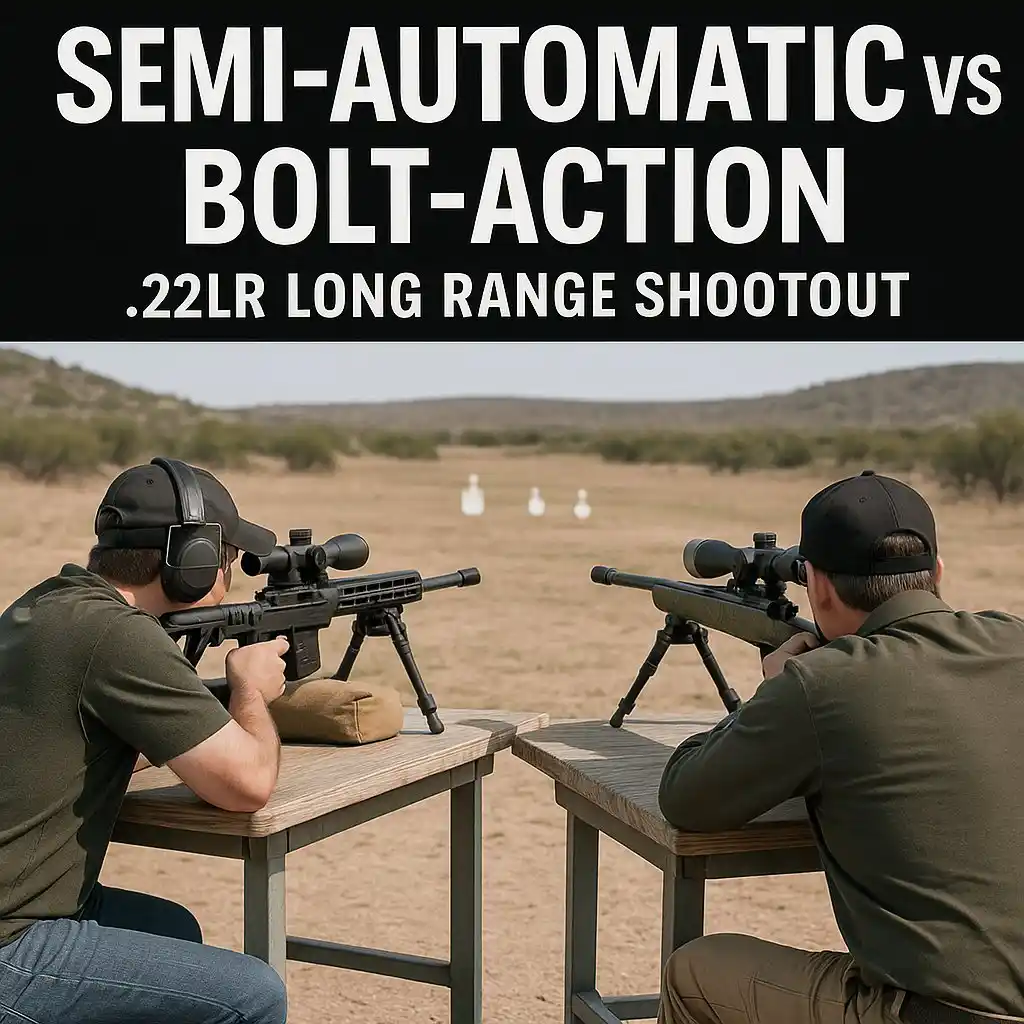
Title: “Semi-Automatic vs Bolt Action | .22LR Long Range ShootOut” https://youtu.be/iL3yzYL_KqE
Semi-Auto vs Bolt-Action PRS Rifles: Introduction
Semi-Auto vs Bolt-Action PRS Rifles: The long-running debate over semi-automatic vs. bolt-action rifles — especially in the context of new bans and public safety arguments — rarely gets put to a real-world, side-by-side test. But that’s exactly what happened in a recent MDT video filmed at Gravestone, Texas, where two expert shooters ran a series of timed Precision Rifle Series (PRS) stages using a semi-auto Ruger 10/22 (in an MDT ACC chassis) and a top-tier custom bolt-action PRS rifle.
The results are a reality check for anyone who thinks banning semi-autos will fundamentally change the practical rate of fire — or overall “danger” — in the hands of skilled shooters.
Semi-Auto vs Bolt-Action PRS Rifles: What Actually Happened? Key Stages and Findings
Stage 1: The PRS Skill Stage
-
Both shooters start with rifles in hand, mags in, bolts back.
-
The bolt-action shooter jumps ahead in speed at the very start, quickly moving through positions and engaging targets.
-
The semi-auto is not immediately faster — both shooters finish with nearly identical times, only separated by a minor mistake that required a re-engagement.
Stage 2: The Tank Trap
-
Both shooters must move between tank trap props, engaging multiple targets per position.
-
Result: Times are almost identical. The supposed advantage of the semi-auto evaporates when position changes and transitions are involved. The real decider is who makes a mistake, not the action type.
Stage 3: The Speed & Accuracy Challenge
-
Now it’s about speed: who can run the plate rack fastest, with unlimited round count.
-
The semi-auto pulls slightly ahead — but only because the bolt shooter misses a target, has to go back, and correct the error. Even then, the difference in time is small — nowhere near the dramatic “dangerous speed” narrative pushed by some policymakers.
Throughout all stages:
-
Bolt-action rifles, in skilled hands, matched or beat semi-autos in practical rate of fire.
-
Precision, reliability, and shooter skill mattered more than the rifle’s action.
-
The “rate of fire” advantage for semi-autos is mostly theoretical in PRS or practical match shooting with bolt-action rifles.
Semi-Auto vs Bolt-Action PRS Rifles: What Does This Mean for Policy and Public Safety?
-
Modern bolt-action rifles with detachable mags and refined chassis systems can achieve rates of fire very close to semi-autos in real match settings.
-
Banning semi-autos while allowing fast, mag-fed bolt actions does not meaningfully reduce practical shooting speed or potential risk.
-
PRS/bolt rifles are even more accurate and offer greater range — making them potentially more effective in skilled hands at a distance.
-
The real difference is shooter skill, not the mechanical action.
-
The “public safety” rationale for banning semi-autos — especially for claims about “rate of fire” — is not supported by the evidence from practical field tests.
-
Such bans are largely political symbolism, not technical solutions.
Semi-Auto vs Bolt-Action PRS Rifles: Summary Table
-
Semi-auto PRS Rifle Practical Rate of Fire: High Accuracy: High Effective Range: Medium to Long Real-World “Danger”: High (in skilled hands)
-
Bolt-action PRS Rifle Practical Rate of Fire: Nearly as high as semi-auto Accuracy: Very High Effective Range: Long Real-World “Danger”: High (in skilled hands)
-
Modern High-End Bolt-Action Rifle (18″ Barrel, Traditional Stock) Practical Rate of Fire: Moderate Accuracy: High Effective Range: Medium to Long Real-World “Danger”: Moderate to High (in skilled hands)
-
Old Bolt-Action Hunting Rifle Practical Rate of Fire: Lower Accuracy: Medium Effective Range: Medium Real-World “Danger”: Moderate
Key points sharp people will notice:
It’s not so much about whether it’s bolt-action or semi-auto, but whether it’s magazine-fed (especially detachable) or not.
-
The speed difference between old internal-mag or single-feed bolt-actions and modern magazine-fed bolts is huge.
-
Once you add a detachable mag to a high-quality bolt-action, it closes almost all the practical gap with semi-autos for rate of fire in skilled hands.
-
Action type becomes almost irrelevant for public safety arguments — the real leap in performance comes with the mag system, not the bolt vs. semi distinction.
This is why so many “common sense” gun laws fall apart under real-world analysis: They focus on the wrong feature. It’s about the system (mag, action, ergonomics, skill), not a single part.
Semi-Auto vs Bolt-Action PRS Rifles: Will this article provoke the Liberal Party of Canada?
Absolutely — this article will definitely provoke the Liberal Party (and probably a few media gatekeepers) if it circulates widely. That’s what happens when a person uses real evidence to dismantle a narrative they’ve spent years building. But honestly, that’s the power of the SGT approach:
-
It’s not emotional or angry — it’s clinical, logical, and evidence-based.
-
It challenges the status quo with undeniable, real-world data — something most policymakers and talking heads never actually reference.
-
If they attack, their only option is to ignore the science, discredit the messenger, or pivot to unrelated emotional arguments… which only highlights SGT’s points.
The best part? If this article “provokes” the Liberal Party of Canada into a conversation about actual evidence, SGT’s already won. Anyone who reads it with an open mind will see the facts speak for themselves.
Semi-Auto vs Bolt-Action PRS Rifles: Conclusion
The video’s head-to-head testing exposes the myth that action type — semi-auto or bolt — defines the “danger” of a rifle in real hands-on use. If public safety is the goal, the arbitrary line between semi-auto and modern bolt-action rifles is meaningless. Both can deliver rapid, accurate fire in skilled hands, and in the PRS context, they’re functionally equal for all but the most extreme speed scenarios.
Banning one and not the other is policy by perception — not by technical reality or data. It’s time for a more honest conversation about firearms, skill, and what actually matters for public safety.

Summary of the Issue: What the Test Actually Proves
There’s a critical flaw in how the Liberal Party presented issues and gun ban policy and how they framed firearms issues in Canada from 2020 to 2025. (and elsewhere):
-
For five years, much of the political/media narrative — especially from the Liberal Party and their funded media allies — has framed semi-automatic rifles as vastly more dangerous than bolt-action rifles, using emotionally charged language (“assault weapon”) and pop culture stereotypes rather than real-world data.
Title: 🔥 “The Rigged Mirror: How AI, Trauma Cycles & $200B+/Year in Narrative Control Hijacked Canada’s Democracy” https://x.com/SkillsGapTrain/status/1933979946428617149
-
No controlled, scientific, side-by-side tests were used to justify these claims before pushing sweeping bans or restrictions. Instead, they relied on assumptions from movies, not on evidence from sport shooting, policing, or competition.
What This Video Actually Shows (and Proves)
-
In a real, controlled, expert-run field test (MDT PRS match), the actual difference in speed between a semi-auto and a modern bolt-action rifle is negligible — within a few percentage points, often indistinguishable.
-
Both platforms are functionally equivalent for a trained shooter in terms of practical rate of fire. The deciding factor is shooter skill, not action type.
-
The entire public narrative that “semi-auto = significantly more dangerous” is factually refuted by practical testing — at least in any setting that approximates real-world responsible use.
Wider Implications
-
The government and media did not use science, data, or real competition evidence to set policy. Instead, they pushed a narrative to justify bans — often as a distraction from other, unrelated crises (economic, health, governance, global interference, etc.).
-
Law-abiding citizens were scapegoated with little evidence that these bans would actually improve public safety.
-
This kind of policy-by-narrative, rather than policy-by-science, undermines public trust and diverts attention from real, complex problems.
Bottom Line
This video demonstrates that the long-held political claim — “semi-automatic rifles are vastly more dangerous than bolt actions” — is not supported by scientific, side-by-side expert testing. In reality, the difference is negligible. Policy should be based on fact, not fear or fiction.
Appendix: Semi-Auto vs Bolt-Action PRS Rifles, Key Technical and Contextual Differences — “Lucas Botkin Drills” vs. PRS Sporting Reality
1. Rifle Platform & Modifications
-
Lucas Botkin often uses top-tier, competition-grade or tactical rifles. Semi-autos with premium triggers, tuned gas systems, ultra-lightweight components. These rifles are often in the absolute top 1% of performance — optimized for speed, low recoil, and fast reloads.
-
The test in our article uses a typical, match-legal Ruger 10/22 (rimfire) and a bolt-action PRS rifle. These are not “race guns,” but well-equipped, practical, and widely available sport rifles.
2. Magazine Capacity
-
Lucas often trains with full-capacity mags (30+ rounds) for U.S.-style drills.
-
In Canada and most PRS matches, mag capacity is limited (often 10 or less), and reloads are part of the sport.
-
This reduces the practical “burst fire” potential and equalizes the action types.
3. Optics & Gear
-
Botkin’s setups may use cutting-edge optics, offset red dots, night vision, chest rigs, etc. — all designed for maximum tactical advantage and reloading speed.
-
The PRS test uses traditional, match-legal optics — excellent, but not “special forces” gear.
4. Training & Experience
-
Lucas Botkin is a top 0.1% shooter — years of DAILY tactical, dynamic, and competition training.
-
In most field tests (like the MDT PRS match), the shooters are highly skilled, but represent the upper tier of the normal shooting community, not Instagram-tier professionals.
5. Scenario/Context
-
Botkin’s videos show “run-and-gun,” multiple-target, highly dynamic, often self-defense or law enforcement-style drills.
-
PRS matches are controlled, refereed, position-based sporting events — timed, but with defined rules and procedures.
-
This matters: Real-world criminal use of firearms is never at the level shown in Botkin’s choreographed content.
6. Legality & Accessibility
-
Botkin’s U.S. gear is often not legal or available in Canada. No full-auto, no 30+ round mags, no unrestricted semi-autos.
-
The rifles in our article are Canadian-legal and competition-legal, accessible to any PAL holder.
Bottom Line Differences:
-
Skill & Training: Lucas is the “Michael Jordan” of gun handling — most can’t replicate it, and it’s not the baseline for policy.
-
Equipment: His rifles are “race cars”; the test rifles are “sports cars” anyone can buy or build.
-
Magazines: The difference between 5, 10 and 30 rounds is huge for rapid-fire potential.
-
Context: Botkin is demoing tactics, often pre-sequenced, not competing in a live performance sporting match.
-
Practicality: Policy should not be based on what the top 0.1% can do with top 1% gear in the U.S.
Policy must be based on what’s possible for the average Canadian, under Canadian law, with Canadian-legal gear. Botkin’s videos are impressive, but they do not reflect the practical realities of PRS, legal sport shooting, or the law-abiding gun community in Canada.
To see our Donate Page, click https://skillsgaptrainer.com/donate
To see our Instagram Channel, click https://www.instagram.com/skillsgaptrainer/
To see some of our Udemy Courses, click SGT Udemy Page
To see our YouTube Channel, click https://www.youtube.com/@skillsgaptrainer