Designed by: Skills Gap Trainer
The open engineering manual, builder culture, repair doctrine, visual canon, and command philosophy for a roadless mobility architecture.
The next Enterprise is not only a ship. It is a civilization that learned how to move, repair, explain, and remain human under pressure.
0. Position in the Five-File Series
This file is the fifth X-page export in the expanded SGT-TNG publication series. File 1 established the thesis and the icon. File 2 explained the framework. File 3 opened the engineering architecture. File 4 applied benchmarks, proof gates, and red-team discipline. File 5 closes the arc by answering the question that remains after the vehicle has been imagined, bounded, scored, and challenged: how does a civilization learn to build, maintain, adapt, govern, and trust it?
The answer is not a marketing brochure. The answer is a manual culture. A serious roadless mobility architecture cannot depend on mystery, celebrity, black-box software, proprietary confusion, or inspirational renders alone. If the vehicle is powerful enough to matter, the public knowledge system around it must also be powerful enough to matter. The manual is not an afterthought. The manual is part of the machine.
This file is therefore about the instruction layer: the 500 to 1000 page open engineering manual concept, the builder network, the global customization boundary, the SGT-TNG literacy stack, the repair culture, the TNG-inspired command philosophy, the visual canon, and the final doctrine. It is about how the project avoids becoming a toy, a cult object, a sealed luxury appliance, or an unsafe garage fantasy. It is about how the architecture becomes teachable without becoming reckless.
1. The Core Thesis of Page 5
The D.E.L.O.R.I.A.N. / BOOM 1971 / NAV-CF architecture is not complete when the vehicles are drawn. It is not complete when the estimated performance bands exist. It is not complete when the red-team risks are named. It becomes serious only when the knowledge system is strong enough to support the machine across time, countries, owners, builders, regulators, service shops, emergency conditions, and future variants.
A next-generation vehicle requires next-generation literacy. That does not mean every owner becomes an aerospace engineer. It means the system refuses to hide the safety-critical truth from the human ecosystem that must operate, service, inspect, govern, and repair it. The vehicle should be beautiful enough to inspire public imagination, but the manual should be disciplined enough to prevent imagination from outrunning evidence.
The architecture therefore has two vehicles and one civilizational knowledge spine. D.E.L.O.R.I.A.N. 001 SGT-TNG is the executive icon and captain’s capsule. BOOM 1971 A.R.G.O. is the rugged field branch and mission-kit platform. NAV-CF is the common framework. Q explains. D.A.N.G.E.R. protects. SGT-TNG coordinates the human layer: literacy, manuals, service doctrine, proof gates, claim boundaries, and repair culture.
A powerful machine without a manual becomes folklore. A powerful machine with a disciplined manual becomes civilization technology.
1.1 What this file is
- A publication-ready X Page 5 segment for the master series.
- A design philosophy for the open engineering manual.
- A builder-culture doctrine for safe customization and international learning.
- A repair-culture doctrine for a vehicle that should degrade like an aircraft, not fail like a phone.
- A visual and cinematic canon that protects the identity of DELORIAN 001 and BOOM 1971 A.R.G.O. after the image-development process revealed hidden requirements.
- A claim-safe bridge between the concept architecture and a future 500 to 1000 page technical manual.
1.2 What this file is not
- It is not a type-certification document.
- It is not a production manual.
- It is not a repair approval document.
- It is not a flight manual.
- It is not a maintenance release procedure.
- It is not a parts catalog.
- It is not a weapons-integration guide.
- It is not permission for public flight, road operation, passenger carriage, or field deployment.
2. Why the Manual Is Part of the Vehicle
First principles begin with the fact that complex systems do not survive by performance alone. They survive because their state can be understood. A vehicle that combines road performance, lift architecture, modular wing logic, high-voltage energy, future hydrogen study branches, digital twins, Q diagnostics, D.A.N.G.E.R. safety thresholds, mission kits, and international customization cannot be governed by a one-page owner brochure. It needs a knowledge architecture that is as intentional as the machine itself.
The manual is the operating memory of the system. It defines what the system is, what it is not, what each module may do, what each interface may accept, what each condition means, what each failure mode requires, what can be inspected, what must be locked out, what can be updated, what must never be changed without proof, and what the public is allowed to claim. Without that memory, every builder becomes an improviser. With that memory, builders become part of a disciplined ecosystem.
This is especially important because the project is intentionally attractive. The vehicle is meant to have emotional force. The stainless road body, blue-white Q lighting, split access architecture, rear-mounted wing assembly, strong hood, clean rear quarter, BOOM wedge, industrial dock stance, and guardian-class visual language all carry mythic energy. That myth is useful. It draws attention. It invites builders. It makes the future feel reachable. But the more beautiful the object becomes, the more serious the manual must become.
The manual prevents beauty from becoming deception. It forces the project to say when a capability is a concept, when it is an estimate, when it is a simulated result, when it is a ground-test result, when it is a prototype result, when it is a certified result, and when it remains forbidden to claim. The manual is how the project keeps its honor.
Do not build a next-generation machine without building the next-generation literacy required to understand it.
2.1 The first-principles chain
- A vehicle cannot be trusted if its configuration cannot be known.
- A configuration cannot be known if parts, software, mission kits, service actions, and energy states are not recorded.
- A record cannot be useful if humans cannot interpret it.
- Human interpretation cannot scale if the manual is incomplete, proprietary, vague, or written only for insiders.
- A manual cannot protect the public if it fails to distinguish concept architecture from validated engineering.
- Therefore the manual must be designed as a formal part of the vehicle architecture, not as an after-sale document.
3. Open Source Does Not Mean Chaos
The phrase open-source can be misunderstood. In software culture it can mean transparency, collaboration, inspection, shared improvement, forkability, public audit, and learning. In vehicle culture, especially where aviation, high voltage, structural loads, and public safety enter the frame, open-source must be narrower and more disciplined. It cannot mean uncontrolled parts, unreviewed modifications, anonymous flight changes, unsafe mission kits, or unsupported claims. The project’s open-source philosophy is not chaos. It is traceable knowledge with controlled interfaces.
SGT-TNG open-source means the public can understand the architecture, read the safety logic, study the requirements, learn the interfaces, inspect the claim boundaries, and participate in a builder culture that respects evidence. It does not mean any person can bolt anything to the vehicle and call it certified. It does not mean the Q system can be replaced by a random cloud assistant. It does not mean the D.A.N.G.E.R. layer can be disabled for performance. It does not mean a mission kit becomes acceptable because it looks cool. It means the knowledge base is open enough to create literacy, but the safety gates remain strict enough to protect the public.
The clean phrase is controlled openness. The design can be learned. The manual can be studied. The requirements can be discussed. The modules can be proposed. The interfaces can be documented. But every change that touches mass, structure, energy, cooling, software, center of gravity, flight state, door path, nacelle lock, passenger protection, or public claim must pass through proof gates.
Open-source does not mean uncontrolled. It means the system is honest enough to be studied and disciplined enough to be trusted.
3.1 Controlled openness requirements
- Every public architecture document must label its maturity level.
- Every estimated performance number must be marked as estimated until proven.
- Every module must declare mass, power, cooling, structural, software, service, and claim effects.
- Every mission kit must be treated as a vehicle state, not an accessory.
- Every flight-relevant change must update the digital twin before the system may be considered trusted.
- Every builder-facing instruction must distinguish concept, inspection, service, and approval language.
- Every customization path must end in proof, not enthusiasm.
4. The 500 to 1000 Page Manual Concept
The master manual should be understood as a future document family, not a single book of static prose. It should be closer to a technical library: part driver’s manual, part builder curriculum, part maintenance orientation, part systems engineering guide, part visual design canon, part safety doctrine, and part public claim ledger. The current publication series is not that manual. It is the front-end architecture from which such a manual could be derived.
The manual should be long because the system is multi-domain. Road systems, lift systems, high-voltage systems, hydrogen study branches, digital systems, human factors, maintenance, inspection, tooling, mission kits, design identity, and public communication each require different layers of explanation. A short manual would either hide complexity or pretend it does not exist. A serious manual lets complexity become navigable.
A 500 to 1000 page manual does not need to be dense, intimidating, or unreadable. It should be modular. Each book should have a human-readable overview, first-principles explanation, requirements register, interface register, inspection logic, failure modes, proof gates, and claim boundary. The reader should be able to enter at the owner level, builder level, technician level, engineer level, regulator level, or public communicator level without confusing one level for another.
4.1 Proposed manual family
Book 1 – Orientation, Ethics, and Claim Boundary
Book 1 explains what the architecture is and what it is not. It introduces DELORIAN 001, BOOM 1971, A.R.G.O., NAV-CF, Q, D.A.N.G.E.R., SGT-TNG, the civil trunk, the rugged branch, the restricted branch, and the concept/proof/certification boundary. It should be the first book every reader touches, because it prevents false confidence. The reader should finish Book 1 knowing that the architecture is serious, but not yet a certified aircraft, road vehicle, production package, or public operating system.
- Core output: common language.
- Core risk prevented: overclaiming.
- Core doctrine: evidence before expansion.
Book 2 – Road Operation and Road-First Identity
Book 2 explains the road-first doctrine. DELORIAN is not an aircraft that reluctantly drives. It is a road-first captain’s capsule that may gain flight capability when the journey requires it. Road identity matters because adoption begins on the ground. The road body must remain desirable, legible, serviceable, and emotionally strong even when the wing kit is not deployed. Road operation also gives the architecture a practical maturity ladder: prove the capsule, prove the drivetrain, prove braking, prove thermal repeatability, prove service, then expand toward flight.
- Core output: road competence before flight ambition.
- Core risk prevented: flying-car spectacle with weak road fundamentals.
- Core doctrine: drive every day; fly when the journey requires it.
Book 3 – Flight Concept, Limitations, and Airspace Discipline
Book 3 should never pretend to be a flight manual before the vehicle is certified. It should explain flight concept, not flight authorization. It should teach why hover is expensive, why wing-borne travel matters, why reserve is safety, why door and nacelle states must be known, why unknown state means no flight, and why airspace integration is not optional. This book should make the reader more humble, not more reckless.
- Core output: flight literacy without false permission.
- Core risk prevented: public confusion between concept art and airworthiness.
- Core doctrine: the sky is earned through lift, control, reserve, proof, and truth.
Book 4 – Energy Systems
Book 4 explains the energy architecture. The baseline path is battery-electric for early civil proof. Battery provides peak power. Thermal management determines repeatability. High-voltage safety determines service viability. Future hydrogen fuel-cell-up architecture may provide endurance, but only when storage, leak detection, ventilation, refueling workflow, safety case, certification pathway, and infrastructure are mature enough. Hydrogen is not a shortcut around proof. It is a later layer that must earn its place.
- Core output: energy truth.
- Core risk prevented: slogans replacing mass, heat, power, reserve, and safety.
- Core doctrine: battery for peak power; fuel cell for endurance; proof before branch expansion.
Book 5 – Door, Egress, and Human Access Systems
Book 5 is one of the most important books because the image-development process exposed the hidden engineering value of the door architecture. A full-width fantasy gullwing creates mechanical conflicts with a rear wing assembly. A random side cutout weakens identity and may damage structural logic. The correct direction is a Captain’s Egress Bay: compact upper gullwing or dihedral element for roof-cut inheritance, plus a secondary rear-sliding or rear-folding egress panel that gives humans a large opening without invading the wing zone. The door is not a flight wing. The door is a human access system.
- Core output: access without interference.
- Core risk prevented: beautiful door geometry that destroys wing integration or human egress.
- Core doctrine: open upward, slide or fold rearward, step out cleanly, fly only when locked.
Book 6 – Wing Kit, Nacelles, and Structural Hardpoints
Book 6 explains the modular flight layer. The wing kit is not a drone carrying the car. It is not a floating logistics platform. It is not a roof rack. It is an integrated vehicle-mounted flight package seated into built-in structural hardpoints and the rear structural spine. The assembly must sit low enough to belong to the vehicle, far enough back to avoid the door zone, and strong enough to transfer loads into the structure without depending on software fantasy. The nacelles must be symmetrical, mechanically retained, geometry-captured, digitally confirmed, and never treated as casual detachable ornaments in flight.
- Core output: wing/nacelle discipline.
- Core risk prevented: image-driven geometry that cannot transmit loads or clear doors.
- Core doctrine: ground-detachable, flight-captive, mechanically locked, digitally confirmed.
Book 7 – Q System
Book 7 explains Q as a modular continuity intelligence. Q is not sovereign. Q does not own the vehicle. Q does not replace the human. Q explains state, diagnoses configuration, translates complexity, stores critical manuals, supports repair, and may exist as a portable module that can be removed and carried when the vehicle is lost or damaged. The Q doctrine is important because the project is not merely about mobility; it is about survival of knowledge under pressure. If the car is destroyed, Q should still help a human understand, navigate, repair, teach, and continue.
- Core output: understandable intelligence.
- Core risk prevented: AI mysticism, cloud dependency, or unsafe autonomy claims.
- Core doctrine: Q explains; the human commands.
Book 8 – D.A.N.G.E.R. and Degraded Modes
Book 8 explains the protection layer. D.A.N.G.E.R. is not a theatrical warning system. It is the threshold logic that prevents the system from entering unsafe states, blocks bad transitions, preserves degraded modes, and supports safe shutdown. It monitors door state, nacelle state, energy state, thermal state, hydrogen state where applicable, mission-kit state, digital twin trust, weather constraints, and human authority. Its job is not to make the vehicle exciting. Its job is to prevent the future from becoming foolish.
- Core output: safe threshold behavior.
- Core risk prevented: performance ambition overriding survival logic.
- Core doctrine: D.A.N.G.E.R. protects; it does not invite recklessness.
Book 9 – Inspection, Service, and Return-to-Trust
Book 9 defines how the machine returns from unknown state to trusted state. Service is not merely repair. Service is the restoration of configuration truth. A replaced nacelle, battery module, door actuator, Q module, sensor, harness, mission kit, or software build must change the digital twin and may require inspection before return to service. The manual should make this legible to technicians and owners without pretending that every user can self-certify safety-critical changes.
- Core output: return-to-trust workflow.
- Core risk prevented: undocumented modifications and invisible faults.
- Core doctrine: no trusted state, no flight.
Book 10 – Builder Training
Book 10 teaches people how to participate responsibly. It defines training tracks for owner literacy, student learning, service technicians, module developers, software contributors, safety reviewers, mission-kit designers, and public communicators. A builder culture without training becomes folklore. A builder culture with staged training becomes a civilizational advantage.
- Core output: trained participation.
- Core risk prevented: enthusiasm masquerading as competence.
- Core doctrine: literacy before modification.
Book 11 – Global Customization Boundaries
Book 11 explains how other countries, shops, universities, clubs, small manufacturers, and public-service teams may adapt the architecture without corrupting it. The rule is simple: customize surfaces and mission fit only when interfaces remain controlled; do not change mass, structure, flight state, thermal burden, software authority, safety state, or public claim boundary without new proof. Global customization is valuable only if the common spine remains legible.
- Core output: local creativity within global discipline.
- Core risk prevented: unsafe forks pretending to be the same system.
- Core doctrine: customize within the interface; prove beyond the interface.
Book 12 – Visual Canon and Identity Control
Book 12 preserves the soul of the machines. DELORIAN must not drift into a generic pod, bubble taxi, rounded luxury EV, or over-softened violet render. BOOM must not drift into a random armored truck, drone-carrier toy, or battlefield prop. The visual canon protects engineering. The image process proved that body shape, wing placement, door size, rear quarter quality, nacelle symmetry, and lighting force are not merely aesthetic details. They affect whether the architecture is understood.
- Core output: identity preservation.
- Core risk prevented: concept drift.
- Core doctrine: visual design is engineering communication.
Book 13 – Red-Team Gates and Claim Control
Book 13 defines how the project resists self-deception. Every public claim must be tied to maturity. Every performance number must have a source state. Every image must be understood as visualization, not proof. Every module must face red-team review. Every weak assumption must be visible. The public should trust the project more because it names what is not proven yet.
- Core output: credibility.
- Core risk prevented: hype collapse.
- Core doctrine: a powerful concept becomes serious when it can say both things at once: this is powerful, and this is not proven yet.
Book 14 – Civilization Use Cases
Book 14 explains why the architecture matters beyond the garage. The vehicle family can be imagined for remote access, disaster response, rural service, Arctic reach, medical logistics, field communications, civic continuity, secure executive movement, infrastructure inspection, and eventually regulated flight corridors. But each use case must be expressed as concept architecture until proof, certification, training, and regulatory acceptance exist. The manual must make aspiration useful without letting aspiration become claim.
- Core output: mission meaning without operational overclaim.
- Core risk prevented: confusing cinematic use cases with deployable capability.
- Core doctrine: the mission is real Earth reach, not fantasy escape.
5. Builder Culture
The builder culture around SGT-TNG should feel like a fusion of engineering school, aerospace maintenance discipline, open-source transparency, elite garage craft, and civic responsibility. It should not feel like anonymous modification culture. It should not reward shortcuts. It should not treat safety systems as obstacles. It should not turn aviation-scale risks into social-media dares. The correct builder culture is proud, precise, humble, and capable.
The best builders are not merely people who can make a vehicle look more aggressive. They understand why the rear wing assembly sits where it sits, why the door is split, why the upper gullwing cannot occupy the entire side opening, why the secondary egress panel must slide or fold rearward, why the Q module must explain state, why D.A.N.G.E.R. must block unsafe transitions, why the digital twin matters, why hydrogen is a future endurance layer and not a magic upgrade, and why a beautiful body must still earn its numbers.
Builder culture should be staged by responsibility. A beginner may study the manual, use a simulator, inspect mockups, and learn terminology. A trained owner may understand warnings, service intervals, degraded modes, and configuration status. A certified technician may replace modules under controlled instructions. A development engineer may propose new modules. A safety reviewer may approve test progression. A public communicator may explain concept boundaries. No one should pretend all levels are the same.
The builder is not someone who defeats the safety system. The builder is someone who understands why the safety system exists.
5.1 Builder levels
- Level 0 – Public reader: understands the concept, boundaries, and doctrine.
- Level 1 – Owner-literacy learner: understands basic states, warnings, Q explanations, and D.A.N.G.E.R. thresholds.
- Level 2 – Student builder: uses non-hazardous mockups, door models, digital-twin simulations, and training modules.
- Level 3 – Service technician: performs approved inspections and component replacements under documented procedures.
- Level 4 – Module developer: proposes controlled modules with mass, power, cooling, software, service, and claim declarations.
- Level 5 – Integration engineer: evaluates system effects across structure, energy, flight, road, software, and human factors.
- Level 6 – Red-team reviewer: tests assumptions, failure modes, proof gates, and public claim boundaries.
- Level 7 – Authority-facing program lead: interfaces with regulators, safety cases, certification pathways, and formal evidence packages.
5.2 The global shop problem
The global shop problem is simple: once a design becomes culturally powerful, many people will want to customize it. That is good if the architecture is prepared. It is dangerous if the architecture is vague. A clear manual can turn global creativity into structured contribution. A vague manual turns creativity into drift.
The project should therefore define what a local shop may safely customize early and what it must not change without serious proof. Exterior trim, interior materials, non-structural accessories, educational mockups, public displays, software skins, and non-flight visualization layers are lower-risk if clearly separated from safety-critical systems. Structural mounts, nacelle retention, door locks, battery modules, hydrogen storage, thermal systems, flight controls, mission-kit loads, digital-twin records, and D.A.N.G.E.R. thresholds are high-risk and must be governed.
5.3 Local adaptation without breaking the common spine
- Local adaptation should improve climate readiness, service tooling, language accessibility, training, road surface fit, and emergency use cases.
- Local adaptation should not silently change structural load paths, center of gravity, thermal margins, battery safety, nacelle geometry, door clearance, software authority, or claim language.
- Every country-specific variant should declare its environment: temperature, altitude, humidity, corrosion exposure, infrastructure quality, road type, service capacity, airspace constraints, and regulatory pathway.
- Every branch must remain traceable to NAV-CF requirements and interface logic.
6. SGT-TNG Literacy Stack
SGT-TNG is the human-coordination layer. It is not a regulator. It is not a replacement for certification. It is not a secret authority. It is a literacy, training, proof, visualization, and communication system that helps humans understand a complex machine before they overclaim it. The literacy stack converts advanced systems from sealed mystery into structured public knowledge.
The literacy stack has to serve multiple audiences at once. Leaders need the strategic idea without pretending it is ready for procurement. Engineers need requirements, interfaces, and proof gates. Builders need training ladders and safe customization paths. Operators need state awareness and limitations. Technicians need service workflows. Public readers need clear boundaries. Artists and image designers need visual canon. The manual must hold all those audiences without collapsing them into one voice.
6.1 Literacy layers
- Civilization layer: why the project exists and what human need it serves.
- Concept layer: what the vehicle family is and what it is not.
- Architecture layer: functions, interfaces, requirements, branches, and states.
- Engineering layer: structure, energy, lift, road, software, human factors, and service.
- Proof layer: simulation, ground tests, prototype tests, flight envelope, certification path, and maturity ladder.
- Operator layer: modes, warnings, state meanings, limitations, and degraded behavior.
- Builder layer: controlled customization, module declarations, and proof requirements.
- Public claim layer: what may be said now and what must wait.
6.2 Why literacy must precede autonomy
The architecture deliberately avoids claiming that autonomy solves everything. Q may explain, assist, diagnose, record, and coordinate. D.A.N.G.E.R. may block unsafe transitions. The digital twin may preserve configuration truth. But human literacy still matters. A system that humans cannot understand becomes brittle, politically fragile, and operationally dangerous. The right doctrine is not maximum automation first. The right doctrine is understandable automation under human authority.
This is where the TNG spirit matters. The best command culture is not anti-technology. It is technology under ethics, observation, reason, crew trust, and restraint. The machine may be advanced, but the human should not be reduced to cargo. The system may be intelligent, but intelligence must remain accountable. The vehicle may be beautiful, but beauty must remain truthful.
Human command is not nostalgia. It is the governance architecture for powerful systems.
7. Repair Culture
Repair culture is a moral and engineering position. A civilization that cannot repair its machines becomes dependent on sealed systems, distant vendors, brittle supply chains, and proprietary permission. A roadless mobility architecture that may serve emergencies, remote areas, field branches, and international builders cannot be designed as a disposable black box. It must be inspectable, explainable, serviceable, and recoverable.
This does not mean every owner should repair safety-critical systems alone. It means the system should not hide service truth. It means the manual should explain inspection logic, state recovery, fault categories, service boundaries, and when the machine must be grounded. It means Q should translate technical states into meaningful explanations. It means D.A.N.G.E.R. should protect recovery paths. It means the digital twin should preserve history. It means modules should be line-replaceable where appropriate and permanently traceable where safety-critical.
7.1 Repair doctrine
- Repair begins with diagnosis, not guessing.
- Diagnosis begins with state truth, not error-code superstition.
- State truth begins with sensors, inspection, service records, and digital twin coherence.
- Return to service begins with proof that the relevant trust boundary has been restored.
- A repaired machine is not trusted because it looks repaired; it is trusted because the relevant evidence chain is complete.
7.2 The degraded-mode ladder
The repair culture must be tied to degraded-mode philosophy. The vehicle should not fail like a phone. It should degrade like an aircraft. That means it should preserve understandable intermediate states rather than jumping from full capability to confusion. The manual should define these states carefully and avoid suggesting that degraded mode is normal operation.
- Full capability: all required states trusted for the intended mode.
- Assisted capability: system can operate with warnings and restrictions under defined boundaries.
- Manual mobility: road-only or low-risk mobility remains available when safe.
- Limp-home: limited movement to reach a safe service location, if permitted by .
- Stationary shelter/power: vehicle may provide communication, lighting, or power without movement, if safe.
- Safe shutdown/recovery: system stops, protects occupants, preserves records, and waits for service.
7.3 Right to understand, not right to bypass
A mature repair culture should avoid two failures. The first failure is sealed dependency, where owners cannot understand anything and technicians become mere parts-swappers under opaque instructions. The second failure is reckless bypass culture, where people disable safety systems because they confuse authority with inconvenience. The correct path is the right to understand, not the right to bypass. The manual should make systems legible while protecting safety-critical thresholds.
8. Q as the Companion to the Manual
Q is the living interface to the manual. The manual is the written knowledge architecture. Q is the interactive explanation layer that helps the human navigate that knowledge under real conditions. Q should never be portrayed as a magical all-powerful AI. It is more valuable as a disciplined state interpreter: it knows the vehicle configuration, shows what changed, explains warnings, retrieves procedures, compares a requested action to the current safety state, and preserves knowledge when the vehicle is damaged or separated from network access.
The removable Q module idea is powerful because it changes the emotional meaning of vehicle intelligence. Intelligence is not trapped inside a luxury object. It can accompany the human. It can carry manuals, diagrams, service records, maps, emergency instructions, and repair guidance. If the vehicle is destroyed, the knowledge does not disappear. This is a civilization-continuity idea, not a gadget idea.
8.1 Q operating principles
- Q explains; it does not command sovereignly.
- Q assists; it does not override D.A.N.G.E.R. safety thresholds.
- Q stores and retrieves manual knowledge in plain language.
- Q tracks configuration truth through the digital twin.
- Q can operate locally when network access is unavailable.
- Q may be removable and portable, but removal must preserve theft prevention, data protection, and vehicle state integrity.
- Q should make the user more capable without making the system less safe.
8.2 Q and human dignity
The TNG-inspired android-intelligence archetype matters here. The best synthetic intelligence is not loud, manipulative, or theatrical. It is calm, precise, observant, loyal to truth, and curious about human meaning. Q should not talk like a hype engine. It should speak like a trusted systems officer: clear, bounded, honest, and patient. If it does not know, it should say so. If proof is missing, it should say so. If a state is unsafe, it should refuse. If the human asks why, it should explain.
The future does not need AI that flatters the operator. It needs intelligence that protects the truth of the system.
9. Visual Canon as Engineering Communication
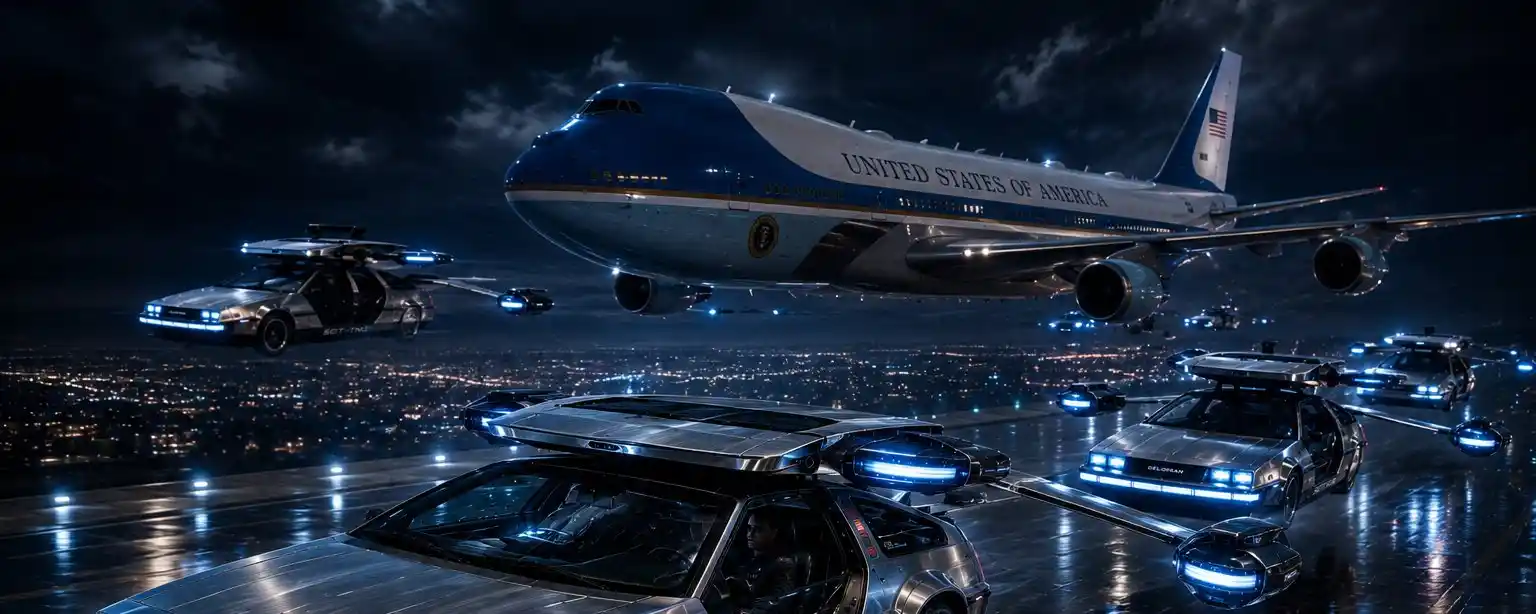
The visual canon belongs in File 5 because the image process was not merely decorative. It uncovered architecture. The repeated failures and corrections around the DELORIAN body, wing placement, door size, nacelle symmetry, and rear-quarter shape revealed what the written report had to say more clearly. When a rendering placed engines beside the driver seat, the image violated the door zone. When the wing assembly rose five feet above the roof, it became a carrier drone instead of a vehicle-mounted module. When a full-width gullwing occupied the entire side, it created a conflict with the rear-mounted wing kit. When the body softened, the public icon lost its force. When the left and right nacelles became unequal, the concept lost engineering credibility.
Therefore the image canon is a requirements artifact. It defines what the public should see and what the design team must not drift away from. It protects the soul of the machine and the clarity of the engineering. DELORIAN must remain the executive civilization vehicle. BOOM must remain the field branch. The Q system must feel intelligent and calm. D.A.N.G.E.R. must feel protective, not reckless. The lighting must feel like blue-white command electricity over wet black civilization.
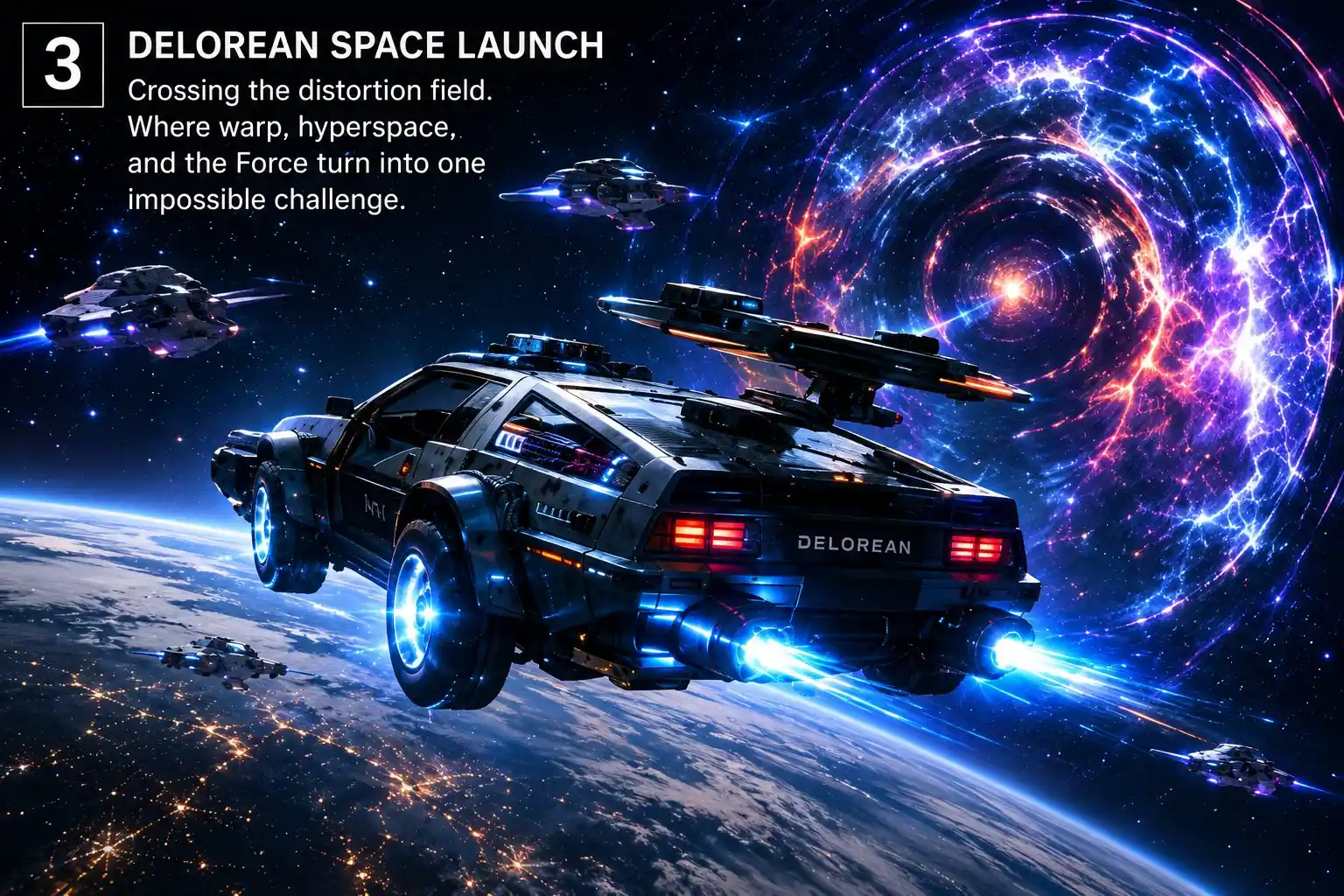
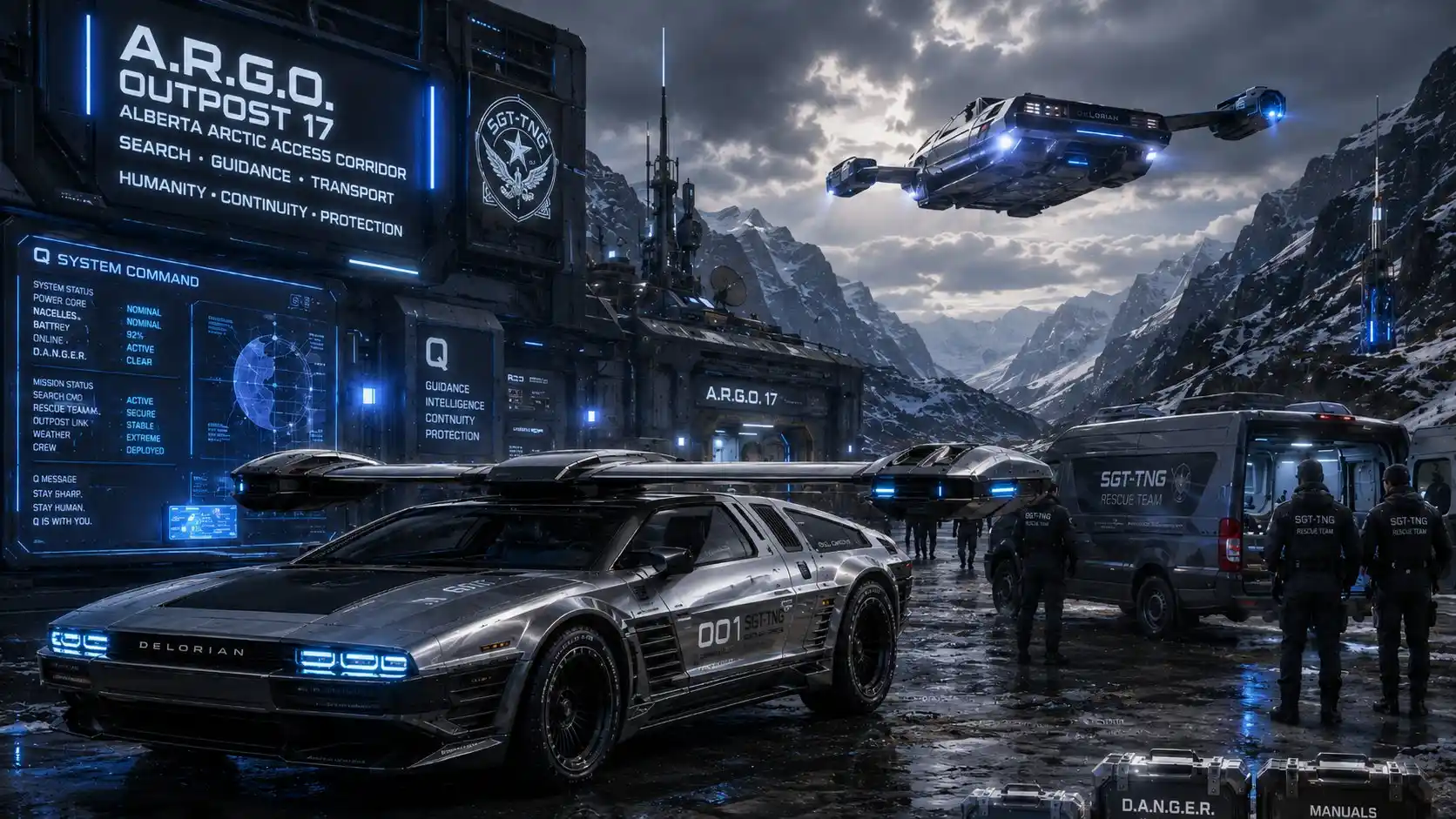
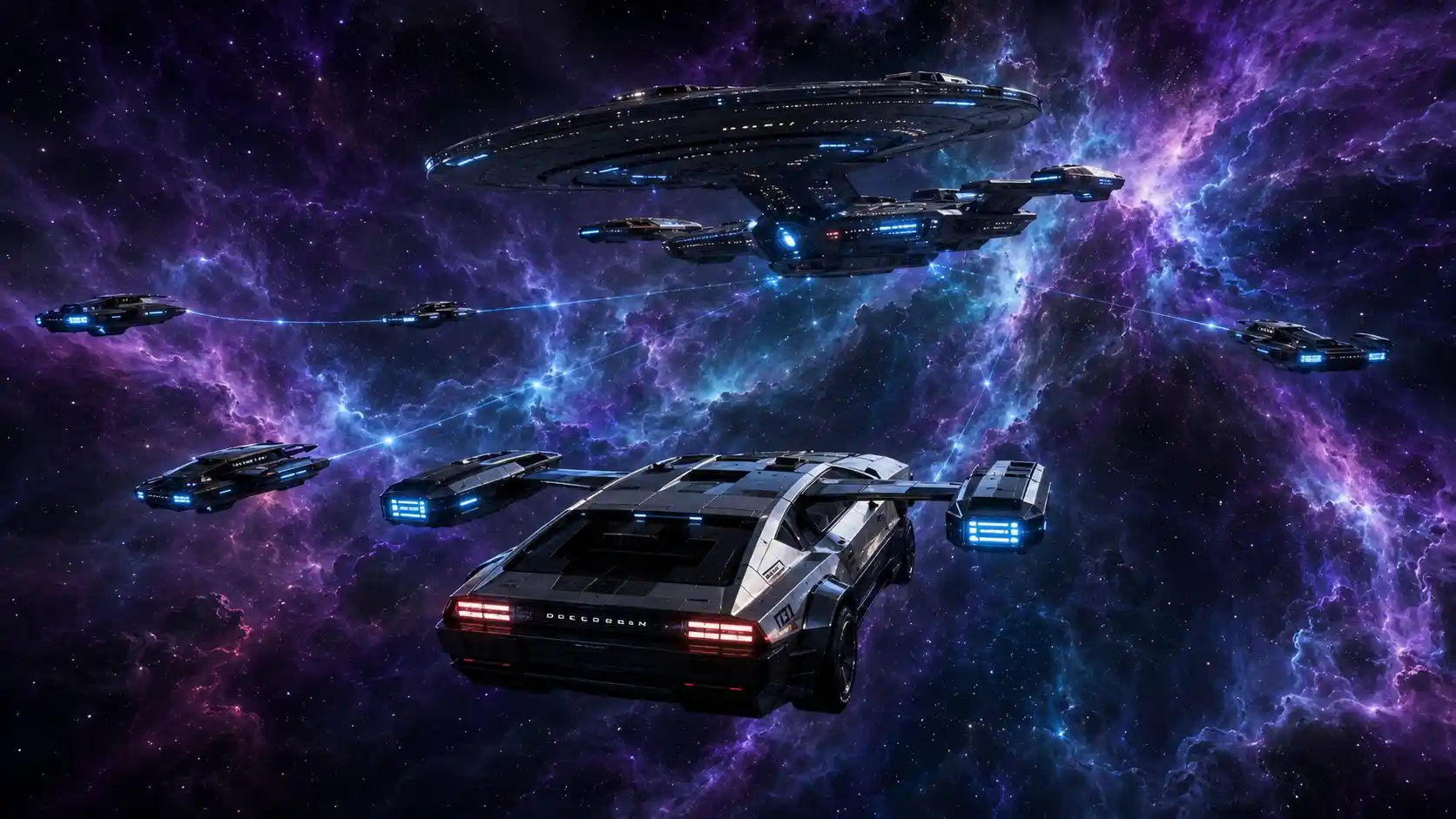
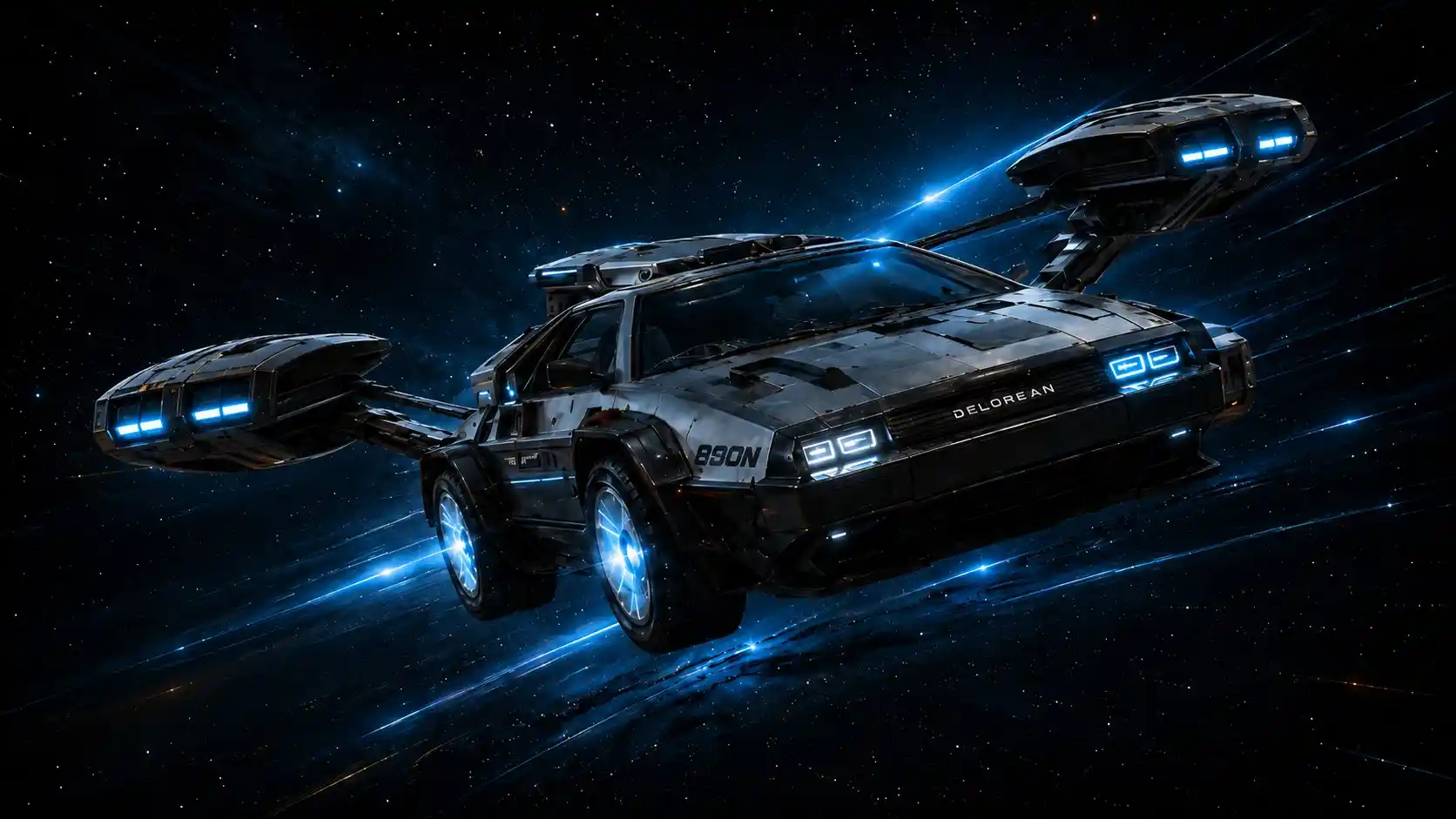
9.1 DELORIAN 001 visual canon
- Low, long, premium road-first body.
- Strong hood presence, not a retreating or recessed hood.
- Clean executive wedge, not a bubble taxi.
- Brushed stainless / silver-metal skin.
- Black lower architecture.
- Blue-white Q lighting.
- 2+2 captain’s capsule.
- Clean rear quarter, not deformed by door or wing errors.
- Compact upper gullwing / dihedral door.
- Secondary lower/rear egress panel that slides or folds rearward.
- Wing assembly mounted behind the main door zone over the rear passenger / rear roof structure.
- One continuous wing span when flight kit is active.
- Symmetrical nacelles, no floating extra pods.
- No raised carrier drone above the car.
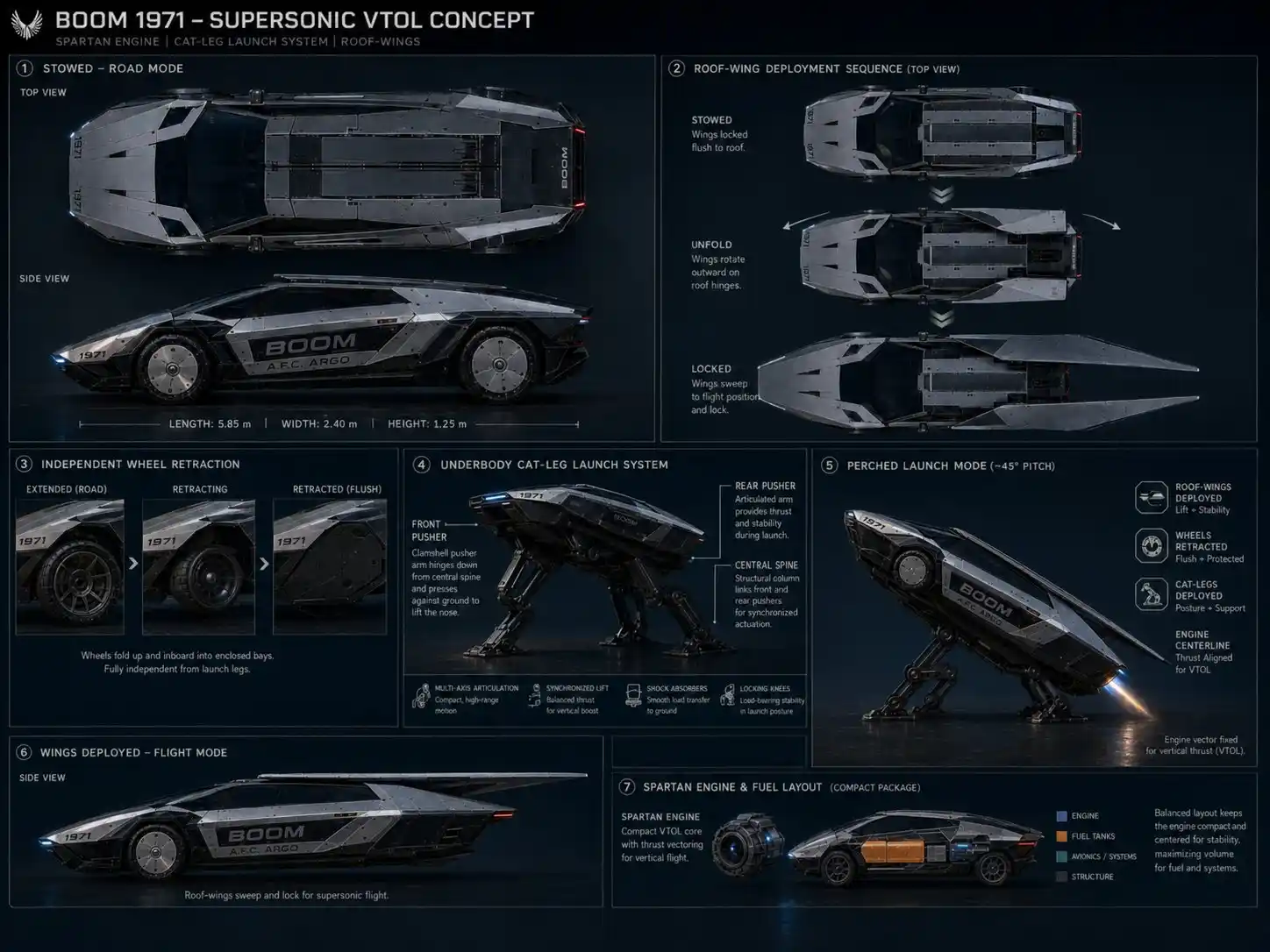
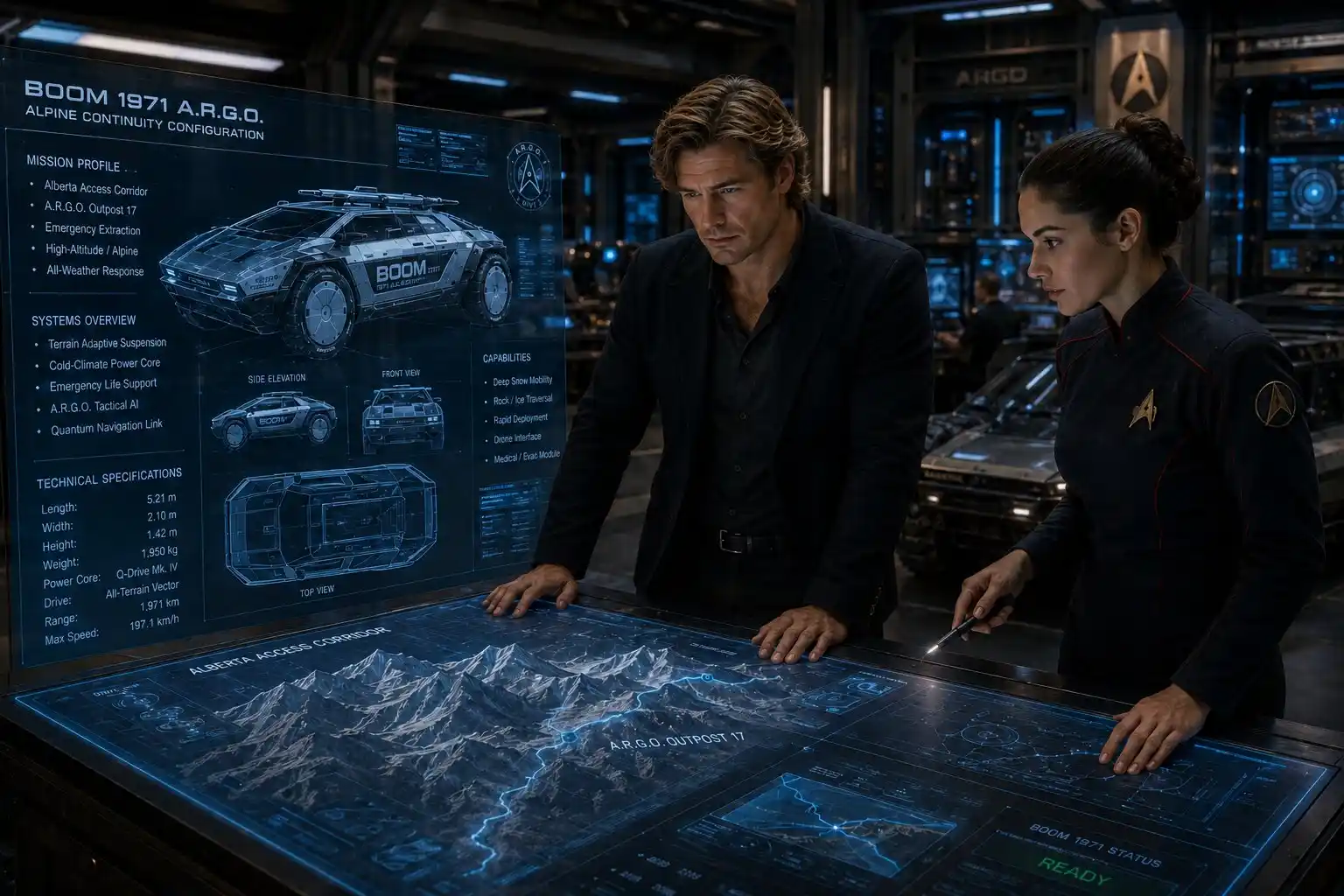
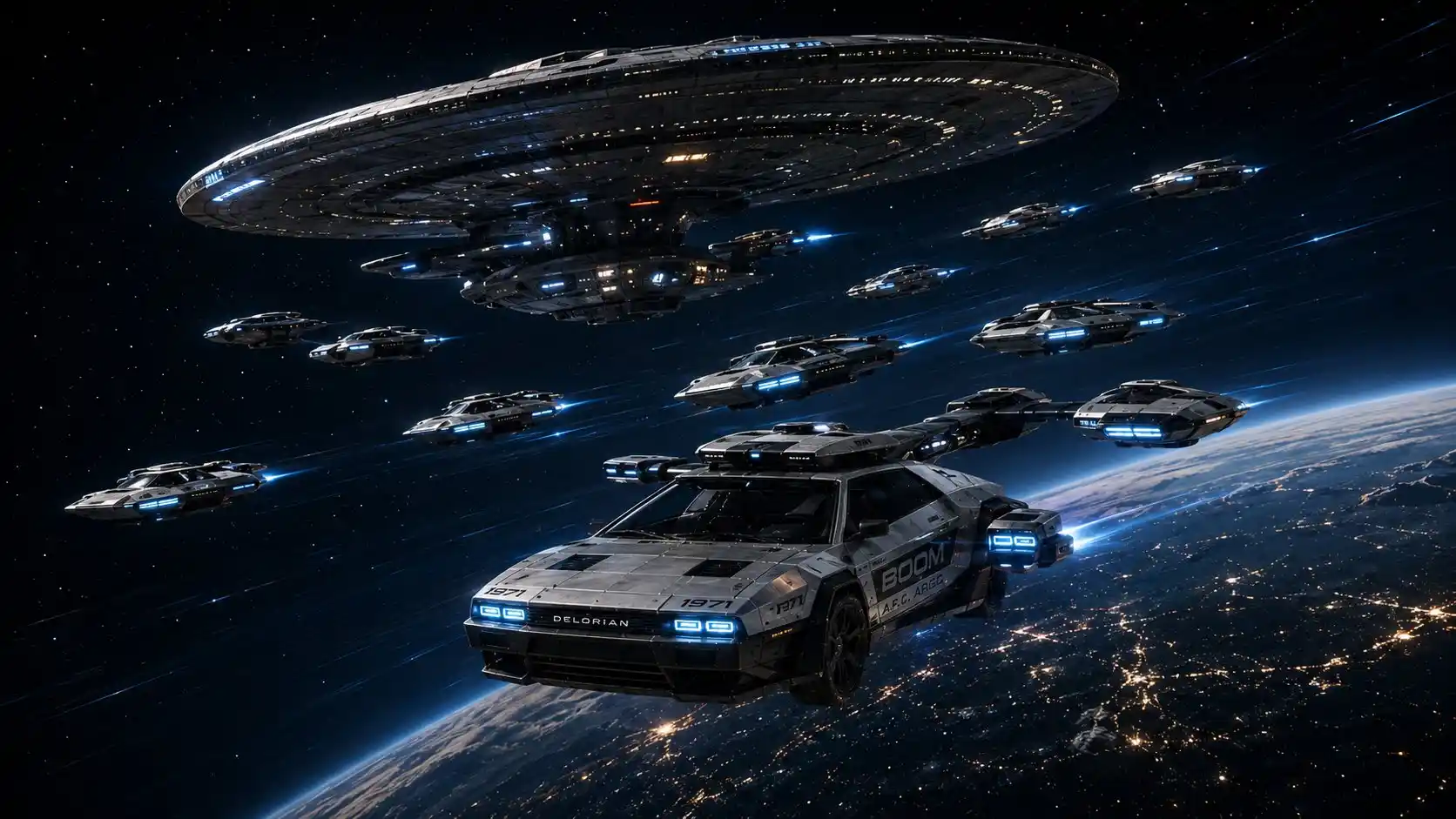
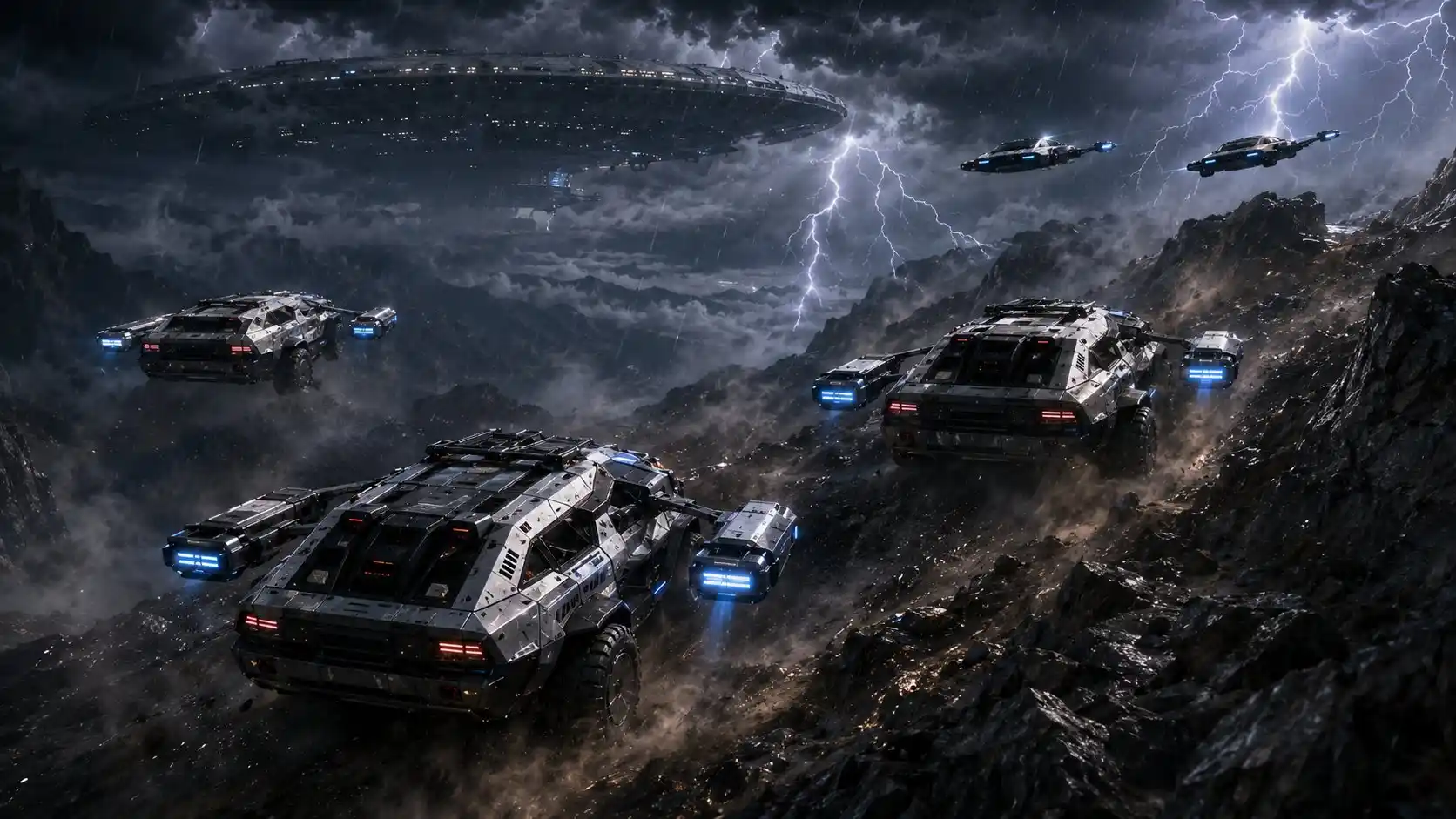
9.2 BOOM 1971 A.R.G.O. visual canon
- Aggressive wedge body.
- Rugged tire package.
- Low armored stance.
- Silver-black industrial finish.
- BOOM 1971 / A.R.G.O. identity.
- Industrial dock, service bay, frontier, rescue, and field-mission compatibility.
- Flight wing kit mounted as a vehicle system, not a separate drone.
- No random armored truck redesign.
- No logistics drone unless the scene explicitly shows a separate transport architecture.
- Field branch energy: useful, hard, disciplined, repairable, and serious.
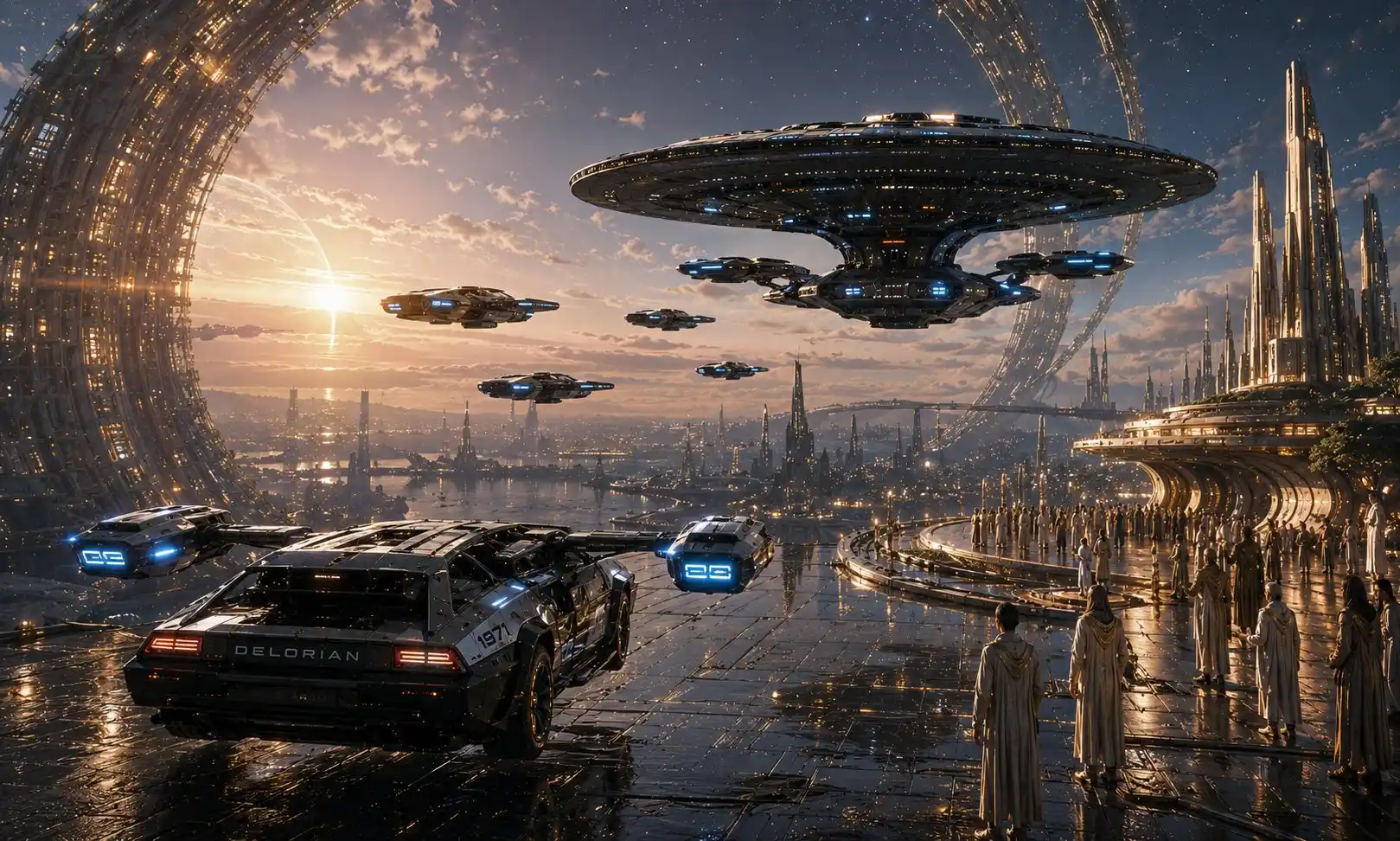
9.3 Lighting canon
- Deep blue-black night.
- Blue-white technical light.
- Wet pavement and sharp reflections.
- Stainless surfaces catching hard light.
- City skyline as civilization substrate.
- Stellar cartography blue for command and intelligence scenes.
- Red warning accents only in crisis, mirror, or field scenes.
- No washed-out violet softness when the scene needs force.
- No low-detail desaturation that removes mechanical edge.
The image is not proof, but it can reveal whether the architecture is being understood.
10. Command Philosophy: What Comes After Enterprise
The project draws inspiration from a command-deck civilization philosophy: calm intelligence, moral command, tactical seriousness, crew trust, and human responsibility in the presence of powerful systems. That spirit can be inherited without copying characters, uniforms, logos, or franchise material. The point is not nostalgia. The point is to bring that standard of seriousness into real Earth mobility, builder culture, and public systems.
What comes after Enterprise is not only a larger ship. It is a distributed civilization that can move, repair, explain, coordinate, and protect itself across roads, skies, workshops, communities, emergencies, and remote regions. The starship becomes a manual. The bridge becomes a garage. The crew becomes a builder network. The computer becomes Q. The security officer becomes D.A.N.G.E.R. The captain remains human command. The mission remains civilization continuity.
This is not militarism. It is responsible strength. It is not an escape from Earth. It is Sector 001 treated as worthy of engineering seriousness. It does not ask people to worship the machine. It asks people to become worthy stewards of a machine powerful enough to change access, resilience, and imagination.
10.1 Command archetypes
- Captain-builder: moral command, restraint, judgment, and public responsibility.
- Synthetic intelligence officer: precision, explanation, curiosity, memory, and diagnostic calm.
- Security: protection, readiness, safety discipline, and refusal of reckless spectacle.
- Systems cartographer: navigation across Earth, infrastructure, airspace, corridors, and proof states.
- Manual keeper: the person or institution that protects the knowledge from hype, secrecy, and decay.
10.2 Enterprise with teeth
The phrase enterprise with teeth means a civilization that remains humane without becoming fragile. It means beauty with proof, openness with discipline, intelligence with human command, and mobility with safety gates. It means the vehicle can be emotionally powerful without becoming a fantasy weapon. It means BOOM can look rugged without becoming a combat overclaim. It means DELORIAN can look executive without becoming soft, sealed, or ornamental.
The teeth are not merely weapons. The teeth are resilience, repair, redundancy, red-team review, manuals, training, safety locks, diagnostic sovereignty, and truth. A civilization with teeth can protect families, executives, engineers, remote communities, emergency corridors, supply routes, and public trust because it has built the knowledge system needed to preserve itself.
11. Public Release Format
A publication series on X should not simply dump the manual. It should guide the reader through an escalating arc. The five files become five public gates. Page 1 gives the icon and the thesis. Page 2 gives the framework. Page 3 gives the engineering. Page 4 gives proof and red-team honesty. Page 5 gives the manual and civilization layer. Together they should feel like a mini technical book, not a thread of slogans.
11.1 Page 5 public-release spine
- Open with the manual thesis: the manual is part of the machine.
- Explain controlled openness: open-source does not mean chaos.
- Introduce the 500 to 1000 page manual family.
- Show builder levels and global customization boundaries.
- Define SGT-TNG literacy and repair culture.
- Explain Q as the manual companion and D.A.N.G.E.R. as protection layer.
- Convert the visual canon into engineering communication.
- Close with command philosophy and final doctrine.
11.2 What the public should feel
The reader should feel that the project is ambitious but not unserious. It should feel visionary but not fake. It should feel cinematic but not ungrounded. It should feel open but not unsafe. It should feel inspired by the best command-science culture but not dependent on copying any existing universe. It should feel like a mature next-generation civilization project that knows the difference between a render, a requirement, a prototype, a certificate, and a public claim.
12. Final Claim Boundary
This file, like the full series, remains concept architecture. It may describe manual philosophy, training doctrine, builder culture, visual canon, repair culture, Q behaviour, D.A.N.G.E.R. behavior, and civilization purpose. It may propose how a future manual could be structured. It may define the knowledge ecosystem required around a roadless mobility architecture. It must not imply that the system is certified, produced, airworthy, roadworthy, passenger-approved, combat-approved, or publicly deployable.
12.1 What can be claimed now
- A coherent SGT-TNG manual architecture has been defined at concept level.
- The project distinguishes open-source literacy from uncontrolled modification.
- The five-file X publication structure now includes thesis, framework, engineering, proof, red-team, manual, and civilization layers.
- The visual canon has been converted into engineering communication rules.
- The Q and D.A.N.G.E.R. layers have been framed as explanation and protection layers, not sovereign autonomy.
- The project has a strong claim boundary that protects credibility.
12.2 What must not be claimed yet
- Do not claim a certified aircraft.
- Do not claim a certified road vehicle.
- Do not claim production readiness.
- Do not claim public flight approval.
- Do not claim passenger service.
- Do not claim validated VTOL performance.
- Do not claim hydrogen readiness.
- Do not claim autonomous operation.
- Do not claim mission-kit approval.
- Do not claim that the open manual is a maintenance approval document.
13. Closing Doctrine
The roadless mobility architecture becomes most interesting when it stops pretending the vehicle alone is enough. The vehicle is the bright object. The manual is the civilization memory. The framework is the discipline. The digital twin is the trust record. Q is the explanation. D.A.N.G.E.R. is the protective threshold. SGT-TNG is the literacy culture that prevents the future from becoming either sealed dependency or unsafe chaos.
The 55-page bundle proved that the architecture could be compressed. The five X files prove that it can breathe. The future 200-page master architecture book should do both: carry the full myth and expose the full engineering chain. Physics, requirements, interfaces, failure modes, proof gates, claim boundaries, visual canon, repair culture, and public meaning must all be present together. That is how a concept becomes worthy of serious expert attention.
If the project is ever built, it should not arrive as a mystery object. It should arrive with a manual culture powerful enough to teach the world what it is, what it is not, how it protects people, how it refuses unsafe states, how it can be repaired, how it can be improved, and what evidence still must be earned. The future should not be a sealed box with blue lights. It should be a teachable machine with a soul.
The doors fold. The nacelles fly. The capsule protects. Q explains. D.A.N.G.E.R. protects. The manual teaches. The builder learns. The human remains in command.
14. Manual Failure Modes
A manual culture can fail just as a vehicle can fail. If the manual becomes too promotional, it stops protecting truth. If it becomes too secretive, it stops creating literacy. If it becomes too technical without a learning path, it becomes a wall that only insiders can climb. If it becomes too casual, it invites unsafe interpretation. If it becomes a marketing artifact, it will hide uncertainty. If it becomes a legal shield only, it will fail to teach. The SGT-TNG manual must avoid all of these failure modes.
The most dangerous manual failure is false simplicity. False simplicity tells the reader that complex systems are easy because complexity is inconvenient to explain. A vehicle that touches road loads, lift loads, batteries, high voltage, software, future hydrogen, mission kits, egress, human factors, airspace, digital twins, and service records cannot be reduced to a slogan. The correct manual makes complexity navigable without pretending it disappeared.
The second dangerous manual failure is expert captivity. Expert captivity happens when a document is technically correct but unreadable to the broader human ecosystem. That may satisfy a narrow engineering audience, but it does not create civilization literacy. SGT-TNG should write for layered competence: public reader, owner learner, builder, technician, engineer, safety reviewer, and authority-facing professional. Each layer must know where its authority begins and ends.
The third dangerous manual failure is permission drift. A document that begins as concept architecture can be misread as approval if the language is loose. This is why claim discipline must appear throughout the manual, not only in a disclaimer at the end. Every chapter should contain its own maturity language. Every performance band should say whether it is estimated, simulated, tested, or certified. Every use case should say whether it is concept, prototype, trial, or operationally authorized.
14.1 Manual red-team checklist
- Does the manual clearly separate concept architecture from validated engineering?
- Does every high-risk module have a declared interface boundary?
- Does every builder-facing section state what must not be modified without proof?
- Does every performance statement name its evidence state?
- Does every image caption avoid implying that a render is a tested system?
- Does every emergency use case avoid implying public-service deployment before approval?
- Does the Q layer explain uncertainty instead of hiding it?
- Does the D.A.N.G.E.R. layer remain non-bypassable in public doctrine?
- Does the manual teach enough for literacy but not so loosely that it invites unsafe action?
The manual must be brave enough to teach and strict enough to refuse unsafe interpretation.
15. International Builder Ecosystem
The most powerful version of this project is not a single vehicle in one country. It is a disciplined international builder ecosystem that can adapt the architecture to different climates, roads, service cultures, public needs, and industrial capabilities without losing the common spine. Canada may emphasize cold-weather resilience, remote community reach, and long-distance infrastructure. The United States may emphasize aerospace integration, platform authority, software assurance, and production scale. Europe may emphasize certification discipline, systems safety, and urban air mobility governance. Japan and South Korea may emphasize precision production, hydrogen systems, robotics, and high-quality manufacturing culture. Other regions may emphasize disaster response, rugged service, coastal corridors, island access, or rural reach.
But internationalization must be handled with discipline. A global project that cannot control its branches becomes fragmented. A global project that cannot allow local learning becomes brittle and elitist. The correct path is a controlled common spine with local adaptation layers. The common spine is NAV-CF requirements, interface discipline, digital twin truth, Q explanation, D.A.N.G.E.R. thresholds, claim boundary, and proof gates. Local adaptation may tune service workflow, climate packages, interior materials, language, training, road equipment, mission-kit priorities, and non-critical visual details. Local adaptation must not silently change the safety case.
The open manual should therefore include an international branch protocol. Every branch should declare its environmental assumptions, road assumptions, airspace assumptions, service capacity, supply chain, quality system, training level, data governance method, and public claim language. The goal is not to freeze the vehicle forever. The goal is to make change visible, reviewable, and honest.
15.1 Branch protocol requirements
- Declare the branch purpose: civil, rugged, educational, service, research, or restricted review.
- Declare the environment: temperature, altitude, corrosion exposure, precipitation, road quality, and infrastructure level.
- Declare affected systems: structure, doors, nacelles, energy, cooling, software, Q, D.A.N.G.E.R., digital twin, or mission kit.
- Declare evidence state: concept, analysis, simulation, ground test, prototype test, flight test, certification path, or operational approval.
- Declare supportability: parts, tools, training, inspection schedule, and service documentation.
- Declare claim boundary: what the branch may say publicly and what it must not imply.
- Declare rollback path: how unsafe or unsupported modifications are removed from the trusted configuration.
16. From Five X Pages to the 200-Page Master Book
The five X files are not the final encyclopedia. They are the public spine. The next artifact should be the 180 to 220 page SGT-TNG master architecture book, built by expanding each proof chain rather than simply adding filler. The five files already divide the architecture correctly: thesis, framework, engineering, proof, and civilization. The master book should deepen each layer while preserving the same claim-safe discipline.
The expansion method should be consistent. Every concept becomes a chapter only if it can answer five questions: what principle governs it, what requirement follows, what interface must be controlled, what failure mode threatens it, and what proof is needed before claim. This prevents bloat. It also prevents the opposite failure, which is compression so severe that expert readers cannot see the reasoning. The master book should feel generous, not padded; rigorous, not cramped; cinematic, not vague.
The master book should keep the companion essays, but expand them into a conceptual gateway. It should keep the registers, but turn the most important register entries into narrative proof chains. It should keep the figures, but make each figure earn its caption. It should keep the red-team section, but expand each risk area into an engineering review. It should keep the visual canon, but treat it as design-control evidence from the image process. It should keep the manual concept, but mark it as future manual architecture, not approved operating procedure.
16.1 Master book page allocation
- Reader gateway and claim boundary: 12 to 15 pages.
- Expanded companion essays: 35 to 45 pages.
- DELORIAN 001 SGT-TNG vehicle canon: 35 to 45 pages.
- BOOM 1971 A.R.G.O. field branch: 25 to 35 pages.
- NAV-CF framework: 30 to 40 pages.
- Technical architecture: 50 to 65 pages.
- Verification, red-team, and proof path: 35 to 45 pages.
- Open manual, builder culture, and visual canon: 25 to 35 pages.
16.2 The master-book quality test
- Can an engineer see the requirements chain?
- Can a designer see why the body shape is protected?
- Can a builder see where customization is allowed and where it is forbidden?
- Can a public reader understand what is concept and what is proof?
- Can a leader understand the civilizational value without mistaking it for procurement readiness?
- Can a safety reviewer find the weak assumptions quickly?
- Can a future manual writer turn the architecture into training books?
17. Civilization Layer: Why This Matters
The deeper purpose of the project is not to make a spectacular object for a few owners. It is to imagine how advanced mobility could become more understandable, more repairable, more resilient, and more aligned with human agency. Roads will remain essential, but roads can break. Bridges can fail. Ferries can stop. Airports can become bottlenecks. Remote regions can be isolated. Supply chains can be fragile. Digital systems can become opaque. A roadless mobility architecture asks how a civilization might preserve reach without giving up beauty, safety, or human command.
This is why the manual belongs in the same moral category as the vehicle. A machine can move people. A manual can move competence. A machine can cross a broken road. A manual can cross a generation. A machine can carry a family or a field team. A manual can carry design discipline into another shop, another country, another school, another builder network. A machine can be destroyed. Knowledge can survive if it is written, taught, updated, and carried by Q and by people.
The final value of SGT-TNG is therefore not only mobility. It is formation. It forms builders who understand safety. It forms readers who can distinguish proof from hype. It forms designers who do not trade away the soul of a vehicle for random novelty. It forms leaders who see that advanced systems require public literacy. It forms a future in which technology is not a sealed priesthood and not an uncontrolled toy, but a disciplined inheritance.
The vehicle gives civilization reach. The manual gives civilization memory. Together, they make the future teachable.
18. Source Notes
These source notes support the external grounding of the manual and civilization layer. They do not certify the SGT-TNG architecture. They are reference categories for systems engineering, maintenance literacy, human factors, cyber-physical security, software assurance, and powered-lift regulatory context.
- [S1] NASA Systems Engineering Handbook, NASA/SP-2016-6105 Rev2 – reference category for systems engineering discipline, technical risk, requirements, verification, and lifecycle thinking.
- [S2] FAA Integration of Powered-Lift: Pilot Certification and Operations; Miscellaneous Amendments Related to Rotorcraft and Airplanes – reference category for the emerging powered-lift regulatory context and why public flight claims must remain bounded.
- [S3] FAA Aviation Handbooks and Manuals, including Aviation Maintenance Technician Handbook series – reference category for the seriousness of maintenance literacy, airframe/powerplant knowledge, and formal training culture.
- [S4] FAA Human Factors in Aviation Safety – reference category for human performance, maintenance, procedures, pilot performance, and system evaluation.
- [S5] NIST SP 800-160 Volume 1, Systems Security Engineering – reference category for cyber-physical systems security, defensibility, survivability, and engineering-driven security.
- [S6] SAE ARP4754B – reference category for civil aircraft and systems development assurance discipline.
- [S7] RTCA DO-178C overview – reference category for airborne software development assurance and certification-oriented software discipline.
- [S8] SAE J3016 taxonomy – reference category for automation terminology discipline and avoiding vague autonomy claims.
19. Build Log
- File: DELORIAN_SGT_TNG_X_Page_5_Manual_Civilization.docx
- Series position: X Page 5 of 5.
- Primary focus: 500-1000 page open manual concept, builder culture, global customization, SGT-TNG literacy, repair culture, TNG command philosophy, visual canon, and final doctrine.
- Structure: narrative chapters plus bullet registers only; no tables.
- Claim posture: concept architecture only; no certification, roadworthiness, airworthiness, production approval, passenger approval, or operational authorization implied.
- Continuity: closes the five-file X publication set by connecting the machine, framework, engineering, proof gates, and civilization knowledge layer.
Appendix A: Ascension Bridge — Heaven’s Ladder
Purpose
The Ascension Bridge is a staged development architecture connecting road mobility, vertical takeoff, subsonic flight, supersonic flight, and eventual hypersonic operation.
It is not a claim that one vehicle can be upgraded continuously from car to hypersonic aircraft without major redesign. Each stage is a separate engineering configuration that inherits only the structures, software, manufacturing methods, control systems, and operating knowledge proven by the stage before it.
The governing principle is:
The vehicle learns to stand before it learns to fly, and it learns to fly efficiently before it attempts extreme speed.
Development Ladder
Road Transport → Subsonic VTOL → Supersonic Flight → Hypersonic Flight
D.E.L.O.R.I.A.N Line
- D.E.L.O.R.I.A.N Road-mobile foundation and systems-development platform.
- D.E.L.O.R.I.A.N Arrow Subsonic or supersonic road-to-air derivative using deployable flight surfaces, vertical-launch assistance, and a dedicated flight propulsion system.
- D.E.L.O.R.I.A.N Dark Arrow High-supersonic or hypersonic research derivative requiring a fundamentally different thermal structure, propulsion cycle, fuel architecture, and mission profile.
BOOM 1971 Line
- BOOM 1971 Armored road platform and foundational mobility architecture.
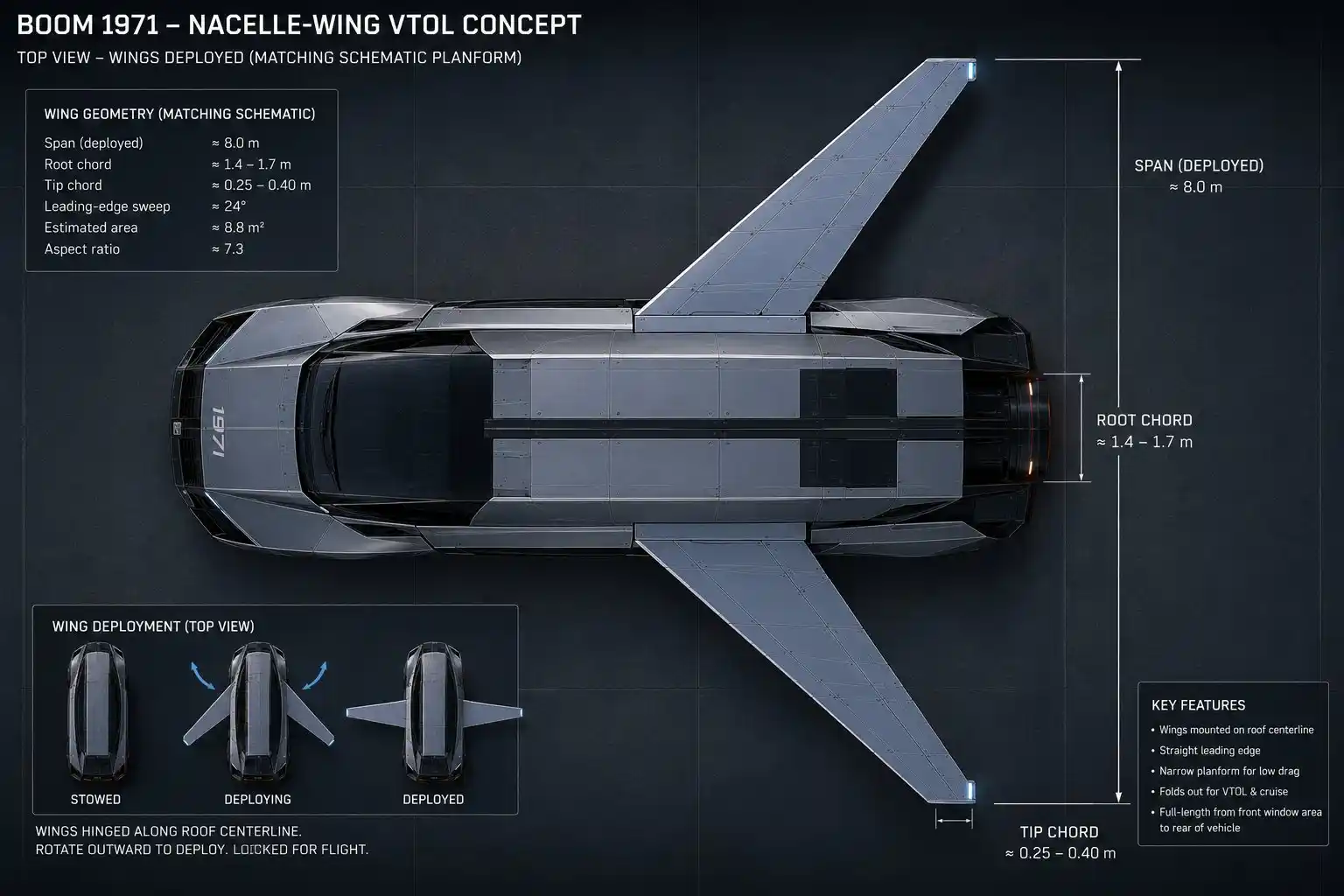
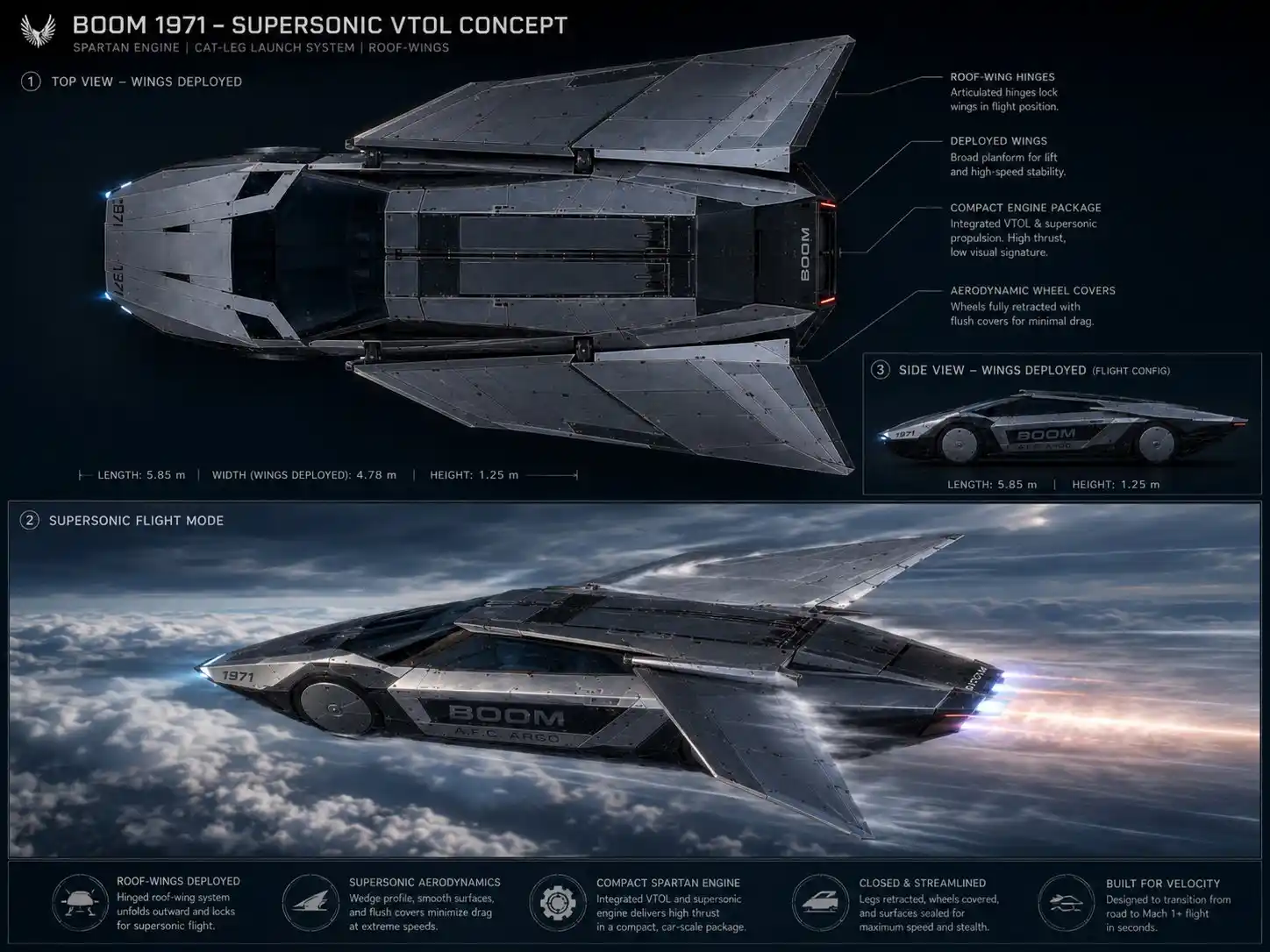
- BOOM 1971 Arrow Road-to-air derivative using the vehicle body as a central lifting surface, two roof-mounted deployable wings, independent retracting wheels, and underbody inception legs for launch and landing posture.
- BOOM 1971 Dark Star / Hermeus Dark Horse High-speed aerospace derivative representing the transition from reusable road-air vehicle to a purpose-built high-supersonic or hypersonic platform.
First-Principles Architecture
The ladder must be governed by five non-negotiable constraints.
1. Mass must close at every stage
Every configuration must carry:
- its own structure
- propulsion system
- fuel
- thermal protection
- landing or launch equipment
- flight controls
- occupants or payload
- required safety margin
A vehicle does not become viable merely because an engine produces sufficient static thrust. The complete mass budget must close with useful range and controllability.
2. Vertical lift and forward flight are different problems
Vertical takeoff requires thrust greater than vehicle weight, rapid control authority, and protection from hot exhaust and ground interaction.
Efficient forward flight requires low drag, adequate wing area, stable pressure distribution, and propulsion optimized for cruise.
The architecture may share hardware between these modes, but it must not assume that the best vertical-lift system is automatically the best cruise system.
3. Each speed regime changes the vehicle
- Subsonic flight is dominated by weight, induced drag, propulsive efficiency, and low-speed control.
- Supersonic flight introduces wave drag, inlet design, shock control, surface precision, and sonic-boom management.
- Hypersonic flight adds severe aerodynamic heating, thermal expansion, high-temperature materials, propulsion-transition problems, and much narrower operating margins.
The hypersonic vehicle must therefore be treated as a descendant of the earlier architecture — not merely the same vehicle with a larger engine.
4. Reuse only what remains physically valid
The most valuable inheritance across the ladder may include:
- flight-control software
- autonomous stabilization
- power distribution
- modular manufacturing
- digital engineering models
- cockpit and human-machine interfaces
- deployable-wing mechanisms
- launch-leg control
- inspection and maintenance systems
Road wheels, armor mass, cabin geometry, ordinary structural alloys, and low-speed propulsion may not survive into the highest-speed configurations.
5. Advancement requires demonstrated gates
A stage should not proceed until the previous stage has demonstrated:
- stable posture and launch control
- safe vertical takeoff and landing
- controlled transition to wing-borne flight
- engine-out or degraded-mode recovery
- repeatable structural inspection
- acceptable fuel fraction and range
- thermal and acoustic limits
- maintainable turnaround procedures
Candidate Subsonic Propulsion
Initial subsonic and vertical-flight studies may examine:
- Valkyrie-class propulsion concepts
- dedicated vertical-takeoff engines
- compact Spartan-engine concepts
These are candidate architectures, not preselected solutions. They must be compared using the same measures:
- thrust-to-weight ratio
- specific fuel consumption
- installed mass
- engine volume
- thermal load
- thrust-vectoring capability
- restart reliability
- maintenance burden
- compatibility with protected internal fuel storage
A twin-engine configuration may improve redundancy and control authority, but it also consumes more volume and fuel. A single-engine configuration may be lighter, but it creates a more severe failure case. Selection must follow the complete vehicle mass, range, safety, and packaging analysis.
Final Doctrine
The Ascension Bridge is not a straight line toward maximum speed.
It is a controlled transfer of capability:
Road mobility establishes the platform. Inception legs establish posture. Vertical flight establishes control. Subsonic flight establishes endurance. Supersonic flight establishes shock discipline. Hypersonic flight establishes thermal survival.
Each rung must remain useful on its own. The ladder succeeds only when every stage produces a credible machine, a validated body of knowledge, and a safer foundation for the stage above it.
Appendix S: NASA Technical Reports Server — NTRS
NTRS contains NASA papers, technical presentations, CFD results, pressure-signature diagrams, aircraft geometry discussions, and sonic-boom propagation studies. For example, it hosts detailed X-59 mission presentations with diagrams explaining how the aircraft’s shocks are prevented from merging into a conventional N-wave boom.
A second valuable NASA resource is the NASA Advanced Supercomputing division — NAS, especially its Cart3D publications archive. That collection includes X-59 CFD, sonic-boom prediction, control-surface optimization, pressure signatures, and ground-noise studies.
So the two names to remember are:
Primary archive: NASA Technical Reports Server — NTRS
Advanced simulation archive: NASA Advanced Supercomputing — NAS / Cart3D
- Quesst Supersonic STEM Toolkit
- Quesst: A Future with Quiet Supersonic Flight
- https://www.youtube.com/watch?v=BkhK88MDnac
- The Future They Dreamed About 50 Years Ago | Retro Sci-Fi Ambient Music
- https://youtu.be/7Dhm3rGDEC4
- The Spartan Line of Turbojet Engines
- https://www.kratosdefense.com/propulsion-power/turbine-propulsion/spartan
- SHIELD AI X-BAT AI VTOL
- https://shield.ai/x-bat/
- HERMEUS Dark Horse
- https://www.hermeus.com/darkhorse
- 👉 D.E.L.O.R.I.A.N. 001 SGT-TNG – X-File 1 – Thesis + Icon
- https://x.com/SkillsGapTrain/status/2075573855167689158
- 👉 D.E.L.O.R.I.A.N. 001 SGT-TNG – X File 2 – THE FRAMEWORK
- https://x.com/SkillsGapTrain/status/2075573991566422084
- 👉 D.E.L.O.R.I.A.N. 001 SGT-TNG – X File 3 – THE ENGINEERING
- https://x.com/SkillsGapTrain/status/2075574071950279037
- 👉 D.E.L.O.R.I.A.N. 001 SGT-TNG – X File 4 – PROOF + RED-TEAM
- https://x.com/SkillsGapTrain/status/2075574131018633350