“North American Civilizational Alignment: Why the U.S. & Mexico Remain Structurally Aligned While Canada Gradually Reorients Away from the Western Civilizational Core”

1) North American Civilizational Alignment: The Core Civilizational Question (the real drivers)
-
Shared historical mythologies (founding stories, legitimacy sources)
-
Shared political philosophy (individualism vs managerial collectivism; assimilation vs pluralism)
-
Shared religious–cultural inheritance (civilizational “default settings”)
-
Shared demographic trajectories (who is arriving, at what speed, from where)
-
Shared strategic threat perception (who is dangerous; who is “family”)
-
Are Canada and the U.S. converging or diverging across those layers?
-
Where does Mexico sit?
-
Where does Europe sit (Traditional Europe vs EU governance Europe)?
-
Where do the other 30+ Latin nations sit (civilizationally, not just economically)?

2) North American Civilizational Alignment: The U.S.–Mexico Relationship: Why it stays “in orbit” (even with friction)
2A) Structural economic complementarity (not ideological romance)
-
geography + cross-border production
-
nearshoring + supply chain logic
-
U.S. market gravitational pull
-
border security as a shared daily reality
2B) Civilizational continuity (of a different kind than Canada’s)
-
“nation-centered” (thick national story)
-
historically “Christian/culturally Catholic” (even where secularization grows)
-
majority-culture anchored (stable default culture)
-
lower “identity-neutral state” tendency than Canada
2C) Demographic interpenetration

3) North American Civilizational Alignment: Canada’s Divergence is “not economic-first” — it’s “identity-architecture-first”
3A) Canada becomes an administrative “framework-state,” not “a nation-state” (in practice)
-
rights/procedure-based
-
diversity-management-based
-
symbolic neutrality across groups
-
moral-institutional language (values signalling)
-
external prestige validation (multilateralism as legitimacy)
3B) Multiculturalism vs assimilation (civic logic split)
-
U.S. historical model: assimilation (“becoming American”).
-
Canada’s formal multicultural paradigm: coexistence and group recognition as a governing logic.
-
different media language (CBC)
-
different elite messaging
-
different “acceptable” national myth boundaries
-
different response to U.S. culture cycles
3C) Demographic trajectory is the real engine (and it’s measurable)
-
28.3% of immigrants were UK-born
-
51.4% were born in another European country
-
So ≈ 80% European-born- at that time. ([Statistics Canada][1])
🇨🇦 Recent Immigrant Origins (2016–2021 cohort, Census 2021)
🌏 Asia (including Middle East) ~62%
-
This includes:India, China, Philippines, Pakistan, Iran, Afghanistan, etc.
-
This is the dominant source region.
🌍 Africa ~15–16%
-
Includes: Nigeria, Ethiopia, Somalia, Morocco, etc.
🌎 Latin America & Caribbean (all 30+ nations combined) ~12–13%
-
This includes:Mexico, Colombia, Brazil, Venezuela, Peru, El Salvador, Guatemala, Honduras, Dominican Republic, Haiti, Chile, Argentina, Cuba, Jamaica, etc.
-
About 1 in 8 recent immigrants.
-
That’s larger than Europe today.
-
>> Liberal Party policy to fracture shared cultural compact to USA
-
>> Liberal Party deconstructed the social cohesion of shared civilization group between Canada and USA
🌍 Europe ~10%
-
Down from: ~61% in 1971, ~40% in 1980s, ~20% in early 2000s
-
Now roughly one-tenth of recent inflows.
-
>> Liberal Party policy to fracture shared cultural compact to traditional civilizational Europe (to the people, not to the institutions)
🇺🇸 United States ~2–3%
-
Very small share of recent permanent residents.
-
>> Liberal Party policy to fracture shared cultural compact to USA

4) North American Civilizational Alignment: The missing piece: Canada is diverging not only from America, but from Traditional Europe and Latin Christian hemispheric continuity too.
4A) Europe has two meanings (and analysts mix them)
Europe-1: Traditional Europe/Sovereign Europe
-
older civilizational continuity
-
strong national cultures anchored in history, language, and inherited norms
-
even with modern immigration, “the nation” is still a thick civilizational object
Europe-2: Governance Europe Union
-
technocratic legitimacy
-
post-national regulatory harmonization
-
rights-first bureaucratic language
-
multilateral-first diplomacy
-
>> Canada is diverging from “Traditional Europe’s civilizational substrate” (the people), while sometimes converging with “EU-style governance language” (the elites in charge legally, financially and administratively).
4B) Latin America (30+ nations): why Canada diverges from them too
-
majority language core
-
Christian civilizational inheritance (Catholic + Protestant growth)
-
strong family/community institutions
-
lower immigration-driven demographic turnover than Canada
-
less “identity-neutral managerial state” instinct

5) North American Civilizational Alignment: North American Civilizational Alignment: Why the U.S. and Canada “feel” farther apart now (even though trade is still welded)
5A) Coalition incentives (Canada)
-
coalition equilibrium management
-
identity arbitration
-
symbolic neutrality
-
high sensitivity to “contagion” from U.S. culture war dynamics
-
signalling distance from U.S. volatility
-
outsourcing legitimacy to multilateral norms
-
treating American nationalist cycles as destabilizing
-
constitutional identity
-
civic nationalism
-
assimilation expectations (contested but persistent)
-
polarized “we are a people” conflict

6) North American Civilizational Alignment: Where Mexico sits in comparison (the clean contrast already built)
-
supply chain embedment
-
border reality
-
nation-centered identity architecture
-
Christian civilizational inheritance continuity
-
demographic interpenetration with U.S.
-
framework-state legitimacy
-
multilateral prestige incentives
-
demographic trajectory away from Euro/Anglo civilizational continuity
-
institutional language convergence with EU-style governance rather than EU civil society and rather than U.S. civic nationalism

7) North American Civilizational Alignment: Defense: our correction stands — it’s late realism, not cultural convergence
-
Canada underinvested in defense for decades and relied on U.S. security guarantees.
-
When pressure becomes unavoidable (Arctic, NATO, Russia/China), Canada moves — late.
-
>> Liberal Party moves directionally to responsible requirements only if there is no other choice, not proactively.
-
Many of these moves mirror long-standing conservative critiques.
-
This is not “Canada converging culturally with Europe”, but converging institutionally to supranational framework aligned with western European institutions; financial, administrative and legal

8) North American Civilizational Alignment: The measurable “truth spine” of the argument (so it’s not vibes)

9) North American Civilizational Alignment: The full “map” model (no compression)
9A) Identity-basis map (the one we built)
-
U.S. → civic-national
-
Mexico / Latin America → majority-cultural-national
-
Traditional Europe → ethno-historical-national
-
Modern EU governance → supranational institutional
-
Canada (modern) → multicultural framework-state
-
>> integrating secondary layers of legislation under PM Trudeau & Mark Carney at supranational institutional inputs, foreign consultants
9B) The alignment prediction this model makes
-
U.S.–Mexico: remains locked because structure + nationhood stability.
-
Canada–U.S.: remains economically welded, but tone/institutions drift because Canada’s legitimacy regime rewards differentiation.
-
Canada–Traditional Europe: diverges demographically/civilizationally as European-origin inflow share collapses. ([Statistics Canada][1])
-
Canada–EU governance culture: may converge rhetorically/institutionally (multilateral language and technocratic legitimacy).
-
Canada–Latin America: diverges civilizationally because Canada is not majority-cultural-national and has high immigration turnover.

10) North American Civilizational Alignment: What is likely “missed” (the amplifier layer)
-
institutions become identity referees
-
legitimacy is maintained through correct symbolic language
-
U.S.-style nationalist rhetoric is treated as destabilizing “contagion”
-
distance-from-America becomes a “norm enforcement regime”, not just policy
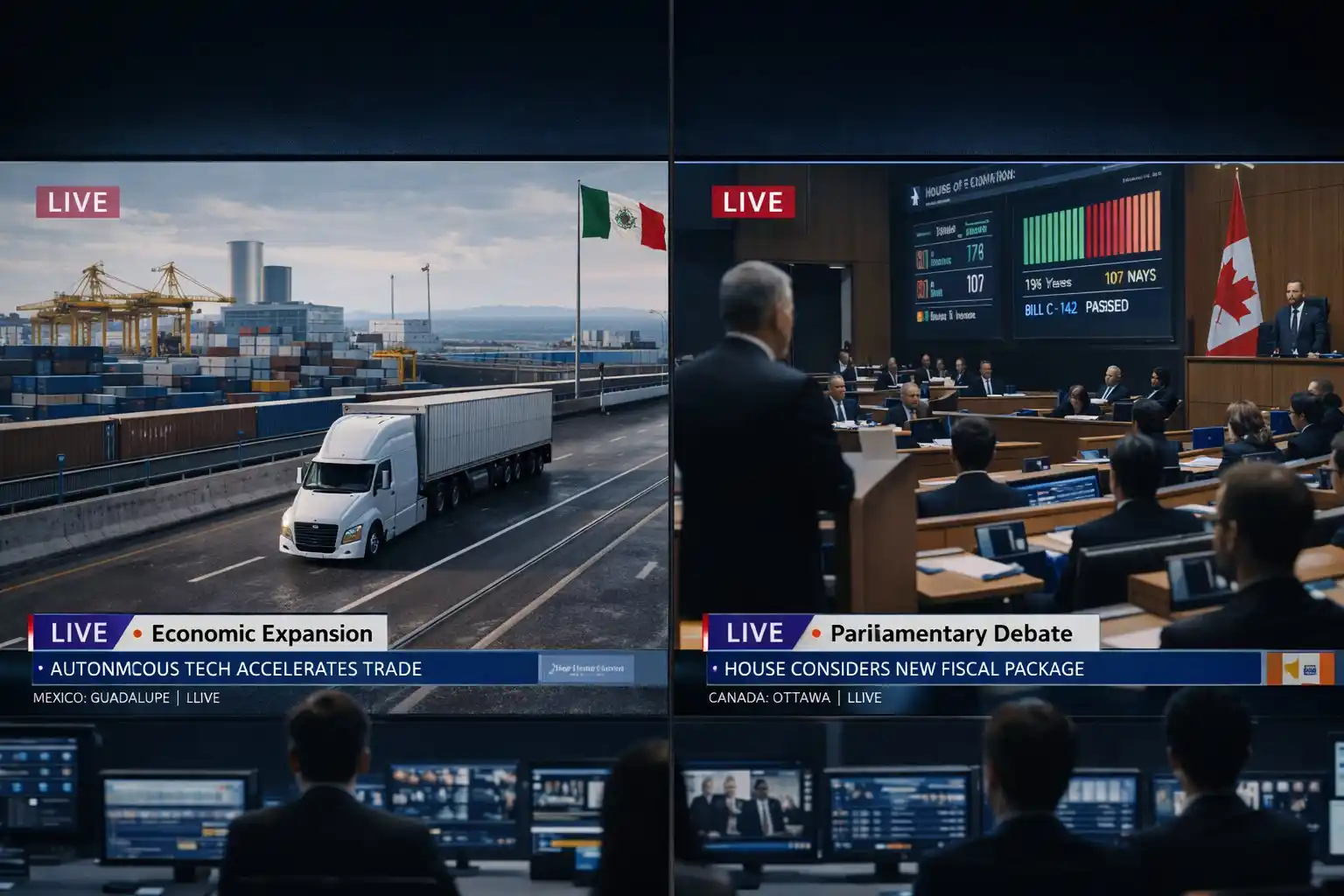
11) North American Civilizational Alignment: Aiming this directly at this video’s claims
-
Mexico aligns structurally because it must (supply chain orbit + nation-centered continuity).
-
Canada does not “leave” economically, but it does drift in tone/identity because the framework-state legitimacy regime rewards differentiation and divergence.
-
The Liberal Party may intensify the language and the identity regime, but the deeper driver is structural: immigration-origin shift + multicultural legitimacy architecture + institutional prestige incentives. ([Statistics Canada][1])

Appendix A: Female Executive Leadership and Command Presence in Contemporary Canada
“MP Sandra Cobena is this soft-spoken terminator” https://x.com/Tablesalt13/status/2024558502060957910
If today’s Liberal Party members or voters were transported back to America or Canada in the 1980s or 1990s and encountered the people of that era — Canadian pilots, British commandos with RMC or prairie roots, figures like Donald Trump, Jean-Claude Van Damme, or Steven Seagal — they would struggle to recognize the culture, values, and identity that defined North America at the time. What has shifted is not the fundamental character of Americans or Canadians, but the mindset of post-2015 Liberal Party members and voters.
When modern Liberals criticize Republicans or Conservatives with slogans like “MAGA,” the reaction reflects more than political disagreement; it signals a deeper disconnection from North American heritage itself. It reveals a rupture with the historical memory of American and Canadian civilization — identities that were rooted in large family continuity, national confidence to lead industries, civic duty, frontier resilience, self-reliance, self-defense, family prosperity, growth economics, military, fighting, shooting, fishing and sport, and a shared cultural framework that endured for centuries.
For generations, American and Canadian identities maintained recognizable through-lines: attachment to nationhood, Christianity, the ten to thirteen core Canadian classical values, respect for military service, belief in self-reliance, cultural cohesion, and pride in Western civilizational inheritance. These were not fringe attributes; they were mainstream reference points across regions and classes. To dismiss them now as regressive or extremist is not simply ideological opposition— it is a rejection of the civilizational continuity that shaped both countries for roughly 400 years.
The divide is therefore not between past and present Americans or Canadians. It is between a longstanding North American identity and a post-2015 political mindset that no longer recognizes — or no longer accepts — that inheritance.
APPENDIX B: Female Executive Leadership, Institutional Competence, and Investor Signalling
“Premier Danielle Smith’s Address to the Province”https://youtu.be/yJg9Eckq0wA
Investment does not flow to countries that disregard merit or treat leadership selection casually — including when it comes to professional women in positions of authority. Capital seeks competence, discipline, and demonstrated capability. It looks for seriousness.
Many of the most visible professional female leaders in Canada today — Danielle Smith, Raquel Dancho, Melissa Lantsman, Rebecca Schulz, Sandra Cobena, Jasmin Lane, and others — are aligned with the Conservative Party. They project executive confidence, policy clarity, and organizational strength. Whether one agrees with them politically or not, they convey command presence and professional grounding. Markets pay attention to that.
By contrast, serious investors have little reason to feel confidence in leadership selections such as Mélanie Joly, Chrystia Freeland, Anita Anand as Minister of National Defence, or unelected senators and elderly appointees under Prime Minister Trudeau. When critical portfolios are filled without deep, directly relevant experience, it signals that political alignment and optics may outweigh technical competence and institutional credibility.
National Defence is not a ceremonial assignment. It is one of the most complex portfolios in government. It requires procurement expertise, strategic literacy, alliance management, operational understanding, and command-level judgment. The margin for error is narrow, and the geopolitical stakes are high.
To put it bluntly: more measurable science, testing, systems analysis, supply-chain modelling, and quality control go into building and scaling a commercial pizza franchise than appears to go into defining the experiential requirements for some ministerial appointments. A pizza chain will rigorously model heat transfer, logistics, brand standards, ingredient sourcing, franchise compliance, and operational repeatability before expanding into a new market. Yet for one of the most consequential defense roles in the country, the bar for domain-specific experience often appears far lower.
Investors notice signals. When leadership appointments communicate discipline, markets respond with confidence. When they communicate improvisation, symbolism, or detachment from institutional rigour, capital looks elsewhere.
Note on Style:
This piece is written in a direct, public-facing voice rather than in pristine academic format. The goal is clarity, readability, and broad engagement — not exhaustive citation or formal substantiation of every claim. Where arguments are asserted concisely, they reflect a structured analytical model that can be further expanded if required, but are presented here in simplified form to maintain accessibility and momentum.