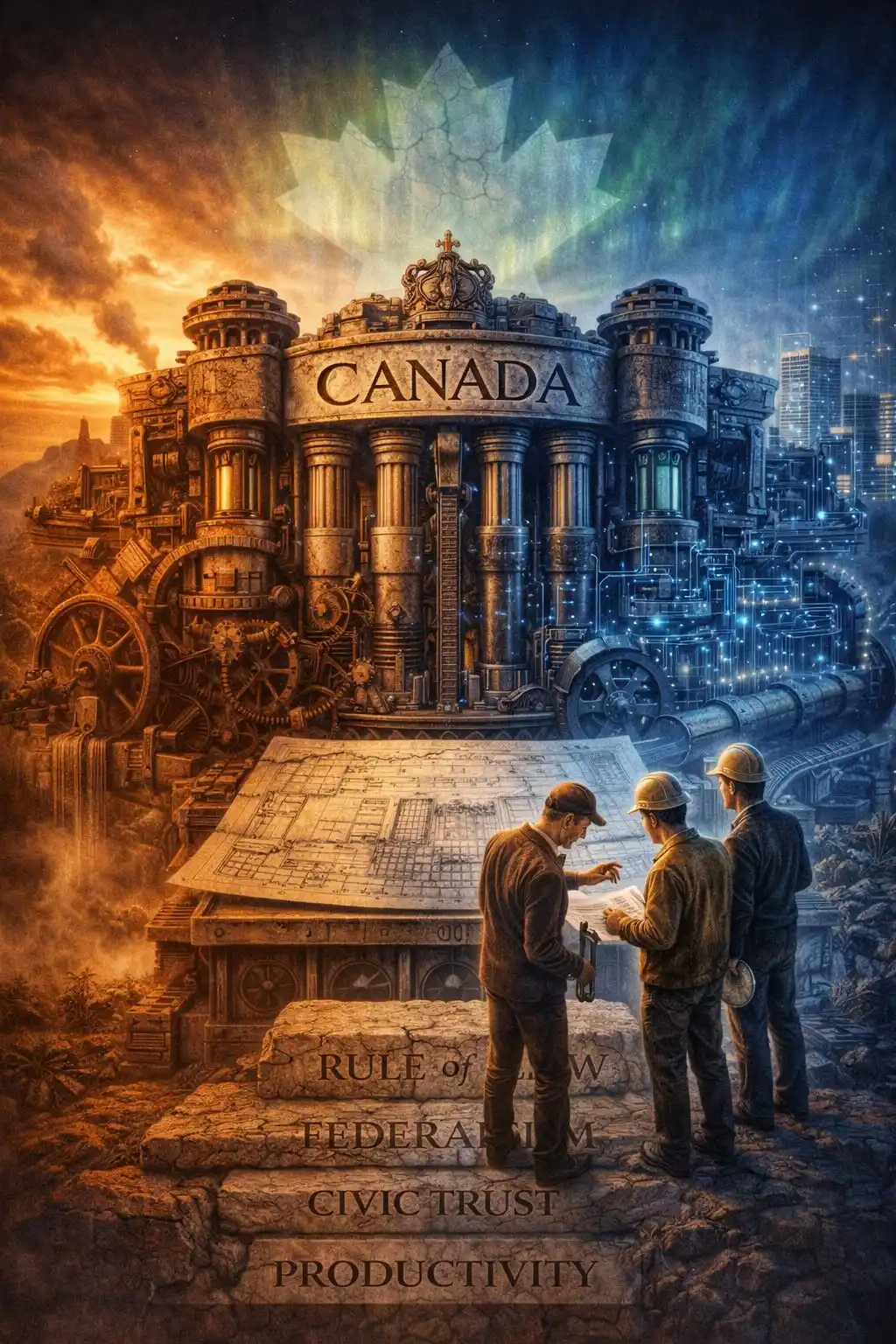
Canada at the Continuity Threshold: Canada is not simply a state. It is a layered inheritance.
- Law continued.
- Memory continued.
- Institutions continued.
- Families continued.
- Builders continued.
That continuity— more than any ideology — is what made the country real.
Now, in the early decades of the 21st century, many Canadians feel something difficult to name. Not collapse. Not revolution. But strain.
A sense that something foundational is being administratively revised faster than it is being transmitted. This is not a partisan accusation. It is a civilizational question.
Can Canada still carry its weight forward?
Canada at the Continuity Threshold: What Built Canada
Canada was not built primarily by administrators.
It was built by settlers, engineers, soldiers, farmers, tradesmen, entrepreneurs, mothers and fathers, immigrants who adopted a constitutional culture and contributed to it.
It was built by:
- French civil law rooted in Catholic tradition
- British common law rooted in constitutional restraint
- Parliamentary sovereignty tempered by judicial review
- A federation negotiated across geography
- Rail laid across rock and shield
- Ports carved from coastline
- Northern supply chains sustained in brutal climates
- Armed forces that fought at Vimy Ridge, Normandy, Kandahar
The country endured because its people produced more than they consumed — materially and morally.
That is continuity.
Canada at the Continuity Threshold: The Civilizational Core
Across 400 years, Canada’s identity rested on several load-bearing realities:
A Moral Framework Initially Christian in structure, later increasingly secular— but always anchored in the belief that the state itself is not the ultimate moral authority.
Rule of Law – Predictable governance. Constitutional order. Limits on arbitrary power.
Shared Civic Culture – Two languages. Multiple regions. But one constitutional identity.
Institutional Memory – Military professionalism. Engineering culture. Educational rigour. Federal balance.
Productive Capacity – Agriculture, manufacturing, energy, infrastructure, logistics.
Family Transmission – Language, skills, values, responsibility passed across generations.
None of these were perfect. All evolved. But together they formed a stable operating system.
Canada at the Continuity Threshold: The Drift
Modern Canada remains peaceful, democratic, and materially prosperous. It is still among the most stable countries in the world.
-
Yet something has shifted.
-
The dominant energy of the country has moved from building to managing.
-
From production to regulation.
-
From expansion to supervision.
-
From physical construction to narrative construction.
The signs are subtle but visible:
Housing scarcity in a land of vast territory. Fertility well below replacement. ¹ Productivity lagging peers. Young people uncertain about long-term ownership — of homes, of families, of identity. Institutional trust fraying at the edges.
Canada at the Continuity Threshold: Identity at Speed
Previous generations experienced identity slowly.
Church, school, family, trade, local community — these shaped memory over decades.
Now identity is shaped at digital speed.
- Algorithms amplify.
- Institutions react.
- Narratives cycle in hours.
Global frameworks move faster than local tradition can metabolize them.
Canada has always integrated foreign influence — French, British, European, American, and in recent times, Eastern and Southern.
The risk is velocity without grounding.
If moral language detaches from historical roots, if law expands discretionary flexibility faster than trust expands with it, if shared civic identity fragments into managed categories,
continuity becomes fragile.
The Builders
Throughout Canadian history, the people who carried the nation forward were rarely the loudest.
They were high-throughput individuals.
- Shipbuilders in Halifax.
- Rail crews in the Rockies.
- Farm families on the Prairies.
- Immigrants opening shops in new towns.
- Engineers designing hydro systems.
- Soldiers holding impossible ground.
They did not debate identity as theory.
They embodied it through production, sacrifice, and long-term investment.
They believed the country would endure long enough to justify effort.
That belief is everything.
When it fades, throughput fades with it.
What This Is Not
- This is not nostalgia for an imaginary golden age.
-
Canada always had conflict — linguistic, religious, regional, constitutional.
-
This is not a call for uniformity.
-
This is not collapse rhetoric.
-
This is an audit.
An honest question:
Are we transmitting strength, or are we transmitting administrative complexity without generational confidence?
Canada at the Continuity Threshold: The Threshold
A civilization approaches a continuity threshold when:
- Families hesitate to form.
- Builders hesitate to invest.
- Law becomes increasingly flexible while trust decreases.
- Memory shortens.
- Administration expands faster than production.
Canada is not beyond that threshold. But it is near enough that thoughtful people sense the edge.
Confidence in the future. Respect for inherited structure. Production sufficient to sustain autonomy. And moral grounding deeper than policy cycles. The question is not whether Canada will change.
It always has.
The deeper question is whether Canada is functioning or whether it’s broken — and whether the mechanisms that sustained its long-term continuity are strengthening or thinning beneath present stability.
And if it is broken, the real question is whether it will remember itself while rising to fix itself.
That is the real audit.
And that is the work of this generation.
¹ Data summarized from Statistics Canada, OECD productivity reports, CMHC housing data, and federal labour market publications (1990–present).

Appendix A
1. Total Fertility Rate
-
Replacement rate: 2.1 births per woman
-
Canada in the early 1990s: approximately 1.7
-
2000s: approximately 1.6
-
2010s: approximately 1.5
-
Most recent years: approximately 1.3–1.4, among the lowest in national history
2. Labour Productivity (GDP per Hour Worked)
-
Canada’s productivity growth has lagged the United States and several OECD peers over the past two decades.
-
The Canada–U.S. productivity gap has widened since the early 2000s.
-
Real wage growth is closely tied to productivity performance.
3. Business Investment per Worker
-
Non-residential business investment per worker has trended below U.S. levels for over a decade.
-
Capital intensity growth has slowed relative to peer economies.
-
Investment gaps are particularly visible in machinery, equipment, and innovation-driven sectors.
4. Housing Supply Relative to Population Growth
-
Population growth has accelerated in recent years.
-
Housing starts have not consistently matched population expansion in major metropolitan areas.
-
Price-to-income ratios in several Canadian cities rank among the highest in the OECD.
5. Public Sector Expansion and Regulatory Density
-
Public sector employment as a share of total employment has increased over time.
-
Regulatory frameworks have expanded in scope and administrative complexity.
-
Major infrastructure and energy projects often experience multi-year approval timelines.
6. Infrastructure Approval and Delivery Timelines
-
Large-scale infrastructure and resource projects increasingly face extended review periods.
-
Approval processes frequently span multiple jurisdictions and regulatory layers.
-
Comparative timelines in some peer countries are shorter for similar categories of projects.