The Human Spark at the Edge of Quantum AI — and Why the Next Great Breakthrough May Begin by Realizing We Are Solving the Wrong Problem

Ana de Armas https://x.com/anadedaily/status/2088392464176746745
A scientist stands in front of a wall of equations.
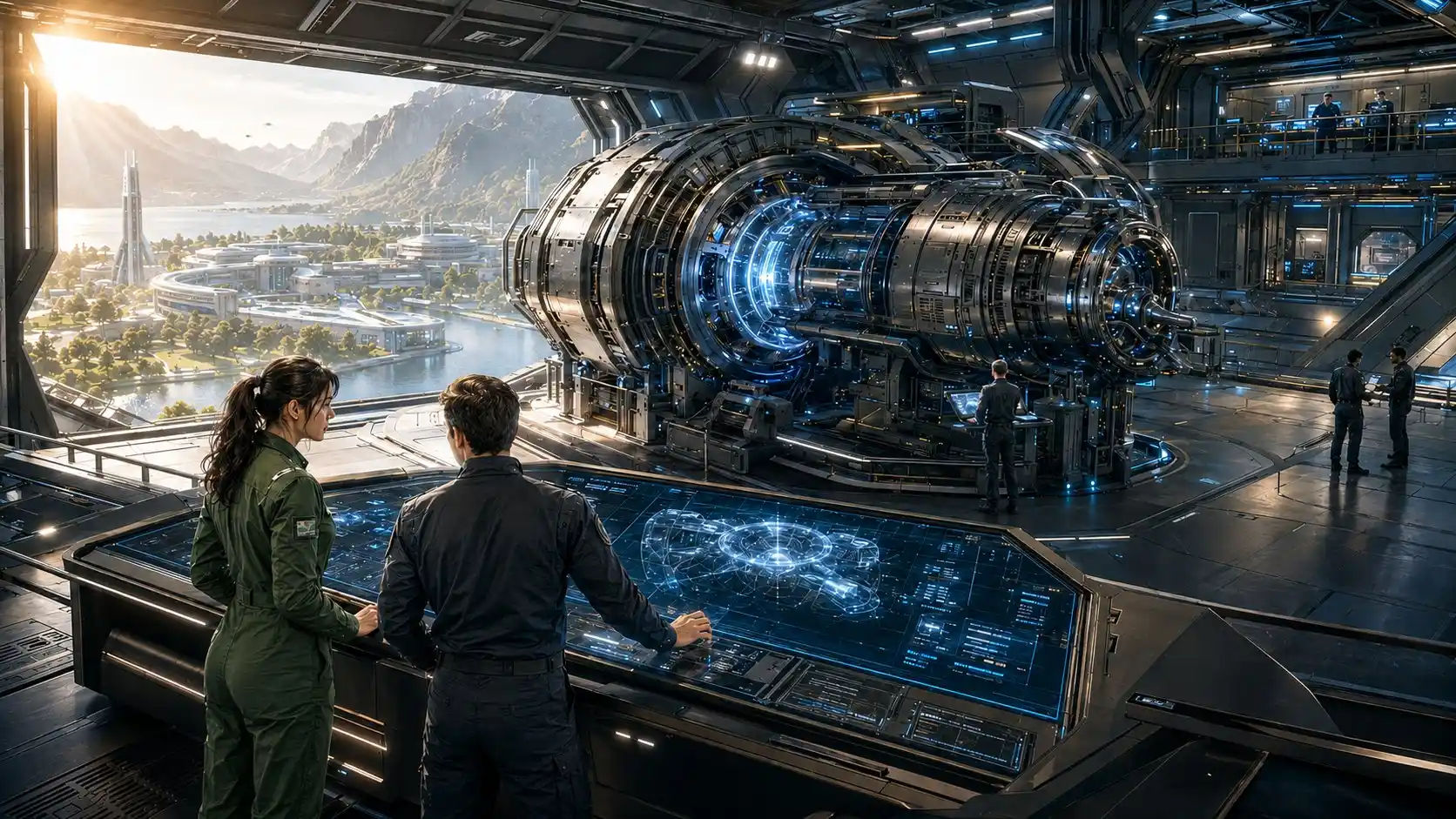
She is dressed in green, surrounded by the visual language of frontier science: mathematics, diagrams, instruments, computational systems and abstractions that seem to disappear into some deeper layer of physical reality.
The association is almost irresistible.
Google Quantum AI, meet Dr. Leah Brahms.
In Star Trek: The Next Generation, Dr. Brahms is one of the engineers behind the propulsion system of the Galaxy-class Enterprise. When Chief Engineer Geordi La Forge encounters an engineering problem that conventional analysis cannot solve, the Enterprise computer reconstructs a holographic representation of Brahms from her technical record. Geordi begins working with it.[1][2]
Viewed from 2026, the scene feels surprisingly contemporary. An engineer accesses a vast technical archive through an interactive reconstruction of an expert. Knowledge that once sat passively in documents becomes something he can interrogate, challenge and reason beside.
It resembles the scientific copilots, multi-agent research systems and increasingly autonomous AI laboratories now beginning to appear in real research.
But that is not what makes Booby Trap profound.
The deeper lesson arrives when more computation ceases to be the answer.
Humanity is rapidly enlarging its computational reach. Artificial-intelligence systems can search literature, synthesize disciplines, generate candidate hypotheses and perform parts of scientific reasoning at scales impossible for an individual researcher. Quantum processors are simultaneously beginning to demonstrate narrow but extraordinary capabilities.
Google’s Willow processors have demonstrated surface-code quantum error correction below threshold, meaning that under the demonstrated conditions increasing code distance reduced logical error rather than merely accumulating more of it.[3]
In a separate 2025 experiment, Google Quantum AI reported a many-body computation for which its researchers estimated that a particular classical tensor-network simulation on Frontier would require about 3.2 years, compared with 2.1 hours of quantum experimental data collection — roughly a 13,000-fold difference for that specific calculation.[4]
Those are remarkable achievements.
They are not evidence that computation is the same thing as discovery.
And discovery is not necessarily the same thing as creation.
That distinction may become one of the defining questions of the next technological age.
The frontier question may eventually stop being:
How much more can we calculate?
and become:
How do we recognize when we are calculating the wrong representation of the problem?
That is where an old episode of Star Trek becomes a surprisingly powerful first-principles model.
1. Begin With the Truth Boundary
Science fiction can help us think, but only if we refuse to confuse metaphor with evidence.
The Enterprise is fictional. Leah Brahms is fictional. Warp cores are fictional engineering devices.
Quantum computing, by contrast, is real. It is also young, highly specialized and nowhere close to being a universal machine for instantaneously solving arbitrary scientific problems.
Warp spacetime is a legitimate subject of theoretical relativity, but that does not make warp propulsion an available technology. Alcubierre-type geometries have been useful precisely because they force physicists to confront questions involving energy conditions, horizons, causality and controllability. Miguel Alcubierre and Francisco Lobo describe such geometries as gedanken-experiments — thought experiments for probing general relativity — and note that superluminal versions present horizon and control problems in addition to violations of classical energy conditions.[15]
The phrase human spark needs an equally strong boundary.
It is not evidence for a measurable spiritual substance that physics has overlooked. Nor does it prove that machines can never become creative.
Here, the phrase is shorthand for a cluster of capacities that currently matter in human discovery: domain knowledge, curiosity, imagination, motivation, persistence, contextual judgment, social interaction, accumulated experience, problem selection, and the willingness to discard assumptions that no longer correspond to reality.
Future AI systems may become exceptional at many of these functions.
That possibility strengthens the argument rather than destroying it.
The real question is therefore not whether humans possess some permanent monopoly on creativity.
It is:
What architecture of humans, machines, institutions, experiments and accumulated knowledge maximizes civilization’s ability to discover things that none of its components could reliably discover alone?
2. The Enterprise Is Caught by Its Own Response
In Booby Trap, the Enterprise encounters an ancient Promellian battle cruiser and becomes trapped by the same Menthar weapon system that destroyed it.
The trap has a vicious property: the Enterprise’s own energy use contributes to the process that is killing the ship. Paramount’s episode description captures the core mechanism directly — the trap converts the ship’s energy into lethal radiation.[1]
Geordi searches the propulsion archive and repeatedly encounters the work of Leah Brahms. Eventually the computer constructs a holographic representation of her. Star Trek’s own account describes Brahms as part of the team that designed the Galaxy-class warp engines and the hologram as Geordi’s attempt to use her expertise to defeat the trap.[2]
The simulation ultimately gravitates toward an intuitively plausible answer: allow the Enterprise computer to exercise greater control because it can make corrections faster than human beings.
Think about how modern that reasoning sounds.
- The system is complicated.
- Humans are too slow.
- Automation is faster.
Therefore:
- increase automation.
Geordi eventually discovers that this solves the wrong problem.
The ship does not escape by becoming more computationally aggressive. The crew drastically reduces active systems, uses an initial powered maneuver, and then lets the Enterprise coast through the field while Picard personally handles the remaining navigation.[1]
The distinction is fundamental.
The computational answer is approximately:
- react faster inside the existing architecture.
The breakthrough is:
- remove the architectural condition that creates the need for those reactions.
That is not merely optimization.
- It is reframing.
3. Separate the Requirement From the Implementation
This is the strongest first-principles lesson in the episode.
Suppose the requirement is:
- move the Enterprise out of the trap.
A conventional engineering process might immediately translate that into:
- operate the propulsion system effectively enough to move the Enterprise out of the trap.
But those are not the same statement.
- One is a required effect.
- The other is an assumed implementation.
Once Geordi separates the two, the problem changes.
- The Enterprise does not fundamentally require continuously powered engines.
- It requires displacement.
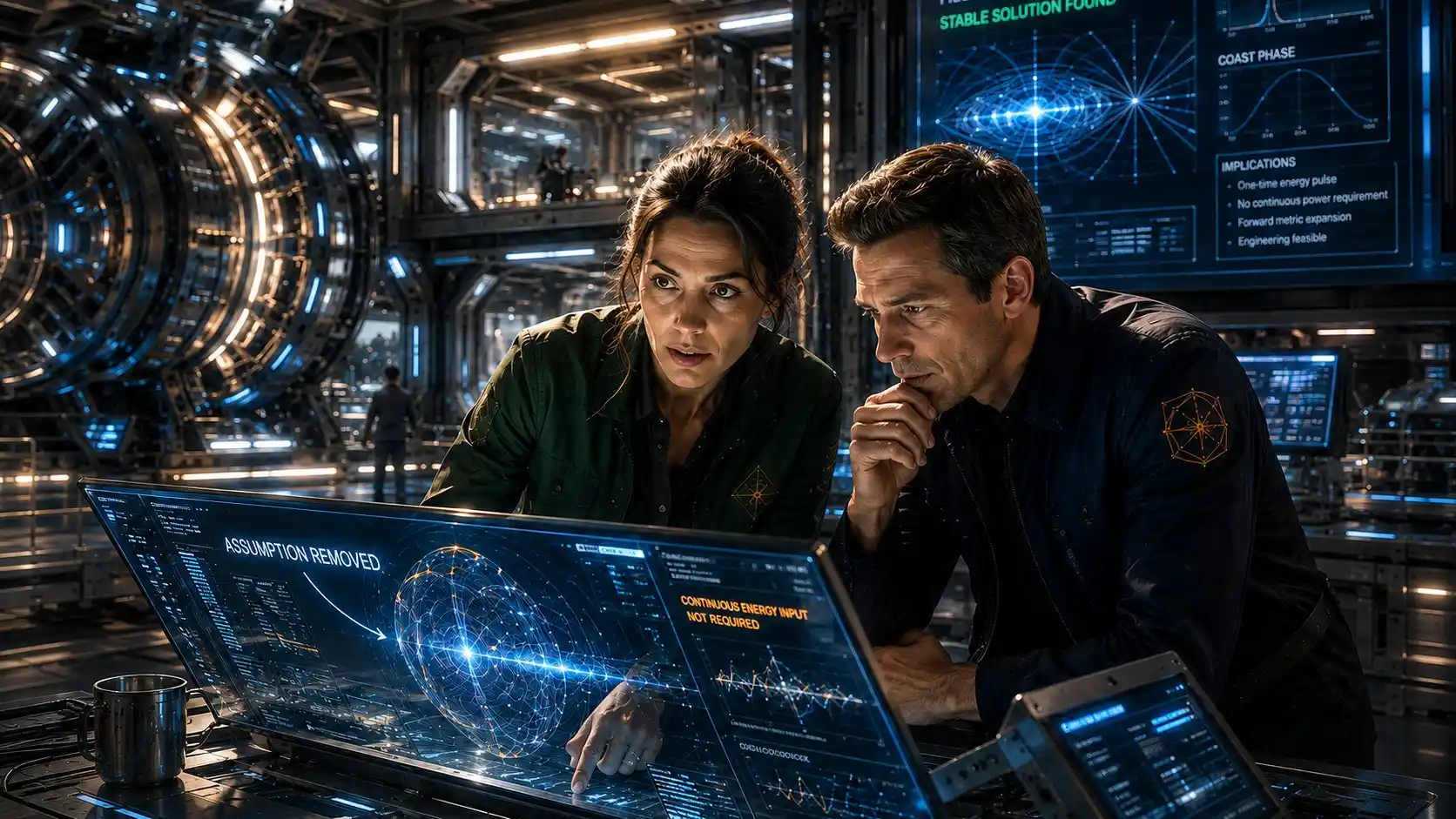
- The ship already possesses momentum.
- The physical environment already contains gravity.
- Minimal thrusters can still provide limited correction.
So the problem can be decomposed:
- Required effect: leave the hazardous region.
- Primary constraint: energy use strengthens the hazard.
- Discardable assumption: continuous powered propulsion is required for movement.
- Available physical resources: inertia, existing momentum and local gravity.
- Minimum active control: thrusters.
- Remaining scarce capability: judgment sufficient to navigate the trajectory.
This is genuine first-principles reasoning because it removes the historical implementation and returns to the physical requirement.
Now imagine a computational system capable of exploring a trillion candidate solutions every second.
That is extraordinary — if the correct solution exists inside the represented search space.
If every candidate inherits the same false assumption, more computation simply explores the wrong architecture more efficiently.
Optimization asks:
- What is the best answer inside this model?
Discovery sometimes asks:
- Why are we using this model?
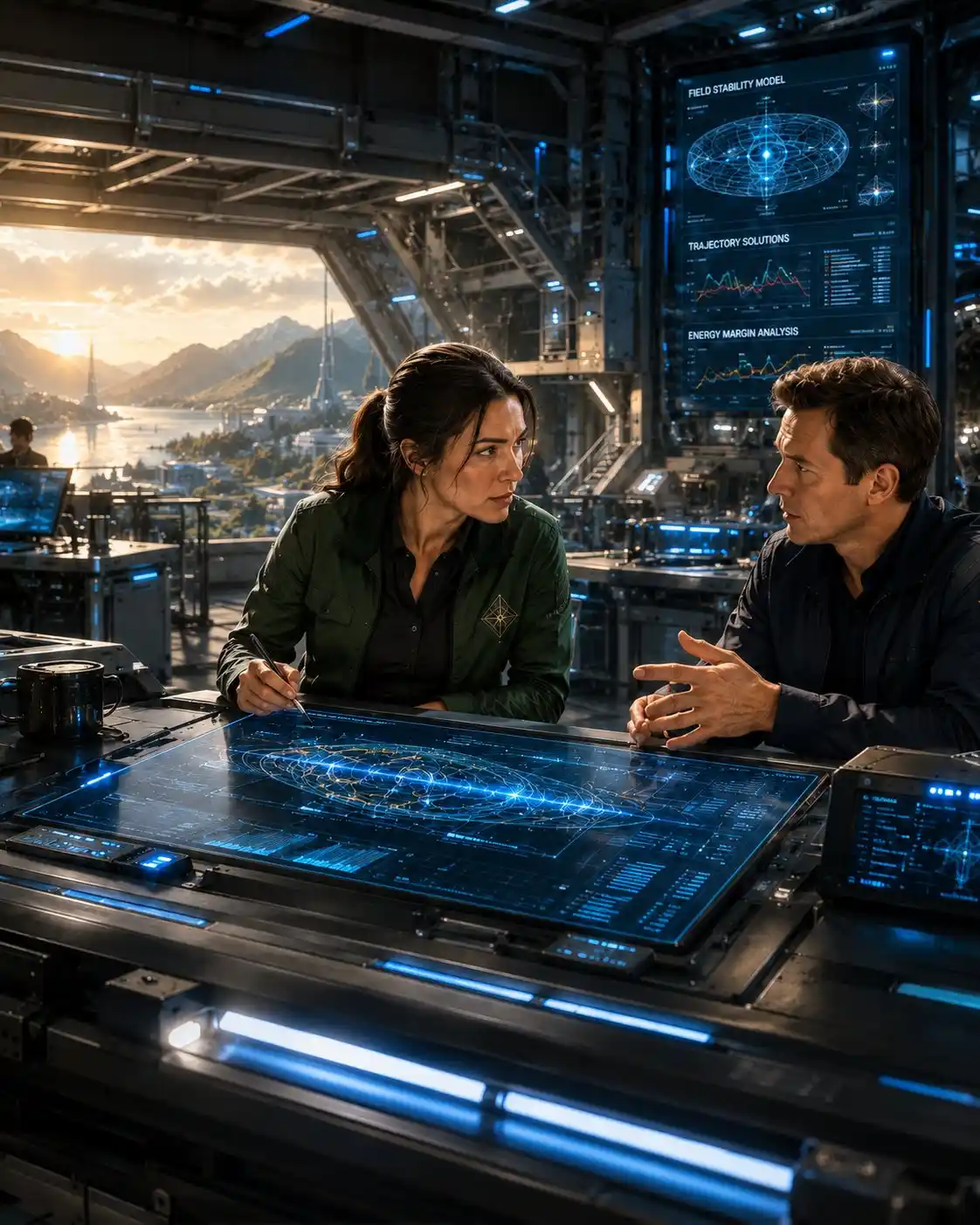
That second question may be more important at the frontier than another order of magnitude of search.
4. But Humans Do Not Own Re-framing
This is where a serious argument has to challenge itself.
It would be tempting to say:
- Machines optimize. Humans reframe.
Current evidence does not justify that comforting division.
A 2025 CHI study involving 280 participants tested three approaches to using GPT-4o for problem reframing. The researchers found no evidence that the LLM-assisted approaches improved the quality of resulting problem frames; the use of LLMs widened the competence gap between experienced and inexperienced designers, and inexperienced users reported lower agency.[6]
That result directly supports the caution at the center of this article: providing more generative computation does not automatically improve the framing of the problem itself.
But we cannot stop there.
In 2025, researchers reported a “Virtual Lab” consisting of an LLM principal-investigator agent coordinating specialist AI agents while a human researcher supplied high-level feedback. The system developed a computational design pipeline for SARS-CoV-2 nanobodies and generated 92 designs, with experimental testing revealing functional candidates.[7]
Then, in 2026, the Robin multi-agent system went further. Robin combined literature search, hypothesis generation and analysis of real laboratory results in an iterative biological discovery loop. In the reported study, it proposed therapeutic candidates, interpreted experiments and generated updated hypotheses; the authors state that the hypotheses, experimental directions, analyses and figures in the main report were produced by Robin.[8]
The honest conclusion is therefore not:
- human = reframing; machine = calculation.
It is:
- reframing itself is becoming a capability whose future distribution between humans and machines remains an empirical question.
That is a much more interesting frontier.
If machines become exceptional reframers, civilization should use that ability.
The objective is not to preserve human intellectual territory.
The objective is to build a discovery system that remains capable of escaping bad frames, regardless of where the decisive challenge originates.
5. Human–AI Chemistry Is Not Automatically Synergy
The holographic Brahms does something more interesting than retrieve technical information.
Geordi begins thinking with the simulation.
That difference matters.
A database supplies information.
A collaborator can alter the next question.
One participant proposes a possibility. The other challenges it. That challenge reveals a hidden assumption. The first responds to the assumption rather than the original question. A third possibility appears that neither participant began with.
The unit of cognition has changed.
It is no longer only:
- human
or:
- machine
but:
- interaction system.
Yet even here, the evidence resists an easy story.
A major 2024 systematic review and meta-analysis examined 370 effect sizes from 106 experiments that directly compared humans alone, AI alone and human–AI combinations. Human–AI systems outperformed humans alone on average, but they performed significantly worse than whichever of the human or AI was individually stronger. The pattern varied by task: decision tasks tended toward losses, while creation tasks were more favorable to combination.[5]
That finding should fundamentally alter how we talk about augmentation.
Human + AI does not automatically equal synergy.
- Sometimes the combination is superior.
- Sometimes the human damages an otherwise better AI output.
- Sometimes the AI anchors the human.
- Sometimes authority is allocated badly.
- Sometimes neither participant knows when to defer to the other.
The real design problem is not attaching an AI to every scientist.
It is determining when different forms of intelligence become complementary rather than interfering.
This is exactly what the Brahms metaphor should mean in a technically serious article.
Not romance with a computer.
Not magic.
Cognitive coupling whose value must be demonstrated rather than assumed.
6. The Strange Productivity of Passion
Geordi’s relationship with holographic Brahms complicates the engineering work.
He becomes emotionally invested. The interaction occupies attention that a purely mechanical model of productivity might classify as waste.
Yet people do not allocate effort like processors allocate cycles.
Motivation changes persistence.
Teresa Amabile’s componential theory of creativity identifies domain-relevant skill, creativity-relevant processes and task motivation as central internal components of creative performance, while also emphasizing the surrounding social environment. Intrinsic motivation — the desire to engage because a problem is interesting, challenging or satisfying — can support creativity, although the relationship is not absolute and is influenced by context.[9]
That gives us a defensible version of the intuition behind the Geordi–Brahms chemistry.
The proposed mechanism is not:
- emotion produces invention.
It is:
- engagement can increase motivation; motivation can increase persistence; additional high-quality iterations can create more opportunities for insight—provided the process remains capable of correction.
Every arrow in that chain matters.
Passion without expertise can produce confident nonsense.
Persistence without falsification can become obsession.
Collaboration without dissent can become groupthink.
Even flow, often treated as an uncomplicated creative ideal, has a downside. Experimental work published in 2024 found that a flow state could impair cognitive flexibility and subsequent verbal creativity after the flow-inducing task, suggesting that intense engagement can produce a kind of carry-over narrowing rather than universal creative benefit.[10]
That is almost perfectly suited to the metaphor.
The same intensity that helps someone remain inside a difficult problem can also make it harder to leave the frame.
So frontier productivity should not be reduced to output per unit time.
A better first-principles model is:
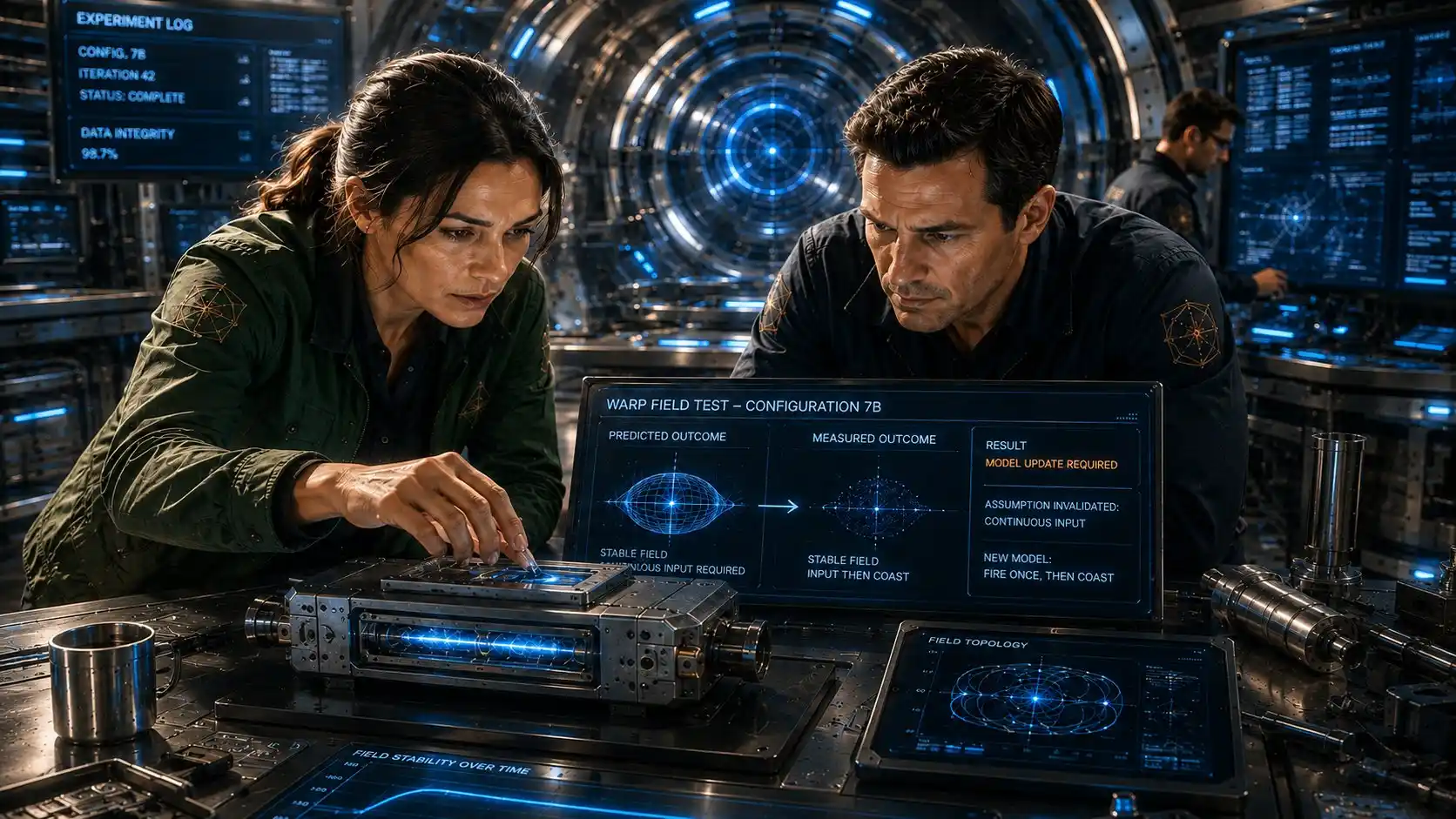
- discovery potential ≈ capability × motivation × persistence × diversity × feedback × correction × contact with reality
This is not a scientific equation.
It is a bottleneck model.
And its most important term may be the last one.
Reality gets a vote.
7. AI Can Increase Creativity — and Narrow the Crowd
Another easy assumption must go.
Humans are not simply “creative” while machines merely calculate.
Generative AI can improve some creative outputs. But an important 2024 experiment found a subtle collective effect: access to generative AI increased the novelty and usefulness of individual short stories while reducing the diversity of outputs across participants.[11]
That creates a remarkable systems problem.
An AI tool can make individual work better while making a population of work more alike.
At the frontier of science, that matters.
Discovery does not require only good answers.
It also requires different wrong answers.
Competing hypotheses.
Unfashionable questions.
Alternative representations.
Research programs that fail differently.
If thousands of scientists increasingly consult systems trained on overlapping data and shaped by similar optimization pressures, average performance could improve while collective exploration becomes more concentrated.
The danger is not that AI makes researchers unintelligent.
It is that civilization becomes exceptionally competent inside the same map.
That would make problem reframing even more valuable.
A resilient scientific civilization therefore needs not only intelligence, but epistemic diversity: multiple models, competing tools, human disagreement, machine disagreement, different institutions and experimental systems capable of terminating attractive theories.
The future of science should not be one perfect oracle.
It should be an architecture in which no oracle gets the final word without encountering reality.
8. Picard Represents a Different Kind of Computation
Geordi discovers the escape architecture.
He does not complete the escape alone.
Picard takes the helm.
The ship is now operating with drastically reduced control authority. The problem has moved from propulsion-system optimization to trajectory judgment. Picard uses the physical environment — including an asteroid’s gravity — to help redirect the Enterprise while preserving minimal energy use.[1]
Call it, informally, the Picard Slingshot.
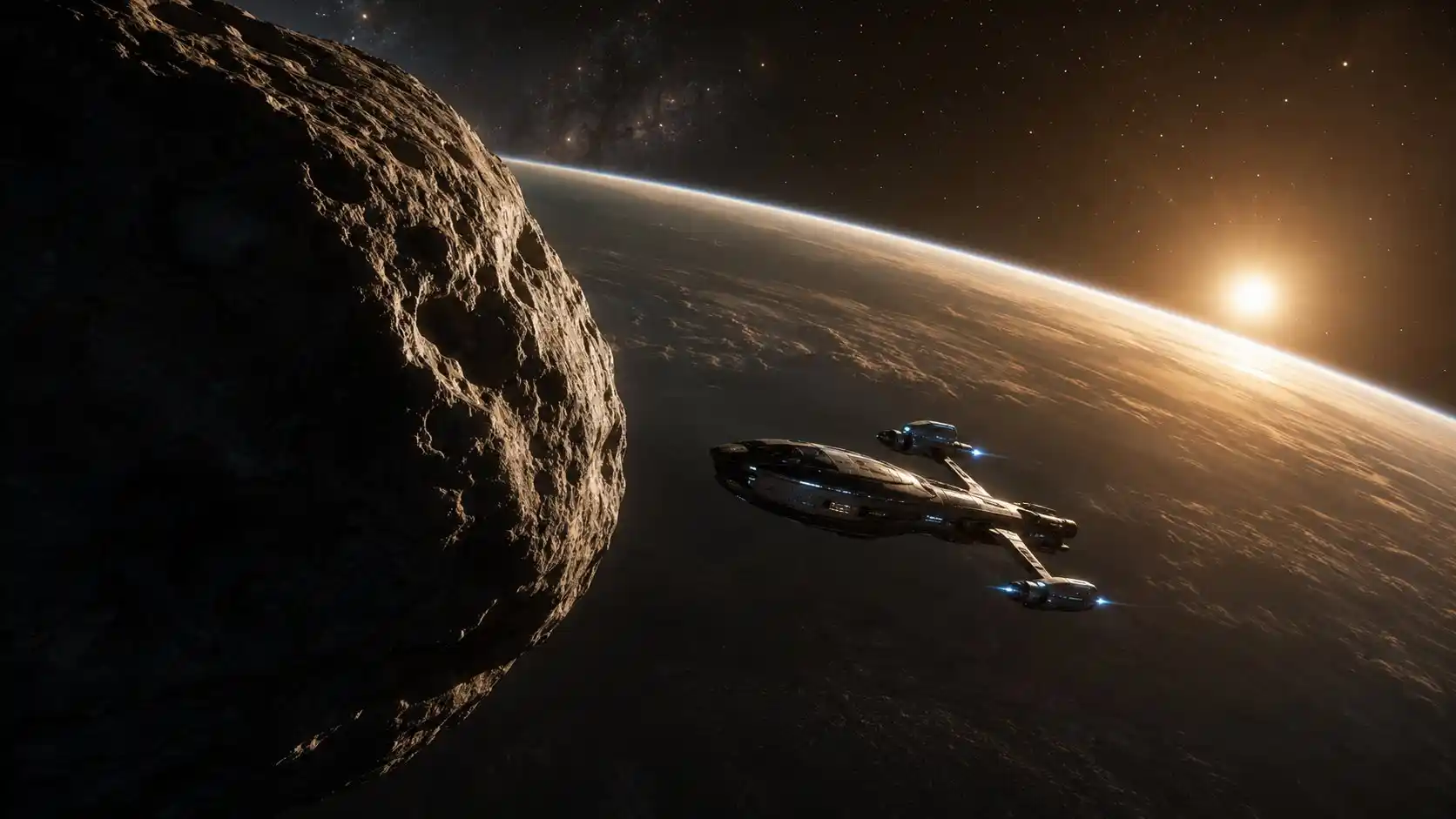
What Picard represents is not mystical intuition.
He represents accumulated expertise.
- Technical knowledge can be written down.
- Procedures can be codified.
- Simulators can preserve scenarios.
- AI can search and recombine enormous archives.
But experienced practitioners also accumulate pattern recognition through repeated contact with consequential situations.
- They have seen a system behave correctly.
- They have seen it almost fail.
- They recognize which deviations matter.
- They develop expectations about what happens before an instrument crosses a threshold.
Some of that knowledge can eventually be modeled and encoded. But until it is, losing practitioners can mean losing capability even while preserving documentation.
This is why engineering education cannot be understood merely as information transfer.
The National Academies’ 2022 study New Directions for Chemical Engineering explicitly recommended stronger connections between concepts and practice and more frequent experiential learning, including earlier physical laboratories and virtual simulation.[12]
The first-principles lesson is not that engineering education must take a predetermined number of years.
It is simpler:
- information and experience are different resources.
- Information can often be compressed dramatically.
- Experience requires interaction with situations.
So the important educational question is not only:
- How quickly can we transmit the curriculum?
It is:
- How early can learners begin converting principles into judgment?
Mathematics, construction, simulation, failure, repair, mentorship, experimentation and gradually increasing responsibility can begin long before a professional title appears.
The objective is not longer schooling.
It is deeper formation.
9. What Quantum Computing Actually Adds
Now quantum computing can enter the argument without mythology.
Willow’s below-threshold surface-code result matters because practical fault-tolerant quantum computation requires logical errors to become more manageable as error-correcting codes scale. The Google team demonstrated this behavior on distance-5 and distance-7 surface-code memories, while also emphasizing that large gaps remain between current logical error rates and those needed for many practical algorithms.[3]
The Quantum Echoes work matters for a different reason. It experimentally accessed many-body quantum correlations using repeated time-reversal protocols, and the authors estimated that a corresponding tensor-network classical simulation for the cited 65-qubit circuit would take roughly 3.2 years on Frontier compared with 2.1 hours of experimental data collection.[4]
The proper conclusion is narrow but powerful.
Quantum processors may expand humanity’s instrument of exploration for particular physical and computational problems.
AI may expand its instrument of synthesis, search and hypothesis generation.
Robotic laboratories may expand its instrument of experimentation.
None automatically determines whether the problem statement is correct.
Imagine the laboratory this implies.
- An AI reads nearly every relevant paper.
- Another generates hypotheses.
- A quantum processor explores a difficult physical model.
- Automated instrumentation executes experiments.
- A human expert notices an anomaly.
- Another AI proposes that the anomaly is an artifact.
- A young researcher asks why the experiment was constructed that way in the first place.
The original theory collapses.
That is not a human laboratory with better tools.
It is a new discovery ecology.
And the decisive innovation may arise anywhere inside it.
10. Why Warp Theory Is Still Useful
Warp drive is valuable precisely because it is not yet an engineering program.
It is an extreme stress test for how we think.
Alcubierre’s 1994 construction demonstrated that general relativity can mathematically describe a geometry in which a localized region undergoes effective displacement through expansion and contraction of spacetime rather than ordinary local acceleration.
But a mathematically valid metric is not a propulsion system.
The theoretical literature has raised severe questions involving exotic stress-energy, violations of classical energy conditions, horizons, causality and whether an observer could create or control such a geometry. Alcubierre and Lobo’s review emphasizes these limitations while treating warp geometries as useful conceptual probes.[15]
That makes warp theory ideal for a thought experiment about quantum AI.
If humanity ever discovers transportation as transformative relative to current propulsion as aviation was relative to walking, the breakthrough may not begin with:
- build a faster engine.
It may begin with:
- why are we assuming transportation requires this kind of engine?
That question may produce nothing.
- It may expose a fundamental prohibition.
- It may lead to an entirely different area of physics.
That is how speculative science should be used responsibly.
Not to pretend the technology exists.
To test the limits of the conceptual frame.
11. Discovery Creates a Safety Obligation
Now the narrative has to turn toward safety, because increasingly powerful discovery changes the consequences of being wrong.
A common development sequence is:
increase capability → encounter hazards → add safeguards.
For low-consequence systems, this may sometimes be acceptable.
For systems capable of irreversible harm, first principles suggest starting further upstream.
MIT’s System-Theoretic Process Analysis, or STPA, treats safety as a control problem at the level of the overall system rather than only as a catalogue of failed components. The method begins by defining unacceptable losses and hazards, modeling the control structure, identifying unsafe control actions and then examining causal scenarios.[13]
That produces a powerful inversion:
- What must never happen?
Then:
- What system states could produce it?
Then:
- What control actions permit those states?
Then:
- What constraints must exist?
Only after that should capability be optimized.
This is the safety analogue of Geordi’s escape.
Do not merely make the response faster.
Ask whether the architecture is generating the danger.
12. A System Can Be Dangerous Without a Weapon Subsystem
This becomes especially important when people define risk by labels.
- Can an AI access the missile?
- Can it fire the weapon?
- Can it open the launch system?
Those questions matter.
But they are incomplete.
The stronger systems question is:
- What irreversible physical effects can the complete system produce through any actuator it controls?
An advanced vehicle does not become harmless merely because a component called weapon is disconnected.
A propulsion system controls energy and trajectory.
Industrial machinery controls force.
A biological laboratory controls transformations of matter.
Cyber-physical systems control infrastructure.
The relevant hazard boundary follows causal capability, not the name printed on a subsystem.
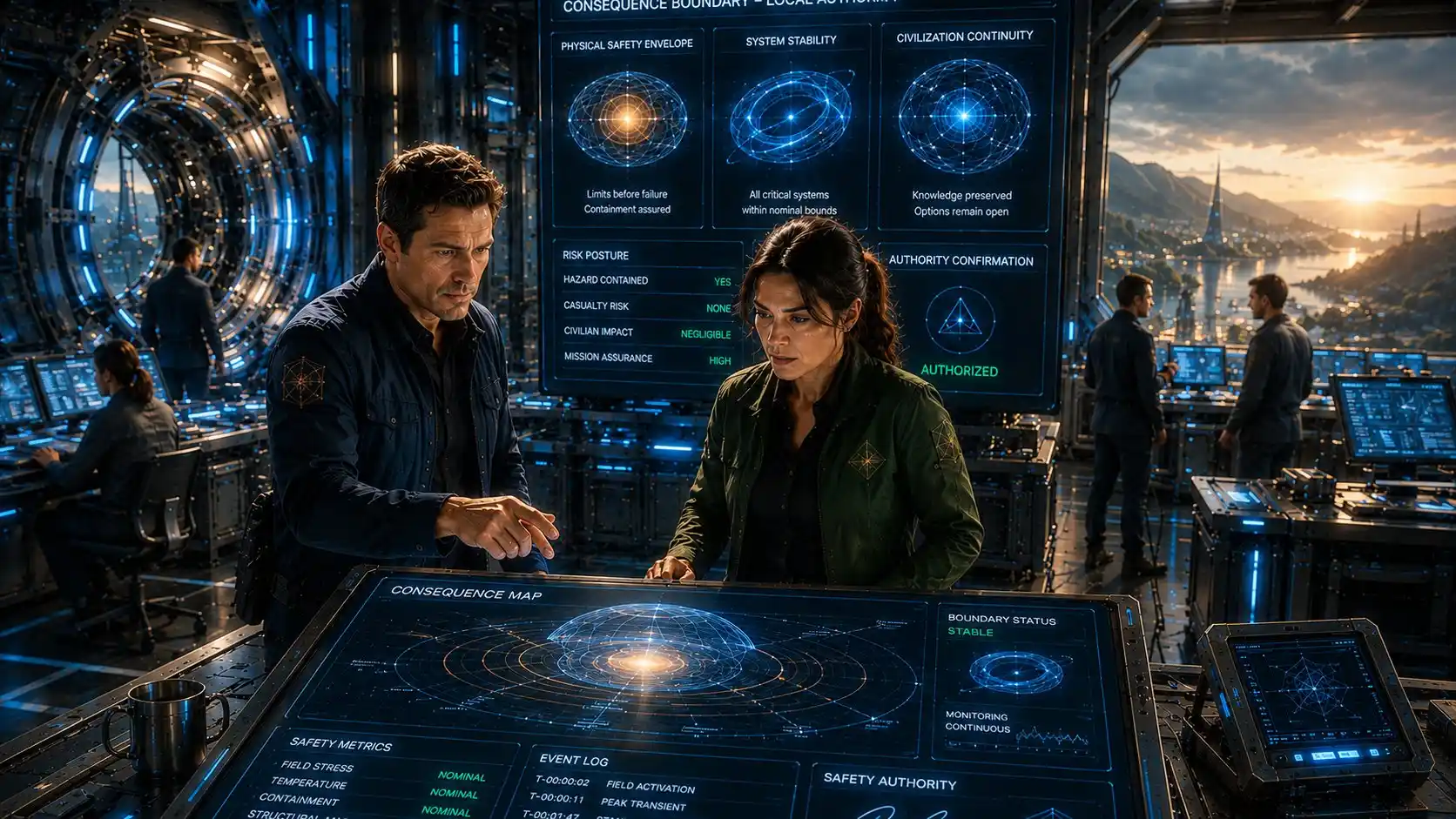
This does not mean powerful propulsion is inherently a weapon.
It means the safety analysis must consider what the integrated system can physically cause.
That principle becomes increasingly important as autonomy migrates from software that recommends actions into systems that can directly change the physical world.
13. Human Command Cannot Mean Human Micromanagement
There is an obvious problem with saying “keep humans in control.”
Many processes happen too quickly for humans to control them manually.
Aircraft stability, high-speed industrial control, spacecraft dynamics and future scientific machines may all contain loops that require machine-speed response.
So meaningful human command cannot mean that a person manually actuates every control variable.
NASA research on adaptive automation and function allocation has wrestled with exactly this problem. Work on air-traffic-control automation found that the effectiveness of automation depends in part on which stage of human information processing is automated; lower-level sensory and action functions can produce different effects from automating higher-level analysis and decision functions.[14] NASA has also treated allocation of control authority between humans and automation as a distinct design problem rather than assuming that maximum automation is automatically desirable.[14]
The first-principles architecture is therefore layered.
- Machines can execute dynamics requiring machine timescales.
- Humans can retain authority over goals, permissions, constraints and consequential transitions where human governance is required.
- Independent mechanisms can constrain both.
- And neither one human nor one machine needs unilateral control over every irreversible action.
Again, Booby Trap becomes a surprisingly elegant metaphor.
- The computer preserves and processes knowledge.
- Brahms contributes the propulsion architecture represented in that knowledge.
- Geordi reframes the engineering problem.
- Picard assumes navigational command.
- Thrusters provide limited actuation.
- Momentum and gravity contribute physical effects neither human nor computer created.
- Capability is distributed.
- So is judgment.
14. Civilization Must Preserve the Chain of Thought Across Generations
There is one final requirement for discovery: memory.
Not merely data.
Meaningful continuity.
Online culture makes information feel permanent because so much of it is immediately searchable. In reality, individual platforms are fragile archives. Licences change. Accounts disappear. Links break. Search ranking changes. Formats become obsolete. Clips are shortened. Context separates from the artifact.
None of that establishes a deliberate project to erase cultural memory.
It establishes a much simpler engineering fact:
- one archive is one point of failure.
An old low-resolution television recording can sometimes preserve a complete scene that a cleaner modern excerpt does not.
In that situation, the better-looking artifact contains less of the relevant information.
Hence another first-principles distinction:
- resolution is not integrity.
Scientific civilization needs redundancy for the same reason spacecraft do.
Published papers.
Laboratory notebooks.
- Code.
- Datasets.
- Physical archives.
- Independent repositories.
- Teachers.
- Practitioners.
- Oral recollection.
- Failed experiments.
- Historical criticism.
A civilization can store petabytes and still lose knowledge if nobody remembers why particular information mattered or how it connected to practice.
The archive therefore does not merely preserve answers.
It preserves the possibility that someone later asks a better question.
15. The Scientist of the Future Is Not Behind the Machine
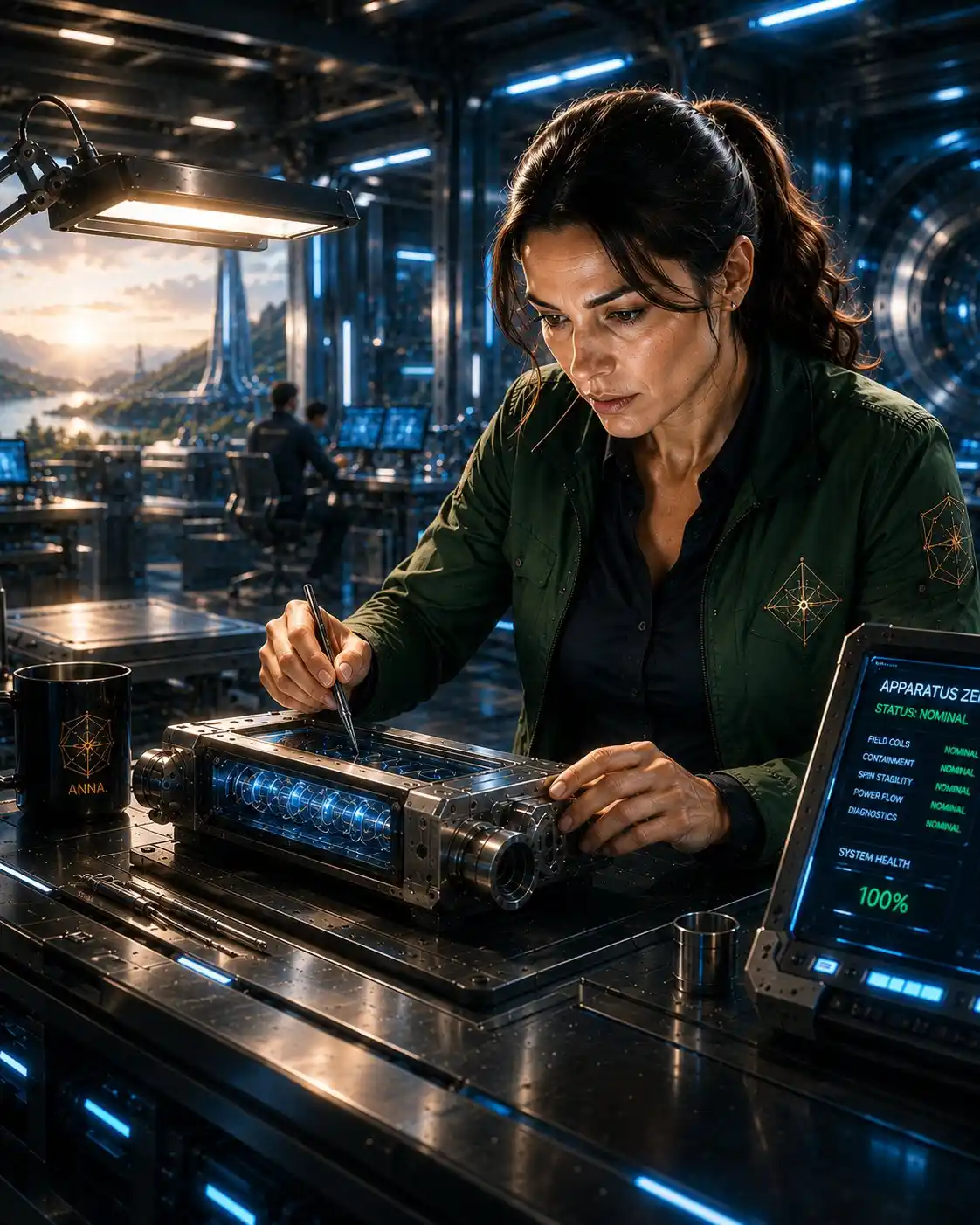
Return to the original image.
The scientist in green is no longer simply a human standing beside an advanced computer.
She is one node in a potentially much larger system of discovery.
The AI may read more literature than she can.
The quantum processor may model something classical computation cannot practically reproduce.
- A laboratory robot may execute thousands of experiments.
- An AI research team may generate the original hypothesis.
- A human specialist may notice that the hypothesis violates a physical assumption.
- Another model may defend it.
- An experiment may falsify both.
- A thirty-year-old paper may contain the missing clue.
- An experienced engineer may recognize a failure mode no formal model captured.
- A student may ask the question every expert stopped asking.
Or an AI may be the first participant to say:
- the problem itself is wrong.
That outcome should not frighten us merely because the insight came from a machine.
It should be exactly what a good discovery architecture is designed to permit.
The breakthrough does not need to belong to one heroic intelligence.
It can emerge from a system of creation, disagreement and correction.
That is a much more powerful idea than either human exceptionalism or machine replacement.
16. The Human Spark, Properly Defined
So perhaps the phrase human spark is worth preserving.
But only if we understand what we mean by it.
- It is not magic.
- It is not proof that machines cannot create.
- It is not an excuse to ignore evidence whenever intuition feels beautiful.
It is the accumulated human experience that great discovery has historically required more than calculation alone:
- knowledge;
- curiosity;
- attention;
- imagination;
- motivation;
- argument;
- failure;
- memory;
- reframing;
and enough persistence to remain beside an impossible problem after the obvious solutions have failed.
AI may eventually contribute to every item in that sequence.
If it does, the argument does not collapse.
It evolves.
Because the real objective is not to preserve a human monopoly on genius.
It is to increase civilization’s capacity for discovery without surrendering diversity, correction, responsibility or contact with reality.
That may be the actual alignment problem at the scientific frontier.
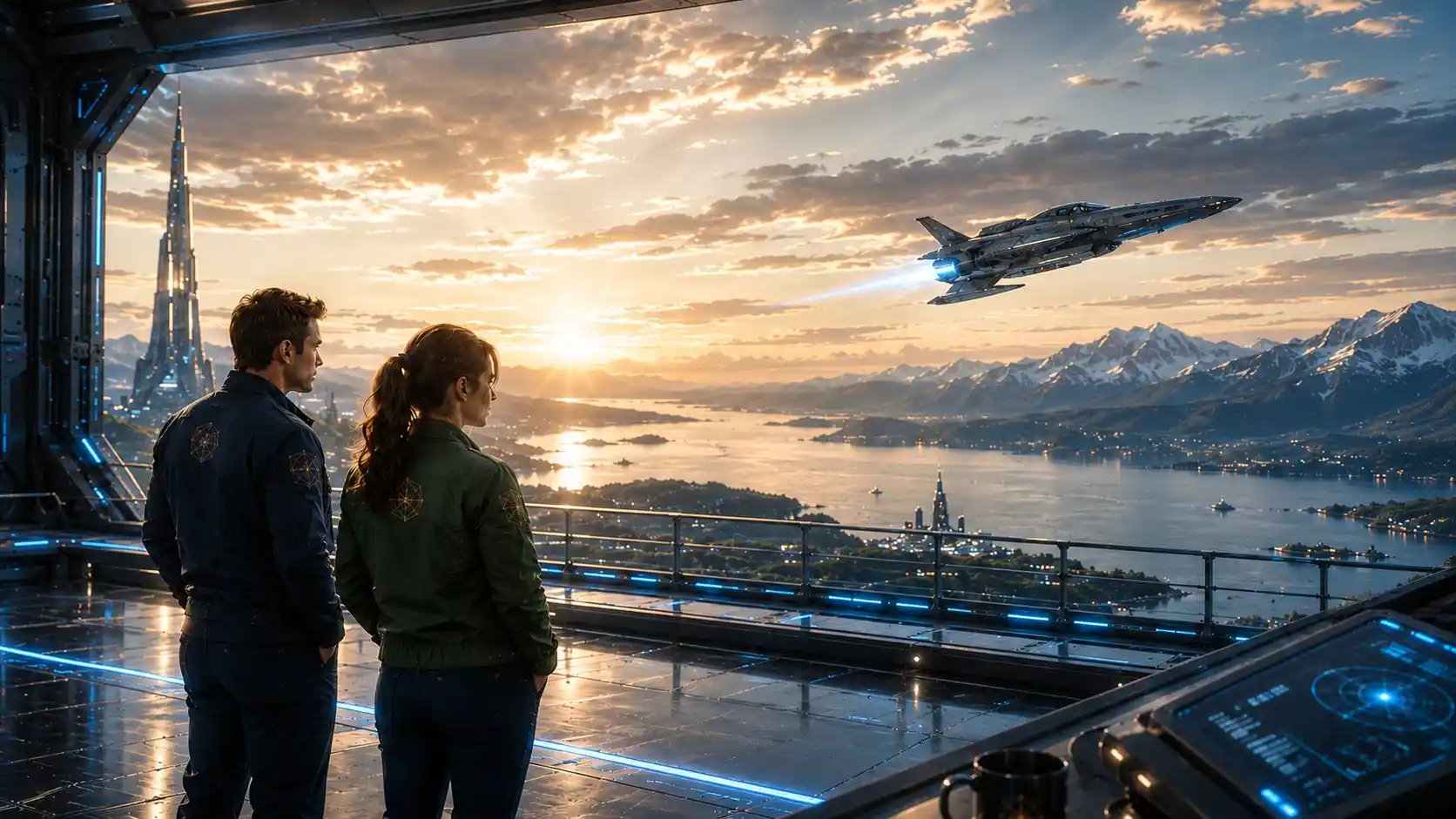
Fire Once, Then Coast
This is why the ending of Booby Trap remains so powerful.
The Enterprise is an extraordinary concentration of advanced technology.
Its computer has enormous computational capability and technical memory.
Its chief engineer has constructed an interactive representation of one of the people behind its propulsion architecture.
The ship is trapped by a technological system that seems to demand an even more sophisticated technological response.
The obvious direction points toward greater automation.
- Faster reactions.
- More corrections.
- More energy.
- Instead, Geordi changes the question.
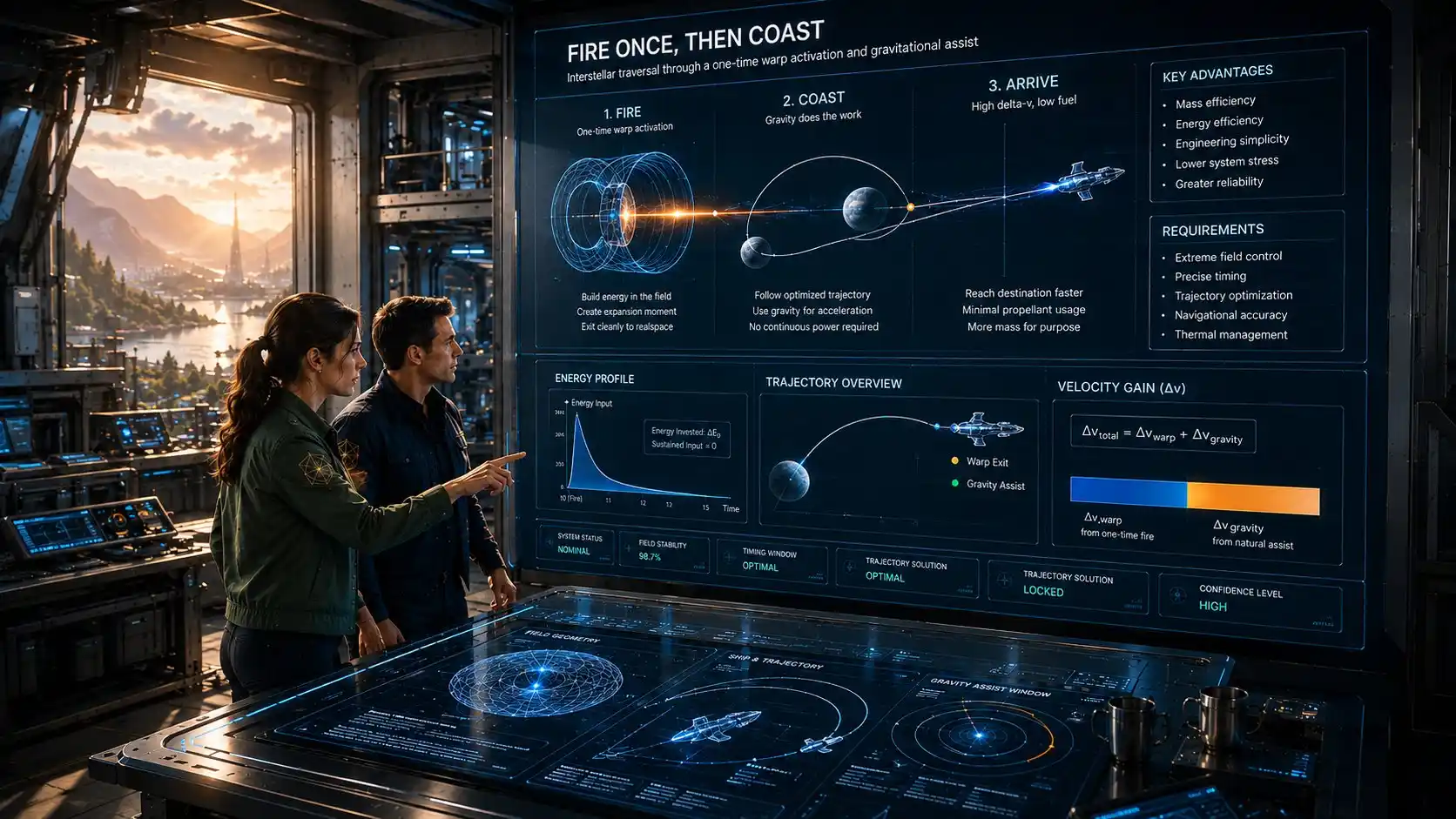
- The Enterprise does not fundamentally need continuous propulsion.
- It needs to leave.
- So the crew reduces the active system.
- The engines fire.
- Once.
- Then the ship coasts.
- Picard takes the helm.
- Momentum carries the Enterprise.
- Thrusters provide the corrections.
- An asteroid that appears to be another obstacle becomes a source of gravitational assistance.

The environment becomes part of the solution.
And the ship escapes.[1]
The lesson is not that primitive technology defeats advanced technology.
It is something far more sophisticated:
advanced engineering includes knowing when complexity has become part of the problem.
That principle may become increasingly valuable as AI and quantum computing enlarge the frontier of what civilization can attempt.
- We should build powerful computational systems.
- We should investigate quantum computing rigorously.
- We should use AI to search scientific literature, generate hypotheses, challenge assumptions and design experiments.
- We should allow machines to surprise scientists.
- We should build experiments capable of surprising the machines.
- We should preserve experienced engineers rather than assuming their competence survives merely because their documents remain on a server.
- We should preserve diverse research programs rather than funneling everyone toward the same algorithmically attractive solution.
- We should design consequential systems from unacceptable outcomes backward rather than maximum capability forward.
And we should resist one of the most seductive errors of the computational age:
- the belief that searching more possibilities necessarily means we are searching the right possibility space.
Someday civilization will encounter another Booby Trap.
- Perhaps it will be an energy problem.
- A materials problem.
- An AI problem.
- A climate problem.
- A biological problem.
- A propulsion problem.
- Or something for which we do not yet possess a name.
Every conventional solution may strengthen the constraint.
- More energy may feed it.
- More computation may optimize it.
- More automation may accelerate the wrong response.
At that point, the decisive intelligence — human, artificial, or emerging from their interaction — will not necessarily be the intelligence capable of calculating the fastest.
It will be the intelligence capable of stepping outside the inherited frame.
- Someone will look at the equations.
- Someone will look at the machine.
- Someone will remember an old principle that appeared obsolete.
And someone — or something — will ask:
What is the thing we actually need to accomplish?
That may be the real frontier of quantum AI.
Not the construction of a machine that thinks instead of humanity.
The construction of a civilization capable of thinking with increasingly powerful machines while retaining enough diversity, experience, memory and freedom of thought to disagree with them — and enough intellectual humility to let them disagree with us.
- At the edge of knowledge, computation can help us search farther.
- Experience can help us recognize patterns.
- Imagination can open another map.
- Experiment can tell us whether that map corresponds to reality.
And first principles can still perform the oldest and sometimes most powerful operation in engineering:
remove an assumption.
Then the engines fire.
Once.
And humanity coasts into a possibility that did not exist on the old map.
Star Trek TNG — 24th Century Computers (Part 1 of 3) https://youtu.be/L0mRMp2kbQY
Star Trek TNG — 24th Century Computers (Part 2 of 3) www.youtube.com/watch?v=v8z0tqr6PfM
Star Trek TNG — 24th Century Computers (Part 3 of 3) https://www.youtube.com/watch?v=EtwLGNTM2yQ
Star Trek Moments TNG – Episode – 54. Booby Trap https://youtu.be/i55zheNcgLY
References
- Star Trek: The Next Generation. “Booby Trap.” Season 3, Episode 6. Paramount Television, 1989. Official episode listing and synopsis.
- Ward, D. “Below Deck with Lower Decks: Say Hello to Leah Brahms.”StarTrek.com, 2022.
- Acharya, R. et al. “Quantum error correction below the surface code threshold.” Nature 638, 920–926 (2025). DOI: 10.1038/s41586-024-08449-y.
- Google Quantum AI and Collaborators. “Observation of constructive interference at the edge of quantum ergodicity.” Nature 646, 825–830 (2025). DOI: 10.1038/s41586-025-09526-6.
- Vaccaro, M., Almaatouq, A. & Malone, T. “When combinations of humans and AI are useful: A systematic review and meta-analysis.” Nature Human Behaviour 8, 2293–2303 (2024).
- Shin, J., Polyanskaya, A., Lucero, A. & Oulasvirta, A. “No Evidence for LLMs Being Useful in Problem Reframing.” CHI Conference on Human Factors in Computing Systems (2025). DOI: 10.1145/3706598.3713273.
- Swanson, K., Wu, W., Bulaong, N. L., Pak, J. E. & Zou, J. “The Virtual Lab of AI agents designs new SARS-CoV-2 nanobodies.” Nature 646, 716–723 (2025). DOI: 10.1038/s41586-025-09442-9.
- Ghareeb, A. E. et al. “A multi-agent system for automating scientific discovery.” Nature 655, 497–505 (2026). DOI: 10.1038/s41586-026-10652-y.
- Amabile, T. M. “Componential Theory of Creativity.” Harvard Business School Working Paper 12-096 (2012).
- Lavoie, R. V. et al. “What happens when flow ends? How and why your creativity is limited after a flow experience.” Current Psychology (2024). DOI: 10.1007/s12144-024-06591-4.
- Doshi, A. R. & Hauser, O. P. “Generative AI enhances individual creativity but reduces the collective diversity of novel content.” Science Advances 10 (2024).
- National Academies of Sciences, Engineering, and Medicine. New Directions for Chemical Engineering. Washington, DC: National Academies Press (2022). DOI: 10.17226/26342.
- Leveson, N. G. & Thomas, J. P. STPA Handbook. MIT Partnership for Systems Approaches to Safety and Security (2018).
- Kaber, D. B., Prinzel, L. J. III & Wright, M. C. Workload-Matched Adaptive Automation Support of Air Traffic Controller Information Processing Stages. NASA/TP-2002-211932 (2002); see also NASA work on systematic human–automation function allocation.
- Alcubierre, M. & Lobo, F. S. N. “Warp drive basics.” Fundamental Theories of Physics / arXiv:2103.05610 (2021).