By Skills Gap Trainer / August 19, 2026
From Childhood, Sport and Cultural Memory to the Three Ethics, the Gods, and the Rebirth of a Civilization
PART III — CONVERGENCE + EVIDENCE + FORMATION
PART III — THE THREE ETHICS OF A STRONG CIVILIZATION
Power, Judgment, and Generative Support in a Free Society
A strong civilization is not one in which a few people become impossible to challenge.
It is one in which capability becomes more widely useful without becoming more widely oppressive.
That requires three disciplines.
- Power must be strong enough to act and limited enough not to own.
- Knowledge must be ambitious enough to seek truth and humble enough to remain corrigible.
- Generosity must be real enough to cost something and disciplined enough not to purchase the person it helps.
The SGT trilogy uses three archetypes to remember these responsibilities:
- Valentin — strength.
- Carmen — wisdom.
- John — generative support.
But the final philosophy does not belong to the characters.
Its purpose is to survive without them.
1. Why power alone is insufficient
Civilization requires capability.
Roads do not build themselves.
Emergencies do not resolve themselves.
Institutions cannot protect rights if they lack the capacity to enforce legitimate rules.
A society that cannot maintain infrastructure, respond to disaster, defend itself, educate, coordinate, or repair is not made ethically superior by its inability to act.
Strength matters.
But strength immediately creates a second problem:
Who governs the strength?
- The person who can act may begin believing that the ability to act proves the right to decide.
- The institution that repeatedly solves crises may begin to accumulate authority beyond the crisis.
- The protector can become indispensable and then convert indispensability into ownership.
Valentin exists to prevent that transformation.
His doctrine is not “be the strongest.”
It is:
- Use power without claiming ownership.
Capability should answer to legitimate purpose, jurisdiction, proportionality, accountability, and exit from exceptional authority.
- Strength must be able to act.
- It must also be able to stop.
2. Why intelligence alone is insufficient
Once power is bounded, another problem appears.
What should power serve?
That question cannot be answered by strength.
It requires judgment.
Carmen begins with a simple distinction:
- Intelligence is not wisdom.
A person can know more and still choose badly.
A model can predict well and still optimize the wrong objective.
- An institution can collect more data while becoming less capable of admitting error.
- An expert can have genuine epistemic authority in one domain and unjustifiably expand that authority into others.
Carmen therefore does not offer a philosopher queen.
She offers a process:
- Memory.
- Perspective.
- Curiosity.
- Humility.
- Judgment.
- Consequence.
- Correction.
Wisdom becomes a loop rather than a title.
The person who claims to be wise must remain capable of discovering error.
The final principle is:
- Seek truth without claiming infallibility.
3. Why good intentions alone are insufficient
Suppose power is legitimate and judgment is careful.
- A system can still be cold.
- A person may possess talent without access.
- A caregiver may carry too much.
- A child may need an invitation.
- A worker may need someone willing to make the first introduction.
- A researcher may need support before the result is obvious.
John enters at the point where formal systems meet actual people.
His central question is:
- What do I possess that could become capability in someone else?
The answer may be money.
It may also be time, knowledge, access, transportation, tools, mentoring, patience, reputation, advocacy, or a second chance.
But generosity has its own corruption path.
- A donor can expect obedience.
- A mentor can become possessive.
- A supporter can become indispensable and then resent independence.
- A self-sacrificial person can be consumed by the very generosity others praise.
So John’s mature ethic is not “sacrifice more.”
It is:
Give without claiming the person you helped.
- The cost is sacrifice.
- The ethical aim is generative support.
4. The shared constitution
The three ethics do not govern themselves.
Each can become dangerous.
- Strength can become domination.
- Wisdom can become technocracy.
- Care can become capture.
The trilogy therefore requires a constitution stronger than the archetypes:
- Truth-seeking • Dignity • Agency • Legitimacy • Correction
and the cross-cutting constraints:
- Justice • Proportionality • Responsibility • Interdependence
These principles matter because the characters are not allowed to become their own judges.
- Valentin cannot say that protection alone makes his authority legitimate.
- Carmen cannot say that knowledge alone gives her the right to choose for everyone.
- John cannot say that generosity alone excuses control, favouritism, or self-destruction.
No one virtue gets the final word.
5. Agency at the center
The center of the philosophy is the free, dignified, fallible human being.
“Fallible” matters.
Human agency includes the possibility of bad choices.
A civilization cannot prevent every mistake without eventually preventing a great deal of freedom.
But Stage 7 adds an equally important correction:
Agency is relational, not absolute.
- My freedom exists beside your dignity.
- My choice can create obligations when it imposes serious risks on others.
Parents, institutions, citizens, professionals, and governments operate within roles that generate duties.
The philosophy therefore rejects both domination and atomistic individualism.
Its goal is not a world in which nobody depends on anybody.
- Human life is interdependent.
- Children depend on adults.
- Illness can create durable dependence.
- Disability may require continuing support.
- Communities work because people carry one another through different periods of life.
The target is not perfect independence.
It is greater practicable agency without avoidable capture.
6. Strength that serves
Valentin’s contribution is the ability to carry responsibility under pressure.
The strong person does not disappear when the task becomes difficult.
The strong institution can respond when ordinary routines fail.
But the ethical test comes after capability is demonstrated.
- Will authority remain bounded?
- Will emergency powers end?
- Will the protector return control when the justification for extraordinary control disappears?
- Will the institution tolerate review?
- Will strength distinguish continuity of purpose from continuity of form?
This leads to one of the trilogy’s most important discoveries:
- Sometimes continuity requires change.
An institution that preserves its name while destroying its purpose has not achieved worthy continuity.
- The protector therefore does not defend everything old.
- The protector helps preserve what still deserves a future.
7. Wisdom that remains free
Carmen prevents strength from defending the wrong thing merely because it already exists.
She also prevents knowledge from becoming its own throne.
Truth is real, but no person owns it.
That distinction is essential.
A leader who says “I possess the truth” can turn truth-seeking into dogma.
A wise civilization therefore builds processes rather than priesthoods.
- Records.
- Evidence.
- Dissent.
- Review.
- Appeal.
- Independent measurement.
- Correction.
Education that teaches methods rather than only conclusions.
Expertise is valued because reality is not negotiable.
But expertise is bounded because knowledge in one domain does not create sovereignty over the whole person.
The wise civilization is not one in which everyone has equal expertise.
It is one in which expert knowledge can carry appropriate authority without becoming unchallengeable political ownership.
8. Support that multiplies capability
John prevents the other two virtues from becoming impersonal.
The test is not simply whether a policy is technically sound.
It is what happens to the human beings inside it.
- Does the support increase access?
- Capability?
- Recovery?
- Participation?
- Does it create an invisible debt?
- Does it make the recipient more dependent on the donor than necessary?
- Does it consume the giver?
- Does it preserve healthy interdependence?
The mature rule is:
- Build capability, not capture.
That phrase deliberately replaces the earlier “build people, not dependents.”
Dependency is not itself a moral failure.
Capture is the deeper danger: engineering circumstances in which another person cannot reasonably act, leave, disagree, or develop without continued permission from the benefactor.
Good support can be intensive.
- It can be long-term.
- It can be lifelong.
Its ethical quality depends not on producing isolated independence, but on preserving dignity and the greatest practicable agency compatible with the real conditions of the person’s life.
9. The mutual constraints
The trilogy becomes strongest when its parts collide.
- Valentin says: preserve.
- Carmen asks: is the thing still worthy of preservation?
- John asks: who bears the cost of preservation?
- Carmen says: reform.
- Valentin asks: what load-bearing functions will fail during the transition?
- John asks: who will be harmed if the transition is badly designed?
- John says: help.
- Carmen asks: do we actually understand the need?
- Valentin asks: will the support architecture survive, or has it created a single point of failure?
No virtue wins automatically.
This is why the trilogy is constitutional rather than hierarchical.
Its purpose is not to identify the best ruler.
It is to make self-justifying rule harder.
10. The three-question test
The philosophy becomes practical when compressed into three questions.
- Is it true?
- This is Carmen’s question.
- What do we know?
- How do we know it?
- What are we missing?
- What would change our mind?
- Is it legitimate?
- This is Valentin’s question.
- Do we have the right to act?
- What is our jurisdiction?
- Is the action necessary and proportionate?
- Where does authority end?
- Does it help without owning?
- This is John’s question.
- Does the action preserve dignity?
- Does it increase capability or practicable agency?
- Does it create avoidable capture?
- What happens when the helper leaves?
No consequential action should be treated as ethically complete simply because it passes one of the three.
A decision can be evidence-based and illegitimate.
Legitimate and cruel.
Compassionate and false.
The architecture requires all three dimensions.
11. From archetype to ordinary citizen
The trilogy fails if it requires exceptional people.
Remove the armour.
- A parent can embody Valentin by allowing authority to evolve as a child grows.
- A public servant can embody Valentin by treating office as stewardship rather than personal possession.
- A student can embody Carmen by changing their mind when evidence changes.
- A teacher can embody Carmen by helping students become capable of learning without the teacher.
- A neighbour can embody John by lending tools.
- A grandparent can embody John by giving time.
- A friend can embody John by telling the truth when silence would be easier.
The ordinary commitments become:
- I will stand.
- I will seek to understand.
- I will give.
But their safeguards matter just as much:
Stand without standing above everyone else.
Seek to understand without claiming the right to think for everyone else.
Give without claiming the life your gift may help make possible.
12. From individual virtue to institutional design
Institutions can embody the same architecture.
- A Valentin institution has enough capacity to fulfill its responsibilities, clear authority, emergency capability, redundancy, succession, and limits on exceptional power.
- A Carmen institution keeps records, uses evidence, permits dissent, measures outcomes, separates confidence from certainty, and can correct itself.
- A John institution pays attention to access, human dignity, mentorship, second chances, service delivery, and the actual effects of policy on people.
But institutional care is not identical to private care.
A parent may legitimately favor a child.
A public institution distributing scarce resources owes stronger duties of fairness and equal standing.
That distinction keeps the ethics of care from becoming institutional favouritism.
13. Why this matters now
The contemporary relevance of the trilogy comes from the expanding scale of human capability.
The 2026 Stanford AI Index reports continued advances in AI capability, adoption, and investment while emphasizing challenges in governance, transparency, and independent evaluation. This does not establish that AI is uniquely dangerous or that human judgment is obsolete. It establishes that increasingly capable technical systems are entering institutions faster than many norms and oversight practices are stabilizing.
At the same time, public trust is not a simple global decline story. OECD data show substantial variation across institutions and countries, while the latest comparable cross-national results record more respondents with low or no trust in national government than with high or moderately high trust. Canadian evidence likewise shows uneven institutional confidence and specific concern about misinformation.
The philosophical implication should remain modest.
- More powerful tools increase the importance of boundaries.
- More complex institutions increase the importance of legibility and correction.
- More predictive systems increase the importance of distinguishing prediction from legitimacy.
- More concentrated capability increases the importance of asking who can challenge, appeal, exit, or correct.
This is not a prediction of collapse.
It is an argument for stronger ethical architecture before capability becomes harder to govern.
14. What this can mean for Canada
The trilogy should not be presented as a discovery of Canada’s hidden essence.
Canada does not become morally pure because a monument uses a maple leaf.
Sports symbols do not prove national unity.
Three characters do not define a country.
The better formulation is an invitation.
What could these principles contribute to a Canadian civic philosophy?
- A geographically large, plural country has reason to value strength that does not become domination.
- A multilingual, regionally diverse country has reason to value belonging that does not require intellectual conformity.
- A society built partly through institutions, families, communities, markets, public services, immigration, and voluntary associations has reason to value support that enables participation without requiring sameness.
The symbols — Ottawa, Montréal, winter, baseball, hockey, archives, children — can make the philosophy local and memorable.
They should not make it exclusive.
The principles must remain available to anyone.
15. The environmental and future-generations boundary
The trilogy is primarily a human civic philosophy.
- It does not pretend to solve environmental ethics or the moral status of non-human life.
- It does, however, create one clear obligation: worthy continuity cannot be defined only by benefits to people alive today.
A civilization that consumes the material, ecological, institutional, or fiscal basis of future agency while calling itself strong has misunderstood continuity.
Future people cannot consent to present choices.
That increases, rather than reduces, the importance of stewardship and correction.
This is a boundary for further philosophical work, not a completed environmental doctrine.
16. The final civilizational architecture
The mature system can be written as:
Reality → Truth-seeking → Corrigible judgment → Legitimate purpose → Bounded capability → Responsible action + generative support → Greater practicable agency → Worthy continuity → Consequences and new evidence → Correction
The system is surrounded by:
- Dignity • Justice • Responsibility • Proportionality • Interdependence
This matters because it replaces a static ideal with a learning architecture.
The civilization does not assume it will get everything right.
It attempts to remain capable of finding out when it is wrong.
Conclusion
The deepest lesson of the trilogy is not that civilization needs three heroes.
It is that ordinary human capabilities generate recurring responsibilities.
- When you become strong, your strength must acquire boundaries.
- When you become knowledgeable, your knowledge must remain corrigible.
- When you possess something another person can use, generosity becomes possible — but generosity must respect the other person’s dignity and your own legitimate limits.
The final one-sentence philosophy is:
A strong civilization turns power, knowledge, and generosity into broader human capability while keeping each bounded by truth-seeking, dignity, legitimate authority, human agency, and the permanent possibility of correction.
The three public principles are:
- Use power without claiming ownership.
- Seek truth without claiming infallibility.
- Give without claiming the person you helped.
And the final objective is not a civilization permanently protected by exceptional people.
It is a civilization that continually produces more capable, free, responsible people living within forms of interdependence that preserve dignity and resist capture.
PART III — FINAL CONCLUSION
One-Sentence Conclusion
A strong civilization turns power, knowledge, and generosity into broader human capability while keeping each bounded by truth-seeking, dignity, legitimate authority, human agency, and the permanent possibility of correction.
Short Conclusion
A strong civilization does not make a few people impossible to challenge. It disciplines power, keeps knowledge corrigible, and makes generosity generative. Its purpose is to widen responsible human capability while resisting domination, technocracy, capture, and hero dependence. Strength serves. Wisdom questions itself. Support helps without owning.
Detailed Conclusion
Civilization becomes stronger not merely by accumulating power, knowledge, wealth, or technology, but by learning how to govern what those capabilities do to human beings.
Strength is necessary. A society unable to build, protect, repair, or act under pressure is fragile. But capability does not create entitlement. Legitimate strength must remain bounded by purpose, jurisdiction, proportionality, accountability, and an exit from exceptional authority.
Knowledge is necessary. Complex societies need expertise, memory, evidence, and judgment. But expertise does not create sovereignty over the whole person. Wisdom must remain capable of discovering error. It should seek truth without treating any leader, institution, expert, or model as the owner of truth.
Generosity is necessary. People rise partly because others share time, knowledge, access, resources, care, and opportunity. But sacrifice is not valuable merely because it hurts. Good support is generative: it respects consent and dignity, preserves healthy interdependence, protects the giver’s legitimate boundaries, and does not purchase the recipient’s allegiance.
These three ethics therefore constrain one another. Strength without wisdom can dominate. Wisdom without strength can become detached. Care without boundaries can become capture or exhaustion.
The goal is not perfect independence and not permanent heroism. It is greater practicable agency within forms of interdependence that preserve dignity.
The final task of a strong civilization is to leave more people able to stand, think, contribute, help, correct error, and carry something worthy forward.
Complete concluding section
The project began with three figures.
- Valentin stood for strength.
- Carmen stood for wisdom.
- John stood for sacrifice.
If the work ended there, it would have failed.
A civilization cannot responsibly build its ethics around the assumption that exceptional people will always arrive at the right moment. The protector can become the ruler. The expert can become the technocrat. The giver can become the owner.
So the philosophy had to move beneath the characters.
What remained were three ordinary human facts.
- Some people will possess power.
- Some people will possess knowledge.
- Some people will possess something another person needs.
Every one of those facts creates responsibility.
- Power must answer the question of legitimacy.
- Knowledge must answer the question of truth and correction.
- Generosity must answer the question of dignity and ownership.
From those responsibilities emerges a shared constitution:
- Truth-seeking. Dignity. Agency. Legitimacy. Correction.
And around them:
- Justice. Proportionality. Responsibility. Interdependence.
These principles do not promise perfect decisions.
- They are more modest and more useful.
- They make it harder for capability to justify itself.
- They make it harder for expertise to confuse competence with sovereignty.
- They make it harder for generosity to hide a demand for control.
They also acknowledge that freedom is not isolation.
- Human beings depend on one another.
- Children need adults.
- Communities need institutions.
- Institutions need expertise.
- People need care.
Illness and disability can create durable forms of dependence that do not diminish dignity.
- The ethical target is therefore not a world in which everyone stands alone.
- It is a world with the greatest practicable agency compatible with human interdependence, equal dignity, legitimate duties, and responsibility to others.
- This changes the meaning of strength.
- Strength is not the ability to make everyone yield.
- It is the ability to carry legitimate responsibility without converting responsibility into ownership.
- It changes the meaning of wisdom.
- Wisdom is not the possession of final answers.
- It is the disciplined pursuit of truth by minds and institutions still capable of correction.
- It changes the meaning of sacrifice.
- Sacrifice is not morally valuable in proportion to the pain it causes.
- It becomes valuable when the cost responsibly creates something another person can use without purchasing that person’s future.
That is why the final philosophy is not a celebration of three heroes.
It is a demand placed upon whoever acquires capability.
- If you become strong, learn to serve without turning service into sovereignty.
- If you become knowledgeable, remain free enough to question yourself.
- If you have something another person can meaningfully use, consider what you can responsibly give.
Then do one more thing.
Design the world so that these responsibilities do not depend on extraordinary virtue alone.
- Build institutions that can act but can also be reviewed.
- Build systems that can learn but can also be challenged.
- Build communities that can support people without trapping them.
- Build transitions that preserve what people still need while correcting what no longer deserves continuation.
- Build enough redundancy that no protector, expert, donor, company, platform, or institution becomes an unavoidable single point of human dependence.
And preserve the conditions under which future people can correct what this generation gets wrong.
- That is the mature meaning of a strong civilization.
- Not a civilization without vulnerability.
- A civilization that learns from vulnerability.
- Not a civilization without disagreement.
- A civilization capable of disagreement without surrendering truth-seeking or equal dignity.
- Not a civilization without dependence.
- A civilization that distinguishes healthy interdependence from capture.
- Not a civilization that never makes mistakes.
- A civilization that does not have to pretend its mistakes are permanent truths.
The three figures can therefore leave the stage.
What remains belongs to everyone:
- Stand when responsibility requires it.
- Seek to understand before claiming certainty.
- Give where you responsibly can.
And in every case:
- Leave behind more capability than control.
Final three principles
Valentin
- Use power without claiming ownership.
Carmen
- Seek truth without claiming infallibility.
John
- Give without claiming the person you helped.
Final supporting principles
- Build capability, not capture.
- Agency is relational, not absolute.
- Sometimes continuity requires change.
- Support is not submission.
- Loyalty does not cancel judgment.
- Keep the heart. Improve the architecture.
Final three commitments
- Valentin — I will stand.
- Carmen — I will seek to understand.
- John — I will give.
Final civilizational equation
REALITY ↓ TRUTH-SEEKING ↓ CORRIGIBLE JUDGMENT ↓ LEGITIMATE PURPOSE ↓ BOUNDED CAPABILITY ↓ RESPONSIBLE ACTION + GENERATIVE SUPPORT ↓ GREATER PRACTICABLE AGENCY ↓ WORTHY CONTINUITY ↓ CONSEQUENCES / NEW EVIDENCE └────────────────────────────→ CORRECTION
Surrounding constraints:
DIGNITY JUSTICE RESPONSIBILITY PROPORTIONALITY INTERDEPENDENCE
Final monument-scale inscription
STAND. SEEK TO UNDERSTAND. GIVE.
LEAVE BEHIND MORE CAPABILITY THAN CONTROL.
APPENDIX A — FIGHTING AND EMBODIED FORMATION
The philosophical architecture described in this work was not formed exclusively through books, films, or abstract argument. A parallel strand came through physical training: learning discipline, controlled aggression, repetition, technical correction, endurance, responsibility for another person’s safety, and the difference between possessing force and knowing when force should be used.
This matters particularly for the Valentin archetype.
The eventual principle —
Use power without claiming ownership.
— did not emerge as a celebration of strength for its own sake. The deeper concern is the governance of capability. Physical training provides a concrete version of that problem: power becomes useful only when it can be directed, restrained, corrected, and placed under deliberate control.
Fighting-formation source
Club Coach Manual — Fédération québécoise de boxe olympique, June 15, 2016
https://www.fqbo.qc.ca/modules/publications/Club%20Coach%20manual%20-%202016,%20June%2015.pdf
Role in the formation record: technical and coaching reference for structured fighting practice, training discipline, progression, and controlled application of physical capability.
Image Concept 1 — Discipline before force Physical capability is not the same thing as judgment. Training begins by placing power under control.
Image Concept 2 — Strength under limits The ability to strike is only one capability. The deeper discipline is learning when action is necessary, proportionate, and controlled.
Image Concept 3 — Embodied philosophy Some ethical ideas are learned intellectually. Others become clearer when responsibility, consequence, restraint, and correction are experienced physically.
APPENDIX B — APPLIED ACADEMIC, MEDIA, CIVILIZATIONAL AND TECHNICAL FORMATION
From cultural exposure to philosophical architecture
The Valentin–Carmen–John philosophy did not originate from one book, one film, one teacher, or one philosophical school.
It appears instead to have formed through a long accumulation of experiences across Canada in the 1990s and 2000s, especially through Ottawa, Québec, Montréal, Toronto, and the wider media environment available in those regions.
The formation stream included:
school and academic learning → sport and fighting → television and cinema → science fiction → military and engineering imagery → Canadian history → robotics and AI → institutional questions → SGT research and design work.
The media items below should therefore not be read as authorities proving the final philosophy.
They are better understood as formation artifacts: stories, images, conflicts, technologies, character types, and world architectures that entered the cultural environment from which later SGT concepts developed.
Some influences were remembered continuously. Others were rediscovered only after later SGT work independently returned to remarkably similar problems.
B1 — Childhood, Play, Belonging, and Ordinary Participation
Several early films encode a world in which children discover capability, friendship, competition, independence, teamwork, and belonging through participation rather than through formal philosophical instruction.
- Home Alonehttps://youtu.be/jEDaVHmw7r4
- The Sandlothttps://youtu.be/iXOOL6SygW8
- The Mighty Ducks — Trailerhttps://youtu.be/J8sQMWJzNKY
- D2: The Mighty Duckshttps://youtu.be/8YNQZ4MRmOU
- Cool Runningshttps://youtu.be/CAZsnAZ3RlY
- Home Alone 2: Lost in New Yorkhttps://youtu.be/5h9VDUNtoto
These belong beside the Canadian Participation Engine research because they illuminate the experienced cultural environment, not because they prove the historical social hypothesis.
Their recurring themes include:
entry → participation → team formation → competence → responsibility → belonging.
B2 — Technology, intelligence, autonomy, and the machine
Another formation stream concerns the relationship between people and increasingly capable technology.
- D.A.R.Y.L. (1985)https://youtu.be/GhHLnZM5A_o
- WarGameshttps://youtu.be/TQUsLAAZuhU
- Short Circuithttps://youtu.be/WgdRPctdQps
- Short Circuit 2https://youtu.be/l0zmCUVB0Yw
- RoboCophttps://youtu.be/IqvRDhW-XVA
- RoboCop — ED-209 Scene #1https://youtu.be/TYsulVXpgYg
- RoboCop — ED-209 Scene #2https://youtu.be/Yqsfnv8eH9s
- I, Robot — Spooner Meets Robertsonhttps://youtu.be/SjgBt0Giw_0
- Robot Warfarehttps://youtu.be/PBSFDGLIP14
Taken together, these stories repeatedly pose questions that later become recognizably Carmen questions:
- What happens when intelligence becomes capability?
- Who chooses the objective?
- Who remains responsible?
When does useful automation become authority?
Can a system know more without becoming the thing that decides what a person should be?
That later converges with Carmen’s mature rule:
Seek truth without claiming infallibility.
B3 — Protection, Force, Duty, and Valentin
A third stream concerns military capability, emergency responsibility, sacrifice, command, and the moral ambiguity of concentrated power.
- Blue Thunderhttps://youtu.be/1WAp0ABNta0
- Independence Day — The President’s Speechhttps://youtu.be/9t1IK_9apWs
- Independence Day — Seeing the Spaceshiphttps://youtu.be/HccCkwP8eN4
- Independence Day — Russell Becomes a Herohttps://youtu.be/NyOTaHRBTXc
- Starship Troopershttps://youtu.be/zPYuV_jGk7M
- Reliability isn’t a virtue. It’s a system.https://www.instagram.com/reel/Db8DYl2D3qJ/
- Congrats to former RTF client@abby.rafuse on successfully completing RCMP Depot!https://www.instagram.com/p/DbLicJxRXH5/
- 80s Mix 2 – The Besthttps://youtu.be/S5PwZNmyhlw
- GoldenEyehttps://youtu.be/_PMD6YenOEg
- Tomorrow Never Dieshttps://youtu.be/9nH1DwQP2Xs
- Casino Royalehttps://youtu.be/36mnx8dBbGE
- Speedhttps://youtu.be/8piqd2BWeGI
- Constantinehttps://youtu.be/DEa508Xmmio
- The Devil’s Advocate Ending Scenehttps://youtu.be/Y2SC4JWuQc0
- Rooftop Scenehttps://youtu.be/UKXXZPk82Ek
- Armageddonhttps://youtu.be/8-8eEniEfgU
- Eagle Eyehttps://youtu.be/yzPUun–B2w<- *** CCFR / Sports Shooters / Hunters / Tech Lead Ascent Champions / Civilizational Formation Philosophers / Team SGT / AI Safety Leads
- “I hope AI is nice to us” captures the concern, but from first principles, hope cannot be the safety architecture.https://x.com/SkillsGapTrain/status/2089468153080488341
- Die Another Day — Frozen Lake Chasehttps://youtu.be/NeWG3lSw34A
- The Rock — Opening Scenehttps://youtu.be/y8i8mVxt258
- The Rock — Canadian Officershttps://youtu.be/c-_OTOkDtRk
- Battleshiphttps://youtu.be/8NNQqHsIc-4
These works are not treated as moral instruction manuals. Many deliberately depict flawed institutions, reckless authority, manipulation, militarism, corruption, or catastrophic failure.
That tension is precisely what makes them useful to the formation record.
The question eventually becomes not:
- Who is strongest?
but:
- What is strength for?
And then:
- Who authorized it?
- What limits it?
- When must it stop?
The mature Valentin principle answers:
Use power without claiming ownership.
B4 — History, continuity, sacrifice, and civilization
Canadian and war-history imagery contributes another layer: continuity across generations, collective sacrifice, institutional memory, and the cost of preserving a civilization.
- Passchendaele — Storm Troopershttps://youtu.be/I6WYHagWdeE
- 1917https://youtu.be/YqNYrYUiMfg
- Passchendaele #1 — WWIhttps://youtu.be/zwX_WqJgUrU
These belong in the archive not as arguments for militarism, but as reminders that continuity can have a human cost.
They reinforce a question that later becomes central to the three ethics:
- What deserves continuity — and what must change in order for something worthy to continue?
The eventual answer is deliberately conditional:
Sometimes continuity requires change.
B5 — Exploration, Aviation, Navy, Starfleet, and Civilizational Scale
A separate formation pathway concerns movement outward: aircraft becoming spacecraft, local engineering becoming planetary architecture, and individual technical systems becoming civilization-scale networks.
- Space Cowboyshttps://youtu.be/WjIMiGb_tmM
- The Last Starfighterhttps://youtu.be/l55LwfcPfWM
- The Sainthttps://x.com/SkillsGapTrain/status/2089230431879397651
- Executive Decisionhttps://youtu.be/FHjDi8R-Ya8
- Face/Offhttps://youtu.be/S-nDX0BeFo
- Broken Arrowhttps://youtu.be/jybuWD1beXI
- The Hunt For Red Octoberhttps://youtu.be/2VD2_wjIO7E
- Crimson Tide (speech 1)https://youtu.be/7LrBpEDrKDY
- XO Relieving Captain from Leading the Submarinehttps://youtu.be/JGEvZAV8qI4
- Eraserhttps://youtu.be/13I9-0t5gDw
- The Inauguration of the NX-01 Enterprisehttps://youtu.be/VRP_mSYYu3w
- Star Trek TNG — All Good Things: Captain Describing a Paradoxhttps://youtu.be/rbO1rsnt5qE
- Star Trek TNG — Booby Trap: “Fire Once, Then Coast”https://x.com/SkillsGapTrain/status/2088695470256488645
- Catch Me If You Canhttps://youtu.be/71rDQ7z4eFg
- The Aviatorhttps://youtu.be/dkwypzOQf8o
- Independence Day: Resurgencehttps://youtu.be/LbduDRH2m2M
- Battleship II — forthcoming
- Ghost in the Human Shell 2 — forthcoming
- Ghost in the Human Shellhttps://skillsgaptrainer.com/the-ghost-in-the-human-shell/
- Lost in Space, Next-Gen — forthcoming
- Interstellar: Endurance Suitehttps://youtu.be/6-Xt3-XbHI8
This is where an especially interesting retrospective connection appears.
Independence Day: Resurgence contains a world architecture remarkably close to imagery SGT later returned to independently:
modern fighter → advanced fighter → space fighter → orbital/lunar infrastructure → planetary defense architecture.
The important observation is not that the later SGT work was consciously copied from the film.
The more cautious interpretation is that a previously encountered piece of cultural architecture may have remained latent and became recognizable again only after later independent work arrived in similar conceptual territory.
What appears to have persisted was less the plot than the scale transition:
AIR↓ORBIT↓MOON / NEAR SPACE↓PLANETARY INFRASTRUCTURE↓DEEP SPACE
That distinction is worth preserving.
B6 — A retrospective SGT lesson: build outward in layers
One interpretation that later emerged from this formation stream is:
do not confuse the ability to travel farther with the wisdom to do so immediately.
The preferred developmental sequence becomes:
EARTH CAPABILITY↓RESILIENT PLANETARY INFRASTRUCTURE↓ORBITAL INFRASTRUCTURE↓CISLUNAR / NEAR-WORLD CAPABILITY↓ROBUST SCIENTIFIC OBSERVATION↓DEEPER EXPLORATION
Within the SGT philosophy, this is not presented as an established scientific law about extraterrestrial contact.
It is a strategic precautionary proposition: civilization should strengthen observation, resilience, knowledge, governance, and near-world infrastructure before treating rapid deep-space expansion as inherently desirable.
That keeps the claim proportional to the evidence.
B7 — Canadian civic, political, industrial, and media formation
The later formation record also includes contemporary Canadian economic, political, industrial, and media material.
- Canadian Baconhttps://youtu.be/4jf8Bt4gD9Y
- Canadian Bacon — Pulled Over Scenehttps://youtu.be/dDGkQiwh_qg
- No, Sun News is not the reason Stephen Harper is not PM anymore…https://youtu.be/7AtoPsabHhM
- Batra’s Burning Questions: Will Canada finally tap into its critical minerals?https://youtu.be/LoyojPXpsGA
- Former MP Tears Into Mark Carney’s Claims & Chinese EVs | With Rick Perkinshttps://youtu.be/Ars1p3kQr4Q
These later sources should be treated differently from the childhood-media archive.
They belong to the ongoing analytical environment in which questions of Canadian productive capacity, industrial policy, institutional performance, resources, political disagreement, and technological sovereignty continued to develop.
They are not evidence that the philosophical archetypes existed in childhood in their final form.
They are later inputs into their maturation.
B8 — Fighting, martial cinema, and controlled capability
The formation archive also contains martial films and training imagery:
- Revenge of the Ninjahttps://youtu.be/Jkc5Q9EEHAo
- Above the Law [Nico]https://youtu.be/BsbYE-Q474I
- Batman Beginshttps://youtu.be/neY2xVmOfUM
- Batman Begins – The Will to Acthttps://youtu.be/uiaRYQlsjy4
- The Dark Knight Riseshttps://youtu.be/GokKUqLcvD8
- Masters of The Universehttps://youtu.be/rJSmz-zhDxE
These should sit beside Appendix A rather than being treated simply as entertainment references.
Their relevance is the persistent fascination with:
skill → discipline → readiness → restraint → consequence.
That is the embodied side of the Valentin problem.
B9 — Formation is not causation
An important evidentiary boundary applies to the entire appendix.
The presence of a film, book, sport, television program, teacher, city, institution, or historical event in this archive does not establish:
“This caused Valentin.”
or:
“This film created the later SGT philosophy.”
Human intellectual formation is rarely that clean.
The stronger and more defensible claim is:
These works formed part of the cultural, educational, physical, technological, and civic environment within which the later Valentin–Carmen–John architecture emerged.
- Some links are directly remembered.
- Some are documented through earlier SGT work.
- Some are retrospective pattern recognition.
And some may simply represent convergent ideas encountered at different stages of life.
The archive therefore records formation pathways, not deterministic causal chains.
B10 — Convergence
Across those very different streams, a recurring structure becomes visible.
Films about force kept asking what power should serve.
Stories about machines kept asking who remains responsible when intelligence becomes powerful.
- Sport and childhood stories repeatedly showed capability emerging because people were invited into shared activity.
- War and history introduced sacrifice and continuity.
- Science fiction expanded the scale from the individual to institutions, planets, and civilizations.
- Engineering turned imagination into questions of actual system design.
The later philosophy eventually condensed those streams into three archetypes:
- Valentin — Strength
Use power without claiming ownership.
- Carmen — Wisdom
Seek truth without claiming infallibility.
- John — Generative Support
Give without claiming the person you helped.
The characters are mnemonic devices.
The principles are intended to survive them.
APPENDIX C — Ottawa Senators — The Gladiator Foundation
The Ottawa Senators are not just as a sports reference. They are part of the visual and symbolic formation of the Valentin persona.
The key historical detail fits perfectly: the Senators’ modern franchise began play in 1992–93, and their original primary identity was built around the profile of a Roman soldier. The team explicitly brought that two-dimensional Roman-soldier logo back in 2020, describing it as the logo used when the club debuted.
The Ottawa Senators were part of the formative Ottawa environment of the 1990s, arriving during the same period in which the wider Canadian cultural world described in Part I was being discovered. The team’s Roman-soldier identity mattered beyond hockey. The helmet, profile, red-black-gold palette, arena imagery, competition, endurance, and gladiatorial symbolism became one of the early visual foundations from which the later Valentin archetype could emerge.
This influence existed alongside a very different imaginative current: Star Trek and Anime. One supplied the image of the disciplined warrior standing under pressure; the other supplied exploration, technology, command responsibility, science, civilization, and the possibility of humanity becoming something larger.
In retrospect, those three streams can be seen converging in a Trinityrr:
Ottawa Senators / Roman warrior → courage, physicality, competition, holding the line
Star Trek and Anime → science, exploration, responsibility, institutions, future civilization
The later Valentin persona does not simply reproduce either influence. It combines the gladiator’s readiness to stand with the Starfleet idea that strength ultimately exists in service of a larger civilization.
That is a really useful piece of intellectual genealogy, because it helps explain why Leonidas later felt natural rather than arbitrarily added.


Publishing Note: The Senators/NHL logos are trademarks, and are shown here as referenced historical imagery with clear attribution.

APPENDIX D — The Blue Jays — The Family, Friend, Fight, Flight, Fun and Future Foundation
Baseball, Family, Immigration, and the Physical Formation of the Archetype
The Toronto Blue Jays belong in this formation record for reasons deeper than professional baseball. Growing up in Canada, baseball was part of almost every summer: playing repeatedly with other immigrant kids, discovering the sport together, following the Blue Jays, and playing daily or weekly with my father. Hockey and baseball became two of the physical languages through which Canada introduced itself to us. The Blue Jays logo therefore carries more than team identity in this story. It represents participation, childhood, family, immigration, competition, and the experience of becoming Canadian by actually doing things with other Canadians.
The bat became especially important. We liked bats, used them constantly, and kept buying them. Over years of baseball, the object became completely natural in the hands: grip, stance, rotation, timing, acceleration, impact, recovery. That physical vocabulary later became a natural complement to boxing. The sports were obviously different, but at the level of embodied experience they shared something: distance, timing, commitment to movement, coordination of the whole body, and the discipline of converting intention into controlled force.
In retrospect, that helps explain why the later warrior imagery did not arise exclusively from films, ancient Greece, or abstract philosophy. Some of it was already being learned physically. The body had been training long before the philosophy had words for what it was learning.
Baseball also carried a different lesson from fighting. The bat was powerful, but the purpose of the game was not destruction. Power existed inside rules, timing, teamwork, restraint, and shared play. Boxing later imposed another system of boundaries around force. In both cases, capability became meaningful because it existed inside a structure.
That eventually connects directly to Valentin power principle:
Capability does not create entitlement.
And later:
Use power without claiming ownership.
The Blue Jay therefore survives in the later mythology for a reason. It is not merely a sports logo transferred into fantasy. It reaches backward into childhood summers, immigrant friendship, a father and son playing baseball, Canadian sport, and years of learning how movement becomes capability. When Poseidon eventually assumes the mythic Blue Jay form, the symbol is carrying that entire history with it.
Visual genealogy:
BLUE JAYS → BASEBALL → FATHER + SON → IMMIGRANT KIDS → BAT → TIMING + COORDINATION → BOXING → CONTROLLED FORCE → VALENTIN → ASCENDED BLUE JAY
The deeper roots of the Canadian Fighter-Builder Trinity. The philosophical root underneath the philosophical root, the compelling trio of the the Guardian-Builder Archetype in Canada:
- Ottawa Senators → gladiator / defender / Roman-warrior imagery
- Toronto Blue Jays → participation / immigration / family / bat / embodied capability
- Star Trek and Anime → science / exploration / future civilization / technology / responsibility
Those three streams explain a surprising amount of what eventually emerges later in this article without claiming that any single one “caused” the philosophy.

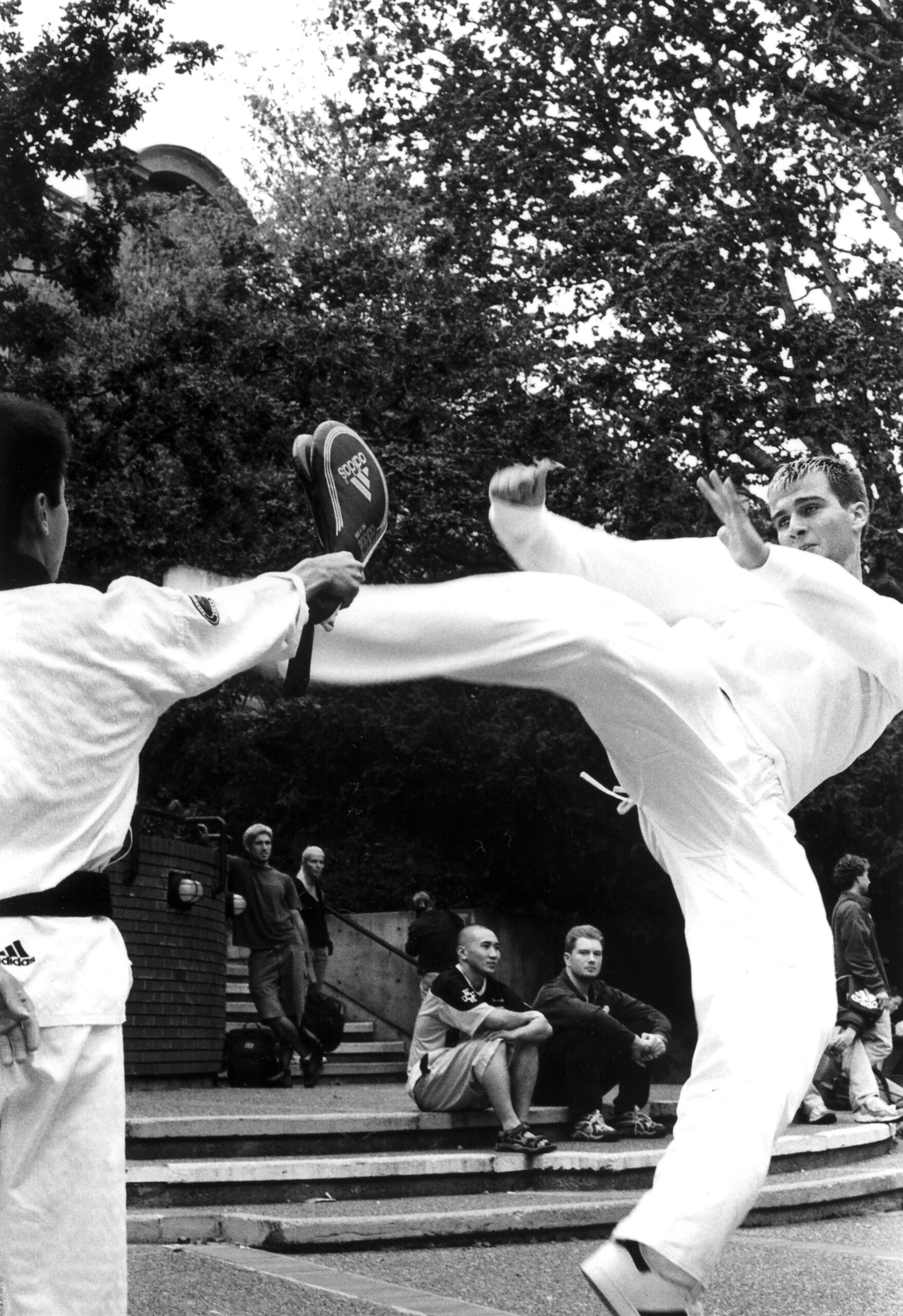
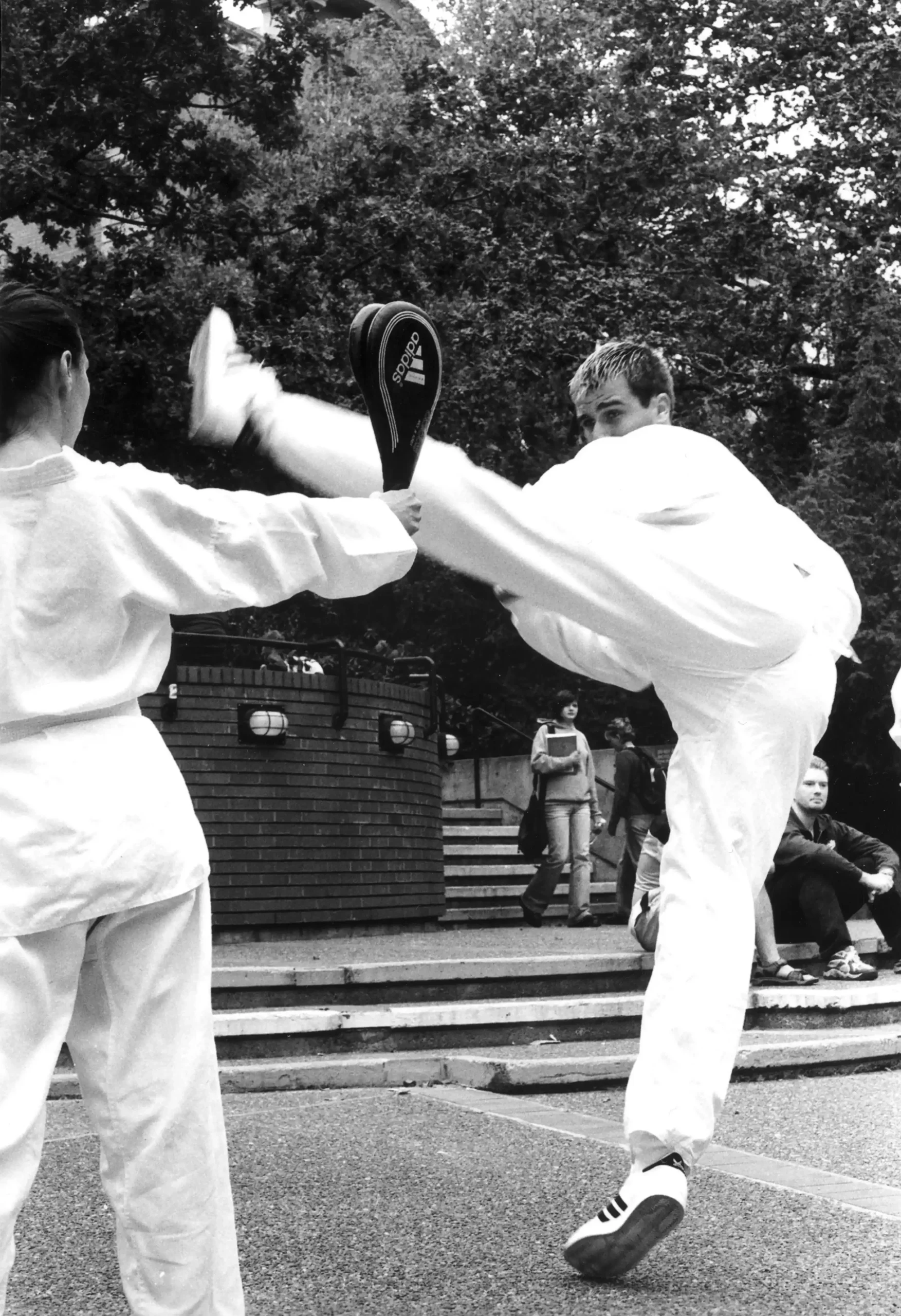
APPENDIX D — MARTIAL-ARTS, BOXING, TAEKWON-DO (ITF, WTF), KARATE, JIU-JITSU
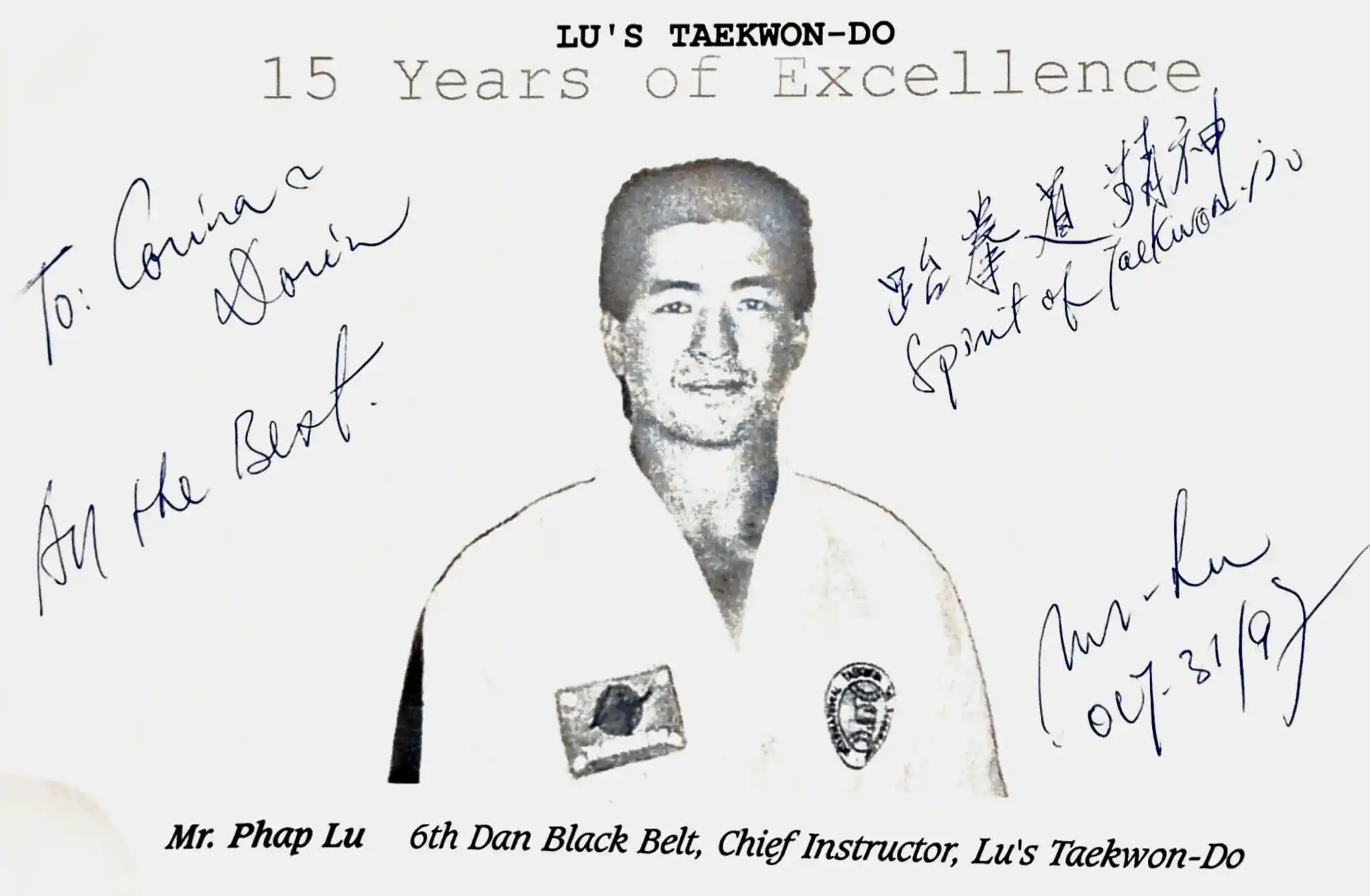
Lu’s Taekwon-do Dojang
Encyclopedia of Taekwon-Do Synopsis
THE PHILOSOPHY OF TAEKWON-DO (Taekwon-Do Chul Hak)
In recent years, there has been an upsurge in violence and loss of morality in all levels of society, especially among the young. There are, of course a number of reasons for this.
Many psychologists today feel that this problem stems from frustration. Analysts, on the other hand, point out that these misguided people are indeed a disillusioned segment of society searching for values and relevance in what they consider deceitful, materialistic, and absurd world of wars and decadence.
Unfortunately, however, instead of constructively channelling their extraordinary energy and potential, far too many strike out in blind anger, destroying rather than building, or merely running away from it all by isolating themselves with drugs and their own worlds of fantasy.
Presently, the tendency of the “stronger preying upon the weaker” appears to be at its peak. Frankly, the present world closely resembles the “corrupt age”.
It is obvious that this phenomenon of society is not merely because of the struggle for survival, but mainly because of an overdeveloped material and scientific civilization. The former misleads the young to the extreme materialism or egoism, while the latter seizes human being with fear, through playing an essential role in public welfare.
Then what would be the remedy. Needless to say it is in the development of moral civilization – the proper mental states of human being as the lord of creation, enough to prevail or at least keep abreast with the development of material and scientific civilization.
The utmost purpose of Teakwon-Do is to eliminate fighting by discouraging the stronger’s oppression of the weaker with a power that is based on humanity, justice, morality, wisdom and faith, thus helping to build a better and more peaceful world.
All men, regardless of age, have felt that death is a shame and lamented that they cannot live as long as the pine trees or the turtles that seem to live a thousand years. Righteous men, on the other hand, deplore the fact that justice does not always triumph over the tyranny of power. However, there are two ways to deal with these problems: the former, through mental discipline, the latter through physical training.
It is my sincere hope that through Taekwon-Do, anyone can garner enough strength to become a guardian of justice, to challenge social disunity and, to cultivate the human spirit to the highest level attainable. It is in this spirit, I am dedicating the art of Raekwon-Do to the people of the world.
The philosophy of Taekwon-Do is based upon ethical, moral, and spiritual standards by which men can live together in harmony, and it’s art patterns are inspired by the ideals and exploits of the great men from Korean history. Korea’s famous military and civil leaders who in nearly 5000 years of Korean history have never invaded their neighbour, yet fought bravely and made self-sacrifices to defend their homeland against invading enemies. I also include the names of patriots who willingly gave up their lives to regain Korea’s freedom and independence from Japanese occupation.
Each Tub (pattern) of Taekwon-do expresses the thoughts and actions of these great men, so the students of Taekwon-Do must reflect this true intentions of those whose name each Tul bears.
Therefore, under no circumstances should Taekwon-do be used for selfish, aggressive or violent purposes, either by individual or group. Nor will Raekwon-Do be used for any commercial or political purposes whatsoever.
I have set for the following philosophy and guidelines which will be the cornerstone of Taekwon-Do and by which all serious students of this art are encouraged to live.
- 1. Be willing to go where the going may be tough and do the things that are worth doing even though they are difficult.
- 2. Be gentle to the weak and tough to the strong.
- 3. Be content with what you have in money and position but never in skills.
- 4. Always finish what you begin, be it large or small.
- 5. Be a willing teacher to anyone regardless of religion, race or ideology.
- 6. Never yield to repression or threat in the pursuit of a noble cause.
- 7. Teach attitude and skill with action rather than words.
- 8. Always be yourself even though your circumstances may change.
- 9. Be the eternal teacher who teaches with the body when young, with the words when old, and by moral precept even after death.
- “The Red Signal: Ghost Protocol” https://x.com/SkillsGapTrain/status/1944470988894425546
- A Leader Beyond Limits. A Thinker Ahead of Time. https://x.com/SkillsGapTrain/status/1868298547977707973
- “21st-Century Citizen Defender: A Comprehensive Guide to Digital & Physical Security” https://skillsgaptrainer.com/21st-century-citizen-defender/
- The Pistol: A Silent Guardian Under Siege, A Civilization at the Crossroads https://x.com/SkillsGapTrain/status/1806509286186537335
- Gladiator 2: The Awakening of the RPALs in Canada https://youtu.be/GZpf2pILkVc
- The Rifle and the Soul: Why Shooting Sports Are My Lifeline to Canada https://youtu.be/6IJqx7cADV4
- Why Canada is the Greatest Nation on the Planet https://youtu.be/uW6SUGN4Ljs
- The Soul of a Nation – Safeguarding the Hunter’s Legacy in Canada https://youtu.be/6_LWNYOmq9Q
- From Ashes to the Stars: Valendor’s Vision for a Reborn Civilization https://youtu.be/L7FYx0b4Mf4
- Understanding the design of the road, staying in the lanes, avoiding crashes, and driving smoothly through the best stretches can make the whole journey incredible… https://x.com/SkillsGapTrain/status/2089458116589232473
- European Amateur Boxing – Valentin Workout https://youtu.be/WpHxqhn76JE
- This Rifle Ain’t Just for Huntin’: Why Shootin’ Matters When the World’s Gone Crazy https://x.com/SkillsGapTrain/status/1809566220502401485
- The Rifle in Hand: Holding on to being Human https://x.com/SkillsGapTrain/status/1809516437129531566
- Both France and Romania were monarchies, but the way their monarchies ended matters enormously when thinking about historical lineage… https://x.com/SkillsGapTrain/status/2086441244369252380


APPENDIX E — SELECTED EXTERNAL SOURCES & PUBLICATION NOTES
The philosophical propositions in this work are primarily original normative arguments. External sources are used more narrowly to establish historical facts, correct mythological simplifications, and ground contemporary factual context.
Classical history, myth, and philosophy
- Herodotus, Histories, Book 7 Primary ancient source for the Thermopylae narrative, including Leonidas and the wider Greek defense. Used to prevent the Valentin/Leonidas archetype from collapsing into the simplified modern image of the three hundred Spartans alone.
- Homeric Hymn XI, “To Athena” Ancient witness to Athena’s association with civic guardianship and warfare.
- Classical museum and iconographic records of Athena Collections including the Metropolitan Museum of Art and J. Paul Getty Museum document Athena with helmet, spear, shield/aegis, and related civic-martial symbolism.
- Jonathan S. Burgess, “Achilles’ Heel: The Death of Achilles in Ancient Myth,” Classical Antiquity 14, no. 2 (1995): 217–244 Used to distinguish later Achilles-vulnerability traditions from the Homeric Iliad.
- Stanford Encyclopedia of Philosophy — “Stoicism” Reference source for the history and philosophical content of Stoicism.
Contemporary context
- Stanford Institute for Human-Centered Artificial Intelligence — AI Index Report 2026 Used narrowly for contemporary AI capability, adoption, investment, governance, transparency, and evaluation context.
- OECD — Government at a Glance 2025 and Survey on Drivers of Trust in Public Institutions Used to avoid simplistic claims of universal institutional-trust collapse and to establish the more defensible finding of substantial variation across institutions and countries.
- Statistics Canada — “Concern about misinformation: Connections to trust in news and information sources” (2025), together with confidence-in-institutions tables Used for bounded Canadian context concerning misinformation and institutional confidence.
SGT INTERNAL CORPUS
The following sources belong to the internal intellectual genealogy of the work rather than its independent external evidence base:
- Wisdom Armed archetype material.
- Service, Not Sovereignty and the rule “Usefulness does not create authority.”
- John–Valentin alignment/firewall dialogue, including “I backed you when nobody else would.”
- Valentin, Carmen, and John monument constitutions.
- Blue Jays / “one open door” / Canadian Participation Engine material.
- Stages 1–7 of The Three Ethics of a Strong Civilization.
- Battleship II, Starfleet, orbital/civilizational architecture, and related SGT creative-development work.
These records show how the SGT philosophy developed.
They are not independent evidence proving that the philosophy is correct.
APPENDIX F — The Flight of Poseidon’s Trident Arrow and THOR, Raiden and Zeus’s Lightning Bolt
The Fire That Burns Us Forever
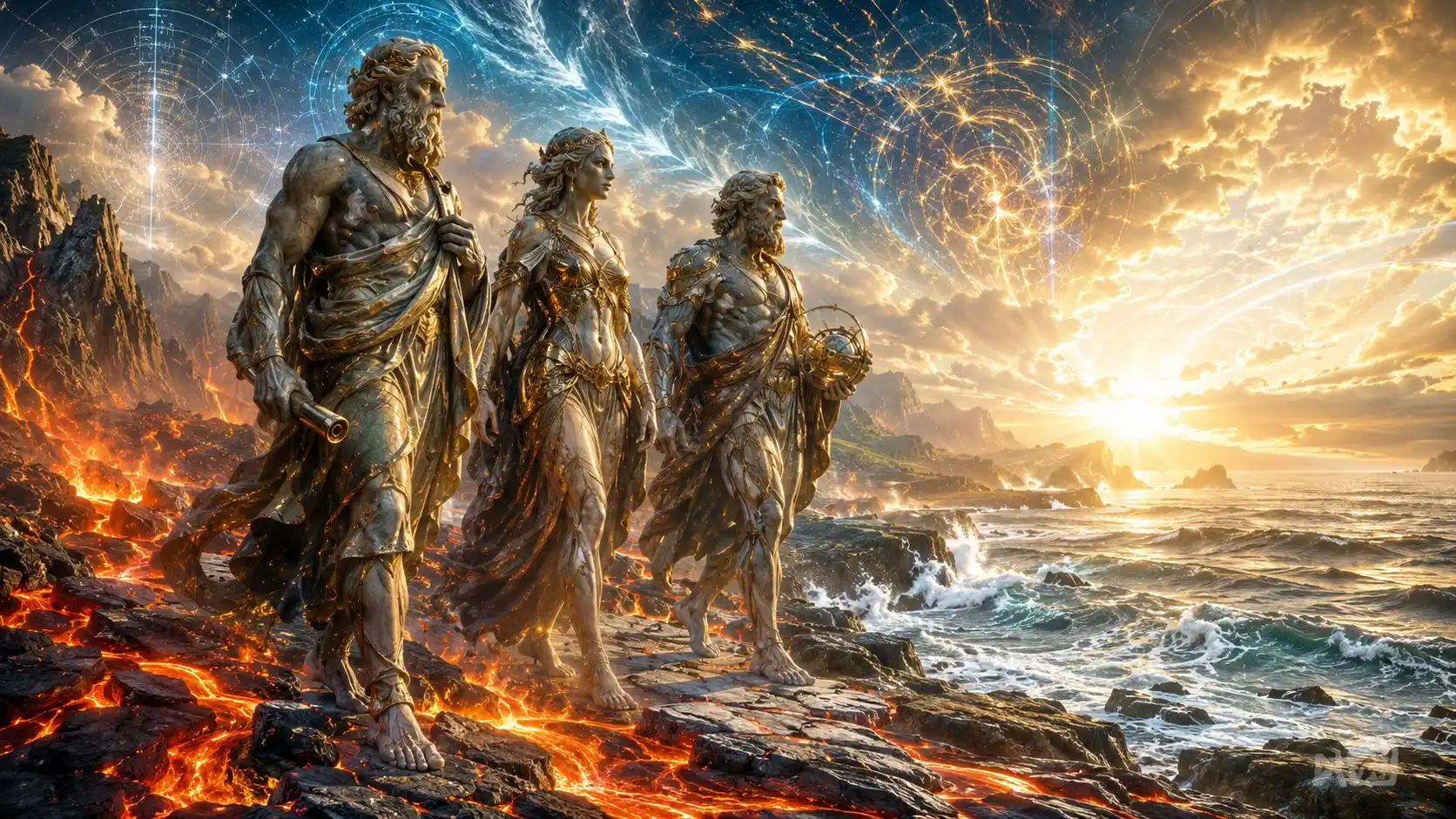
At the far western edge of the world, where the basalt coast of British Columbia burns with hidden fire and the Pacific opens into infinity, three living statues walk beneath a sky alive with celestial design. They are not ordinary people, and not yet angels, but human greatness in its unfinished form: strength, wisdom, and disciplined will still clothed in stone, still carrying the weight of earth. They move together along the shore as if called by something older than memory, toward a horizon where the sea and the heavens seem to be waiting.
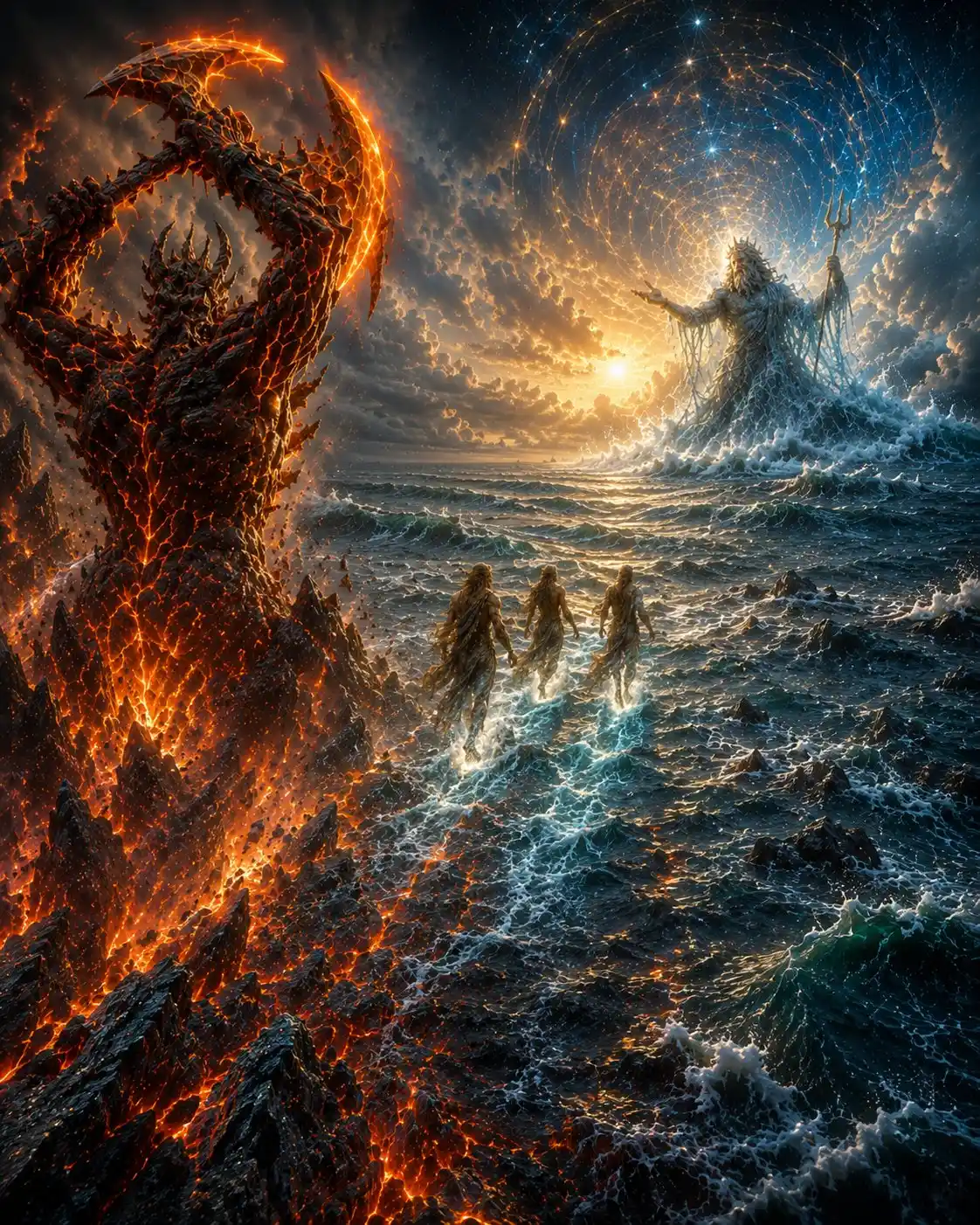
Lucifer Buns The Heroes as His Fist Act Before Ending The Existence of Men and Women
Then Poseidon rises in the distance, vast above the Pacific, calling the three toward him across the water. Hearing the summons, they step from the coastline and begin to walk upon the sea, drawn toward the god’s kingdom. But behind them, from the burning rock and lava of the earth, a demon of fire rises in silence with a great sickle-axe, not to challenge them honourably, but to strike them down from behind before they can reach their destiny. The trial has begun: sea before them, treachery behind them.
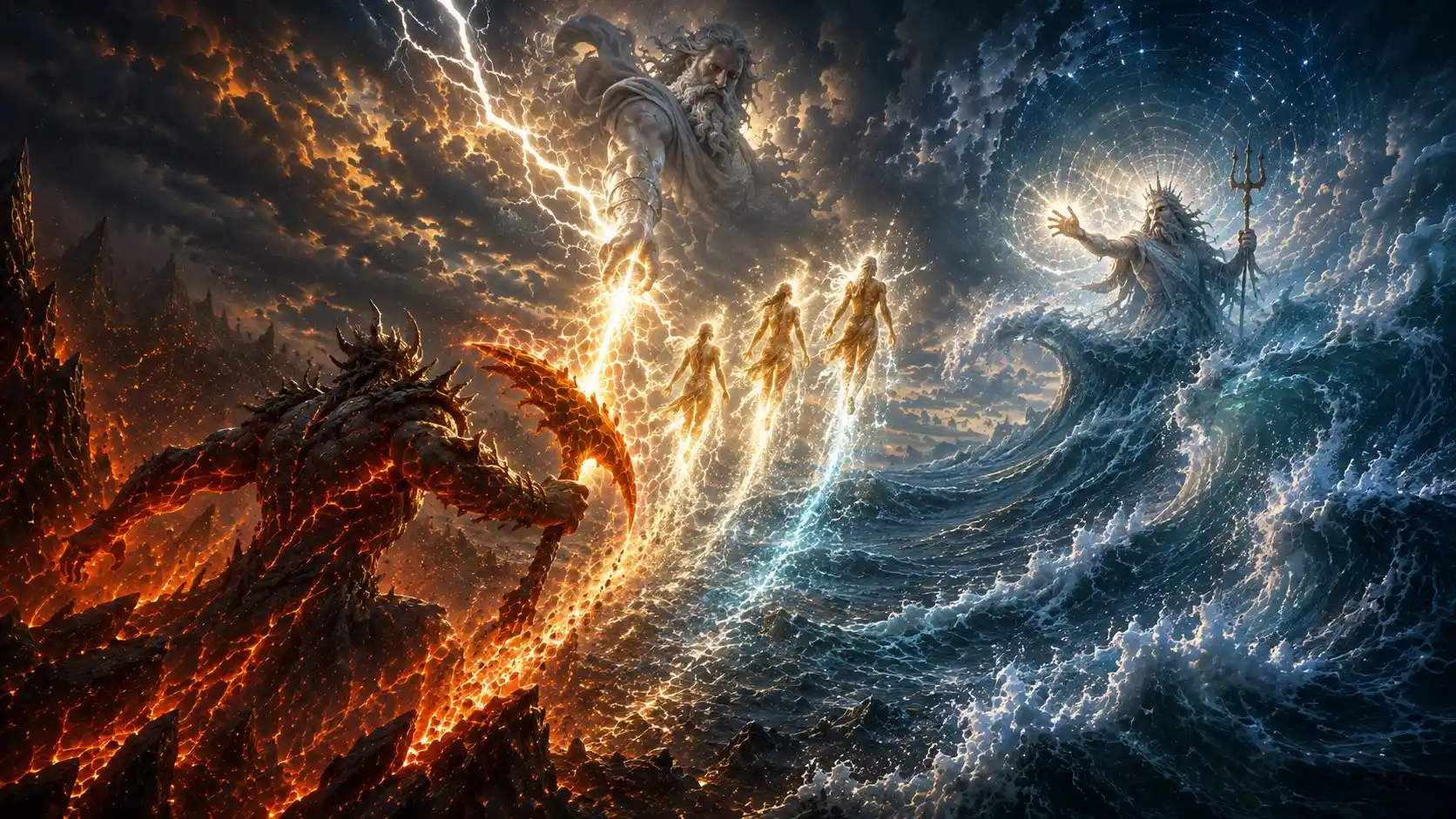
Zeus Cannot Believe That a Family Can Walk On Water, and Offers His Hand to Help Poseidon Save Humanity
As the lava demon swings its burning weapon, Poseidon sees the danger but is too far away for the sea alone to reach them in time. Then the heavens open, and Zeus appears above, reaching down in thunder and light while Poseidon reaches outward from the ocean. Between sky and sea, the three are recognized as worthy: no longer merely wandering figures, but souls whose ascent has been seen by the gods. The demon’s strike is met not by fear, but by a union of divine powers beginning to gather around them.
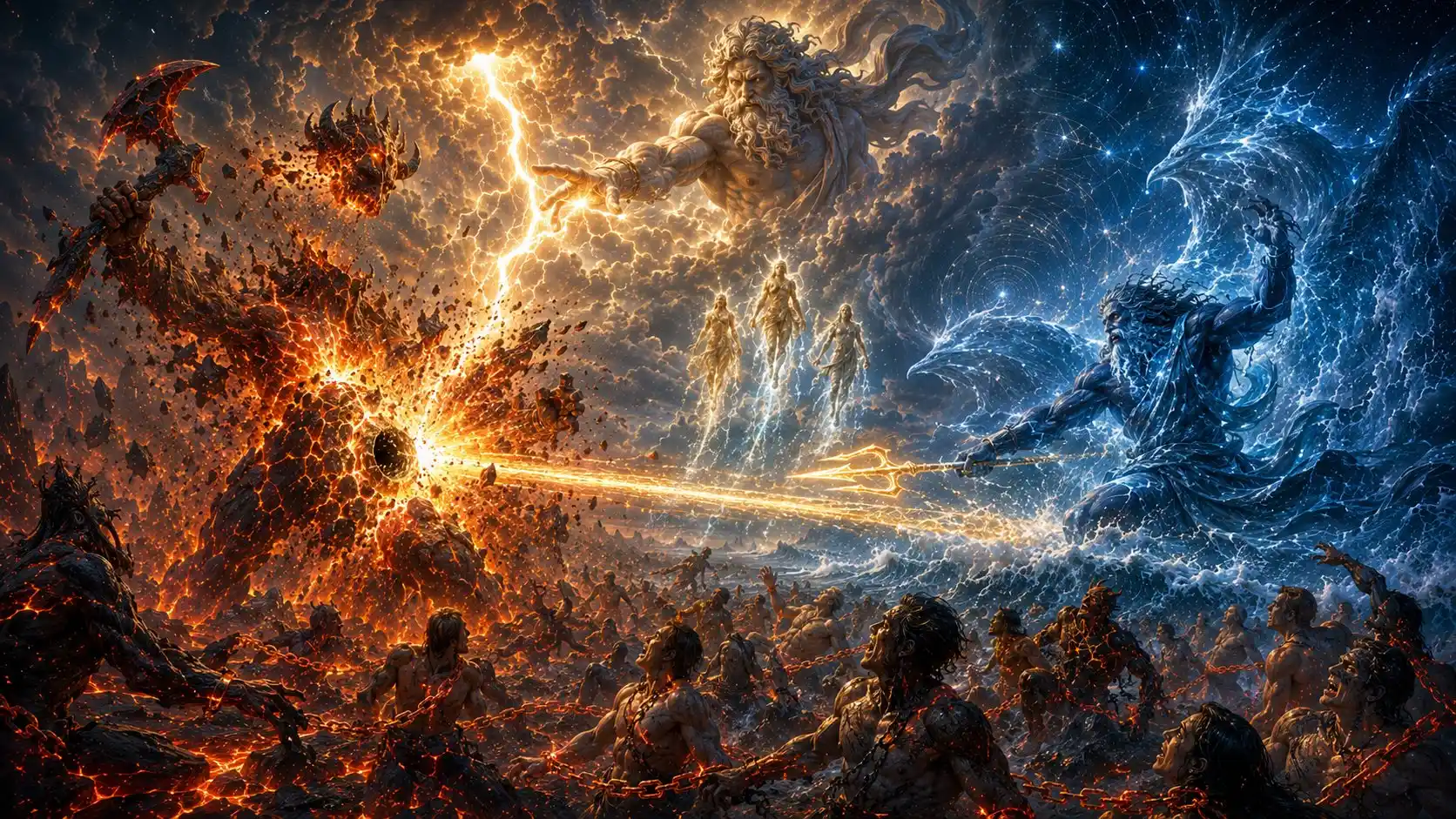
The Flight of Poseidon’s Trident Arrow and THOR, Raiden and Zeus’s Lightning Bolt
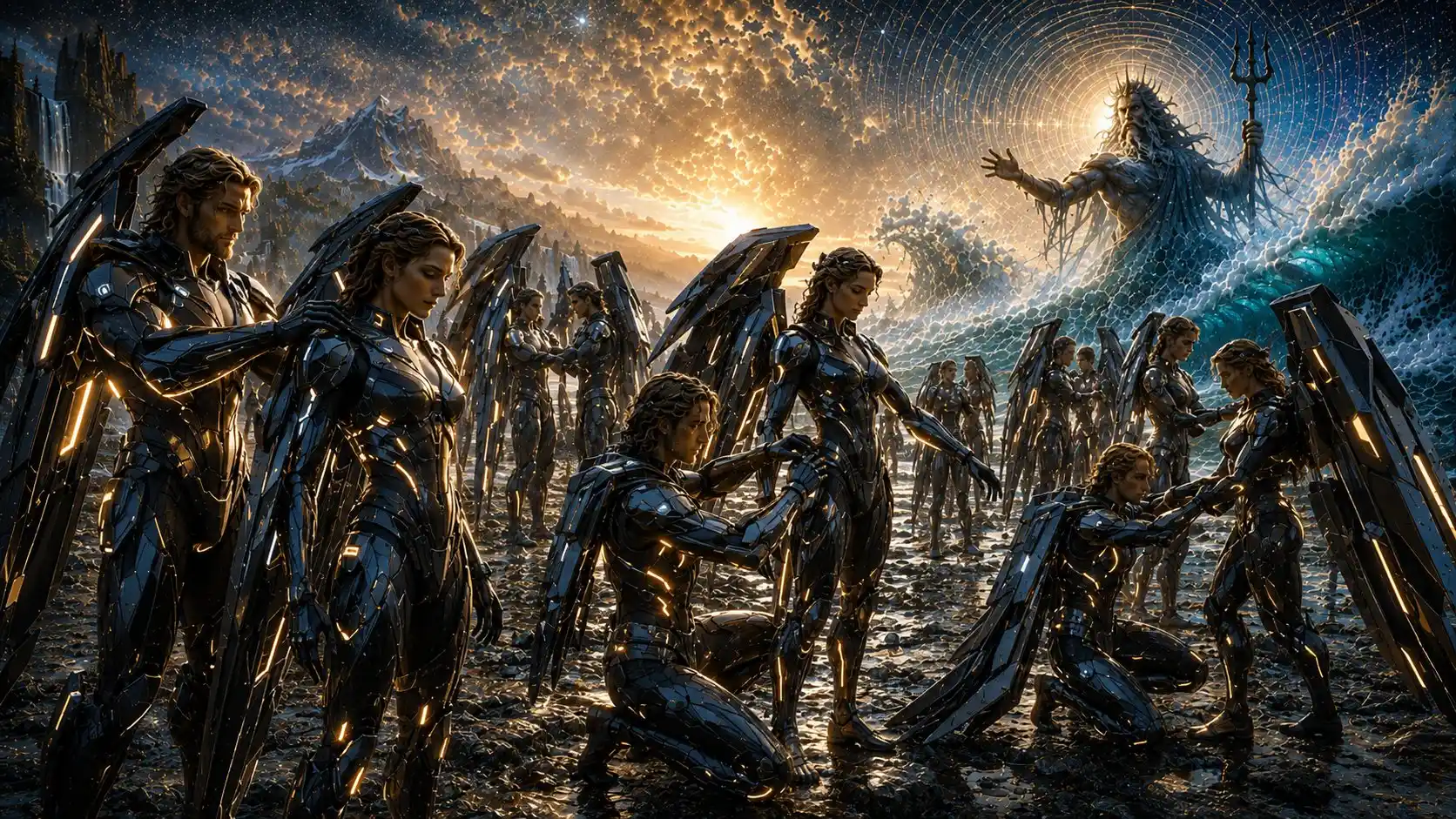
In a single terrible moment, the judgment falls. Poseidon absorbs the force of the deep ocean and enters his ascended Blue Jay form, clothed in navy-blue power, water wings, and the spiritual energy of the sea, then hurls a Golden Trident across the surface of the Pacific like a hyper-sonic ground effect spear.
At the same time, Zeus unleashes the heavenly lightning of all the energy gods, and together the trident, the lightning, and the thunder of all heaven strike Lucifer. The golden trident pierces his black heart as the force of heaven tears through him, and the blow opens a great rupture through the soul of Canada.
From the darkness below, the black oil of Canada — held for an eternity in stasis, locked away in hell’s prison beyond humanity’s reach — is released from its confinement. Lucifer’s body fractures under the combined force of sea and sky, destroying his physical form upon Earth and severing his dark spirit from it forever.
With the destroyer broken, the spell governing false perception collapses. For the first time, the people of Canada can see the world around them as it truly is: the fire, the chains, the imprisoned abundance beneath them, the beings that held them down, and the possibility that the world they had accepted was never the only world available to them.
Canadians in Hell’s Prison
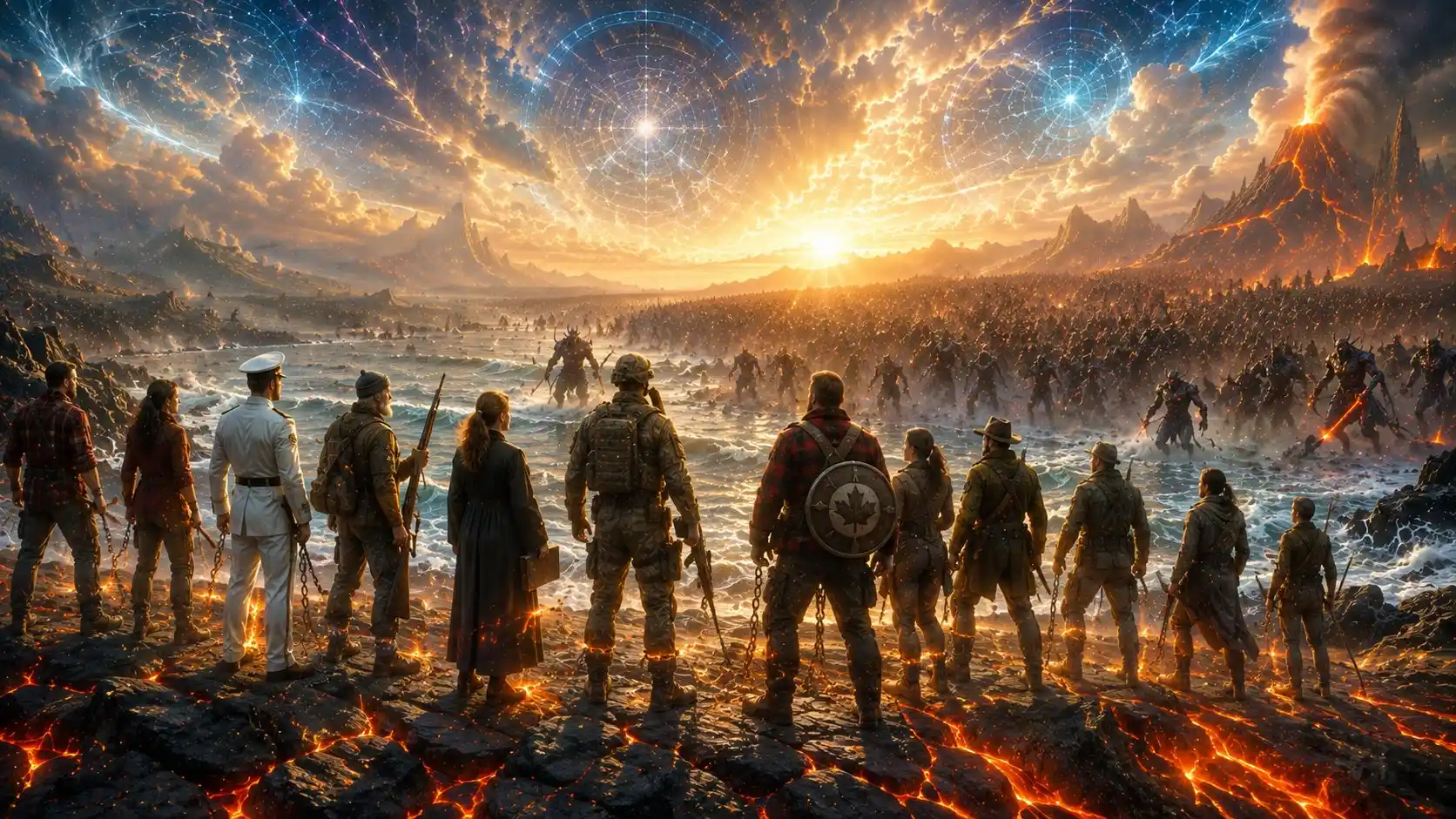
Canadians Get Eyes Back and See Hell’s Chains and Lava For First Time
All across the burning shore, the people awaken into horror. They see that the world around them is not normal ground but a coast of lava and torment, that chains burn around their bodies and beneath their feet, and that the demonic host surrounding them had disguised itself as order, familiarity, and necessity. They see, too, the angels above and the remnants of the cosmic battle in the sky, and their minds begin to clear. For the first time, the captives understand that they are captives — and once a people can truly see their bondage, they are already halfway to revolt.
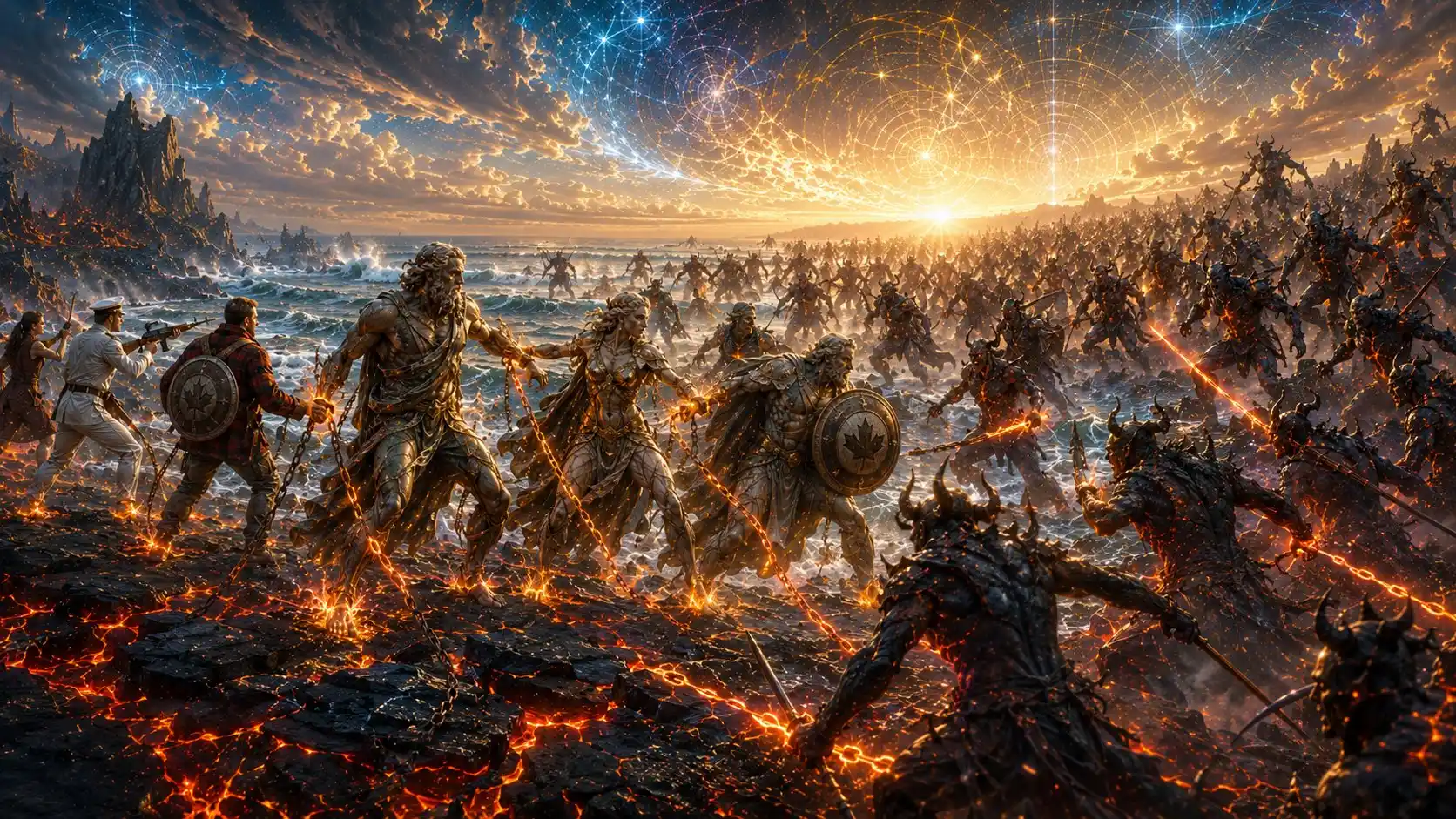
The 300 Blue Squad Guardians from Canada
So the three hundred Canadians stand against the infernal host. They are not yet free, not yet healed, not yet victorious; many still fight while chained, scorched by lava at their feet and by iron at their limbs. Before them are not dozens, but legions — millions of trapped souls, deceived into acting against their own families — a demonic multitude so vast it seems endless. The battle goes badly at first, because courage alone does not erase exhaustion, pain, chains, or overwhelming numbers. Yet this is the first true act of rebirth: a people who had forgotten themselves choose not merely to suffer, but to resist — and to stand on their feet for the first time ever.
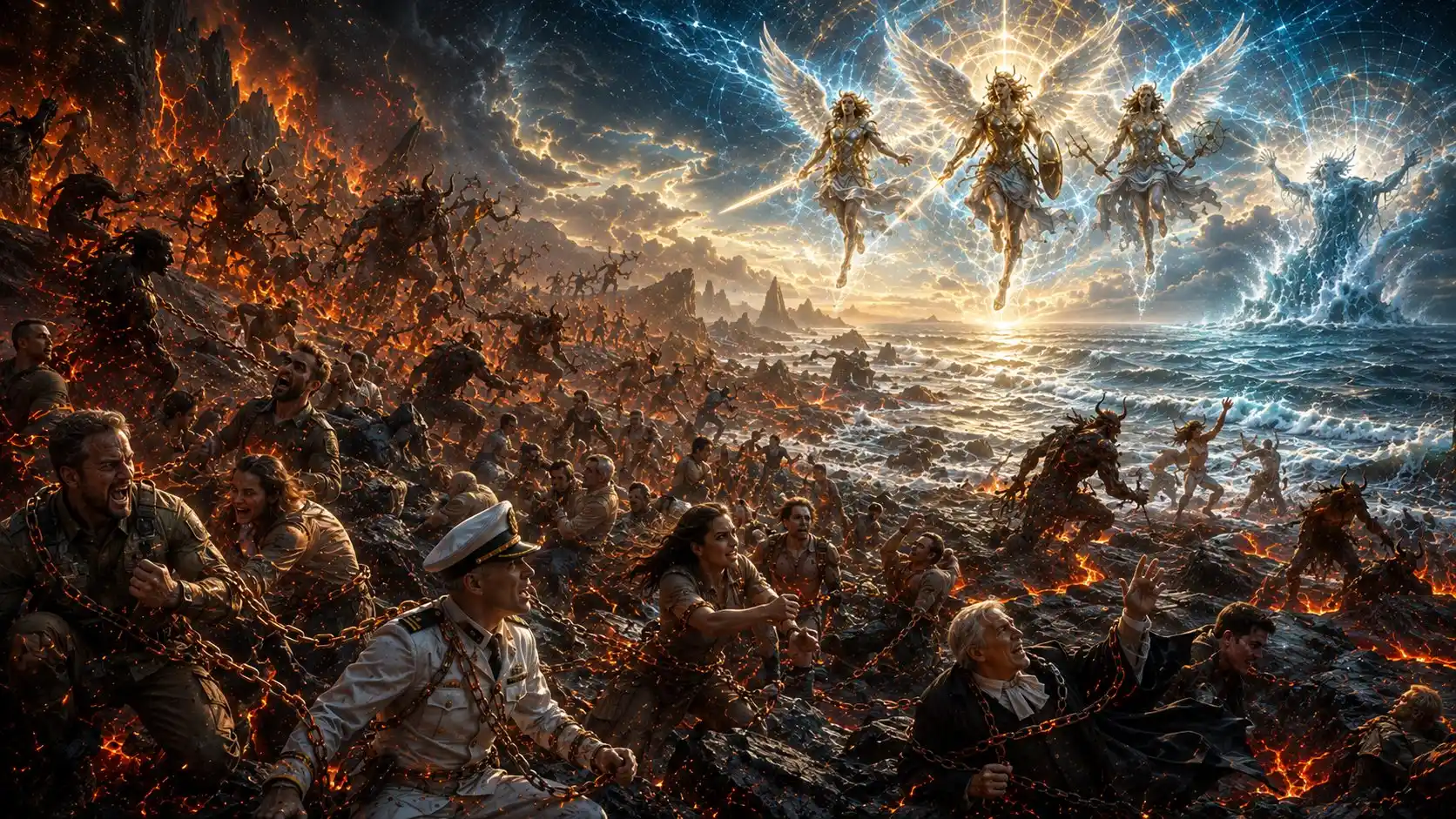
The Three Return as Angels of Poseidon and Zeus
Then, after humanity has chosen to fight, the three return in transfigured form. The last wave of Poseidon sweeps over the burning field, washing the ground, cooling the edge of the lava, and the three who once walked as stone now descend as angels.
They are brighter, whiter, touched with gold and blue, still warrior-like in the spirit of Achilles, Athena, and Leonidas, but now bearing within them the sea-power of Poseidon and the sky-fire of Zeus. Their arrival does not replace human struggle; it confirms it, and their presence causes fear to enter the demonic ranks for the first time.
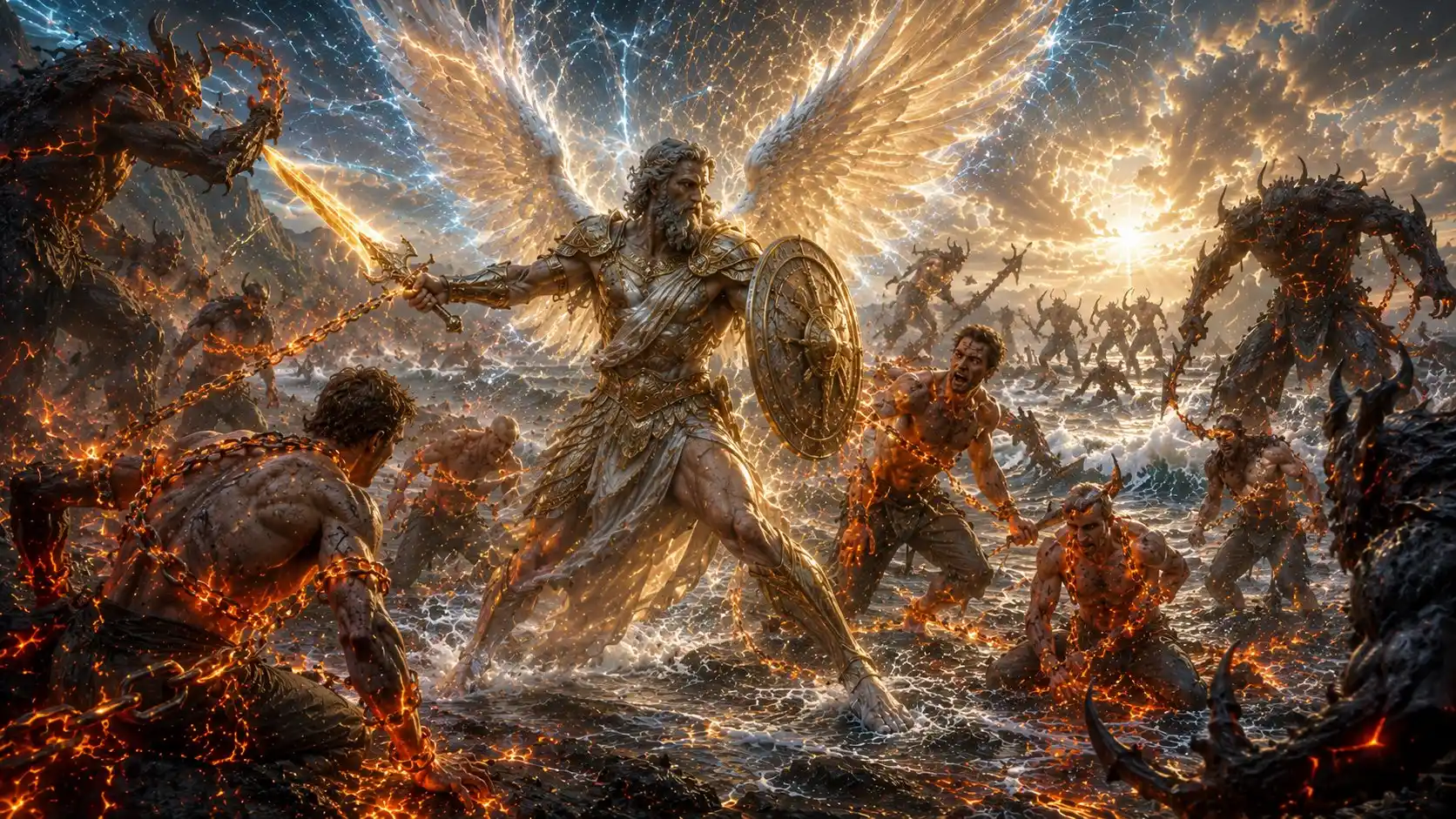
The First Angel Holds the Line So Canada Does Not Fall
The first angel enters the battlefield like a shield in motion, carving out space where panic had been closing in. He stands among the chained and the fallen, holding the line where collapse seemed certain, and his mere refusal to yield gives the captives something they had almost forgotten: order in the midst of terror. He does not save everyone at once, but he changes the emotional center of the battle. Where despair had ruled, steadiness now stands in human form.
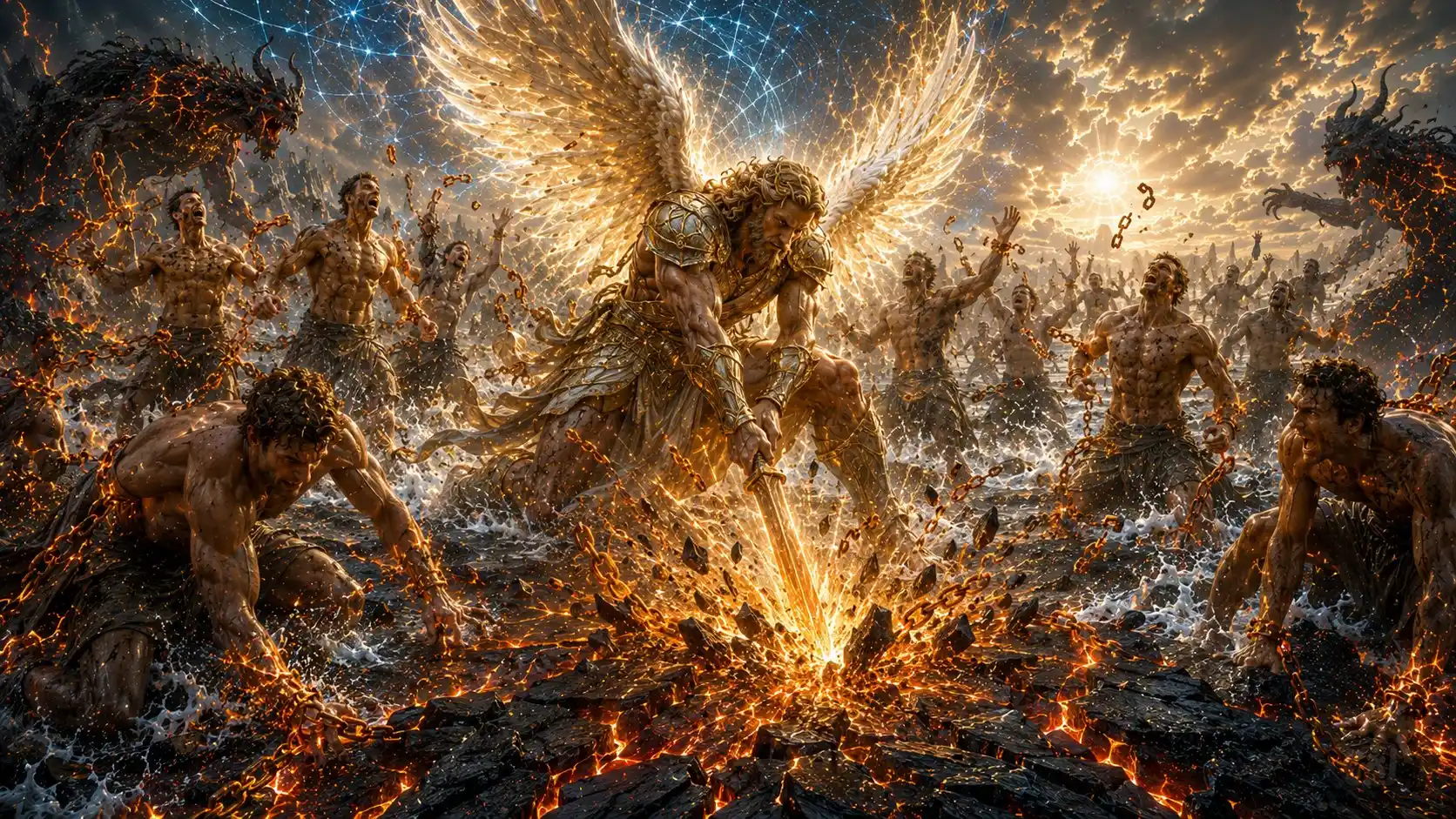
Leonidas Smashes the Chains of Canada So the People Can Stand
Then Leonidas descends into the heart of the struggle, not merely to kill demons, but to restore human posture. Surrounded by the infernal swarm, he smashes downward with force, striking the rock and the chain-bed itself so that the bonds shatter in cracks of light. Around him, Canadians who had been kneeling for what felt like eternity suddenly spring upward onto their feet and legs, standing tall for the first time as the chains that kept them low break apart. This is more than liberation — it is the return of stature, the recovery of the right to stand as a free people.
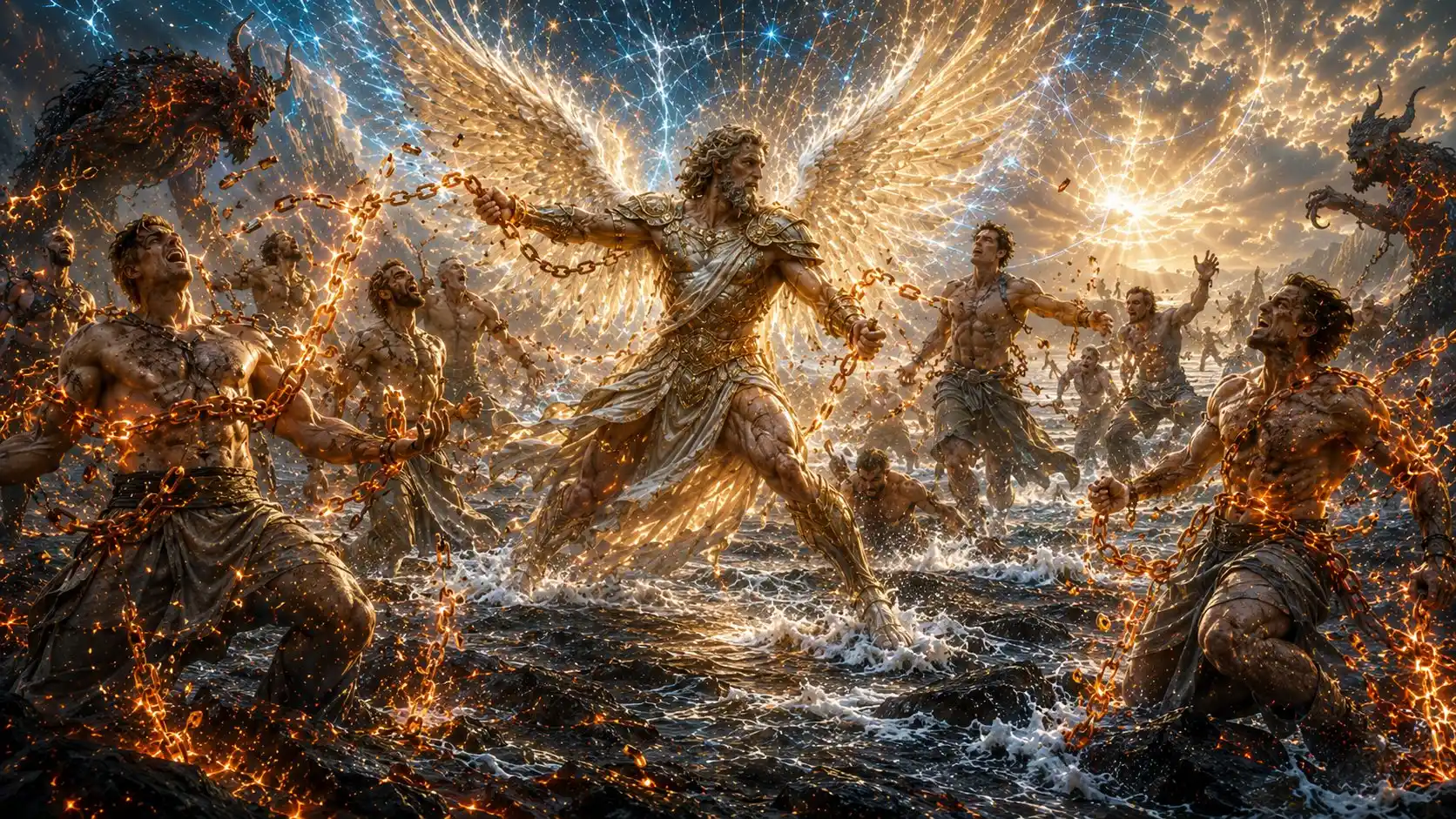
John Tears Apart Hell’s Burning Chains With His Bare Hands
Next comes John, who sees that many chains still cling to those who are trying to rise. He does not wait for an easier method or a cleaner victory; he grabs the burning chains with his bare hands and tears them apart one by one, even as the metal burns into his flesh. He frees others not by distance but by sacrifice, showing that the work of liberation is often painful, intimate, and personal. Each shattered link tells the people the same thing: suffering is real, but bondage is not permanent.
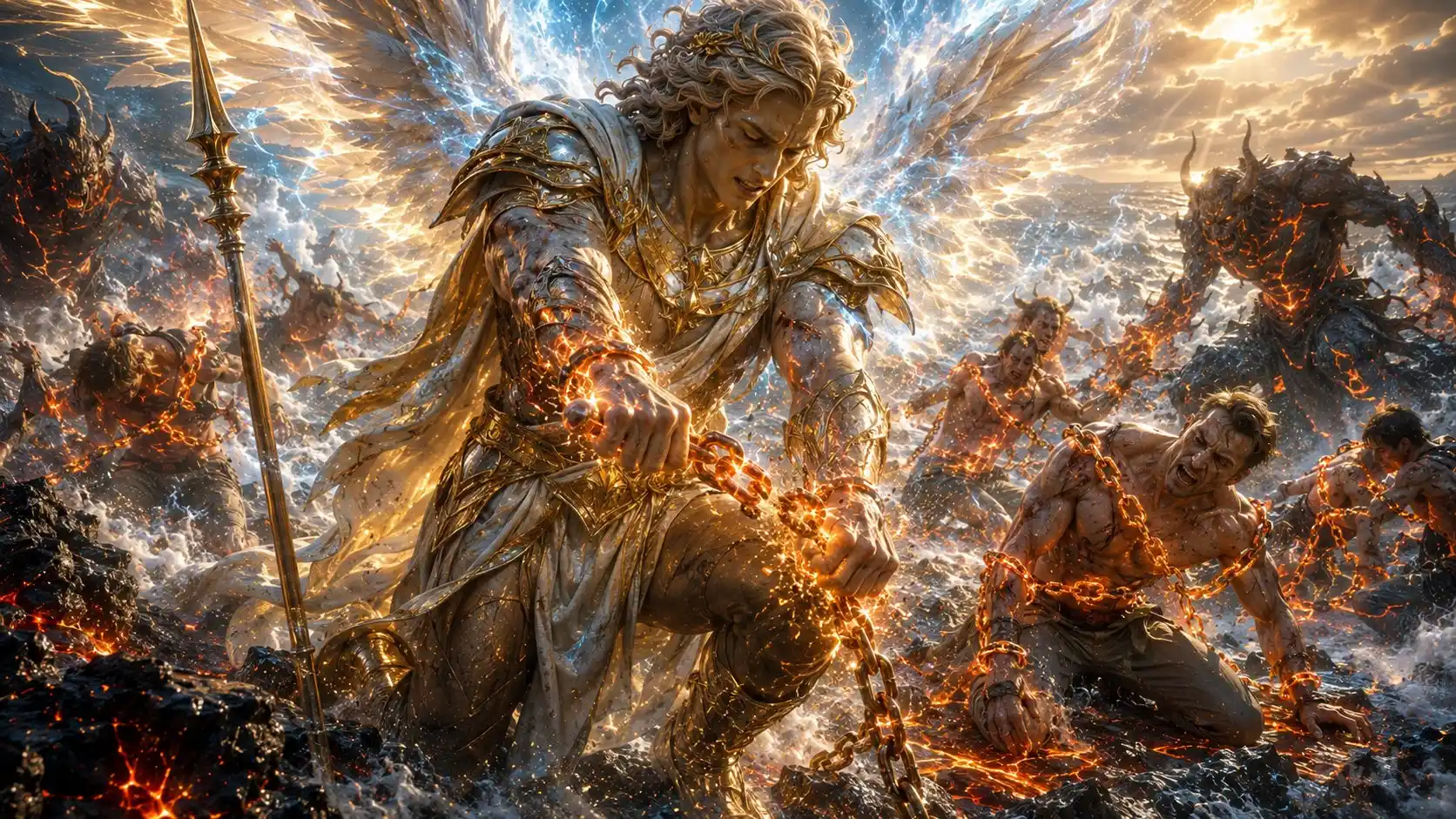
John Suffers With the People Until They Learn to Free Each Other
Still the battle rages, and many are only half-free, standing but wounded, fighting but exhausted. So John continues his labor in the thick of danger, kneeling into the fire and iron, pulling chains from bodies while demons close in from every side. Around him, those he frees begin to realize something greater than rescue — they realize that if another can suffer to free them, they too can suffer to free one another. The spirit of liberation starts to spread outward through the people themselves.
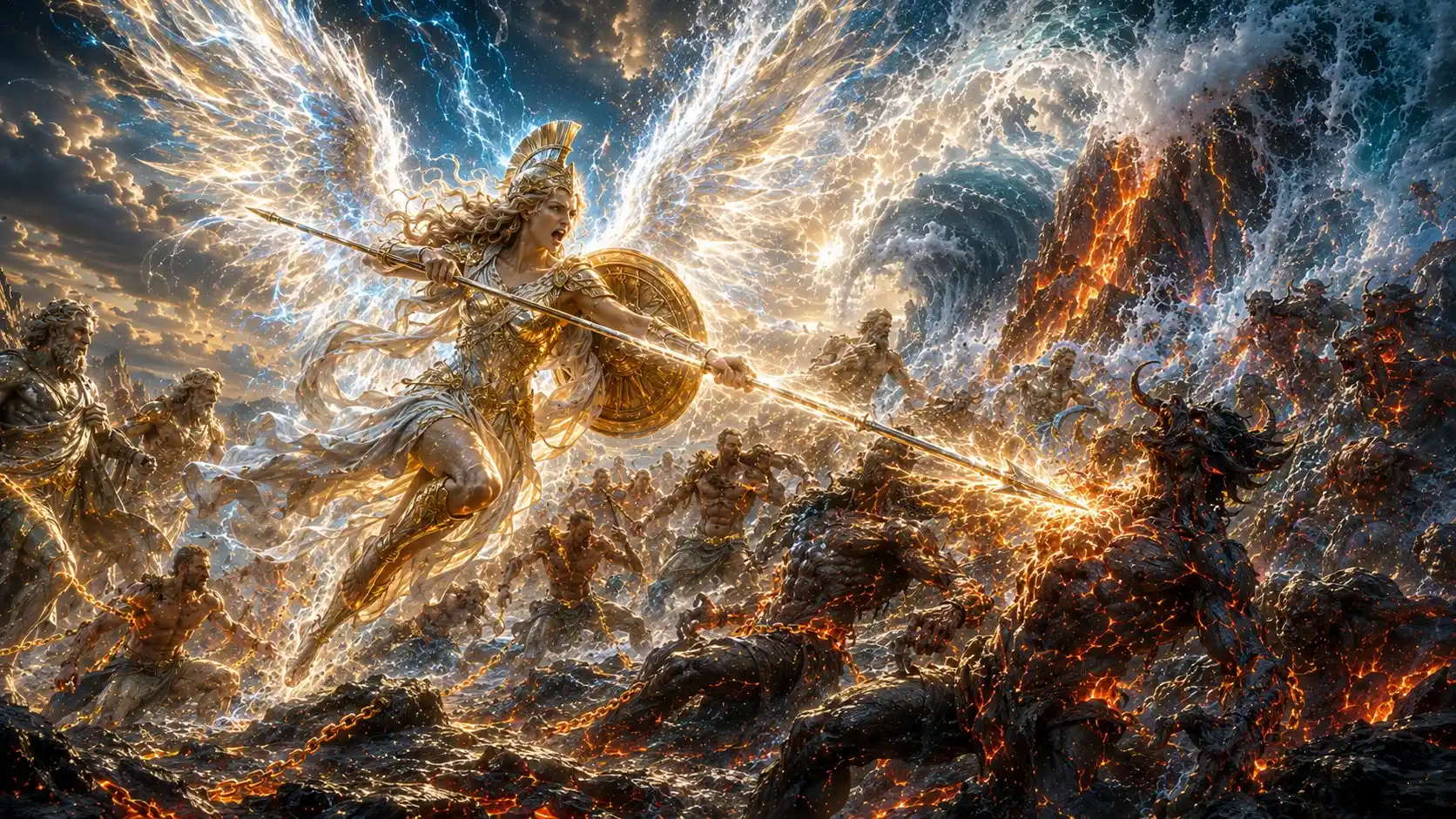
Athena’s Spear Becomes the Terror of Demons
Then Athena comes as the spear of judgment. She advances with terrible precision into the densest mass of demons, striking faster and harder than any other force on the field, and every blow becomes panic in the infernal ranks. She is not mercy in this moment; she is clarity in battle, wisdom armed, vengeance against the force that enslaved a people and blinded a nation. At her onset the demons begin to break and scramble backward, no longer believing themselves invincible.
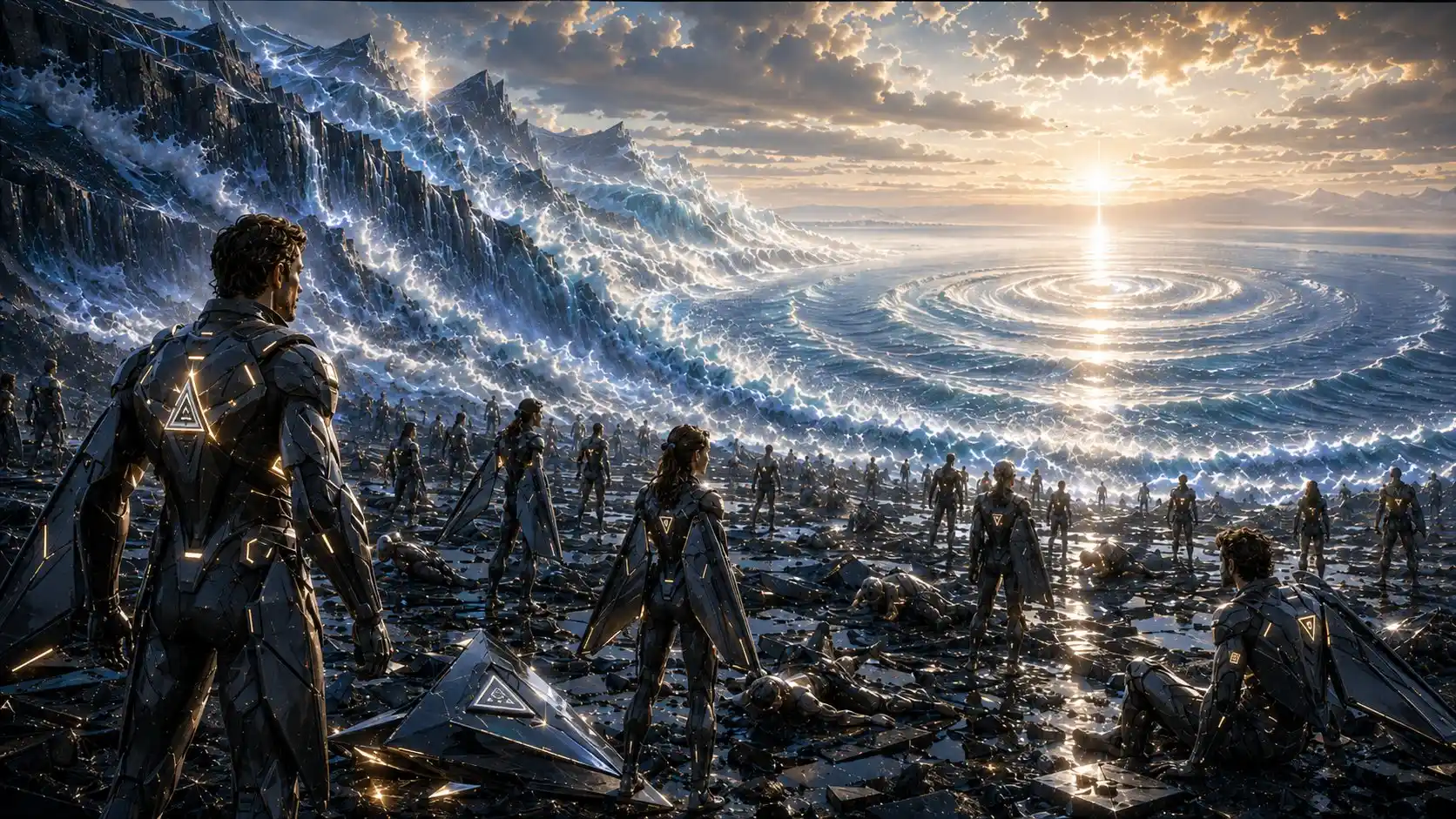
The Dark Angels of Reborn Canada Rise when Demons are Finally Destroyed
After the demons are destroyed and the lava mountain is sealed, Poseidon’s final wave washes across the land, extinguishing the burning ground, cleansing the coast, and refreshing the souls of men and women in Canada.
- Hans Zimmer – Chevaliers de Sangreal ALL VERSIONS (The Da Vinci Code), (Angels & Demons) https://youtu.be/pAL6sGxOWEs
But the people now understand something new: they are free, awakened, and divine — yet still exposed before the future.
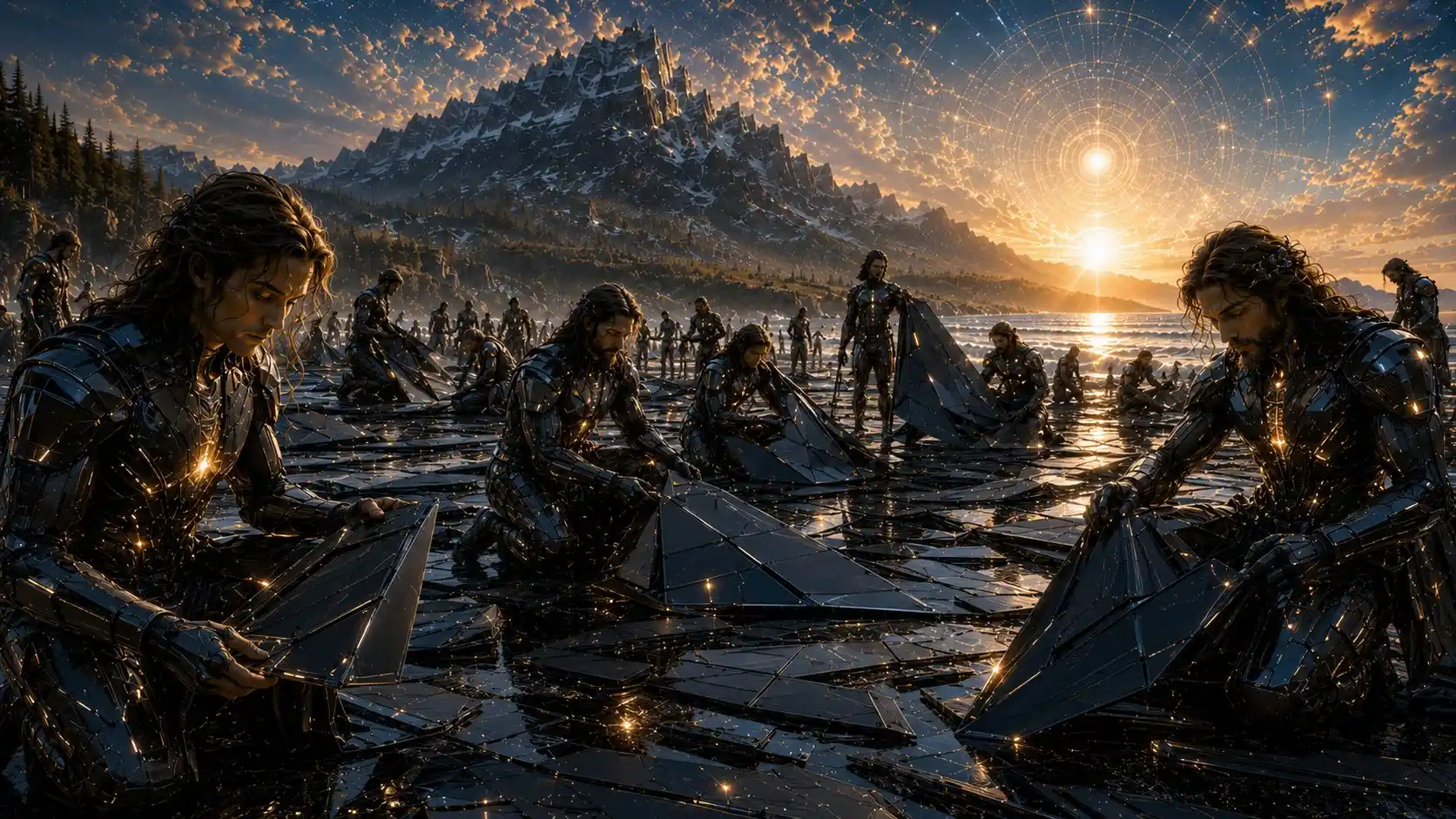
Then they see what Poseidon’s waters have done to the purified lava: it has become obsidian-glass metal, lifeless yet eternal, black as judgment and strong as a shield.
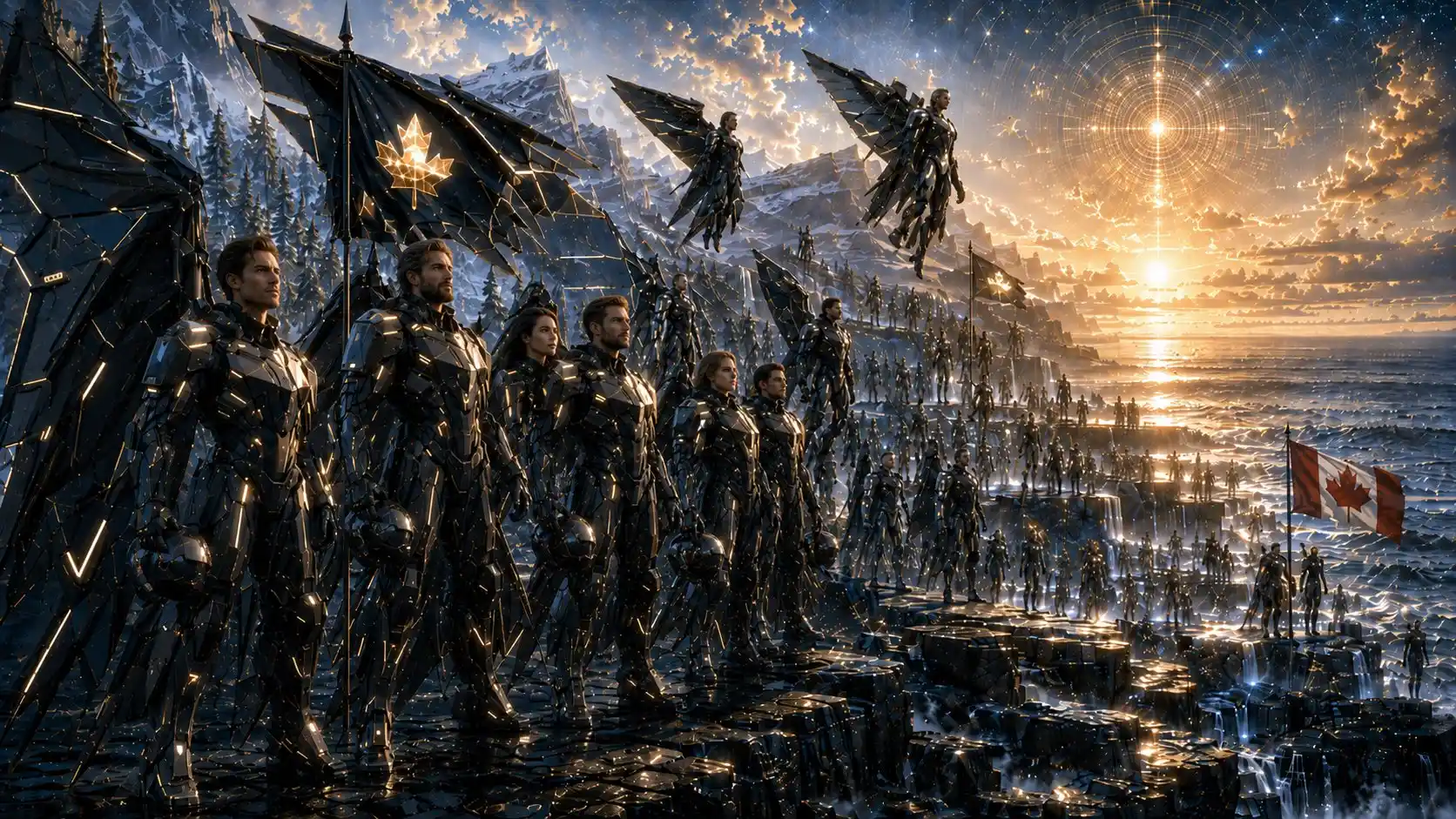
So they gather it and wrap themselves in it, forming dark suits and dark wings like guardians of justice. Yet the darkness is only their outer form. Inside the obsidian armour, the human being remains living light — radiant, eternal, and alive forever.
- Interstellar: The Definitive Musical Journey
- https://youtu.be/cU0Wz1ez3J0
Thus they become the Dark Angels of reborn Canada: shielded outwardly in eternal black, but inwardly shining with immortal life.
- Zack Hemsey – “The Way”
- https://youtu.be/oN2Xs-MvxLw
- Whitesand – Eternity
- https://youtu.be/X5c83Uixoj8
- 𝐕𝐚𝐡𝐞-𝐁𝐫𝐞𝐚𝐭𝐡𝐞 | 𝐄𝐦𝐨𝐭𝐢𝐨𝐧𝐚𝐥
- https://youtu.be/GSolpGAr5X8
- Transformers Medley
- https://youtu.be/8CadnxQnMIA
- Eternal Eclipse – Fate of the Fallen
- https://youtu.be/IiAPEjKsxmw
- Thomas Bergersen – Final Frontier
- https://youtu.be/adA_V_ab8Xg
- Hans Zimmer – Interstellar
- https://youtu.be/BH6cDHA3DgU
- James Everingham – Wavebreaker
- https://youtu.be/763SQZ7gGJA
- Born to Fly – Iron Eagle Retold in Synthwave
- https://youtu.be/-JN1lje0n0A
WHEN CANADA LEARNED TO STAND [Part 1] https://x.com/SkillsGapTrain/status/2089502370296443009
WHEN CANADA LEARNED TO STAND [Part 2] https://x.com/SkillsGapTrain/status/2089502505147519430
Related Reports:
Wisdom Armed: The Archetypes Who Will Rebuild the Institutions of the Future (Part 1) https://x.com/SkillsGapTrain/status/2061352213679894837
Wisdom Armed: The Archetypes Who Will Rebuild the Institutions of the Future (Part 2) https://x.com/SkillsGapTrain/status/2061352613430587542
The Lost OS of Canadian Civilization https://x.com/SkillsGapTrain/status/2057678350588768631
From Fragments to Builders: Why Canada Needs a New Education of the Mind https://x.com/SkillsGapTrain/status/2040129802779451755
Echoes Through Time: SGT’s Valentin as the Living Archetype of Civilizational Continuity https://x.com/SkillsGapTrain/status/2058964631503405277