Sector 001: A First-Principles System for Patrol, Speed Discipline, Emergency Resilience, and Human Command
Pre-Prototype Architecture Report v1.1 | Skills Gap Trainer (SGT) | July 2026
Architecture status: complete for pre-prototype planning. This is not a certified vehicle design, a purchasing instruction, or evidence from operational deployment.
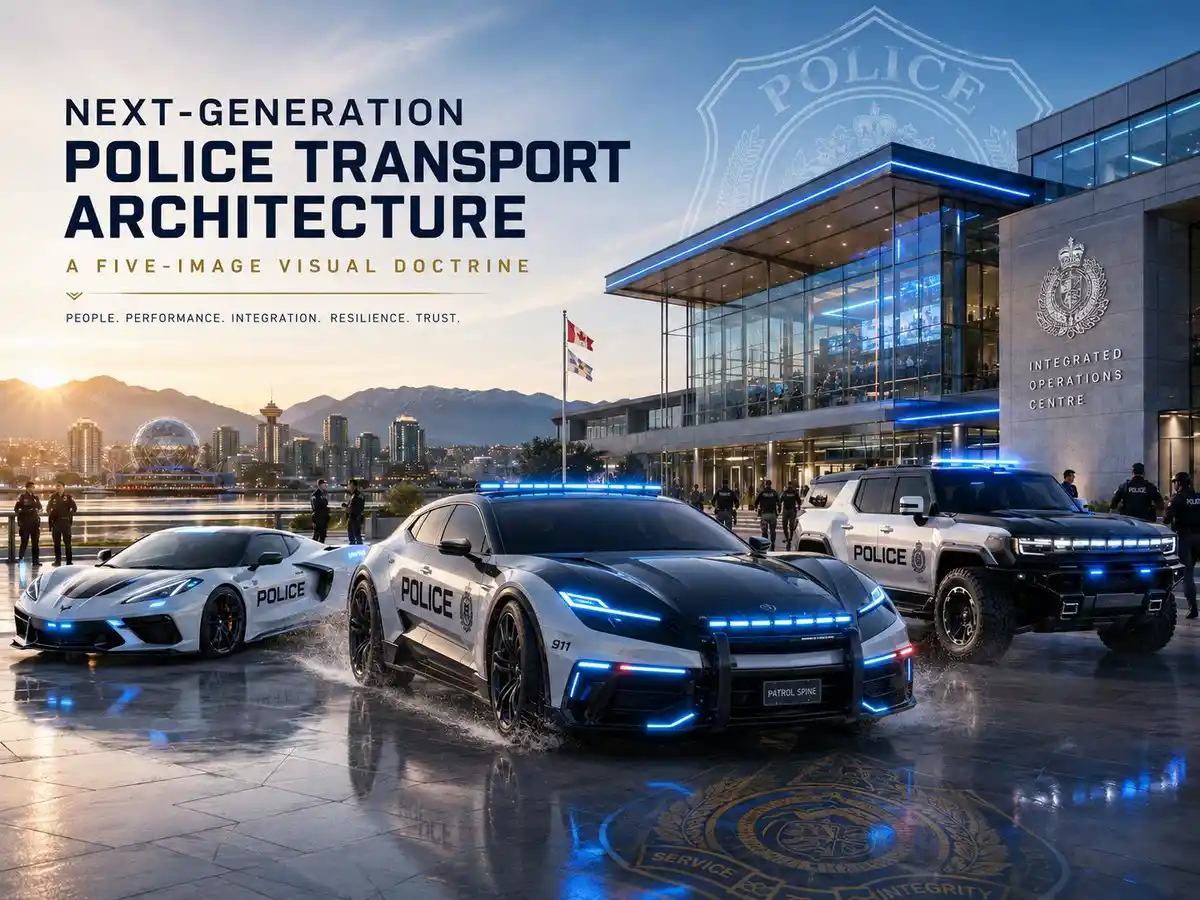
Executive Purpose and Truth Boundary
A police vehicle is no longer just a car.
It is a mobile workstation, communications relay, electrical-power node, detainee compartment, evidence carrier, medical-support point, officer shelter, public symbol, and last-mile response system. It must serve through ordinary patrol days, long highway shifts, winter nights, rural roads, prolonged incident scenes, communications failures, grid outages, and the moment when normal infrastructure begins to break.
That changes the design question.
The question is not whether police should prefer sedans, SUVs, pickups, Corvettes, Hummers, hybrids, electric vehicles, or internal-combustion vehicles.
The first-principles question is:
What must public safety still be able to do when normal systems fail?
Once that question is asked, the fleet stops being a shopping list. It becomes an architecture.
This report develops that architecture from mission physics: officer workspace, detainee transport, equipment load, highway efficiency, terrain access, stationary energy demand, communications, maintainability, lifecycle cost, training burden, degraded operation, public legitimacy, and concentration of effect.
The resulting system has a clear shape:
PUBLIC PURPOSE / BADGE | GOVERNANCE + TRAINING + SUPPORT | LOW-DRAG PATROL SPINE | +——+——+ | | EFFICIENCY SPECIAL MISSIONS BLADE / \ SPEED RESILIENCE DISCIPLINE ARROWHEAD \ / DUAL-PATH ENERGY | HUMAN FALLBACK ENGINE
The commercial names in this report are reference archetypes, not permanent dependencies. A Corvette represents the speed-discipline class. A Hummer represents the emergency-resilience class. The current Ford-style police utility represents the patrol-spine benchmark. Another manufacturer may ultimately produce the better answer.
Several claims are supported by current production vehicles and official guidance: purpose-built police utilities, pursuit-rated police EVs, hybrid auxiliary-power operation, bidirectional vehicle power, lightweight materials, vehicle cybersecurity practice, and formal police-vehicle testing.[1][2][3][4][5][6][7][8][9][10]
Other elements are original pre-prototype concepts developed through this architecture:
- the low-drag pursuit-utility spine;
- the sedan or fastback efficiency blade;
- the Corvette-class speed-discipline arrowhead;
- the Hummer-class Emergency Resilience SUV;
- the Auxiliary Command Principle;
- the Human Fallback Engine;
- the Sagittarius Principle;
- and Sector 001.
The report does not claim that these proposed systems are certified, costed, or ready for deployment. It defines what must be engineered, tested, rejected, revised, or proven before deployment becomes legitimate.
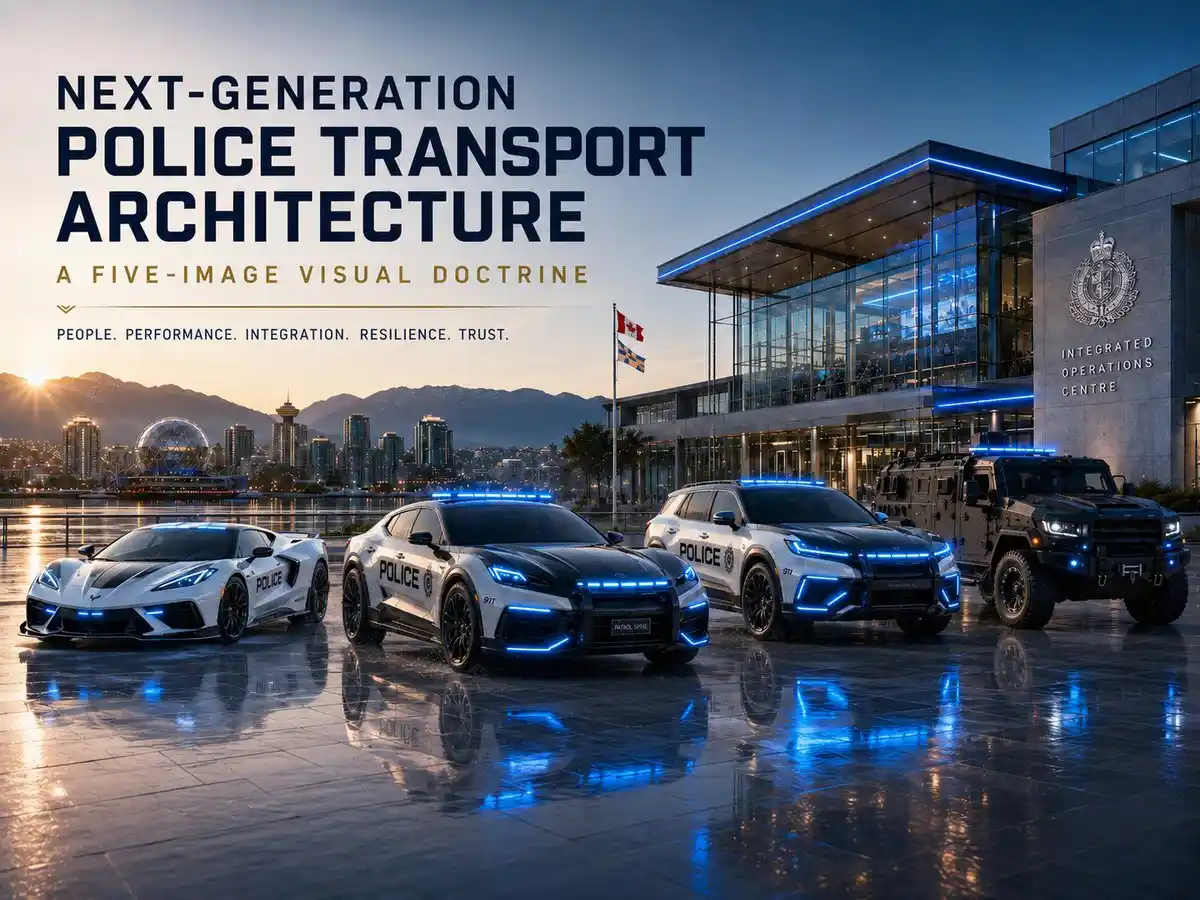
1. The Police Vehicle Is No Longer a Car
A consumer vehicle is primarily expected to move people and personal cargo. A modern police vehicle must carry an operating system for public safety.
Inside it may be two officers wearing body armor and duty belts; a detainee compartment; radios and antennas; computers, cameras, printers, sensors, and body-camera docks; medical equipment; evidence; cones and traffic-control tools; winter or rural-response gear; drones and rechargeable tools; emergency lighting; navigation; and enough heating or cooling to support people through a prolonged stationary incident.
The machine also faces a duty cycle unlike ordinary private use:
- repeated stop-and-go movement;
- rapid acceleration and emergency braking;
- long periods of stationary electrical load;
- full payload;
- curbs, potholes, gravel, salt, heat, cold, and snow;
- repeated entry and exit;
- and operation by many officers across several shifts.
The vehicle should therefore not be selected by body style first.
It should be selected by duty cycle.
A sports car may be exceptional at speed and still fail patrol reality. A large SUV may be exceptional in difficult terrain and still waste energy during routine movement. A sedan may be efficient and stable while lacking the volume required for full patrol equipment and detainee transport. A battery-electric platform may provide excellent local power while requiring additional protection against prolonged infrastructure failure.
The correct design sequence is:
mission -> operating conditions -> requirements -> failure modes -> vehicle form -> energy architecture -> equipment architecture -> testing -> governance
Beginning with a preferred machine and inventing a police mission afterward is backwards. Beginning with the mission reveals which capabilities are universal, which are specialist, and which do not justify their cost.
The badge comes last.
The vehicle earns the insignia only after the architecture proves that it serves.
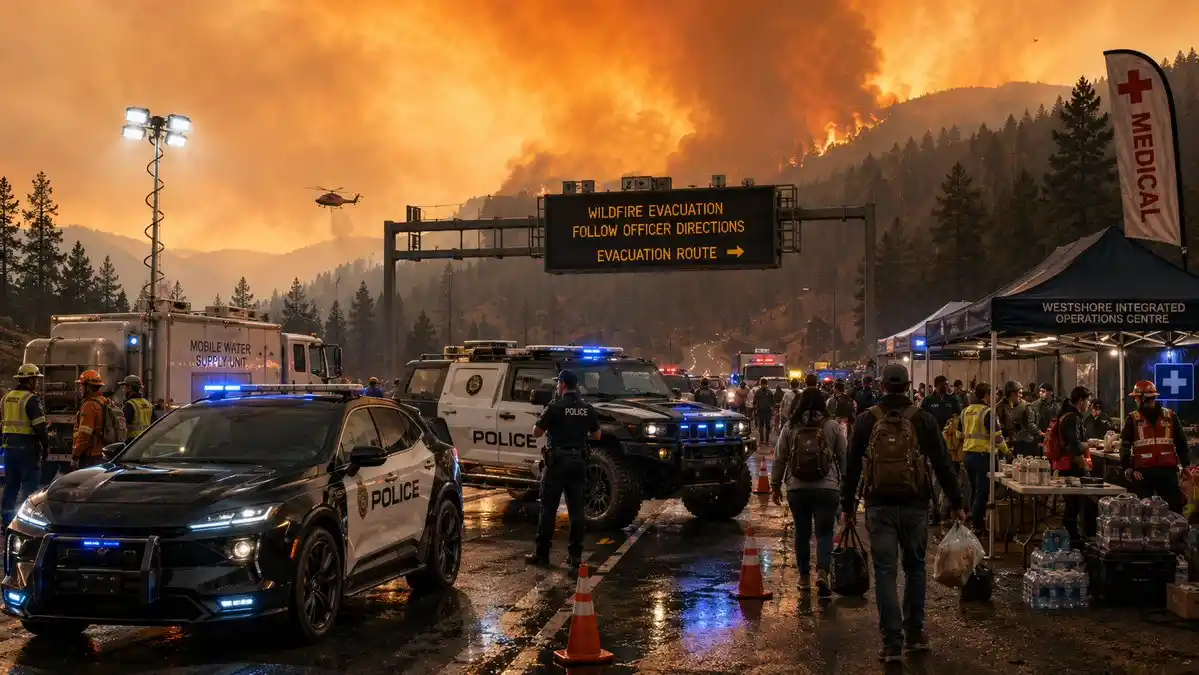
2. Fleet Sprawl Without Doctrine
Police fleets are being pulled in several directions at once.
SUVs provide space, visibility, officer access, detainee capacity, and all-weather packaging. Sedans preserve lower drag, lower profile, and efficient highway movement. EVs offer quiet operation, rapid low-speed torque, regenerative braking, and substantial onboard electrical energy. Hybrids can support radios, computers, emergency lighting, and climate systems while reducing unnecessary engine operation.[1][2] Pickups provide towing and open cargo. Vans provide command volume. Performance cars attract attention. Off-road vehicles provide access, rescue support, and mobile power.
None of those capabilities is inherently wrong.
The danger is not variety. The danger is variety without doctrine.
Without architecture, familiar vehicles remain in service because nobody has re-examined the mission. Special vehicles are acquired because they are impressive rather than necessary. Electrification is discussed as a consumer identity rather than an operational energy system. Police equipment is installed through layers of aftermarket improvisation. Maintenance teams inherit unrelated software, parts, batteries, tires, tools, and repair procedures. A narrow pilot becomes permanent before it proves public value.
The result is a parking lot of individually capable machines that do not form a coherent fleet.
The recurring failures are easy to recognize:
- Inertia: familiarity is mistaken for optimization.
- Spectacle: attention becomes the mission instead of supporting the mission.
- Fragmentation: every platform adds another training, parts, software, and maintenance ecosystem.
- Single-path dependence: mobility, power, communications, or command relies on one chain with no credible recovery path.
- Interface failure: radios, computers, cameras, partitions, chargers, and sensors are installed as separate projects rather than one system.
- Legitimacy failure: the public cannot be told, in plain language, why the vehicle exists.
A future fleet may contain different bodies and propulsion systems. But it should have one premium regular patrol spine, one controlled efficiency layer, only a few mission-concentrating specialist platforms, common interfaces, a defined degraded operating doctrine, and governance strong enough to say no.
The fleet may contain variety.
It must not become scattered.
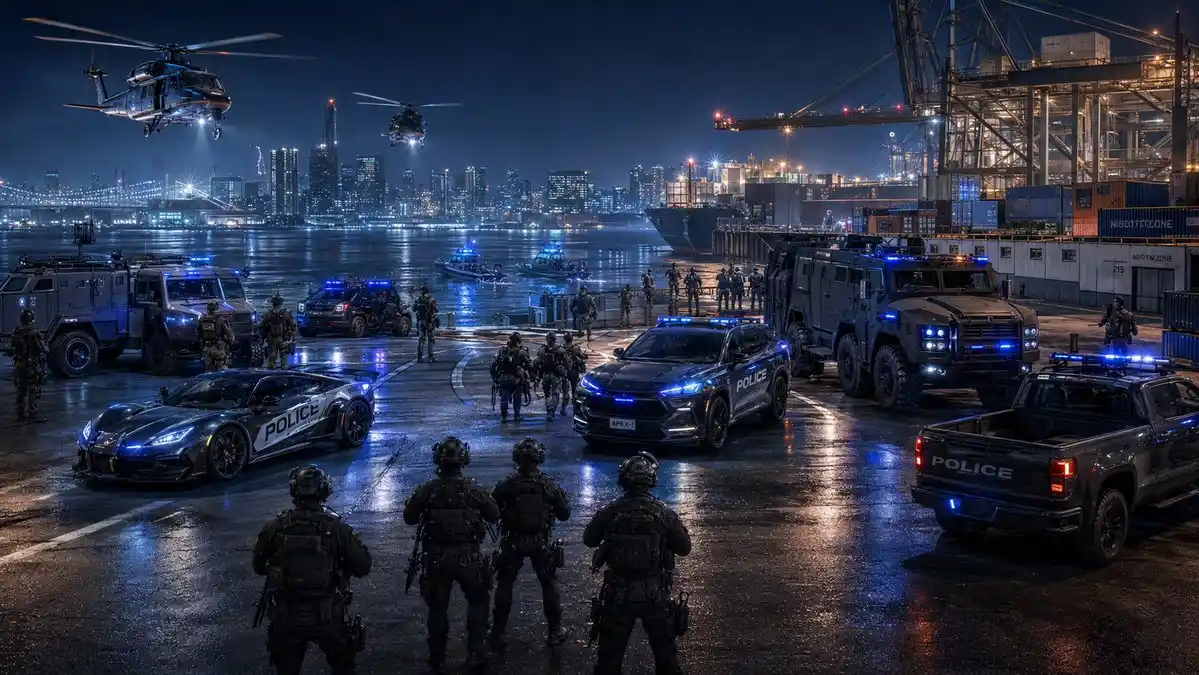
3. The System We Are Actually Designing
The object being designed is not merely the vehicle.
It is the chain that allows the vehicle to remain useful under pressure.
That chain begins with the officer and extends through the machine, mission equipment, dispatch, communications, energy, maintenance, training, procurement, and public authority.
Inside the architecture
The architecture includes:
- the vehicle body, chassis, propulsion, brakes, tires, and structural safety systems;
- officers, passengers, detainees, and carried equipment;
- radios, computers, sensors, cameras, lighting, evidence systems, medical systems, and approved mission modules;
- the electrical buses and energy reserves that keep essential systems alive;
- charging, fueling, and recovery support;
- dispatch and local communications;
- cybersecurity, software updates, offline modes, and restoration;
- maintenance facilities, parts, diagnostic tools, and technician training;
- operator training;
- procurement rules;
- utilization records;
- public reporting;
- and the authority that decides when a specialist capability may be used.
Outside the architecture
The report does not redesign national cellular networks, the public electricity grid, roads, bridges, provincial or state radio infrastructure, building codes, or national emergency-management institutions.
Those are external systems.
Their failure is still part of the operating environment.
The vehicle architecture does not control the grid. It must account for the grid being unavailable. It does not control cellular service. It must preserve essential local command when that service disappears. It does not control every road. It must define where the patrol spine stops and where a specialist platform becomes justified.
Five living parts
The architecture remains understandable when reduced to five living parts.
- The human must be able to enter, see, think, communicate, decide, and recover the vehicle without fighting its controls.
- The machine must move, stop, protect, carry, power, and survive its actual duty cycle.
- The mission equipment must be integrated rather than merely attached.
- The supporting institution must maintain, fuel, charge, train, dispatch, and repair the system long after the demonstration day.
- The public authority must define why the machine exists, who may use it, and where capability must stop.
A failure in any one of these can neutralize the others.
A powerful vehicle without maintainers becomes an exhibit. A resilient vehicle without trained officers becomes a risk. An advanced vehicle without public purpose becomes spectacle. A concept without evidence remains an idea.
The architecture must hold all five together.
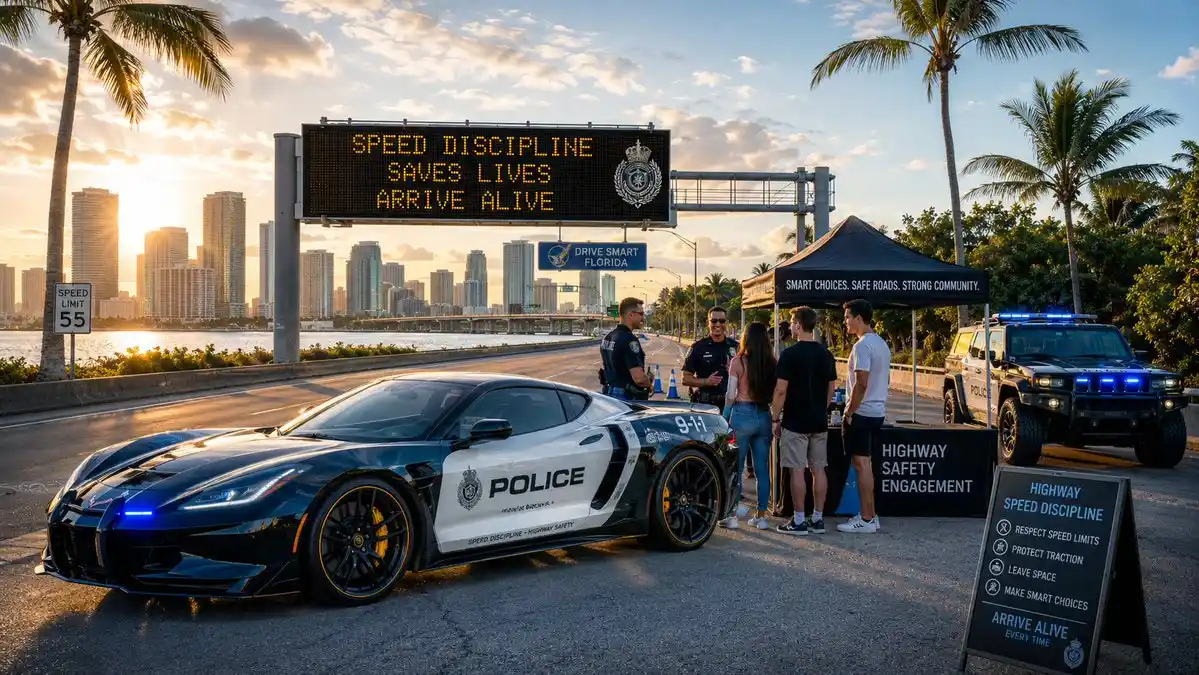
4. Mission Requirements and the Gates of Entry
The architecture now knows what belongs inside the system. The next task is to define the promises it must keep.
A regular vehicle and a specialist vehicle do not need identical strengths. They do need clear minimums, evidence, and boundaries.
Fit the human
The patrol spine must support two fully equipped officers without critical interference between body armor, duty belts, doors, seats, consoles, and essential controls.
The driver must be able to reach emergency functions without navigating several software layers. Visibility must be treated as a safety capability, not a styling decision. The cabin must support long shifts without turning ordinary discomfort into fatigue, distraction, or injury.
Carry the mission
- A patrol platform must carry its assigned officers, detainees, evidence, medical supplies, radios, computers, traffic tools, and seasonal equipment without exceeding safe payload, axle, tire, braking, or structural limits.
- A specialist platform must carry the equipment that makes it special.
- A rescue vehicle with no organized rescue bay is merely an off-road vehicle. A command vehicle with improvised wiring is merely a large cabin. A performance vehicle with no education program is merely a performance car.
Sustain electrical work
Police vehicles frequently remain stationary while radios, emergency lighting, computers, cameras, and HVAC continue operating. Federal alternative-fuel guidance identifies police vehicles as strong candidates for auxiliary-power and idle-reduction systems because those electrical and thermal loads continue while the vehicle is stopped.[7]
The design must measure both:
- the energy required to move;
- and the energy required to serve while not moving.
Survive degradation
Essential operation should not depend exclusively on a functioning public charger, a cellular connection, a cloud service, a single low-voltage battery, one software controller, or a perfectly functioning primary energy system.
Degraded operation does not mean full performance after every failure.
It means retaining the minimum safe capability needed to communicate, protect occupants, preserve heat, recover essential data, and reach assistance.
Remain repairable
Access to parts, diagnostic tools, qualified technicians, isolation procedures, and replacement modules is part of the architecture.
A fleet is not resilient if a damaged sensor, proprietary lock, unavailable component, or minor collision removes a vehicle from service for weeks.
Remain legitimate
The public should be able to understand the mission without decoding technical language.
A sound explanation is:
This vehicle exists to carry rescue, medical, drone, communications, and emergency-power equipment into conditions where the regular patrol fleet cannot safely perform the mission.
A weak explanation is:
This vehicle demonstrates innovation and enhances presence.
The first states public value. The second hides the absence of a mission.
The Seven Gates
Gate 1 – Patrol reality
Can the vehicle carry the daily police burden safely, repeatedly, and under full equipment load?
Current purpose-built police utilities show why this gate matters. Ford describes the Police Interceptor Utility as purpose-built and upfit-friendly, while GM’s current Tahoe PPV includes a police-rated suspension and heavy-duty braking package.[1][3]
Gate 2 – Efficiency and highway logic
Can the vehicle travel long distances without wasting unacceptable energy, tire life, brake life, or fleet money?
Lower and cleaner body forms retain a physical advantage at highway speed because aerodynamic drag rises rapidly with velocity. The sedan’s lesson is not nostalgia. It is energy discipline.
Gate 3 – Utility and integration
Can the platform accept radios, computers, cameras, emergency lighting, medical equipment, detainee systems, and future modules without becoming a wiring maze?
The equipment should serve the officer. The officer should not spend the shift working around the equipment.
Gate 4 – Energy resilience
Can essential systems remain alive when the primary energy path or external infrastructure becomes unavailable?
An emergency vehicle must be evaluated not only at full charge or with a full tank, but at the moment when the expected source of energy has failed.
Gate 5 – Terrain and disaster access
Can the vehicle enter the roads, weather, and geography assigned to it without encouraging unsafe overconfidence?
Off-road capability expands the routes available to an officer; it does not make every route or obstacle safe. Officers may select lawful access routes according to operational need, but they must still account for moving water, unstable terrain, bridge-load limits, tire capability, vehicle clearance, visibility, and available recovery support.
Gate 6 – Speed discipline and public signal
Can a performance platform translate attention into measurable safety education, recruitment, technical literacy, or responsible-driving engagement?
A vehicle that attracts attention but produces no public benefit fails.
Gate 7 – Badge legitimacy
Can the agency explain the platform’s purpose, cost, operators, utilization, restrictions, and outcomes?
The badge gate is not softer than the engineering gates. It is the gate that prevents capability from becoming vanity.
Role score and the no-compensation rule
A machine does not receive one universal score. It receives a role score.
The judgment has four parts:
- Mission fit: does it solve the assigned problem?
- Evidence confidence: is the claim proven, supported, or still conceptual?
- Implementation maturity: is the capability in production, prototype, or architecture?
- Residual risk: what remains dangerous, expensive, uncertain, or unverified?
Some failures cannot be averaged away.
- High speed cannot compensate for failed officer ergonomics in a patrol vehicle.
- Terrain capability cannot compensate for unsafe tires, braking, mass, or route limits.
- Public attention cannot compensate for the absence of a public mission.
- Electric range cannot compensate for failure to preserve emergency recovery.
- A high average score cannot compensate for failed occupant safety, lawful control, maintainability, or badge legitimacy.
That is the no-compensation rule.
It keeps scoring from becoming a method for flattering a preferred machine.
5. Vehicle Morphology: Why No Single Body Wins
Vehicle shape determines what a machine can carry, where it can go, how officers enter it, how it handles, how much energy it uses, and what message it communicates.
No single body can optimize every one of those conditions.
The sedan teaches efficiency
A sedan or low fastback offers reduced frontal area, lower visual mass, stable highway movement, and efficient long-distance operation.
It remains useful for detectives, supervisors, surveillance, court and liaison work, traffic duties, and missions that do not require the full patrol load.
Its limitation is volume. Once asked to carry two equipped officers, a detainee cell, medical supplies, electronics, evidence, traffic equipment, and winter gear, the sedan begins to sacrifice the qualities that made it attractive.
It should become a specialist layer.
It is the efficiency blade, not the whole fleet.
The pursuit utility teaches useful volume
The pursuit utility provides space, entry height, visibility, detainee capacity, cargo flexibility, and room for modern police electronics.
That is why it has become the dominant patrol form.
Its danger is uncontrolled growth. A taller and heavier vehicle brings larger aerodynamic loads, greater tire and brake burden, more energy demand, and more difficult urban packaging.
The future patrol spine should recover the discipline of the sedan while retaining the usefulness of the utility vehicle.
The pickup teaches work capacity
A pickup provides towing, payload, open cargo, and rugged worksite capability. It may be appropriate for marine support, towing, animal control, rural equipment, maintenance, or specialized logistics.
But an open bed is not an organized command bay. Radios, batteries, medical equipment, drones, evidence, computers, and rescue gear benefit from security, weather protection, thermal control, and immediate interior access.
The pickup remains valuable. It is simply not the universal answer.
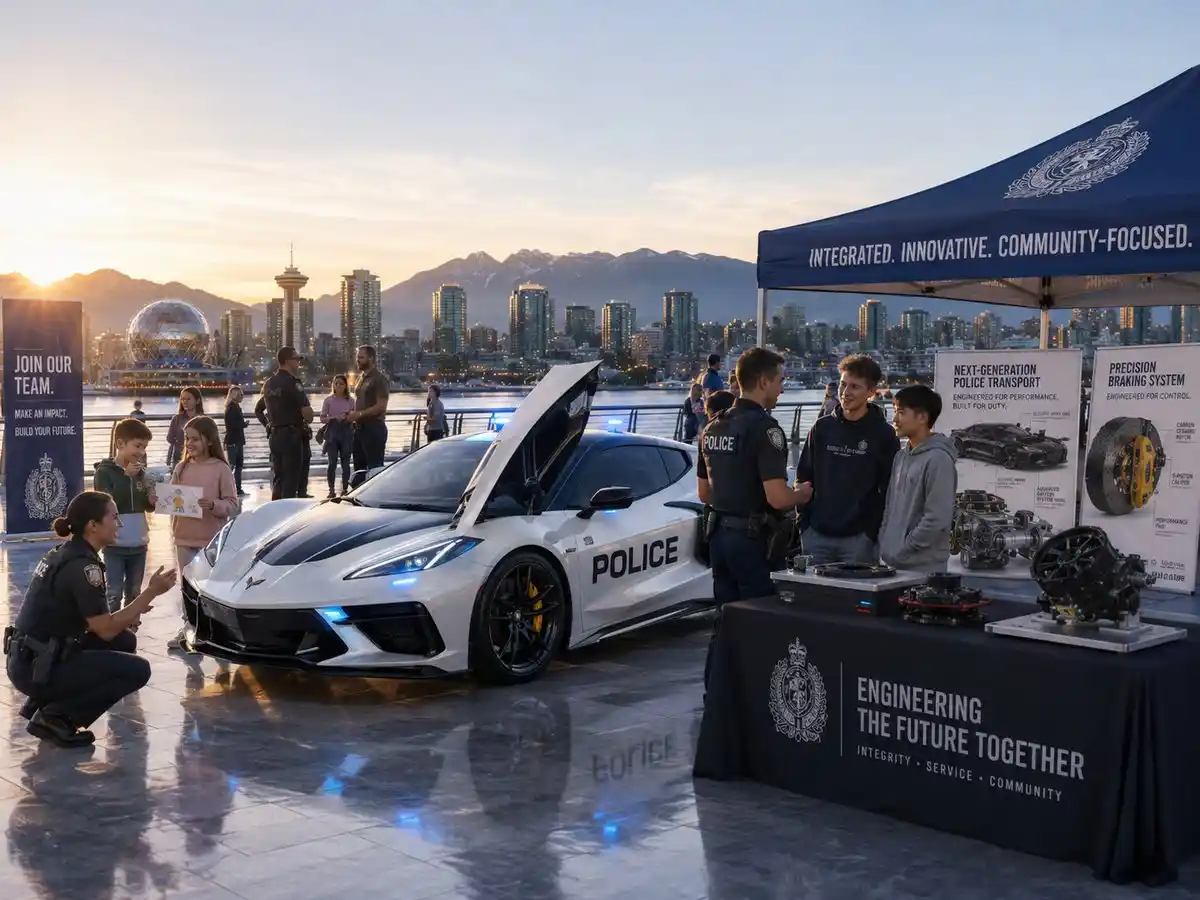
The performance coupe teaches signal concentration
A performance coupe is poor at detainee transport, cargo, officer entry, ground clearance, and routine patrol.
It can, however, concentrate public attention in a way that a normal patrol vehicle cannot.
That attention is useful only when it is converted into a disciplined program.
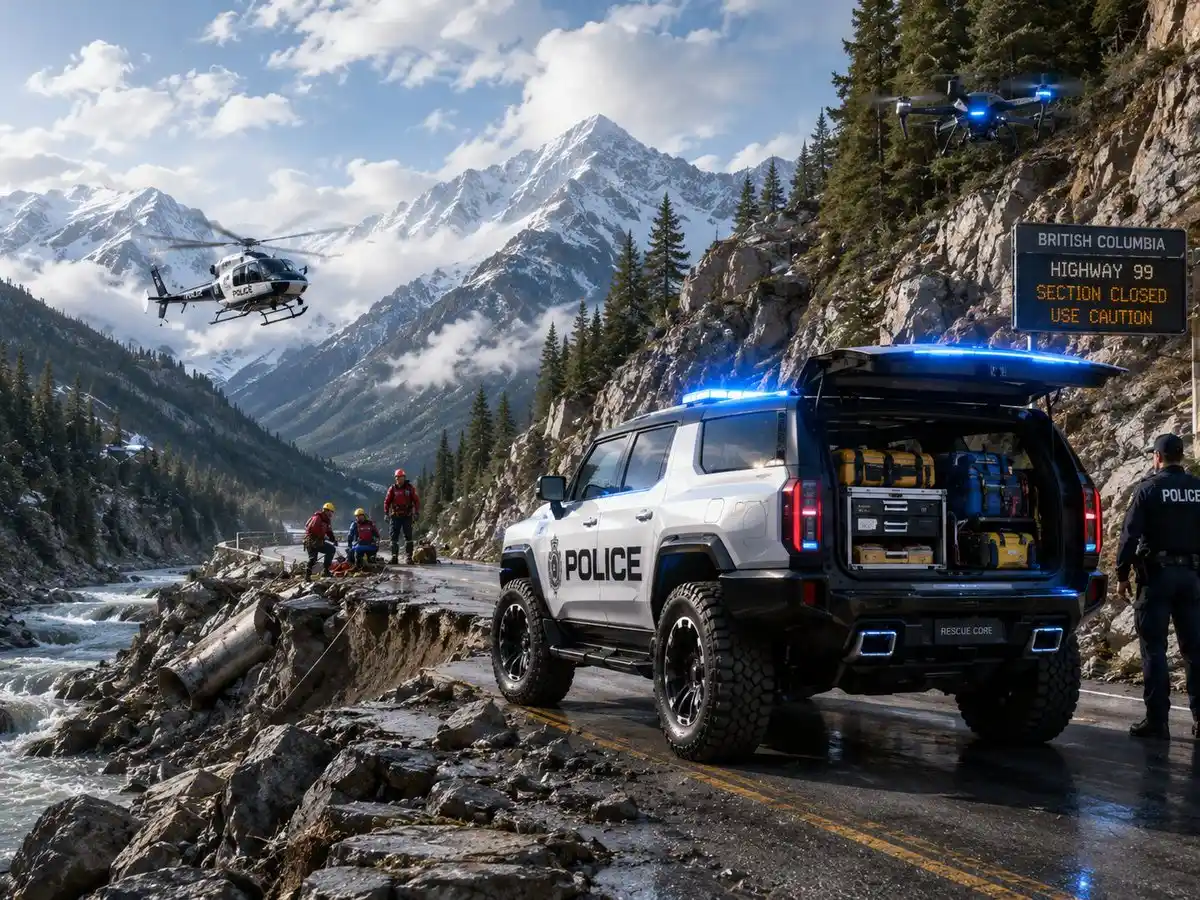
The off-road SUV teaches resilience
A terrain-capable enclosed SUV can carry rescue, communications, medical, energy, and compact command equipment beyond the ordinary patrol envelope.
Its weaknesses are equally real: mass, tires, brakes, cost, repair complexity, route limits, and public-optics risk.
It must remain rare, governed, and assigned to missions that justify its existence.
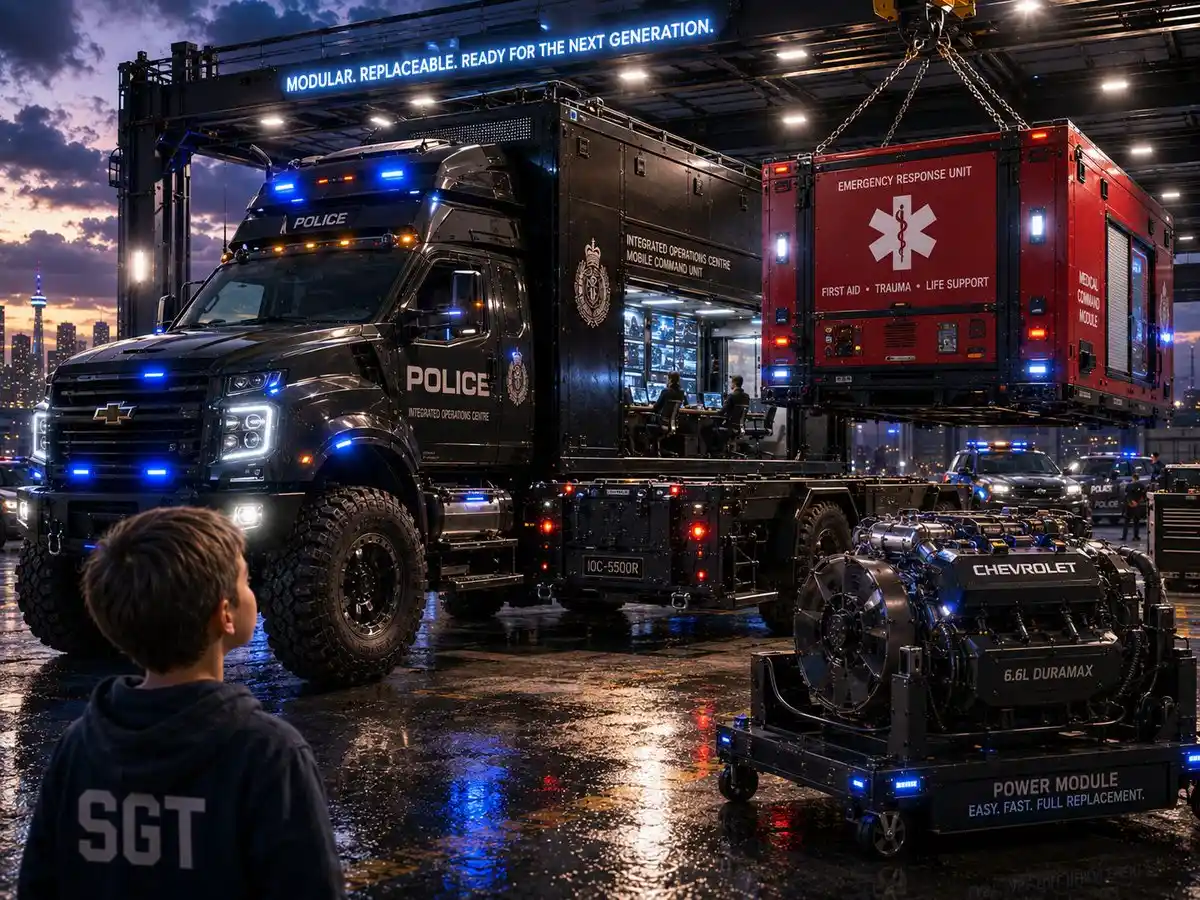
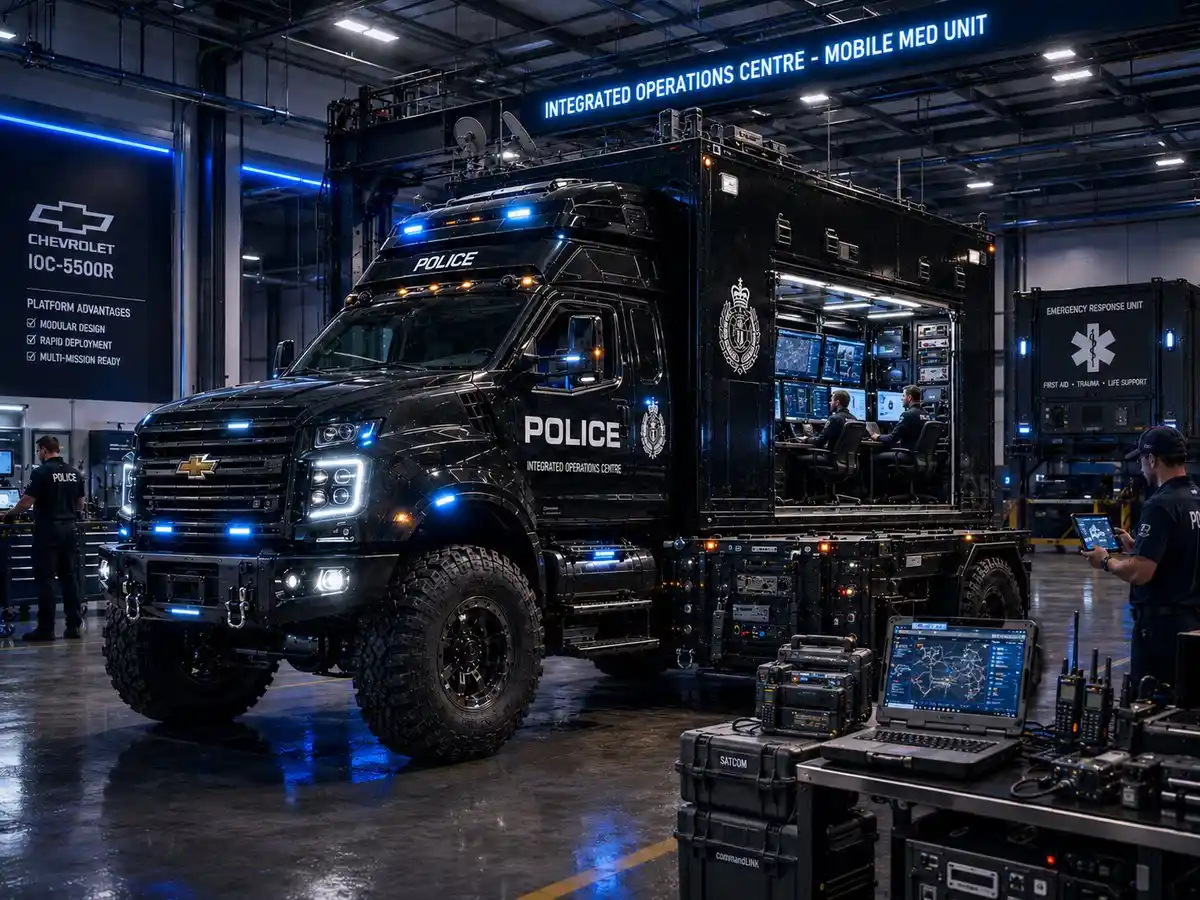
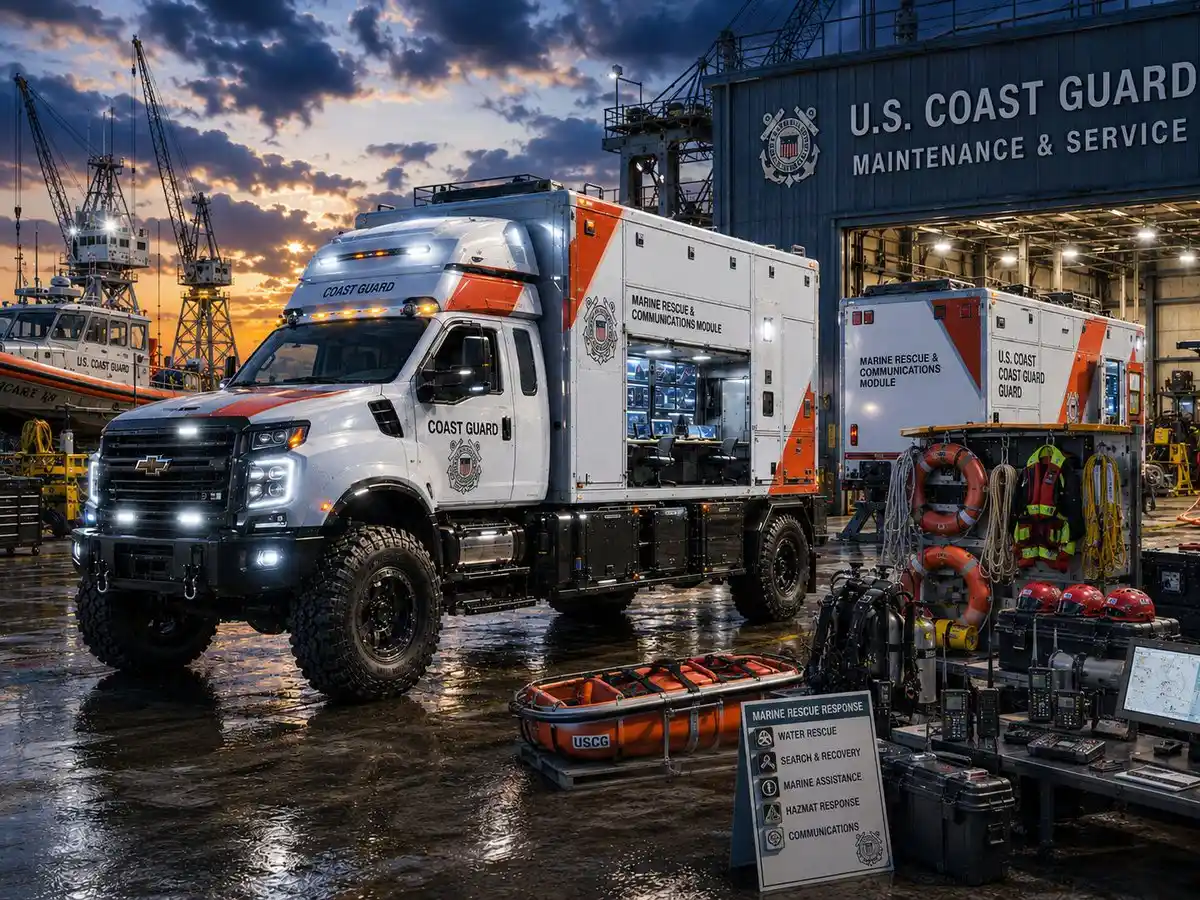
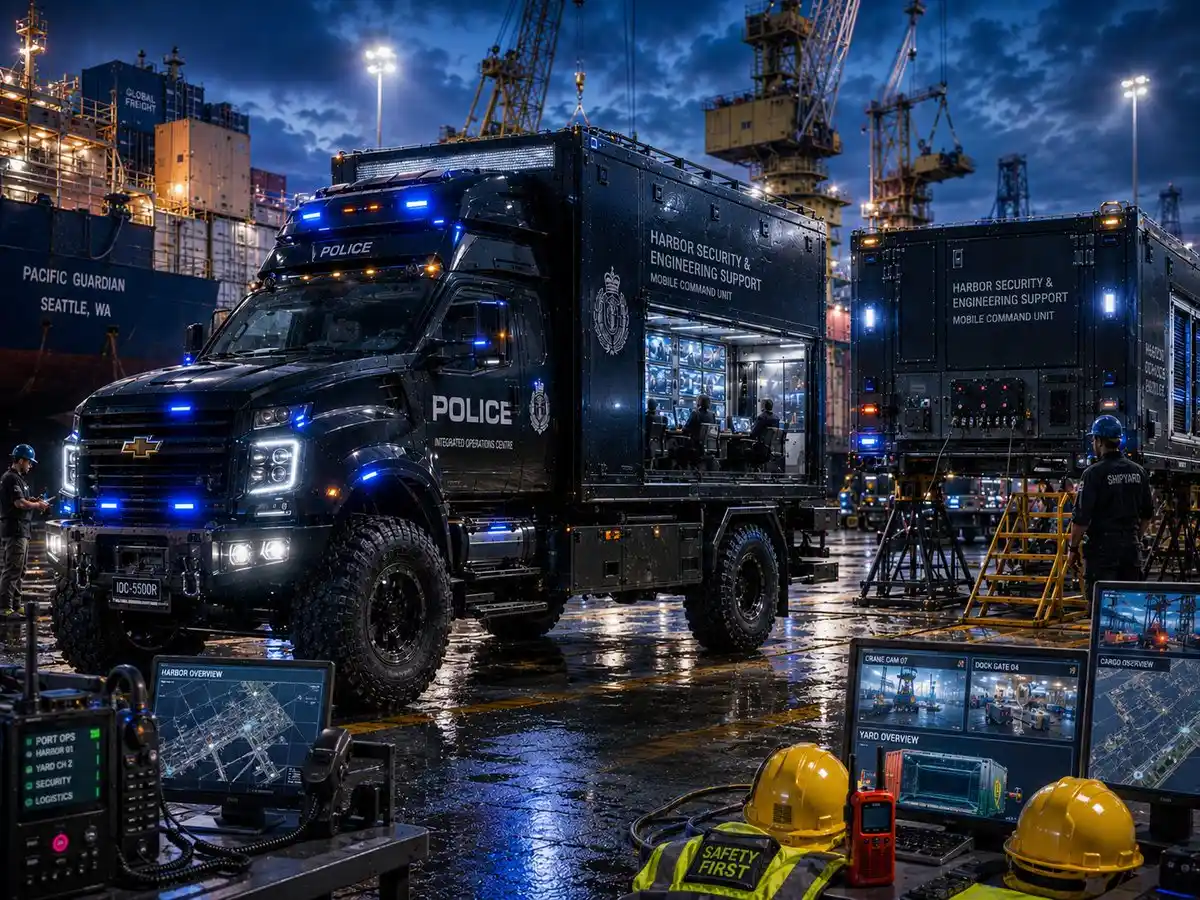
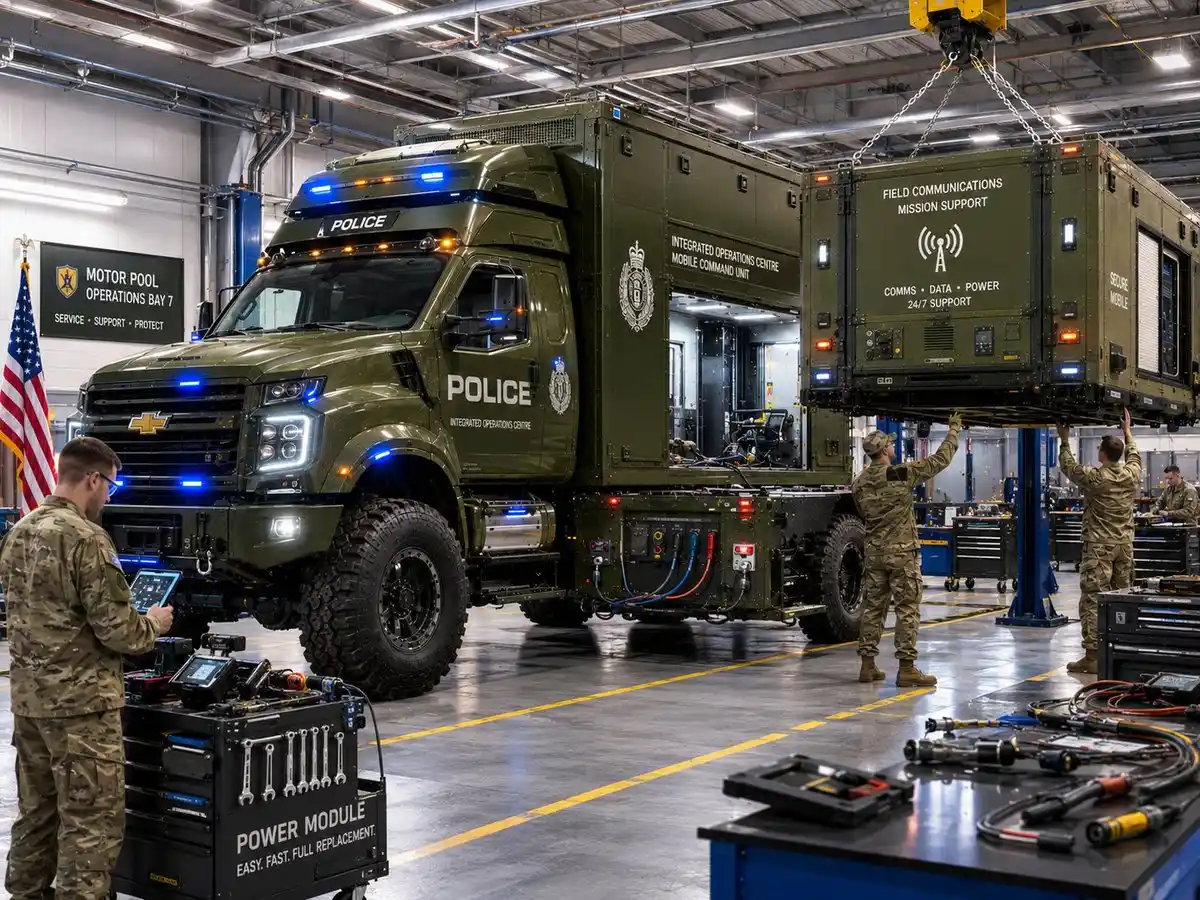
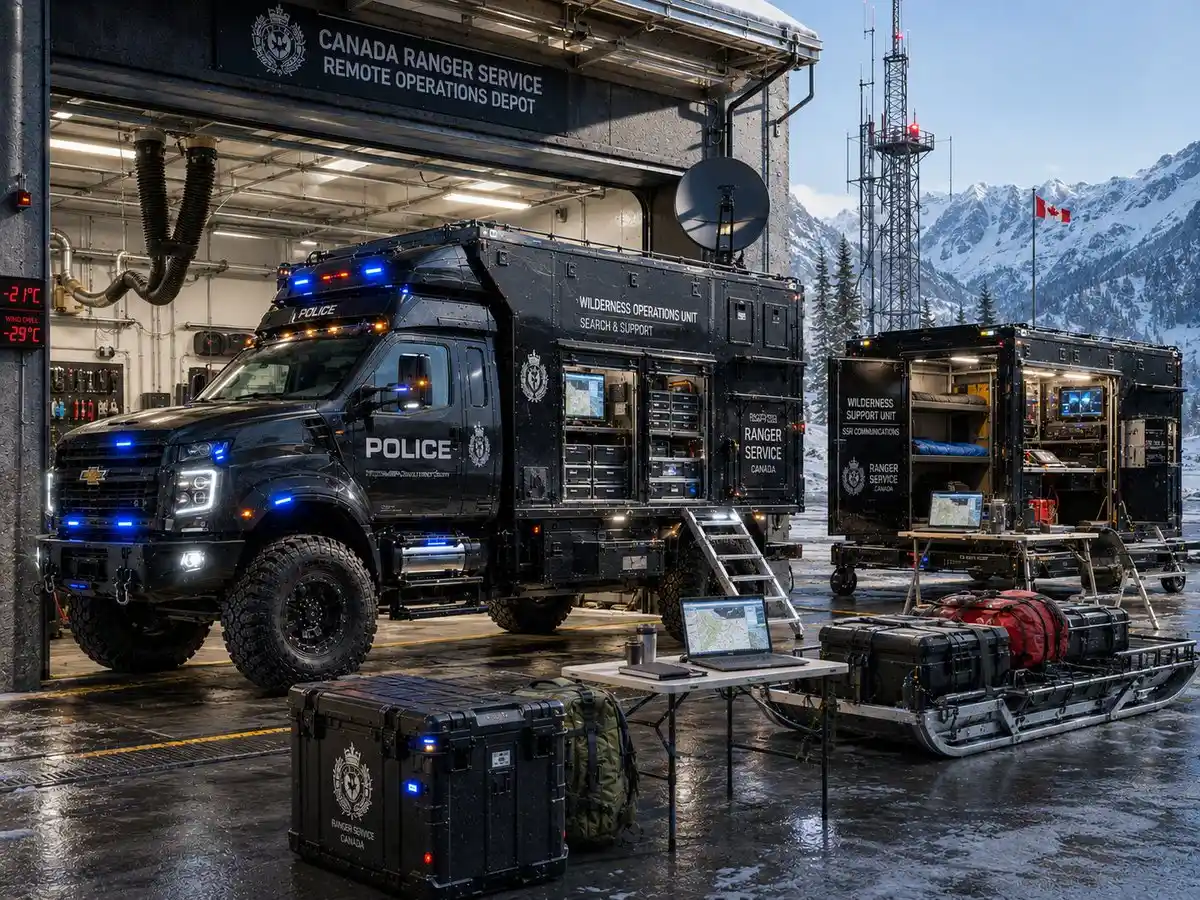
The Integrated Operations and Resilience Command Truck
Chevrolet IOC-5500R Lead-Reference Concept
The command vehicle addresses a capability that none of the other fleet members can provide at the same depth.
The patrol spine carries the ordinary police mission. The efficiency blade reduces the burden of lower-load movement. The Corvette-class platform concentrates speed discipline and public engagement. The Hummer-class Emergency Resilience SUV carries rescue, energy, communications, and compact command toward the edge of infrastructure.
The command truck creates the protected space in which several agencies, information streams, communications systems, and responsible decision-makers can work together through a prolonged incident.
It does not merely carry equipment.
It carries coordinated continuity.
The first-principles mission
A command vehicle is not fundamentally a room on wheels.
Its real purpose is to preserve the chain through which an incident can still be understood, governed, communicated, and resolved.
That chain includes:
- accountable human command;
- trusted information;
- interoperable communications;
- a common operating picture;
- resource coordination;
- public information;
- decision records;
- electrical and thermal support;
- and the ability to transfer command when the vehicle itself can proceed no farther.
A large truck filled with screens but unable to operate without commercial networks is not a resilient command system.
A connected command centre with no local records, offline maps, or protected radio path remains dependent.
A powerful vehicle that cannot be repaired, recovered, or safely loaded is not durable.
The first-principles object is therefore not the truck.
It is command continuity.
LAWFUL AUTHORITY | v HUMAN COMMAND | v TRUSTED INFORMATION | v COMMUNICATIONS + COORDINATION | v RESOURCE AND PUBLIC-SAFETY ACTION | v RECOVERY + TRANSFER OF COMMAND
The truck exists to preserve that chain.
Why a conventional command van is incomplete
A conventional command van provides standing room, workstations, communications equipment, and multi-person coordination.
Its weakness is physical.
Increasing interior volume generally increases:
- mass;
- body length;
- wheelbase;
- rear overhang;
- turning radius;
- roof loading;
- braking and tire burden;
- heating and cooling demand;
- levelling requirements;
- deployment complexity;
- and dependence on wide, stable, intact roads.
A larger command room may therefore become less capable of reaching the incident it was created to support.
The next-generation answer should not be the largest command vehicle that can be purchased.
It should provide:
The greatest useful command capability per kilogram, per kilowatt, per operator, and per square metre.
Why the Chevrolet 5500-class platform
The proposed lead-reference platform is the Chevrolet Silverado 5500 HD 4×4 chassis cab.
The current production platform is available in regular- and crew-cab configurations, 2WD or 4WD, and multiple wheelbases intended for specialized upfitting. Its 17,500- to 19,500-pound gross-vehicle-weight range creates substantially more design margin than a light-duty pickup while avoiding the uncontrolled growth of a full-size bus or tractor-based command centre.[12]
Those production facts do not prove the IOC-5500R.
They establish only that Chevrolet offers a credible medium-duty foundation on which the proposed command architecture could be engineered.
The final platform must still be selected through:
- full-payload analysis;
- axle and tire loading;
- braking and stability tests;
- turning and mobility studies;
- body-integration engineering;
- maintainability;
- lifecycle cost;
- parts support;
- and competition against alternative manufacturers.
Chevrolet is the lead-reference candidate.
It receives no permanent procurement entitlement.
Mission
The IOC-5500R should establish, preserve, or restore command during:
- major urban incidents;
- highway closures;
- wildfire and evacuation operations;
- flood and severe-weather response;
- rural search operations;
- industrial emergencies;
- communications outages;
- prolonged investigations;
- temporary public-safety coordination;
- infrastructure disruption;
- and incidents requiring several agencies to operate from one common picture.
Where lawful agreements permit, it should support coordination among police, fire, emergency medical services, transportation agencies, utilities, municipalities, emergency management, and search-and-rescue organizations.
It should not replace a permanent emergency operations centre.
It should provide command when the permanent centre is unavailable, too distant, overloaded, disconnected, or operationally unsuitable.
Form
The strongest body is a compact, fixed-width, walk-in command module mounted on a governed subframe.
Its proposed layout includes:
- four permanent operator workstations;
- one incident-command position;
- one flexible communications or technical position;
- standing room;
- a protected central aisle;
- crash-safe storage and equipment retention;
- one principal operations display;
- rugged removable computers;
- modular communications and computing cartridges;
- a rear technical bay separated from the human workspace;
- an upward-opening side canopy;
- and deployable exterior workstations.
The IOC-5500R should not attempt to place an entire headquarters inside one truck.
Larger incidents should expand through portable shelters, folding workstations, rugged computers, communications kits, and other vehicles in the architecture.
The truck carries the command core.
The system creates the wider command environment.
Lightweight command body
Every kilogram inside the command body must justify its effect on payload, braking, stability, energy demand, and mobility.
The proposed body should use:
- an aluminum structural frame;
- lightweight sandwich wall and floor panels;
- composite roof skins and secondary exterior panels;
- aluminum-honeycomb or qualified composite work surfaces;
- lightweight modular cabinets;
- removable equipment drawers;
- governed mounting rails;
- and low-mounted heavy equipment.
Traditional wood cabinetry should not be carried merely because it is familiar.
Large fixed server racks should not be carried when compact removable computing can perform the mission.
Walls of permanent displays should not be installed when one principal display, rugged operator computers, and a deployable briefing display provide better flexibility.
Room-sized slide-outs should be rejected unless testing proves that their additional workspace outweighs their:
- mass;
- actuators;
- structural reinforcement;
- seals;
- levelling burden;
- wiring complexity;
- maintenance requirements;
- and failure exposure.
The objective is not a fragile ultralight structure.
It is disciplined mass.
Steel remains where crash, chassis, towing, suspension, or recovery loads require it. Aluminum remains where structural repairability matters. Composites are used where they reduce secondary mass without creating unacceptable inspection or repair problems.
Remountable architecture
The expensive command body should not be permanently trapped on one generation of chassis.
The subframe should govern:
- mechanical mounting;
- electrical power;
- data connections;
- environmental control;
- mission-energy connections;
- external communications;
- and body-control interfaces.
This creates the possibility of:
- removing the command module for major repair;
- updating it independently of the drivetrain;
- transferring it to a future compatible chassis;
- replacing obsolete communications or computers;
- and preserving the useful structure through several technology cycles.
The longevity principle is not that one engine, battery, computer, or truck remains unchanged until 2070.
It is:
Build the expensive structural skeleton for continuity. Replace the technological nervous system through controlled modules.
Interior operations
The interior should be designed around people performing command under stress.
Operators must be able to:
- enter and leave without obstruction;
- see the principal operating picture;
- communicate without excessive noise;
- work in body armor where required;
- reach emergency controls;
- identify degraded modes;
- secure equipment before movement;
- and transfer command rapidly.
The interior should use neutral task lighting for sustained work, controlled blue lighting for low-light operations, and emergency illumination on a protected circuit.
Displays should communicate operational truth rather than decorative complexity.
The command crew should be able to determine:
- which communications paths remain available;
- which systems have failed;
- what information is verified;
- what energy remains;
- which loads have been disconnected;
- and what operational limits now apply.
Technology should reduce cognitive burden.
It should not convert the command cell into another system that must be managed during the emergency.
Computing
The command truck should use rugged removable computers rather than making the vehicle dependent on permanently installed proprietary workstations.
The proposed computing layer includes:
- rugged docked laptops;
- a low-power local server;
- encrypted removable storage;
- a compact principal display;
- a deployable projector or portable display for external briefings;
- and an optional removable edge-computing module.
Local computing may support:
- mapping;
- incident records;
- communications management;
- transcription;
- translation;
- video search;
- drone imagery;
- resource tracking;
- and information fusion.
Artificial intelligence may accelerate analysis.
It may not become the condition for command.
Failure of the AI processor, local server, or advanced display must not eliminate essential radio, local maps, incident logging, emergency power, or accountable human control.
Communications depth
The command truck should not rely on one network.
Its communications architecture should include several paths whose failures are not perfectly shared:
- public-safety land-mobile radio;
- more than one commercial carrier where practical;
- satellite communications;
- local encrypted wireless networking;
- direct vehicle-to-vehicle links;
- deployable wired Ethernet or fibre;
- offline maps;
- locally retained procedures;
- and direct unit communication.
A retractable mast may support antennas, cameras, or temporary communications equipment.
Large permanent rooftop systems should be avoided when smaller deployable equipment can provide the same function with less mass, drag, height, and maintenance burden.
Loss of wide-area communications should reduce reach.
It should not eliminate local command.
Energy architecture
The command truck must distinguish the energy required to move from the energy required to command.
The propulsion system may remain functional while the command cell loses power.
The command cell may retain power while the drivetrain is unavailable.
Those conditions require separate measurement, protection, and control.
The proposed architecture therefore includes:
- the primary vehicle electrical system;
- a separately managed mission-energy reserve;
- shore-power input;
- sustained auxiliary generation;
- a protected emergency bus;
- controlled charging;
- and deliberate load shedding.
The command-energy hierarchy should prioritize:
- essential radio and communications;
- emergency lighting;
- minimum heating, cooling, and ventilation;
- local maps and incident records;
- essential computing;
- principal command displays;
- ordinary operator equipment;
- convenience loads.
The system should disconnect lower-priority loads before uncontrolled voltage collapse.
The operator should always know:
- which energy source is active;
- how much reserve remains;
- how long essential operations can continue;
- which loads have been shed;
- and which actions are prohibited.
The command truck should be capable of infrastructure-independent essential operation for a defined and tested period.
That period must be derived from actual communications, computing, lighting, environmental, and operator-support loads.
It must not be invented for appearance.
All-road mobility
The IOC-5500R should be more mobile than a conventional bus-based command vehicle.
It should not pretend to possess unlimited off-road capability.
Its intended operating envelope includes:
- paved roads;
- broken pavement;
- snow-covered routes;
- gravel roads;
- maintained forestry or resource roads;
- shallow mud and ruts;
- construction access;
- uneven emergency staging grounds;
- and inspected disaster-damaged routes.
Its proposed mobility equipment includes:
- four-wheel drive;
- suitable commercial all-terrain tires;
- meaningful tire sidewall;
- protected vulnerable underbody systems;
- rated front and rear recovery points;
- a full-size spare;
- properly sized self-recovery equipment;
- controlled rear load levelling;
- protected cooling;
- and heavy equipment positioned as low as practical.
The vehicle should be tested at full mission payload.
The tested envelope — not its size, appearance, tire pattern, or marketing —defines where it may operate.
It should not enter:
- moving floodwater;
- structurally uncertain bridges;
- severe side slopes;
- deep mud;
- extreme rock terrain;
- or routes from which safe recovery cannot be planned.
The machine should bring command closer to disruption.
It must not manufacture confidence beyond its physical limits.
The no-compensation rule
No capability elsewhere may compensate for failure of:
- occupant safety;
- braking and controllability;
- payload and axle limits;
- tire capacity;
- thermal control;
- communications continuity;
- protected emergency power;
- cybersecurity isolation;
- maintainability;
- recovery;
- lawful mission;
- or safe transfer of command.
Additional screens cannot compensate for failed environmental control.
Four-wheel drive cannot compensate for excessive rear overhang or unsafe loading.
Satellite communications cannot compensate for loss of local radio.
A generator cannot compensate for a shared controller that disables every power path.
A visually impressive command body cannot compensate for inability to reach, operate, or leave its assigned staging area.
A high average score cannot erase a failed command-continuity gate.
Command beyond the truck
The IOC-5500R should not be forced to imitate the Hummer-class Emergency Resilience SUV.
The command truck provides greater protected volume, endurance, communications depth, and multi-person coordination.
The resilience SUV provides greater terrain reach, access, recovery, and forward mobility.
When the truck reaches the boundary of its safe operating envelope, a Field Command Reach Package transfers into the resilience vehicle.
That package may include:
- rugged computers;
- portable radio gateway;
- satellite terminal;
- independent batteries;
- compact display or projector;
- offline maps and command records;
- temporary shelter;
- scene lighting;
- and drone or sensor interfaces.
COMMAND TRUCK STOPS | v FIELD PACKAGE TRANSFERS | v RESILIENCE SUV CONTINUES | v LOCAL COMMAND SURVIVES
The command truck provides volume, endurance, coordination, and depth.
The Emergency Resilience SUV provides access, recovery, reach, and forward support.
The field-command package provides continuity after the truck stops.
No single body wins.
The architecture keeps command alive.
Truth boundary
The Chevrolet IOC-5500R remains a pre-prototype concept.
Its proposed command body, mission-energy system, communications architecture, all-road mobility, remountable interfaces, cybersecurity controls, and field-transfer system have not yet been physically demonstrated as one complete vehicle.
The concept must still pass:
- full-payload axle and tire analysis;
- braking and stability testing;
- turning and access studies;
- snow, gravel, and damaged-road trials;
- stationary energy and environmental endurance tests;
- grid-loss and communications-loss exercises;
- cyber-isolated operation;
- primary-power failure testing;
- command-package transfer;
- timed module replacement;
- technician repair trials;
- officer evaluation;
- and a small operational pilot.
The Chevrolet platform proves that a credible medium-duty chassis exists.
It does not prove the completed command architecture.
The truck earns its role only when evidence shows that it can preserve command without sacrificing safety, repairability, mobility, restraint, or human control.
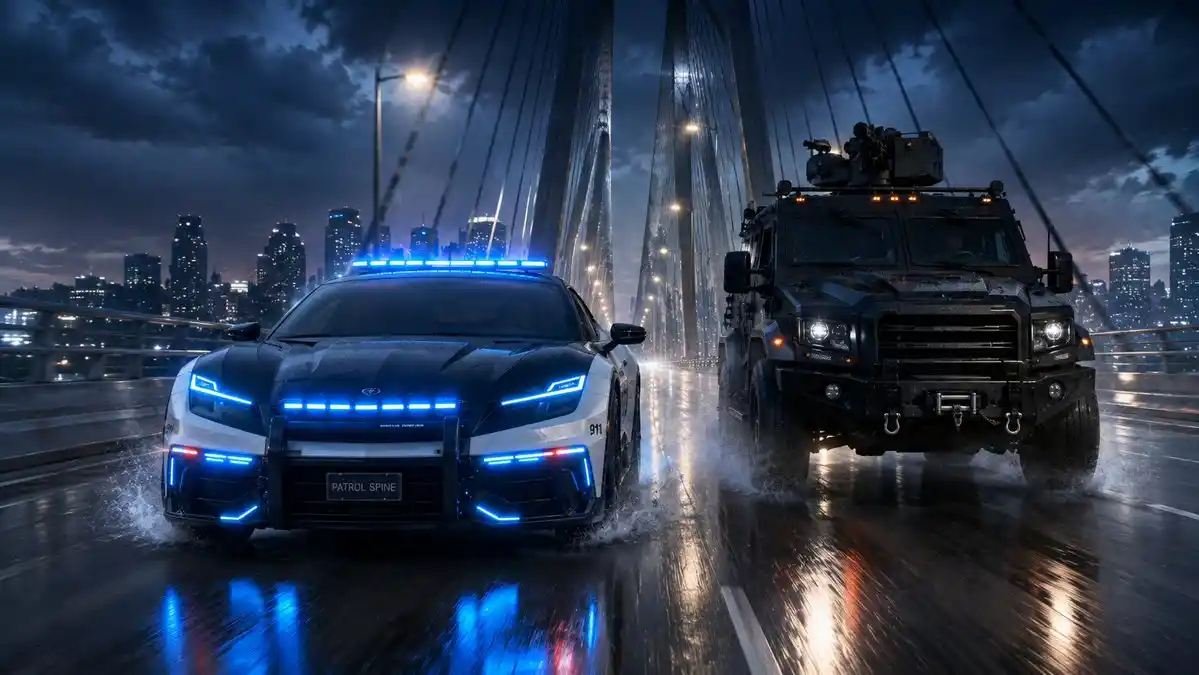
6. The Patrol Spine: A Low-Drag Pursuit Utility
The regular fleet carries most of the burden. It should receive the best engineering, not merely the lowest acceptable purchase price.
The future patrol spine should combine the low-drag discipline of a sedan with the interior usefulness of a police utility.
Form
The ideal body is a low pursuit utility or patrol fastback:
- lower and aerodynamically cleaner than a large conventional SUV;
- high enough for duty-belt access, winter roads, and reasonable curb tolerance;
- long enough for detainee and modular equipment space;
- and wide enough for two equipped officers without excessive interference.
Roof lighting, antennas, cameras, and sensors should be integrated rather than scattered across the roof as separate drag-producing objects.
The future patrol vehicle should look shaped by the air, not merely decorated by technology.
Cabin
The interior should be designed from the equipped officer outward.
The seat, door, belt anchor, center console, laptop mount, steering wheel, radio controls, and emergency switches should be evaluated with body armor and a complete duty belt.
Essential controls should remain tactile and immediately available. A large display may support information, but it should not become the only door to emergency command.
Rear architecture
The rear should accept controlled modules rather than one permanent arrangement:
- detainee transport;
- traffic and highway equipment;
- medical response;
- drone and sensor support;
- rural patrol;
- supervisor command;
- or mixed general cargo.
A module should connect through known mechanical, electrical, data, and cooling interfaces.
Changing the mission should not require rebuilding the vehicle.
Chassis and safety
The patrol spine should emphasize repeatable performance:
- predictable handling under full load;
- stable braking after repeated stops;
- all-weather traction;
- heat rejection;
- curb and pothole tolerance;
- safe tire and wheel margins;
- structural protection for occupants and equipment;
- and controllability after partial degradation.
The goal is not the most dramatic acceleration time.
The goal is a machine that can perform the thousandth demanding stop with the same discipline as the first.
Energy
The exact propulsion system may differ by geography.
Dense urban fleets may benefit from extensive electric operation. Large rural regions may require rapid refueling, longer reserve range, or a range-extending system. Cold climates may require greater thermal reserve.
The architecture does not impose one fuel ideology on every mission.
It imposes a performance requirement:
Efficient normal operation plus protected degraded operation.
The patrol spine is the shaft of the arrow. It carries ordinary reality. Everything else exists only because the spine already performs that role well.
7. The Fastback Crossover Efficiency Blade
Sedans should not return as the answer to every police mission.
Their advantages should not disappear either.
Not every officer movement requires a detainee cell, full emergency equipment, large ground clearance, and the weight of a patrol utility.
A lower and cleaner platform may remain better suited to:
- detective and investigative work;
- supervisor travel;
- surveillance;
- court and liaison duties;
- highway movement;
- training;
- and long-distance administrative travel.
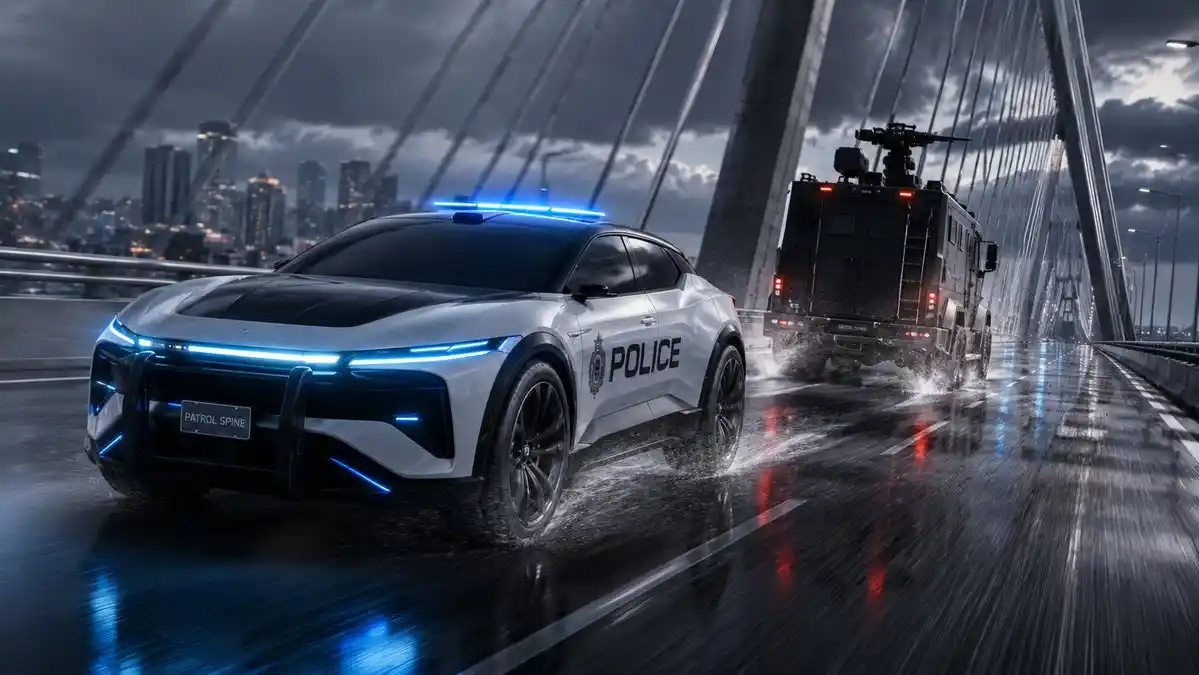
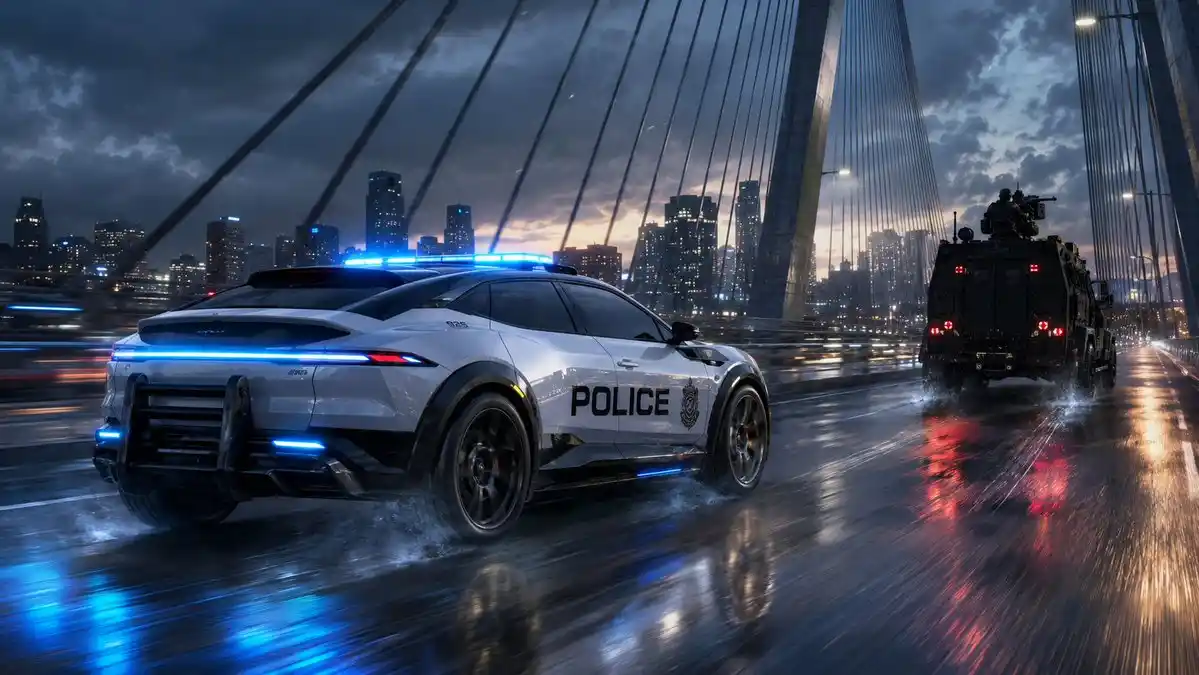
Where a traditional sedan is unavailable, a low fastback, wagon-like form, or efficient crossover may fill the function.
The important requirement is not the word sedan. It is lower aerodynamic burden, stable highway behavior, useful enclosed cargo, reliable service, low-profile appearance, and reduced energy use where the full patrol body is unnecessary.
The blade layer must remain controlled. It should not become a second fragmented fleet with unrelated controls, radios, software, parts, and maintenance tools.
Wherever possible, it should share communications equipment, data architecture, operator controls, diagnostics, and service standards with the patrol spine.
The sedan preserves efficiency.
The patrol spine carries the full load.
The architecture needs both lessons.
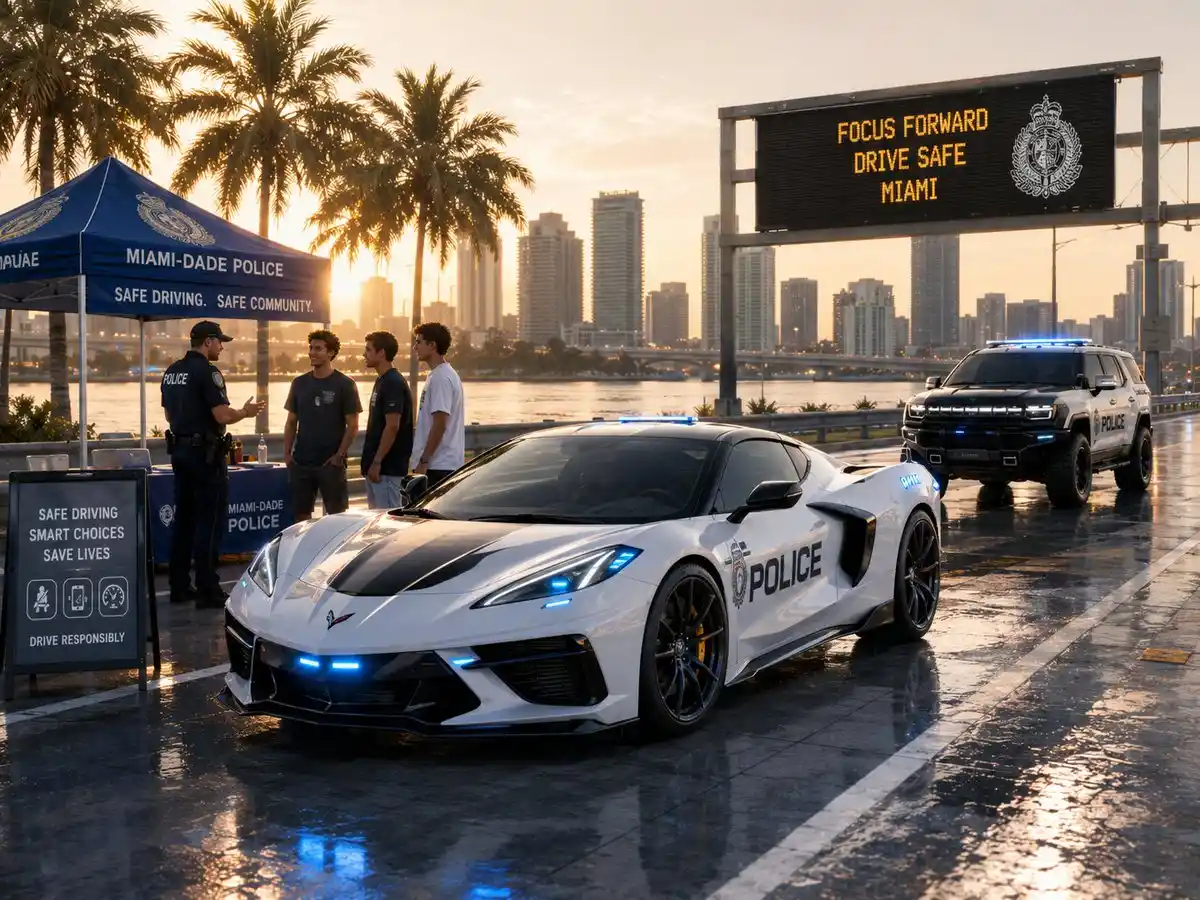
8. The Corvette-Class Speed-Discipline Arrowhead
A Corvette is not a patrol replacement.
That boundary must be stated before any argument for the vehicle begins.
It has limited cargo, poor detainee capacity, difficult duty-belt access, low clearance, specialized repair demands, and a significant risk of being interpreted as a status purchase.
It should not become a chief’s personal car, a routine pursuit vehicle, an excuse for uncontrolled fleet spending, or a public-relations ornament without measurable outcomes.
Yet performance culture exists.
Street racing, modified vehicles, braking limits, tires, reaction time, traction, road temperature, and driver discipline are real public-safety subjects.
A technically credible performance platform can open a conversation that a conventional marked utility cannot open in the same way.
The current Corvette E-Ray combines a gasoline V8 with a front electric motor and all-wheel drive. Chevrolet identifies it as a gas-electric AWD Corvette.[5] Those production facts make it a coherent reference for controlled, electrified performance rather than a maximum-power track fantasy.
But the platform earns its role only through the program around it.
A legitimate speed-discipline program could include:
- highway-safety education;
- responsible-performance events;
- technical discussions about tires, braking, traction, and reaction time;
- anti-street-racing outreach;
- recruitment of skilled drivers and technicians;
- engagement with schools and engineering programs;
- and collaboration with organized automotive communities.
The vehicle attracts the eye.
The institution must convert that attention into knowledge and restraint.
The charter
A Corvette-class arrowhead should enter service only with:
- no routine patrol or detainee role;
- no executive-personal-use role;
- a very small group of trained operators;
- measurable annual objectives;
- documented utilization;
- public reporting;
- and a termination rule if the program fails to produce value.
The Corvette is not justified because it is fast.
It is justified only if it can govern the meaning of speed.
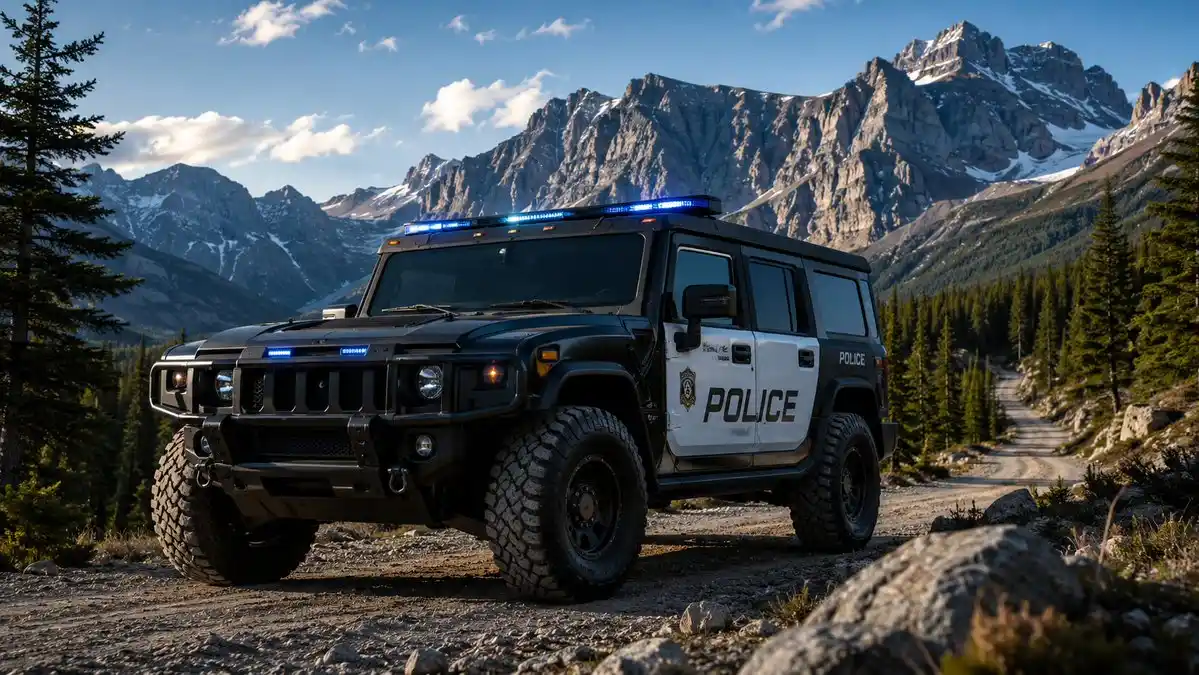
9. The Hummer-Class Emergency Resilience SUV
The second arrowhead addresses a different edge of the operating world.
It does not concentrate speed.
It concentrates access, power, rescue, and continuity.
A Hummer-class Emergency Resilience SUV could support rural rescue, severe-weather response, debris and damaged-road access, search and rescue, remote operations, medical equipment, drone deployment, communications relay, scene lighting, mobile energy, and compact auxiliary command.
It should not replace the patrol spine.
It should be sent where the patrol spine approaches the boundary of its mobility, energy, equipment, or command capacity.
Why enclosed volume matters
A pickup provides useful open cargo and towing.
The emergency-resilience mission requires protected systems: radios, maps, computers, drones, batteries, medical supplies, rescue gear, charged tools, and command displays.
These systems benefit from security, weather protection, climate control, organized mounting, and direct interior access.
That is why an SUV form is stronger than a pickup for this particular architecture.
What present technology proves
The production Hummer EV demonstrates useful directions, including high-capacity electrification, terrain-oriented design, and bidirectional power. GMC states that the 2026 Hummer EV offers vehicle-to-vehicle and vehicle-to-home power transfer when properly equipped.[6]
That does not make the retail vehicle a completed police-resilience platform.
A police architecture would still need protected communications and equipment bays, controlled electrical buses, recovery equipment, medical and drone modules, route and bridge analysis, tire and brake validation, field-repair provisions, cybersecurity controls, and a second-path recovery system.
The term Hummer-classdescribes the capability envelope.
It is not an instruction to purchase an unmodified showroom vehicle.
Strength without overconfidence
The platform’s mass may reduce access to weak bridges, soft ground, narrow trails, or some recovery routes. Large tires may be expensive or difficult to obtain quickly. Heavy batteries create recovery and fire-management challenges. A visually capable machine can tempt operators to enter terrain that should not be entered.
The architecture must therefore define route limits, water-depth and current limits, recovery requirements, tire and brake margins, bridge restrictions, and conditions in which the vehicle must stop.
The machine should inspire confidence.
It must not manufacture overconfidence.
Its public meaning should be clear: rescue, access, power, command, and continuity.
10. Dual-Path Resilience and the Human Fallback Engine
In ordinary automotive language, hybrid usually describes a powertrain that uses electricity and combustion to improve efficiency or performance.
For emergency vehicles, that definition is incomplete.
The important question is whether the two energy sources create a genuine second path.
A hybrid can still possess one critical failure domain. Both sources may depend on the same low-voltage battery, controller, cooling loop, software authorization, high-voltage contactors, or damaged wiring corridor.
Two energy sources do not automatically create resilience.
The electric path
Electric traction and stored energy can provide rapid low-speed torque, quiet movement, reduced stationary engine use, regenerative braking, emergency lighting, communications and computing power, heating or cooling, drone and tool charging, and external power.
Current police hybrids already demonstrate the usefulness of battery-supported auxiliary loads, while GM’s Blazer EV PPV demonstrates that a purpose-built pursuit-rated police EV is now a production category.[2][4]
The recovery path
A protected secondary path should preserve essential communications, minimum emergency lighting, cabin thermal survival, controlled charging, basic computing, and limited get-home mobility.
Its purpose is not full pursuit performance.
Its purpose is to prevent a manageable failure from becoming abandonment.
The Auxiliary Command Principle
Complex emergency systems often preserve a second means of command or power.
A ship has main and emergency power. A building has normal and emergency circuits. A command organization has primary and alternate command.
A public-safety vehicle should also distinguish:
- normal operation from degraded operation;
- networked control from offline survival;
- primary energy from emergency energy;
- full mobility from get-home mobility;
- and ordinary digital controls from protected emergency activation.
The vehicle should be most capable when everything works.
It should remain comprehensible when everything does not.
The Human Fallback Engine
The Human Fallback Engine is the proposed subsystem that gives physical form to the second path.
The most credible first version is not a complete duplicate drivetrain. It is a small, protected range extender or auxiliary generator connected to an emergency energy path.
PRIMARY TRACTION / NORMAL CONTROL | PRIMARY FAILURE | GUARDED ACTIVATION | FALLBACK CONTROLLER | EMERGENCY POWER BUS | | | | RADIO LIGHTS HEAT COMPUTE | CONTROLLED CHARGING | GET-HOME MOBILITY
Its minimum mission is modest:
- keep the radio alive;
- maintain essential lighting;
- provide minimum heat;
- recharge essential low-voltage systems;
- support controlled battery recovery;
- and provide reduced-speed movement toward safety.
The name matters because it keeps the purpose visible.
The electric system gives the vehicle modern capability. The fallback system gives the human being the last path home.
11. The Interfaces: Where the Architecture Becomes Real
The architecture now knows what every vehicle must do. The more dangerous question is what happens where the systems meet.
Complex systems often fail not because every major component was badly designed, but because good components were connected badly.
A radio draws more power than expected. A computer blocks an airbag zone. A drone charger overheats inside a closed cabinet. A software update affects a communications gateway. A rescue module changes rear-axle load. An emergency generator shares the failed low-voltage supply it was meant to rescue.
The architecture must govern what crosses every boundary.
Human-to-machine interface
The officer must know what mode the vehicle is in, how much reserve remains, which systems have failed, which loads were disconnected, how to enter degraded mode, and what the machine can no longer safely do.
A degraded vehicle should not communicate only through vague warning icons.
It should state the operational truth:
Primary traction unavailable. Communications and heat preserved. Get-home mode limited to defined speed and reserve.
Mechanical interface
Every approved police module should attach through known mounting points and load limits.
A medical module, detainee cell, drone bay, or command system must not be secured through improvised drilling into unknown structures.
The interface must define allowable mass, center-of-gravity limits, crash loads, attachment points, and removal procedures.
Electrical interface
The electrical architecture should distinguish safety-critical vehicle power, communications, emergency lighting, mission equipment, cabin survival, convenience loads, and emergency reserve.
When power becomes scarce, the vehicle should shed loads deliberately.
It should not wait for voltage collapse to decide what survives.
Data interface
Police equipment should exchange only the data required for its mission.
A printer does not need command access to propulsion. Infotainment does not need unrestricted access to evidence. Remote fleet management should not become an unexamined path into emergency controls.
NHTSA and Transport Canada both frame vehicle cybersecurity as a lifecycle discipline involving risk management, protection, monitoring, response, and recovery.[9][10]
Thermal interface
Batteries, radios, computers, chargers, power electronics, and auxiliary generators all produce heat.
That heat must be controlled during hot stationary operation, cold starts, closed-cabin charging, and prolonged emergency-power use.
A component that works in an air-conditioned laboratory may fail in a sealed command bay during a summer incident.
Maintenance interface
Technicians need physical access, understandable diagnostics, replacement procedures, isolation points, approved parts, and a way to restore essential function without dependence on an unavailable remote server.
A vehicle that can only be repaired by replacing large sealed assemblies may be viable in a consumer warranty model and still be unacceptable for a public fleet.
Governance interface
Every module, software service, energy system, and specialist role needs an owner.
Someone must be accountable for approving it, testing it, documenting changes, maintaining it, and removing it when it no longer serves.
The decisive question at every boundary is:
What passes through this interface, who controls it, and what happens when it fails?
12. How the Architecture Behaves When the World Goes Wrong
A credible architecture should be understandable through stories of failure, not only through lists of features.
The long winter night
A patrol vehicle remains at a road closure for hours in dangerous cold. Emergency lights, radios, computers, and heat are still required.
The architecture should preserve a defined mobility reserve, warn the officer before reserve energy becomes critical, and shed nonessential loads before the vehicle silently consumes the last path away from the scene.
The failed charger
An electric patrol vehicle returns with a low state of charge and the assigned charger is unavailable.
The system should know whether the vehicle can accept another source, whether it can be reassigned to a lower-demand mission, and when it becomes unavailable for emergency response.
The architecture must recognize the moment when a charger problem becomes a readiness problem.
The communications blackout
Wide-area data fails during a major incident.
The vehicle should retain local radio, direct unit communication, offline maps, locally stored emergency procedures, and basic incident logging.
It does not need to recreate the entire network.
It must preserve enough command to avoid becoming blind and isolated.
The failed update
A software update causes a fault in a noncritical system.
The architecture should isolate the affected function, preserve braking, steering, propulsion safety, communications, and emergency power, and allow controlled rollback or service recovery.
A convenience-system failure must not disable the public-safety mission.
Rural isolation
A resilience vehicle reaches a remote rescue area after severe weather. The road behind becomes impassable.
The platform should support local communications, medical and rescue equipment, drone reconnaissance, lighting, thermal shelter, and disciplined energy use.
Its operators should know exactly how long those functions can be sustained.
Primary energy failure
The traction system becomes unavailable.
The Human Fallback Engine starts from its protected activation path. The vehicle enters a restricted mode. Nonessential loads are shed. Communications, minimum lighting, heat, and essential computing remain available. The operator receives a plain-language display of reserve, allowable speed, remaining functions, and nearest recovery point.
Fallback mode must never be mistaken for ordinary operation.
Flood-edge response
A resilience vehicle approaches a flooded route.
Depth, current, road integrity, electrical-isolation status, escape route, and rescue doctrine determine whether it proceeds.
The vehicle’s ability to enter water does not create authority to enter moving water beyond controlled limits.
Damaged specialist module
A drone, medical, or communications module develops an electrical fault.
The system should isolate the module without disabling the entire platform. Technicians should be able to remove and replace it through approved interfaces.
A noncritical equipment failure should not take the whole vehicle out of service.
These scenarios make resilience observable.
They reveal whether the architecture is real.
13. Failure Modes, Residual Risks, and Honest Limits
A magnificent concept becomes credible when it describes what can still defeat it.
Common energy failure
A battery and emergency generator may both depend on the same failed low-voltage system.
The control is not merely another energy source. It is a separately protected activation and emergency-power path.
Shared software failure
A fallback controller may use the same software platform, update process, or authorization service as the primary vehicle.
The control is a smaller, separately verified controller with tightly limited functions and minimal external exposure.
Shared cooling failure
Primary traction and emergency generation may both depend on one cooling loop.
The control may require limited independent cooling, passive survival time, or a reduced-output mode capable of operating without full thermal support.
High mass
A large resilience vehicle can create heavy tire, brake, bridge, recovery, and road burdens.
The control is route assessment, axle-load control, tire support, braking validation, mass reduction, and the willingness to reject an oversized design.
Battery degradation
Capacity and power may decline through age, climate, repeated fast charging, and duty cycle.
The control is regular battery-health measurement and replacement planning based on emergency reserve, not merely consumer driving range.
Cold-weather loss
Cold temperatures increase heating demand and can reduce battery performance.
The control includes thermal preparation, protected equipment zones, reserve policy, climate-specific testing, and alternate energy where necessary.
Specialty-parts dependence
A rare platform may suffer long repair delays.
The control is very low fleet quantity, predetermined parts support, substitute mission plans, and a rule preventing any rare specialist platform from becoming a single point of failure.
False confidence in physical switches
A physical switch may feel independent while still commanding the same failed controller.
The control is verified electrical and logical separation.
The switch must activate a genuinely protected path, not simply a different user interface to the same system.
Public rejection
A Corvette- or Hummer-class vehicle may be interpreted as waste, militarization, or vanity.
The control is not better advertising. It is transparent purpose, measurable outcomes, strict use limits, visible public benefit, and willingness to end the program.
Mission creep
A specialist vehicle may drift into routine executive or patrol use.
The control is a written charter, operator authorization, utilization audit, and automatic review when use departs from the assigned mission.
Vendor capture
A proprietary platform may lock the agency into one software stack, service path, or equipment integrator.
The control is governed interfaces, diagnostic access, data portability, replacement rights, and competition at the module level where safety permits.
No architecture can eliminate every risk.
Its purpose is to make risk visible early enough that it can be reduced, accepted knowingly, or used to reject the concept before large-scale procurement.
A system becomes safer not when it claims certainty, but when it knows where certainty ends.
14. From Vision to Evidence
The architecture should move toward service through a disciplined sequence.
Not through excitement. Not through announcements. Not through a demonstration vehicle that quietly becomes permanent.
Establish the real baseline
Before designing the future fleet, measure the present one:
- mission hours;
- mileage;
- stationary operating time;
- fuel or electricity;
- tire and brake consumption;
- repairs and collision damage;
- upfit failures;
- officer discomfort;
- unavailable vehicles;
- and specialist-platform utilization.
The baseline prevents the project from comparing a measured prototype with an imagined conventional fleet.
Separate mission families
Patrol, highway, investigation, rural rescue, command, outreach, and training should not be blended into one impossible universal specification.
Each mission receives its own duty cycle and minimum requirements.
Build digital models
Model vehicle mass, payload, drag, energy use, thermal behavior, stationary demand, range, charging or fueling, braking, and degraded operation.
Simulation does not prove the machine.
It reveals where physical testing should concentrate.
Build interfaces before the showcase vehicle
Develop and test power buses, equipment rails, communications gateways, emergency-load priorities, module connectors, and isolation controls.
A beautiful prototype with improvised internals is not architecture.
Bench-test the second path
The Human Fallback Engine and emergency bus should first be tested outside a complete vehicle.
Test low-voltage failure, depleted battery, failed network, cold start, heat, load shedding, controller isolation, and prolonged operation.
A fallback system should prove that it can survive the failure it was created to answer.
Build the patrol demonstrator first
The first complete vehicle should be the patrol spine because that is where most public value exists.
It should prove officer-centered packaging, low-drag utility, modular equipment, repeatable braking, electrical endurance, maintainability, and degraded operation.
Test beyond acceleration
A serious police evaluation tests braking, dynamics, ergonomics, payload, thermal performance, and durability. Michigan State Police continues to publish model-year police-vehicle evaluations, providing an established real-world reference.[11]
A future program should add winter, heat, long-idle, grid-down, communications-loss, cyber-isolated, emergency-power, module-replacement, and get-home tests.
Pilot in small numbers
A pilot should compare the new platform with a defined baseline.
Every vehicle should have an assigned mission, trained operators, maintenance tracking, energy tracking, officer feedback, public-benefit measures, and documented failure events.
Preserve the option to stop
The process must allow four outcomes:
- scale;
- revise;
- restrict to a narrow role;
- or terminate.
Stopping can be evidence of a successful engineering process.
Scale slowly
Success in one climate, agency, or mission does not prove universal suitability.
Scale should proceed through bounded blocks with repeated reviews.
A compelling prototype is not permission to scale. It is permission to test again under harder conditions.
A vehicle does not enter the fleet because it is impressive.
It enters because it survives the gates.
The Sagittarius Principle, Sector 001, and the Badge
Once the engineering chain is complete, the doctrine can be stated.
Not as poetry replacing engineering.
As meaning revealed by engineering.
The Sagittarius Principle
A serious fleet does not scatter capability.
It forms it.
The public-safety institution is the bow.
Training, dispatch, maintenance, communications, policy, and legitimacy form the string.
- The low-drag patrol utility is the shaft.
- The sedan or fastback preserves the efficiency blade.
- The Corvette-class vehicle concentrates the speed-discipline effect.
- The Hummer-class vehicle concentrates rescue, power, terrain, and auxiliary command.
- The badge determines when the arrow may be released.
Draw capability inward. Form it. Aim it. Govern it. Release it only where it serves.
The patrol spine is not inferior to the special vehicles.
It is more important.
It carries the ordinary burden every day. The specialist platforms may remain rare precisely because the regular platform is excellent.
Sector 001
Police transport can be treated as Sector 001 in a wider renewal of public systems.
It is an ideal first sector because the public can see the machine.
Citizens may never see the data architecture, maintenance standards, energy models, failure analysis, or interface controls behind the vehicle.
They see the result.
They see whether technology appears coherent or improvised. They see whether power is restrained or theatrical. They see whether the machine was designed to serve people or dominate them.
Sector 001 demonstrates a larger rule:
Advanced public technology must remain explainable, repairable, auditable, bounded, resilient, and human-commanded.
- A technically excellent vehicle under a weak doctrine remains a weak public system.
- A sophisticated EV with no credible recovery path remains incomplete.
- A powerful specialist platform with no legitimate mission remains a governance failure.
The Badge Principle
The badge is not an image added after procurement.
It is the final systems constraint.
It asks whether the vehicle serves a real mission, whether the mission is stronger than the alternatives, whether the public can understand the purpose, whether technicians can keep the machine alive, whether officers can operate it when systems fail, whether use can be audited, whether the vehicle strengthens rather than fragments the fleet, and whether capability remains under human command.
- A Corvette without doctrine becomes spectacle.
- A Hummer without restraint becomes visual power without public purpose.
- A sedan without a clear mission becomes nostalgia.
- A patrol utility without continued engineering becomes inertia.
- An EV without degraded operation becomes dependence.
- A hybrid without fault separation becomes marketing.
The badge authorizes capability only after capability accepts limits.
Final verdict
The future police fleet should not be built around one fashionable body, one propulsion ideology, one manufacturer, or one impressive specialist machine.
It should be built around continuity of public service.
- The patrol spine carries the everyday world.
- The efficiency blade prevents the everyday world from becoming needlessly heavy.
- The Corvette-class platform concentrates attention into speed discipline.
- The Hummer-class platform carries rescue, power, and command toward the edge of infrastructure.
- The Human Fallback Engine preserves the final path when the normal path disappears.
- The interfaces make the machines work together.
- The failure doctrine prevents confidence from becoming blindness.
- The verification chain forces imagination to face evidence.
- The Sagittarius Principle forms the fleet.
Sector 001 makes the system visible.
The badge keeps every capability subordinate to service.
The fleet should not become louder merely because technology advances.
- It should become clearer.
- It should not become more complicated merely because more systems can be installed.
- It should become more coherent.
- It should not ask the human being to trust an invisible chain that cannot explain itself.
- It should reveal what remains, what has failed, and where the road home still exists.
The fleet should not sprawl. It should form.
That is how the vehicle earns the insignia.
- 👉 The Next-Generation Police Transport Architecture [Part 2]
- https://skillsgaptrainer.com/the-next-generation-police-transport-architecture-part-2/
Related articles and posts
- A brochure-metric change is one of the most realistic ways to force the vehicle market to think differently.
- https://x.com/SkillsGapTrain/status/2062375613097504895
- D.E.L.O.R.I.A.N. 001 SGT-TNG – X-File 1 – Thesis + Icon
- https://x.com/SkillsGapTrain/status/2075573855167689158
- THE FIRE THAT CAME BACK II [Part 1]
- https://x.com/SkillsGapTrain/status/2065610135897337864
- THE FIRE THAT CAME BACK II [Part 2]
- https://x.com/SkillsGapTrain/status/2065610411899257058
- The Fire That Came Back
- https://x.com/SkillsGapTrain/status/2064186145261695002
- Would Valentin Buy the Tesla CyberSUV? A Resilience Audit of the Future Car
- https://x.com/SkillsGapTrain/status/2060294542499381393
- Vehicles in a Contested World [Part 1]
- https://x.com/SkillsGapTrain/status/2059749203769979152
- The Resilience Vehicle Thesis
- https://x.com/SkillsGapTrain/status/1967015147282792476
- 🌏 The Quiet Shift North: How 🇰🇷 Korea and 🇯🇵 Japan Are Shaping the Auto Future in 🇨🇦 Canada
- https://youtu.be/kUH9g7X81oY
- 🇨🇦 Canada vs. 🇨🇳 China: Emissions, Policy, and Consequences
- https://x.com/SkillsGapTrain/status/1964632254321439000
- 🔻 THE EV DECEPTION: Engineering a Fragile Grid for AGI Control, Not Climate
- https://x.com/SkillsGapTrain/status/1935570823294910952