Public AI Systems Integrity Act
Model Act Generated from the NSIR / CLIP Clean-System Framework
Long Title
An Act to govern the use of artificial intelligence, automated decision systems, algorithmic decision support, and machine-assisted administrative processes in public administration; to ensure that such systems remain lawful, mapped, auditable, appealable, reversible, citizen-legible, and subject to meaningful human accountability; and to prevent artificial intelligence from amplifying unmapped, unappealable, unauditable, or democratically uncorrectable public systems.
Preamble
Whereas public administration increasingly uses artificial intelligence, automation, algorithmic systems, predictive analytics, generative systems, rules engines, risk models, triage tools, digital platforms, and vendor-provided decision-support systems;
Whereas such systems may improve public service, detect bottlenecks, support auditing, improve accessibility, assist public servants, and help citizens understand public systems;
Whereas artificial intelligence does not fix the public system it enters, but amplifies the quality, defects, incentives, data, authority, workflow, appeal structure, auditability, and governance of that system;
Whereas a lawful, mapped, appealable, auditable, reversible, citizen-legible, and well-governed public system may be strengthened by responsible AI;
Whereas an opaque, fragmented, unappealable, unauditable, legally unclear, vendor-dependent, or poorly governed public system may be made faster, larger, harder to challenge, and harder to reverse by AI;
Whereas public decisions affecting rights, benefits, eligibility, legal status, access, enforcement, liberty, privacy, public safety, housing, immigration, taxation, health, education, social services, policing, child welfare, procurement, or essential services must remain subject to democratic correction;
Whereas no public authority should use artificial intelligence to conceal responsibility, avoid explanation, weaken appeal, bypass lawful process, or substitute machine output for human accountability;
Whereas the purpose of AI in democratic government is not machine government, but machine-assisted self-government;
Therefore, Parliament enacts as follows.
Part 1 — Short Title, Purpose, and Core Principles
1. Short Title
This Act may be cited as the Public AI Systems Integrity Act.
2. Purpose
The purpose of this Act is to ensure that artificial intelligence and automated systems used in public administration:
- are grounded in lawful and bounded authority;
- serve a clear public purpose;
- are mapped before deployment;
- are disclosed where they affect high-impact public decisions;
- preserve meaningful human accountability;
- provide understandable reasons to affected persons;
- permit meaningful human review;
- preserve audit trails sufficient for oversight, appeal, and legal review;
- permit correction of relevant data and errors;
- are subject to incident reporting, evaluation, and independent review;
- can be suspended, limited, corrected, rolled back, or decommissioned where necessary;
- do not weaken democratic correction, procedural fairness, public trust, or the rule of law.
3. Core Rule
A public authority shall not deploy, procure, expand, or materially alter an AI system for a high-impact public use unless the host public system has been mapped, reviewed, and determined to be lawful, auditable, appealable, reversible where possible, citizen-legible, and safe for the proposed AI use.
4. AI Amplification Principle
For the purposes of this Act, artificial intelligence shall be understood as an amplification system.
A public authority shall evaluate not only the AI system, but also the quality, legality, data integrity, workflow, appeal structure, auditability, vendor structure, and reversibility of the public system into which the AI system is introduced.
5. Human Accountability Principle
A public authority remains responsible for any public decision, recommendation, action, omission, delay, classification, prioritization, triage, enforcement step, or service outcome materially influenced by AI or automation.
No public authority may avoid responsibility by attributing the decision or outcome to a model, algorithm, vendor system, automated workflow, database, or machine-generated output.
6. Non-Substitution Principle
Nothing in this Act permits artificial intelligence or automation to replace:
- constitutional authority;
- statutory authority;
- procedural fairness;
- lawful discretion;
- public accountability;
- meaningful human review;
- appeal or remedy;
- judicial or tribunal review;
- parliamentary or legislative oversight;
- the citizen’s right to understand and challenge public power.
7. Relationship to Other Law
This Act supplements, and does not limit, rights, remedies, duties, protections, or obligations under constitutional law, administrative law, privacy law, human rights law, access-to-information law, public records law, procurement law, cybersecurity law, public-sector ethics law, or any other applicable law.
Where another law provides stronger protection, the stronger protection prevails.
Part 2 — Definitions
8. Definitions
In this Act:
“affected person” means a person, household, organization, community, Indigenous government, business, public body, or legal entity whose rights, benefits, obligations, eligibility, status, access, service level, enforcement exposure, privacy, liberty, property, livelihood, safety, or public interest may be materially affected by an AI-assisted or automated public system.
“AI-assisted decision” means a public decision materially influenced, supported, prioritized, classified, summarized, recommended, generated, scored, routed, predicted, or otherwise shaped by an AI system.
“AI system” means a machine-based system that, for explicit or implicit objectives, generates outputs such as predictions, classifications, recommendations, rankings, scores, summaries, content, analyses, decisions, or decision-support outputs that influence public administration.
“algorithmic system” means any computational, statistical, rules-based, machine-learning, artificial intelligence, automated, or semi-automated process used to classify, recommend, score, prioritize, route, approve, deny, enforce, investigate, summarize, generate, or otherwise influence public administration.
“automated decision system” means any technology that fully or partially automates, supports, recommends, prioritizes, classifies, scores, or determines a public decision, service, enforcement action, or administrative outcome.
“automation disclosure” means notice that AI, automation, algorithmic scoring, rules engines, decision-support tools, or machine-assisted processes have been used in a public system or decision pathway.
“critical AI system” means a high-impact AI system whose failure, misuse, error, opacity, security breach, or unreviewable operation could materially affect constitutional rights, essential services, public safety, emergency response, national security, critical infrastructure, legal status, public finance, public trust, or continuity of government.
“data provenance” means the origin, source, collection method, transformation history, sharing history, correction history, and legal authority associated with data used in an AI system.
“decision pathway” means the sequence through which law, data, workflow, automation, human review, and authority produce or influence a public decision.
“explainability record” means a record sufficient to explain the role, limits, data inputs, rules, model outputs, human review, and decision logic of an AI-assisted public decision at a level appropriate to the affected person, reviewer, auditor, tribunal, court, or oversight body.
“generative AI system” means an AI system capable of generating text, images, audio, code, summaries, analysis, recommendations, classifications, or other content in response to prompts or inputs.
“high-impact AI use” means the use of an AI system in a manner that materially affects, or is reasonably likely to materially affect, rights, benefits, eligibility, access to essential services, legal status, enforcement, policing, immigration, taxation, health, education, housing, social services, child welfare, licensing, permitting, procurement, public safety, emergency response, or other significant public interests.
“host public system” means the public system, workflow, law, program, database, service, procurement, enforcement process, appeal structure, or administrative pathway into which an AI system is introduced.
“human-in-command” means a governance arrangement in which a responsible human public authority retains authority to approve, reject, override, suspend, review, explain, correct, or reverse an AI-assisted public decision or process.
“meaningful human review” means review by a human decision-maker with authority to inspect the relevant record, understand the AI system’s role, consider additional evidence, correct relevant data, provide reasons, vary or reverse the decision where appropriate, and identify systemic error.
“model card” means a documented description of an AI system’s purpose, intended use, limits, data categories, evaluation results, known risks, human oversight, affected population, and review status.
“public AI register” means the register established under this Act identifying high-impact AI systems used in public administration.
“public authority” means a department, ministry, agency, Crown corporation, tribunal, regulator, public office, municipality, delegated authority, contractor acting under public authority, or other body exercising public functions under law.
“red-team review” means adversarial, independent, or structured testing intended to identify failure modes, misuse risks, bias, security vulnerabilities, appeal failures, audit gaps, data defects, illegality, or harmful system behaviour.
“responsible authority” means the public authority legally responsible for the design, procurement, deployment, operation, review, suspension, or decommissioning of an AI system used in public administration.
“system incident” means an event, error, misuse, breach, failure, model behaviour, workflow defect, data defect, or human oversight failure that causes or could cause material harm, unlawful action, denial of rights, erroneous classification, inaccessible review, security risk, privacy breach, or loss of public accountability.
“system map” means a documented representation of the public purpose, authority, actors, institutions, data flows, workflows, decision points, outputs, feedback loops, appeal paths, audit trails, automation components, vendors, risks, and correction mechanisms of a public system.
Part 3 — Application and Risk Classification
9. Application
This Act applies to every AI system, automated decision system, algorithmic system, generative AI system, decision-support system, scoring system, triage system, rules engine, or machine-assisted workflow that is procured, developed, deployed, operated, authorized, or materially relied upon by a public authority for public administration.
10. High-Impact AI Systems
An AI system shall be classified as high-impact if it is used, or is reasonably likely to be used, to materially influence:
- eligibility for public benefits, services, permits, grants, licenses, housing, health, education, immigration, taxation, or social supports;
- enforcement, inspection, investigation, risk scoring, sanctions, penalties, or compliance actions;
- policing, corrections, border administration, child welfare, public safety, or emergency response;
- legal status, liberty, mobility, property, livelihood, identity, or access to essential services;
- allocation of scarce public resources;
- procurement decisions above a prescribed threshold;
- public-sector employment decisions where rights, career status, discipline, or security clearance are materially affected;
- critical infrastructure, public finance, defense, cybersecurity, or national resilience;
- any other matter prescribed by regulation.
11. Critical AI Systems
A high-impact AI system shall be designated as critical where failure, misuse, opacity, breach, bias, error, or unreviewable operation could create serious harm to rights, essential services, safety, public trust, public finance, critical infrastructure, national security, or continuity of government.
Critical AI systems shall be subject to enhanced review, independent testing, red-team review, security review, and rollback planning.
12. Low-Risk Administrative Uses
This Act does not prohibit low-risk administrative uses of AI, including internal drafting support, translation support, summarization, accessibility assistance, training support, research support, or document organization, provided that such use does not materially determine or influence a high-impact public decision and is subject to appropriate information-security, privacy, records, and human-review controls.
13. Prohibition on Avoidance
A public authority shall not divide, outsource, relabel, technically reclassify, or embed an AI system within a vendor platform, workflow, database, portal, or procurement arrangement for the purpose of avoiding this Act.
14. Vendor and Contractor Systems
Where a public authority uses a vendor, contractor, foundation model provider, platform provider, data broker, consultant, delegated authority, or third-party system to perform or support public administration, the responsible authority remains accountable under this Act.
Part 4 — Pre-Deployment Requirements
15. No Deployment Without Host-System Review
A responsible authority shall not deploy or materially expand a high-impact AI system unless it has completed a host-system review.
16. Contents of Host-System Review
A host-system review shall determine:
- the public purpose of the host system;
- the legal authority for the host system;
- the legal authority for the proposed AI use;
- affected persons and affected communities;
- data used by the system;
- decisions or workflows affected by AI;
- existing appeal and remedy pathways;
- audit trails and recordkeeping capacity;
- vendor dependencies;
- data correction mechanisms;
- human review mechanisms;
- rollback or suspension capacity;
- foreseeable failure modes;
- risks of bias, error, opacity, misuse, security breach, or automation bias;
- whether the host system is safe to accelerate.
17. AI Systems Integrity Assessment
Before deployment of a high-impact AI system, the responsible authority shall complete an AI systems integrity assessment.
18. Contents of AI Systems Integrity Assessment
The assessment shall include:
- system name and responsible authority;
- intended use;
- prohibited uses;
- affected population;
- authority relied on;
- decision pathway affected;
- data categories used;
- data provenance;
- training, testing, tuning, validation, or configuration information appropriate to the system;
- evaluation results;
- known limitations;
- failure modes;
- human oversight model;
- appeal and remedy process;
- audit-trail design;
- incident response plan;
- cybersecurity and privacy assessment;
- vendor documentation;
- rollback and decommissioning plan;
- automation readiness rating.
19. Automation Readiness Gate
A high-impact AI system shall not be deployed unless the responsible authority demonstrates that:
- the host public system is mapped;
- the system has lawful and bounded authority;
- data flows are mapped;
- affected persons can receive reasons;
- meaningful human review exists;
- appeal or remedy exists;
- audit trails are preserved;
- vendors are auditable and exit-capable;
- errors can be corrected;
- harms can be reversed where possible;
- failure modes are identified;
- rollback mechanisms exist;
- citizen-readable summaries are published;
- the system has not been classified as Not Ready or Prohibited Use.
20. Prohibited Deployment
A responsible authority shall not deploy a high-impact AI system where:
- the system’s legal authority is unclear;
- the host public system is unmapped;
- affected persons cannot receive reasons;
- meaningful human review is unavailable;
- decisions cannot be audited;
- material data errors cannot be corrected;
- appeal or remedy is unavailable;
- vendor systems cannot be inspected by authorized reviewers;
- the system cannot be suspended or rolled back where necessary;
- deployment would likely produce unlawful, discriminatory, arbitrary, unsafe, or unreviewable outcomes.
Part 5 — Public AI Register
21. Establishment of Register
The government shall establish and maintain a public AI register.
22. Registration Requirement
A responsible authority shall register every high-impact AI system before deployment.
23. Contents of Register
The public AI register shall include:
- system name;
- responsible authority;
- public purpose;
- legal authority;
- affected population;
- high-impact or critical classification;
- AI role in the decision pathway;
- whether the system is advisory, triage-based, scoring-based, enforcement-related, generative, predictive, classificatory, or decision-making;
- data categories used;
- human oversight mechanism;
- appeal or review path;
- audit status;
- vendor involvement;
- date of assessment;
- date of last review;
- next review date;
- incident history where appropriate;
- automation readiness rating;
- public contact for questions, correction requests, and appeals.
24. Restricted Information
The register need not disclose information where disclosure would create a serious and demonstrable risk to national security, cybersecurity, privacy, personal safety, law enforcement, or lawful confidentiality.
Where information is withheld, the responsible authority shall publish the highest safe level of explanation and provide the restricted record to authorized reviewers.
25. Material Change Update
A responsible authority shall update the register where there is a material change to:
- system purpose;
- legal authority;
- affected population;
- data sources;
- model or vendor;
- decision pathway;
- human review;
- appeal process;
- risk classification;
- automation readiness rating;
- incident status;
- deployment scale.
Part 6 — Notice, Reasons, and Citizen Legibility
26. Notice of AI Use
An affected person shall receive notice where a high-impact public decision is materially influenced by an AI system.
27. Contents of Notice
The notice shall identify:
- that AI or automation was used;
- the public authority responsible;
- the decision or workflow affected;
- the general role of the AI system;
- the right to reasons;
- the right to request human review;
- the right to request correction of relevant data;
- the appeal or remedy pathway.
28. Reasons Requirement
An affected person shall receive understandable reasons for a high-impact AI-assisted decision.
29. Contents of Reasons
Reasons shall include:
- the decision made;
- the authority relied on;
- the information or data materially relied on;
- the role of the AI system;
- whether the AI output was accepted, modified, rejected, or overridden by a human;
- the responsible human decision-maker or responsible office;
- the available review or appeal pathway;
- the process for correcting relevant data;
- the available remedy where applicable.
30. Limits on Explanation
Where disclosure of full technical information would create security, privacy, or lawful confidentiality risks, the responsible authority shall provide an explanation sufficient for the affected person to understand and challenge the decision without exposing protected information.
31. Citizen-Readable Summary
Every high-impact AI system shall have a citizen-readable summary explaining:
- what the system does;
- who runs it;
- who may be affected;
- what data categories are used;
- what decisions or workflows it affects;
- what human review exists;
- how to obtain reasons;
- how to correct data;
- how to appeal;
- how the system is audited;
- how it can be suspended or corrected.
Part 7 — Meaningful Human Review, Appeal, and Remedy
32. Right to Meaningful Human Review
An affected person has the right to meaningful human review of a high-impact AI-assisted decision.
33. Powers of Human Reviewer
A human reviewer shall have authority to:
- inspect the relevant decision record;
- examine the AI system’s role in the decision pathway;
- review data materially relied upon;
- consider additional evidence from the affected person;
- correct or require correction of relevant data;
- determine whether the AI output was appropriate for the decision;
- vary, reverse, suspend, or remit the decision where appropriate;
- provide reasons;
- identify systemic error for further review.
34. No Illusory Review
A review process shall not satisfy this Act if the reviewer:
- cannot inspect the relevant record;
- cannot understand the AI system’s material role;
- cannot correct data;
- cannot consider additional evidence;
- cannot vary or reverse the decision;
- merely confirms that a process occurred;
- relies exclusively on the AI system under review.
A rubber stamp is not review.
A chatbot is not appeal.
A form letter is not accountability.
35. Appeal and Remedy
A responsible authority shall establish a clear appeal or remedy pathway for high-impact AI-assisted decisions.
The pathway shall identify:
- who may appeal;
- what may be challenged;
- applicable timelines;
- decision-maker on appeal;
- evidence that may be considered;
- remedies available;
- urgent relief where delay would cause serious harm;
- process for systemic correction where recurring error is identified.
36. Systemic Error
Where a responsible authority identifies recurring errors, biased outcomes, data defects, review failures, or unlawful patterns in a high-impact AI system, it shall investigate and prepare a systemic correction plan.
Part 8 — Data Governance and Correction
37. Data Provenance Requirement
A responsible authority shall maintain records of data provenance for data materially used in high-impact AI systems.
38. Data Quality Controls
A responsible authority shall implement controls to assess whether data used in a high-impact AI system is:
- lawful;
- relevant;
- accurate;
- current;
- representative for the intended purpose where applicable;
- limited to the public purpose;
- correctable;
- auditable;
- protected against unauthorized access or misuse.
39. Data Correction Right
An affected person has the right to request inspection and correction of personal or case data materially used in a high-impact AI-assisted decision.
40. Material Data Error
Where a high-impact AI-assisted decision was materially influenced by incorrect, stale, incomplete, unlawfully obtained, or misapplied data, the responsible authority shall provide correction, reconsideration, and remedy where appropriate.
41. Secondary Use
Data collected for one public purpose shall not be used in a high-impact AI system for a materially different public purpose without legal authority, public notice, systems integrity review, and appropriate safeguards.
42. Data Minimization
A responsible authority shall limit data used in high-impact AI systems to data reasonably necessary, lawful, and proportionate for the stated public purpose.
43. Inferred Data and Risk Scores
Where inferred data, derived classifications, risk scores, predictions, or behavioural assessments materially influence a high-impact public decision, the responsible authority shall ensure that such outputs are reviewable, challengeable, and not treated as conclusive proof without lawful basis and human judgment.
Part 9 — Audit Trails, Logs, and Explainability Records
44. Audit-Trail Duty
A responsible authority shall preserve audit trails sufficient to reconstruct high-impact AI-assisted decisions and system operations.
45. Contents of Audit Trail
Audit trails shall include, where applicable:
- legal authority relied on;
- data used;
- workflow steps;
- AI system or model used;
- model version or configuration;
- rules or thresholds applied;
- prompt or input records where relevant and lawful;
- output generated;
- human review;
- decision rationale;
- notice provided;
- appeal or review;
- correction action;
- incident record;
- system changes;
- vendor involvement.
46. Explainability Record
For every high-impact AI system, the responsible authority shall maintain an explainability record sufficient for:
- affected persons to understand and challenge decisions;
- human reviewers to assess decisions;
- auditors to reconstruct the decision pathway;
- tribunals or courts to review legality;
- oversight bodies to assess systemic risks.
47. Retention
Audit trails, explainability records, model documentation, incident records, and review records shall be retained for a period sufficient to support appeal, audit, investigation, legal review, public accountability, and systemic correction.
48. Tampering and Destruction
A person shall not knowingly destroy, alter, conceal, or prevent access to records required under this Act.
Part 10 — Testing, Evaluation, and Red-Team Review
49. Pre-Deployment Testing
A responsible authority shall test a high-impact AI system before deployment.
Testing shall assess:
- accuracy for intended use;
- error patterns;
- bias and disparate impact where relevant;
- robustness;
- security vulnerabilities;
- privacy risks;
- data-quality sensitivity;
- automation bias risk;
- explainability;
- appealability;
- auditability;
- failure modes;
- rollback capacity.
50. Post-Deployment Monitoring
A responsible authority shall monitor high-impact AI systems after deployment.
Monitoring shall include:
- performance drift;
- error rates;
- complaint patterns;
- appeal outcomes;
- incident reports;
- data-quality issues;
- security events;
- bias or disparate-impact indicators where relevant;
- human override rates;
- system uptime and failure;
- repair progress.
51. Red-Team Review for Critical AI Systems
A critical AI system shall be subject to red-team review before deployment and at prescribed intervals.
52. Red-Team Questions
A red-team review shall assess:
- how the system could fail;
- how affected persons could be denied meaningful review;
- how data errors could propagate;
- how the system could produce biased or arbitrary outcomes;
- how the system could be misused;
- how a vendor could limit auditability;
- how human reviewers could over-rely on AI output;
- how the system could hide responsibility;
- how rollback could fail;
- how the system could resist correction.
53. Independent Evaluation
Critical AI systems shall be independently evaluated by persons with appropriate expertise in law, public administration, systems engineering, data governance, cybersecurity, privacy, accessibility, human rights, audit, and the affected domain.
54. Evaluation Reports
Evaluation reports shall classify findings as:
- sourced fact;
- official data;
- legal authority;
- audit finding;
- expert assessment;
- systems inference;
- scenario risk;
- operational risk;
- recommendation;
- claim requiring further review.
Part 11 — Incident Reporting and Corrective Action
55. Incident Reporting Duty
A responsible authority shall report system incidents involving high-impact AI systems.
56. Reportable Incidents
A reportable incident includes:
- unlawful or unauthorized decision-making;
- material data error affecting decisions;
- denial of meaningful human review;
- failure to provide required reasons;
- serious security or privacy breach;
- model or workflow error causing material harm;
- biased or discriminatory outcome pattern;
- system outage affecting essential services;
- vendor failure affecting public accountability;
- unapproved material system change;
- inability to reconstruct a decision;
- inability to suspend or roll back a harmful system.
57. Incident Response
A responsible authority shall prepare an incident response plan for every high-impact AI system.
The plan shall identify:
- incident detection process;
- responsible officials;
- triage process;
- affected-person notification where appropriate;
- emergency suspension authority;
- correction process;
- appeal or remedy process;
- public reporting process;
- post-incident review;
- systemic repair process.
58. Public Reporting of Incidents
Material incidents shall be reported publicly unless disclosure would create a serious and demonstrable risk to national security, cybersecurity, privacy, law enforcement, personal safety, or lawful confidentiality.
Where full disclosure is restricted, the responsible authority shall publish the highest safe level of public explanation.
Part 12 — Vendor Auditability and Procurement Controls
59. Vendor Auditability Requirement
A public authority shall not procure, deploy, or rely on a vendor-provided AI system for high-impact public administration unless the contract preserves public auditability, public control, and exit capability.
60. Required Contract Terms
A high-impact AI contract shall require:
- documentation sufficient for audit;
- access to relevant logs;
- system and model documentation appropriate to the use;
- security testing cooperation;
- incident reporting;
- performance testing;
- data portability;
- interoperability;
- decommissioning support;
- subcontractor disclosure;
- change notification;
- public records compliance;
- support for human review;
- support for audit trails;
- exit transition assistance;
- prohibition on undisclosed material changes;
- compliance with this Act.
61. Vendor Secrecy
Trade secret, intellectual property, commercial confidentiality, or contractual secrecy shall not prevent authorized audit, legal review, oversight, investigation, or appeal review of a high-impact AI system.
62. Foundation Model and Cloud Dependency
Where a high-impact AI system depends on a foundation model, cloud service, API, third-party platform, or external infrastructure, the responsible authority shall assess:
- dependency risk;
- service continuity risk;
- data protection risk;
- sovereignty or jurisdictional risk;
- model update risk;
- auditability limitations;
- exit options;
- fallback procedures.
63. Exit Plan
A responsible authority shall maintain an exit plan for each high-impact vendor AI system.
The exit plan shall identify:
- alternative service continuity;
- data export process;
- record preservation;
- transition requirements;
- decommissioning process;
- risk to affected persons;
- fallback procedures;
- timeline for exit.
Part 13 — Suspension, Rollback, and Decommissioning
64. Reversibility Duty
A high-impact AI system shall be designed, where possible, to allow harmful, unlawful, inaccurate, unappealable, unauditable, insecure, or inconsistent operations to be paused, corrected, limited, rolled back, or decommissioned.
65. Suspension Authority
A responsible authority shall suspend or limit a high-impact AI system where there are reasonable grounds to believe the system:
- lacks lawful authority;
- creates serious and uncorrected harm;
- produces material error at scale;
- prevents meaningful human review;
- lacks auditability;
- relies on materially incorrect data;
- is insecure;
- produces discriminatory or arbitrary outcomes;
- cannot be explained sufficiently for review;
- is inconsistent with public purpose;
- cannot be operated in compliance with this Act.
66. Emergency Suspension
Where delay would likely create serious harm, the responsible authority may suspend a high-impact AI system immediately, subject to written reasons and subsequent review.
67. Decommissioning
A high-impact AI system shall be decommissioned where repair is not feasible, lawful operation is impossible, or continued operation would create unacceptable risk to rights, safety, legality, public trust, or democratic accountability.
68. Rollback Plan
Every critical AI system shall maintain a rollback plan identifying:
- conditions triggering rollback;
- authority to initiate rollback;
- affected systems and services;
- data preservation requirements;
- notice to affected persons;
- continuity of service plan;
- post-rollback review;
- public reporting obligations.
Part 14 — Prohibited and Restricted Uses
69. Prohibited Uses
A public authority shall not deploy an AI system for a high-impact public use where the system:
- makes final decisions without meaningful human accountability where rights, benefits, legal status, liberty, or essential services are materially affected;
- prevents affected persons from obtaining reasons;
- prevents meaningful appeal or review;
- cannot preserve audit trails sufficient for oversight;
- uses unlawful data;
- relies on hidden or undisclosed material criteria;
- manipulates affected persons into surrendering rights, benefits, consent, or appeal;
- creates social scoring or generalized loyalty scoring unrelated to a lawful and specific public purpose;
- infers sensitive traits for enforcement, exclusion, or penalty without clear lawful authority and strict necessity;
- deploys biometric identification, emotion recognition, or behavioural prediction in high-impact contexts except where expressly authorized by law and subject to enhanced safeguards;
- cannot be suspended or decommissioned if harmful.
70. Restricted Uses
The following uses require enhanced authorization, independent review, public reporting, and periodic renewal:
- AI use in policing, corrections, border administration, child welfare, immigration, national security, or emergency response;
- AI use affecting legal status, liberty, eligibility for essential services, or enforcement exposure;
- AI use involving biometric data, sensitive personal data, inferred traits, predictive risk scoring, or cross-system data integration;
- AI use in critical infrastructure, public finance, procurement integrity, cybersecurity, or defense administration;
- any other use prescribed by regulation.
Part 15 — Oversight, Compliance, and Remedies
71. Oversight Body
An authorized oversight body shall monitor compliance with this Act.
The oversight body may be established by regulation or assigned to an existing public authority with appropriate independence, expertise, and legal powers.
72. Powers of Oversight Body
The oversight body may:
- require records;
- inspect AI systems;
- review assessments;
- require system maps;
- require audit trails;
- investigate incidents;
- order corrective action;
- order suspension of unsafe systems;
- require public reporting;
- conduct or require independent evaluation;
- receive public complaints;
- refer matters to tribunals, courts, auditors, privacy commissioners, human rights bodies, procurement authorities, or law enforcement where appropriate.
73. Compliance Orders
The oversight body may issue a compliance order requiring a responsible authority to:
- register an AI system;
- complete an AI systems integrity assessment;
- publish or update a citizen-readable summary;
- repair an appeal gap;
- establish meaningful human review;
- correct data-governance deficiencies;
- preserve audit trails;
- update vendor contracts;
- suspend unsafe deployment;
- prepare a rollback plan;
- report on repair progress.
74. Individual Remedy
Where an affected person suffers material harm due to a failure to provide notice, reasons, meaningful human review, data correction, appeal, auditability, or lawful process required by this Act, the affected person may seek remedy through the applicable review, appeal, tribunal, court, ombuds, privacy, human rights, administrative, or oversight process.
75. Systemic Correction Orders
Where recurring error, biased outcomes, unlawful patterns, audit gaps, or review failures are identified, the oversight body may require a systemic correction plan.
76. Whistleblower Protection
No person shall suffer retaliation for reporting an AI systems integrity failure, unsafe automation, data error, unlawful authority, vendor concealment, auditability gap, appeal failure, or serious public-system risk in good faith.
Part 16 — Public Reporting and Dashboard
77. Annual Public AI Systems Integrity Report
The government shall publish an annual public AI systems integrity report.
78. Contents of Annual Report
The annual report shall include:
- high-impact AI systems registered;
- critical AI systems registered;
- systems assessed;
- systems classified Not Ready, Conditionally Ready, Limited Ready, Ready, or Prohibited Use;
- incidents reported;
- systems suspended;
- systems decommissioned;
- appeal gaps identified;
- auditability gaps identified;
- data-correction gaps identified;
- vendor auditability gaps identified;
- repair sequences completed;
- unresolved high-risk systems;
- public complaints received;
- independent reviews completed;
- planned reviews for the following year.
79. Public Dashboard
The government shall maintain a public AI systems integrity dashboard.
80. Dashboard Indicators
The dashboard shall include indicators for:
- number of registered high-impact AI systems;
- number of critical AI systems;
- number of systems reviewed;
- number of systems not ready for deployment;
- number of systems suspended;
- number of systems decommissioned;
- number of appeal gaps;
- number of auditability gaps;
- number of incidents;
- number of vendor dependency risks;
- number of repair actions completed;
- next review dates.
Part 17 — Security, Confidentiality, and Bounded Accountability
81. Protected Information
Nothing in this Act requires public disclosure of information where disclosure would create a serious and demonstrable risk to national security, cybersecurity, privacy, law enforcement, personal safety, or lawful confidentiality.
82. Bounded Accountability
Where information cannot be made public, the responsible authority shall provide:
- a public summary at the highest safe level of abstraction;
- a restricted record for authorized reviewers;
- audit access sufficient to verify legality, accountability, and compliance;
- written reasons for withholding public disclosure.
83. No Secrecy Without Review
Confidentiality shall not eliminate the requirement for authorized audit, legal review, oversight, investigation, appeal review, and accountability.
Part 18 — Regulations
84. Regulations
The Governor in Council may make regulations:
- prescribing high-impact AI uses;
- prescribing critical AI systems;
- establishing AI systems integrity assessment standards;
- establishing registry requirements;
- establishing testing and evaluation requirements;
- establishing red-team review requirements;
- establishing audit-trail retention periods;
- prescribing vendor contract requirements;
- prescribing public reporting formats;
- prescribing citizen-readable summary requirements;
- establishing incident reporting thresholds;
- establishing dashboard indicators;
- establishing phased implementation timelines;
- exempting systems where equivalent or stronger protections exist.
85. No Regulation May Defeat Purpose
No regulation made under this Act shall defeat the purpose of ensuring lawful, mapped, auditable, appealable, reversible, citizen-legible, and democratically correctable use of AI in public administration.
Part 19 — Statutory Review, Pilot Phase, and Coming into Force
86. Statutory Review
A committee of Parliament shall review this Act within three years after coming into force and every five years thereafter.
The review shall examine:
- whether the Act improves public AI visibility;
- whether it improves appeal and remedy;
- whether it improves auditability;
- whether it reduces unsafe automation;
- whether it creates unnecessary bureaucracy;
- whether it supports lawful modernization;
- whether it adequately governs vendor systems;
- whether amendments are required.
87. Pilot Phase
This Act shall be implemented through a pilot phase applying first to prescribed high-impact AI uses, including:
- public benefits or eligibility systems;
- immigration or status systems;
- public-service triage systems;
- fraud detection or risk scoring systems;
- digital identity or access systems;
- housing, permitting, or licensing systems;
- procurement or grant-evaluation systems;
- enforcement or inspection systems.
88. Coming into Force
This Act comes into force on a day fixed by order of the Governor in Council.
Different provisions may come into force on different days.
Schedule A — AI Systems Integrity Assessment Template
An AI systems integrity assessment shall include:
- system name;
- responsible authority;
- public purpose;
- legal authority;
- host public system;
- affected population;
- high-impact or critical classification;
- decision pathway affected;
- AI role;
- data categories used;
- data provenance;
- evaluation results;
- known limitations;
- failure modes;
- privacy assessment;
- cybersecurity assessment;
- human review mechanism;
- appeal and remedy pathway;
- audit-trail design;
- vendor dependency review;
- incident response plan;
- rollback plan;
- automation readiness rating;
- citizen-readable summary.
Schedule B — Automation Readiness Gate for Public AI
A high-impact AI system may not be deployed unless the responsible authority demonstrates that:
- the host public system has been mapped;
- the AI system has lawful authority;
- the AI role is disclosed;
- affected persons can receive reasons;
- affected persons can access meaningful human review;
- affected persons can correct relevant data;
- affected persons can appeal or seek remedy;
- audit trails are preserved;
- vendors are auditable;
- incidents can be reported and investigated;
- errors can be corrected;
- harms can be reversed where possible;
- rollback mechanisms exist;
- the public register is updated;
- a citizen-readable summary is published.
Schedule C — Citizen-Readable AI Summary
A citizen-readable AI summary shall answer:
- What does this AI system do?
- Which public authority is responsible?
- Who can be affected?
- What law authorizes it?
- What decisions or workflows does it affect?
- What data categories does it use?
- Does it make decisions or support humans?
- Can a human override it?
- How can I get reasons?
- How can I ask for human review?
- How can I correct wrong data?
- How can I appeal?
- How is the system audited?
- What happens if the system fails?
- Can the system be paused or decommissioned?
Schedule D — AI Failure Mode Register
An AI failure-mode register shall identify:
- failure mode;
- affected population;
- triggering condition;
- likely harm;
- severity;
- probability;
- detectability;
- responsible authority;
- existing control;
- missing control;
- repair action;
- deadline;
- status;
- review date.
Schedule E — Vendor AI Integrity Requirements
A vendor supporting a high-impact AI system shall provide:
- documentation sufficient for audit;
- access to relevant logs;
- system or model documentation appropriate to use;
- performance testing cooperation;
- security testing cooperation;
- incident reporting;
- data portability support;
- decommissioning support;
- subcontractor disclosure;
- material change notification;
- support for human review;
- support for audit trails;
- compliance with public records law;
- exit transition assistance.
Schedule F — Prohibited Use Review
Before classifying an AI use as permissible, the responsible authority shall assess whether the proposed use would:
- prevent meaningful human accountability;
- prevent affected persons from receiving reasons;
- prevent appeal or remedy;
- rely on unlawful or uncorrectable data;
- create hidden enforcement criteria;
- infer sensitive traits without lawful authority and necessity;
- create generalized social scoring;
- manipulate citizens into surrendering rights or appeal;
- operate beyond auditability;
- resist suspension or decommissioning.
Final Standard
The Public AI Systems Integrity Act exists to prevent artificial intelligence from amplifying public systems that democratic government cannot see, explain, challenge, audit, or repair.
It does not prevent responsible AI.
It prevents blind acceleration.
A public AI system should not be deployed until the host system is mapped.
It should not affect citizens unless they can receive reasons.
It should not shape high-impact decisions unless a human can review it.
It should not be trusted unless it can be audited.
It should not be scaled unless it can be corrected.
The standard is simple:
Do not automate what you have not mapped.
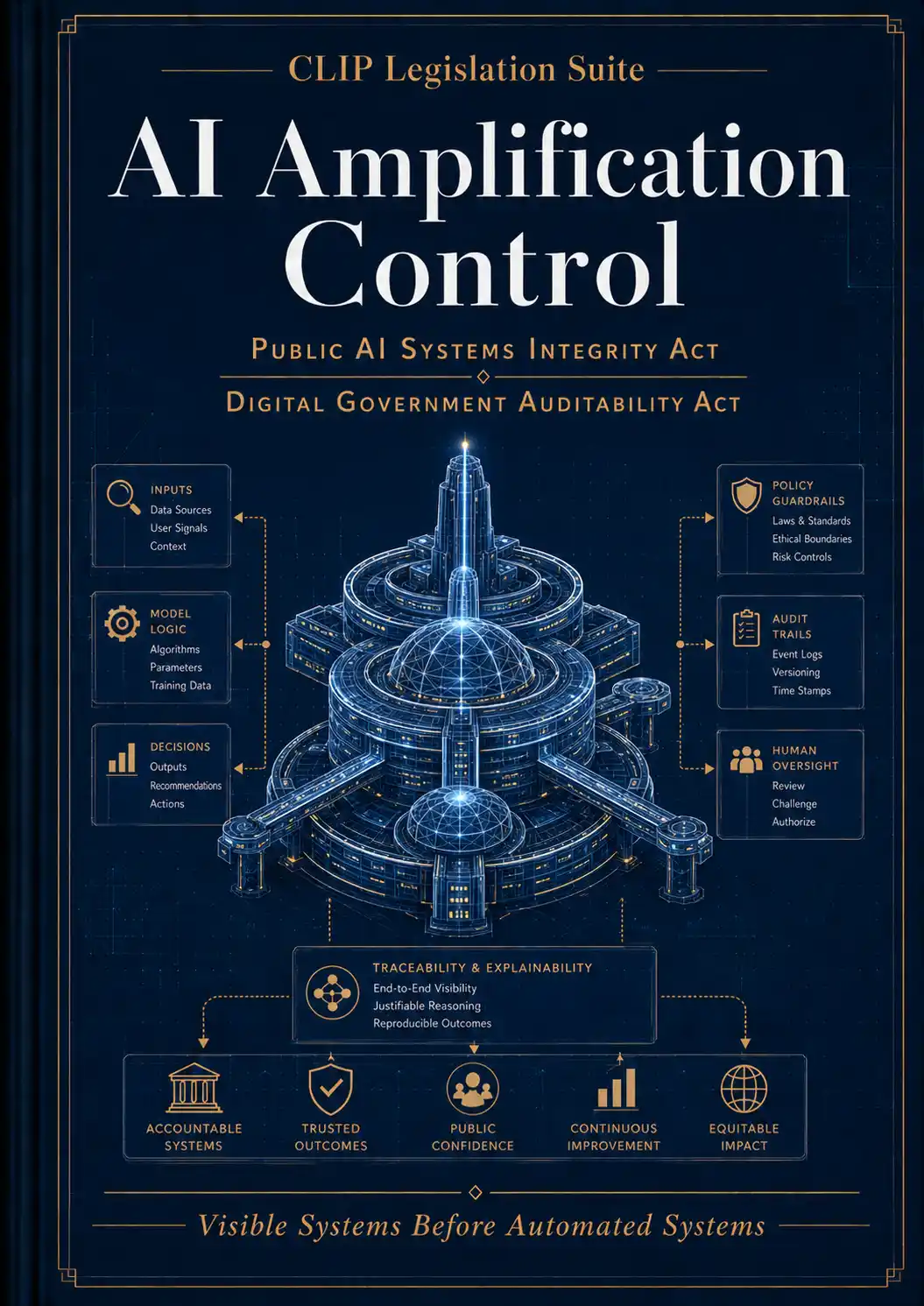
Project Page: AI Does Not Fix Government. It Amplifies It (Part 1) https://x.com/SkillsGapTrain/status/2065348053645861271
Disclaimer: This is an open-source educational system that is being developed for learning, research, frontier systems engineering and prototyping, intended to help students, teachers, public-sector builders, policy analysts, political leaders, corporate leaders and responsible organizations explore next-generation governance systems for humanity; it is not legal advice, policy authority, certification, or deployment-ready public infrastructure. Executive Summary of Audit of current development status is located at bottom of Part 3 of Project Page.