Model Act Generated from the NSIR / CLIP Clean-System Framework
Long Title
An Act to ensure that emergency powers remain lawful, necessary, proportionate, reviewable, time-bounded, reversible, auditable, and democratically accountable; to establish trigger conditions, rights review, legislative renewal, public reporting, post-emergency audit, rollback duties, data deletion and deactivation requirements, and recovery mechanisms for emergency governance; and to prevent temporary crisis powers from becoming permanent public systems.
Preamble
Whereas democratic government must be capable of acting quickly during emergencies, disasters, attacks, pandemics, infrastructure failures, cyber incidents, public-safety threats, financial shocks, or other serious crises;
Whereas speed in emergency governance may be necessary to preserve life, safety, rights, public order, essential services, critical infrastructure, national security, and continuity of government;
Whereas emergency powers may also create extraordinary risks to rights, liberty, privacy, mobility, property, livelihood, democratic oversight, public trust, institutional accountability, and the ordinary balance of public authority;
Whereas crisis powers, emergency data systems, extraordinary enforcement tools, temporary restrictions, procurement shortcuts, digital surveillance systems, emergency benefits, identity systems, health systems, mobility controls, public-order measures, and delegated authorities may persist after the emergency that justified them has ended;
Whereas emergency power without rollback can become permanent architecture;
Whereas a democratic system must be able to act quickly without normalizing exceptional authority;
Whereas emergency governance must remain lawful, explainable, challengeable, auditable, reversible where possible, and subject to public reporting, legislative review, rights review, and post-emergency repair;
Whereas the purpose of emergency law is not permanent exception, but lawful recovery;
Therefore, Parliament enacts as follows.
Part 1 — Short Title, Purpose, and Core Principles
1. Short Title
This Act may be cited as the Emergency Powers Recovery Act.
2. Purpose
The purpose of this Act is to ensure that emergency powers and emergency systems:
- are activated only under clear legal conditions;
- are necessary and proportionate to the emergency;
- are subject to rights review;
- are time-bounded;
- are publicly explained where possible;
- are subject to legislative renewal;
- preserve meaningful review, appeal, and remedy;
- maintain audit trails;
- preserve public records;
- include rollback and recovery mechanisms;
- do not silently expand into permanent governance systems;
- are audited after use;
- are deactivated, deleted, repealed, or normalized only through lawful review.
3. Core Rule
A public authority shall not invoke, extend, operationalize, digitize, automate, or retain emergency powers unless the authority, trigger conditions, affected rights, data flows, enforcement mechanisms, duration, review process, rollback plan, and recovery pathway are mapped, recorded, and subject to oversight.
4. Emergency Reversibility Principle
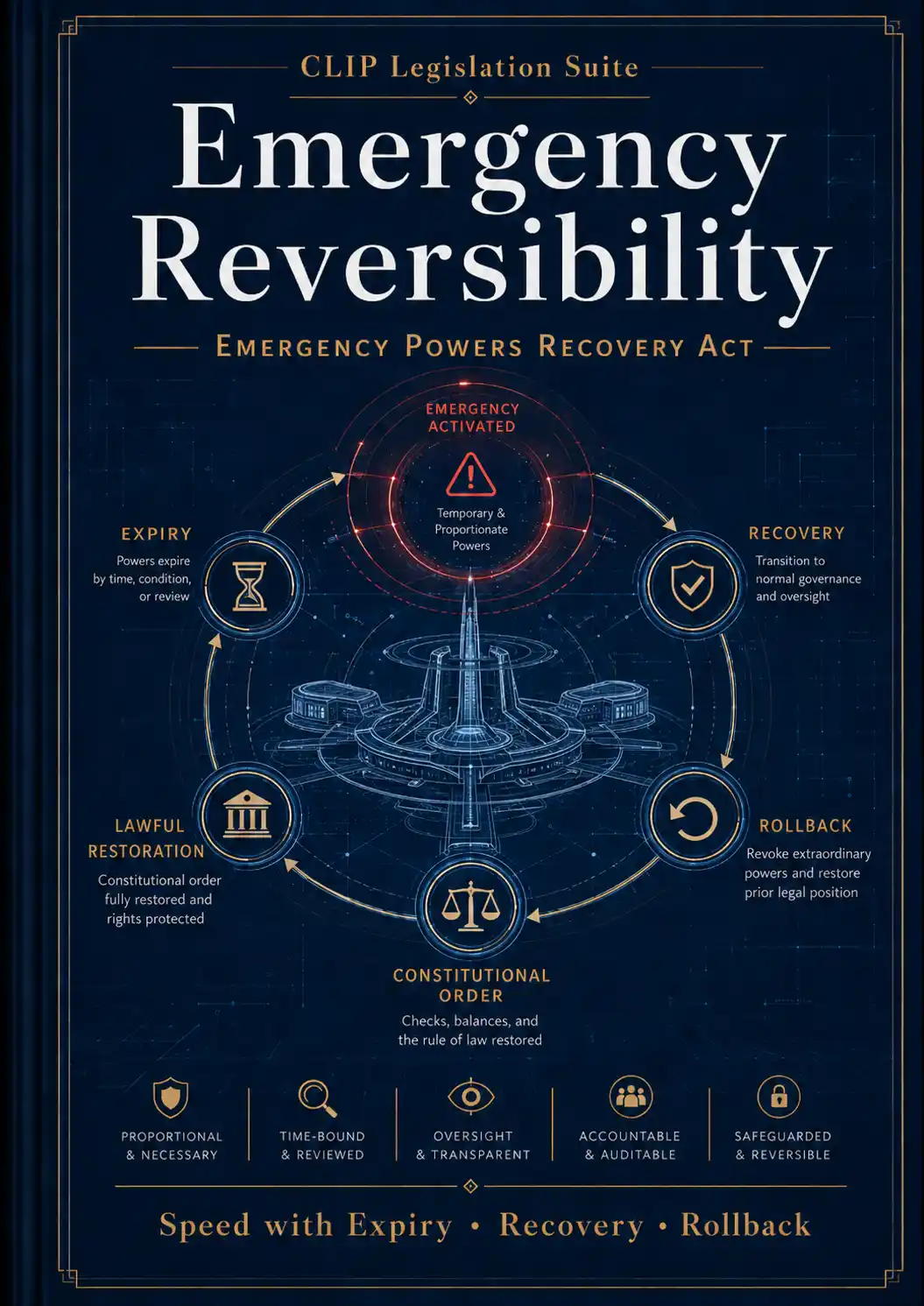
Emergency powers shall be designed to expire, deactivate, roll back, or return to ordinary lawful administration once the conditions justifying them no longer exist.
5. Necessity and Proportionality Principle
Emergency powers shall be limited to what is necessary, proportionate, lawful, time-bounded, reviewable, and connected to the emergency purpose.
6. No Permanent Exception Principle
A public authority shall not convert temporary emergency powers, data systems, enforcement mechanisms, procurement arrangements, digital infrastructure, identity systems, surveillance tools, mobility controls, or administrative shortcuts into permanent systems without ordinary legislative authority, public review, systems integrity review, and rights analysis.
7. Democratic Correction Principle
Emergency governance shall preserve the ability of affected persons, courts, legislatures, auditors, oversight bodies, journalists, civil society, Indigenous governments, and the public to understand, challenge, review, audit, and repair the use of emergency powers.
Part 2 — Definitions
8. Definitions
In this Act:
“affected person” means a person, household, organization, community, Indigenous government, business, public body, or legal entity whose rights, benefits, obligations, eligibility, access, service level, enforcement exposure, legal status, liberty, mobility, property, livelihood, privacy, safety, or public interest may be materially affected by an emergency power or emergency system.
“continuity measure” means a measure designed to maintain essential services, public safety, critical infrastructure, public records, government operations, public benefits, emergency relief, or legal processes during an emergency.
“emergency” means a serious situation, event, threat, or condition that creates an urgent risk to life, safety, health, public order, essential services, critical infrastructure, national security, public finance, environment, food supply, water supply, energy supply, transportation, digital infrastructure, or continuity of government, and that cannot be adequately addressed through ordinary legal powers within the time available.
“emergency data system” means a system, database, registry, dashboard, portal, identity tool, reporting system, tracing system, analytics system, AI system, automated workflow, data-sharing arrangement, or digital infrastructure created, expanded, repurposed, or relied upon for emergency purposes.
“emergency power” means a power, order, regulation, directive, delegation, restriction, enforcement mechanism, procurement shortcut, data power, public-health measure, mobility control, property control, financial measure, service mandate, or administrative authority invoked or expanded because of an emergency.
“emergency system” means the organized arrangement of law, authority, personnel, data, technology, vendors, workflows, enforcement, public communications, relief programs, appeals, audits, and oversight used to respond to an emergency.
“ordinary authority” means public authority available outside an emergency declaration or emergency legal framework.
“post-emergency audit” means a structured review of emergency powers and emergency systems after use to determine legality, necessity, proportionality, rights impact, data use, enforcement impact, procurement integrity, public outcomes, harms, rollback completion, and lessons for repair.
“recovery plan” means the plan through which emergency powers, emergency systems, emergency data flows, emergency contracts, emergency restrictions, and emergency processes are ended, reviewed, normalized, repaired, repealed, or returned to ordinary administration.
“responsible authority” means the public authority legally responsible for declaring, invoking, administering, reviewing, extending, enforcing, reporting, rolling back, or auditing an emergency power or emergency system.
“rights review” means analysis of the effect of emergency powers or emergency systems on constitutional rights, statutory rights, privacy, human rights, procedural fairness, equality, mobility, liberty, property, livelihood, Indigenous rights, treaty obligations, democratic participation, access to justice, and other protected interests.
“rollback” means the suspension, expiry, repeal, deactivation, deletion, decommissioning, restoration, reversal, limitation, or correction of emergency powers, emergency systems, emergency data flows, emergency contracts, emergency restrictions, or emergency administrative arrangements.
“sunset clause” means a provision causing a power, order, regulation, contract, data system, delegation, or emergency arrangement to expire unless renewed through prescribed lawful review.
Part 3 — Application
9. Application
This Act applies to every emergency power, emergency declaration, emergency order, emergency regulation, emergency data system, emergency procurement, emergency enforcement mechanism, emergency benefit system, emergency digital system, emergency AI system, emergency surveillance system, emergency restriction, emergency delegation, and recovery process exercised by or under the authority of a public authority.
10. High-Impact Emergency Measures
An emergency measure shall be classified as high-impact where it materially affects, or is reasonably likely to affect:
- liberty, mobility, privacy, property, livelihood, or legal status;
- freedom of expression, assembly, association, conscience, religion, or democratic participation;
- access to health, housing, income, food, water, energy, transportation, education, or essential services;
- policing, enforcement, inspection, penalties, sanctions, detention, borders, or public order;
- Indigenous rights, treaty rights, consultation duties, or community governance;
- emergency benefits, relief payments, rationing, priority access, or eligibility;
- public procurement or public funds above a prescribed threshold;
- digital identity, data sharing, AI, automation, surveillance, tracing, or analytics;
- any other matter prescribed by regulation.
11. Critical Emergency Systems
A responsible authority shall designate an emergency system as critical where failure, outage, breach, misuse, delay, non-reversibility, or loss of public trust could create serious harm to rights, essential services, safety, public order, critical infrastructure, public finance, national security, or continuity of government.
Critical emergency systems shall be subject to enhanced auditability, continuity, rollback, and post-emergency audit requirements.
12. Prohibition on Avoidance
A public authority shall not divide, relabel, delegate, outsource, digitize, automate, or technically reclassify an emergency power or emergency system for the purpose of avoiding this Act.
Part 4 — Declaration, Trigger Conditions, and Authority Mapping
13. Declaration Requirements
An emergency declaration shall identify:
- the nature of the emergency;
- the legal authority relied on;
- the facts supporting activation;
- why ordinary authority is insufficient;
- the public purpose of emergency action;
- the responsible authority;
- affected rights and interests;
- geographic scope;
- persons or sectors affected;
- powers activated;
- expected duration;
- renewal process;
- reporting process;
- rollback and recovery process.
14. Trigger Conditions
Emergency powers shall be activated only where prescribed trigger conditions are satisfied.
Trigger conditions shall be clear enough to permit legislative review, judicial review, audit, and public accountability.
15. Authority Map
The responsible authority shall prepare an emergency authority map identifying:
- statutory authority;
- delegated authority;
- responsible officials;
- enforcement bodies;
- review bodies;
- appeal or complaint bodies;
- oversight bodies;
- rights affected;
- limits on powers;
- expiry and renewal requirements.
16. No Unmapped Emergency Authority
A public authority shall not exercise, delegate, automate, enforce, or materially rely on an emergency power unless the power is identified in the emergency authority map, except where immediate action is necessary to prevent serious harm and the authority map is updated as soon as practicable.
17. Written Reasons for Activation
The responsible authority shall provide written reasons for activating emergency powers.
Where immediate action is necessary, reasons shall be published or provided as soon as practicable.
Part 5 — Rights Review and Safeguards
18. Rights Review Requirement
Before activating, extending, materially altering, or operationalizing a high-impact emergency measure, the responsible authority shall complete a rights review.
19. Contents of Rights Review
A rights review shall assess:
- rights and interests affected;
- necessity;
- proportionality;
- alternatives considered;
- geographic scope;
- affected populations;
- equality and disparate impact;
- Indigenous rights and treaty implications;
- privacy and data protection;
- procedural fairness;
- mobility and liberty restrictions;
- enforcement risk;
- access to review, appeal, complaint, or remedy;
- time limits;
- rollback safeguards.
20. Continuing Rights Review
A responsible authority shall update the rights review where emergency powers are extended, expanded, repurposed, digitized, automated, or materially changed.
21. Least Restrictive Effective Means
Emergency powers shall use the least restrictive effective means reasonably available to achieve the emergency purpose.
22. Non-Discrimination
Emergency powers shall not be applied in an arbitrary or discriminatory manner.
Where disparate impact is identified, the responsible authority shall assess mitigation, accommodation, remedy, or modification.
23. Indigenous Rights and Consultation
Nothing in this Act limits Indigenous rights, treaty rights, or lawful consultation obligations.
Where emergency powers materially affect Indigenous peoples, lands, governance, services, rights, or treaty interests, the responsible authority shall engage appropriate Indigenous governments or representative bodies to the extent practicable in the emergency circumstances.
Part 6 — Time Limits, Renewal, and Legislative Oversight
24. Initial Duration
An emergency declaration or high-impact emergency power shall expire after the prescribed initial period unless renewed under this Act.
25. Renewal Requirement
An emergency power may be renewed only where the responsible authority demonstrates:
- the emergency continues;
- the power remains necessary;
- the power remains proportionate;
- ordinary authority remains insufficient;
- rights impacts have been reviewed;
- alternatives have been considered;
- public reporting has been provided;
- rollback remains planned.
26. Legislative Renewal
A high-impact emergency power shall not continue beyond the prescribed period without legislative review or approval.
27. Renewal Record
A renewal request shall include:
- updated facts;
- current risk assessment;
- powers still required;
- powers no longer required;
- rights review update;
- data-use update;
- enforcement update;
- procurement update;
- incident update;
- public outcome assessment;
- rollback status.
28. Sunset Clause
Every emergency power, emergency order, emergency regulation, emergency data system, emergency procurement shortcut, emergency delegation, and emergency restriction shall include a sunset date unless expressly exempted by law.
29. Expiry Effect
Upon expiry, the emergency power shall cease to have effect unless lawfully renewed or transitioned to ordinary authority through ordinary legislative process.
Part 7 — Emergency Data Systems and Data Rollback
30. Emergency Data Map
Every high-impact emergency data system shall maintain a data map identifying:
- data collected;
- legal authority;
- public purpose;
- affected population;
- data sources;
- sensitive data;
- data sharing;
- vendor access;
- AI or analytics use;
- retention period;
- correction pathway;
- deletion or deactivation process;
- audit logs;
- post-emergency data rollback plan.
31. Emergency Data Minimization
Emergency data collection and use shall be limited to what is lawful, necessary, proportionate, and connected to the emergency purpose.
32. Secondary Use Restriction
Emergency data shall not be used for a materially different purpose after the emergency without lawful authority, public notice, privacy review, rights review, systems integrity review, and correction safeguards.
33. Emergency Data Correction
An affected person shall have a practical pathway to request correction of personal or case data materially used in emergency eligibility, enforcement, access, relief, restriction, or public decision-making.
34. Deletion, Deactivation, or Retention Review
Upon termination of an emergency, the responsible authority shall determine whether emergency data shall be:
- deleted;
- de-identified;
- archived as a public record;
- retained under ordinary lawful authority;
- restricted from further use;
- transferred to another lawful system;
- preserved for audit, appeal, inquiry, or legal proceedings.
35. Data Rollback Report
The responsible authority shall publish a data rollback report identifying, at an appropriate level of abstraction:
- what emergency data systems were used;
- what data categories were collected;
- what data was deleted, deactivated, archived, retained, or transferred;
- what safeguards apply to retained data;
- what correction pathways remain available;
- what audit records are preserved.
Part 8 — AI, Automation, Digital Systems, and Emergency Technology
36. Emergency Technology Register
The responsible authority shall maintain a register of high-impact emergency technologies, including:
- digital portals;
- data-sharing systems;
- digital identity systems;
- public dashboards;
- AI systems;
- automated decision systems;
- risk models;
- tracing or monitoring systems;
- enforcement technologies;
- emergency procurement platforms;
- vendor systems.
37. Automation Safeguards
A public authority shall not use AI, automation, algorithmic scoring, risk classification, or automated workflows in high-impact emergency decisions unless:
- the system has lawful authority;
- the emergency purpose is defined;
- human accountability remains;
- affected persons can obtain reasons where appropriate;
- meaningful review or complaint pathways exist;
- audit trails are preserved;
- errors can be corrected;
- the system can be suspended or rolled back.
38. Emergency AI Review
High-impact emergency AI systems shall undergo expedited systems integrity review before deployment where practicable and full review as soon as practicable after deployment.
39. No Permanent Emergency Technology Without Review
A public authority shall not retain, normalize, repurpose, or expand an emergency technology after the emergency without ordinary authority, public notice, rights review, privacy review, cybersecurity review, systems integrity review, and legislative or regulatory authorization where required.
Part 9 — Emergency Procurement and Vendor Controls
40. Emergency Procurement Record
Where ordinary procurement rules are modified, expedited, waived, or bypassed during an emergency, the responsible authority shall maintain an emergency procurement record.
41. Contents of Emergency Procurement Record
The record shall identify:
- vendor;
- public purpose;
- emergency justification;
- goods or services procured;
- value;
- duration;
- procurement process used;
- reason ordinary procurement was insufficient;
- conflict-of-interest safeguards;
- audit rights;
- data access;
- subcontractors where known;
- service continuity;
- exit and decommissioning requirements;
- review date.
42. Vendor Auditability
Emergency procurement shall preserve audit rights, public record control, data portability, incident reporting, cybersecurity review, privacy safeguards, decommissioning support, and exit rights where the vendor system supports high-impact emergency administration.
43. Emergency Contract Sunset
An emergency contract shall expire after the prescribed period unless renewed through ordinary procurement review or emergency renewal process.
44. Post-Emergency Procurement Review
Emergency procurement above a prescribed threshold shall be reviewed after the emergency to assess necessity, value, conflicts, performance, auditability, data use, vendor dependency, and whether the contract should end, transition, or be recompeted.
Part 10 — Enforcement, Review, Appeal, and Remedy
45. Reasons for High-Impact Emergency Decisions
An affected person shall receive understandable reasons for a high-impact emergency decision where practicable and where reasons can be provided without defeating the emergency purpose or creating serious security, privacy, safety, or lawful confidentiality risks.
46. Human Review
A high-impact emergency decision shall be subject to meaningful human review where the decision materially affects rights, liberty, mobility, legal status, benefits, essential services, enforcement exposure, property, livelihood, or safety.
47. Complaint Pathway
The responsible authority shall maintain a complaint or review pathway for affected persons to challenge emergency decisions, enforcement actions, data errors, service denials, eligibility decisions, or emergency-system failures.
48. Urgent Relief
Where emergency action causes or threatens serious harm, an affected person may request urgent relief, including temporary suspension, expedited review, correction, access restoration, benefit continuation, or other lawful interim measure.
49. Remedy
Where an emergency decision or system causes material harm through illegality, error, unfairness, arbitrary application, data error, automation failure, enforcement misuse, or failure to provide review, the responsible authority shall provide remedy within lawful authority.
50. No Emergency Immunity for Bad Faith
Nothing in this Act protects bad faith, knowing illegality, intentional concealment, willful destruction of records, corruption, retaliation, or deliberate evasion of oversight.
Part 11 — Audit Trails, Records, and Public Reporting
51. Emergency Recordkeeping Duty
A responsible authority shall preserve records sufficient to reconstruct emergency authority, decisions, data use, enforcement, procurement, technology use, renewals, rights review, incidents, complaints, remedies, rollback, and recovery.
52. Contents of Emergency Audit Trail
An emergency audit trail shall include, where applicable:
- declaration record;
- authority map;
- rights review;
- orders and regulations;
- enforcement records;
- data maps;
- procurement records;
- technology register;
- AI or automation records;
- public communications;
- complaints and reviews;
- remedies;
- renewal records;
- incident records;
- rollback actions;
- post-emergency audit findings.
53. Public Emergency Report
During an emergency, the responsible authority shall publish periodic public reports at prescribed intervals.
54. Contents of Public Emergency Report
A public emergency report shall include, at an appropriate level of detail:
- current emergency status;
- powers currently active;
- powers expired or withdrawn;
- rights affected;
- public purpose;
- data systems active;
- emergency technologies active;
- procurement measures active;
- enforcement measures active;
- complaints or review statistics;
- incidents where appropriate;
- expected next review date;
- rollback planning status.
55. Protection of Sensitive Information
Public reporting shall not disclose information where disclosure would create a serious and demonstrable risk to national security, cybersecurity, privacy, law enforcement, personal safety, emergency response, or lawful confidentiality.
Where details are restricted, the responsible authority shall publish the highest safe level of explanation.
Part 12 — Rollback, Recovery, and Deactivation
56. Recovery Plan Requirement
A responsible authority shall prepare a recovery plan for every high-impact emergency system.
57. Contents of Recovery Plan
The recovery plan shall identify:
- powers to expire;
- powers to repeal;
- powers to transition to ordinary authority;
- data systems to delete, deactivate, archive, or retain;
- digital systems to decommission or normalize;
- emergency contracts to terminate, recompete, or transition;
- enforcement measures to end;
- public communications required;
- affected-person notice;
- review and remedy pathways continuing after the emergency;
- records to preserve for audit;
- post-emergency audit schedule;
- responsible officials;
- deadlines.
58. Rollback Duty
Upon termination or expiry of an emergency, the responsible authority shall roll back emergency powers and emergency systems unless continued use is authorized through ordinary legal process.
59. Deactivation of Emergency Systems
Emergency systems shall be deactivated, decommissioned, deleted, archived, or transferred to ordinary authority in accordance with the recovery plan.
60. Restoration of Ordinary Administration
The responsible authority shall restore ordinary administrative processes, appeal pathways, procurement rules, reporting standards, and oversight mechanisms as soon as practicable.
61. Post-Emergency Rights Restoration
Where emergency measures suspended, restricted, delayed, or modified ordinary rights, benefits, services, appeal pathways, mobility, access, or legal processes, the responsible authority shall identify steps to restore ordinary rights and repair unresolved harm.
Part 13 — Post-Emergency Audit
62. Post-Emergency Audit Requirement
Every high-impact emergency shall be subject to post-emergency audit.
63. Contents of Post-Emergency Audit
A post-emergency audit shall assess:
- whether trigger conditions were satisfied;
- whether ordinary authority was insufficient;
- legality of powers used;
- necessity and proportionality;
- rights impacts;
- equality and disparate impacts;
- Indigenous rights and treaty impacts;
- data collected and retained;
- emergency technologies used;
- AI or automation used;
- enforcement actions;
- procurement actions;
- public outcomes;
- harms caused;
- complaints and remedies;
- public communications;
- auditability and recordkeeping;
- rollback completion;
- lessons for repair.
64. Audit Independence
A post-emergency audit shall be conducted or reviewed by persons with appropriate independence and expertise in law, emergency management, public administration, systems engineering, privacy, cybersecurity, human rights, audit, procurement, public health or safety where relevant, and the affected domain.
65. Public Audit Report
A public version of the post-emergency audit shall be published.
Restricted annexes may be prepared for protected information, but confidentiality shall not eliminate authorized review.
66. Corrective Action Plan
Where the post-emergency audit identifies unlawful action, excessive restriction, data misuse, procurement failure, enforcement misuse, system failure, rights harm, or rollback failure, the responsible authority shall prepare a corrective action plan.
Part 14 — Oversight, Compliance, and Public Challenge
67. Oversight Body
An authorized oversight body shall monitor compliance with this Act.
The oversight body may be established by regulation or assigned to an existing public authority with appropriate independence, expertise, and legal powers.
68. Powers of Oversight Body
The oversight body may:
- require records;
- inspect emergency authority maps;
- inspect rights reviews;
- inspect emergency data maps;
- inspect procurement records;
- inspect emergency technology registers;
- investigate complaints;
- review renewals;
- require rollback plans;
- require post-emergency audits;
- require corrective action;
- refer matters to courts, tribunals, auditors, privacy commissioners, human rights bodies, procurement authorities, law enforcement, or legislative committees where appropriate.
69. Compliance Orders
The oversight body may issue a compliance order requiring a responsible authority to:
- prepare or update an emergency authority map;
- complete or update a rights review;
- publish a public emergency report;
- prepare a recovery plan;
- suspend an unauthorized emergency system;
- delete, deactivate, or restrict emergency data;
- review emergency procurement;
- restore appeal or complaint pathways;
- complete a post-emergency audit;
- prepare a corrective action plan.
70. Public Challenge Process
The responsible authority shall establish a process through which affected persons, civil society, journalists, public servants, auditors, experts, Indigenous governments, public bodies, and other affected parties may submit evidence of emergency-power overreach, rights harm, data misuse, procurement defect, rollback failure, review failure, or emergency-system persistence.
71. Whistleblower Protection
No person shall suffer retaliation for reporting emergency-power misuse, unlawful emergency action, data misuse, procurement irregularity, record destruction, rights harm, rollback failure, or serious public-system risk in good faith.
Part 15 — Security, Confidentiality, and Bounded Accountability
72. Protected Information
Nothing in this Act requires public disclosure of information where disclosure would create a serious and demonstrable risk to national security, cybersecurity, emergency response, privacy, law enforcement, personal safety, legally privileged information, or lawful confidentiality.
73. Bounded Accountability
Where information cannot be made public, the responsible authority shall provide:
- a public summary at the highest safe level of abstraction;
- a restricted record for authorized reviewers;
- audit access sufficient to verify legality, accountability, and compliance;
- written reasons for withholding public disclosure.
74. No Secrecy Without Review
Confidentiality shall not eliminate the requirement for authorized audit, legal review, rights review, legislative review, oversight, and accountability.
Part 16 — Regulations
75. Regulations
The Governor in Council may make regulations:
- prescribing emergency trigger conditions;
- prescribing initial duration limits;
- prescribing renewal procedures;
- prescribing rights review requirements;
- prescribing emergency data mapping standards;
- prescribing emergency technology register requirements;
- prescribing emergency procurement thresholds;
- prescribing public reporting intervals;
- prescribing post-emergency audit standards;
- prescribing rollback plan requirements;
- prescribing data deletion or deactivation requirements;
- prescribing oversight procedures;
- prescribing phased implementation timelines;
- exempting measures where equivalent or stronger protections exist.
76. No Regulation May Defeat Purpose
No regulation made under this Act shall defeat the purpose of ensuring that emergency powers remain lawful, necessary, proportionate, reviewable, time-bounded, reversible, auditable, and democratically accountable.
Part 17 — Statutory Review and Coming into Force
77. Statutory Review
A committee of Parliament shall review this Act within three years after coming into force and every five years thereafter.
The review shall examine:
- whether the Act improves emergency accountability;
- whether it improves rollback of emergency powers;
- whether it improves rights review;
- whether it improves public reporting;
- whether it improves emergency data governance;
- whether it improves emergency procurement accountability;
- whether it improves post-emergency audit and repair;
- whether it creates unnecessary delay during legitimate emergencies;
- whether amendments are required.
78. Coming into Force
This Act comes into force on a day fixed by order of the Governor in Council.
Different provisions may come into force on different days.
Schedule A — Emergency Declaration Template
An emergency declaration shall identify:
- emergency name;
- responsible authority;
- legal authority;
- facts supporting activation;
- why ordinary authority is insufficient;
- public purpose;
- geographic scope;
- affected population;
- rights affected;
- powers activated;
- enforcement mechanisms;
- data systems activated;
- technologies used;
- procurement shortcuts used;
- initial duration;
- renewal process;
- reporting schedule;
- rollback plan;
- recovery plan owner.
Schedule B — Rights Review Template
A rights review shall assess:
- rights affected;
- legal authority;
- necessity;
- proportionality;
- alternatives considered;
- affected population;
- equality impact;
- Indigenous rights and treaty implications;
- privacy impact;
- mobility or liberty impact;
- property or livelihood impact;
- procedural fairness;
- review, appeal, or complaint pathway;
- remedy pathway;
- sunset date;
- rollback safeguards.
Schedule C — Emergency Data Rollback Template
An emergency data rollback plan shall identify:
- data system;
- responsible authority;
- data categories;
- legal authority;
- emergency purpose;
- data sources;
- sharing arrangements;
- vendor access;
- AI or analytics use;
- retention period;
- deletion process;
- deactivation process;
- archive process;
- correction pathway;
- audit record preservation;
- public reporting.
Schedule D — Emergency Procurement Review Template
An emergency procurement review shall identify:
- vendor;
- contract value;
- emergency justification;
- procurement process used;
- reason ordinary procurement was insufficient;
- goods or services provided;
- duration;
- audit rights;
- public records involved;
- data involved;
- subcontractors;
- security review;
- privacy review;
- service performance;
- conflicts of interest;
- exit or decommissioning plan;
- recommendation to end, renew, recompete, or transition.
Schedule E — Post-Emergency Audit Template
A post-emergency audit shall include:
- emergency summary;
- trigger assessment;
- authority map;
- powers used;
- rights review;
- public reporting review;
- enforcement review;
- data systems review;
- technology review;
- procurement review;
- complaints and remedies;
- public outcomes;
- harms identified;
- rollback status;
- unresolved emergency architecture;
- corrective action plan;
- lessons for future emergencies.
Schedule F — Emergency Rollback Checklist
Upon termination or expiry of an emergency, the responsible authority shall assess:
- which powers expire immediately;
- which orders must be repealed;
- which regulations must be revoked;
- which enforcement measures end;
- which data systems are deactivated;
- which data is deleted, archived, or retained;
- which emergency contracts end;
- which digital systems are decommissioned;
- which appeal pathways remain open;
- which affected persons require notice;
- which records are preserved for audit;
- which harms require remedy;
- which systems require post-emergency review;
- which measures require ordinary legislation if continued.
Final Standard
The Emergency Powers Recovery Act exists because democracies must be able to act quickly without becoming permanently exceptional.
An emergency may justify speed.
It does not justify invisibility.
It may justify temporary restriction.
It does not justify permanent architecture without review.
It may justify extraordinary data collection.
It does not justify silent reuse forever.
It may justify emergency procurement.
It does not justify non-auditability.
The standard is simple:
Emergency powers must be able to end. Emergency systems must be able to roll back. Emergency governance must recover democracy after crisis.
Project Page: AI Does Not Fix Government. It Amplifies It (Part 1) https://x.com/SkillsGapTrain/status/2065348053645861271
Disclaimer: This is an open-source educational system that is being developed for learning, research, frontier systems engineering and prototyping, intended to help students, teachers, public-sector builders, policy analysts, political leaders, corporate leaders and responsible organizations explore next-generation governance systems for humanity; it is not legal advice, policy authority, certification, or deployment-ready public infrastructure. Executive Summary of Audit of current development status is located at bottom of Part 3 of Project Page.