Model Act Generated from the NSIR / CLIP Clean-System Framework
Long Title
An Act to establish public dashboards, systems transparency registers, integrity indicators, public reporting duties, evidence standards, data-quality requirements, auditability safeguards, and citizen-readable system summaries for high-impact public systems; to ensure that public authorities report the condition, performance, risks, failures, repairs, and outputs of public systems in a way that is accurate, understandable, auditable, and democratically useful; and to prevent public reporting from substituting announcements, activity, or symbolic metrics for real public outcomes.
Preamble
Whereas democratic government requires that public power be visible enough to be understood, challenged, audited, corrected, and improved;
Whereas public systems increasingly operate through legislation, regulation, funding programs, digital portals, databases, case-management systems, artificial intelligence, vendor platforms, procurement systems, eligibility systems, infrastructure approval systems, emergency powers, and multi-jurisdictional delivery chains;
Whereas citizens, legislators, public servants, journalists, auditors, courts, civil society, Indigenous governments, municipalities, researchers, and affected persons cannot evaluate public systems if the systems are hidden, fragmented, unmeasured, or reported only through announcements and high-level summaries;
Whereas public reporting often measures activity rather than output, intentions rather than completion, spending rather than capability, approval rather than occupancy, programs rather than outcomes, and dashboards rather than truth;
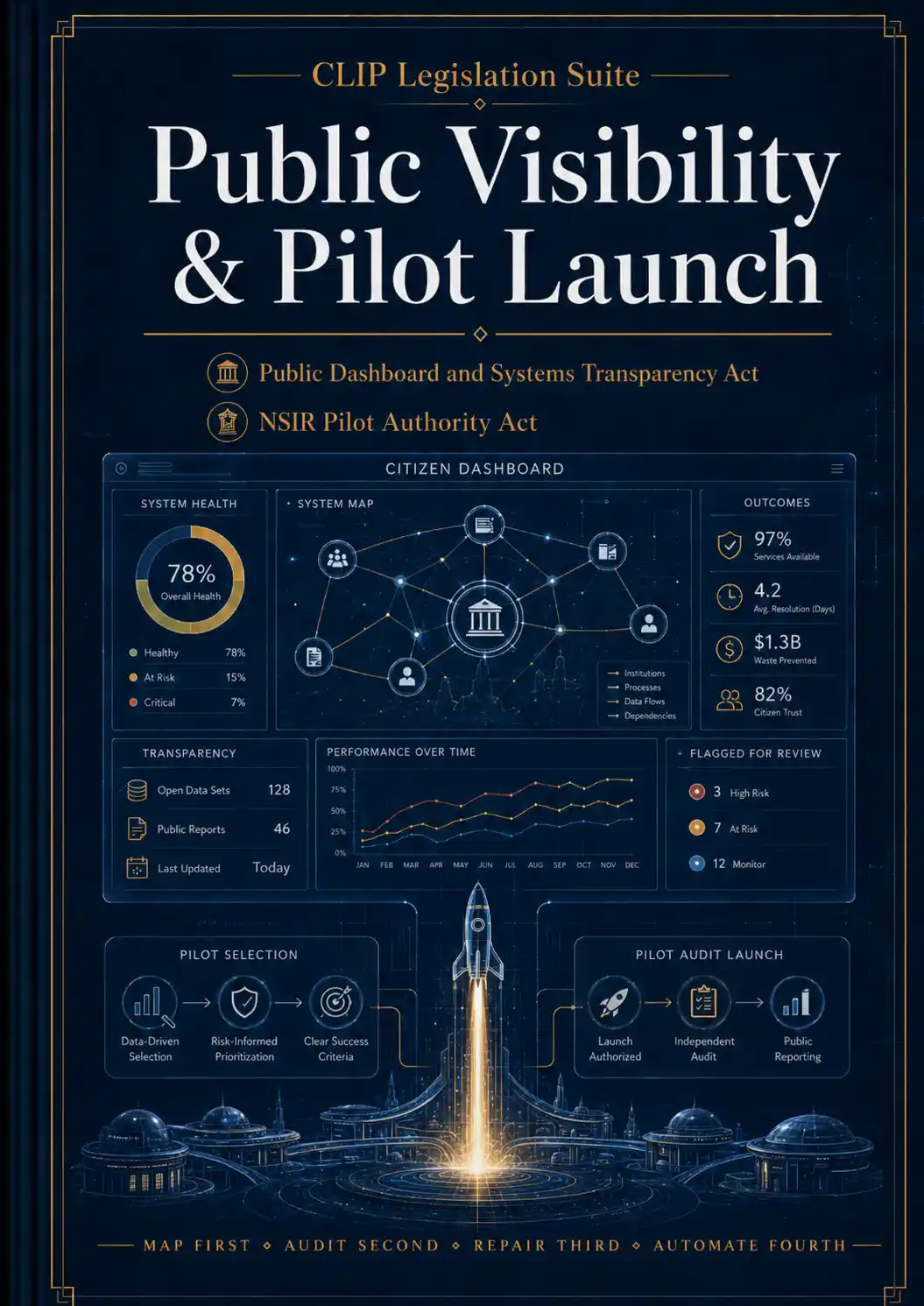
Whereas a dashboard can improve public accountability only if it is accurate, sourced, updated, auditable, citizen-legible, resistant to manipulation, and connected to real decision-making;
Whereas public dashboards should reveal system health, bottlenecks, risks, failures, repair progress, appeal gaps, auditability gaps, data correction gaps, vendor dependency, emergency powers, AI exposure, and output conversion;
Whereas transparency without data quality may mislead, and data without explanation may obscure;
Whereas public visibility is not performative openness, but a control surface for democratic correction;
Therefore, Parliament enacts as follows.
Part 1 — Short Title, Purpose, and Core Principles
1. Short Title
This Act may be cited as the Public Dashboard and Systems Transparency Act.
2. Purpose
The purpose of this Act is to ensure that high-impact public systems are made visible through accurate, auditable, citizen-readable, and decision-useful public dashboards, registers, reports, and system summaries that identify:
- public purpose;
- responsible authority;
- system status;
- system maps;
- data flows;
- AI and automation exposure;
- appeal and remedy pathways;
- auditability gaps;
- data correction gaps;
- vendor dependencies;
- emergency or exceptional powers;
- output conversion;
- failure modes;
- incidents;
- bottlenecks;
- repair progress;
- public outcomes.
3. Core Rule
A public authority operating a high-impact public system shall publish and maintain a citizen-readable system summary, a systems transparency register entry, and dashboard indicators sufficient to allow the public and authorized reviewers to understand the system’s purpose, authority, status, risks, outputs, appeal paths, auditability, and repair progress.
4. Truthful Measurement Principle
A public authority shall not report activity as output, intention as result, approval as completion, funding as delivery, strategy as capability, or dashboard presence as system integrity.
5. Democratic Visibility Principle
Public dashboards shall be designed not merely for communication, but for democratic correction.
They shall help citizens, legislators, auditors, journalists, public servants, and affected persons see where public systems are working, failing, delaying, excluding, hiding risk, or requiring repair.
6. Auditability Principle
A dashboard indicator shall be traceable to source data, methodology, update frequency, responsible owner, limitations, and revision history.
7. Citizen Legibility Principle
Public system information shall be understandable to non-specialist readers without eliminating technical detail required for audit, review, research, or legislative oversight.
8. Anti-Gaming Principle
A public authority shall not design, select, suppress, redefine, aggregate, or manipulate dashboard indicators in a manner that hides system failure, creates misleading success, shifts blame, obscures bottlenecks, or prevents public accountability.
Part 2 — Definitions
9. Definitions
In this Act:
“affected person” means a person, household, organization, community, Indigenous government, business, public body, or legal entity whose rights, benefits, obligations, eligibility, access, service level, legal status, privacy, property, livelihood, safety, or public interest may be materially affected by a high-impact public system.
“auditability gap” means a condition in which a public system lacks records, logs, documentation, source data, authority maps, decision records, review records, or system information sufficient to reconstruct, verify, audit, review, or correct material system operations.
“bottleneck” means a recurring or material constraint, delay, failure point, dependency, conflict, capacity gap, infrastructure gap, legal ambiguity, procurement issue, vendor issue, data problem, staffing issue, appeal failure, or implementation defect that prevents a public system from producing intended public outputs.
“citizen-readable system summary” means a plain-language explanation of a public system’s purpose, authority, affected persons, data use, AI or automation use, responsible authority, appeal path, correction path, audit status, risks, incidents, and review schedule.
“dashboard indicator” means a metric, measure, status field, classification, timeline, count, rate, ratio, signal, or qualitative status used to describe the condition, performance, risk, output, failure, or repair progress of a public system.
“data-quality statement” means a statement identifying the source, method, update frequency, limitations, confidence level, known gaps, and responsible owner of data used in a dashboard, register, or public report.
“failure mode” means a foreseeable or observed way in which a public system may fail to achieve its public purpose, violate rights, create delay, hide error, prevent appeal, resist audit, cause harm, or fail to convert activity into output.
“high-impact public system” means a public system that materially affects, or is reasonably likely to materially affect, rights, benefits, eligibility, access to essential services, legal status, enforcement, housing, health, education, child welfare, immigration, taxation, public safety, emergency response, infrastructure, energy, procurement, public finance, digital identity, AI systems, data systems, or other significant public interests.
“output conversion” means the degree to which public inputs, authority, funding, approvals, programs, decisions, or strategies produce real-world public outcomes, completed services, completed infrastructure, delivered benefits, repaired systems, or measurable public value.
“public authority” means a department, ministry, agency, Crown corporation, tribunal, regulator, public office, municipality, delegated authority, contractor acting under public authority, or other body exercising public functions under law.
“public dashboard” means a public-facing reporting system that displays dashboard indicators, system status, public outputs, risks, bottlenecks, incidents, repair progress, or other information about public systems.
“responsible authority” means the public authority legally responsible for the design, operation, reporting, review, correction, audit, or repair of a high-impact public system or public dashboard.
“systems transparency register” means the public register established under this Act identifying high-impact public systems and their purpose, authority, responsible owner, status, risk classification, dashboard links, audit status, review date, and citizen-readable summary.
Part 3 — Application
10. Application
This Act applies to high-impact public systems operated, funded, authorized, procured, digitized, automated, delegated, or materially relied upon by a public authority.
11. Covered Systems
Covered systems include high-impact systems relating to:
- public benefits and eligibility;
- housing delivery;
- infrastructure approval and delivery;
- public-sector AI and automation;
- digital identity and access;
- emergency powers;
- public procurement and vendor-supported systems;
- public data systems;
- immigration or legal-status processes;
- taxation, grants, credits, and public finance;
- health, education, child welfare, and social services;
- policing, enforcement, inspections, sanctions, and public safety;
- energy, transportation, water, broadband, ports, defense, and critical infrastructure;
- any other system prescribed by regulation.
12. Critical Public Systems
A responsible authority shall designate a high-impact public system as critical where system failure, opacity, delay, data error, auditability gap, vendor dependency, AI exposure, emergency power, or output failure could create serious harm to rights, essential services, public safety, infrastructure, public finance, public trust, or continuity of government.
Critical public systems shall be subject to enhanced dashboard, audit, reporting, public challenge, and review requirements.
13. Prohibition on Avoidance
A public authority shall not divide, relabel, outsource, technically reclassify, aggregate, suppress, or move system reporting into another format for the purpose of avoiding this Act.
Part 4 — Systems Transparency Register
14. Establishment of Register
The government shall establish and maintain a systems transparency register for high-impact public systems.
15. Registration Requirement
A responsible authority shall register every high-impact public system within its responsibility.
16. Contents of Register
The systems transparency register shall include:
- system name;
- responsible authority;
- accountable official or office;
- public purpose;
- legal authority;
- affected population;
- high-impact or critical classification;
- system map status;
- data-flow map status;
- AI or automation exposure;
- vendor involvement;
- emergency or exceptional powers involved;
- appeal or remedy pathway;
- data correction pathway;
- audit status;
- incident history where appropriate;
- dashboard link;
- citizen-readable system summary;
- date of last review;
- next review date.
17. Public Searchability
The register shall be searchable by:
- responsible authority;
- system name;
- public purpose;
- affected population;
- policy domain;
- high-impact classification;
- critical classification;
- AI or automation involvement;
- vendor involvement;
- review status;
- unresolved risk category.
18. Restricted Information
Information may be withheld from public display only where disclosure would create a serious and demonstrable risk to national security, cybersecurity, privacy, personal safety, Indigenous confidentiality, law enforcement, procurement integrity, legal privilege, or lawful commercial confidentiality.
Where information is withheld, the responsible authority shall publish the highest safe level of public explanation and maintain a restricted record for authorized review.
Part 5 — Citizen-Readable System Summaries
19. Summary Requirement
Every high-impact public system shall have a citizen-readable system summary.
20. Contents of Summary
A citizen-readable system summary shall answer:
- What does this system do?
- Which public authority is responsible?
- What law authorizes it?
- Who can be affected?
- What decisions, services, or outputs does it produce?
- What data does it use?
- Does it use AI, automation, or algorithmic tools?
- Does it rely on vendors?
- How can affected persons get reasons?
- How can affected persons correct wrong data?
- How can affected persons appeal or seek review?
- How is the system audited?
- What are the known risks or limitations?
- What happens if the system fails?
- When was the system last reviewed?
- What repair actions are underway?
21. Accessibility
The summary shall be published in accessible format and written in language understandable to non-specialist readers.
Where appropriate, summaries shall be available in translated, assisted, plain-language, audio, visual, or alternative formats.
22. No Substitute for Technical Record
The citizen-readable summary shall not replace system maps, audit records, data-quality statements, legislative records, or technical documentation required for authorized review.
Part 6 — Public Dashboard Requirement
23. Dashboard Requirement
A responsible authority shall maintain a public dashboard for every critical public system and for prescribed high-impact public systems.
24. Dashboard Purpose
A public dashboard shall allow the public to understand:
- system status;
- system outputs;
- backlog or delay;
- risks;
- bottlenecks;
- incidents;
- appeal or review performance;
- data correction performance;
- auditability;
- repair progress;
- output conversion.
25. Dashboard Minimum Indicators
A public dashboard shall include, where applicable:
- system volume;
- system throughput;
- application or case backlog;
- decision timelines;
- approval, denial, refusal, completion, or delivery rates;
- reasons compliance;
- appeal or review requests;
- appeal or review outcomes;
- data correction requests;
- incidents;
- system outages;
- auditability gaps;
- vendor dependency risks;
- AI or automation use;
- public complaints;
- bottlenecks;
- repair actions;
- output conversion;
- next review date.
26. Domain-Specific Indicators
Dashboard indicators shall be adapted to domain-specific outputs.
For housing systems, dashboards shall distinguish announced, planned, approved, permitted, started, completed, and occupied homes.
For infrastructure systems, dashboards shall distinguish submitted, reviewed, approved, under construction, completed, operational, delayed, and cancelled projects.
For public benefits systems, dashboards shall distinguish applications received, applications approved, applications denied, processing times, reviews requested, reversals, urgent relief, and systemic errors.
For AI systems, dashboards shall identify registered systems, impact classification, assessment status, incidents, suspensions, audit status, and review dates.
For procurement systems, dashboards shall identify vendor-supported systems, audit status, exit-plan status, incidents, lock-in risks, and renewal dates.
27. Public Dashboard Design
A public dashboard shall be designed to show:
- current status;
- trend over time;
- comparison to target or benchmark where appropriate;
- uncertainty or limitations;
- responsible authority;
- last update date;
- source data;
- methodology;
- open data availability where lawful;
- contact point for correction or challenge.
Part 7 — Evidence Standards and Data Quality
28. Data-Quality Statement
Every public dashboard shall include a data-quality statement.
29. Contents of Data-Quality Statement
A data-quality statement shall identify:
- source data;
- responsible data owner;
- collection method;
- update frequency;
- definitions;
- exclusions;
- known limitations;
- known data gaps;
- confidence level where appropriate;
- revision history;
- audit process;
- correction process.
30. Source Traceability
A dashboard indicator shall be traceable to source data, administrative records, audit findings, official statistics, or documented methodology.
31. Classification of Claims
Public dashboard claims shall be classified as:
- official data;
- sourced fact;
- audit finding;
- administrative record;
- estimate;
- forecast;
- expert assessment;
- systems inference;
- scenario risk;
- claim requiring further review.
32. Revision and Correction
Where dashboard data is materially wrong, stale, incomplete, misleading, or improperly classified, the responsible authority shall correct the data, preserve revision history, and publish a correction note where appropriate.
33. No Metric Laundering
A public authority shall not transform weak, incomplete, uncertain, or proxy data into apparent certainty through dashboard design, aggregation, colour coding, scoring, or ranking.
Part 8 — Output Conversion Reporting
34. Output Conversion Requirement
A public dashboard shall report output conversion where public systems are intended to produce material public outcomes.
35. Output Conversion Categories
Output conversion reporting shall distinguish, where applicable:
- announced;
- planned;
- funded;
- contracted;
- approved;
- permitted;
- started;
- delivered;
- completed;
- operational;
- used by affected persons;
- producing intended public benefit.
36. Public Spending to Output
Where public funds are used, dashboards shall distinguish:
- funds announced;
- funds appropriated;
- funds committed;
- funds contracted;
- funds disbursed;
- goods or services delivered;
- public outputs completed;
- public outcomes measured.
37. Approval to Completion
Where a public system issues approvals, permits, licenses, grants, or authorizations, dashboards shall distinguish approvals from final public outputs.
38. No Announcement Substitution
A public authority shall not represent announcements, strategies, targets, plans, funding envelopes, approvals, or dashboards themselves as completed public outputs.
Part 9 — Bottleneck and Failure-Mode Reporting
39. Bottleneck Register
A responsible authority shall maintain a bottleneck register for every critical public system.
40. Contents of Bottleneck Register
The bottleneck register shall identify:
- bottleneck category;
- system affected;
- affected population;
- triggering condition;
- likely harm;
- severity;
- frequency;
- detectability;
- responsible authority;
- existing control;
- missing control;
- repair action;
- deadline;
- status;
- review date.
41. Failure-Mode Register
A responsible authority shall maintain a failure-mode register for every critical public system.
42. Contents of Failure-Mode Register
The failure-mode register shall identify:
- failure mode;
- system component involved;
- authority involved;
- affected persons;
- likely harm;
- severity;
- probability;
- detectability;
- auditability;
- correction pathway;
- existing safeguard;
- missing safeguard;
- repair option;
- responsible authority;
- review date.
43. Public Reporting of Failures
A public authority shall report material recurring failure modes at a level of detail sufficient for public accountability, subject to lawful confidentiality limits.
44. No Silent Repair
A public authority shall not silently repair a material recurring public-system failure without assessing whether affected persons require notice, reconsideration, correction, remedy, or public explanation.
Part 10 — AI, Automation, Vendor, and Digital Exposure Transparency
45. AI and Automation Indicators
A public dashboard for a high-impact system shall identify whether AI, automation, algorithmic scoring, decision-support, rules engines, generative AI, risk models, or automated workflows are materially used.
46. AI Register Linkage
Where an AI or automated system is used in a high-impact public system, the dashboard shall link to the relevant public AI register entry where lawful.
47. Vendor Dependency Indicators
A public dashboard shall identify material vendor dependencies where lawful, including:
- vendor-supported system involvement;
- audit status;
- public record control status;
- incident status;
- exit-plan status;
- renewal date where lawful;
- unresolved vendor dependency risk.
48. Digital System Indicators
Where a high-impact public system relies on digital portals, digital identity, databases, case-management systems, cloud platforms, or data-sharing systems, the dashboard shall identify the relevant public digital system register entries where lawful.
49. Emergency Power Indicators
Where a public system involves emergency powers, exceptional authority, temporary powers, crisis data systems, or emergency procurement, the dashboard shall identify activation, renewal, expiry, rollback, and post-emergency audit status.
Part 11 — Appeal, Remedy, and Correction Transparency
50. Review and Appeal Indicators
A public dashboard shall report, where applicable:
- number of review requests;
- number of appeals;
- average review timelines;
- reversal or variation rates;
- reasons compliance;
- urgent relief requests;
- unresolved review backlog;
- systemic error referrals.
51. Data Correction Indicators
A public dashboard shall report, where applicable:
- correction requests received;
- correction requests granted;
- correction requests refused;
- correction timelines;
- downstream correction notices;
- recurring data error categories;
- unresolved correction gaps.
52. Remedy Indicators
A public dashboard shall report, where applicable:
- remedies granted;
- remedies refused;
- types of remedy;
- systemic correction plans;
- retrospective reviews;
- affected-person notice where appropriate;
- outstanding remedy gaps.
53. No Privacy Violation
Appeal, correction, and remedy reporting shall be aggregated or anonymized where necessary to protect privacy, safety, legal privilege, or lawful confidentiality.
Part 12 — Public Challenge and Data Correction Process
54. Public Challenge Process
A responsible authority shall provide a process through which affected persons, civil society, journalists, public servants, auditors, researchers, Indigenous governments, public bodies, and other affected parties may submit evidence that a dashboard, register entry, or public system report is inaccurate, misleading, incomplete, stale, or missing material information.
55. Challenge Response
The responsible authority shall respond to a material dashboard challenge within the prescribed period.
The response shall indicate whether the authority will:
- correct the data;
- revise methodology;
- add limitation language;
- publish a correction note;
- initiate audit review;
- reject the challenge with reasons;
- escalate to systemic review.
56. Public Challenge Log
A public dashboard shall maintain a public challenge log where appropriate.
The log may identify:
- challenge category;
- date received;
- status;
- response;
- correction made;
- reason no correction was made.
57. Protection Against Retaliation
No person shall suffer retaliation for submitting evidence of dashboard inaccuracy, system failure, data suppression, metric manipulation, auditability gap, public reporting defect, or serious public-system risk in good faith.
Part 13 — Independent Audit and Red-Team Review
58. Independent Audit
A critical public dashboard shall be subject to periodic independent audit.
59. Audit Scope
An independent audit shall assess:
- indicator accuracy;
- source traceability;
- data-quality statements;
- methodology;
- exclusions;
- update frequency;
- revision history;
- risk of metric manipulation;
- alignment with public purpose;
- output conversion integrity;
- accessibility;
- public challenge process;
- auditability of source data.
60. Red-Team Review
A critical public dashboard shall be subject to red-team review.
The review shall ask:
- how the dashboard could mislead;
- how metrics could be gamed;
- how outputs could be replaced by activity measures;
- how bad news could be suppressed;
- how categories could hide failure;
- how aggregation could conceal harm;
- how data gaps could be disguised;
- how public trust could be manipulated;
- how dashboard design could discourage accountability;
- how affected persons could fail to see what matters.
61. Independent Review Publication
A public version of independent audit and red-team review findings shall be published, subject to lawful limits.
Part 14 — Accessibility, Open Data, and Public Use
62. Accessibility Requirement
Public dashboards, registers, and system summaries shall be accessible to persons with disabilities and usable by persons with low digital literacy, language barriers, limited connectivity, or other access barriers.
63. Open Data
Where lawful and appropriate, dashboard data shall be made available as open data in machine-readable formats.
64. Documentation
Open data shall be accompanied by documentation identifying:
- fields;
- definitions;
- source;
- update frequency;
- limitations;
- privacy protections;
- permitted use;
- contact point.
65. Non-Digital Access
Where a dashboard contains information necessary to access rights, benefits, services, appeal, correction, or remedy, the responsible authority shall provide non-digital or assisted access where digital-only access would create unfair exclusion.
Part 15 — Security, Confidentiality, and Bounded Transparency
66. Protected Information
Nothing in this Act requires public disclosure of information where disclosure would create a serious and demonstrable risk to national security, cybersecurity, privacy, personal safety, Indigenous confidentiality, law enforcement, procurement integrity, legal privilege, emergency response, or lawful commercial confidentiality.
67. Bounded Transparency
Where information cannot be publicly disclosed, the responsible authority shall provide:
- a public summary at the highest safe level of abstraction;
- a restricted record for authorized reviewers;
- audit access sufficient to verify legality, accuracy, accountability, and compliance;
- written reasons for withholding public disclosure where lawful.
68. No Secrecy Without Review
Confidentiality shall not eliminate the requirement for authorized audit, legal review, legislative review, privacy review, cybersecurity review, appeal review, oversight, and accountability.
69. Anti-Mosaic Review
Where publication of multiple dashboard indicators could create a combined security, privacy, or safety risk, the responsible authority may aggregate, delay, redact, or summarize indicators to the minimum extent necessary while preserving accountability.
Part 16 — Oversight, Compliance, and Orders
70. Oversight Body
An authorized oversight body shall monitor compliance with this Act.
The oversight body may be established by regulation or assigned to an existing public authority with appropriate independence, expertise, and legal powers.
71. Powers of Oversight Body
The oversight body may:
- require records;
- inspect dashboard data;
- inspect source methodology;
- inspect data-quality statements;
- inspect system register entries;
- review citizen-readable summaries;
- investigate dashboard challenges;
- require correction of inaccurate indicators;
- require publication of missing indicators;
- require independent audit;
- require red-team review;
- require public reporting;
- refer matters to auditors, courts, tribunals, privacy commissioners, information commissioners, human rights bodies, procurement authorities, cybersecurity authorities, legislative committees, or law enforcement where appropriate.
72. Compliance Orders
An oversight body may issue a compliance order requiring a responsible authority to:
- register a high-impact public system;
- publish a citizen-readable system summary;
- create or update a public dashboard;
- publish a data-quality statement;
- correct dashboard data;
- revise misleading methodology;
- publish a correction note;
- add missing output-conversion indicators;
- add appeal, remedy, or data-correction indicators;
- prepare a bottleneck register;
- prepare a failure-mode register;
- complete independent audit;
- report on repair progress.
73. Metric Manipulation Finding
Where an oversight body finds intentional or reckless metric manipulation, suppression of material failure, false reporting, destruction of source data, or dashboard design intended to mislead, it may order correction, public notice, audit, referral, or other lawful remedy.
74. Individual Remedy
Where an affected person suffers material harm because a public authority failed to publish or correct information necessary for access, review, appeal, data correction, remedy, or public-service use, the affected person may seek remedy through the applicable review, appeal, tribunal, court, ombuds, information, privacy, human rights, administrative, or oversight process.
Part 17 — Public Dashboard Integrity Office
75. Establishment
A Public Dashboard Integrity Office may be established to support dashboard standards, register maintenance, data-quality review, methodology guidance, public challenge processes, and cross-government transparency improvement.
76. Functions
The Office may:
- maintain dashboard standards;
- maintain indicator libraries;
- maintain data-quality templates;
- support public authorities;
- audit dashboard methodology;
- advise on output-conversion indicators;
- support open data publication;
- maintain the systems transparency register;
- receive public challenges;
- support red-team reviews;
- publish annual transparency reports;
- train public servants in public systems reporting.
77. Independence
The Office shall operate with sufficient independence to identify misleading reporting, missing indicators, dashboard manipulation, and public-system visibility gaps.
78. Limits
The Office shall not decide political priorities.
It shall ensure that public reporting is accurate, auditable, citizen-legible, and connected to real public-system condition.
Part 18 — Regulations
79. Regulations
The Governor in Council may make regulations:
- prescribing high-impact public systems;
- prescribing critical public systems;
- establishing systems transparency register requirements;
- establishing dashboard indicator standards;
- establishing citizen-readable summary standards;
- establishing data-quality statement requirements;
- establishing output-conversion reporting requirements;
- establishing bottleneck register standards;
- establishing failure-mode register standards;
- establishing independent audit intervals;
- establishing red-team review requirements;
- establishing open data standards;
- establishing public challenge procedures;
- establishing dashboard accessibility requirements;
- establishing phased implementation timelines;
- exempting systems where equivalent or stronger transparency exists.
80. No Regulation May Defeat Purpose
No regulation made under this Act shall defeat the purpose of ensuring accurate, auditable, citizen-legible, output-oriented, and democratically useful transparency for high-impact public systems.
Part 19 — Statutory Review, Pilot Phase, and Coming into Force
81. Statutory Review
A committee of Parliament shall review this Act within three years after coming into force and every five years thereafter.
The review shall examine:
- whether the Act improves public visibility of high-impact systems;
- whether it improves dashboard accuracy;
- whether it improves output-conversion reporting;
- whether it reduces misleading public reporting;
- whether it improves public challenge and correction;
- whether it improves auditability;
- whether it improves citizen understanding;
- whether it creates unnecessary reporting burden;
- whether amendments are required.
82. Pilot Phase
This Act shall be implemented through a pilot phase applying first to prescribed systems, including:
- housing delivery systems;
- infrastructure approval systems;
- public AI systems;
- digital identity systems;
- public benefits and eligibility systems;
- emergency powers systems;
- procurement and vendor-supported systems;
- public data systems;
- public finance and grant systems;
- critical service delivery systems.
83. Coming into Force
This Act comes into force on a day fixed by order of the Governor in Council.
Different provisions may come into force on different days.
Schedule A — Systems Transparency Register Template
A systems transparency register entry shall include:
- system name;
- responsible authority;
- accountable office;
- public purpose;
- legal authority;
- affected population;
- system classification;
- critical status;
- system map status;
- data-flow map status;
- AI or automation exposure;
- vendor involvement;
- emergency power involvement;
- appeal pathway;
- data correction pathway;
- audit status;
- dashboard link;
- citizen-readable summary;
- last review date;
- next review date;
- unresolved risk categories.
Schedule B — Citizen-Readable System Summary Template
A citizen-readable system summary shall answer:
- What does this system do?
- Which public authority is responsible?
- What law authorizes it?
- Who can be affected?
- What decisions, services, or outputs does it produce?
- What data does it use?
- Does it use AI or automation?
- Does it rely on vendors?
- How can I get reasons?
- How can I correct wrong data?
- How can I appeal or request review?
- How is the system audited?
- What are the main risks?
- What happens if the system fails?
- What repair actions are underway?
- When will it next be reviewed?
Schedule C — Dashboard Data-Quality Statement Template
A data-quality statement shall identify:
- dashboard name;
- indicator name;
- responsible authority;
- data owner;
- source data;
- collection method;
- update frequency;
- definition;
- exclusions;
- known limitations;
- confidence level where appropriate;
- revision history;
- audit process;
- correction process;
- contact point.
Schedule D — Output Conversion Indicator Template
An output conversion indicator shall identify:
- public input;
- authority granted;
- funding announced;
- funding committed;
- contract awarded;
- work started;
- work completed;
- service delivered;
- public output achieved;
- public outcome measured;
- delay or failure point;
- repair action.
Schedule E — Bottleneck Register Template
A bottleneck register shall identify:
- bottleneck category;
- public system affected;
- affected population;
- triggering condition;
- likely harm;
- severity;
- frequency;
- detectability;
- responsible authority;
- existing control;
- missing control;
- repair action;
- deadline;
- status;
- review date.
Schedule F — Failure-Mode Register Template
A failure-mode register shall identify:
- failure mode;
- system component involved;
- affected persons;
- likely harm;
- severity;
- probability;
- detectability;
- auditability;
- existing safeguard;
- missing safeguard;
- repair option;
- responsible authority;
- review date.
Schedule G — Public Challenge Process Template
A public dashboard challenge process shall include:
- challenge intake;
- affected dashboard or register entry;
- challenged indicator or claim;
- evidence submitted;
- acknowledgement of receipt;
- responsible reviewer;
- response timeline;
- correction decision;
- reasons if correction refused;
- escalation pathway;
- public correction note where appropriate;
- revision history.
Schedule H — Domain Indicator Examples
Dashboard indicators may include, where applicable:
Housing
- housing need;
- applications submitted;
- permits issued;
- construction starts;
- completed homes;
- occupied homes;
- bottlenecks repaired.
Infrastructure
- projects submitted;
- projects under review;
- projects approved;
- projects under construction;
- projects completed;
- projects operational;
- reasons for delay.
Public Benefits
- applications received;
- average processing time;
- denials;
- reviews requested;
- decisions reversed;
- urgent relief requests;
- systemic errors.
AI Systems
- systems registered;
- systems assessed;
- incidents reported;
- systems suspended;
- systems decommissioned;
- audit status;
- next review date.
Procurement
- high-impact vendor systems;
- audit status;
- exit-plan status;
- incidents;
- unresolved lock-in risks;
- renewal dates.
Emergency Powers
- powers activated;
- powers renewed;
- powers expired;
- emergency data systems active;
- rollback status;
- post-emergency audit status.
Final Standard
The Public Dashboard and Systems Transparency Act exists because citizens cannot correct what they cannot see.
A dashboard is not a decoration.
It is a democratic control surface.
It should show whether public systems are mapped, audited, appealable, correctable, delayed, failing, repaired, or producing real outputs.
It should distinguish activity from achievement.
It should distinguish announcements from completion.
It should distinguish spending from capability.
It should distinguish opacity from accountability.
The standard is simple:
Make public systems visible enough to govern, audit, challenge, repair, and trust.
Project Page: AI Does Not Fix Government. It Amplifies It (Part 1) https://x.com/SkillsGapTrain/status/2065348053645861271
Disclaimer: This is an open-source educational system that is being developed for learning, research, frontier systems engineering and prototyping, intended to help students, teachers, public-sector builders, policy analysts, political leaders, corporate leaders and responsible organizations explore next-generation governance systems for humanity; it is not legal advice, policy authority, certification, or deployment-ready public infrastructure. Executive Summary of Audit of current development status is located at bottom of Part 3 of Project Page.