Model Act Generated from the NSIR / CLIP Clean-System Framework
Long Title
An Act to authorize time-limited National Systems Integrity Review pilots for high-impact public systems; to establish lawful powers, evidence standards, audit templates, citizen-readable reporting, independent review, red-team testing, public challenge, repair recommendations, dashboard reporting, and sunset controls; and to determine whether systems-integrity auditing can improve public administration, democratic accountability, public-service reliability, lawful automation, and institutional repair without creating unnecessary permanent bureaucracy.
Preamble
Whereas public systems increasingly determine access to rights, benefits, housing, infrastructure, energy, emergency powers, public services, digital identity, procurement, data systems, and automated decision-making;
Whereas many public failures arise not from a single bad decision, but from unclear authority, broken feedback loops, hidden data flows, weak appeal pathways, poor audit trails, vendor lock-in, fragmented jurisdiction, poor implementation, and failure to convert public intention into public output;
Whereas artificial intelligence, automation, digital platforms, data-sharing, emergency powers, and vendor systems can amplify public systems that are not mapped, auditable, appealable, correctable, or reversible;
Whereas democratic government requires a practical method to inspect high-impact public systems before they are accelerated, automated, expanded, or relied upon at scale;
Whereas systems-integrity review should begin through bounded pilots before permanent institutional expansion;
Whereas pilots should test the method, publish useful findings, protect rights, respect lawful confidentiality, avoid unnecessary bureaucracy, and produce repair options rather than abstract reports;
Whereas the purpose of National Systems Integrity Review is not to replace political judgment, judicial review, Indigenous rights, public administration, audit institutions, legislatures, or democratic choice, but to make public systems visible enough to repair;
Therefore, Parliament enacts as follows.
Part 1 — Short Title, Purpose, and Core Principles
1. Short Title
This Act may be cited as the NSIR Pilot Authority Act.
2. Purpose
The purpose of this Act is to authorize time-limited National Systems Integrity Review pilots to assess whether selected high-impact public systems are:
- lawful;
- purposeful;
- mapped;
- auditable;
- appealable;
- data-correctable;
- citizen-legible;
- automation-ready;
- vendor-auditable;
- resilient;
- reversible where possible;
- capable of converting public authority, spending, and administration into real public outputs.
3. Core Rule
A National Systems Integrity Review pilot shall diagnose system integrity gaps and produce repair recommendations.
It shall not replace legislative authority, executive responsibility, judicial review, Indigenous rights, statutory duties, public consultation, program administration, or democratic decision-making.
4. Pilot-First Principle
National Systems Integrity Review shall begin as a bounded pilot authority.
No permanent NSIR institution shall be established under this Act unless the pilot is independently reviewed, publicly reported, legislatively assessed, and renewed or replaced by subsequent legislation.
5. Clean-System Principle
For the purposes of this Act, a clean public system is one whose authority is clear, data is correctable, decisions are traceable, outputs are measurable, appeals are meaningful, audit trails are preserved, failure modes are visible, vendors are inspectable, harms are reversible where possible, and affected persons can understand how to challenge the system.
6. Repair Before Automation Principle
A high-impact public system should be mapped, audited, and repaired before being automated, integrated, scaled, or accelerated by artificial intelligence, digital platforms, or automated workflows.
7. Public Usefulness Principle
An NSIR pilot shall produce outputs useful to citizens, legislators, public servants, auditors, courts, oversight bodies, Indigenous governments, journalists, administrators, engineers, and affected persons.
A pilot shall not produce abstract compliance theatre.
Part 2 — Definitions
8. Definitions
In this Act:
“affected person” means a person, household, organization, community, Indigenous government, business, public body, or legal entity whose rights, benefits, obligations, eligibility, access, legal status, privacy, property, livelihood, safety, or public interest may be materially affected by a high-impact public system under review.
“automation readiness” means the degree to which a public system is lawful, mapped, auditable, appealable, data-correctable, citizen-legible, vendor-auditable, and reversible enough to safely support AI, automation, digital integration, or machine-assisted administration.
“citizen-readable report” means a plain-language public report explaining the system reviewed, the public purpose, responsible authorities, affected persons, data flows, AI exposure, appeal paths, auditability, risks, findings, and repair recommendations.
“critical public system” means a high-impact public system whose failure, opacity, delay, data error, auditability gap, vendor dependency, AI exposure, emergency authority, or output failure could create serious harm to rights, essential services, public safety, public finance, infrastructure, public trust, or continuity of government.
“failure mode” means a foreseeable or observed way in which a public system may fail to achieve its public purpose, violate rights, create delay, obscure authority, prevent appeal, hide error, become unauditable, create irreversible harm, or resist correction.
“high-impact public system” means a public system that materially affects, or is reasonably likely to materially affect, rights, benefits, eligibility, access to essential services, legal status, enforcement, housing, immigration, taxation, health, education, child welfare, public safety, emergency response, infrastructure, energy, procurement, public finance, digital identity, AI systems, data systems, or other significant public interests.
“NSIR pilot” means a time-limited National Systems Integrity Review authorized under this Act.
“public authority” means a department, ministry, agency, Crown corporation, tribunal, regulator, public office, municipality, delegated authority, contractor acting under public authority, or other body exercising public functions under law.
“repair recommendation” means a recommendation to improve legality, authority mapping, appealability, auditability, data correction, output conversion, vendor control, automation readiness, public reporting, rollback, implementation, or system integrity.
“responsible authority” means the public authority legally responsible for the system, program, data, authority, procurement, decision pathway, digital system, public service, or implementation area under review.
“restricted annex” means a non-public portion of an NSIR report containing protected information available only to authorized reviewers.
“systems integrity review” means a structured review of a high-impact public system to determine whether the system is lawful, purposeful, mapped, auditable, appealable, data-correctable, citizen-legible, vendor-auditable, automation-ready, resilient, reversible where possible, and capable of repair.
Part 3 — Establishment of Pilot Authority
9. Pilot Authority Established
A time-limited National Systems Integrity Review pilot authority is established.
10. Duration
The pilot authority shall operate for a prescribed period not exceeding three years unless renewed by Act of Parliament.
11. Pilot Mandate
The mandate of the pilot authority is to conduct systems integrity reviews of selected high-impact public systems and to produce:
- system maps;
- authority maps;
- data-flow maps;
- AI and automation exposure reviews;
- appeal and remedy reviews;
- auditability reviews;
- vendor dependency reviews;
- failure-mode registers;
- automation readiness ratings;
- repair recommendations;
- citizen-readable reports;
- dashboard indicators;
- pilot evaluation findings.
12. No Permanent Bureaucracy by Default
Nothing in this Act creates a permanent National Systems Integrity Review agency beyond the pilot period.
Any permanent institution shall require separate legislative authorization following review of pilot results.
13. Administrative Host
The pilot authority may be housed within an existing public body, independent office, secretariat, audit institution, or prescribed administrative host, provided it has sufficient independence, expertise, legal access, and public reporting capacity to perform its mandate.
14. Independence
The pilot authority shall operate independently in the conduct of reviews, classification of findings, publication of reports, and issuance of repair recommendations, subject to lawful confidentiality, security, privacy, and parliamentary limits.
Part 4 — Selection of Pilot Domains
15. Pilot Domains
The pilot authority shall conduct reviews in prescribed high-impact domains, which may include:
- public AI and automated decision systems;
- housing delivery systems;
- infrastructure approval systems;
- digital identity and access systems;
- public benefits and eligibility systems;
- emergency powers and crisis-governance systems;
- procurement and vendor-supported systems;
- public data-sharing systems;
- immigration or legal-status systems;
- public finance, grants, or tax-credit systems;
- energy, transportation, water, or critical infrastructure systems;
- any other domain prescribed by regulation.
16. Pilot Selection Criteria
A system may be selected for NSIR pilot review based on:
- impact on rights or essential services;
- AI or automation exposure;
- scale of affected population;
- public spending involved;
- history of delay, error, or complaint;
- vendor dependency;
- data-sharing complexity;
- emergency authority;
- infrastructure or housing throughput importance;
- auditability concern;
- appeal or remedy concern;
- public trust concern;
- national resilience concern;
- potential for replicable repair.
17. Critical Pilot Designation
A selected system may be designated as critical where failure could create serious harm to rights, essential services, safety, infrastructure, public finance, public trust, or continuity of government.
Critical pilot reviews shall receive enhanced independent review, red-team testing, and public reporting.
18. Pilot Balance
The pilot portfolio shall include systems of different types, including at least:
- one service-delivery system;
- one digital or AI-exposed system;
- one physical-output system;
- one system involving multi-jurisdictional coordination;
- one system affecting vulnerable persons, unless impracticable.
Part 5 — Scope of Review
19. Review Axes
An NSIR pilot shall assess a public system across the following axes:
- public purpose;
- legal authority;
- authority mapping;
- system mapping;
- data-flow mapping;
- decision-pathway mapping;
- appeal and remedy;
- data correction;
- auditability;
- AI and automation exposure;
- vendor dependency;
- output conversion;
- implementation capacity;
- failure modes;
- rollback and reversibility;
- citizen legibility.
20. Public Purpose Review
The pilot authority shall determine whether the system has a clear public purpose and whether the system’s actual operation aligns with that purpose.
21. Authority Review
The pilot authority shall map the legal authority, delegated authority, discretionary authority, responsible officials, review bodies, oversight bodies, and limits on power within the system.
22. System Map Review
The pilot authority shall map actors, workflows, institutions, decision points, data flows, public outputs, appeals, vendors, digital systems, AI components, feedback loops, bottlenecks, and correction pathways.
23. Data Review
The pilot authority shall identify data sources, data flows, data-sharing arrangements, correction pathways, audit logs, retention rules, secondary uses, sensitive data, AI or automation use, and material data risks.
24. Appeal and Remedy Review
The pilot authority shall assess whether affected persons can receive reasons, inspect relevant records, correct data, access meaningful human review, appeal decisions, obtain urgent relief where appropriate, and receive remedy for error.
25. Auditability Review
The pilot authority shall assess whether the system preserves records sufficient for audit, legal review, public reporting, appeal, investigation, and systemic correction.
26. Automation Readiness Review
Where a system uses or may use AI, automation, algorithmic tools, rules engines, risk scoring, digital workflows, or data integration, the pilot authority shall assess whether the system is ready for automation.
27. Output Conversion Review
Where a system is intended to produce real-world outputs, the pilot authority shall assess whether public authority, funding, approvals, programs, or decisions convert into actual outputs.
28. Failure-Mode Review
The pilot authority shall identify foreseeable and observed failure modes, including failure modes relating to rights, data, appeal, auditability, vendors, implementation, delay, output conversion, automation, and rollback.
Part 6 — Powers and Information Access
29. Information Request Power
For the purpose of conducting a pilot review, the pilot authority may request from a responsible authority records reasonably necessary to complete the review.
30. Records That May Be Requested
Records may include:
- legislation, regulations, policies, guidance, and operating procedures;
- authority maps;
- system maps;
- data-flow maps;
- decision records;
- audit logs;
- dashboard data;
- procurement records;
- vendor contracts;
- AI or automation documentation;
- appeal and review data;
- incident reports;
- complaint data;
- performance reports;
- public communications;
- implementation plans;
- prior audits or evaluations.
31. Duty to Cooperate
A responsible authority shall cooperate with an authorized NSIR pilot review and provide requested records within prescribed timelines, subject to lawful limits.
32. Vendor Records
Where a vendor-supported public system is under review, the responsible authority shall provide or obtain vendor records necessary to assess auditability, data flows, public record control, system performance, incident history, and exit capability.
33. Protected Information
Protected information may be provided through secure process, restricted annex, anonymization, aggregation, or authorized reviewer access.
34. No Unbounded Fishing
The pilot authority shall request only information reasonably necessary to conduct the pilot review.
The pilot authority shall not use review powers to conduct unrelated investigations.
Part 7 — Evidence Standards
35. Evidence Classification
Every material finding in an NSIR pilot report shall be classified as one or more of the following:
- legal authority;
- official data;
- administrative record;
- sourced fact;
- audit finding;
- expert assessment;
- affected-person evidence;
- systems inference;
- scenario risk;
- unresolved issue requiring further review.
36. Source Reliability
The pilot authority shall maintain a source reliability standard for official data, administrative records, interviews, public submissions, vendor materials, expert assessments, and systems inferences.
37. Distinguishing Fact and Inference
An NSIR pilot report shall distinguish established facts from systems inferences, risk judgments, recommendations, hypotheses, and unresolved questions.
38. No Overclaiming
The pilot authority shall not state conclusions with greater certainty than the evidence supports.
39. Evidence Ledger
For each pilot review, the pilot authority shall maintain an evidence ledger identifying major claims, sources, confidence, limitations, and unresolved gaps.
The evidence ledger may include a restricted annex where required by law.
Part 8 — Public Participation and Challenge
40. Public Evidence Window
For each pilot review, the pilot authority shall provide a public evidence window where affected persons, public servants, Indigenous governments, municipalities, civil society, journalists, auditors, experts, vendors, applicants, service users, and other affected parties may submit evidence.
41. Affected-Person Evidence
The pilot authority shall consider affected-person evidence relating to access, denial, delay, appeal, data error, service failure, identity failure, automation harm, public reporting error, or other system failures.
42. Indigenous Participation
Where a pilot review may affect Indigenous rights, treaty rights, Indigenous governance, Indigenous data, Indigenous services, Indigenous lands, or Indigenous communities, the pilot authority shall identify appropriate Indigenous participation, confidentiality, consultation, or partnership requirements.
43. Public Challenge Process
A draft or final pilot finding may be challenged through a prescribed process where a person or body provides credible evidence that the finding is inaccurate, incomplete, misleading, unsupported, or missing a material issue.
44. Challenge Response
The pilot authority shall respond to material challenges by correcting the finding, adding limitation language, revising methodology, rejecting the challenge with reasons, or escalating the issue for further review.
Part 9 — Independent Review and Red-Team Testing
45. Independent Review
A critical pilot review shall include independent review by persons with appropriate expertise in law, public administration, systems engineering, data governance, privacy, cybersecurity, audit, Indigenous rights where relevant, accessibility, affected-domain knowledge, and public accountability.
46. Red-Team Review
A critical pilot review shall include red-team testing.
47. Red-Team Questions
Red-team review shall ask:
- how the public system could fail;
- how the review could miss failure;
- how authority could be unclear;
- how data errors could propagate;
- how appeal could be blocked;
- how auditability could fail;
- how AI could amplify harm;
- how vendors could hide risk;
- how output reporting could mislead;
- how repair recommendations could be gamed;
- how public reporting could overclaim;
- how the pilot itself could become bureaucracy without value.
48. Review of Draft Findings
Independent reviewers may review draft findings before publication and may identify evidence gaps, overclaims, legal concerns, methodology defects, missing affected-person perspectives, or repair weaknesses.
49. Dissenting Views
Where reviewers materially disagree, the pilot report may include dissenting or minority views.
A systems-integrity review that cannot be challenged is not a systems-integrity review.
Part 10 — Pilot Reports
50. Report Requirement
The pilot authority shall prepare a report for each NSIR pilot review.
51. Contents of Pilot Report
A pilot report shall include:
- system reviewed;
- responsible authority;
- public purpose;
- legal authority;
- affected population;
- system map;
- authority map;
- data-flow map;
- decision-pathway map;
- AI or automation exposure;
- vendor dependency review;
- appeal and remedy review;
- auditability review;
- output conversion review;
- failure-mode register;
- automation readiness rating;
- key findings;
- repair recommendations;
- evidence classification;
- unresolved issues;
- citizen-readable summary.
52. Citizen-Readable Report
Each pilot report shall include a citizen-readable version explaining:
- what system was reviewed;
- why it matters;
- who is affected;
- what the system is supposed to do;
- where authority sits;
- what data is used;
- whether AI or automation is involved;
- whether people can appeal or correct errors;
- whether the system can be audited;
- what failure modes were found;
- what repairs are recommended.
53. Restricted Annex
Where protected information cannot be published, the pilot authority shall prepare a restricted annex for authorized reviewers.
54. Publication
Pilot reports shall be published subject to lawful limits.
Where information is withheld, the published report shall provide the highest safe level of public explanation.
55. No Report Without Repair
A pilot report shall not merely describe problems.
It shall identify repair recommendations, responsible authorities, implementation options, and where appropriate, legislative, administrative, technical, procurement, data, appeal, audit, or dashboard changes.
Part 11 — Automation Readiness Ratings
56. Rating Requirement
Where a pilot review involves a system that uses or may use AI, automation, digital workflows, data integration, algorithmic systems, or decision-support tools, the pilot report shall include an automation readiness rating.
57. Rating Categories
Automation readiness ratings shall include:
- Not Ready — the system is unmapped, unlawful, unappealable, unauditable, uncorrectable, irreversible, unsafe, or insufficiently citizen-legible.
- Conditionally Ready — the system may proceed only after specified repairs are completed.
- Limited Ready — the system may proceed for low-risk or supervised use with human review, monitoring, and rollback.
- Ready — the system satisfies the requirements for the proposed use and may proceed with safeguards.
- Prohibited Use — the proposed AI or automation use should not proceed because risk cannot be adequately mitigated.
58. Rating Reasons
The pilot report shall provide reasons for the rating, including specific gaps and repairs required.
59. No Automatic Legal Effect
An automation readiness rating under this Act does not itself approve, prohibit, suspend, or authorize a system unless another law gives it such effect.
It provides evidence and recommendations for responsible authorities and decision-makers.
Part 12 — Repair Recommendations and Response
60. Repair Recommendations
A pilot report may recommend:
- system mapping;
- authority clarification;
- data-flow repair;
- data correction pathway;
- reasons requirement;
- meaningful human review;
- appeal or remedy repair;
- audit-trail improvement;
- vendor auditability repair;
- dashboard improvement;
- AI or automation suspension pending repair;
- procurement amendment;
- legal amendment;
- regulatory amendment;
- administrative repair;
- public reporting improvement;
- rollback or decommissioning plan;
- post-review monitoring.
61. Responsible Authority Response
A responsible authority receiving repair recommendations shall provide a public response within the prescribed period.
62. Contents of Response
The response shall identify:
- recommendations accepted;
- recommendations rejected;
- recommendations requiring further review;
- repair actions planned;
- responsible officials;
- timelines;
- resources required;
- legal or operational barriers;
- dashboard indicators for tracking repair;
- reasons for rejecting or deferring recommendations.
63. Repair Tracking
Accepted repair recommendations shall be tracked in a public repair dashboard, subject to lawful limits.
64. No Binding Override
A repair recommendation does not override lawful authority, budgetary process, legislative decision-making, judicial process, Indigenous rights, or responsible ministerial accountability.
It creates a structured public repair obligation unless rejected with reasons.
Part 13 — NSIR Pilot Dashboard
65. Pilot Dashboard
The pilot authority shall maintain a public NSIR pilot dashboard.
66. Dashboard Indicators
The dashboard shall include:
- pilot systems selected;
- pilot status;
- system maps completed;
- authority maps completed;
- data-flow maps completed;
- AI exposure reviews completed;
- appeal gaps identified;
- auditability gaps identified;
- data correction gaps identified;
- vendor dependency risks identified;
- automation readiness ratings;
- repair recommendations issued;
- responsible authority responses;
- repair actions accepted;
- repair actions completed;
- unresolved high-risk findings;
- pilot completion dates.
67. Dashboard Integrity
Dashboard indicators shall include source, definition, update frequency, limitations, and responsible owner.
68. Public Challenge
The pilot dashboard shall include a process to challenge inaccurate, stale, incomplete, misleading, or missing pilot information.
Part 14 — Safeguards Against Bureaucratic Expansion
69. Burden Control
The pilot authority shall design reviews to minimize unnecessary duplication, paperwork, delay, and administrative burden.
70. Use Existing Records
Where possible, NSIR pilots shall use existing audits, program evaluations, data-flow maps, privacy assessments, cybersecurity reviews, procurement records, court records, tribunal records, ombuds reports, legislative reports, and public dashboards.
71. No Duplicate Reporting Without Value
The pilot authority shall not require a responsible authority to produce duplicative reporting unless the existing reporting is insufficient for systems integrity review.
72. Pilot Cost Tracking
The pilot authority shall track the cost, staffing, time, and administrative burden of each pilot review.
73. Value Assessment
Each pilot report shall include a short assessment of whether the review produced useful findings, repair options, dashboard improvements, or public value proportionate to the burden.
74. Anti-Compliance Theatre Rule
The pilot authority shall not treat the completion of templates, forms, checklists, or dashboards as evidence of system integrity unless the underlying public system is actually mapped, auditable, appealable, correctable, and producing useful outputs.
Part 15 — Security, Confidentiality, and Bounded Accountability
75. Protected Information
Nothing in this Act requires public disclosure of information where disclosure would create a serious and demonstrable risk to national security, cybersecurity, privacy, personal safety, Indigenous confidentiality, law enforcement, procurement integrity, legal privilege, emergency response, or lawful commercial confidentiality.
76. Bounded Accountability
Where information cannot be made public, the pilot authority shall provide:
- a public summary at the highest safe level of abstraction;
- a restricted annex for authorized reviewers;
- audit access sufficient to verify legality, accountability, and compliance;
- written reasons for withholding public disclosure where lawful.
77. No Secrecy Without Review
Confidentiality shall not eliminate the requirement for authorized audit, legal review, legislative review, privacy review, cybersecurity review, appeal review, oversight, and accountability.
78. Privacy Protection
The pilot authority shall not publish personal information except where lawful, necessary, proportionate, and subject to privacy safeguards.
Part 16 — Oversight and Accountability
79. Pilot Oversight
The pilot authority shall be subject to oversight by a designated legislative committee, auditor, commissioner, or other prescribed oversight body.
80. Annual Pilot Report
The pilot authority shall publish an annual pilot report.
81. Contents of Annual Pilot Report
The report shall include:
- pilots launched;
- pilots completed;
- pilot domains;
- major findings;
- recurring system gaps;
- repair recommendations issued;
- responsible authority responses;
- repairs completed;
- unresolved high-risk findings;
- costs and burden;
- evidence-quality assessment;
- public challenge statistics;
- independent review findings;
- recommendation on pilot continuation, modification, or termination.
82. Independent Evaluation
Before the pilot authority expires, an independent evaluation shall assess whether NSIR pilots:
- improved system visibility;
- identified real failure modes;
- improved public reporting;
- improved appealability or correction;
- improved auditability;
- improved automation readiness;
- produced useful repair recommendations;
- avoided unnecessary bureaucracy;
- respected rights and confidentiality;
- should be continued, modified, expanded, or ended.
83. Public Evaluation Report
A public version of the independent evaluation shall be published, subject to lawful limits.
Part 17 — Relationship to Other Institutions
84. No Displacement of Existing Oversight
Nothing in this Act displaces the authority of courts, tribunals, auditors, privacy commissioners, information commissioners, human rights bodies, ombuds institutions, procurement authorities, cybersecurity authorities, Indigenous governments, legislative committees, regulators, or other lawful oversight bodies.
85. Referral Power
Where a pilot review identifies issues within the jurisdiction of another oversight body, the pilot authority may refer the issue to that body.
86. Cooperation
The pilot authority may cooperate with existing oversight bodies to reduce duplication and improve systems understanding.
87. Judicial and Tribunal Proceedings
The pilot authority shall not interfere with active judicial or tribunal proceedings.
Where a pilot review concerns issues before a court or tribunal, the pilot authority shall respect applicable legal limits.
Part 18 — Regulations
88. Regulations
The Governor in Council may make regulations:
- prescribing pilot domains;
- prescribing pilot selection criteria;
- prescribing review templates;
- prescribing evidence standards;
- prescribing public reporting requirements;
- prescribing dashboard indicators;
- prescribing response timelines;
- prescribing independent review requirements;
- prescribing red-team review requirements;
- prescribing restricted annex procedures;
- prescribing privacy safeguards;
- prescribing pilot evaluation standards;
- prescribing sunset procedures;
- prescribing administrative host arrangements.
89. No Regulation May Defeat Purpose
No regulation made under this Act shall defeat the purpose of testing whether systems-integrity review can improve public-system visibility, repair, accountability, and automation readiness without creating unnecessary permanent bureaucracy.
Part 19 — Sunset, Review, and Coming into Force
90. Sunset
The pilot authority expires three years after coming into force unless renewed by Act of Parliament.
91. No Automatic Renewal
The pilot authority shall not be renewed by regulation alone.
Renewal requires legislative consideration of the independent evaluation and annual pilot reports.
92. Final Legislative Review
Before expiry, a committee of Parliament shall review:
- pilot results;
- public value;
- cost and burden;
- repair outcomes;
- evidence quality;
- public reporting quality;
- impact on affected persons;
- impact on responsible authorities;
- whether a permanent NSIR institution is justified;
- whether the pilot should be ended, narrowed, expanded, or redesigned.
93. Coming into Force
This Act comes into force on a day fixed by order of the Governor in Council.
Different provisions may come into force on different days.
Schedule A — NSIR Pilot Review Template
An NSIR pilot review shall include:
- system name;
- responsible authority;
- public purpose;
- legal authority;
- affected population;
- system map;
- authority map;
- data-flow map;
- decision-pathway map;
- AI and automation exposure;
- vendor dependency review;
- appeal and remedy review;
- data correction review;
- auditability review;
- output conversion review;
- failure-mode register;
- automation readiness rating;
- repair recommendations;
- evidence classification;
- citizen-readable report.
Schedule B — Pilot Selection Scoring Template
A candidate pilot system may be scored on:
- rights impact;
- affected population scale;
- essential-service impact;
- AI or automation exposure;
- data-sharing complexity;
- vendor dependency;
- appeal or remedy concern;
- auditability concern;
- history of complaints or failures;
- public spending involved;
- output-conversion concern;
- emergency or crisis relevance;
- national resilience relevance;
- potential for replicable repair.
Schedule C — Automation Readiness Assessment
An automation readiness assessment shall determine whether the system has:
- clear public purpose;
- lawful authority;
- system map;
- data-flow map;
- reasons pathway;
- meaningful human review;
- data correction process;
- appeal or remedy pathway;
- audit trails;
- vendor auditability;
- incident reporting;
- rollback capacity;
- citizen-readable summary;
- failure-mode register;
- repair plan.
Schedule D — Failure-Mode Register Template
A failure-mode register shall identify:
- failure mode;
- system component involved;
- affected persons;
- likely harm;
- severity;
- probability;
- detectability;
- auditability;
- existing safeguard;
- missing safeguard;
- repair option;
- responsible authority;
- review date.
Schedule E — Repair Recommendation Template
A repair recommendation shall identify:
- finding addressed;
- system component affected;
- repair type;
- legal repair required;
- administrative repair required;
- technical repair required;
- data repair required;
- procurement repair required;
- appeal or remedy repair required;
- dashboard repair required;
- responsible authority;
- suggested timeline;
- expected public value;
- risk if not repaired.
Schedule F — Responsible Authority Response Template
A responsible authority response shall identify:
- recommendation received;
- accepted, rejected, deferred, or under review;
- reasons;
- repair action planned;
- responsible office;
- timeline;
- resources required;
- legal barriers;
- operational barriers;
- dashboard indicator;
- next update date.
Schedule G — Citizen-Readable NSIR Report Template
A citizen-readable NSIR report shall answer:
- What system was reviewed?
- Why does the system matter?
- Who is responsible?
- Who can be affected?
- What is the system supposed to do?
- What data does it use?
- Does it use AI or automation?
- Can people get reasons?
- Can people correct wrong data?
- Can people appeal or ask for review?
- Can the system be audited?
- What are the main failure modes?
- What repairs are recommended?
- What happens next?
Schedule H — Pilot Value Assessment Template
A pilot value assessment shall identify:
- review cost;
- review duration;
- responsible authority burden;
- public evidence received;
- findings produced;
- repair recommendations produced;
- dashboard improvements produced;
- auditability improvements produced;
- affected-person usefulness;
- replicability;
- risks of bureaucracy;
- recommendation to continue, modify, or end the pilot method.
Final Standard
The NSIR Pilot Authority Act exists to test the method before building the institution.
It gives government a way to inspect high-impact public systems without pretending every problem needs a permanent new bureaucracy.
It asks practical questions:
Is the system mapped?
Is authority clear?
Is data correctable?
Can people appeal?
Can auditors reconstruct decisions?
Are vendors inspectable?
Is AI safe to use here?
Are outputs real?
Can failure be repaired?
The standard is simple:
Pilot the audit. Prove the value. Repair the system. Sunset the authority unless it earns renewal.
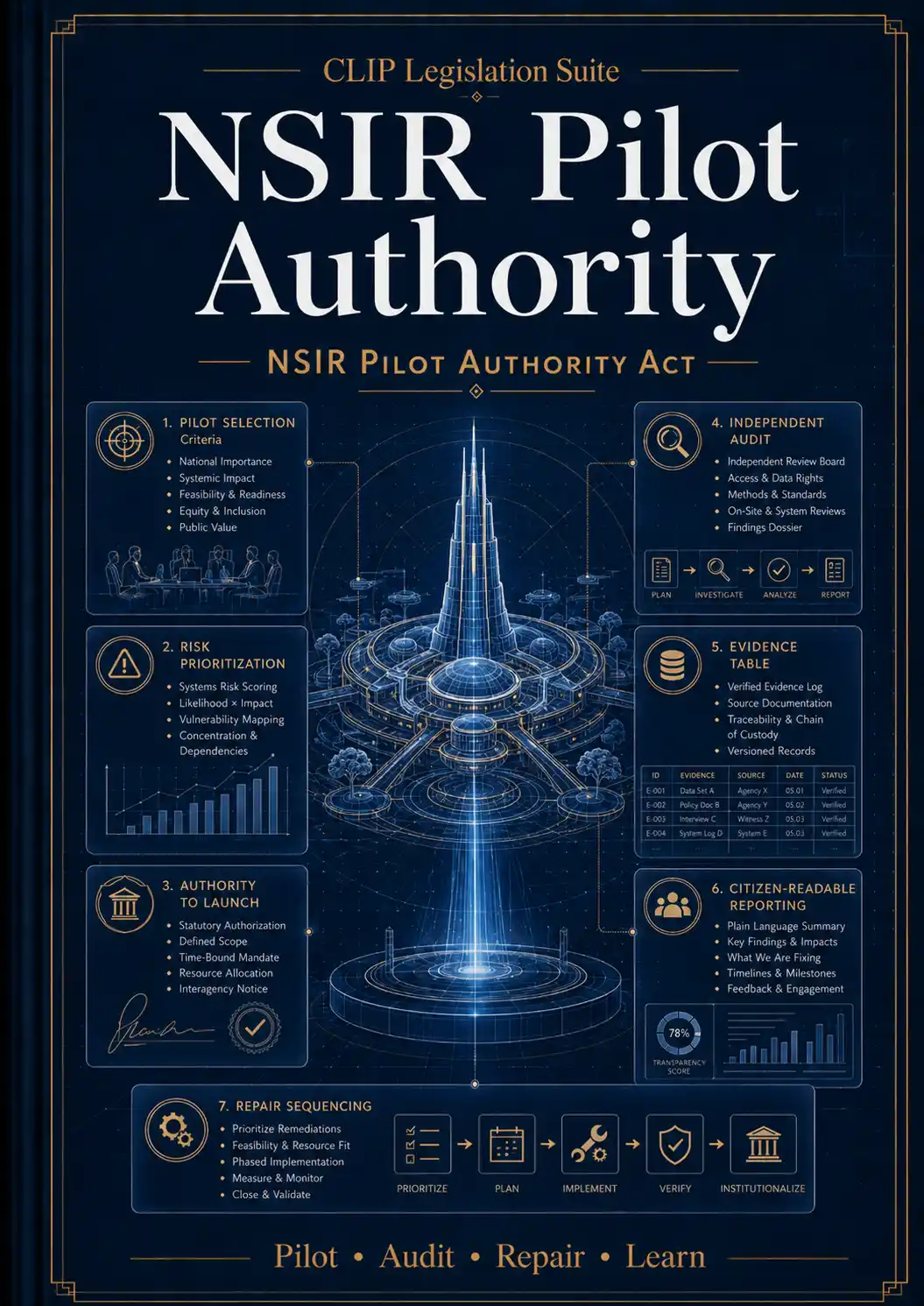
Project Page: AI Does Not Fix Government. It Amplifies It (Part 1) https://x.com/SkillsGapTrain/status/2065348053645861271
Disclaimer: This is an open-source educational system that is being developed for learning, research, frontier systems engineering and prototyping, intended to help students, teachers, public-sector builders, policy analysts, political leaders, corporate leaders and responsible organizations explore next-generation governance systems for humanity; it is not legal advice, policy authority, certification, or deployment-ready public infrastructure. Executive Summary of Audit of current development status is located at bottom of Part 3 of Project Page.