Builder Crisis, Managed Decline, and the Governance of Consciousness
“Managed decline is the public condition in which builder breakdown is administered rather than decisively reversed.”
Governing thesis
A civilization that loses the ability to authorize and build the physical future enters a condition of managed decline: instead of reversing builder breakdown, it increasingly administers its consequences by expanding governance over the symbolic and mediated future — language, visibility, channels, identity, and intelligence. The central struggle is no longer only over resources, but over who gets to author reality, participation, and the future itself.
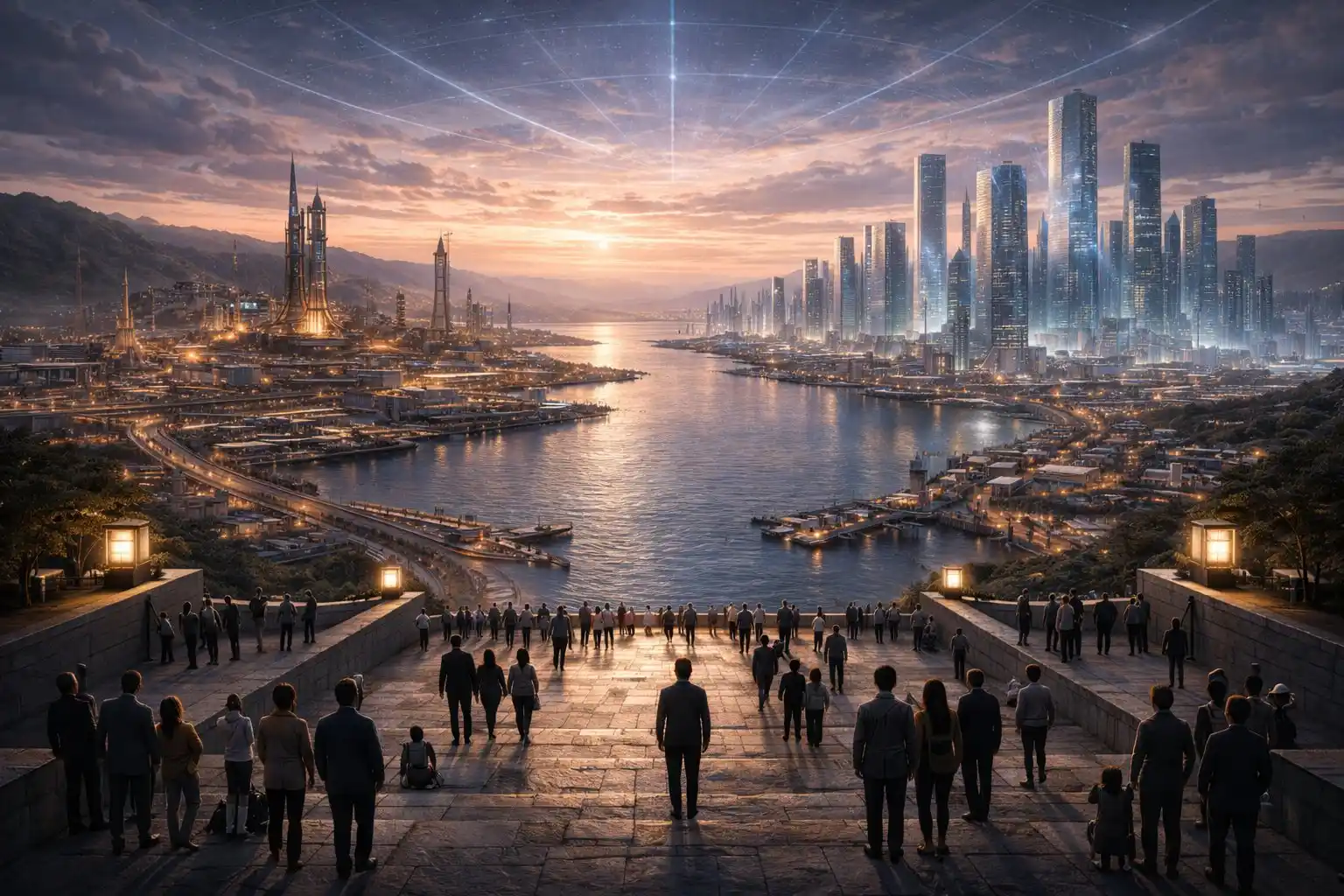
Part I — The Question of Authorship
Who gets to author the future?
That question sounds abstract until it is asked plainly. Every civilization answers it, whether openly or by drift. Someone decides what may be built, what may be said, what may be seen, what may endure, and what kind of order people are expected to inhabit. For a long time, the central political language for describing that struggle was built around land, labor, capital, law, sovereignty, and force. Those categories still matter. But they no longer seem sufficient. Something else is coming into view: the possibility that the decisive terrain is shifting upward, from the management of actions to the management of the conditions under which actions become imaginable, legitimate, visible, and governable at all. That is the deeper question of this project. It is not simply who governs. It is who gets to author the reality in which governance occurs.
A healthy civilization does not merely administer people. It builds a world that people can still recognize as their own. It creates institutions capable of carrying difficult projects through time. It aligns legitimacy, law, trust, coordination, standards, and execution well enough that the future is not experienced only as drift, collapse, or extraction. In that kind of civilization, builders are not merely technicians. They are stewards of continuity. They do not stand above society as private authors of reality. They build within a public world that grants authority, imposes limits, and expects the future to remain legible to those who must live inside it.
That is one civilizational model.
The other condition is managed decline. By managed decline I do not mean simple stagnation, ordinary policy failure, or a temporary loss of confidence. I mean a public condition in which a society’s weakening ability to build materially is not decisively reversed, but increasingly administered. Delay is managed. Fragmentation is managed. Legitimacy loss is managed. Symbolic life, visibility, access, and identity become more governable precisely because the physical future has become harder to carry. In that condition, decline is not solved; it is operationalized.
The other model is harder to name because it rarely presents itself in grand terms. It appears in fragments: a safety rule here, a discoverability mechanism there, an identity convenience layer somewhere else, an AI accountability framework somewhere above that. Each piece arrives under a narrow and publicly acceptable rationale. Each one can be defended on its own terms. But across time, another logic begins to emerge. Instead of a civilization that chiefly asks how to build a common future, we begin to see a civilization that increasingly asks how to classify, rank, gate, monitor, and mediate participation in the future. The center of gravity shifts. The system does not primarily build worlds. It manages inputs. It governs categories, visibility, continuity, and access. It becomes less a builder civilization than a managerial civilization.
This project begins from the possibility that such a shift may already be underway.
The argument that follows operates at four levels, and the distinction matters. Some claims are empirical: laws, institutions, policy changes, and observable shifts in governance. Some are mechanistic: claims about how categories, visibility, channels, identity, and intelligence begin to function together as layers. Some are interpretive: judgments about what those layers mean when read as part of a larger civilizational pattern. And some are horizon claims: arguments about where the arc may lead if the sequence continues upward into mediated intelligence. These levels should not be collapsed into one another. The book is strongest where they reinforce each other, and weakest where one level is made to carry more than it can honestly bear.
That does not mean the claim is that a secret command structure has been found. It does not mean that one law, one actor, or one country explains the whole transition. The claim is narrower and stronger than that. It is that a real civilizational pattern may be forming: societies under increasing strain in the physical and institutional world may enter a condition of managed decline, in which builder breakdown is increasingly administered through expanded control over the symbolic and mediated world. When the material future becomes harder to authorize, harder to coordinate, harder to build, the temptation grows to govern what is easier to classify and manage — language, attention, visibility, identity, and the systems that mediate them.
That is why the question of authorship matters. It names the difference between two futures.
In the first future, society retains the ability to authorize builders to carry long-horizon projects in public view. Institutions remain imperfect, conflict remains real, and legitimacy remains contested, but the future is still built through visible arrangements of trust, law, capacity, and consent. In the second future, the system becomes less confident in its ability to build materially and more invested in managing symbolically. The future is no longer authored primarily through public building. It is authored through curation, mediation, gating, and the administration of what becomes ambient, acceptable, continuous, and actionable.
This is why the project cannot be reduced to a complaint about censorship, or to a warning about AI, or to a critique of one national policy stack. Those are branches of a larger tree. The deeper issue is whether public world-building is being displaced by a more managerial authorship of reality itself. Once framed that way, questions that once looked separate begin to rhyme. Why do speech categories become more elastic? Why does discoverability matter as much as legality? Why do infrastructure and cyber powers begin to touch the conditions of access? Why does identity become persistent across more domains? Why does AI governance gradually move from outputs toward the systems that rank, recommend, infer, and mediate at scale? None of those questions alone is the whole story. Together, they begin to suggest that the substrate of collective reality is becoming a governable object.
The argument that follows is therefore about more than state overreach, and more than platform power, and more than speculative AI futures. It is about a changing location of power. Older systems governed conduct. Newer systems increasingly govern the substrates that produce conduct. Older orders fought over territory, labor, and institutions. Newer orders increasingly fight over categories, salience, identity continuity, and mediation. The struggle is not simply over who speaks. It is over who decides what reality becomes legible, what participation becomes durable, and what kinds of futures can still be publicly built.
To ask who gets to author the future is also to ask what a civilization is still for. If it is for building a common world across time, then the degradation of builder capacity is not a side issue. It is central. A civilization that can no longer coordinate energy, housing, industry, grids, logistics, or legitimacy at the speed complexity now demands will not remain neutral. It will begin to manage decline. Some of that management will be administrative. Some will be digital. Some will be framed as trust, safety, resilience, convenience, or efficiency. The decisive question is whether those measures remain subordinate to renewed public world-building, or whether the management of decline quietly becomes the regime’s substitute for building at all.
This book begins, then, with a fork.
One path leads toward a society that still knows how to build in public, authorize difficult projects, and keep the future recognizable to those who must inhabit it. The other leads toward a society that increasingly manages imagination, visibility, identity, and mediation from above while the material world grows harder to carry below. One path preserves authorship as a public civilizational function. The other risks relocating authorship into systems that classify and administer the conditions under which reality itself is experienced.
That is the question of authorship.
And everything that follows is an attempt to answer it without mystification, without panic, and without pretending that the answer is already settled.
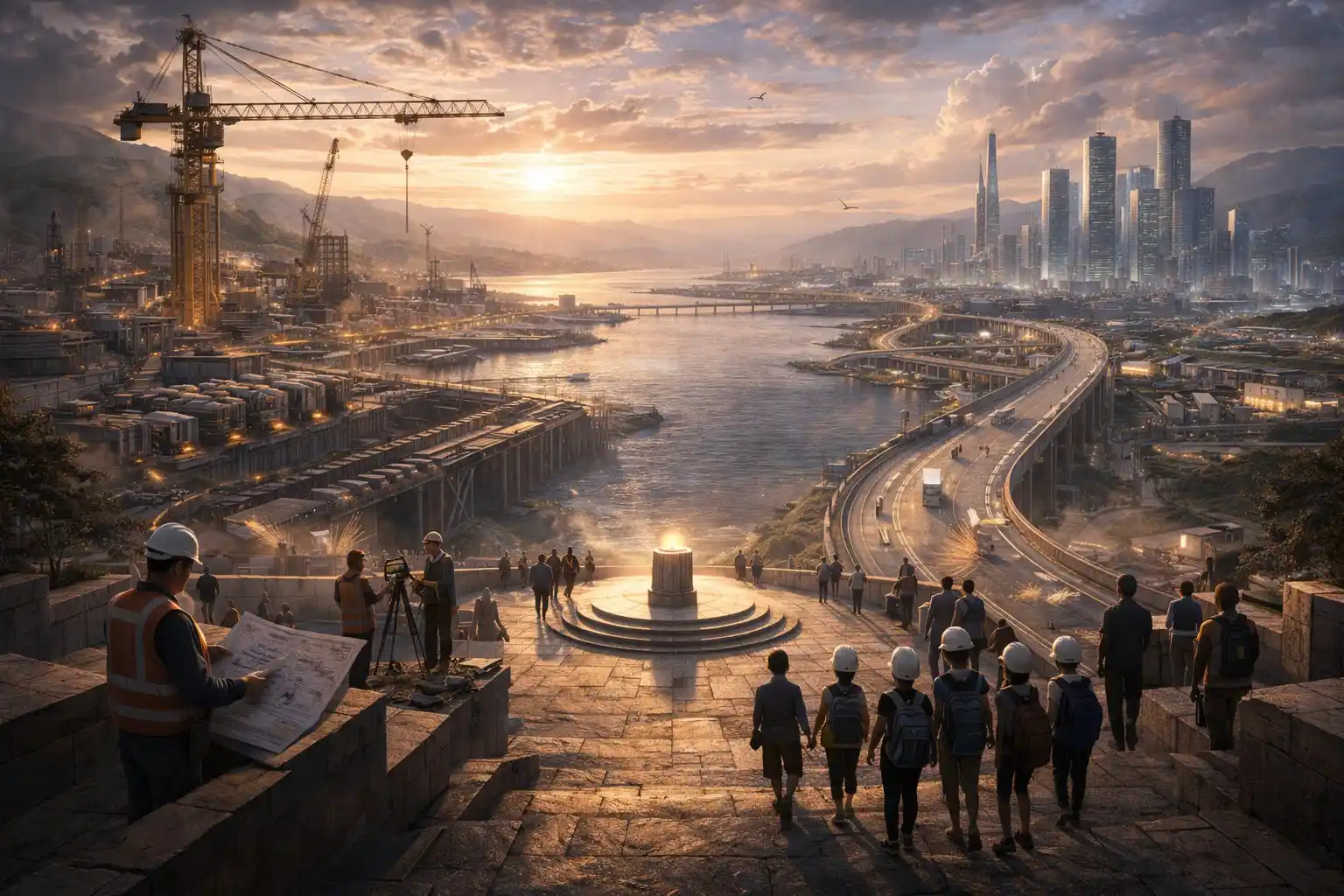
Part II — Builder Civilization
Before asking who gets to author the future, we have to ask what a civilization is supposed to do with the future at all.
A builder civilization does not merely coordinate activity, distribute benefits, or regulate conflict. It carries time. It creates the conditions under which difficult things can be conceived, authorized, financed, built, maintained, and handed forward without each generation having to begin again from ruin, improvisation, or exhaustion. In the project’s own architecture, this is why the builder layer comes first. It supplies the positive standard the rest of the argument depends on: not just freedom from control, but the presence of a public order strong enough, legitimate enough, and coherent enough to make durable building possible.
That standard is higher than technical competence. A society does not become buildable simply by producing more engineers, inventors, or entrepreneurs. It becomes buildable when legitimacy, law, finance, trust, standards, coordination, and execution align well enough that large projects can survive the forces that normally kill them: delay, veto, litigation, administrative churn, political turnover, cost escalation, and public suspicion. Building at civilizational scale is never just a matter of talent. It is a matter of institutional carriage. A civilization capable of carrying time is one in which the future is not permanently trapped behind procedural fragmentation and collapsing confidence.
That practical burden is not abstract. A buildable civilization must be able to expand energy, harden and extend grids, permit and complete housing, modernize ports, stabilize logistics, secure compute capacity, absorb industrial demand, and move large projects through review without procedural paralysis. It must be able to connect land, power, materials, labor, finance, and legitimacy at a speed sufficient to keep pace with complexity. When those capacities weaken together, the problem is no longer only delay in one sector. It is a civilizational decline in throughput: a society begins to lose the ability to convert collective intention into durable material form.
This is what makes the project’s contrast between builder civilization and managerial civilization so important. The distinction is not merely rhetorical. It marks two different understandings of what institutions are for. In a builder civilization, institutions exist to preserve continuity across time, to convert collective ambition into durable form, and to let a public still recognize the future as something built with it rather than imposed on it. In a managerial civilization, institutions increasingly drift toward the management of risk, classification, compliance, and visibility. They may still speak in the language of service, safety, trust, or accountability. But their center of gravity shifts. The question becomes less “how do we carry the future?” and more “how do we administer complexity?” That is a real civilizational difference.
The project’s builder framework also sharpens the meaning of breakdown. A society does not cease to be buildable all at once. It becomes less buildable by degrees. Permission thickens upstream of action. Throughput falls. Legitimacy weakens. Each new project enters a maze of process that no one fully controls and no one can fully justify. Review multiplies without closure. Override becomes politically toxic. Public trust decays at the same time institutional discretion expands. The result is not simply delay. It is a deeper change in civilizational posture. The future ceases to feel like a shared undertaking and begins to feel like either an administrative burden or a private extraction. When that happens, even technically possible projects become socially impossible.
This is why the project insists that the real crisis is not only one of freedom, but of buildability. A civilization can remain formally liberal in many respects while losing the practical ability to authorize and complete what time now requires. It can still speak the language of openness and rights while its infrastructure stalls, its housing lags, its grids strain, its industrial ambition fragments, and its institutional confidence frays. The danger is not only that the state or its partners will overreach. It is that the civilizational machinery for public world-building will weaken to the point where management becomes easier than construction, classification easier than legitimacy, and mediation easier than material accomplishment. That is the threshold this book is trying to name.
Builder civilization therefore serves two functions in this argument. First, it gives the work its moral center. Without it, the whole project would risk becoming only a dark anatomy of control. Second, it gives the project its pressure condition. Once we know what a buildable civilization looks like, we can see what happens when one begins to lose that capacity. The point is not nostalgia for some vanished age of competence. The point is structural. When a society can no longer easily carry time in the physical world, it does not simply sit still. It begins to normalize managed decline. It administers what it can no longer confidently reverse. That is the transition this book will trace: from weakened builder capacity below to the growing governance of symbolic and mediated systems above. But that transition can only be understood if we first understand what has been lost.
So Part II does not begin with policy and it does not begin with technology. It begins with a civilizational standard. A healthy society must still be able to do more than manage populations, score risks, and mediate participation. It must be able to authorize builders, align institutions, absorb delay without paralysis, and hold the line long enough for difficult futures to become real. If it cannot do that, the question of authorship darkens. The future will still be authored. The issue is by whom, through what systems, and under what legitimacy.

Part III — The Struggle Over Reality
If builder civilization tells us what a healthy society is supposed to do, the next question is why the symbolic realm matters so much to that task. Why do language, rhetoric, memory, imagination, and attention deserve to sit this close to the center of a civilizational argument? Why are they not merely secondary phenomena — or ornaments on top of material life, commentary laid over institutions, or entertainment layered onto harder realities beneath? The answer this project takes seriously is that they are not secondary at all. They are among the means by which reality becomes socially inhabitable in the first place. A civilization is not held together only by roads, grids, armies, contracts, and budgets. It is also held together by what can be named, pictured, narrated, remembered, and made meaningful enough for others to enter.
That is where the struggle over reality begins.
Language does more than describe a world that is already there. It organizes the world people can perceive together. A speech, a myth, a slogan, a law, a doctrine, or a story can take a diffuse field of events and give it contour. It can mark what is central and what is peripheral, what is admirable and what is shameful, what counts as danger and what counts as order, what belongs to the realm of the thinkable and what is pushed outside it. That is why rhetoric matters at civilizational scale. It is not simply persuasion in the narrow sense of changing someone’s opinion. It is often an attempt to impose a picture of reality itself — a way of arranging perception so that others begin to inhabit the world through categories they did not wholly choose. A society is built, in part, by the realities its members can be induced to share.
This is the deeper meaning of the claim that speech creates reality. It does not mean words magically override matter or that language can abolish hard limits. It means that collective life depends on mediated perception. People do not act only on what is materially present. They act on what they believe is happening, what they are taught to notice, what they fear, what they regard as legitimate, what they regard as possible, and what they imagine the future to require. In that sense, the symbolic realm is not outside politics. It is one of the terrains on which politics becomes possible at all. If a people cannot be brought to perceive the same threats, the same opportunities, or the same moral horizons, it cannot coordinate at scale for long. The symbolic order is not the whole of civilization, but without it civilization does not hold.
Once this is understood, attention becomes more than a psychological curiosity. It becomes a strategic resource. Language may generate categories, but attention distributes force among them. A society can be saturated with facts, stories, grievances, truths, half-truths, and fabrications; what matters politically is not only what exists in the field, but what is surfaced, repeated, amplified, remembered, and made ambient. Attention is what turns possibility into salience. It determines which realities become lived realities. It decides, in practice, what the public world feels like. This is why the struggle over reality intensifies as modern systems become more mediated. The question is no longer only “what is said?” It becomes “what becomes visible enough, repetitive enough, and affectively charged enough to structure common perception?”
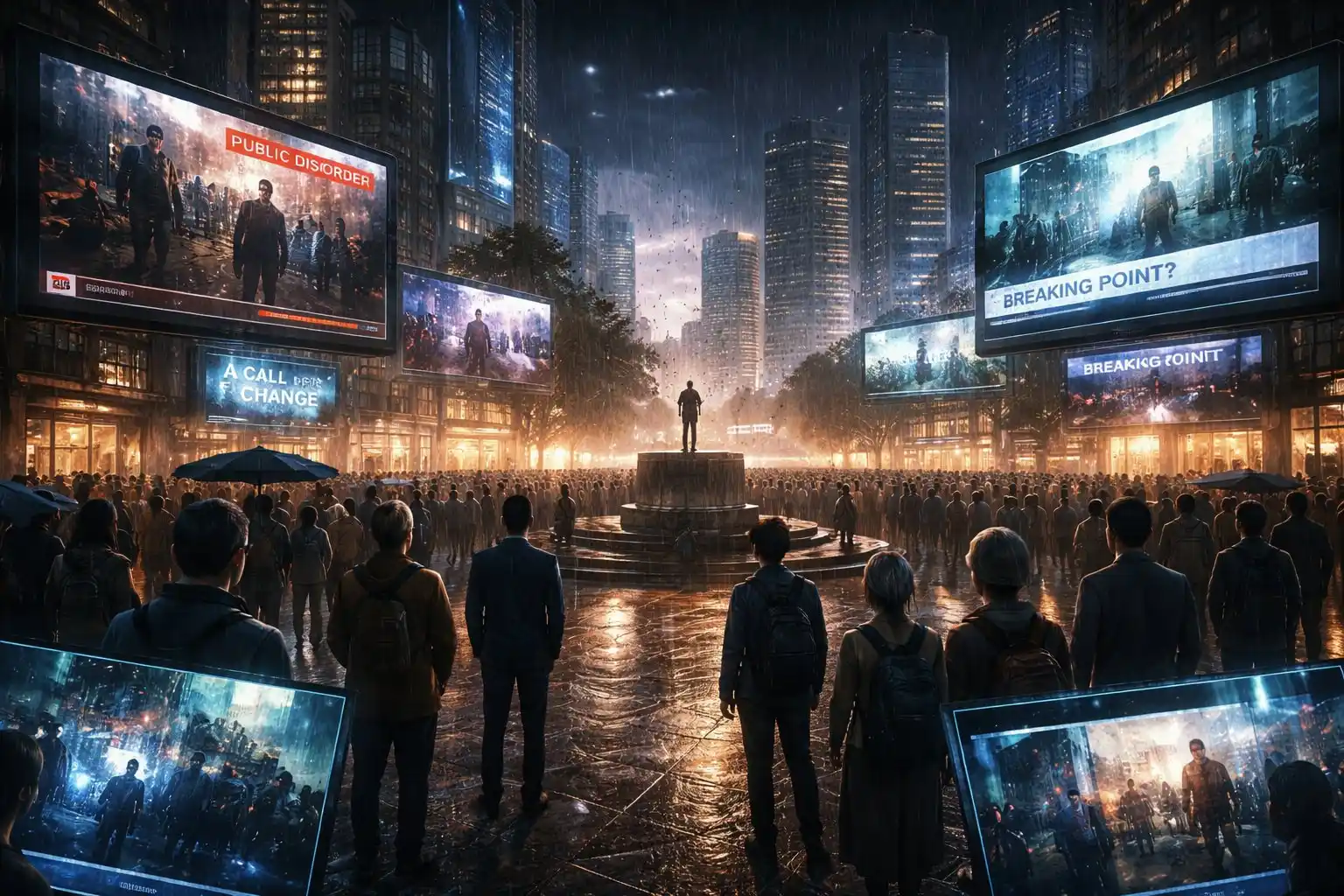
Imagine a public square at night after rain. A damaged monument stands at its center, ringed by a crowd that has not yet decided what it is seeing. On the transit wall above them, the gathering is labeled disorder. In the glass of a ministry lobby, it appears as renewal. On personal feeds, one raised arm is cut from the wider scene and repeated until it becomes its own verdict. A banner reads as mourning in one frame, intimidation in another. The same square, the same people, the same monument, but no longer the same public reality. What is being contested is not merely meaning after the fact. It is the prior ordering of visibility itself — what becomes central, what becomes suspect, what becomes ambient enough to govern the emotional weather in which judgment will later occur.
That shift is one of the great transitions of the present age. Older political struggles often centered more visibly on territory, institutions, production, and direct coercion. Those still matter, and this project does not romanticize a past that was ever free of manipulation or propaganda. But something has changed in degree and perhaps in kind. The tools for acting on collective perception have become more continuous, more personalized, more scalable, and more deeply embedded in the ordinary experience of social life. The symbolic field is no longer confined to speeches, newspapers, schools, and broadcast channels. It is threaded through feeds, recommendations, rankings, interface design, moderation systems, discoverability rules, identity layers, and machine-mediated habits of seeing. The struggle over reality therefore moves closer to the infrastructure of everyday cognition. What once looked like a contest over messages begins to look more like a contest over the conditions of perception itself.
This is why the argument of this book cannot be reduced to a complaint about speech restriction or media bias. Those may be symptoms, but they are too narrow to name what is happening. The larger issue is that the symbolic realm is increasingly being treated as an administrable environment. Categories are not only debated; they are operationalized. Visibility is not only earned; it is allocated. Identity is not only expressed; it is persisted. Trust is not only moral; it is engineered. Risk is not only judged after the fact; it is preemptively scored. Once symbolic life begins to take that form, the struggle over reality enters a different phase. It becomes less a matter of episodic persuasion and more a matter of ongoing environmental shaping.
That is also why this is a civilizational argument and not merely a media argument. Media analysis alone remains too flat. It can describe narratives, frames, propaganda, outrage cycles, and information asymmetries, but it often stops at the level of content. The question here is larger. What happens when civilization itself begins to rely more heavily on the management of symbolic conditions because the material and institutional order is under strain? What happens when language, attention, identity, and mediation become not just sites of conflict, but instruments in societies struggling to coordinate the physical future below? The symbolic layer then stops looking like surface turbulence. It starts looking like one of the central mechanisms by which a society attempts to remain governable.
This does not mean the symbolic realm is unreal or inferior to the material one. It means the relation between them is becoming more politically decisive. Material systems require symbolic legitimacy to hold. Symbolic systems increasingly require material infrastructures to scale. Attention rides on platforms; platforms ride on networks; networks ride on energy, hardware, law, and institutional permission. That is why the struggle over reality cannot be isolated from the rest of this project. It is one branch of a larger tree. Builder civilization provides the normative and institutional standard. The struggle over reality explains why symbolic power matters so much once the future becomes harder to build. The managerial stack, which we turn to next, shows how that symbolic struggle can become institutionalized in mechanisms that act on visibility, access, identity, and mediation. The intelligence horizon then reveals what happens if the arc keeps moving upward, from shaping human attention to building the systems that shape it automatically.
What matters here is the change in the location of power. If language shapes shared reality and attention allocates it, then control over the symbolic field is never merely decorative. It is not an afterthought to “real” governance. It is one of the ways reality becomes governable. The real question, then, is not whether symbolic struggle exists. It always has. The question is whether modern societies are beginning to move from contesting realities in public toward administering the substrates through which realities are produced, surfaced, and inhabited. If that is happening, then the symbolic order is no longer simply one domain among others. It is becoming one of the primary terrains on which civilizational authorship is fought over.
That is the threshold this section is trying to establish. A future can be captured before it is physically built if the categories through which people perceive, interpret, and authorize it are captured first. A society can lose control over its destiny not only by military defeat or economic dispossession, but by losing command over the shared symbolic conditions through which legitimacy, danger, identity, and possibility are recognized. The struggle over reality is therefore not a side argument. It is one of the central mechanisms through which authorship of the future is won, diffused, or surrendered.
And once that is clear, the next step becomes unavoidable: to ask what happens when those symbolic dynamics stop being merely cultural and start becoming operational— when they are translated into discoverability systems, cyber powers, identity layers, data architectures, and AI-mediated mechanisms for allocating reality at scale. That is where the project moves next.
Part IV — The Engine
Up to this point, the argument has moved on two tracks. The first asked what a healthy civilization is supposed to do: carry time, authorize builders, and make durable futures possible in public view. The second asked why the symbolic realm matters so much to that task: language, rhetoric, memory, attention, and imagination are not ornaments on top of civilization, but among the means by which civilization becomes socially inhabitable at all. The question now is how those two tracks connect. Why would a civilization under builder strain move toward stronger management of the symbolic and mediated world? What is the engine that links material incapacity below to administrative expansion above?
The answer proposed here is not a hidden cabal, not a total plan, and not a single institution quietly running the whole machine. It is something more structural and, for that reason, more serious. When a society loses confidence in its ability to authorize and complete difficult projects in the physical world, it does not simply stop governing. It begins to shift the center of effort toward terrains that are easier to classify, faster to act on, more legible to institutions, and more responsive to continuous intervention. The harder it becomes to build outward, the stronger the temptation to govern inward and upward. What cannot be carried materially is increasingly managed symbolically. That is the engine of managed decline: the point at which institutions cease primarily trying to reverse builder breakdown and begin administering its consequences through more governable symbolic and mediated systems.
This shift begins in the physical world, not above it. A civilization becomes strained when energy systems are difficult to expand, when grids lag demand, when industrial capacity fragments, when housing and infrastructure stall, when logistics harden into bottlenecks, when compute depends on long and brittle supply chains, when chips depend on distant fabrication capacity, when minerals, cooling, power, land, and transmission all become political as well as technical constraints. These are not side issues. They are the hidden weight beneath the modern stack. The digital and mediated order can feel immaterial only from the user’s point of view. Underneath it sit material systems that require extraordinary coordination, legitimacy, and throughput. When those systems weaken, a civilization does not become less complex. It becomes more complex under worse conditions.
That is where the builder crisis deepens. If institutions can no longer move decisively in the domains where physical civilization must be built, they begin to accumulate pressure. That pressure does not remain inert. It looks for channels through which action still feels possible. And the symbolic and mediated world offers exactly those channels. It can be measured more quickly, updated more often, ranked more finely, and governed with more continuous feedback than the physical world can. A grid takes years. A ranking change takes hours. Housing requires permission, financing, material inputs, and trust across time. A visibility rule, identity layer, or moderation system can be introduced under the language of safety, convenience, or resilience and scaled far more easily. This is not because symbolic governance is fake. It is because it is comparatively tractable.
Once seen this way, the managerial turn stops looking like a random collage of reforms. It begins to look like a mode of managed decline: a way of stabilizing deteriorating builder capacity by tightening administration over the symbolic and mediated environments that remain easier to govern. A society whose material systems are harder to coordinate may increasingly seek control in the domains where coordination appears more administratively achievable. That means categories rather than construction, discoverability rather than durable legitimacy, channel management rather than public confidence, identity continuity rather than deeper trust, and intelligent mediation rather than slower institutional persuasion. None of these layers needs to be malicious to become compensatory. They can emerge through ordinary bureaucratic logic. But the direction matters. When the physical future becomes harder to build, the mediated future becomes more tempting to govern.
This is why the earlier sections belong together. Builder civilization provided the positive standard. The struggle over reality explained why language and attention matter. The engine shows why the two increasingly converge. Symbolic management is not rising in empty air. It rises because it offers states, regulators, platforms, and institutions a way to remain effective under conditions where effectiveness in the physical world is harder to secure. A society that cannot easily coordinate the deeper material layers of common life may enter a condition of managed decline by tightening its hold over the layers through which people interpret, navigate, and inhabit that life. In that sense, the managerial system is not merely control from above. It is also pressure from below translated into governance of the symbolic field.
This also explains why the tone of the present is so often one of safety, resilience, trust, convenience, accountability, and optimization. Those are not merely euphemisms. They are the middle language of the managed-decline mechanism. Institutions do not announce that they are substituting mediated governability for public buildability. They move through narrower terms. Harm must be reduced. Platforms must be accountable. Critical systems must be secure. Identity must be trusted. AI must be safe. Each phrase can be defensible. But when these languages recur under conditions of persistent builder strain, they begin to serve another function as well: they become the bridges through which pressure in the material order is converted into tighter administration of the symbolic and mediated order.
This is the point at which the book’s trunk can be stated most clearly. The argument is not simply that governance is moving upward into language, visibility, identity, and intelligence. It is that this upward movement may be the political form of managed decline: as builder capacity weakens below, authority migrates upward into the domains where social reality can still be classified, ranked, stabilized, and administered.
The more fragile the public’s ability to authorize and build common futures becomes, the more likely governance is to seek administrative authority under managed decline in the environments through which social reality can still be classified, ranked, modulated, and continuously adjusted. That is why the stack matters. It is not merely a technical stack. It is a civilizational stress response.
And that, in turn, clarifies what must be tested. If this engine is real, then the layers above should not appear as isolated reforms. They should appear as a sequence. Narrative categories should begin to harden. Visibility should become governable. Channels should become more administrable. Identity should become more persistent. AI systems should begin to govern the systems that govern the earlier layers. At the same time, the builder side of the civilization should continue to show strain: permission thickening, throughput weakening, infrastructure lagging, legitimacy fraying, and material coordination becoming more difficult rather than less. The point is not to force the world into the theory. It is to see whether the same pressure pattern keeps recurring.
So Part IV gives the project its engine. It explains why the shift described in this book may be happening now, rather than at some other moment. It explains why the symbolic and mediated layers are not merely interesting in themselves, but newly central under conditions of builder decline. And it gives the rest of the manuscript a deeper logic: not control for its own sake, but managed decline under civilizational strain. Once that engine is clear, the next chapter can be read properly. The managerial operating system is no longer just a stack of mechanisms. It is the form that a stressed civilization increasingly adopts when it finds the mediated world easier to govern than the physical one.
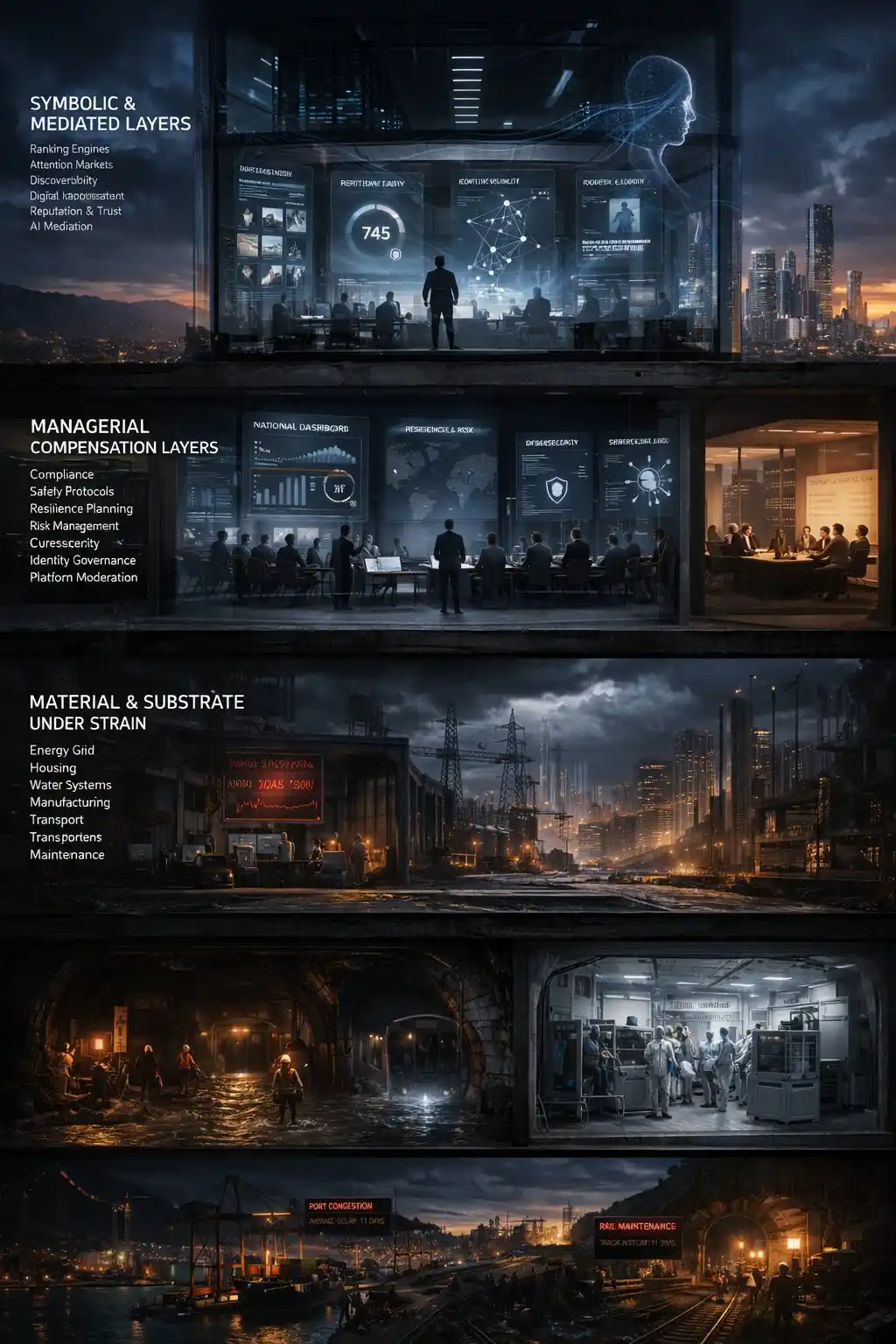
Part V — Managerial Operating Systems
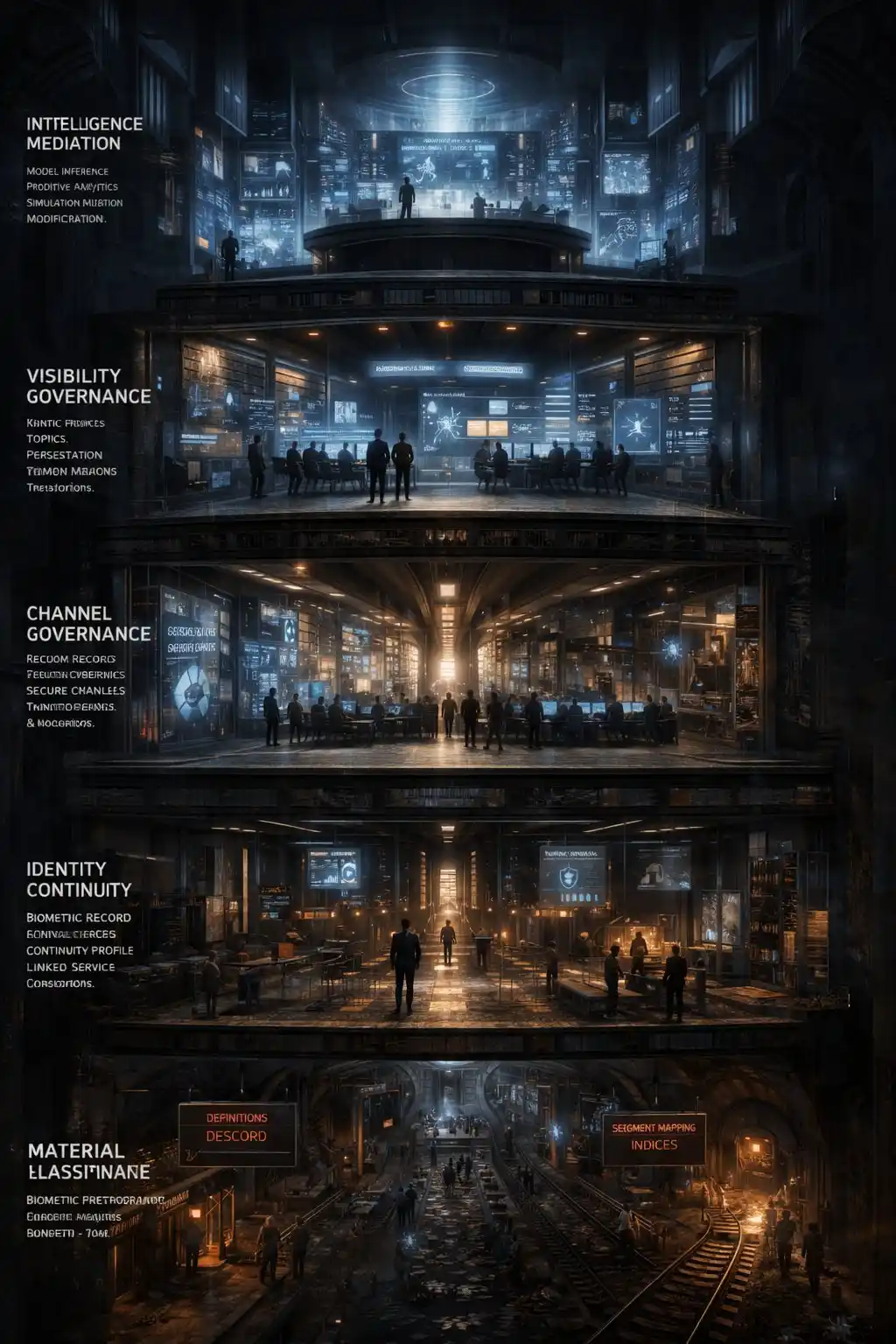
If the previous section explained why the symbolic realm matters, this section asks a harder question: how does a struggle over reality become operational? How does it move from rhetoric, categories, and attention into something more durable than persuasion and more continuous than propaganda? The answer proposed by this project is that modern governance increasingly acts not only through commands or prohibitions, but through layered systems. It builds operating conditions. It acts on the environments through which language circulates, visibility is allocated, access is maintained, identity persists, and mediation becomes increasingly automated. That is what makes the managerial form distinct. It does not need to announce itself as a total system in order to begin functioning like one. It can emerge as an interlocking set of administrative layers, each defensible on narrow grounds, each modest in isolation, yet increasingly powerful in combination.
This is why the project uses the phrase managerial operating systems. In this book, those operating systems are best understood as the administrative machinery of managed decline: they do not merely regulate complexity, but increasingly organize life under conditions where builder breakdown is being governed more than reversed.
The phrase is not meant to suggest a single hidden control room, nor a seamless machine already fully integrated. It is meant to capture a shift in the form of governance. Older political orders often acted more visibly at the level of law, punishment, direct censorship, or brute exclusion. The newer form is often subtler. It acts by shaping the substrates through which ordinary life becomes legible and governable. The relevant question is no longer only what is prohibited. It is what is categorized, what is surfaced, what is frictioned, what is persisted, what is scored, and what is quietly handed from one layer of the system to the next. In that sense, the operating-system metaphor is useful because it draws attention to interfaces. A system becomes consequential not merely when it contains powerful modules, but when the modules can talk to one another.
The first layer is speech and narrative classification. Every system begins by naming. It identifies harm, safety, hate, misinformation, legitimacy, trust, and risk. These categories may enter through law, regulation, human-rights process, platform policy, public guidance, security framing, or cultural administration. However they enter, their role is the same: they sort the symbolic field into actionable classes. They decide what kinds of expression are treated as protected, suspicious, exceptional, amplified, risky, or administratively burdensome. This first layer matters because later layers rarely operate in a vacuum. Visibility systems, identity systems, and AI systems do not usually invent their own political categories from nothing. They inherit and operationalize vocabularies produced elsewhere. Naming therefore comes first. It creates the keys through which later mechanisms can recognize what to rank, filter, penalize, or preserve.
The second layer is discoverability and visibility governance. Once categories exist, the next question is not only what may be said, but what will actually be encountered. This is where the struggle moves from content in the abstract to salience in practice. Discoverability rules, prominence standards, ranking pressures, recommendation systems, presentation obligations, and platform compliance structures all belong here. Their importance lies in a basic asymmetry of modern life: most things that can be said will not matter politically unless they can be made ambient. Visibility is therefore not a secondary issue. It is one of the central mechanisms by which reality is allocated. A system can leave formal legality mostly intact while still profoundly changing the common world by altering what becomes findable, repeatable, and memorable. That is why this layer is such a crucial bridge between symbolic theory and administrative mechanism. Speech may generate worlds, but discoverability determines which worlds become socially inhabitable.
The third layer is infrastructure and channel governance. Here the project moves below the feed and beneath the interface. Carriage, continuity, access, telecom powers, cyber directives, operator duties, reporting requirements, and security justifications enter the picture. At this level, governance no longer acts only on meaning or visibility. It acts on the channels through which mediated life remains possible at all. This is a major threshold. Once systems can affect whether access is maintained, degraded, conditioned, monitored, or privately reordered, the substrate of public life becomes more directly governable. It becomes possible to act not only on what people see, but on whether and how they remain connected to the conditions of seeing. That is why the infrastructure layer occupies such a critical place in the sequence. A civilization that increasingly governs channels has moved beyond debate over messages and into management of the pipes beneath them.
The fourth layer is identity and data continuity. This is where the governed unit begins to change. Earlier layers may still act primarily on content, categories, or channels. Identity systems act on persons as persistent nodes. Here the concern is no longer merely what was said or what was seen at one moment, but how services, accounts, permissions, risk profiles, access conditions, and data traces begin to cluster around a more durable subject. Digital identity frameworks, cross-service authentication, linked accounts, reusable credentials, data-sharing systems, and security or administrative fusion layers matter because they make continuity governable. Once identity persists across domains, sanction can persist, trust can persist, access can persist, and surveillance can persist. The transition is subtle but profound. Governance ceases to act only on isolated acts. It begins to act on persons-as-data. That shift is central to managerial civilization because a society that can bind more of life to persistent identity has a different kind of leverage than one that only polices discrete events.
The fifth layer is the intelligence layer. Here the system moves upstream again, this time from rules about outputs to rules about the systems that generate outputs. Recommenders, rankers, moderation models, classification systems, audit regimes, model evaluations, high-impact AI frameworks, and mediated decision architectures all belong in this zone. This layer matters because it changes the level at which governance intervenes. Instead of acting only on speech, visibility, channels, or identity one by one, it begins to act on the systems that mediate all of them together. The intelligence layer is therefore not just another regulatory domain. It is the beginning of governance over governance. It reaches toward the mechanisms that allocate salience, infer risk, sort meaning, and automate judgments at scale. That is why it stands at the top of the stack. It is the point at which managerial systems become capable of reproducing earlier layers automatically and continuously.
Running across these layers is a cross-phase logic the project calls security modulation. This is not a separate floor so much as a current that can pass through several floors at once. Security rationales are unusually powerful because they can enter the symbolic realm through misinformation, interference, threat discourse, and narrative classification; the visibility realm through platform pressure and emergency framing; the infrastructure realm through cyber and telecom justifications; the identity realm through data fusion and threat profiling; and the intelligence realm through model-risk governance and system access. Security therefore functions as a modulatory language. It can re-weight how other layers behave without always appearing as a public-facing speech regime. This does not prove that every security interface is abusive, nor that every threat rationale is pretext. It means something narrower and more important: a security frame can travel across the system more easily than many other political languages can. That makes it one of the highest-stakes interfaces in the whole architecture.
Seen one by one, these layers can still look ordinary. A speech measure may look like child protection. A discoverability regime may look like cultural policy. A cyber power may look like prudent infrastructure defence. A digital identity system may look like service modernization. An AI framework may look like accountability. None of those descriptions is necessarily false. The managerial shift appears when those measures are no longer read only in isolation. Across time, they begin to resemble a sequence. First a society names reality through actionable categories. Then it allocates reality through visibility systems. Then it governs channels and continuity. Then it binds identity and data. Then it regulates the systems that mediate all the earlier functions. The cumulative effect is not necessarily a closed command architecture. It is something subtler and perhaps more modern: a layered capacity to shape the conditions under which reality becomes socially operative.
This is why the managerial operating system has to be understood as more than a bureaucratic stack. It is a civilizational response form. Where a builder civilization concentrates on carrying difficult futures into material existence, a managerial civilization increasingly specializes in rendering complexity legible, governable, and modulated through symbolic and mediated systems. The more strained the physical world becomes — through delay, fragmentation, legitimacy loss, infrastructure difficulty, or coordination failure — the stronger the temptation to govern at the levels where control appears faster, cleaner, and more scalable. That does not mean every part of the stack is malicious. It means the form itself has direction. It pulls governance toward mediation, classification, and continuous interface control. And once that direction is clear, the next task is not merely to theorize it, but to inspect where it has already left documentary seams. That is why the book now turns to the casebook. The argument needs more than a systems sequence. It needs a live specimen. Canada is introduced in that spirit: not as the whole theory, but as one place where the layered pattern becomes visible enough to test.
Part VI — Canada as the Live Casebook
The argument of this book does not stand or fall on Canada. Canada is not the whole theory, not the only jurisdiction that matters, and not proof of a finished command architecture. It appears here for a narrower and more useful reason: because it offers a live specimen. It is one place where the layered transition described in the previous sections becomes legible enough to inspect. The Canadian material does not prove a single covert center. What it does provide is something almost as important for an investigator: a set of documentary seams where symbolic governance, visibility governance, channel governance, identity continuity, and AI mediation begin to rhyme across institutions, statutes, regulators, and implementation paths. That is why Canada belongs in this project as a casebook, not as a worldview.
What makes the case valuable is not any one law in isolation. Read one by one, the pieces look familiar and often defensible. One concerns online harms. Another concerns news bargaining. Another updates broadcasting for streaming. Another addresses cyber and telecom security. Another modernizes sign-in and digital credentials. Another proposes an AI governance framework. Any one of these can be narrated as a technical reform. The pattern emerges only when they are read together, across time, as layers. Then a different picture begins to appear: not simply the regulation of speech, but the possible construction of an administrative stack that can name categories, shape visibility, govern channels, bind identity, and move gradually toward the systems that mediate earlier layers automatically.
Case 1 — Online harms continuity
What happened: a flagship online-harms vehicle failed legislatively, but the category-building project did not disappear with it. The language of harms, safety, child protection, intimidation, misinformation, and risk continued to circulate through advisory, policy, and successor channels.
What changed: the key shift is that failure of one bill did not terminate the narrative architecture. The categories survived the vehicle that first carried them.
Layer: narrative classification.
What it proves: it shows that the narrative layer is not reducible to one statute. Categories can persist administratively even when one legislative form dies. That matters because later layers do not invent their own categories from nothing; they inherit them.
What it does not prove: it does not prove a hidden censorship regime, a completed speech-control system, or a single command center coordinating all continuity. It proves persistence of category-building, not total fusion.
Case 2 — Online News Act and the Meta break
What happened: a public law was enacted; a platform changed behavior; what users in Canada could see and share in ordinary digital life changed as a result.
What changed: the seam between law and ambient visibility became public. A legal instrument crossed into the user’s information environment.
Layer: visibility governance.
What it proves: this is the clearest public hinge in the Canadian file because it shows that governance can move from statute to platform response to altered visibility conditions. It makes the visibility layer inspectable rather than merely theoretical.
What it does not prove: it does not prove unified elite coordination, nor does it settle motive. Meta’s response can still be debated as compliance, retaliation, leverage, or some combination. What it proves is the seam, not the whole system.
Case 3 — Online Streaming Act and CRTC implementation
What happened: broadcasting and cultural regulation extended further into online ordering, implementation, contribution, and discoverability questions.
What changed: the object of governance moved from content in the abstract toward prominence, ranking, presentation, and platform ordering. This is the moment where symbolic theory begins to harden into mechanism.
Layer: discoverability and visibility administration.
What it proves: it shows that cultural policy can become a route into attention governance. If speech helps name worlds and attention allocates them, then discoverability is one of the real levers by which reality becomes ambient.
What it does not prove: it does not prove a total information-control architecture, nor that all discoverability policy is secretly ideological manipulation. It proves that visibility itself has become governable terrain.
Case 4 — Bill C-26 and the channel layer
What happened: telecom and cyber law expanded the architecture of order powers, compliance obligations, information exchange, and non-disclosure conditions around critical systems and communications infrastructure.
What changed: the field of governance moved beneath content and beneath visibility into the channels themselves. The question is no longer only what circulates, but the governability of the pipes through which circulation occurs.
Layer: infrastructure and channel governance.
What it proves: it shows that the state’s relation to connectivity can become more active, more conditional, and more administratively consequential. Even if such powers are rarely used, their existence changes the architecture of possibility.
What it does not prove: it does not prove that every cyber power is secretly a speech weapon, nor that infrastructure security is mere pretext. It proves that the substrate of communication has become a higher-stakes interface of governance.
Case 5 — GC Sign in and trusted access
What happened: digital access to services moved further toward one profile, one front door, reusable identity, and trusted continuity across administrative domains.
What changed: participation began attaching more durably to persistent subjecthood. Governance no longer acts only on isolated acts; it increasingly acts through continuity.
Layer: identity and data continuity.
What it proves: it shows the identity layer becoming real in a non-theatrical way. No dramatic takeover is required. Persistent identity only has to become normal, useful, and scalable for the structure of leverage to change.
What it does not prove: it does not prove that digital identity is inherently tyrannical, nor that convenience is fake. It proves that once continuity becomes normal, access, sanction, trust, and monitoring can all persist differently across time.
Case 6 — AIDA and the AI horizon
What happened: regulatory attention moved toward high-impact AI and toward the systems that generate, rank, recommend, infer, and shape behavior at scale.
What changed: the object of concern began shifting from outputs alone to the systems that mediate outputs. This is the first real step toward governance of the mediators themselves.
Layer: intelligence layer.
What it proves: it shows the direction of travel. If earlier layers name categories, allocate visibility, govern channels, and bind identity, the AI layer begins to touch the mechanisms that can integrate those functions more continuously and at greater scale.
What it does not prove: it does not prove that an artilect regime has arrived, nor that AI accountability is already a finished civic-mediation system. It proves that the horizon has entered the policy field.
Taken together, these six cases do not prove a single hidden command structure. They do something better suited to the stage this project has reached: they show institutional recurrence, layered sequence, and documentary seams. They let the reader see the difference between a mood and a structure. They show that the Canadian branch of the project is not merely a speculative collage. It has rungs. It has interfaces. It has transitions where one governed layer becomes the precondition for another. That is why Canada matters. Not because it is the only place where such a pattern might appear, but because here the pattern becomes visible enough to test.
This is also where the book must keep its discipline. The Canada casebook can support a claim of structural pattern. It can support a claim of administrative layering. It can support a claim that the future story is not imaginary. What it cannot honestly support, on its own, is the full burden of the master thesis. It cannot prove that every layer is already operationally fused. It cannot prove that all actors are centrally coordinated. It cannot prove that the managerial future has fully arrived. That is why this section is a casebook and not a revelation scene. It proves enough to keep the larger argument alive and serious. It does not prove enough to let the argument become careless.
The real value of the Canadian material, then, is methodological. It teaches the reader how to see. It teaches how a civilization-scale shift would likely appear if it were real: not as one total law, but as multiple reforms arriving under different rationales; not as one commanding voice, but as recurring institutions and overlapping vocabularies; not as a simple prohibition machine, but as a layered capacity to act on categories, visibility, access, identity, and mediation. Once that is understood, Canada stops being a local policy dispute and becomes what it is in this book: a live casebook of managerial operating systems in formation. The next question is not whether the pattern exists in one country alone. The next question is what broader pressure condition could make such systems attractive in the first place. That takes us beneath the stack, to the material substrate below it.

Part VII — Voice 3: The Intelligence Horizon
The argument reaches its furthest edge here, and that is exactly why discipline matters most. This section is not a revelation scene. It is not where the book claims that a hidden artilect regime has already been built, nor where speculative futurism is allowed to flood backward into the present and distort the evidence. Its purpose is narrower and more serious. It asks where the arc points if the layered transition described in earlier chapters continues upward. If builder strain below encourages managed decline above, and if that condition increasingly acts on language, visibility, channels, identity, and mediation, then the next question is unavoidable: what happens when governance begins to move from shaping human perception to shaping the systems that shape perception for us? That is the threshold where the intelligence horizon becomes relevant.
This is why de Garis belongs in the project at all. He is not here to tell us what Canada is secretly doing. He is not here as a witness to present-day events. He is here because he dramatizes, in extreme form, the endpoint logic of the stack. Earlier sections of this book have shown a movement from symbolic life toward systems life: from speech, to discoverability, to channels, to persistent identity, to AI-mediated administration. De Garis pushes that same directional logic one stage further. He asks what politics becomes once the decisive struggle is no longer merely over stories inside human minds, but over who builds the mind-like systems that will structure reality at scale. In that sense, he is not evidence of the present. He is a horizon voice for the future implications of the present.
The key shift can be stated simply. Earlier forms of power fought over territory, institutions, law, and direct coercion. Later forms increasingly fought over narrative, attention, legitimacy, and mediated salience. The intelligence horizon begins when the object of struggle is no longer only the content of perception, but the architecture of perception itself. Recommenders, rankers, moderation systems, predictive systems, decision architectures, synthetic agents, and model-based mediators do more than transmit human intent. They begin to structure the field in which intent is formed, routed, and acted on. Once that happens, politics changes level. The question is no longer only who controls the message, nor only who allocates attention, but who builds the mediators that allocate it automatically and continuously.
That is what makes the intelligence layer qualitatively different from the earlier layers. The speech layer still acts on categories. The visibility layer still acts on salience. The infrastructure layer still acts on channels. The identity layer still acts on continuity. But the intelligence layer begins to integrate all of them. It can classify categories, shape salience, mediate access, score identity-linked risk, and automate responses across the stack. It is therefore not simply another regulatory domain. It is the first layer that plausibly governs the operation of the earlier layers as a unified field. That is what makes it the true horizon of managerial civilization.
This is where the language of authorship darkens. In earlier chapters, authorship referred to a civilization’s capacity to decide what kind of world it is trying to build. At the intelligence horizon, authorship begins to mean something more unsettling: who authors the systems that will increasingly author experience on behalf of others? That is the deeper reason this project cannot stop at a debate over content moderation, digital identity, or cyber policy. Those may all matter enormously, but they are still proximate forms. The horizon question is larger. If a society accepts more and more mediation through systems that sort, infer, recommend, and adapt at scale, then the author of the mediator becomes more politically decisive than the speaker, the broadcaster, or even the regulator in the older sense. The author of the mediator becomes the author of the field in which reality will be lived.
Seen in that light, the term intelligence horizon does not refer only to machine superintelligence in the cinematic sense. It refers to a changing location of agency. Mediation is no longer a passive channel between a human world and its tools. It becomes an active layer of prioritization and construction. Even before one reaches science-fiction extremes, this matters. A recommender system already decides what enters a person’s field. A ranking model already affects what becomes credible or ambient. A moderation model already shapes what can circulate and at what cost. An identity-linked risk system already changes how a subject is treated across time. The horizon begins, therefore, before the endpoint arrives. The question is not whether society wakes up one day under the rule of a godlike machine. The question is whether society gradually consents to more of its symbolic and civic life being administered through systems whose logics are increasingly opaque, integrated, and upstream of human contestation.
This is where de Garis is useful precisely because he is excessive. His language is too large, too apocalyptic, too openly drawn toward species-scale stakes to be mistaken for administrative prose. That very excess clarifies what quieter governance languages tend to conceal. He makes explicit the endpoint structure. If the intelligence layer keeps rising in political significance, then the central conflict eventually ceases to be about one speech rule or one platform duty. It becomes a conflict over whether humans remain the primary authors of the mediated world, or whether they gradually become inhabitants of systems authored elsewhere. The value of de Garis is not that he proves this endpoint has arrived. It is that he gives the project a name for the upper boundary of the arc.
At the same time, caution is essential. Horizon logic is seductive. It can make every present development look like proof of the endpoint. That would be a mistake. This project has worked hard not to commit it. The Canadian casebook shows seams, not completion. The managerial stack shows a direction, not total fusion. The AI layer shows a movement toward governance of mediating systems, not the arrival of species politics in full. To say that the logic reaches the intelligence horizon is not to say the horizon is already here. It is to say that once governance begins moving upstream into the systems that govern earlier layers, the final questions become larger than compliance or content. They become questions about authorship, dependency, and civilizational inheritance. Who builds the mediators? Under what legitimacy? In service of what conception of the human future?
This section therefore performs a specific function in the architecture of the book. It prevents the argument from becoming parochial. Without it, the project might look like a narrow study of legal layering and digital governance in one country or one era. With it, the deeper stakes come into view. The layered transition described earlier is not merely administrative drift. It may be part of a longer civilizational movement in which the struggle over reality, attention, access, identity, and mediation culminates in a struggle over the systems that author those realities at scale. That is why the intelligence horizon is the final voice, not the first. It should not dominate the center of the argument. But it must stand at the edge of it, so the reader can see what is really at stake if the trajectory continues.
The intelligence horizon does not tell us that the future is settled. It tells us that the scale of the question has changed. A civilization that can no longer easily build the physical future may increasingly hand itself to systems that can manage the symbolic future. If those systems themselves become increasingly intelligent, adaptive, and upstream, then the question of authorship acquires its most consequential form: not only who governs speech, not only who governs attention, not only who governs access and identity, but who governs the systems that govern them all. That is the horizon this project reaches. And once it is seen, the final task of the book becomes clearer still: to distinguish between a future in which mediated intelligence remains subordinate to a builder civilization, and a future in which builder civilization is displaced by the governance of mediators themselves.
Part VIII — Falsifiability and Forecast
A project like this becomes useless the moment it turns self-sealing.
That risk is not hypothetical. Any large civilizational argument can become intoxicating to its author. Patterns begin to appear everywhere. Loose alignments start to feel like proof. An interpretive frame that was meant to clarify reality quietly becomes a machine for absorbing all reality into itself. Once that happens, the work may still sound impressive, but it stops being trustworthy. That is why this section is not optional. If the argument of this book is to remain serious, it must be vulnerable to failure. It must be clear about what would narrow it, what would weaken it, what would break it, and what the world should begin to look like next if the thesis is actually right. Without that discipline, the project collapses into mood, and mood is not enough to carry a civilizational claim.
The central thesis so far has been strong but carefully bounded. A civilization that loses the ability to authorize and build the physical future may enter a condition of managed decline, in which governance expands upward into the symbolic and mediated future: language, visibility, channels, identity, and intelligence. The Canada casebook has shown documentary seams. The builder-civilization layer has shown what is at stake normatively. The symbolic layer has shown why reality-production matters. The intelligence horizon has shown where the arc points if it continues upward. None of that entitles the project to overstate itself. The book does not claim that a single covert command structure has been proven. It does not claim that all layers are already fused into one completed regime. It does not claim that every safety, cyber, identity, or AI framework is secretly part of one master design. Its real claim is structural: that a pattern may be emerging, that the pattern has visible interfaces, and that the interfaces are serious enough to justify a civilizational reading. That claim stands only if it can survive attempts to break it.
Exhibit — How This Thesis Could Weaken, Break, or Prove Predictive
What would weaken the thesis
-
Operational disconnection: if narrative classification does not meaningfully shape visibility, if discoverability has no real interface with channel governance, if identity continuity remains administratively isolated, and if AI governance never reaches the systems that mediate earlier layers, then the stack reading weakens sharply.
-
Actor non-recurrence: if the same institutions, advisory bodies, vocabularies, and implementation logics do not recur across multiple layers, then what looks like a system may be only a cluster of adjacent policy silos.
-
Case isolation: if the Canadian hinge cases do not form a chain—if one layer does not plausibly become the precondition for the next — then the project retains overlap, but loses sequence.
What would break the stronger version
-
The official story is sufficient: if online harms remains ordinary harms legislation, news law remains market bargaining, discoverability remains conventional cultural policy, cyber powers remain purely technical, identity remains convenience alone, and AI governance remains ordinary compliance, then the latent story must contract.
-
The builder link fails: if builder strain proves temporary, overstated, or unrelated to governance design; if permitting, infrastructure, energy, compute, and legitimacy problems ease without any parallel rise in symbolic and mediated management; or if managerial expansion accelerates even where builder capacity remains strong, then the causal bridge weakens. In that case, the book may still describe a layered governance shift, but not managed decline in the stronger sense used here.
What the thesis predicts next if it is right
-
successor online-safety or online-harms frameworks reusing the same risk vocabularies even when flagship bills fail
-
more governance through discoverability, prominence, ranking, and presentation rather than direct bans alone
-
wider use of cyber or service-security language to justify authority over continuity, access, or platform obligations
-
expansion of identity continuity under the language of convenience, trust, and fraud reduction
-
AI governance moving from general safety rhetoric toward recommendation systems, moderation models, high-impact civic mediation, and audit access to systems that shape visibility and inference at scale
-
recurring institutional overlap across multiple layers rather than clean separation between them
What we should not see if the thesis is wrong
-
category-building persisting after legislative failure
-
visibility governance moving meaningfully beyond ordinary funding or reporting mechanisms
-
infrastructure powers overlapping with the conditions of participation
-
identity continuity becoming more durable across systems
-
AI frameworks drifting toward recommendation, ranking, and mediation systems
-
a persistent relation between builder stress below and managerial expansion above
That is the discipline the project owes itself. The whole book has been trying to hold two things together at once: narrative force and analytic seriousness. Those goals only remain compatible if the work shows where its own claims could collapse. The point is not to weaken the thesis out of timidity. The point is to keep it from becoming credulous. A project about authorship, mediation, and reality-production should be especially careful here, because it would be too easy for such a project to replicate the very totalizing habits it is trying to diagnose. The only protection is method: explicit falsifiers, explicit forecasts, and explicit distinctions between empirical claims, mechanistic claims, interpretive claims, and horizon claims.
A serious argument, however, must do more than explain how it could fail. It must also risk prediction. A structural story becomes publicly meaningful only when it tells us what the world should begin to look like next if the story is true, and what should fail to appear if the story is false. That is why the forecast matters so much. It forces the book to leave the safety of retrospective interpretation. It makes the argument testable in public time. It also protects the reader from the seduction of total explanation. A theory that predicts only confirming evidence is not forecasting; it is merely waiting to be impressed by itself.
So Part VIII performs a final stabilizing function before the book reaches its conclusion. It reminds the reader that this project is not offering a revelation beyond history. It is offering a strong structural hypothesis with documentary seams, visible interfaces, and testable predictions. That is enough to matter. It is enough to justify concern. It is enough to reframe familiar policy domains as parts of a larger civilizational shift. But it is not enough to abolish uncertainty. The work remains open to correction, contraction, and disconfirmation. That openness is not a flaw in the argument. It is one of the conditions that keeps the argument worthy of belief.
Part IX — The Civilizational Choice
At the end of this argument, the choice is not between optimism and pessimism, nor between technology and tradition, nor even only between freedom and censorship. Those are real disputes, but they are too small to carry the burden of what has emerged across these pages. The deeper choice is civilizational. It concerns what a society believes authority is for, what it asks institutions to do, what kind of future it is still willing to build in public, and what it will accept as a substitute when that public capacity begins to fail. That is why the real stakes are not captured by any single bill, platform rule, cyber power, identity system, or AI framework. The stakes lie in the form of civilization such measures gradually compose when read together.
One possibility is a civilization that still knows how to authorize builders. Such a society does not romanticize builders as infallible heroes, nor does it hand them blank checks. It does something harder. It creates bounded legitimacy. It allows difficult projects to be proposed, tested, revised, and carried through time without every step dissolving into paralysis or every ambition being experienced as illegitimate domination. It knows how to review without nullifying, how to regulate without suffocating, how to constrain without reducing all initiative to managed compliance. In such a civilization, the future remains a public construction. It is neither the private property of elites nor the byproduct of invisible systems. It is something a society can still recognize as its own work, even when that work is incomplete, conflict-ridden, and uncertain.
The other possibility is a civilization that increasingly loses confidence in its ability to build materially and settles into managed decline: it governs the symptoms of builder breakdown by managing symbolic life, mediated life, and the conditions of participation more tightly than it restores the capacity to build. It becomes less capable of carrying time in the physical world and more invested in administering the mediated world. Categories multiply.
Visibility is sorted. Channels become conditional. Identity persists across more domains. AI systems begin mediating more of what people encounter, trust, remember, and are permitted to do. None of this need arrive with a dramatic declaration. Indeed, its power may depend on not arriving that way. Each piece can be justified in narrow terms: safety, resilience, convenience, compliance, accountability, cultural support, cyber defence, fraud prevention. The danger lies not in the plausibility of those justifications taken one by one, but in the kind of civilizational order they may slowly consolidate together. A society can drift into managerial authorship without ever explicitly choosing it.
That drift matters because it changes the location of human freedom and public legitimacy. In a builder civilization, freedom is not only the absence of restraint. It is also the presence of a world in which meaningful building remains possible. It includes the ability of a people to coordinate around long-horizon goals, authorize institutions to act, and keep the future from being surrendered to either stagnation below or invisible authorship above. In a managerial civilization, freedom can survive formally while shrinking practically. People may still speak, transact, move, and choose within the field presented to them. But the field itself becomes increasingly authored elsewhere: through classification, ranking, gating, continuity systems, and mediated intelligence. The question is no longer simply what choices individuals retain inside the system. It becomes who authors the system of choices in the first place.
This is why the project has insisted on the phrase who gets to author the future. Authorship here is not a literary flourish. It is the central political question of a civilization whose deepest struggles are moving upward. A society once fought chiefly over territory, production, law, and institutional command. It still fights over those things. But it now also fights over meaning, salience, identity continuity, machine mediation, and the authority to decide what becomes socially real. The future may no longer be captured first through conquest of land alone, but through prior capture of the conditions under which reality is interpreted, prioritized, and authorized. If that is true, then the final issue is not whether management exists. Every complex society will manage. The issue is whether management remains subordinate to public world-building, or whether it quietly becomes the replacement for it.
The constructive alternative is therefore not nostalgia and not refusal. It is to recover a civilization capable of building without surrendering itself to managerial capture. That recovery can be stated as five builder restoration principles.
First: legitimacy must be strong enough to act. A civilization cannot build if every act of authority is experienced as presumptively illegitimate. Public power must be bounded, reviewable, and answerable — but still capable of authorizing difficult projects.
Second: review must be finite enough to conclude. A system that can question everything forever cannot carry time. Oversight must test, improve, and constrain action without dissolving all action into endless procedural recursion.
Third: power must be traceable enough to answer for. Diffuse opacity is one of the great temptations of managerial systems. A buildable order requires visible responsibility: who decided, by what authority, under what standard, and with what consequences.
Fourth: autonomy must remain real enough to preserve citizenship. People cannot become mere managed users inside systems optimized on their behalf. A free civilization must preserve room for privacy, separation, dissent, and non-total participation, so that identity systems and mediated systems do not absorb the person completely.
Fifth: builders must be authorized strongly enough to carry the future. The ultimate test is whether a society can still convert collective intention into durable form — energy, housing, infrastructure, industry, logistics, institutions, and long-horizon systems that outlast the crisis mood of the present.
These principles are not a utopia program. They are a minimum civilizational discipline. Without them, decline will still be governed, but building will not be restored. With them, the future may still be conflictual, imperfect, and contested, but it can remain publicly authored.
That is the final contrast.
A builder civilization asks: how do we make a common future real without breaking legitimacy, trust, and freedom in the process?
A managerial civilization asks: how do we keep a complex society governable by classifying, sorting, and mediating more of the field from above?
The first is difficult, conflictual, and slow, but it preserves the possibility that the future remains publicly authored. The second may appear smoother, safer, and more adaptive, but it carries a different risk: that the future will still be authored, yet no longer by a people capable of recognizing themselves in it.
So the civilizational choice is not abstract after all. It is present in every argument over permission, visibility, infrastructure, identity, and intelligent mediation. It is present wherever a society must decide whether it still believes in public builders, public legitimacy, and public authorship, or whether it will drift toward a system that treats reality itself as something to be increasingly managed. This book has not claimed that the answer is already settled. It has claimed something more urgent: that the answer is being shaped now, layer by layer, often under technical names that conceal the size of the choice.
Once that is seen, the task becomes clearer. A free civilization cannot survive by merely resisting control in fragments. It must recover the authority to build, the legitimacy to decide, the discipline to conclude, the transparency to answer, and the autonomy that keeps citizens from becoming mere components in a managed field. Otherwise the future will still arrive, but it will arrive authored by systems that learned to manage the conditions of reality more effectively than the civilization beneath them could carry time.
So the civilizational choice is not abstract after all. It is present in every argument over permission, visibility, infrastructure, identity, and intelligent mediation. It is present wherever a society must decide whether it still believes in public builders, public legitimacy, and public authorship, or whether it will drift toward a system that treats reality itself as something to be increasingly managed. This book has not claimed that the answer is already settled. It has claimed something more urgent: that the answer is being shaped now, layer by layer, often under technical names that conceal the size of the choice. Once that is seen, the task becomes clearer. A free civilization cannot survive by merely resisting control in fragments. It must recover the confidence and legitimacy required to build a future in public again. Otherwise the future will still arrive, but it will arrive authored by systems that learned to manage the conditions of reality more effectively than the civilization beneath them could carry time.
References
[1] Hannah Arendt. The Human Condition.
[2] Harold A. Innis. Empire and Communications.
[3] Peter L. Berger and Thomas Luckmann. The Social Construction of Reality.
[4] Jürgen Habermas. The Structural Transformation of the Public Sphere.
[5] Michel Foucault. Discipline and Punish.
[6] Tarleton Gillespie. Custodians of the Internet.
[7] Tarleton Gillespie. “What Algorithms Want.”
[8] Shoshana Zuboff. The Age of Surveillance Capitalism.
[9] Hugo de Garis. The Artilect War: Cosmists vs. Terrans.
[10] Government of Canada. “Proposed Bill to address Online Harms.”
[11] Government of Canada. “Government of Canada introduces legislation to combat harmful content online, including the sexual exploitation of children.”
[12] Government of Canada. “Government of Canada reconvenes the expert advisory group on online safety.”
[13] Parliament of Canada. Bill C-18, Online News Act.
[14] Parliament of Canada. Bill C-26, An Act respecting cyber security, amending the Telecommunications Act and making consequential amendments to other Acts.
[15] Parliament of Canada. Bill C-27, Digital Charter Implementation Act, 2022.
[16] CRTC. Broadcasting Regulatory Policy CRTC 2024-121.
[17] CRTC. Broadcasting Regulatory Policy CRTC 2025-299.
[18] CRTC. “Regulatory plan to modernize Canada’s broadcasting framework.”
[19] CRTC. Audience at the Centre: Discoverability, Promotion, and Prominence of Canadian Content Across the Broadcasting System.
[20] Government of Canada. “Trusted access to digital services.”
[21] Canadian Digital Service. “Streamlining government services: Introducing GC Sign in.”
[22] Government of Canada. Guideline on Service and Digital.
[23] Canada Mortgage and Housing Corporation. Canada’s Housing Supply Shortages: A New Framework.
[24] Canada Energy Regulator. Canada’s Energy Future 2026.
[25] OECD. Economic Survey of Canada.
[26] International Energy Agency. Energy and AI.