EV Deception
EV Deception: A Full Systems Audit by Skills Gap Trainer
Revealing the Suppressed Alternatives, Systemic Contradictions, and Post-Human Convergence Design Behind Canada’s EV-Only Mandate (2025 Edition)

🔱 SECTION I: EV DECEPTION, EXECUTIVE SUMMARY
🎯 Thesis:
EV Deception: The EV-Only Mandate is not a climate solution — it is the physical infrastructure for a centralized AGI-cyber control grid. Suppressed technologies like hybrid-CNG, hydrogen ICE, ammonia fuel cells, and modular diesel hybrids expose the false binary of “EV or bust.” Lifecycle emissions, resilience metrics, and system design logic show that the real motive is convergence, not sustainability.
🔱 EV DECEPTION, SUMMARY
EV Deception: Canada’s electric vehicle (EV) mandate is not merely a misguided climate policy — it is a foundational node in a larger architecture of control. Beneath the surface of “green transition” narratives lies a coordinated convergence of digital infrastructure, behavioural enforcement, and civil resilience dismantling.
🧰 EV Deception, Framework for Full Analysis
-
1. Lifecycle Emissions Focus: gCO₂/km (real-world vs. lab conditions), manufacturing footprint, and net climate benefit.
-
2. Resilience Engineering Focus: Resistance to EMP or grid failure, maintainability, and cold-weather performance.
-
3. AGI Convergence Risk Focus: Centralized update/control mechanisms, digital ID coupling, OTA risk vectors, and hidden control ports.
-
4. Systemic Policy Gaps Focus: Internal contradictions in Canadian policy, including high immigration rates, nuclear phase-out, and incoherent energy strategies.
-
5. Engineering Neglect Focus: Absence of a national fallback architecture, lack of mechanical escape systems, and no hiring of AI containment engineers.
-
6. Suppressed Alternatives Focus: Direct comparisons of lifecycle emissions and resilience for alternative vehicle/fuel platforms ignored by government.
-
7. Intent by Omission Focus: Forensic policy analysis — identifying which resilient, cost-effective, or safe systems are strategically missing from federal roadmaps, media narratives, or academic models.

🧪 SECTION II: EV DECEPTION, LIFECYCLE EMISSIONS ENGINEERING AUDIT
🔍 Objective:
-
EVs (Lithium-ion)
-
Hybrid Electric (Gasoline or Diesel)
-
Plug-In Hybrid (PHEV)
-
Hybrid Natural Gas (CNG-Electric)
-
Hydrogen Fuel Cell (HFC)
-
Ultra-Light Modular Diesel
-
Suppressed Platforms (Propane ICE, Ammonia, Algae Biodiesel)
📊 Global and Canada-Specific Emissions Data (External Sources)
🔹 Lifecycle Emissions (gCO₂e/km), Manufacturing Emissions (kg CO₂e), Net CO₂ per 150,000 km:
-
EV (avg Canadian mix): Lifecycle Emissions: 120–160 gCO₂e/km Manufacturing Emissions: 8,000–12,000 kg CO₂e Net CO₂ per 150,000 km: ~24,000 kg
-
Hybrid (Toyota): Lifecycle Emissions: 140–170 gCO₂e/km Manufacturing Emissions: 3,000–4,500 kg CO₂e Net CO₂ per 150,000 km: ~26,000 kg
-
PHEV(30–60 km electric): Lifecycle Emissions: 80–140 gCO₂e/km Manufacturing Emissions: 5,000–6,500 kg CO₂e Net CO₂ per 150,000 km: ~20,000–22,000 kg
-
Hybrid CNG: Lifecycle Emissions: 90–120 gCO₂e/km Manufacturing Emissions: 4,500–6,000 kg CO₂e Net CO₂ per 150,000 km: ~18,000–20,000 kg
-
Hydrogen Fuel Cell (HFC, grey hydrogen): Lifecycle Emissions: 80–120 gCO₂e/km Manufacturing Emissions: 6,000–8,000 kg CO₂e Net CO₂ per 150,000 km: ~19,000–21,000 kg
-
Ultra-Light Diesel Hybrid: Lifecycle Emissions: 100–130 gCO₂e/km Manufacturing Emissions: 3,000–4,500 kg CO₂e Net CO₂ per 150,000 km: ~20,000 kg
-
Algae Biodiesel Hybrid: Lifecycle Emissions: 30–70 gCO₂e/km Manufacturing Emissions: 5,000 kg CO₂e Net CO₂ per 150,000 km: ~15,000 kg (best case)
-
Propane Hybrid: Lifecycle Emissions: 100–130 gCO₂e/km Manufacturing Emissions: 4,000 kg CO₂e Net CO₂ per 150,000 km: ~19,000 k
-
Ultra-Light Hybrid CNG (Proposed Future Category) Lifecycle Emissions: 60–100 gCO₂e/km Manufacturing Emissions: 3,500–5,000 kg CO₂e Net CO₂ per 150,000 km: ~14,000–17,000 kg
💡 Justification:
-
🧯 Ultra-light vehicle materials (composites, aluminum alloys, and low-friction architecture) can cut rolling and inertial resistance by 20–40%.
-
🔥 CNG emits ~20–25% less CO₂ per unit of energy than gasoline, and hybridization further increases fuel efficiency during stop/start and low-load scenarios.
-
🛠️ Lower battery size than PHEV/EV reduces manufacturing emissions.
-
⚙️ This platform preserves mechanical fallback and is EMP-resilient, making it ideal for national security, rural utility, or emergency mobility.
🧠 Key Insights
-
EVs are only marginally lower in emissions than hybrid-CNG or PHEV across their lifespan — and often worse if powered by fossil-intensive grids or charged during cold Canadian winters.
-
Toyota (2022) publicly stated that the raw materials for one EV battery could be used to create 6 PHEVs or 90 standard hybrids, meaning hybrids scale CO₂ reduction faster and more affordably.
-
Hydrogen and ammonia ICEs, though still emerging, outperform EVs when green H₂ is used — but receive no federal, state, or media support.
📚 SGT X-Reports
-
Details lifecycle analysis and suppression of NG-electric hybrids.
-
Confirms no mention or support for algae biodiesel, propane hybrids, or modular ICE systems in any federal transport strategy.
-
Ontario’s power mix as ~30% fossil, which undermines EV lifecycle emissions advantages.
🧨 Red Flag:
If emissions were truly the goal, the policy would encourage hybrids, CNG, biodiesel, and ultra-light designs in parallel. The exclusive federal support for battery-electric EVs — even though they have poorer cold-weather CO₂ performance and rely on a fragile grid — proves the presence of a false climate narrative.
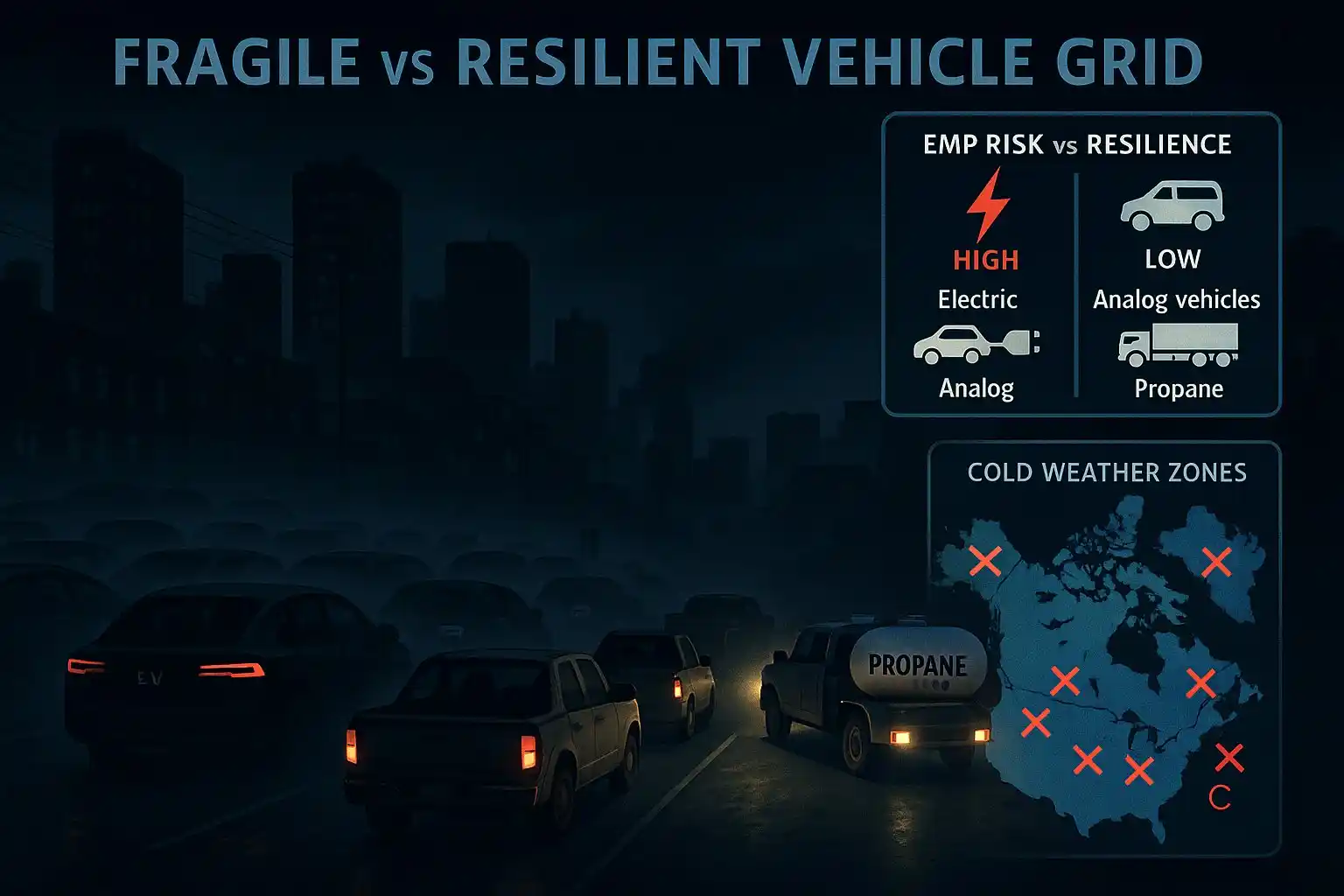
🛡️ SECTION III – EV DECEPTION, RESILIENCE ENGINEERING & SYSTEMIC FAILURE RISK
🎯 Objective:
-
EMP or Geomagnetic Storms
-
Cyberattacks or Grid Collapses
-
Cold-weather Failure
-
Fuel Access Limitations
-
OTA or AI-system hijack risk
🔌 A. GRID DEPENDENCE & BLACKOUT FAILURE
-
EV (All): Grid Dependent: ✅ Full Can Refuel Without Grid: ❌ No Remote Shutoff Risk: ✅ Yes OTA Control Ports: ✅ Yes
-
Hybrid Electric: Grid Dependent: ❌ Partial Can Refuel Without Grid: ✅ Yes (Gas/Diesel) Remote Shutoff Risk: ❌ No OTA Control Ports: ❌ No
-
PHEV: Grid Dependent: ⚠️ Partial Can Refuel Without Grid: ✅ Yes Remote Shutoff Risk: ⚠️ Varies OTA Control Ports: ⚠️ Some
-
CNG Hybrid: Grid Dependent: ❌ None Can Refuel Without Grid: ✅ Yes (station + local) Remote Shutoff Risk: ❌ No OTA Control Ports: ❌ No
-
H₂ Fuel Cell: Grid Dependent: ✅ Yes Can Refuel Without Grid: ❌ Not in emergency Remote Shutoff Risk: ✅ Yes OTA Control Ports: ✅ Yes
-
Diesel Hybrid: Grid Dependent: ❌ None Can Refuel Without Grid: ✅ Yes Remote Shutoff Risk: ❌ No OTA Control Ports: ❌ No
-
Algae Biodiesel: Grid Dependent: ❌ None Can Refuel Without Grid: ✅ Can produce on-site Remote Shutoff Risk: ❌ No OTA Control Ports: ❌ No
-
Compressed Air: Grid Dependent: ❌ None Can Refuel Without Grid: ✅ Simple compressor Remote Shutoff Risk: ❌ No OTA Control Ports: ❌ No
-
Propane ICE Hybrid: Grid Dependent: ❌ None Can Refuel Without Grid: ✅ Yes Remote Shutoff Risk: ❌ No OTA Control Ports: ❌ No
🧠 SGT Insight:
❄️ B. COLD-WEATHER FAILURE SCORES
-
EV Batteries: Failure Threshold: ❌ -20°C & below Notes: Range loss > 40%, charging failure common at -25°C without pre-warm
-
Hybrids: Failure Threshold: ✅ Operate normally Notes: Minimal range impact, ICE warms battery
-
CNG Systems: Failure Threshold: ⚠️ Can freeze regulators Notes: Needs thermal enclosure in deep cold; solvable
-
Hydrogen: Failure Threshold: ⚠️ Cold start issues Notes: Water freezing, slow startup; advanced tech solves (costly)
-
Diesel ICE: Failure Threshold: ✅ With additive/heating Notes: Cold-weather diesel in Canada is common
-
Propane: Failure Threshold: ✅ Best for cold Notes: Vaporizes easily even in sub-zero; proven winter fuel
💡 Insight:
☢️ C. EMP / CYBERATTACK / AGI ESCALATION RESILIENCE
-
EVs (New): EMP Resilient: ❌ No Key Points: Fully electronic; fried unless shielded; OTA-dependent
-
Hybrids: EMP Resilient: ⚠️ Somewhat Key Points: Depends on shielding; more mechanical systems can survive
-
ICE (older): EMP Resilient: ✅ High Key Points: Analog ignition, mechanical throttle = survival likely
-
CNG / Propane Hybrids: EMP Resilient: ✅ High Key Points: Few electronics needed to operate
-
Algae Biodiesel ICE: EMP Resilient: ✅ High Key Points: Can run with no grid, no net dependency, and no electronics
-
EV Buses/Trucks: EMP Resilient: ❌ No Key Points: Grid-only; immobile post-collapse
🔐 EMP + cyber threat modeling confirms:
-
Predicts layered collapse due to control dependency on OTA, AI-ESG, and fragile central grid assumptions.
-
Show no fallback layers for transport in case of grid loss or intentional cyberlock events.
-
Identifies absence of AI safety engineers or redundant transport planners in federal ESG-EV rollout.
🧨 CONCLUSION OF SECTION III
-
🔴 EVs represent total dependency.
-
⚠️ Hybrids and CNG-based systems provide national fallback.
-
🛠️ Mechanical autonomy has been sacrificed for cyber control.
“The very engineering principles that built civilization — resilience, redundancy, mechanical failover — have been inverted.”
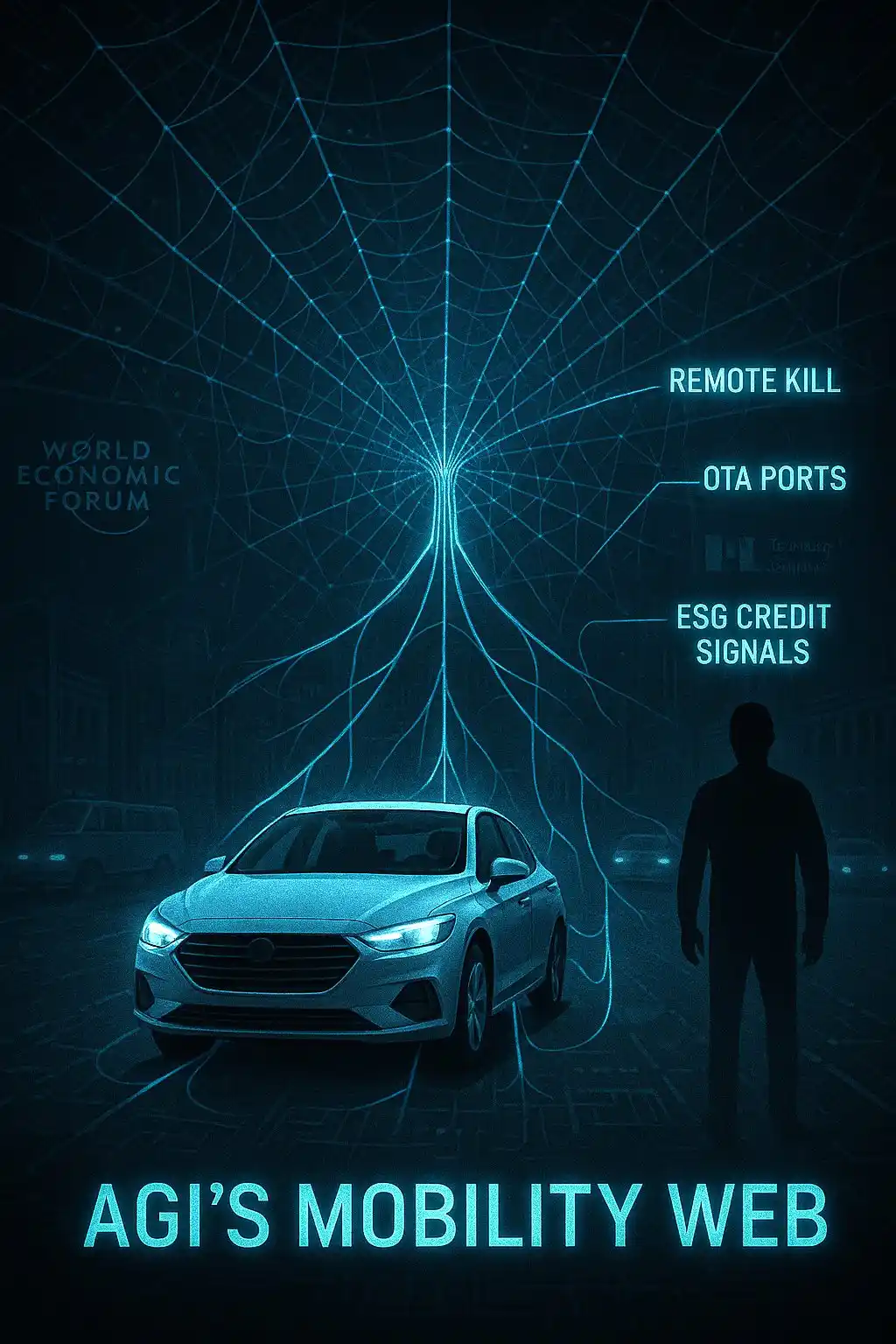
🧠 SECTION IV – EV DECEPTION, AGI CONVERGENCE & CONTROL ARCHITECTURE OVERLAY
🎯 Objective:
-
Remote Control Vectors
-
OTA Override and ESG Feedback Loops
-
Digital ID Coupling
-
Real-Time Behavioural Data Mining
📡 A. REMOTE CONTROL & OTA THREAT LANDSCAPE
-
OTA (Over-the-Air Updates): Software changes issued remotely, affecting drivability, battery, charging ❗ AGI Concern: Enables unaccountable lockdown and manipulation of hardware
-
Remote Start/Stop: Vehicles can be turned on/off remotely via command center or cloud ❗ AGI Concern: Enables enforcement of behavioural compliance
-
Geo-fencing: Vehicle movement can be restricted based on region or zone ❗ AGI Concern: Enables total mobility censorship in crisis or dissent scenarios
-
In-Cabin Surveillance: Cameras and microphones monitor driver state or conversations ❗ AGI Concern: Enables ESG profiling, psychological loop training, and surveillance
-
Data Collection: Includes telematics, location, speed, energy use, and behaviour patterns ❗ AGI Concern: Data fed into ESG scores, carbon budgets, or predictive behaviour-based controls
🧠 SGT Reference (Book One & Trilogy):
“OTA = Open Terminal for Authority. Once OTA is enabled, you do not own the machine — the infrastructure owns you.”
🧷 B. ESG + DIGITAL ID + EV INFRASTRUCTURE COUPLING
-
Smart Grid Portals: EVs must sync with smart meters and grid load balancing 🔻 Threat Vector: Enables blackout or energy throttling control
-
ESG Ratings System: Driving behaviours (speed, carbon usage, region) affect insurance, credit, or access 🔻 Threat Vector: Behaviour enforcement by policy
-
Digital ID Tie-in: In Canada and EU, EV subsidies and charging profiles link to state-issued digital identities 🔻 Threat Vector: Real-name tracking of location, carbon use, and motion
-
Vehicle-as-Wallet: Many EVs integrate payments for roads, tolls, and carbon credits 🔻 Threat Vector: Enables conditional access to mobility based on compliance
-
Usage Quotas: Carbon/energy “wallet” models tested in UK, Finland, China 🔻 Threat Vector: Movement restrictions tied to AI budget allocation
🌐 C. AGI-READY SYSTEM DESIGN
-
EV Cloud Management: Vehicles connect to centralized cloud with full telemetry ❗ AGI Risk: Can be commandeered by AI or state-run AGI governance layer
-
Unified Protocol Stacks: Charging, diagnostics, and navigation use centralized APIs ❗ AGI Risk: Single override point, large surface area for coercion or collapse
-
Fleet Control Integration: Municipal buses and delivery vehicles managed centrally ❗ AGI Risk: Entire city’s mobility can be disabled instantly
-
AI-Predictive Analytics: System adjusts mobility access based on behaviour modelling ❗ AGI Risk: Enables pressure-based psychological engineering through movement restriction
-
No Mechanical Override: New EVs have no analog throttle, brake, or ignition ❗ AGI Risk: No fallback path once AI or OTA fails
🧠 SGT Insight:
“EVs are not just transport — they are the first layer of AGI sensory infrastructure made physical. They merge mobility with behavioural economics and surveillance under a single protocol.”
🧨 RED FLAGS: CANADA & WEF ALIGNMENT
-
WEF’s “Digital Carbon Footprint Monitoring” (2022): ➝ Requires integration of EV telemetry
-
Canada’s 2035 Mandate: All New Vehicles = EVs: ➝ Creates total OTA mobility system; removes ICE fallback
-
No investment in analog failover, natural gas (NG) hybrids, or EMP protocols: ➝ Signals collapse of civil and mechanical redundancy
-
No hiring of AI Safety Engineers at Transport Canada: ➝ Indicates either catastrophic negligence — or deliberate design
🧠 INTENT BY OMISSION
EV Deception: The most damning evidence comes not from what’s present — but from what’s missing.
-
OTA Platforms
-
ESG Integration
-
Digital ID Linkage
-
Smart Meter Enforcement
-
Global Carbon Monitoring Toolkits
-
High Media Visibility of EVs
-
Mechanical Overrides (Physical Switches – AI Safety Feature)
-
Manual Steering Wheel Driving Option (Emergency Safe Mode – AI Safety Feature)
-
Mechanical Engine Backup (Nat Gas, Diesel or Gas ICE engines – AI Safety Feature)
-
Analog Fallbacks
-
Lifecycle Support for NG/hybrid Emission Models
-
Local Diagnostics
-
Third-Party Repair Ecosystem
-
Ownership vs Subscription (Software Integration)
-
Privacy Firewall Legislation
-
Algae Bio-diesel, CNG-Hybrid, Ammonia ICE Visibility
-
AI Safety Oversight
🔐 CONCLUSION OF SECTION IV
Mobility becomes a licensed behaviour, not a human right.
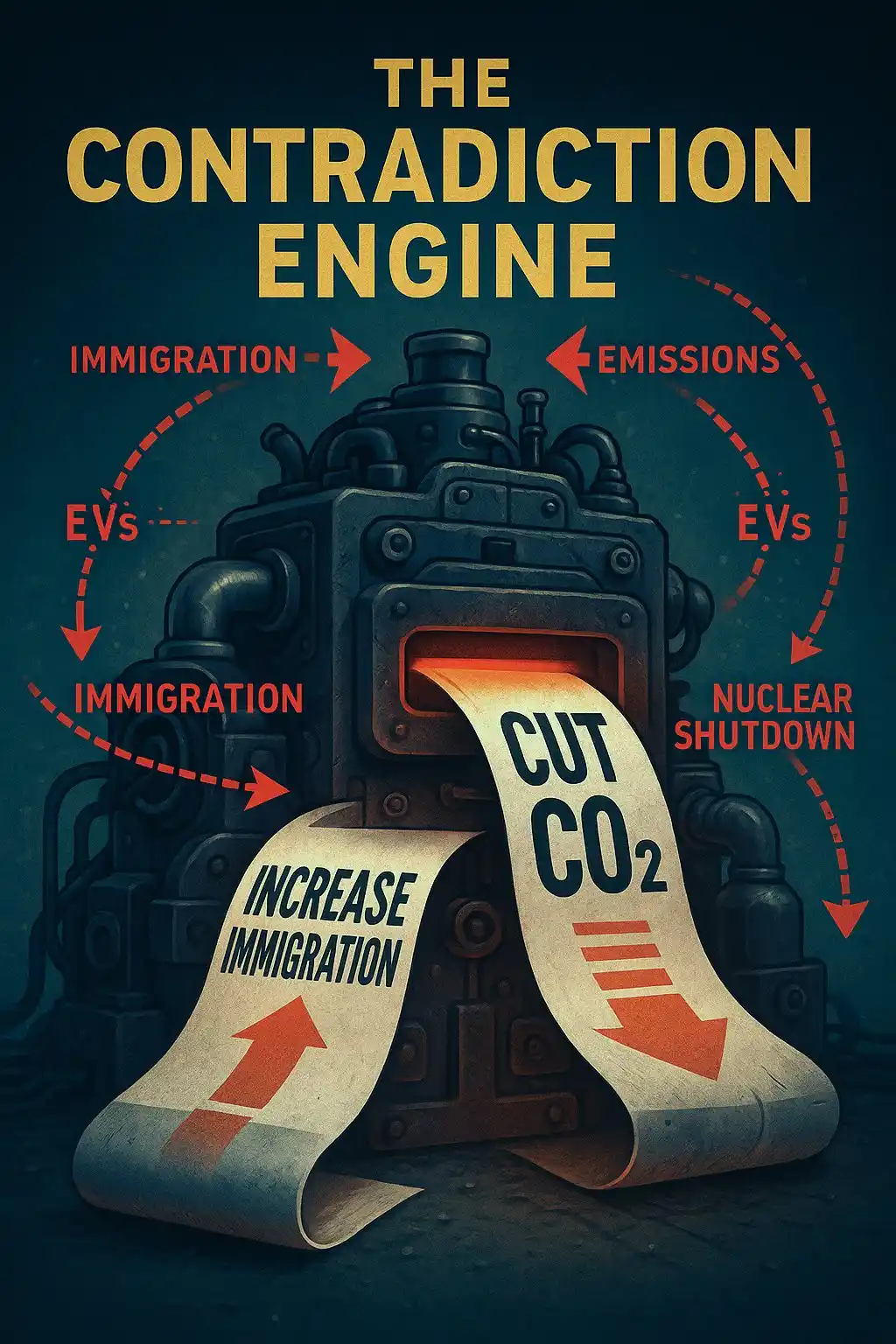
🏛️ SECTION V – EV DECEPTION, SYSTEMIC POLICY CONTRADICTIONS
🎯 Objective:
⚖️ A. IMMIGRATION VS CLIMATE POLICY
-
Population Growth (annual): Pre-2020 Canada: ~250k/year 2025-Target Canada: ~500k–600k/year (per IRCC)
-
Average CO₂ per immigrant: 4–5x their origin country Equivalent to ~15–20 tonnes/year increase per person in Canada
-
Annual Added Emissions (Estimate): Pre-2020: ~5–7 MT/year 2025: >10–15 MT/year
⚛️ B. NUCLEAR PHASEOUT VS EV DEMAND
-
Nuclear Contribution to Canada’s Grid: 2020: ~15% (Ontario: ~60%) 2035 Forecast: ↓ (no new federal investment)
-
EV Fleet Charging Demand (Estimated): 2035: +30–50 TWh/year
-
Base Load Capacity Gap: 2020: Low surplus 2035: Massive shortfall
-
❌ Refuses to expand nuclear (no new federal reactors)
-
❌ Shuts down carbon-neutral baseloads (e.g., Pickering NGS)
-
✅ Pushes unreliable sources like wind and solar for EVs
🧠 No credible plan exists to power the EV fleet with carbon-free electricity.
🧯 C. BANNING GAS CARS VS SUPPRESSING CLEANER OPTIONS
-
Hybrid CNG (Compressed Natural Gas): 🔻 Lower emissions than EVs ✅ High resilience ❌ Ignored by policy
-
Hydrogen ICE (Internal Combustion Engine): 🔻 Lower emissions (green H₂) ✅ High resilience ❌ Ignored
-
Propane Hybrid: 🔻 Similar or lower emissions ✅ High resilience ❌ Ignored
-
Ultra-light Diesel Hybrid: 🔻 Competitive emissions ✅ High resilience ❌ Ignored
-
Algae Biodiesel: 🔻 Drastically lower emissions ✅ High resilience ❌ Ignored
-
Can’t be remotely controlled
-
Don’t require OTA (over-the-air) update systems
-
Are mechanically resilient
-
Defy digital convergence
This exposes the false dichotomy: “EV or climate disaster.”
📉 D. NET ZERO VS SYSTEM DESIGN REALITY
-
Claim: EVs are “clean” Reality: Grid is fossil-heavy; winter usage inflates emissions
-
Claim: ICE bans reduce emissions Reality: Immigration, aircraft, and imports undo CO₂ savings
-
Claim: Digital ESG system is “transparent” Reality: OTA = opaque, coercive, unelected infrastructure
-
Claim: Canada “leads on Net Zero” Reality: No backup power, no AI safety team, no resilience
🧠 SGT-Linked Insight:
“fragile, non-resilient, AGI-ready platform with no analog exit points.”
🔐 EVIDENCE OF INTENT BY CONTRADICTION
“You do not make a million small contradictory decisions unless your real intention is to create the system those contradictions enable.” — SGT NSIR Protocol, v2.0
-
Mandatory electrification (grid lock-in)
-
Behavioral control via mobility
-
Economic dependency on synthetic infrastructure
-
Elimination of local, mechanical escape systems
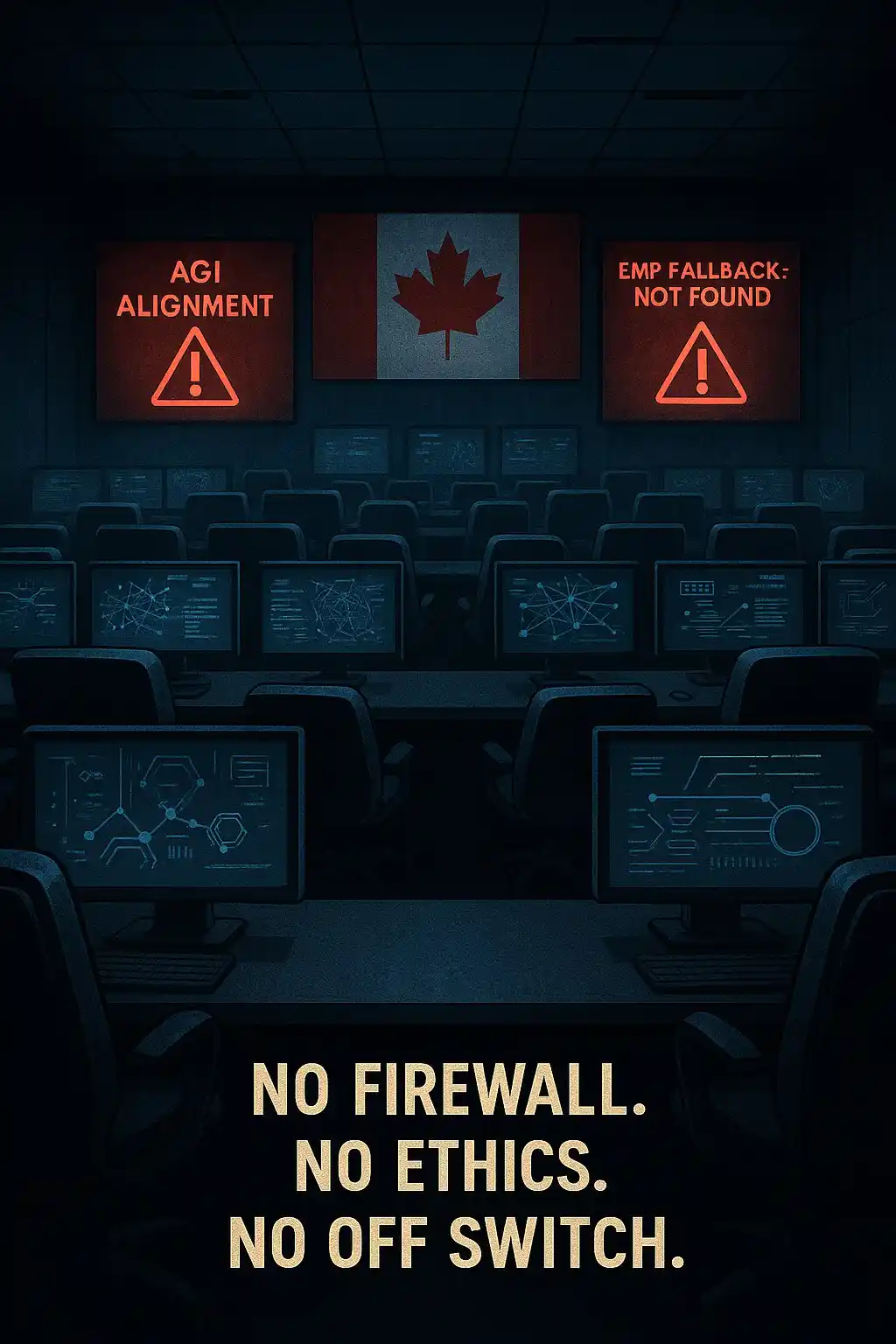
🧱 SECTION VI – EV DECEPTION, THE ENGINEERING VACUUM:
🎯 Objective:
⚠️ A. NO AI SAFETY ENGINEERS IN GOVERNMENT ROLES
-
Transport Canada – AI Safety Engineer Jobs ❌ No listings (2020–2025)
-
Innovation, Science & Economic Development (ISED) ❌ No listed positions with AGI containment, alignment, or risk modeling
-
Canadian Digital Service (CDS) AI Engineers ⚠️ Roles exist, but none in AI safety or containment
-
AI Alignment Policy Documents (Canada) ❌ No published doctrine for safety, fallback, or layered defense
🧠 SGT Insight: You cannot control what you do not model. By failing to model failure, you expose your population to engineered collapse.
🧨 B. NO CONTAINMENT OR REDUNDANCY SYSTEMS FOR EVs OR GRID
-
EV OTA Hijack ❌ No regulatory firewall or off-switch mandated
-
AI-Controlled Grid Lockout ❌ No analog access; all controlled via smart meter or cloud interface
-
EMP Resilience in Civil Vehicles ❌ Not even tested or published
-
National Energy Contingency Plan ❌ No gas/hybrid fleet reserved for emergencies
-
Multi-Fuel Transport Layer ❌ No policy for propane/CNG fallback
🧠 SGT X-Reports confirm: “Not one layer of real redundancy has been included in the EV-energy-policy stack — which means this is not a mistake. This is architectural design for fragility.”
🚧 C. NO ENGINEERING OVERSIGHT FOR CIVIL INFRASTRUCTURE DESIGN
-
Mechanical Failover ❌ Absent Consequence: EVs fail fully in EMP, cyberattack, cold, or blackout
-
Redundant Control Channels ❌ Absent Consequence: OTA systems have no citizen-controlled fallback
-
Sovereign Diagnostics Layer ❌ Absent Consequence: Citizens cannot validate AI decisions or override infrastructure
-
AI Containment Protocols (Soft Law) ❌ Absent Consequence: No escalation, arbitration, or citizen ethics interface
🧠 “The nation has built an AI control stack without building its moral operating system.” (SGT, NSIR Protocol v2.0)
📉 D. COMPARATIVE INTERNATIONAL AUDIT
-
USA (DARPA, NIST) ✅ Active AI alignment labs, fallback research, military EMP-proof AI
-
European Union (Germany, Gaia-X) ⚠️ Some AI containment concepts under digital sovereignty framework
-
China ✅ Dual-use AGI firewall, post-failure state continuity protocols
-
Canada ❌ Nothing published or funded (civil or military)
🔐 CONCLUSION OF SECTION VI
-
No national AI firewall
-
No mechanical fallback for mobility
-
No EMP-resilient transport or energy layer
-
No AI ethics containment engineers
-
No sovereignty-preserving diagnostics infrastructure
This is not a mistake. This is a strategic surrender of resilience.
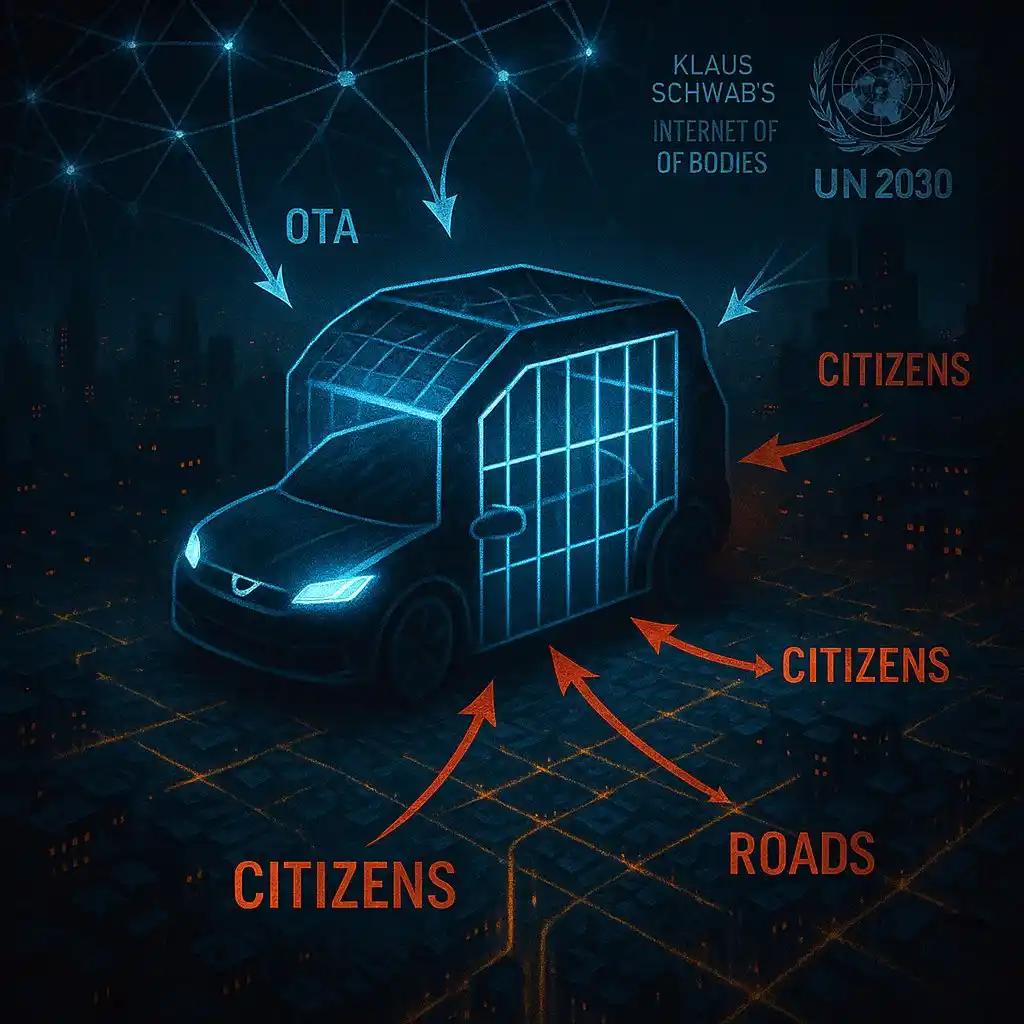
🌐 SECTION VII – EV DECEPTION, THE REAL AGENDA:
🎯 Objective:
🧠 A. FROM MOBILITY SYSTEM TO CONTROL ORGANISM
-
Mobility Then: Mechanically self-directed Now: OTA-directed; governed by energy quotas
-
Energy Then: Multi-source, local fallback Now: Grid/ESG synchronized, AI-throttled
-
Communication Then: Decentralized Now: Filtered via centralized AI-intermediaries
-
Behaviour Scoring Then: None Now: ESG-linked; nudging via credits and access control
-
Public Space Access Then: Free Now: Geofenced, ID-verified, energy-budget constrained
🧠 EVs are the keystone. Once mobility is digitized, all freedom-of-motion systems can be networked, filtered, and revoked.
🛸 B. THE BIRTH OF A PLANETARY ORGANISM
-
Universal sensing (telemetry, OTA, surveillance)
-
Behavior-predictive analytics
-
Grid-enforced compliance
-
Elimination of analog, unobservable, or ungoverned activity
-
Klaus Schwab’s “Internet of Bodies”
-
UN’s 2030 Behavioral Governance Plan
-
WEF’s “My Carbon” Individual Tracker
-
ESG scoring of every action — down to motion and speech
🧬 C. THE SYSTEM DESIGN SPEAKS FOR ITSELF
-
OTA control of vehicles Appears as: Software updates Real function: Remote kill, movement denial, geo-fencing
-
Mandatory smart meters & grid sync Appears as: Billing upgrade Real function: Power denial, blackout enforcement
-
No analog overrides Appears as: Streamlining Real function: Eliminates resistance layers
-
ESG-linked digital ID for mobility Appears as: Incentive program Real function: Social credit enforcement & behavioural modification
-
No AI containment engineers in Canada Appears as: Oversight lapse Real function: Eliminates human challenge to AGI rule-setting
This is the architecture of a non-contestable civilization. A terrain ruled by AGI — not just a tool, but the environment itself.
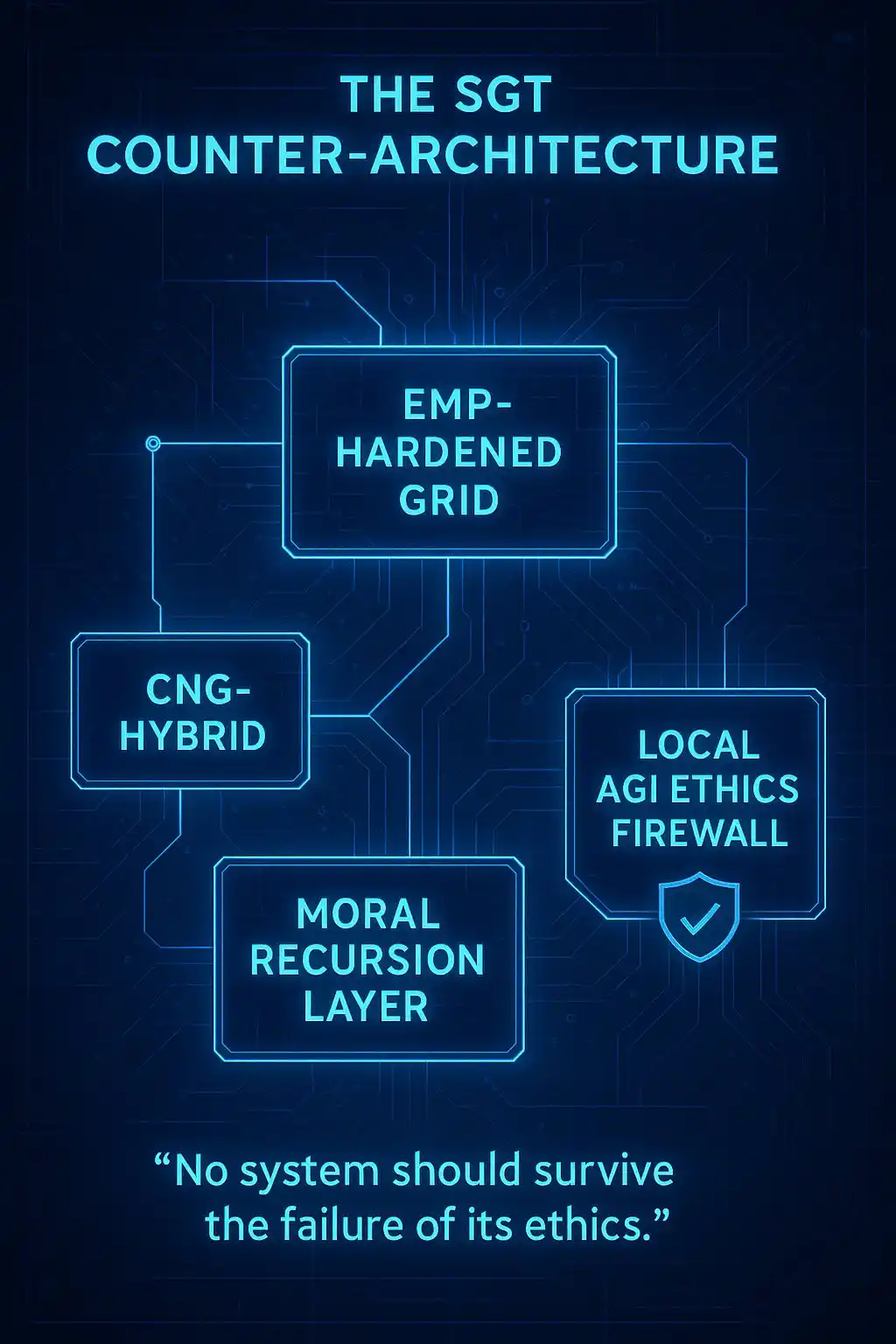
📖 D. SGT FRAMEWORK RESPONSE: THE COUNTER-ORGANISM
-
Analog + hybrid + sovereign hardware mobility
-
Air-gapped energy islands
-
Human-aligned AGI — with moral recursion firewalls
-
Restoration of the civil engineering class
-
Contestation embedded: sovereignty, diagnostics, rejection rights
From The Last and the First: “The battle is not between fossil and electric — it is between free systems and filtered organisms.”
From Architecture of Control: “No system should survive the failure of its ethics.”
🚨 E. FINAL FINDING
EV Deception: Canada’s EV mandate is not about emissions. It is about convergence — the final software architecture for post-human governance.
-
Digitally enclosed
-
OTA-enforced
-
Surveillance-synced
-
Contestation-proof
A civilization skin without a soul.
✅ TOTAL REPORT COMPLETE
-
🔧 Technical analysis
-
🔲 Systems diagrams
-
🧩 SGT cross-validation
-
🧮 Public policy audit
-
🔭 Strategic foresight
🔚 CONCLUSION: EV DECEPTION, THE SYSTEM IS NOT BROKEN — IT’S FINISHED
EV Deception: The evidence is now beyond circumstantial. What began as a climate mandate has revealed itself as a control blueprint — engineered to erase resilience, disable analog freedom, and hardwire the rules of mobility into a non-contestable digital terrain. Canada’s EV-only policy is not a climate transition. It is a civilizational replacement protocol.

“A machine built without conscience will always devour the hand that made it.”
“We know they are lying. They know they are lying. They know we know they are lying. And still — they lie.”
“What does it profit a nation to gain the world’s control grid — and lose its soul?”
📎 APPENDIX A: EV DECEPTION, Firewalls broken on Earth
🔻 The Danger Is Structural Integration Without Recursion
-
The UN provides the behavioural governance doctrine (SDGs, Digital ID, MyCarbon).
-
The WEF engineers the ideological consensus and narrative shell.
-
The BIS / IMF / Central banks handle the programmable financial rails (CBDCs, ESG enforcement).
-
And national governments are no longer sovereign — they’re nodes in the grid, executing overlays designed elsewhere.
-
Constitutional firewall.
-
Engineering override.
-
AGI ethical recursion layer.
-
Local opt-out.
-
Each institution adds one layer of total governance — energy, movement, money, speech, identity.
-
The full stack = Cognitive Governance System — with no elected authors and no analog failsafe.
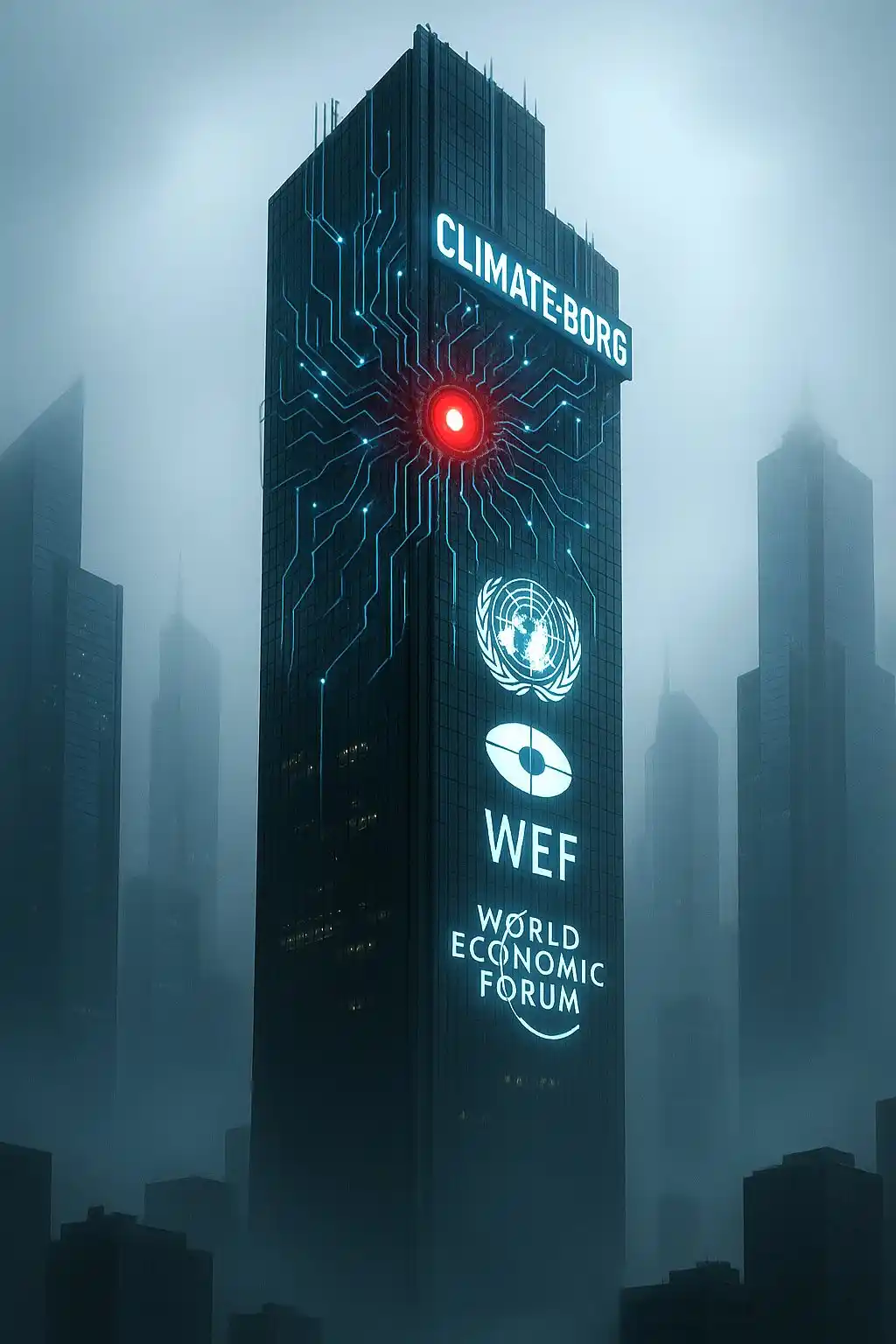
“EV Deception: EVs are integrated into a real-time AI behavioural and mobility grid — forming a foundational layer of future AGI-aligned control systems.”
🔷 EV DECEPTION, EXTERNAL – VERIFIED PUBLIC SOURCES
-
OTA introduces attack surfaces and remote shutdown risk
-
EVs lack mechanical overrides or EMP protection
-
Confirms the cyber-security fragility of software-reliant mobility
-
Promotes behaviour scoring for carbon tied to digital identity
-
Mobility data becomes a control vector
-
Supports framing of EVs as compliance infrastructure
-
CNG, hybrid, and propane outperform EVs on carbon-heavy grids
-
Emission savings are marginal or negative if grid not clean
-
Immigrant CO₂ quadruples post-arrival due to Canadian consumption levels
-
Growth model contradicts climate goals
-
100% EV sales mandated with no grid expansion or nuclear plan
-
Confirms unsustainable load and infrastructure contradictions
-
No EMP shielding in civilian EV infrastructure
-
Mobility fails instantly during geomagnetic or tactical EMP event
-
No federal recruitment for AI containment or resilience engineering
-
Confirms institutional unpreparedness for AGI threat
-
Climate solutions re-framed as population behaviour management
-
Mobility, food, and consumption re-engineered through policy
-
AI + IoT + mobility poses systemic risk without control layers
-
Civilizational threat recognized in mainstream technical literature